7th Intl. Symp. on Agglomeration
Tuesday 29, May 2001

 Binderless granulation –
 Binderless granulation –
Its potential and relevant
   fundamental issues
    fundamental issues


               Masayuki Horio
             Tokyo University of A&T
                 Koganei, Tokyo
Koganei ?
25 min from
Shinjuku
Nice place to escape
①Fluidizing
Bag filter                 interval
                                              15s
                                            1s
                          ②Compaction
                           interval
                                        0           time[s]   7200


  0.41m

               f0.108m


                 Air          ①Fluidizing      ②Compaction
                               interval         interval

   (a) Test apparatus            (b)Operation scheme


         Pressure Swing Granulation
         Nishii et al., U.S. Patent No. 5124100 (1992)
         Nishii, Itoh, Kawakami,Horio, Powd. Tech., 74, 1 (1993)
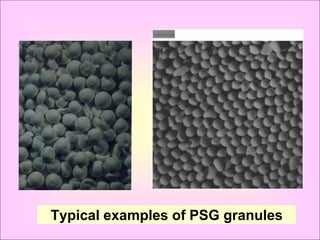
Typical examples of PSG granules
Cumulative weight [%]

                         PSG
                         granules                           slide
                         from ZnO                           gate
                         dp=0.57m


                         after
                         1st fall
                         2nd fall
                         3rd fall


                                    Particle size [10-6m]


PSG granules: weak but strong enough!
Change in PSD of PSG granules in realistic conditions
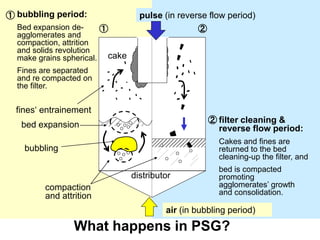
① bubbling period:                pulse (in reverse flow period)
  Bed expansion de-     ①                        ②
  agglomerates and
  compaction, attrition
  and solids revolution
  make grains spherical. cake
  Fines are separated
  and re compacted on
  the filter.


  fines‘ entrainement
                                                     ② filter cleaning &
   bed expansion                                       reverse flow period:
                                                       Cakes and fines are
    bubbling                                           returned to the bed
                                                       cleaning-up the filter, and
                                                       bed is compacted
                                distributor            promoting
         compaction                                    agglomerates’ growth
         and attrition                                 and consolidation.

                                         air (in bubbling period)
                 What happens in PSG?
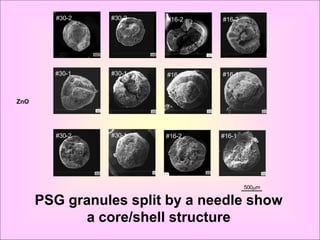
#30-2   #30-2   #16-2   #16-2


        #30-1    #30-1   #16-1   #16-1


ZnO


        #30-2    #30-1   #16-2   #16-1


                                         500m

      PSG granules split by a needle show
            a core/shell structure
Fig.5
1000

  Median diameter [m10-6]

                              500


                                                    E

                              150
                                 0.1                          0.5       1.0
                                       Superficial gas velocity [m/s]


Effect of fluidizing gas velocity on da
1.2
 Bulk density of granules [kg/m3]
                                             w=0.4kg
                                    1.0        0.2kg

                                                             with
                                                          gas velocity
                                    0.8                       and
                                                         solids charge


                                    0.6
            0           2.0            4.0          6.0
       Maximum pressure difference for compaction [Pa104]


Factors affecting PSG granule density
Possibility of size control by surface
                modification


Polar-polar interaction
between adsorbate molecules
500
Median diameter [10-6m] Median diameter [10-                                                                   600


                                                                                       Median diameter [10-
                                                     adsorption at: 293K,                                                                293K,
                                                     p(adsorbate): 4kPa                                                                  4kPa

                  400                                                                                            500

                                                       No effect: desorbed
                                                       during PSG
                         6m]


                                                                                       6m]
                          300                                                                                    400
                                                 0      3        6          9   12                                     0   3         6           9        12     Notes: At 573K all
                                                         Absorption time [h]                                                   Absorption time [h]               hydroxyl groups


                                                                                      Median diameter [10-6m]
                          500                                                                                                                                    on TiO2 are
                                                                                                                 500                                             eliminated
                                                                     573K,                                                           573K,                       (Morimoto, et al.,
                                                                     13.3kPa                                                         13.3kPa                     Bull. Chem. Soc.
                     400                                                                                                                                         JPN, 21, 41(1988).
                                                                                                                 400                                             Highest heat of
                                                                                                                                                                 immersion at 573K
                             300                                                                                                                                 (Wade &
                                                                                                                                    No effect ??                 Hackerman, Adv.
                                                                                                                                                                 Chem. Ser., 43, 222,
                             200                                                                                 300                                             (1964))
                                                 0      3        6          9   12                                     0   3         6           9        12
                                                        Absorption time                                                    Absorption time [h]
                                                        [h]                                                                                                    heat treatment:at p<13.3Pa
                                                        (a) C2H5OH                                                         (b) NH4OH                                523K, for 6 hrs
                                                                                                                                                               adsorption:
                                                                                                                                                                    bed= f150x10mm

                            Mean size of PSG granules from TiO2 (0.27x10 m)                                                                          -6             in a 0.03m3 vacuum
                                                                                                                                                                       dryer

                            after heat treatment and surface modification                                                                                      PSG: charge=0.0333 kg
                                                                                                                                                                    u0=0.55 m/s RH: 40-
                                                                                                                                                               50%
                                                                         Nishii & Horio (Fluidization VIII, 1996)                                                   fluidiz.:15 s comp.: 1 s
                                                                                                                                                                    total cycles=450
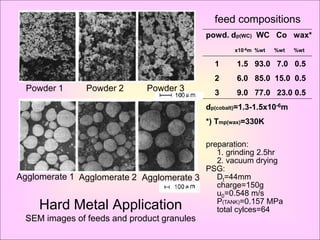
feed compositions
                                             powd. dp(WC) WC Co wax*
                                                     x10-6m %wt   %wt   %wt

                                               1      1.5 93.0 7.0 0.5
                                               2      6.0 85.0 15.0 0.5
  Powder 1      Powder 2      Powder 3         3      9.0 77.0 23.0 0.5
                                             dp(cobalt)=1.3-1.5x10⁻⁶m
                                             *) Tmp(wax)=330K

                                          preparation:
                                             1. grinding 2.5hr
                                             2. vacuum drying
                                          PSG:
Agglomerate 1 Agglomerate 2 Agglomerate 3    Dt=44mm
                                             charge=150g
                                             u0=0.548 m/s
                                             P(TANK)=0.157 MPa
     Hard Metal Application                  total cylces=64
  SEM images of feeds and product granules
Transverse rupture strength [N/mm2]
                                                                           PSG
                                                                           method


                                                            convent-
                                                            ional
                                                            method


                                                                Co content [wt%]


      Application to hard metal industry
Improved strength of sintered bodies
500m            500m            500m            500m         500m

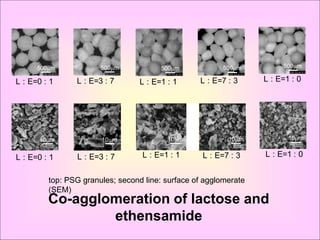
L : E=0 : 1     L : E=3 : 7       L : E=1 : 1     L : E=7 : 3     L : E=1 : 0


      10m             10m               10m            10m           10m


L : E=0 : 1     L : E=3 : 7       L : E=1 : 1      L : E=7 : 3    L : E=1 : 0


         top: PSG granules; second line: surface of agglomerate
         (SEM)
         Co-agglomeration of lactose and
                 ethensamide
1,000                                                                             0.1

            500
                          Chaouki et al.
            300
                    Iwadate-Horio                                                       0.05
  da [m]                                                                                                                  Bubble size


                                                                              Da [m]
            200                                                                         0.03
                                                 (IHM)
            100                                                                         0.02
              50                                                                                                           bubbling
                        Morooka et al.                                                  0.01          fixed bed
              30                                                                                                           bed
              20                                                                                            u0=umf
                                                          u0=0.5m/s
                                                                                    2,000
                                                                                    0.005
              10                                                                               0.01    0.03   0.1    0.3      1     3
               0.01 0.03     0.1   0.3       1    3       10       30   100         1,000
                                   dp [m]                                              500
                                                                                                                             IHM
(a) Effect of primary particle size                                                     200


                                                                              da [m]
                                                                                        100
              5,000                                                                      50
                                                                                                         Chaouki et al.
              2,000                                                                                      Morooka et al.
                                                                                         20
              1,000       IHM
    da [m]


                                                                                         10
               500                                                                             0.01    0.03   0.1    0.3      1     3
               200                                                                                            u [m/s]
                                                                                                               0

               100
                   50              Chaouki et al.                                                       (c) Effect of u0
                   20              Morooka et al.
                                                          u0=0.5m/s
                   10
                    0.3     0.5          1            2        3        5
                                             Ha [J]
(b) Effect of Hamaker const.

            Comparison of model performances
1.4E-3

               1.2E-3
                                                                        Lactose
                1E-3                                                    ZnO
 da,calc [m]                                                            L:E=7:3
                8E-4                                                    L:E=1:1
                                                                        L:E=3:7
                6E-4

                4E-4

                2E-4

                0E+0
                   0E+0          4E-4        8E-4        1.2E-3
                          2E-4          6E-4        1E-3       1.4E-3
                                        da,obs[m]
Comparison of model predictions with observed data


                        Model (IHM) works !
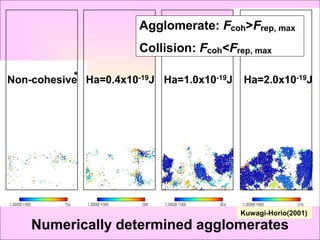
Agglomerate: Fcoh>Frep, max
                       Collision: Fcoh<Frep, max

           *
Non-cohesive Ha=0.4x10⁻¹⁹J Ha=1.0x10⁻¹⁹J   Ha=2.0x10⁻¹⁹J


                                           Kuwagi-Horio(2001)
    Numerically determined agglomerates
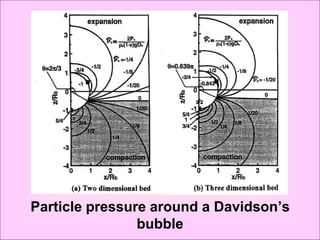
Particle pressure around a Davidson’s
                bubble
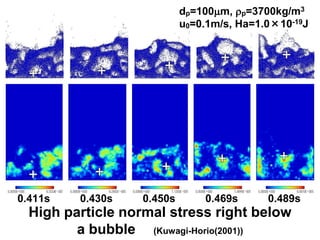
dp=100m, p=3700kg/m3
                           u0=0.1m/s, Ha=1.0×10⁻¹⁹J


0.411s   0.430s   0.450s       0.469s      0.489s
  High particle normal stress right below
         a bubble (Kuwagi-Horio(2001))
Comparison of previous model concepts
  Authors             Model               External force/energy                   Cohesion force/energy                            Comments

                                         FGa                                     Fpp
 Chaouki
                                                                                                             [              ]
                    FGa = Fpp                                                                                                   No bubble
                                                   FGa =  d a3
                                                                                                     hwd p
                                                                                                         hw
 et al.                                                                                      Fpp =
                                                                                                 2 1+ 8 2 3                     hydrodynamic
                                                    ag
                                                         6                                   16       
                                                                                                                                effects included.
                 Force balance                                                                        Hr
                                                                                 van der Waals force
                                        gravity force ≒drag force
                                                                                 between primary particles

                                                                                                                                No bubble
                                        v=u mf       Etotal =(Ekin+Elam )           Esplit
                                                                                                                                hydrodynamic
                Etotal=(Ekin+Elam )                                                            h w (1- a)d a2
 Morooka                                             Elaminer =3u mfd a2                   Esplit =
                                                                                                                                effects included.
                      =Esplit                         shear
                                                                                                 322                           If 3 umf <hw (1-a)
  et al.                                             Ekinetic =mu mf 2/2          Etotal          ad p                         /(32d p  a),
                Energy balance                                                     energy required to                           negative d a is
                                      laminar shear + kinetic force
                                                                                   break an agglomerate                         obtained.

                                      expansion                               Fcoh,rup
                 Fexp = Fcoh,rup                    exp = - Ps                                                                 Bed expansion
                                                                                                                                force caused by
                                                            Db ag(-Ps)d a2                                 Had a(1- a)
                                       bubble       Fexp =                                   Fcoh,rup =                         bubbles is
Iwadate-Horio                                                     2n k                                           242           equated with
                 Force balance                                                                                                  cohesive rupture
                                                                                                                                force.
                                           bed expansion force                     cohesive rupture force
(a) example force balance and                                                                              (b) Limiting size of agglomerates
               two solutions
                                                                                                                                 The critical condition
                                                stable point                unstable point
           1E-4

                                                                                                           1E-4


           1E-5
                                         ^
                                Dbag(-Ps)d a2                                      B                     1E-5


                          Fexp=     2nk
           1E-6
                                                                     A easy to                             1E-6
                                                                                                                                                                  C
log F[N]


                                                                                                log F[N]
           1E-7
                                                                       defluidize                          1E-7


                                                             fluidized
           1E-8                                                                                            1E-8
                                                                                                                                                          saddle point

                                              Hada(1- a)
                                 Fcoh,rup=
           1E-9                                                                                            1E-9


                                                24 2
                                                                                                           1E-10
           1E-10


                                                                                                                   1E-6   3E-6   1E-5   3E-5       1E-4    3E-4       1E-3   3E-3
                   1E-6   3E-6         1E-5      3E-5       1E-4     3E-4     1E-3       3E-3


                                                        log d a[m]                                                                             log da[m]


                                                          Force balance of I-H model
                                                           and the critical solution

010529 binderless granulation, its potential and relevant fundamental issues 7th Intl Symp on agglomeration

  • 1.
    7th Intl. Symp.on Agglomeration Tuesday 29, May 2001 Binderless granulation – Binderless granulation – Its potential and relevant Its potential and relevant fundamental issues fundamental issues Masayuki Horio Tokyo University of A&T Koganei, Tokyo
  • 2.
    Koganei ? 25 minfrom Shinjuku Nice place to escape
  • 3.
    ①Fluidizing Bag filter interval 15s 1s ②Compaction interval 0 time[s] 7200 0.41m f0.108m Air ①Fluidizing ②Compaction interval interval (a) Test apparatus (b)Operation scheme Pressure Swing Granulation Nishii et al., U.S. Patent No. 5124100 (1992) Nishii, Itoh, Kawakami,Horio, Powd. Tech., 74, 1 (1993)
  • 4.
    Typical examples ofPSG granules
  • 5.
    Cumulative weight [%] PSG granules slide from ZnO gate dp=0.57m after 1st fall 2nd fall 3rd fall Particle size [10-6m] PSG granules: weak but strong enough! Change in PSD of PSG granules in realistic conditions
  • 7.
    ① bubbling period: pulse (in reverse flow period) Bed expansion de- ① ② agglomerates and compaction, attrition and solids revolution make grains spherical. cake Fines are separated and re compacted on the filter. fines‘ entrainement ② filter cleaning & bed expansion reverse flow period: Cakes and fines are bubbling returned to the bed cleaning-up the filter, and bed is compacted distributor promoting compaction agglomerates’ growth and attrition and consolidation. air (in bubbling period) What happens in PSG?
  • 8.
    #30-2 #30-2 #16-2 #16-2 #30-1 #30-1 #16-1 #16-1 ZnO #30-2 #30-1 #16-2 #16-1 500m PSG granules split by a needle show a core/shell structure
  • 9.
  • 10.
    1000 Mediandiameter [m10-6] 500 E 150 0.1 0.5 1.0 Superficial gas velocity [m/s] Effect of fluidizing gas velocity on da
  • 11.
    1.2 Bulk densityof granules [kg/m3] w=0.4kg 1.0 0.2kg with gas velocity 0.8 and solids charge 0.6 0 2.0 4.0 6.0 Maximum pressure difference for compaction [Pa104] Factors affecting PSG granule density
  • 12.
    Possibility of sizecontrol by surface modification Polar-polar interaction between adsorbate molecules
  • 13.
    500 Median diameter [10-6m]Median diameter [10- 600 Median diameter [10- adsorption at: 293K, 293K, p(adsorbate): 4kPa 4kPa 400 500 No effect: desorbed during PSG 6m] 6m] 300 400 0 3 6 9 12 0 3 6 9 12 Notes: At 573K all Absorption time [h] Absorption time [h] hydroxyl groups Median diameter [10-6m] 500 on TiO2 are 500 eliminated 573K, 573K, (Morimoto, et al., 13.3kPa 13.3kPa Bull. Chem. Soc. 400 JPN, 21, 41(1988). 400 Highest heat of immersion at 573K 300 (Wade & No effect ?? Hackerman, Adv. Chem. Ser., 43, 222, 200 300 (1964)) 0 3 6 9 12 0 3 6 9 12 Absorption time Absorption time [h] [h] heat treatment:at p<13.3Pa (a) C2H5OH (b) NH4OH 523K, for 6 hrs adsorption: bed= f150x10mm Mean size of PSG granules from TiO2 (0.27x10 m) -6 in a 0.03m3 vacuum dryer after heat treatment and surface modification PSG: charge=0.0333 kg u0=0.55 m/s RH: 40- 50% Nishii & Horio (Fluidization VIII, 1996) fluidiz.:15 s comp.: 1 s total cycles=450
  • 14.
    feed compositions powd. dp(WC) WC Co wax* x10-6m %wt %wt %wt 1 1.5 93.0 7.0 0.5 2 6.0 85.0 15.0 0.5 Powder 1 Powder 2 Powder 3 3 9.0 77.0 23.0 0.5 dp(cobalt)=1.3-1.5x10⁻⁶m *) Tmp(wax)=330K preparation: 1. grinding 2.5hr 2. vacuum drying PSG: Agglomerate 1 Agglomerate 2 Agglomerate 3 Dt=44mm charge=150g u0=0.548 m/s P(TANK)=0.157 MPa Hard Metal Application total cylces=64 SEM images of feeds and product granules
  • 15.
    Transverse rupture strength[N/mm2] PSG method convent- ional method Co content [wt%] Application to hard metal industry Improved strength of sintered bodies
  • 16.
    500m 500m 500m 500m 500m L : E=0 : 1 L : E=3 : 7 L : E=1 : 1 L : E=7 : 3 L : E=1 : 0 10m 10m 10m 10m 10m L : E=0 : 1 L : E=3 : 7 L : E=1 : 1 L : E=7 : 3 L : E=1 : 0 top: PSG granules; second line: surface of agglomerate (SEM) Co-agglomeration of lactose and ethensamide
  • 17.
    1,000 0.1 500 Chaouki et al. 300 Iwadate-Horio 0.05 da [m] Bubble size Da [m] 200 0.03 (IHM) 100 0.02 50 bubbling Morooka et al. 0.01 fixed bed 30 bed 20 u0=umf u0=0.5m/s 2,000 0.005 10 0.01 0.03 0.1 0.3 1 3 0.01 0.03 0.1 0.3 1 3 10 30 100 1,000 dp [m] 500 IHM (a) Effect of primary particle size 200 da [m] 100 5,000 50 Chaouki et al. 2,000 Morooka et al. 20 1,000 IHM da [m] 10 500 0.01 0.03 0.1 0.3 1 3 200 u [m/s] 0 100 50 Chaouki et al. (c) Effect of u0 20 Morooka et al. u0=0.5m/s 10 0.3 0.5 1 2 3 5 Ha [J] (b) Effect of Hamaker const. Comparison of model performances
  • 18.
    1.4E-3 1.2E-3 Lactose 1E-3 ZnO da,calc [m] L:E=7:3 8E-4 L:E=1:1 L:E=3:7 6E-4 4E-4 2E-4 0E+0 0E+0 4E-4 8E-4 1.2E-3 2E-4 6E-4 1E-3 1.4E-3 da,obs[m] Comparison of model predictions with observed data Model (IHM) works !
  • 19.
    Agglomerate: Fcoh>Frep, max Collision: Fcoh<Frep, max * Non-cohesive Ha=0.4x10⁻¹⁹J Ha=1.0x10⁻¹⁹J Ha=2.0x10⁻¹⁹J Kuwagi-Horio(2001) Numerically determined agglomerates
  • 20.
    Particle pressure arounda Davidson’s bubble
  • 21.
    dp=100m, p=3700kg/m3 u0=0.1m/s, Ha=1.0×10⁻¹⁹J 0.411s 0.430s 0.450s 0.469s 0.489s High particle normal stress right below a bubble (Kuwagi-Horio(2001))
  • 22.
    Comparison of previousmodel concepts Authors Model External force/energy Cohesion force/energy Comments FGa Fpp Chaouki [ ] FGa = Fpp No bubble FGa =  d a3 hwd p hw et al. Fpp = 2 1+ 8 2 3 hydrodynamic  ag 6 16  effects included. Force balance Hr van der Waals force gravity force ≒drag force between primary particles No bubble v=u mf Etotal =(Ekin+Elam ) Esplit hydrodynamic Etotal=(Ekin+Elam ) h w (1- a)d a2 Morooka Elaminer =3u mfd a2 Esplit = effects included. =Esplit shear 322 If 3 umf <hw (1-a) et al. Ekinetic =mu mf 2/2 Etotal  ad p /(32d p  a), Energy balance energy required to negative d a is laminar shear + kinetic force break an agglomerate obtained. expansion Fcoh,rup Fexp = Fcoh,rup exp = - Ps Bed expansion force caused by  Db ag(-Ps)d a2 Had a(1- a) bubble Fexp = Fcoh,rup = bubbles is Iwadate-Horio 2n k 242 equated with Force balance cohesive rupture force. bed expansion force cohesive rupture force
  • 23.
    (a) example forcebalance and (b) Limiting size of agglomerates two solutions The critical condition stable point unstable point 1E-4 1E-4 1E-5 ^ Dbag(-Ps)d a2 B 1E-5 Fexp= 2nk 1E-6 A easy to 1E-6 C log F[N] log F[N] 1E-7 defluidize 1E-7 fluidized 1E-8 1E-8 saddle point Hada(1- a) Fcoh,rup= 1E-9 1E-9 24 2 1E-10 1E-10 1E-6 3E-6 1E-5 3E-5 1E-4 3E-4 1E-3 3E-3 1E-6 3E-6 1E-5 3E-5 1E-4 3E-4 1E-3 3E-3 log d a[m] log da[m] Force balance of I-H model and the critical solution