Gray garden slug or milky slug, Deroceras reticulatum, great gray 
garden slug, Limax maximus, and European slug, Arion ater 
Host/Site 
Slugs damage many kinds of plants. 
Corn, lettuce, beans, and many varieties 
of ornamentals are just a few of the hosts. 
Especially attractive are hostas, astilbe, 
and emerging lilies and other bulbs. Ripe 
strawberries are also very likely to be eaten 
by slugs. Slug damage is greatest in cool, 
moist weather or when young plants are 
small and tender. 
Identifi cation/appearance 
Slugs are very easy to identify, as is their 
damage. Slugs vary in length, depending 
on species and age, from 1/4 inch to as 
much as 10 inches. The most damaging 
slugs in western Washington are the 3- to 
4-inch AAArrriiiooonnn aaattteeerrr ((oorraannggee ttoo bbllaacckk iinn 
color) and the 1- to 1-1/2-inch Deroceras 
reticulatum (gray to brown). The native 
yellow “banana slug” is seldom a serious 
pest. Slugs are elongated, with a slightly en-larged 
fleshy mantle that looks like a saddle 
Slugs 
on the center of the body. Slugs glide on a “foot” that secretes the 
slime which helps them move. They also have obvious eye stalks on 
the head. When touched, slugs typically contract or roll up into a ball. 
Slug damage appears as large, ragged holes in foliage, with traces of 
telltale slime that looks silvery when dry. Tender, young plants can be 
completely destroyed overnight. 
Life Cycle 
Slugs are Molluscs, a large group of animals that also includes clams, 
oysters, squid, and octopus. Slugs are most closely related to snails; 
in fact, slugs are generally thought of as snails without shells. Snails 
cause similar damage but usually are not as serious a pest in the 
Pacific Northwest, though their populations seem to be growing in the 
last few years. 
Slugs can live from 1 to 2 years. They reach sexual maturity before 
becoming fully developed, and they can begin to lay eggs at three 
months, depending on moisture and food 
conditions. Eggs can be laid anytime 
during the year but less so during drier or 
colder weather. 
Each slug has both male and female 
reproductive organs, meaning that all 
mature slugs can lay eggs, up to 400 per 
year. Eggs are laid in small groups of 3 
or 4, or as many as 30 or 40 primarily in 
moist places such as under stones, in plant 
debris, or under boards. Eggs are round or 
oval, about 1/8 to 1/4 inch in diameter and 
colorless to milky white. If conditions are 
right, they hatch in a few weeks, but if the 
weather is hot and dry, hatching may be 
delayed until cooler, more moist conditions 
occur. Immature slugs are shaped just like 
adults but may not be the same color. They 
can begin to damage plants immediately 
upon hatching. 
Slugs feed during the night and on over-cast, 
cool, cloudy days. If the weather is hot 
and dry, slugs hide beneath stones, boxes, boards, and under dense 
plant cover such as ivy. Slugs avoid dry, dusty areas. 
Natural Enemies 
A number of predators will help control slugs. Some of the more com-mon 
ones include garter snakes, birds, and frogs. Ducks and geese are 
effective predators that can provide considerable control, especially 
domesticated birds that have access to the landscape. 
Monitoring 
Look for large, ragged holes in foliage, with silvery slime around the 
edges. To monitor slugs directly, go out at night with a flashlight. Ad-ditionally, 
look under large rocks, boards, or other nearby objects that 
may shield slugs during the day. Lettuce is a classic slug home, and 
many slugs can often be found among or under the leaves. 
(continued/over) 
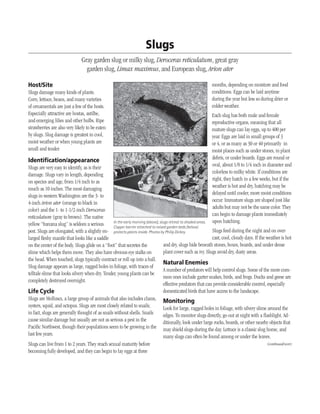
In the early morning (above), slugs retreat to shaded areas. 
Copper barrier attached to raised garden beds (below) 
protects plants inside. Photos by Philip Dickey.
Action Threshold 
Controls may be required if damage exceeds aesthetic standards or 
endangers survival of young plants. Anticipate spring population 
buildup with preventative controls described below before unaccept-able 
damage occurs. 
Cultural/Physical Controls 
Cultural/physical controls inculde plant selection, optimum timing 
of irrigation, elimination of habitat, manual removal, destruction of 
eggs, trapping, and exclusion by barriers. The same controls should 
generally work for both slugs and snails. No single strategy, but rather 
a combination of all techniques, will be most effective at reducing 
slug populations and minimizing damage. 
Where slugs are numerous, landscape design and plant selection 
are critical to minimizing damage. Slugs and snails feed selectively, 
damaging some plants extensively and others moderately or not at all. 
Careful monitoring of damage patterns in the landscape will suggest 
plants that could be replaced by others that are not receiving the same 
level of feeding. Plants susceptible to slug damage should be kept far 
away from slug habitat such as tall grass or weeds, evergreen ground-covers, 
garden debris or boards, or even heavy mulches that provide 
cool shade during the day. Reducing such habitat in areas where 
damage is greatest may be helpful. It may also help to place slug-prone 
plants in barrels or pots. These containers can be banded with 
copper (see below) if needed, but that may not prove necessary. 
Irrigation of landscapes in the morning rather than the evening may 
reduce slug damage considerably. Recent research showed slug feed-ing 
on lettuce to be reduced fivefold by this technique. 
Manual removal of slugs is effective but labor intensive. It is best done 
at night when slugs are actively feeding. Destruction of egg masses in 
the fall is recommended as a productive way to reduce populations 
during the damp winter and early spring months. 
A variety of slug traps are available commercially or can be made 
from various types of containers such as margarine tubs. Typically 
they are baited with beer, which serves as an attractant and also 
drowns the slugs. The traps will catch slugs, however they must be 
maintained by removing drowned slugs and refreshing the beer. 
Selective deployment of traps near areas of highest damage can be 
worthwhile. Traps should be covered to keep rain from diluting the 
beer. Keep openings elevated about 1/2” above soil surface to discour-age 
beneficial beetles from being killed. 
Another way of trapping is to place a board, inverted saucer, or plastic 
lid on the ground near damaged plants. Slugs will congregate under-neath 
and many can be removed all at once. 
Finally, exclusion via barriers is one of the most effective preventative 
measures. Although a number of barriers such as sawdust, crushed 
eggshells, ground oystershells, cinders, or diatomaceous earth may 
provide some control when dry, they tend to lose effectiveness when 
wet. Copper barriers are reportedly most effective. They should be 
installed vertically as a perimeter fence tall enough that the slugs 
cannot arch over it, preferably no less than 4 inches in height. It is 
important to remove all slugs (and eggs if possible) from inside the 
perimeter when the fence is installed. Salt impregnated plastic barriers 
are also available. A new, electrified copper slug barrier shows promise 
but has not yet undergone rigorous testing. 
Biological Controls 
Slugs have a number of natural enemies that can provide some 
predatory pressures but most are unlikely to be effective alone if dam-age 
is great. Protecting bird populations is probably the best way to 
maximize biological controls. Domestic ducks and geese can be very 
effective if practical to use. 
Chemical Controls 
Iron phosphate baits (Sluggo, Escar-go, Worry Free) are less toxic 
than traditional metaldehyde baits and do not require warning labels 
for domestic animals. These products are quite new on the market 
and their effectiveness has not been studied in western Washington, 
but early anecdotal reports are promising. These baits are broken 
down by rain and may require reapplication at least every two weeks. 
Most commercial slug baits are formulated with metaldehyde. The 
biggest hazard with these baits is their attractiveness to dogs, which 
may think they are being fed if they see bait being broadcast on the 
ground. Metaldehyde baits should only be used as a last resort and 
should be placed in tamper-proof bait stations whenever possible to 
reduce off-target toxicity. Bait stations that dogs can open may pose 
more risk than a broadcast application because they can contain a 
lethal dose all in one place. “Slug and bug” baits that include the 
insecticide carbaryl are considerably more toxic to insects and birds 
and should be avoided as a general rule.

Slugs Integrated Pest Management

  • 1.
    Gray garden slugor milky slug, Deroceras reticulatum, great gray garden slug, Limax maximus, and European slug, Arion ater Host/Site Slugs damage many kinds of plants. Corn, lettuce, beans, and many varieties of ornamentals are just a few of the hosts. Especially attractive are hostas, astilbe, and emerging lilies and other bulbs. Ripe strawberries are also very likely to be eaten by slugs. Slug damage is greatest in cool, moist weather or when young plants are small and tender. Identifi cation/appearance Slugs are very easy to identify, as is their damage. Slugs vary in length, depending on species and age, from 1/4 inch to as much as 10 inches. The most damaging slugs in western Washington are the 3- to 4-inch AAArrriiiooonnn aaattteeerrr ((oorraannggee ttoo bbllaacckk iinn color) and the 1- to 1-1/2-inch Deroceras reticulatum (gray to brown). The native yellow “banana slug” is seldom a serious pest. Slugs are elongated, with a slightly en-larged fleshy mantle that looks like a saddle Slugs on the center of the body. Slugs glide on a “foot” that secretes the slime which helps them move. They also have obvious eye stalks on the head. When touched, slugs typically contract or roll up into a ball. Slug damage appears as large, ragged holes in foliage, with traces of telltale slime that looks silvery when dry. Tender, young plants can be completely destroyed overnight. Life Cycle Slugs are Molluscs, a large group of animals that also includes clams, oysters, squid, and octopus. Slugs are most closely related to snails; in fact, slugs are generally thought of as snails without shells. Snails cause similar damage but usually are not as serious a pest in the Pacific Northwest, though their populations seem to be growing in the last few years. Slugs can live from 1 to 2 years. They reach sexual maturity before becoming fully developed, and they can begin to lay eggs at three months, depending on moisture and food conditions. Eggs can be laid anytime during the year but less so during drier or colder weather. Each slug has both male and female reproductive organs, meaning that all mature slugs can lay eggs, up to 400 per year. Eggs are laid in small groups of 3 or 4, or as many as 30 or 40 primarily in moist places such as under stones, in plant debris, or under boards. Eggs are round or oval, about 1/8 to 1/4 inch in diameter and colorless to milky white. If conditions are right, they hatch in a few weeks, but if the weather is hot and dry, hatching may be delayed until cooler, more moist conditions occur. Immature slugs are shaped just like adults but may not be the same color. They can begin to damage plants immediately upon hatching. Slugs feed during the night and on over-cast, cool, cloudy days. If the weather is hot and dry, slugs hide beneath stones, boxes, boards, and under dense plant cover such as ivy. Slugs avoid dry, dusty areas. Natural Enemies A number of predators will help control slugs. Some of the more com-mon ones include garter snakes, birds, and frogs. Ducks and geese are effective predators that can provide considerable control, especially domesticated birds that have access to the landscape. Monitoring Look for large, ragged holes in foliage, with silvery slime around the edges. To monitor slugs directly, go out at night with a flashlight. Ad-ditionally, look under large rocks, boards, or other nearby objects that may shield slugs during the day. Lettuce is a classic slug home, and many slugs can often be found among or under the leaves. (continued/over) In the early morning (above), slugs retreat to shaded areas. Copper barrier attached to raised garden beds (below) protects plants inside. Photos by Philip Dickey.
  • 2.
    Action Threshold Controlsmay be required if damage exceeds aesthetic standards or endangers survival of young plants. Anticipate spring population buildup with preventative controls described below before unaccept-able damage occurs. Cultural/Physical Controls Cultural/physical controls inculde plant selection, optimum timing of irrigation, elimination of habitat, manual removal, destruction of eggs, trapping, and exclusion by barriers. The same controls should generally work for both slugs and snails. No single strategy, but rather a combination of all techniques, will be most effective at reducing slug populations and minimizing damage. Where slugs are numerous, landscape design and plant selection are critical to minimizing damage. Slugs and snails feed selectively, damaging some plants extensively and others moderately or not at all. Careful monitoring of damage patterns in the landscape will suggest plants that could be replaced by others that are not receiving the same level of feeding. Plants susceptible to slug damage should be kept far away from slug habitat such as tall grass or weeds, evergreen ground-covers, garden debris or boards, or even heavy mulches that provide cool shade during the day. Reducing such habitat in areas where damage is greatest may be helpful. It may also help to place slug-prone plants in barrels or pots. These containers can be banded with copper (see below) if needed, but that may not prove necessary. Irrigation of landscapes in the morning rather than the evening may reduce slug damage considerably. Recent research showed slug feed-ing on lettuce to be reduced fivefold by this technique. Manual removal of slugs is effective but labor intensive. It is best done at night when slugs are actively feeding. Destruction of egg masses in the fall is recommended as a productive way to reduce populations during the damp winter and early spring months. A variety of slug traps are available commercially or can be made from various types of containers such as margarine tubs. Typically they are baited with beer, which serves as an attractant and also drowns the slugs. The traps will catch slugs, however they must be maintained by removing drowned slugs and refreshing the beer. Selective deployment of traps near areas of highest damage can be worthwhile. Traps should be covered to keep rain from diluting the beer. Keep openings elevated about 1/2” above soil surface to discour-age beneficial beetles from being killed. Another way of trapping is to place a board, inverted saucer, or plastic lid on the ground near damaged plants. Slugs will congregate under-neath and many can be removed all at once. Finally, exclusion via barriers is one of the most effective preventative measures. Although a number of barriers such as sawdust, crushed eggshells, ground oystershells, cinders, or diatomaceous earth may provide some control when dry, they tend to lose effectiveness when wet. Copper barriers are reportedly most effective. They should be installed vertically as a perimeter fence tall enough that the slugs cannot arch over it, preferably no less than 4 inches in height. It is important to remove all slugs (and eggs if possible) from inside the perimeter when the fence is installed. Salt impregnated plastic barriers are also available. A new, electrified copper slug barrier shows promise but has not yet undergone rigorous testing. Biological Controls Slugs have a number of natural enemies that can provide some predatory pressures but most are unlikely to be effective alone if dam-age is great. Protecting bird populations is probably the best way to maximize biological controls. Domestic ducks and geese can be very effective if practical to use. Chemical Controls Iron phosphate baits (Sluggo, Escar-go, Worry Free) are less toxic than traditional metaldehyde baits and do not require warning labels for domestic animals. These products are quite new on the market and their effectiveness has not been studied in western Washington, but early anecdotal reports are promising. These baits are broken down by rain and may require reapplication at least every two weeks. Most commercial slug baits are formulated with metaldehyde. The biggest hazard with these baits is their attractiveness to dogs, which may think they are being fed if they see bait being broadcast on the ground. Metaldehyde baits should only be used as a last resort and should be placed in tamper-proof bait stations whenever possible to reduce off-target toxicity. Bait stations that dogs can open may pose more risk than a broadcast application because they can contain a lethal dose all in one place. “Slug and bug” baits that include the insecticide carbaryl are considerably more toxic to insects and birds and should be avoided as a general rule.