AEN 301
PESTS OF FIELD CROPS AND THEIR MANAGEMENT (1+1)
Presented by,
JAYASANKARAN.P
B.Sc. Agriculture
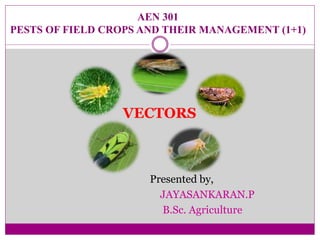
VECTORS
1.Green leaf Hopper
Tungro Disease
Green leaf Hopper
, Nephotettix virescens,
Cicadellidae, Hemiptera
Yellowing from Tip to
Downwards
Stunted with Reduced Tillering
Completely Withered Plant
Symptoms
Special detection technique
Collect leaf samples at 6 a.m.
The top 10 cm portion of the leaf is immersed in a
solution containing 2 g of iodine and 6 g of KI in 100
ml of water for 15 minutes.
Washed in water and when examined.
Tungro infected leaves develop dark blue streaks.
Management
Trap methods:
TNAU-Light Trap
Spray Fenthion Near Traps
Cultural methods
Resistant varieties:
IR 36, IR 50 ,ADT
37, Ponmani, Co 45, Co
48, IR 36 and white ponni
Apply Neem Cake to nursery
Ploughing to Incorporate Stubbles
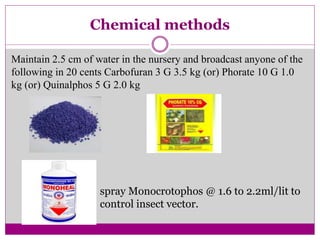
Chemical methods
Maintain 2.5 cm of water in the nursery and broadcast anyone of the
following in 20 cents Carbofuran 3 G 3.5 kg (or) Phorate 10 G 1.0
kg (or) Quinalphos 5 G 2.0 kg
spray Monocrotophos @ 1.6 to 2.2ml/lit to
control insect vector.
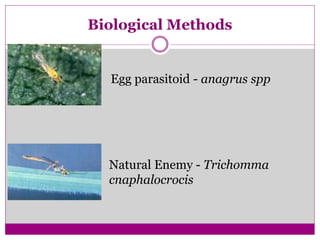
Biological Methods
Egg parasitoid - anagrus spp
Natural Enemy - Trichomma
cnaphalocrocis
2.Brown Plant hopper(BPH)
Ragged stunt virus
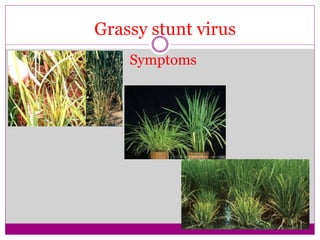
Grassy stunt virus
Symptoms
Grassy stunt virus
Ragged stunt virus
Symptoms
Presence of Brown plant hopper
nymphs and adults
Completely withered and desapped plant
Management Strategies
Avoid excess use of nitrogen
Use resistant variety IR 36
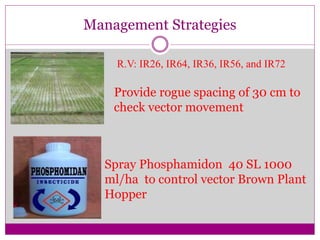
Management Strategies
Provide rogue spacing of 30 cm to
check vector movement
Spray Phosphamidon 40 SL 1000
ml/ha to control vector Brown Plant
Hopper
R.V: IR26, IR64, IR36, IR56, and IR72
Red gram Sterility mosaic virus
Aceria cajani Sterility mosaic virus
Symptom
• The affected plants are stunted due to shortening
of internodes.
• The auxiliary buds are stimulated to grow and the
branches are crowded at the top giving
bushy appearance.
• Mainly three types of symptoms are
associated viz. severe mosaic in leaflets with
complete sterility , mild mosaic with partial
sterility and ring spots characterized by a green
island surrounded by a chlorotic halo.
Symptom
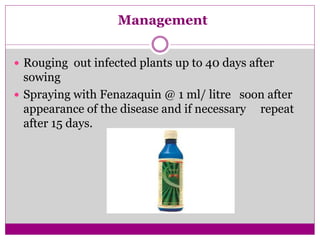
Management
 Rouging out infected plants up to 40 days after
sowing
 Spraying with Fenazaquin @ 1 ml/ litre soon after
appearance of the disease and if necessary repeat
after 15 days.
Groundnut Bud Necrosis
Thrips palmi Bud Necrosis
Symptoms
 First symptoms are visible 2-6 weeks after infection
as ring spots on leaves.
 The newly emerging leaves are small, rounded or
pinched inwards and varying patterns of mottling
and minute ring spots.
 Necrotic spots and irregularly shaped lesions develop
on leaves and petioles. Stem also
exhibits necrotic streaks.
Symptoms
Bud Necrosis
Management
 Adopt plant spacing of 15x15 cm.
 Remove and destory infected plants up to 6 weeks after
sowing.
 Application of Monocrotophos 500 ml/ha, 30 days after
sowing either alone or in combination with AVP (Anti Viral
Principle) extracted from sorghum or coconut leaves. Spray
the crop with 10 per cent AVP at 500 lit/ha, ten and twenty
days after sowing.
Cotton leaf curl virus
Bemisia tabaci leaf curl virus
Symptoms
• Upward and downward leaf curling
• Thick green veins and leaf like growth
emerging from these veins.
Management
 Dimethoate 30% EC 500ml/ha
 Methyl demeton 25%EC 500ml/ha
 Imidacloprid 17.8 SL 100-125 ml/ha
Blackgram Yellow Mosaic Virus
Yellow Mosaic Virus
Bemisia tabaci
Symptom
• The disease is more prevalent on black gram than green
gram
• Initially mild scattered yellow spots appear on young
leaves.
• The next trifoliate leaves emerging from the growing apex
show irregular yellow and green patches alternating with
each other.
• Spots gradually increase in size and ultimately some leaves
turn completely yellow.
• Infected leaves also show necrotic symptoms.
• Diseased plants are stunted, mature late and produce very
few flowers and pods.
• Pods of infected plants are reduced in size and turn yellow
in colour.
Management
 Growing resistant varieties such as VBN 4, VBN 6
and VBN 7
 Seed treatment with Dimethoate (or) Imidacloprid
@ 5 ml /kg
 Installation of yellow sticky traps 12 nos/ha
 Rogue out the infected plants up to 45 days
 Spray methyl demeton 25 EC 500 ml/ha or
dimethoate 30 EC 500 ml/ha or thiamethoxam 75
WS 1g /3 lit and repeat after 15 days, if necessary.
Sesamum phyllody
Sesamum phyllody
Leaf hopper –
Orosius albicintus
Symptom
 All floral parts are transformed into green leafy
structures followed by abundant vein clearing in
different flower parts.
 In severe infection, the entire inflorescences is
replaced by short twisted leaves closely arranged on
a stem with short internodes, abundant abnormal
branches bend down.
 Finally, plants look like witches broom.
 If capsules are formed on lower portion of plant they
do not yield quality seeds.
Management
 Remove and destroy infected plants.
 To control vector, spray Monocrotophos 36 or
Dimethoate 30 EC 500 ml/ha combined with
intercropping of Sesamum + Redgram (6 : 1)
THANK YOU!!!!

Insect vector for plant diseases

  • 1.
    AEN 301 PESTS OFFIELD CROPS AND THEIR MANAGEMENT (1+1) Presented by, JAYASANKARAN.P B.Sc. Agriculture VECTORS
  • 2.
    1.Green leaf Hopper TungroDisease Green leaf Hopper , Nephotettix virescens, Cicadellidae, Hemiptera
  • 3.
    Yellowing from Tipto Downwards Stunted with Reduced Tillering Completely Withered Plant Symptoms
  • 4.
    Special detection technique Collectleaf samples at 6 a.m. The top 10 cm portion of the leaf is immersed in a solution containing 2 g of iodine and 6 g of KI in 100 ml of water for 15 minutes. Washed in water and when examined. Tungro infected leaves develop dark blue streaks.
  • 5.
  • 6.
    Cultural methods Resistant varieties: IR36, IR 50 ,ADT 37, Ponmani, Co 45, Co 48, IR 36 and white ponni Apply Neem Cake to nursery Ploughing to Incorporate Stubbles
  • 7.
    Chemical methods Maintain 2.5cm of water in the nursery and broadcast anyone of the following in 20 cents Carbofuran 3 G 3.5 kg (or) Phorate 10 G 1.0 kg (or) Quinalphos 5 G 2.0 kg spray Monocrotophos @ 1.6 to 2.2ml/lit to control insect vector.
  • 8.
    Biological Methods Egg parasitoid- anagrus spp Natural Enemy - Trichomma cnaphalocrocis
  • 9.
    2.Brown Plant hopper(BPH) Raggedstunt virus Grassy stunt virus
  • 10.
  • 11.
  • 12.
    Presence of Brownplant hopper nymphs and adults Completely withered and desapped plant
  • 13.
    Management Strategies Avoid excessuse of nitrogen Use resistant variety IR 36
  • 14.
    Management Strategies Provide roguespacing of 30 cm to check vector movement Spray Phosphamidon 40 SL 1000 ml/ha to control vector Brown Plant Hopper R.V: IR26, IR64, IR36, IR56, and IR72
  • 15.
    Red gram Sterilitymosaic virus Aceria cajani Sterility mosaic virus
  • 16.
    Symptom • The affectedplants are stunted due to shortening of internodes. • The auxiliary buds are stimulated to grow and the branches are crowded at the top giving bushy appearance. • Mainly three types of symptoms are associated viz. severe mosaic in leaflets with complete sterility , mild mosaic with partial sterility and ring spots characterized by a green island surrounded by a chlorotic halo.
  • 17.
  • 18.
    Management  Rouging outinfected plants up to 40 days after sowing  Spraying with Fenazaquin @ 1 ml/ litre soon after appearance of the disease and if necessary repeat after 15 days.
  • 19.
  • 20.
    Symptoms  First symptomsare visible 2-6 weeks after infection as ring spots on leaves.  The newly emerging leaves are small, rounded or pinched inwards and varying patterns of mottling and minute ring spots.  Necrotic spots and irregularly shaped lesions develop on leaves and petioles. Stem also exhibits necrotic streaks.
  • 21.
  • 22.
    Management  Adopt plantspacing of 15x15 cm.  Remove and destory infected plants up to 6 weeks after sowing.  Application of Monocrotophos 500 ml/ha, 30 days after sowing either alone or in combination with AVP (Anti Viral Principle) extracted from sorghum or coconut leaves. Spray the crop with 10 per cent AVP at 500 lit/ha, ten and twenty days after sowing.
  • 23.
    Cotton leaf curlvirus Bemisia tabaci leaf curl virus
  • 24.
    Symptoms • Upward anddownward leaf curling • Thick green veins and leaf like growth emerging from these veins.
  • 25.
    Management  Dimethoate 30%EC 500ml/ha  Methyl demeton 25%EC 500ml/ha  Imidacloprid 17.8 SL 100-125 ml/ha
  • 26.
    Blackgram Yellow MosaicVirus Yellow Mosaic Virus Bemisia tabaci
  • 27.
    Symptom • The diseaseis more prevalent on black gram than green gram • Initially mild scattered yellow spots appear on young leaves. • The next trifoliate leaves emerging from the growing apex show irregular yellow and green patches alternating with each other. • Spots gradually increase in size and ultimately some leaves turn completely yellow. • Infected leaves also show necrotic symptoms. • Diseased plants are stunted, mature late and produce very few flowers and pods. • Pods of infected plants are reduced in size and turn yellow in colour.
  • 29.
    Management  Growing resistantvarieties such as VBN 4, VBN 6 and VBN 7  Seed treatment with Dimethoate (or) Imidacloprid @ 5 ml /kg  Installation of yellow sticky traps 12 nos/ha  Rogue out the infected plants up to 45 days  Spray methyl demeton 25 EC 500 ml/ha or dimethoate 30 EC 500 ml/ha or thiamethoxam 75 WS 1g /3 lit and repeat after 15 days, if necessary.
  • 30.
    Sesamum phyllody Sesamum phyllody Leafhopper – Orosius albicintus
  • 31.
    Symptom  All floralparts are transformed into green leafy structures followed by abundant vein clearing in different flower parts.  In severe infection, the entire inflorescences is replaced by short twisted leaves closely arranged on a stem with short internodes, abundant abnormal branches bend down.  Finally, plants look like witches broom.  If capsules are formed on lower portion of plant they do not yield quality seeds.
  • 33.
    Management  Remove anddestroy infected plants.  To control vector, spray Monocrotophos 36 or Dimethoate 30 EC 500 ml/ha combined with intercropping of Sesamum + Redgram (6 : 1)
  • 34.