1
4/21/2021
Topic
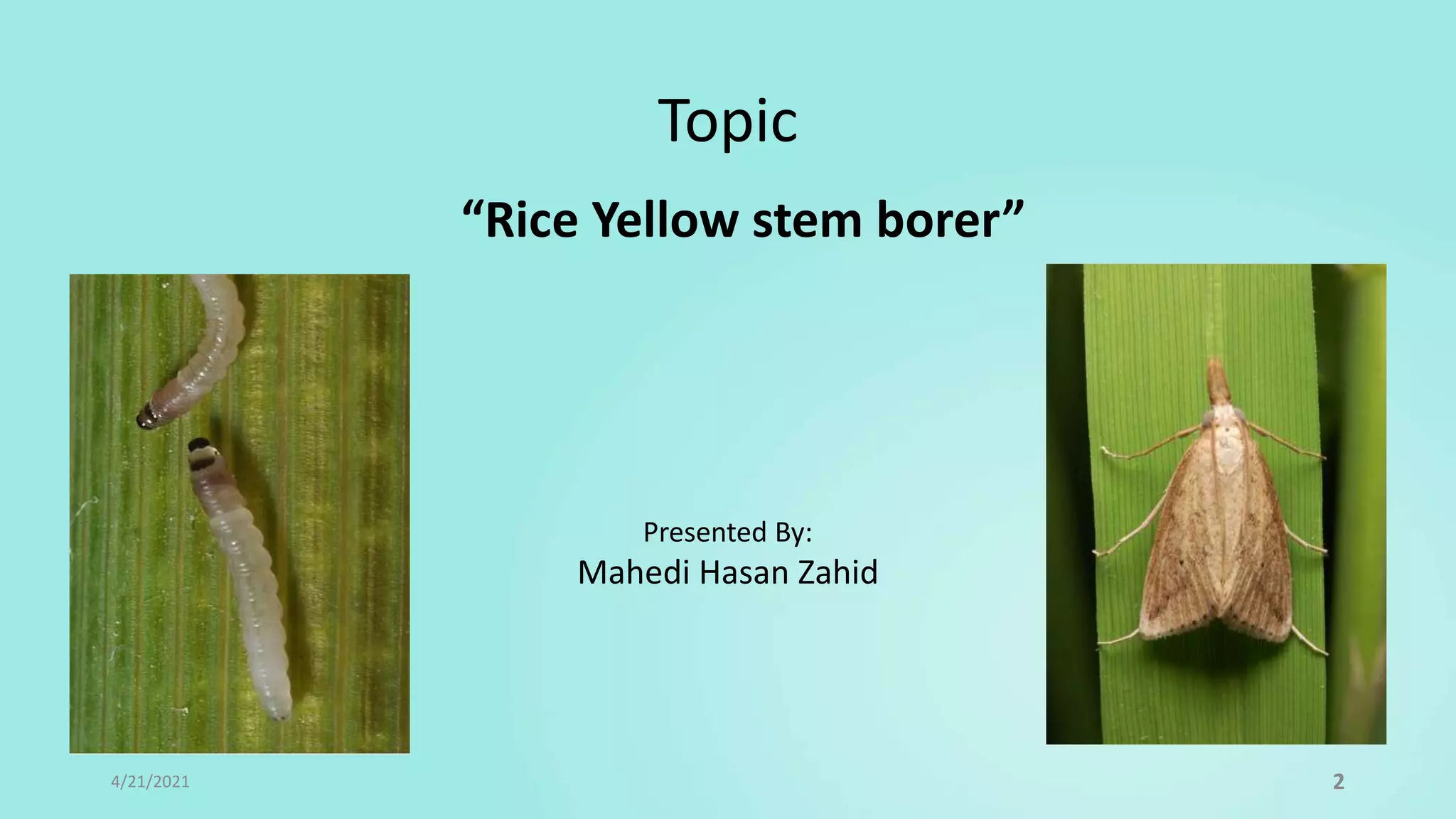
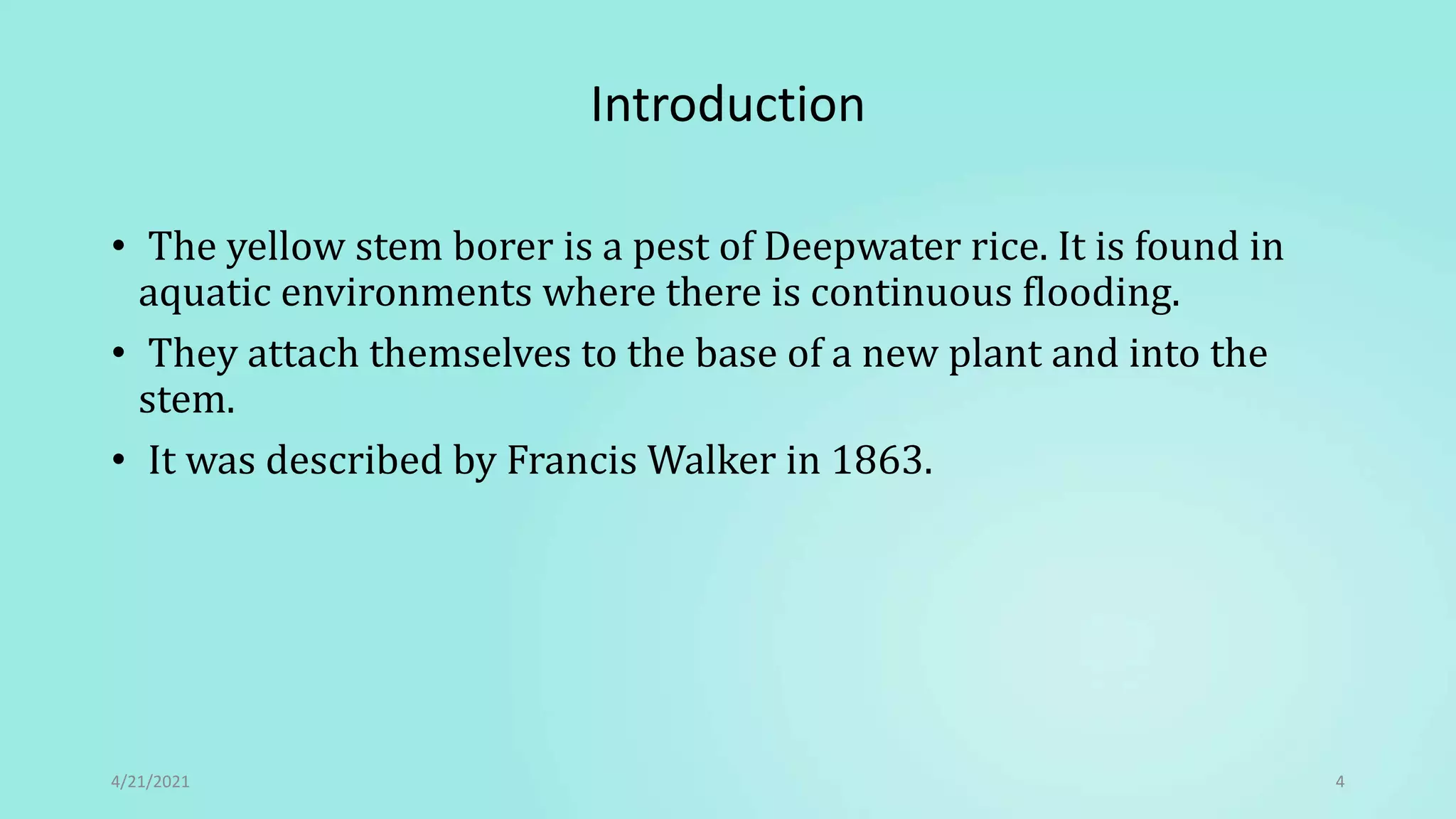
“Rice Yellow stem borer”
2
4/21/2021
Presented By:
Mahedi Hasan Zahid
Contents
• Introduction.
• Scientific classification.
• Metamorphosis.
• Eggs, Larva, Pupa.
• Description.
• Difference Between Male and Female.
• What it does?
• Identification process.
• Management.
• Conclusion.
3
4/21/2021
Introduction
• The yellow stem borer is a pest of Deepwater rice. It is found in
aquatic environments where there is continuous flooding.
• They attach themselves to the base of a new plant and into the
stem.
• It was described by Francis Walker in 1863.
4/21/2021 4
Scientific classification
Rice Yellow stem borer
Family: Crambidae
Genus: Scirpophaga
Order: Lepidoptera
Species: S. incertulas
Class: Insecta
Kingdom: Animalia
Scientific name: Scirpophaga incertulas
4/21/2021 5
Metamorphosis
A yellow stem borer insect's complete life cycle by 46 days.
• Eggs to Larva take 8 days.
• Larva to pupa take 30 days.
• Pupa to adult take 8 days.
4/21/2021 6
Eggs
• The eggs of the yellow stem borers are laid near the tip of the leaf
blade.
• Eggs are white in color they are oval, Flattened.
• The eggs, which hatch in 8 days, are laid in oval masses of 50-200
eggs e and covered with brownish anal hair of female moth.
4/21/2021 7
Larva
• The body of the larva is cream colored and the head is reddish
brown. Yellow stem borer larva body cream head radish brown.
4/21/2021 8
Pupa
• The pupa is yellowish white with a tinge of green. It turns dark
brawn just before adult emergence. The pupal stage takes place
inside the stem, and often below the soil surface.
4/21/2021 9
Description
• The wingspan of the male is 18–22 mm and the female is
34 mm. Adult males are smaller than the females. Males are
brownish ochreous. Forewings irrorated (sprinkled) with dark
scales and with the veins slightly streaked with fuscous.
• A black spot found at lower angle of cell. There is an oblique
fuscous line runs from apex to vein 2.
• A marginal black specks series can be seen. Hindwings ochreous
white. Female fuscous brown with pale fuscous hindwings.
4/21/2021 10
What it does
• Stem borers can destroy rice at any stage of the plant from
seedling to maturity.
• They feed upon tillers and causes dead hearts or drying of the
central tiller, during vegetative stage; and causes whiteheads at
reproductive stage.
4/21/2021 11
Difference
Male
• The male, gray or light brown in
color, is smaller and has two
rows of black spots at the tip of
the forewings.
• It has a wingspan of about 20-
30 mm. Its abdomen is slender
toward its anal end and is
covered with thin hairs dorsally
4/21/2021 12
Female
• The female YSB moth has a pair
of black spots at the middle of
each whitish, light brown to
yellowish forewing.
• It has a wingspan of 24-36 mm.
Its abdomen is wide with tufts
of yellowish hairs all over.
Male Female
4/21/2021 13
Difference
How to identify
Check the field for the following damage
symptoms
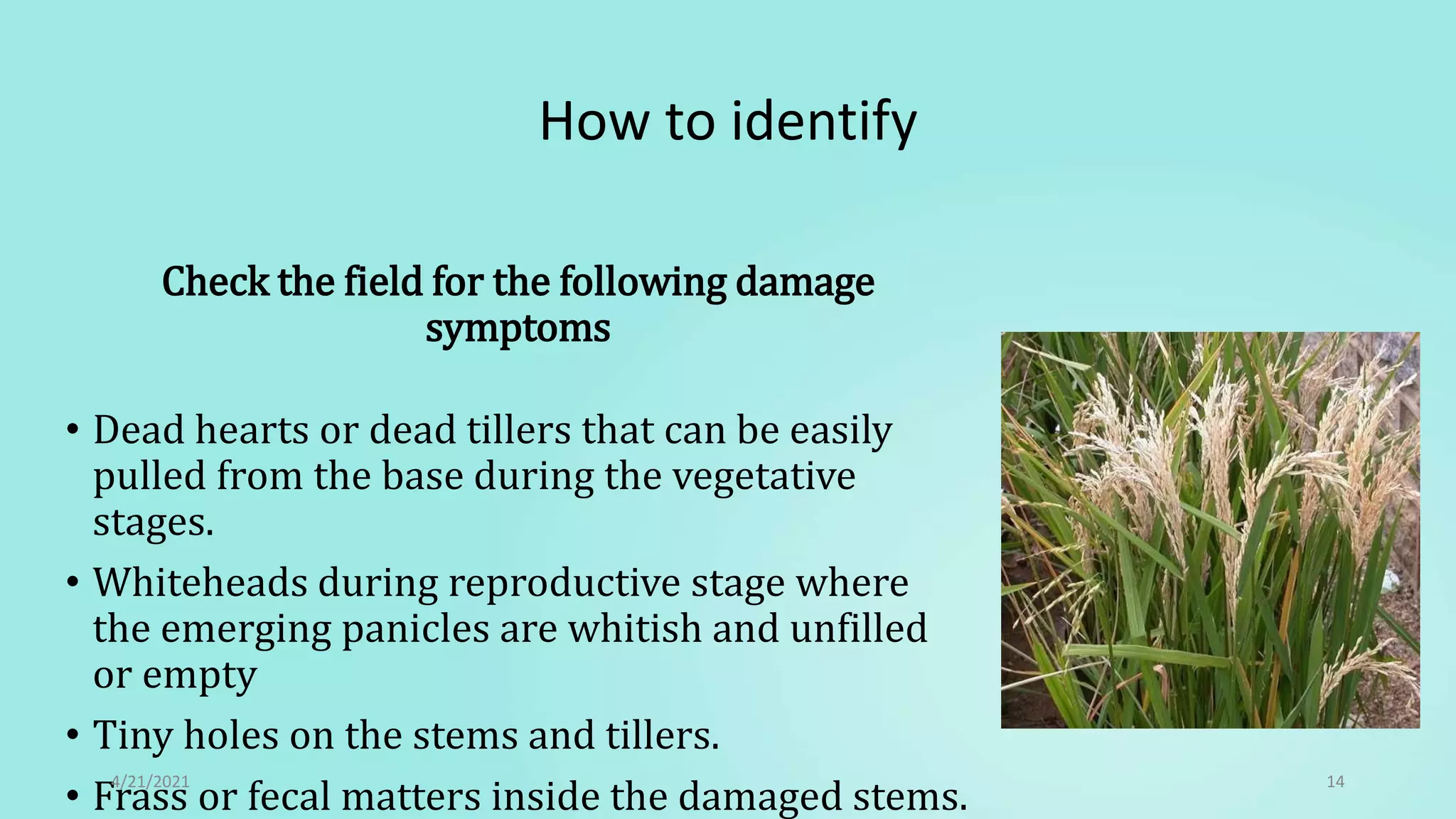
• Dead hearts or dead tillers that can be easily
pulled from the base during the vegetative
stages.
• Whiteheads during reproductive stage where
the emerging panicles are whitish and unfilled
or empty
• Tiny holes on the stems and tillers.
• Frass or fecal matters inside the damaged stems.
4/21/2021 14
How to manage
• Use resistant varieties
• At seedbed and transplanting, handpick and destroy egg masses
• Before transplanting, cut the leaf-top to reduce carry-over of eggs
from the seedbed to the field
• Raise level of irrigation water periodically to submerge the eggs
deposited on the lower parts of the plant
• Encourage biological control agents: braconid, eulophid,
pentatomic bugs, ants, mites, earwigs, bird and so on.
4/21/2021 15
Conclusion
• Due to heavy damage to rice throughout the world, many
controlling measures are underway. Chemical, physical, and
biological controls and many traditional methods are used to
control the pest at any stage of its life cycle.
• As a comparison, the pest can cause about 20% yield loss in early
planted rice, and 80% in late-planted crops.
4/21/2021 16
4/21/2021 17

Rice yellow stem Borer

  • 1.
  • 2.
    Topic “Rice Yellow stemborer” 2 4/21/2021 Presented By: Mahedi Hasan Zahid
  • 3.
    Contents • Introduction. • Scientificclassification. • Metamorphosis. • Eggs, Larva, Pupa. • Description. • Difference Between Male and Female. • What it does? • Identification process. • Management. • Conclusion. 3 4/21/2021
  • 4.
    Introduction • The yellowstem borer is a pest of Deepwater rice. It is found in aquatic environments where there is continuous flooding. • They attach themselves to the base of a new plant and into the stem. • It was described by Francis Walker in 1863. 4/21/2021 4
  • 5.
    Scientific classification Rice Yellowstem borer Family: Crambidae Genus: Scirpophaga Order: Lepidoptera Species: S. incertulas Class: Insecta Kingdom: Animalia Scientific name: Scirpophaga incertulas 4/21/2021 5
  • 6.
    Metamorphosis A yellow stemborer insect's complete life cycle by 46 days. • Eggs to Larva take 8 days. • Larva to pupa take 30 days. • Pupa to adult take 8 days. 4/21/2021 6
  • 7.
    Eggs • The eggsof the yellow stem borers are laid near the tip of the leaf blade. • Eggs are white in color they are oval, Flattened. • The eggs, which hatch in 8 days, are laid in oval masses of 50-200 eggs e and covered with brownish anal hair of female moth. 4/21/2021 7
  • 8.
    Larva • The bodyof the larva is cream colored and the head is reddish brown. Yellow stem borer larva body cream head radish brown. 4/21/2021 8
  • 9.
    Pupa • The pupais yellowish white with a tinge of green. It turns dark brawn just before adult emergence. The pupal stage takes place inside the stem, and often below the soil surface. 4/21/2021 9
  • 10.
    Description • The wingspanof the male is 18–22 mm and the female is 34 mm. Adult males are smaller than the females. Males are brownish ochreous. Forewings irrorated (sprinkled) with dark scales and with the veins slightly streaked with fuscous. • A black spot found at lower angle of cell. There is an oblique fuscous line runs from apex to vein 2. • A marginal black specks series can be seen. Hindwings ochreous white. Female fuscous brown with pale fuscous hindwings. 4/21/2021 10
  • 11.
    What it does •Stem borers can destroy rice at any stage of the plant from seedling to maturity. • They feed upon tillers and causes dead hearts or drying of the central tiller, during vegetative stage; and causes whiteheads at reproductive stage. 4/21/2021 11
  • 12.
    Difference Male • The male,gray or light brown in color, is smaller and has two rows of black spots at the tip of the forewings. • It has a wingspan of about 20- 30 mm. Its abdomen is slender toward its anal end and is covered with thin hairs dorsally 4/21/2021 12 Female • The female YSB moth has a pair of black spots at the middle of each whitish, light brown to yellowish forewing. • It has a wingspan of 24-36 mm. Its abdomen is wide with tufts of yellowish hairs all over.
  • 13.
  • 14.
    How to identify Checkthe field for the following damage symptoms • Dead hearts or dead tillers that can be easily pulled from the base during the vegetative stages. • Whiteheads during reproductive stage where the emerging panicles are whitish and unfilled or empty • Tiny holes on the stems and tillers. • Frass or fecal matters inside the damaged stems. 4/21/2021 14
  • 15.
    How to manage •Use resistant varieties • At seedbed and transplanting, handpick and destroy egg masses • Before transplanting, cut the leaf-top to reduce carry-over of eggs from the seedbed to the field • Raise level of irrigation water periodically to submerge the eggs deposited on the lower parts of the plant • Encourage biological control agents: braconid, eulophid, pentatomic bugs, ants, mites, earwigs, bird and so on. 4/21/2021 15
  • 16.
    Conclusion • Due toheavy damage to rice throughout the world, many controlling measures are underway. Chemical, physical, and biological controls and many traditional methods are used to control the pest at any stage of its life cycle. • As a comparison, the pest can cause about 20% yield loss in early planted rice, and 80% in late-planted crops. 4/21/2021 16
  • 17.