Presentation By : Jyoti Padalkar
Atmiya Institute of pharmacy
Size Reduction
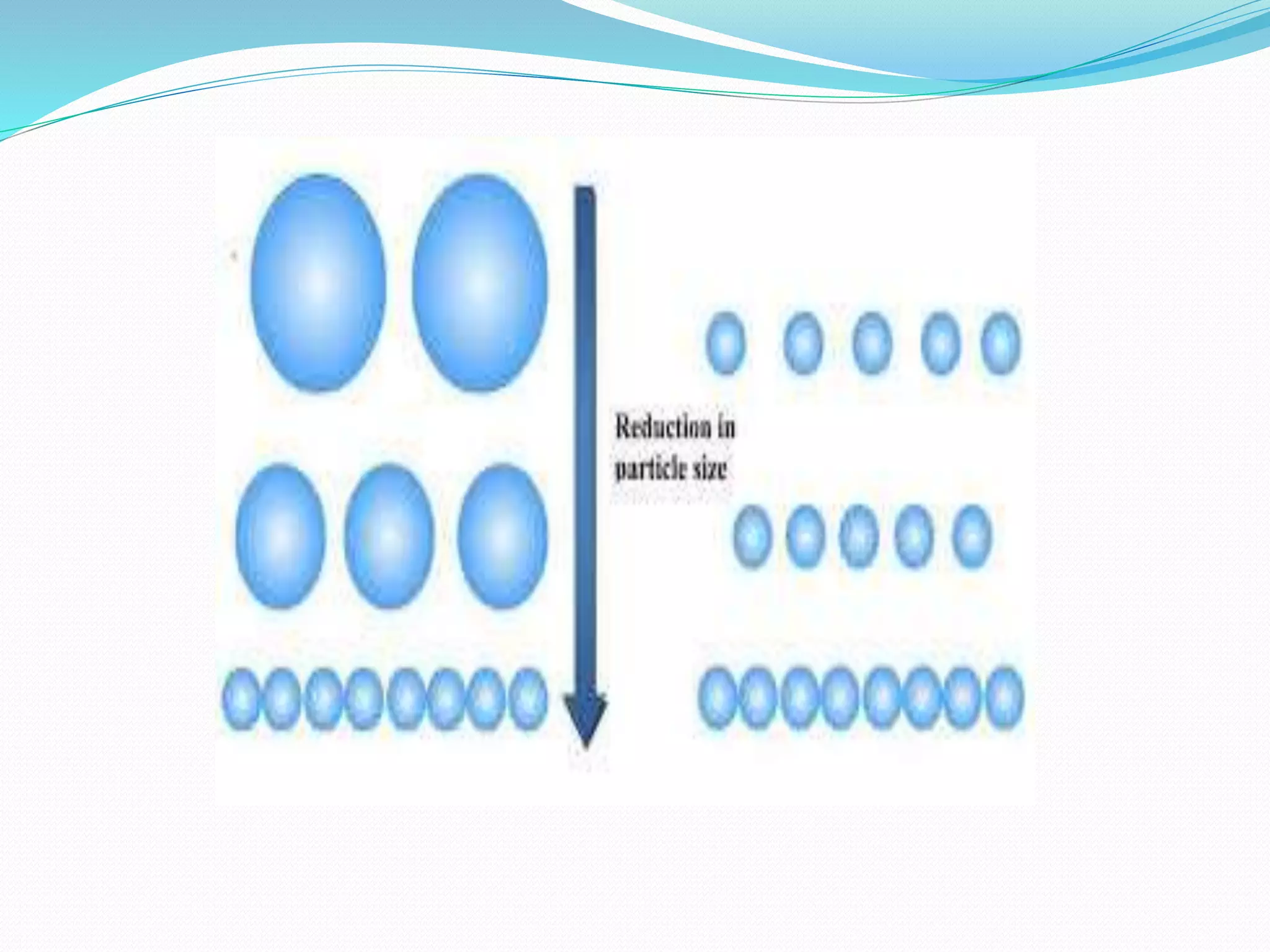
 Size reduction is the operation carried out for reducing
the size of bigger particle into smaller one of desired
shapes and size with the help of external forces.
 Comminution is another term used for size reduction.
Objectives
 To increase surface area
 To produce smaller particle
 To achieve proper mixing
 To improve flow of powders
 To prepare pharmaceutical dispersion
 To improve handling of powders
 To improve physical stability
 To improve extraction process
 To improve rate of absorption
 To improve dissolution rate of powders
 To dispose solid wastes easily
Advantages
 Uniform flow
 Content uniformity
 Effective drying
 Increase surface area or viscosity
 Uniform mixing and drying
 Improve dissolution rate
 Improve rate of absorption .
smaller particles ∝ greater the absorption
Disadvantages
 Drug degradation
 contamination
 Possible change in polymorphic form of API
 Possible degradation by heat
 Small particles as a result of static charge that may
decrease dissolution rate and flowability
 Air adsorption, hence less wetting
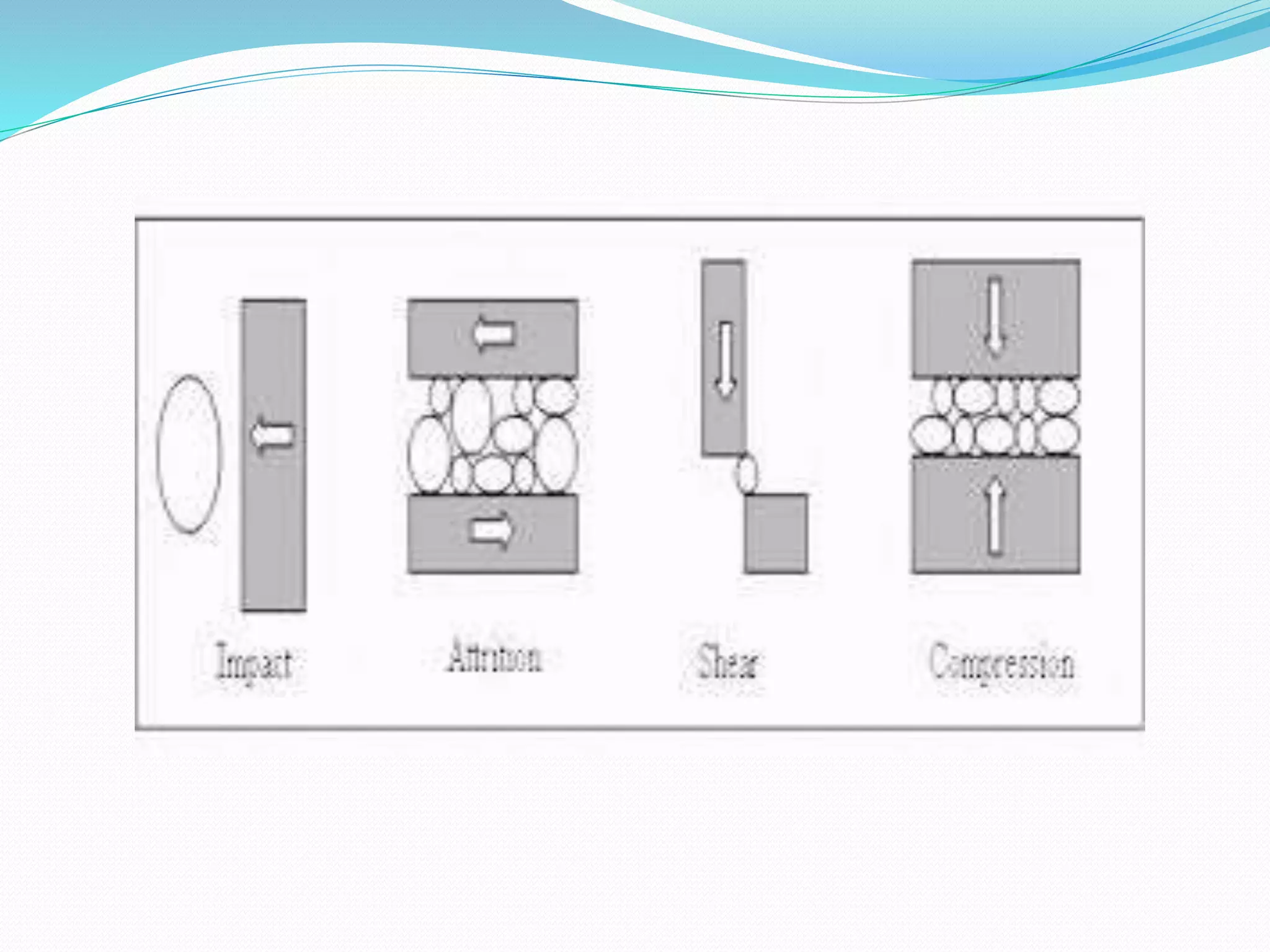
Mechanism of size reduction
 Impact- particle concussion by a single rigid
force(hammer).
 Compression- particle disintegration by two rigid
forces(nutcracker)’
 Shear- produced when the particle is compressed
between the edges of two hard surfaces moving
tangentially.
 Attrition- arising from particles scraping against one
another or against a rigid surface(fluid energy mill).
Factors affecting size reduction
1) Hardness
2) Toughness
3) Abrasiveness
4) Stickiness
5) Softening temperature
6) Material structure
7) Moisture content
8) Physiological effect
9) Purity required
10) Ratio of feed size to product ratio
1) Hardness
- It is a surface property of the material.
- It is confused with a property named strength.
An arbitrary scale of hardness has been devised known as
Moh’s Scale:
Moh’s scale = 1 is for graphite
Moh’s scale < 3 is for soft material
Moh’s scale > 7 is for hard material
Moh’s scale = 10 is for diamond
If material is brittle then size reduction may present no
special problems.
- Harder the materials,more difficult to reduce the size.
2) toughness
- toughness is the ability of a material to absorb
energy and resist impact.
- soft but tough material is more difficult to reduce
the size than hard but brittle.
- increase toughness,decrease in reduction of
sizes
3) Abrasiveness
- Abrasiveness is a property of hard materials(particularly
those of mineral origin)
- It may limit the type of machinery that can be used.
- During the grinding of some very abrasive substances.
The final powder may be contaminated with more than
0.1 % of metal worn from the grinding mill.
.
4) Stickiness
- a sticky material will tend to clog the grinding
equipment and it should therefore be ground in a
plant that can be cleaned easily.
- substances that are gummy or resinous may be
troublesome for size reduction.
- sometimes the addition of inert substances may be of
assistance such as a kaolin to sulphur.
5) softening temperature
- Many of the size reduction processes result in the
generation of heat,which may soften some
substances
- example : waxy substances such as stearic acid and
drugs containing oils or fats.
- It may be possible to cool the mill,either by a water
jacket or by a passing a steam of air through the
equipment or to use liquid nitrogen.
6) Material structure
- some substances are homogeneous in character.
- mineral substances may have lines of weakness along
which the material splits to form flate- like particles.
- vegetable drugs have a cellular structure often leading
to long fibrous particles.
7) Moisture content
- moisture content influence a number of the properties
that affect size reduction as hardness, toughness or
stickiness.
- It is found that material do not flow well if they
contain between about 5% to 50% of moisture.
- Usually,less than 5% of moisture is suitable if the
substance is to be ground dry or more than 50% it is
being for wet grinding.
8) Physiological effect
- Some substances are very potent and small
amounts of dust have an effect on the operators.
- To avoid this dust,enclose mills must be
used,systems that can extracts air are also
desirable ,and wet grinding also if possible, as it
eliminates the problem entirely.
.
9) Purity required
- Certain types of size reduction apparatus cause the
grinding surfaces to wear,and such methods must be
avoided if a high degree of purity of product is
needed.
- Similarly,some machines will be unsutaitable if
cleaning between batches of different materials is
difficult.
10) Ratio of feed size to product size
- Machines that produce a fine product require a small
feed size.
Size reduction theories
The energy requirement for particle size reduction is a
function of input and output of particle
size,hardness,strength and other properties of solids.
Various theories for energy requirments are:
1) Rittinger’s theory
2) Bond’s theory
3) Kick’s theory
- The energy required to reduce the size of particles is
inversely proportional to the size raised to the some
power.
𝑑𝐸
𝑑𝐷
=-c/Dⁿ ………..(1)
where,
E= amt.of energy required to produce a change
D=size of unit mass
c,n =constants
 Integrating equation ……(1)
E = C ℓn(
𝑑ᵢ
𝑑ₙ
) …….(2)
(dᵢ/dₙ)=reduction ratio
If n=1,0 equation (2)becomes kick’s theory
If n=1.5 equation (2)becomes bond’s theory
If n=2,0 equation (2)becomes Rittinger’s theory
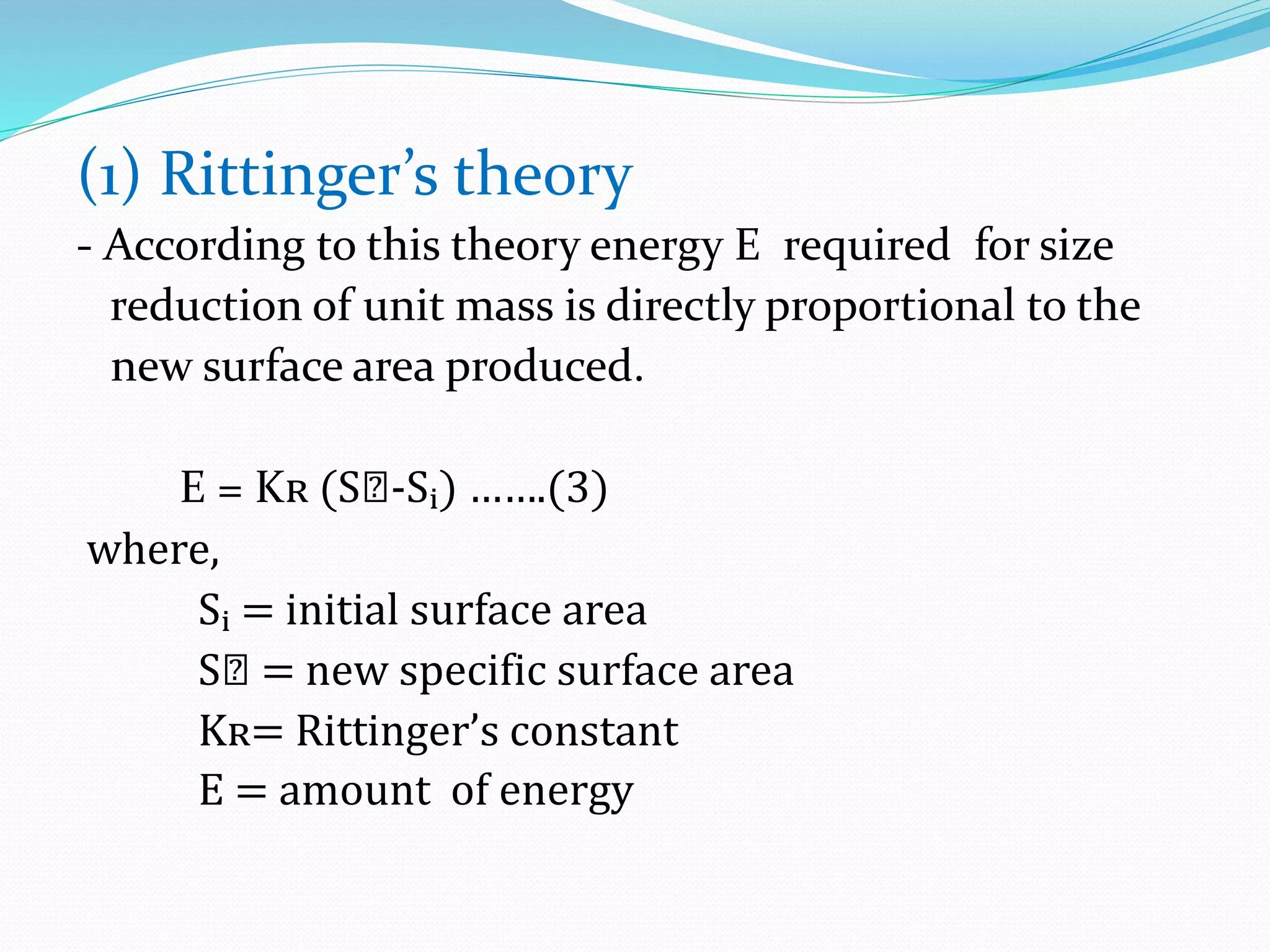
(1) Rittinger’s theory
- According to this theory energy E required for size
reduction of unit mass is directly proportional to the
new surface area produced.
E = Kʀ (Sₙ-Sᵢ) …….(3)
where,
Sᵢ = initial surface area
Sₙ = new specific surface area
Kʀ= Rittinger’s constant
E = amount of energy
o Application
- Applicable to brittle materials undergoing
fine milling.
- This theory ignore deformation before fracture.
2) Bond’s theory
- According to bond theory the energy used in crack
propagation is proportional to new crack length
produced.
- It states that energy required for deforming a set of
particle of equivalent shape is proportional to the
change in particle dimensions.
E = 2Kᴃ (
1
√𝑑ₙ
-
1
√𝑑ᵢ
) ……..(4)
where,
Kᴃ = Bond’s work index,energy per unit mass
dᵢ = initial dia.of particles,µm
dₙ = new dia.of particles,µm
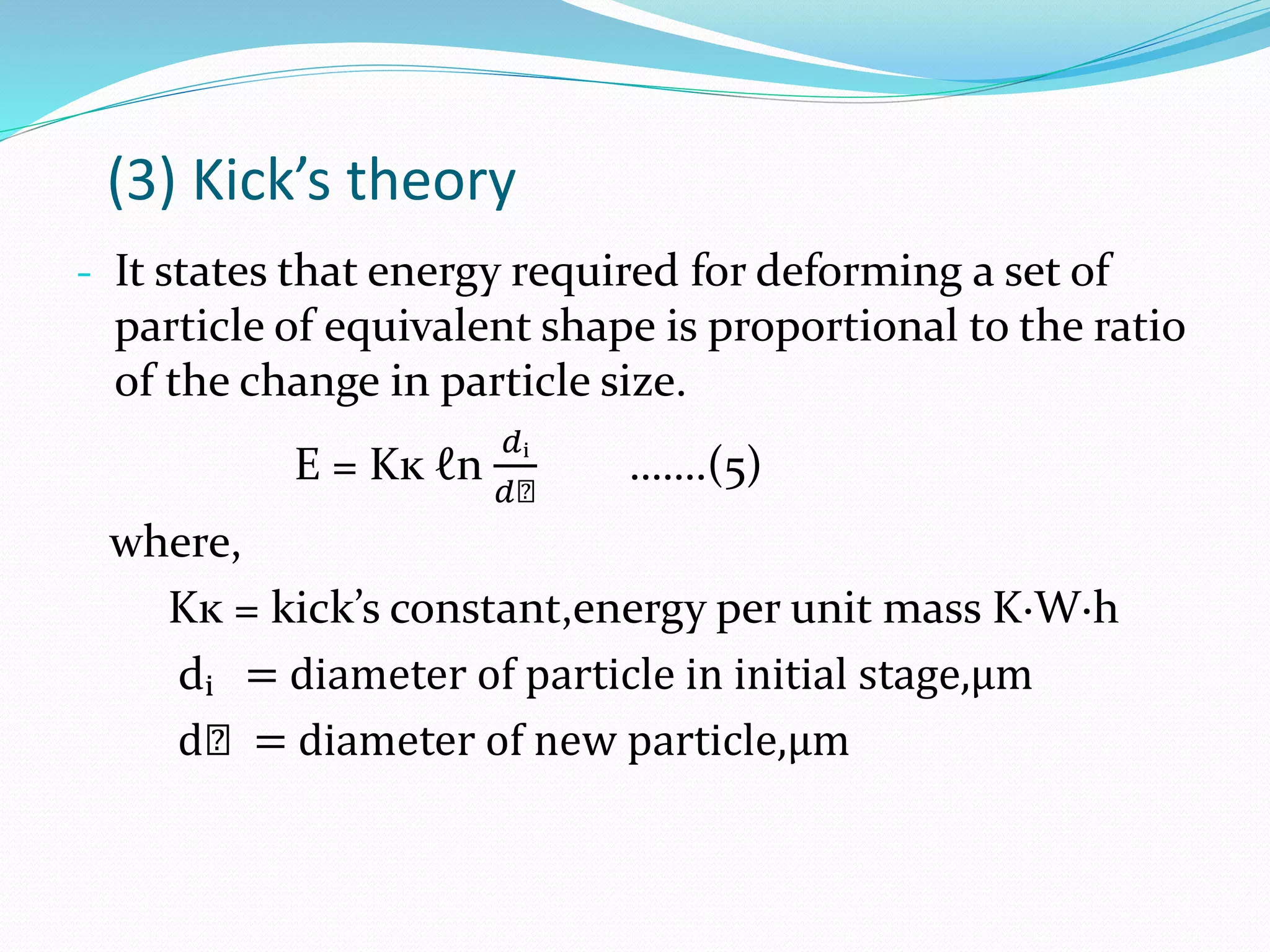
(3) Kick’s theory
- It states that energy required for deforming a set of
particle of equivalent shape is proportional to the ratio
of the change in particle size.
E = Kĸ ℓn
𝑑ᵢ
𝑑ₙ
…….(5)
where,
Kĸ = kick’s constant,energy per unit mass K·W·h
dᵢ = diameter of particle in initial stage,µm
dₙ = diameter of new particle,µm
 Summary
(1) Rittinger’s theory : (n =2,0)
- energy ά new surface area formed.
(2) Bond’s theory : (n =1,5)
- energy used in crack propagation ά crack
length produced.
(3) Kick’s theory : (n = 1,0)
- energy ά ratio of change in size.
 For compression of large particles Kick’s theory is
useful.
Ball mill
Principle
- Ball mill works on the
impact between rapidly
moving Ball and powder
material.Both enclosed
in a hollow cylinder.
Thus,in the ball mill
impact or attrition or both
are responsible for
size reduction.
Working
- Ball mil grinds material by rotating a cylinder with
steel grinding balls causing the balls to fall back into
cylinder & on to the material to be ground.
- Ball occuping 30 to 50% of the mill vol.& its may be of
metal,porcelain or stones(pebble mill) .
- Drug is filled into cylinder 60% of the volume.
Advantages
- suitable for both dry and wet grinding process.
Disadvantages
- very noisy machine.
- its not suitable for milling of soft,tacky and fibrous
materials.
Uses
- For production of ophthalmic & parentral products
- For milling dyes,pigments and insectiside at low
speed.
- fertilizers,silicate products,Limestone,granites,gypsum
products
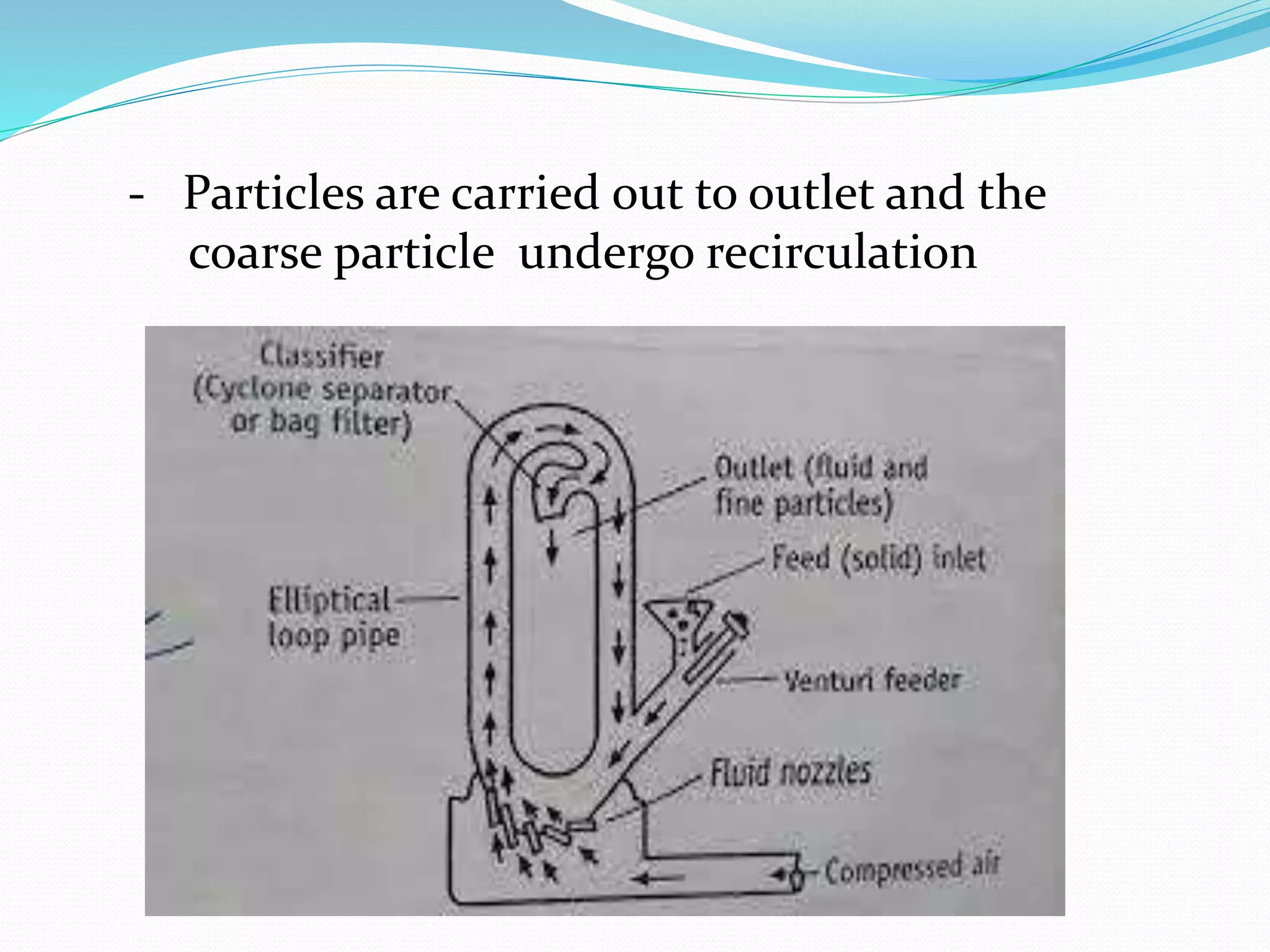
Fluid energy mill
Principle
- Fluid energy mill operates on the principle of impact
and attrition the feed stock is suspended with high
velocity air stream.
Working
- Powder is introduced through the inlet of
venture.Air introduce through the grinding nozzles
transport the powder in the circular track of the
mill.The turbulent air stream break the particles
colloids with each other & break.
-
- Particles are carried out to outlet and the
coarse particle undergo recirculation
Advantages
- it has no moving parts heat is not produced during
milling.
- contamination is not possible.
Disadvantages
- Equipment is expensive.
- Not suitable for milling of soft,tracky & fibrous
materials.
Uses
- It is used to reduce particle size (10-325 mesh)of most of
- drugs such as antibiotics and vitamins.
Colloidal mill
Principle
- Colloidal mill consist
Of two steel disc
having very small
clearance between
them.one disc is
rotating while the
other one is stationary.
Working
- Suspension and emulsion are placed in hopper.The
solid are mixed with liquid vehicle before introduce
into colloid mill rotor is moved 3000 to 20,000 rpm.
- The dispersion flow down & adhere to the rotor.
Advantages
- Production of sterile products.
Disadvantages
- Not useful for dry milling.
Uses
- ointments,gels & high viscous fluids .
- Increased the stability of colloidal dispersion
dispersion,suspension,emulsions & ointments.
- comminution of solids.
Hammer mill
 Principle
- The Hammer mill consist of a central shaft to which
four or more hammers are attached,
- These are mounted with swivel joints,so that the
hammers swing out to radial position when the shaft
is rotated.
- The lower part of the casing consists of a screen
through which material can escape .
- The screen can be changed according to the particle
size required.
Advantages
- Easy to use
- Versatile as it process a wide range of materials.
- Grain,high fiber,high protein
- Can be set up for very fine grinding (90% - 60 mesh)
- Must be configured per application.
Disadvantages
- Heat build-up during milling is more.therefore,product
degradation is possible.
- Hammer mill cann’t apply to sticky,fibrous,hard
materials.
- The screen may get clogged.
- Many hammer mills vibrate & very noisy.
Uses
- Used in grinding spices,dried milk,sugar
agglomerate,cocoa press cake,dry fruits,dry
vegetables,extracted bones etc.

slideshare-220217130923.pdf

  • 1.
    Presentation By :Jyoti Padalkar Atmiya Institute of pharmacy
  • 2.
    Size Reduction  Sizereduction is the operation carried out for reducing the size of bigger particle into smaller one of desired shapes and size with the help of external forces.  Comminution is another term used for size reduction.
  • 4.
    Objectives  To increasesurface area  To produce smaller particle  To achieve proper mixing  To improve flow of powders  To prepare pharmaceutical dispersion  To improve handling of powders  To improve physical stability  To improve extraction process  To improve rate of absorption  To improve dissolution rate of powders  To dispose solid wastes easily
  • 5.
    Advantages  Uniform flow Content uniformity  Effective drying  Increase surface area or viscosity  Uniform mixing and drying  Improve dissolution rate  Improve rate of absorption . smaller particles ∝ greater the absorption
  • 6.
    Disadvantages  Drug degradation contamination  Possible change in polymorphic form of API  Possible degradation by heat  Small particles as a result of static charge that may decrease dissolution rate and flowability  Air adsorption, hence less wetting
  • 7.
    Mechanism of sizereduction  Impact- particle concussion by a single rigid force(hammer).  Compression- particle disintegration by two rigid forces(nutcracker)’  Shear- produced when the particle is compressed between the edges of two hard surfaces moving tangentially.  Attrition- arising from particles scraping against one another or against a rigid surface(fluid energy mill).
  • 9.
    Factors affecting sizereduction 1) Hardness 2) Toughness 3) Abrasiveness 4) Stickiness 5) Softening temperature 6) Material structure 7) Moisture content 8) Physiological effect 9) Purity required 10) Ratio of feed size to product ratio
  • 10.
    1) Hardness - Itis a surface property of the material. - It is confused with a property named strength. An arbitrary scale of hardness has been devised known as Moh’s Scale: Moh’s scale = 1 is for graphite Moh’s scale < 3 is for soft material Moh’s scale > 7 is for hard material Moh’s scale = 10 is for diamond If material is brittle then size reduction may present no special problems. - Harder the materials,more difficult to reduce the size.
  • 11.
    2) toughness - toughnessis the ability of a material to absorb energy and resist impact. - soft but tough material is more difficult to reduce the size than hard but brittle. - increase toughness,decrease in reduction of sizes
  • 12.
    3) Abrasiveness - Abrasivenessis a property of hard materials(particularly those of mineral origin) - It may limit the type of machinery that can be used. - During the grinding of some very abrasive substances. The final powder may be contaminated with more than 0.1 % of metal worn from the grinding mill. .
  • 13.
    4) Stickiness - asticky material will tend to clog the grinding equipment and it should therefore be ground in a plant that can be cleaned easily. - substances that are gummy or resinous may be troublesome for size reduction. - sometimes the addition of inert substances may be of assistance such as a kaolin to sulphur.
  • 14.
    5) softening temperature -Many of the size reduction processes result in the generation of heat,which may soften some substances - example : waxy substances such as stearic acid and drugs containing oils or fats. - It may be possible to cool the mill,either by a water jacket or by a passing a steam of air through the equipment or to use liquid nitrogen.
  • 15.
    6) Material structure -some substances are homogeneous in character. - mineral substances may have lines of weakness along which the material splits to form flate- like particles. - vegetable drugs have a cellular structure often leading to long fibrous particles.
  • 16.
    7) Moisture content -moisture content influence a number of the properties that affect size reduction as hardness, toughness or stickiness. - It is found that material do not flow well if they contain between about 5% to 50% of moisture. - Usually,less than 5% of moisture is suitable if the substance is to be ground dry or more than 50% it is being for wet grinding.
  • 17.
    8) Physiological effect -Some substances are very potent and small amounts of dust have an effect on the operators. - To avoid this dust,enclose mills must be used,systems that can extracts air are also desirable ,and wet grinding also if possible, as it eliminates the problem entirely. .
  • 18.
    9) Purity required -Certain types of size reduction apparatus cause the grinding surfaces to wear,and such methods must be avoided if a high degree of purity of product is needed. - Similarly,some machines will be unsutaitable if cleaning between batches of different materials is difficult. 10) Ratio of feed size to product size - Machines that produce a fine product require a small feed size.
  • 19.
    Size reduction theories Theenergy requirement for particle size reduction is a function of input and output of particle size,hardness,strength and other properties of solids. Various theories for energy requirments are: 1) Rittinger’s theory 2) Bond’s theory 3) Kick’s theory
  • 20.
    - The energyrequired to reduce the size of particles is inversely proportional to the size raised to the some power. 𝑑𝐸 𝑑𝐷 =-c/Dⁿ ………..(1) where, E= amt.of energy required to produce a change D=size of unit mass c,n =constants
  • 21.
     Integrating equation……(1) E = C ℓn( 𝑑ᵢ 𝑑ₙ ) …….(2) (dᵢ/dₙ)=reduction ratio If n=1,0 equation (2)becomes kick’s theory If n=1.5 equation (2)becomes bond’s theory If n=2,0 equation (2)becomes Rittinger’s theory
  • 22.
    (1) Rittinger’s theory -According to this theory energy E required for size reduction of unit mass is directly proportional to the new surface area produced. E = Kʀ (Sₙ-Sᵢ) …….(3) where, Sᵢ = initial surface area Sₙ = new specific surface area Kʀ= Rittinger’s constant E = amount of energy
  • 23.
    o Application - Applicableto brittle materials undergoing fine milling. - This theory ignore deformation before fracture.
  • 24.
    2) Bond’s theory -According to bond theory the energy used in crack propagation is proportional to new crack length produced. - It states that energy required for deforming a set of particle of equivalent shape is proportional to the change in particle dimensions. E = 2Kᴃ ( 1 √𝑑ₙ - 1 √𝑑ᵢ ) ……..(4)
  • 25.
    where, Kᴃ = Bond’swork index,energy per unit mass dᵢ = initial dia.of particles,µm dₙ = new dia.of particles,µm
  • 26.
    (3) Kick’s theory -It states that energy required for deforming a set of particle of equivalent shape is proportional to the ratio of the change in particle size. E = Kĸ ℓn 𝑑ᵢ 𝑑ₙ …….(5) where, Kĸ = kick’s constant,energy per unit mass K·W·h dᵢ = diameter of particle in initial stage,µm dₙ = diameter of new particle,µm
  • 27.
     Summary (1) Rittinger’stheory : (n =2,0) - energy ά new surface area formed. (2) Bond’s theory : (n =1,5) - energy used in crack propagation ά crack length produced. (3) Kick’s theory : (n = 1,0) - energy ά ratio of change in size.  For compression of large particles Kick’s theory is useful.
  • 28.
    Ball mill Principle - Ballmill works on the impact between rapidly moving Ball and powder material.Both enclosed in a hollow cylinder. Thus,in the ball mill impact or attrition or both are responsible for size reduction.
  • 29.
    Working - Ball milgrinds material by rotating a cylinder with steel grinding balls causing the balls to fall back into cylinder & on to the material to be ground. - Ball occuping 30 to 50% of the mill vol.& its may be of metal,porcelain or stones(pebble mill) . - Drug is filled into cylinder 60% of the volume.
  • 31.
    Advantages - suitable forboth dry and wet grinding process. Disadvantages - very noisy machine. - its not suitable for milling of soft,tacky and fibrous materials. Uses - For production of ophthalmic & parentral products - For milling dyes,pigments and insectiside at low speed. - fertilizers,silicate products,Limestone,granites,gypsum products
  • 33.
    Fluid energy mill Principle -Fluid energy mill operates on the principle of impact and attrition the feed stock is suspended with high velocity air stream. Working - Powder is introduced through the inlet of venture.Air introduce through the grinding nozzles transport the powder in the circular track of the mill.The turbulent air stream break the particles colloids with each other & break. -
  • 34.
    - Particles arecarried out to outlet and the coarse particle undergo recirculation
  • 35.
    Advantages - it hasno moving parts heat is not produced during milling. - contamination is not possible. Disadvantages - Equipment is expensive. - Not suitable for milling of soft,tracky & fibrous materials. Uses - It is used to reduce particle size (10-325 mesh)of most of - drugs such as antibiotics and vitamins.
  • 37.
    Colloidal mill Principle - Colloidalmill consist Of two steel disc having very small clearance between them.one disc is rotating while the other one is stationary.
  • 38.
    Working - Suspension andemulsion are placed in hopper.The solid are mixed with liquid vehicle before introduce into colloid mill rotor is moved 3000 to 20,000 rpm. - The dispersion flow down & adhere to the rotor.
  • 39.
    Advantages - Production ofsterile products. Disadvantages - Not useful for dry milling. Uses - ointments,gels & high viscous fluids . - Increased the stability of colloidal dispersion dispersion,suspension,emulsions & ointments. - comminution of solids.
  • 40.
    Hammer mill  Principle -The Hammer mill consist of a central shaft to which four or more hammers are attached, - These are mounted with swivel joints,so that the hammers swing out to radial position when the shaft is rotated. - The lower part of the casing consists of a screen through which material can escape . - The screen can be changed according to the particle size required.
  • 42.
    Advantages - Easy touse - Versatile as it process a wide range of materials. - Grain,high fiber,high protein - Can be set up for very fine grinding (90% - 60 mesh) - Must be configured per application. Disadvantages - Heat build-up during milling is more.therefore,product degradation is possible. - Hammer mill cann’t apply to sticky,fibrous,hard materials.
  • 43.
    - The screenmay get clogged. - Many hammer mills vibrate & very noisy. Uses - Used in grinding spices,dried milk,sugar agglomerate,cocoa press cake,dry fruits,dry vegetables,extracted bones etc.