

"GOVERNMENT: American Period"
            (1898-1941)


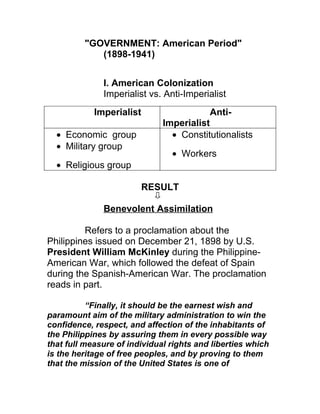
              I. American Colonization
              Imperialist vs. Anti-Imperialist
            Imperialist                   Anti-
                              Imperialist
  • Economic group              • Constitutionalists
  • Military group
                                • Workers
  • Religious group

                          RESULT

              Benevolent Assimilation

         Refers to a proclamation about the
Philippines issued on December 21, 1898 by U.S.
President William McKinley during the Philippine-
American War, which followed the defeat of Spain
during the Spanish-American War. The proclamation
reads in part.

           “Finally, it should be the earnest wish and
paramount aim of the military administration to win the
confidence, respect, and affection of the inhabitants of
the Philippines by assuring them in every possible way
that full measure of individual rights and liberties which
is the heritage of free peoples, and by proving to them
that the mission of the United States is one of
benevolent assimilation substituting the mild sway of
justice and right for arbitrary rule. “


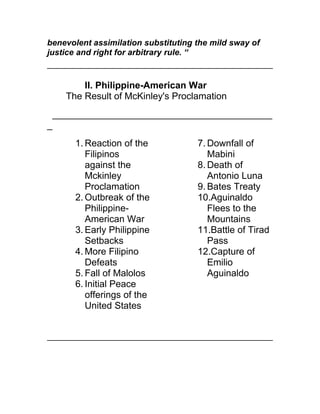
          II. Philippine-American War
      The Result of McKinley's Proclamation
    __________________________________________
_
        1. Reaction of the           7. Downfall of
           Filipinos                    Mabini
           against the               8. Death of
           Mckinley                     Antonio Luna
           Proclamation              9. Bates Treaty
        2. Outbreak of the           10.Aguinaldo
           Philippine-                  Flees to the
           American War                 Mountains
        3. Early Philippine          11.Battle of Tirad
           Setbacks                     Pass
        4. More Filipino             12.Capture of
           Defeats                      Emilio
        5. Fall of Malolos              Aguinaldo
        6. Initial Peace
           offerings of the
           United States
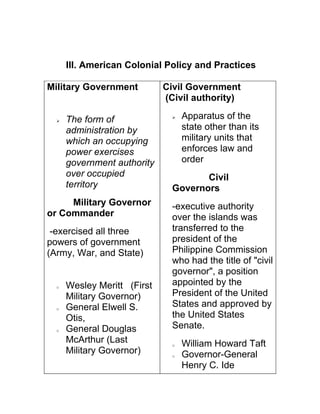
III. American Colonial Policy and Practices

Military Government          Civil Government
                             (Civil authority)

     The form of                 Apparatus of the
      administration by            state other than its
      which an occupying           military units that
      power exercises              enforces law and
      government authority         order
      over occupied                   Civil
      territory                Governors
     Military Governor         -executive authority
or Commander                   over the islands was
 -exercised all three          transferred to the
powers of government           president of the
(Army, War, and State)         Philippine Commission
                               who had the title of "civil
                               governor", a position
  o   Wesley Meritt (First     appointed by the
      Military Governor)       President of the United
  o   General Elwell S.        States and approved by
      Otis,                    the United States
  o   General Douglas          Senate.
      McArthur (Last           o   William Howard Taft
      Military Governor)       o   Governor-General
                                   Henry C. Ide
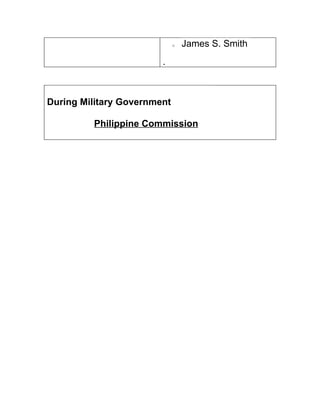
o   James S. Smith
                        .


During Military Government

         Philippine Commission
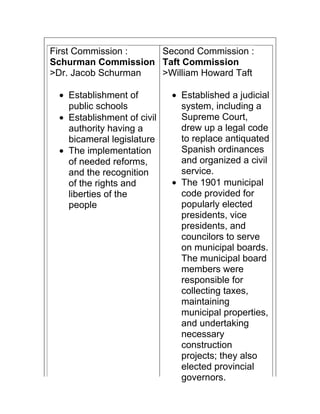
First Commission :  Second Commission :
Schurman Commission Taft Commission
>Dr. Jacob Schurman >William Howard Taft

 • Establishment of         • Established a judicial
   public schools             system, including a
 • Establishment of civil     Supreme Court,
   authority having a         drew up a legal code
   bicameral legislature      to replace antiquated
 • The implementation         Spanish ordinances
   of needed reforms,         and organized a civil
   and the recognition        service.
   of the rights and        • The 1901 municipal
   liberties of the           code provided for
   people                     popularly elected
                              presidents, vice
                              presidents, and
                              councilors to serve
                              on municipal boards.
                              The municipal board
                              members were
                              responsible for
                              collecting taxes,
                              maintaining
                              municipal properties,
                              and undertaking
                              necessary
                              construction
                              projects; they also
                              elected provincial
                              governors.
During Civil Government
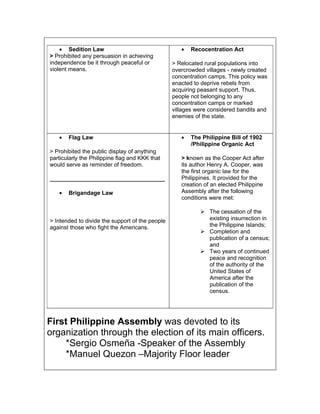
• Sedition Law                                  •   Recocentration Act
> Prohibited any persuasion in achieving
independence be it through peaceful or           > Relocated rural populations into
violent means.                                   overcrowded villages - newly created
                                                 concentration camps. This policy was
                                                 enacted to deprive rebels from
                                                 acquiring peasant support. Thus,
                                                 people not belonging to any
                                                 concentration camps or marked
                                                 villages were considered bandits and
                                                 enemies of the state.


   •   Flag Law                                     •   The Philippine Bill of 1902
                                                        /Philippine Organic Act
> Prohibited the public display of anything
particularly the Philippine flag and KKK that       > known as the Cooper Act after
would serve as reminder of freedom.                 its author Henry A. Cooper, was
                                                    the first organic law for the
____________________________________                Philippines. It provided for the
                                                    creation of an elected Philippine
   •   Brigandage Law                               Assembly after the following
                                                    conditions were met:

                                                            The cessation of the
> Intended to divide the support of the people               existing insurrection in
against those who fight the Americans.                       the Philippine Islands;
                                                            Completion and
                                                             publication of a census;
                                                             and
                                                            Two years of continued
                                                             peace and recognition
                                                             of the authority of the
                                                             United States of
                                                             America after the
                                                             publication of the
                                                             census.


First Philippine Assembly was devoted to its
organization through the election of its main officers.
    *Sergio Osmeña -Speaker of the Assembly
    *Manuel Quezon –Majority Floor leader
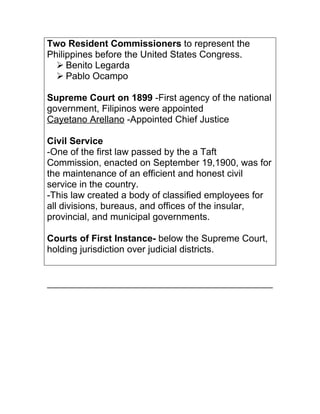
Two Resident Commissioners to represent the
Philippines before the United States Congress.
   Benito Legarda
   Pablo Ocampo

Supreme Court on 1899 -First agency of the national
government, Filipinos were appointed
Cayetano Arellano -Appointed Chief Justice

Civil Service
-One of the first law passed by the a Taft
Commission, enacted on September 19,1900, was for
the maintenance of an efficient and honest civil
service in the country.
-This law created a body of classified employees for
all divisions, bureaus, and offices of the insular,
provincial, and municipal governments.

Courts of First Instance- below the Supreme Court,
holding jurisdiction over judicial districts.
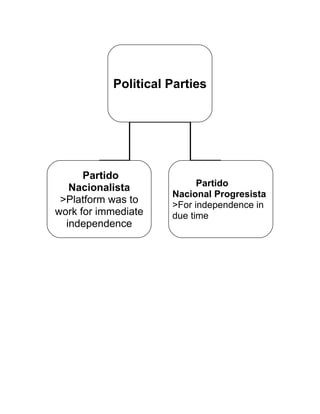
Political Parties


      Partido
   Nacionalista            Partido
                     Nacional Progresista
 >Platform was to    >For independence in
work for immediate   due time
  independence
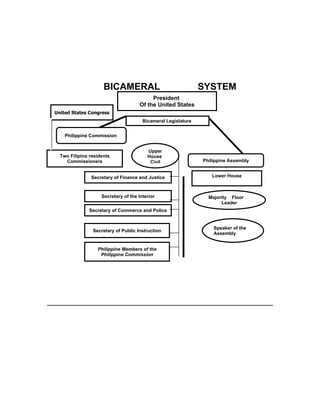
BICAMERAL                                 SYSTEM
                                          President
                                     Of the United States
United States Congress
                                       Bicameral Legislature


    Philippine Commission


                                         Upper
  Two Filipino residents                 House
    Commissioners                         Civil                Philippine Assembly


               Secretary of Finance and Justice                   Lower House


                    Secretary of the Interior                    Majority Floor
                                                                      Leader
              Secretary of Commerce and Police


                                                                   Speaker of the
                Secretary of Public Instruction
                                                                   Assembly


                  Philippine Members of the
                   Philippine Commission
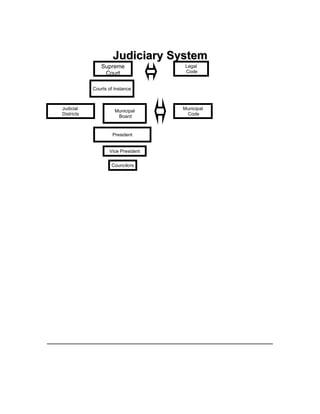
Judiciary System
               Supreme               Legal
                Court                Code


            Courts of Instance


Judicial                            Municipal
                      Municipal
Districts                            Code
                       Board


                     President


                   Vice President


                    Councilors
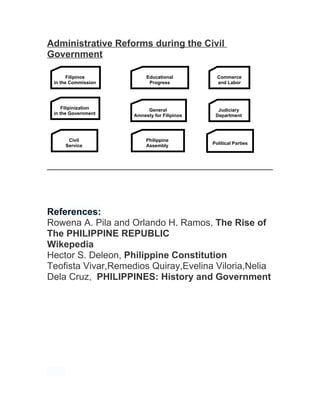
Administrative Reforms during the Civil
Government

       Filipinos           Educational          Commerce
 in the Commission          Progress            and Labor


     Filipinization        General              Judiciary
 in the Government    Amnesty for Filipinos    Department


       Civil               Philippine
                                              Political Parties
      Service              Assembly


References:
Rowena A. Pila and Orlando H. Ramos, The Rise of
The PHILIPPINE REPUBLIC
Wikepedia
Hector S. Deleon, Philippine Constitution
Teofista Vivar,Remedios Quiray,Evelina Viloria,Nelia
Dela Cruz, PHILIPPINES: History and Government
“The LORD is my strength and my shield.
My heart trusted him, so I received help. My heart
is triumphant; I give thanks to Him with my song.”
                                        -Psalm 28:7

Slideshare upload

  • 1.
    "GOVERNMENT: American Period" (1898-1941) I. American Colonization Imperialist vs. Anti-Imperialist Imperialist Anti- Imperialist • Economic group • Constitutionalists • Military group • Workers • Religious group RESULT Benevolent Assimilation Refers to a proclamation about the Philippines issued on December 21, 1898 by U.S. President William McKinley during the Philippine- American War, which followed the defeat of Spain during the Spanish-American War. The proclamation reads in part. “Finally, it should be the earnest wish and paramount aim of the military administration to win the confidence, respect, and affection of the inhabitants of the Philippines by assuring them in every possible way that full measure of individual rights and liberties which is the heritage of free peoples, and by proving to them that the mission of the United States is one of
  • 2.
    benevolent assimilation substitutingthe mild sway of justice and right for arbitrary rule. “ II. Philippine-American War The Result of McKinley's Proclamation __________________________________________ _ 1. Reaction of the 7. Downfall of Filipinos Mabini against the 8. Death of Mckinley Antonio Luna Proclamation 9. Bates Treaty 2. Outbreak of the 10.Aguinaldo Philippine- Flees to the American War Mountains 3. Early Philippine 11.Battle of Tirad Setbacks Pass 4. More Filipino 12.Capture of Defeats Emilio 5. Fall of Malolos Aguinaldo 6. Initial Peace offerings of the United States
  • 3.
    III. American ColonialPolicy and Practices Military Government Civil Government (Civil authority)  The form of  Apparatus of the administration by state other than its which an occupying military units that power exercises enforces law and government authority order over occupied Civil territory Governors Military Governor -executive authority or Commander over the islands was -exercised all three transferred to the powers of government president of the (Army, War, and State) Philippine Commission who had the title of "civil governor", a position o Wesley Meritt (First appointed by the Military Governor) President of the United o General Elwell S. States and approved by Otis, the United States o General Douglas Senate. McArthur (Last o William Howard Taft Military Governor) o Governor-General Henry C. Ide
  • 4.
    o James S. Smith . During Military Government Philippine Commission
  • 5.
    First Commission : Second Commission : Schurman Commission Taft Commission >Dr. Jacob Schurman >William Howard Taft • Establishment of • Established a judicial public schools system, including a • Establishment of civil Supreme Court, authority having a drew up a legal code bicameral legislature to replace antiquated • The implementation Spanish ordinances of needed reforms, and organized a civil and the recognition service. of the rights and • The 1901 municipal liberties of the code provided for people popularly elected presidents, vice presidents, and councilors to serve on municipal boards. The municipal board members were responsible for collecting taxes, maintaining municipal properties, and undertaking necessary construction projects; they also elected provincial governors.
  • 7.
  • 8.
    • Sedition Law • Recocentration Act > Prohibited any persuasion in achieving independence be it through peaceful or > Relocated rural populations into violent means. overcrowded villages - newly created concentration camps. This policy was enacted to deprive rebels from acquiring peasant support. Thus, people not belonging to any concentration camps or marked villages were considered bandits and enemies of the state. • Flag Law • The Philippine Bill of 1902 /Philippine Organic Act > Prohibited the public display of anything particularly the Philippine flag and KKK that > known as the Cooper Act after would serve as reminder of freedom. its author Henry A. Cooper, was the first organic law for the ____________________________________ Philippines. It provided for the creation of an elected Philippine • Brigandage Law Assembly after the following conditions were met:  The cessation of the > Intended to divide the support of the people existing insurrection in against those who fight the Americans. the Philippine Islands;  Completion and publication of a census; and  Two years of continued peace and recognition of the authority of the United States of America after the publication of the census. First Philippine Assembly was devoted to its organization through the election of its main officers. *Sergio Osmeña -Speaker of the Assembly *Manuel Quezon –Majority Floor leader
  • 9.
    Two Resident Commissionersto represent the Philippines before the United States Congress.  Benito Legarda  Pablo Ocampo Supreme Court on 1899 -First agency of the national government, Filipinos were appointed Cayetano Arellano -Appointed Chief Justice Civil Service -One of the first law passed by the a Taft Commission, enacted on September 19,1900, was for the maintenance of an efficient and honest civil service in the country. -This law created a body of classified employees for all divisions, bureaus, and offices of the insular, provincial, and municipal governments. Courts of First Instance- below the Supreme Court, holding jurisdiction over judicial districts.
  • 10.
    Political Parties Partido Nacionalista Partido Nacional Progresista >Platform was to >For independence in work for immediate due time independence
  • 11.
    BICAMERAL SYSTEM President Of the United States United States Congress Bicameral Legislature Philippine Commission Upper Two Filipino residents House Commissioners Civil Philippine Assembly Secretary of Finance and Justice Lower House Secretary of the Interior Majority Floor Leader Secretary of Commerce and Police Speaker of the Secretary of Public Instruction Assembly Philippine Members of the Philippine Commission
  • 12.
    Judiciary System Supreme Legal Court Code Courts of Instance Judicial Municipal Municipal Districts Code Board President Vice President Councilors
  • 13.
    Administrative Reforms duringthe Civil Government Filipinos Educational Commerce in the Commission Progress and Labor Filipinization General Judiciary in the Government Amnesty for Filipinos Department Civil Philippine Political Parties Service Assembly References: Rowena A. Pila and Orlando H. Ramos, The Rise of The PHILIPPINE REPUBLIC Wikepedia Hector S. Deleon, Philippine Constitution Teofista Vivar,Remedios Quiray,Evelina Viloria,Nelia Dela Cruz, PHILIPPINES: History and Government
  • 14.
    “The LORD ismy strength and my shield. My heart trusted him, so I received help. My heart is triumphant; I give thanks to Him with my song.” -Psalm 28:7