0
The role of competitor research in
corporate branding and design
Summer 2013
Know the competition
1
Good to know
 The enemy (competition)
 Yourself
 The terrain (environment)
Hence the saying: If you know the enemy and you know
yourself, your victory will not stand in doubt; if you now
Heaven and you know Earth, you may make your victory
complete.
 Sun Tzu’s Art of War
2
Modern day capitalism=ancient warfare?
 Uncontrolled environment
 Conditions change
 Competitive dynamics
 Requires quick and appropriate responses
3
Job one
As a first step in large scale
engagement, it is important to
look at the competitive landscape.
Ensures the ultimate end product is
unique and engaging.
4
Provides frame of reference
Where you compete
 Market
 Landscape
 Context
5
Within this context…
 How do you position yourself?
 Where do you excel?
 What is comparable?
 What do others do better?
 What makes you uniquely you?
6
What can you learn?
 Valuable intelligence
 Best practices
 Pitfalls
7
The who, what, when, where,
why, and how…
8
Who
Hire a pro and benefit from their expertise,
insights and fresh perspective. Limit scope
and scale as needed to keep costs down.
Your involvement is key, but a full-fledged
DIY approach is time-consuming and may
shortchange the final product.
9
What
Typically, assess no more than five
competitors.
Execs get information overload after that.
10
When
Early on in planning/discovery phase.
Knowing where others stake a claim, how
they express themselves, etc., helps define
constraints for the effort at hand.
11
Where (information sources)
Company-generated
 Website content
 Investor communications
 Advertising
 Public relations
 Social media
 Etc.
12
Where (information sources)
Secondary sources
 Social media
 Company reviews: Glassdoor, CareerBliss
 Paid sources (Forrester, Gartner, etc.)*
Primary research*
* Paid sources and primary research (e.g., interviews, focus groups) are high cost; used when budget is
extensive and brand is high value and high stakes.
13
Why
Oh, the things you’ll learn…
 Relative position: strengths, weaknesses,
opportunities, threats
 Marketing, sales, operations, HR, tactics
 Audience interaction
 Visual, verbal expression
 Quick problem analysis, solving
14
How
Case study: Bank
15
Case study:
competitor benchmarking
16
Background
 Regional commercial bank (southern California, Arizona)
 Acquired 10 banks since its inception in 2010, growing from a
startup to $2.2 billion in assets.
 Opened startup banking division in 2013
 Seeking to refresh the brand and website in an effort to address
the challenges and capitalize on the fresh opportunities that
come with such explosive growth.
17
Competitor positioning audit
Snapshot of how competitor banks position themselves:
Traditional commercial banks
 American Business Bank
 City National Bank
 First Republic Bank
Venture banks
 Silicon Valley Bank
 Square 1 Bank
18
Competitor positioning audit
Case study
Sample from competitor positioning audit: competitor bank
19
Competitor positioning audit
Case study
Sample from competitor positioning audit: competitor bank
20
Website benchmarking
 After brand research and development,
ready to refresh web design to reflect
updated brand.
 Competitive study with different
evaluation criteria, e.g.:
• Target user groups
• Navigation scheme
• Noteworthy content /functionality
• Social media, mobile presence
• Imagery and messaging style
• Etc.
21
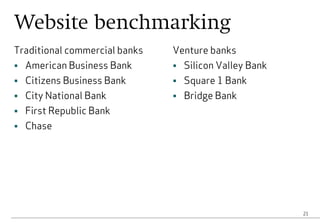
Website benchmarking
Traditional commercial banks
 American Business Bank
 Citizens Business Bank
 City National Bank
 First Republic Bank
 Chase
Venture banks
 Silicon Valley Bank
 Square 1 Bank
 Bridge Bank
22
Website benchmarking
Case study
Sample from competitor website benchmarking
23
Website benchmarking
Case study
Sample from competitor website benchmarking
24
Rinse and repeat
25
It’s a short half life
 Even if you get it, competitor advantage
typically fades
 Sustaining advantage in the face of
competitive dynamics requires constant
monitoring… awareness… anticipation.
Prepared by:
Jill Stephens
Vice President
Baker Brand Communications
@jillstephens

Slideshare competitor benchmarking

  • 1.
    0 The role ofcompetitor research in corporate branding and design Summer 2013 Know the competition
  • 2.
    1 Good to know The enemy (competition)  Yourself  The terrain (environment) Hence the saying: If you know the enemy and you know yourself, your victory will not stand in doubt; if you now Heaven and you know Earth, you may make your victory complete.  Sun Tzu’s Art of War
  • 3.
    2 Modern day capitalism=ancientwarfare?  Uncontrolled environment  Conditions change  Competitive dynamics  Requires quick and appropriate responses
  • 4.
    3 Job one As afirst step in large scale engagement, it is important to look at the competitive landscape. Ensures the ultimate end product is unique and engaging.
  • 5.
    4 Provides frame ofreference Where you compete  Market  Landscape  Context
  • 6.
    5 Within this context… How do you position yourself?  Where do you excel?  What is comparable?  What do others do better?  What makes you uniquely you?
  • 7.
    6 What can youlearn?  Valuable intelligence  Best practices  Pitfalls
  • 8.
    7 The who, what,when, where, why, and how…
  • 9.
    8 Who Hire a proand benefit from their expertise, insights and fresh perspective. Limit scope and scale as needed to keep costs down. Your involvement is key, but a full-fledged DIY approach is time-consuming and may shortchange the final product.
  • 10.
    9 What Typically, assess nomore than five competitors. Execs get information overload after that.
  • 11.
    10 When Early on inplanning/discovery phase. Knowing where others stake a claim, how they express themselves, etc., helps define constraints for the effort at hand.
  • 12.
    11 Where (information sources) Company-generated Website content  Investor communications  Advertising  Public relations  Social media  Etc.
  • 13.
    12 Where (information sources) Secondarysources  Social media  Company reviews: Glassdoor, CareerBliss  Paid sources (Forrester, Gartner, etc.)* Primary research* * Paid sources and primary research (e.g., interviews, focus groups) are high cost; used when budget is extensive and brand is high value and high stakes.
  • 14.
    13 Why Oh, the thingsyou’ll learn…  Relative position: strengths, weaknesses, opportunities, threats  Marketing, sales, operations, HR, tactics  Audience interaction  Visual, verbal expression  Quick problem analysis, solving
  • 15.
  • 16.
  • 17.
    16 Background  Regional commercialbank (southern California, Arizona)  Acquired 10 banks since its inception in 2010, growing from a startup to $2.2 billion in assets.  Opened startup banking division in 2013  Seeking to refresh the brand and website in an effort to address the challenges and capitalize on the fresh opportunities that come with such explosive growth.
  • 18.
    17 Competitor positioning audit Snapshotof how competitor banks position themselves: Traditional commercial banks  American Business Bank  City National Bank  First Republic Bank Venture banks  Silicon Valley Bank  Square 1 Bank
  • 19.
    18 Competitor positioning audit Casestudy Sample from competitor positioning audit: competitor bank
  • 20.
    19 Competitor positioning audit Casestudy Sample from competitor positioning audit: competitor bank
  • 21.
    20 Website benchmarking  Afterbrand research and development, ready to refresh web design to reflect updated brand.  Competitive study with different evaluation criteria, e.g.: • Target user groups • Navigation scheme • Noteworthy content /functionality • Social media, mobile presence • Imagery and messaging style • Etc.
  • 22.
    21 Website benchmarking Traditional commercialbanks  American Business Bank  Citizens Business Bank  City National Bank  First Republic Bank  Chase Venture banks  Silicon Valley Bank  Square 1 Bank  Bridge Bank
  • 23.
    22 Website benchmarking Case study Samplefrom competitor website benchmarking
  • 24.
    23 Website benchmarking Case study Samplefrom competitor website benchmarking
  • 25.
  • 26.
    25 It’s a shorthalf life  Even if you get it, competitor advantage typically fades  Sustaining advantage in the face of competitive dynamics requires constant monitoring… awareness… anticipation.
  • 27.
    Prepared by: Jill Stephens VicePresident Baker Brand Communications @jillstephens