INTRODUCTION
 TO
PRESENTATION
TOPIC
 BIOGRAPHICAL BACKGROUND
 OF
 ALEXANDER POPE

•HISLIFE
•FAMILY
•RELIGION
•MARITAL STATUS
•EDUCATION
EDUCATION
As Spence says,
  “In some respects for not having a
 regular education, he read originally
 for the sense, whereas we are
 taught for so many years to read
 only for words”
HIS WORKS

 Heroic Couplet
 Translation of Homer
 Satire
 Essay On Criticism
 Essay On Man
 The Rape Of The Lock
 Pastorals
 Universal Prayer (Religious
  Poem)
HIS CONTEMPORARIES


 SWIFT
 ARBUTHNOT
 GAY
 BOLINGBROKE
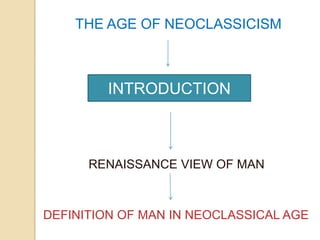
THE AGE OF NEOCLASSICISM


         INTRODUCTION


      RENAISSANCE VIEW OF MAN


DEFINITION OF MAN IN NEOCLASSICAL AGE
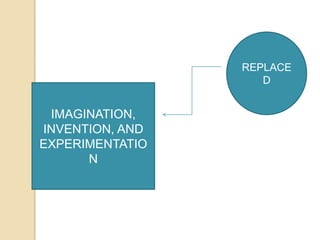
REPLACE
                    D


 IMAGINATION,
INVENTION, AND
EXPERIMENTATIO
      N
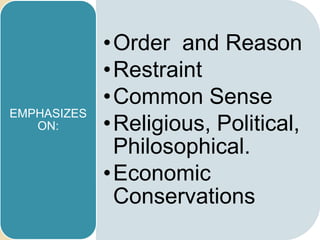
• Order and Reason
             • Restraint
             • Common Sense
EMPHASIZES
   ON:       • Religious, Political,
               Philosophical.
             • Economic
               Conservations
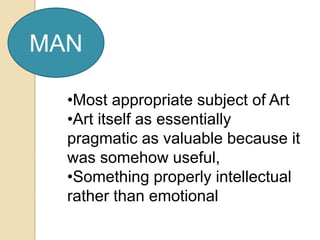
MAN

  •Most appropriate subject of Art
  •Art itself as essentially
  pragmatic as valuable because it
  was somehow useful,
  •Something properly intellectual
  rather than emotional
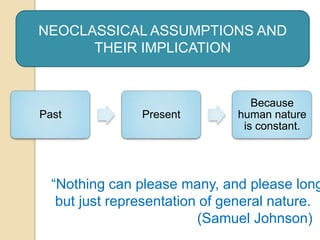
NEOCLASSICAL ASSUMPTIONS AND
      THEIR IMPLICATION


                                  Because
Past            Present        human nature
                                is constant.


  “Nothing can please many, and please long
   but just representation of general nature.
                          (Samuel Johnson)
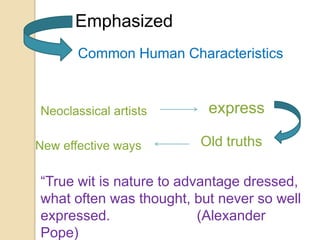
Emphasized
       Common Human Characteristics


Neoclassical artists      express

New effective ways       Old truths

“True wit is nature to advantage dressed,
what often was thought, but never so well
expressed.                (Alexander
Pope)
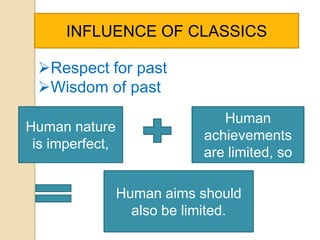
INFLUENCE OF CLASSICS

 Respect for past
 Wisdom of past
                                Human
Human nature
                             achievements
 is imperfect,
                             are limited, so

                 Human aims should
                   also be limited.
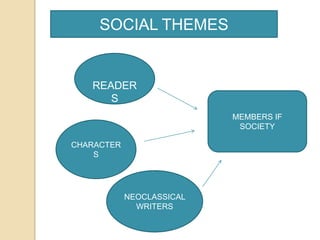
SOCIAL THEMES


   READER
      S
                           MEMBERS IF
                            SOCIETY

CHARACTER
    S


            NEOCLASSICAL
              WRITERS
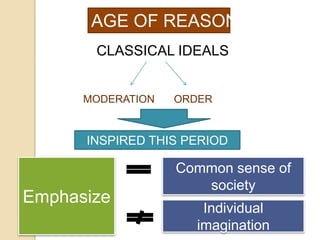
AGE OF REASON
       CLASSICAL IDEALS


      MODERATION   ORDER


      INSPIRED THIS PERIOD

                   Common sense of
                      society
Emphasize
                       Individual
                      imagination
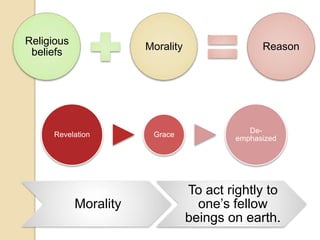
REASON

Traditionally assumed to be
 the highest mental faculty,
But, considered it as a
 sufficient guide by many
 thinkers of this period.
Religious
                       Morality                 Reason
 beliefs


                                             De-
     Revelation         Grace
                                          emphasized


                                  To act rightly to
            Morality                one‟s fellow
                                  beings on earth.
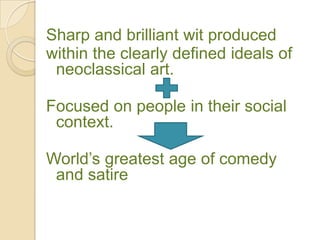
Sharp and brilliant wit produced
within the clearly defined ideals of
 neoclassical art.

Focused on people in their social
 context.

World‟s greatest age of comedy
 and satire
THEOLOGY OF
 EIGHTEENTH
   CENTURY
POPE‟S RELIGIOUS
THINKING
 His  religious thinking is prominent
  in his poetry.
 His poem “Essay On Man” shows
  his theology which is influenced
  by seventeenth century
  philosophers.
 And “Universal Prayer” is said to
  be “short companion to the poem”
ESSAY ON MAN
   It is a philosophical poem.
 Itis written in heroic couplets,
 published between 1732 and
  1734.
 Pope intended this poem to be
  the centerpiece of a proposed
  system of ethics that was to be
  put forth in poetic form.
THEOLOGICAL CONCEPTS IN
THE POEM “ESSAY ON MAN”
 Anthropocentric  Worldview
 The Great Chain of Being
 Natural Laws
 Principle Of Plenitude
 Deism
 Characteristics Of Deism
ANTHROPOCENTRIC
    WORLDVIEW

 This   view regards humankind as
  centre of existence.
 It is a world view that considers
  humans to be the most important
  factor and value in the universe.
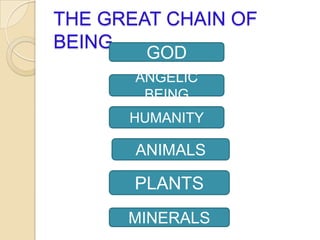
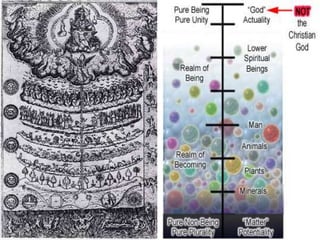
THE GREAT CHAIN OF
BEING
        GOD
       ANGELIC
        BEING
      HUMANITY

       ANIMALS

       PLANTS
      MINERALS
NATURAL LAWS
 Universe   as a whole is a perfect
  work of God.
 Pope says that no matter how
  imperfect, complex, inscrutable
  and disturbing the Universe
  appears to be,
 it functions in a rational fashion
  according to the natural laws.
PRINCIPLE OF PLENITUDE
 Plenitude  means fullness,
  abundance, completeness.
 To humans it appears to be evil
  and imperfect in many ways;
 however, Pope points out that this
  is due to our limited mindset and
  limited intellectual capacity.
Now the question arises that, if our mind has
limited intellectual capacity, than what is the
            message behind this?
Pope gets the message across that humans
  must accept their position in the "Great
 Chain of Being" which is at a middle stage
 between the angels and the beasts of the
world. If we are able to accomplish this then
    we potentially could lead happy and
                virtuous lives
Deism is a religious philosophy
became prominent in 17th and 18th
century.
• It holds that reason and observation of the
  natural world.

It can determine that the universe is
the product of an all powerful creator.
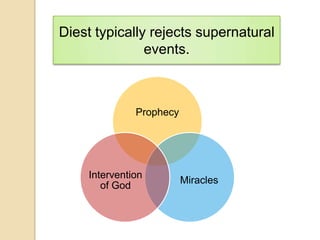
Diest typically rejects supernatural
               events.


              Prophecy


    Intervention
                         Miracles
       of God
Characteristics Of Deism
 Concept  of reason.
 Argument for the existence of
  God.
 Deist mission.
 Freedom and Necessity
 Belief about immortality of the
  soul.
 Deist terminology.
UNIVERSAL PRAYER
EXPLANATION OF THE POEM AND CRITICAL
             ANALYSIS
Significance of the title.
• Stylistic features.

Main theme.
• Figurative language
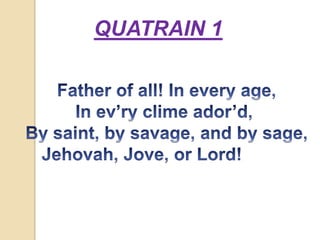
QUATRAIN 1
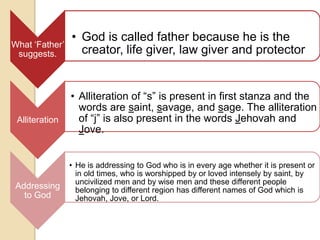
• God is called father because he is the
What „Father‟
 suggests.        creator, life giver, law giver and protector


                • Alliteration of “s” is present in first stanza and the
                  words are saint, savage, and sage. The alliteration
 Alliteration     of “j” is also present in the words Jehovah and
                  Jove.


                • He is addressing to God who is in every age whether it is present or
                  in old times, who is worshipped by or loved intensely by saint, by
                  uncivilized men and by wise men and these different people
 Addressing       belonging to different region has different names of God which is
   to God         Jehovah, Jove, or Lord.
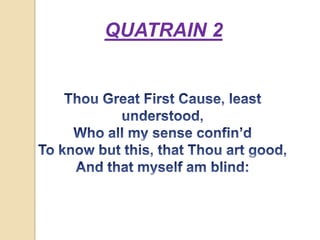
QUATRAIN 2
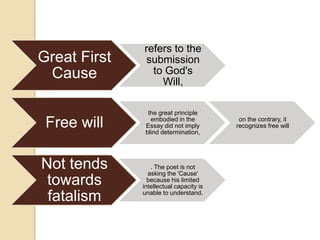
refers to the
Great First    submission
 Cause          to God's
                  Will,

                the great principle

 Free will       embodied in the
               Essay did not imply
               blind determination,
                                          on the contrary, it
                                         recognizes free will


Not tends        . The poet is not
                asking the 'Cause'
 towards        because his limited
              intellectual capacity is

 fatalism     unable to understand.
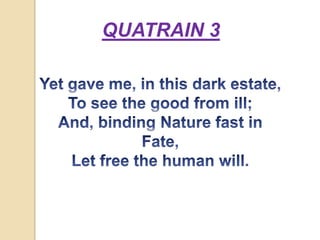
QUATRAIN 3
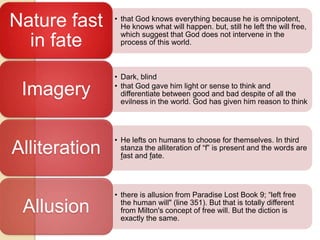
Nature fast    • that God knows everything because he is omnipotent,
                 He knows what will happen. but, still he left the will free,
                 which suggest that God does not intervene in the
  in fate        process of this world.


               • Dark, blind

 Imagery       • that God gave him light or sense to think and
                 differentiate between good and bad despite of all the
                 evilness in the world. God has given him reason to think


               • He lefts on humans to choose for themselves. In third
Alliteration     stanza the alliteration of “f” is present and the words are
                 fast and fate.


               • there is allusion from Paradise Lost Book 9; “left free

 Allusion        the human will" (line 351). But that is totally different
                 from Milton's concept of free will. But the diction is
                 exactly the same.
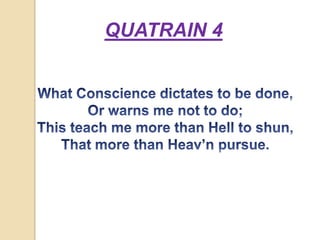
QUATRAIN 4
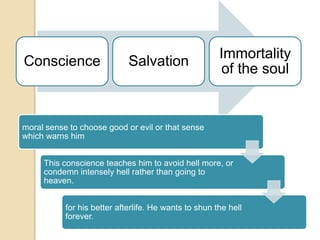
Immortality
Conscience                   Salvation
                                                       of the soul


moral sense to choose good or evil or that sense
which warns him


     This conscience teaches him to avoid hell more, or
     condemn intensely hell rather than going to
     heaven.


           for his better afterlife. He wants to shun the hell
           forever.
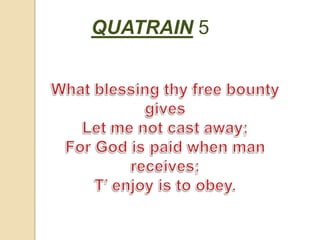
QUATRAIN 5
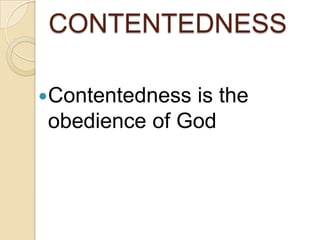
CONTENTEDNESS

Contentednessis the
obedience of God
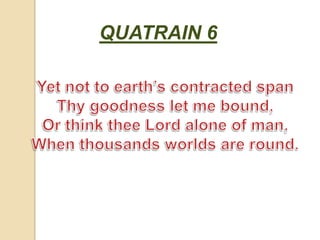
QUATRAIN 6
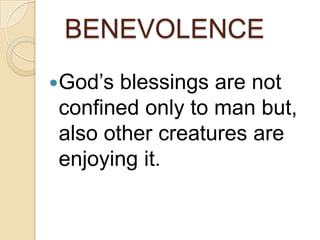
BENEVOLENCE
God‟s blessings are not
confined only to man but,
also other creatures are
enjoying it.
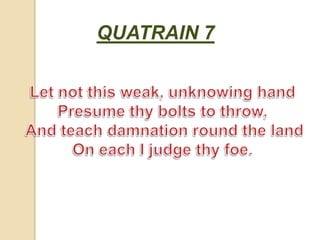
QUATRAIN 7
DAMNATION
God deals damnation
around the land on
each foe of God that
He judges.
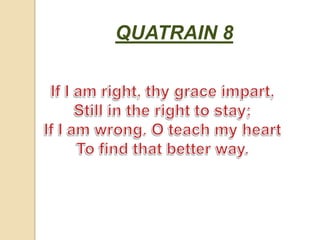
QUATRAIN 8
GOD‟S GRACE
 Pope evidently believes
 that grace should more
 probably be associated with
 the sinner/non-believer of
 God than the righteous
 person.
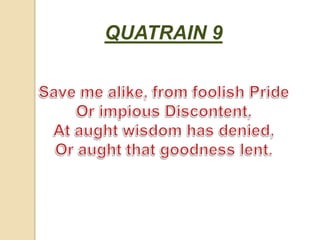
QUATRAIN 9
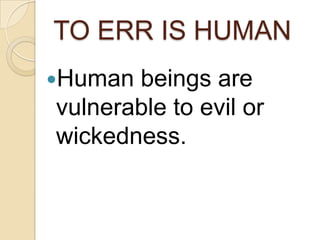
TO ERR IS HUMAN
Human beings are
vulnerable to evil or
wickedness.
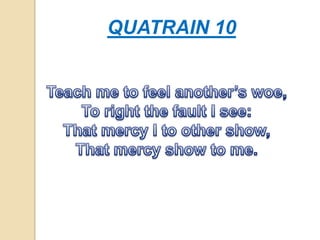
QUATRAIN 10
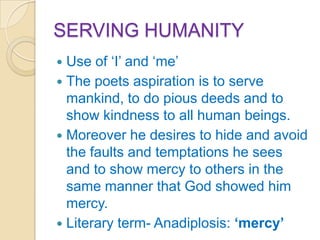
SERVING HUMANITY
 Use of „I‟ and „me‟
 The poets aspiration is to serve
  mankind, to do pious deeds and to
  show kindness to all human beings.
 Moreover he desires to hide and avoid
  the faults and temptations he sees
  and to show mercy to others in the
  same manner that God showed him
  mercy.
 Literary term- Anadiplosis: ‘mercy’
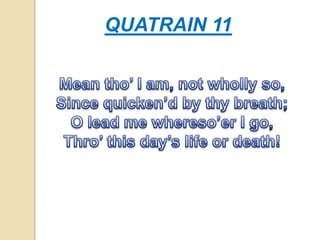
QUATRAIN 11
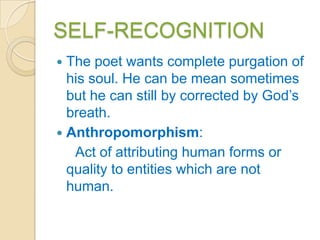
SELF-RECOGNITION
 The poet wants complete purgation of
  his soul. He can be mean sometimes
  but he can still by corrected by God‟s
  breath.
 Anthropomorphism:
   Act of attributing human forms or
  quality to entities which are not
  human.
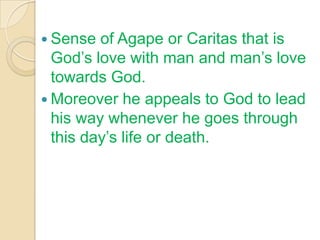
 Sense  of Agape or Caritas that is
  God‟s love with man and man‟s love
  towards God.
 Moreover he appeals to God to lead
  his way whenever he goes through
  this day‟s life or death.
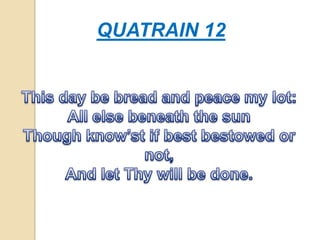
QUATRAIN 12
PROSPERITY AND FAITH
 The   poet‟s ultimate wish is to
  have his daily bread and
  peace to his soul.
 Alliteration:
 “Though know‟st if best
  bestowed or not”
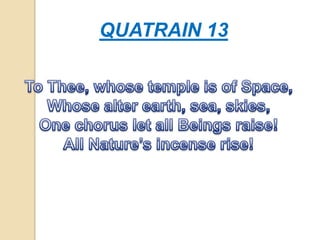
QUATRAIN 13
GOD‟S GREATNESS
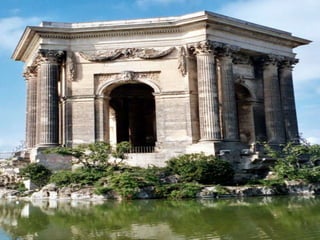
 Almighty   God whose temple
  occupies all the space, whose
  altar includes the earth, sea and
  skies so,
 He says let all the living beings
  raise up their voices and shouts of
  praise to God.
 Imagery:
 temple, earth, sea and sky.
CONCLUSION

Slides of Universal Prayer

  • 1.
  • 4.
    TOPIC BIOGRAPHICAL BACKGROUND OF ALEXANDER POPE •HISLIFE •FAMILY •RELIGION •MARITAL STATUS •EDUCATION
  • 5.
    EDUCATION As Spence says, “In some respects for not having a regular education, he read originally for the sense, whereas we are taught for so many years to read only for words”
  • 6.
    HIS WORKS  HeroicCouplet  Translation of Homer  Satire
  • 7.
     Essay OnCriticism  Essay On Man  The Rape Of The Lock  Pastorals  Universal Prayer (Religious Poem)
  • 8.
    HIS CONTEMPORARIES  SWIFT ARBUTHNOT  GAY  BOLINGBROKE
  • 10.
    THE AGE OFNEOCLASSICISM INTRODUCTION RENAISSANCE VIEW OF MAN DEFINITION OF MAN IN NEOCLASSICAL AGE
  • 11.
    REPLACE D IMAGINATION, INVENTION, AND EXPERIMENTATIO N
  • 12.
    • Order andReason • Restraint • Common Sense EMPHASIZES ON: • Religious, Political, Philosophical. • Economic Conservations
  • 13.
    MAN •Mostappropriate subject of Art •Art itself as essentially pragmatic as valuable because it was somehow useful, •Something properly intellectual rather than emotional
  • 14.
    NEOCLASSICAL ASSUMPTIONS AND THEIR IMPLICATION Because Past Present human nature is constant. “Nothing can please many, and please long but just representation of general nature. (Samuel Johnson)
  • 15.
    Emphasized Common Human Characteristics Neoclassical artists express New effective ways Old truths “True wit is nature to advantage dressed, what often was thought, but never so well expressed. (Alexander Pope)
  • 16.
    INFLUENCE OF CLASSICS Respect for past Wisdom of past Human Human nature achievements is imperfect, are limited, so Human aims should also be limited.
  • 17.
    SOCIAL THEMES READER S MEMBERS IF SOCIETY CHARACTER S NEOCLASSICAL WRITERS
  • 18.
    AGE OF REASON CLASSICAL IDEALS MODERATION ORDER INSPIRED THIS PERIOD Common sense of society Emphasize Individual imagination
  • 19.
    REASON Traditionally assumed tobe the highest mental faculty, But, considered it as a sufficient guide by many thinkers of this period.
  • 20.
    Religious Morality Reason beliefs De- Revelation Grace emphasized To act rightly to Morality one‟s fellow beings on earth.
  • 21.
    Sharp and brilliantwit produced within the clearly defined ideals of neoclassical art. Focused on people in their social context. World‟s greatest age of comedy and satire
  • 22.
  • 23.
    POPE‟S RELIGIOUS THINKING  His religious thinking is prominent in his poetry.  His poem “Essay On Man” shows his theology which is influenced by seventeenth century philosophers.  And “Universal Prayer” is said to be “short companion to the poem”
  • 24.
    ESSAY ON MAN  It is a philosophical poem.  Itis written in heroic couplets,  published between 1732 and 1734.  Pope intended this poem to be the centerpiece of a proposed system of ethics that was to be put forth in poetic form.
  • 25.
    THEOLOGICAL CONCEPTS IN THEPOEM “ESSAY ON MAN”  Anthropocentric Worldview  The Great Chain of Being  Natural Laws  Principle Of Plenitude  Deism  Characteristics Of Deism
  • 26.
    ANTHROPOCENTRIC WORLDVIEW  This view regards humankind as centre of existence.  It is a world view that considers humans to be the most important factor and value in the universe.
  • 27.
    THE GREAT CHAINOF BEING GOD ANGELIC BEING HUMANITY ANIMALS PLANTS MINERALS
  • 29.
    NATURAL LAWS  Universe as a whole is a perfect work of God.  Pope says that no matter how imperfect, complex, inscrutable and disturbing the Universe appears to be,  it functions in a rational fashion according to the natural laws.
  • 30.
    PRINCIPLE OF PLENITUDE Plenitude means fullness, abundance, completeness.  To humans it appears to be evil and imperfect in many ways;  however, Pope points out that this is due to our limited mindset and limited intellectual capacity.
  • 31.
    Now the questionarises that, if our mind has limited intellectual capacity, than what is the message behind this?
  • 32.
    Pope gets themessage across that humans must accept their position in the "Great Chain of Being" which is at a middle stage between the angels and the beasts of the world. If we are able to accomplish this then we potentially could lead happy and virtuous lives
  • 33.
    Deism is areligious philosophy became prominent in 17th and 18th century. • It holds that reason and observation of the natural world. It can determine that the universe is the product of an all powerful creator.
  • 34.
    Diest typically rejectssupernatural events. Prophecy Intervention Miracles of God
  • 35.
    Characteristics Of Deism Concept of reason.  Argument for the existence of God.  Deist mission.  Freedom and Necessity  Belief about immortality of the soul.  Deist terminology.
  • 36.
    UNIVERSAL PRAYER EXPLANATION OFTHE POEM AND CRITICAL ANALYSIS
  • 37.
    Significance of thetitle. • Stylistic features. Main theme. • Figurative language
  • 38.
  • 39.
    • God iscalled father because he is the What „Father‟ suggests. creator, life giver, law giver and protector • Alliteration of “s” is present in first stanza and the words are saint, savage, and sage. The alliteration Alliteration of “j” is also present in the words Jehovah and Jove. • He is addressing to God who is in every age whether it is present or in old times, who is worshipped by or loved intensely by saint, by uncivilized men and by wise men and these different people Addressing belonging to different region has different names of God which is to God Jehovah, Jove, or Lord.
  • 40.
  • 41.
    refers to the GreatFirst submission Cause to God's Will, the great principle Free will embodied in the Essay did not imply blind determination, on the contrary, it recognizes free will Not tends . The poet is not asking the 'Cause' towards because his limited intellectual capacity is fatalism unable to understand.
  • 42.
  • 43.
    Nature fast • that God knows everything because he is omnipotent, He knows what will happen. but, still he left the will free, which suggest that God does not intervene in the in fate process of this world. • Dark, blind Imagery • that God gave him light or sense to think and differentiate between good and bad despite of all the evilness in the world. God has given him reason to think • He lefts on humans to choose for themselves. In third Alliteration stanza the alliteration of “f” is present and the words are fast and fate. • there is allusion from Paradise Lost Book 9; “left free Allusion the human will" (line 351). But that is totally different from Milton's concept of free will. But the diction is exactly the same.
  • 44.
  • 45.
    Immortality Conscience Salvation of the soul moral sense to choose good or evil or that sense which warns him This conscience teaches him to avoid hell more, or condemn intensely hell rather than going to heaven. for his better afterlife. He wants to shun the hell forever.
  • 46.
  • 47.
  • 48.
  • 49.
    BENEVOLENCE God‟s blessings arenot confined only to man but, also other creatures are enjoying it.
  • 50.
  • 51.
    DAMNATION God deals damnation aroundthe land on each foe of God that He judges.
  • 52.
  • 53.
    GOD‟S GRACE  Popeevidently believes that grace should more probably be associated with the sinner/non-believer of God than the righteous person.
  • 54.
  • 55.
    TO ERR ISHUMAN Human beings are vulnerable to evil or wickedness.
  • 56.
  • 57.
    SERVING HUMANITY  Useof „I‟ and „me‟  The poets aspiration is to serve mankind, to do pious deeds and to show kindness to all human beings.  Moreover he desires to hide and avoid the faults and temptations he sees and to show mercy to others in the same manner that God showed him mercy.  Literary term- Anadiplosis: ‘mercy’
  • 58.
  • 59.
    SELF-RECOGNITION  The poetwants complete purgation of his soul. He can be mean sometimes but he can still by corrected by God‟s breath.  Anthropomorphism: Act of attributing human forms or quality to entities which are not human.
  • 60.
     Sense of Agape or Caritas that is God‟s love with man and man‟s love towards God.  Moreover he appeals to God to lead his way whenever he goes through this day‟s life or death.
  • 61.
  • 62.
    PROSPERITY AND FAITH The poet‟s ultimate wish is to have his daily bread and peace to his soul.  Alliteration: “Though know‟st if best bestowed or not”
  • 63.
  • 64.
    GOD‟S GREATNESS  Almighty God whose temple occupies all the space, whose altar includes the earth, sea and skies so,  He says let all the living beings raise up their voices and shouts of praise to God.  Imagery: temple, earth, sea and sky.
  • 66.