Editoril Cartooning
Querino D. Lonsagon
Editorial Cartooning
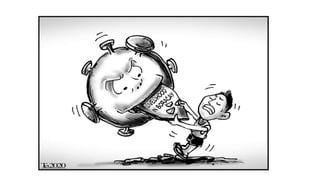
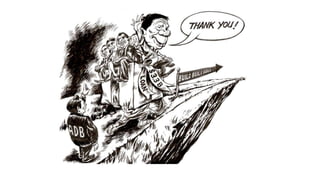
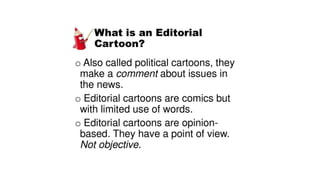
- , also known as a political cartoon, is an illustration
containing a commentary that usually relates to current
events or personalities. An artist who draws such images is
known as an editorial cartoonist. - www.en.wikipedia.org
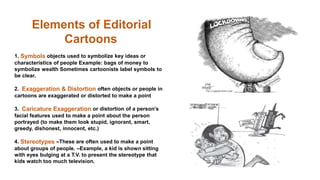
Elements of Editorial
Cartoons
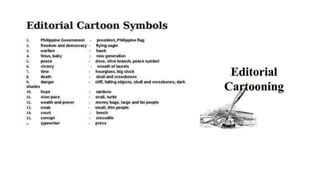
1. Symbols objects used to symbolize key ideas or
characteristics of people Example: bags of money to
symbolize wealth Sometimes cartoonists label symbols to
be clear.
2. Exaggeration & Distortion often objects or people in
cartoons are exaggerated or distorted to make a point
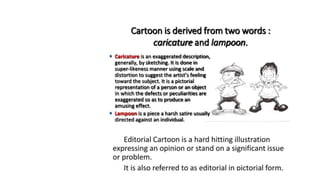
3. Caricature Exaggeration or distortion of a person’s
facial features used to make a point about the person
portrayed (to make them look stupid, ignorant, smart,
greedy, dishonest, innocent, etc.)
4. Stereotypes –These are often used to make a point
about groups of people. –Example, a kid is shown sitting
with eyes bulging at a T.V. to present the stereotype that
kids watch too much television.
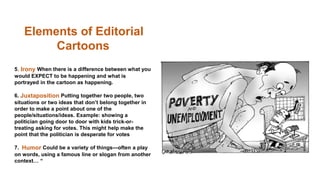
Elements of Editorial
Cartoons
5. Irony When there is a difference between what you
would EXPECT to be happening and what is
portrayed in the cartoon as happening.
6. Juxtaposition Putting together two people, two
situations or two ideas that don’t belong together in
order to make a point about one of the
people/situations/ideas. Example: showing a
politician going door to door with kids trick-or-
treating asking for votes. This might help make the
point that the politician is desperate for votes
7. Humor Could be a variety of things—often a play
on words, using a famous line or slogan from another
context… “
Thank you so much for the opportunity.

Editorial Cartooning.pptx

  • 2.
  • 5.
    Editorial Cartooning - ,also known as a political cartoon, is an illustration containing a commentary that usually relates to current events or personalities. An artist who draws such images is known as an editorial cartoonist. - www.en.wikipedia.org
  • 8.
    Elements of Editorial Cartoons 1.Symbols objects used to symbolize key ideas or characteristics of people Example: bags of money to symbolize wealth Sometimes cartoonists label symbols to be clear. 2. Exaggeration & Distortion often objects or people in cartoons are exaggerated or distorted to make a point 3. Caricature Exaggeration or distortion of a person’s facial features used to make a point about the person portrayed (to make them look stupid, ignorant, smart, greedy, dishonest, innocent, etc.) 4. Stereotypes –These are often used to make a point about groups of people. –Example, a kid is shown sitting with eyes bulging at a T.V. to present the stereotype that kids watch too much television.
  • 9.
    Elements of Editorial Cartoons 5.Irony When there is a difference between what you would EXPECT to be happening and what is portrayed in the cartoon as happening. 6. Juxtaposition Putting together two people, two situations or two ideas that don’t belong together in order to make a point about one of the people/situations/ideas. Example: showing a politician going door to door with kids trick-or- treating asking for votes. This might help make the point that the politician is desperate for votes 7. Humor Could be a variety of things—often a play on words, using a famous line or slogan from another context… “
  • 20.
    Thank you somuch for the opportunity.