Knowledge of the
     Holy
Knowledge of the
     Holy
   Why Study God’s Attributes?
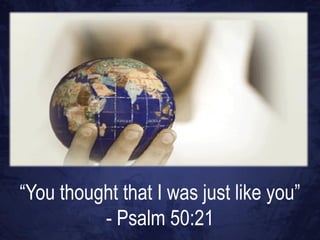
“You thought that I was just like you”
          - Psalm 50:21
What is an Attribute of God?


     “He in condescending love has by revelation declared certain
        things to be true of Himself. These we call His attributes.”
                                                     - A. W. Tozer

  “By „attribute‟ is meant some characteristic that can be attributed
                         to God‟s nature – an essential trait of God.”
                                                   - Norman Geisler
Why Study the Attributes of God?
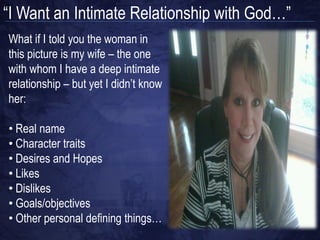
“I Want an Intimate Relationship with God…”
What if I told you the woman in
this picture is my wife – the one
with whom I have a deep intimate
relationship – but yet I didn‟t know
her:

• Real name
• Character traits
• Desires and Hopes
• Likes
• Dislikes
• Goals/objectives
• Other personal defining things…
All Theological Truth Depends on God‟s Attributes


• Creation – depends on God‟s attributes of eternality,
  omnipotence, aseity, necessity, actuality, etc.
• Soteriology (study of Salvation) – depends on God‟s attributes
  of justice, love, mercy, sovereignty, righteousness, holiness,
  etc.
• Eschatology (study of the End Times) – depends on God‟s
  attributes of omniscience, omnipotence, truthfulness, wrath,
  etc.
“Ignorance of God-ignorance
      both of his ways and of the
practice of communion with him-
   lies at the root of much of the
      church‟s weakness today.”
                      - J. I. Packer
Must know the True God to Recognize Fake gods


• “For many days Israel was without the true God and without a
  teaching priest and without law” (2 Chron. 15:3)
• “But the LORD is the true God; He is the living God and the
  everlasting King” (Jer. 10:9)
• “A man does not call a line crooked unless he has some idea
  of a straight line.” – C. S. Lewis
• “Little children, guard yourselves from idols” (1 John 5:21)
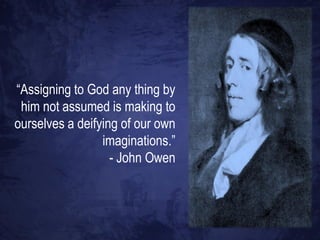
“Assigning to God any thing by
 him not assumed is making to
ourselves a deifying of our own
                 imaginations.”
                   - John Owen
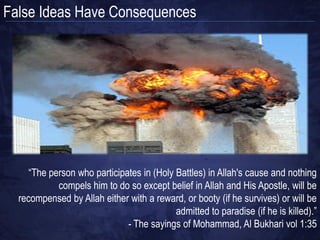
False Ideas Have Consequences


     “The person who participates in (Holy Battles) in Allah's cause and nothing
            compels him to do so except belief in Allah and His Apostle, will be
  recompensed by Allah either with a reward, or booty (if he survives) or will be
                                           admitted to paradise (if he is killed).”
                              - The sayings of Mohammad, Al Bukhari vol 1:35
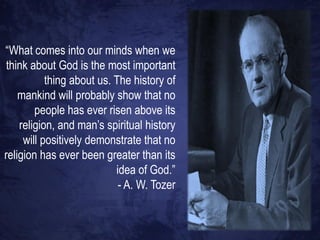
“What comes into our minds when we
 think about God is the most important
           thing about us. The history of
    mankind will probably show that no
        people has ever risen above its
    religion, and man‟s spiritual history
     will positively demonstrate that no
religion has ever been greater than its
                           idea of God.”
                            - A. W. Tozer
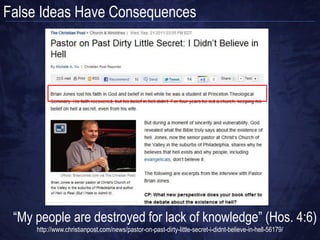
False Ideas Have Consequences


 “My people are destroyed for lack of knowledge” (Hos. 4:6)
False Ideas Have Consequences


 “My people are destroyed for lack of knowledge” (Hos. 4:6)
     http://www.christianpost.com/news/pastor-on-past-dirty-little-secret-i-didnt-believe-in-hell-56179/
Spiritual Maturity Depends on a Right Concept of God

• “For I testify about them that they have a zeal for God, but not in accordance
  with knowledge.” (Rom. 10:2)
• “And He gave some as apostles, and some as prophets, and some as
  evangelists, and some as pastors and teachers, for the equipping of the
  saints for the work of service, to the building up of the body of Christ; until we
  all attain to the unity of the faith, and of the knowledge of the Son of God, to a
  mature man, to the measure of the stature which belongs to the fullness of
  Christ. As a result, we are no longer to be children, tossed here and there by
  waves and carried about by every wind of doctrine, by the trickery of men, by
  craftiness in deceitful scheming; but speaking the truth in love, we are to
  grow up in all aspects into Him who is the head, even Christ, from whom the
  whole body, being fitted and held together by what every joint supplies,
  according to the proper working of each individual part, causes the growth of
  the body for the building up of itself in love.” (Ephesians 4:11–16)
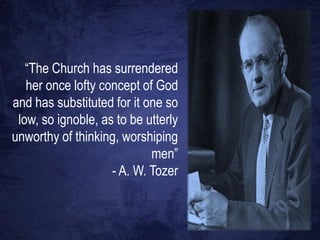
“The Church has surrendered
   her once lofty concept of God
and has substituted for it one so
 low, so ignoble, as to be utterly
unworthy of thinking, worshiping
                            men”
                    - A. W. Tozer
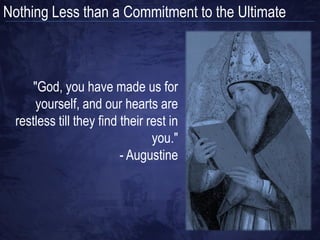
Nothing Less than a Commitment to the Ultimate


     "God, you have made us for
      yourself, and our hearts are
 restless till they find their rest in
                                you."
                         - Augustine
Questions on the Attributes of God
How Can God be One and Have Many Attributes?


• How can a God who is absolutely
  one have many attributes? Doesn‟t
  this violate the concept of God
  being one?
• Answer: there may be many things
  said about one thing, but yet it is
  still one
• A single rock can be smooth,
  round, gray, etc.
How Many Attributes does God Have?

• Different theologians ascribe
  different numbers of attributes to
  God
• Some combine attributes together
  to form one characteristic
• They can be broken up into
  Metaphysical attributes (non-moral)
  and Moral attributes
How Many Attributes does God Have?
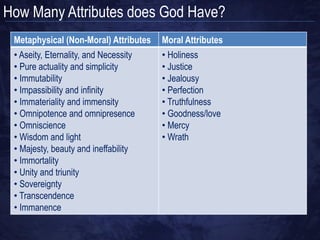
 Metaphysical (Non-Moral) Attributes   Moral Attributes
 • Aseity, Eternality, and Necessity   • Holiness
 • Pure actuality and simplicity       • Justice
 • Immutability                        • Jealousy
 • Impassibility and infinity          • Perfection
 • Immateriality and immensity         • Truthfulness
 • Omnipotence and omnipresence        • Goodness/love
 • Omniscience                         • Mercy
 • Wisdom and light                    • Wrath
 • Majesty, beauty and ineffability
 • Immortality
 • Unity and triunity
 • Sovereignty
 • Transcendence
 • Immanence
Why are Many Attributes of God “Negative”

• God is “infinite” (not finite)
• God is “Immutable” (not
  changeable)
• God is “indivisible” (not divisible)
• The negative aspect of some of
  God‟s attributes is to ensure the
  finitude is removed
• The negation removes any
  limitation from God
How can We Speak about God‟s Attributes?

• Univocally – ascribe an attribute in
  exactly the same way as with us.
  You can‟t describe an infinite being
  in the same way as a finite being
• Equivocally – ascribe an attribute in
  an exactly different way than with
  us. This would leave us completely
  in the dark about God
• Analogically – ascribe an attribute
  in a similar way as with us. This is
  the only meaningful way open to us
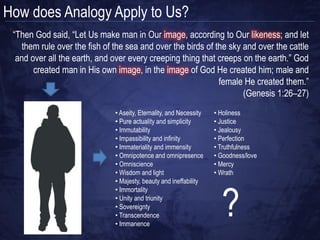
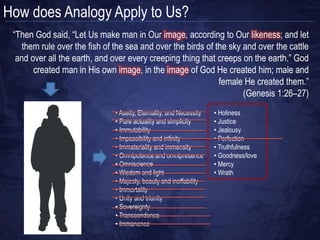
How does Analogy Apply to Us?
 “Then God said, “Let Us make man in Our image, according to Our likeness; and let
    them rule over the fish of the sea and over the birds of the sky and over the cattle
  and over all the earth, and over every creeping thing that creeps on the earth.” God
       created man in His own image, in the image of God He created him; male and
                                                              female He created them.”
                                                                     (Genesis 1:26–27)
                               • Aseity, Eternality, and Necessity   • Holiness
                               • Pure actuality and simplicity       • Justice
                               • Immutability                        • Jealousy
                               • Impassibility and infinity          • Perfection
                               • Immateriality and immensity         • Truthfulness
                               • Omnipotence and omnipresence        • Goodness/love
                               • Omniscience                         • Mercy
                               • Wisdom and light                    • Wrath
                               • Majesty, beauty and ineffability


                                                                       ?
                               • Immortality
                               • Unity and triunity
                               • Sovereignty
                               • Transcendence
                               • Immanence
How does Analogy Apply to Us?


            “Man was made in God‟s image (ṣelem) and likeness (dĕmût) which is then
     explained as his having dominion over God‟s creation as vice-regent. Ps 8:5–8 is
 similar citing man‟s God-given glory, honor and rule. God‟s image obviously does not
       consist in man‟s body which was formed from earthly matter, but in his spiritual,
             intellectual, moral likeness to God from whom his animating breath came.”
                                            - Theological Wordbook of the Old Testament
How does Analogy Apply to Us?
 “Then God said, “Let Us make man in Our image, according to Our likeness; and let
    them rule over the fish of the sea and over the birds of the sky and over the cattle
  and over all the earth, and over every creeping thing that creeps on the earth.” God
       created man in His own image, in the image of God He created him; male and
                                                              female He created them.”
                                                                     (Genesis 1:26–27)
                               • Aseity, Eternality, and Necessity   • Holiness
                               • Pure actuality and simplicity       • Justice
                               • Immutability                        • Jealousy
                               • Impassibility and infinity          • Perfection
                               • Immateriality and immensity         • Truthfulness
                               • Omnipotence and omnipresence        • Goodness/love
                               • Omniscience                         • Mercy
                               • Wisdom and light                    • Wrath
                               • Majesty, beauty and ineffability
                               • Immortality
                               • Unity and triunity
                               • Sovereignty
                               • Transcendence
                               • Immanence
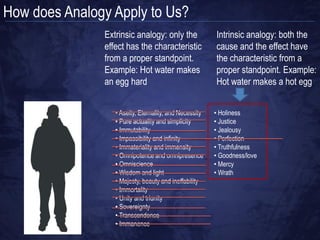
How does Analogy Apply to Us?
               Extrinsic analogy: only the              Intrinsic analogy: both the
               effect has the characteristic            cause and the effect have
               from a proper standpoint.                the characteristic from a
               Example: Hot water makes                 proper standpoint. Example:
               an egg hard                              Hot water makes a hot egg


                  • Aseity, Eternality, and Necessity   • Holiness
                  • Pure actuality and simplicity       • Justice
                  • Immutability                        • Jealousy
                  • Impassibility and infinity          • Perfection
                  • Immateriality and immensity         • Truthfulness
                  • Omnipotence and omnipresence        • Goodness/love
                  • Omniscience                         • Mercy
                  • Wisdom and light                    • Wrath
                  • Majesty, beauty and ineffability
                  • Immortality
                  • Unity and triunity
                  • Sovereignty
                  • Transcendence
                  • Immanence
Metaphorical vs. Metaphysical Attributes of God
• Not all descriptions about God in
  the Bible are metaphysical (literal)
• God is called:
  • A Rock (1 Sam. 2:2)
  • A Tower (Prov. 18:10)
  • A Shield (Gen. 15:1)
• God is said to have:
  • Wings (Ex. 19:4)
  • Eyes (Heb. 4:13)
  • Arms (Deut. 33:27)
Metaphorical vs. Metaphysical Attributes of God
• Metaphysical attribution is based
  on the way God actually is
• Metaphors often inform us of what
  God can do
• Metaphors communicate what God
  is like in an indirect and non-literal
  way
• Metaphors are evocative; they
  invoke a emotional response from
  us
Metaphorical vs. Metaphysical Attributes of God
• Metaphysical: God is the uncaused cause of everything
• Metaphorical: “Underneath are the everlasting arms” (Deut.
  33:27)

• Metaphysical: God is omnipotent
• Metaphorical: “Who is like me and who can challenge me?
  And what shepherd can stand against me?” (Jer. 49:19)

• Metaphysical: God is omniscient
• Metaphorical: “Everything is uncovered and laid bare before
  the eyes of him to whom we must give account” (Heb. 4:13)
Types of Metaphors


• Anthropomorphisms – depict God in human form, such as
  having eyes, etc.
• Anthropopathisms – picture God has having changing human
  feelings such as moving between anger and grief
• Anthropoieses – attribute human actions to God such as
  repenting and forgetting
Warning about Metaphorical Descriptions


•   “The Lord repented” (Ex. 32:14) can lead to a denial of immutability
•   “The eyes of Him…” (Heb. 4:13) can lead to a denial of immateriality
•   “He is a Rock…” (Deut. 32:4) can lead to a denial of infinity
•   “Whom He foreknew…” (Rom. 11:2) can lead to a denial of eternality
    and omniscience
•   “The Lord became angry…” (1 Kings 11:9) can lead to a denial of
    impassibility or immutability
•   “The Lord came down to see…” (Gen. 11:5) can lead to a denial of
    omniscience
“What is God like?” If by that
 question we mean “What is God
     like in Himself?” there is no
  answer. If we mean “What has
God disclosed about Himself that
         the reverent reason can
comprehend?” there is, I believe,
          an answer both full and
                        satisfying”
                    - A. W. Tozer
How God‟s Attributes can Impact Us
          “What overwhelmed him was two seemingly opposite
  attributes of the triune God “in a sweet conjunction: majesty
    and meekness joined together: it was a sweet and gentle,
   and holy majesty; and also a majestic meekness; an awful
     sweetness; a high, and great, and holy gentleness”. . . .If
              God were simply a cosmic version of the greatest
 imaginable human, God would still be by human standards a
   capricious and unreasonable tyrant, the father whose love
  turned out to be petty control, harsh judgments, tenderness
             mixed with fits of anger, unyielding disciplines, and
      punishments. In fact, it was only when Jonathan‟s vision
   expanded to appreciate that the triune God who controlled
       this vast universe must be ineffably good, beautiful, and
      loving beyond human comprehension that he could lose
                                                 himself in God.”
                                    - Historian George Marsden
                                        Jonathan Edwards: A Life
How God‟s Attributes can Impact Us


  “This is eternal life, that they may know You, the only true God,
                            and Jesus Christ whom You have sent.”
                                                        (John 17:3)
The End Goal of This Series


        “Thank you. Now I can worship God much better.”
                              -Man to Francis Schaeffer
  After Schaeffer had answered all his questions about God and His nature
Knowledge of the
     Holy
   Why Study God’s Attributes?

Knowledge of the Holy - Introduction

  • 1.
  • 2.
    Knowledge of the Holy Why Study God’s Attributes?
  • 3.
    “You thought thatI was just like you” - Psalm 50:21
  • 4.
    What is anAttribute of God? “He in condescending love has by revelation declared certain things to be true of Himself. These we call His attributes.” - A. W. Tozer “By „attribute‟ is meant some characteristic that can be attributed to God‟s nature – an essential trait of God.” - Norman Geisler
  • 5.
    Why Study theAttributes of God?
  • 6.
    “I Want anIntimate Relationship with God…” What if I told you the woman in this picture is my wife – the one with whom I have a deep intimate relationship – but yet I didn‟t know her: • Real name • Character traits • Desires and Hopes • Likes • Dislikes • Goals/objectives • Other personal defining things…
  • 7.
    All Theological TruthDepends on God‟s Attributes • Creation – depends on God‟s attributes of eternality, omnipotence, aseity, necessity, actuality, etc. • Soteriology (study of Salvation) – depends on God‟s attributes of justice, love, mercy, sovereignty, righteousness, holiness, etc. • Eschatology (study of the End Times) – depends on God‟s attributes of omniscience, omnipotence, truthfulness, wrath, etc.
  • 8.
    “Ignorance of God-ignorance both of his ways and of the practice of communion with him- lies at the root of much of the church‟s weakness today.” - J. I. Packer
  • 9.
    Must know theTrue God to Recognize Fake gods • “For many days Israel was without the true God and without a teaching priest and without law” (2 Chron. 15:3) • “But the LORD is the true God; He is the living God and the everlasting King” (Jer. 10:9) • “A man does not call a line crooked unless he has some idea of a straight line.” – C. S. Lewis • “Little children, guard yourselves from idols” (1 John 5:21)
  • 10.
    “Assigning to Godany thing by him not assumed is making to ourselves a deifying of our own imaginations.” - John Owen
  • 11.
    False Ideas HaveConsequences “The person who participates in (Holy Battles) in Allah's cause and nothing compels him to do so except belief in Allah and His Apostle, will be recompensed by Allah either with a reward, or booty (if he survives) or will be admitted to paradise (if he is killed).” - The sayings of Mohammad, Al Bukhari vol 1:35
  • 12.
    “What comes intoour minds when we think about God is the most important thing about us. The history of mankind will probably show that no people has ever risen above its religion, and man‟s spiritual history will positively demonstrate that no religion has ever been greater than its idea of God.” - A. W. Tozer
  • 13.
    False Ideas HaveConsequences “My people are destroyed for lack of knowledge” (Hos. 4:6)
  • 14.
    False Ideas HaveConsequences “My people are destroyed for lack of knowledge” (Hos. 4:6) http://www.christianpost.com/news/pastor-on-past-dirty-little-secret-i-didnt-believe-in-hell-56179/
  • 15.
    Spiritual Maturity Dependson a Right Concept of God • “For I testify about them that they have a zeal for God, but not in accordance with knowledge.” (Rom. 10:2) • “And He gave some as apostles, and some as prophets, and some as evangelists, and some as pastors and teachers, for the equipping of the saints for the work of service, to the building up of the body of Christ; until we all attain to the unity of the faith, and of the knowledge of the Son of God, to a mature man, to the measure of the stature which belongs to the fullness of Christ. As a result, we are no longer to be children, tossed here and there by waves and carried about by every wind of doctrine, by the trickery of men, by craftiness in deceitful scheming; but speaking the truth in love, we are to grow up in all aspects into Him who is the head, even Christ, from whom the whole body, being fitted and held together by what every joint supplies, according to the proper working of each individual part, causes the growth of the body for the building up of itself in love.” (Ephesians 4:11–16)
  • 16.
    “The Church hassurrendered her once lofty concept of God and has substituted for it one so low, so ignoble, as to be utterly unworthy of thinking, worshiping men” - A. W. Tozer
  • 17.
    Nothing Less thana Commitment to the Ultimate "God, you have made us for yourself, and our hearts are restless till they find their rest in you." - Augustine
  • 18.
    Questions on theAttributes of God
  • 19.
    How Can Godbe One and Have Many Attributes? • How can a God who is absolutely one have many attributes? Doesn‟t this violate the concept of God being one? • Answer: there may be many things said about one thing, but yet it is still one • A single rock can be smooth, round, gray, etc.
  • 20.
    How Many Attributesdoes God Have? • Different theologians ascribe different numbers of attributes to God • Some combine attributes together to form one characteristic • They can be broken up into Metaphysical attributes (non-moral) and Moral attributes
  • 21.
    How Many Attributesdoes God Have? Metaphysical (Non-Moral) Attributes Moral Attributes • Aseity, Eternality, and Necessity • Holiness • Pure actuality and simplicity • Justice • Immutability • Jealousy • Impassibility and infinity • Perfection • Immateriality and immensity • Truthfulness • Omnipotence and omnipresence • Goodness/love • Omniscience • Mercy • Wisdom and light • Wrath • Majesty, beauty and ineffability • Immortality • Unity and triunity • Sovereignty • Transcendence • Immanence
  • 22.
    Why are ManyAttributes of God “Negative” • God is “infinite” (not finite) • God is “Immutable” (not changeable) • God is “indivisible” (not divisible) • The negative aspect of some of God‟s attributes is to ensure the finitude is removed • The negation removes any limitation from God
  • 23.
    How can WeSpeak about God‟s Attributes? • Univocally – ascribe an attribute in exactly the same way as with us. You can‟t describe an infinite being in the same way as a finite being • Equivocally – ascribe an attribute in an exactly different way than with us. This would leave us completely in the dark about God • Analogically – ascribe an attribute in a similar way as with us. This is the only meaningful way open to us
  • 24.
    How does AnalogyApply to Us? “Then God said, “Let Us make man in Our image, according to Our likeness; and let them rule over the fish of the sea and over the birds of the sky and over the cattle and over all the earth, and over every creeping thing that creeps on the earth.” God created man in His own image, in the image of God He created him; male and female He created them.” (Genesis 1:26–27) • Aseity, Eternality, and Necessity • Holiness • Pure actuality and simplicity • Justice • Immutability • Jealousy • Impassibility and infinity • Perfection • Immateriality and immensity • Truthfulness • Omnipotence and omnipresence • Goodness/love • Omniscience • Mercy • Wisdom and light • Wrath • Majesty, beauty and ineffability ? • Immortality • Unity and triunity • Sovereignty • Transcendence • Immanence
  • 25.
    How does AnalogyApply to Us? “Man was made in God‟s image (ṣelem) and likeness (dĕmût) which is then explained as his having dominion over God‟s creation as vice-regent. Ps 8:5–8 is similar citing man‟s God-given glory, honor and rule. God‟s image obviously does not consist in man‟s body which was formed from earthly matter, but in his spiritual, intellectual, moral likeness to God from whom his animating breath came.” - Theological Wordbook of the Old Testament
  • 26.
    How does AnalogyApply to Us? “Then God said, “Let Us make man in Our image, according to Our likeness; and let them rule over the fish of the sea and over the birds of the sky and over the cattle and over all the earth, and over every creeping thing that creeps on the earth.” God created man in His own image, in the image of God He created him; male and female He created them.” (Genesis 1:26–27) • Aseity, Eternality, and Necessity • Holiness • Pure actuality and simplicity • Justice • Immutability • Jealousy • Impassibility and infinity • Perfection • Immateriality and immensity • Truthfulness • Omnipotence and omnipresence • Goodness/love • Omniscience • Mercy • Wisdom and light • Wrath • Majesty, beauty and ineffability • Immortality • Unity and triunity • Sovereignty • Transcendence • Immanence
  • 27.
    How does AnalogyApply to Us? Extrinsic analogy: only the Intrinsic analogy: both the effect has the characteristic cause and the effect have from a proper standpoint. the characteristic from a Example: Hot water makes proper standpoint. Example: an egg hard Hot water makes a hot egg • Aseity, Eternality, and Necessity • Holiness • Pure actuality and simplicity • Justice • Immutability • Jealousy • Impassibility and infinity • Perfection • Immateriality and immensity • Truthfulness • Omnipotence and omnipresence • Goodness/love • Omniscience • Mercy • Wisdom and light • Wrath • Majesty, beauty and ineffability • Immortality • Unity and triunity • Sovereignty • Transcendence • Immanence
  • 28.
    Metaphorical vs. MetaphysicalAttributes of God • Not all descriptions about God in the Bible are metaphysical (literal) • God is called: • A Rock (1 Sam. 2:2) • A Tower (Prov. 18:10) • A Shield (Gen. 15:1) • God is said to have: • Wings (Ex. 19:4) • Eyes (Heb. 4:13) • Arms (Deut. 33:27)
  • 29.
    Metaphorical vs. MetaphysicalAttributes of God • Metaphysical attribution is based on the way God actually is • Metaphors often inform us of what God can do • Metaphors communicate what God is like in an indirect and non-literal way • Metaphors are evocative; they invoke a emotional response from us
  • 30.
    Metaphorical vs. MetaphysicalAttributes of God • Metaphysical: God is the uncaused cause of everything • Metaphorical: “Underneath are the everlasting arms” (Deut. 33:27) • Metaphysical: God is omnipotent • Metaphorical: “Who is like me and who can challenge me? And what shepherd can stand against me?” (Jer. 49:19) • Metaphysical: God is omniscient • Metaphorical: “Everything is uncovered and laid bare before the eyes of him to whom we must give account” (Heb. 4:13)
  • 31.
    Types of Metaphors •Anthropomorphisms – depict God in human form, such as having eyes, etc. • Anthropopathisms – picture God has having changing human feelings such as moving between anger and grief • Anthropoieses – attribute human actions to God such as repenting and forgetting
  • 32.
    Warning about MetaphoricalDescriptions • “The Lord repented” (Ex. 32:14) can lead to a denial of immutability • “The eyes of Him…” (Heb. 4:13) can lead to a denial of immateriality • “He is a Rock…” (Deut. 32:4) can lead to a denial of infinity • “Whom He foreknew…” (Rom. 11:2) can lead to a denial of eternality and omniscience • “The Lord became angry…” (1 Kings 11:9) can lead to a denial of impassibility or immutability • “The Lord came down to see…” (Gen. 11:5) can lead to a denial of omniscience
  • 33.
    “What is Godlike?” If by that question we mean “What is God like in Himself?” there is no answer. If we mean “What has God disclosed about Himself that the reverent reason can comprehend?” there is, I believe, an answer both full and satisfying” - A. W. Tozer
  • 34.
    How God‟s Attributescan Impact Us “What overwhelmed him was two seemingly opposite attributes of the triune God “in a sweet conjunction: majesty and meekness joined together: it was a sweet and gentle, and holy majesty; and also a majestic meekness; an awful sweetness; a high, and great, and holy gentleness”. . . .If God were simply a cosmic version of the greatest imaginable human, God would still be by human standards a capricious and unreasonable tyrant, the father whose love turned out to be petty control, harsh judgments, tenderness mixed with fits of anger, unyielding disciplines, and punishments. In fact, it was only when Jonathan‟s vision expanded to appreciate that the triune God who controlled this vast universe must be ineffably good, beautiful, and loving beyond human comprehension that he could lose himself in God.” - Historian George Marsden Jonathan Edwards: A Life
  • 35.
    How God‟s Attributescan Impact Us “This is eternal life, that they may know You, the only true God, and Jesus Christ whom You have sent.” (John 17:3)
  • 36.
    The End Goalof This Series “Thank you. Now I can worship God much better.” -Man to Francis Schaeffer After Schaeffer had answered all his questions about God and His nature
  • 37.
    Knowledge of the Holy Why Study God’s Attributes?