236781
Lecture 9
Deep learning
Transformers for Vision Tasks
Dr. Chaim Baskin
Transformers for image modeling
Transformers for image modeling: Outline
• Architectures
• Self-supervised learning
Previous approaches
1. On pixels, but locally or
factorized
Usually replaces 3x3 conv in ResNet:
Image credit: Stand-Alone Self-Attention in Vision Models by Ramachandran et.al.
Image credit: Local Relation Networks for Image Recognition by Hu et.al.
Examples:
Non-local NN (Wang et.al. 2017)
SASANet (Stand-Alone Self-Attention in Vision Models)
HaloNet (Scaling Local Self-Attn for Parameter Efficient...)
LR-Net (Local Relation Networks for Image Recognition)
SANet (Exploring Self-attention for Image Recognition)
...
Results:
Are usually "meh", nothing to call home about
Do not justify increased complexity
Do not justify slowdown over convolutions
Many prior works attempted to introduce self-
attention at the pixel level.
For 224px², that's 50k sequence length, too much!
Previous approaches
2. Globally, after/inside a full-blown CNN, or even detector/segmenter!
Cons:
result is highly complex, often multi-stage trained architecture.
not from pixels, i.e. transformer can't "learn to fix" the (often frozen!) CNN's mistakes.
Examples:
DETR (Carion, Massa et.al. 2020) Visual Transformers (Wu et.al. 2020)
UNITER (Chen, Li, Yu et.al. 2019) ViLBERT (Lu et.al. 2019)
etc...
VisualBERT (Li et.al. 20190)
Image credit: UNITER: UNiversal Image-TExt Representation Learning by Chen et.al.
Image credit: Visual Transformers: Token-based Image Representation and Processing for Computer Vision by Wu et.al.
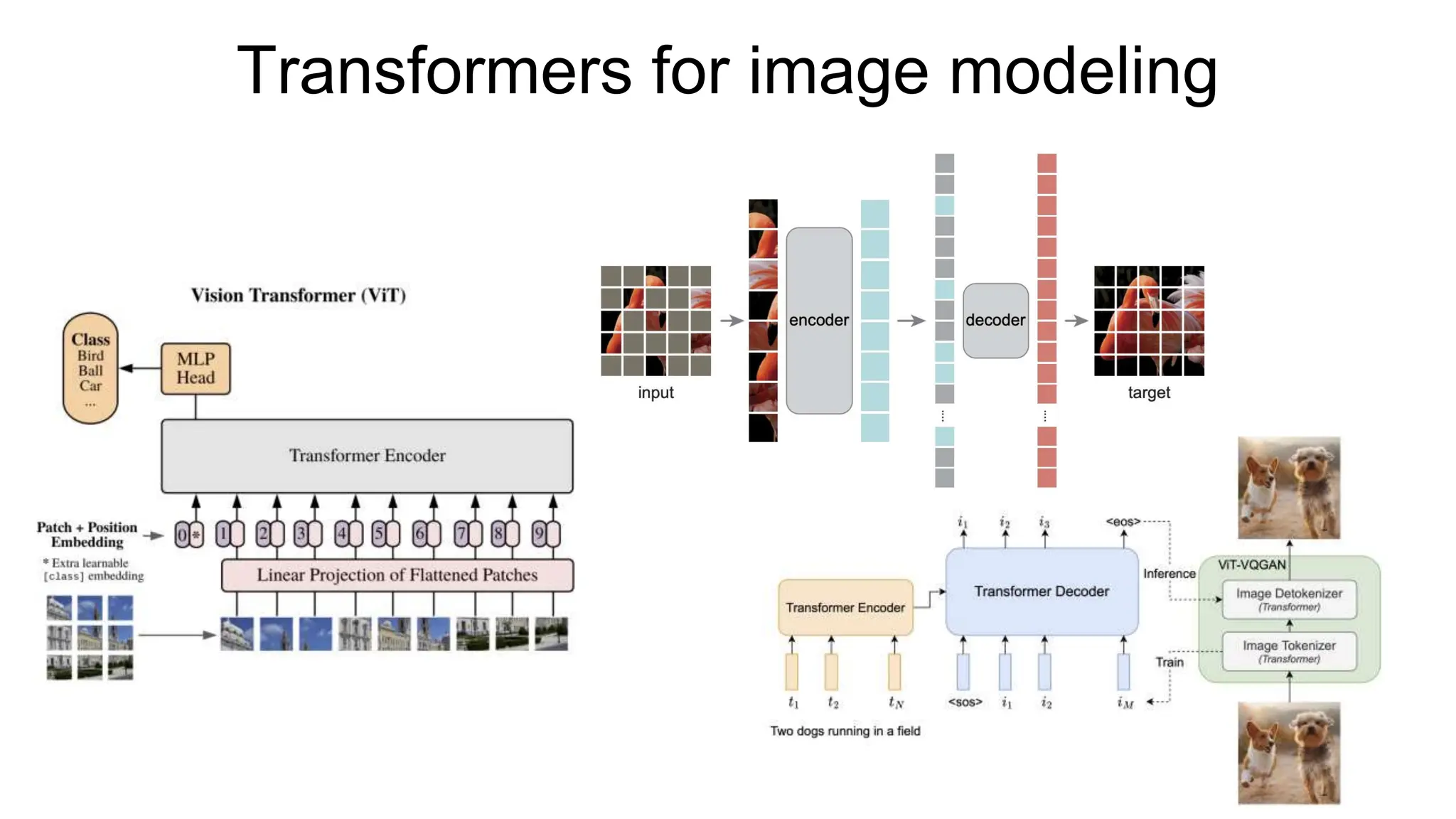
• Split an image into patches, feed linearly projected patches into
standard transformer encoder
• With patches of 14x14 pixels, you need 16x16=256 patches to represent 224x224 images
Vision transformer (ViT) – Google
A. Dosovitskiy et al. An image is worth 16x16 words: Transformers for image recognition at scale. ICLR 2021
Vision transformer (ViT)
BiT: Big Transfer (ResNet)
ViT: Vision Transformer (Base/Large/Huge,
patch size of 14x14, 16x16, or 32x32)
Internal Google dataset (not public)
A. Dosovitskiy et al. An image is worth 16x16 words: Transformers for image recognition at scale. ICLR 2021
• Trained in a supervised fashion, fine-tuned on ImageNet
Vision transformer (ViT)
A. Dosovitskiy et al. An image is worth 16x16 words: Transformers for image recognition at scale. ICLR 2021
• Transformers are claimed to be more computationally
efficient than CNNs or hybrid architectures
Hierarchical transformer: Swin
Z. Liu et al. Swin Transformer: Hierarchical Vision Transformer using Shifted Windows. ICCV 2021
Hierarchical transformer: Swin
Z. Liu et al. Swin Transformer: Hierarchical Vision Transformer using Shifted Windows. ICCV 2021
Hierarchical transformer: Swin
Z. Liu et al. Swin Transformer: Hierarchical Vision Transformer using Shifted Windows. ICCV 2021
Swin results
COCO detection and segmentation
Beyond transformers?
I. Tolstikhin et al. MLP-Mixer: An all-MLP Architecture for Vision. NeurIPS 2021
Hybrid of CNNs and transformers?
T. Xiao et al. Early convolutions help transformers see better. NeurIPS 2021
Or completely back to CNNs?
Z. Liu et al. A ConvNet for the 2020s. CVPR 2022
Back to CNNs?
Z. Liu et al. A ConvNet for the 2020s. CVPR 2022
Back to CNNs?
Z. Liu et al. A ConvNet for the 2020s. CVPR 2022
Outline
• Architectures
• Self-supervised learning
DINO: Self-distillation with no labels
M. Caron et al. Emerging Properties in Self-Supervised Vision Transformers. ICCV 2021
DINO
M. Caron et al. Emerging Properties in Self-Supervised Vision Transformers. ICCV 2021
DINO
M. Caron et al. Emerging Properties in Self-Supervised Vision Transformers. ICCV 2021
Masked autoencoders
K. He et al. Masked autoencoders are scalable vision learners. CVPR 2022
Masked autoencoders
K. He et al. Masked autoencoders are scalable vision learners. CVPR 2022
Masked autoencoders: Results
K. He et al. Masked autoencoders are scalable vision learners. CVPR 2022
Application: Visual prompting
A. Bar et al. Visual prompting via image inpainting. NeurIPS 2022
Application: Visual prompting

SLIDES OF LECTURE ABOUT TRANSFORMERS FOR VISION TASKS

  • 1.
    236781 Lecture 9 Deep learning Transformersfor Vision Tasks Dr. Chaim Baskin
  • 2.
  • 3.
    Transformers for imagemodeling: Outline • Architectures • Self-supervised learning
  • 4.
    Previous approaches 1. Onpixels, but locally or factorized Usually replaces 3x3 conv in ResNet: Image credit: Stand-Alone Self-Attention in Vision Models by Ramachandran et.al. Image credit: Local Relation Networks for Image Recognition by Hu et.al. Examples: Non-local NN (Wang et.al. 2017) SASANet (Stand-Alone Self-Attention in Vision Models) HaloNet (Scaling Local Self-Attn for Parameter Efficient...) LR-Net (Local Relation Networks for Image Recognition) SANet (Exploring Self-attention for Image Recognition) ... Results: Are usually "meh", nothing to call home about Do not justify increased complexity Do not justify slowdown over convolutions Many prior works attempted to introduce self- attention at the pixel level. For 224px², that's 50k sequence length, too much!
  • 5.
    Previous approaches 2. Globally,after/inside a full-blown CNN, or even detector/segmenter! Cons: result is highly complex, often multi-stage trained architecture. not from pixels, i.e. transformer can't "learn to fix" the (often frozen!) CNN's mistakes. Examples: DETR (Carion, Massa et.al. 2020) Visual Transformers (Wu et.al. 2020) UNITER (Chen, Li, Yu et.al. 2019) ViLBERT (Lu et.al. 2019) etc... VisualBERT (Li et.al. 20190) Image credit: UNITER: UNiversal Image-TExt Representation Learning by Chen et.al. Image credit: Visual Transformers: Token-based Image Representation and Processing for Computer Vision by Wu et.al.
  • 6.
    • Split animage into patches, feed linearly projected patches into standard transformer encoder • With patches of 14x14 pixels, you need 16x16=256 patches to represent 224x224 images Vision transformer (ViT) – Google A. Dosovitskiy et al. An image is worth 16x16 words: Transformers for image recognition at scale. ICLR 2021
  • 7.
    Vision transformer (ViT) BiT:Big Transfer (ResNet) ViT: Vision Transformer (Base/Large/Huge, patch size of 14x14, 16x16, or 32x32) Internal Google dataset (not public) A. Dosovitskiy et al. An image is worth 16x16 words: Transformers for image recognition at scale. ICLR 2021 • Trained in a supervised fashion, fine-tuned on ImageNet
  • 8.
    Vision transformer (ViT) A.Dosovitskiy et al. An image is worth 16x16 words: Transformers for image recognition at scale. ICLR 2021 • Transformers are claimed to be more computationally efficient than CNNs or hybrid architectures
  • 9.
    Hierarchical transformer: Swin Z.Liu et al. Swin Transformer: Hierarchical Vision Transformer using Shifted Windows. ICCV 2021
  • 10.
    Hierarchical transformer: Swin Z.Liu et al. Swin Transformer: Hierarchical Vision Transformer using Shifted Windows. ICCV 2021
  • 11.
    Hierarchical transformer: Swin Z.Liu et al. Swin Transformer: Hierarchical Vision Transformer using Shifted Windows. ICCV 2021
  • 12.
  • 13.
    Beyond transformers? I. Tolstikhinet al. MLP-Mixer: An all-MLP Architecture for Vision. NeurIPS 2021
  • 14.
    Hybrid of CNNsand transformers? T. Xiao et al. Early convolutions help transformers see better. NeurIPS 2021
  • 15.
    Or completely backto CNNs? Z. Liu et al. A ConvNet for the 2020s. CVPR 2022
  • 16.
    Back to CNNs? Z.Liu et al. A ConvNet for the 2020s. CVPR 2022
  • 17.
    Back to CNNs? Z.Liu et al. A ConvNet for the 2020s. CVPR 2022
  • 18.
  • 19.
    DINO: Self-distillation withno labels M. Caron et al. Emerging Properties in Self-Supervised Vision Transformers. ICCV 2021
  • 20.
    DINO M. Caron etal. Emerging Properties in Self-Supervised Vision Transformers. ICCV 2021
  • 21.
    DINO M. Caron etal. Emerging Properties in Self-Supervised Vision Transformers. ICCV 2021
  • 22.
    Masked autoencoders K. Heet al. Masked autoencoders are scalable vision learners. CVPR 2022
  • 23.
    Masked autoencoders K. Heet al. Masked autoencoders are scalable vision learners. CVPR 2022
  • 24.
    Masked autoencoders: Results K.He et al. Masked autoencoders are scalable vision learners. CVPR 2022
  • 25.
    Application: Visual prompting A.Bar et al. Visual prompting via image inpainting. NeurIPS 2022
  • 26.
  • 27.
  • 28.

Editor's Notes

  • #6 DETR uses a conventional CNN backbone to learn a 2D representation of an input image. The model flattens it and supplements it with a positional encoding before passing it into a transformer encoder. A transformer decoder then takes as input a small fixed number of learned positional embeddings, which we call object queries, and additionally attends to the encoder output. We pass each output embedding of the decoder to a shared feed forward network (FFN) that predicts either a detection (class and bounding box) or a “no object” class.
  • #7 Abstract: In this work, we generalize a recently proposed model architecture based on self-attention, the Transformer, to a sequence modeling formulation of image generation with a tractable likelihood. By restricting the selfattention mechanism to attend to local neighborhoods we significantly increase the size of images the model can process in practice, despite maintaining significantly larger receptive fields per layer than typical convolutional neural networks. While conceptually simple, our generative models significantly outperform the current state of the art in image generation on ImageNet, improving the best published negative log-likelihood on ImageNet from 3.83 to 3.77.
  • #11 Abstract: While the Transformer architecture has become the de-facto standard for natural language processing tasks, its applications to computer vision remain limited. In vision, attention is either applied in conjunction with convolutional networks, or used to replace certain components of convolutional networks while keeping their overall structure in place. We show that this reliance on CNNs is not necessary and a pure transformer applied directly to sequences of image patches can perform very well on image classification tasks. When pre-trained on large amounts of data and transferred to multiple mid-sized or small image recognition benchmarks (ImageNet, CIFAR-100, VTAB, etc.), Vision Transformer (ViT) attains excellent results compared to state-of-the-art convolutional networks while requiring substantially fewer computational resources to train
  • #12 Patches of size 14x14 = 16x16 patches to represent 224x224 images (sequence length = 256)
  • #13 Abstract: While the Transformer architecture has become the de-facto standard for natural language processing tasks, its applications to computer vision remain limited. In vision, attention is either applied in conjunction with convolutional networks, or used to replace certain components of convolutional networks while keeping their overall structure in place. We show that this reliance on CNNs is not necessary and a pure transformer applied directly to sequences of image patches can perform very well on image classification tasks. When pre-trained on large amounts of data and transferred to multiple mid-sized or small image recognition benchmarks (ImageNet, CIFAR-100, VTAB, etc.), Vision Transformer (ViT) attains excellent results compared to state-of-the-art convolutional networks while requiring substantially fewer computational resources to train
  • #19 Abstract: Vision transformer (ViT) models exhibit substandard optimizability. In particular, they are sensitive to the choice of optimizer (AdamW vs. SGD), optimizer hyperparameters, and training schedule length. In comparison, modern convolutional neural networks are easier to optimize. Why is this the case? In this work, we conjecture that the issue lies with the patchify stem of ViT models, which is implemented by a stride-p p×p convolution (p = 16 by default) applied to the input image. This large-kernel plus large-stride convolution runs counter to typical design choices of convolutional layers in neural networks. To test whether this atypical design choice causes an issue, we analyze the optimization behavior of ViT models with their original patchify stem versus a simple counterpart where we replace the ViT stem by a small number of stacked stride-two 3×3 convolutions. While the vast majority of computation in the two ViT designs is identical, we find that this small change in early visual processing results in markedly different training behavior in terms of the sensitivity to optimization settings as well as the final model accuracy. Using a convolutional stem in ViT dramatically increases optimization stability and also improves peak performance (by ∼1-2% top-1 accuracy on ImageNet-1k), while maintaining flops and runtime. The improvement can be observed across the wide spectrum of model complexities (from 1G to 36G flops) and dataset scales (from ImageNet-1k to ImageNet-21k). These findings lead us to recommend using a standard, lightweight convolutional stem for ViT models in this regime as a more robust architectural choice compared to the original ViT model design.