Space and Economics
Chapter 2: Land use theory

Author
Wim Heijman (Wageningen, the Netherlands)

July 20, 2009
2. Land use theory

   2.1   Functions of land
   2.2   Land rent
   2.3   Land rent and the intensity of land use
   2.4   The price of land
2.1 Functions of land


   Location of raw materials
   Location and carrier of capital goods
   Input for agriculture
   Location and carrier for housing, recreation,
    infrastructure
2.1 Functions of land


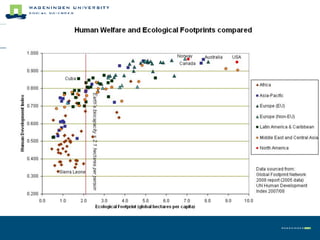
   Land fulfills needs
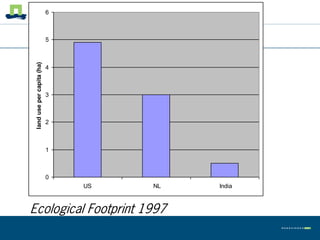
   Ecological footprint: the amount of land per capita
    needed to fulfill human needs
6


 land use per capita (ha)   5


                            4


                            3


                            2


                            1


                            0
                                US   NL   India


Ecological Footprint 1997
2.1 Functions of land


   http://en.wikipedia.org/wiki/Ecological_footprint
2.2 Land Rent

   Land rent: profit of a hectare
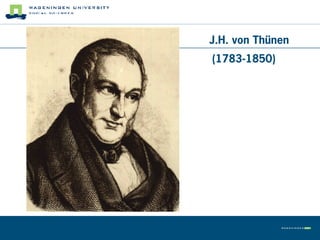
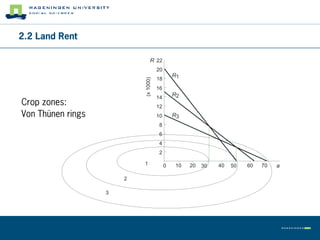
   Johann Heinrich Von Thünen (1783-1850): “The
    Isolated State”
   Isotropic plane
   The quality of the soil is equal
   Transportation costs are proportional to the
    distance
J.H. von Thünen
(1783-1850)
2.2 Land Rent
Questions:
 Which crop is grown where?
 What explains the productivity of land and the intensity of
  land use?
Solutions:
 Land will be used for the activity that generates the highest
  possible rent.
 The closer to the market the higher the intensity of land use
  and the more productive the land.
2.2 Land Rent

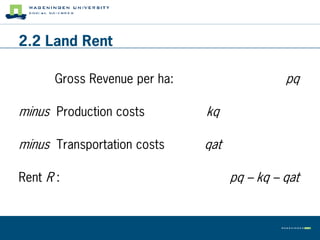
      Gross Revenue per ha:                   pq

minus Production costs        kq

minus Transportation costs    qat

Rent R :                            pq – kq – qat
2.2 Land Rent

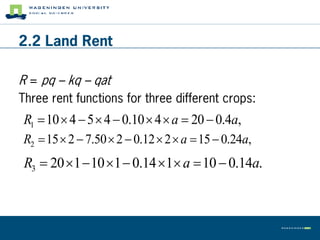
R = pq – kq – qat
Three rent functions for three different crops:
R1  10  4  5  4  0.10  4  a  20  0.4a,
R2  15  2  7.50  2  0.12  2  a  15  0.24a,
 R3  20  1  10 1  0.14  1 a  10  0.14a.
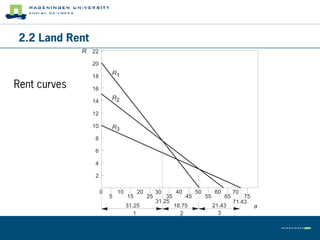
2.2 Land Rent
              R   22

                  20

                  18
                           R1

Rent curves       16
                           R2
                  14

                  12

                  10       R3
                   8

                   6

                   4

                   2

                       0       10        20        30       40        50        60        70
                           5        15        25       35        45        55        65       75
                                                   31.25                                  71.43
                                    31.25                   18.75               21.43              a
                                       1                      2                   3
2.2 Land Rent

                                 R 22
                                      20
                                               R1
                                      18


                           (x 1000)
                                      16
                                      14       R2
Crop zones:                           12
Von Thünen rings                      10       R3
                                       8
                                       6
                                       4
                                       2

                           1               0   10   20   30   40   50   60   70   a

                       2

                   3
2.3 Land Rent and intensity of land use


   David Ricardo (1772-1823), takes the differences
    in land quality into account.
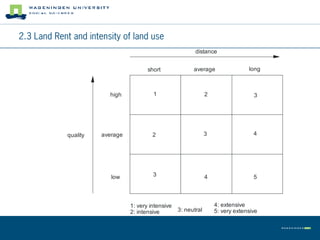
   According to Ricardo’s land rent theory the intensity
    of land use (input of labour per ha) is the highest on
    the land of the highest quality.
David Ricardo
 (1772-1823)
2.3 Land Rent and intensity of land use
                                                            distance


                                        short              average                 long


                         high             1                       2                  3


             quality   average            2                       3                  4


                          low             3                       4                  5


                                 1: very intensive                    4: extensive
                                 2: intensive        3: neutral       5: very extensive
2.3 Land rent and intensity of land use


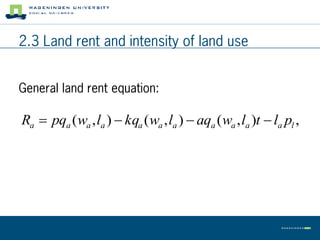
General land rent equation:

Ra  pqa (wa , la )  kqa (wa , la )  aqa (wa , la )t  la pl ,
2.3 Land rent and intensity of land use


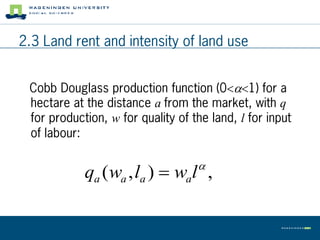
 Cobb Douglass production function (01) for a
 hectare at the distance a from the market, with q
 for production, w for quality of the land, l for input
 of labour:

                                   
            qa (wa , la )  wal ,
2.3 Land rent and intensity of land use


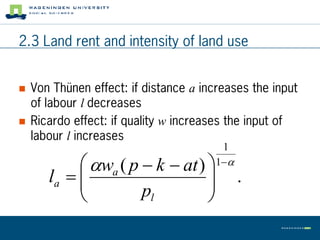
   Von Thünen effect: if distance a increases the input
    of labour l decreases
   Ricardo effect: if quality w increases the input of
    labour l increases
                                         1
             wa ( p  k  at )       1
       la  
                                
                                             .
                     pl         
2.4 The price of land
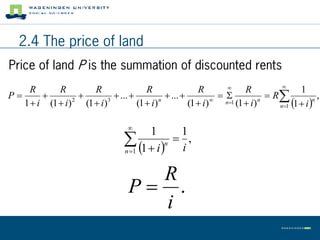
Price of land P is the summation of discounted rents
                                                                                  
     R      R       R                 R                 R              R                 1
P                        ...             ...                           R            ,
                                                                                  n1   i 
                                                             
   1  i (1  i) (1  i)
                2        3
                                   (1  i) n
                                                     (1  i)    n1 (1  i ) n         1
                                                                                             n


                                    
                                        1        1
                                    1  i n  i ,
                                   n 1


                                       R
                                     P .
                                       i
2.4 The price of land
Land speculation:
    If agricultural land changes into residential land
   then the price will increase. Speculators anticipate
   that and buy agricultural land for relatively low
   prices. They hope to sell it at high prices for
   residential or industrial use in the future. If they are
   successful they may gain high profits.
http://www.realestatejournal.com/columnists/houset
   alk/20030530-barta.html
2.5 Application


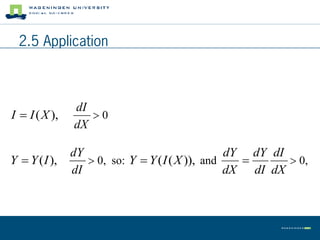
              dI
I  I (X ),      0
              dX

              dY                                dY dY dI
Y  Y (I ),       0, so: Y  Y ( I ( X )), and          0,
              dI                                dX dI dX
2.5 Application
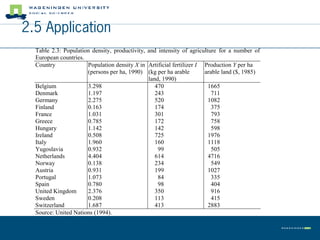
  Table 2.3: Population density, productivity, and intensity of agriculture for a number of
  European countries.
  Country             Population density X in Artificial fertilizer I Production Y per ha
                      (persons per ha, 1990) (kg per ha arable        arable land ($, 1985)
                                               land, 1990)
  Belgium             3.298                       470                   1665
  Denmark             1.197                       243                    711
  Germany             2.275                       520                   1082
  Finland             0.163                       174                    375
  France              1.031                       301                    793
  Greece              0.785                       172                    758
  Hungary             1.142                       142                    598
  Ireland             0.508                       725                   1976
  Italy               1.960                       160                   1118
  Yugoslavia          0.932                        99                    505
  Netherlands         4.404                       614                   4716
  Norway              0.138                       234                    549
  Austria             0.931                       199                   1027
  Portugal            1.073                        84                    335
  Spain               0.780                        98                    404
  United Kingdom      2.376                       350                    916
  Sweden              0.208                       113                    415
  Switzerland         1.687                       413                   2883
  Source: United Nations (1994).
2.5 Application
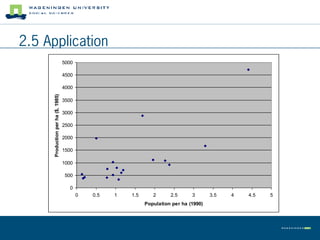
                                    5000

                                    4500

                                    4000
      Production per ha ($, 1985)


                                    3500

                                    3000

                                    2500

                                    2000

                                    1500

                                    1000

                                    500

                                      0
                                           0   0.5   1   1.5      2      2.5      3       3.5   4   4.5   5
                                                               Population per ha (1990)
2.5 Application


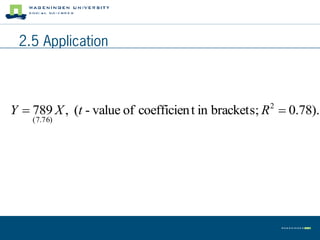
Y  789 X , (t - value of coefficien t in brackets; R  0.78).
                                                    2
    ( 7.76)
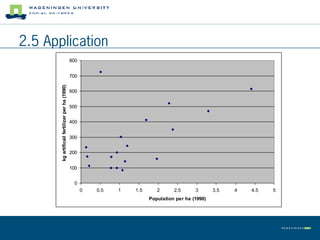
2.5 Application
                                                800


                                                700
       kg artificail fertilizer per ha (1990)


                                                600


                                                500


                                                400


                                                300


                                                200


                                                100


                                                 0
                                                      0   0.5   1   1.5      2      2.5      3       3.5   4   4.5   5
                                                                          Population per ha (1990)
2.5 Application


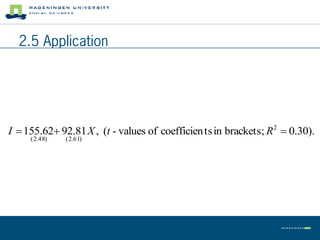
I  155.62 92.81 X , (t - values of coefficien ts in brackets; R 2  0.30).
     ( 2.48)   ( 2.61)
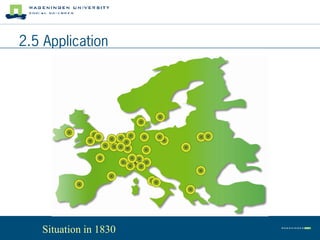
2.5 Application


   Situation in 1830
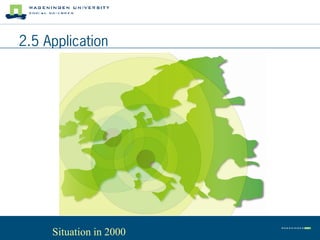
2.5 Application


     Situation in 2000
Chapter 2: Land use Theory

Chapter 2: Land use Theory

  • 1.
    Space and Economics Chapter2: Land use theory Author Wim Heijman (Wageningen, the Netherlands) July 20, 2009
  • 2.
    2. Land usetheory  2.1 Functions of land  2.2 Land rent  2.3 Land rent and the intensity of land use  2.4 The price of land
  • 3.
    2.1 Functions ofland  Location of raw materials  Location and carrier of capital goods  Input for agriculture  Location and carrier for housing, recreation, infrastructure
  • 4.
    2.1 Functions ofland  Land fulfills needs  Ecological footprint: the amount of land per capita needed to fulfill human needs
  • 5.
    6 land useper capita (ha) 5 4 3 2 1 0 US NL India Ecological Footprint 1997
  • 7.
    2.1 Functions ofland  http://en.wikipedia.org/wiki/Ecological_footprint
  • 8.
    2.2 Land Rent  Land rent: profit of a hectare  Johann Heinrich Von Thünen (1783-1850): “The Isolated State”  Isotropic plane  The quality of the soil is equal  Transportation costs are proportional to the distance
  • 9.
  • 10.
    2.2 Land Rent Questions: Which crop is grown where?  What explains the productivity of land and the intensity of land use? Solutions:  Land will be used for the activity that generates the highest possible rent.  The closer to the market the higher the intensity of land use and the more productive the land.
  • 11.
    2.2 Land Rent Gross Revenue per ha: pq minus Production costs kq minus Transportation costs qat Rent R : pq – kq – qat
  • 12.
    2.2 Land Rent R= pq – kq – qat Three rent functions for three different crops: R1  10  4  5  4  0.10  4  a  20  0.4a, R2  15  2  7.50  2  0.12  2  a  15  0.24a, R3  20  1  10 1  0.14  1 a  10  0.14a.
  • 13.
    2.2 Land Rent R 22 20 18 R1 Rent curves 16 R2 14 12 10 R3 8 6 4 2 0 10 20 30 40 50 60 70 5 15 25 35 45 55 65 75 31.25 71.43 31.25 18.75 21.43 a 1 2 3
  • 14.
    2.2 Land Rent R 22 20 R1 18 (x 1000) 16 14 R2 Crop zones: 12 Von Thünen rings 10 R3 8 6 4 2 1 0 10 20 30 40 50 60 70 a 2 3
  • 15.
    2.3 Land Rentand intensity of land use  David Ricardo (1772-1823), takes the differences in land quality into account.  According to Ricardo’s land rent theory the intensity of land use (input of labour per ha) is the highest on the land of the highest quality.
  • 16.
  • 17.
    2.3 Land Rentand intensity of land use distance short average long high 1 2 3 quality average 2 3 4 low 3 4 5 1: very intensive 4: extensive 2: intensive 3: neutral 5: very extensive
  • 18.
    2.3 Land rentand intensity of land use General land rent equation: Ra  pqa (wa , la )  kqa (wa , la )  aqa (wa , la )t  la pl ,
  • 19.
    2.3 Land rentand intensity of land use Cobb Douglass production function (01) for a hectare at the distance a from the market, with q for production, w for quality of the land, l for input of labour:  qa (wa , la )  wal ,
  • 20.
    2.3 Land rentand intensity of land use  Von Thünen effect: if distance a increases the input of labour l decreases  Ricardo effect: if quality w increases the input of labour l increases 1  wa ( p  k  at )  1 la      .  pl 
  • 21.
    2.4 The priceof land Price of land P is the summation of discounted rents   R R R R R R 1 P    ...   ...    R , n1   i   1  i (1  i) (1  i) 2 3 (1  i) n (1  i) n1 (1  i ) n 1 n  1 1  1  i n  i , n 1 R P . i
  • 22.
    2.4 The priceof land Land speculation: If agricultural land changes into residential land then the price will increase. Speculators anticipate that and buy agricultural land for relatively low prices. They hope to sell it at high prices for residential or industrial use in the future. If they are successful they may gain high profits. http://www.realestatejournal.com/columnists/houset alk/20030530-barta.html
  • 23.
    2.5 Application dI I  I (X ), 0 dX dY dY dY dI Y  Y (I ),  0, so: Y  Y ( I ( X )), and   0, dI dX dI dX
  • 24.
    2.5 Application Table 2.3: Population density, productivity, and intensity of agriculture for a number of European countries. Country Population density X in Artificial fertilizer I Production Y per ha (persons per ha, 1990) (kg per ha arable arable land ($, 1985) land, 1990) Belgium 3.298 470 1665 Denmark 1.197 243 711 Germany 2.275 520 1082 Finland 0.163 174 375 France 1.031 301 793 Greece 0.785 172 758 Hungary 1.142 142 598 Ireland 0.508 725 1976 Italy 1.960 160 1118 Yugoslavia 0.932 99 505 Netherlands 4.404 614 4716 Norway 0.138 234 549 Austria 0.931 199 1027 Portugal 1.073 84 335 Spain 0.780 98 404 United Kingdom 2.376 350 916 Sweden 0.208 113 415 Switzerland 1.687 413 2883 Source: United Nations (1994).
  • 25.
    2.5 Application 5000 4500 4000 Production per ha ($, 1985) 3500 3000 2500 2000 1500 1000 500 0 0 0.5 1 1.5 2 2.5 3 3.5 4 4.5 5 Population per ha (1990)
  • 26.
    2.5 Application Y 789 X , (t - value of coefficien t in brackets; R  0.78). 2 ( 7.76)
  • 27.
    2.5 Application 800 700 kg artificail fertilizer per ha (1990) 600 500 400 300 200 100 0 0 0.5 1 1.5 2 2.5 3 3.5 4 4.5 5 Population per ha (1990)
  • 28.
    2.5 Application I 155.62 92.81 X , (t - values of coefficien ts in brackets; R 2  0.30). ( 2.48) ( 2.61)
  • 29.
    2.5 Application Situation in 1830
  • 30.
    2.5 Application Situation in 2000