Professor (Dr.) A. Chamaru De Alwis
(Ph.D. (Mgt) TBU in Zlin, Cz, M.Sc (Mgt) Sri J, B.Sc (B.Ad) Sri J.
Professor in Management
University of Kelaniya
ORCID :https://orcid.org/0000-0003-2492-9466
Google Scholar: https://scholar.google.com/citations?user=mAMWuxkAAAAJ&hl=en
ResearchGate: https://www.researchgate.net/profile/A_De_Alwis
Introduction
An business entity refers collection (pool) of
interrelated group of people acting towards achieving
common goal(s) and will be either one of the
following;
Sole Trader
Partnership
Company
Non-profit motive organization
Basic Characteristics of Formal Organization
•Common goal
•Have an organizational structure
•People involvement
•Using resources
•No of process
•Have a name
•Commonly accepted behaviour
Sole Trade/Sole Proprietorship
A Soletrader is a business owned by a person/an
individual and control/manage by himself.
Key features:
Owner & controller is a same individual.
Not a legal entity.
Formation is not complex.
Need to obtain BRN & TIN.
For tax purpose, entity’s income is treated
as individual’s income
Sole Trade/Sole Proprietorship
•Advantages •Disadvantages
- Easy & inexpensive to
form.
- Not govern under strict
rules & regulations.
- Total autonomy over
business
decisions.
- Enjoy entire benefits.
- Not charge tax on business
profit.
- Unlimited liability since
not treated as separate
legal entity.
- Limited skills &
capabilities.
- Cease the business when
owner
experience incapability.
- Bear entire loss and
liabilities.
A Partnership is an association of two or more persons
or entities that carry on business as partners with the
common motive of earning profit.
A partnership could be form verbally, impliedly or in
writing. Most of the partnerships carry on business in
line with the provisions made in Partnership
Agreement.
Note: Key duties & responsibilities of each partners,
contribution for capital, sharing of profit/loss,
payment of salaries are generally included in a
partnership agreement.
Key features;
•Involvement of two or more
individuals/parties.
•Profit motive.
•Common goal.
•Not a legal entity.
•Easy to form.
•BRN to be obtain.
Advantages Disadvantages
- Easy to form.
- Not involvement of
much rules &
regulations.
- Combination of skills &
capabilities.
- Profit Motive.
- Work towards a common
goal.
- Unlimited liability
- Limited life time.
- Disputes/Disagreement
between each
partners.
- Some decisions couldn’t be
implemented.
A Company is a widely available business entity which treated as an
independent legal entity.
Legal entity - Entity (company) treated as a separate unit/person (legal)
from the people who own, control and manage it.
Generally, Shareholders (ordinary) are the owners of a company
(public) whom received dividends as their compensation.
Registration of a company generally involve complex procedures than
sole trader and partnership.
Initially, each individuals who are willing to act as shareholders,
directors and company secretary must register at ROC and then
simultaneously CRN can obtained from the ROC once register the
company.
.
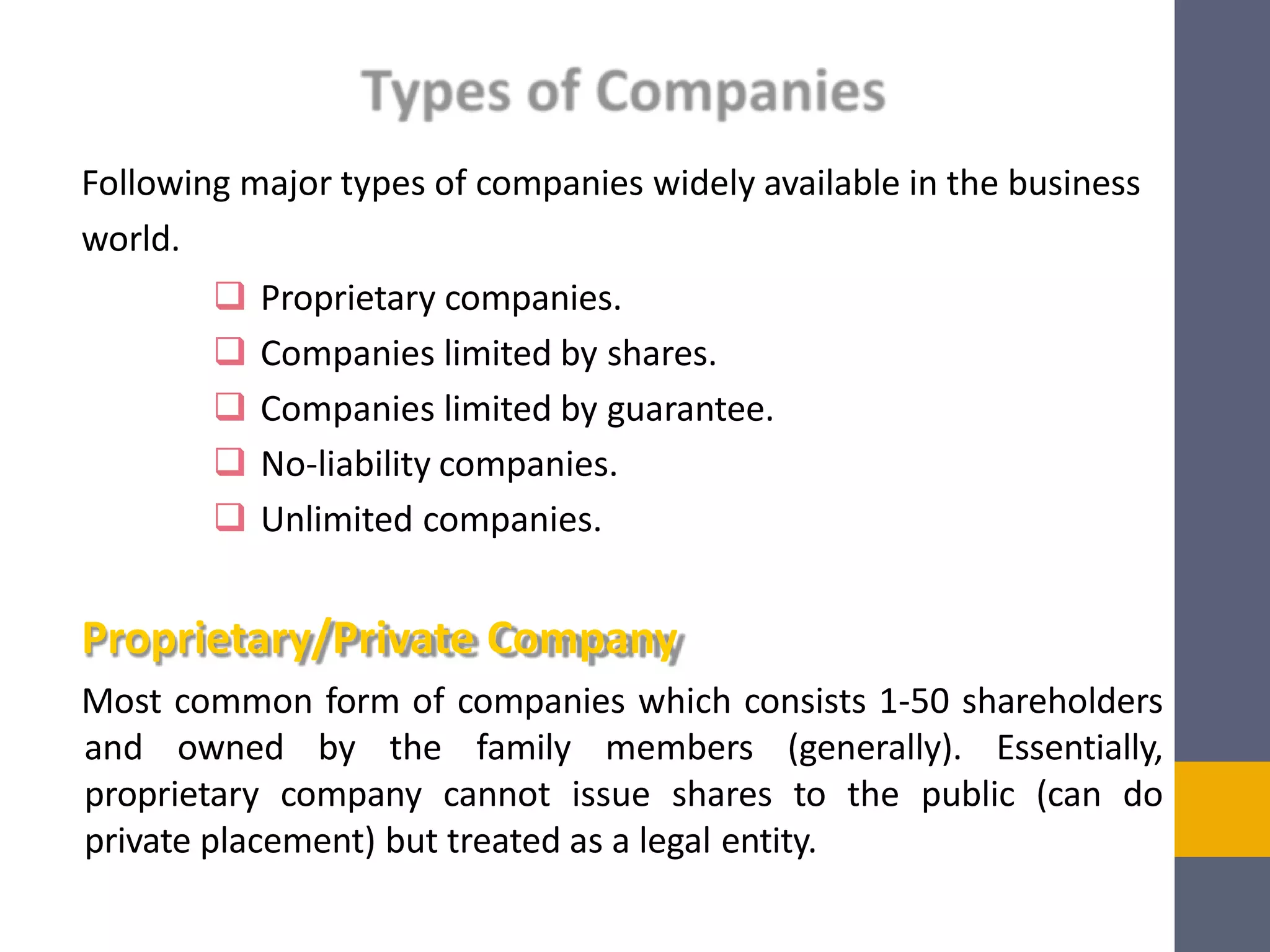
Following major types of companies widely available in the business
world.
 Proprietary companies.
 Companies limited by shares.
 Companies limited by guarantee.
 No-liability companies.
 Unlimited companies.
Proprietary/Private Company
Most common form of companies which consists 1-50 shareholders
and owned by the family members (generally). Essentially,
proprietary company cannot issue shares to the public (can do
private placement) but treated as a legal entity.
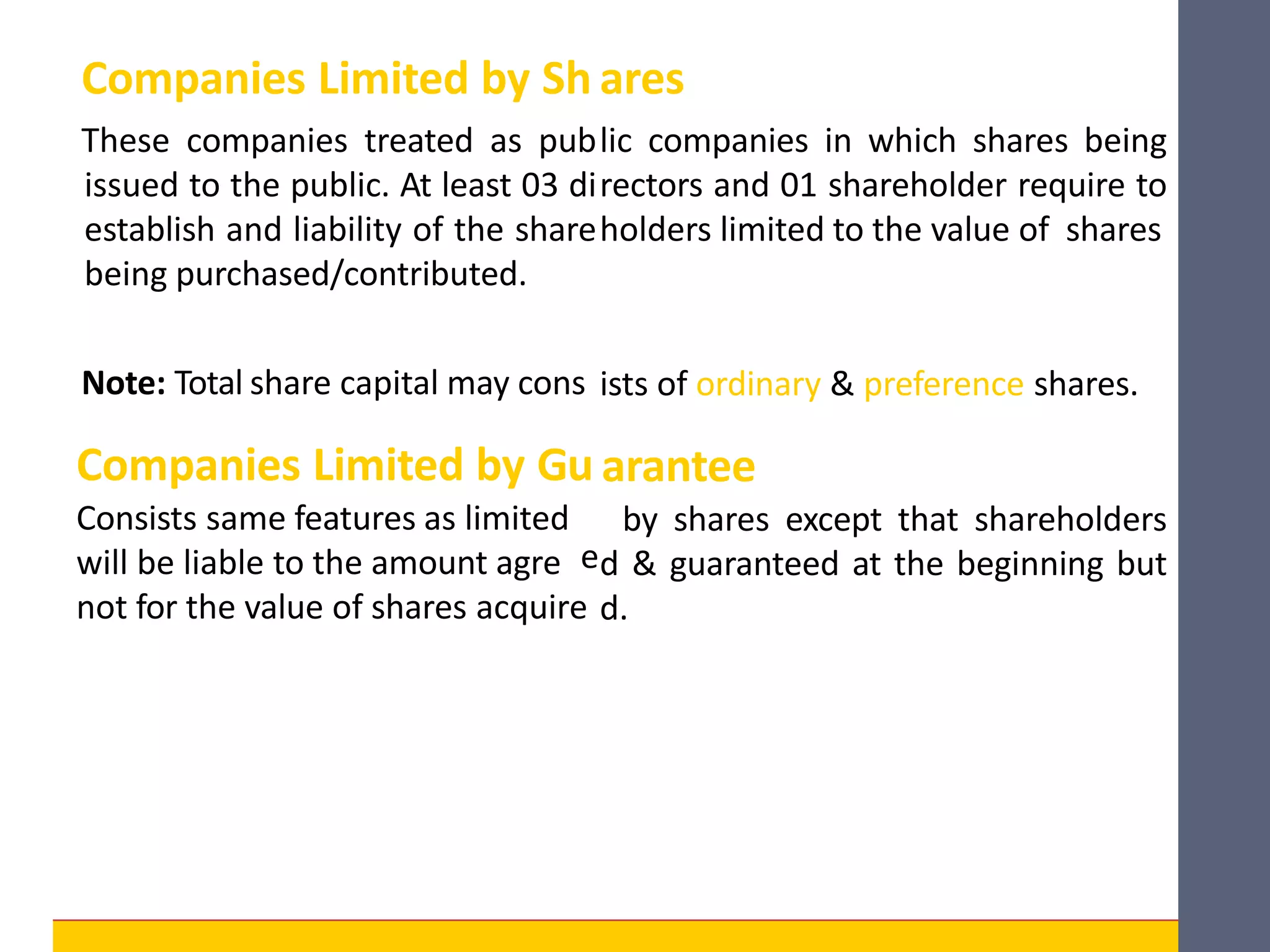
Companies Limited by Sh
These companies treated as pub
issued to the public. At least 03 di
establish and liability of the share
being purchased/contributed.
Note: Total share capital may cons
Companies Limited by Gu
Consists same features as limited
will be liable to the amount agre
not for the value of shares acquire
ares
lic companies in which shares being
rectors and 01 shareholder require to
holders limited to the value of shares
ists of ordinary & preference shares.
arantee
by shares except that shareholders
d & guaranteed at the beginning but
d.
e
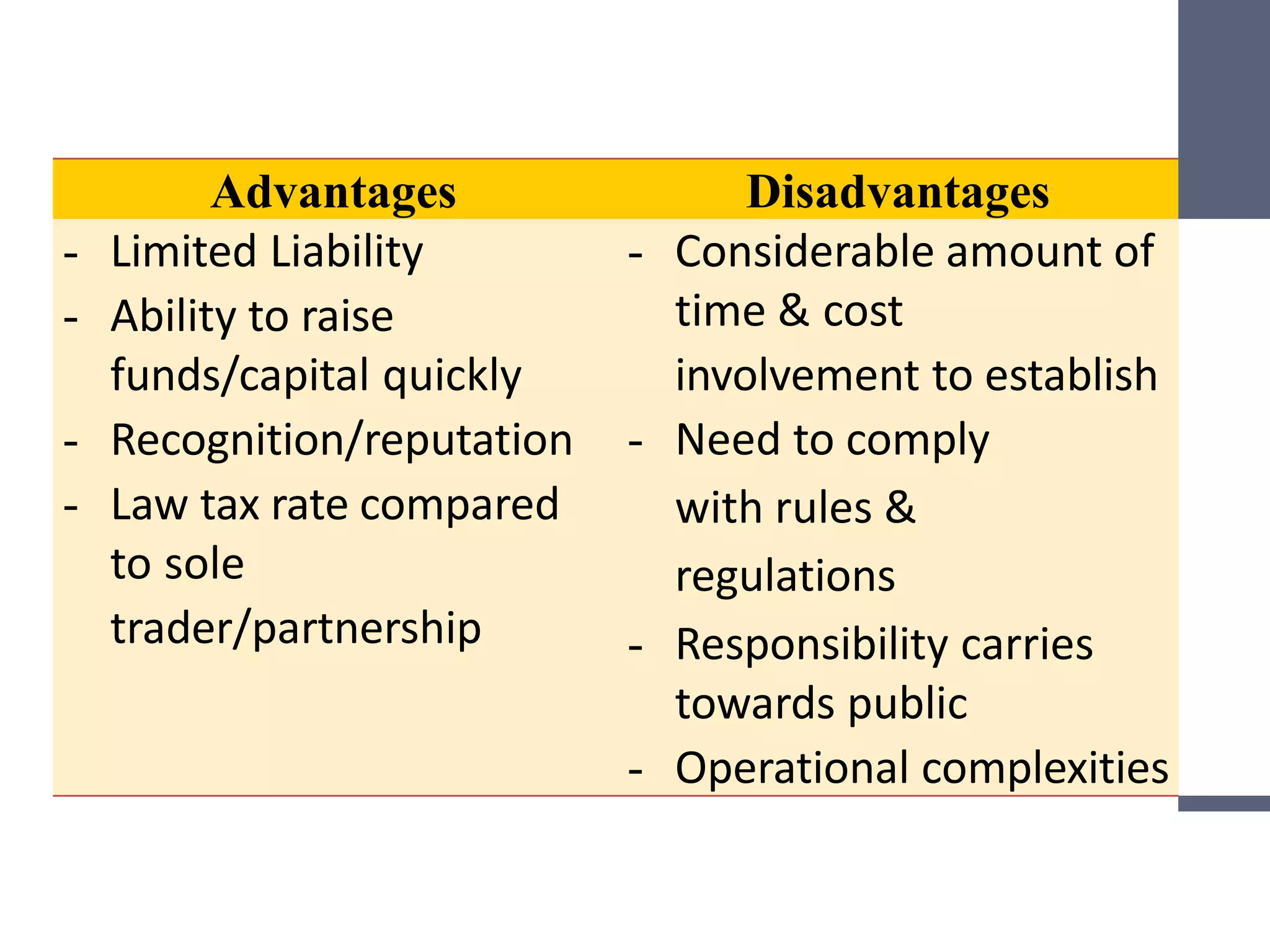
Advantages Disadvantages
- Limited Liability
- Ability to raise
funds/capital quickly
- Recognition/reputation
- Law tax rate compared
to sole
trader/partnership
- Considerable amount of
time & cost
involvement to establish
- Need to comply
with rules &
regulations
- Responsibility carries
towards public
- Operational complexities
As name implied, shareholders are not liable for any debt of the
company due to the risk & uncertainty involve in operations and
revenue sources.
Unlimited Company
Members/Shareholders of the company hold unlimited liability over
company debts.
Non-Profit Motive Organization
An organization established with the main objective of maintaining
healthy education, social, cultural level in the society as a whole.
Since there is no profit motive, operations will be carried out with
the assistance of various individuals and entities.
E.g.: UNA/WHO/Red Cross Society/Lions Club
Financial reporting of each of the above entities vary based on
the applicability of various rules & regulations.
Financial Reporting in
Sole Trader (too simple)
Partnership (simple)
Private Company (complex)
Public Company (too complex)
Trust (simple ~ complex)
Legal features of the business entity
•Liability
•Unlimited liability
•Limited liability
•Legal Entity / Personality
•Continuity of existence
•Registration
Comparison
•Ownership
•Capital
•Management
• Liability
•Legal Entity
•Registration
•Profit sharing
•Business Risk

Business structures

  • 1.
    Professor (Dr.) A.Chamaru De Alwis (Ph.D. (Mgt) TBU in Zlin, Cz, M.Sc (Mgt) Sri J, B.Sc (B.Ad) Sri J. Professor in Management University of Kelaniya ORCID :https://orcid.org/0000-0003-2492-9466 Google Scholar: https://scholar.google.com/citations?user=mAMWuxkAAAAJ&hl=en ResearchGate: https://www.researchgate.net/profile/A_De_Alwis
  • 2.
    Introduction An business entityrefers collection (pool) of interrelated group of people acting towards achieving common goal(s) and will be either one of the following; Sole Trader Partnership Company Non-profit motive organization
  • 3.
    Basic Characteristics ofFormal Organization •Common goal •Have an organizational structure •People involvement •Using resources •No of process •Have a name •Commonly accepted behaviour
  • 4.
    Sole Trade/Sole Proprietorship ASoletrader is a business owned by a person/an individual and control/manage by himself. Key features: Owner & controller is a same individual. Not a legal entity. Formation is not complex. Need to obtain BRN & TIN. For tax purpose, entity’s income is treated as individual’s income
  • 5.
    Sole Trade/Sole Proprietorship •Advantages•Disadvantages - Easy & inexpensive to form. - Not govern under strict rules & regulations. - Total autonomy over business decisions. - Enjoy entire benefits. - Not charge tax on business profit. - Unlimited liability since not treated as separate legal entity. - Limited skills & capabilities. - Cease the business when owner experience incapability. - Bear entire loss and liabilities.
  • 6.
    A Partnership isan association of two or more persons or entities that carry on business as partners with the common motive of earning profit. A partnership could be form verbally, impliedly or in writing. Most of the partnerships carry on business in line with the provisions made in Partnership Agreement. Note: Key duties & responsibilities of each partners, contribution for capital, sharing of profit/loss, payment of salaries are generally included in a partnership agreement.
  • 7.
    Key features; •Involvement oftwo or more individuals/parties. •Profit motive. •Common goal. •Not a legal entity. •Easy to form. •BRN to be obtain.
  • 8.
    Advantages Disadvantages - Easyto form. - Not involvement of much rules & regulations. - Combination of skills & capabilities. - Profit Motive. - Work towards a common goal. - Unlimited liability - Limited life time. - Disputes/Disagreement between each partners. - Some decisions couldn’t be implemented.
  • 9.
    A Company isa widely available business entity which treated as an independent legal entity. Legal entity - Entity (company) treated as a separate unit/person (legal) from the people who own, control and manage it. Generally, Shareholders (ordinary) are the owners of a company (public) whom received dividends as their compensation. Registration of a company generally involve complex procedures than sole trader and partnership. Initially, each individuals who are willing to act as shareholders, directors and company secretary must register at ROC and then simultaneously CRN can obtained from the ROC once register the company. .
  • 10.
    Following major typesof companies widely available in the business world.  Proprietary companies.  Companies limited by shares.  Companies limited by guarantee.  No-liability companies.  Unlimited companies. Proprietary/Private Company Most common form of companies which consists 1-50 shareholders and owned by the family members (generally). Essentially, proprietary company cannot issue shares to the public (can do private placement) but treated as a legal entity.
  • 11.
    Companies Limited bySh These companies treated as pub issued to the public. At least 03 di establish and liability of the share being purchased/contributed. Note: Total share capital may cons Companies Limited by Gu Consists same features as limited will be liable to the amount agre not for the value of shares acquire ares lic companies in which shares being rectors and 01 shareholder require to holders limited to the value of shares ists of ordinary & preference shares. arantee by shares except that shareholders d & guaranteed at the beginning but d. e
  • 12.
    Advantages Disadvantages - LimitedLiability - Ability to raise funds/capital quickly - Recognition/reputation - Law tax rate compared to sole trader/partnership - Considerable amount of time & cost involvement to establish - Need to comply with rules & regulations - Responsibility carries towards public - Operational complexities
  • 13.
    As name implied,shareholders are not liable for any debt of the company due to the risk & uncertainty involve in operations and revenue sources. Unlimited Company Members/Shareholders of the company hold unlimited liability over company debts. Non-Profit Motive Organization An organization established with the main objective of maintaining healthy education, social, cultural level in the society as a whole. Since there is no profit motive, operations will be carried out with the assistance of various individuals and entities. E.g.: UNA/WHO/Red Cross Society/Lions Club
  • 14.
    Financial reporting ofeach of the above entities vary based on the applicability of various rules & regulations. Financial Reporting in Sole Trader (too simple) Partnership (simple) Private Company (complex) Public Company (too complex) Trust (simple ~ complex)
  • 15.
    Legal features ofthe business entity •Liability •Unlimited liability •Limited liability •Legal Entity / Personality •Continuity of existence •Registration
  • 16.