Anemia in pregnancyAnemia in pregnancy
byby
Islam abdel-baset hashimIslam abdel-baset hashim
Islam abdel-fattahIslam abdel-fattah kalilkalil
Islam abd allah mohammadIslam abd allah mohammad
DefinitionDefinition
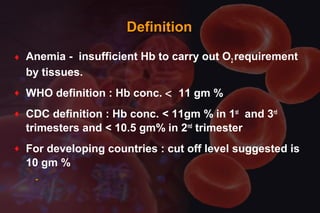
♦ Anemia - insufficient Hb to carry out O2 requirement
by tissues.
♦ WHO definition : Hb conc. < 11 gm %
♦ CDC definition : Hb conc. < 11gm % in 1st
and 3rd
trimesters and < 10.5 gm% in 2nd
trimester
♦ For developing countries : cut off level suggested is
10 gm %
-
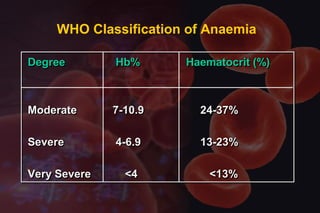
Degree Hb% Haematocrit (%)
Moderate 7-10.9 24-37%
Severe 4-6.9 13-23%
Very Severe <4 <13%
Degree Hb% Haematocrit (%)
Moderate 7-10.9 24-37%
Severe 4-6.9 13-23%
Very Severe <4 <13%
WHO Classification of Anaemia
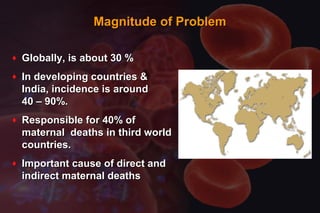
Magnitude of ProblemMagnitude of Problem
♦ Globally, is about 30 %Globally, is about 30 %
♦ In developing countries &In developing countries &
India, incidence is aroundIndia, incidence is around
40 – 90%.40 – 90%.
♦ Responsible for 40% ofResponsible for 40% of
maternal deaths in third worldmaternal deaths in third world
countries.countries.
♦ Important cause of direct andImportant cause of direct and
indirect maternal deathsindirect maternal deaths
physiological changes inphysiological changes in
pregnancypregnancy
♦ Plasama volume increased by 50% (by 34weeks)Plasama volume increased by 50% (by 34weeks)
♦ But RBC mass only increased by 25%But RBC mass only increased by 25%
♦ Results in haemodilution :Results in haemodilution :
♦ No change in MCV or MCHNo change in MCV or MCH
♦ 2-3 fold increase in Fe requierment.2-3 fold increase in Fe requierment.
♦ 10-20 Fold increase in folate requirement10-20 Fold increase in folate requirement
Common Anaemias inCommon Anaemias in
pregnancypregnancy
♦ Nutritional deficiency anaemiasNutritional deficiency anaemias
- Iron deficiency- Iron deficiency
- Folate deficiency- Folate deficiency
- Vit. B12 deficiency- Vit. B12 deficiency
♦ Haemoglobinopathies:Haemoglobinopathies:
- Thallassemias- Thallassemias
- SCD- SCD
ETIOLOGY OF IRONETIOLOGY OF IRON
DEFICIENCY ANAEMIADEFICIENCY ANAEMIA
♦ Depleted iron storesDepleted iron stores– dietary lack, chronic– dietary lack, chronic
renal failure, worm infestation, chronic menorrhagiarenal failure, worm infestation, chronic menorrhagia
♦ Chronic infectionsChronic infections: ( like malaria): ( like malaria)
♦ Repeated pregnanciesRepeated pregnancies ::
♦ with interval < 1 yearwith interval < 1 year
♦ blood loss at time of deliveryblood loss at time of delivery
♦ multiple pregnancymultiple pregnancy
Reason For IncreasedReason For Increased
Incidence Of AnemiaIncidence Of Anemia
♦ Poor pre-pregnancy iron balance due to –Poor pre-pregnancy iron balance due to –
untreated systemic diseases & menstrual disordersuntreated systemic diseases & menstrual disorders
♦ Improper supplementation of iron in pregnancy ( lateImproper supplementation of iron in pregnancy ( late
registration and poor follow up)registration and poor follow up)
♦ Repeated childbearingRepeated childbearing
♦ Lack of awareness and illiteracyLack of awareness and illiteracy
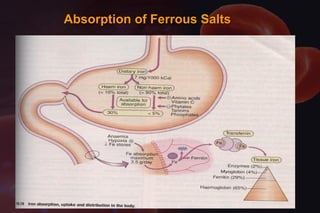
Absorption of Ferrous SaltsAbsorption of Ferrous Salts
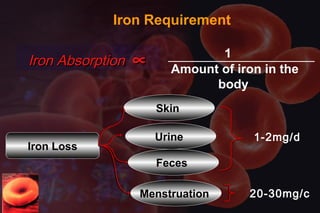
Iron Requirement
Iron AbsorptionIron Absorption ∝∝ 1
Amount of iron in the
body
Iron Loss
Skin
Urine
Feces
Menstruation
1-2mg/d
20-30mg/c
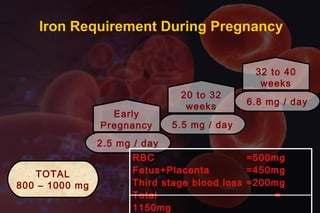
Early
Pregnancy
2.5 mg / day
32 to 40
weeks
6.8 mg / day
TOTAL
800 – 1000 mg
20 to 32
weeks
5.5 mg / day
RBC =500mg
Fetus+Placenta =450mg
Third stage blood loss =200mg
Total =
1150mg
Iron Requirement During Pregnancy
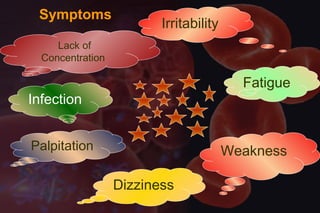
Infection
Lack of
Concentration
Weakness
Irritability
Palpitation
Fatigue
Dizziness
Symptoms
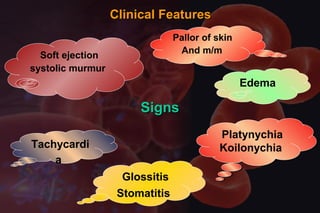
Clinical FeaturesClinical Features
Pallor of skin
And m/m
Edema
Platynychia
Koilonychia
Platynychia
Koilonychia
Glossitis
Stomatitis
Tachycardi
a
Soft ejection
systolic murmur
SignsSigns
Reason For IncreasedReason For Increased
Incidence Of AnemiaIncidence Of Anemia
♦ Poor pre-pregnancy iron balance due to –Poor pre-pregnancy iron balance due to –
untreated systemic diseases & menstrualuntreated systemic diseases & menstrual
disordersdisorders
♦ Improper supplementation of iron in pregnancyImproper supplementation of iron in pregnancy
( late registration and poor follow up)( late registration and poor follow up)
♦ Repeated childbearingRepeated childbearing
♦ Lack of awareness and illiteracyLack of awareness and illiteracy
♦ Low socioeconomic status and poor hygieneLow socioeconomic status and poor hygiene
♦ Chronic malnutritionChronic malnutrition
♦ Poor availability of iron due to predominantlyPoor availability of iron due to predominantly
veg diet, diet low in calories but rich in phytates.veg diet, diet low in calories but rich in phytates.
Food and religious taboosFood and religious taboos
♦ GI infections and infestationsGI infections and infestations
(e.g. Kala azar, worm infestations)(e.g. Kala azar, worm infestations)
Reason For IncreasedReason For Increased
Incidence Of AnemiaIncidence Of Anemia
EFFECTS OF ANAEMA INEFFECTS OF ANAEMA IN
PREGNANCYPREGNANCY
Mother :Mother :
♦ High output Cardiac failure (more likely ifHigh output Cardiac failure (more likely if
precelampsia present. inadequate tissueprecelampsia present. inadequate tissue
oxygenation increase requirments for excessiveoxygenation increase requirments for excessive
blood flow )blood flow )
♦ PPHPPH
♦ Predisposes to infectionPredisposes to infection
♦ Risk of thrombo-embolismRisk of thrombo-embolism
♦ Delayed general physical recovery esp after c.Delayed general physical recovery esp after c.
sectionsection
♦ Fetus: . IUGRFetus: . IUGR
. Preterm birth. Preterm birth
. LBW. LBW
. Depleted Fe store. Depleted Fe store
. Delayed Cognitive function.. Delayed Cognitive function.
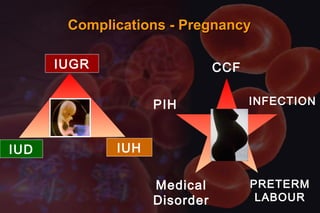
IUGR
IUD IUH
CCF
INFECTION
PRETERM
LABOUR
PIH
Medical
Disorder
Complications - PregnancyComplications - Pregnancy
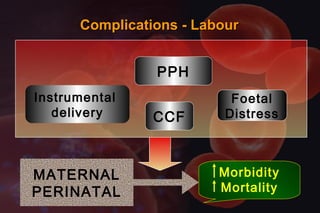
Instrumental
delivery
PPH
Foetal
DistressCCF
MATERNAL
PERINATAL
Morbidity
Mortality
Complications - LabourComplications - Labour
INVESTIGATIONSINVESTIGATIONS
♦ HbdecreasedHbdecreased
♦ Haematocrit decreasedHaematocrit decreased
♦ RBC Indices:RBC Indices:
- Low MCV- Low MCV
- Low MCH- Low MCH
- Low MCHC- Low MCHC
- Low PCV- Low PCV
♦ Peripheral blood picture :Peripheral blood picture :
♦ MicrocyticHypochromicanaemia .MicrocyticHypochromicanaemia .
♦ Serum iron decreased (<12 micro mol / l)Serum iron decreased (<12 micro mol / l)
♦ Total iron binding capacity:Total iron binding capacity:
♦ TIBC in non-pregnant state is 33% saturated withTIBC in non-pregnant state is 33% saturated with
iron .when serum iron level fall ,<15% ofTIBCiron .when serum iron level fall ,<15% ofTIBC
saturated.by fall in saturation,the TIBC INCREASED.saturated.by fall in saturation,the TIBC INCREASED.
♦ S. ferritin :In healthy adults ferritin circulate inS. ferritin :In healthy adults ferritin circulate in
plasma in range of 15_300 pg/l. in iron deficiencyplasma in range of 15_300 pg/l. in iron deficiency
anemia it is the first test to become abnormal.anemia it is the first test to become abnormal.
♦ Serum transferrinreceptor(TfR)Serum transferrinreceptor(TfR)
present on all cells as transmembrane protien thatpresent on all cells as transmembrane protien that
binds transferrin iron and transfer it to cell interior.binds transferrin iron and transfer it to cell interior.
Increased in iron def. anemiaIncreased in iron def. anemia
♦ Bone marrow examination.Bone marrow examination.
 Urine for haemturia.Urine for haemturia.
♦ Stool examination for ova ,cyst and occult blood.Stool examination for ova ,cyst and occult blood.
Management OptionsManagement Options
Pre – pregnancy :
♦ Treat the cause before conception
♦ Pre-pregnancy balanced diet, education
and health support.
♦ Build up iron stores during adolescent
phase
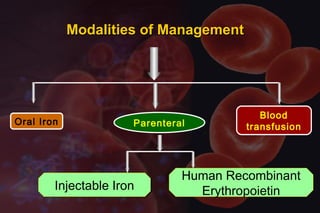
Oral Iron
Blood
transfusionParenteral
Injectable IronInjectable Iron
Human Recombinant
Erythropoietin
Modalities of ManagementModalities of Management
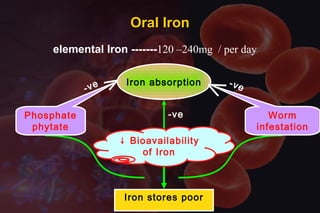
elemental Iron -------120 –240mg / per day
Iron stores poor
-ve
Iron absorption
↓ Bioavailability
of Iron
-ve-ve
Phosphate
phytate
Worm
infestation
Oral IronOral Iron
↑ Hb – 0.21 gm %
Fractionated Irondextran
[Iron hydroxide dextran complex]
Les
s
Les
s
Parenteral Therapy
120 mg
elemental Iron
AnaphylacticAnaphylactic
reactionreaction
AnaphylacticAnaphylactic
reactionreaction
I.M. I.V.
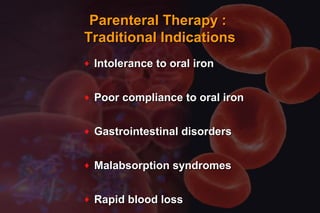
Parenteral Therapy :Parenteral Therapy :
Traditional IndicationsTraditional Indications
♦ Intolerance to oral ironIntolerance to oral iron
♦ Poor compliance to oral ironPoor compliance to oral iron
♦ Gastrointestinal disordersGastrointestinal disorders
♦ Malabsorption syndromesMalabsorption syndromes
♦ Rapid blood lossRapid blood loss
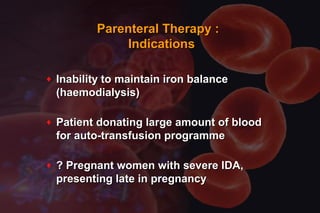
♦ Inability to maintain iron balanceInability to maintain iron balance
(haemodialysis)(haemodialysis)
♦ Patient donating large amount of bloodPatient donating large amount of blood
for auto-transfusion programmefor auto-transfusion programme
♦ ? Pregnant women with severe IDA,? Pregnant women with severe IDA,
presenting late in pregnancypresenting late in pregnancy
Parenteral Therapy :Parenteral Therapy :
IndicationsIndications
TheThe
World Health OrganisationWorld Health Organisation
states…states…
‘‘transfusion should betransfusion should be
prescribedprescribed ONLYONLY forfor
conditions for which there isconditions for which there is
NONO OTHER TREATMENT’OTHER TREATMENT’
Side effect of Fe Oral therapySide effect of Fe Oral therapy
♦ . G. I upset.. G. I upset.
. Constipation.. Constipation.
. Diarrhoea.. Diarrhoea.
Side effect of Parentral ironSide effect of Parentral iron
♦ - skindiscolouration- skindiscolouration
- local abscess- local abscess
- allergic reaction- allergic reaction
- Fe over load- Fe over load
Reasons for Failure toReasons for Failure to
RespondRespond
♦ Non complianceNon compliance
♦ Concomitant folate deficiencyConcomitant folate deficiency
♦ Continuous loss of blood through hookwormContinuous loss of blood through hookworm
infestation or bleeding haemorrhoidsinfestation or bleeding haemorrhoids
♦ Co-existing infectionCo-existing infection
♦ Faulty iron absorptionFaulty iron absorption
♦ Inaccurate diagnosisInaccurate diagnosis
♦ Non iron deficiency microcytic anaemiaNon iron deficiency microcytic anaemia
MEGALOBLASTIC ANAEMIAMEGALOBLASTIC ANAEMIA
♦ Complicates upto 1% of pregnanciesComplicates upto 1% of pregnancies
♦ Characterized by :Characterized by :
- RBC with high MCV- RBC with high MCV
- White blood cells with altered morphology- White blood cells with altered morphology
(hypersegmented neutrophils(hypersegmented neutrophils
causescauses
♦ Folate deficiency :may occur after exposureFolate deficiency :may occur after exposure
to sulfa drugs or hydroxyureato sulfa drugs or hydroxyurea
♦ - Vitamin B12 deficiency- Vitamin B12 deficiency
Folic acid deficiencyFolic acid deficiency
♦ At cellular levelAt cellular level
♦ Folic acid reduced to Dihydrofolicacid thenFolic acid reduced to Dihydrofolicacid then
♦ Tetrahydro-folicacid . (THF)Tetrahydro-folicacid . (THF) ee is required for cellis required for cell
growth & division.growth & division.
♦ dependant on supply of folic acid.dependant on supply of folic acid.
♦ So bone marrow and epithelial lining are therefore atSo bone marrow and epithelial lining are therefore at
particular risk.particular risk.
♦
causescauses
♦ . Woman taking anticonvulsants.. Woman taking anticonvulsants.
♦ . Multiple pregnancy.. Multiple pregnancy.
♦ . Hemolytic anemia; thalasemiaH.spherocytosis. Hemolytic anemia; thalasemiaH.spherocytosis
investigationinvestigation
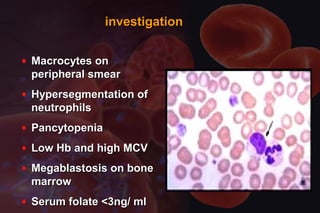
♦ Macrocytes onMacrocytes on
peripheral smearperipheral smear
♦ Hypersegmentation ofHypersegmentation of
neutrophilsneutrophils
♦ PancytopeniaPancytopenia
♦ Low Hb and high MCVLow Hb and high MCV
♦ Megablastosis on boneMegablastosis on bone
marrowmarrow
♦ Serum folate <3ng/ mlSerum folate <3ng/ ml
treatmenttreatment
♦ Daily folate requirement for :Daily folate requirement for :
♦ Non pregnant women -- 50 -100 microgramNon pregnant women -- 50 -100 microgram
♦ Pregnant woman –-------- 300-400 microgramPregnant woman –-------- 300-400 microgram
♦ Usually folic acid present in diets like fresh fruitsUsually folic acid present in diets like fresh fruits
and vegetables and destroyed by cooking.and vegetables and destroyed by cooking.
♦
♦ Folic acidFolic acid - 0.5-1.0mg folic acid/day- 0.5-1.0mg folic acid/day
♦ Ifpresence .of neural tube defect - 4mg folicIfpresence .of neural tube defect - 4mg folic
acid/day.acid/day.
HemoglobinopathiesHemoglobinopathies
♦ Inherited disorders of haemoglobin.Inherited disorders of haemoglobin.
♦ Defect may be in:Defect may be in:
♦ Globin chain synthesis------Globin chain synthesis------
thalassemia”quantitative defect”thalassemia”quantitative defect”
♦ Structure of globin chains-sickle cellStructure of globin chains-sickle cell
disease”qualitdisease”qualit
♦ Hb.abnormalities may be:Hb.abnormalities may be:
♦ Homozygous(rr) = inherited from both parents.Homozygous(rr) = inherited from both parents.
Hetrozygous(Rr) = inherited from one parentHetrozygous(Rr) = inherited from one parent
HAEMOGLOBINOPATHIES.HAEMOGLOBINOPATHIES.
♦ Normal adult Hb. after age of 6 month,Normal adult Hb. after age of 6 month,
♦ HbA---97%, HbA2---(1.5-3.5%), HbF2--<1%.HbA---97%, HbA2---(1.5-3.5%), HbF2--<1%.
♦ 4 Globin chains associated with haem complex.4 Globin chains associated with haem complex.
♦ Hb. A = 2 alpha +2 beta globin chains.Hb. A = 2 alpha +2 beta globin chains.
♦ Hb.A2= 2alpha+2 delta globin chains.Hb.A2= 2alpha+2 delta globin chains.
♦ Hb.F = 2 alpha+ 2 gamma globin chains.Hb.F = 2 alpha+ 2 gamma globin chains.
♦ Hb. synthesis is controlled by genes.Hb. synthesis is controlled by genes.
♦ Alpha chains by 4 gene,2 from each parent.Alpha chains by 4 gene,2 from each parent.
♦ Beta chains by 2 genes ,1 from each parent.Beta chains by 2 genes ,1 from each parent.
ThalassemiaThalassemia
♦ The synthesis of globin chain is partially orThe synthesis of globin chain is partially or
completely suppressed resulting in reduced Hb.completely suppressed resulting in reduced Hb.
content in red cells,which then have shortened lifecontent in red cells,which then have shortened life
spanspan
♦ TYPES:TYPES:
a- Alpha thalassaemia.a- Alpha thalassaemia.
b- Beta thalassaemia:b- Beta thalassaemia:
. Major. Major
. minor. minor
ThalassemiaThalassemia
♦ Genetic disorders; lack orGenetic disorders; lack or ↓↓sed synthesis of globinsed synthesis of globin
chainschains
♦ Two types :Two types : αα && ββ thalassemiathalassemia
♦ αα chains encoded by 2 pairs of genes onchains encoded by 2 pairs of genes on
chromosome 16chromosome 16
♦ ββ chains encoded by single pair of genes onchains encoded by single pair of genes on
chromosome 11chromosome 11
♦ ββ thalassemia more common and presents as eitherthalassemia more common and presents as either
ββ°(major) or°(major) or ββ++
(minor)(minor)
Beta thalassemia minorBeta thalassemia minor
♦ Heterozygous inheritance from one parent.Heterozygous inheritance from one parent.
♦ Most frequent encountered variety.Most frequent encountered variety.
♦ Partial suppression of the Hb. synthesis.Partial suppression of the Hb. synthesis.
♦ Mild anaemia.Mild anaemia.
IInvestigationsnvestigations: Hb----around 10 g/dl.: Hb----around 10 g/dl.
♦ Red cell indices: low MCV.Red cell indices: low MCV.
low MCH.low MCH.
normal MCHC.normal MCHC.
♦ Diagnostic testDiagnostic test: Hb. Electrophoresis.: Hb. Electrophoresis.
Beta Thalassemia MinorBeta Thalassemia Minor
♦ Management:Management:
♦ Same as normal woman in pregnancy.Same as normal woman in pregnancy.
♦ Frequent Hb. Testing.Frequent Hb. Testing.
♦ Iron & folate supplements in usual dose.Iron & folate supplements in usual dose.
♦ Parenteral iron should be avoided. because of iron overload.Parenteral iron should be avoided. because of iron overload.
♦ If not responded ---I/M folic acid.If not responded ---I/M folic acid.
♦ blood transfusion close to time of delivery.blood transfusion close to time of delivery.
Beta Thalassaemia MajorBeta Thalassaemia Major
♦ Homozygous inheritance from both parents.Homozygous inheritance from both parents.
♦ Sever anaemia.Sever anaemia.
ALPHA THALASSAEMIA:ALPHA THALASSAEMIA:
♦ Both heterozygous & homozygous forms exist.Both heterozygous & homozygous forms exist.
♦ Alpha thalassaemia trait.Alpha thalassaemia trait.
♦ HbH disease.HbH disease.
♦ Alpha thalassaemia major.Alpha thalassaemia major.
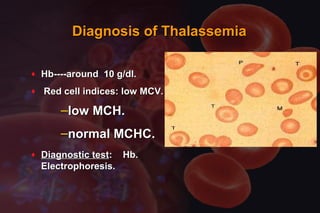
Diagnosis of ThalassemiaDiagnosis of Thalassemia
♦ Hb----around 10 g/dl.Hb----around 10 g/dl.
♦ Red cell indices: low MCV.Red cell indices: low MCV.
–low MCH.low MCH.
–normal MCHC.normal MCHC.
♦ Diagnostic testDiagnostic test: Hb.: Hb.
Electrophoresis.Electrophoresis.
Sickle Cell Disease (SCD)Sickle Cell Disease (SCD)
♦ Sickeling crises frequently occurs in pregnancy, puerperium &inSickeling crises frequently occurs in pregnancy, puerperium &in
state of hypoxia like G/A and Hag.state of hypoxia like G/A and Hag.
♦ Increased incidance of abortion and still birthIncreased incidance of abortion and still birth
growth restriction, premature birth and intrapartum fetal distressgrowth restriction, premature birth and intrapartum fetal distress
with increased perinatal mortality.with increased perinatal mortality.
♦ Sickle cell trait:(carrier state)Sickle cell trait:(carrier state)
Does not pose any significance clinical problemsDoes not pose any significance clinical problems
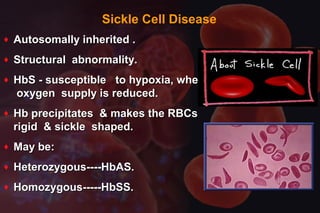
Sickle Cell Disease
♦ Autosomally inherited .Autosomally inherited .
♦ Structural abnormality.Structural abnormality.
♦ HbS - susceptible to hypoxia, whenHbS - susceptible to hypoxia, when
oxygen supply is reduced.oxygen supply is reduced.
♦ Hb precipitates & makes the RBCsHb precipitates & makes the RBCs
rigid & sickle shaped.rigid & sickle shaped.
♦ May be:May be:
♦ Heterozygous----HbAS.Heterozygous----HbAS.
♦ Homozygous-----HbSS.Homozygous-----HbSS.
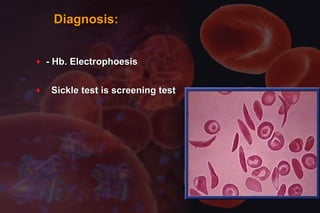
Diagnosis:Diagnosis:
♦ - Hb. Electrophoesis- Hb. Electrophoesis
♦ Sickle test is screening testSickle test is screening test
Management:Management:
♦ - No curative Tx.- No curative Tx.
♦ - only symptomatic- only symptomatic
♦ - Well hydration, effective analgesia, prophylactic- Well hydration, effective analgesia, prophylactic
♦ antibiotics, O2 inhalation, folic acid, oral ironantibiotics, O2 inhalation, folic acid, oral iron
♦ supplement (I/V iron is C/I), blood transfusionsupplement (I/V iron is C/I), blood transfusion
♦
Management During labourManagement During labour
♦ Comfortable PositionComfortable Position
♦ Adequate analgesiaAdequate analgesia
♦ O2 inhalationO2 inhalation
♦ Low threshold of assisted deliveryLow threshold of assisted delivery
♦ Prophylactic antibioticsProphylactic antibiotics
♦ Continue iron &folate therapy for 3 mo after deliveryContinue iron &folate therapy for 3 mo after delivery
Thank You
Egypt

Anemia with pregnancy

  • 1.
    Anemia in pregnancyAnemiain pregnancy byby Islam abdel-baset hashimIslam abdel-baset hashim Islam abdel-fattahIslam abdel-fattah kalilkalil Islam abd allah mohammadIslam abd allah mohammad
  • 2.
    DefinitionDefinition ♦ Anemia -insufficient Hb to carry out O2 requirement by tissues. ♦ WHO definition : Hb conc. < 11 gm % ♦ CDC definition : Hb conc. < 11gm % in 1st and 3rd trimesters and < 10.5 gm% in 2nd trimester ♦ For developing countries : cut off level suggested is 10 gm % -
  • 3.
    Degree Hb% Haematocrit(%) Moderate 7-10.9 24-37% Severe 4-6.9 13-23% Very Severe <4 <13% Degree Hb% Haematocrit (%) Moderate 7-10.9 24-37% Severe 4-6.9 13-23% Very Severe <4 <13% WHO Classification of Anaemia
  • 4.
    Magnitude of ProblemMagnitudeof Problem ♦ Globally, is about 30 %Globally, is about 30 % ♦ In developing countries &In developing countries & India, incidence is aroundIndia, incidence is around 40 – 90%.40 – 90%. ♦ Responsible for 40% ofResponsible for 40% of maternal deaths in third worldmaternal deaths in third world countries.countries. ♦ Important cause of direct andImportant cause of direct and indirect maternal deathsindirect maternal deaths
  • 5.
    physiological changes inphysiologicalchanges in pregnancypregnancy ♦ Plasama volume increased by 50% (by 34weeks)Plasama volume increased by 50% (by 34weeks) ♦ But RBC mass only increased by 25%But RBC mass only increased by 25% ♦ Results in haemodilution :Results in haemodilution : ♦ No change in MCV or MCHNo change in MCV or MCH ♦ 2-3 fold increase in Fe requierment.2-3 fold increase in Fe requierment. ♦ 10-20 Fold increase in folate requirement10-20 Fold increase in folate requirement
  • 6.
    Common Anaemias inCommonAnaemias in pregnancypregnancy ♦ Nutritional deficiency anaemiasNutritional deficiency anaemias - Iron deficiency- Iron deficiency - Folate deficiency- Folate deficiency - Vit. B12 deficiency- Vit. B12 deficiency ♦ Haemoglobinopathies:Haemoglobinopathies: - Thallassemias- Thallassemias - SCD- SCD
  • 7.
    ETIOLOGY OF IRONETIOLOGYOF IRON DEFICIENCY ANAEMIADEFICIENCY ANAEMIA ♦ Depleted iron storesDepleted iron stores– dietary lack, chronic– dietary lack, chronic renal failure, worm infestation, chronic menorrhagiarenal failure, worm infestation, chronic menorrhagia ♦ Chronic infectionsChronic infections: ( like malaria): ( like malaria) ♦ Repeated pregnanciesRepeated pregnancies :: ♦ with interval < 1 yearwith interval < 1 year ♦ blood loss at time of deliveryblood loss at time of delivery ♦ multiple pregnancymultiple pregnancy
  • 8.
    Reason For IncreasedReasonFor Increased Incidence Of AnemiaIncidence Of Anemia ♦ Poor pre-pregnancy iron balance due to –Poor pre-pregnancy iron balance due to – untreated systemic diseases & menstrual disordersuntreated systemic diseases & menstrual disorders ♦ Improper supplementation of iron in pregnancy ( lateImproper supplementation of iron in pregnancy ( late registration and poor follow up)registration and poor follow up) ♦ Repeated childbearingRepeated childbearing ♦ Lack of awareness and illiteracyLack of awareness and illiteracy
  • 9.
    Absorption of FerrousSaltsAbsorption of Ferrous Salts
  • 10.
    Iron Requirement Iron AbsorptionIronAbsorption ∝∝ 1 Amount of iron in the body Iron Loss Skin Urine Feces Menstruation 1-2mg/d 20-30mg/c
  • 11.
    Early Pregnancy 2.5 mg /day 32 to 40 weeks 6.8 mg / day TOTAL 800 – 1000 mg 20 to 32 weeks 5.5 mg / day RBC =500mg Fetus+Placenta =450mg Third stage blood loss =200mg Total = 1150mg Iron Requirement During Pregnancy
  • 12.
  • 13.
    Clinical FeaturesClinical Features Pallorof skin And m/m Edema Platynychia Koilonychia Platynychia Koilonychia Glossitis Stomatitis Tachycardi a Soft ejection systolic murmur SignsSigns
  • 14.
    Reason For IncreasedReasonFor Increased Incidence Of AnemiaIncidence Of Anemia ♦ Poor pre-pregnancy iron balance due to –Poor pre-pregnancy iron balance due to – untreated systemic diseases & menstrualuntreated systemic diseases & menstrual disordersdisorders ♦ Improper supplementation of iron in pregnancyImproper supplementation of iron in pregnancy ( late registration and poor follow up)( late registration and poor follow up) ♦ Repeated childbearingRepeated childbearing ♦ Lack of awareness and illiteracyLack of awareness and illiteracy
  • 15.
    ♦ Low socioeconomicstatus and poor hygieneLow socioeconomic status and poor hygiene ♦ Chronic malnutritionChronic malnutrition ♦ Poor availability of iron due to predominantlyPoor availability of iron due to predominantly veg diet, diet low in calories but rich in phytates.veg diet, diet low in calories but rich in phytates. Food and religious taboosFood and religious taboos ♦ GI infections and infestationsGI infections and infestations (e.g. Kala azar, worm infestations)(e.g. Kala azar, worm infestations) Reason For IncreasedReason For Increased Incidence Of AnemiaIncidence Of Anemia
  • 16.
    EFFECTS OF ANAEMAINEFFECTS OF ANAEMA IN PREGNANCYPREGNANCY Mother :Mother : ♦ High output Cardiac failure (more likely ifHigh output Cardiac failure (more likely if precelampsia present. inadequate tissueprecelampsia present. inadequate tissue oxygenation increase requirments for excessiveoxygenation increase requirments for excessive blood flow )blood flow ) ♦ PPHPPH ♦ Predisposes to infectionPredisposes to infection ♦ Risk of thrombo-embolismRisk of thrombo-embolism ♦ Delayed general physical recovery esp after c.Delayed general physical recovery esp after c. sectionsection
  • 17.
    ♦ Fetus: .IUGRFetus: . IUGR . Preterm birth. Preterm birth . LBW. LBW . Depleted Fe store. Depleted Fe store . Delayed Cognitive function.. Delayed Cognitive function.
  • 18.
  • 19.
  • 20.
    INVESTIGATIONSINVESTIGATIONS ♦ HbdecreasedHbdecreased ♦ HaematocritdecreasedHaematocrit decreased ♦ RBC Indices:RBC Indices: - Low MCV- Low MCV - Low MCH- Low MCH - Low MCHC- Low MCHC - Low PCV- Low PCV ♦ Peripheral blood picture :Peripheral blood picture : ♦ MicrocyticHypochromicanaemia .MicrocyticHypochromicanaemia .
  • 21.
    ♦ Serum irondecreased (<12 micro mol / l)Serum iron decreased (<12 micro mol / l) ♦ Total iron binding capacity:Total iron binding capacity: ♦ TIBC in non-pregnant state is 33% saturated withTIBC in non-pregnant state is 33% saturated with iron .when serum iron level fall ,<15% ofTIBCiron .when serum iron level fall ,<15% ofTIBC saturated.by fall in saturation,the TIBC INCREASED.saturated.by fall in saturation,the TIBC INCREASED.
  • 22.
    ♦ S. ferritin:In healthy adults ferritin circulate inS. ferritin :In healthy adults ferritin circulate in plasma in range of 15_300 pg/l. in iron deficiencyplasma in range of 15_300 pg/l. in iron deficiency anemia it is the first test to become abnormal.anemia it is the first test to become abnormal. ♦ Serum transferrinreceptor(TfR)Serum transferrinreceptor(TfR) present on all cells as transmembrane protien thatpresent on all cells as transmembrane protien that binds transferrin iron and transfer it to cell interior.binds transferrin iron and transfer it to cell interior. Increased in iron def. anemiaIncreased in iron def. anemia
  • 23.
    ♦ Bone marrowexamination.Bone marrow examination.  Urine for haemturia.Urine for haemturia. ♦ Stool examination for ova ,cyst and occult blood.Stool examination for ova ,cyst and occult blood.
  • 24.
    Management OptionsManagement Options Pre– pregnancy : ♦ Treat the cause before conception ♦ Pre-pregnancy balanced diet, education and health support. ♦ Build up iron stores during adolescent phase
  • 25.
    Oral Iron Blood transfusionParenteral Injectable IronInjectableIron Human Recombinant Erythropoietin Modalities of ManagementModalities of Management
  • 26.
    elemental Iron -------120–240mg / per day Iron stores poor -ve Iron absorption ↓ Bioavailability of Iron -ve-ve Phosphate phytate Worm infestation Oral IronOral Iron
  • 27.
    ↑ Hb –0.21 gm % Fractionated Irondextran [Iron hydroxide dextran complex] Les s Les s Parenteral Therapy 120 mg elemental Iron AnaphylacticAnaphylactic reactionreaction AnaphylacticAnaphylactic reactionreaction I.M. I.V.
  • 28.
    Parenteral Therapy :ParenteralTherapy : Traditional IndicationsTraditional Indications ♦ Intolerance to oral ironIntolerance to oral iron ♦ Poor compliance to oral ironPoor compliance to oral iron ♦ Gastrointestinal disordersGastrointestinal disorders ♦ Malabsorption syndromesMalabsorption syndromes ♦ Rapid blood lossRapid blood loss
  • 29.
    ♦ Inability tomaintain iron balanceInability to maintain iron balance (haemodialysis)(haemodialysis) ♦ Patient donating large amount of bloodPatient donating large amount of blood for auto-transfusion programmefor auto-transfusion programme ♦ ? Pregnant women with severe IDA,? Pregnant women with severe IDA, presenting late in pregnancypresenting late in pregnancy Parenteral Therapy :Parenteral Therapy : IndicationsIndications
  • 30.
    TheThe World Health OrganisationWorldHealth Organisation states…states… ‘‘transfusion should betransfusion should be prescribedprescribed ONLYONLY forfor conditions for which there isconditions for which there is NONO OTHER TREATMENT’OTHER TREATMENT’
  • 31.
    Side effect ofFe Oral therapySide effect of Fe Oral therapy ♦ . G. I upset.. G. I upset. . Constipation.. Constipation. . Diarrhoea.. Diarrhoea.
  • 32.
    Side effect ofParentral ironSide effect of Parentral iron ♦ - skindiscolouration- skindiscolouration - local abscess- local abscess - allergic reaction- allergic reaction - Fe over load- Fe over load
  • 33.
    Reasons for FailuretoReasons for Failure to RespondRespond ♦ Non complianceNon compliance ♦ Concomitant folate deficiencyConcomitant folate deficiency ♦ Continuous loss of blood through hookwormContinuous loss of blood through hookworm infestation or bleeding haemorrhoidsinfestation or bleeding haemorrhoids ♦ Co-existing infectionCo-existing infection ♦ Faulty iron absorptionFaulty iron absorption ♦ Inaccurate diagnosisInaccurate diagnosis ♦ Non iron deficiency microcytic anaemiaNon iron deficiency microcytic anaemia
  • 34.
    MEGALOBLASTIC ANAEMIAMEGALOBLASTIC ANAEMIA ♦Complicates upto 1% of pregnanciesComplicates upto 1% of pregnancies ♦ Characterized by :Characterized by : - RBC with high MCV- RBC with high MCV - White blood cells with altered morphology- White blood cells with altered morphology (hypersegmented neutrophils(hypersegmented neutrophils
  • 35.
    causescauses ♦ Folate deficiency:may occur after exposureFolate deficiency :may occur after exposure to sulfa drugs or hydroxyureato sulfa drugs or hydroxyurea ♦ - Vitamin B12 deficiency- Vitamin B12 deficiency
  • 36.
    Folic acid deficiencyFolicacid deficiency ♦ At cellular levelAt cellular level ♦ Folic acid reduced to Dihydrofolicacid thenFolic acid reduced to Dihydrofolicacid then ♦ Tetrahydro-folicacid . (THF)Tetrahydro-folicacid . (THF) ee is required for cellis required for cell growth & division.growth & division. ♦ dependant on supply of folic acid.dependant on supply of folic acid. ♦ So bone marrow and epithelial lining are therefore atSo bone marrow and epithelial lining are therefore at particular risk.particular risk. ♦
  • 37.
    causescauses ♦ . Womantaking anticonvulsants.. Woman taking anticonvulsants. ♦ . Multiple pregnancy.. Multiple pregnancy. ♦ . Hemolytic anemia; thalasemiaH.spherocytosis. Hemolytic anemia; thalasemiaH.spherocytosis
  • 38.
    investigationinvestigation ♦ Macrocytes onMacrocyteson peripheral smearperipheral smear ♦ Hypersegmentation ofHypersegmentation of neutrophilsneutrophils ♦ PancytopeniaPancytopenia ♦ Low Hb and high MCVLow Hb and high MCV ♦ Megablastosis on boneMegablastosis on bone marrowmarrow ♦ Serum folate <3ng/ mlSerum folate <3ng/ ml
  • 39.
    treatmenttreatment ♦ Daily folaterequirement for :Daily folate requirement for : ♦ Non pregnant women -- 50 -100 microgramNon pregnant women -- 50 -100 microgram ♦ Pregnant woman –-------- 300-400 microgramPregnant woman –-------- 300-400 microgram ♦ Usually folic acid present in diets like fresh fruitsUsually folic acid present in diets like fresh fruits and vegetables and destroyed by cooking.and vegetables and destroyed by cooking. ♦ ♦ Folic acidFolic acid - 0.5-1.0mg folic acid/day- 0.5-1.0mg folic acid/day ♦ Ifpresence .of neural tube defect - 4mg folicIfpresence .of neural tube defect - 4mg folic acid/day.acid/day.
  • 40.
    HemoglobinopathiesHemoglobinopathies ♦ Inherited disordersof haemoglobin.Inherited disorders of haemoglobin. ♦ Defect may be in:Defect may be in: ♦ Globin chain synthesis------Globin chain synthesis------ thalassemia”quantitative defect”thalassemia”quantitative defect” ♦ Structure of globin chains-sickle cellStructure of globin chains-sickle cell disease”qualitdisease”qualit ♦ Hb.abnormalities may be:Hb.abnormalities may be: ♦ Homozygous(rr) = inherited from both parents.Homozygous(rr) = inherited from both parents. Hetrozygous(Rr) = inherited from one parentHetrozygous(Rr) = inherited from one parent
  • 41.
    HAEMOGLOBINOPATHIES.HAEMOGLOBINOPATHIES. ♦ Normal adultHb. after age of 6 month,Normal adult Hb. after age of 6 month, ♦ HbA---97%, HbA2---(1.5-3.5%), HbF2--<1%.HbA---97%, HbA2---(1.5-3.5%), HbF2--<1%. ♦ 4 Globin chains associated with haem complex.4 Globin chains associated with haem complex. ♦ Hb. A = 2 alpha +2 beta globin chains.Hb. A = 2 alpha +2 beta globin chains. ♦ Hb.A2= 2alpha+2 delta globin chains.Hb.A2= 2alpha+2 delta globin chains. ♦ Hb.F = 2 alpha+ 2 gamma globin chains.Hb.F = 2 alpha+ 2 gamma globin chains. ♦ Hb. synthesis is controlled by genes.Hb. synthesis is controlled by genes. ♦ Alpha chains by 4 gene,2 from each parent.Alpha chains by 4 gene,2 from each parent. ♦ Beta chains by 2 genes ,1 from each parent.Beta chains by 2 genes ,1 from each parent.
  • 42.
    ThalassemiaThalassemia ♦ The synthesisof globin chain is partially orThe synthesis of globin chain is partially or completely suppressed resulting in reduced Hb.completely suppressed resulting in reduced Hb. content in red cells,which then have shortened lifecontent in red cells,which then have shortened life spanspan ♦ TYPES:TYPES: a- Alpha thalassaemia.a- Alpha thalassaemia. b- Beta thalassaemia:b- Beta thalassaemia: . Major. Major . minor. minor
  • 43.
    ThalassemiaThalassemia ♦ Genetic disorders;lack orGenetic disorders; lack or ↓↓sed synthesis of globinsed synthesis of globin chainschains ♦ Two types :Two types : αα && ββ thalassemiathalassemia ♦ αα chains encoded by 2 pairs of genes onchains encoded by 2 pairs of genes on chromosome 16chromosome 16 ♦ ββ chains encoded by single pair of genes onchains encoded by single pair of genes on chromosome 11chromosome 11 ♦ ββ thalassemia more common and presents as eitherthalassemia more common and presents as either ββ°(major) or°(major) or ββ++ (minor)(minor)
  • 44.
    Beta thalassemia minorBetathalassemia minor ♦ Heterozygous inheritance from one parent.Heterozygous inheritance from one parent. ♦ Most frequent encountered variety.Most frequent encountered variety. ♦ Partial suppression of the Hb. synthesis.Partial suppression of the Hb. synthesis. ♦ Mild anaemia.Mild anaemia. IInvestigationsnvestigations: Hb----around 10 g/dl.: Hb----around 10 g/dl. ♦ Red cell indices: low MCV.Red cell indices: low MCV. low MCH.low MCH. normal MCHC.normal MCHC. ♦ Diagnostic testDiagnostic test: Hb. Electrophoresis.: Hb. Electrophoresis.
  • 45.
    Beta Thalassemia MinorBetaThalassemia Minor ♦ Management:Management: ♦ Same as normal woman in pregnancy.Same as normal woman in pregnancy. ♦ Frequent Hb. Testing.Frequent Hb. Testing. ♦ Iron & folate supplements in usual dose.Iron & folate supplements in usual dose. ♦ Parenteral iron should be avoided. because of iron overload.Parenteral iron should be avoided. because of iron overload. ♦ If not responded ---I/M folic acid.If not responded ---I/M folic acid. ♦ blood transfusion close to time of delivery.blood transfusion close to time of delivery.
  • 46.
    Beta Thalassaemia MajorBetaThalassaemia Major ♦ Homozygous inheritance from both parents.Homozygous inheritance from both parents. ♦ Sever anaemia.Sever anaemia. ALPHA THALASSAEMIA:ALPHA THALASSAEMIA: ♦ Both heterozygous & homozygous forms exist.Both heterozygous & homozygous forms exist. ♦ Alpha thalassaemia trait.Alpha thalassaemia trait. ♦ HbH disease.HbH disease. ♦ Alpha thalassaemia major.Alpha thalassaemia major.
  • 47.
    Diagnosis of ThalassemiaDiagnosisof Thalassemia ♦ Hb----around 10 g/dl.Hb----around 10 g/dl. ♦ Red cell indices: low MCV.Red cell indices: low MCV. –low MCH.low MCH. –normal MCHC.normal MCHC. ♦ Diagnostic testDiagnostic test: Hb.: Hb. Electrophoresis.Electrophoresis.
  • 48.
    Sickle Cell Disease(SCD)Sickle Cell Disease (SCD) ♦ Sickeling crises frequently occurs in pregnancy, puerperium &inSickeling crises frequently occurs in pregnancy, puerperium &in state of hypoxia like G/A and Hag.state of hypoxia like G/A and Hag. ♦ Increased incidance of abortion and still birthIncreased incidance of abortion and still birth growth restriction, premature birth and intrapartum fetal distressgrowth restriction, premature birth and intrapartum fetal distress with increased perinatal mortality.with increased perinatal mortality. ♦ Sickle cell trait:(carrier state)Sickle cell trait:(carrier state) Does not pose any significance clinical problemsDoes not pose any significance clinical problems
  • 49.
    Sickle Cell Disease ♦Autosomally inherited .Autosomally inherited . ♦ Structural abnormality.Structural abnormality. ♦ HbS - susceptible to hypoxia, whenHbS - susceptible to hypoxia, when oxygen supply is reduced.oxygen supply is reduced. ♦ Hb precipitates & makes the RBCsHb precipitates & makes the RBCs rigid & sickle shaped.rigid & sickle shaped. ♦ May be:May be: ♦ Heterozygous----HbAS.Heterozygous----HbAS. ♦ Homozygous-----HbSS.Homozygous-----HbSS.
  • 50.
    Diagnosis:Diagnosis: ♦ - Hb.Electrophoesis- Hb. Electrophoesis ♦ Sickle test is screening testSickle test is screening test
  • 51.
    Management:Management: ♦ - Nocurative Tx.- No curative Tx. ♦ - only symptomatic- only symptomatic ♦ - Well hydration, effective analgesia, prophylactic- Well hydration, effective analgesia, prophylactic ♦ antibiotics, O2 inhalation, folic acid, oral ironantibiotics, O2 inhalation, folic acid, oral iron ♦ supplement (I/V iron is C/I), blood transfusionsupplement (I/V iron is C/I), blood transfusion ♦
  • 52.
    Management During labourManagementDuring labour ♦ Comfortable PositionComfortable Position ♦ Adequate analgesiaAdequate analgesia ♦ O2 inhalationO2 inhalation ♦ Low threshold of assisted deliveryLow threshold of assisted delivery ♦ Prophylactic antibioticsProphylactic antibiotics ♦ Continue iron &folate therapy for 3 mo after deliveryContinue iron &folate therapy for 3 mo after delivery
  • 53.