Development of a new high-fidelity
simulated learning environment
(SLE) in audiology education
By:
Nur ‘Ain Fathanah bt. Mohd. Puzi (G1528498)
Programme:
Master of Health Science (Audiology)
Supervisors:
Asst. Prof. Dr. Ahmad Aidil Arafat bin Dzulkarnain
Asst. Prof. Dr. Sarah binti Rahmat
Content
Introduction
Objectives
Methodology
Gantt chart
Milestone & dates
Expected outcomes
Introduction
 SLE is defined as a training tool that tries to imitate the reality by
having the ability to standardized the curriculum across students
and location, which enables a reproducible and standardized
experience (Sutton et al., 2010).
 SLE is categorized into three levels of fidelity, based on how close
the SLE training to a real clinical practice; which are low-, medium-
and high-fidelity (Munshi, Lababidi & Alyousef, 2015; Gaba, 2004).
 Among SLEs types that have been used in medical and health
sciences are simulated patients (SPs), computer-based simulation
(CBS), part-task trainers, and virtual reality (Wilson et al. 2011).
 Successful evidence from other fields
Positive perceptions towards SLE in nurses (Hawkins et al., 2014)
Student satisfaction regarding SLE (Hill et al., 2013)
Enhance medical, nursing and pharmacy students’ clinical skills
(Cook, 2014; McGaghie et al., 2011)
Improve general knowledge (Gordon et al., 2006)
Useful for student assessment and examination (Botezatu et al.,
2010)
 Successful evidence of using high-fidelity SLE in medicine and
nursing:
More scoring improvement than the low- and medium-fidelity
SLE (Basak et al., 2015; Wang et al., 2013)
The high-fidelity SLE is perceived by the students as:
Improving knowledge
Critical thinking
Competency in practical skills
Confidence level
The integration of knowledge and practice
(Dwyer et al., 2015; Kaddoura et al., 2015; Kearns et al., 2015; Niell et
al., 2015; Smith et al., 2015; Przybl et al., 2015)
 SLE is important in audiology to promote patient safety in
clinical training, and to provide an additional training to
improve students’ skills and performance (Wilson et al., 2011)
 Majority of the SLE audiology studies showed positive
findings such as significantly higher post-training examination
score following the SLE training and higher post-training
examination score than the control group (Dzulkarnain et al.,
2015)
Problem statement
 Most of the SLE studies in audiology utilizes only a low- or
medium-fidelity SLE types of simulations.
 The literature did not focus on the social learning domains
and communication skills in their SLE training.
 Most of the literature related to SLE used only basic
instructional feedback to the students with lack of formative
feedback modules.
Possible solutions? New high-fidelity SLE
training module
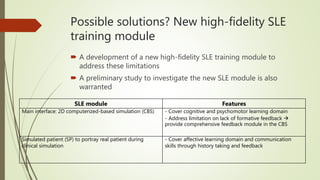
 A development of a new high-fidelity SLE training module to
address these limitations
 A preliminary study to investigate the new SLE module is also
warranted
SLE module Features
Main interface: 2D computerized-based simulation (CBS) - Cover cognitive and psychomotor learning domain
- Address limitation on lack of formative feedback 
provide comprehensive feedback module in the CBS
Simulated patient (SP) to portray real patient during
clinical simulation
- Cover affective learning domain and communication
skills through history taking and feedback
Research objectives
General objective: To develop and validate high-
fidelity SLE training module.
Specific objectives
To determine common errors made by audiology
students from audiology instructors.
To develop a high-fidelity SLE training module in
routine audiology testing (adult).
To validate the new high-fidelity SLE training module
among audiology instructors.
Research questions
What are the common errors made by the audiology
students during clinical training?
Is the new SLE training module is a valid training tool
for audiology students?
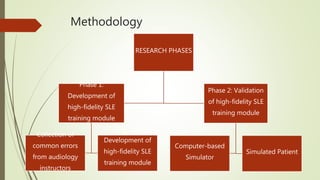
Methodology
RESEARCH PHASES
Phase 1:
Development of
high-fidelity SLE
training module
Collection of
common errors
from audiology
instructors
Development of
high-fidelity SLE
training module
Phase 2: Validation
of high-fidelity SLE
training module
Computer-based
Simulator
Simulated Patient
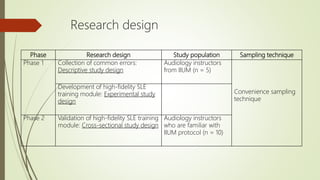
Phase Research design Study population Sampling technique
Phase 1 Collection of common errors:
Descriptive study design
Audiology instructors
from IIUM (n = 5)
Convenience sampling
technique
Development of high-fidelity SLE
training module: Experimental study
design
Phase 2 Validation of high-fidelity SLE training
module: Cross-sectional study design
Audiology instructors
who are familiar with
IIUM protocol (n = 10)
Research design
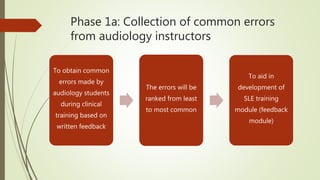
Phase 1a: Collection of common errors
from audiology instructors
To obtain common
errors made by
audiology students
during clinical
training based on
written feedback
The errors will be
ranked from least
to most common
To aid in
development of
SLE training
module (feedback
module)
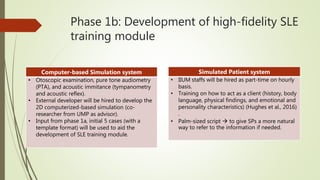
Phase 1b: Development of high-fidelity SLE
training module
Computer-based Simulation system
• Otoscopic examination, pure tone audiometry
(PTA), and acoustic immitance (tympanometry
and acoustic reflex).
• External developer will be hired to develop the
2D computerized-based simulation (co-
researcher from UMP as advisor).
• Input from phase 1a, initial 5 cases (with a
template format) will be used to aid the
development of SLE training module.
Simulated Patient system
• IIUM staffs will be hired as part-time on hourly
basis.
• Training on how to act as a client (history, body
language, physical findings, and emotional and
personality characteristics) (Hughes et al., 2016)
.
• Palm-sized script  to give SPs a more natural
way to refer to the information if needed.
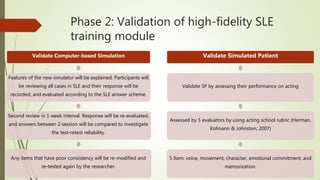
Phase 2: Validation of high-fidelity SLE
training module
Validate Computer-based Simulation
Features of the new simulator will be explained. Participants will
be reviewing all cases in SLE and their response will be
recorded, and evaluated according to the SLE answer scheme.
Second review in 1 week interval. Response will be re-evaluated,
and answers between 2 session will be compared to investigate
the test-retest reliability.
Any items that have poor consistency will be re-modified and
re-tested again by the researcher.
Validate Simulated Patient
Validate SP by assessing their performance on acting
Assessed by 5 evaluators by using acting school rubric (Herman,
Kolmann & Johnston, 2007)
5 Item: voice, movement, character, emotional commitment, and
memorization.
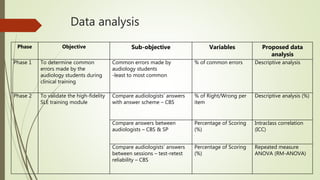
Data analysis
Phase Objective Sub-objective Variables Proposed data
analysis
Phase 1 To determine common
errors made by the
audiology students during
clinical training
Common errors made by
audiology students
-least to most common
% of common errors Descriptive analysis
Phase 2 To validate the high-fidelity
SLE training module
Compare audiologists’ answers
with answer scheme – CBS
% of Right/Wrong per
item
Descriptive analysis (%)
Compare answers between
audiologists – CBS & SP
Percentage of Scoring
(%)
Intraclass correlation
(ICC)
Compare audiologists’ answers
between sessions – test-retest
reliability – CBS
Percentage of Scoring
(%)
Repeated measure
ANOVA (RM-ANOVA)
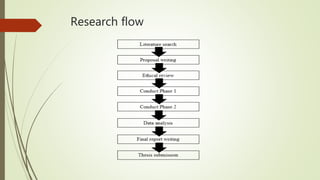
Research flow
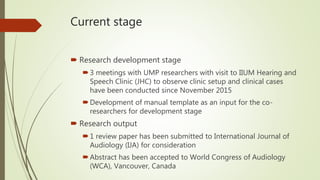
Current stage
 Research development stage
3 meetings with UMP researchers with visit to IIUM Hearing and
Speech Clinic (JHC) to observe clinic setup and clinical cases
have been conducted since November 2015
Development of manual template as an input for the co-
researchers for development stage
 Research output
1 review paper has been submitted to International Journal of
Audiology (IJA) for consideration
Abstract has been accepted to World Congress of Audiology
(WCA), Vancouver, Canada
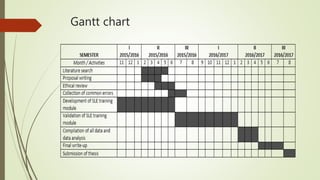
Gantt chart
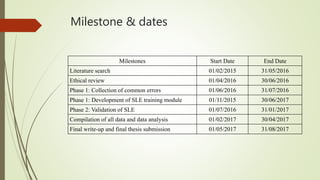
Milestone & dates
Milestones Start Date End Date
Literature search 01/02/2015 31/05/2016
Ethical review 01/04/2016 30/06/2016
Phase 1: Collection of common errors 01/06/2016 31/07/2016
Phase 1: Development of SLE training module 01/11/2015 30/06/2017
Phase 2: Validation of SLE 01/07/2016 31/01/2017
Compilation of all data and data analysis 01/02/2017 30/04/2017
Final write-up and final thesis submission 01/05/2017 31/08/2017
Expected outcomes
 Information from audiology instructors regarding the new
model of high-fidelity SLE training module will be obtained to
assist in improving the simulator.
 The new preliminary model of SLE training module is
validated and can be used for further research for basic
clinical training for audiology students.
Acknowledgement
 Fundamental Research Grant Scheme (FRGS) 2015, Ministry of
Education (MOE) for funding (RM 162, 200).
References
 Sutton, B., Bearman, M., Jolly, B., Nestel, D., Brookes, P., Flanagan, B., Watson, M. & McMenamin, C. (2010). Simulated learning
environment: Medical curriculum report. Monash University.
 Gaba, D. M. (2004). The future vision of simulation in health care. Qual Saf Health Care, 13(i2-i10).
 Munshi, F., Lababidi, H. & Alyousef, S. (2015). Low- versus high-fidelity simulations in teaching and assessing clinical skills.
Journal of Taibah University Medical Sciences, 10(1): 12-15.
 Dzulkarnain, A. A. A., Wan Mhd Pandi, W. M., Rahmat, S. & Zakaria, N. (2015). Simulated learning environment (SLE) in
audiology education: A systematic review. Int Audiol J, 22: 1-8.
 Wilson, W. J. et al. (2011). A national approach for the integration of simulated learning environments into audiology
education. Health Workforce Australia: Australia.
 Heitz, A. (2013). Improving clinical education through the use of virtual patient-based computer simulations [in PhD thesis].
University of Canterbury.
 Hawkins, R., Bendickson, L., Benson, P., Osborne, L., McPherson, J., Todd, L., Snelson, J., Bruner, S. & Bohan, K. (2014). A pilot
study evaluating the perceptions of certified registered nurse anaesthetists toward human patient simulation. AANA Journal,
82(5); 375-384.
 Joseph, N., Nelliyanil, M., Jindal, S., Utkarsha, Abraham, A. E., Alok, Y., Srivastava, N. & Lankeshwar, R. (2015). Perception of
simulation-based learning among medical students in South India. Annals of Medical and Health Sciences Research, 5(4):
247-252.
 Schlein, K. M. (2011). Perceptions and attitudes of dietetics program educators regarding use of distance education and
computer-based simulations in dietetics education [in Masters thesis]. University of Massachusetts.
 Hughes, J. R. (2016). An investigation of the use of simulated patients in audiology student education. University of
Queensland [Master thesis].
 Herman, M., Kolmann, C. & Johnston, C. (2007). Collier County School performance-based portfolio assessment. The District
School Board of Collier County.

research proposal defense

  • 1.
    Development of anew high-fidelity simulated learning environment (SLE) in audiology education By: Nur ‘Ain Fathanah bt. Mohd. Puzi (G1528498) Programme: Master of Health Science (Audiology) Supervisors: Asst. Prof. Dr. Ahmad Aidil Arafat bin Dzulkarnain Asst. Prof. Dr. Sarah binti Rahmat
  • 2.
  • 3.
    Introduction  SLE isdefined as a training tool that tries to imitate the reality by having the ability to standardized the curriculum across students and location, which enables a reproducible and standardized experience (Sutton et al., 2010).  SLE is categorized into three levels of fidelity, based on how close the SLE training to a real clinical practice; which are low-, medium- and high-fidelity (Munshi, Lababidi & Alyousef, 2015; Gaba, 2004).  Among SLEs types that have been used in medical and health sciences are simulated patients (SPs), computer-based simulation (CBS), part-task trainers, and virtual reality (Wilson et al. 2011).
  • 4.
     Successful evidencefrom other fields Positive perceptions towards SLE in nurses (Hawkins et al., 2014) Student satisfaction regarding SLE (Hill et al., 2013) Enhance medical, nursing and pharmacy students’ clinical skills (Cook, 2014; McGaghie et al., 2011) Improve general knowledge (Gordon et al., 2006) Useful for student assessment and examination (Botezatu et al., 2010)
  • 5.
     Successful evidenceof using high-fidelity SLE in medicine and nursing: More scoring improvement than the low- and medium-fidelity SLE (Basak et al., 2015; Wang et al., 2013) The high-fidelity SLE is perceived by the students as: Improving knowledge Critical thinking Competency in practical skills Confidence level The integration of knowledge and practice (Dwyer et al., 2015; Kaddoura et al., 2015; Kearns et al., 2015; Niell et al., 2015; Smith et al., 2015; Przybl et al., 2015)
  • 6.
     SLE isimportant in audiology to promote patient safety in clinical training, and to provide an additional training to improve students’ skills and performance (Wilson et al., 2011)  Majority of the SLE audiology studies showed positive findings such as significantly higher post-training examination score following the SLE training and higher post-training examination score than the control group (Dzulkarnain et al., 2015)
  • 7.
    Problem statement  Mostof the SLE studies in audiology utilizes only a low- or medium-fidelity SLE types of simulations.  The literature did not focus on the social learning domains and communication skills in their SLE training.  Most of the literature related to SLE used only basic instructional feedback to the students with lack of formative feedback modules.
  • 8.
    Possible solutions? Newhigh-fidelity SLE training module  A development of a new high-fidelity SLE training module to address these limitations  A preliminary study to investigate the new SLE module is also warranted SLE module Features Main interface: 2D computerized-based simulation (CBS) - Cover cognitive and psychomotor learning domain - Address limitation on lack of formative feedback  provide comprehensive feedback module in the CBS Simulated patient (SP) to portray real patient during clinical simulation - Cover affective learning domain and communication skills through history taking and feedback
  • 9.
    Research objectives General objective:To develop and validate high- fidelity SLE training module. Specific objectives To determine common errors made by audiology students from audiology instructors. To develop a high-fidelity SLE training module in routine audiology testing (adult). To validate the new high-fidelity SLE training module among audiology instructors.
  • 10.
    Research questions What arethe common errors made by the audiology students during clinical training? Is the new SLE training module is a valid training tool for audiology students?
  • 11.
    Methodology RESEARCH PHASES Phase 1: Developmentof high-fidelity SLE training module Collection of common errors from audiology instructors Development of high-fidelity SLE training module Phase 2: Validation of high-fidelity SLE training module Computer-based Simulator Simulated Patient
  • 12.
    Phase Research designStudy population Sampling technique Phase 1 Collection of common errors: Descriptive study design Audiology instructors from IIUM (n = 5) Convenience sampling technique Development of high-fidelity SLE training module: Experimental study design Phase 2 Validation of high-fidelity SLE training module: Cross-sectional study design Audiology instructors who are familiar with IIUM protocol (n = 10) Research design
  • 13.
    Phase 1a: Collectionof common errors from audiology instructors To obtain common errors made by audiology students during clinical training based on written feedback The errors will be ranked from least to most common To aid in development of SLE training module (feedback module)
  • 14.
    Phase 1b: Developmentof high-fidelity SLE training module Computer-based Simulation system • Otoscopic examination, pure tone audiometry (PTA), and acoustic immitance (tympanometry and acoustic reflex). • External developer will be hired to develop the 2D computerized-based simulation (co- researcher from UMP as advisor). • Input from phase 1a, initial 5 cases (with a template format) will be used to aid the development of SLE training module. Simulated Patient system • IIUM staffs will be hired as part-time on hourly basis. • Training on how to act as a client (history, body language, physical findings, and emotional and personality characteristics) (Hughes et al., 2016) . • Palm-sized script  to give SPs a more natural way to refer to the information if needed.
  • 15.
    Phase 2: Validationof high-fidelity SLE training module Validate Computer-based Simulation Features of the new simulator will be explained. Participants will be reviewing all cases in SLE and their response will be recorded, and evaluated according to the SLE answer scheme. Second review in 1 week interval. Response will be re-evaluated, and answers between 2 session will be compared to investigate the test-retest reliability. Any items that have poor consistency will be re-modified and re-tested again by the researcher. Validate Simulated Patient Validate SP by assessing their performance on acting Assessed by 5 evaluators by using acting school rubric (Herman, Kolmann & Johnston, 2007) 5 Item: voice, movement, character, emotional commitment, and memorization.
  • 16.
    Data analysis Phase ObjectiveSub-objective Variables Proposed data analysis Phase 1 To determine common errors made by the audiology students during clinical training Common errors made by audiology students -least to most common % of common errors Descriptive analysis Phase 2 To validate the high-fidelity SLE training module Compare audiologists’ answers with answer scheme – CBS % of Right/Wrong per item Descriptive analysis (%) Compare answers between audiologists – CBS & SP Percentage of Scoring (%) Intraclass correlation (ICC) Compare audiologists’ answers between sessions – test-retest reliability – CBS Percentage of Scoring (%) Repeated measure ANOVA (RM-ANOVA)
  • 17.
  • 18.
    Current stage  Researchdevelopment stage 3 meetings with UMP researchers with visit to IIUM Hearing and Speech Clinic (JHC) to observe clinic setup and clinical cases have been conducted since November 2015 Development of manual template as an input for the co- researchers for development stage  Research output 1 review paper has been submitted to International Journal of Audiology (IJA) for consideration Abstract has been accepted to World Congress of Audiology (WCA), Vancouver, Canada
  • 19.
  • 20.
    Milestone & dates MilestonesStart Date End Date Literature search 01/02/2015 31/05/2016 Ethical review 01/04/2016 30/06/2016 Phase 1: Collection of common errors 01/06/2016 31/07/2016 Phase 1: Development of SLE training module 01/11/2015 30/06/2017 Phase 2: Validation of SLE 01/07/2016 31/01/2017 Compilation of all data and data analysis 01/02/2017 30/04/2017 Final write-up and final thesis submission 01/05/2017 31/08/2017
  • 21.
    Expected outcomes  Informationfrom audiology instructors regarding the new model of high-fidelity SLE training module will be obtained to assist in improving the simulator.  The new preliminary model of SLE training module is validated and can be used for further research for basic clinical training for audiology students.
  • 22.
    Acknowledgement  Fundamental ResearchGrant Scheme (FRGS) 2015, Ministry of Education (MOE) for funding (RM 162, 200).
  • 23.
    References  Sutton, B.,Bearman, M., Jolly, B., Nestel, D., Brookes, P., Flanagan, B., Watson, M. & McMenamin, C. (2010). Simulated learning environment: Medical curriculum report. Monash University.  Gaba, D. M. (2004). The future vision of simulation in health care. Qual Saf Health Care, 13(i2-i10).  Munshi, F., Lababidi, H. & Alyousef, S. (2015). Low- versus high-fidelity simulations in teaching and assessing clinical skills. Journal of Taibah University Medical Sciences, 10(1): 12-15.  Dzulkarnain, A. A. A., Wan Mhd Pandi, W. M., Rahmat, S. & Zakaria, N. (2015). Simulated learning environment (SLE) in audiology education: A systematic review. Int Audiol J, 22: 1-8.  Wilson, W. J. et al. (2011). A national approach for the integration of simulated learning environments into audiology education. Health Workforce Australia: Australia.  Heitz, A. (2013). Improving clinical education through the use of virtual patient-based computer simulations [in PhD thesis]. University of Canterbury.  Hawkins, R., Bendickson, L., Benson, P., Osborne, L., McPherson, J., Todd, L., Snelson, J., Bruner, S. & Bohan, K. (2014). A pilot study evaluating the perceptions of certified registered nurse anaesthetists toward human patient simulation. AANA Journal, 82(5); 375-384.  Joseph, N., Nelliyanil, M., Jindal, S., Utkarsha, Abraham, A. E., Alok, Y., Srivastava, N. & Lankeshwar, R. (2015). Perception of simulation-based learning among medical students in South India. Annals of Medical and Health Sciences Research, 5(4): 247-252.  Schlein, K. M. (2011). Perceptions and attitudes of dietetics program educators regarding use of distance education and computer-based simulations in dietetics education [in Masters thesis]. University of Massachusetts.  Hughes, J. R. (2016). An investigation of the use of simulated patients in audiology student education. University of Queensland [Master thesis].  Herman, M., Kolmann, C. & Johnston, C. (2007). Collier County School performance-based portfolio assessment. The District School Board of Collier County.