Welcome to Your Library
         BCHS 4321


       COMD 6361
Class Objectives

1.   Able to understand and navigate Library’s web site and locate research
     databases.

2.   Understand what Peer Reviewed articles are and know how to locate
     them.

3.   Able to distinguish between primary, secondary, and tertiary sources.

4.   Establish a RefWorks user account and be able to import 3 sources from
     two different databases.

5.   Understand how to formulate a computer database search.

6.   Understand the value “Citation Searching” and be able to conduct one.
Quick Tour of Services
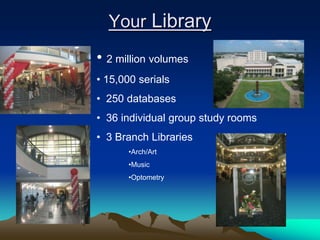
Your Library
• 2 million volumes
• 15,000 serials
• 250 databases
• 36 individual group study rooms
• 3 Branch Libraries
       •Arch/Art
       •Music
       •Optometry
Services
• Remote access– CougarNet account
• Full text Journal articles
• Cougar One Card
• Cougar-net account
• VPN account
• Inter Library Loan [online]
• Library Provides 500 free pages of prints
• IT Central Site also 500 free prints (Library Basement –
  own entrance)
• Free Photocopying or you can email or save on a flash
  drive
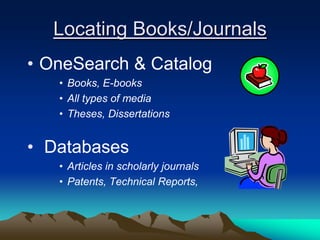
Locating Books/Journals
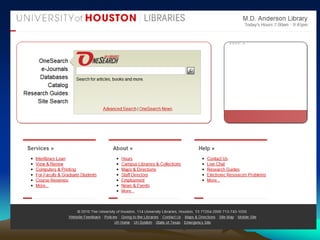
• OneSearch & Catalog
   • Books, E-books
   • All types of media
   • Theses, Dissertations


• Databases
   • Articles in scholarly journals
   • Patents, Technical Reports,
Peer Review
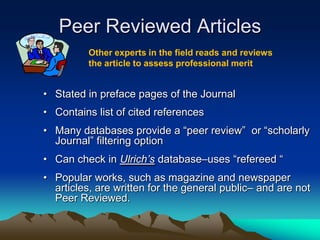
Peer Reviewed Articles
          Other experts in the field reads and reviews
          the article to assess professional merit


• Stated in preface pages of the Journal
• Contains list of cited references
• Many databases provide a “peer review” or “scholarly
  Journal” filtering option
• Can check in Ulrich’s database–uses “refereed “
• Popular works, such as magazine and newspaper
  articles, are written for the general public– and are not
  Peer Reviewed.
Types of Research Literature
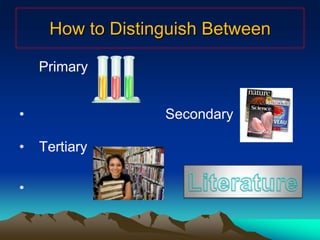
How to Distinguish Between

    Primary


•                 Secondary

•   Tertiary

•
Primary Sources


• Source material that is closest to the original research.

• A source with direct personal knowledge of the events being
  described. It serves as an original source of information about the
  topic. A person with direct knowledge of a situation, or a document
  created by such a person.

• E.G. Case Reports, Clinical Trials, Original reporting articles…1st
  person
Secondary Sources


• Cite, comment on, or build upon primary sources.

• Involve generalization, analysis, synthesis, interpretation, or
  evaluation of the original information. If an article discusses old
  documents to derive a new conclusion, it is considered to be a
  primary source for the new conclusion

• E.G. Review Articles, meta-analysis [most peer review articles
  report new findings and thus are considered primary resources]
Tertiary Sources

• More peripheral

• Bibliographies, library catalogs, directories,
  reading lists and survey articles.
• Compilation of data…E.G. Red Book, PDR, Martindale
  Extra Pharmacopeia

• Longer lead time in publishing..years rather than months
Boolean Searching
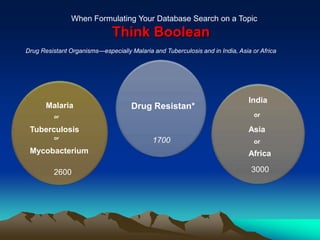
When Formulating Your Database Search on a Topic
                              Think Boolean
Drug Resistant Organisms—especially Malaria and Tuberculosis and in India, Asia or Africa


                                                                               India
       Malaria                       Drug Resistan*
          or                                                                     or

 Tuberculosis                                                                  Asia
          or
                                             1700                                or
 Mycobacterium                                                                 Africa

          2600                                                                  3000
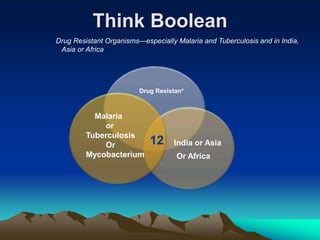
Think Boolean
Drug Resistant Organisms—especially Malaria and Tuberculosis and in India,
 Asia or Africa


                         Drug Resistan*


           Malaria
             or
         Tuberculosis
             Or             12     India or Asia
         Mycobacterium              Or Africa
Citation Searching
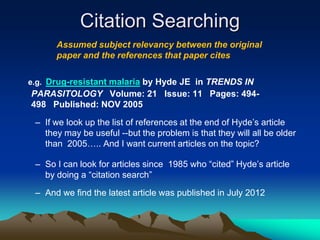
Citation Searching
      Assumed subject relevancy between the original
      paper and the references that paper cites

e.g. Drug-resistant malaria by Hyde JE in TRENDS IN
PARASITOLOGY Volume: 21 Issue: 11 Pages: 494-
498 Published: NOV 2005

 – If we look up the list of references at the end of Hyde’s article
   they may be useful --but the problem is that they will all be older
   than 2005….. And I want current articles on the topic?

 – So I can look for articles since 1985 who “cited” Hyde’s article
   by doing a “citation search”

 – And we find the latest article was published in July 2012
Citation Searching

       Traditional Search             Citation Search
                                            2011
                               2010                     2010

          1984               1998
                                                        2008


                                       1984
 1980

             1975
                    1970
1963
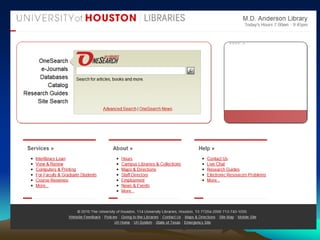
Navigating UH Library
     Web Pages
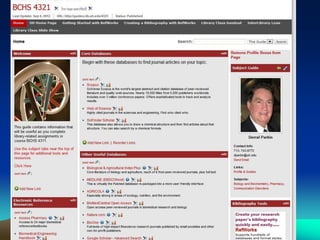
BCHS Biochemistry Library Class Guide
Questions?

Slide bcs4321

  • 1.
    Welcome to YourLibrary BCHS 4321 COMD 6361
  • 2.
    Class Objectives 1. Able to understand and navigate Library’s web site and locate research databases. 2. Understand what Peer Reviewed articles are and know how to locate them. 3. Able to distinguish between primary, secondary, and tertiary sources. 4. Establish a RefWorks user account and be able to import 3 sources from two different databases. 5. Understand how to formulate a computer database search. 6. Understand the value “Citation Searching” and be able to conduct one.
  • 3.
    Quick Tour ofServices
  • 4.
    Your Library • 2million volumes • 15,000 serials • 250 databases • 36 individual group study rooms • 3 Branch Libraries •Arch/Art •Music •Optometry
  • 5.
    Services • Remote access–CougarNet account • Full text Journal articles • Cougar One Card • Cougar-net account • VPN account • Inter Library Loan [online] • Library Provides 500 free pages of prints • IT Central Site also 500 free prints (Library Basement – own entrance) • Free Photocopying or you can email or save on a flash drive
  • 6.
    Locating Books/Journals • OneSearch& Catalog • Books, E-books • All types of media • Theses, Dissertations • Databases • Articles in scholarly journals • Patents, Technical Reports,
  • 8.
  • 9.
    Peer Reviewed Articles Other experts in the field reads and reviews the article to assess professional merit • Stated in preface pages of the Journal • Contains list of cited references • Many databases provide a “peer review” or “scholarly Journal” filtering option • Can check in Ulrich’s database–uses “refereed “ • Popular works, such as magazine and newspaper articles, are written for the general public– and are not Peer Reviewed.
  • 10.
  • 11.
    How to DistinguishBetween Primary • Secondary • Tertiary •
  • 12.
    Primary Sources • Sourcematerial that is closest to the original research. • A source with direct personal knowledge of the events being described. It serves as an original source of information about the topic. A person with direct knowledge of a situation, or a document created by such a person. • E.G. Case Reports, Clinical Trials, Original reporting articles…1st person
  • 13.
    Secondary Sources • Cite,comment on, or build upon primary sources. • Involve generalization, analysis, synthesis, interpretation, or evaluation of the original information. If an article discusses old documents to derive a new conclusion, it is considered to be a primary source for the new conclusion • E.G. Review Articles, meta-analysis [most peer review articles report new findings and thus are considered primary resources]
  • 14.
    Tertiary Sources • Moreperipheral • Bibliographies, library catalogs, directories, reading lists and survey articles. • Compilation of data…E.G. Red Book, PDR, Martindale Extra Pharmacopeia • Longer lead time in publishing..years rather than months
  • 15.
  • 16.
    When Formulating YourDatabase Search on a Topic Think Boolean Drug Resistant Organisms—especially Malaria and Tuberculosis and in India, Asia or Africa India Malaria Drug Resistan* or or Tuberculosis Asia or 1700 or Mycobacterium Africa 2600 3000
  • 17.
    Think Boolean Drug ResistantOrganisms—especially Malaria and Tuberculosis and in India, Asia or Africa Drug Resistan* Malaria or Tuberculosis Or 12 India or Asia Mycobacterium Or Africa
  • 18.
  • 19.
    Citation Searching Assumed subject relevancy between the original paper and the references that paper cites e.g. Drug-resistant malaria by Hyde JE in TRENDS IN PARASITOLOGY Volume: 21 Issue: 11 Pages: 494- 498 Published: NOV 2005 – If we look up the list of references at the end of Hyde’s article they may be useful --but the problem is that they will all be older than 2005….. And I want current articles on the topic? – So I can look for articles since 1985 who “cited” Hyde’s article by doing a “citation search” – And we find the latest article was published in July 2012
  • 20.
    Citation Searching Traditional Search Citation Search 2011 2010 2010 1984 1998 2008 1984 1980 1975 1970 1963
  • 21.
  • 23.
  • 24.