Introduction to Economics
Mr. Ahmed
(He/Him)
Room 3202
Economics resources
YouTube channels: Econplusdal,
Brad Cartwright, Enhance Tuition,
ACDC Econ
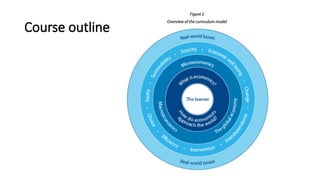
Course outline
Learning
objectives
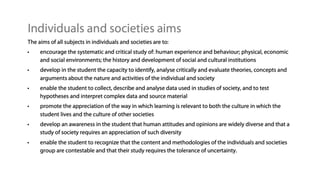
To understand the nature of economics as a
social science
To distinguish between microeconomics
and macroeconomics
To explain why scarcity exists and how it
forces choices to be made
To understand what is meant by
opportunity cost
To explain the connection between scarcity
and sustainability
1. Understanding the nature of
economics
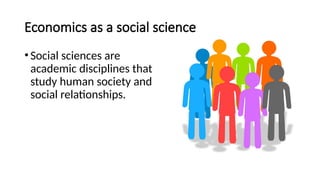
Economics as a social science
•Social sciences are
academic disciplines that
study human society and
social relationships.
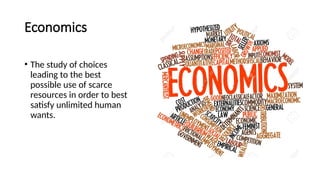
Economics
• The study of choices
leading to the best
possible use of scarce
resources in order to best
satisfy unlimited human
wants.
Do you think like an economist?
1. Because it is desirable, sunshine is scarce.​
2. Because it is limited, asthma is scarce.​
3. Because water covers three-fourths of the earth’s surface and is renewable,
it cannot be considered scarce.​
4. The main costs of going to college are tuition and living expenses.​
5. If public transportation fares are raised, almost everyone will take
the subway anyway.​
6. You get what you pay for.​
7. If someone makes an economic gain, someone else loses. ​
8. A business owner’s decision to show more care for consumers is a
decision to accept lower levels of profits. ​
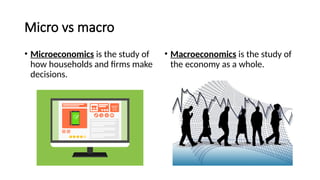
Micro vs macro
• Microeconomics is the study of
how households and firms make
decisions.
• Macroeconomics is the study of
the economy as a whole.
Micro or macro?
• The price of Air Jordan 11s has risen by 20% since the end of last month.
• The government reduces individual income tax to boost consumer
spending.
• Haidilao is closing many dine-in locations due to poor performance.
• Petroleum producers see record profits.
• The total revenue of BYD car production has increased as consumers
purchase more electric vehicles.
• Consumers discover their purchasing power has fallen as the general
price level has risen.
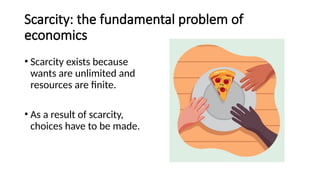
Scarcity: the fundamental problem of
economics
• Scarcity exists because
wants are unlimited and
resources are finite.
• As a result of scarcity,
choices have to be made.
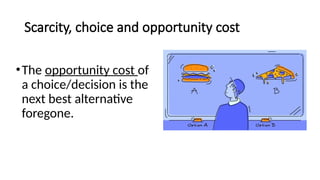
Scarcity, choice and opportunity cost
•The opportunity cost of
a choice/decision is the
next best alternative
foregone.
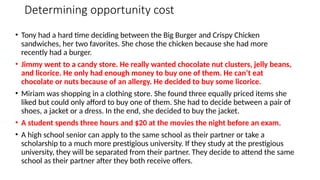
Determining opportunity cost
• Tony had a hard time deciding between the Big Burger and Crispy Chicken
sandwiches, her two favorites. She chose the chicken because she had more
recently had a burger.
• Jimmy went to a candy store. He really wanted chocolate nut clusters, jelly beans,
and licorice. He only had enough money to buy one of them. He can’t eat
chocolate or nuts because of an allergy. He decided to buy some licorice.
• Miriam was shopping in a clothing store. She found three equally priced items she
liked but could only afford to buy one of them. She had to decide between a pair of
shoes, a jacket or a dress. In the end, she decided to buy the jacket.
• A student spends three hours and $20 at the movies the night before an exam.
• A high school senior can apply to the same school as their partner or take a
scholarship to a much more prestigious university. If they study at the prestigious
university, they will be separated from their partner. They decide to attend the same
school as their partner after they both receive offers.
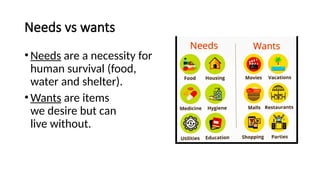
Needs vs wants
•Needs are a necessity for
human survival (food,
water and shelter).​
•Wants are items
we desire but can
live without.​
Free goods
• Free goods do not require
resources to produce them
and therefore have no
opportunity cost.
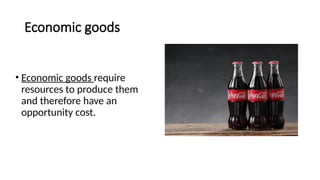
Economic goods
• Economic goods require
resources to produce them
and therefore have an
opportunity cost.
Scarcity and sustainability
• Sustainability means using
scarce resources in a way that
does not leave behind fewer or
lower-quality resources for
future generations.
Fresh water scarcity:
What can we do
about it?
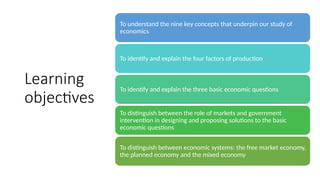
Learning
objectives
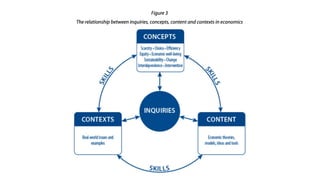
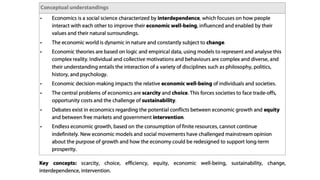
To understand the nine key concepts that underpin our study of
economics
To identify and explain the four factors of production
To identify and explain the three basic economic questions
To distinguish between the role of markets and government
intervention in designing and proposing solutions to the basic
economic questions
To distinguish between economic systems: the free market economy,
the planned economy and the mixed economy
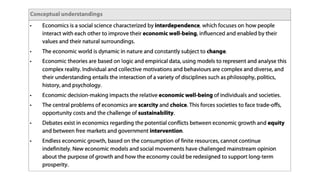
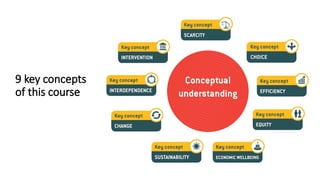
9 key concepts
of this course
What is Economics? (again)
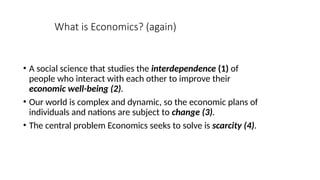
• A social science that studies the interdependence (1) of
people who interact with each other to improve their
economic well-being (2).
• Our world is complex and dynamic, so the economic plans of
individuals and nations are subject to change (3).
• The central problem Economics seeks to solve is scarcity (4).
What is Economics?
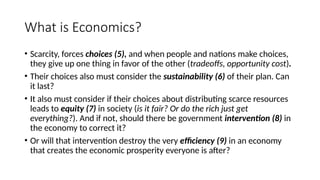
• Scarcity, forces choices (5), and when people and nations make choices,
they give up one thing in favor of the other (tradeoffs, opportunity cost).
• Their choices also must consider the sustainability (6) of their plan. Can
it last?
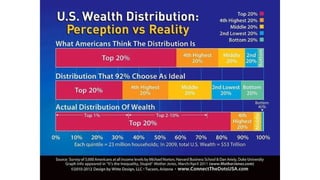
• It also must consider if their choices about distributing scarce resources
leads to equity (7) in society (is it fair? Or do the rich just get
everything?). And if not, should there be government intervention (8) in
the economy to correct it?
• Or will that intervention destroy the very efficiency (9) in an economy
that creates the economic prosperity everyone is after?
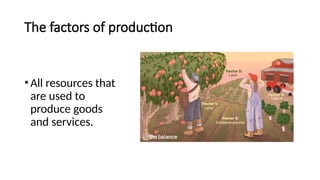
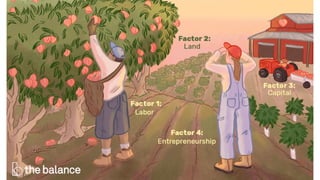
The factors of production
•All resources that
are used to
produce goods
and services.
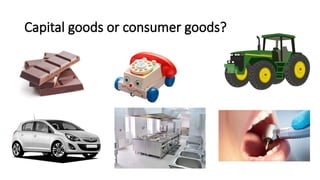
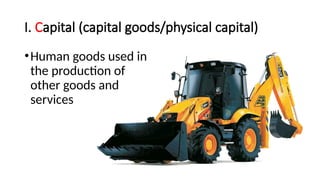
I. Capital (capital goods/physical capital)
•Human goods used in
the production of
other goods and
services
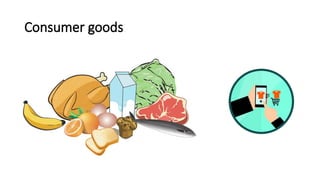
Consumer goods
Capital goods or consumer goods?
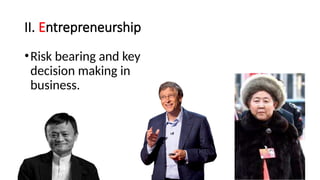
II. Entrepreneurship
•Risk bearing and key
decision making in
business.
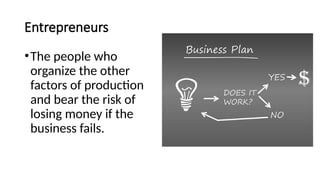
Entrepreneurs
•The people who
organize the other
factors of production
and bear the risk of
losing money if the
business fails.
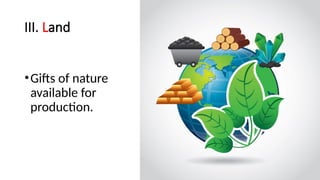
III. Land
•Gifts of nature
available for
production.
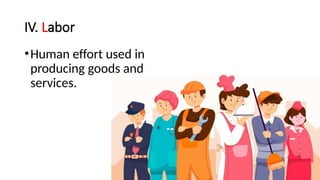
IV. Labor
•Human effort used in
producing goods and
services.
Economic problem activity
•Take out a single piece of paper.
•Make it into something.
•You have 3 minutes to complete the task.
How should we distribute what
we’ve created?
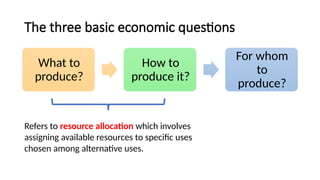
The three basic economic questions
What to
produce?
How to
produce it?
For whom
to
produce?
Refers to resource allocation which involves
assigning available resources to specific uses
chosen among alternative uses.
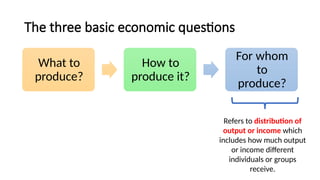
The three basic economic questions
What to
produce?
How to
produce it?
For whom
to
produce?
Refers to distribution of
output or income which
includes how much output
or income different
individuals or groups
receive.
Alternative ways to answer the
economic questions
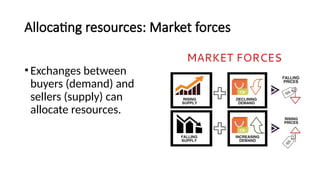
Allocating resources: Market forces
•Exchanges between
buyers (demand) and
sellers (supply) can
allocate resources.
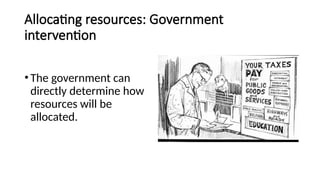
Allocating resources: Government
intervention
•The government can
directly determine how
resources will be
allocated.
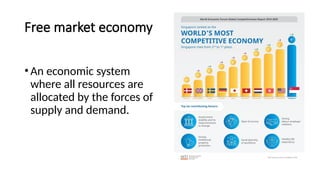
Free market economy
•An economic system
where all resources are
allocated by the forces of
supply and demand.
Planned economy
•An economic system
where all resources are
owned and distributed by
the government.
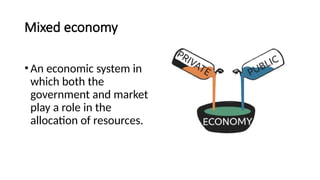
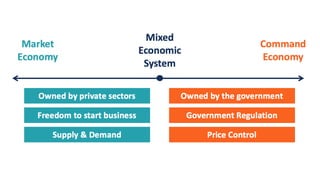
Mixed economy
•An economic system in
which both the
government and market
play a role in the
allocation of resources.
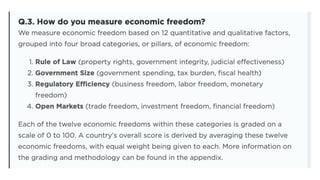
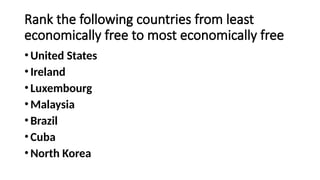
Rank the following countries from least
economically free to most economically free
•United States
•Ireland
•Luxembourg
•Malaysia
•Brazil
•Cuba
•North Korea
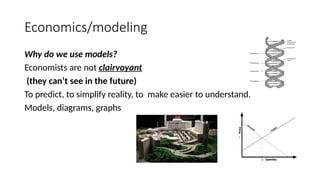
Economics/modeling
Why do we use models?
Economists are not clairvoyant
(they can’t see in the future)
To predict, to simplify reality, to make easier to understand.
Models, diagrams, graphs
The Production possibilities
curve (PPC)
Learning objectives
•Identify and explain relationships in the production
possibilities curve (PPC) model
•Use the PPC model to explain opportunity cost,
choice, scarcity, unemployment, efficiency, actual
growth and growth in production possibilities
•Draw a diagram to explain all of the above concepts in
a diagram
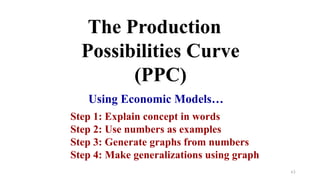
The Production
Possibilities Curve
(PPC)
Using Economic Models…
Step 1: Explain concept in words
Step 2: Use numbers as examples
Step 3: Generate graphs from numbers
Step 4: Make generalizations using graph
63
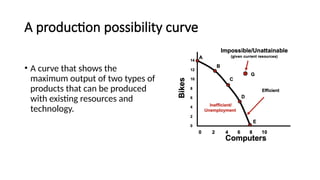
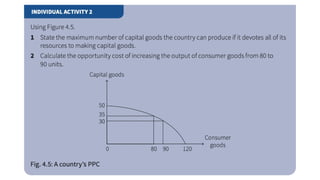
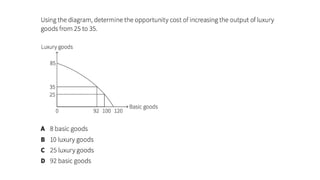
A production possibility curve
• A curve that shows the
maximum output of two types of
products that can be produced
with existing resources and
technology.
Assumptions
•Only two goods can be produced
•Full employment of resources
•Fixed Resources (Ceteris Paribus)
•Fixed Technology
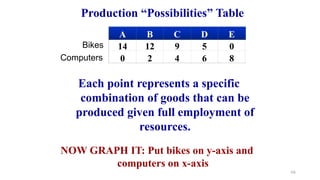
A B C D E f
14 12 9 5 0 0
0 2 4 6 8 10
Bikes
Computers
NOW GRAPH IT: Put bikes on y-axis and
computers on x-axis
Production “Possibilities” Table
Each point represents a specific
combination of goods that can be
produced given full employment of
resources.
66
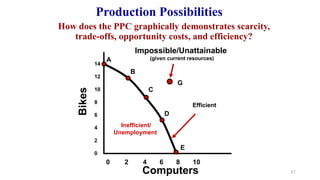
Bikes
Computers
14
12
10
8
6
4
2
0
0 2 4 6 8 10
A
B
C
D
E
G
Inefficient/
Unemployment
Impossible/Unattainable
(given current resources)
Efficient
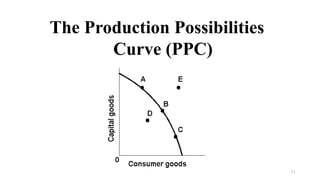
Production Possibilities
How does the PPC graphically demonstrates scarcity,
trade-offs, opportunity costs, and efficiency?
67
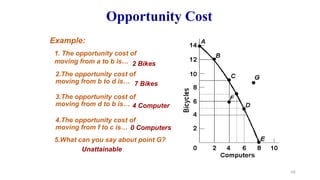
2 Bikes
2.The opportunity cost of
moving from b to d is…
4.The opportunity cost of
moving from f to c is…
3.The opportunity cost of
moving from d to b is…
7 Bikes
4 Computer
0 Computers
5.What can you say about point G?
Unattainable
1. The opportunity cost of
moving from a to b is…
Example:
Opportunity Cost
68
The Production Possibilities
Curve (PPC)
71
Learning objectives
•Distinguish between constant and increasing
opportunity costs in the PPC model
•Draw a diagram to illustrate the difference between
constant and increasing opportunity costs in the PPC
model
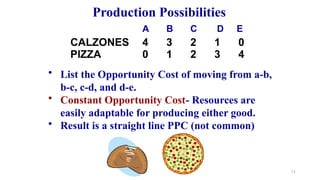
PIZZA 0 1 2 3 4
CALZONES 4 3 2 1 0
• List the Opportunity Cost of moving from a-b,
b-c, c-d, and d-e.
• Constant Opportunity Cost- Resources are
easily adaptable for producing either good.
• Result is a straight line PPC (not common)
Production Possibilities
A B C D E
73
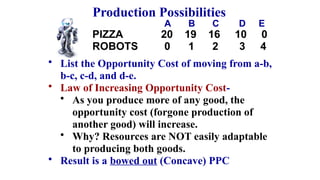
PIZZA 20 19 16 10 0
ROBOTS 0 1 2 3 4
• List the Opportunity Cost of moving from a-b,
b-c, c-d, and d-e.
• Law of Increasing Opportunity Cost-
• As you produce more of any good, the
opportunity cost (forgone production of
another good) will increase.
• Why? Resources are NOT easily adaptable
to producing both goods.
• Result is a bowed out (Concave) PPC
A B C D E
Production Possibilities
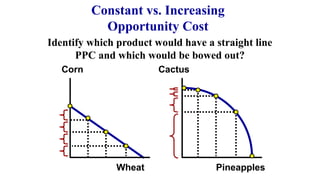
Constant vs. Increasing
Opportunity Cost
Corn
Wheat
Cactus
Pineapples
Identify which product would have a straight line
PPC and which would be bowed out?
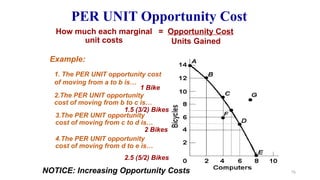
1 Bike
2.The PER UNIT opportunity
cost of moving from b to c is…
4.The PER UNIT opportunity
cost of moving from d to e is…
3.The PER UNIT opportunity
cost of moving from c to d is…
1.5 (3/2) Bikes
2 Bikes
2.5 (5/2) Bikes
= Opportunity Cost
Units Gained
1. The PER UNIT opportunity cost
of moving from a to b is…
Example:
PER UNIT Opportunity Cost
How much each marginal
unit costs
NOTICE: Increasing Opportunity Costs 76
Shifting the Production
Possibilities Curve (growth in
production possibilities)
77
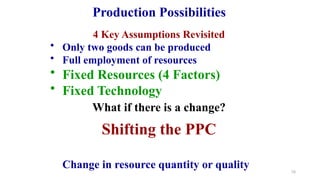
4 Key Assumptions Revisited
• Only two goods can be produced
• Full employment of resources
• Fixed Resources (4 Factors)
• Fixed Technology
What if there is a change?
Shifting the PPC
Change in resource quantity or quality 78
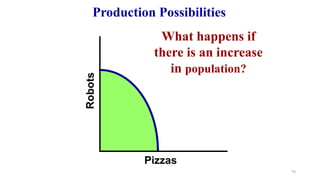
Production Possibilities
Robots
Pizzas
What happens if
there is an increase
in population?
79
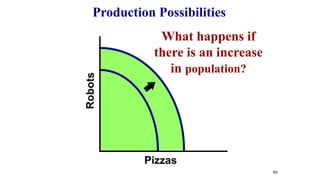
Production Possibilities
Robots
Pizzas
What happens if
there is an increase
in population?
80
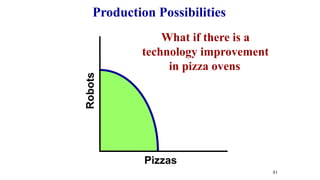
Production Possibilities
Robots
Pizzas
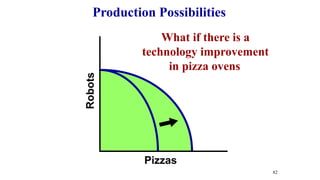
What if there is a
technology improvement
in pizza ovens
81
Production Possibilities
Robots
Pizzas
What if there is a
technology improvement
in pizza ovens
82
Production Possibilities
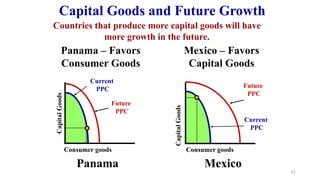
Panama – Favors
Consumer Goods
Mexico – Favors
Capital Goods
Consumer goods
Capital
Goods
Current
PPC
Future
PPC
Consumer goods
Capital
Goods
Future
PPC
Current
PPC
Capital Goods and Future Growth
Mexico
Panama
83
Countries that produce more capital goods will have
more growth in the future.
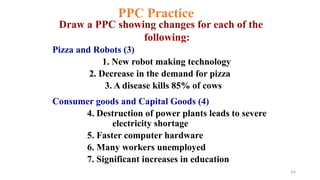
PPC Practice
Draw a PPC showing changes for each of the
following:
Pizza and Robots (3)
1. New robot making technology
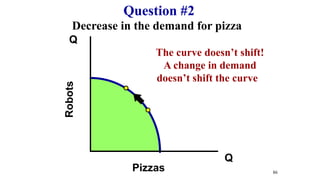
2. Decrease in the demand for pizza
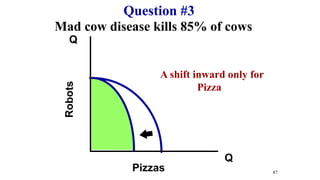
3. A disease kills 85% of cows
Consumer goods and Capital Goods (4)
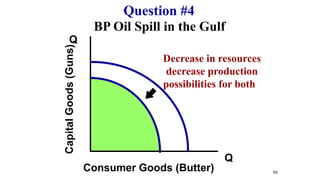
4. Destruction of power plants leads to severe
electricity shortage
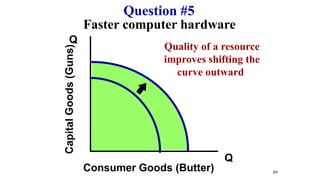
5. Faster computer hardware
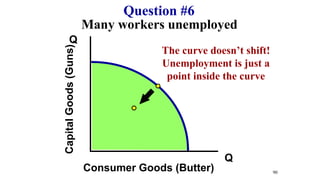
6. Many workers unemployed
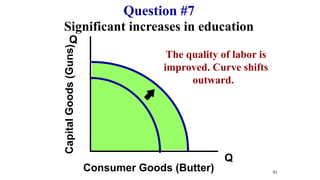
7. Significant increases in education
84
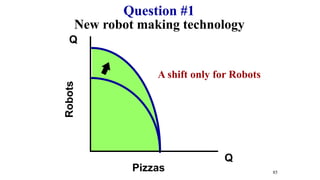
New robot making technology
Q
Q
Robots
Pizzas
Question #1
85
A shift only for Robots
Decrease in the demand for pizza
Q
Q
Robots
Pizzas
Question #2
86
The curve doesn’t shift!
A change in demand
doesn’t shift the curve
Mad cow disease kills 85% of cows
Q
Q
Robots
Pizzas
Question #3
87
A shift inward only for
Pizza
BP Oil Spill in the Gulf
Q
Q
Capital
Goods
(Guns)
Consumer Goods (Butter)
Question #4
88
Decrease in resources
decrease production
possibilities for both
Faster computer hardware
Q
Q
Capital
Goods
(Guns)
Consumer Goods (Butter)
Question #5
89
Quality of a resource
improves shifting the
curve outward
Many workers unemployed
Q
Q
Capital
Goods
(Guns)
Consumer Goods (Butter)
Question #6
90
The curve doesn’t shift!
Unemployment is just a
point inside the curve
Significant increases in education
Q
Q
Capital
Goods
(Guns)
Consumer Goods (Butter)
Question #7
91
The quality of labor is
improved. Curve shifts
outward.
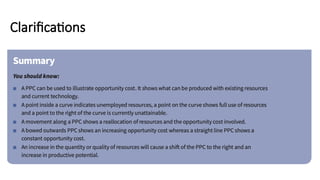
Clarifications
Learning objectives
• To distinguish between positive and normative economics
• To explain the role of positive economics:
• The use of logic, hypotheses and theories
• The role of the ceteris paribus assumption
• The role of empirical evidence and refutation in positive economics
• To explain the role of normative economics:
• The role of value judgments in policy-making in normative economics
• To distinguish between equity and equality
Positive statements are objective statements
dealing with matters of fact that can be proven to
be truthful or false.
They may suggest an economic relationship that
can be tested by recourse to the available
evidence.
Positive statements
Normative statements are subjective -
based on opinion only - often without a basis
in fact or theory.
They are value-judgments, or emotional
statements that focus on "what ought to be".
Normative statements
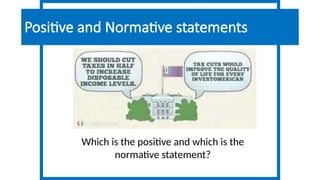
Which is the positive and which is the
normative statement?
Positive and Normative statements
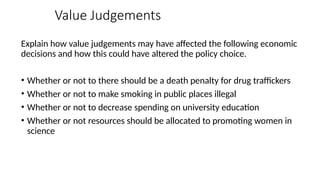
Value Judgements
Explain how value judgements may have affected the following economic
decisions and how this could have altered the policy choice.
• Whether or not to there should be a death penalty for drug traffickers
• Whether or not to make smoking in public places illegal
• Whether or not to decrease spending on university education
• Whether or not resources should be allocated to promoting women in
science
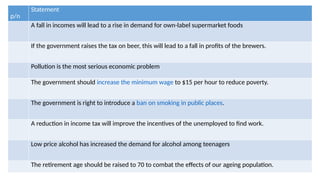
p/n
Statement
A fall in incomes will lead to a rise in demand for own-label supermarket foods
If the government raises the tax on beer, this will lead to a fall in profits of the brewers.
Pollution is the most serious economic problem
The government should increase the minimum wage to $15 per hour to reduce poverty.
The government is right to introduce a ban on smoking in public places.
A reduction in income tax will improve the incentives of the unemployed to find work.
Low price alcohol has increased the demand for alcohol among teenagers
The retirement age should be raised to 70 to combat the effects of our ageing population.
The role of positive economics
Logic, hypotheses and theories
• Logic is a method of reasoning that involves making a series of
statements each of which is true if the preceding statement is true.
• A hypothesis is an educated guess.
• In economics a hypothesis will typically be formulated about a cause and
effect relationship.
• Economic theories are particular ideas or principles that aim to best
describe how an economy works.
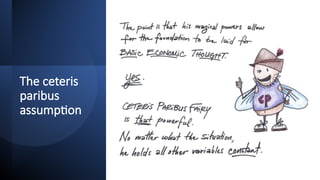
The ceteris
paribus
assumption
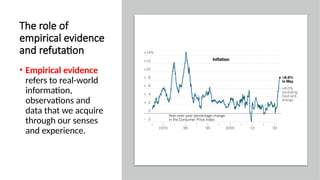
The role of
empirical evidence
and refutation
• Empirical evidence
refers to real-world
information,
observations and
data that we acquire
through our senses
and experience.
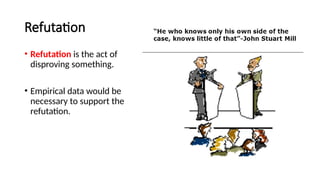
Refutation
• Refutation is the act of
disproving something.
• Empirical data would be
necessary to support the
refutation.
The role of normative economics
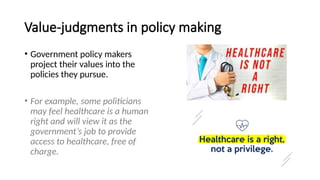
Value-judgments in policy making
• Government policy makers
project their values into the
policies they pursue.
• For example, some politicians
may feel healthcare is a human
right and will view it as the
government’s job to provide
access to healthcare, free of
charge.
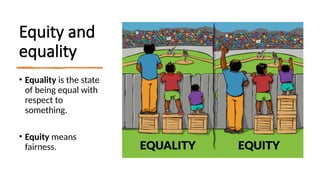
Equity and
equality
• Equality is the state
of being equal with
respect to
something.
• Equity means
fairness.
Learning objectives
• To understand the origins of economic ideas in a historical context
• 18th century: Adam Smith and laissez faire
• 19th century: classical microeconomics (utility); the concept of the margin;
Classical macroeconomics; Marxist critique
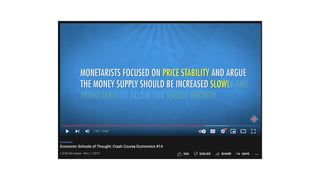
• 20th century: Keynesian revolution, rise of macroeconomic policy,
monetarist/new classical counter revolution
• 21st century: Increased dialogue with other disciplines such as psychology
and the growing role of behavioral economics, increasing awareness of the
interdependencies that exist between the economy, society and environment
and the need to appreciate the compelling reasons for moving toward a
circular economy
Brief history of economic thought
• Economics is a relatively new science
• Adam Smith, “Wealth of Nations,” 1776 - Self interest, free trade, limited government
intervention, “Invisible Hand” – Economic man is rational – so we need a “Free Market”
• David Ricardo – Comparative advantage – nations trade based on abilities to produce with less
opportunity cost
• Jean-Baptiste “Say’s Law” – Supply creates its own demand. Spending will never fall enough to
prevent what is being produced from being sold. (Say what?)
• Karl Marx, “Communist Manifesto,” 1848 – reaction to free markets – Labor theory of value (value
of a product determined by labor put into it – difference between price and labor value is surplus
value (profit) = exploitation of workers – so we need a “Command Economy”
• Utility theory (1850s +)– Pleasure/satisfaction/benefit derived from consumption determines
value or price (Karl off the mark)
• Marginal Utility (1850s+) – What matters is not total utility but marginal utility, the pleasure
gained from consumption of an additional unit
• Marginal Utility (1800s+) – What matters is not total utility but marginal utility, the
pleasure gained from consumption of an additional unit.
• Alfred Marshall (early 1900s) – marginal utility leads to “Law of demand” and demand
curve
• John Maynard Keynes, 1920s-1940s – Capitalist’s free-market reaction to communism
is the “Mixed Economy” (pretty much in use everywhere in world today)
• Milton Friedman – Friedrich Hayek, “Chicago School,” 1940s-1990s (1980s) reaction to
Keynesian economics – Supply side should drive economy not demand side (more of a
return to Free Markets)
• Behavioral Economics – Economic man is not rational (2008 “Nudge”) Richard Thaler
- humans are in fact predictably irrational when it comes to economic decision making;
Daniel Kahneman (2015) “Thinking fast and slow.” Quick judgements and biases
misguide our economic choices
• Circular economy (contemporary)– Sustainable economic growth means we need a
circular economy where products are built to be repaired not thrown away and that
are made from biological materials that if discarded, do not pollute the planet.
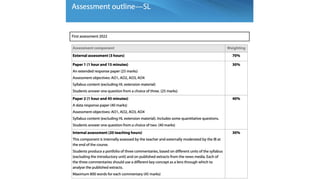
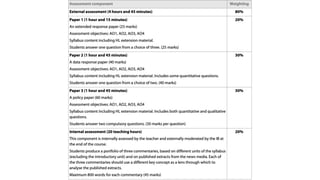
Preparation for your first
assessment
What to expect
• 10 marks for a part (a) style question
• 45 minutes
• Topic: PPC
• need ruler, blue or black pen, and pencil
• Day 3 or Day 4
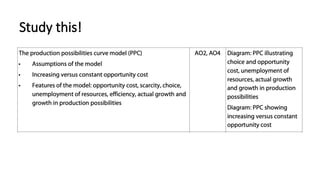
Study this!

economics presentation for high school studentr .pptx

  • 1.
    Introduction to Economics Mr.Ahmed (He/Him) Room 3202
  • 2.
  • 3.
    YouTube channels: Econplusdal, BradCartwright, Enhance Tuition, ACDC Econ
  • 4.
  • 13.
    Learning objectives To understand thenature of economics as a social science To distinguish between microeconomics and macroeconomics To explain why scarcity exists and how it forces choices to be made To understand what is meant by opportunity cost To explain the connection between scarcity and sustainability
  • 14.
    1. Understanding thenature of economics
  • 15.
    Economics as asocial science •Social sciences are academic disciplines that study human society and social relationships.
  • 16.
    Economics • The studyof choices leading to the best possible use of scarce resources in order to best satisfy unlimited human wants.
  • 17.
    Do you thinklike an economist? 1. Because it is desirable, sunshine is scarce.​ 2. Because it is limited, asthma is scarce.​ 3. Because water covers three-fourths of the earth’s surface and is renewable, it cannot be considered scarce.​ 4. The main costs of going to college are tuition and living expenses.​ 5. If public transportation fares are raised, almost everyone will take the subway anyway.​ 6. You get what you pay for.​ 7. If someone makes an economic gain, someone else loses. ​ 8. A business owner’s decision to show more care for consumers is a decision to accept lower levels of profits. ​
  • 18.
    Micro vs macro •Microeconomics is the study of how households and firms make decisions. • Macroeconomics is the study of the economy as a whole.
  • 19.
    Micro or macro? •The price of Air Jordan 11s has risen by 20% since the end of last month. • The government reduces individual income tax to boost consumer spending. • Haidilao is closing many dine-in locations due to poor performance. • Petroleum producers see record profits. • The total revenue of BYD car production has increased as consumers purchase more electric vehicles. • Consumers discover their purchasing power has fallen as the general price level has risen.
  • 23.
    Scarcity: the fundamentalproblem of economics • Scarcity exists because wants are unlimited and resources are finite. • As a result of scarcity, choices have to be made.
  • 24.
    Scarcity, choice andopportunity cost •The opportunity cost of a choice/decision is the next best alternative foregone.
  • 25.
    Determining opportunity cost •Tony had a hard time deciding between the Big Burger and Crispy Chicken sandwiches, her two favorites. She chose the chicken because she had more recently had a burger. • Jimmy went to a candy store. He really wanted chocolate nut clusters, jelly beans, and licorice. He only had enough money to buy one of them. He can’t eat chocolate or nuts because of an allergy. He decided to buy some licorice. • Miriam was shopping in a clothing store. She found three equally priced items she liked but could only afford to buy one of them. She had to decide between a pair of shoes, a jacket or a dress. In the end, she decided to buy the jacket. • A student spends three hours and $20 at the movies the night before an exam. • A high school senior can apply to the same school as their partner or take a scholarship to a much more prestigious university. If they study at the prestigious university, they will be separated from their partner. They decide to attend the same school as their partner after they both receive offers.
  • 26.
    Needs vs wants •Needsare a necessity for human survival (food, water and shelter).​ •Wants are items we desire but can live without.​
  • 27.
    Free goods • Freegoods do not require resources to produce them and therefore have no opportunity cost.
  • 28.
    Economic goods • Economicgoods require resources to produce them and therefore have an opportunity cost.
  • 29.
    Scarcity and sustainability •Sustainability means using scarce resources in a way that does not leave behind fewer or lower-quality resources for future generations.
  • 30.
    Fresh water scarcity: Whatcan we do about it?
  • 31.
    Learning objectives To understand thenine key concepts that underpin our study of economics To identify and explain the four factors of production To identify and explain the three basic economic questions To distinguish between the role of markets and government intervention in designing and proposing solutions to the basic economic questions To distinguish between economic systems: the free market economy, the planned economy and the mixed economy
  • 32.
    9 key concepts ofthis course
  • 33.
    What is Economics?(again) • A social science that studies the interdependence (1) of people who interact with each other to improve their economic well-being (2). • Our world is complex and dynamic, so the economic plans of individuals and nations are subject to change (3). • The central problem Economics seeks to solve is scarcity (4).
  • 34.
    What is Economics? •Scarcity, forces choices (5), and when people and nations make choices, they give up one thing in favor of the other (tradeoffs, opportunity cost). • Their choices also must consider the sustainability (6) of their plan. Can it last? • It also must consider if their choices about distributing scarce resources leads to equity (7) in society (is it fair? Or do the rich just get everything?). And if not, should there be government intervention (8) in the economy to correct it? • Or will that intervention destroy the very efficiency (9) in an economy that creates the economic prosperity everyone is after?
  • 36.
    The factors ofproduction •All resources that are used to produce goods and services.
  • 38.
    I. Capital (capitalgoods/physical capital) •Human goods used in the production of other goods and services
  • 39.
  • 40.
    Capital goods orconsumer goods?
  • 41.
    II. Entrepreneurship •Risk bearingand key decision making in business.
  • 42.
    Entrepreneurs •The people who organizethe other factors of production and bear the risk of losing money if the business fails.
  • 43.
    III. Land •Gifts ofnature available for production.
  • 44.
    IV. Labor •Human effortused in producing goods and services.
  • 46.
    Economic problem activity •Takeout a single piece of paper. •Make it into something. •You have 3 minutes to complete the task.
  • 47.
    How should wedistribute what we’ve created?
  • 49.
    The three basiceconomic questions What to produce? How to produce it? For whom to produce? Refers to resource allocation which involves assigning available resources to specific uses chosen among alternative uses.
  • 50.
    The three basiceconomic questions What to produce? How to produce it? For whom to produce? Refers to distribution of output or income which includes how much output or income different individuals or groups receive.
  • 51.
    Alternative ways toanswer the economic questions
  • 52.
    Allocating resources: Marketforces •Exchanges between buyers (demand) and sellers (supply) can allocate resources.
  • 53.
    Allocating resources: Government intervention •Thegovernment can directly determine how resources will be allocated.
  • 54.
    Free market economy •Aneconomic system where all resources are allocated by the forces of supply and demand.
  • 55.
    Planned economy •An economicsystem where all resources are owned and distributed by the government.
  • 56.
    Mixed economy •An economicsystem in which both the government and market play a role in the allocation of resources.
  • 59.
    Rank the followingcountries from least economically free to most economically free •United States •Ireland •Luxembourg •Malaysia •Brazil •Cuba •North Korea
  • 60.
    Economics/modeling Why do weuse models? Economists are not clairvoyant (they can’t see in the future) To predict, to simplify reality, to make easier to understand. Models, diagrams, graphs
  • 61.
  • 62.
    Learning objectives •Identify andexplain relationships in the production possibilities curve (PPC) model •Use the PPC model to explain opportunity cost, choice, scarcity, unemployment, efficiency, actual growth and growth in production possibilities •Draw a diagram to explain all of the above concepts in a diagram
  • 63.
    The Production Possibilities Curve (PPC) UsingEconomic Models… Step 1: Explain concept in words Step 2: Use numbers as examples Step 3: Generate graphs from numbers Step 4: Make generalizations using graph 63
  • 64.
    A production possibilitycurve • A curve that shows the maximum output of two types of products that can be produced with existing resources and technology.
  • 65.
    Assumptions •Only two goodscan be produced •Full employment of resources •Fixed Resources (Ceteris Paribus) •Fixed Technology
  • 66.
    A B CD E f 14 12 9 5 0 0 0 2 4 6 8 10 Bikes Computers NOW GRAPH IT: Put bikes on y-axis and computers on x-axis Production “Possibilities” Table Each point represents a specific combination of goods that can be produced given full employment of resources. 66
  • 67.
    Bikes Computers 14 12 10 8 6 4 2 0 0 2 46 8 10 A B C D E G Inefficient/ Unemployment Impossible/Unattainable (given current resources) Efficient Production Possibilities How does the PPC graphically demonstrates scarcity, trade-offs, opportunity costs, and efficiency? 67
  • 68.
    2 Bikes 2.The opportunitycost of moving from b to d is… 4.The opportunity cost of moving from f to c is… 3.The opportunity cost of moving from d to b is… 7 Bikes 4 Computer 0 Computers 5.What can you say about point G? Unattainable 1. The opportunity cost of moving from a to b is… Example: Opportunity Cost 68
  • 71.
  • 72.
    Learning objectives •Distinguish betweenconstant and increasing opportunity costs in the PPC model •Draw a diagram to illustrate the difference between constant and increasing opportunity costs in the PPC model
  • 73.
    PIZZA 0 12 3 4 CALZONES 4 3 2 1 0 • List the Opportunity Cost of moving from a-b, b-c, c-d, and d-e. • Constant Opportunity Cost- Resources are easily adaptable for producing either good. • Result is a straight line PPC (not common) Production Possibilities A B C D E 73
  • 74.
    PIZZA 20 1916 10 0 ROBOTS 0 1 2 3 4 • List the Opportunity Cost of moving from a-b, b-c, c-d, and d-e. • Law of Increasing Opportunity Cost- • As you produce more of any good, the opportunity cost (forgone production of another good) will increase. • Why? Resources are NOT easily adaptable to producing both goods. • Result is a bowed out (Concave) PPC A B C D E Production Possibilities
  • 75.
    Constant vs. Increasing OpportunityCost Corn Wheat Cactus Pineapples Identify which product would have a straight line PPC and which would be bowed out?
  • 76.
    1 Bike 2.The PERUNIT opportunity cost of moving from b to c is… 4.The PER UNIT opportunity cost of moving from d to e is… 3.The PER UNIT opportunity cost of moving from c to d is… 1.5 (3/2) Bikes 2 Bikes 2.5 (5/2) Bikes = Opportunity Cost Units Gained 1. The PER UNIT opportunity cost of moving from a to b is… Example: PER UNIT Opportunity Cost How much each marginal unit costs NOTICE: Increasing Opportunity Costs 76
  • 77.
    Shifting the Production PossibilitiesCurve (growth in production possibilities) 77
  • 78.
    4 Key AssumptionsRevisited • Only two goods can be produced • Full employment of resources • Fixed Resources (4 Factors) • Fixed Technology What if there is a change? Shifting the PPC Change in resource quantity or quality 78 Production Possibilities
  • 79.
    Robots Pizzas What happens if thereis an increase in population? 79 Production Possibilities
  • 80.
    Robots Pizzas What happens if thereis an increase in population? 80 Production Possibilities
  • 81.
    Robots Pizzas What if thereis a technology improvement in pizza ovens 81 Production Possibilities
  • 82.
    Robots Pizzas What if thereis a technology improvement in pizza ovens 82 Production Possibilities
  • 83.
    Panama – Favors ConsumerGoods Mexico – Favors Capital Goods Consumer goods Capital Goods Current PPC Future PPC Consumer goods Capital Goods Future PPC Current PPC Capital Goods and Future Growth Mexico Panama 83 Countries that produce more capital goods will have more growth in the future.
  • 84.
    PPC Practice Draw aPPC showing changes for each of the following: Pizza and Robots (3) 1. New robot making technology 2. Decrease in the demand for pizza 3. A disease kills 85% of cows Consumer goods and Capital Goods (4) 4. Destruction of power plants leads to severe electricity shortage 5. Faster computer hardware 6. Many workers unemployed 7. Significant increases in education 84
  • 85.
    New robot makingtechnology Q Q Robots Pizzas Question #1 85 A shift only for Robots
  • 86.
    Decrease in thedemand for pizza Q Q Robots Pizzas Question #2 86 The curve doesn’t shift! A change in demand doesn’t shift the curve
  • 87.
    Mad cow diseasekills 85% of cows Q Q Robots Pizzas Question #3 87 A shift inward only for Pizza
  • 88.
    BP Oil Spillin the Gulf Q Q Capital Goods (Guns) Consumer Goods (Butter) Question #4 88 Decrease in resources decrease production possibilities for both
  • 89.
    Faster computer hardware Q Q Capital Goods (Guns) ConsumerGoods (Butter) Question #5 89 Quality of a resource improves shifting the curve outward
  • 90.
    Many workers unemployed Q Q Capital Goods (Guns) ConsumerGoods (Butter) Question #6 90 The curve doesn’t shift! Unemployment is just a point inside the curve
  • 91.
    Significant increases ineducation Q Q Capital Goods (Guns) Consumer Goods (Butter) Question #7 91 The quality of labor is improved. Curve shifts outward.
  • 96.
  • 97.
    Learning objectives • Todistinguish between positive and normative economics • To explain the role of positive economics: • The use of logic, hypotheses and theories • The role of the ceteris paribus assumption • The role of empirical evidence and refutation in positive economics • To explain the role of normative economics: • The role of value judgments in policy-making in normative economics • To distinguish between equity and equality
  • 98.
    Positive statements areobjective statements dealing with matters of fact that can be proven to be truthful or false. They may suggest an economic relationship that can be tested by recourse to the available evidence. Positive statements
  • 99.
    Normative statements aresubjective - based on opinion only - often without a basis in fact or theory. They are value-judgments, or emotional statements that focus on "what ought to be". Normative statements
  • 100.
    Which is thepositive and which is the normative statement? Positive and Normative statements
  • 101.
    Value Judgements Explain howvalue judgements may have affected the following economic decisions and how this could have altered the policy choice. • Whether or not to there should be a death penalty for drug traffickers • Whether or not to make smoking in public places illegal • Whether or not to decrease spending on university education • Whether or not resources should be allocated to promoting women in science
  • 102.
    p/n Statement A fall inincomes will lead to a rise in demand for own-label supermarket foods If the government raises the tax on beer, this will lead to a fall in profits of the brewers. Pollution is the most serious economic problem The government should increase the minimum wage to $15 per hour to reduce poverty. The government is right to introduce a ban on smoking in public places. A reduction in income tax will improve the incentives of the unemployed to find work. Low price alcohol has increased the demand for alcohol among teenagers The retirement age should be raised to 70 to combat the effects of our ageing population.
  • 103.
    The role ofpositive economics
  • 104.
    Logic, hypotheses andtheories • Logic is a method of reasoning that involves making a series of statements each of which is true if the preceding statement is true. • A hypothesis is an educated guess. • In economics a hypothesis will typically be formulated about a cause and effect relationship. • Economic theories are particular ideas or principles that aim to best describe how an economy works.
  • 105.
  • 106.
    The role of empiricalevidence and refutation • Empirical evidence refers to real-world information, observations and data that we acquire through our senses and experience.
  • 107.
    Refutation • Refutation isthe act of disproving something. • Empirical data would be necessary to support the refutation.
  • 108.
    The role ofnormative economics
  • 110.
    Value-judgments in policymaking • Government policy makers project their values into the policies they pursue. • For example, some politicians may feel healthcare is a human right and will view it as the government’s job to provide access to healthcare, free of charge.
  • 111.
    Equity and equality • Equalityis the state of being equal with respect to something. • Equity means fairness.
  • 113.
    Learning objectives • Tounderstand the origins of economic ideas in a historical context • 18th century: Adam Smith and laissez faire • 19th century: classical microeconomics (utility); the concept of the margin; Classical macroeconomics; Marxist critique • 20th century: Keynesian revolution, rise of macroeconomic policy, monetarist/new classical counter revolution • 21st century: Increased dialogue with other disciplines such as psychology and the growing role of behavioral economics, increasing awareness of the interdependencies that exist between the economy, society and environment and the need to appreciate the compelling reasons for moving toward a circular economy
  • 115.
    Brief history ofeconomic thought • Economics is a relatively new science • Adam Smith, “Wealth of Nations,” 1776 - Self interest, free trade, limited government intervention, “Invisible Hand” – Economic man is rational – so we need a “Free Market” • David Ricardo – Comparative advantage – nations trade based on abilities to produce with less opportunity cost • Jean-Baptiste “Say’s Law” – Supply creates its own demand. Spending will never fall enough to prevent what is being produced from being sold. (Say what?) • Karl Marx, “Communist Manifesto,” 1848 – reaction to free markets – Labor theory of value (value of a product determined by labor put into it – difference between price and labor value is surplus value (profit) = exploitation of workers – so we need a “Command Economy” • Utility theory (1850s +)– Pleasure/satisfaction/benefit derived from consumption determines value or price (Karl off the mark) • Marginal Utility (1850s+) – What matters is not total utility but marginal utility, the pleasure gained from consumption of an additional unit
  • 116.
    • Marginal Utility(1800s+) – What matters is not total utility but marginal utility, the pleasure gained from consumption of an additional unit. • Alfred Marshall (early 1900s) – marginal utility leads to “Law of demand” and demand curve • John Maynard Keynes, 1920s-1940s – Capitalist’s free-market reaction to communism is the “Mixed Economy” (pretty much in use everywhere in world today) • Milton Friedman – Friedrich Hayek, “Chicago School,” 1940s-1990s (1980s) reaction to Keynesian economics – Supply side should drive economy not demand side (more of a return to Free Markets) • Behavioral Economics – Economic man is not rational (2008 “Nudge”) Richard Thaler - humans are in fact predictably irrational when it comes to economic decision making; Daniel Kahneman (2015) “Thinking fast and slow.” Quick judgements and biases misguide our economic choices • Circular economy (contemporary)– Sustainable economic growth means we need a circular economy where products are built to be repaired not thrown away and that are made from biological materials that if discarded, do not pollute the planet.
  • 117.
    Preparation for yourfirst assessment
  • 118.
    What to expect •10 marks for a part (a) style question • 45 minutes • Topic: PPC • need ruler, blue or black pen, and pencil • Day 3 or Day 4
  • 120.

Editor's Notes

  • #6 Group 3 - The Group 3: Individuals and societies subjects of the IB Diploma Programme consist of ten courses offered at both the Standard level (SL) and Higher level (HL): Business Management, Economics, Geography, Global Politics, History, Information technology in a global society (ITGS), Philosophy, Psychology, Social and cultural anthropology, and World religions (SL only).[1] There is also a transdisciplinary course, Environmental systems and societies (SL only), that satisfies Diploma requirements for Groups 3 and 4.[
  • #20 5-7 minutes reading 10-15 minutes to choose 5-7 minutes discuss how choices were made, opportunity cost and the concept of scarcity
  • #22 Lead into scarcity
  • #24 Emphasize this definition.
  • #26 Ask students to distinguish between needs and wants based on the image provided. Can they clarify if any needs may actually be wants?
  • #27 Students to name other free goods such as wind and water. Contrast against economic goods which require resources to produce and therefore have an opportunity cost such as consumer goods and services.
  • #30 Students generate ideas about how to preserve fresh water. Where does the problem lie and what is the solution?
  • #32 Students are given a specific term to lookup in the IB economics guide and explain its meaning with an example. 5 minutes
  • #38 Alternative meaning of capital – human capital, natural capital and financial capital ---- not applicable in our context.
  • #39 Goods and services purchased by households for their own satisfaction.
  • #40 5 minutes
  • #46 Collect everything that has been produced.
  • #47 The products could be given to the tallest people, smartest people, most important people, best friends, richest, neediest, and so on.) Encourage as many diverse suggestions as possible even if they are impractical. List suggestions on the board Allow time for each group to decide which method of allocation it will use and tell the class. Discuss: • Who will benefit from your allocation method and who will suffer? • Do you think one allocation method is fairer than another? • Besides producing more, is there any way for everyone to be satisfied? (no) • What three questions did each group have to answer during this lesson? (What to produce? How to produce? F or whom to produce?)
  • #48 Students have just come up with an economic system that addresses the basic economic problem.
  • #49 Relate to efficiency, equity
  • #50 Relate back to equity
  • #59 Heritage Foundation ranking Ireland #3 Luxembourg #5 US #25 Malaysia #42 Brazil #133 Cuba #175 North Korea #177
  • #64 What economic concepts can we demonstrate with a PPC? Scarcity, trade-offs, opportunity cost and efficiency
  • #66 Students to graph this on the paper provided.
  • #98 Be sure to emphasize that it is not about being right or wrong but provable and opinion
  • #99 Be sure to emphasize that it is not about being right or wrong but provable and opinion
  • #102 Students to complete and discuss P P N N N P P N
  • #116 Are we in control of our decisions? Dan Ariely https://www.youtube.com/watch?v=9X68dm92HVI
  • #120 PDF activity for practice questions (Tragakes textbook)