




bobdorf@gmail.com 
twitter: @bobdorf 
www.bobdorf.nyc 
some slides © Steve Blank 
An Introduction and DobroPozhalovat! 
1
This is not a Fad… 
•Many thousandsof startups 
•Moscow GVA Startup Academy…7th time! 
•USA National Science Foundation 
•400+ leading Universities 
•Many major corporations 
2
More startups fail from a lack of customers than from a failure of product development 
3
Why are we here?? 
•The odds are very much againstyour success 
•We want to reduce the risk of failure 
•And provide a method to help you and your team build a strong, enduring company! 
…What really matters most: 
•GREAT companies with long-term potential 
•Excited CUSTOMERS who tell their friends 
4
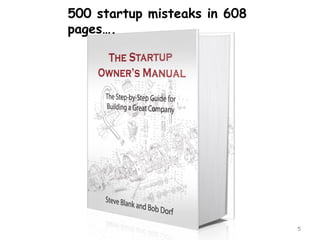
500 startup misteaksin 608 pages…. 
5
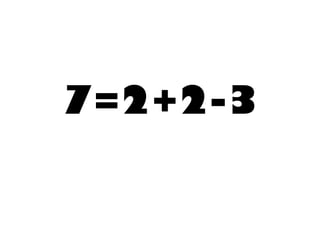
7=2+2-3
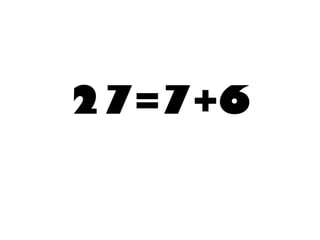
27=7+6
why math matters:
650,000!
12? (or 0.2%?)
A great iPhone appto manage recipes??
your investment: >20,000++ hours
YOUR startup will likely FAIL…
YOUR startup will likely FAIL… the most likely cause: a lack of customers
make your startup MATTER
It’s MUCHharderhere in Russia: -web penetration-online credit use
It’s MUCHharderhere in Russia: -web penetration-online credit use-available investment
It’s MUCHharderhere in Russia: -web penetration-online credit use-available investment-marketing talent-oh, and did I say…
What do I dodifferently? CUSTOMER DISCOVERY
What do I dodifferently? CUSTOMER DISCOVERYREFINE, IMPROVE YOUR IDEA
What do I dodifferently? CUSTOMER DISCOVERYREFINE, IMPROVE YOUR IDEAGO SLOWER AND FASTER
What do I dodifferently? CUSTOMER DISCOVERYREFINE, IMPROVE YOUR IDEAGO SLOWER AND FASTERRAISE AS LITTLE AS YOU CANWORK AS HARD AS YOU CAN
Key question #1: be Google??
Key question #1: be Google?? Or be happy?
11/24/2014 25
Startups are a Smaller Version of a Large Company
Startups Search Companies Execute
All You Need to Do: Execute the Plan
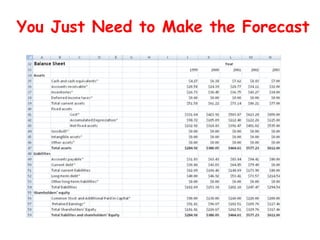
You Just Need to Make the Forecast
If it were all so easy, we’d all be Oligarchs!
PAUSEQUESTIONS??
11/24/2014 32
The New, Better Wayto build Great Startups: CUSTOMER DEVELOPMENT
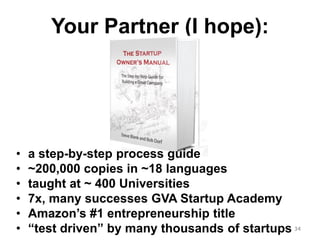
Your Partner (I hope): 
34 
•a step-by-step process guide 
•~200,000 copies in ~18 languages 
•taught at ~ 400 Universities 
•7x, many successes GVA Startup Academy 
•Amazon’s #1 entrepreneurship title 
•“test driven” by many thousands of startups
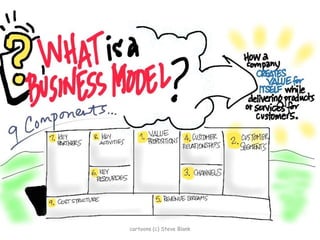
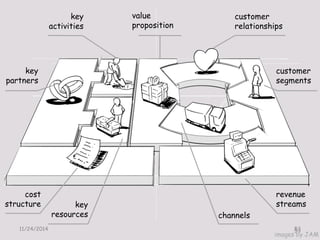
The Better Way: no plan. Start with aBUSINESS MODEL!
cartoons (c) Steve Blank
The canvas: before we move on 
•The “Mad Russian” approach 
•Powerful tool designed for ANY business 
•Use it to audit your, competitors businesses 
•Use separate canvases for each segment!! 
•Use it to figure out what to go out and test 
•BE SURE your investors, team, understand! 
11/24/2014 40
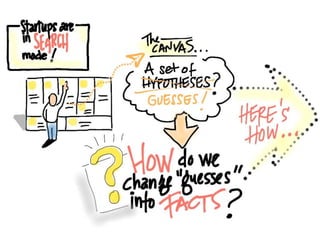
But, Realize They’re Hypotheses
42 
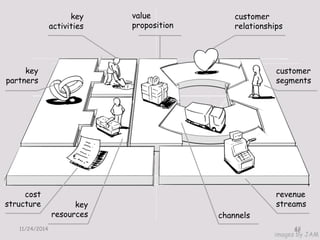
images by JAM 
customer segments 
key partners 
cost structure 
revenue streams 
channels 
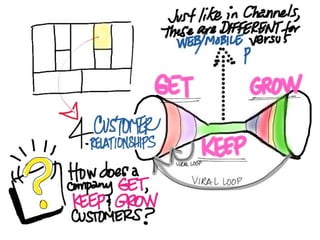
customer relationships 
key activities 
key 
resources 
value proposition 
11/24/2014 42
3key Discovery phases 
1: Does anybody care? 
…are we solving a serious problem? 
…are we filling a “big” need? 
11/24/2014 44
3key Discovery phases 
1: Does anybody care? 
…are we solving a serious problem? 
…are we filling a “big” need? 
2. Become Your Own Customer 
11/24/2014 45
3key Discovery phases 
1: Does anybody care? 
…are we solving a serious problem? 
…are we filling a “big” need? 
2. Become Your Own Customer 
3: Does our product do the job? 
…do they grab it out of your hands? 
…are they eager to tell their friends? 
(product/market fit) 
11/24/2014 46
Customer Discovery RULES: 
…DON’T talk to friends or family! 
…FOUNDERS must do this themselves 
…Unstructured, peer-to-peer chats 
…DO NOT SELL!!!
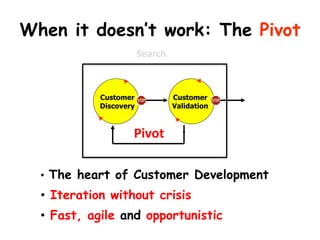
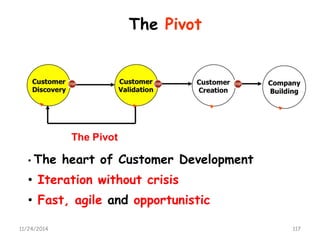
When it doesn’t work: The Pivot 
•The heart of Customer Development 
•Iteration without crisis 
•Fast, agile and opportunistic 
CustomerDiscovery 
CustomerValidation 
Pivot 
Search
When it still Doesn’t Work(hint: that’s most of the time…)
DO IT AGAIN!
What do I dodifferently? CUSTOMER DISCOVERY
Product/Market Fit: Why do we Care so Much? 
•It ain’ta business without it 
•It usually takes quite a few tries 
•(sadly, right now, you have the time!)
53 
images by JAM 
customer segments 
key partners 
cost structure 
revenue streams 
channels 
customer relationships 
key activities 
key 
resources 
value proposition 
11/24/2014 53
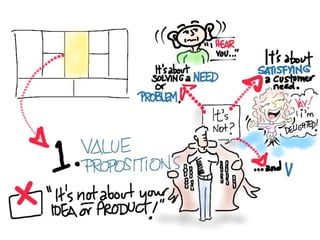
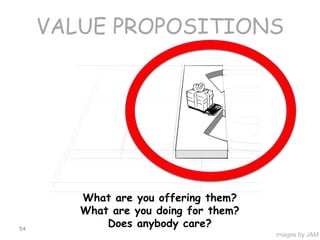
VALUE PROPOSITIONS 
images by JAM 
What are you offering them? 
What are you doing for them? 
Does anybody care? 54
Product/Market Fit: Why do we Care so Much? 
•It ain’ta business without it 
•It usually takes quite a few tries 
•You can’t settle for 3’s and 4’s… 
•…if the goal is Compelling, Scalable, Profitable!
Product/Market Fit: Why do we Care so Much? 
•It ain’ta business without it 
•It usually takes quite a few tries 
•You can’t settle for 3’s and 4’s… 
•…if the goal is Compelling, Scalable, Profitable! 
…”If we can do this for Ford, Schwab, BA…” 
…When we tell our friends as a favor to them! 
…There’s NO ALTERNATIVE
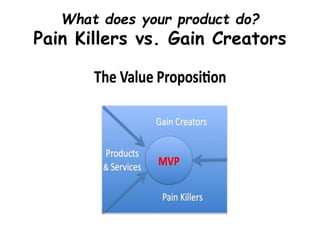
What does your product do? Pain Killers vs. Gain Creators
Pain Killers 
Reduce or eliminate wasted time, costs, negative emotions, risks… during and after getting the job done
Pain Killers -Hypotheses 
•Perform better? 
•Produce savings? Time, money, or effort 
•Fix underperforming e-solutions? 
new features, better performance, better quality, speed 
•Ends customers’ difficulties/challenges 
make things easier, help them get done, eliminate resistance 
•Eliminate risks/enhance vs“old way” 
•educational, social, technical risks, what could go awfully wrong 
•Make your customers feel better? 
e.g. kills frustrations, annoyances, inefficiency, stress, headaches 
59
Pain Killer –Problem or Need? 
•Are you solving a serious, painful Problem? 
•Are you fulfilling a Need? 
•For who? How many users/customers/seats? 
•How often do I have this problem??? 
•Will I lose my spouse, house, grant, job? 
60
Pain Killer Ranking 
•Rank each pain your products and services according to their intensity for the customer. 
•Is it very intense or very light? 
•For each pain indicate its frequency 
•Is it intense/frequent enough to be a business? 
•Angel cleaner 
•Is the core product a passing grade or an attempt? 
•Where is it “needed” or “painful” 
•Is it worse for certain segments? 
•Is it different selling to parents vsschool systems? 
61
Gain Creators: 
Do they create benefits customers expect, desire or get surprised by? 
•functional utility 
•enhanced value to client’s product 
•cost savings 
•Improved productivity
Gain Creator-Ranking 
•Rank the gain your product or service creates 
•Base rank on relevance to the customer(who?) 
•Compare ASAP to established/installed options 
63
Gain Creator-Ranking 
•Rank the gain your product or service creates 
•Base rank on relevance to the customer(who?) 
•Compare ASAP to established/installed options 
•Is gain substantial or insignificant? 
•How frequently does the gain occur? 
•How much “incremental gain” do you deliver? 
64
Value Proposition: WHAT’S IN IT? 
1.Product 
a.Long-term Product Vision 
b.Features 
c.Benefits 
d.MVP spec!!!! 
2.Competitive Set and differentiation 
3.Market Size 
4.Relative Pricing SWAG 
65
What’s a Minimum Viable Product? 
•Diapers.comwithout diapers 
•Googlewithout ads 
•Zapposwithout inventory 
…Fewest possible features to make the point! 
…Why? Powerpointfeedback is blurry. 
11/24/2014 66
Minimum Viable Product in your world? 
•It works! Acceptable to customers 
•It could sell! Acceptable to management 
•Adequate to demonstrate value 
•“not embarrassing” 
11/24/2014 67
Common Value Prop Mistakes 
•Is it just a feature or a product? 
•Is it a product or a business? 
•“nice to have” vs. “got to have” 
•Who wants this? My customer/my boss? 
…Customer ENTHUSIASM: 
–“Not 3’s or 4’s…” seek “buy it now” 
–If viral, marketing more economical 
–Sell direct or thru existing channel, partners 
68
Common Value Proposition Mistakes 
•Is it just a feature or a product? 
•“nice to have” vs. “got to have” 
•Can it scale to become a company? 
•Who wants this? My customer/my boss? 
…Customer ENTHUSIASM: 
–“Not 3’s or 4’s…” seek “buy it now” 
–If viral, marketing more economical 
–Sell direct or thru existing channel, partners 
69
Step 2: What’s the Digital MVP? 
NOW “low fidelity” web/app for customer feedback 
–First, tests your understanding of the problem 
LATER, “high fidelity” web/app tests the solution 
–Proves that it solves a core problemfor customers 
–Minimum set feature set to learn from earlyvangelists 
-Avoid building products nobody wants 
-Enhance feature sets, usability on the fly 
-Maximize product learning vs. time spent 
70
Step 2: Testing the Digital MVP 
•Smoke testing with landing pages using AdWords 
•In-product split-testing 
•Prototypes (particularly for hardware) 
•Removing features 
•Continued customer discovery and validation 
•Sell it!! 
•Trial offers, future offers 
•RikersIsland vs. “Revenue now” 
•…Mailbox.comand the $100mm smoke test! 
71
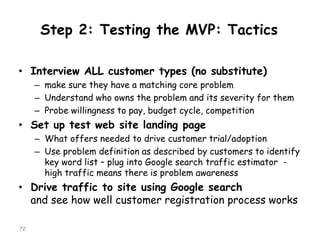
Step 2: Testing the MVP: Tactics 
•Interview ALL customer types (no substitute) 
–make sure they have a matching core problem 
–Understand who owns the problem and its severity for them 
–Probe willingness to pay, budget cycle, competition 
•Set up test web site landing page 
–What offers needed to drive customer trial/adoption 
–Use problem definition as described by customers to identify key word list –plug into Google search traffic estimator - high traffic means there is problem awareness 
•Drive traffic to site using Google search and see how well customer registration process works 
72
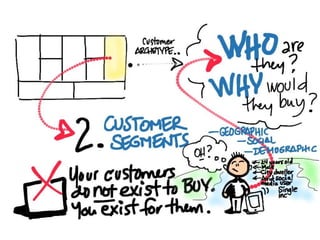
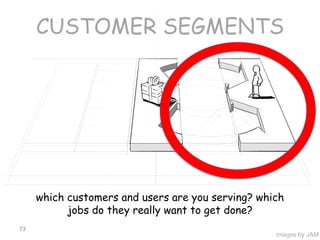
CUSTOMER SEGMENTS 
images by JAM 
which customers and users are you serving? which jobs do they really want to get done? 
73
Who’s a CUSTOMER? 
•They give you money or clicks or post stuff 
•They may buy it to giveto others to use 
•If they sell to others, they’re a channel! 
•If they recommend, they’re a partner! 
•If they blog about it, they’re a “get tool” 
And if that’s not bad enough… 
…there are lots of customer TYPES! 
74
What do they want you to do? 
•Decrease costs? 
•Increase productivity? 
•Add competitive or new efficiency? 
•Reduce failure points? 
•How important is it? 
•Problem or a Need? 
•…what else could they want you to do?? 
75
Clues from the Customer Problem 
76
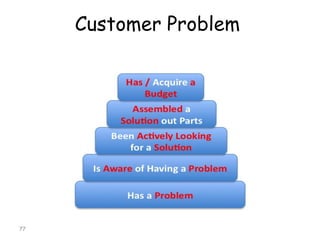
Customer Problem 
77
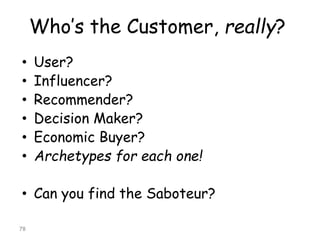
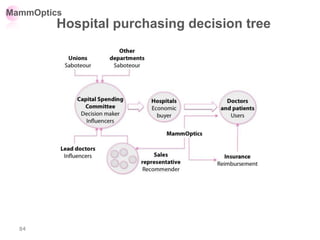
Who’s the Customer, really? 
•User? 
•Influencer? 
•Recommender? 
•Decision Maker? 
•Economic Buyer? 
•Archetypes for each one! 
•Can you find the Saboteur? 
78
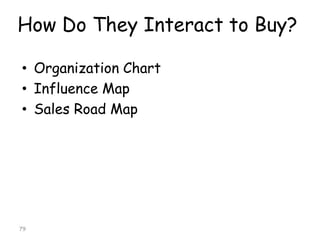
How Do They Interact to Buy? 
•Organization Chart 
•Influence Map 
•Sales Road Map 
79
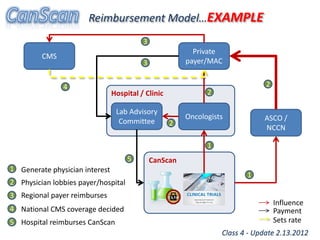
CanScan 
Hospital / Clinic 
Reimbursement Model…EXAMPLE 
Oncologists 
CMS 
Private payer/MACClass 4 -Update 2.13.2012 
ASCO / NCCN 
Lab Advisory Committee 
Influence 
Payment 
Sets rate 
1 
1 
1 
2 
2 
3 
3 
3 
2 
2 
5 
4 
4 
5 
Generate physician interest 
Physician lobbies payer/hospital 
Regional payer reimburses 
National CMS coverage decided 
Hospital reimburses CanScan
How Do They Hear About You? 
•Demand Creation 
•Network effect 
•Your Sales organization 
•Other locales? 
81
When the customer is a parent!! 
•How do I reach them through the student? 
•How do I collect or encourage the purchase? 
•What are school system rules/policies? 
•Who am I selling to? Mom or kid? 
82
If It’s a Multi-sided Market Diagram It!! HINT: YOURS USUALLY IS!
MammOptics 
Hospital purchasing decision tree 
84
Who’s The Customer? 
•B-to-B, often not the end user 
•Who’ll be in the room after your pitch? 
•(Arlene and the $200,000 “wangkiller”) 
•Who’s the customer for kids’ toys? 
•Who buys? 
•Who pays? 
•Who gets asked? 
85
Who’s The Customer? 
•B-to-B, often not the end user 
•Who’ll be in the room after your pitch? 
•(Arlene and the $200,000 “wangkiller”) 
•Who’s the customer for kids’ toys? 
•who buys? Who pays? Who gets asked? 
FEAR THE WORST: 
•Multiple, Distinct Discovery efforts 
•Beware “false positives” 
•Follow the people…then follow the money 
86
Multiple Customer Segments 
•Each has its own Value Proposition 
•Each has its own Revenue Stream 
•One segment cannot exist without the other 
•Which one do you start with? 
87
When it Doesn’t Work(hint: that’s most of the time…)
DO IT AGAIN!
LET’S TAKE A BREAKYOUR QUESTIONS
30 MINUTE BREAKYOUR ASSIGNMENT 
When we come back… 
We welcome a few 
brave volunteers!
Once you have a business model,thehard work starts! Customer Development 
Get Out of the Building 
The founders
TWO key Discovery phases 
•FIRST: Does anybody care? 
…are we solving a serious problem? 
…are we filling a “big” need? 
•THEN: Does our product do the job? 
…do they grab it out of your hands? 
…are they eager to tell friends? 
93
Customer Discovery: MUCH more than “do you like it?” 
•How big is the market? Not today…eventually! 
•Who’s the customer? 
•Does product solve the problem?Fill the need? 
•Who else solves it? Cheaper? Better? Faster? 
•How do you create demand? 
•How do you deliver the product? 
•Will the customer let you make money? 
94
Customer Discovery: FIRST, Some Ground Rules 
•MUST be done by Leaders, not researchers 
•You’re never selling, always asking, probing 
•The customer steers the conversation 
•No customer can answer every question 
•Ask for 5 minutes (consumer) 20 (b-to-b)… 
95
always remember rule #1: NO SELLING ALLOWED 
96
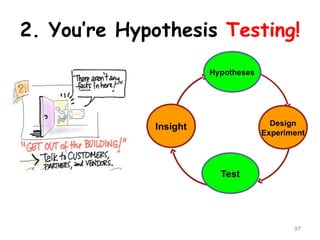
2. You’re Hypothesis Testing! 
97
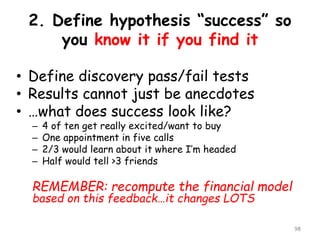
2. Define hypothesis “success” so youknow it if you find it 
•Define discovery pass/fail tests 
•Results cannot just be anecdotes 
•…what does success look like? 
–4 of ten get really excited/want to buy 
–One appointment in five calls 
–2/3 would learn about it where I’m headed 
–Half would tell >3 friends 
REMEMBER: recomputethe financial model based on this feedback…it changes LOTS 
98
Customer Discovery: Before your First Interview 
•Know your subject…memorizeyour questions 
•“Dress for success,” make them comfortable 
•Consider/Rehearse your “Opening Line” 
•ALWAYS stress “this is not a sales call” 
•NEVER get caught following a script 
•Be curious, dig deeper, don’t push an agenda 
•Let the customer guide the conversation 
99
3. Discovery: ROUND ONE! 
•PRIMARY MISSION is “test the problem” 
•Anything else is gravy…get what you can 
•Avoid details on product much as you can 
•…how do you solve it now 
•…anyone solve it well for you 
•…problems with current solutions 
…but mostly: do customers care?? 
100
Who Do I Call On? 
•WHO is your “customer” here? 
•Do NOT do Discovery with friends, colleagues 
•Use existing company customers, contacts 
•Get referrals from sales, alumni, edu’s, pals 
•Don’t worry about titles or the right person 
•Can you really talk to anyone? 
101
I Have a Meeting –Now What? 
•The goal is to test all hypotheses but… 
•ALWAYS get to product/market fit 
–Does the value proposition match the segment? 
–Do the customers seem to genuinely care?? 
•THEN move to other issues 
–How do they buy?…How to get their attention? 
–How much might they pay? Do they pay today? 
–How horrible is the budget cycle? 
–Who pays? Teacher? Kid? Parent? System? 
102
I Have a Meeting –Now What? 
•The goal is to test all hypotheses but… 
•ALWAYS get to product/market fit 
–Does the value proposition match the segment? 
–Do the customers seem to genuinely care?? 
•THEN move to other issues 
–How do they buy?…How to get their attention? 
–How much might they pay? Do they pay today? 
–How horrible is the budget cycle? 
–Who pays? Teacher? Kid? Parent? Boss? CFO? 
103
What Do I Say? 
•Remember 1sttest the problem 
•“Hi, I’ve been told you’re the smartest... 
•Don’t try to get all the answers at once 
•Every sentence is a question 
•Use “Stack ranking” 
•3 columns…Dummy Boxes…“Dry test” 
104
Conversation Starters 
•Does the person match the Target Segment? Yes/No 
•Objective 1: Problem Exploration 
–Learn if they have the Problem, and how much of a problem it really is by hearing about their Existing Behavior/Usage 
•Objective #2: Influence, Control, Cash? 
105
Conversation Starters: Beginner 
Beginner: I’m working on an idea around… 
–Have you ever…? 
–Tell me about a time you’ve… 
–I hear many in my customer segmenthave this problem of… 
106
Finding the Customer’s Level of Pain 
•How frequent? How often a problem? 
•Looking for any other solutions? 
•What would your ideal solution be? 
Remember: its just a simple, unstructuredchat with another person, people love to talk! 
107
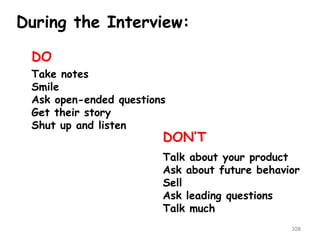
During the Interview: 
DO 
Take notes 
Smile 
Ask open-ended questions 
Get their story 
Shut up and listen 
DON’T 
Talk about your product 
Ask about future behavior 
Sell 
Ask leading questions 
Talk much 
108
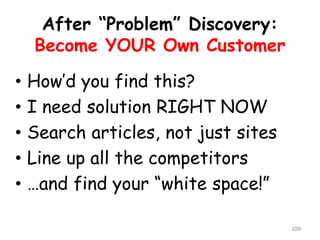
After “Problem” Discovery: Become YOUR Own Customer 
•How’d you find this? 
•I need solution RIGHT NOW 
•Search articles, not just sites 
•Line up all the competitors 
•…and find your “white space!” 
109
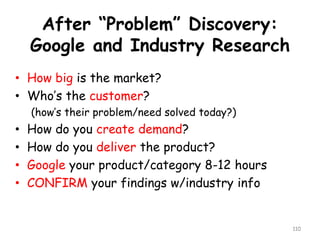
After “Problem” Discovery: Google and Industry Research 
•How big is the market? 
•Who’s the customer? 
(how’s their problem/need solved today?) 
•How do you create demand? 
•How do you deliver the product? 
•Googleyour product/category 8-12 hours 
•CONFIRMyour findings w/industry info 
110
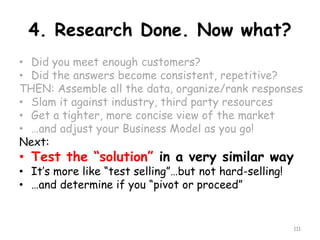
4. Research Done. Now what? 
•Did you meet enough customers? 
•Did the answers become consistent, repetitive? 
THEN: Assemble all the data, organize/rank responses 
•Slam it against industry, third party resources 
•Get a tighter, more concise view of the market 
•…and adjust your Business Model as you go! 
Next: 
•Test the “solution” in a very similar way 
•It’s more like “test selling”…but not hard-selling! 
•…and determine if you “pivot or proceed” 
111
Testing the Solution: 
Dreaded Questions 
•Will people use it? 
•Why won’t people use it? 
•What will they compare it to? 
•What’s wrong with it? 
•How could I make it better? 
•Do people like it? 
•Can people find it? 
112
always remember rule #1: NO SELLING ALLOWED 
113
FIND the EARLYVANGELISTS 
Customers “FOAMING AT THE MOUTH” 
1)Have the problem 
2)Know they have the problem 
3)Searched for solution 
4)Hacked a solution 
5)Paid for a solution 
…when you find these people, you have likely found product/market fit! 
114
To build a great company, remember: GET OUT OFTHE BUILDING! 
115
…and when it doesn’t work… 
(HINT: THAT’S MOST OF THE TIME)
The Pivot 
•The heart of Customer Development 
•Iteration without crisis 
•Fast, agile and opportunistic 
11/24/2014 117
Three Great Pivots 
•Steve Blank: “Page 6” 
•Perimeter: “there are 9000 of us” 
•Groupon: the $12billion pivot 
•…and hundreds more! 
11/24/2014 118
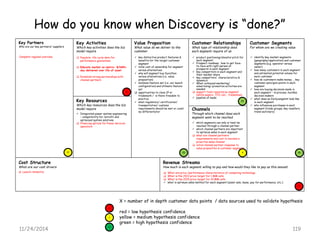
How do you know when Discovery is “done?” 
Key Partners 
Who are our key partners/ suppliers 
Key Activities 
Which key activities does the biz model require 
Value Proposition 
What value do we deliver to the customer 
Customer Relationships 
What type of relationship does each segment require of us 
Customer Segments 
For whom are we creating value 
Channels 
Through which channel does each segment want to be reached 
Revenue Streams 
How much is each segment willing to pay and how would they like to pay us this amount 
Cost Structure 
What are our cost drivers 
Key Resources 
Which key resources does the biz model require 
identify key market segments (geography/application) and customer segments (e.g. operator versus owner) 
how many customers in each segment and estimated potential volume for each customer 
how do customers make money … key customer pain/gain points in each segment 
how are buying decisions made in each segment -id process, hurdles, decision makers 
what does an Earlyvangelistlook like in each segment 
who influences purchases in each segment (trade groups, key resellers, trend watchers) 
key distinctive product features & benefits for the target customer segment 
total cost of ownership for segment versus alternatives 
why will segment buy Durathonversus alternatives (i.e. value proposition) 
minimum feature set (i.e. our launch configuration) and ultimate feature set 
opportunities to claim IP or trademark / is there freedom to practice 
what regulatory/ certification/ transportation/ customs requirements should be met or could be differentiator 
which segments can only or best be reached through a channel partner 
which channel partners are important to optimize sales in each segment 
what are channel partners' requirements and cost to become a proactive sales channel 
initial channel partner response to value proposition & customer segments 
What are price /performance characteristics of competing technology 
What is the 2013 price target for 1 MM cells 
What is the 2015 price target for 10 MM cells 
what is optimum sales method for each segment (asset sale, lease, pay for performance, etc.) 
product positioning/elevator pitch for each segment 
Prospect roadmap: how to get face- to-face with right person at prospects in each segment 
key competitors in each segment and their market share 
key competitors' characteristics & dynamics 
What outbound marketing/ advertising/ promotion activities are needed 
support tools required by segment (white papers, TCO calc., tradeshow) 
pipeline of leads 
x 
x 
x 
X = number of in depth customer data points / data sources used to validate hypothesis 
red = low hypothesis confidence 
yellow = medium hypothesis confidence 
green = high hypothesis confidence 
25 
25 
4 
50 
3 
Complete regional overview 
12 
Populate life cycle data for performance guarantees 
Educate market on metric: $/kWh- day delivered over life of asset 
Establish strong partnerships with channel partners 
Integrated power system engineering –compatibility for retrofit and optimized system solutions 
Financing options for Power services operators 
Launch reliability 
0 
11/24/2014 119
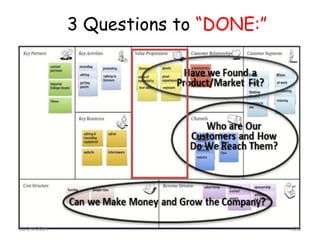
3 Questions to “DONE:” 
11/24/2014 120
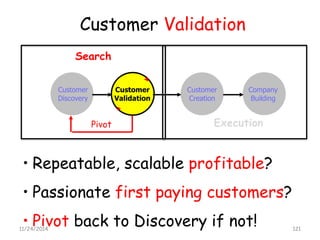
Customer Validation 
CustomerDiscovery 
CustomerValidation 
Customer Creation 
Company 
Building 
•Repeatable, scalable profitable? 
•Passionate first paying customers? 
•Pivot back to Discovery if not! 
Pivot 
Execution 
Search 
11/24/2014 121
Validation is VERY DIFFERENT 
•“Test selling” vssearch and exploration 
•Is the business “repeatable, scalable” 
•Do the “ratios hold up” as you accelerate 
•Is it a “Pachinko machine” yet? 
(we’ll do lots of team-by-teamwork on this!) 
11/24/2014 122
When It Doesn’t Work(REPEAT: that’s most of the time…)
do it again!
this is howGREATcompaniesare built!!!
QUESTIONS?? @bobdorfwww.bobdorf.nyc 
tools/more: www.steveblank.com 
online canvas: www.canvanizer.com

Customer Development for Startups

  • 1.
    bobdorf@gmail.com twitter: @bobdorf www.bobdorf.nyc some slides © Steve Blank An Introduction and DobroPozhalovat! 1
  • 2.
    This is nota Fad… •Many thousandsof startups •Moscow GVA Startup Academy…7th time! •USA National Science Foundation •400+ leading Universities •Many major corporations 2
  • 3.
    More startups failfrom a lack of customers than from a failure of product development 3
  • 4.
    Why are wehere?? •The odds are very much againstyour success •We want to reduce the risk of failure •And provide a method to help you and your team build a strong, enduring company! …What really matters most: •GREAT companies with long-term potential •Excited CUSTOMERS who tell their friends 4
  • 5.
    500 startup misteaksin608 pages…. 5
  • 6.
  • 7.
  • 8.
  • 9.
  • 10.
  • 11.
    A great iPhoneappto manage recipes??
  • 12.
  • 13.
    YOUR startup willlikely FAIL…
  • 14.
    YOUR startup willlikely FAIL… the most likely cause: a lack of customers
  • 15.
  • 16.
    It’s MUCHharderhere inRussia: -web penetration-online credit use
  • 17.
    It’s MUCHharderhere inRussia: -web penetration-online credit use-available investment
  • 18.
    It’s MUCHharderhere inRussia: -web penetration-online credit use-available investment-marketing talent-oh, and did I say…
  • 19.
    What do Idodifferently? CUSTOMER DISCOVERY
  • 20.
    What do Idodifferently? CUSTOMER DISCOVERYREFINE, IMPROVE YOUR IDEA
  • 21.
    What do Idodifferently? CUSTOMER DISCOVERYREFINE, IMPROVE YOUR IDEAGO SLOWER AND FASTER
  • 22.
    What do Idodifferently? CUSTOMER DISCOVERYREFINE, IMPROVE YOUR IDEAGO SLOWER AND FASTERRAISE AS LITTLE AS YOU CANWORK AS HARD AS YOU CAN
  • 23.
    Key question #1:be Google??
  • 24.
    Key question #1:be Google?? Or be happy?
  • 25.
  • 26.
    Startups are aSmaller Version of a Large Company
  • 27.
  • 28.
    All You Needto Do: Execute the Plan
  • 29.
    You Just Needto Make the Forecast
  • 30.
    If it wereall so easy, we’d all be Oligarchs!
  • 31.
  • 32.
  • 33.
    The New, BetterWayto build Great Startups: CUSTOMER DEVELOPMENT
  • 34.
    Your Partner (Ihope): 34 •a step-by-step process guide •~200,000 copies in ~18 languages •taught at ~ 400 Universities •7x, many successes GVA Startup Academy •Amazon’s #1 entrepreneurship title •“test driven” by many thousands of startups
  • 35.
    The Better Way:no plan. Start with aBUSINESS MODEL!
  • 36.
  • 40.
    The canvas: beforewe move on •The “Mad Russian” approach •Powerful tool designed for ANY business •Use it to audit your, competitors businesses •Use separate canvases for each segment!! •Use it to figure out what to go out and test •BE SURE your investors, team, understand! 11/24/2014 40
  • 41.
  • 42.
    42 images byJAM customer segments key partners cost structure revenue streams channels customer relationships key activities key resources value proposition 11/24/2014 42
  • 44.
    3key Discovery phases 1: Does anybody care? …are we solving a serious problem? …are we filling a “big” need? 11/24/2014 44
  • 45.
    3key Discovery phases 1: Does anybody care? …are we solving a serious problem? …are we filling a “big” need? 2. Become Your Own Customer 11/24/2014 45
  • 46.
    3key Discovery phases 1: Does anybody care? …are we solving a serious problem? …are we filling a “big” need? 2. Become Your Own Customer 3: Does our product do the job? …do they grab it out of your hands? …are they eager to tell their friends? (product/market fit) 11/24/2014 46
  • 47.
    Customer Discovery RULES: …DON’T talk to friends or family! …FOUNDERS must do this themselves …Unstructured, peer-to-peer chats …DO NOT SELL!!!
  • 48.
    When it doesn’twork: The Pivot •The heart of Customer Development •Iteration without crisis •Fast, agile and opportunistic CustomerDiscovery CustomerValidation Pivot Search
  • 49.
    When it stillDoesn’t Work(hint: that’s most of the time…)
  • 50.
  • 51.
    What do Idodifferently? CUSTOMER DISCOVERY
  • 52.
    Product/Market Fit: Whydo we Care so Much? •It ain’ta business without it •It usually takes quite a few tries •(sadly, right now, you have the time!)
  • 53.
    53 images byJAM customer segments key partners cost structure revenue streams channels customer relationships key activities key resources value proposition 11/24/2014 53
  • 54.
    VALUE PROPOSITIONS imagesby JAM What are you offering them? What are you doing for them? Does anybody care? 54
  • 55.
    Product/Market Fit: Whydo we Care so Much? •It ain’ta business without it •It usually takes quite a few tries •You can’t settle for 3’s and 4’s… •…if the goal is Compelling, Scalable, Profitable!
  • 56.
    Product/Market Fit: Whydo we Care so Much? •It ain’ta business without it •It usually takes quite a few tries •You can’t settle for 3’s and 4’s… •…if the goal is Compelling, Scalable, Profitable! …”If we can do this for Ford, Schwab, BA…” …When we tell our friends as a favor to them! …There’s NO ALTERNATIVE
  • 57.
    What does yourproduct do? Pain Killers vs. Gain Creators
  • 58.
    Pain Killers Reduceor eliminate wasted time, costs, negative emotions, risks… during and after getting the job done
  • 59.
    Pain Killers -Hypotheses •Perform better? •Produce savings? Time, money, or effort •Fix underperforming e-solutions? new features, better performance, better quality, speed •Ends customers’ difficulties/challenges make things easier, help them get done, eliminate resistance •Eliminate risks/enhance vs“old way” •educational, social, technical risks, what could go awfully wrong •Make your customers feel better? e.g. kills frustrations, annoyances, inefficiency, stress, headaches 59
  • 60.
    Pain Killer –Problemor Need? •Are you solving a serious, painful Problem? •Are you fulfilling a Need? •For who? How many users/customers/seats? •How often do I have this problem??? •Will I lose my spouse, house, grant, job? 60
  • 61.
    Pain Killer Ranking •Rank each pain your products and services according to their intensity for the customer. •Is it very intense or very light? •For each pain indicate its frequency •Is it intense/frequent enough to be a business? •Angel cleaner •Is the core product a passing grade or an attempt? •Where is it “needed” or “painful” •Is it worse for certain segments? •Is it different selling to parents vsschool systems? 61
  • 62.
    Gain Creators: Dothey create benefits customers expect, desire or get surprised by? •functional utility •enhanced value to client’s product •cost savings •Improved productivity
  • 63.
    Gain Creator-Ranking •Rankthe gain your product or service creates •Base rank on relevance to the customer(who?) •Compare ASAP to established/installed options 63
  • 64.
    Gain Creator-Ranking •Rankthe gain your product or service creates •Base rank on relevance to the customer(who?) •Compare ASAP to established/installed options •Is gain substantial or insignificant? •How frequently does the gain occur? •How much “incremental gain” do you deliver? 64
  • 65.
    Value Proposition: WHAT’SIN IT? 1.Product a.Long-term Product Vision b.Features c.Benefits d.MVP spec!!!! 2.Competitive Set and differentiation 3.Market Size 4.Relative Pricing SWAG 65
  • 66.
    What’s a MinimumViable Product? •Diapers.comwithout diapers •Googlewithout ads •Zapposwithout inventory …Fewest possible features to make the point! …Why? Powerpointfeedback is blurry. 11/24/2014 66
  • 67.
    Minimum Viable Productin your world? •It works! Acceptable to customers •It could sell! Acceptable to management •Adequate to demonstrate value •“not embarrassing” 11/24/2014 67
  • 68.
    Common Value PropMistakes •Is it just a feature or a product? •Is it a product or a business? •“nice to have” vs. “got to have” •Who wants this? My customer/my boss? …Customer ENTHUSIASM: –“Not 3’s or 4’s…” seek “buy it now” –If viral, marketing more economical –Sell direct or thru existing channel, partners 68
  • 69.
    Common Value PropositionMistakes •Is it just a feature or a product? •“nice to have” vs. “got to have” •Can it scale to become a company? •Who wants this? My customer/my boss? …Customer ENTHUSIASM: –“Not 3’s or 4’s…” seek “buy it now” –If viral, marketing more economical –Sell direct or thru existing channel, partners 69
  • 70.
    Step 2: What’sthe Digital MVP? NOW “low fidelity” web/app for customer feedback –First, tests your understanding of the problem LATER, “high fidelity” web/app tests the solution –Proves that it solves a core problemfor customers –Minimum set feature set to learn from earlyvangelists -Avoid building products nobody wants -Enhance feature sets, usability on the fly -Maximize product learning vs. time spent 70
  • 71.
    Step 2: Testingthe Digital MVP •Smoke testing with landing pages using AdWords •In-product split-testing •Prototypes (particularly for hardware) •Removing features •Continued customer discovery and validation •Sell it!! •Trial offers, future offers •RikersIsland vs. “Revenue now” •…Mailbox.comand the $100mm smoke test! 71
  • 72.
    Step 2: Testingthe MVP: Tactics •Interview ALL customer types (no substitute) –make sure they have a matching core problem –Understand who owns the problem and its severity for them –Probe willingness to pay, budget cycle, competition •Set up test web site landing page –What offers needed to drive customer trial/adoption –Use problem definition as described by customers to identify key word list –plug into Google search traffic estimator - high traffic means there is problem awareness •Drive traffic to site using Google search and see how well customer registration process works 72
  • 73.
    CUSTOMER SEGMENTS imagesby JAM which customers and users are you serving? which jobs do they really want to get done? 73
  • 74.
    Who’s a CUSTOMER? •They give you money or clicks or post stuff •They may buy it to giveto others to use •If they sell to others, they’re a channel! •If they recommend, they’re a partner! •If they blog about it, they’re a “get tool” And if that’s not bad enough… …there are lots of customer TYPES! 74
  • 75.
    What do theywant you to do? •Decrease costs? •Increase productivity? •Add competitive or new efficiency? •Reduce failure points? •How important is it? •Problem or a Need? •…what else could they want you to do?? 75
  • 76.
    Clues from theCustomer Problem 76
  • 77.
  • 78.
    Who’s the Customer,really? •User? •Influencer? •Recommender? •Decision Maker? •Economic Buyer? •Archetypes for each one! •Can you find the Saboteur? 78
  • 79.
    How Do TheyInteract to Buy? •Organization Chart •Influence Map •Sales Road Map 79
  • 80.
    CanScan Hospital /Clinic Reimbursement Model…EXAMPLE Oncologists CMS Private payer/MACClass 4 -Update 2.13.2012 ASCO / NCCN Lab Advisory Committee Influence Payment Sets rate 1 1 1 2 2 3 3 3 2 2 5 4 4 5 Generate physician interest Physician lobbies payer/hospital Regional payer reimburses National CMS coverage decided Hospital reimburses CanScan
  • 81.
    How Do TheyHear About You? •Demand Creation •Network effect •Your Sales organization •Other locales? 81
  • 82.
    When the customeris a parent!! •How do I reach them through the student? •How do I collect or encourage the purchase? •What are school system rules/policies? •Who am I selling to? Mom or kid? 82
  • 83.
    If It’s aMulti-sided Market Diagram It!! HINT: YOURS USUALLY IS!
  • 84.
  • 85.
    Who’s The Customer? •B-to-B, often not the end user •Who’ll be in the room after your pitch? •(Arlene and the $200,000 “wangkiller”) •Who’s the customer for kids’ toys? •Who buys? •Who pays? •Who gets asked? 85
  • 86.
    Who’s The Customer? •B-to-B, often not the end user •Who’ll be in the room after your pitch? •(Arlene and the $200,000 “wangkiller”) •Who’s the customer for kids’ toys? •who buys? Who pays? Who gets asked? FEAR THE WORST: •Multiple, Distinct Discovery efforts •Beware “false positives” •Follow the people…then follow the money 86
  • 87.
    Multiple Customer Segments •Each has its own Value Proposition •Each has its own Revenue Stream •One segment cannot exist without the other •Which one do you start with? 87
  • 88.
    When it Doesn’tWork(hint: that’s most of the time…)
  • 89.
  • 90.
    LET’S TAKE ABREAKYOUR QUESTIONS
  • 91.
    30 MINUTE BREAKYOURASSIGNMENT When we come back… We welcome a few brave volunteers!
  • 92.
    Once you havea business model,thehard work starts! Customer Development Get Out of the Building The founders
  • 93.
    TWO key Discoveryphases •FIRST: Does anybody care? …are we solving a serious problem? …are we filling a “big” need? •THEN: Does our product do the job? …do they grab it out of your hands? …are they eager to tell friends? 93
  • 94.
    Customer Discovery: MUCHmore than “do you like it?” •How big is the market? Not today…eventually! •Who’s the customer? •Does product solve the problem?Fill the need? •Who else solves it? Cheaper? Better? Faster? •How do you create demand? •How do you deliver the product? •Will the customer let you make money? 94
  • 95.
    Customer Discovery: FIRST,Some Ground Rules •MUST be done by Leaders, not researchers •You’re never selling, always asking, probing •The customer steers the conversation •No customer can answer every question •Ask for 5 minutes (consumer) 20 (b-to-b)… 95
  • 96.
    always remember rule#1: NO SELLING ALLOWED 96
  • 97.
  • 98.
    2. Define hypothesis“success” so youknow it if you find it •Define discovery pass/fail tests •Results cannot just be anecdotes •…what does success look like? –4 of ten get really excited/want to buy –One appointment in five calls –2/3 would learn about it where I’m headed –Half would tell >3 friends REMEMBER: recomputethe financial model based on this feedback…it changes LOTS 98
  • 99.
    Customer Discovery: Beforeyour First Interview •Know your subject…memorizeyour questions •“Dress for success,” make them comfortable •Consider/Rehearse your “Opening Line” •ALWAYS stress “this is not a sales call” •NEVER get caught following a script •Be curious, dig deeper, don’t push an agenda •Let the customer guide the conversation 99
  • 100.
    3. Discovery: ROUNDONE! •PRIMARY MISSION is “test the problem” •Anything else is gravy…get what you can •Avoid details on product much as you can •…how do you solve it now •…anyone solve it well for you •…problems with current solutions …but mostly: do customers care?? 100
  • 101.
    Who Do ICall On? •WHO is your “customer” here? •Do NOT do Discovery with friends, colleagues •Use existing company customers, contacts •Get referrals from sales, alumni, edu’s, pals •Don’t worry about titles or the right person •Can you really talk to anyone? 101
  • 102.
    I Have aMeeting –Now What? •The goal is to test all hypotheses but… •ALWAYS get to product/market fit –Does the value proposition match the segment? –Do the customers seem to genuinely care?? •THEN move to other issues –How do they buy?…How to get their attention? –How much might they pay? Do they pay today? –How horrible is the budget cycle? –Who pays? Teacher? Kid? Parent? System? 102
  • 103.
    I Have aMeeting –Now What? •The goal is to test all hypotheses but… •ALWAYS get to product/market fit –Does the value proposition match the segment? –Do the customers seem to genuinely care?? •THEN move to other issues –How do they buy?…How to get their attention? –How much might they pay? Do they pay today? –How horrible is the budget cycle? –Who pays? Teacher? Kid? Parent? Boss? CFO? 103
  • 104.
    What Do ISay? •Remember 1sttest the problem •“Hi, I’ve been told you’re the smartest... •Don’t try to get all the answers at once •Every sentence is a question •Use “Stack ranking” •3 columns…Dummy Boxes…“Dry test” 104
  • 105.
    Conversation Starters •Doesthe person match the Target Segment? Yes/No •Objective 1: Problem Exploration –Learn if they have the Problem, and how much of a problem it really is by hearing about their Existing Behavior/Usage •Objective #2: Influence, Control, Cash? 105
  • 106.
    Conversation Starters: Beginner Beginner: I’m working on an idea around… –Have you ever…? –Tell me about a time you’ve… –I hear many in my customer segmenthave this problem of… 106
  • 107.
    Finding the Customer’sLevel of Pain •How frequent? How often a problem? •Looking for any other solutions? •What would your ideal solution be? Remember: its just a simple, unstructuredchat with another person, people love to talk! 107
  • 108.
    During the Interview: DO Take notes Smile Ask open-ended questions Get their story Shut up and listen DON’T Talk about your product Ask about future behavior Sell Ask leading questions Talk much 108
  • 109.
    After “Problem” Discovery:Become YOUR Own Customer •How’d you find this? •I need solution RIGHT NOW •Search articles, not just sites •Line up all the competitors •…and find your “white space!” 109
  • 110.
    After “Problem” Discovery:Google and Industry Research •How big is the market? •Who’s the customer? (how’s their problem/need solved today?) •How do you create demand? •How do you deliver the product? •Googleyour product/category 8-12 hours •CONFIRMyour findings w/industry info 110
  • 111.
    4. Research Done.Now what? •Did you meet enough customers? •Did the answers become consistent, repetitive? THEN: Assemble all the data, organize/rank responses •Slam it against industry, third party resources •Get a tighter, more concise view of the market •…and adjust your Business Model as you go! Next: •Test the “solution” in a very similar way •It’s more like “test selling”…but not hard-selling! •…and determine if you “pivot or proceed” 111
  • 112.
    Testing the Solution: Dreaded Questions •Will people use it? •Why won’t people use it? •What will they compare it to? •What’s wrong with it? •How could I make it better? •Do people like it? •Can people find it? 112
  • 113.
    always remember rule#1: NO SELLING ALLOWED 113
  • 114.
    FIND the EARLYVANGELISTS Customers “FOAMING AT THE MOUTH” 1)Have the problem 2)Know they have the problem 3)Searched for solution 4)Hacked a solution 5)Paid for a solution …when you find these people, you have likely found product/market fit! 114
  • 115.
    To build agreat company, remember: GET OUT OFTHE BUILDING! 115
  • 116.
    …and when itdoesn’t work… (HINT: THAT’S MOST OF THE TIME)
  • 117.
    The Pivot •Theheart of Customer Development •Iteration without crisis •Fast, agile and opportunistic 11/24/2014 117
  • 118.
    Three Great Pivots •Steve Blank: “Page 6” •Perimeter: “there are 9000 of us” •Groupon: the $12billion pivot •…and hundreds more! 11/24/2014 118
  • 119.
    How do youknow when Discovery is “done?” Key Partners Who are our key partners/ suppliers Key Activities Which key activities does the biz model require Value Proposition What value do we deliver to the customer Customer Relationships What type of relationship does each segment require of us Customer Segments For whom are we creating value Channels Through which channel does each segment want to be reached Revenue Streams How much is each segment willing to pay and how would they like to pay us this amount Cost Structure What are our cost drivers Key Resources Which key resources does the biz model require identify key market segments (geography/application) and customer segments (e.g. operator versus owner) how many customers in each segment and estimated potential volume for each customer how do customers make money … key customer pain/gain points in each segment how are buying decisions made in each segment -id process, hurdles, decision makers what does an Earlyvangelistlook like in each segment who influences purchases in each segment (trade groups, key resellers, trend watchers) key distinctive product features & benefits for the target customer segment total cost of ownership for segment versus alternatives why will segment buy Durathonversus alternatives (i.e. value proposition) minimum feature set (i.e. our launch configuration) and ultimate feature set opportunities to claim IP or trademark / is there freedom to practice what regulatory/ certification/ transportation/ customs requirements should be met or could be differentiator which segments can only or best be reached through a channel partner which channel partners are important to optimize sales in each segment what are channel partners' requirements and cost to become a proactive sales channel initial channel partner response to value proposition & customer segments What are price /performance characteristics of competing technology What is the 2013 price target for 1 MM cells What is the 2015 price target for 10 MM cells what is optimum sales method for each segment (asset sale, lease, pay for performance, etc.) product positioning/elevator pitch for each segment Prospect roadmap: how to get face- to-face with right person at prospects in each segment key competitors in each segment and their market share key competitors' characteristics & dynamics What outbound marketing/ advertising/ promotion activities are needed support tools required by segment (white papers, TCO calc., tradeshow) pipeline of leads x x x X = number of in depth customer data points / data sources used to validate hypothesis red = low hypothesis confidence yellow = medium hypothesis confidence green = high hypothesis confidence 25 25 4 50 3 Complete regional overview 12 Populate life cycle data for performance guarantees Educate market on metric: $/kWh- day delivered over life of asset Establish strong partnerships with channel partners Integrated power system engineering –compatibility for retrofit and optimized system solutions Financing options for Power services operators Launch reliability 0 11/24/2014 119
  • 120.
    3 Questions to“DONE:” 11/24/2014 120
  • 121.
    Customer Validation CustomerDiscovery CustomerValidation Customer Creation Company Building •Repeatable, scalable profitable? •Passionate first paying customers? •Pivot back to Discovery if not! Pivot Execution Search 11/24/2014 121
  • 122.
    Validation is VERYDIFFERENT •“Test selling” vssearch and exploration •Is the business “repeatable, scalable” •Do the “ratios hold up” as you accelerate •Is it a “Pachinko machine” yet? (we’ll do lots of team-by-teamwork on this!) 11/24/2014 122
  • 123.
    When It Doesn’tWork(REPEAT: that’s most of the time…)
  • 124.
  • 125.
  • 126.
    QUESTIONS?? @bobdorfwww.bobdorf.nyc tools/more:www.steveblank.com online canvas: www.canvanizer.com