04/14/2025 1
Spanning Trees
• Given (connected) graph G(V,E),
a spanning tree T(V’,E’):
› Is a subgraph of G; that is, V’  V, E’  E.
› Spans the graph (V’ = V)
› Forms a tree (no cycle);
› So, E’ has |V| -1 edges
04/14/2025 2
Minimum Spanning Trees
• Edges are weighted: find minimum cost
spanning tree
• Applications
› Find cheapest way to wire your house
› Find minimum cost to send a message on
the Internet
04/14/2025 3
Strategy
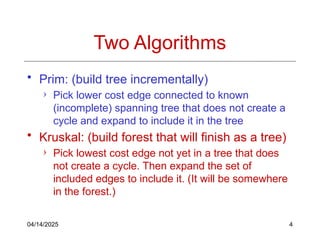
• Strategy for construction:
› Add an edge of minimum cost that does
not create a cycle (greedy algorithm)
› Repeat |V| -1 times
› Correct since if we could replace an edge
with one of lower cost, the algorithm would
have picked it up
04/14/2025 4
Two Algorithms
• Prim: (build tree incrementally)
› Pick lower cost edge connected to known
(incomplete) spanning tree that does not create a
cycle and expand to include it in the tree
• Kruskal: (build forest that will finish as a tree)
› Pick lowest cost edge not yet in a tree that does
not create a cycle. Then expand the set of
included edges to include it. (It will be somewhere
in the forest.)
04/14/2025 5
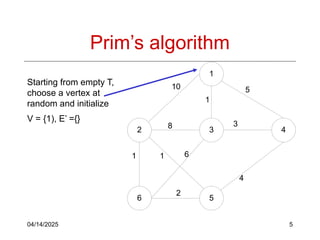
Prim’s algorithm
1
2 3 4
6 5
10
1
5
8 3
1 1 6
2
4
Starting from empty T,
choose a vertex at
random and initialize
V = {1), E’ ={}
04/14/2025 6
Prim’s algorithm
1
2 3 4
6 5
10
1
5
8 3
1 1 6
2
4
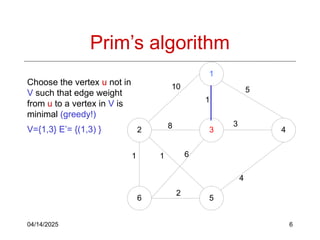
Choose the vertex u not in
V such that edge weight
from u to a vertex in V is
minimal (greedy!)
V={1,3} E’= {(1,3) }
04/14/2025 7
Prim’s algorithm
1
2 3 4
6 5
10
1
5
8 3
1 1 6
2
4
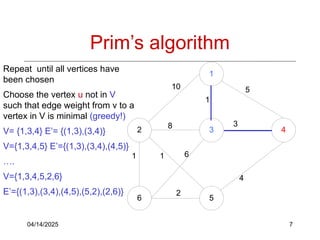
Repeat until all vertices have
been chosen
Choose the vertex u not in V
such that edge weight from v to a
vertex in V is minimal (greedy!)
V= {1,3,4} E’= {(1,3),(3,4)}
V={1,3,4,5} E’={(1,3),(3,4),(4,5)}
….
V={1,3,4,5,2,6}
E’={(1,3),(3,4),(4,5),(5,2),(2,6)}
04/14/2025 8
Prim’s algorithm
1
2 3 4
6 5
10
1
5
8 3
1 1 6
2
4
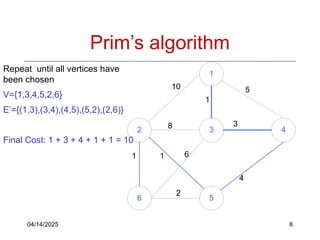
Repeat until all vertices have
been chosen
V={1,3,4,5,2,6}
E’={(1,3),(3,4),(4,5),(5,2),(2,6)}
Final Cost: 1 + 3 + 4 + 1 + 1 = 10
04/14/2025 9
Kruskal’s Algorithm
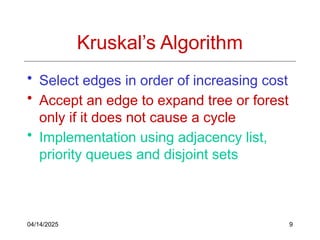
• Select edges in order of increasing cost
• Accept an edge to expand tree or forest
only if it does not cause a cycle
• Implementation using adjacency list,
priority queues and disjoint sets
04/14/2025 10
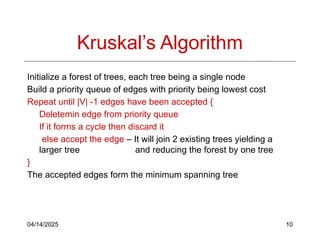
Kruskal’s Algorithm
Initialize a forest of trees, each tree being a single node
Build a priority queue of edges with priority being lowest cost
Repeat until |V| -1 edges have been accepted {
Deletemin edge from priority queue
If it forms a cycle then discard it
else accept the edge – It will join 2 existing trees yielding a
larger tree and reducing the forest by one tree
}
The accepted edges form the minimum spanning tree
04/14/2025 11
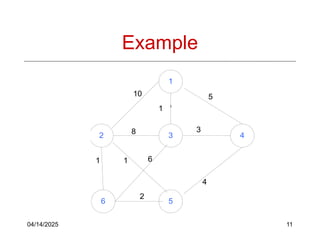
Example
1
2 3 4
6 5
10
1
5
8 3
1 1 6
2
4
1
04/14/2025 12
1
2 3 4
6 5
10
1
5
8 3
1 1 6
2
4
1
04/14/2025 13
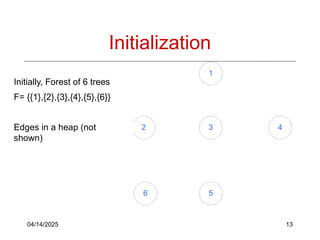
Initialization
1
2 3 4
6 5
Initially, Forest of 6 trees
F= {{1},{2},{3},{4},{5},{6}}
Edges in a heap (not
shown)
04/14/2025 14
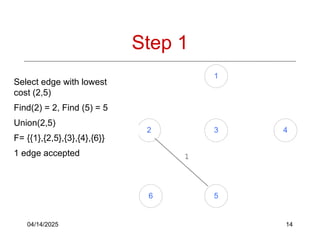
Step 1
1
2 3 4
6 5
Select edge with lowest
cost (2,5)
Find(2) = 2, Find (5) = 5
Union(2,5)
F= {{1},{2,5},{3},{4},{6}}
1 edge accepted 1
04/14/2025 15
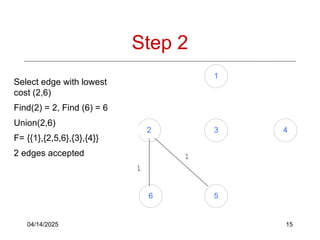
Step 2
1
2 3 4
6 5
Select edge with lowest
cost (2,6)
Find(2) = 2, Find (6) = 6
Union(2,6)
F= {{1},{2,5,6},{3},{4}}
2 edges accepted 1
1
04/14/2025 16
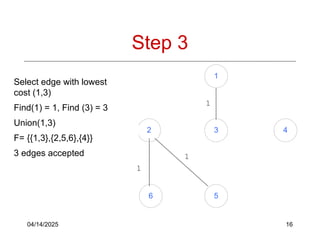
Step 3
1
2 3 4
6 5
Select edge with lowest
cost (1,3)
Find(1) = 1, Find (3) = 3
Union(1,3)
F= {{1,3},{2,5,6},{4}}
3 edges accepted 1
1
1
04/14/2025 17
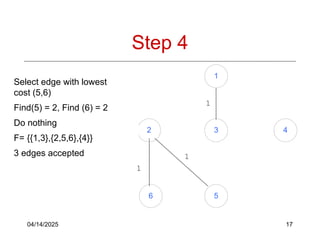
Step 4
1
2 3 4
6 5
Select edge with lowest
cost (5,6)
Find(5) = 2, Find (6) = 2
Do nothing
F= {{1,3},{2,5,6},{4}}
3 edges accepted 1
1
1
04/14/2025 18
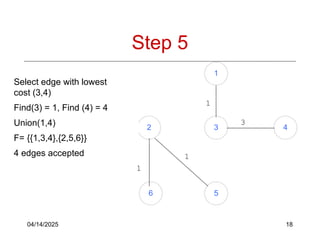
Step 5
1
2 3 4
6 5
Select edge with lowest
cost (3,4)
Find(3) = 1, Find (4) = 4
Union(1,4)
F= {{1,3,4},{2,5,6}}
4 edges accepted 1
1
1
3
04/14/2025 19
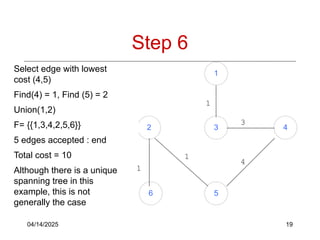
Step 6
1
2 3 4
6 5
Select edge with lowest
cost (4,5)
Find(4) = 1, Find (5) = 2
Union(1,2)
F= {{1,3,4,2,5,6}}
5 edges accepted : end
Total cost = 10
Although there is a unique
spanning tree in this
example, this is not
generally the case
1
1
1
3
4
DM Min SPan Tree Minimum spanning tree .pptx

  • 1.
    04/14/2025 1 Spanning Trees •Given (connected) graph G(V,E), a spanning tree T(V’,E’): › Is a subgraph of G; that is, V’  V, E’  E. › Spans the graph (V’ = V) › Forms a tree (no cycle); › So, E’ has |V| -1 edges
  • 2.
    04/14/2025 2 Minimum SpanningTrees • Edges are weighted: find minimum cost spanning tree • Applications › Find cheapest way to wire your house › Find minimum cost to send a message on the Internet
  • 3.
    04/14/2025 3 Strategy • Strategyfor construction: › Add an edge of minimum cost that does not create a cycle (greedy algorithm) › Repeat |V| -1 times › Correct since if we could replace an edge with one of lower cost, the algorithm would have picked it up
  • 4.
    04/14/2025 4 Two Algorithms •Prim: (build tree incrementally) › Pick lower cost edge connected to known (incomplete) spanning tree that does not create a cycle and expand to include it in the tree • Kruskal: (build forest that will finish as a tree) › Pick lowest cost edge not yet in a tree that does not create a cycle. Then expand the set of included edges to include it. (It will be somewhere in the forest.)
  • 5.
    04/14/2025 5 Prim’s algorithm 1 23 4 6 5 10 1 5 8 3 1 1 6 2 4 Starting from empty T, choose a vertex at random and initialize V = {1), E’ ={}
  • 6.
    04/14/2025 6 Prim’s algorithm 1 23 4 6 5 10 1 5 8 3 1 1 6 2 4 Choose the vertex u not in V such that edge weight from u to a vertex in V is minimal (greedy!) V={1,3} E’= {(1,3) }
  • 7.
    04/14/2025 7 Prim’s algorithm 1 23 4 6 5 10 1 5 8 3 1 1 6 2 4 Repeat until all vertices have been chosen Choose the vertex u not in V such that edge weight from v to a vertex in V is minimal (greedy!) V= {1,3,4} E’= {(1,3),(3,4)} V={1,3,4,5} E’={(1,3),(3,4),(4,5)} …. V={1,3,4,5,2,6} E’={(1,3),(3,4),(4,5),(5,2),(2,6)}
  • 8.
    04/14/2025 8 Prim’s algorithm 1 23 4 6 5 10 1 5 8 3 1 1 6 2 4 Repeat until all vertices have been chosen V={1,3,4,5,2,6} E’={(1,3),(3,4),(4,5),(5,2),(2,6)} Final Cost: 1 + 3 + 4 + 1 + 1 = 10
  • 9.
    04/14/2025 9 Kruskal’s Algorithm •Select edges in order of increasing cost • Accept an edge to expand tree or forest only if it does not cause a cycle • Implementation using adjacency list, priority queues and disjoint sets
  • 10.
    04/14/2025 10 Kruskal’s Algorithm Initializea forest of trees, each tree being a single node Build a priority queue of edges with priority being lowest cost Repeat until |V| -1 edges have been accepted { Deletemin edge from priority queue If it forms a cycle then discard it else accept the edge – It will join 2 existing trees yielding a larger tree and reducing the forest by one tree } The accepted edges form the minimum spanning tree
  • 11.
    04/14/2025 11 Example 1 2 34 6 5 10 1 5 8 3 1 1 6 2 4 1
  • 12.
    04/14/2025 12 1 2 34 6 5 10 1 5 8 3 1 1 6 2 4 1
  • 13.
    04/14/2025 13 Initialization 1 2 34 6 5 Initially, Forest of 6 trees F= {{1},{2},{3},{4},{5},{6}} Edges in a heap (not shown)
  • 14.
    04/14/2025 14 Step 1 1 23 4 6 5 Select edge with lowest cost (2,5) Find(2) = 2, Find (5) = 5 Union(2,5) F= {{1},{2,5},{3},{4},{6}} 1 edge accepted 1
  • 15.
    04/14/2025 15 Step 2 1 23 4 6 5 Select edge with lowest cost (2,6) Find(2) = 2, Find (6) = 6 Union(2,6) F= {{1},{2,5,6},{3},{4}} 2 edges accepted 1 1
  • 16.
    04/14/2025 16 Step 3 1 23 4 6 5 Select edge with lowest cost (1,3) Find(1) = 1, Find (3) = 3 Union(1,3) F= {{1,3},{2,5,6},{4}} 3 edges accepted 1 1 1
  • 17.
    04/14/2025 17 Step 4 1 23 4 6 5 Select edge with lowest cost (5,6) Find(5) = 2, Find (6) = 2 Do nothing F= {{1,3},{2,5,6},{4}} 3 edges accepted 1 1 1
  • 18.
    04/14/2025 18 Step 5 1 23 4 6 5 Select edge with lowest cost (3,4) Find(3) = 1, Find (4) = 4 Union(1,4) F= {{1,3,4},{2,5,6}} 4 edges accepted 1 1 1 3
  • 19.
    04/14/2025 19 Step 6 1 23 4 6 5 Select edge with lowest cost (4,5) Find(4) = 1, Find (5) = 2 Union(1,2) F= {{1,3,4,2,5,6}} 5 edges accepted : end Total cost = 10 Although there is a unique spanning tree in this example, this is not generally the case 1 1 1 3 4