Andreas Mahendro Kuncoro, S.T., M.Sc., M.Sc., Ph.D.
Agenda
• Review main objective of 6 Sigma
• DMAIC vs DMADV (DFSS)
• Key factor success of 6 Sigma
implementation
• Principles of 6 Sigma
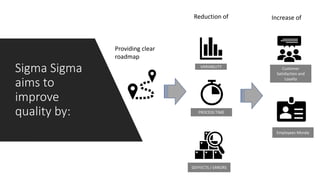
PROCESS TIME
VARIABILITY
DEFFECTS / ERRORS
Sigma Sigma
aims to
improve
quality by:
Customer
Satisfaction and
Loyalty
Employees Morale
Increase of
Reduction of
Providing clear
roadmap
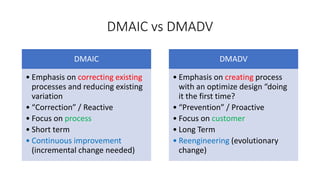
DMAIC vs DMADV
DMAIC
• Emphasis on correcting existing
processes and reducing existing
variation
• “Correction” / Reactive
• Focus on process
• Short term
• Continuous improvement
(incremental change needed)
DMADV
• Emphasis on creating process
with an optimize design “doing
it the first time?
• “Prevention” / Proactive
• Focus on customer
• Long Term
• Reengineering (evolutionary
change)
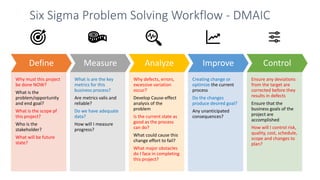
Six Sigma Problem Solving Workflow - DMAIC
Define
Why must this project
be done NOW?
What is the
problem/opportunity
and end goal?
What is the scope pf
this project?
Who is the
stakeholder?
What will be future
state?
Measure
What is are the key
metrics for this
business process?
Are metrics valis and
reliable?
Do we have adequate
data?
How will I measure
progress?
Analyze
Why defects, errors,
excessive variation
occur?
Develop Cause-effect
analysis of the
problem
Is the current state as
good as the process
can do?
What could cause this
change effort to fail?
What major obstacles
do I face in completing
this project?
Improve
Creating change or
optimize the current
process
Do the changes
produce desired goal?
Any unanticipated
consequences?
Control
Ensure any deviations
from the target are
corrected before they
results in defects
Ensure that the
business goals of the
project are
accomplished
How will I control risk,
quality, cost, schedule,
scope and changes to
plan?
Six Sigma Problem Solving Workflow - DMADV
Define
Why must this project
be done NOW?
What is the problem
and end goal?
What is the scope pf
this project?
Who are the
customers? Define
their needs
What will be future
state?
Measure
What is are the key
metrics for this
business process?
How does customers
response to the
product?
Do we have adequate
data?
How will I measure
progress?
Analyze
Are the products
aligned with the
customer needs
Design
Design and optimize
the process details to
ensure customer
needs are met
Do the changes
produce desired goal?
Any unanticipated
consequences?
Verify
How well the design
meet the customer
needs?
Ensure that the
business goals of the
project are
accomplished
How will I control risk,
quality, cost, schedule,
scope and changes to
plan?
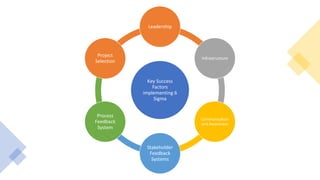
Key Success
Factors
implementing 6
Sigma
Leadership
Infrastructure
Communication
and Awareness
Stakeholder
Feedback
Systems
Process
Feedback
System
Project
Selection
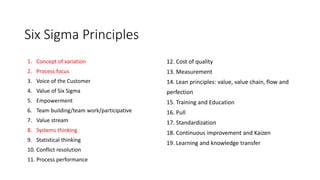
Six Sigma Principles
1. Concept of variation
2. Process focus
3. Voice of the Customer
4. Value of Six Sigma
5. Empowerment
6. Team building/team work/participative
7. Value stream
8. Systems thinking
9. Statistical thinking
10. Conflict resolution
11. Process performance
12. Cost of quality
13. Measurement
14. Lean principles: value, value chain, flow and
perfection
15. Training and Education
16. Pull
17. Standardization
18. Continuous improvement and Kaizen
19. Learning and knowledge transfer
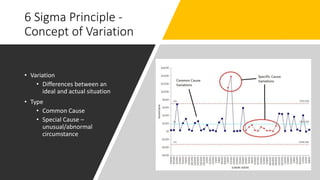
6 Sigma Principle -
Concept of Variation
• Variation
• Differences between an
ideal and actual situation
• Type
• Common Cause
• Special Cause –
unusual/abnormal
circumstance
6 Sigma
Principle -
System
Thinking
• System:
"A set of elements that are
interrelated and influenced each
other in carrying out activities
together to achieve a goal"
"A system is a collection of
elements consisting of human
resources and the other resources (
materials, machines, procedures,
documents, data or other
elements) that are organized to
achieve a goal. Without human,
system cannot run"
Karakteristik
Sistem
Komponen/Elemen
(component)
Batas sistem
(boundary)
Lingkungan luar
sistem
(environment)
Penghubung
(interface)
Masukan (input) Pengolah (process)
Keluaran (output) Sasaran (objective)
atau tujuan (goal)
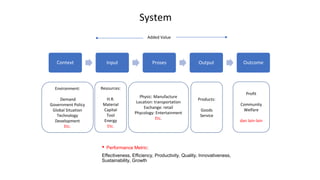
Context Input Proses Output Outcome
Resources:
H.R.
Material
Capital
Tool
Energy
Etc.
Products:
Goods
Service
Physic: Manufacture
Location: transportation
Exchange: retail
Phycology: Entertainment
Etc.
System
Added Value
Environment:
Demand
Government Policy
Global Situation
Technology
Development
Etc.
Profit
Community
Welfare
dan lain-lain
• Performance Metric:
Effectiveness, Efficiency, Productivity, Quality, Innovativeness,
Sustainability, Growth
• Manufacturing Systems: machinery, operators, goods, etc.
• Education System: human resources, curriculum, infrastructure
facilities, learners, learning, etc.
• Hospital System: doctors, nurses, sick people, admins, medical
equipment, consultations, surgical operations, medications, etc.
• Transportation System: road elements, vehicles, humans,
regulations, etc.
• Human body system: sub digestive system, respiratory sub-
system, etc.
Examples of Systems
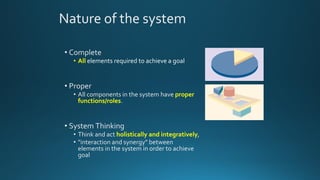
Nature of the system
• Complete
• All elements required to achieve a goal
• Proper
• All components in the system have proper
functions/roles.
• System Thinking
• Think and act holistically and integratively,
• "interaction and synergy" between
elements in the system in order to achieve
goal
(Hadjisaroso, Purnomosidi, 2003. Pendekatan sistem dalam manajemen dan bisnis)
Manufaktur dan Produksi
• Perakitan Barang
• Pemeriksaan kualitas
Penjualan dan Pemasaran
• Identifikasi pelanggan
• Memperkenalkan produk
• Menjual produk
Keuangan dan akuntansi
• Membuat laporan keuangan
• Mengelola Keuangan
Sumber Daya Manusia
• Merekrut Karyawan
• Mengevaluasi kinerja manusia
Order Fulfillment Process

Six Sigma Principles.pdf

  • 1.
    Andreas Mahendro Kuncoro,S.T., M.Sc., M.Sc., Ph.D.
  • 2.
    Agenda • Review mainobjective of 6 Sigma • DMAIC vs DMADV (DFSS) • Key factor success of 6 Sigma implementation • Principles of 6 Sigma
  • 3.
    PROCESS TIME VARIABILITY DEFFECTS /ERRORS Sigma Sigma aims to improve quality by: Customer Satisfaction and Loyalty Employees Morale Increase of Reduction of Providing clear roadmap
  • 4.
    DMAIC vs DMADV DMAIC •Emphasis on correcting existing processes and reducing existing variation • “Correction” / Reactive • Focus on process • Short term • Continuous improvement (incremental change needed) DMADV • Emphasis on creating process with an optimize design “doing it the first time? • “Prevention” / Proactive • Focus on customer • Long Term • Reengineering (evolutionary change)
  • 5.
    Six Sigma ProblemSolving Workflow - DMAIC Define Why must this project be done NOW? What is the problem/opportunity and end goal? What is the scope pf this project? Who is the stakeholder? What will be future state? Measure What is are the key metrics for this business process? Are metrics valis and reliable? Do we have adequate data? How will I measure progress? Analyze Why defects, errors, excessive variation occur? Develop Cause-effect analysis of the problem Is the current state as good as the process can do? What could cause this change effort to fail? What major obstacles do I face in completing this project? Improve Creating change or optimize the current process Do the changes produce desired goal? Any unanticipated consequences? Control Ensure any deviations from the target are corrected before they results in defects Ensure that the business goals of the project are accomplished How will I control risk, quality, cost, schedule, scope and changes to plan?
  • 6.
    Six Sigma ProblemSolving Workflow - DMADV Define Why must this project be done NOW? What is the problem and end goal? What is the scope pf this project? Who are the customers? Define their needs What will be future state? Measure What is are the key metrics for this business process? How does customers response to the product? Do we have adequate data? How will I measure progress? Analyze Are the products aligned with the customer needs Design Design and optimize the process details to ensure customer needs are met Do the changes produce desired goal? Any unanticipated consequences? Verify How well the design meet the customer needs? Ensure that the business goals of the project are accomplished How will I control risk, quality, cost, schedule, scope and changes to plan?
  • 7.
    Key Success Factors implementing 6 Sigma Leadership Infrastructure Communication andAwareness Stakeholder Feedback Systems Process Feedback System Project Selection
  • 8.
    Six Sigma Principles 1.Concept of variation 2. Process focus 3. Voice of the Customer 4. Value of Six Sigma 5. Empowerment 6. Team building/team work/participative 7. Value stream 8. Systems thinking 9. Statistical thinking 10. Conflict resolution 11. Process performance 12. Cost of quality 13. Measurement 14. Lean principles: value, value chain, flow and perfection 15. Training and Education 16. Pull 17. Standardization 18. Continuous improvement and Kaizen 19. Learning and knowledge transfer
  • 9.
    6 Sigma Principle- Concept of Variation • Variation • Differences between an ideal and actual situation • Type • Common Cause • Special Cause – unusual/abnormal circumstance
  • 10.
    6 Sigma Principle - System Thinking •System: "A set of elements that are interrelated and influenced each other in carrying out activities together to achieve a goal" "A system is a collection of elements consisting of human resources and the other resources ( materials, machines, procedures, documents, data or other elements) that are organized to achieve a goal. Without human, system cannot run"
  • 11.
  • 13.
    Context Input ProsesOutput Outcome Resources: H.R. Material Capital Tool Energy Etc. Products: Goods Service Physic: Manufacture Location: transportation Exchange: retail Phycology: Entertainment Etc. System Added Value Environment: Demand Government Policy Global Situation Technology Development Etc. Profit Community Welfare dan lain-lain • Performance Metric: Effectiveness, Efficiency, Productivity, Quality, Innovativeness, Sustainability, Growth
  • 14.
    • Manufacturing Systems:machinery, operators, goods, etc. • Education System: human resources, curriculum, infrastructure facilities, learners, learning, etc. • Hospital System: doctors, nurses, sick people, admins, medical equipment, consultations, surgical operations, medications, etc. • Transportation System: road elements, vehicles, humans, regulations, etc. • Human body system: sub digestive system, respiratory sub- system, etc. Examples of Systems
  • 15.
    Nature of thesystem • Complete • All elements required to achieve a goal • Proper • All components in the system have proper functions/roles. • System Thinking • Think and act holistically and integratively, • "interaction and synergy" between elements in the system in order to achieve goal
  • 16.
    (Hadjisaroso, Purnomosidi, 2003.Pendekatan sistem dalam manajemen dan bisnis)
  • 18.
    Manufaktur dan Produksi •Perakitan Barang • Pemeriksaan kualitas Penjualan dan Pemasaran • Identifikasi pelanggan • Memperkenalkan produk • Menjual produk Keuangan dan akuntansi • Membuat laporan keuangan • Mengelola Keuangan Sumber Daya Manusia • Merekrut Karyawan • Mengevaluasi kinerja manusia
  • 19.