Six principles for engaging people and
communities
Jeremy Taylor, CEO, National Voices
1 November 2016
• Coalition of 160+ charities
• Founded 2008
• Championing person centred care, a strong
patient and citizen voice, and services built
around people
• Standing up for voluntary organisations and
their vital work for people’s health and care
• Supporting the People & Communities Board
“
The Five Year Forward view
• We need “a radical upgrade in prevention and
public health”
• Quality of care is too variable
• We need £22 billion of productivity
improvements
• “Patients will gain far greater control of their
own care”
• “Decisive steps to break down the barriers in
how care is provided”
“
The Five Year Forward: chapter 2
• “A new relationship with patients and communities”
• “personalised care will only happen when services
recognise that patients’ own life goals are what
count;
• that services need to support families, carers and
communities;
• that promoting wellbeing and independence need to
be the key outcomes of care;
• and that patients, their families and carers are often
‘experts by experience’.”
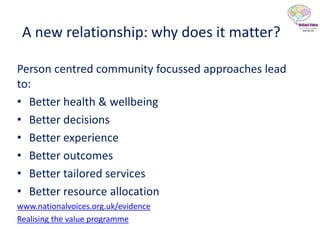
A new relationship: why does it matter?
Person centred community focussed approaches lead
to:
• Better health & wellbeing
• Better decisions
• Better experience
• Better outcomes
• Better tailored services
• Better resource allocation
www.nationalvoices.org.uk/evidence
Realising the value programme
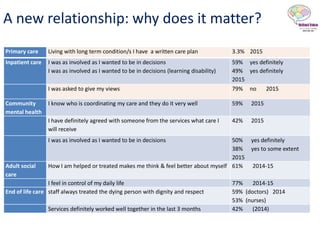
Primary care Living with long term condition/s I have a written care plan 3.3% 2015
Inpatient care I was as involved as I wanted to be in decisions
I was as involved as I wanted to be in decisions (learning disability)
59% yes definitely
49% yes definitely
2015
I was asked to give my views 79% no 2015
Community
mental health
I know who is coordinating my care and they do it very well 59% 2015
I have definitely agreed with someone from the services what care I
will receive
42% 2015
I was as involved as I wanted to be in decisions 50% yes definitely
38% yes to some extent
2015
Adult social
care
How I am helped or treated makes me think & feel better about myself 61% 2014-15
I feel in control of my daily life 77% 2014-15
End of life care staff always treated the dying person with dignity and respect 59% (doctors) 2014
53% (nurses)
Services definitely worked well together in the last 3 months 42% (2014)
A new relationship: why does it matter?
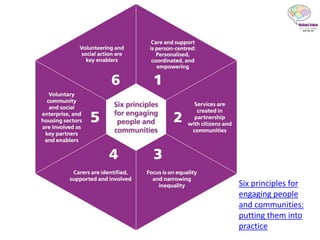
Six principles for
engaging people
and communities:
putting them into
practice
Principles into practice: the “what”
• care and support planning, using the principles and stages outlined by
National Voices, TLAP, C4CC, RCGP and others.
• shared decisions about treatments
• information, education and support for self-management, including peer
support, for people living with long term conditions and disabilities
• access to personal records – proven to support self management, shared
decisions and people’s commitment to courses of prevention and
treatment
• health coaching
• peer support
• asset based approaches such as social prescribing
• personal budgets to give people greater control over the way they
maintain their health and wellbeing
• experience based co-design
www.nationalvoices.org.uk/evidence
Realising the value programme
Principles into practice: the “who”
• People & communities
• Patient & lay leaders, volunteers, activists
• VCSE sector
• Clinical and managerial champions & leaders
• Front line staff
• Local government, wider public sector
• Quality improvement champions
Principles into practice: the “how”
• national levers/incentives/laws/requirements
• commissioning
• funding
• regulation
• new care model vanguards/other test-beds
• “MCP” and “PACS” contracts
• “STPs”
• GP contract/ GP forward view
• “Integrated Personalised Commissioning”
• mental health, cancer, maternity, learning disabilities, end
of life care commitments etc
• clinical training
• revalidation
• OMG
What high impact actions could help?
• A shared vision and narrative – making this a priority
• A coherent framework of national
levers/incentives/metrics/accountabilities
• A really supportive support offer to local areas
• A shared sense of moral purpose for change
• A “road map” for change
• Champions for change
• Partnership working
• A social movement, not just a technocratic exercise
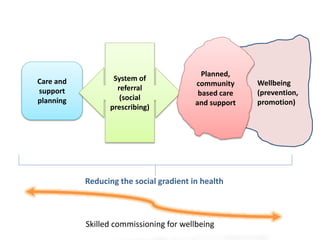
Care and
support
planning
System of
referral
(social
prescribing)
Planned,
community
based care
and support
Skilled commissioning for wellbeing
Wellbeing
(prevention,
promotion)
Reducing the social gradient in health
Thanks for listening!
• www.nationalvoices.org.uk
• You can follow us on Twitter
– @NVTweeting
– @JeremyTaylorNV
• You can sign up for our newsletter: email
info@nationalvoices.org.uk
• You can become a member, partner or
supporter: email info@nationalvoices.org.uk

Six principles for engaging people and communities

  • 1.
    Six principles forengaging people and communities Jeremy Taylor, CEO, National Voices 1 November 2016
  • 2.
    • Coalition of160+ charities • Founded 2008 • Championing person centred care, a strong patient and citizen voice, and services built around people • Standing up for voluntary organisations and their vital work for people’s health and care • Supporting the People & Communities Board
  • 3.
    “ The Five YearForward view • We need “a radical upgrade in prevention and public health” • Quality of care is too variable • We need £22 billion of productivity improvements • “Patients will gain far greater control of their own care” • “Decisive steps to break down the barriers in how care is provided”
  • 4.
    “ The Five YearForward: chapter 2 • “A new relationship with patients and communities” • “personalised care will only happen when services recognise that patients’ own life goals are what count; • that services need to support families, carers and communities; • that promoting wellbeing and independence need to be the key outcomes of care; • and that patients, their families and carers are often ‘experts by experience’.”
  • 5.
    A new relationship:why does it matter? Person centred community focussed approaches lead to: • Better health & wellbeing • Better decisions • Better experience • Better outcomes • Better tailored services • Better resource allocation www.nationalvoices.org.uk/evidence Realising the value programme
  • 6.
    Primary care Livingwith long term condition/s I have a written care plan 3.3% 2015 Inpatient care I was as involved as I wanted to be in decisions I was as involved as I wanted to be in decisions (learning disability) 59% yes definitely 49% yes definitely 2015 I was asked to give my views 79% no 2015 Community mental health I know who is coordinating my care and they do it very well 59% 2015 I have definitely agreed with someone from the services what care I will receive 42% 2015 I was as involved as I wanted to be in decisions 50% yes definitely 38% yes to some extent 2015 Adult social care How I am helped or treated makes me think & feel better about myself 61% 2014-15 I feel in control of my daily life 77% 2014-15 End of life care staff always treated the dying person with dignity and respect 59% (doctors) 2014 53% (nurses) Services definitely worked well together in the last 3 months 42% (2014) A new relationship: why does it matter?
  • 7.
    Six principles for engagingpeople and communities: putting them into practice
  • 8.
    Principles into practice:the “what” • care and support planning, using the principles and stages outlined by National Voices, TLAP, C4CC, RCGP and others. • shared decisions about treatments • information, education and support for self-management, including peer support, for people living with long term conditions and disabilities • access to personal records – proven to support self management, shared decisions and people’s commitment to courses of prevention and treatment • health coaching • peer support • asset based approaches such as social prescribing • personal budgets to give people greater control over the way they maintain their health and wellbeing • experience based co-design www.nationalvoices.org.uk/evidence Realising the value programme
  • 9.
    Principles into practice:the “who” • People & communities • Patient & lay leaders, volunteers, activists • VCSE sector • Clinical and managerial champions & leaders • Front line staff • Local government, wider public sector • Quality improvement champions
  • 10.
    Principles into practice:the “how” • national levers/incentives/laws/requirements • commissioning • funding • regulation • new care model vanguards/other test-beds • “MCP” and “PACS” contracts • “STPs” • GP contract/ GP forward view • “Integrated Personalised Commissioning” • mental health, cancer, maternity, learning disabilities, end of life care commitments etc • clinical training • revalidation • OMG
  • 11.
    What high impactactions could help? • A shared vision and narrative – making this a priority • A coherent framework of national levers/incentives/metrics/accountabilities • A really supportive support offer to local areas • A shared sense of moral purpose for change • A “road map” for change • Champions for change • Partnership working • A social movement, not just a technocratic exercise
  • 12.
    Care and support planning System of referral (social prescribing) Planned, community basedcare and support Skilled commissioning for wellbeing Wellbeing (prevention, promotion) Reducing the social gradient in health
  • 13.
    Thanks for listening! •www.nationalvoices.org.uk • You can follow us on Twitter – @NVTweeting – @JeremyTaylorNV • You can sign up for our newsletter: email info@nationalvoices.org.uk • You can become a member, partner or supporter: email info@nationalvoices.org.uk