Ar. J.K.GUPTA, Former Director, College of Architecture, IET Bhaddal--
Email---- jit.kumar1944@gmail.com
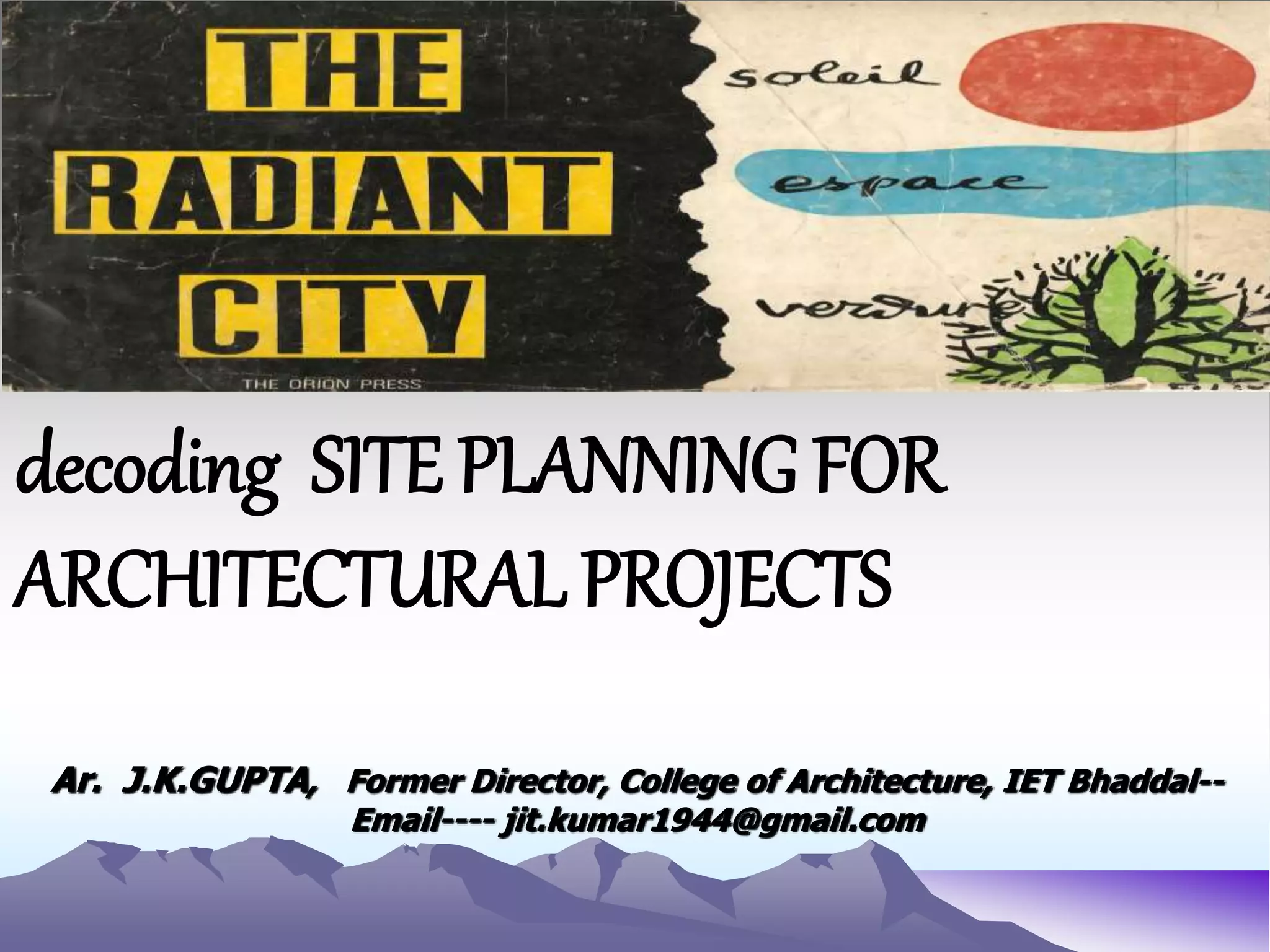
decoding SITE PLANNING FOR
ARCHITECTURAL PROJECTS
Buildings- Role and Importance
๏‚— Buildings-- integral part of human history, growth &
development
๏‚— Buildings -- shall continue to define journey of human
growth & development
๏‚— Buildings-- manmade environment- vital for human growth
๏‚— Buildings โ€“ living organism
๏‚— Buildings -- as structures cater to all human activities
๏‚— Buildings -- largest consumers of energy (50%)
๏‚— Buildings - largest consumers of resources
๏‚— Buildings โ€“ largest generators of waste
๏‚— Buildings- largest polluter of environment /ecology
๏‚— Buildings --- responsible for largest carbon footprints
๏‚— Buildings -- responsible for global warming
๏‚— Buildings -- major determinant of global sustainability
๏‚—
Buildings- Role and Importance
โ€ข Buildingsโ€“ providers of optimum/worst living conditions
๏‚— Buildings -- make people healthy/sick
๏‚— Buildings โ€“ 80% human life spent in buildings
๏‚— Buildings-- valuable to address / overcome human/
ecological concerns
๏‚— Making Buildings Sustainableโ€“ essential- to make value
addition to resources, environment ,ecology
๏‚— Studies revealed โ€”
๏‚— Sustainable school -makes learning easy/ more meaningful
๏‚— Sustainable Home --- makes people happy and healthy
๏‚— Sustainable Hospital -- cures patients quickly
๏‚— Sustainable shopping mall-- increases sale / profits
BUILDINGS AS CONSUMERS OF
RESOURCES
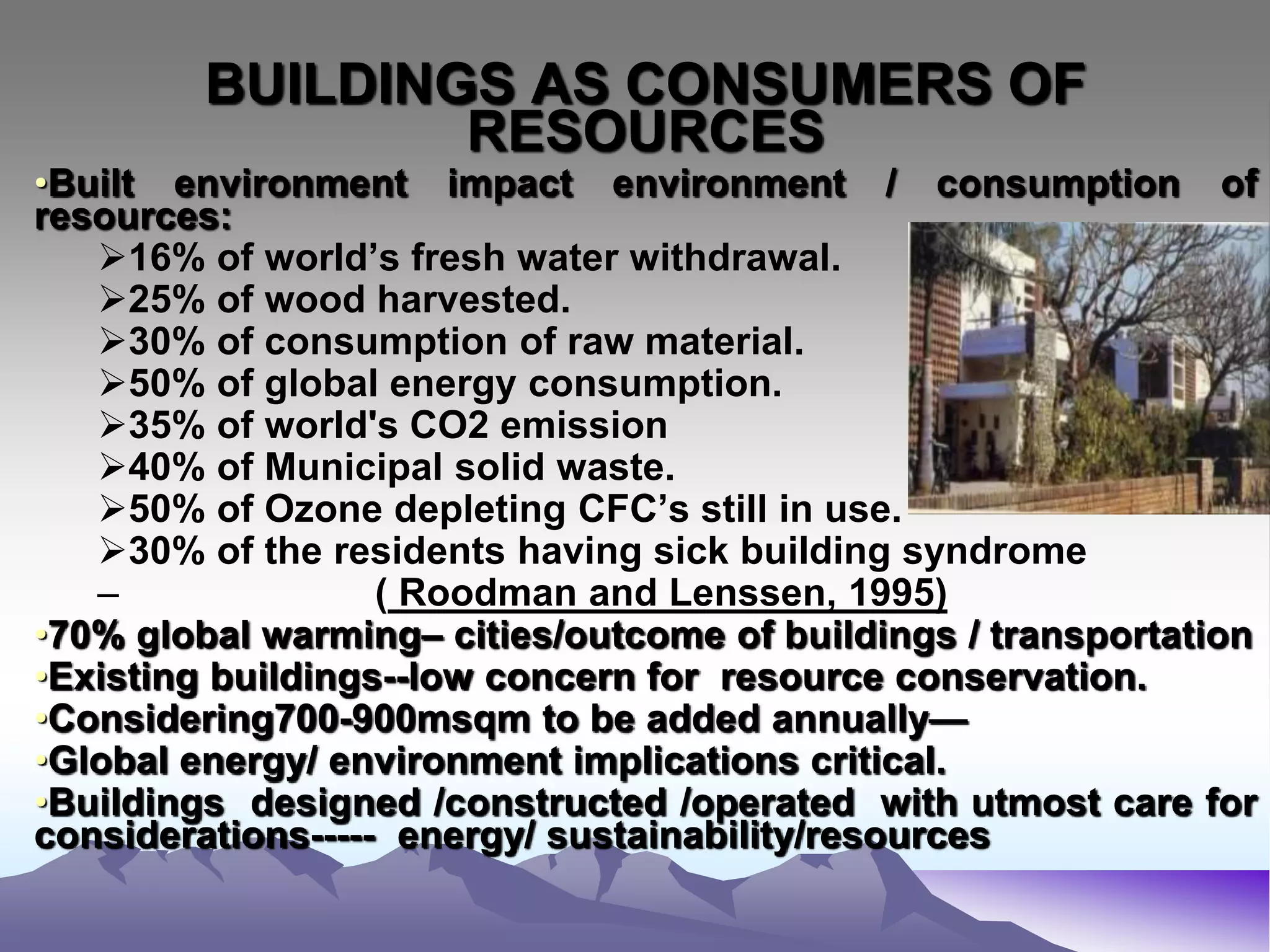
โ€ขBuilt environment impact environment / consumption of
resources:
๏ƒ˜16% of worldโ€™s fresh water withdrawal.
๏ƒ˜25% of wood harvested.
๏ƒ˜30% of consumption of raw material.
๏ƒ˜50% of global energy consumption.
๏ƒ˜35% of world's CO2 emission
๏ƒ˜40% of Municipal solid waste.
๏ƒ˜50% of Ozone depleting CFCโ€™s still in use.
๏ƒ˜30% of the residents having sick building syndrome
โ€“ ( Roodman and Lenssen, 1995)
โ€ข70% global warmingโ€“ cities/outcome of buildings / transportation
โ€ขExisting buildings--low concern for resource conservation.
โ€ขConsidering700-900msqm to be added annuallyโ€”
โ€ขGlobal energy/ environment implications critical.
โ€ขBuildings designed /constructed /operated with utmost care for
considerations----- energy/ sustainability/resources
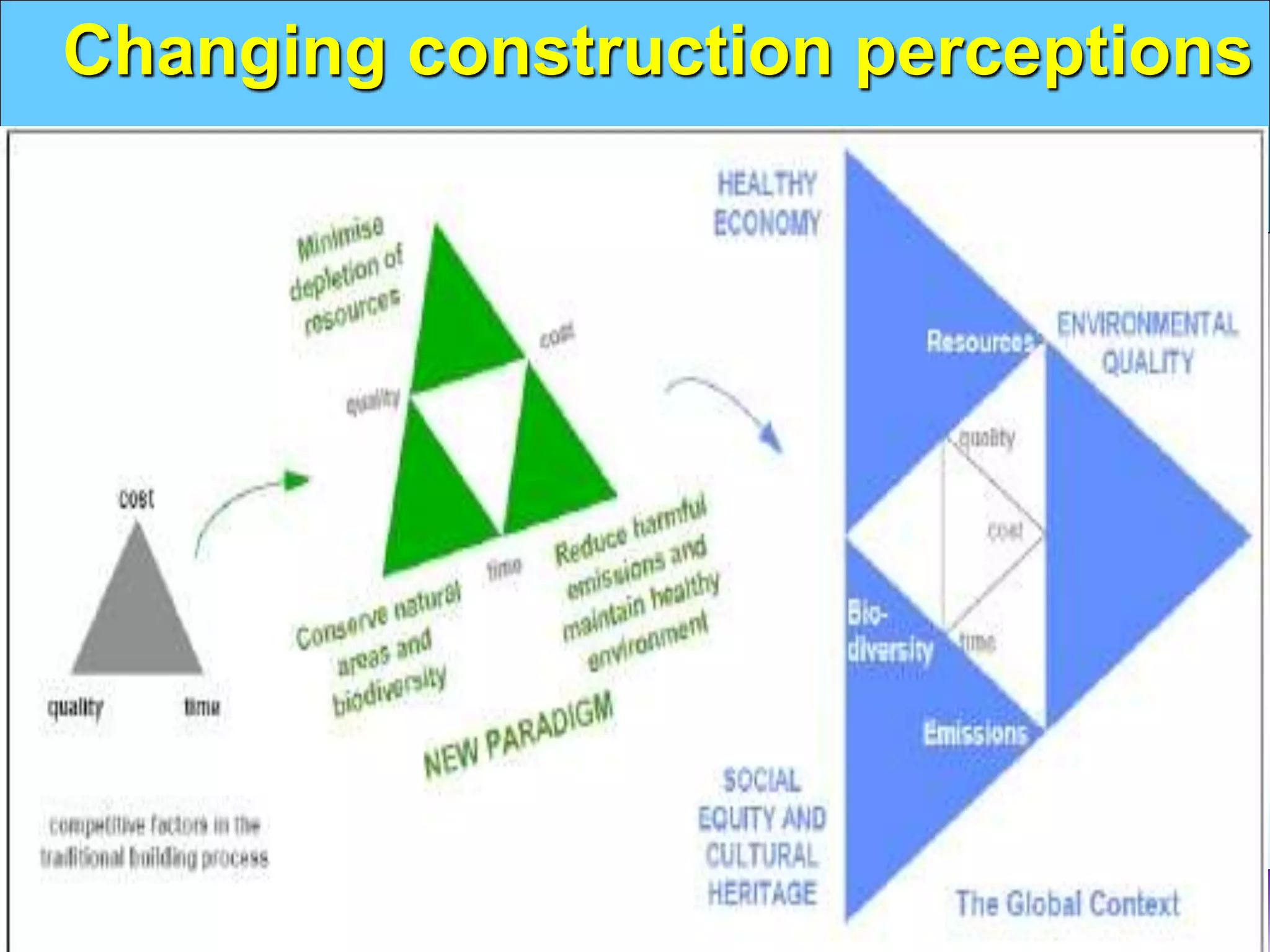
Changing construction perceptions
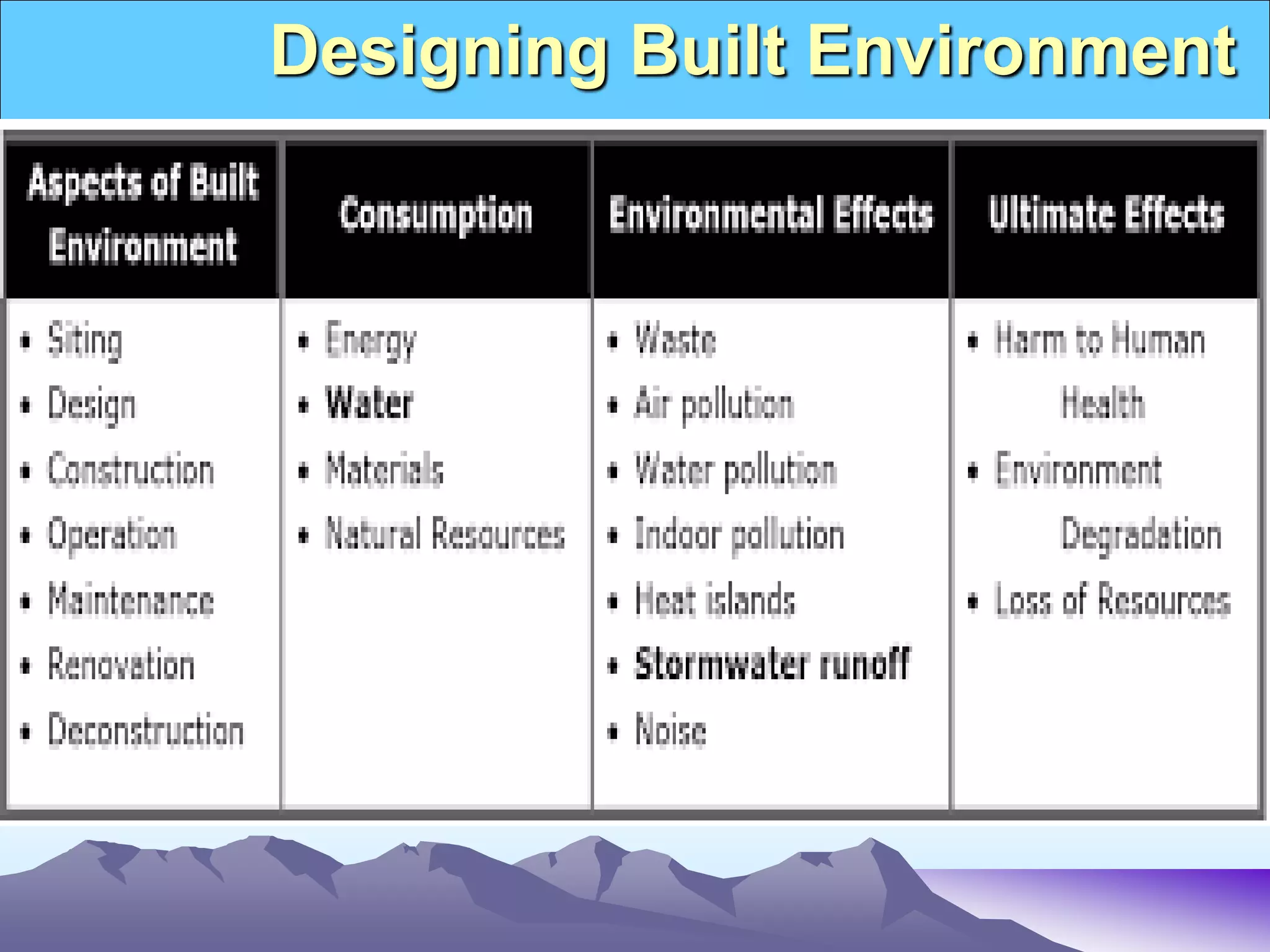
Designing Built Environment
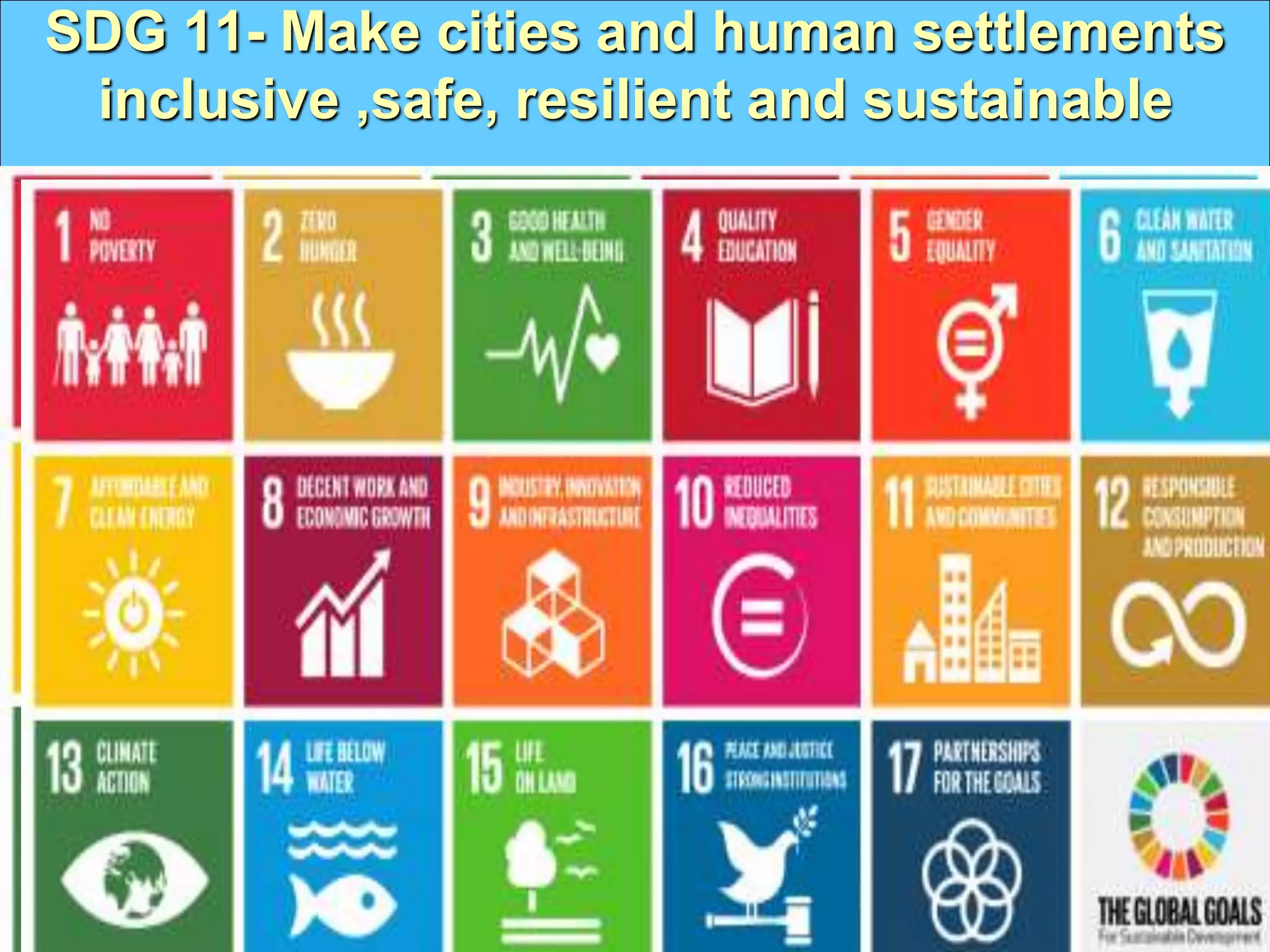
SDG 11- Make cities and human settlements
inclusive ,safe, resilient and sustainable
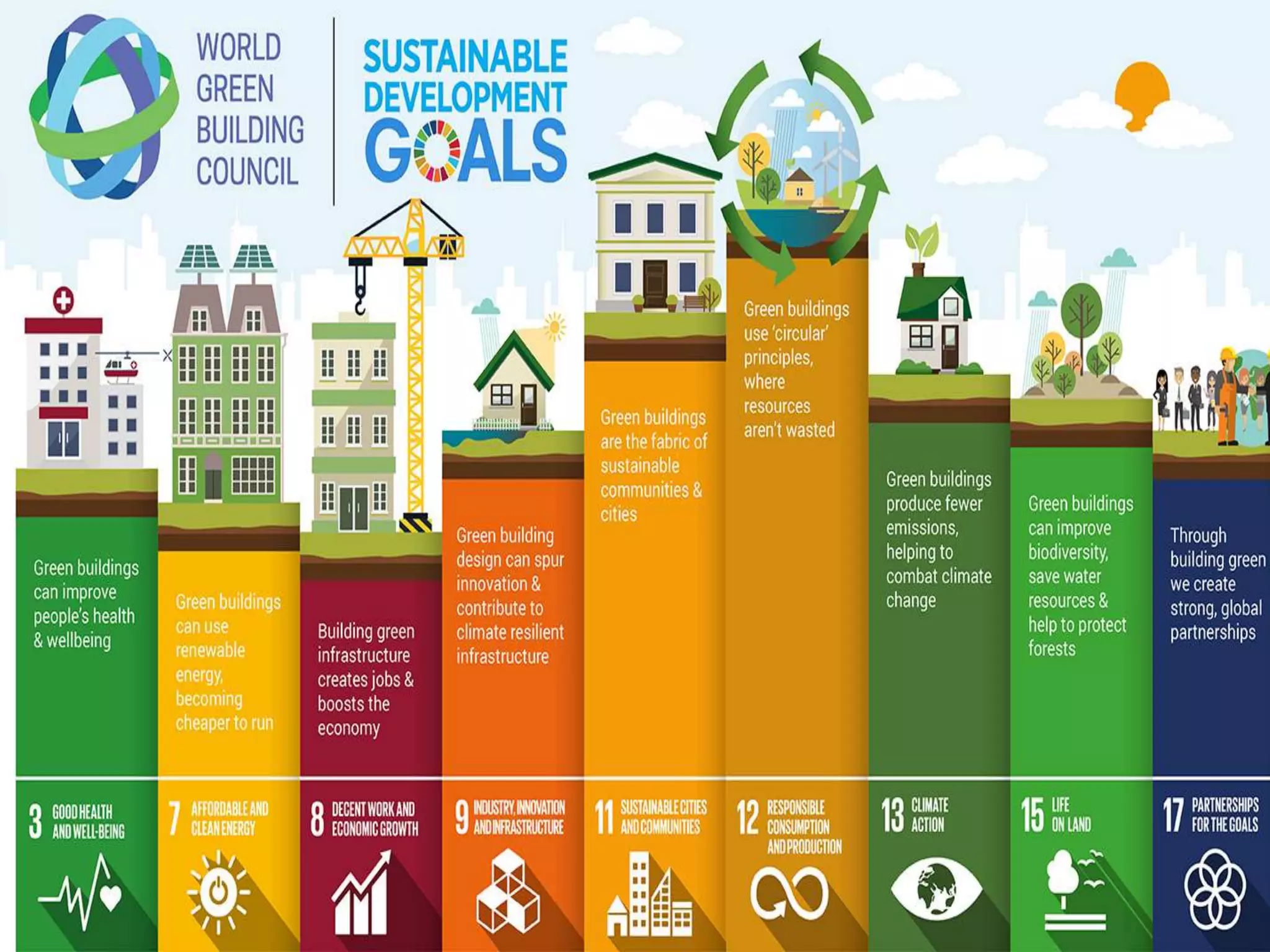
โ€ขDesigning
Green
Buildings
Buildings- Built Environment
โ€ข Operational domain of professions of Architecture
revolves around creating state of art built environment
through:
โ€ข -- Siting
โ€ข -- planning,
โ€ข -- designing,
โ€ข -- construction,
โ€ข -- operation,
โ€ข -- maintenance
โ€ข -- demolition and
โ€ข -- reconstruction
-- Architects- have critical role / responsibility in--making value
addition to resources ,environment ,ecology- by creating
sustainable built environment.
-Town Planners also play vital role by : evolving layout plans with energy as focus,
โ€“making best use of sun and wind
-- Going green --necessity--to ensure sustainable tomorrow
--Each building unique--requires different options to make it green
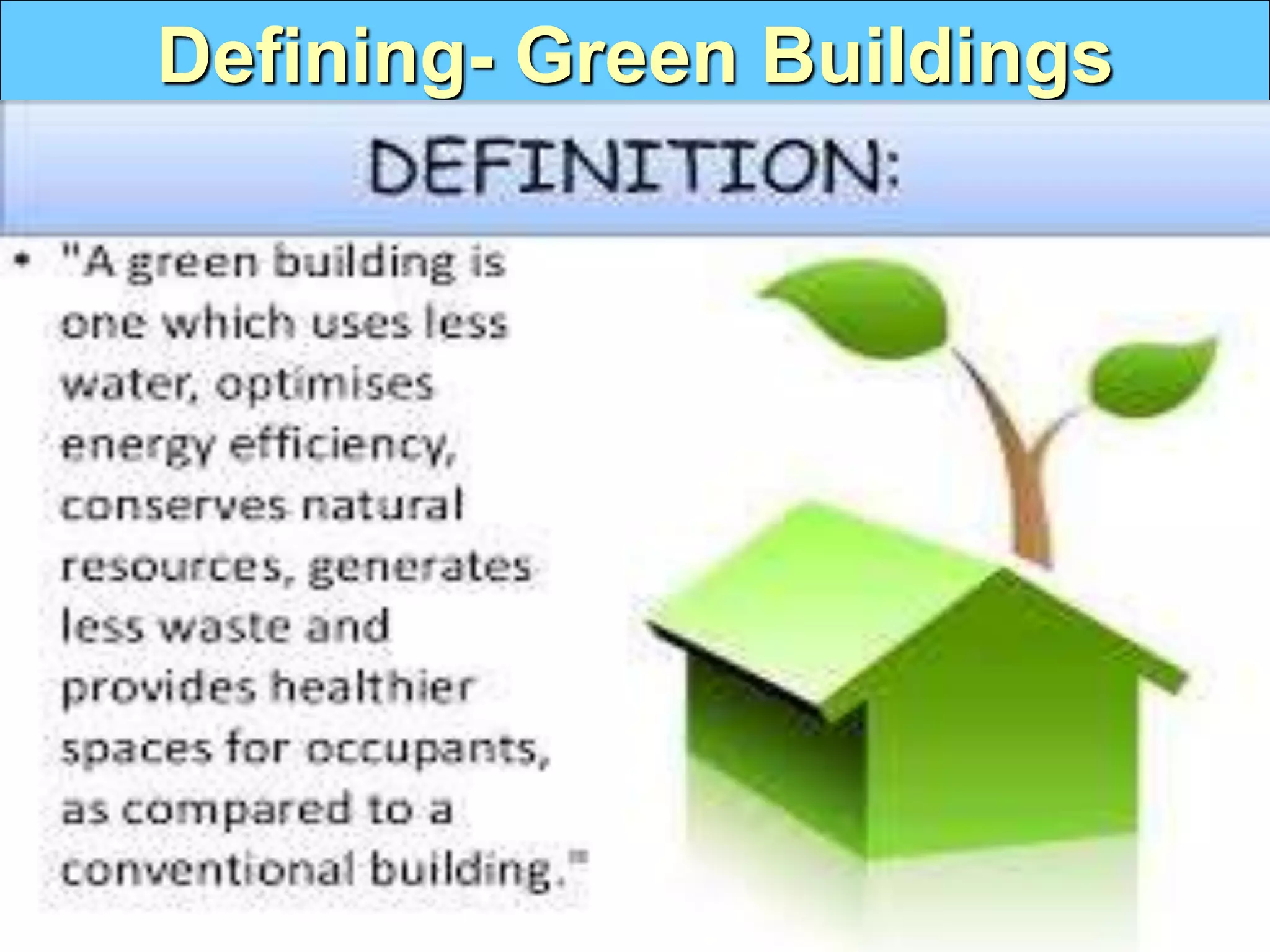
Defining- Green Buildings
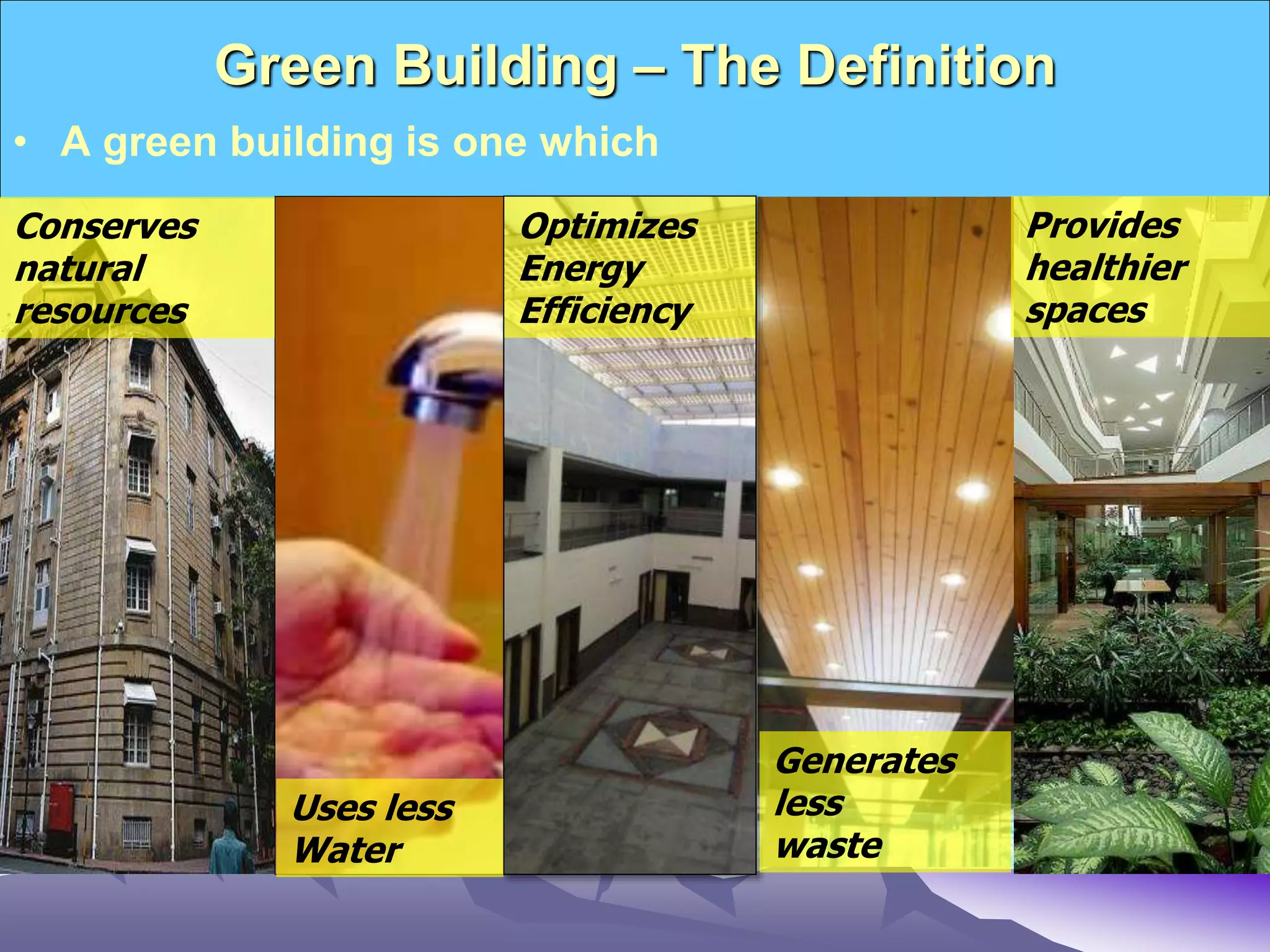
Green Building โ€“ The Definition
โ€ข A green building is one which
Uses less
Water
Optimizes
Energy
Efficiency
Conserves
natural
resources
Generates
less
waste
Provides
healthier
spaces
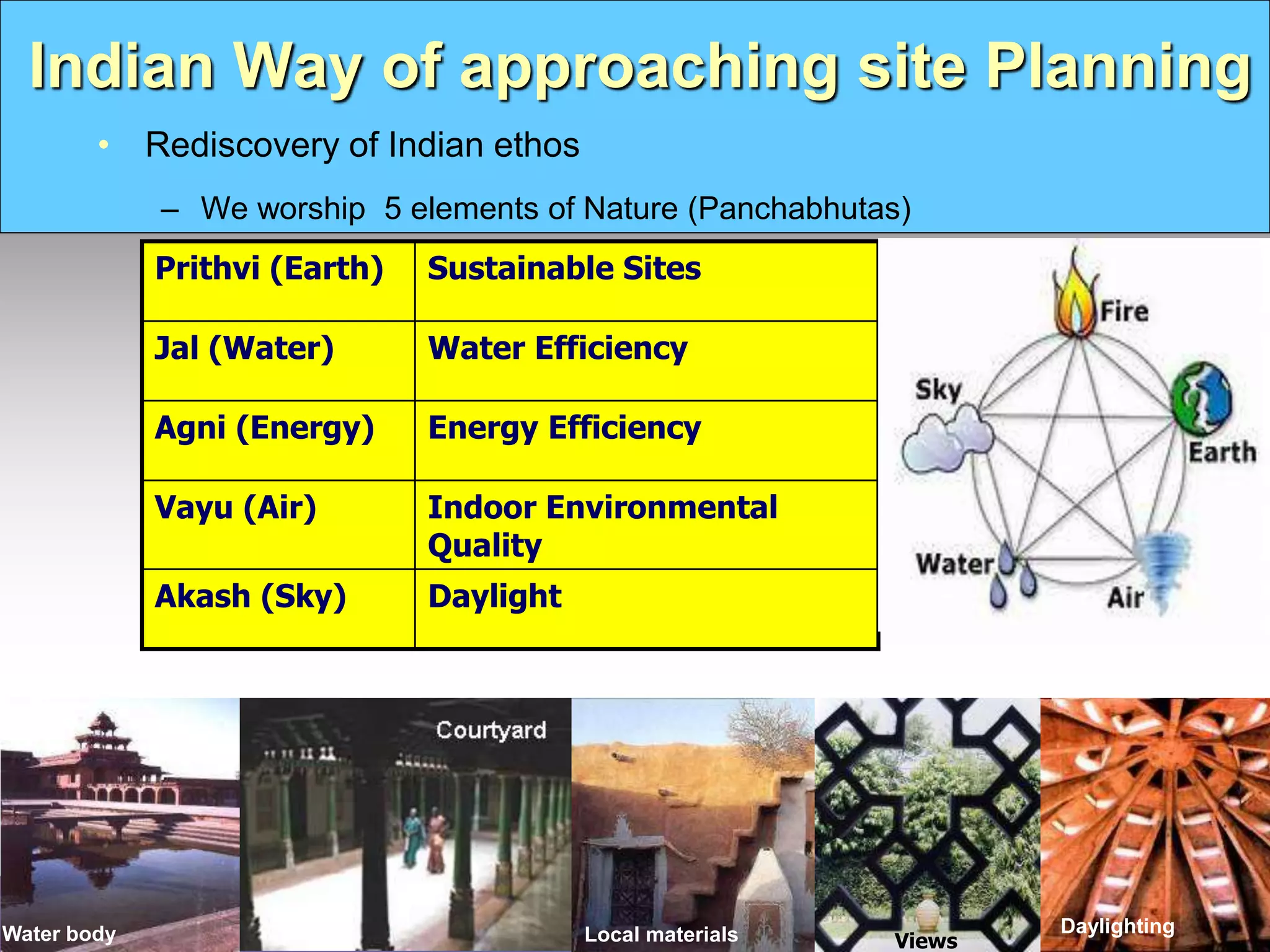
Daylighting
Local materials
Indian Way of approaching site Planning
โ€ข Rediscovery of Indian ethos
โ€“ We worship 5 elements of Nature (Panchabhutas)
Prithvi (Earth) Sustainable Sites
Jal (Water) Water Efficiency
Agni (Energy) Energy Efficiency
Vayu (Air) Indoor Environmental
Quality
Akash (Sky) Daylight
Views
Water body
Designing Sustainable Buildings
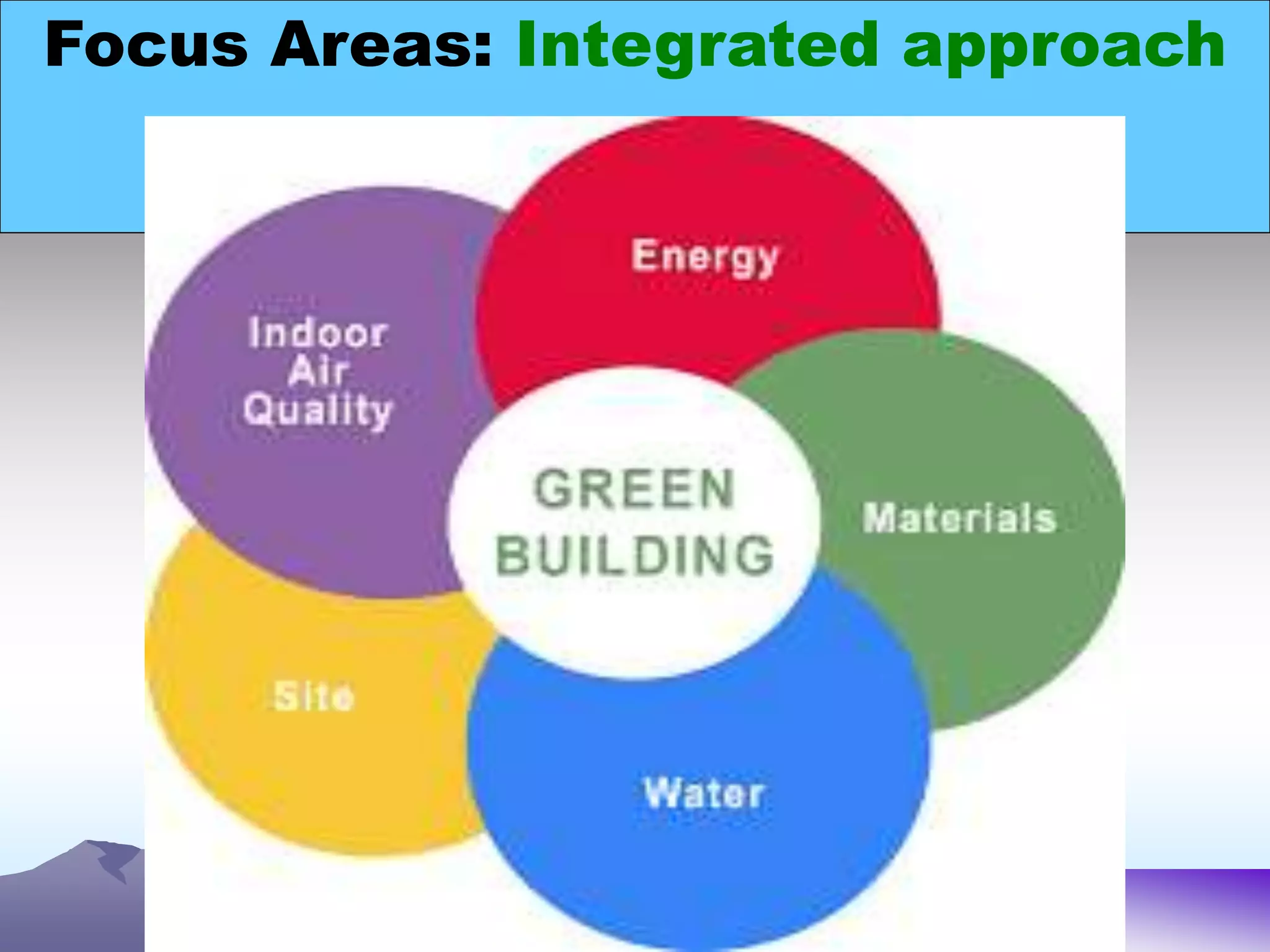
โ€ข - Adopting Integrated approach to designing of buildings
โ€ข Based on CLIMATE- Regional, City, Site Climates
โ€ข Rational Site planning- planning with nature, making best use of site
potential
โ€ข Orientation -- optimizing light / heat gain/heat loss
โ€ข Sun movement-- For maximizing use of free solar energy for heating
/lighting
โ€ข Wind direction---using movement of air for ventilation/ cooling
โ€ข Planning -- for optimizing siting, shape of building, planning spaces,
allocating uses, placing of rooms, circulation, promoting building
efficiency, promoting natural sunlight, air and ventilation
โ€ข Building Envelop--โ€“ based on Mass โ€“ space relationships/ solids and
voids, positioning of openings ,projections, shading devices, height,
shape of building, natural lighting and ventilations etc
โ€ข Materials- Materials used for buildings- low embodied materials locally
available ;in natural form, lightweight โ€“ reduce dead load
โ€ข Technologies โ€“Adopted to be- Cost- effective, material efficient,
speedier construction, energy efficient
โ€ข Indoor Air Quality- Creating optimum living conditions for residents
Focus Areas: Integrated approach
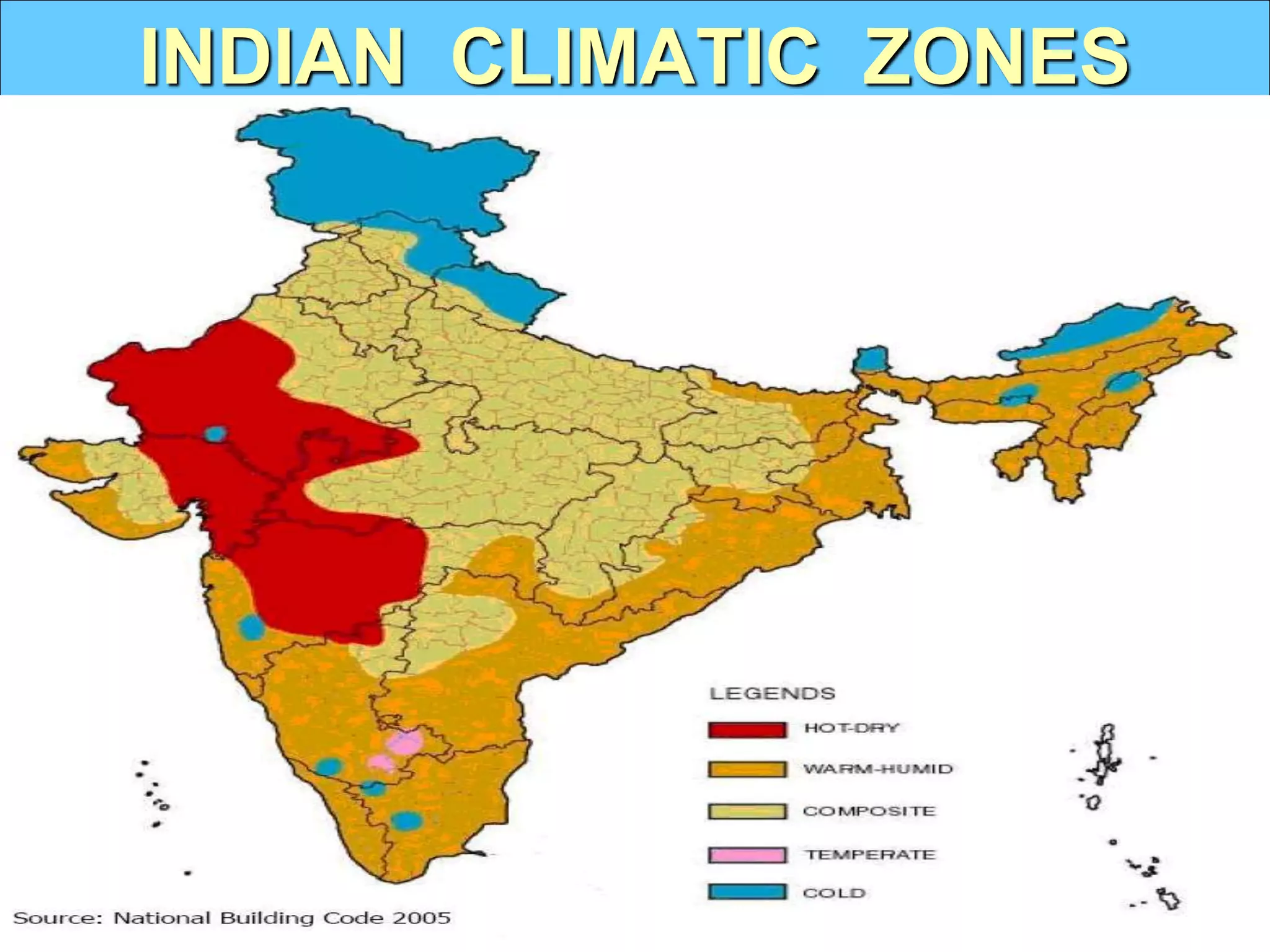
INDIAN CLIMATIC ZONES
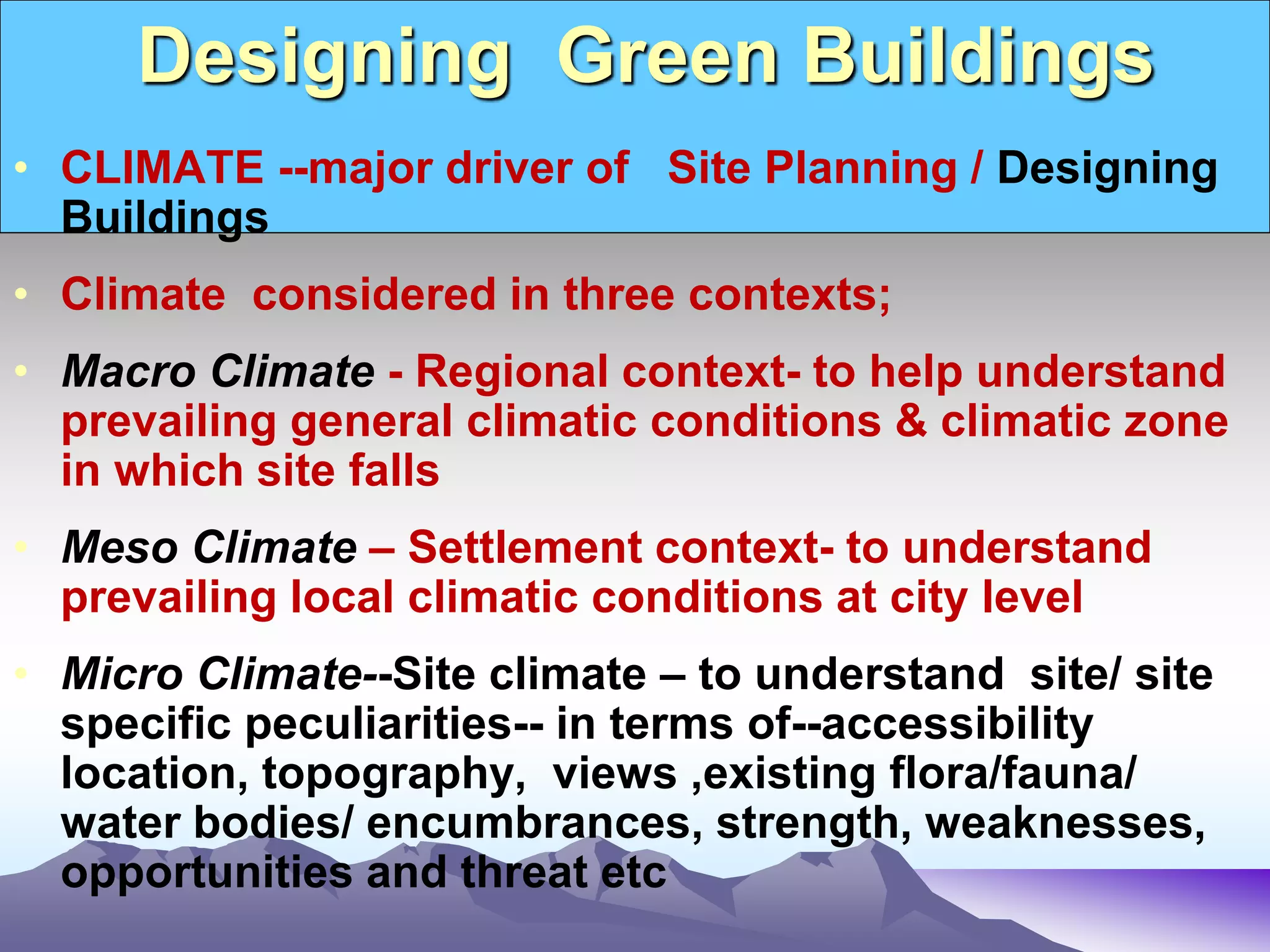
Designing Green Buildings
โ€ข CLIMATE --major driver of Site Planning / Designing
Buildings
โ€ข Climate considered in three contexts;
โ€ข Macro Climate - Regional context- to help understand
prevailing general climatic conditions & climatic zone
in which site falls
โ€ข Meso Climate โ€“ Settlement context- to understand
prevailing local climatic conditions at city level
โ€ข Micro Climate--Site climate โ€“ to understand site/ site
specific peculiarities-- in terms of--accessibility
location, topography, views ,existing flora/fauna/
water bodies/ encumbrances, strength, weaknesses,
opportunities and threat etc
โ€ขContext of Site
โ€ขIn Site Planning
Designing
Buildings
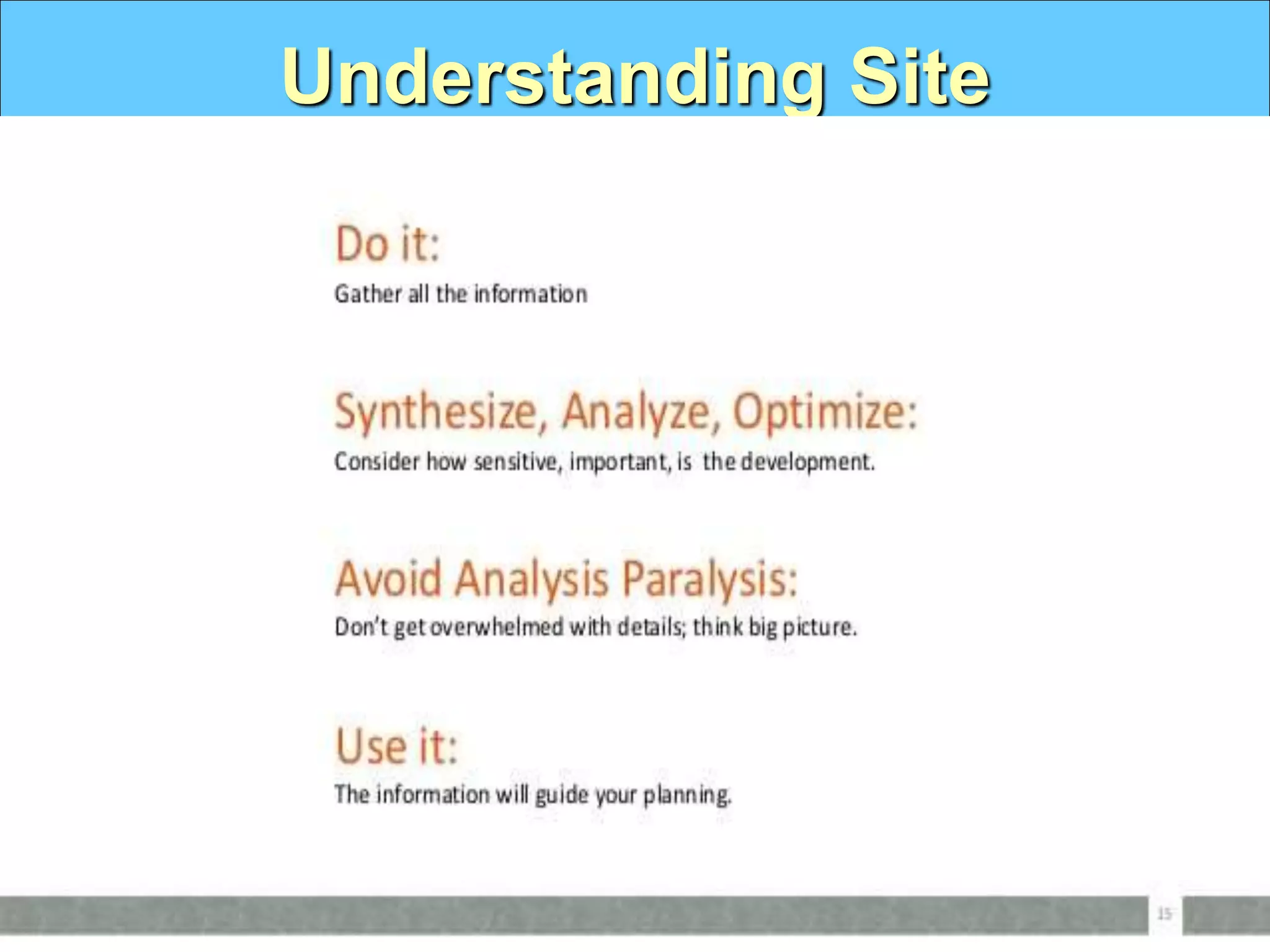
Understanding Site
Before searching for design solutionsโ€“Look, understand,
appreciate, evaluate, analyse Site & Carry out a SWOT
analysis;
โ€ข -- site studied, analysed /understoodโ€“ thoroughly/ objectively
โ€ข --Design solution -- outcome of site / prevailing site conditions
โ€ข - Premeditated design always fails-- to do justice to project-
making them irrational/unsustainable
โ€ข --Carrying out SWOT analysis of Site โ€“ critical to understand
strength, weaknesses, opportunities & threats posed by site
โ€ข --Evolve Design based on -- making optimum use of strength
of site -- overcome weaknesses
โ€ข -- make best use of opportunities offered and
โ€ข -- Eliminating all possible threats
โ€ข Look at site Sit-- both from inside, outside, top and bottom
โ€ข ..
Understanding Site
โ€ข Site needs study/analysis in terms of;-19 factors
โ€ข Location,
โ€ข Accessibility
โ€ข Shape and size
โ€ข Topography,
โ€ข Vegetation,
โ€ข Infrastructure,
โ€ข Orientation
โ€ข Wind Direction
โ€ข Local culture, soil conditions
โ€ข View from site /View to site
โ€ข Prevailing typology of buildings/environment around site-
โ€ข Existing structures within site
โ€ข Existing encumbrances- electric /gas lines, depression water bodies
โ€ข Local Building bye laws
โ€ข Developmental Controls- Height, FAR, Setbacks ,land use etc
Understanding Site/Site planning
โ€ข Understanding Site critical
โ€ข -- For site Planning / for designing climate responsive/passive
buildings/ Planning / designing Sustainable Buildings
โ€ข i- Rational Planning of spaces- both internal and external
โ€ข Ii Defining --Entries &Exits;
โ€ข Iii Positioningโ€“ Buildings,
โ€ข Iv Defining area for Landscaping /Parking
โ€ข V Planning & designing of Buildings;
โ€ข vi--Determining shape, size &volume of buildings
โ€ข Vii Determining distances between buildings
โ€ข Viii Determining building setbacks
--- ix Evolving Traffic and Transportation Plan
โ€ข x Preparing Infrastructure plan/ Evolving Service Plan - Preparing
Drainage Plan
โ€ข Xi - Positioning Rain water Harvesting
Understanding Site
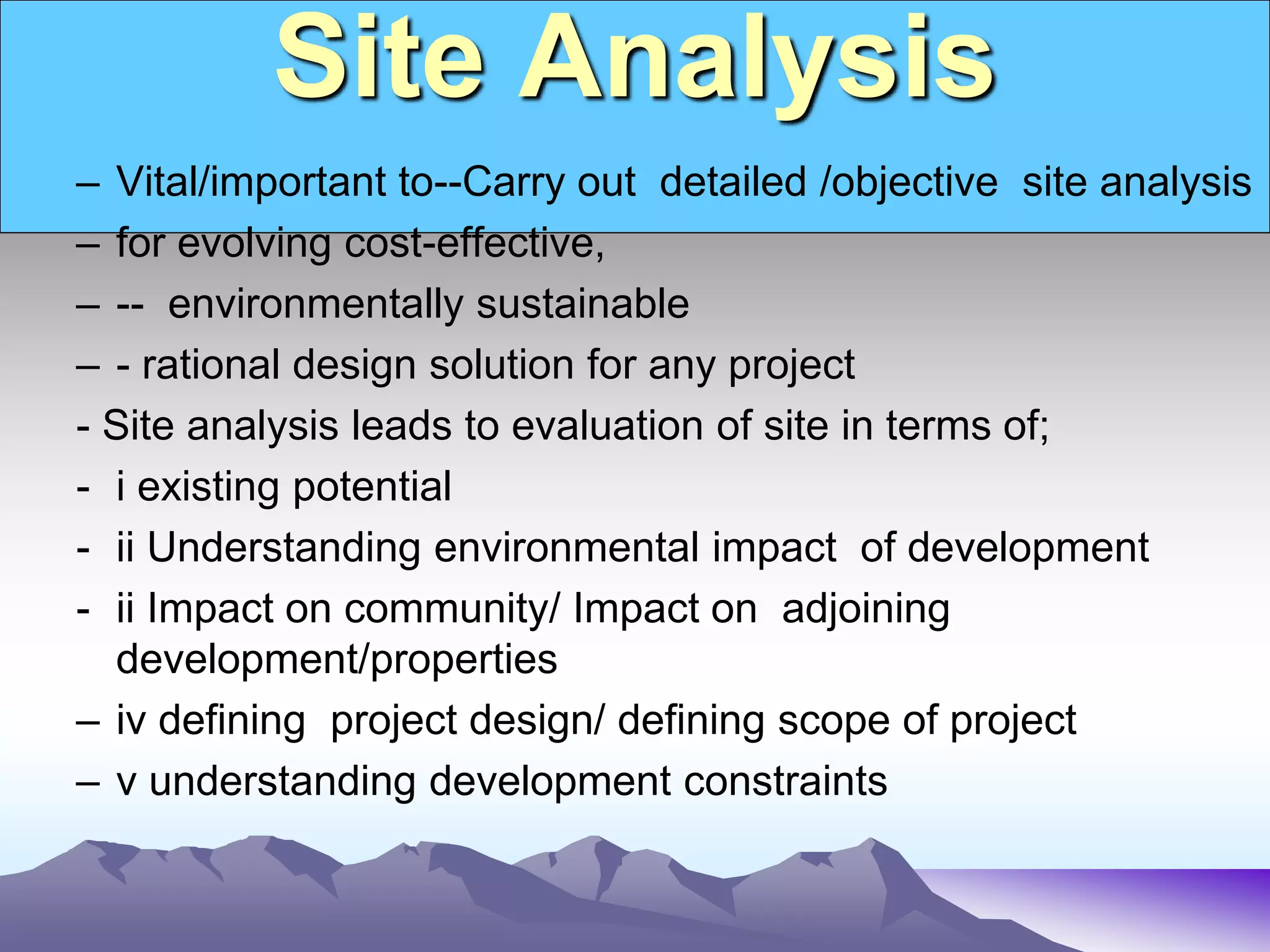
โ€ขSite Analysis
Site Analysis
โ€“ Vital/important to--Carry out detailed /objective site analysis
โ€“ for evolving cost-effective,
โ€“ -- environmentally sustainable
โ€“ - rational design solution for any project
- Site analysis leads to evaluation of site in terms of;
- i existing potential
- ii Understanding environmental impact of development
- ii Impact on community/ Impact on adjoining
development/properties
โ€“ iv defining project design/ defining scope of project
โ€“ v understanding development constraints
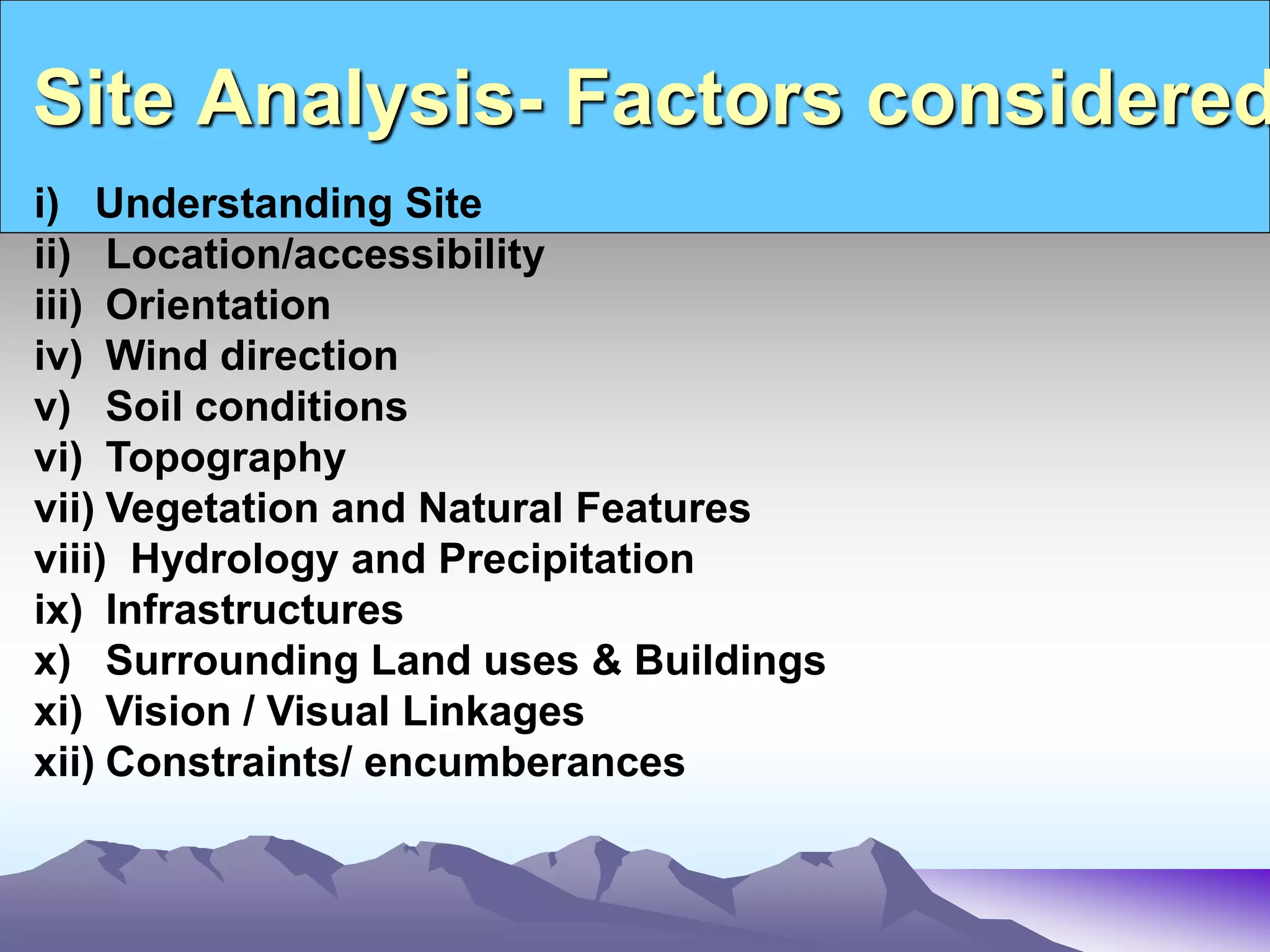
Site Analysis- Factors considered
i) Understanding Site
ii) Location/accessibility
iii) Orientation
iv) Wind direction
v) Soil conditions
vi) Topography
vii) Vegetation and Natural Features
viii) Hydrology and Precipitation
ix) Infrastructures
x) Surrounding Land uses & Buildings
xi) Vision / Visual Linkages
xii) Constraints/ encumberances
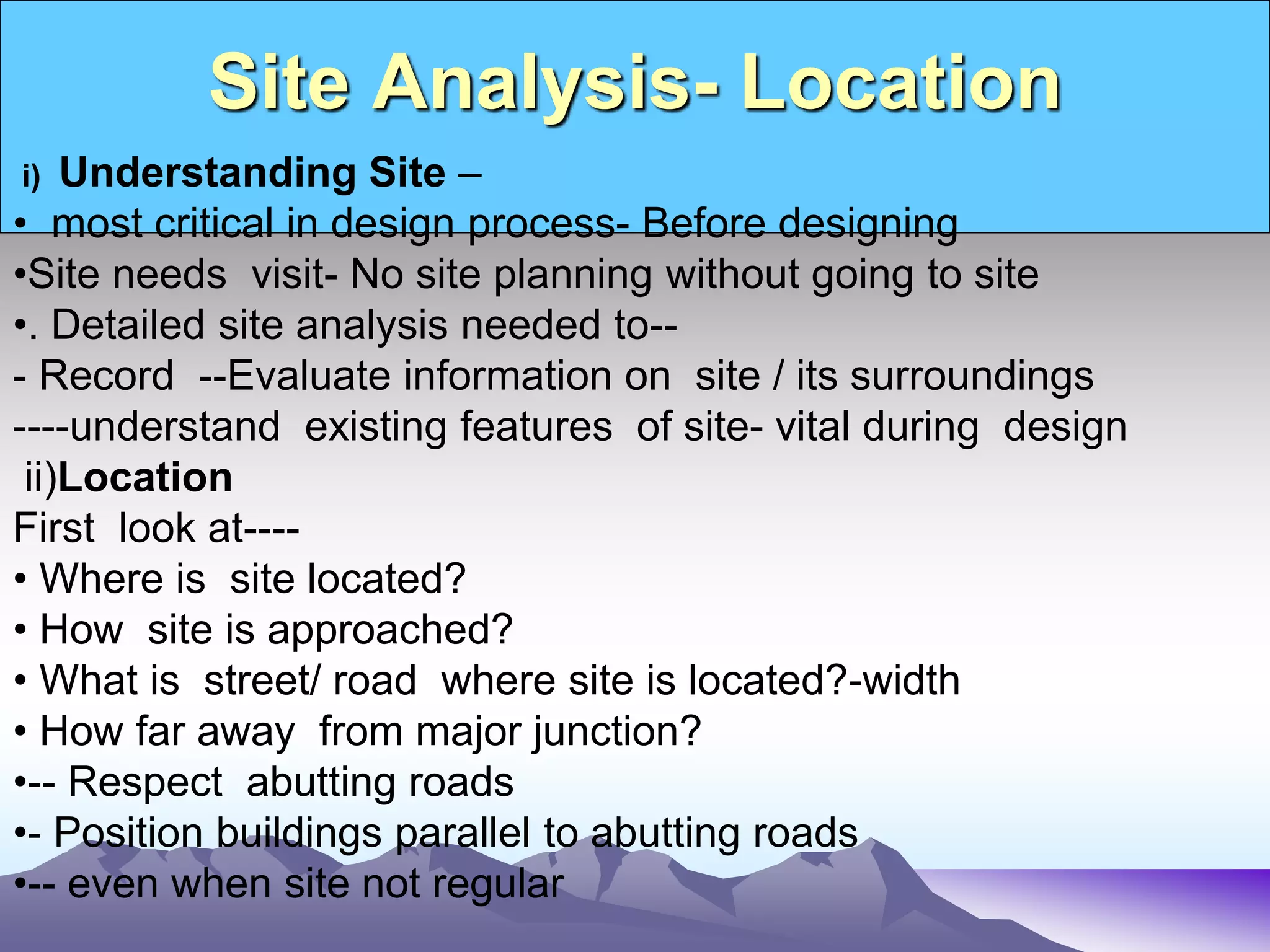
Site Analysis- Location
i) Understanding Site โ€“
โ€ข most critical in design process- Before designing
โ€ขSite needs visit- No site planning without going to site
โ€ข. Detailed site analysis needed to--
- Record --Evaluate information on site / its surroundings
----understand existing features of site- vital during design
ii)Location
First look at----
โ€ข Where is site located?
โ€ข How site is approached?
โ€ข What is street/ road where site is located?-width
โ€ข How far away from major junction?
โ€ข-- Respect abutting roads
โ€ข- Position buildings parallel to abutting roads
โ€ข-- even when site not regular
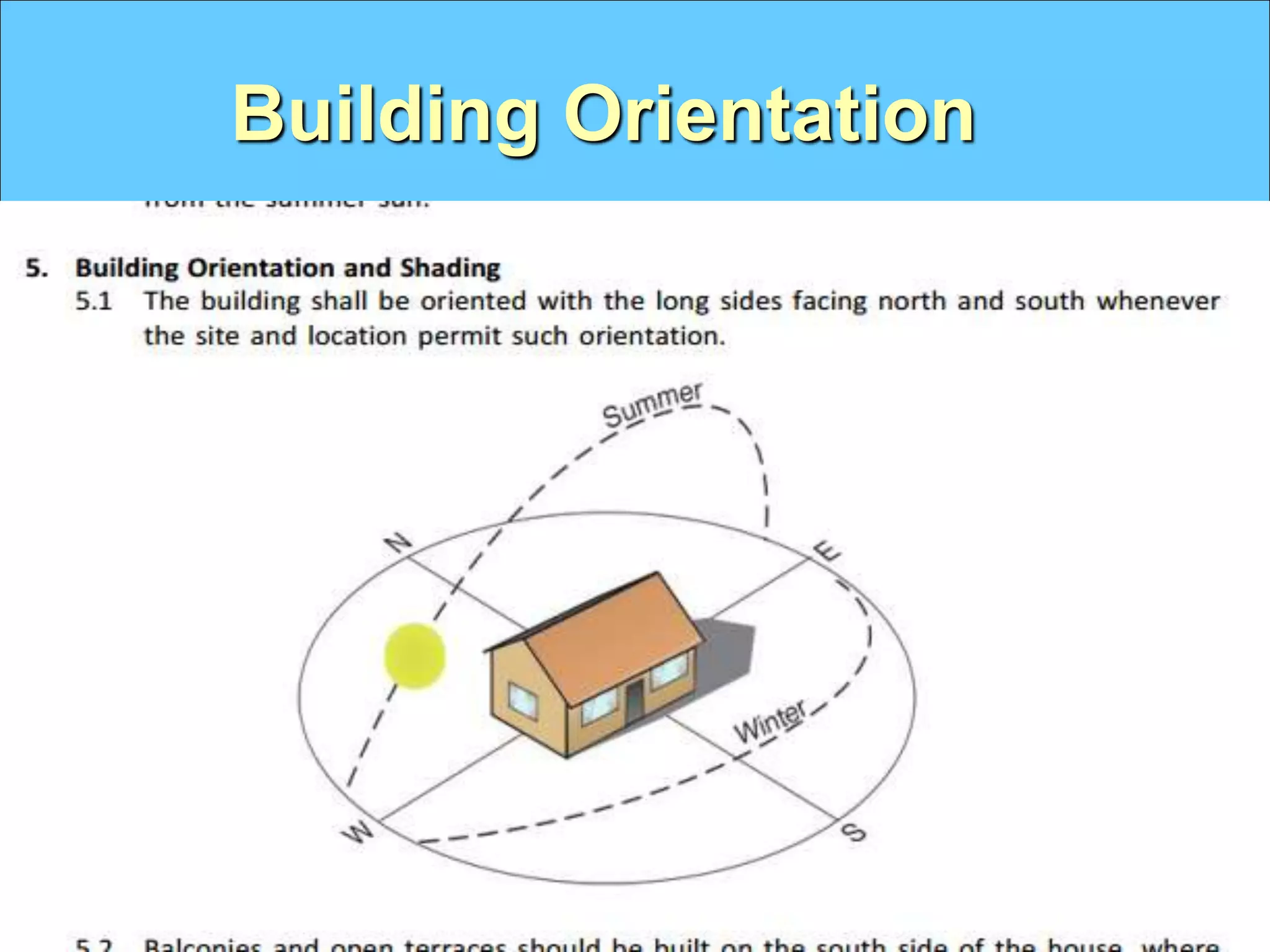
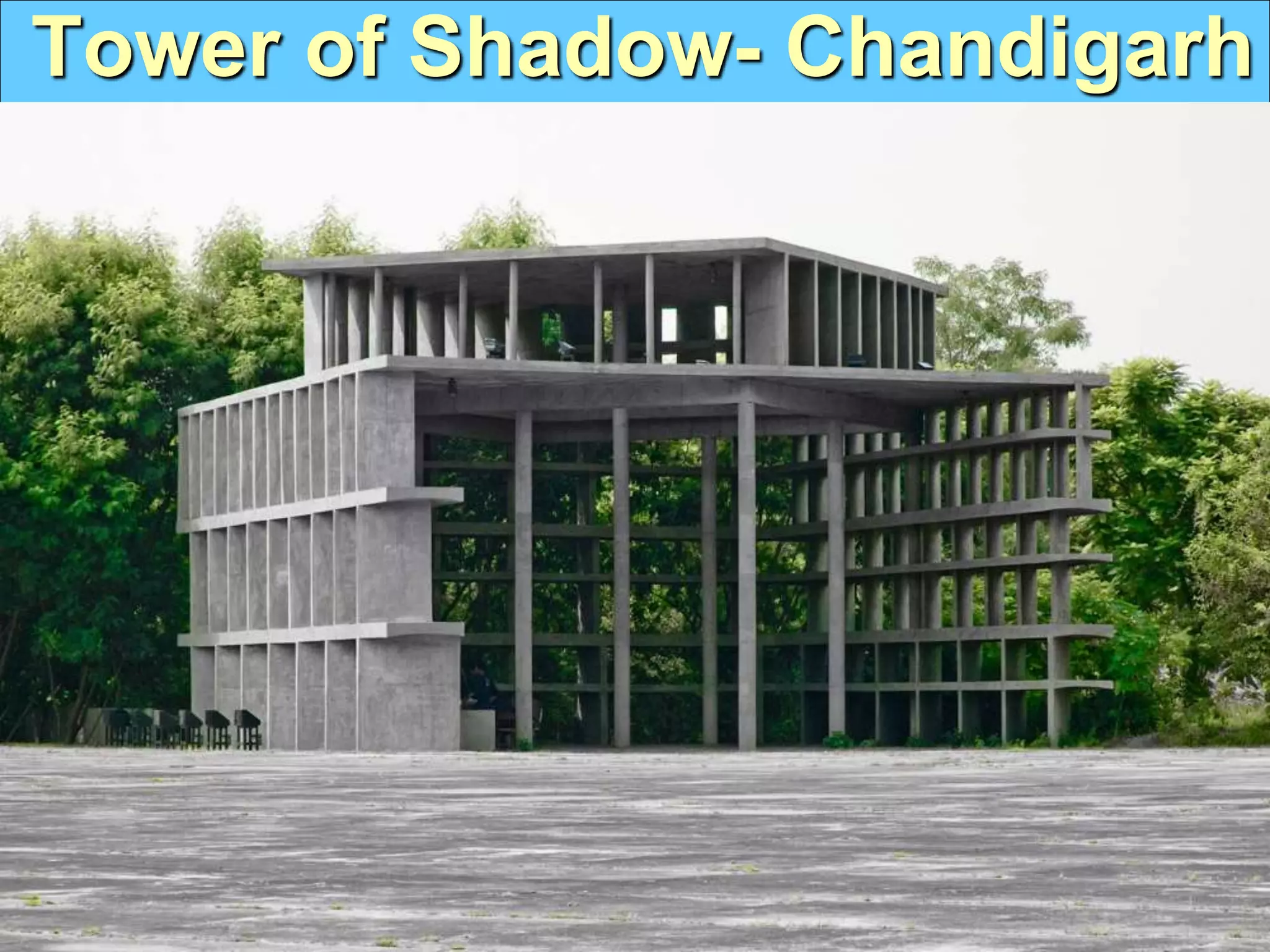
Orientation--
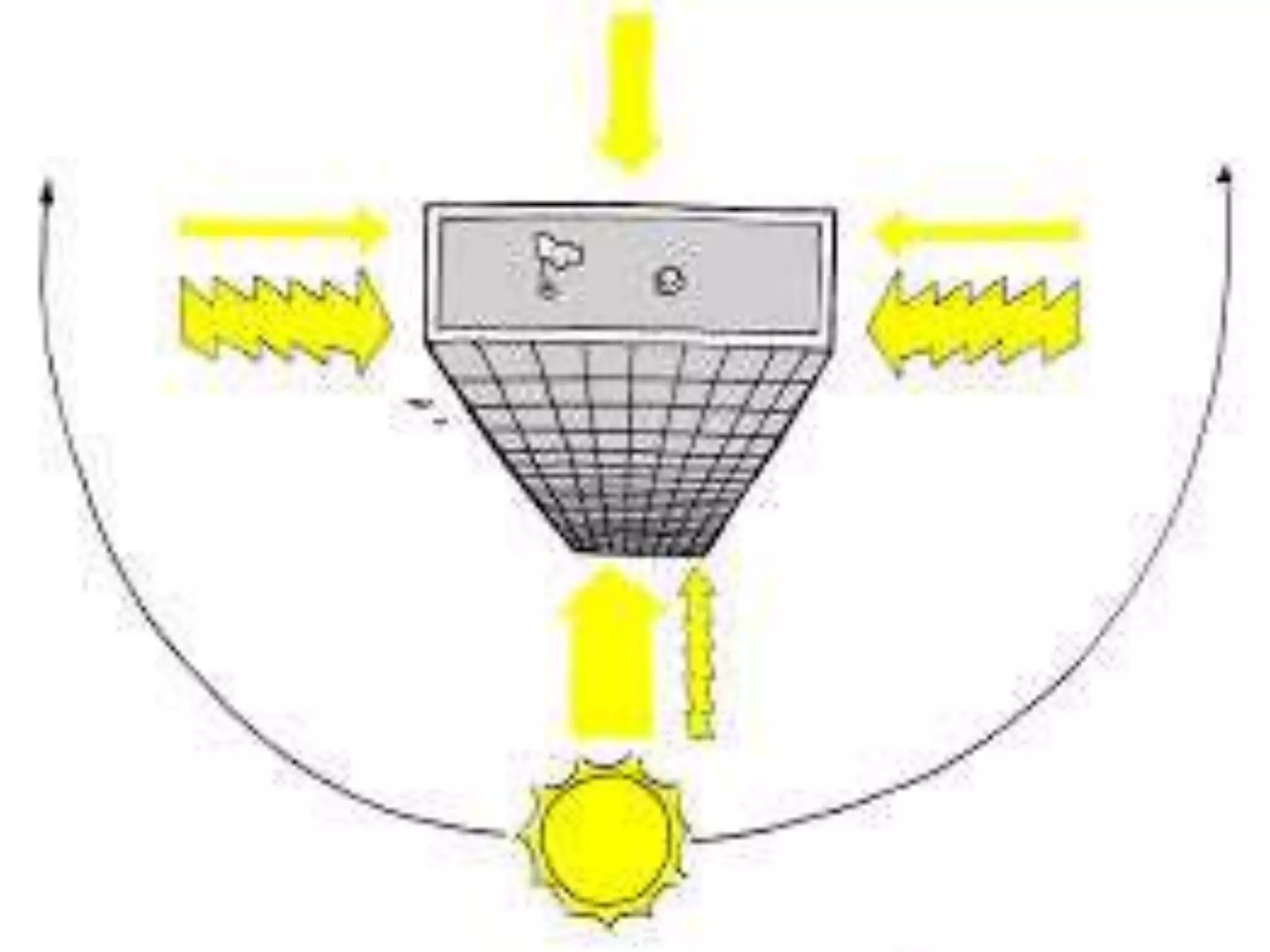
Movement of Sun
and planning of
building
Site Analysis- Orientation
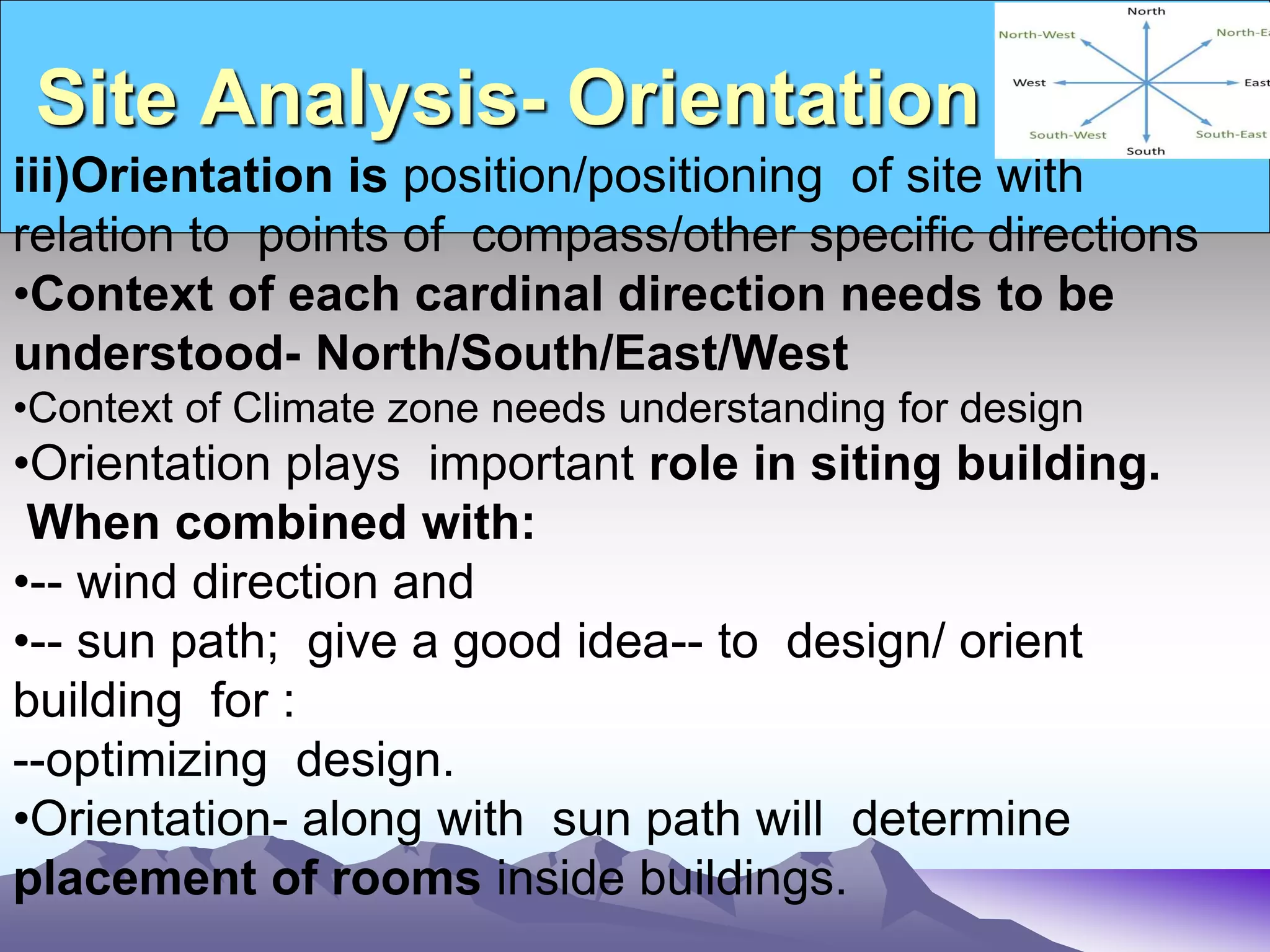
iii)Orientation is position/positioning of site with
relation to points of compass/other specific directions
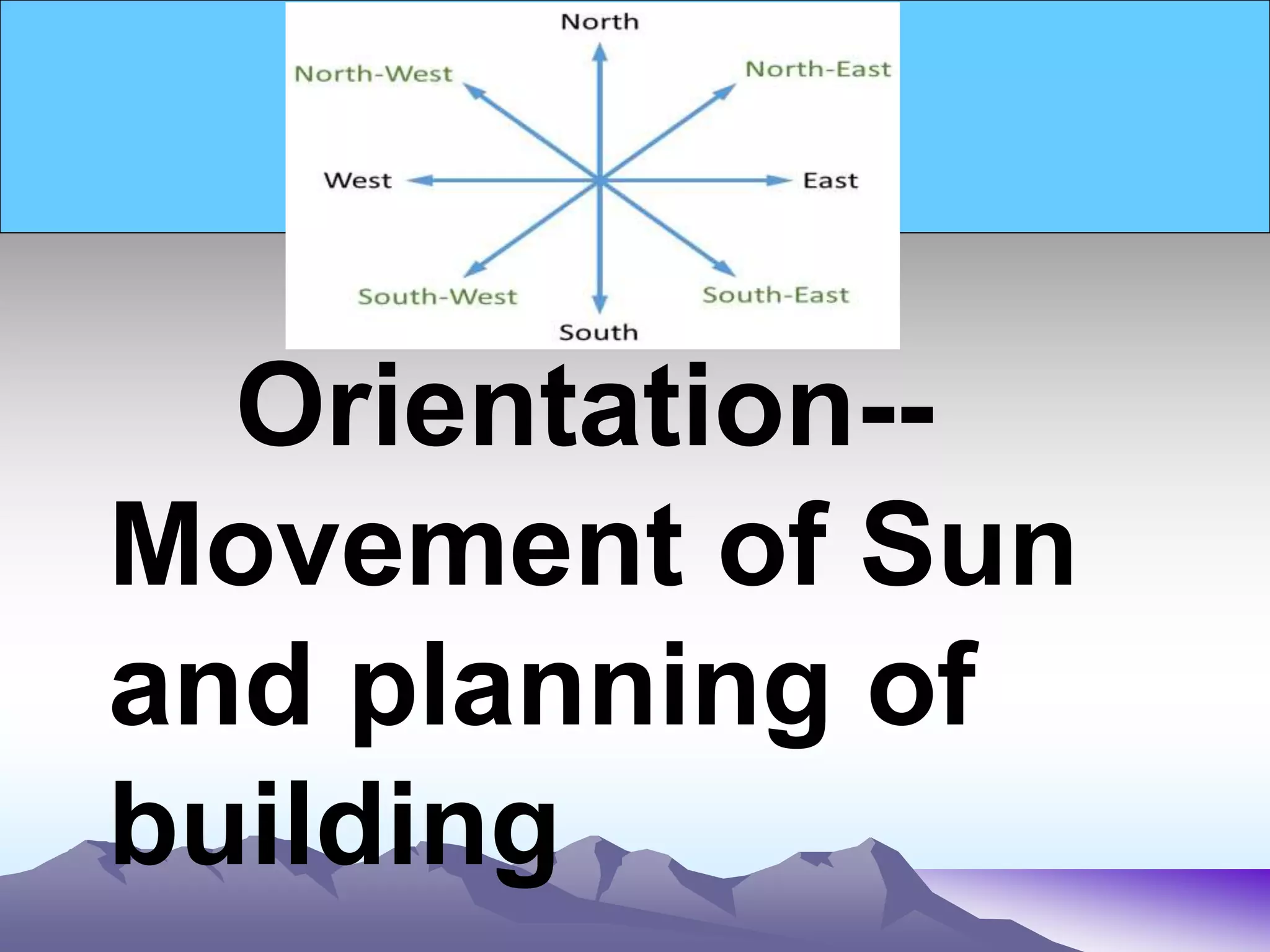
โ€ขContext of each cardinal direction needs to be
understood- North/South/East/West
โ€ขContext of Climate zone needs understanding for design
โ€ขOrientation plays important role in siting building.
When combined with:
โ€ข-- wind direction and
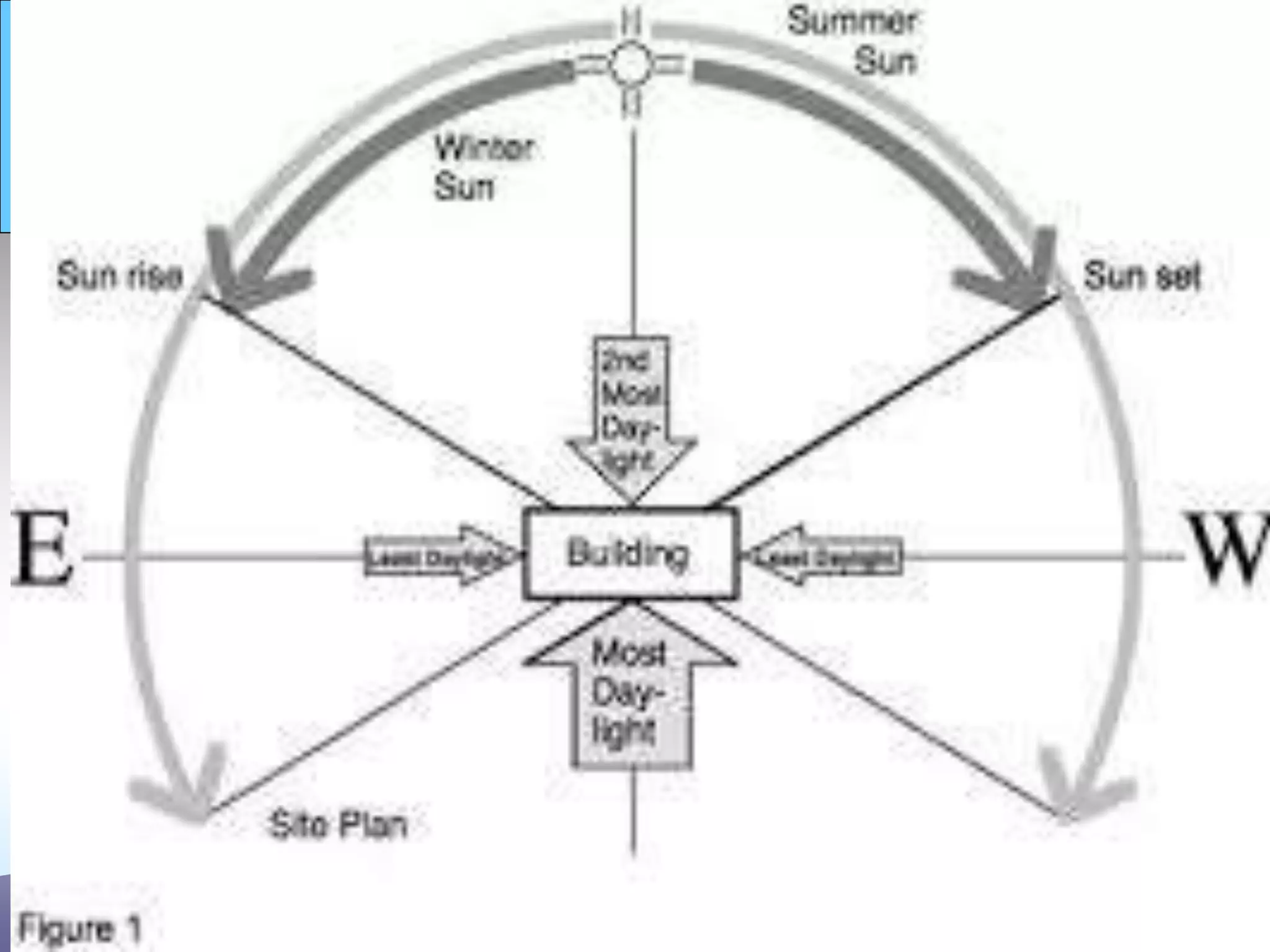
โ€ข-- sun path; give a good idea-- to design/ orient
building for :
--optimizing design.
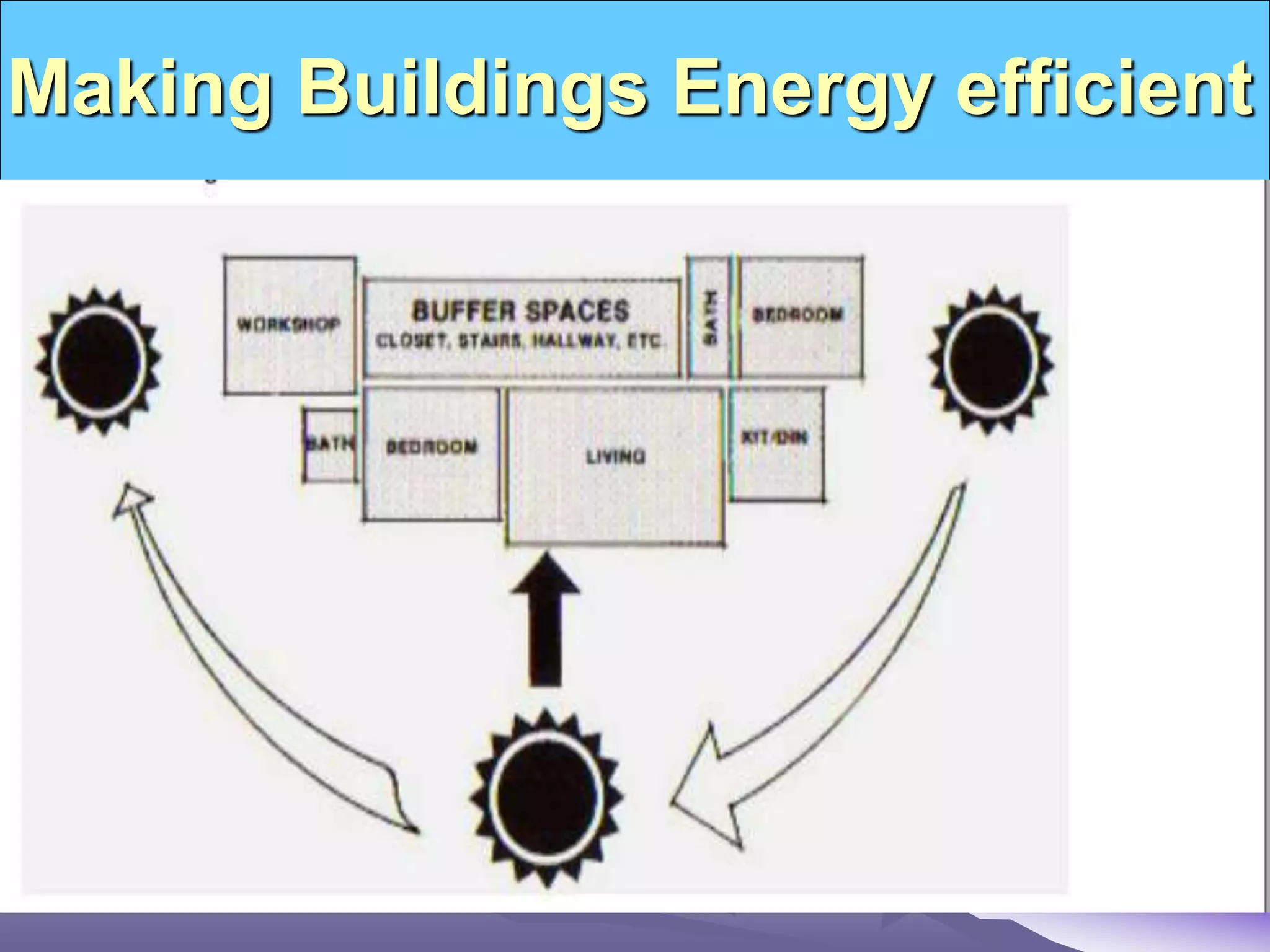
โ€ขOrientation- along with sun path will determine
placement of rooms inside buildings.
Site Analysis- Orientation
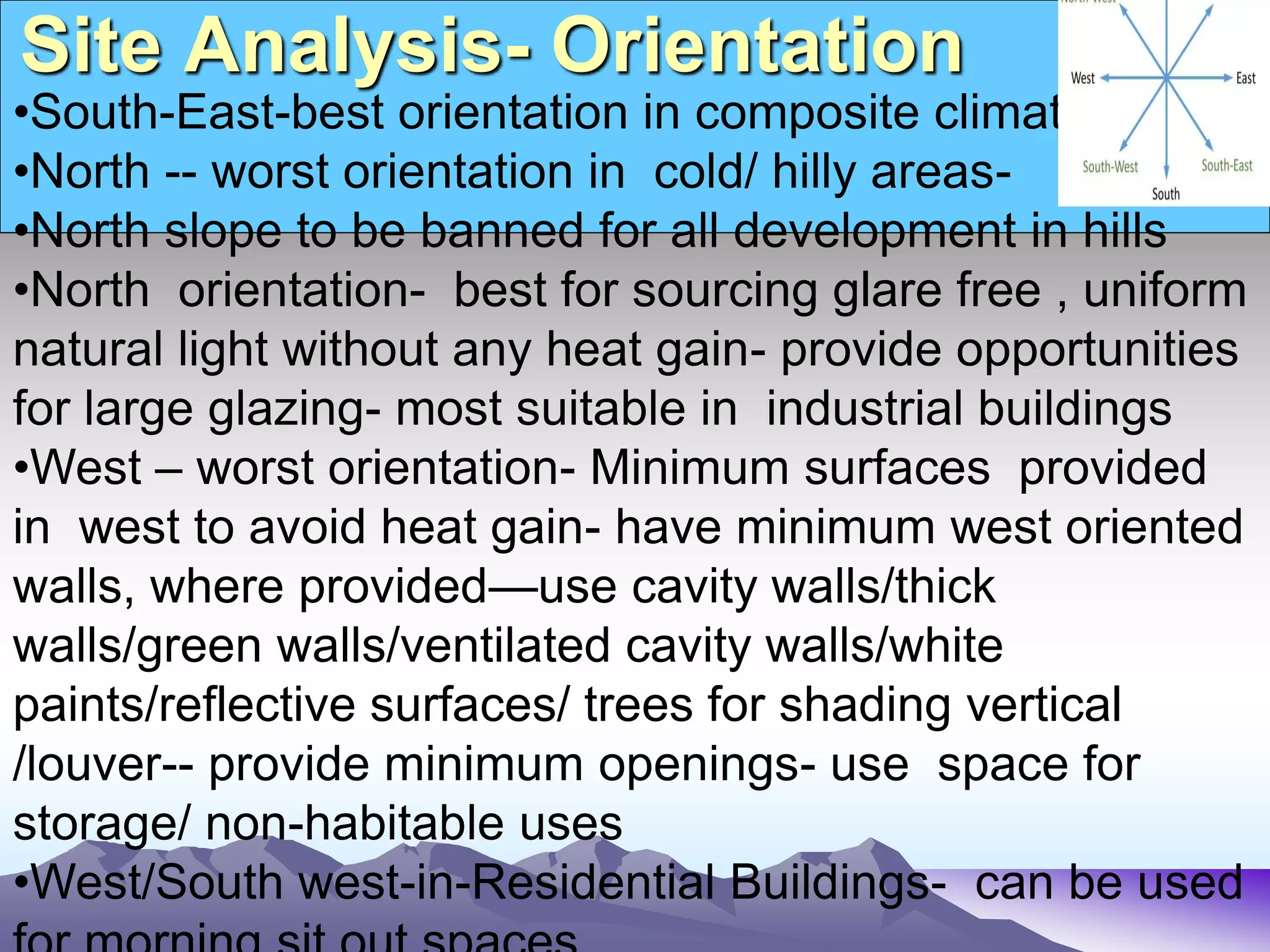
โ€ขSouth-East-best orientation in composite climate
โ€ขNorth -- worst orientation in cold/ hilly areas-
โ€ขNorth slope to be banned for all development in hills
โ€ขNorth orientation- best for sourcing glare free , uniform
natural light without any heat gain- provide opportunities
for large glazing- most suitable in industrial buildings
โ€ขWest โ€“ worst orientation- Minimum surfaces provided
in west to avoid heat gain- have minimum west oriented
walls, where providedโ€”use cavity walls/thick
walls/green walls/ventilated cavity walls/white
paints/reflective surfaces/ trees for shading vertical
/louver-- provide minimum openings- use space for
storage/ non-habitable uses
โ€ขWest/South west-in-Residential Buildings- can be used
Making Buildings Energy efficient
Building Orientation
Tower of Shadow- Chandigarh
Site Analysis- Wind Direction
.
iv) Wind Direction
---Most locations
-- have general major direction from which
wind comes. SE-NWs; NW-SEw
-- However, not always hold true
-- varies from location to location
-- season to season.
โ€ข For designing a
climatologically responsive building --
important to consider
-- direction of wind
-- channelized through interiors in summer
at night/stopped during day
Cold air avoided in winter
Courtyard planning best option/smaller
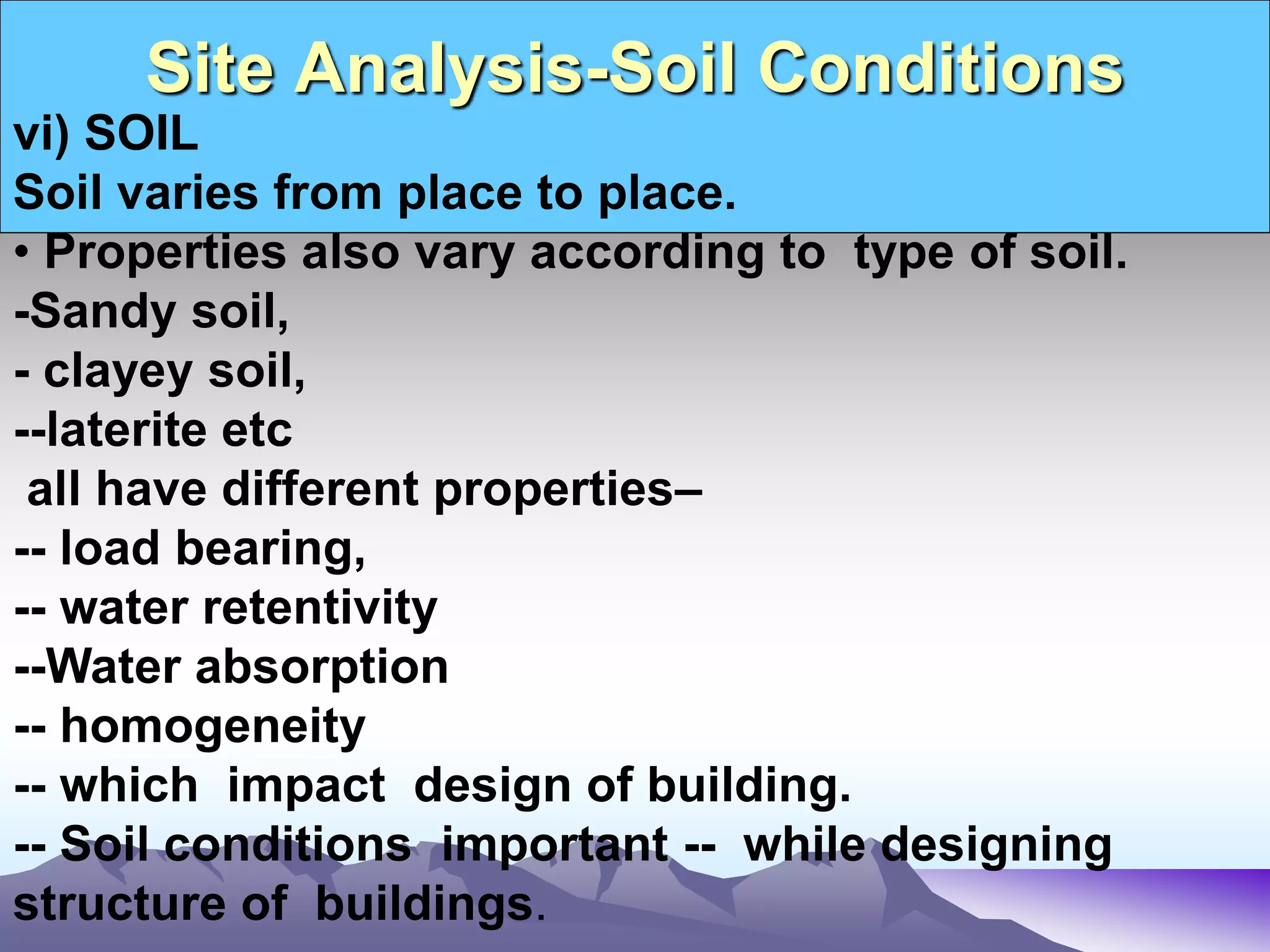
Site Analysis-Soil Conditions
vi) SOIL
Soil varies from place to place.
โ€ข Properties also vary according to type of soil.
-Sandy soil,
- clayey soil,
--laterite etc
all have different propertiesโ€“
-- load bearing,
-- water retentivity
--Water absorption
-- homogeneity
-- which impact design of building.
-- Soil conditions important -- while designing
structure of buildings.
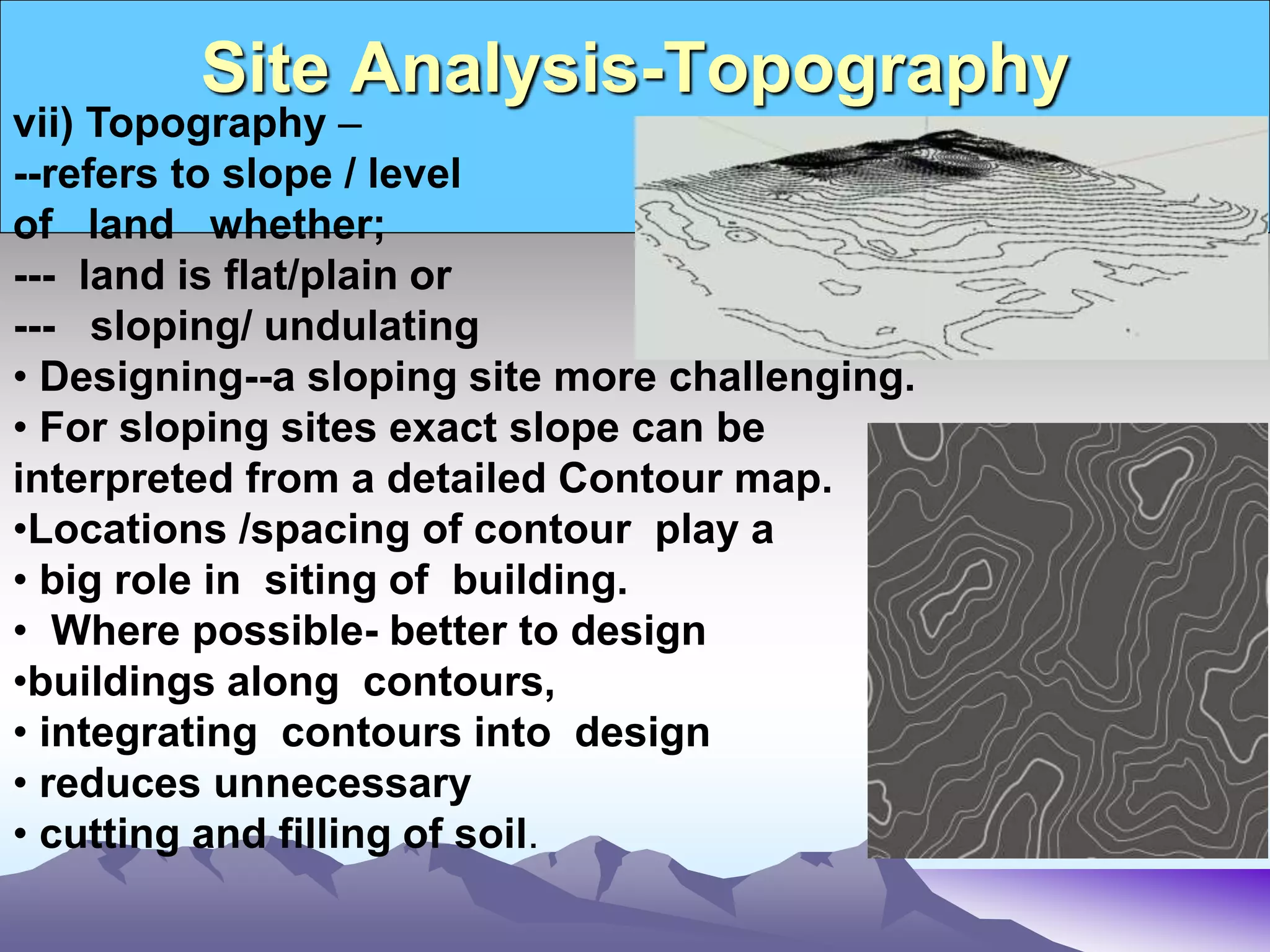
Site Analysis-Topography
vii) Topography โ€“
--refers to slope / level
of land whether;
--- land is flat/plain or
--- sloping/ undulating
โ€ข Designing--a sloping site more challenging.
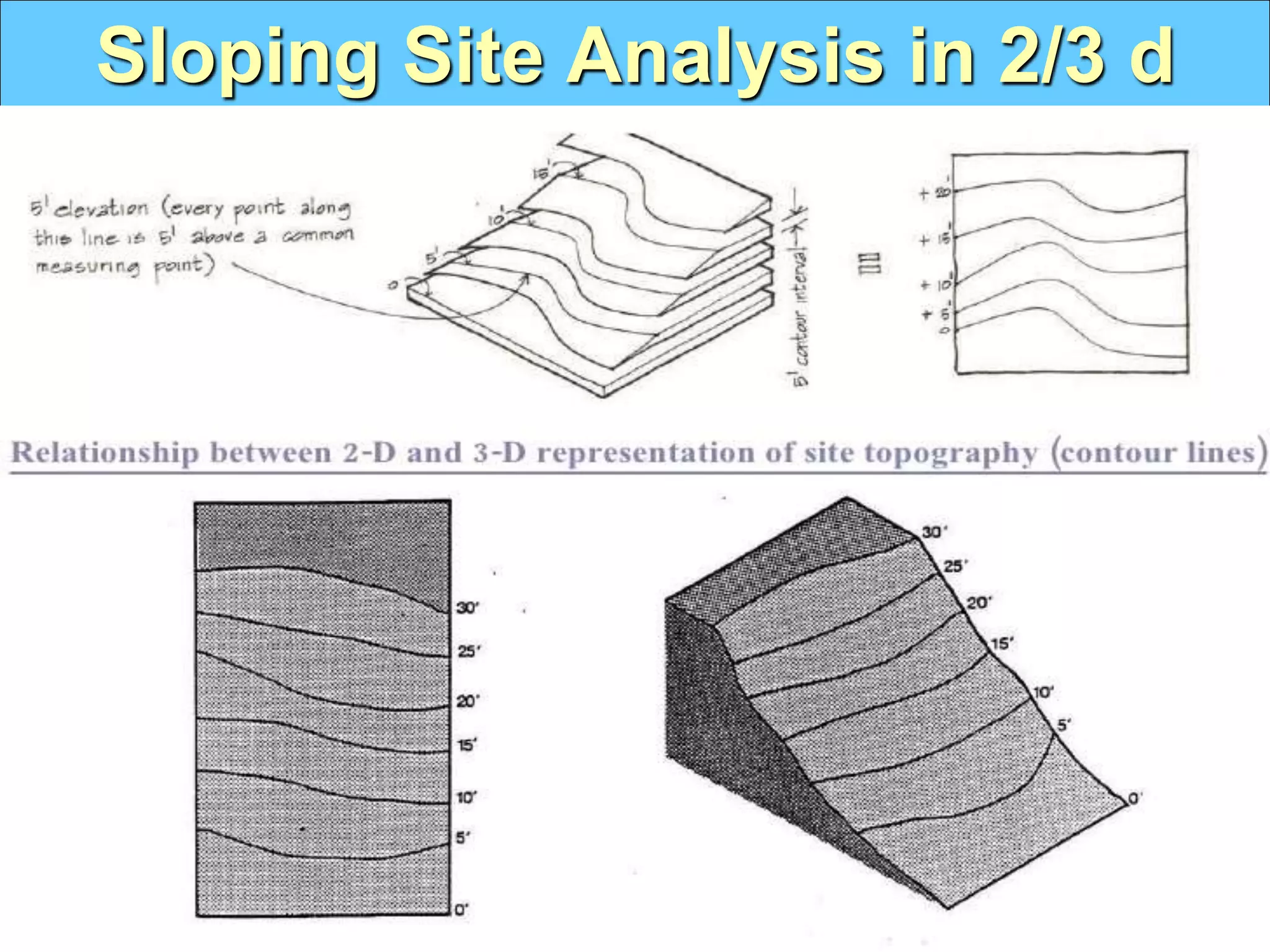
โ€ข For sloping sites exact slope can be
interpreted from a detailed Contour map.
โ€ขLocations /spacing of contour play a
โ€ข big role in siting of building.
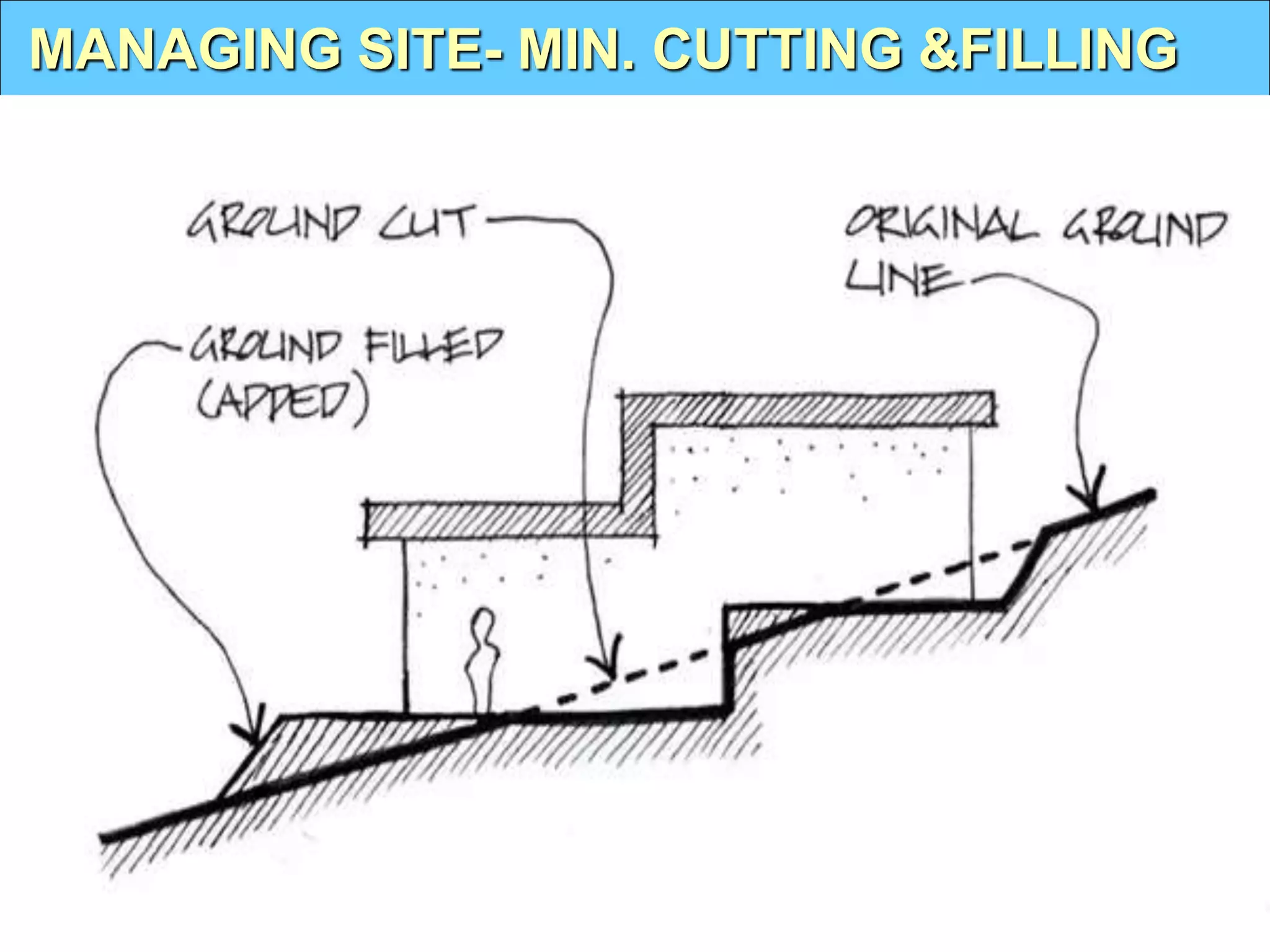
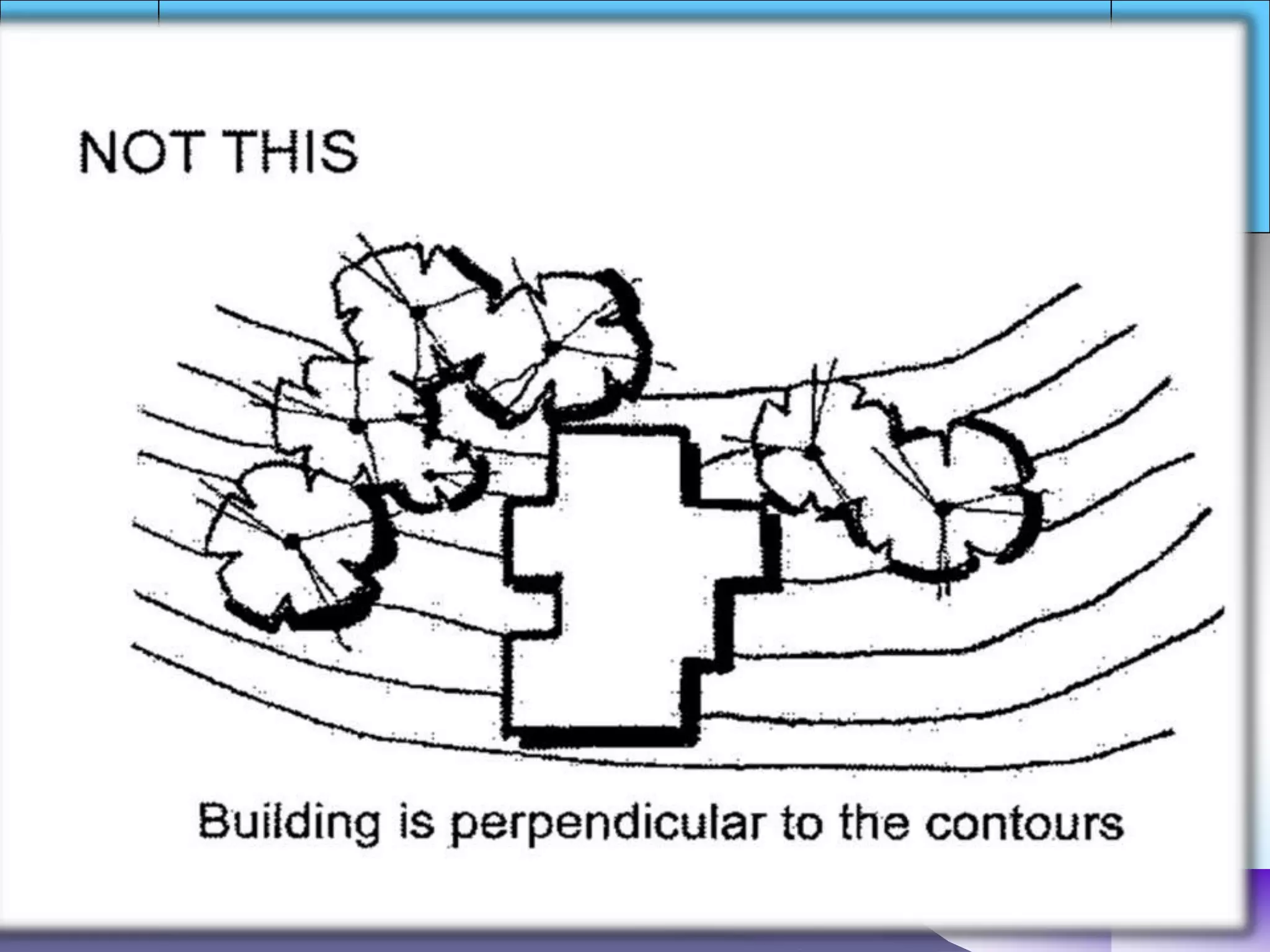
โ€ข Where possible- better to design
โ€ขbuildings along contours,
โ€ข integrating contours into design
โ€ข reduces unnecessary
โ€ข cutting and filling of soil.
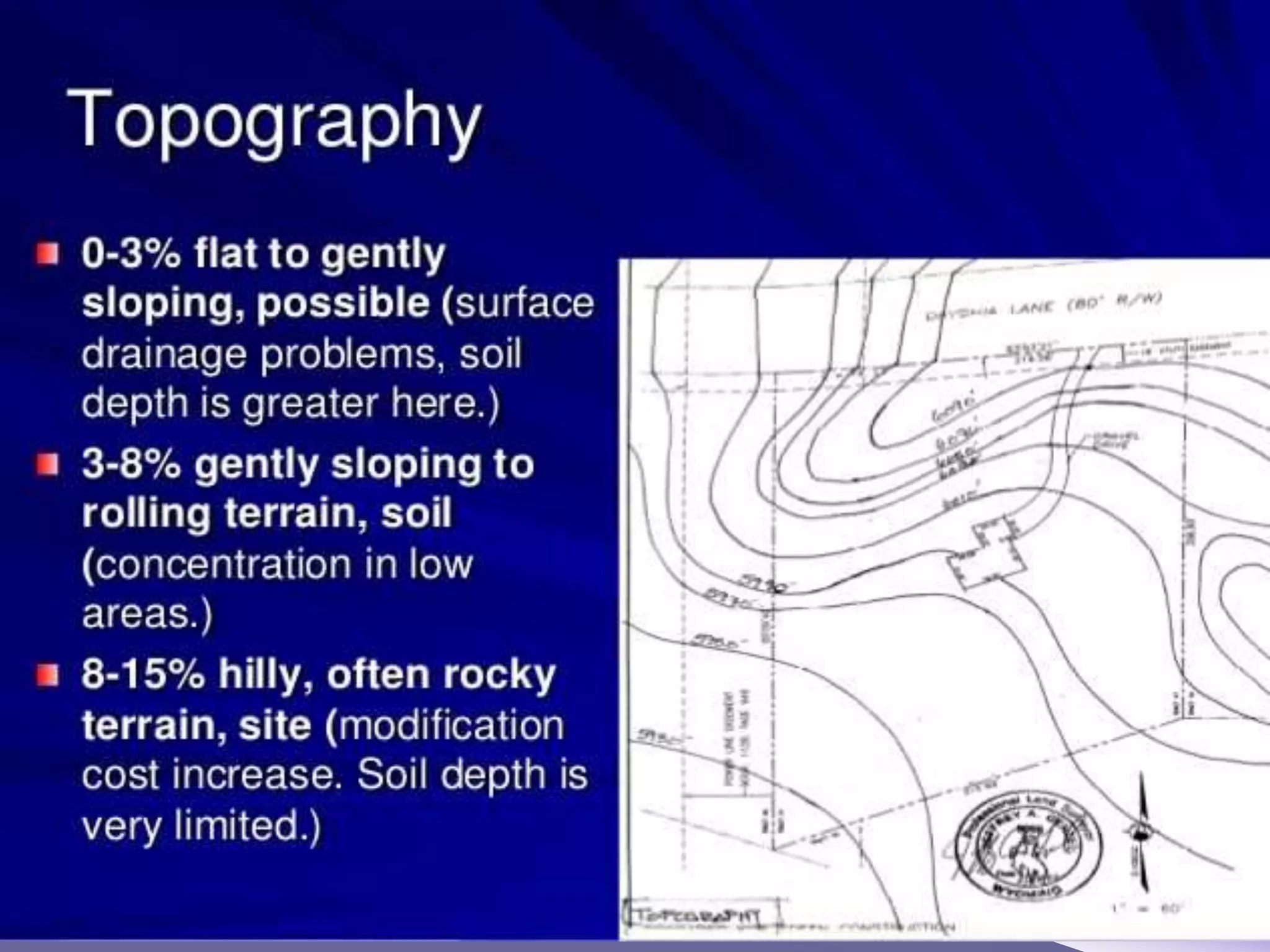
Site Analysis-Topography
Site Analysis-Vegetation/Natural
Features
Viii) Vegetation and Natural Features
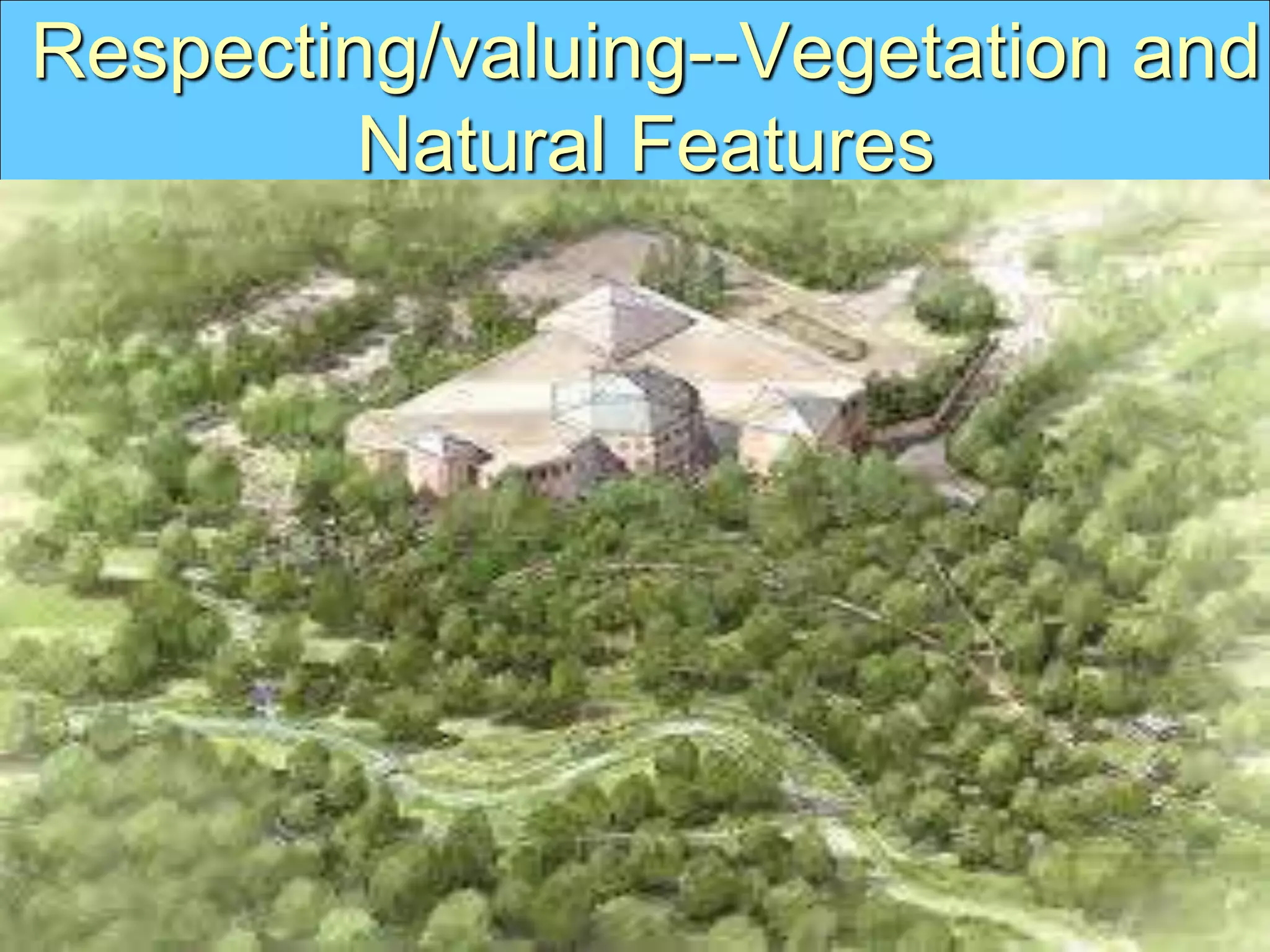
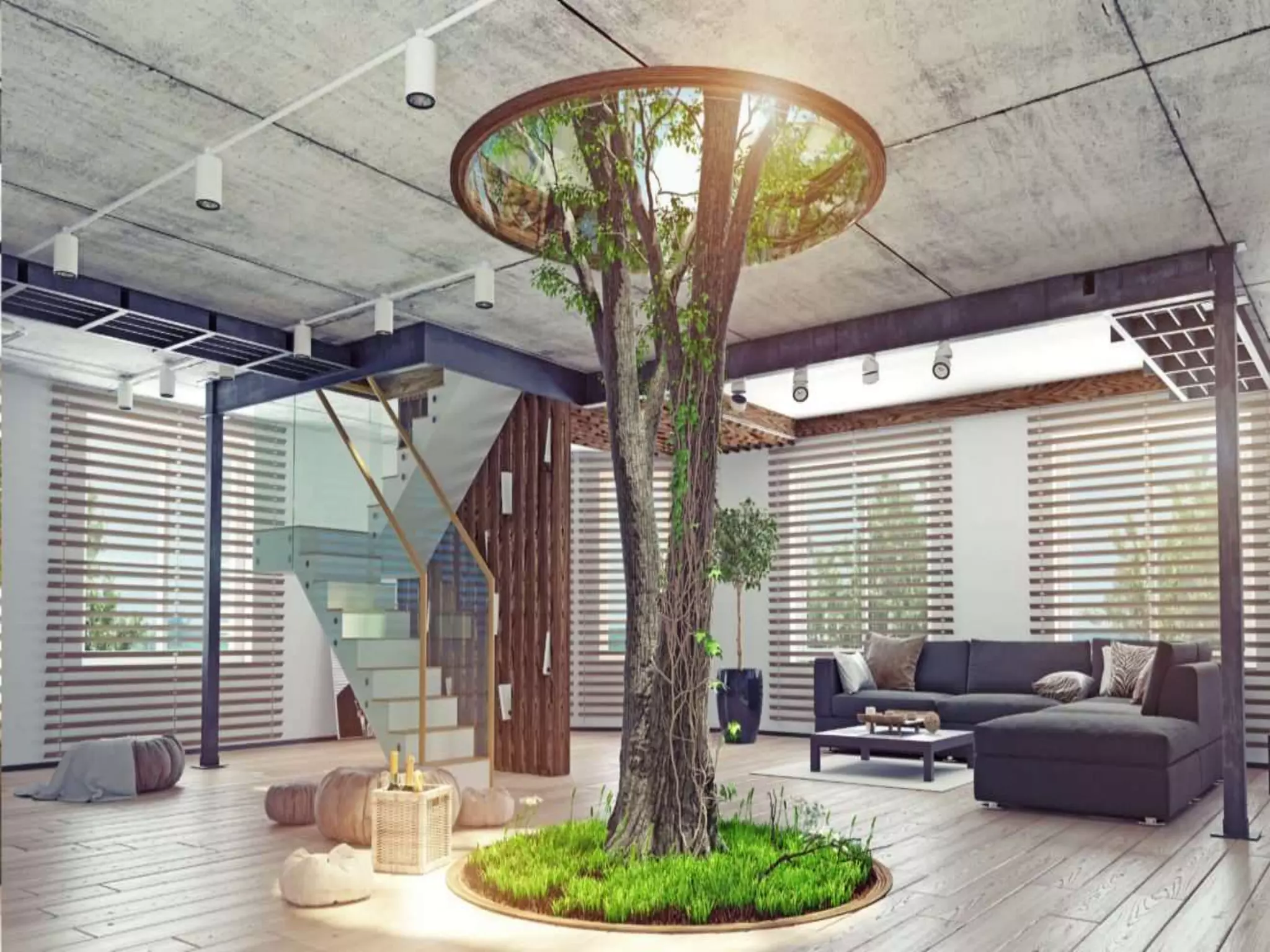
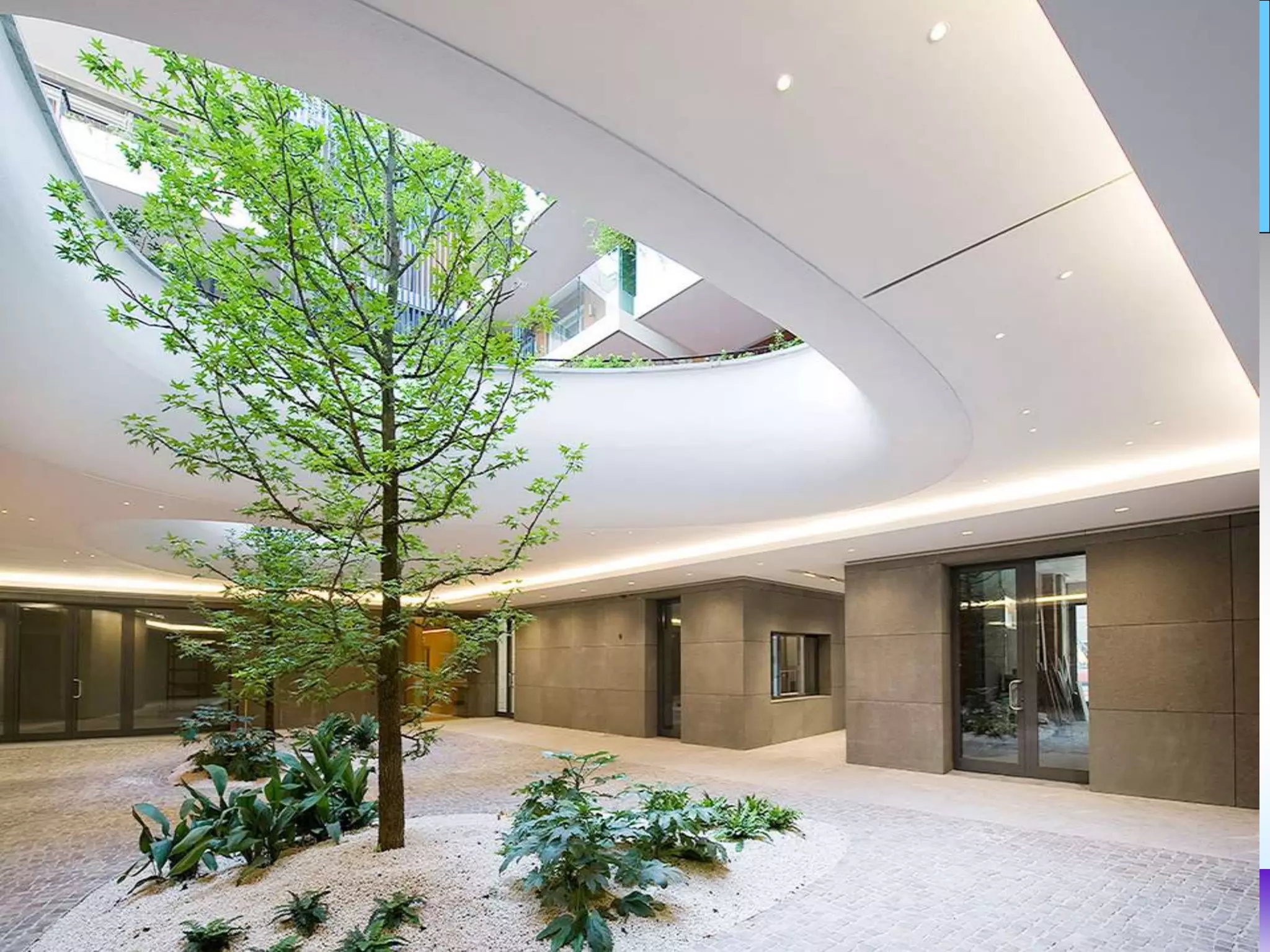
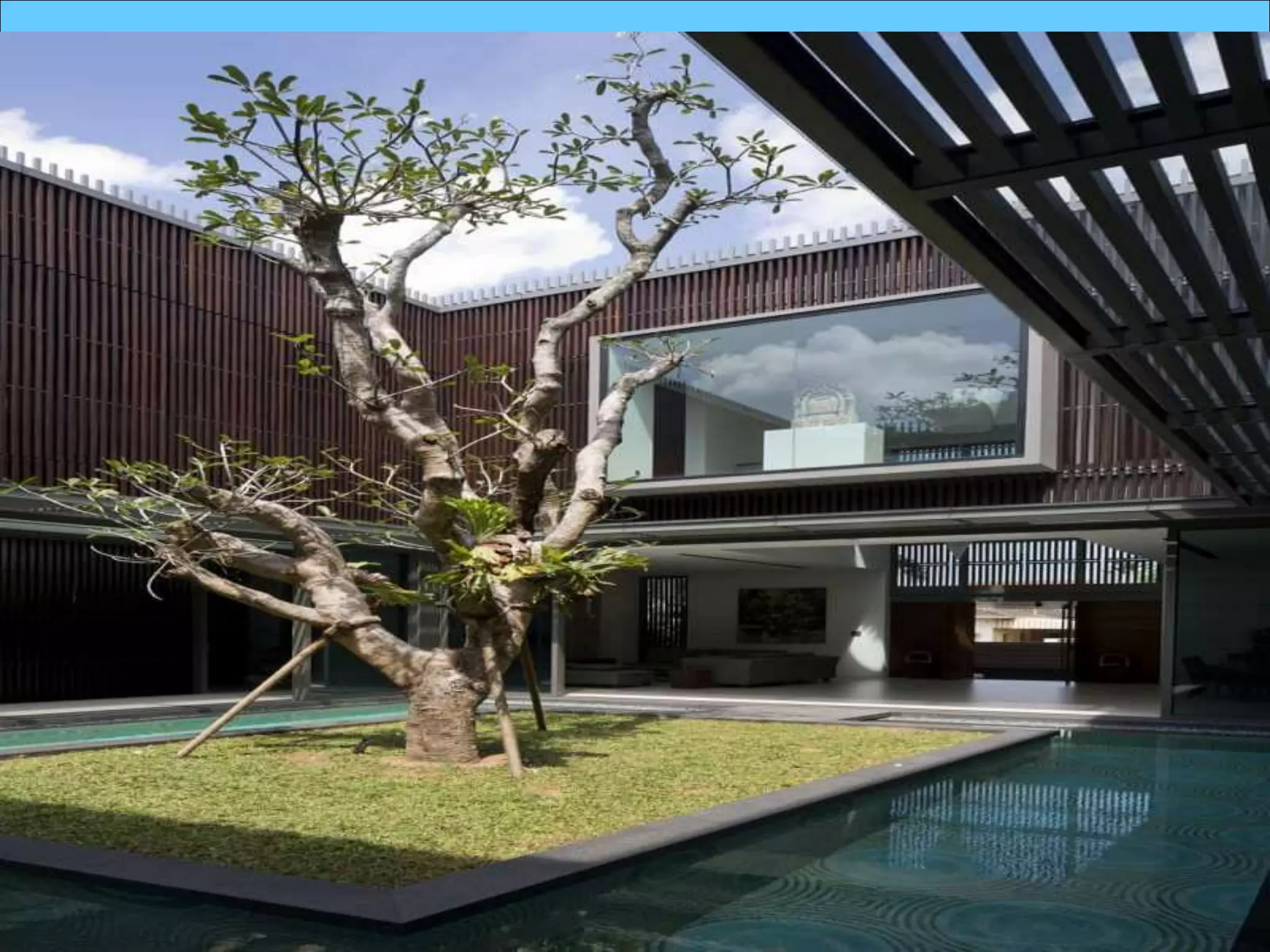
โ€ขNatural vegetation present on site -- important.
โ€ข Every good design will
-- integrate
---highlight &
---accentuate
Natural vegetation to create perfect harmony between building and
nature
โ€ขVegetation comprises of-- trees, flora & fauna existing on site.
โ€ขMark them on site plan & integrate with design by defining their;
--location,
--Age
-Growth
-- type ,
-- size ,
--diameter or
- spread of branches
- -- heights etc
Respecting/valuing--Vegetation and
Natural Features
Site Analysis-Precipitation &
Hydrology
ix) Hydrology & Precipitation:
โ€ข Recording--Amount of rainfall
โ€ข --Time period during which rainfall occurs/ site receives
โ€ขRelative Humidity also found out to
โ€ข --determine moisture content in atmosphere.
โ€ข Higher relative humidity suggests a humid climate,
โ€ข-- cross circulation of wind at body level--must for comfort.
โ€ข- A lower relative humidity suggests a dry climate
โ€ขNeeds increase in moisture- courtyards- with trees/water
โ€ขWhere lot of precipitation โ€“ provide sloping roofs- protecting
walls
Avoiding low- lying area for locating buildings
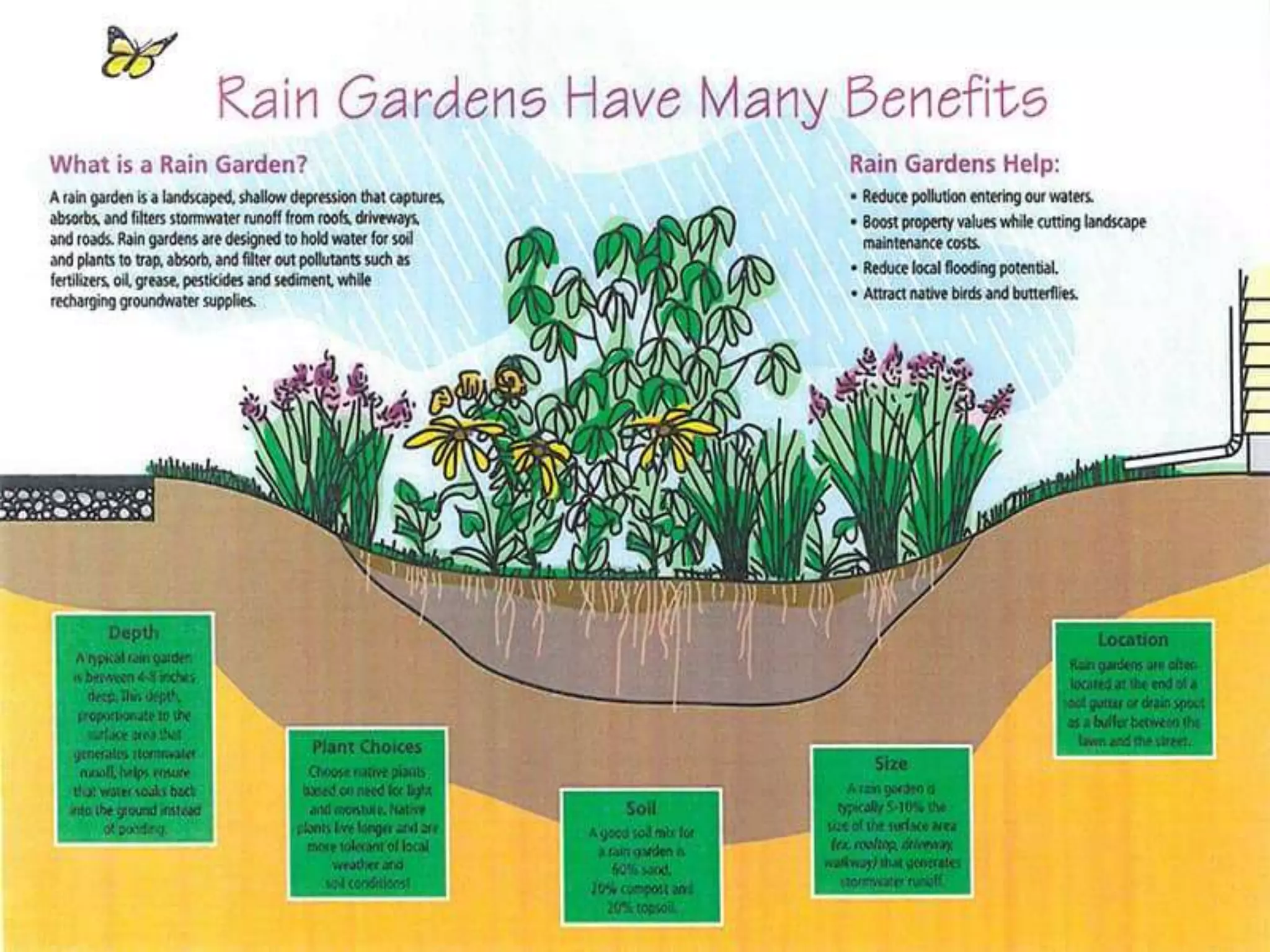
โ€ขUsing low area for creating Rain gardens/rain water
harvesting
Site Analysis- Infrastructure
Facilities
x) Infrastructure
โ€ขInfrastructure facilities refer to services present in
vicinity of Site.
โ€ข Major facilities to be considered are :
-- water supply,
-- Storm water drainage ,
-- Waste disposal,
-- Electricity supply
- Roads
-Communication network etc.
โ€ข Important while planning / zoning site for :
--promoting economy and
--making optimum use of services
Site Analysis-Land Use/Visual
linkages
xi)Surrounding land uses & buildings โ€“
. For optimum design solution โ€”
--need close focus and consideration of surrounding land uses /
buildings
-- Incompatible land uses may lead to creation of issues in
design
Avoid โ€“ slums/polluting industries/waste dumping yards
โ€ขHeight /setbacks of adjoining buildings important for ensuring
โ€ข--flow of air and --- sunlight.
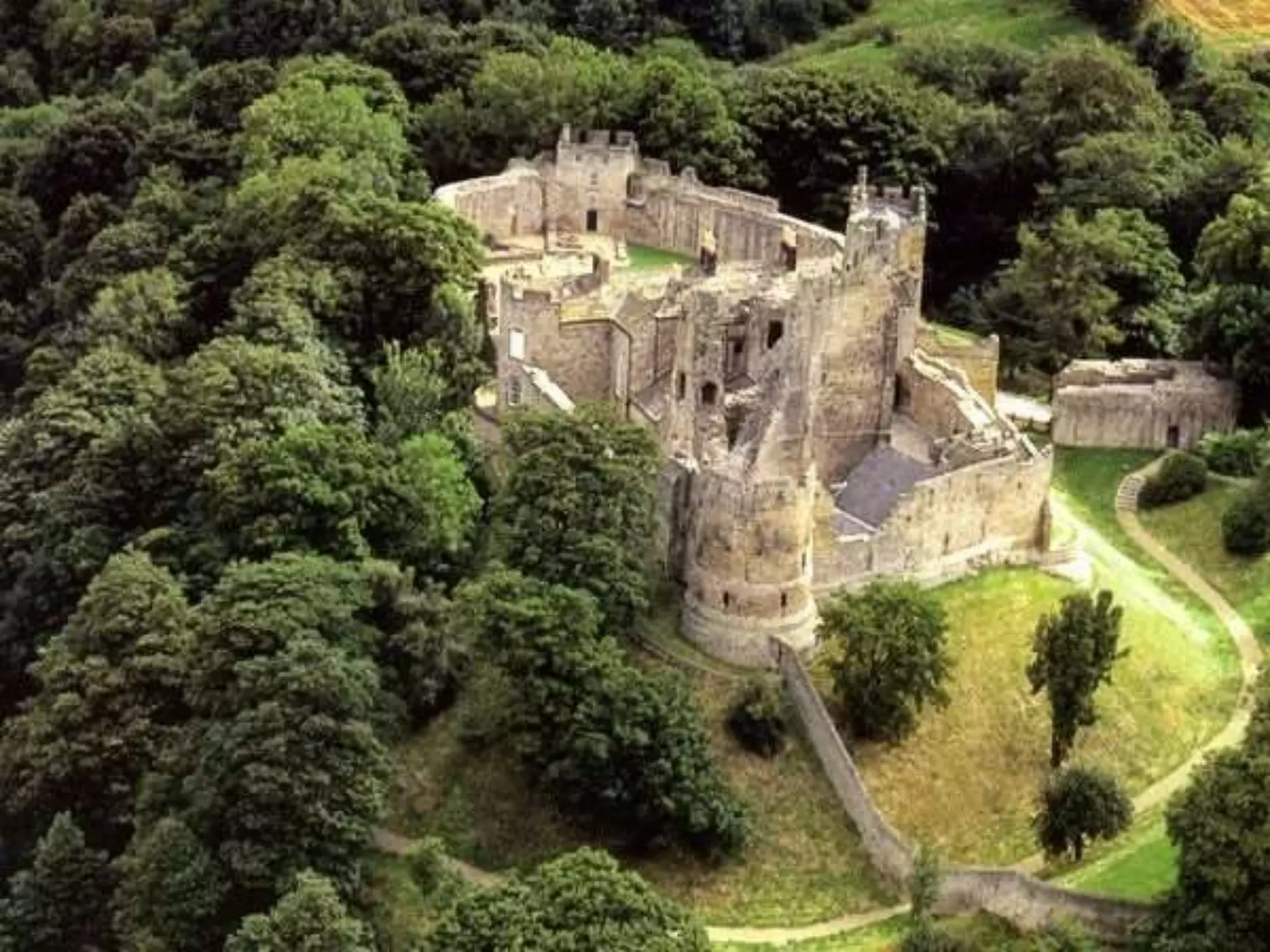
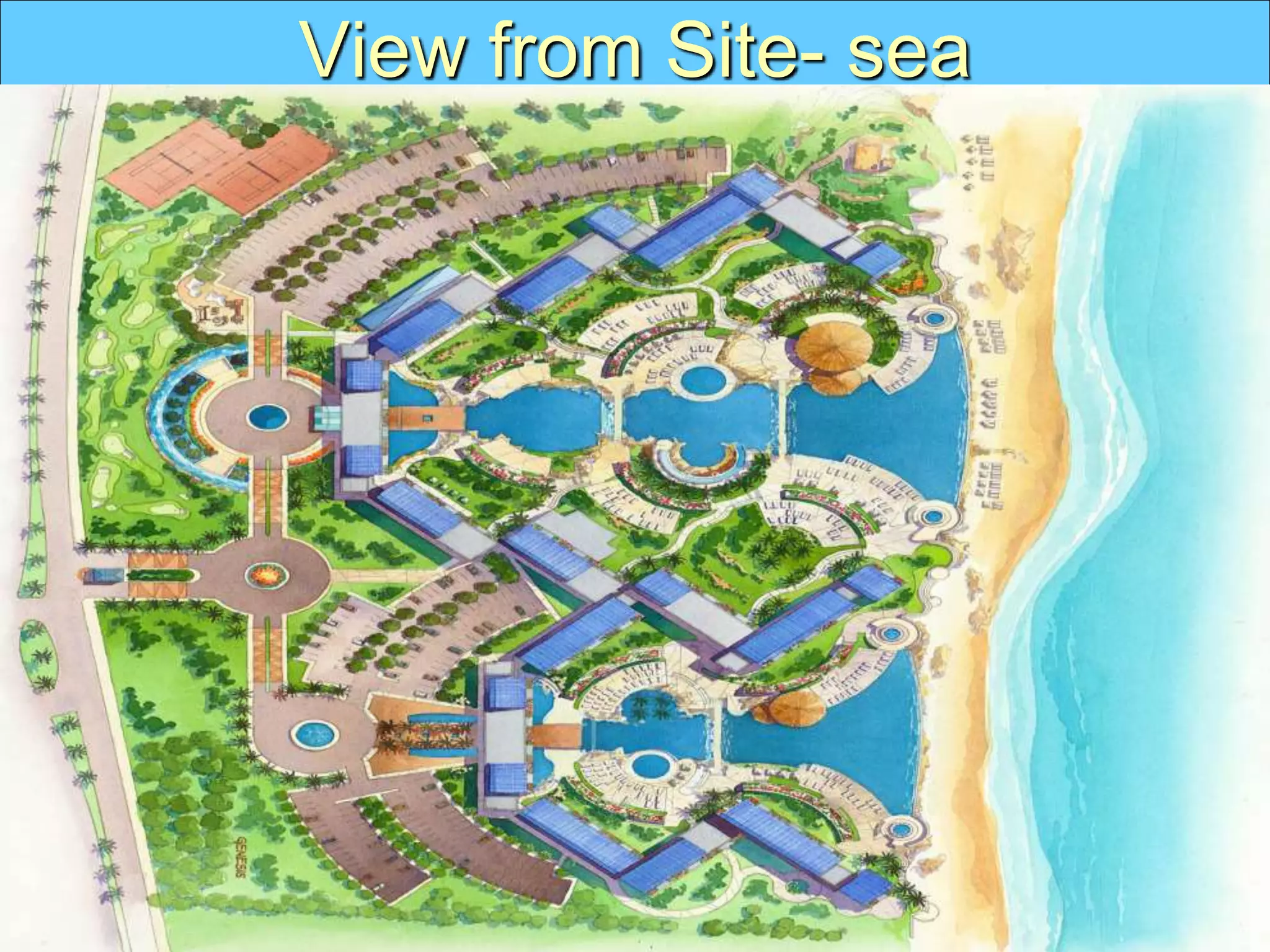
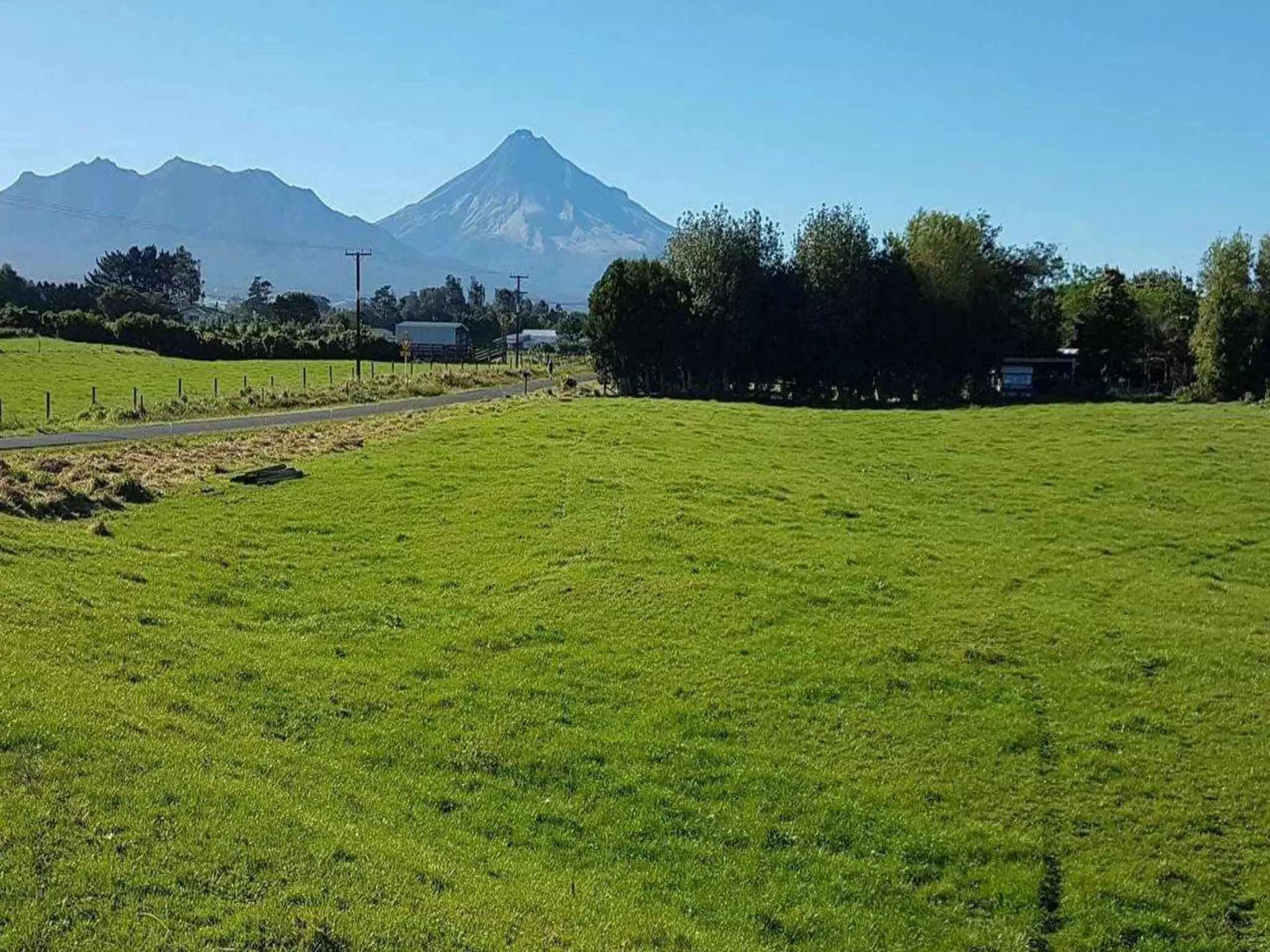
xii) Prominent Vision lines / Visual linkages โ€“
โ€ขImportant element in design process.
โ€ข Views to site as well
โ€ข-- views from the site
โ€ข-- need careful consideration, while designing.
View from Site- sea
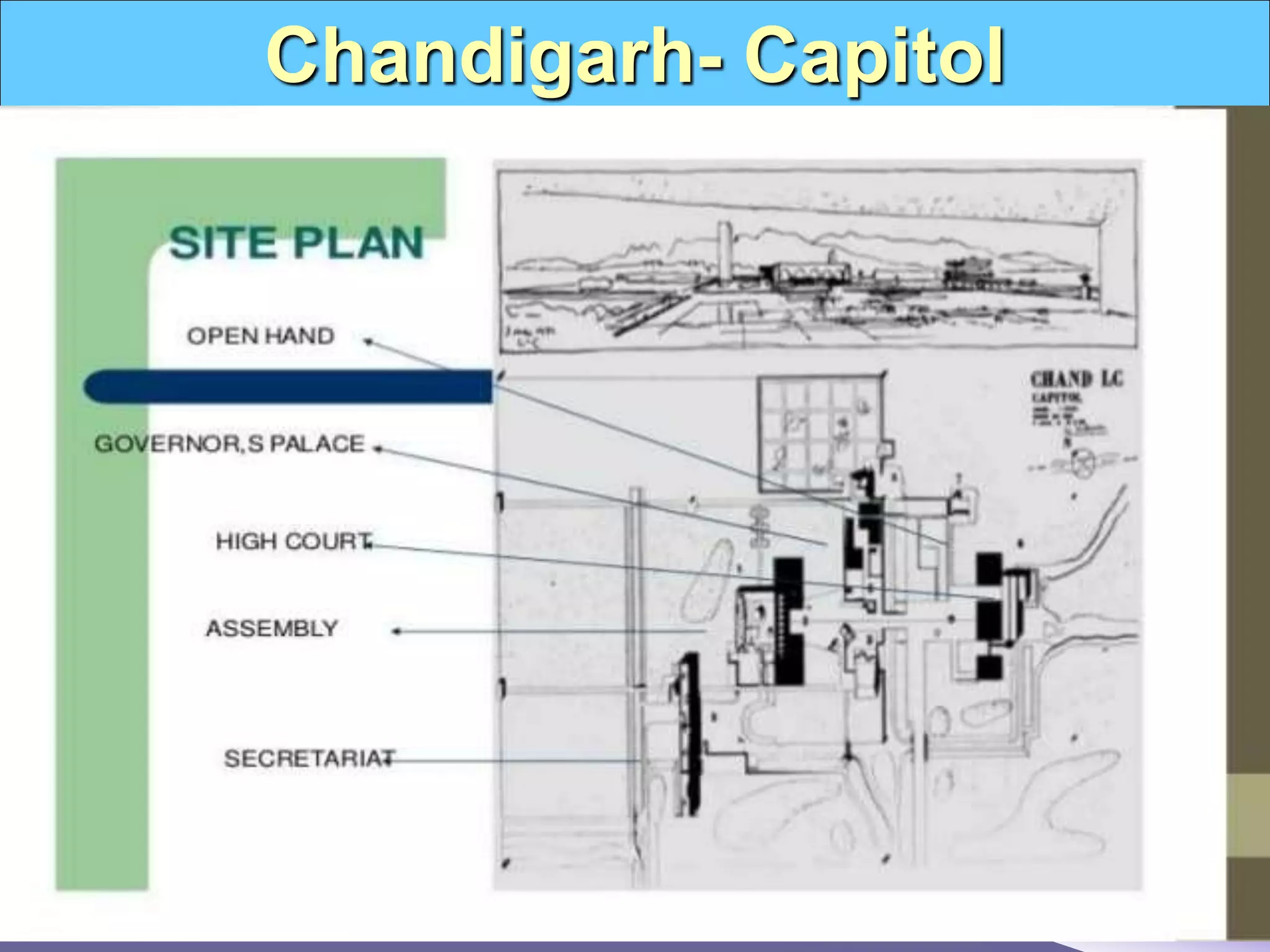
Chandigarh- Capitol
Site
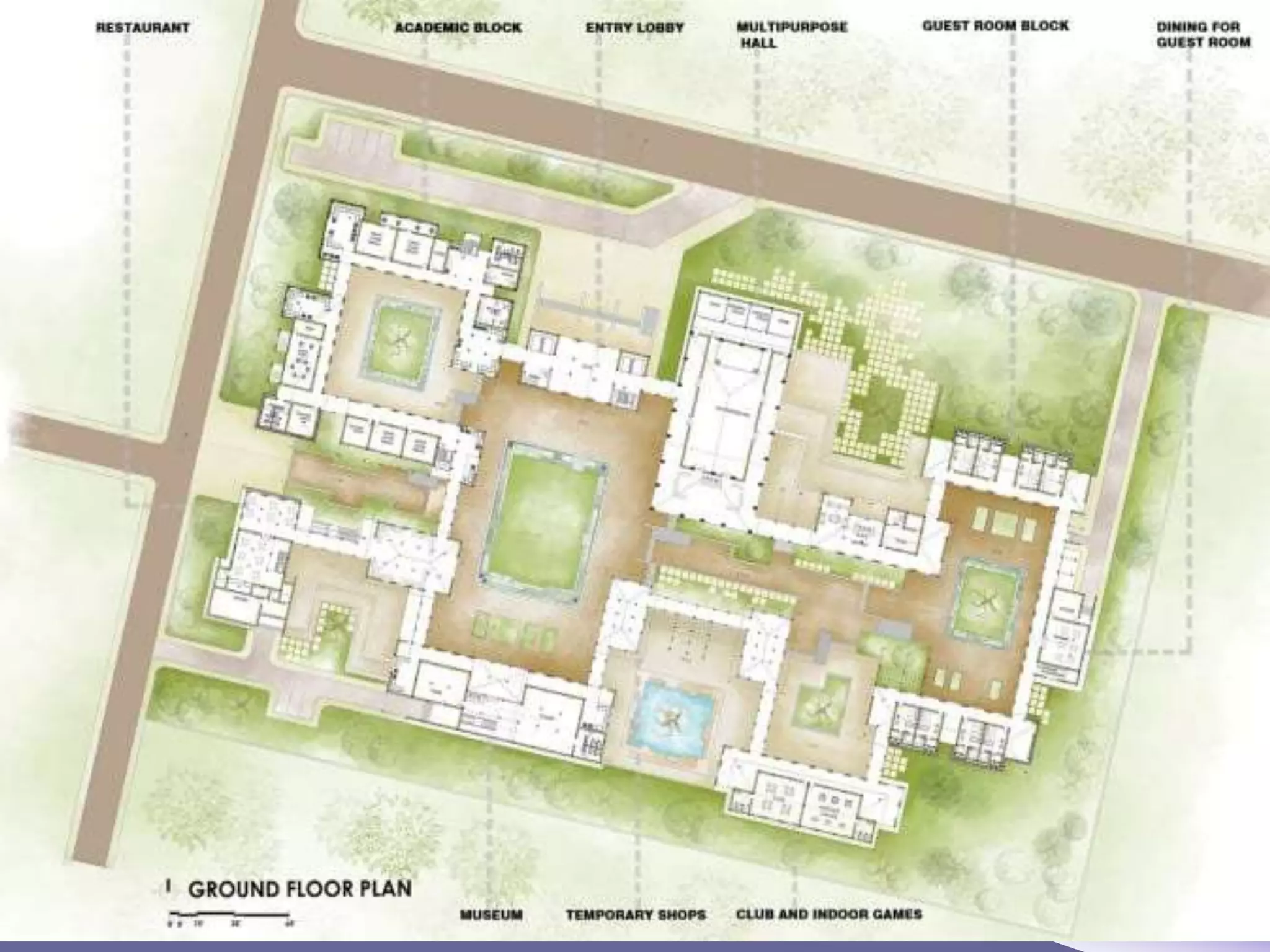
Planning
Definitions-Site Planning
Site planning ;
i Art &science of positioning structures and designing internal
and external spaces in a given site.
โ€ข ii Art & science of determining typology of buildings
and their location in the context of a given site-- having
regard to orientation , landscaping, infrastructure, mobility,
parking , privacy, view etc
โ€ข iii Art of arranging structures on the land and shaping spaces
between
โ€ข iv An art linked to architecture, engineering, landscaping
and city planning- Kelvin Lynch- site planning 1984
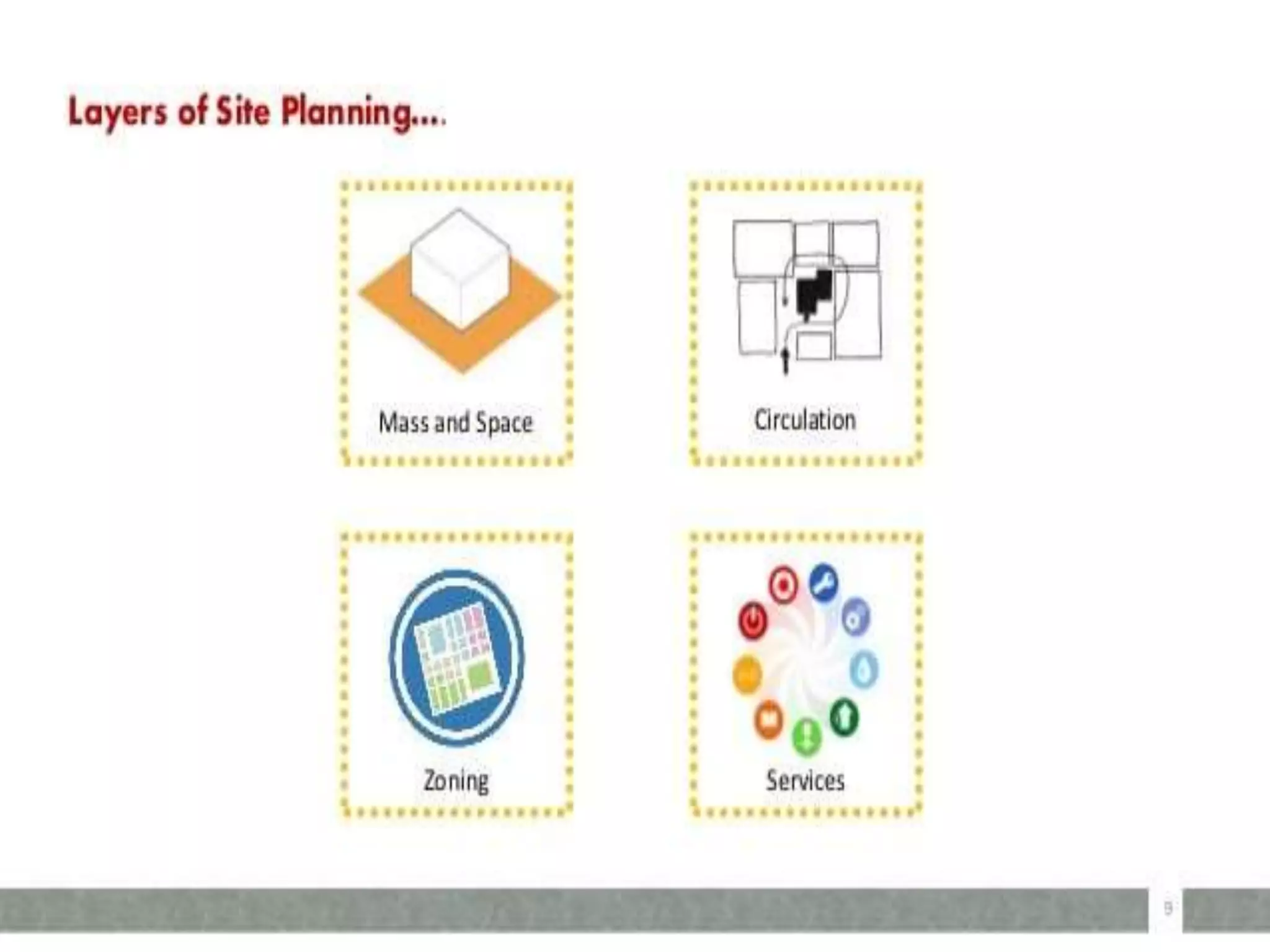
โ€ข v. Relation between Mass, space, zoning , services &
maintenance
โ€ข
Site Planning-definitions
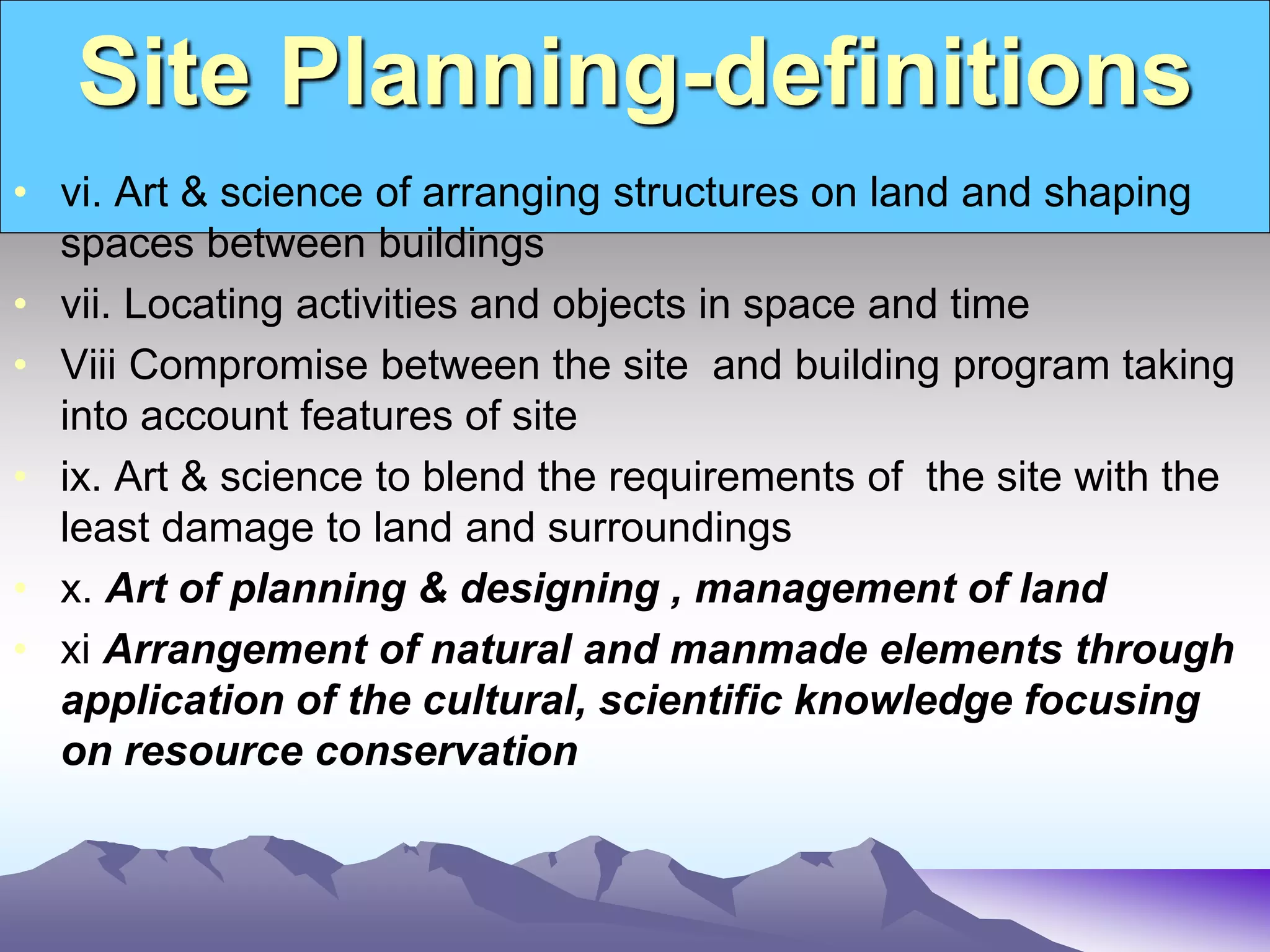
โ€ข vi. Art & science of arranging structures on land and shaping
spaces between buildings
โ€ข vii. Locating activities and objects in space and time
โ€ข Viii Compromise between the site and building program taking
into account features of site
โ€ข ix. Art & science to blend the requirements of the site with the
least damage to land and surroundings
โ€ข x. Art of planning & designing , management of land
โ€ข xi Arrangement of natural and manmade elements through
application of the cultural, scientific knowledge focusing
on resource conservation
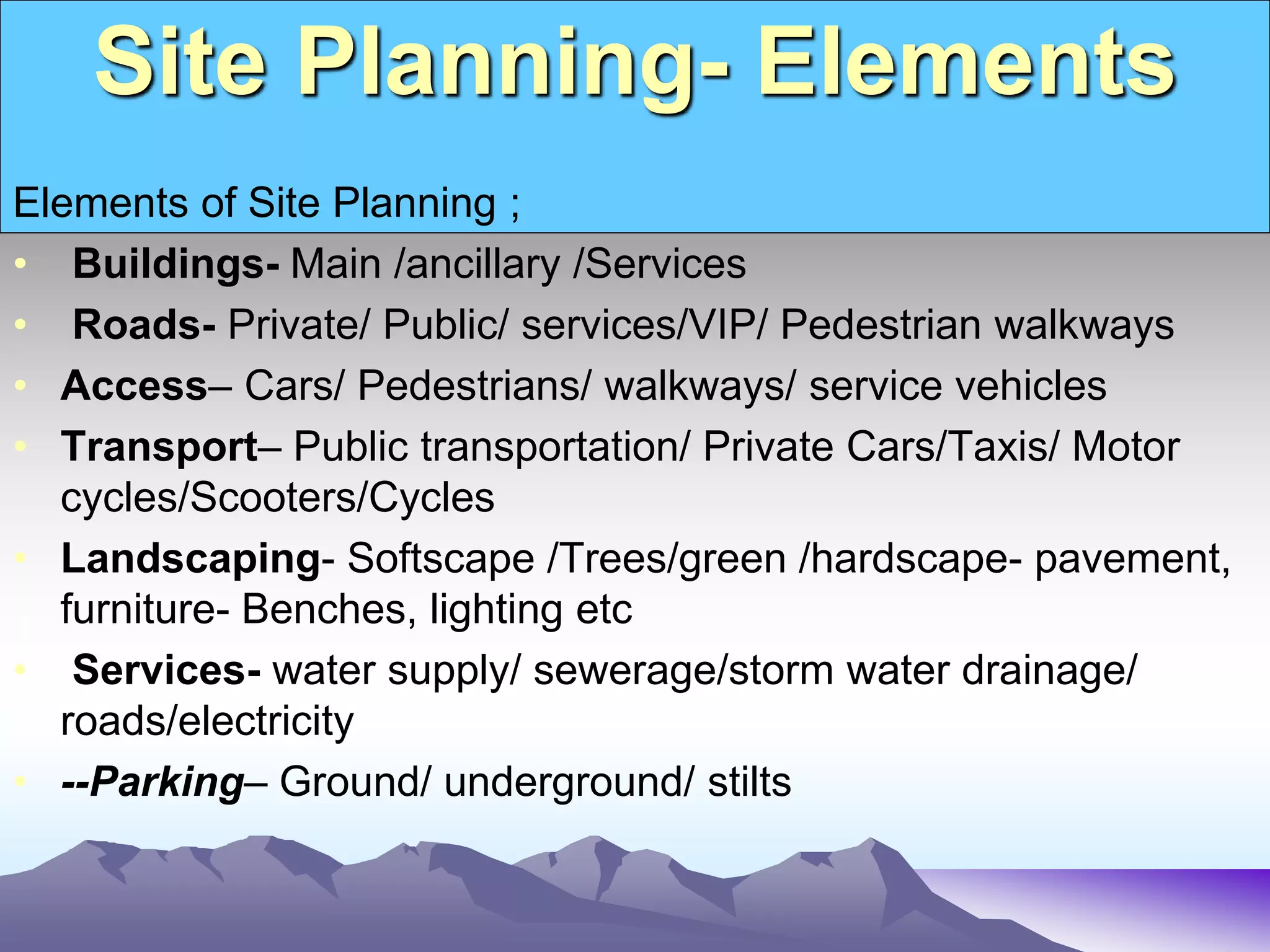
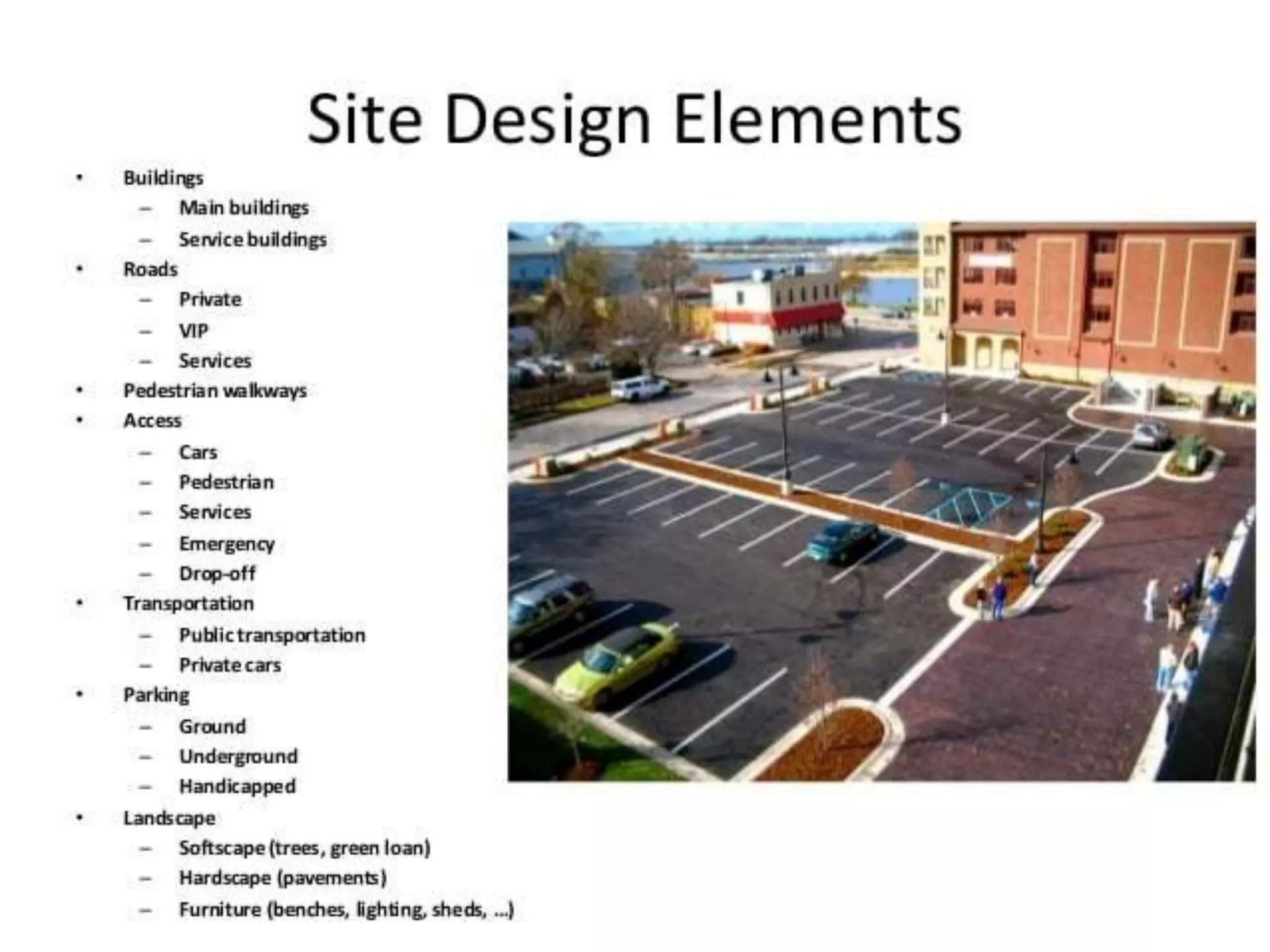
Site Planning- Elements
Elements of Site Planning ;
โ€ข Buildings- Main /ancillary /Services
โ€ข Roads- Private/ Public/ services/VIP/ Pedestrian walkways
โ€ข Accessโ€“ Cars/ Pedestrians/ walkways/ service vehicles
โ€ข Transportโ€“ Public transportation/ Private Cars/Taxis/ Motor
cycles/Scooters/Cycles
โ€ข Landscaping- Softscape /Trees/green /hardscape- pavement,
furniture- Benches, lighting etc
โ€ข Services- water supply/ sewerage/storm water drainage/
roads/electricity
โ€ข --Parkingโ€“ Ground/ underground/ stilts
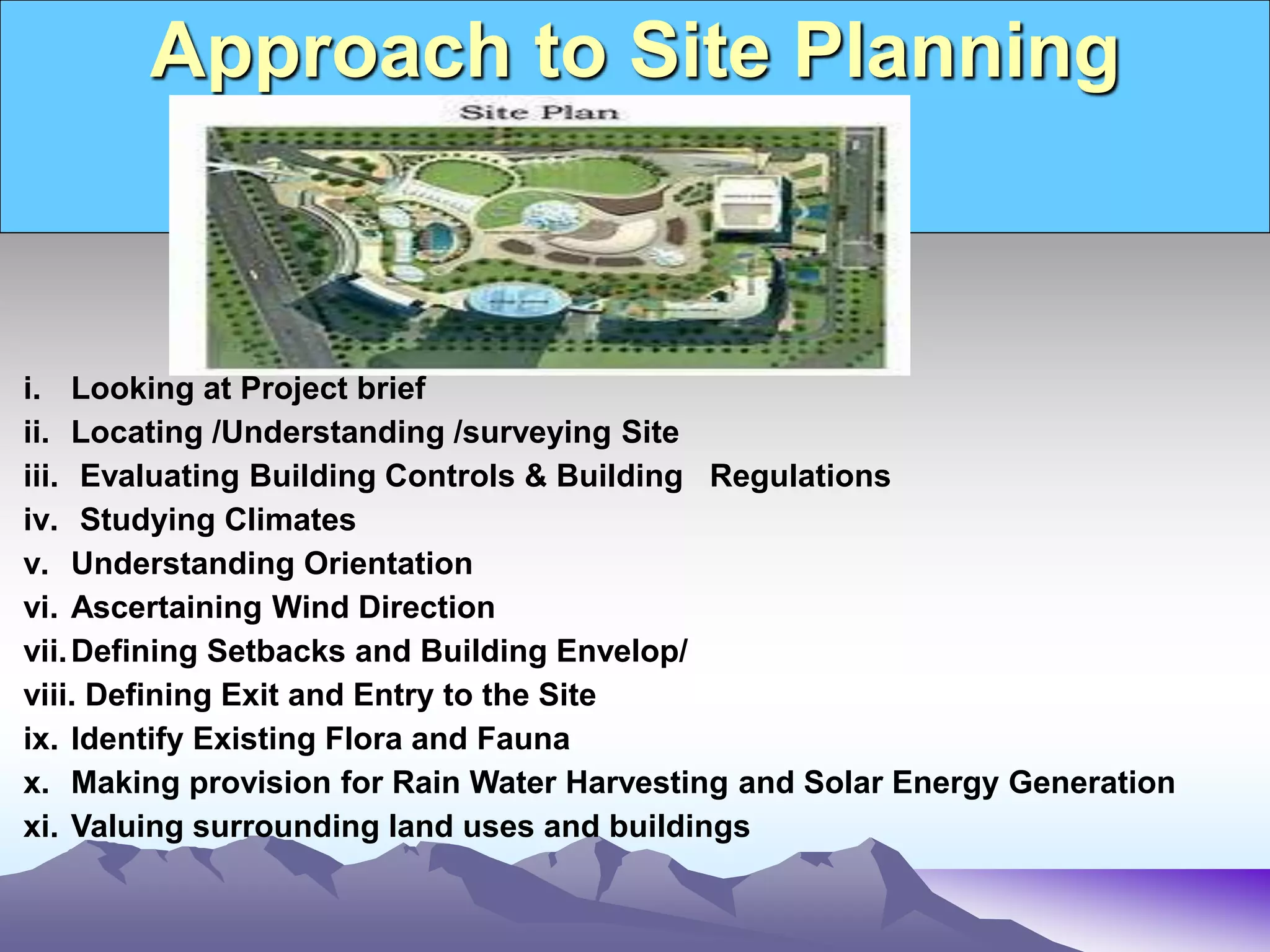
Approach to Site Planning
i. Looking at Project brief
ii. Locating /Understanding /surveying Site
iii. Evaluating Building Controls & Building Regulations
iv. Studying Climates
v. Understanding Orientation
vi. Ascertaining Wind Direction
vii.Defining Setbacks and Building Envelop/
viii. Defining Exit and Entry to the Site
ix. Identify Existing Flora and Fauna
x. Making provision for Rain Water Harvesting and Solar Energy Generation
xi. Valuing surrounding land uses and buildings
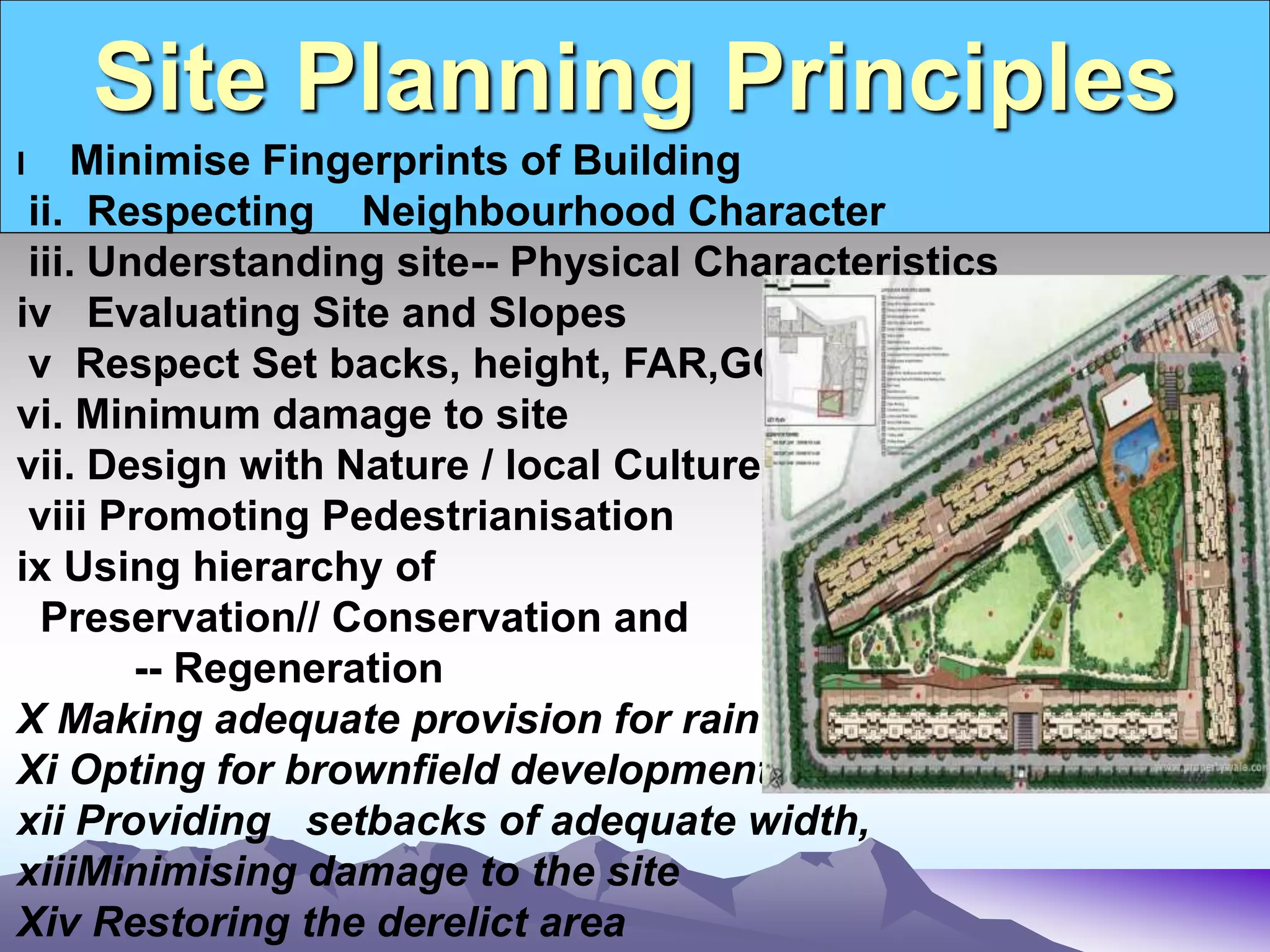
Site Planning Principles
.
I Minimise Fingerprints of Building
ii. Respecting Neighbourhood Character
iii. Understanding site-- Physical Characteristics
iv Evaluating Site and Slopes
v Respect Set backs, height, FAR,GC
vi. Minimum damage to site
vii. Design with Nature / local Culture
viii Promoting Pedestrianisation
ix Using hierarchy of
Preservation// Conservation and
-- Regeneration
X Making adequate provision for rain water harvesting
Xi Opting for brownfield development
xii Providing setbacks of adequate width,
xiiiMinimising damage to the site
Xiv Restoring the derelict area
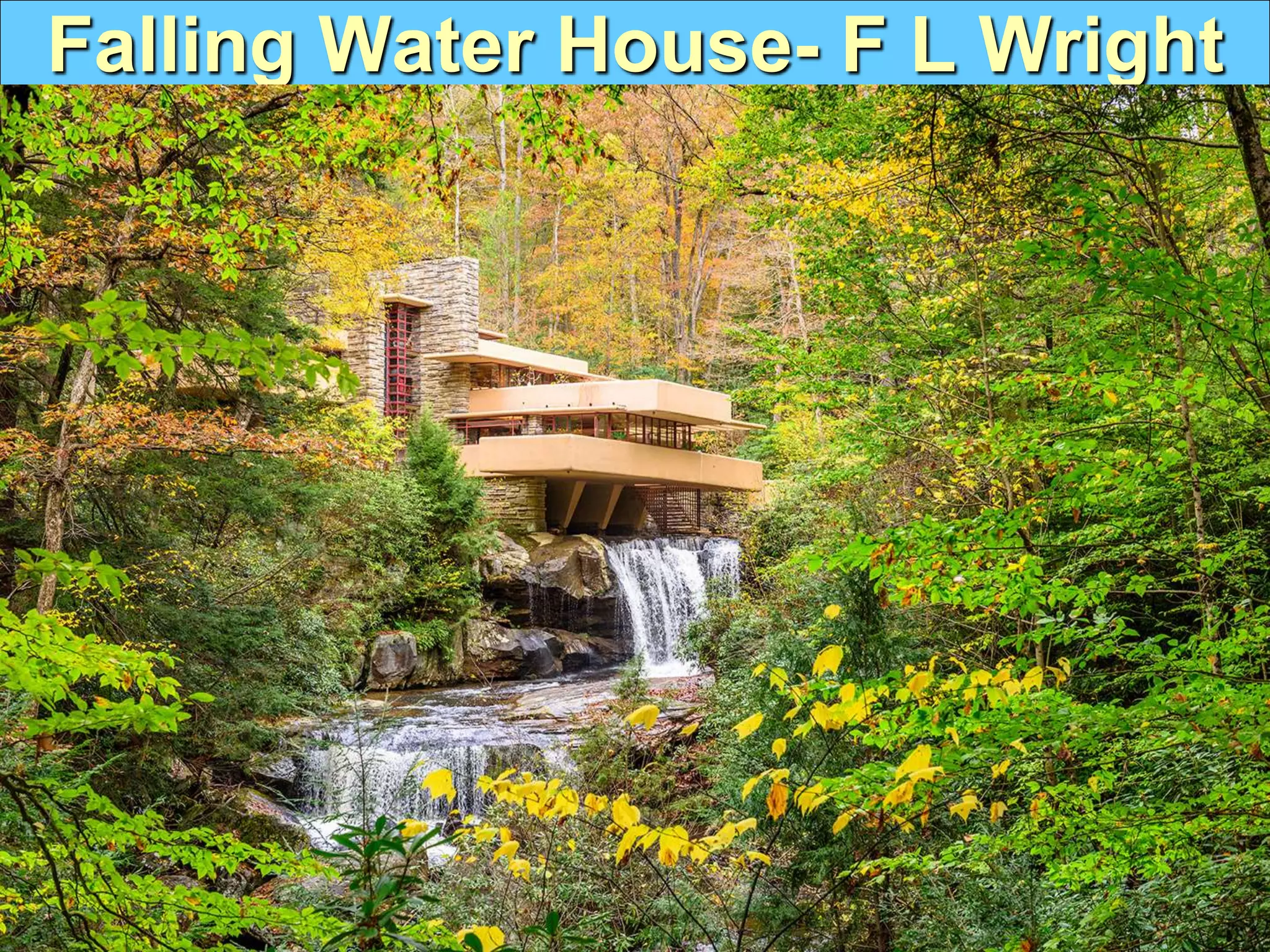
Falling Water House- F L Wright
Site Planning Principles
.
Site planning / design--- Need to consider broad range of concerns
before evolving design concept.:
---physical aspects of site
--vision/ program of client,
---designerโ€™s own creative inclination,
-- concerns of community
---interests of end user.
--- zoning /bye-laws requirements -- to regulate the density / geometry of
development, road widths ,parking and drainage requirements,
--- natural resource( protection ) areas.
ii) Neighbourhood Character
iii) Physical Characteristics
Site planning incorporate an accurate description of:
โ€ข Shape, size, orientation of site and easements.
โ€ข Levels / contours of site and
-- difference in levels between site / surrounding properties.
โ€ข Location/ height of existing buildings on site and surrounding
properties.
use of surrounding buildings, including location of habitable rooms.
Site Planning Principles
.
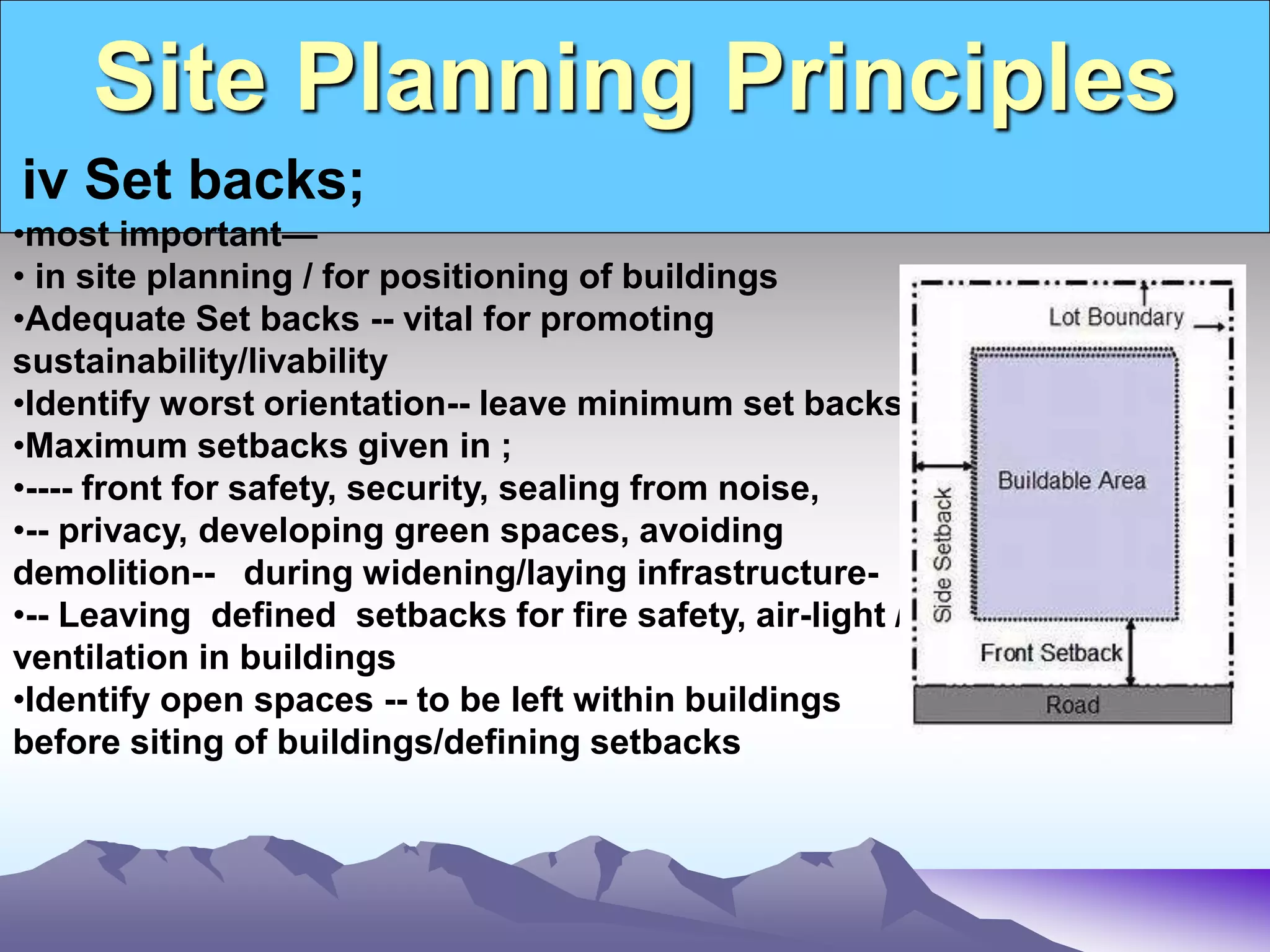
iv Set backs;
โ€ขmost importantโ€”
โ€ข in site planning / for positioning of buildings
โ€ขAdequate Set backs -- vital for promoting
sustainability/livability
โ€ขIdentify worst orientation-- leave minimum set backs.
โ€ขMaximum setbacks given in ;
โ€ข---- front for safety, security, sealing from noise,
โ€ข-- privacy, developing green spaces, avoiding
demolition-- during widening/laying infrastructure-
โ€ข-- Leaving defined setbacks for fire safety, air-light /
ventilation in buildings
โ€ขIdentify open spaces -- to be left within buildings
before siting of buildings/defining setbacks
Site Planning Principles
.
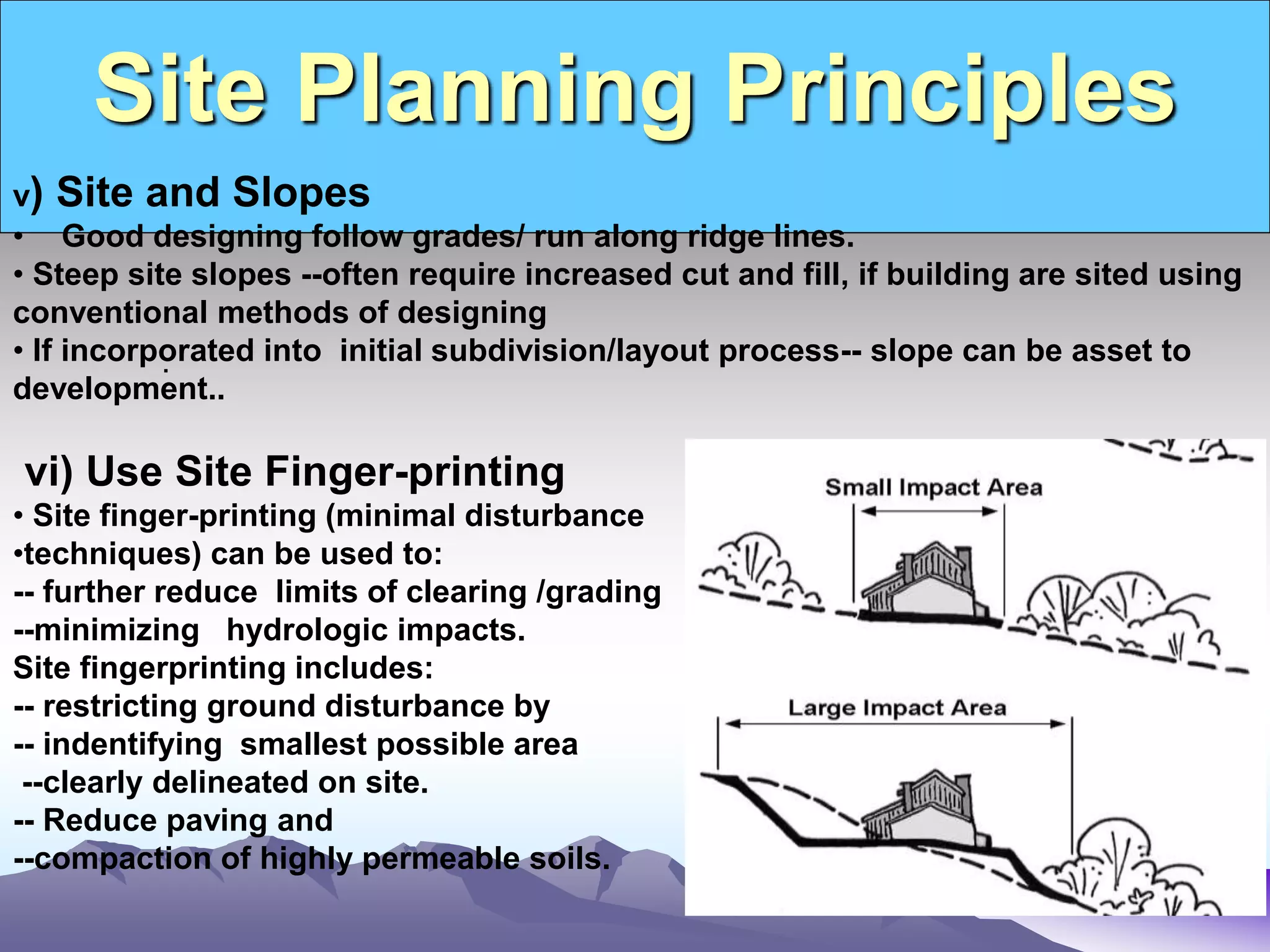
v) Site and Slopes
โ€ข Good designing follow grades/ run along ridge lines.
โ€ข Steep site slopes --often require increased cut and fill, if building are sited using
conventional methods of designing
โ€ข If incorporated into initial subdivision/layout process-- slope can be asset to
development..
vi) Use Site Finger-printing
โ€ข Site finger-printing (minimal disturbance
โ€ขtechniques) can be used to:
-- further reduce limits of clearing /grading
--minimizing hydrologic impacts.
Site fingerprinting includes:
-- restricting ground disturbance by
-- indentifying smallest possible area
--clearly delineated on site.
-- Reduce paving and
--compaction of highly permeable soils.
Sloping Site Analysis in 2/3 d
MANAGING SITE- MIN. CUTTING &FILLING
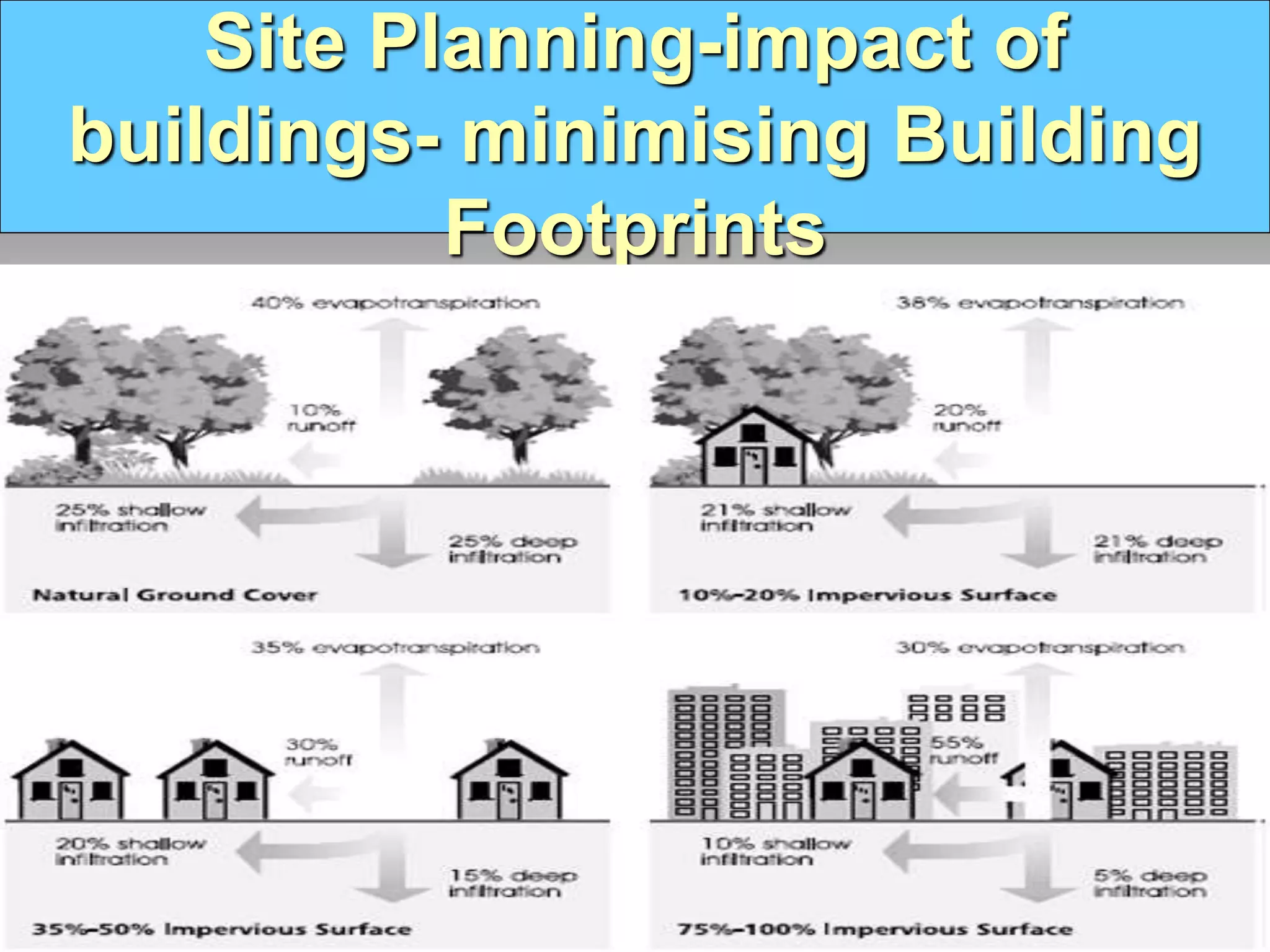
Site Planning-impact of
buildings- minimising Building
Footprints
Site Planning Principles
.
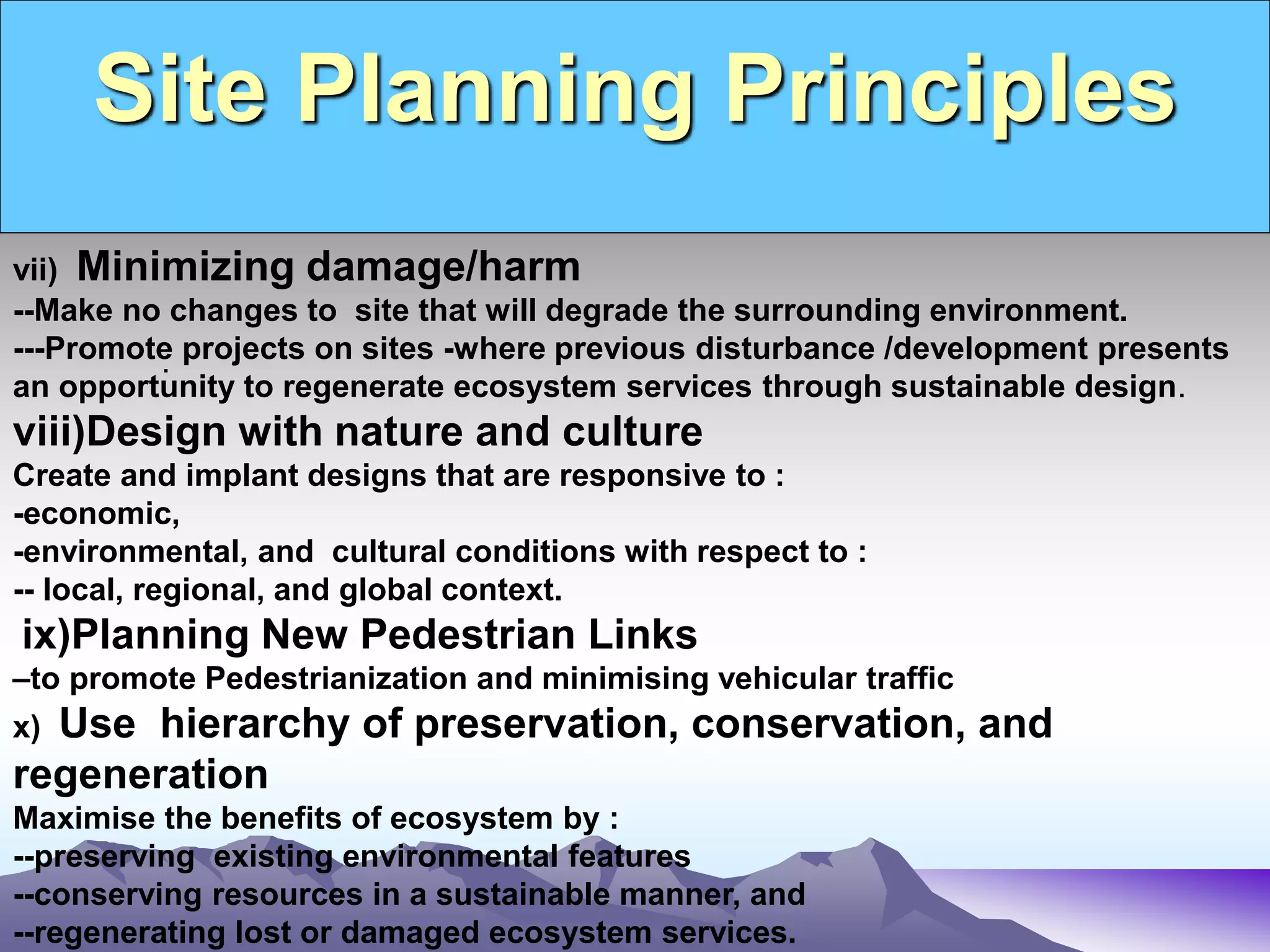
vii) Minimizing damage/harm
--Make no changes to site that will degrade the surrounding environment.
---Promote projects on sites -where previous disturbance /development presents
an opportunity to regenerate ecosystem services through sustainable design.
viii)Design with nature and culture
Create and implant designs that are responsive to :
-economic,
-environmental, and cultural conditions with respect to :
-- local, regional, and global context.
ix)Planning New Pedestrian Links
โ€“to promote Pedestrianization and minimising vehicular traffic
x) Use hierarchy of preservation, conservation, and
regeneration
Maximise the benefits of ecosystem by :
--preserving existing environmental features
--conserving resources in a sustainable manner, and
--regenerating lost or damaged ecosystem services.
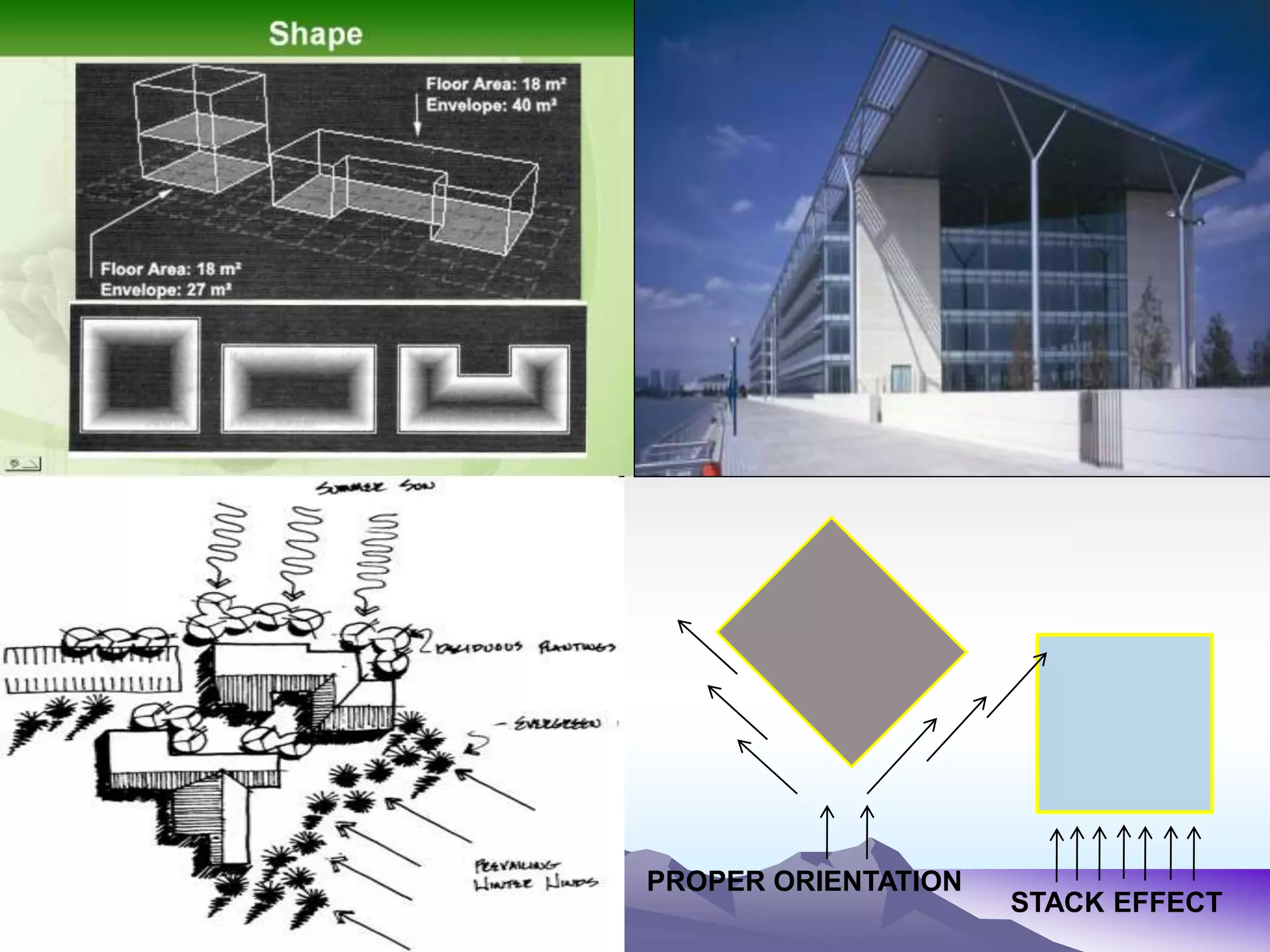
STACK EFFECT
PROPER ORIENTATION
โ€ขConclusions
Site Planning and Building Design
โ€ข All state of art building designs--- have genesis in careful site
analysis.
โ€ข Before going for site planning / building design- ensure site
properly/accurately surveyed -- mapping everything within/ outside
site-- relevant for planning/designing
โ€ข Site Survey should include;
๏ƒผ -dimensions of outer boundaries,- angles of all sides,
๏ƒผ - contours/levels at regular intervals- gradient, landform, elevation,
drainage pattern etc
๏ƒผ -existing trees/flora fauna- in terms of type, size, location, shape,
pattern, aesthetics, ecology,
โ€ข -water bodies,- electric lines,
โ€ข - services- both underground /over-ground/within /outside,
โ€ข --roads- inside/outside,
โ€ข structures โ€“ within/outside ; area of site,
โ€ข -- views- within /outside
โ€ข --water table/ floodability โ€“
Site Planning and Building Design
โ€ข --Locate North
โ€ข --Identify Wind direction /pattern of wind flow
โ€ข -- Define Setbacks to be left within building as per bye-laws
โ€ข -- Define โ€˜No building Zoneโ€™- to be left within site as per Master
Plan/National /State Highways law etc
โ€ข -- โ€˜Define Mandatory No building zoneโ€™-- to be left when located
near to defense installations/ protected monuments/ zoo/
botanical gardens/ electric installations
โ€ข -Define-โ€˜No Building Zoneโ€™ --to be left when site located near
water bodies/rivers etc
โ€ข --Defining right of way for High Tension Electric Lines when
passing through site
โ€ข - Preferably obtain a Zoning Plan of site , when allotted by any
Development Authority/Urban Local Body/Improvement Trust/
Industrial Corporation etc before starting planning
Site Planning and Building Design
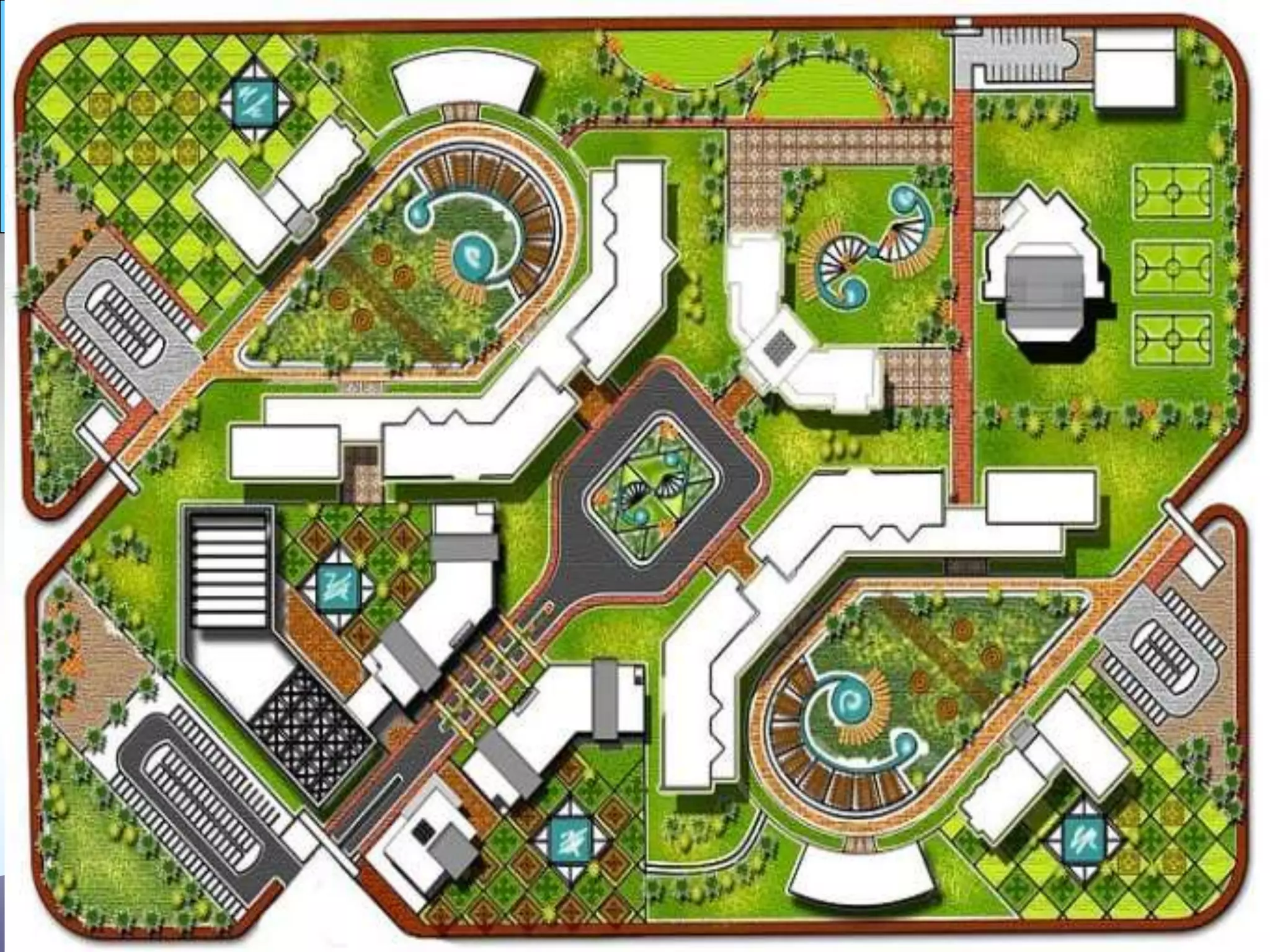
โ€ข Site planning/ building design -- require simultaneous conceptualization.
โ€ข Site planning for large sites-- calls for carrying out detailed analysis of site
in terms of area to be preserved/ conserved/fit for development
โ€ข large sites/educational institutions โ€“ site zoning must be done initially by
drawing a master plan in terms of area for academics/ administration/
residential for staff/ hostels/play area etc along with broad road network
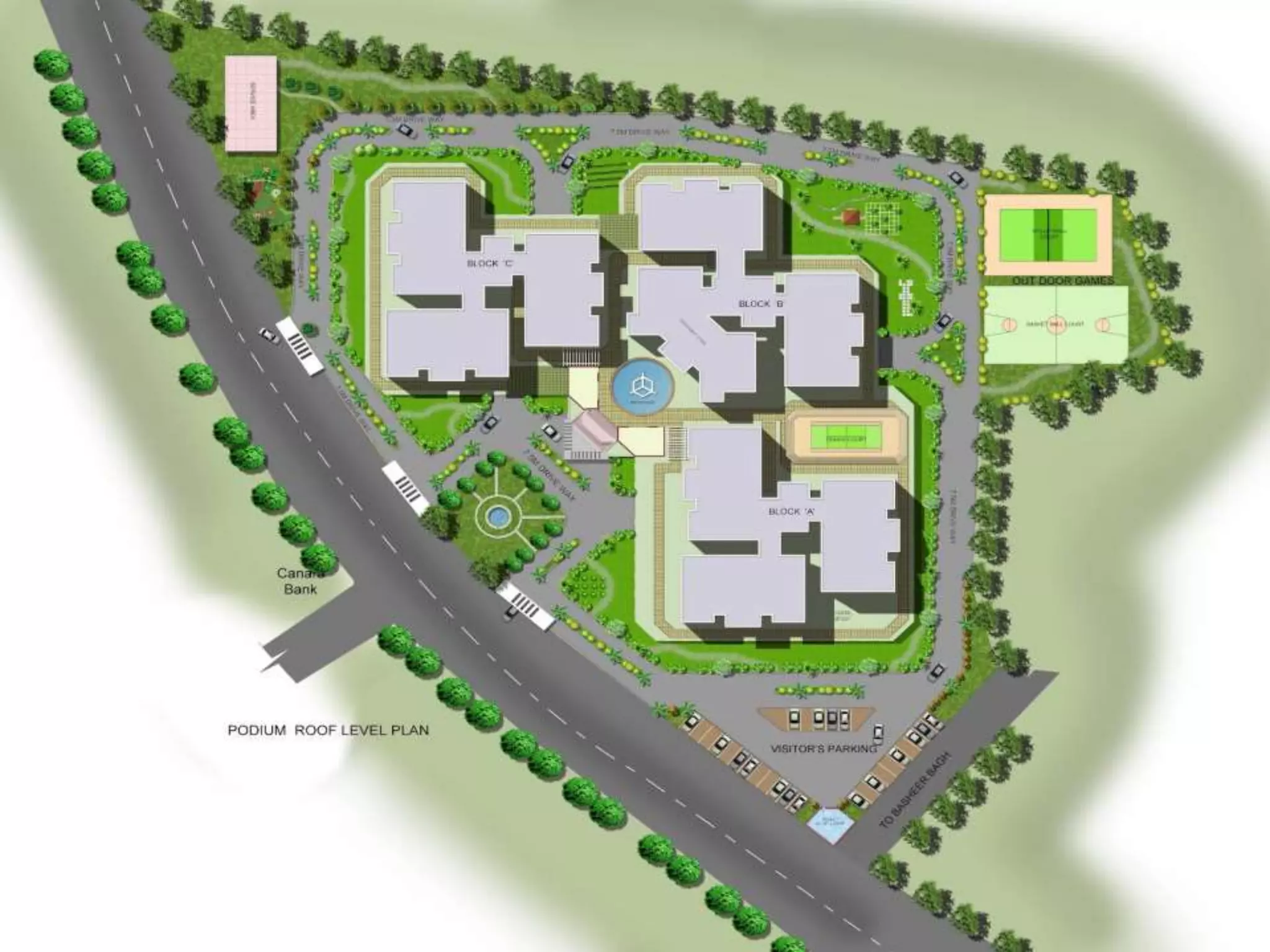
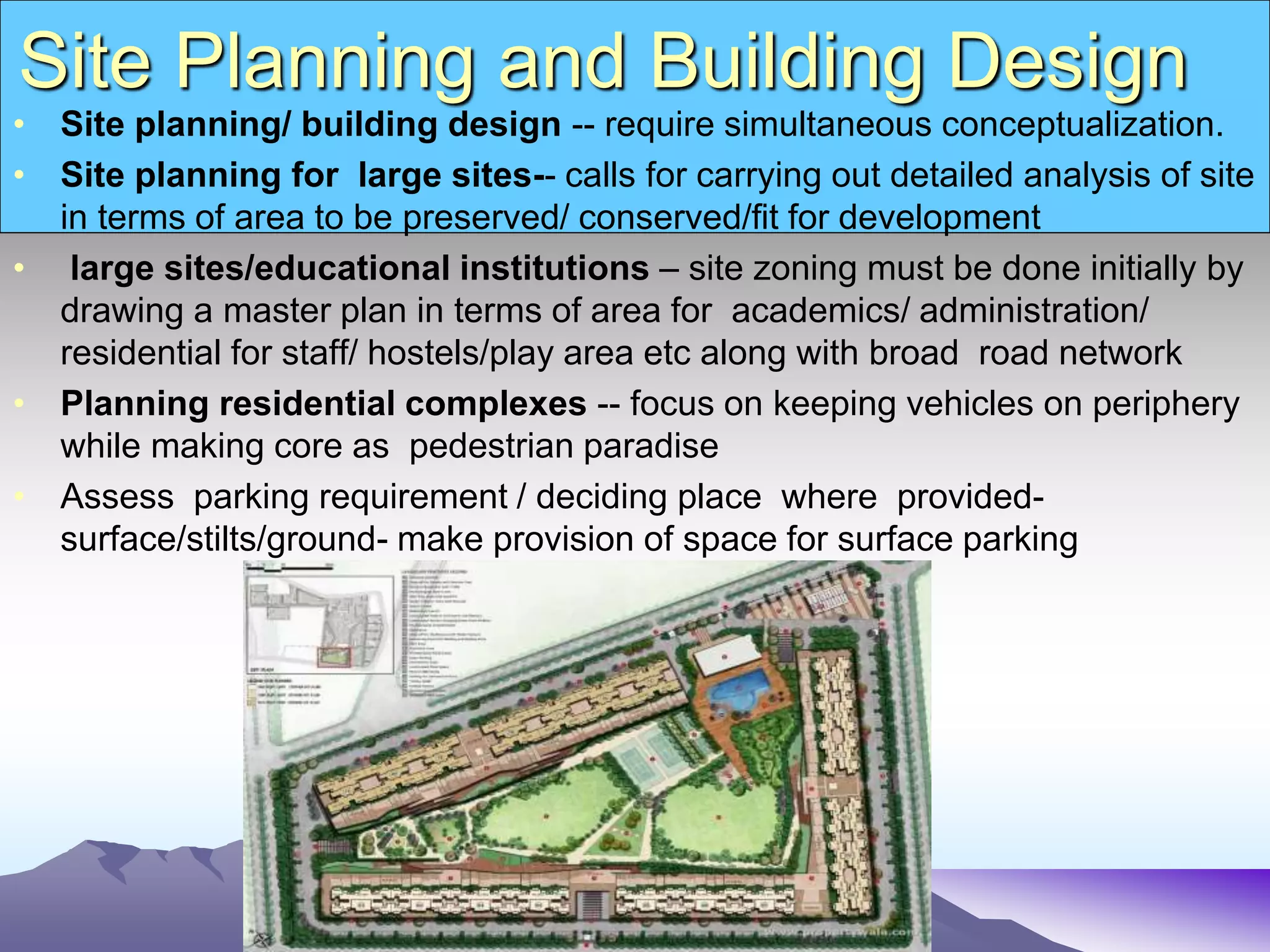
โ€ข Planning residential complexes -- focus on keeping vehicles on periphery
while making core as pedestrian paradise
โ€ข Assess parking requirement / deciding place where provided-
surface/stilts/ground- make provision of space for surface parking
Site Planning and Building Design
โ€ข project to be designed as single/multiple blocks
critical-- considering site/area/ shape etc and
distances to be left within different blocks.
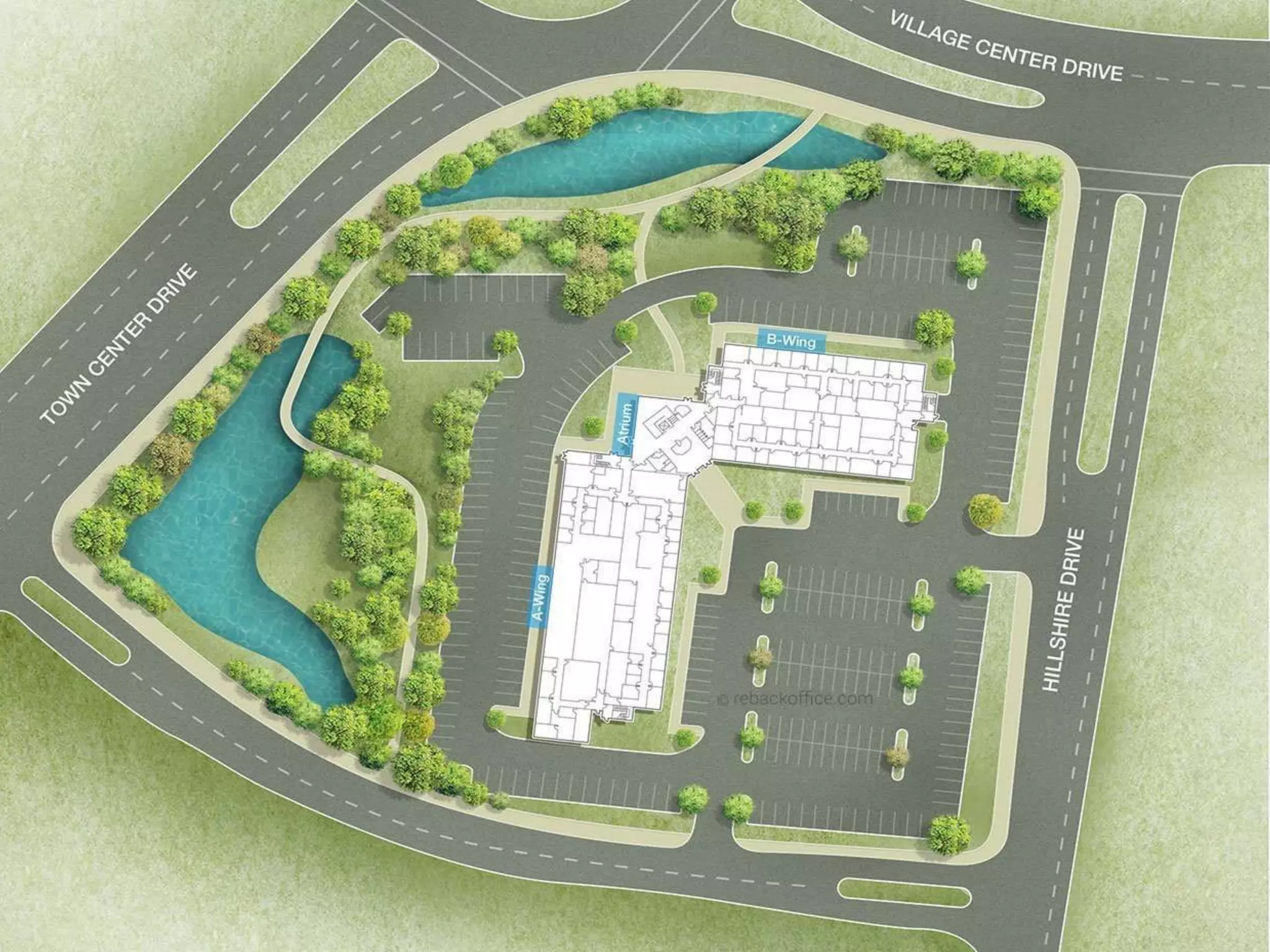
โ€ข Respect abutting roads-- while positioning/
designing buildings- buildings to run parallel to
abutting roads
โ€ข Set backs within site-- should be dictated by the
orientation/legal framework โ€“ with minimum setback
kept on worst side and large setback on best
orientation/front side
โ€ข Setbacks also define-- open spaces to be provided
within buildings/ prevailing flora- fauna -- area to be
used for landscaping
Site Planning and Building Design
โ€ข Lighting/ ventilation - dictate positioning of
building- with north best for glare
free/uniform/cool light
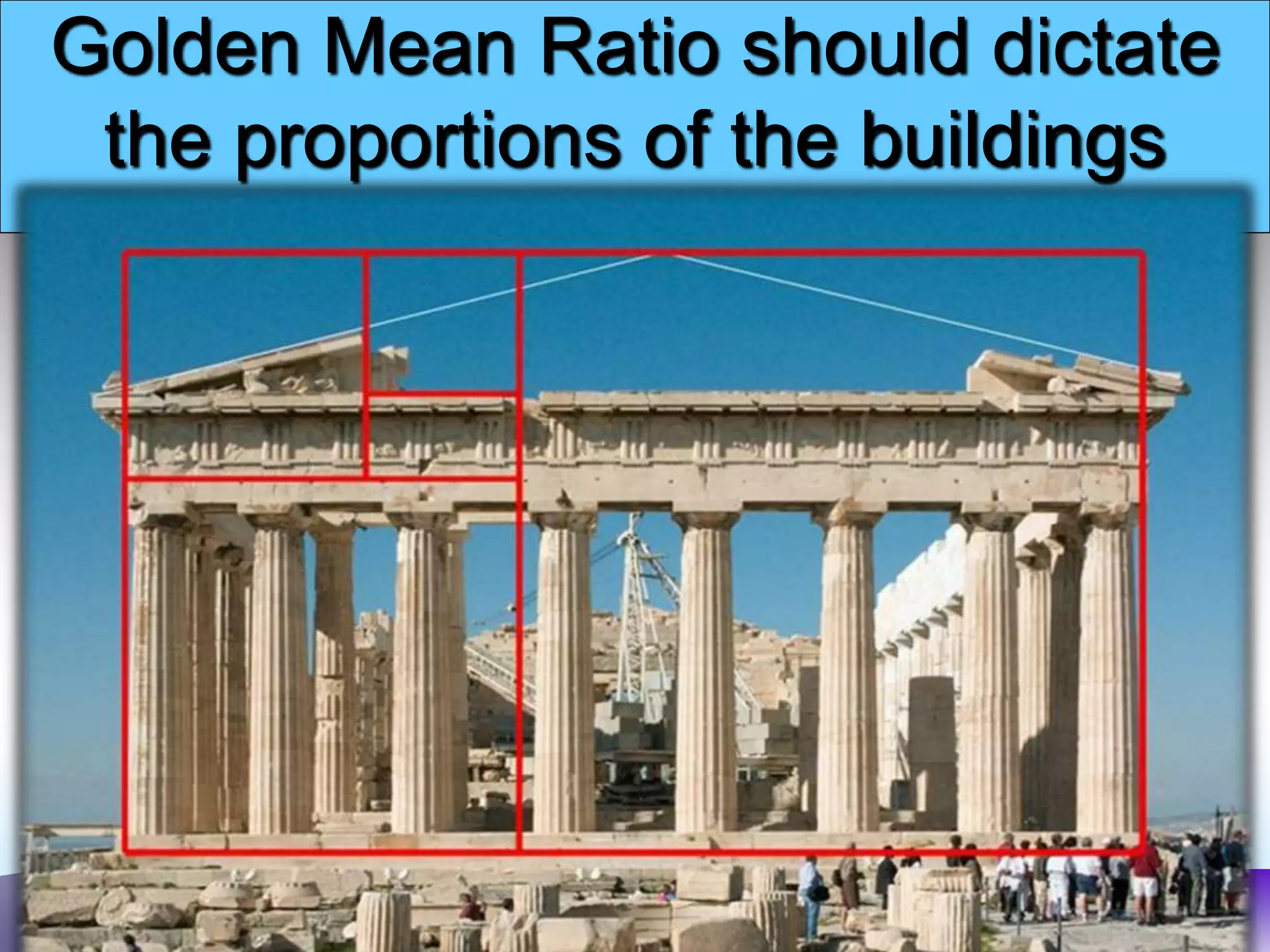
โ€ข Building design-- dictated by golden mean
ratio while considering proportions
โ€ข For irregular site- plan for regular buildings
with walls running parallel to abutting roads
and residual irregular spaces used for
landscaping/set backs.
โ€ข In designing-- respect site, respect nature,
existing topography and existing water bodies
Site Planning and Building Design
โ€ข Site planning- based on Climate considered at
Regional/ Settlement/Site levels
โ€ข Look for prevailing wind direction for site planning
and positioning of buildings in siteโ€”
โ€ข Look for desirable winds/undesirable winds
โ€ข Look at the orientation context for site planning
โ€ข Look at the views from/to siteโ€“ make best use of
views focusing on nature, avoid views of slums
/industry /pollution etc
โ€ข Carry out land suitability analysis- in large projects
for defining areas needing preservation/conservation/
fit for development/unfit for development for rational
site planning
Site Planning and Building Design
โ€ข Site and project design should be compatible
โ€ข - Building design should be response to the available site
โ€ข Size/shape/location /levels etc will largely dictate site planning/
building design
โ€ข Avoid pre-meditated building design
โ€ข Plan along contours- Planning across contours involves large cutting
/filling- making project cost-intensive, environmentally unsustainable
โ€ข - Avoid building on steep slopes - reject sites which are very steep
โ€ข -- Reject north slopes for construction in hilly
โ€ข - Plan for compact buildings --with large site area left green- have as
small footprints of building as may be possible/feasible
โ€ข - Mark all existing trees -plan for their protection while site planning
โ€ข - Trees coming within buildings be made part of building by adjusting
them in open spaces or shaping the buildings to exclude them
โ€ข -mark low lying area for rain water harvesting/ locating STP
โ€ข Plan higher areas for locating water supply through gravity
โ€ข Use native plants for landscaping and minimize plantation from
different climate
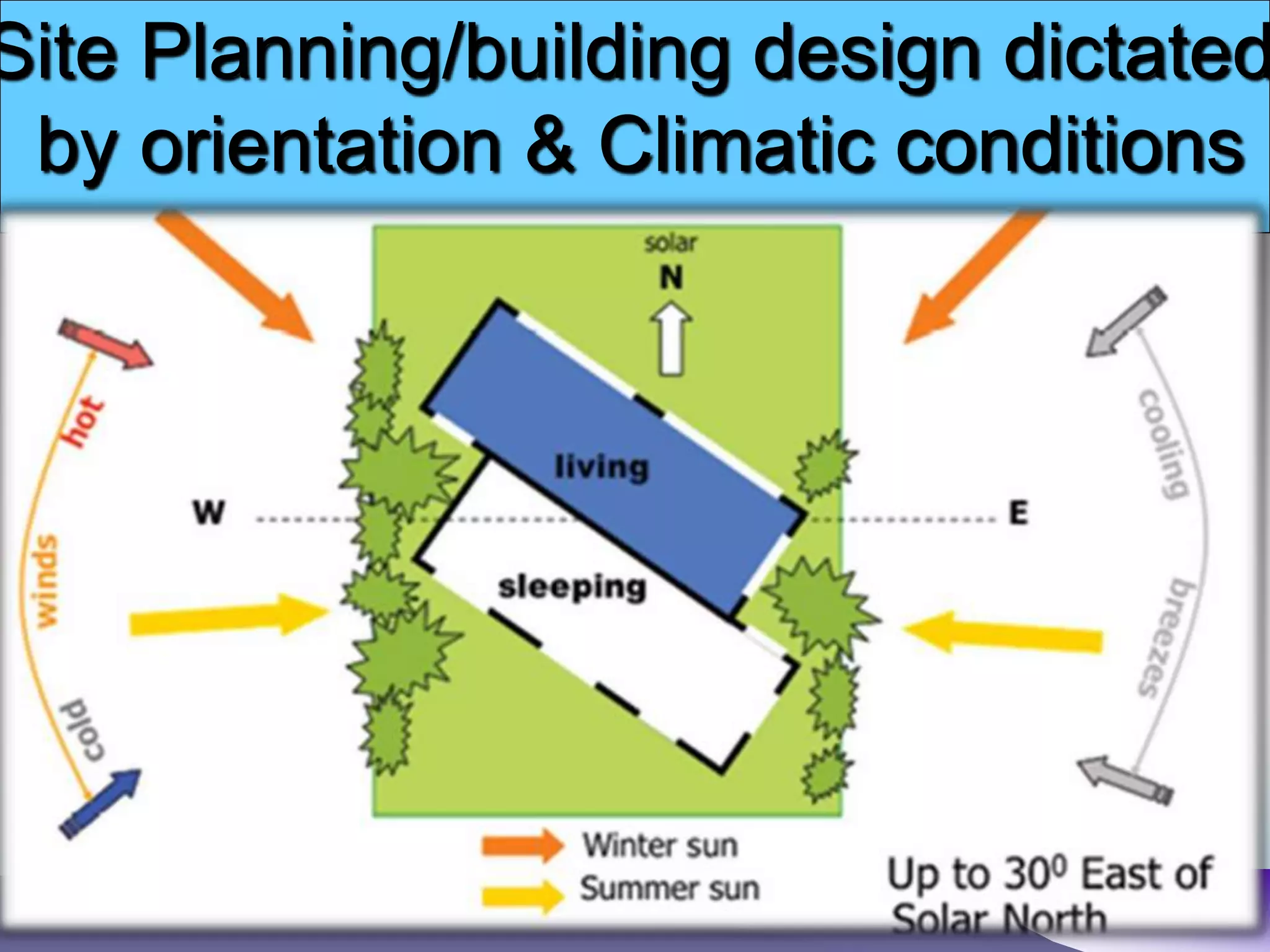
Site Planning/building design dictated
by orientation & Climatic conditions
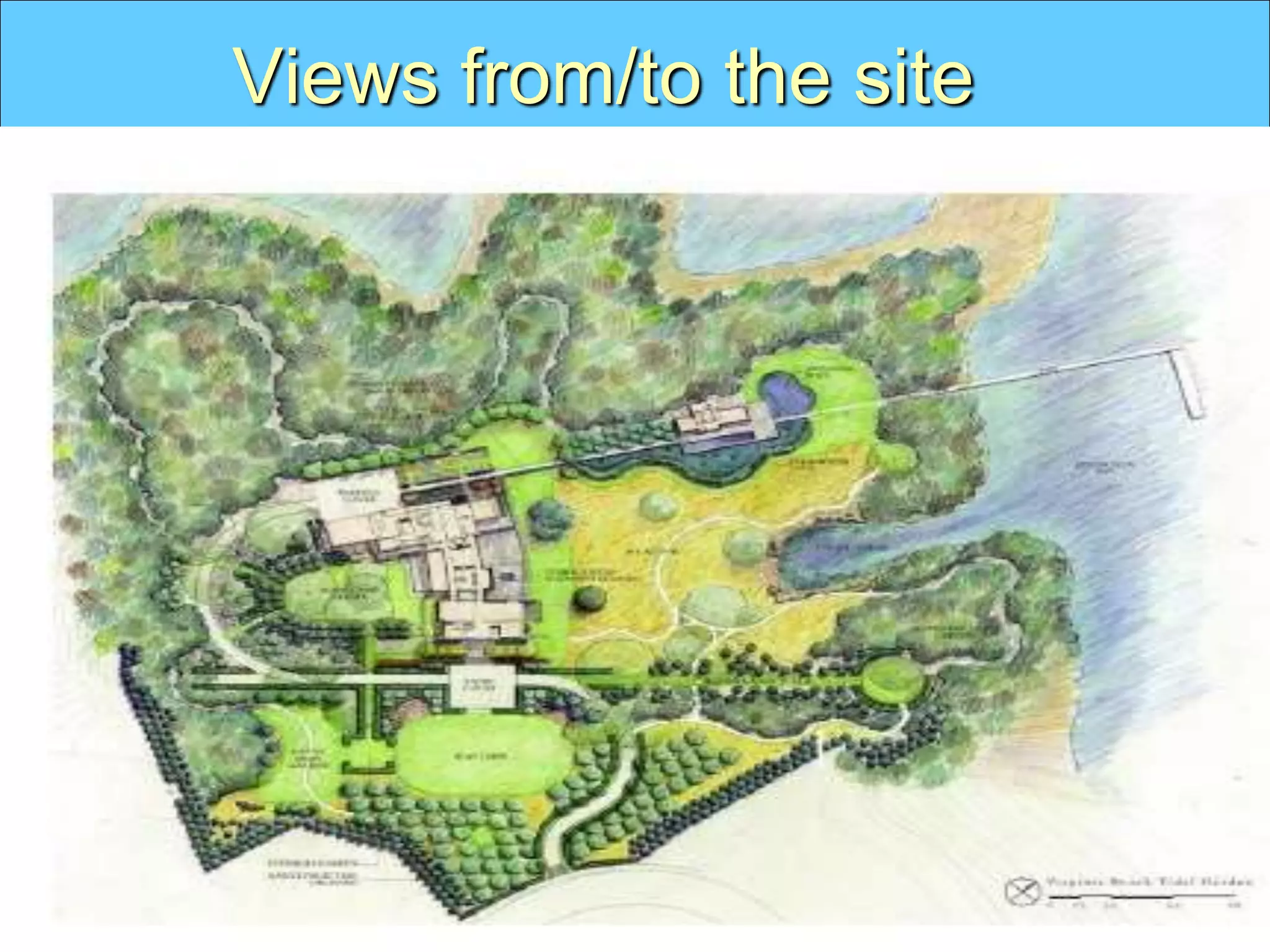
Views from/to the site
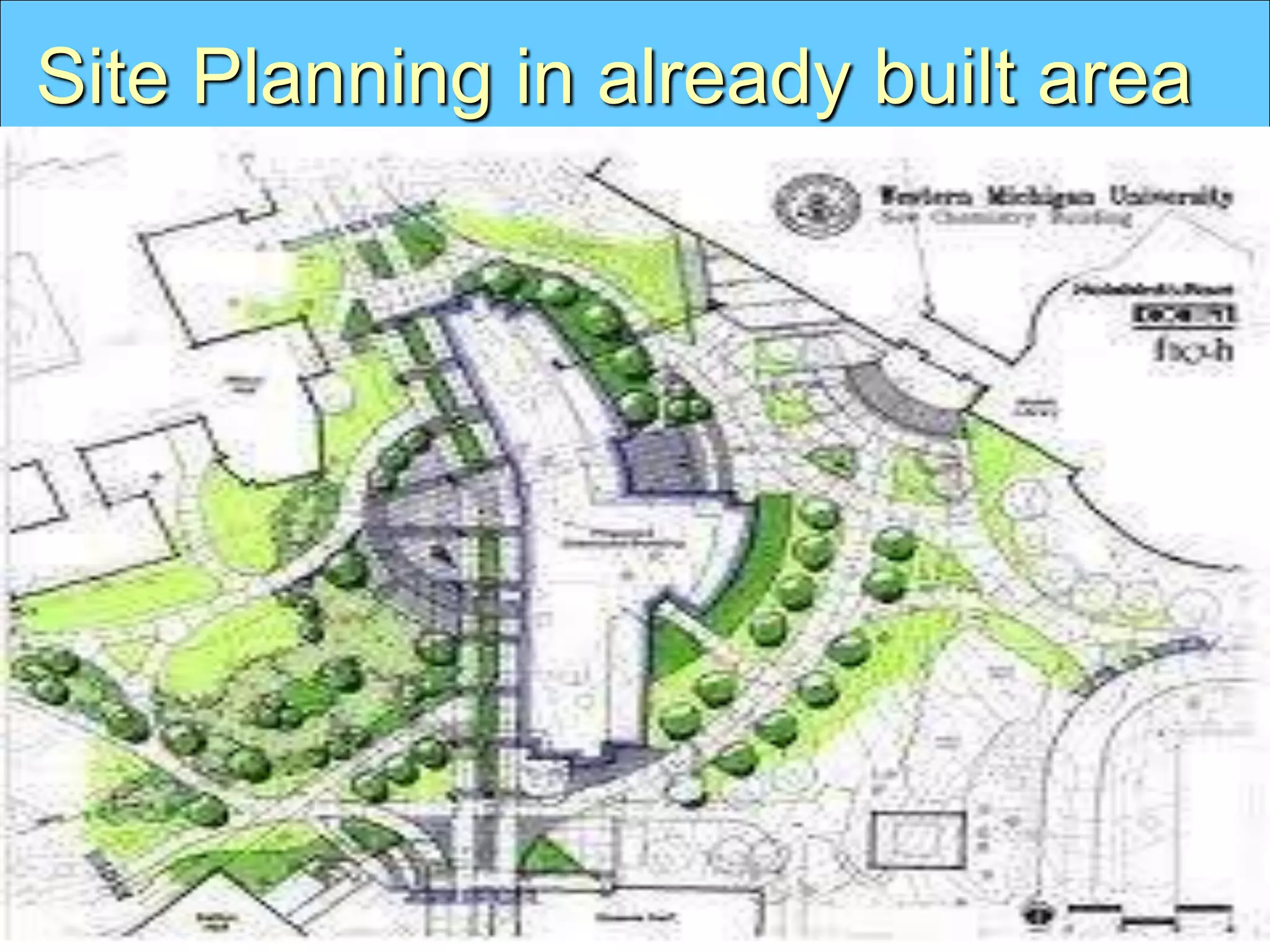
Site Planning in already built area
Site Planning in a Regular Site
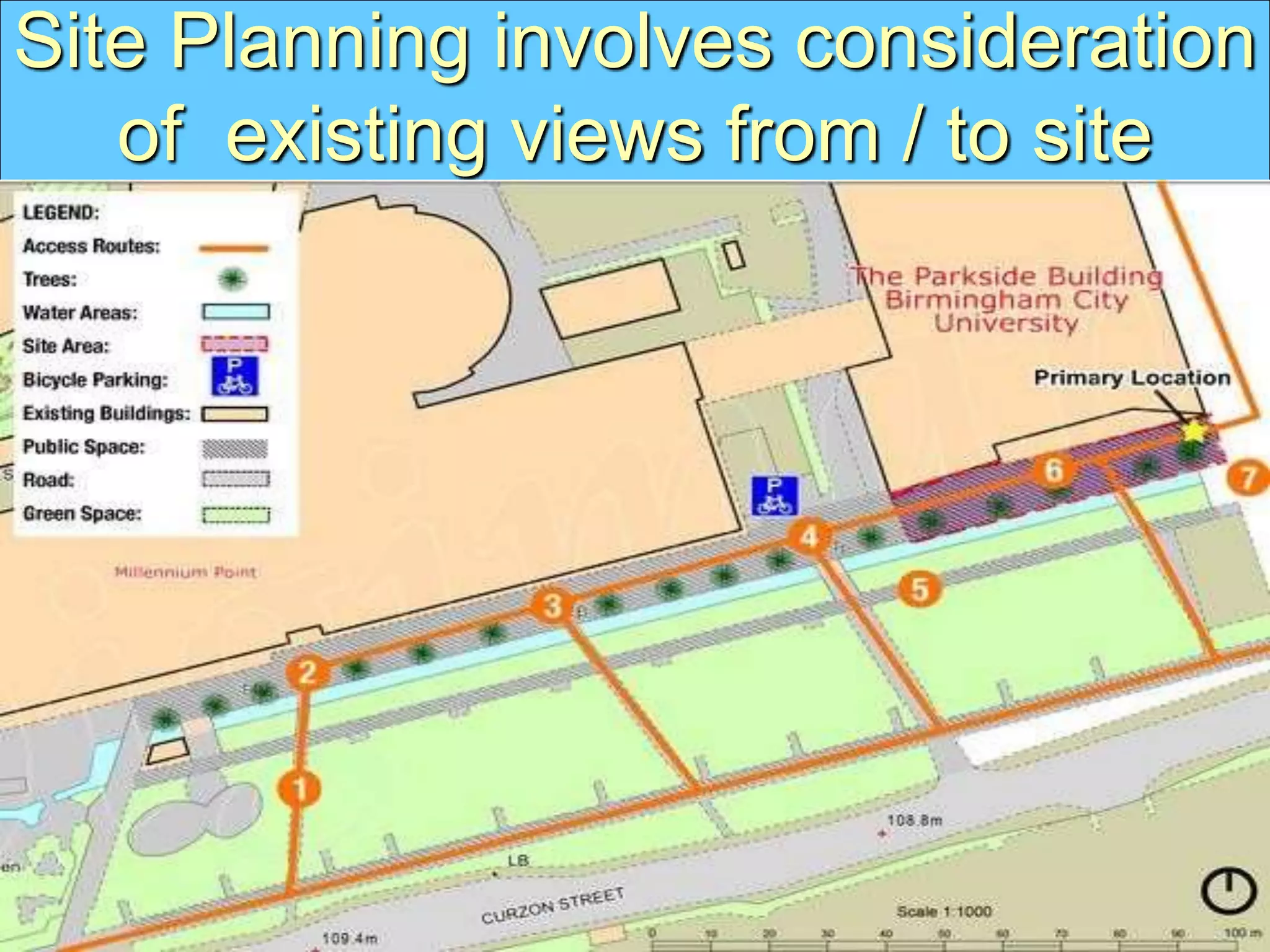
Site Planning involves consideration
of existing views from / to site
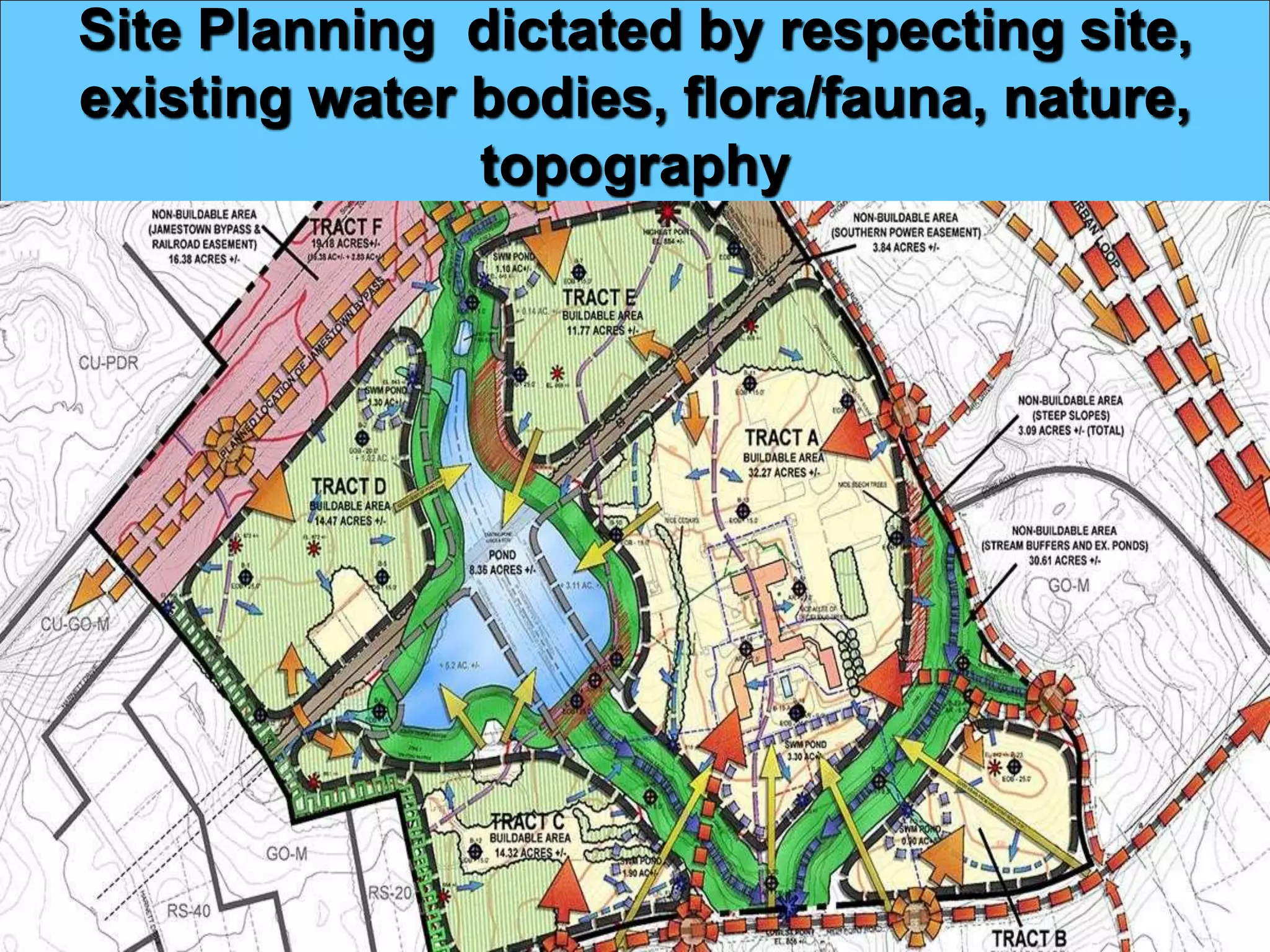
Site Planning dictated by respecting site,
existing water bodies, flora/fauna, nature,
topography
Golden Mean Ratio should dictate
the proportions of the buildings
AND SEARCH FOR PROMOTING RATIONAL SITE
PLANNING CONTINUES AS FORMIDABLE
CHALLENGE TO ARCHITECTS

Site planning in Architectural Projects- Principles and Approaches

  • 1.
    Ar. J.K.GUPTA, FormerDirector, College of Architecture, IET Bhaddal-- Email---- jit.kumar1944@gmail.com decoding SITE PLANNING FOR ARCHITECTURAL PROJECTS
  • 2.
    Buildings- Role andImportance ๏‚— Buildings-- integral part of human history, growth & development ๏‚— Buildings -- shall continue to define journey of human growth & development ๏‚— Buildings-- manmade environment- vital for human growth ๏‚— Buildings โ€“ living organism ๏‚— Buildings -- as structures cater to all human activities ๏‚— Buildings -- largest consumers of energy (50%) ๏‚— Buildings - largest consumers of resources ๏‚— Buildings โ€“ largest generators of waste ๏‚— Buildings- largest polluter of environment /ecology ๏‚— Buildings --- responsible for largest carbon footprints ๏‚— Buildings -- responsible for global warming ๏‚— Buildings -- major determinant of global sustainability ๏‚—
  • 3.
    Buildings- Role andImportance โ€ข Buildingsโ€“ providers of optimum/worst living conditions ๏‚— Buildings -- make people healthy/sick ๏‚— Buildings โ€“ 80% human life spent in buildings ๏‚— Buildings-- valuable to address / overcome human/ ecological concerns ๏‚— Making Buildings Sustainableโ€“ essential- to make value addition to resources, environment ,ecology ๏‚— Studies revealed โ€” ๏‚— Sustainable school -makes learning easy/ more meaningful ๏‚— Sustainable Home --- makes people happy and healthy ๏‚— Sustainable Hospital -- cures patients quickly ๏‚— Sustainable shopping mall-- increases sale / profits
  • 4.
    BUILDINGS AS CONSUMERSOF RESOURCES โ€ขBuilt environment impact environment / consumption of resources: ๏ƒ˜16% of worldโ€™s fresh water withdrawal. ๏ƒ˜25% of wood harvested. ๏ƒ˜30% of consumption of raw material. ๏ƒ˜50% of global energy consumption. ๏ƒ˜35% of world's CO2 emission ๏ƒ˜40% of Municipal solid waste. ๏ƒ˜50% of Ozone depleting CFCโ€™s still in use. ๏ƒ˜30% of the residents having sick building syndrome โ€“ ( Roodman and Lenssen, 1995) โ€ข70% global warmingโ€“ cities/outcome of buildings / transportation โ€ขExisting buildings--low concern for resource conservation. โ€ขConsidering700-900msqm to be added annuallyโ€” โ€ขGlobal energy/ environment implications critical. โ€ขBuildings designed /constructed /operated with utmost care for considerations----- energy/ sustainability/resources
  • 5.
  • 6.
  • 7.
    SDG 11- Makecities and human settlements inclusive ,safe, resilient and sustainable
  • 9.
  • 10.
    Buildings- Built Environment โ€ขOperational domain of professions of Architecture revolves around creating state of art built environment through: โ€ข -- Siting โ€ข -- planning, โ€ข -- designing, โ€ข -- construction, โ€ข -- operation, โ€ข -- maintenance โ€ข -- demolition and โ€ข -- reconstruction -- Architects- have critical role / responsibility in--making value addition to resources ,environment ,ecology- by creating sustainable built environment. -Town Planners also play vital role by : evolving layout plans with energy as focus, โ€“making best use of sun and wind -- Going green --necessity--to ensure sustainable tomorrow --Each building unique--requires different options to make it green
  • 11.
  • 12.
    Green Building โ€“The Definition โ€ข A green building is one which Uses less Water Optimizes Energy Efficiency Conserves natural resources Generates less waste Provides healthier spaces
  • 13.
    Daylighting Local materials Indian Wayof approaching site Planning โ€ข Rediscovery of Indian ethos โ€“ We worship 5 elements of Nature (Panchabhutas) Prithvi (Earth) Sustainable Sites Jal (Water) Water Efficiency Agni (Energy) Energy Efficiency Vayu (Air) Indoor Environmental Quality Akash (Sky) Daylight Views Water body
  • 14.
    Designing Sustainable Buildings โ€ข- Adopting Integrated approach to designing of buildings โ€ข Based on CLIMATE- Regional, City, Site Climates โ€ข Rational Site planning- planning with nature, making best use of site potential โ€ข Orientation -- optimizing light / heat gain/heat loss โ€ข Sun movement-- For maximizing use of free solar energy for heating /lighting โ€ข Wind direction---using movement of air for ventilation/ cooling โ€ข Planning -- for optimizing siting, shape of building, planning spaces, allocating uses, placing of rooms, circulation, promoting building efficiency, promoting natural sunlight, air and ventilation โ€ข Building Envelop--โ€“ based on Mass โ€“ space relationships/ solids and voids, positioning of openings ,projections, shading devices, height, shape of building, natural lighting and ventilations etc โ€ข Materials- Materials used for buildings- low embodied materials locally available ;in natural form, lightweight โ€“ reduce dead load โ€ข Technologies โ€“Adopted to be- Cost- effective, material efficient, speedier construction, energy efficient โ€ข Indoor Air Quality- Creating optimum living conditions for residents
  • 15.
  • 16.
  • 17.
    Designing Green Buildings โ€ขCLIMATE --major driver of Site Planning / Designing Buildings โ€ข Climate considered in three contexts; โ€ข Macro Climate - Regional context- to help understand prevailing general climatic conditions & climatic zone in which site falls โ€ข Meso Climate โ€“ Settlement context- to understand prevailing local climatic conditions at city level โ€ข Micro Climate--Site climate โ€“ to understand site/ site specific peculiarities-- in terms of--accessibility location, topography, views ,existing flora/fauna/ water bodies/ encumbrances, strength, weaknesses, opportunities and threat etc
  • 18.
    โ€ขContext of Site โ€ขInSite Planning Designing Buildings
  • 19.
    Understanding Site Before searchingfor design solutionsโ€“Look, understand, appreciate, evaluate, analyse Site & Carry out a SWOT analysis; โ€ข -- site studied, analysed /understoodโ€“ thoroughly/ objectively โ€ข --Design solution -- outcome of site / prevailing site conditions โ€ข - Premeditated design always fails-- to do justice to project- making them irrational/unsustainable โ€ข --Carrying out SWOT analysis of Site โ€“ critical to understand strength, weaknesses, opportunities & threats posed by site โ€ข --Evolve Design based on -- making optimum use of strength of site -- overcome weaknesses โ€ข -- make best use of opportunities offered and โ€ข -- Eliminating all possible threats โ€ข Look at site Sit-- both from inside, outside, top and bottom โ€ข ..
  • 20.
    Understanding Site โ€ข Siteneeds study/analysis in terms of;-19 factors โ€ข Location, โ€ข Accessibility โ€ข Shape and size โ€ข Topography, โ€ข Vegetation, โ€ข Infrastructure, โ€ข Orientation โ€ข Wind Direction โ€ข Local culture, soil conditions โ€ข View from site /View to site โ€ข Prevailing typology of buildings/environment around site- โ€ข Existing structures within site โ€ข Existing encumbrances- electric /gas lines, depression water bodies โ€ข Local Building bye laws โ€ข Developmental Controls- Height, FAR, Setbacks ,land use etc
  • 21.
    Understanding Site/Site planning โ€ขUnderstanding Site critical โ€ข -- For site Planning / for designing climate responsive/passive buildings/ Planning / designing Sustainable Buildings โ€ข i- Rational Planning of spaces- both internal and external โ€ข Ii Defining --Entries &Exits; โ€ข Iii Positioningโ€“ Buildings, โ€ข Iv Defining area for Landscaping /Parking โ€ข V Planning & designing of Buildings; โ€ข vi--Determining shape, size &volume of buildings โ€ข Vii Determining distances between buildings โ€ข Viii Determining building setbacks --- ix Evolving Traffic and Transportation Plan โ€ข x Preparing Infrastructure plan/ Evolving Service Plan - Preparing Drainage Plan โ€ข Xi - Positioning Rain water Harvesting
  • 22.
  • 23.
  • 24.
    Site Analysis โ€“ Vital/importantto--Carry out detailed /objective site analysis โ€“ for evolving cost-effective, โ€“ -- environmentally sustainable โ€“ - rational design solution for any project - Site analysis leads to evaluation of site in terms of; - i existing potential - ii Understanding environmental impact of development - ii Impact on community/ Impact on adjoining development/properties โ€“ iv defining project design/ defining scope of project โ€“ v understanding development constraints
  • 25.
    Site Analysis- Factorsconsidered i) Understanding Site ii) Location/accessibility iii) Orientation iv) Wind direction v) Soil conditions vi) Topography vii) Vegetation and Natural Features viii) Hydrology and Precipitation ix) Infrastructures x) Surrounding Land uses & Buildings xi) Vision / Visual Linkages xii) Constraints/ encumberances
  • 26.
    Site Analysis- Location i)Understanding Site โ€“ โ€ข most critical in design process- Before designing โ€ขSite needs visit- No site planning without going to site โ€ข. Detailed site analysis needed to-- - Record --Evaluate information on site / its surroundings ----understand existing features of site- vital during design ii)Location First look at---- โ€ข Where is site located? โ€ข How site is approached? โ€ข What is street/ road where site is located?-width โ€ข How far away from major junction? โ€ข-- Respect abutting roads โ€ข- Position buildings parallel to abutting roads โ€ข-- even when site not regular
  • 27.
  • 28.
    Site Analysis- Orientation iii)Orientationis position/positioning of site with relation to points of compass/other specific directions โ€ขContext of each cardinal direction needs to be understood- North/South/East/West โ€ขContext of Climate zone needs understanding for design โ€ขOrientation plays important role in siting building. When combined with: โ€ข-- wind direction and โ€ข-- sun path; give a good idea-- to design/ orient building for : --optimizing design. โ€ขOrientation- along with sun path will determine placement of rooms inside buildings.
  • 29.
    Site Analysis- Orientation โ€ขSouth-East-bestorientation in composite climate โ€ขNorth -- worst orientation in cold/ hilly areas- โ€ขNorth slope to be banned for all development in hills โ€ขNorth orientation- best for sourcing glare free , uniform natural light without any heat gain- provide opportunities for large glazing- most suitable in industrial buildings โ€ขWest โ€“ worst orientation- Minimum surfaces provided in west to avoid heat gain- have minimum west oriented walls, where providedโ€”use cavity walls/thick walls/green walls/ventilated cavity walls/white paints/reflective surfaces/ trees for shading vertical /louver-- provide minimum openings- use space for storage/ non-habitable uses โ€ขWest/South west-in-Residential Buildings- can be used
  • 33.
  • 34.
  • 35.
    Tower of Shadow-Chandigarh
  • 36.
    Site Analysis- WindDirection . iv) Wind Direction ---Most locations -- have general major direction from which wind comes. SE-NWs; NW-SEw -- However, not always hold true -- varies from location to location -- season to season. โ€ข For designing a climatologically responsive building -- important to consider -- direction of wind -- channelized through interiors in summer at night/stopped during day Cold air avoided in winter Courtyard planning best option/smaller
  • 37.
    Site Analysis-Soil Conditions vi)SOIL Soil varies from place to place. โ€ข Properties also vary according to type of soil. -Sandy soil, - clayey soil, --laterite etc all have different propertiesโ€“ -- load bearing, -- water retentivity --Water absorption -- homogeneity -- which impact design of building. -- Soil conditions important -- while designing structure of buildings.
  • 38.
    Site Analysis-Topography vii) Topographyโ€“ --refers to slope / level of land whether; --- land is flat/plain or --- sloping/ undulating โ€ข Designing--a sloping site more challenging. โ€ข For sloping sites exact slope can be interpreted from a detailed Contour map. โ€ขLocations /spacing of contour play a โ€ข big role in siting of building. โ€ข Where possible- better to design โ€ขbuildings along contours, โ€ข integrating contours into design โ€ข reduces unnecessary โ€ข cutting and filling of soil.
  • 39.
  • 40.
    Site Analysis-Vegetation/Natural Features Viii) Vegetationand Natural Features โ€ขNatural vegetation present on site -- important. โ€ข Every good design will -- integrate ---highlight & ---accentuate Natural vegetation to create perfect harmony between building and nature โ€ขVegetation comprises of-- trees, flora & fauna existing on site. โ€ขMark them on site plan & integrate with design by defining their; --location, --Age -Growth -- type , -- size , --diameter or - spread of branches - -- heights etc
  • 41.
  • 46.
    Site Analysis-Precipitation & Hydrology ix)Hydrology & Precipitation: โ€ข Recording--Amount of rainfall โ€ข --Time period during which rainfall occurs/ site receives โ€ขRelative Humidity also found out to โ€ข --determine moisture content in atmosphere. โ€ข Higher relative humidity suggests a humid climate, โ€ข-- cross circulation of wind at body level--must for comfort. โ€ข- A lower relative humidity suggests a dry climate โ€ขNeeds increase in moisture- courtyards- with trees/water โ€ขWhere lot of precipitation โ€“ provide sloping roofs- protecting walls Avoiding low- lying area for locating buildings โ€ขUsing low area for creating Rain gardens/rain water harvesting
  • 48.
    Site Analysis- Infrastructure Facilities x)Infrastructure โ€ขInfrastructure facilities refer to services present in vicinity of Site. โ€ข Major facilities to be considered are : -- water supply, -- Storm water drainage , -- Waste disposal, -- Electricity supply - Roads -Communication network etc. โ€ข Important while planning / zoning site for : --promoting economy and --making optimum use of services
  • 49.
    Site Analysis-Land Use/Visual linkages xi)Surroundingland uses & buildings โ€“ . For optimum design solution โ€” --need close focus and consideration of surrounding land uses / buildings -- Incompatible land uses may lead to creation of issues in design Avoid โ€“ slums/polluting industries/waste dumping yards โ€ขHeight /setbacks of adjoining buildings important for ensuring โ€ข--flow of air and --- sunlight. xii) Prominent Vision lines / Visual linkages โ€“ โ€ขImportant element in design process. โ€ข Views to site as well โ€ข-- views from the site โ€ข-- need careful consideration, while designing.
  • 51.
  • 53.
  • 54.
  • 56.
    Definitions-Site Planning Site planning; i Art &science of positioning structures and designing internal and external spaces in a given site. โ€ข ii Art & science of determining typology of buildings and their location in the context of a given site-- having regard to orientation , landscaping, infrastructure, mobility, parking , privacy, view etc โ€ข iii Art of arranging structures on the land and shaping spaces between โ€ข iv An art linked to architecture, engineering, landscaping and city planning- Kelvin Lynch- site planning 1984 โ€ข v. Relation between Mass, space, zoning , services & maintenance โ€ข
  • 57.
    Site Planning-definitions โ€ข vi.Art & science of arranging structures on land and shaping spaces between buildings โ€ข vii. Locating activities and objects in space and time โ€ข Viii Compromise between the site and building program taking into account features of site โ€ข ix. Art & science to blend the requirements of the site with the least damage to land and surroundings โ€ข x. Art of planning & designing , management of land โ€ข xi Arrangement of natural and manmade elements through application of the cultural, scientific knowledge focusing on resource conservation
  • 58.
    Site Planning- Elements Elementsof Site Planning ; โ€ข Buildings- Main /ancillary /Services โ€ข Roads- Private/ Public/ services/VIP/ Pedestrian walkways โ€ข Accessโ€“ Cars/ Pedestrians/ walkways/ service vehicles โ€ข Transportโ€“ Public transportation/ Private Cars/Taxis/ Motor cycles/Scooters/Cycles โ€ข Landscaping- Softscape /Trees/green /hardscape- pavement, furniture- Benches, lighting etc โ€ข Services- water supply/ sewerage/storm water drainage/ roads/electricity โ€ข --Parkingโ€“ Ground/ underground/ stilts
  • 66.
    Approach to SitePlanning i. Looking at Project brief ii. Locating /Understanding /surveying Site iii. Evaluating Building Controls & Building Regulations iv. Studying Climates v. Understanding Orientation vi. Ascertaining Wind Direction vii.Defining Setbacks and Building Envelop/ viii. Defining Exit and Entry to the Site ix. Identify Existing Flora and Fauna x. Making provision for Rain Water Harvesting and Solar Energy Generation xi. Valuing surrounding land uses and buildings
  • 67.
    Site Planning Principles . IMinimise Fingerprints of Building ii. Respecting Neighbourhood Character iii. Understanding site-- Physical Characteristics iv Evaluating Site and Slopes v Respect Set backs, height, FAR,GC vi. Minimum damage to site vii. Design with Nature / local Culture viii Promoting Pedestrianisation ix Using hierarchy of Preservation// Conservation and -- Regeneration X Making adequate provision for rain water harvesting Xi Opting for brownfield development xii Providing setbacks of adequate width, xiiiMinimising damage to the site Xiv Restoring the derelict area
  • 68.
  • 70.
    Site Planning Principles . Siteplanning / design--- Need to consider broad range of concerns before evolving design concept.: ---physical aspects of site --vision/ program of client, ---designerโ€™s own creative inclination, -- concerns of community ---interests of end user. --- zoning /bye-laws requirements -- to regulate the density / geometry of development, road widths ,parking and drainage requirements, --- natural resource( protection ) areas. ii) Neighbourhood Character iii) Physical Characteristics Site planning incorporate an accurate description of: โ€ข Shape, size, orientation of site and easements. โ€ข Levels / contours of site and -- difference in levels between site / surrounding properties. โ€ข Location/ height of existing buildings on site and surrounding properties. use of surrounding buildings, including location of habitable rooms.
  • 71.
    Site Planning Principles . ivSet backs; โ€ขmost importantโ€” โ€ข in site planning / for positioning of buildings โ€ขAdequate Set backs -- vital for promoting sustainability/livability โ€ขIdentify worst orientation-- leave minimum set backs. โ€ขMaximum setbacks given in ; โ€ข---- front for safety, security, sealing from noise, โ€ข-- privacy, developing green spaces, avoiding demolition-- during widening/laying infrastructure- โ€ข-- Leaving defined setbacks for fire safety, air-light / ventilation in buildings โ€ขIdentify open spaces -- to be left within buildings before siting of buildings/defining setbacks
  • 72.
    Site Planning Principles . v)Site and Slopes โ€ข Good designing follow grades/ run along ridge lines. โ€ข Steep site slopes --often require increased cut and fill, if building are sited using conventional methods of designing โ€ข If incorporated into initial subdivision/layout process-- slope can be asset to development.. vi) Use Site Finger-printing โ€ข Site finger-printing (minimal disturbance โ€ขtechniques) can be used to: -- further reduce limits of clearing /grading --minimizing hydrologic impacts. Site fingerprinting includes: -- restricting ground disturbance by -- indentifying smallest possible area --clearly delineated on site. -- Reduce paving and --compaction of highly permeable soils.
  • 73.
  • 74.
    MANAGING SITE- MIN.CUTTING &FILLING
  • 76.
    Site Planning-impact of buildings-minimising Building Footprints
  • 77.
    Site Planning Principles . vii)Minimizing damage/harm --Make no changes to site that will degrade the surrounding environment. ---Promote projects on sites -where previous disturbance /development presents an opportunity to regenerate ecosystem services through sustainable design. viii)Design with nature and culture Create and implant designs that are responsive to : -economic, -environmental, and cultural conditions with respect to : -- local, regional, and global context. ix)Planning New Pedestrian Links โ€“to promote Pedestrianization and minimising vehicular traffic x) Use hierarchy of preservation, conservation, and regeneration Maximise the benefits of ecosystem by : --preserving existing environmental features --conserving resources in a sustainable manner, and --regenerating lost or damaged ecosystem services.
  • 78.
  • 79.
  • 80.
    Site Planning andBuilding Design โ€ข All state of art building designs--- have genesis in careful site analysis. โ€ข Before going for site planning / building design- ensure site properly/accurately surveyed -- mapping everything within/ outside site-- relevant for planning/designing โ€ข Site Survey should include; ๏ƒผ -dimensions of outer boundaries,- angles of all sides, ๏ƒผ - contours/levels at regular intervals- gradient, landform, elevation, drainage pattern etc ๏ƒผ -existing trees/flora fauna- in terms of type, size, location, shape, pattern, aesthetics, ecology, โ€ข -water bodies,- electric lines, โ€ข - services- both underground /over-ground/within /outside, โ€ข --roads- inside/outside, โ€ข structures โ€“ within/outside ; area of site, โ€ข -- views- within /outside โ€ข --water table/ floodability โ€“
  • 81.
    Site Planning andBuilding Design โ€ข --Locate North โ€ข --Identify Wind direction /pattern of wind flow โ€ข -- Define Setbacks to be left within building as per bye-laws โ€ข -- Define โ€˜No building Zoneโ€™- to be left within site as per Master Plan/National /State Highways law etc โ€ข -- โ€˜Define Mandatory No building zoneโ€™-- to be left when located near to defense installations/ protected monuments/ zoo/ botanical gardens/ electric installations โ€ข -Define-โ€˜No Building Zoneโ€™ --to be left when site located near water bodies/rivers etc โ€ข --Defining right of way for High Tension Electric Lines when passing through site โ€ข - Preferably obtain a Zoning Plan of site , when allotted by any Development Authority/Urban Local Body/Improvement Trust/ Industrial Corporation etc before starting planning
  • 82.
    Site Planning andBuilding Design โ€ข Site planning/ building design -- require simultaneous conceptualization. โ€ข Site planning for large sites-- calls for carrying out detailed analysis of site in terms of area to be preserved/ conserved/fit for development โ€ข large sites/educational institutions โ€“ site zoning must be done initially by drawing a master plan in terms of area for academics/ administration/ residential for staff/ hostels/play area etc along with broad road network โ€ข Planning residential complexes -- focus on keeping vehicles on periphery while making core as pedestrian paradise โ€ข Assess parking requirement / deciding place where provided- surface/stilts/ground- make provision of space for surface parking
  • 83.
    Site Planning andBuilding Design โ€ข project to be designed as single/multiple blocks critical-- considering site/area/ shape etc and distances to be left within different blocks. โ€ข Respect abutting roads-- while positioning/ designing buildings- buildings to run parallel to abutting roads โ€ข Set backs within site-- should be dictated by the orientation/legal framework โ€“ with minimum setback kept on worst side and large setback on best orientation/front side โ€ข Setbacks also define-- open spaces to be provided within buildings/ prevailing flora- fauna -- area to be used for landscaping
  • 84.
    Site Planning andBuilding Design โ€ข Lighting/ ventilation - dictate positioning of building- with north best for glare free/uniform/cool light โ€ข Building design-- dictated by golden mean ratio while considering proportions โ€ข For irregular site- plan for regular buildings with walls running parallel to abutting roads and residual irregular spaces used for landscaping/set backs. โ€ข In designing-- respect site, respect nature, existing topography and existing water bodies
  • 85.
    Site Planning andBuilding Design โ€ข Site planning- based on Climate considered at Regional/ Settlement/Site levels โ€ข Look for prevailing wind direction for site planning and positioning of buildings in siteโ€” โ€ข Look for desirable winds/undesirable winds โ€ข Look at the orientation context for site planning โ€ข Look at the views from/to siteโ€“ make best use of views focusing on nature, avoid views of slums /industry /pollution etc โ€ข Carry out land suitability analysis- in large projects for defining areas needing preservation/conservation/ fit for development/unfit for development for rational site planning
  • 86.
    Site Planning andBuilding Design โ€ข Site and project design should be compatible โ€ข - Building design should be response to the available site โ€ข Size/shape/location /levels etc will largely dictate site planning/ building design โ€ข Avoid pre-meditated building design โ€ข Plan along contours- Planning across contours involves large cutting /filling- making project cost-intensive, environmentally unsustainable โ€ข - Avoid building on steep slopes - reject sites which are very steep โ€ข -- Reject north slopes for construction in hilly โ€ข - Plan for compact buildings --with large site area left green- have as small footprints of building as may be possible/feasible โ€ข - Mark all existing trees -plan for their protection while site planning โ€ข - Trees coming within buildings be made part of building by adjusting them in open spaces or shaping the buildings to exclude them โ€ข -mark low lying area for rain water harvesting/ locating STP โ€ข Plan higher areas for locating water supply through gravity โ€ข Use native plants for landscaping and minimize plantation from different climate
  • 87.
    Site Planning/building designdictated by orientation & Climatic conditions
  • 88.
  • 89.
    Site Planning inalready built area
  • 90.
    Site Planning ina Regular Site
  • 91.
    Site Planning involvesconsideration of existing views from / to site
  • 92.
    Site Planning dictatedby respecting site, existing water bodies, flora/fauna, nature, topography
  • 93.
    Golden Mean Ratioshould dictate the proportions of the buildings
  • 94.
    AND SEARCH FORPROMOTING RATIONAL SITE PLANNING CONTINUES AS FORMIDABLE CHALLENGE TO ARCHITECTS