Introduction to Web Services
Jeff Anderson
janderson141@cscc.edu
Center for Workforce Development
Why Services?
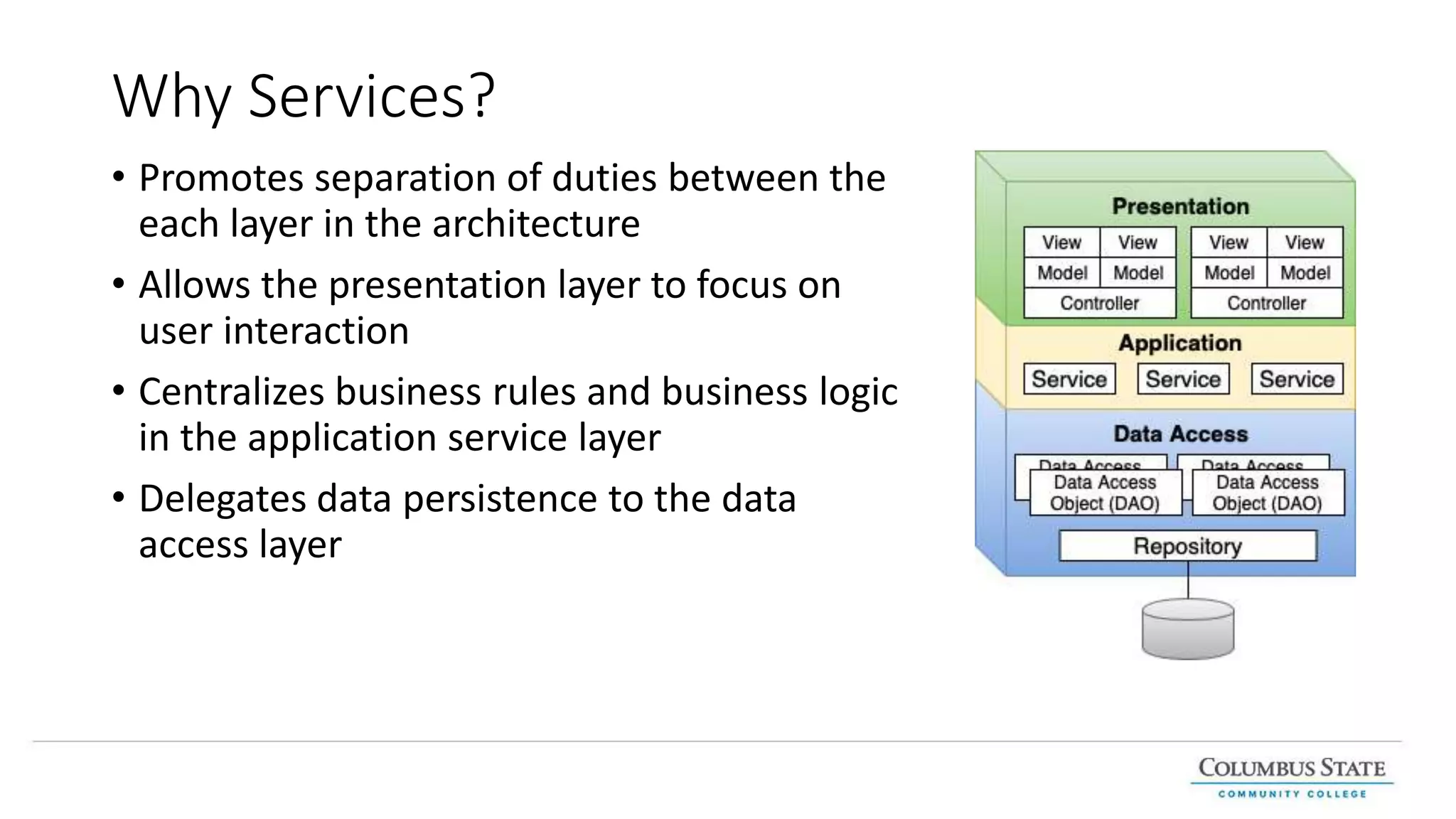
• Promotes separation of duties between the
each layer in the architecture
• Allows the presentation layer to focus on
user interaction
• Centralizes business rules and business logic
in the application service layer
• Delegates data persistence to the data
access layer
Web Services
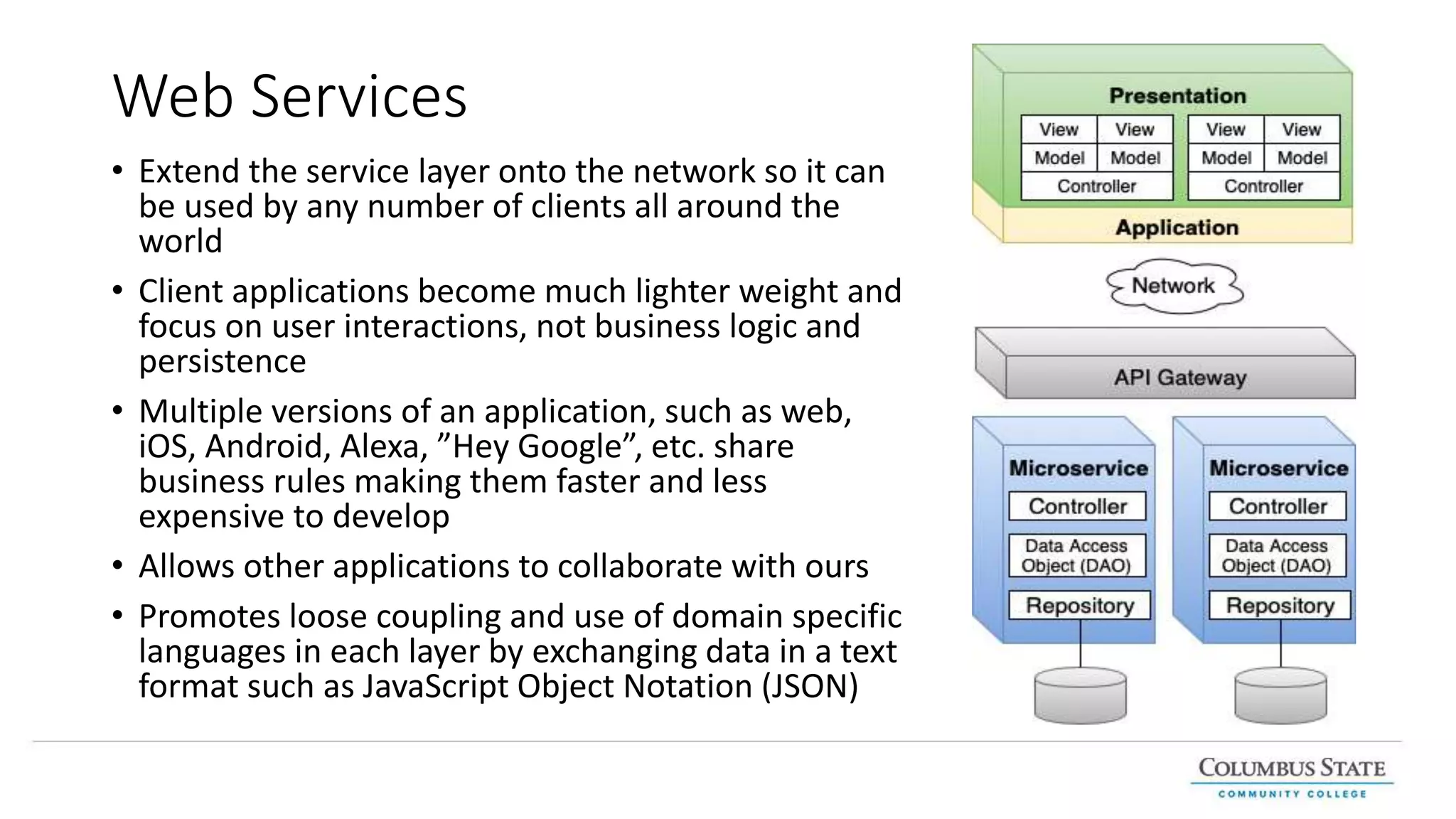
• Extend the service layer onto the network so it can
be used by any number of clients all around the
world
• Client applications become much lighter weight and
focus on user interactions, not business logic and
persistence
• Multiple versions of an application, such as web,
iOS, Android, Alexa, ”Hey Google”, etc. share
business rules making them faster and less
expensive to develop
• Allows other applications to collaborate with ours
• Promotes loose coupling and use of domain specific
languages in each layer by exchanging data in a text
format such as JavaScript Object Notation (JSON)
Microservices
“In short, the microservice architectural style is an approach to
developing a single application as a suite of small services, each
running in its own process and communicating with lightweight
mechanisms, often an HTTP resource API. These services are built
around business capabilities and independently deployable by fully
automated deployment machinery. There is a bare minimum of
centralized management of these services, which may be written in
different programming languages and use different data storage
technologies.”
-- James Lewis and Martin Fowler
https://martinfowler.com/microservices/
Simple Object Access Protocol
(SOAP)
Types of Webservices
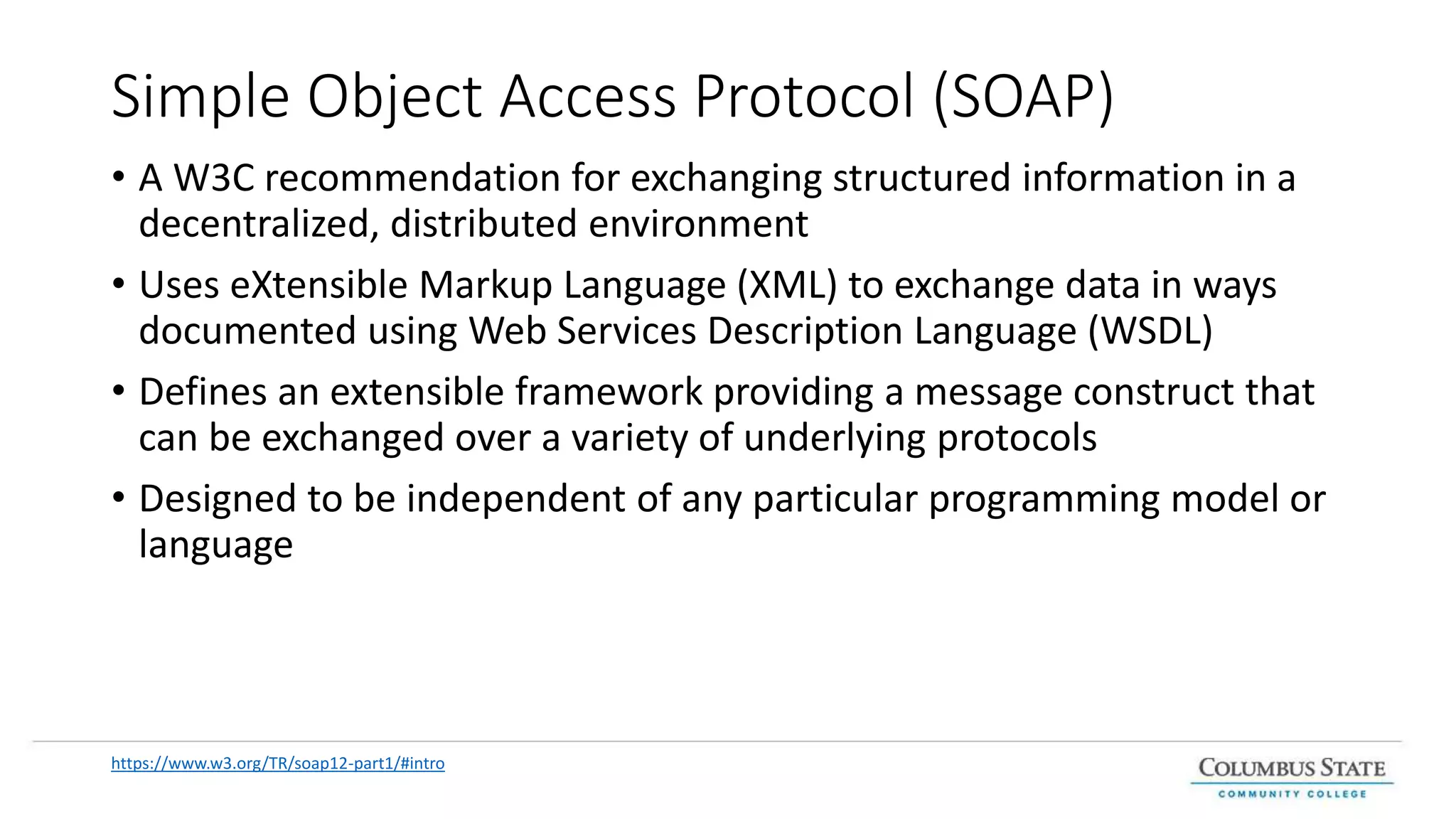
Simple Object Access Protocol (SOAP)
• A W3C recommendation for exchanging structured information in a
decentralized, distributed environment
• Uses eXtensible Markup Language (XML) to exchange data in ways
documented using Web Services Description Language (WSDL)
• Defines an extensible framework providing a message construct that
can be exchanged over a variety of underlying protocols
• Designed to be independent of any particular programming model or
language
https://www.w3.org/TR/soap12-part1/#intro
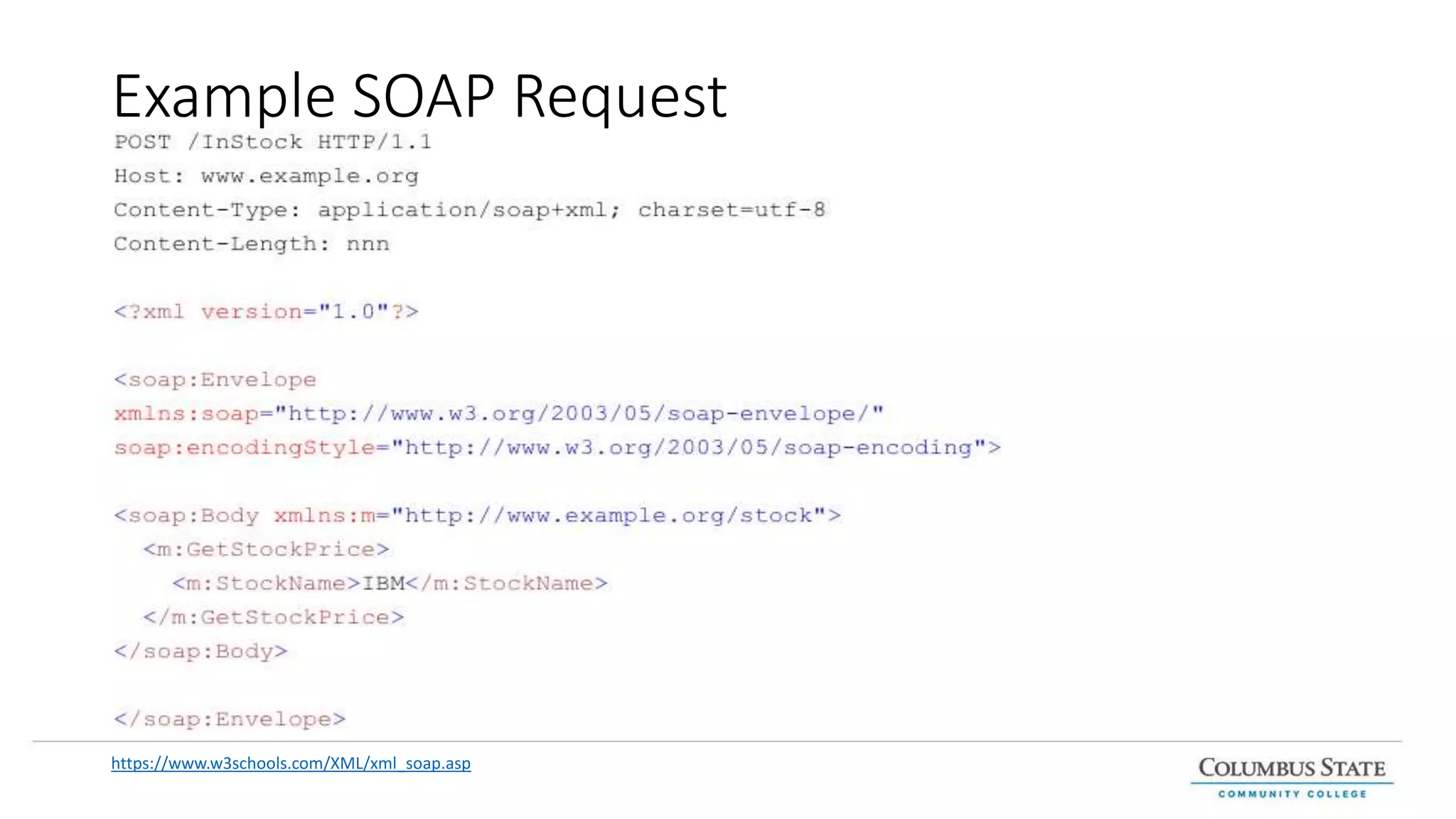
Example SOAP Request
https://www.w3schools.com/XML/xml_soap.asp
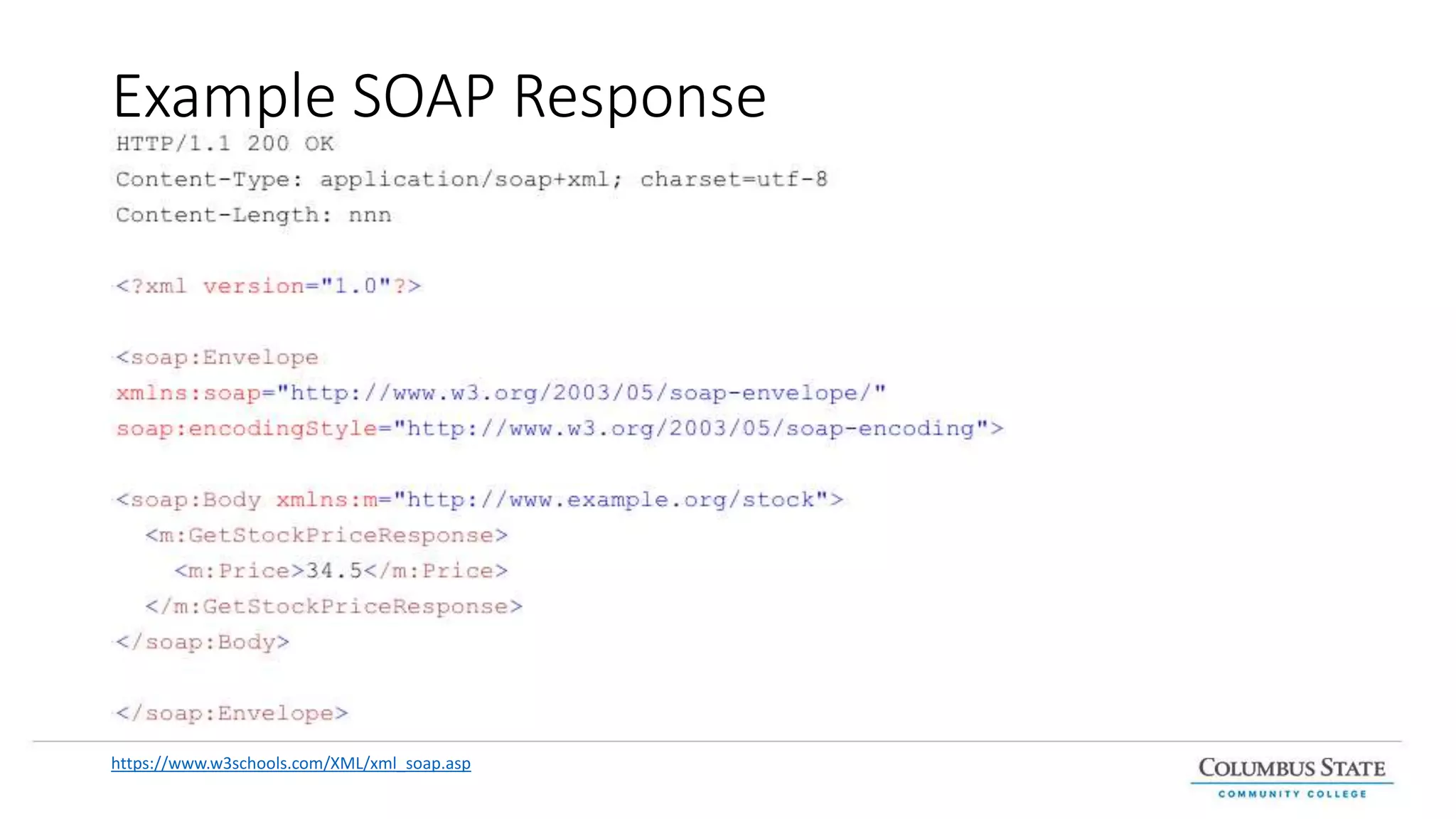
Example SOAP Response
https://www.w3schools.com/XML/xml_soap.asp
Challenges With SOAP Services
• XML parsing is complex and can be slow to process
• The Extensible Stylesheet Language (XSL) and XML Path Language
(XPath) assist with transforming XML but add another level of
complexity
• The WSDL can be used to generate code for working with SOAP web
services but versioning becomes a problem when the WSDL needs to
change
• While SOAP may be simpler than it’s predecessors, it is way more
complex than it’s name would imply
• In most organizations, SOAP web services are consider ”legacy” code
REpresentational State Transfer
(REST)
Types of Webservices
Representational State Transfer (REST)
• A network based architectural style for proposed by Roy Thomas
Fielding in his PhD Dissertation at the University of California in 2000
• A stateless, cacheable, client-server based architectural style for
building distributed applications at internet scale
• Uses HTTP as the application-level protocol for communication and
transfer of resource representations
• Resources can be represented any number of ways, such as XML or
JSON, and are negotiated via “accept” and “content-type” headers
• Actions to be performed are articulated through HTTP methods with
success or failure denoted by HTTP status codes
https://www.ics.uci.edu/~fielding/pubs/dissertation/top.htm
Principles of REST
• Resources expose easily understood directory structure URIs.
• Representations transfer JSON or XML to represent data objects and
attributes.
• Messages use HTTP methods explicitly (for example, GET, POST, PUT,
and DELETE).
• Stateless interactions store no client context on the server between
requests. State dependencies limit and restrict scalability. The client
holds session state.
https://spring.io/understanding/rest#principles-of-rest
Resources
REST Webservices
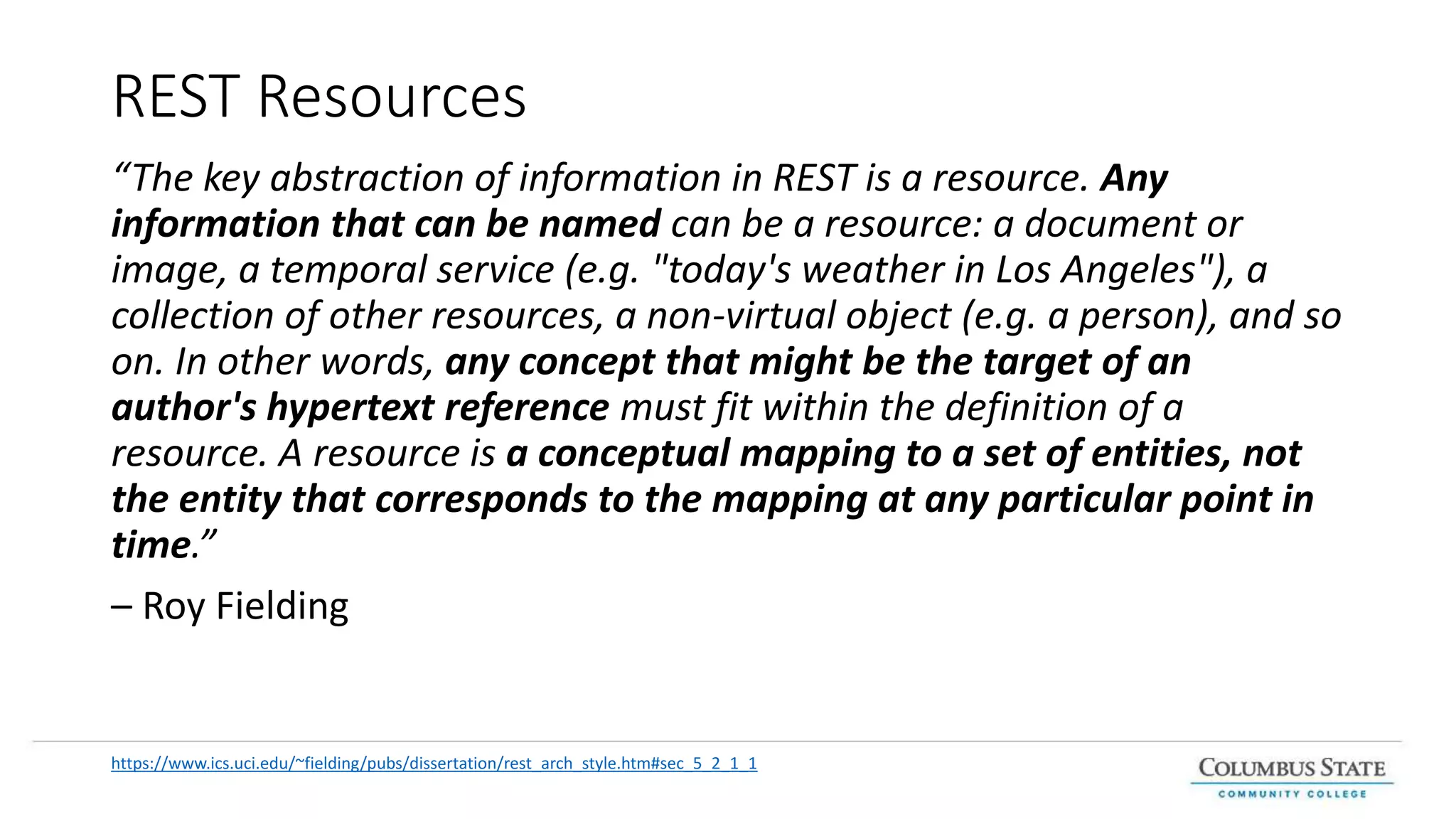
REST Resources
“The key abstraction of information in REST is a resource. Any
information that can be named can be a resource: a document or
image, a temporal service (e.g. "today's weather in Los Angeles"), a
collection of other resources, a non-virtual object (e.g. a person), and so
on. In other words, any concept that might be the target of an
author's hypertext reference must fit within the definition of a
resource. A resource is a conceptual mapping to a set of entities, not
the entity that corresponds to the mapping at any particular point in
time.”
– Roy Fielding
https://www.ics.uci.edu/~fielding/pubs/dissertation/rest_arch_style.htm#sec_5_2_1_1
Uniform Resource Identifier (URI)
• http://www.ietf.org/rfc/rfc2396.txt
• tel:+1-816-555-1212
• mailto:John.Doe@example.com
• ftp://ftp.is.co.za/rfc/rfc1808.txt
• ldap://[2001:db8::7]/c=GB?objectClass?one
• urn:oasis:names:specification:docbook:dtd:xml:4.1.2
https://tools.ietf.org/html/rfc3986#section-1.1.2
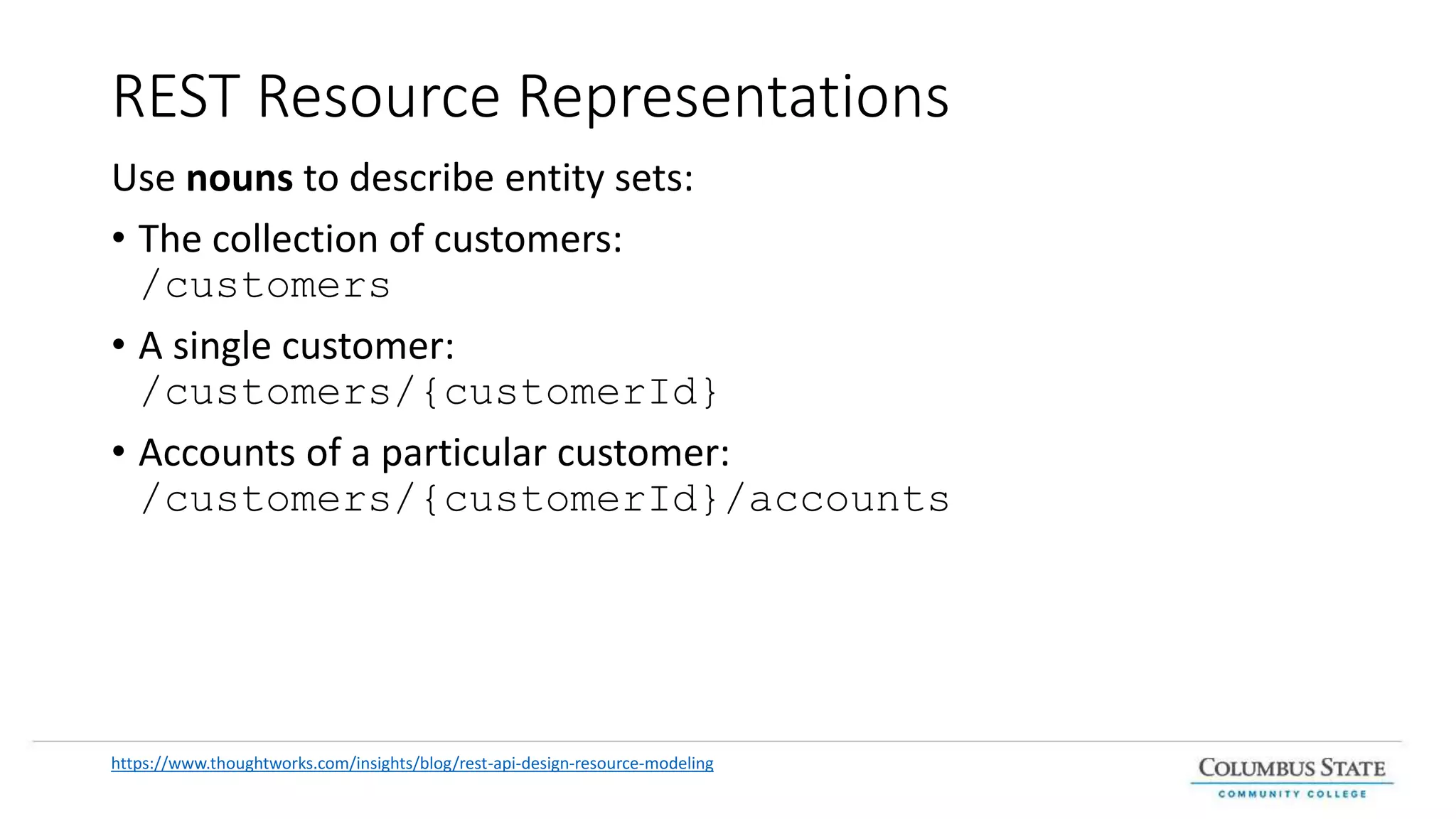
REST Resource Representations
Use nouns to describe entity sets:
• The collection of customers:
/customers
• A single customer:
/customers/{customerId}
• Accounts of a particular customer:
/customers/{customerId}/accounts
https://www.thoughtworks.com/insights/blog/rest-api-design-resource-modeling
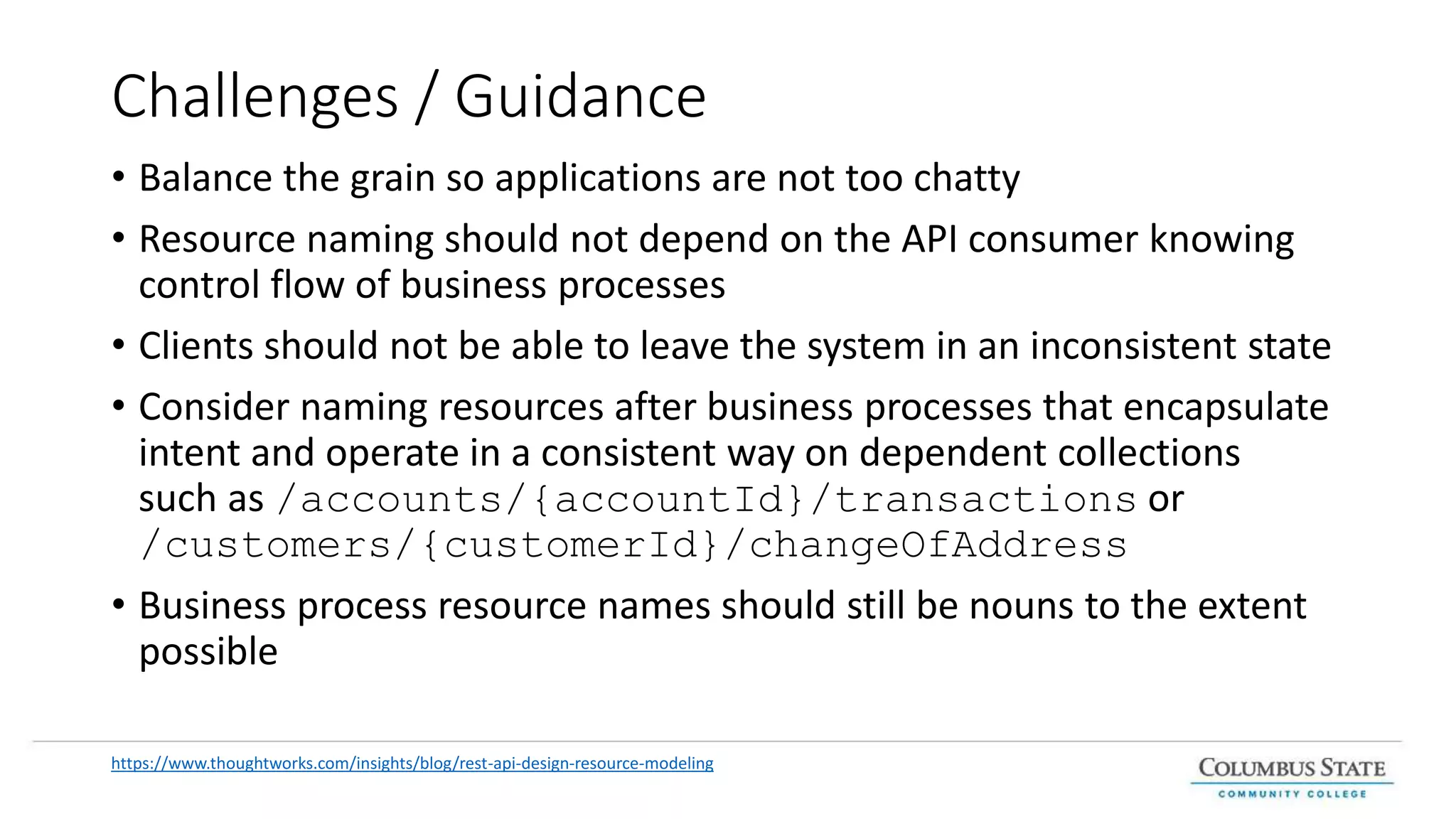
Challenges / Guidance
• Balance the grain so applications are not too chatty
• Resource naming should not depend on the API consumer knowing
control flow of business processes
• Clients should not be able to leave the system in an inconsistent state
• Consider naming resources after business processes that encapsulate
intent and operate in a consistent way on dependent collections
such as /accounts/{accountId}/transactions or
/customers/{customerId}/changeOfAddress
• Business process resource names should still be nouns to the extent
possible
https://www.thoughtworks.com/insights/blog/rest-api-design-resource-modeling
HTTP Methods
Invoking REST Services
Safe Methods
• Safe means GET and HEAD methods should only retrieve data with no
significant side effects
• This enables other methods, such as POST, PUT and DELETE to be
special in a way the user would expect that a possibly unsafe action is
being requested
https://tools.ietf.org/html/rfc2616#section-9.1.1
Idempotent Methods
• Idempotent means, aside from error or expiration issues, the side-
effects of N > 0 (multiple) identical requests is the same as for N = 1 (a
single) request
• GET, HEAD, PUT and DELETE are idempotent
• OPTIONS and TRACE SHOULD NOT have side effects, and so are
inherently idempotent
https://tools.ietf.org/html/rfc2616#section-9.1.2
GET
Retrieve whatever information (in the form of an entity) identified by
the Request-URI. Example: Retrieve an address with an ID of 1:
GET /addresses/1
• GET can be conditional if the request includes an If-Modified-Since,
If-Unmodified-Since, If-Match, If-None-Match, or If-Range header
field
• GET can be partial if the request includes a Range header field or
request parameters for limiting results
• Responses are cacheable to reduce latency and network traffic
• Using request headers, the client can request uncached data
https://tools.ietf.org/html/rfc7231#section-4.3.1
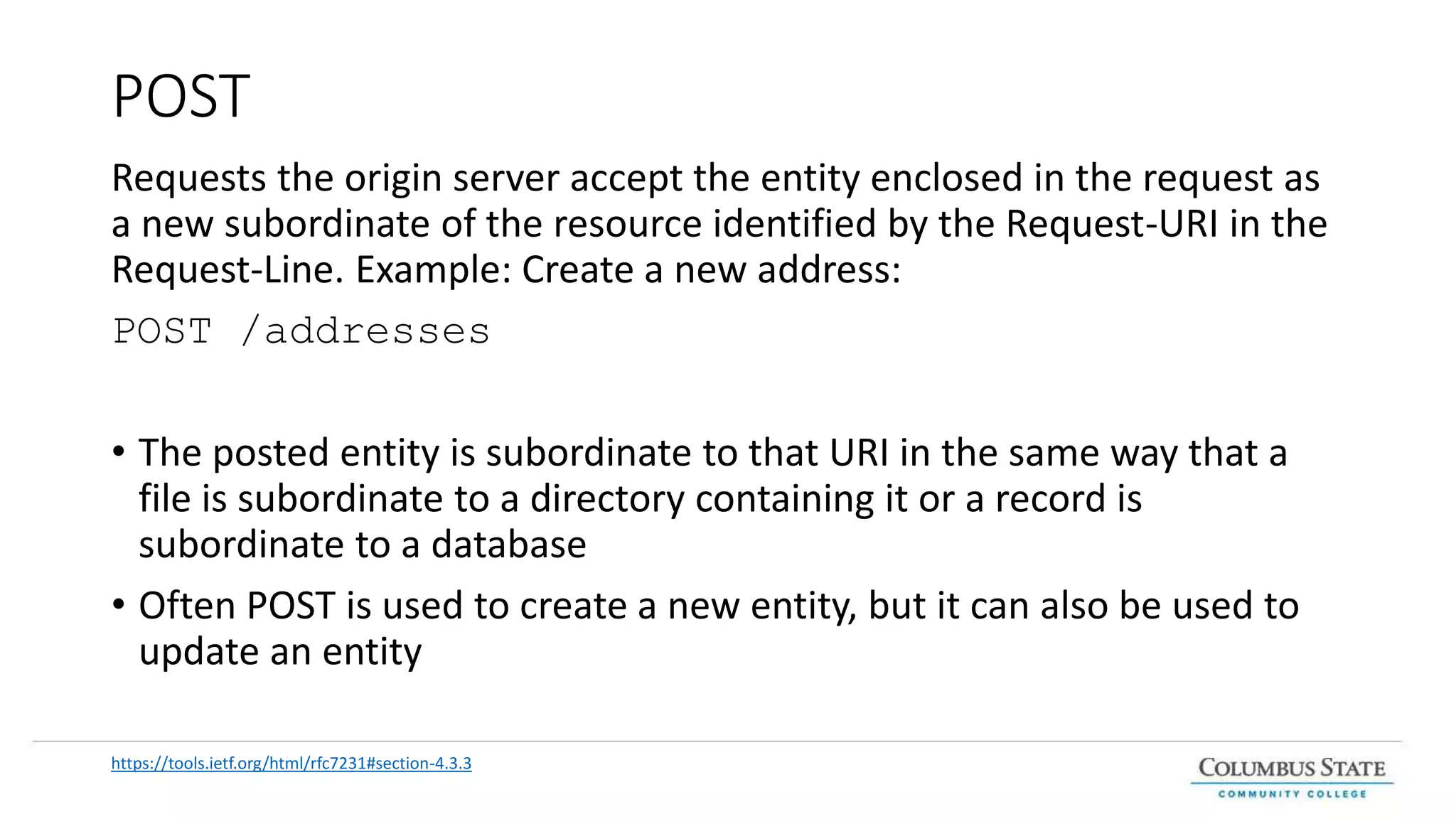
POST
Requests the origin server accept the entity enclosed in the request as
a new subordinate of the resource identified by the Request-URI in the
Request-Line. Example: Create a new address:
POST /addresses
• The posted entity is subordinate to that URI in the same way that a
file is subordinate to a directory containing it or a record is
subordinate to a database
• Often POST is used to create a new entity, but it can also be used to
update an entity
https://tools.ietf.org/html/rfc7231#section-4.3.3
PUT
Requests the enclosed entity be stored under the supplied Request-URI. Example:
create or modify the address with an ID of 1:
PUT /addresses/1
• If the Request-URI refers to an already existing resource, the enclosed entity
SHOULD be considered as a modified version of the one residing on the origin
server
• If the Request-URI does not point to an existing resource, and that URI is capable
of being defined as a new resource by the requesting user agent, the origin server
can create the resource with that URI
• A PUT request is idempotent which is the main difference between the
expectations of PUT versus a POST request
• PUT replaces an existing entity. If only a subset of data elements are provided,
the rest will be replaced with empty or null
https://tools.ietf.org/html/rfc7231#section-4.3.4
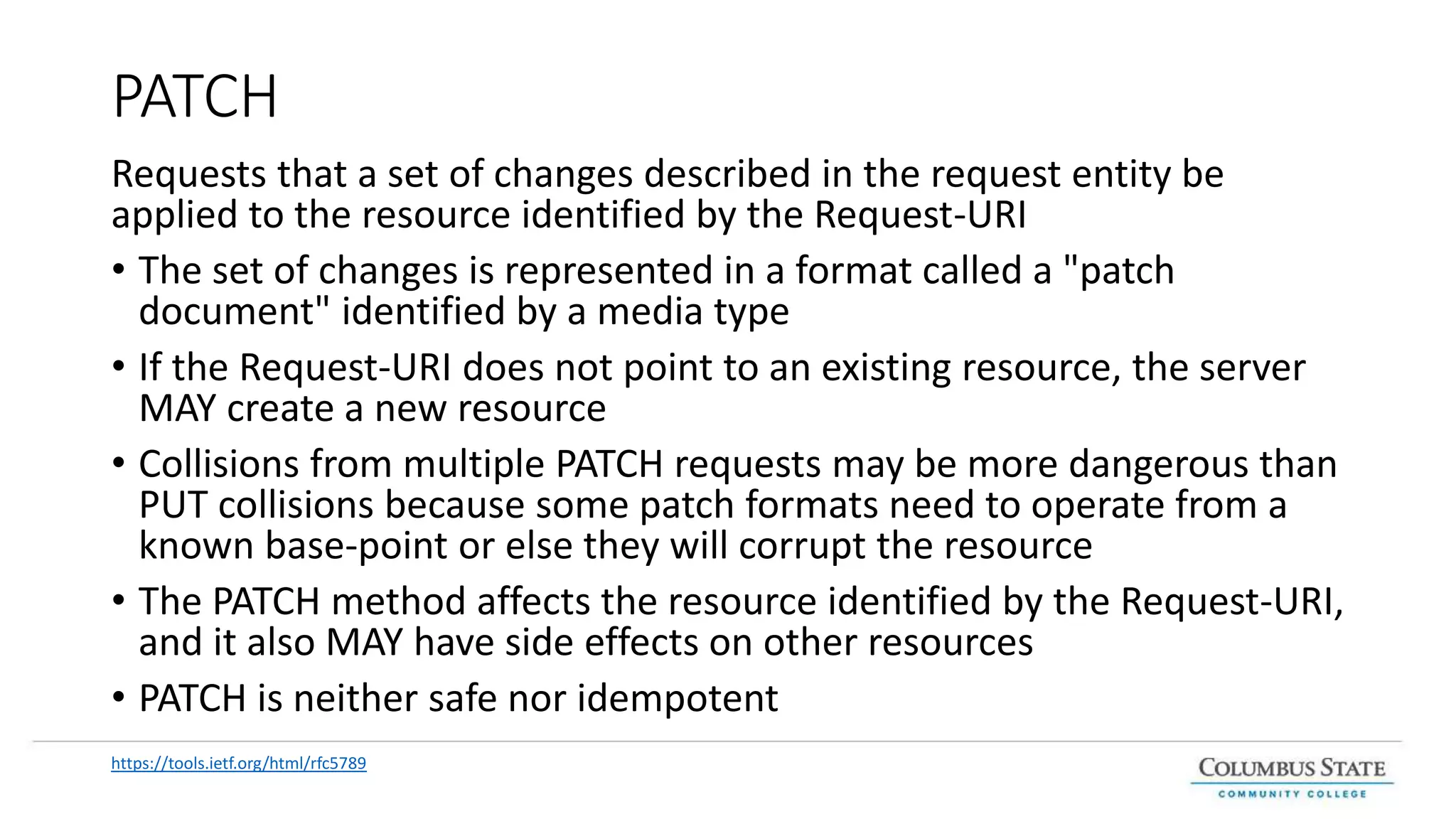
PATCH
Requests that a set of changes described in the request entity be
applied to the resource identified by the Request-URI
• The set of changes is represented in a format called a "patch
document" identified by a media type
• If the Request-URI does not point to an existing resource, the server
MAY create a new resource
• Collisions from multiple PATCH requests may be more dangerous than
PUT collisions because some patch formats need to operate from a
known base-point or else they will corrupt the resource
• The PATCH method affects the resource identified by the Request-URI,
and it also MAY have side effects on other resources
• PATCH is neither safe nor idempotent
https://tools.ietf.org/html/rfc5789
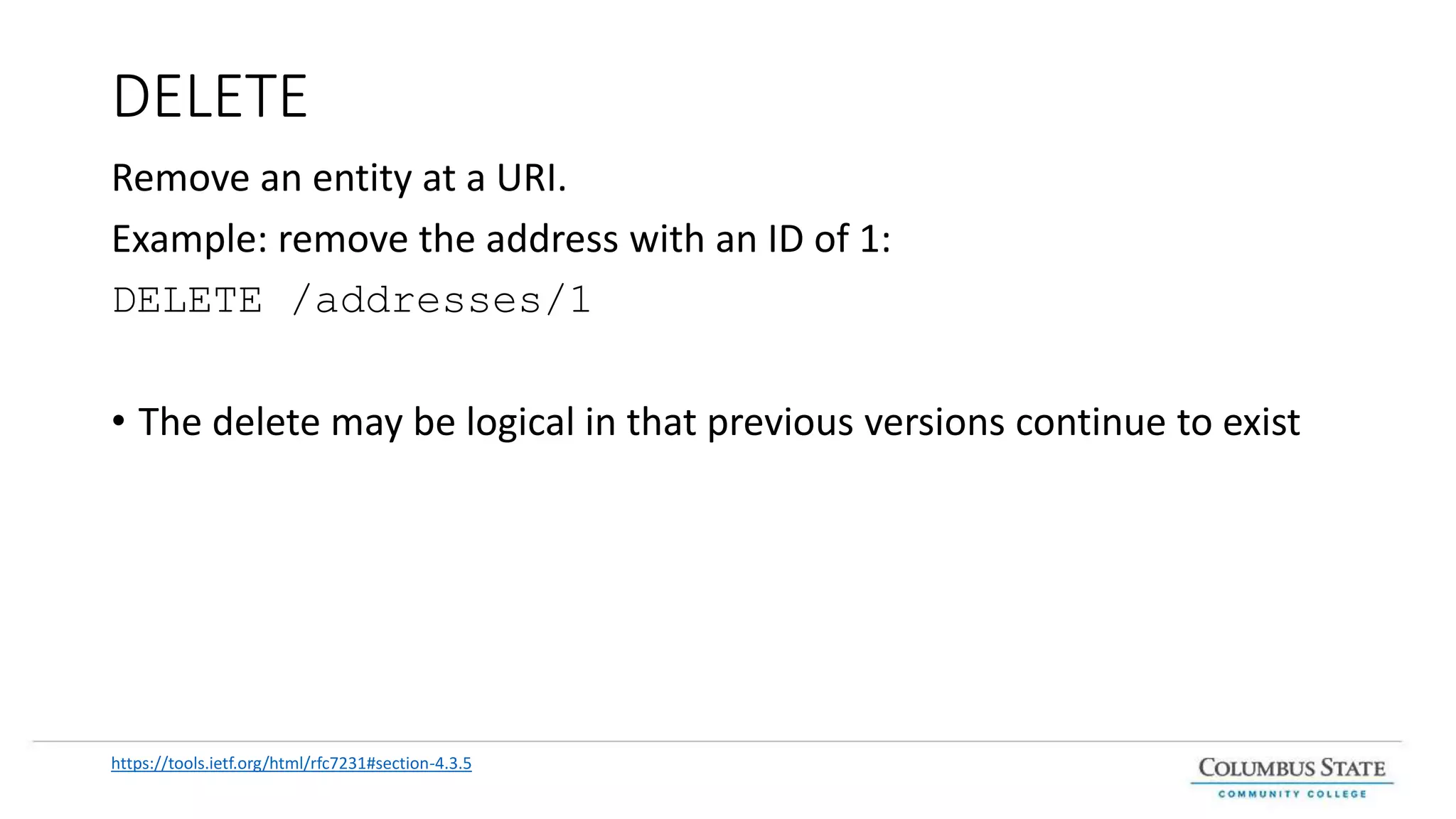
DELETE
Remove an entity at a URI.
Example: remove the address with an ID of 1:
DELETE /addresses/1
• The delete may be logical in that previous versions continue to exist
https://tools.ietf.org/html/rfc7231#section-4.3.5
HTTP Status Codes
Invoking REST Services
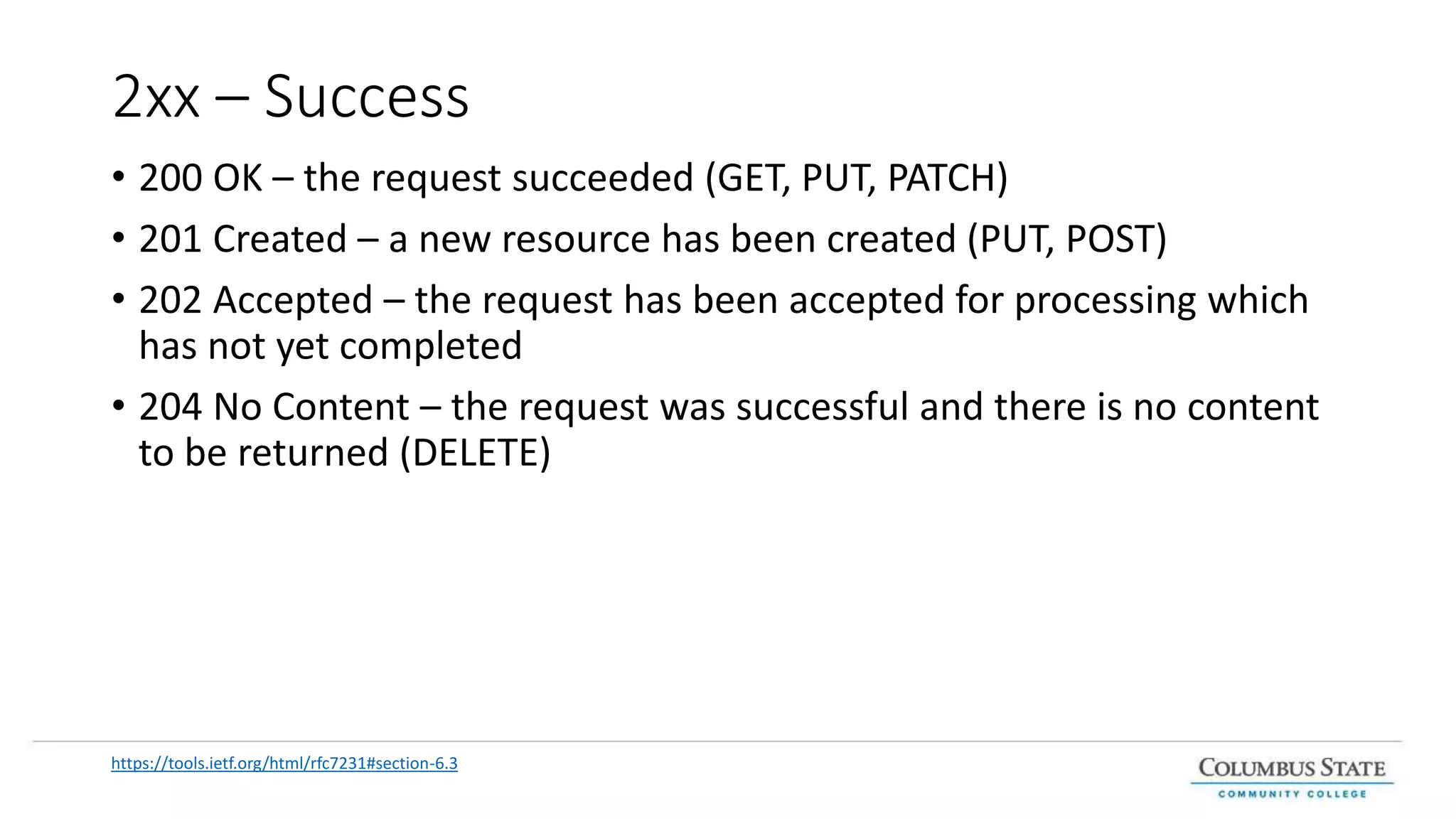
2xx – Success
• 200 OK – the request succeeded (GET, PUT, PATCH)
• 201 Created – a new resource has been created (PUT, POST)
• 202 Accepted – the request has been accepted for processing which
has not yet completed
• 204 No Content – the request was successful and there is no content
to be returned (DELETE)
https://tools.ietf.org/html/rfc7231#section-6.3
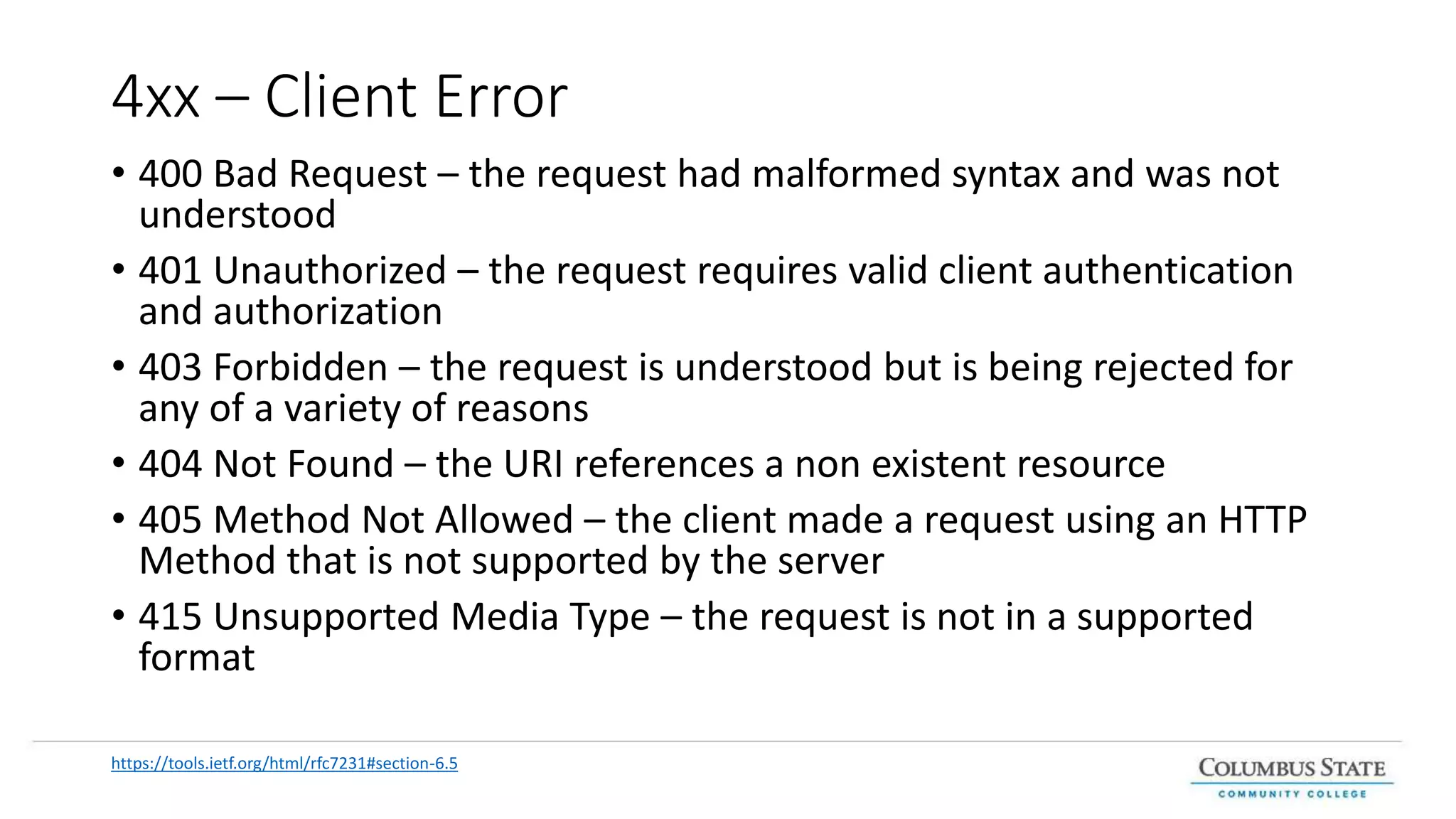
4xx – Client Error
• 400 Bad Request – the request had malformed syntax and was not
understood
• 401 Unauthorized – the request requires valid client authentication
and authorization
• 403 Forbidden – the request is understood but is being rejected for
any of a variety of reasons
• 404 Not Found – the URI references a non existent resource
• 405 Method Not Allowed – the client made a request using an HTTP
Method that is not supported by the server
• 415 Unsupported Media Type – the request is not in a supported
format
https://tools.ietf.org/html/rfc7231#section-6.5
500 – Server Error
• 500 Internal Server Error – an unexpected error prevented the
request from being fulfilled
• 503 Service Unavailable – The server is down or overloaded and
unable to handle the request
https://tools.ietf.org/html/rfc7231#section-6.6
Cross-Origin Resource Sharing
(CORS)
Using REST Services
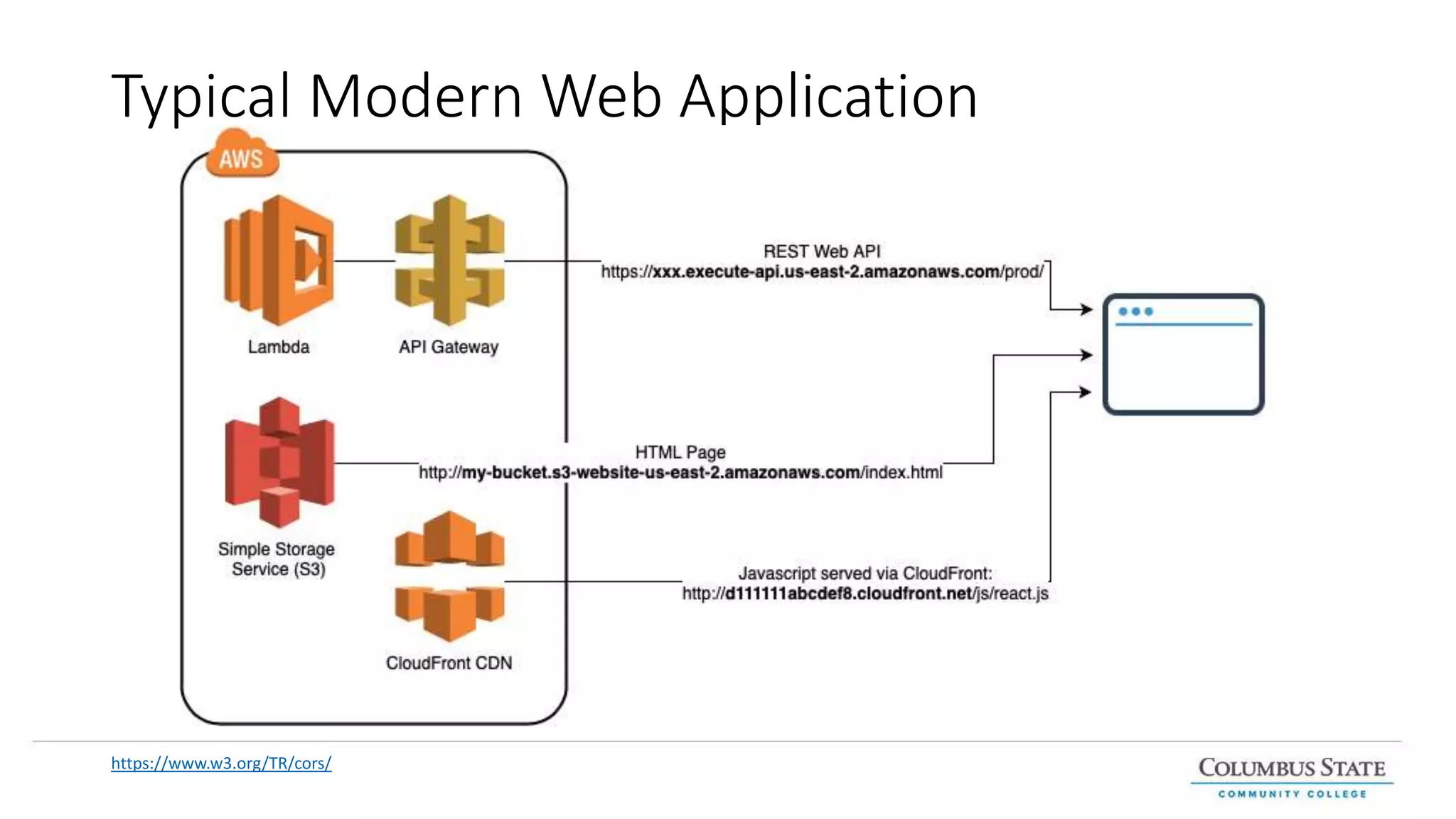
Typical Modern Web Application
https://www.w3.org/TR/cors/
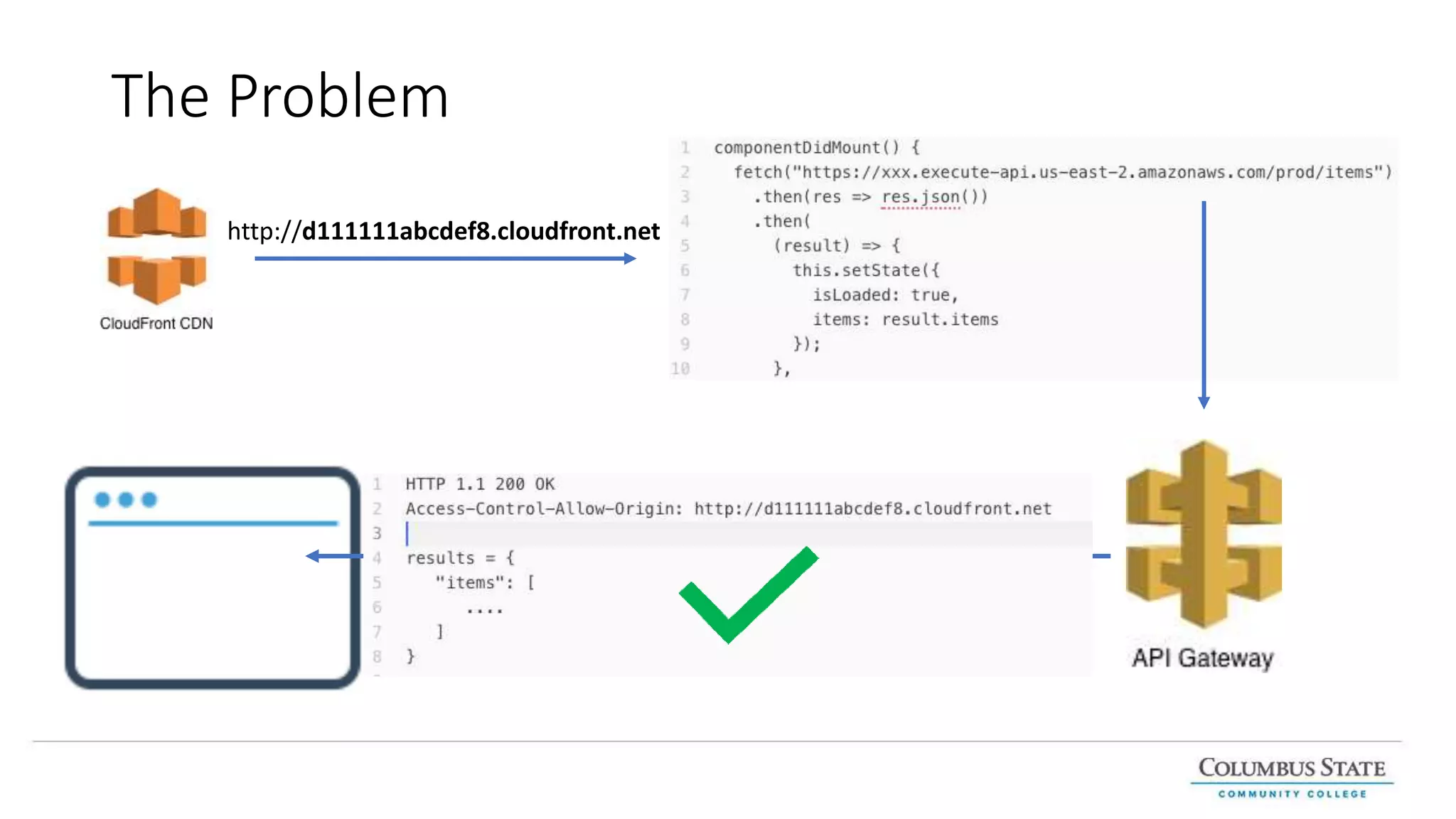
The Problem
http://d111111abcdef8.cloudfront.net
Hypermedia As The Engine Of
Application State (HATEOAS)
Designing REST Services
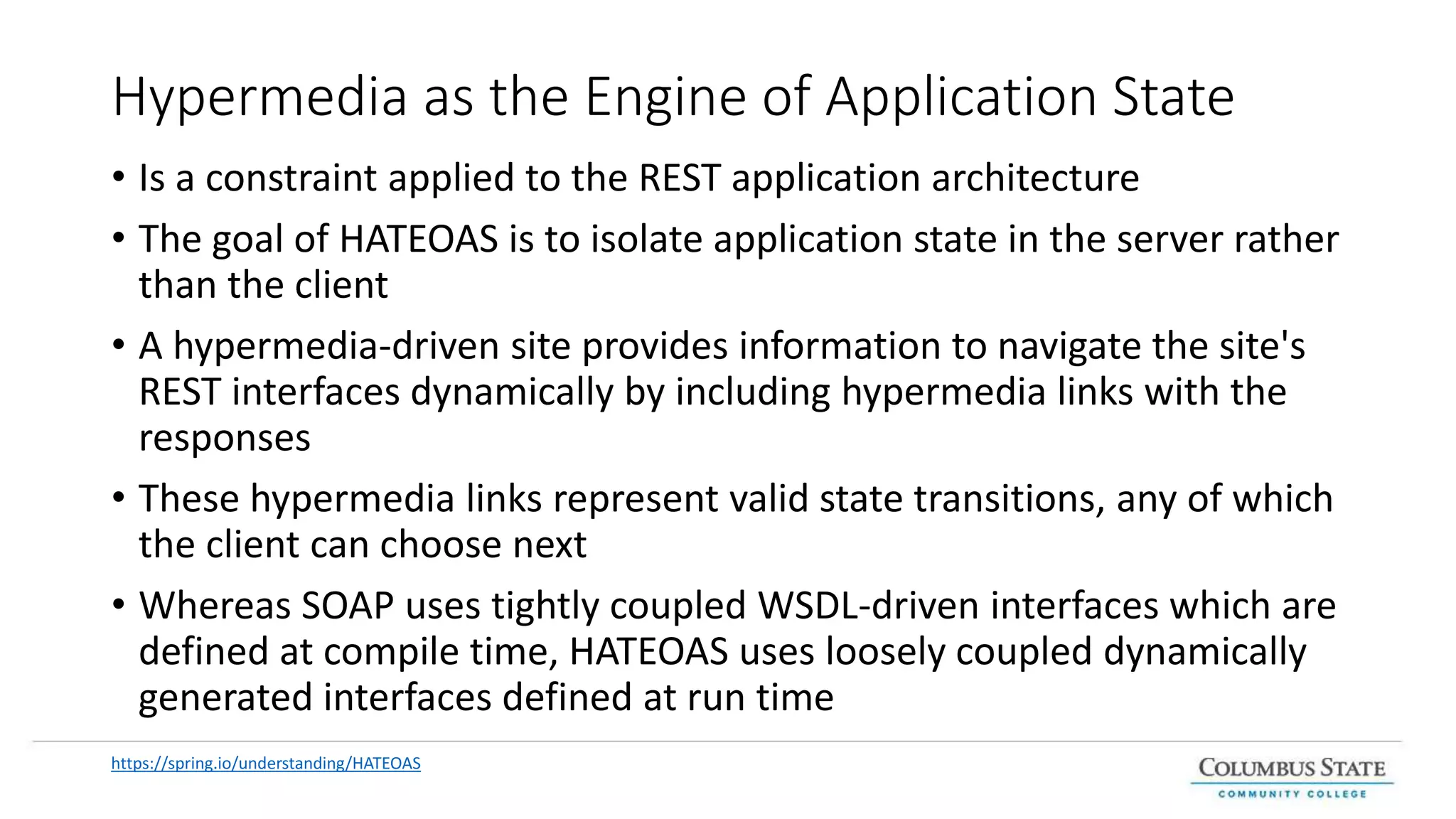
Hypermedia as the Engine of Application State
• Is a constraint applied to the REST application architecture
• The goal of HATEOAS is to isolate application state in the server rather
than the client
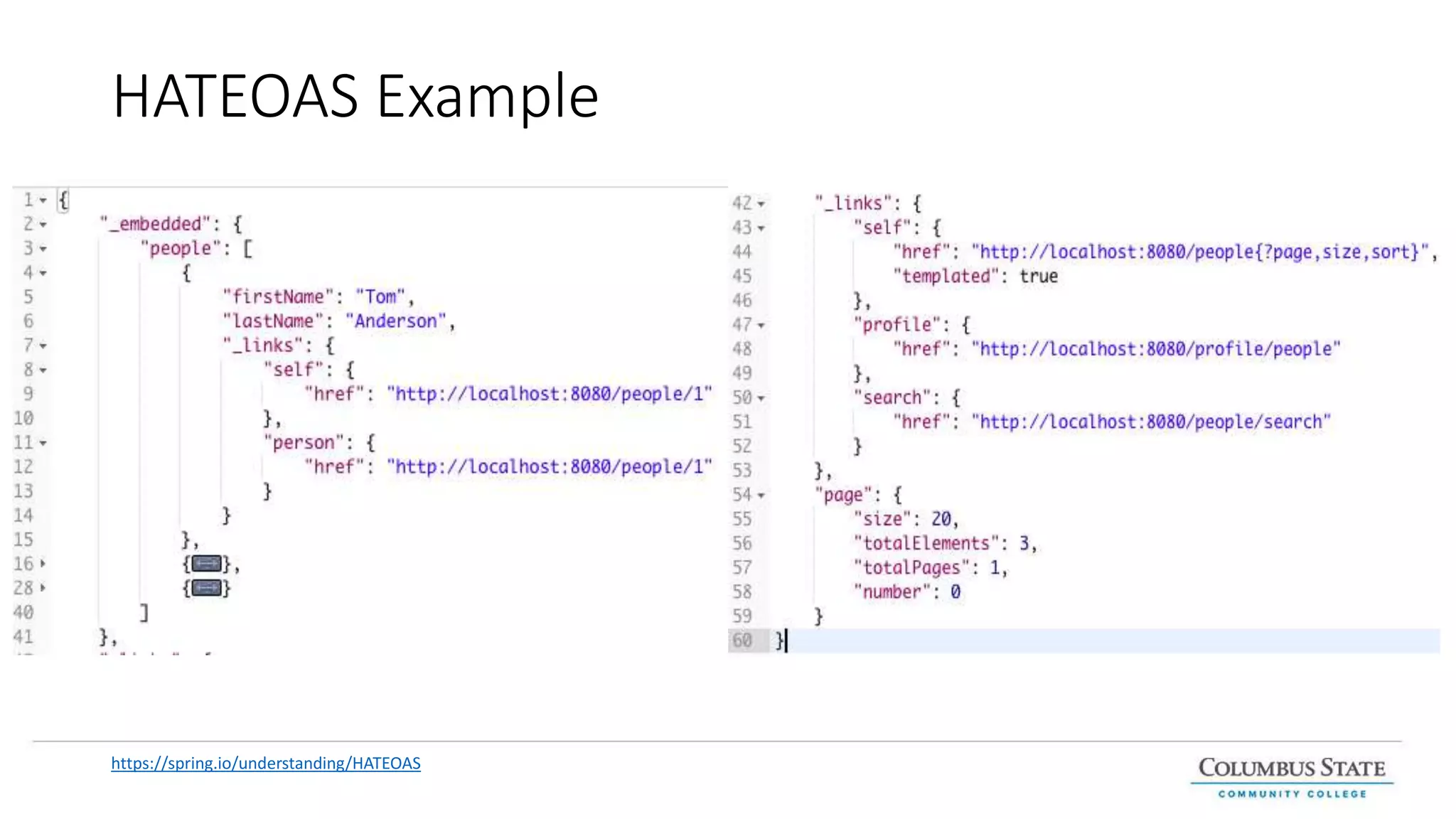
• A hypermedia-driven site provides information to navigate the site's
REST interfaces dynamically by including hypermedia links with the
responses
• These hypermedia links represent valid state transitions, any of which
the client can choose next
• Whereas SOAP uses tightly coupled WSDL-driven interfaces which are
defined at compile time, HATEOAS uses loosely coupled dynamically
generated interfaces defined at run time
https://spring.io/understanding/HATEOAS
HATEOAS Example
https://spring.io/understanding/HATEOAS
Where To Go For More
Webservices
Further Reading
• Understanding REST from the Spring website
• REST API Design – Resource Modeling by Prakash Subramaniam
• Understanding HATEOAS from the Spring website
• Richardson Maturity Model by Martin Fowler
• GitHub API Documentation
• Architectural Styles and the Design of Network-based Software
Architectures by Roy Fielding
• RFC 7231, Hypertext Transfer Protocol
• Cross-Origin Resource Sharing by W3C

Introduction to Web Services

  • 1.
    Introduction to WebServices Jeff Anderson janderson141@cscc.edu Center for Workforce Development
  • 2.
    Why Services? • Promotesseparation of duties between the each layer in the architecture • Allows the presentation layer to focus on user interaction • Centralizes business rules and business logic in the application service layer • Delegates data persistence to the data access layer
  • 3.
    Web Services • Extendthe service layer onto the network so it can be used by any number of clients all around the world • Client applications become much lighter weight and focus on user interactions, not business logic and persistence • Multiple versions of an application, such as web, iOS, Android, Alexa, ”Hey Google”, etc. share business rules making them faster and less expensive to develop • Allows other applications to collaborate with ours • Promotes loose coupling and use of domain specific languages in each layer by exchanging data in a text format such as JavaScript Object Notation (JSON)
  • 4.
    Microservices “In short, themicroservice architectural style is an approach to developing a single application as a suite of small services, each running in its own process and communicating with lightweight mechanisms, often an HTTP resource API. These services are built around business capabilities and independently deployable by fully automated deployment machinery. There is a bare minimum of centralized management of these services, which may be written in different programming languages and use different data storage technologies.” -- James Lewis and Martin Fowler https://martinfowler.com/microservices/
  • 5.
    Simple Object AccessProtocol (SOAP) Types of Webservices
  • 6.
    Simple Object AccessProtocol (SOAP) • A W3C recommendation for exchanging structured information in a decentralized, distributed environment • Uses eXtensible Markup Language (XML) to exchange data in ways documented using Web Services Description Language (WSDL) • Defines an extensible framework providing a message construct that can be exchanged over a variety of underlying protocols • Designed to be independent of any particular programming model or language https://www.w3.org/TR/soap12-part1/#intro
  • 7.
  • 8.
  • 9.
    Challenges With SOAPServices • XML parsing is complex and can be slow to process • The Extensible Stylesheet Language (XSL) and XML Path Language (XPath) assist with transforming XML but add another level of complexity • The WSDL can be used to generate code for working with SOAP web services but versioning becomes a problem when the WSDL needs to change • While SOAP may be simpler than it’s predecessors, it is way more complex than it’s name would imply • In most organizations, SOAP web services are consider ”legacy” code
  • 10.
  • 11.
    Representational State Transfer(REST) • A network based architectural style for proposed by Roy Thomas Fielding in his PhD Dissertation at the University of California in 2000 • A stateless, cacheable, client-server based architectural style for building distributed applications at internet scale • Uses HTTP as the application-level protocol for communication and transfer of resource representations • Resources can be represented any number of ways, such as XML or JSON, and are negotiated via “accept” and “content-type” headers • Actions to be performed are articulated through HTTP methods with success or failure denoted by HTTP status codes https://www.ics.uci.edu/~fielding/pubs/dissertation/top.htm
  • 12.
    Principles of REST •Resources expose easily understood directory structure URIs. • Representations transfer JSON or XML to represent data objects and attributes. • Messages use HTTP methods explicitly (for example, GET, POST, PUT, and DELETE). • Stateless interactions store no client context on the server between requests. State dependencies limit and restrict scalability. The client holds session state. https://spring.io/understanding/rest#principles-of-rest
  • 13.
  • 14.
    REST Resources “The keyabstraction of information in REST is a resource. Any information that can be named can be a resource: a document or image, a temporal service (e.g. "today's weather in Los Angeles"), a collection of other resources, a non-virtual object (e.g. a person), and so on. In other words, any concept that might be the target of an author's hypertext reference must fit within the definition of a resource. A resource is a conceptual mapping to a set of entities, not the entity that corresponds to the mapping at any particular point in time.” – Roy Fielding https://www.ics.uci.edu/~fielding/pubs/dissertation/rest_arch_style.htm#sec_5_2_1_1
  • 15.
    Uniform Resource Identifier(URI) • http://www.ietf.org/rfc/rfc2396.txt • tel:+1-816-555-1212 • mailto:John.Doe@example.com • ftp://ftp.is.co.za/rfc/rfc1808.txt • ldap://[2001:db8::7]/c=GB?objectClass?one • urn:oasis:names:specification:docbook:dtd:xml:4.1.2 https://tools.ietf.org/html/rfc3986#section-1.1.2
  • 16.
    REST Resource Representations Usenouns to describe entity sets: • The collection of customers: /customers • A single customer: /customers/{customerId} • Accounts of a particular customer: /customers/{customerId}/accounts https://www.thoughtworks.com/insights/blog/rest-api-design-resource-modeling
  • 17.
    Challenges / Guidance •Balance the grain so applications are not too chatty • Resource naming should not depend on the API consumer knowing control flow of business processes • Clients should not be able to leave the system in an inconsistent state • Consider naming resources after business processes that encapsulate intent and operate in a consistent way on dependent collections such as /accounts/{accountId}/transactions or /customers/{customerId}/changeOfAddress • Business process resource names should still be nouns to the extent possible https://www.thoughtworks.com/insights/blog/rest-api-design-resource-modeling
  • 18.
  • 19.
    Safe Methods • Safemeans GET and HEAD methods should only retrieve data with no significant side effects • This enables other methods, such as POST, PUT and DELETE to be special in a way the user would expect that a possibly unsafe action is being requested https://tools.ietf.org/html/rfc2616#section-9.1.1
  • 20.
    Idempotent Methods • Idempotentmeans, aside from error or expiration issues, the side- effects of N > 0 (multiple) identical requests is the same as for N = 1 (a single) request • GET, HEAD, PUT and DELETE are idempotent • OPTIONS and TRACE SHOULD NOT have side effects, and so are inherently idempotent https://tools.ietf.org/html/rfc2616#section-9.1.2
  • 21.
    GET Retrieve whatever information(in the form of an entity) identified by the Request-URI. Example: Retrieve an address with an ID of 1: GET /addresses/1 • GET can be conditional if the request includes an If-Modified-Since, If-Unmodified-Since, If-Match, If-None-Match, or If-Range header field • GET can be partial if the request includes a Range header field or request parameters for limiting results • Responses are cacheable to reduce latency and network traffic • Using request headers, the client can request uncached data https://tools.ietf.org/html/rfc7231#section-4.3.1
  • 22.
    POST Requests the originserver accept the entity enclosed in the request as a new subordinate of the resource identified by the Request-URI in the Request-Line. Example: Create a new address: POST /addresses • The posted entity is subordinate to that URI in the same way that a file is subordinate to a directory containing it or a record is subordinate to a database • Often POST is used to create a new entity, but it can also be used to update an entity https://tools.ietf.org/html/rfc7231#section-4.3.3
  • 23.
    PUT Requests the enclosedentity be stored under the supplied Request-URI. Example: create or modify the address with an ID of 1: PUT /addresses/1 • If the Request-URI refers to an already existing resource, the enclosed entity SHOULD be considered as a modified version of the one residing on the origin server • If the Request-URI does not point to an existing resource, and that URI is capable of being defined as a new resource by the requesting user agent, the origin server can create the resource with that URI • A PUT request is idempotent which is the main difference between the expectations of PUT versus a POST request • PUT replaces an existing entity. If only a subset of data elements are provided, the rest will be replaced with empty or null https://tools.ietf.org/html/rfc7231#section-4.3.4
  • 24.
    PATCH Requests that aset of changes described in the request entity be applied to the resource identified by the Request-URI • The set of changes is represented in a format called a "patch document" identified by a media type • If the Request-URI does not point to an existing resource, the server MAY create a new resource • Collisions from multiple PATCH requests may be more dangerous than PUT collisions because some patch formats need to operate from a known base-point or else they will corrupt the resource • The PATCH method affects the resource identified by the Request-URI, and it also MAY have side effects on other resources • PATCH is neither safe nor idempotent https://tools.ietf.org/html/rfc5789
  • 25.
    DELETE Remove an entityat a URI. Example: remove the address with an ID of 1: DELETE /addresses/1 • The delete may be logical in that previous versions continue to exist https://tools.ietf.org/html/rfc7231#section-4.3.5
  • 26.
  • 27.
    2xx – Success •200 OK – the request succeeded (GET, PUT, PATCH) • 201 Created – a new resource has been created (PUT, POST) • 202 Accepted – the request has been accepted for processing which has not yet completed • 204 No Content – the request was successful and there is no content to be returned (DELETE) https://tools.ietf.org/html/rfc7231#section-6.3
  • 28.
    4xx – ClientError • 400 Bad Request – the request had malformed syntax and was not understood • 401 Unauthorized – the request requires valid client authentication and authorization • 403 Forbidden – the request is understood but is being rejected for any of a variety of reasons • 404 Not Found – the URI references a non existent resource • 405 Method Not Allowed – the client made a request using an HTTP Method that is not supported by the server • 415 Unsupported Media Type – the request is not in a supported format https://tools.ietf.org/html/rfc7231#section-6.5
  • 29.
    500 – ServerError • 500 Internal Server Error – an unexpected error prevented the request from being fulfilled • 503 Service Unavailable – The server is down or overloaded and unable to handle the request https://tools.ietf.org/html/rfc7231#section-6.6
  • 30.
  • 31.
    Typical Modern WebApplication https://www.w3.org/TR/cors/
  • 32.
  • 33.
    Hypermedia As TheEngine Of Application State (HATEOAS) Designing REST Services
  • 34.
    Hypermedia as theEngine of Application State • Is a constraint applied to the REST application architecture • The goal of HATEOAS is to isolate application state in the server rather than the client • A hypermedia-driven site provides information to navigate the site's REST interfaces dynamically by including hypermedia links with the responses • These hypermedia links represent valid state transitions, any of which the client can choose next • Whereas SOAP uses tightly coupled WSDL-driven interfaces which are defined at compile time, HATEOAS uses loosely coupled dynamically generated interfaces defined at run time https://spring.io/understanding/HATEOAS
  • 35.
  • 36.
    Where To GoFor More Webservices
  • 37.
    Further Reading • UnderstandingREST from the Spring website • REST API Design – Resource Modeling by Prakash Subramaniam • Understanding HATEOAS from the Spring website • Richardson Maturity Model by Martin Fowler • GitHub API Documentation • Architectural Styles and the Design of Network-based Software Architectures by Roy Fielding • RFC 7231, Hypertext Transfer Protocol • Cross-Origin Resource Sharing by W3C

Editor's Notes

  • #16 A Uniform Resource Identifier (URI) is a compact sequence of characters that identifies an abstract or physical resource It allows different types of resource identifiers to be used in the same context, even when the mechanisms used to access those resources may differ The term "resource" is used in a general sense for whatever might be identified by a URI such as an electronic document, an image, a web page Each URI begins with a scheme name that refers to a specification for assigning identifiers within that scheme
  • #22 A conditional GET method requests that the entity be transferred only under the circumstances described by the conditional header field(s). The conditional GET method is intended to reduce unnecessary network usage by allowing cached entities to be refreshed without requiring multiple requests or transferring data already held by the client. A partial GET requests that only part of the entity be transferred, as described in section 14.35. The partial GET method is intended to reduce unnecessary network usage by allowing partially-retrieved entities to be completed without transferring data already held by the client. The response to a GET request is cacheable if and only if it meets the requirements for HTTP caching described in section 13 of the HTTP specification
  • #25 In a PUT request, the enclosed entity is considered to be a modified version of the resource stored on the origin server, and the client is requesting that the stored version be replaced. With PATCH, however, the enclosed entity contains a set of instructions describing how a resource currently residing on the origin server should be modified to produce a new version
  • #26  Delete is also expected to be idempotent in that subsequent delete requests for a given resource are ignored.
  • #32 Index.html served from S3 includes Javascript from Cloudfront (different domain) that wants to pull content from API gateway on a 3rd domain. CORS would block access to the API gateway content from the Javascript