ADVANCED DIGITAL
SIGNAL
PROCESSING
(CECNG-522)
13-07-2022 1
‘SIMULATION OF QMF(QUADRATURE MIRROR FILTER)
BANK
USING MATLAB SOFTWARE
SUBMITTED TO:
PROF. DR. K . ANUSUDHA
SUBMITTED BY:
MOHAMMAD HANNAN(21304014)
M-TECH ELECTRONICS AND COMMUNICATION ENGINEERING
DEPARTMENT OF ELECTRONICS ENGINEERING
SCHOOL OF ENGINEERING AND TECHNOLOGY
PONDICHERRY UNIVERSITY , KALAPET
PUDUCHERRY-605014
13-07-2022 2
Quadrature-Mirror Filter
Bank
 In many applications, a discrete-time signal x[n] is
split into a number of sub-band signals by
means of an analysis filter bank
 The sub-band signals are then processed
 Finally, the processed sub-band signals are combined
by a synthesis filter bank resulting in an output signal
y[n]
 If the sub-band signals are band limited to
frequency ranges much smaller than that of the
original input signal x[n], they can be down-sampled
before processing
 Because of the lower sampling rate, the processing of
the down-sampled signals can be carried out more
efficiently
]}
[
{ n
vk
]}
[
{ n
vk
13-07-2022 3
 After processing, these signals are then up-sampled
before being combined by the synthesis filter bank
into a higher-rate signal
 The combined structure is called a quadrature-mirror
filter (QMF) bank
 If the down-sampling and up-sampling factors are
equal to or greater than the number of bands of the
filter bank, then the output y[n] can be made to retain
some or all of the characteristics of the input signal
x[n] by choosing appropriately the filters in the
structure
 If the up-sampling and down-sampling factors are
equal to the number of bands, then the structure is
called a critically sampled filter bank
 The most common application of this scheme is in the
efficient coding of a signal x[n]
13-07-2022 4
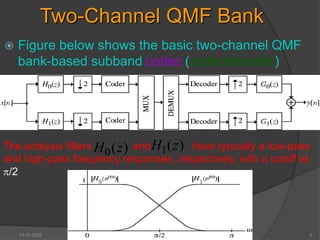
Two-Channel QMF Bank
 Figure below shows the basic two-channel QMF
bank-based subband codec (coder/decoder)
The analysis filters and have typically a low-pass
and high-pass frequency responses, respectively, with a cutoff at
p/2
)
(z
H0
)
(z
H1
13-07-2022 5
 Each down-sampled subband signal is encoded
by exploiting the special spectral properties of the
signal, such as energy levels and perceptual
importance
 It follows from the figure that the sampling rates of
the output y[n] and the input x[n] are the same
 The analysis and the synthesis filters are chosen
so as to ensure that the reconstructed output y[n]
is a reasonably close replica of the input x[n]
 Moreover, they are also designed to provide good
frequency selectivity in order to ensure that the
sum of the power of the subband signals is
reasonably close to the input signal power
13-07-2022 6
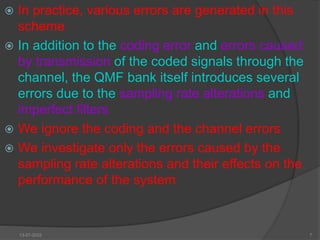
 In practice, various errors are generated in this
scheme
 In addition to the coding error and errors caused
by transmission of the coded signals through the
channel, the QMF bank itself introduces several
errors due to the sampling rate alterations and
imperfect filters
 We ignore the coding and the channel errors
 We investigate only the errors caused by the
sampling rate alterations and their effects on the
performance of the system
13-07-2022 7
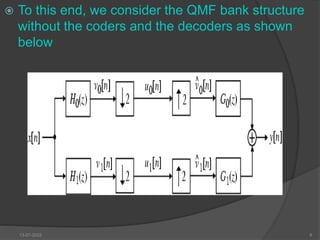
 To this end, we consider the QMF bank structure
without the coders and the decoders as shown
below
13-07-2022 8
Analysis of the Two-Channel
QMF Bank
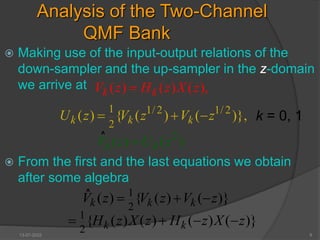
 Making use of the input-output relations of the
down-sampler and the up-sampler in the z-domain
we arrive at
 From the first and the last equations we obtain
after some algebra
),
(
)
(
)
( z
X
z
H
z
V k
k 
)},
(
)
(
{
)
( /
/ 2
1
2
1
2
1
z
V
z
V
z
U k
k
k 


)
(
)
( 2
z
U
z
V k
k 
)}
(
)
(
{
)
( z
V
z
V
z
V k
k
k 


2
1
)}
(
)
(
)
(
)
(
{ z
X
z
H
z
X
z
H k
k 



2
1
^
k = 0, 1
^
13-07-2022 9
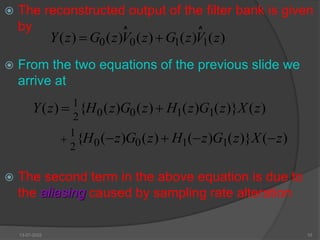
 The reconstructed output of the filter bank is given
by
 From the two equations of the previous slide we
arrive at
 The second term in the above equation is due to
the aliasing caused by sampling rate alteration
)
(
)
(
)
(
)
(
)
( z
V
z
G
z
V
z
G
z
Y 1
1
0
0 

^ ^
)
(
)}
(
)
(
)
(
)
(
{
)
( z
X
z
G
z
H
z
G
z
H
z
Y 1
1
0
0
2
1


)
(
)}
(
)
(
)
(
)
(
{ z
X
z
G
z
H
z
G
z
H 



 1
1
0
0
2
1
13-07-2022 10
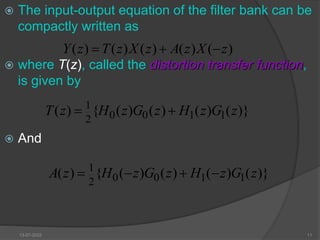
 The input-output equation of the filter bank can be
compactly written as
 where T(z), called the distortion transfer function,
is given by
 And
)
(
)
(
)
(
)
(
)
( z
X
z
A
z
X
z
T
z
Y 


)}
(
)
(
)
(
)
(
{
)
( z
G
z
H
z
G
z
H
z
T 1
1
0
0
2
1


)}
(
)
(
)
(
)
(
{
)
( z
G
z
H
z
G
z
H
z
A 1
1
0
0
2
1




13-07-2022 11
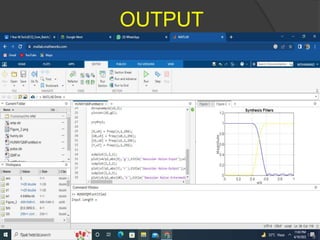
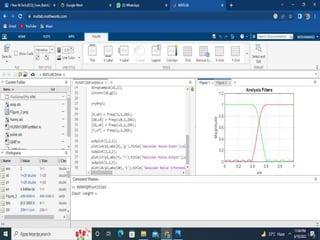
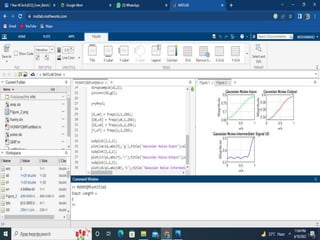
MATLAB CODE
 [N,fpts,mag,wt]=firpmord([0.395 0.605],[1 0],[0.0005
0.0005]);[q,err]=firpm(N,fpts,mag,wt);q(18)=q(18)+err;h0=firminphase(q)
;g0=fliplr(h0);k=0:17;h1=((-1).^k).*g0;g1=-((-1).^k).*h0;[H0,w0] =
freqz(h0,1,256);[H1,w1] = freqz(h1,1,256);[G0,w2] =
freqz(g0,1,256);[G1,w3] =
freqz(g1,1,256);plot(w0/pi,abs(H0),'g',w1/pi,abs(H1),'r'),title('Analysis
Filters');xlabel('omega/pi');
ylabel('Magnitude');grid;figure;plot(w2/pi,abs(G0),'b',w3/pi,abs(G1),'y'),titl
e('Synthesis Filters');grid;xlabel('omega/pi'); ylabel('Magnitude');m =
input('Input Length =
');x=randn(1,m);v0=conv(h0,x);u0=downsample(v0,2);d0=upsample(u0,
2);y0=conv(d0,g0);v1=conv(h1,x);u1=downsample(v1,2);d1=upsample(u
1,2);y1=conv(d1,g1);y=y0+y1;[X,w4] = freqz(x,1,256);[U0,w5] =
freqz(u0,1,256);[U1,w6] = freqz(u1,1,256);[Y,w7] =
freqz(y,1,256);subplot(2,2,1);plot(w4/pi,abs(X),'g'),title('Gaussian Noise-
Input');xlabel('omega/pi');
ylabel('Magnitude');grid;subplot(2,2,2);plot(w7/pi,abs(Y),'r'),title('Gaussia
n Noise-Output');xlabel('omega/pi');
ylabel('Magnitude');grid;subplot(2,2,3);plot(w5/pi,abs(U0),'b'),title('Gaussi
an Noise-Intermediate Signal U0');xlabel('omega/pi');
ylabel('Magnitude');grid;
13-07-2022 12
OUTPUT
13-07-2022 13
13-07-2022 14
13-07-2022 15
REFERENCES
 Gershenfeld, Neil (1998), The Nature of
Mathematical Modeling, Cambridge,
England: Cambridge University Press, pp.
132–135, ISBN 0521570956
 Design of Quadrature Mirror filter banks
using complex half-band filters-
https://ieeexplore.ieee.org/document/59574
13
 Quadrature mirror filter bank--
https://slideplayer.com/slide/15977224/
13-07-2022 16
THANK
YOU
13-07-2022 17

SIMULATION OF QMF FILTER Bank

  • 1.
  • 2.
    ‘SIMULATION OF QMF(QUADRATUREMIRROR FILTER) BANK USING MATLAB SOFTWARE SUBMITTED TO: PROF. DR. K . ANUSUDHA SUBMITTED BY: MOHAMMAD HANNAN(21304014) M-TECH ELECTRONICS AND COMMUNICATION ENGINEERING DEPARTMENT OF ELECTRONICS ENGINEERING SCHOOL OF ENGINEERING AND TECHNOLOGY PONDICHERRY UNIVERSITY , KALAPET PUDUCHERRY-605014 13-07-2022 2
  • 3.
    Quadrature-Mirror Filter Bank  Inmany applications, a discrete-time signal x[n] is split into a number of sub-band signals by means of an analysis filter bank  The sub-band signals are then processed  Finally, the processed sub-band signals are combined by a synthesis filter bank resulting in an output signal y[n]  If the sub-band signals are band limited to frequency ranges much smaller than that of the original input signal x[n], they can be down-sampled before processing  Because of the lower sampling rate, the processing of the down-sampled signals can be carried out more efficiently ]} [ { n vk ]} [ { n vk 13-07-2022 3
  • 4.
     After processing,these signals are then up-sampled before being combined by the synthesis filter bank into a higher-rate signal  The combined structure is called a quadrature-mirror filter (QMF) bank  If the down-sampling and up-sampling factors are equal to or greater than the number of bands of the filter bank, then the output y[n] can be made to retain some or all of the characteristics of the input signal x[n] by choosing appropriately the filters in the structure  If the up-sampling and down-sampling factors are equal to the number of bands, then the structure is called a critically sampled filter bank  The most common application of this scheme is in the efficient coding of a signal x[n] 13-07-2022 4
  • 5.
    Two-Channel QMF Bank Figure below shows the basic two-channel QMF bank-based subband codec (coder/decoder) The analysis filters and have typically a low-pass and high-pass frequency responses, respectively, with a cutoff at p/2 ) (z H0 ) (z H1 13-07-2022 5
  • 6.
     Each down-sampledsubband signal is encoded by exploiting the special spectral properties of the signal, such as energy levels and perceptual importance  It follows from the figure that the sampling rates of the output y[n] and the input x[n] are the same  The analysis and the synthesis filters are chosen so as to ensure that the reconstructed output y[n] is a reasonably close replica of the input x[n]  Moreover, they are also designed to provide good frequency selectivity in order to ensure that the sum of the power of the subband signals is reasonably close to the input signal power 13-07-2022 6
  • 7.
     In practice,various errors are generated in this scheme  In addition to the coding error and errors caused by transmission of the coded signals through the channel, the QMF bank itself introduces several errors due to the sampling rate alterations and imperfect filters  We ignore the coding and the channel errors  We investigate only the errors caused by the sampling rate alterations and their effects on the performance of the system 13-07-2022 7
  • 8.
     To thisend, we consider the QMF bank structure without the coders and the decoders as shown below 13-07-2022 8
  • 9.
    Analysis of theTwo-Channel QMF Bank  Making use of the input-output relations of the down-sampler and the up-sampler in the z-domain we arrive at  From the first and the last equations we obtain after some algebra ), ( ) ( ) ( z X z H z V k k  )}, ( ) ( { ) ( / / 2 1 2 1 2 1 z V z V z U k k k    ) ( ) ( 2 z U z V k k  )} ( ) ( { ) ( z V z V z V k k k    2 1 )} ( ) ( ) ( ) ( { z X z H z X z H k k     2 1 ^ k = 0, 1 ^ 13-07-2022 9
  • 10.
     The reconstructedoutput of the filter bank is given by  From the two equations of the previous slide we arrive at  The second term in the above equation is due to the aliasing caused by sampling rate alteration ) ( ) ( ) ( ) ( ) ( z V z G z V z G z Y 1 1 0 0   ^ ^ ) ( )} ( ) ( ) ( ) ( { ) ( z X z G z H z G z H z Y 1 1 0 0 2 1   ) ( )} ( ) ( ) ( ) ( { z X z G z H z G z H      1 1 0 0 2 1 13-07-2022 10
  • 11.
     The input-outputequation of the filter bank can be compactly written as  where T(z), called the distortion transfer function, is given by  And ) ( ) ( ) ( ) ( ) ( z X z A z X z T z Y    )} ( ) ( ) ( ) ( { ) ( z G z H z G z H z T 1 1 0 0 2 1   )} ( ) ( ) ( ) ( { ) ( z G z H z G z H z A 1 1 0 0 2 1     13-07-2022 11
  • 12.
    MATLAB CODE  [N,fpts,mag,wt]=firpmord([0.3950.605],[1 0],[0.0005 0.0005]);[q,err]=firpm(N,fpts,mag,wt);q(18)=q(18)+err;h0=firminphase(q) ;g0=fliplr(h0);k=0:17;h1=((-1).^k).*g0;g1=-((-1).^k).*h0;[H0,w0] = freqz(h0,1,256);[H1,w1] = freqz(h1,1,256);[G0,w2] = freqz(g0,1,256);[G1,w3] = freqz(g1,1,256);plot(w0/pi,abs(H0),'g',w1/pi,abs(H1),'r'),title('Analysis Filters');xlabel('omega/pi'); ylabel('Magnitude');grid;figure;plot(w2/pi,abs(G0),'b',w3/pi,abs(G1),'y'),titl e('Synthesis Filters');grid;xlabel('omega/pi'); ylabel('Magnitude');m = input('Input Length = ');x=randn(1,m);v0=conv(h0,x);u0=downsample(v0,2);d0=upsample(u0, 2);y0=conv(d0,g0);v1=conv(h1,x);u1=downsample(v1,2);d1=upsample(u 1,2);y1=conv(d1,g1);y=y0+y1;[X,w4] = freqz(x,1,256);[U0,w5] = freqz(u0,1,256);[U1,w6] = freqz(u1,1,256);[Y,w7] = freqz(y,1,256);subplot(2,2,1);plot(w4/pi,abs(X),'g'),title('Gaussian Noise- Input');xlabel('omega/pi'); ylabel('Magnitude');grid;subplot(2,2,2);plot(w7/pi,abs(Y),'r'),title('Gaussia n Noise-Output');xlabel('omega/pi'); ylabel('Magnitude');grid;subplot(2,2,3);plot(w5/pi,abs(U0),'b'),title('Gaussi an Noise-Intermediate Signal U0');xlabel('omega/pi'); ylabel('Magnitude');grid; 13-07-2022 12
  • 13.
  • 14.
  • 15.
  • 16.
    REFERENCES  Gershenfeld, Neil(1998), The Nature of Mathematical Modeling, Cambridge, England: Cambridge University Press, pp. 132–135, ISBN 0521570956  Design of Quadrature Mirror filter banks using complex half-band filters- https://ieeexplore.ieee.org/document/59574 13  Quadrature mirror filter bank-- https://slideplayer.com/slide/15977224/ 13-07-2022 16
  • 17.