Simple Present tense
By: Akbar Zaman
The basics
 Whenever we talk about simple present tense, it means that we’re talking about
something that is either a fact or is a part of someone’s habit/daily activities.
For example:
 We wash our hands with water and soap. (Here, the underlined verb, “wash”, is
talking about an actual fact.)
 He goes for a walk in the park on the weekend. (Here, the verb “goes” tells about
someone’s activities/habits)
These examples show us how the simple present tense can be used to talk about
different things.
More about simple present tense
 So, we found out that simple present tense is talks about actual facts,
statements and habits, etc., but, do we know why certain verbs in it have “s”
added to them, whilst we add “es” and “ies” to the others?
 The answer to that questions lies in the verb being used. For most verbs, we
generally add “s” at the end, but, we add “es” to verbs ending in “h”. For those
verbs that end in the letter “y”, we replace it with “ies”.
 Let’s look at some examples:
 She listens to music on her IPod.
 He fries the onions on a low flame.
 The fielder catches the ball firmly.
Simple tense with singular and plural nouns/pronouns
 The simple present tense takes on different forms, according to the
nouns/pronouns that are used with them. People often use the same verb-
form with both singular/plural nouns, which isn’t correct.
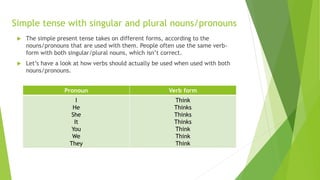
 Let’s have a look at how verbs should actually be used when used with both
nouns/pronouns.
Pronoun Verb form
I
He
She
It
You
We
They
Think
Thinks
Thinks
Thinks
Think
Think
Think
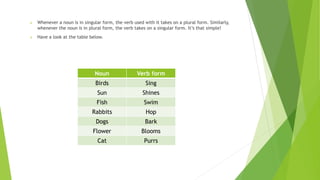
Noun Verb form
Birds Sing
Sun Shines
Fish Swim
Rabbits Hop
Dogs Bark
Flower Blooms
Cat Purrs
 Whenever a noun is in singular form, the verb used with it takes on a plural form. Similarly,
whenever the noun is in plural form, the verb takes on a singular form. It’s that simple!
 Have a look at the table below.

Simple Present tense.pptx

  • 1.
  • 2.
    The basics  Wheneverwe talk about simple present tense, it means that we’re talking about something that is either a fact or is a part of someone’s habit/daily activities. For example:  We wash our hands with water and soap. (Here, the underlined verb, “wash”, is talking about an actual fact.)  He goes for a walk in the park on the weekend. (Here, the verb “goes” tells about someone’s activities/habits) These examples show us how the simple present tense can be used to talk about different things.
  • 3.
    More about simplepresent tense  So, we found out that simple present tense is talks about actual facts, statements and habits, etc., but, do we know why certain verbs in it have “s” added to them, whilst we add “es” and “ies” to the others?  The answer to that questions lies in the verb being used. For most verbs, we generally add “s” at the end, but, we add “es” to verbs ending in “h”. For those verbs that end in the letter “y”, we replace it with “ies”.  Let’s look at some examples:  She listens to music on her IPod.  He fries the onions on a low flame.  The fielder catches the ball firmly.
  • 4.
    Simple tense withsingular and plural nouns/pronouns  The simple present tense takes on different forms, according to the nouns/pronouns that are used with them. People often use the same verb- form with both singular/plural nouns, which isn’t correct.  Let’s have a look at how verbs should actually be used when used with both nouns/pronouns. Pronoun Verb form I He She It You We They Think Thinks Thinks Thinks Think Think Think
  • 5.
    Noun Verb form BirdsSing Sun Shines Fish Swim Rabbits Hop Dogs Bark Flower Blooms Cat Purrs  Whenever a noun is in singular form, the verb used with it takes on a plural form. Similarly, whenever the noun is in plural form, the verb takes on a singular form. It’s that simple!  Have a look at the table below.