Determining
the equation
for simple
harmonic
motion of an
object on a
spring Itai Buxbaum
LD2
2/1/15
The situation:
 In your sleep, you dream that you have
invented a special, frictionless spring
mechanism, where no energy is being lost to
friction (thermal energy).
 As you wake up, you remember that the 2.0
kg object on the spring would move 12
meters from the equilibrium point, then return,
and continue 12 meters past the equilibrium
point in the other direction! It took 6 seconds
for this period to complete its cycle.
 Luckily remember that in PHYS 101 you
learned about SHM and now you decide that
you want to graph the functions for velocity
displacement and acceleration!
Game plan: what do we need
to figure out?
 We will need to find:
 The period, T and frequency, f
 the angular frequency ω
 A graph of the displacement of the object
 A graph of the velocity of the object
 And a graph of the acceleration of the
object
What do you remember? Lets
parse what we know into
physics terms…
The mass of the object
was 2 kg
m=2 kg
The max displacement
was 12m
Amplitude, A= 12
It took 6 seconds to
complete the period
Period, T= 6
No energy was lost due
to friction
Cool!
Step 2.
lets get to it!
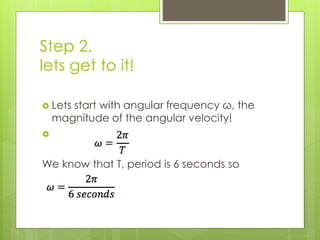
 Lets start with angular frequency ω, the
magnitude of the angular velocity!

We know that T, period is 6 seconds so
Step 3. Put it into a function:
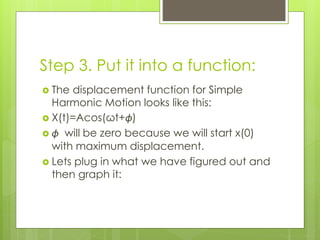
 The displacement function for Simple
Harmonic Motion looks like this:
 X(t)=Acos(ωt+ϕ)
 ϕ will be zero because we will start x(0)
with maximum displacement.
 Lets plug in what we have figured out and
then graph it:
Graph displacement
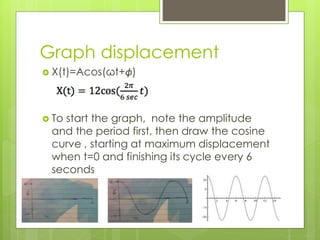
 X(t)=Acos(ωt+ϕ)
 To start the graph, note the amplitude
and the period first, then draw the cosine
curve , starting at maximum displacement
when t=0 and finishing its cycle every 6
seconds
Now for velocity:
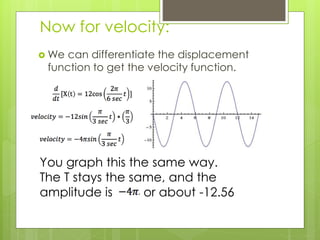
 We can differentiate the displacement
function to get the velocity function.
You graph this the same way.
The T stays the same, and the
amplitude is or about -12.56
For acceleration:
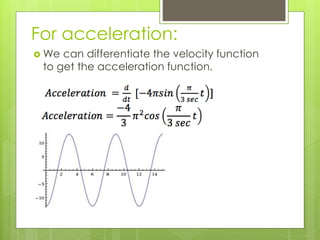
 We can differentiate the velocity function
to get the acceleration function.
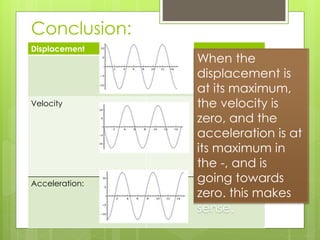
Conclusion:
Displacement
Velocity
Acceleration:
When the
displacement is
at its maximum,
the velocity is
zero, and the
acceleration is at
its maximum in
the -, and is
going towards
zero. this makes
sense.

Phys learning object 1

  • 1.
    Determining the equation for simple harmonic motionof an object on a spring Itai Buxbaum LD2 2/1/15
  • 2.
    The situation:  Inyour sleep, you dream that you have invented a special, frictionless spring mechanism, where no energy is being lost to friction (thermal energy).  As you wake up, you remember that the 2.0 kg object on the spring would move 12 meters from the equilibrium point, then return, and continue 12 meters past the equilibrium point in the other direction! It took 6 seconds for this period to complete its cycle.  Luckily remember that in PHYS 101 you learned about SHM and now you decide that you want to graph the functions for velocity displacement and acceleration!
  • 3.
    Game plan: whatdo we need to figure out?  We will need to find:  The period, T and frequency, f  the angular frequency ω  A graph of the displacement of the object  A graph of the velocity of the object  And a graph of the acceleration of the object
  • 4.
    What do youremember? Lets parse what we know into physics terms… The mass of the object was 2 kg m=2 kg The max displacement was 12m Amplitude, A= 12 It took 6 seconds to complete the period Period, T= 6 No energy was lost due to friction Cool!
  • 5.
    Step 2. lets getto it!  Lets start with angular frequency ω, the magnitude of the angular velocity!  We know that T, period is 6 seconds so
  • 6.
    Step 3. Putit into a function:  The displacement function for Simple Harmonic Motion looks like this:  X(t)=Acos(ωt+ϕ)  ϕ will be zero because we will start x(0) with maximum displacement.  Lets plug in what we have figured out and then graph it:
  • 7.
    Graph displacement  X(t)=Acos(ωt+ϕ) To start the graph, note the amplitude and the period first, then draw the cosine curve , starting at maximum displacement when t=0 and finishing its cycle every 6 seconds
  • 8.
    Now for velocity: We can differentiate the displacement function to get the velocity function. You graph this the same way. The T stays the same, and the amplitude is or about -12.56
  • 9.
    For acceleration:  Wecan differentiate the velocity function to get the acceleration function.
  • 10.
    Conclusion: Displacement Velocity Acceleration: When the displacement is atits maximum, the velocity is zero, and the acceleration is at its maximum in the -, and is going towards zero. this makes sense.