

Copyright (c) 2014 Scale Unlimited.

1
Similarity at Scale
Fuzzy matching and recommendations
using Hadoop, Solr, and heuristics
Ken Krugler
Scale Unlimited
Copyright (c) 2014 Scale Unlimited.
The Twitter Pitch
Wide class of problems that rely on "good" similarity
Fast
Accurate
Scalable
Benefit from my mistakes
Scale Unlimited - consulting & training
Talking about solutions to real problems
2
Copyright (c) 2014 Scale Unlimited.
What are similarity problems?
Clustering
Grouping similar advertisers
Deduplication
Joining noisy sets of POI data
Recommendations
Suggesting pages to users
Entity resolution
Fuzzy matching of people and companies
3
Copyright (c) 2014 Scale Unlimited.
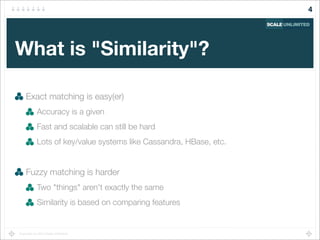
What is "Similarity"?
Exact matching is easy(er)
Accuracy is a given
Fast and scalable can still be hard
Lots of key/value systems like Cassandra, HBase, etc.
Fuzzy matching is harder
Two "things" aren't exactly the same
Similarity is based on comparing features
4
Copyright (c) 2014 Scale Unlimited.
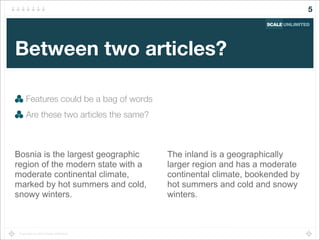
Between two articles?
Features could be a bag of words
Are these two articles the same?
5
Bosnia is the largest geographic
region of the modern state with a
moderate continental climate,
marked by hot summers and cold,
snowy winters.
The inland is a geographically
larger region and has a moderate
continental climate, bookended by
hot summers and cold and snowy
winters.
Copyright (c) 2014 Scale Unlimited.
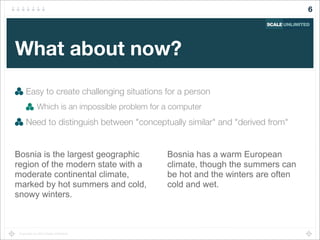
What about now?
Easy to create challenging situations for a person
Which is an impossible problem for a computer
Need to distinguish between "conceptually similar" and "derived from"
6
Bosnia is the largest geographic
region of the modern state with a
moderate continental climate,
marked by hot summers and cold,
snowy winters.
Bosnia has a warm European
climate, though the summers can
be hot and the winters are often
cold and wet.
Copyright (c) 2014 Scale Unlimited.
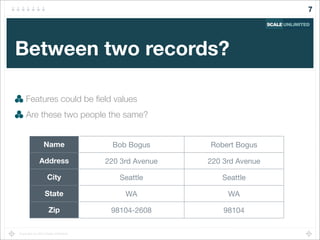
Between two records?
Features could be field values
Are these two people the same?
7
Name
Address
City
State
Zip
Bob Bogus Robert Bogus
220 3rd Avenue 220 3rd Avenue
Seattle Seattle
WA WA
98104-2608 98104
Copyright (c) 2014 Scale Unlimited.
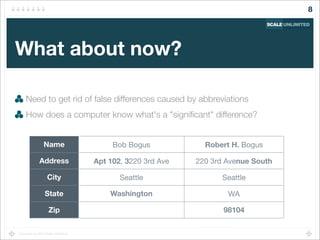
What about now?
Need to get rid of false differences caused by abbreviations
How does a computer know what's a "significant" difference?
8
Name
Address
City
State
Zip
Bob Bogus Robert H. Bogus
Apt 102, 3220 3rd Ave 220 3rd Avenue South
Seattle Seattle
Washington WA
98104
Copyright (c) 2014 Scale Unlimited.
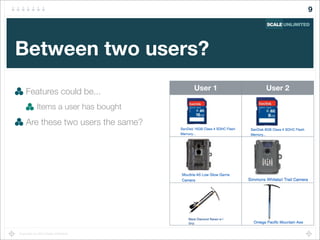
Between two users?
Features could be...
Items a user has bought
Are these two users the same?
9
User 1 User 2
Copyright (c) 2014 Scale Unlimited.
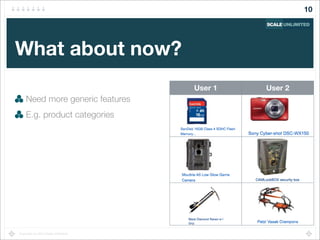
What about now?
Need more generic features
E.g. product categories
10
User 1 User 2
Copyright (c) 2014 Scale Unlimited.
How to measure similarity?
Assuming you have some features for two "things"
How does a program determine their degree of similarity?
You want a number that represents their "closeness"
Typically 1.0 means exactly the same
And 0.0 means completely different
11
Copyright (c) 2014 Scale Unlimited.
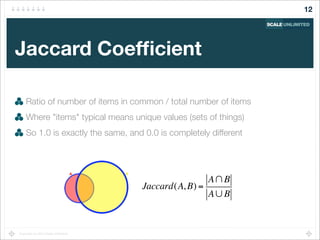
Jaccard Coefficient
Ratio of number of items in common / total number of items
Where "items" typical means unique values (sets of things)
So 1.0 is exactly the same, and 0.0 is completely different
12
Jaccard(A, B) =
A!B
A"B
Copyright (c) 2014 Scale Unlimited.
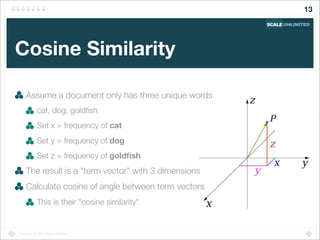
Cosine Similarity
Assume a document only has three unique words
cat, dog, goldfish
Set x = frequency of cat
Set y = frequency of dog
Set z = frequency of goldfish
The result is a "term vector" with 3 dimensions
Calculate cosine of angle between term vectors
This is their "cosine similarity"
13
Copyright (c) 2014 Scale Unlimited.
Why is scalability hard?
Assume you have 8.5 million businesses in the US
There are ≈ N^2/2 pairs to evaluate
That's 36 trillion comparisons
Sometimes you can quickly trim this problem
E.g. if you assume the ZIP code exists, and must match
Then this becomes about 4 billion comparisons
But often you don't have a "magic" field
14
Copyright (c) 2011-2014 Scale Unlimited. All Rights Reserved. Reproduction or distribution of this document in any form without prior written permission is forbidden.
DataStax Web
Site Page
Recommender
15
Copyright (c) 2014 Scale Unlimited.
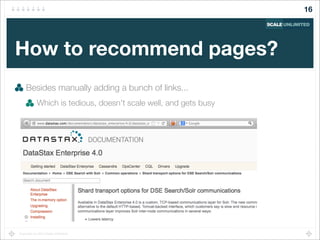
How to recommend pages?
Besides manually adding a bunch of links...
Which is tedious, doesn't scale well, and gets busy
16
Copyright (c) 2014 Scale Unlimited.
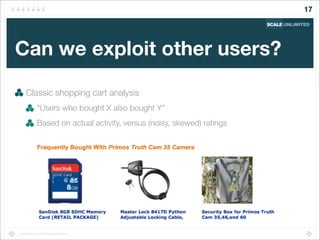
Can we exploit other users?
Classic shopping cart analysis
"Users who bought X also bought Y"
Based on actual activity, versus (noisy, skewed) ratings
17
Copyright (c) 2014 Scale Unlimited.
What's the general approach?
We have web logs with IP addresses, time, path to page
157.55.33.39 - - [18/Mar/2014:00:01:00 -0500]
"GET /solutions/nosql HTTP/1.1"
A browsing session is a series of requests from one IP address
With some maximum time gap between requests
Find sessions "similar to" the current user's session
Recommend pages from these similar sessions
18
Copyright (c) 2014 Scale Unlimited.
How to find similar sessions?
Create a Lucene search index with one document per session
Each indexed document contains the page paths for one session
session-1 /path/to/page1, /path/to/page2, /path/to/page3
session-2 /path/to/pageX, /path/to/pageY
Search for paths from the current user's session
19
Copyright (c) 2014 Scale Unlimited.
Why is this a search issue?
Solr (search in general) is all about similarity
Find documents similar to the words in my query
Cosine similarity is used to calculate similarity
Between the term vector for my query
and the term vector of each document
20
Copyright (c) 2014 Scale Unlimited.
What's the algorithm?
Find sessions similar to the target (current user's) session
Calculate similarity between these sessions and the target session
Aggregate similarity scores for all paths from these sessions
Remove paths that are already in the target session
Recommend the highest scoring path(s)
21
Copyright (c) 2014 Scale Unlimited.
Why do you sum similarities?
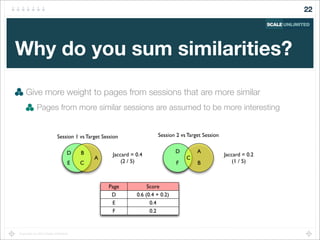
Give more weight to pages from sessions that are more similar
Pages from more similar sessions are assumed to be more interesting
22
F
D
B
C
A
Jaccard = 0.2
(1 / 5)
Session 2 vs Target Session
E
D B
C
A
Jaccard = 0.4
(2 / 5)
Session 1 vs Target Session
D
E
F
0.6 (0.4 + 0.2)
0.4
0.2
Page Score
Copyright (c) 2014 Scale Unlimited.
What are some problems?
The classic problem is that we recommend "common" pages
23
Copyright (c) 2014 Scale Unlimited.
What are some problems?
The classic problem is that we recommend "common" pages
E.g. if you haven't viewed the top-level page in your session
23
Copyright (c) 2014 Scale Unlimited.
What are some problems?
The classic problem is that we recommend "common" pages
E.g. if you haven't viewed the top-level page in your session
But this page is very common in most of the other sessions
23
Copyright (c) 2014 Scale Unlimited.
What are some problems?
The classic problem is that we recommend "common" pages
E.g. if you haven't viewed the top-level page in your session
But this page is very common in most of the other sessions
So then it becomes one of the top recommended page
23
Copyright (c) 2014 Scale Unlimited.
What are some problems?
The classic problem is that we recommend "common" pages
E.g. if you haven't viewed the top-level page in your session
But this page is very common in most of the other sessions
So then it becomes one of the top recommended page
But that generally stinks as a recommendation
23
Copyright (c) 2014 Scale Unlimited.
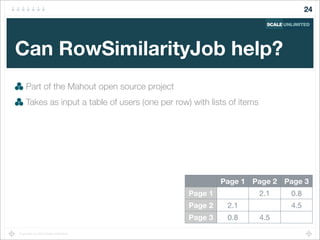
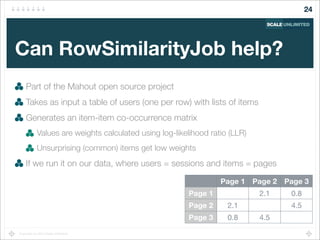
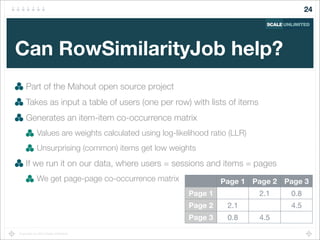
Can RowSimilarityJob help?
24
Page 1 Page 2 Page 3
Page 1
Page 2
Page 3
2.1 0.8
2.1 4.5
0.8 4.5
Copyright (c) 2014 Scale Unlimited.
Can RowSimilarityJob help?
Part of the Mahout open source project
24
Page 1 Page 2 Page 3
Page 1
Page 2
Page 3
2.1 0.8
2.1 4.5
0.8 4.5
Copyright (c) 2014 Scale Unlimited.
Can RowSimilarityJob help?
Part of the Mahout open source project
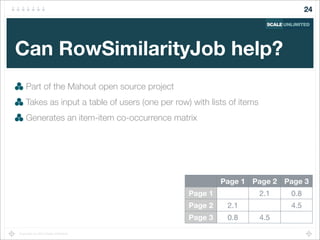
Takes as input a table of users (one per row) with lists of items
24
Page 1 Page 2 Page 3
Page 1
Page 2
Page 3
2.1 0.8
2.1 4.5
0.8 4.5
Copyright (c) 2014 Scale Unlimited.
Can RowSimilarityJob help?
Part of the Mahout open source project
Takes as input a table of users (one per row) with lists of items
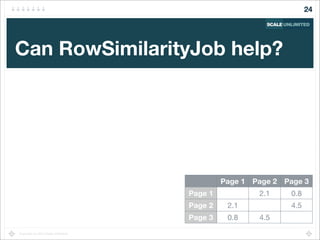
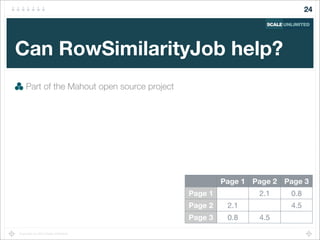
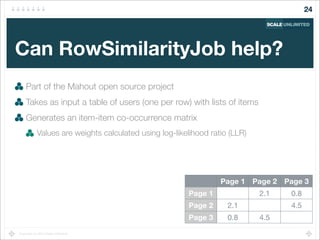
Generates an item-item co-occurrence matrix
24
Page 1 Page 2 Page 3
Page 1
Page 2
Page 3
2.1 0.8
2.1 4.5
0.8 4.5
Copyright (c) 2014 Scale Unlimited.
Can RowSimilarityJob help?
Part of the Mahout open source project
Takes as input a table of users (one per row) with lists of items
Generates an item-item co-occurrence matrix
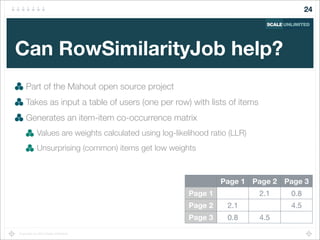
Values are weights calculated using log-likelihood ratio (LLR)
24
Page 1 Page 2 Page 3
Page 1
Page 2
Page 3
2.1 0.8
2.1 4.5
0.8 4.5
Copyright (c) 2014 Scale Unlimited.
Can RowSimilarityJob help?
Part of the Mahout open source project
Takes as input a table of users (one per row) with lists of items
Generates an item-item co-occurrence matrix
Values are weights calculated using log-likelihood ratio (LLR)
Unsurprising (common) items get low weights
24
Page 1 Page 2 Page 3
Page 1
Page 2
Page 3
2.1 0.8
2.1 4.5
0.8 4.5
Copyright (c) 2014 Scale Unlimited.
Can RowSimilarityJob help?
Part of the Mahout open source project
Takes as input a table of users (one per row) with lists of items
Generates an item-item co-occurrence matrix
Values are weights calculated using log-likelihood ratio (LLR)
Unsurprising (common) items get low weights
If we run it on our data, where users = sessions and items = pages
24
Page 1 Page 2 Page 3
Page 1
Page 2
Page 3
2.1 0.8
2.1 4.5
0.8 4.5
Copyright (c) 2014 Scale Unlimited.
Can RowSimilarityJob help?
Part of the Mahout open source project
Takes as input a table of users (one per row) with lists of items
Generates an item-item co-occurrence matrix
Values are weights calculated using log-likelihood ratio (LLR)
Unsurprising (common) items get low weights
If we run it on our data, where users = sessions and items = pages
We get page-page co-occurrence matrix
24
Page 1 Page 2 Page 3
Page 1
Page 2
Page 3
2.1 0.8
2.1 4.5
0.8 4.5
Copyright (c) 2014 Scale Unlimited.
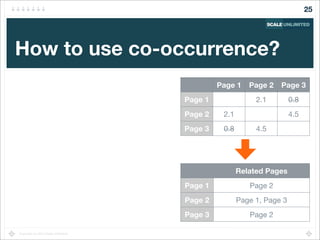
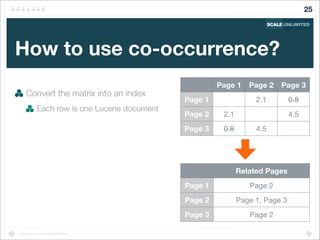
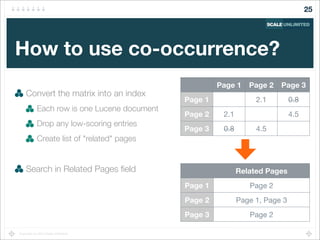
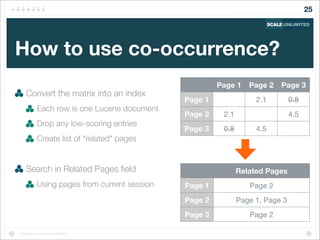
How to use co-occurrence?
25
Page 1 Page 2 Page 3
Page 1
Page 2
Page 3
2.1 0.8
2.1 4.5
0.8 4.5
Related Pages
Page 1
Page 2
Page 3
Page 2
Page 1, Page 3
Page 2
Copyright (c) 2014 Scale Unlimited.
How to use co-occurrence?
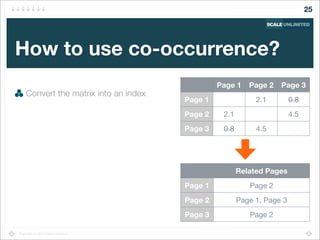
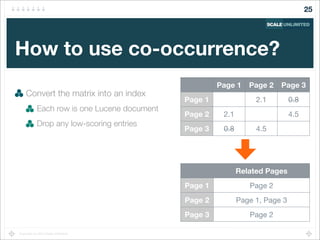
Convert the matrix into an index
25
Page 1 Page 2 Page 3
Page 1
Page 2
Page 3
2.1 0.8
2.1 4.5
0.8 4.5
Related Pages
Page 1
Page 2
Page 3
Page 2
Page 1, Page 3
Page 2
Copyright (c) 2014 Scale Unlimited.
How to use co-occurrence?
Convert the matrix into an index
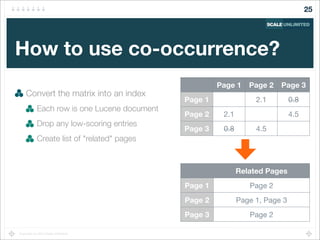
Each row is one Lucene document
25
Page 1 Page 2 Page 3
Page 1
Page 2
Page 3
2.1 0.8
2.1 4.5
0.8 4.5
Related Pages
Page 1
Page 2
Page 3
Page 2
Page 1, Page 3
Page 2
Copyright (c) 2014 Scale Unlimited.
How to use co-occurrence?
Convert the matrix into an index
Each row is one Lucene document
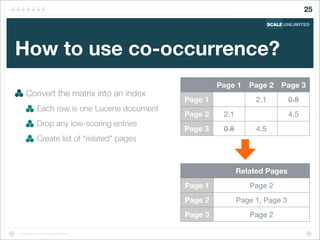
Drop any low-scoring entries
25
Page 1 Page 2 Page 3
Page 1
Page 2
Page 3
2.1 0.8
2.1 4.5
0.8 4.5
Related Pages
Page 1
Page 2
Page 3
Page 2
Page 1, Page 3
Page 2
Copyright (c) 2014 Scale Unlimited.
How to use co-occurrence?
Convert the matrix into an index
Each row is one Lucene document
Drop any low-scoring entries
Create list of "related" pages
25
Page 1 Page 2 Page 3
Page 1
Page 2
Page 3
2.1 0.8
2.1 4.5
0.8 4.5
Related Pages
Page 1
Page 2
Page 3
Page 2
Page 1, Page 3
Page 2
Copyright (c) 2014 Scale Unlimited.
How to use co-occurrence?
Convert the matrix into an index
Each row is one Lucene document
Drop any low-scoring entries
Create list of "related" pages
25
Page 1 Page 2 Page 3
Page 1
Page 2
Page 3
2.1 0.8
2.1 4.5
0.8 4.5
Related Pages
Page 1
Page 2
Page 3
Page 2
Page 1, Page 3
Page 2
Copyright (c) 2014 Scale Unlimited.
How to use co-occurrence?
Convert the matrix into an index
Each row is one Lucene document
Drop any low-scoring entries
Create list of "related" pages
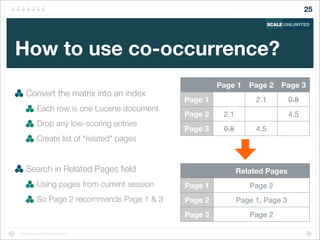
Search in Related Pages field
25
Page 1 Page 2 Page 3
Page 1
Page 2
Page 3
2.1 0.8
2.1 4.5
0.8 4.5
Related Pages
Page 1
Page 2
Page 3
Page 2
Page 1, Page 3
Page 2
Copyright (c) 2014 Scale Unlimited.
How to use co-occurrence?
Convert the matrix into an index
Each row is one Lucene document
Drop any low-scoring entries
Create list of "related" pages
Search in Related Pages field
Using pages from current session
25
Page 1 Page 2 Page 3
Page 1
Page 2
Page 3
2.1 0.8
2.1 4.5
0.8 4.5
Related Pages
Page 1
Page 2
Page 3
Page 2
Page 1, Page 3
Page 2
Copyright (c) 2014 Scale Unlimited.
How to use co-occurrence?
Convert the matrix into an index
Each row is one Lucene document
Drop any low-scoring entries
Create list of "related" pages
Search in Related Pages field
Using pages from current session
So Page 2 recommends Page 1 & 3
25
Page 1 Page 2 Page 3
Page 1
Page 2
Page 3
2.1 0.8
2.1 4.5
0.8 4.5
Related Pages
Page 1
Page 2
Page 3
Page 2
Page 1, Page 3
Page 2
Copyright (c) 2011-2014 Scale Unlimited. All Rights Reserved. Reproduction or distribution of this document in any form without prior written permission is forbidden.
EWS
Entity
Resolution
26
Copyright (c) 2014 Scale Unlimited.
What is Early Warning?
Early Warning helps banks fight fraud
It's owned by the top 5 US banks
And gets data from 800+ financial institutions
So they have details on most US bank accounts
When somebody signs up for an account
They need to quickly match the person to "known entities"
And derive a risk score based on related account details
27
Copyright (c) 2014 Scale Unlimited.
Why do they need similarity?
Assume you have information on 100s of millions of entities
Name(s), address(es), phone number(s), etc.
And often a unique ID (Social Security Number, EIN, etc)
Why is this a similarity problem?
Data is noisy - typos, abbreviations, partial data
People lie - much fraud starts with opening an account using bad data
28
Copyright (c) 2014 Scale Unlimited.
How does search help?
We can quickly build a list of candidate entities, using search
Query contains field data provided by the client bank
Significantly less than 1 second for 30 candidate entities
Then do more precise, sophisticated and CPU-intensive scoring
The end result is a ranked list of entities with similarity scores
Which then is used to look up account status, fraud cases, etc.
29
Copyright (c) 2014 Scale Unlimited.
What's the data pipeline?
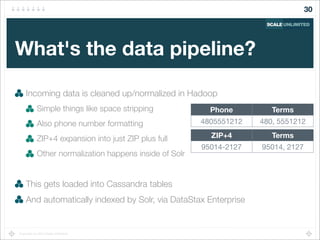
Incoming data is cleaned up/normalized in Hadoop
Simple things like space stripping
Also phone number formatting
ZIP+4 expansion into just ZIP plus full
Other normalization happens inside of Solr
This gets loaded into Cassandra tables
And automatically indexed by Solr, via DataStax Enterprise
30
ZIP+4 Terms
95014-2127 95014, 2127
Phone Terms
4805551212 480, 5551212
Copyright (c) 2014 Scale Unlimited.
What's the Solr setup?
Each field in the index has very specific analysis
Simple things like normalization
Synonym expansion for names, abbreviations
Split up fields so partial matches work
At query time we can weight the importance of each field
Which helps order the top N candidates similar to their real match scores
E.g. an SSN matching means much more than a first name matching
31
Copyright (c) 2011-2014 Scale Unlimited. All Rights Reserved. Reproduction or distribution of this document in any form without prior written permission is forbidden.
Batch Similarity
32
Copyright (c) 2014 Scale Unlimited.
Can we do batch similarity?
Search works well for real-time similarity
But batch processing at scale maxes out the search system
We can use two different techniques with Hadoop for batch
SimHash - good for text document similarity
Parallel Set-Similarity Joins - good for record similarity
33
Copyright (c) 2014 Scale Unlimited.
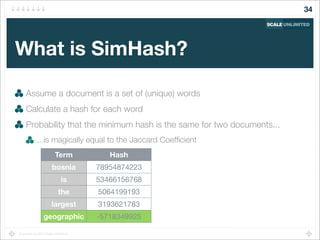
What is SimHash?
Assume a document is a set of (unique) words
Calculate a hash for each word
Probability that the minimum hash is the same for two documents...
...is magically equal to the Jaccard Coefficient
34
Term Hash
bosnia
is
the
largest
geographic
78954874223
53466156768
5064199193
3193621783
-5718349925
Copyright (c) 2014 Scale Unlimited.
What is a SimHash workflow?
Calculate N hash values
Easy way is to use the N smallest hash values
Calculate number of matching hash values between doc pairs (M)
Then the Jaccard Coefficient is ≈ M/N
Only works if N is much smaller than # of unique words in docs
Implementation of this in cascading.utils open source project
https://github.com/ScaleUnlimited/cascading.utils
35
Copyright (c) 2014 Scale Unlimited.
What is Set-Similarity Join?
Joining records in two sets that are "close enough"
aka "fuzzy join"
Requires generation of "tokens" from record field(s)
Typically words from text
Simple implementation has three phases
First calculate counts for each unique token value
Then output <token, record> for N most common tokens of each record
Group by token, compare records in each group
36
Copyright (c) 2014 Scale Unlimited.
How does fuzzy join work?
For two records to be "similar enough"...
They need to share one of their common tokens
Generalization of the ZIP code "magic field" approach
Basic implementation has a number of issues
Passing around copies of full record is inefficient
Too-common tokens create huge groups for comparison
Two records compared multiple times
37
Copyright (c) 2011-2014 Scale Unlimited. All Rights Reserved. Reproduction or distribution of this document in any form without prior written permission is forbidden.
Summary
38
Copyright (c) 2014 Scale Unlimited.
The Net-Net
39
Copyright (c) 2014 Scale Unlimited.
The Net-Net
Similarity is a common requirement for many applications
39
Copyright (c) 2014 Scale Unlimited.
The Net-Net
Similarity is a common requirement for many applications
Recommendations
39
Copyright (c) 2014 Scale Unlimited.
The Net-Net
Similarity is a common requirement for many applications
Recommendations
Entity matching
39
Copyright (c) 2014 Scale Unlimited.
The Net-Net
Similarity is a common requirement for many applications
Recommendations
Entity matching
Combining Hadoop with search is a powerful combination
39
Copyright (c) 2014 Scale Unlimited.
The Net-Net
Similarity is a common requirement for many applications
Recommendations
Entity matching
Combining Hadoop with search is a powerful combination
Scalability
39
Copyright (c) 2014 Scale Unlimited.
The Net-Net
Similarity is a common requirement for many applications
Recommendations
Entity matching
Combining Hadoop with search is a powerful combination
Scalability
Performance
39
Copyright (c) 2014 Scale Unlimited.
The Net-Net
Similarity is a common requirement for many applications
Recommendations
Entity matching
Combining Hadoop with search is a powerful combination
Scalability
Performance
Flexibility
39
Copyright (c) 2014 Scale Unlimited.
Questions?
Feel free to contact me
http://www.scaleunlimited.com/contact/
Take a look at Pat Ferrel's Hadoop + Solr recommender
http://github.com/pferrel/solr-recommender
Check out Mahout
http://mahout.apache.org
Read paper & code for fuzzyjoin project
http://asterix.ics.uci.edu/fuzzyjoin/
40

Similarity at Scale

  • 1.
    Copyright (c) 2014Scale Unlimited. 1 Similarity at Scale Fuzzy matching and recommendations using Hadoop, Solr, and heuristics Ken Krugler Scale Unlimited
  • 2.
    Copyright (c) 2014Scale Unlimited. The Twitter Pitch Wide class of problems that rely on "good" similarity Fast Accurate Scalable Benefit from my mistakes Scale Unlimited - consulting & training Talking about solutions to real problems 2
  • 3.
    Copyright (c) 2014Scale Unlimited. What are similarity problems? Clustering Grouping similar advertisers Deduplication Joining noisy sets of POI data Recommendations Suggesting pages to users Entity resolution Fuzzy matching of people and companies 3
  • 4.
    Copyright (c) 2014Scale Unlimited. What is "Similarity"? Exact matching is easy(er) Accuracy is a given Fast and scalable can still be hard Lots of key/value systems like Cassandra, HBase, etc. Fuzzy matching is harder Two "things" aren't exactly the same Similarity is based on comparing features 4
  • 5.
    Copyright (c) 2014Scale Unlimited. Between two articles? Features could be a bag of words Are these two articles the same? 5 Bosnia is the largest geographic region of the modern state with a moderate continental climate, marked by hot summers and cold, snowy winters. The inland is a geographically larger region and has a moderate continental climate, bookended by hot summers and cold and snowy winters.
  • 6.
    Copyright (c) 2014Scale Unlimited. What about now? Easy to create challenging situations for a person Which is an impossible problem for a computer Need to distinguish between "conceptually similar" and "derived from" 6 Bosnia is the largest geographic region of the modern state with a moderate continental climate, marked by hot summers and cold, snowy winters. Bosnia has a warm European climate, though the summers can be hot and the winters are often cold and wet.
  • 7.
    Copyright (c) 2014Scale Unlimited. Between two records? Features could be field values Are these two people the same? 7 Name Address City State Zip Bob Bogus Robert Bogus 220 3rd Avenue 220 3rd Avenue Seattle Seattle WA WA 98104-2608 98104
  • 8.
    Copyright (c) 2014Scale Unlimited. What about now? Need to get rid of false differences caused by abbreviations How does a computer know what's a "significant" difference? 8 Name Address City State Zip Bob Bogus Robert H. Bogus Apt 102, 3220 3rd Ave 220 3rd Avenue South Seattle Seattle Washington WA 98104
  • 9.
    Copyright (c) 2014Scale Unlimited. Between two users? Features could be... Items a user has bought Are these two users the same? 9 User 1 User 2
  • 10.
    Copyright (c) 2014Scale Unlimited. What about now? Need more generic features E.g. product categories 10 User 1 User 2
  • 11.
    Copyright (c) 2014Scale Unlimited. How to measure similarity? Assuming you have some features for two "things" How does a program determine their degree of similarity? You want a number that represents their "closeness" Typically 1.0 means exactly the same And 0.0 means completely different 11
  • 12.
    Copyright (c) 2014Scale Unlimited. Jaccard Coefficient Ratio of number of items in common / total number of items Where "items" typical means unique values (sets of things) So 1.0 is exactly the same, and 0.0 is completely different 12 Jaccard(A, B) = A!B A"B
  • 13.
    Copyright (c) 2014Scale Unlimited. Cosine Similarity Assume a document only has three unique words cat, dog, goldfish Set x = frequency of cat Set y = frequency of dog Set z = frequency of goldfish The result is a "term vector" with 3 dimensions Calculate cosine of angle between term vectors This is their "cosine similarity" 13
  • 14.
    Copyright (c) 2014Scale Unlimited. Why is scalability hard? Assume you have 8.5 million businesses in the US There are ≈ N^2/2 pairs to evaluate That's 36 trillion comparisons Sometimes you can quickly trim this problem E.g. if you assume the ZIP code exists, and must match Then this becomes about 4 billion comparisons But often you don't have a "magic" field 14
  • 15.
    Copyright (c) 2011-2014Scale Unlimited. All Rights Reserved. Reproduction or distribution of this document in any form without prior written permission is forbidden. DataStax Web Site Page Recommender 15
  • 16.
    Copyright (c) 2014Scale Unlimited. How to recommend pages? Besides manually adding a bunch of links... Which is tedious, doesn't scale well, and gets busy 16
  • 17.
    Copyright (c) 2014Scale Unlimited. Can we exploit other users? Classic shopping cart analysis "Users who bought X also bought Y" Based on actual activity, versus (noisy, skewed) ratings 17
  • 18.
    Copyright (c) 2014Scale Unlimited. What's the general approach? We have web logs with IP addresses, time, path to page 157.55.33.39 - - [18/Mar/2014:00:01:00 -0500] "GET /solutions/nosql HTTP/1.1" A browsing session is a series of requests from one IP address With some maximum time gap between requests Find sessions "similar to" the current user's session Recommend pages from these similar sessions 18
  • 19.
    Copyright (c) 2014Scale Unlimited. How to find similar sessions? Create a Lucene search index with one document per session Each indexed document contains the page paths for one session session-1 /path/to/page1, /path/to/page2, /path/to/page3 session-2 /path/to/pageX, /path/to/pageY Search for paths from the current user's session 19
  • 20.
    Copyright (c) 2014Scale Unlimited. Why is this a search issue? Solr (search in general) is all about similarity Find documents similar to the words in my query Cosine similarity is used to calculate similarity Between the term vector for my query and the term vector of each document 20
  • 21.
    Copyright (c) 2014Scale Unlimited. What's the algorithm? Find sessions similar to the target (current user's) session Calculate similarity between these sessions and the target session Aggregate similarity scores for all paths from these sessions Remove paths that are already in the target session Recommend the highest scoring path(s) 21
  • 22.
    Copyright (c) 2014Scale Unlimited. Why do you sum similarities? Give more weight to pages from sessions that are more similar Pages from more similar sessions are assumed to be more interesting 22 F D B C A Jaccard = 0.2 (1 / 5) Session 2 vs Target Session E D B C A Jaccard = 0.4 (2 / 5) Session 1 vs Target Session D E F 0.6 (0.4 + 0.2) 0.4 0.2 Page Score
  • 23.
    Copyright (c) 2014Scale Unlimited. What are some problems? The classic problem is that we recommend "common" pages 23
  • 24.
    Copyright (c) 2014Scale Unlimited. What are some problems? The classic problem is that we recommend "common" pages E.g. if you haven't viewed the top-level page in your session 23
  • 25.
    Copyright (c) 2014Scale Unlimited. What are some problems? The classic problem is that we recommend "common" pages E.g. if you haven't viewed the top-level page in your session But this page is very common in most of the other sessions 23
  • 26.
    Copyright (c) 2014Scale Unlimited. What are some problems? The classic problem is that we recommend "common" pages E.g. if you haven't viewed the top-level page in your session But this page is very common in most of the other sessions So then it becomes one of the top recommended page 23
  • 27.
    Copyright (c) 2014Scale Unlimited. What are some problems? The classic problem is that we recommend "common" pages E.g. if you haven't viewed the top-level page in your session But this page is very common in most of the other sessions So then it becomes one of the top recommended page But that generally stinks as a recommendation 23
  • 28.
    Copyright (c) 2014Scale Unlimited. Can RowSimilarityJob help? 24 Page 1 Page 2 Page 3 Page 1 Page 2 Page 3 2.1 0.8 2.1 4.5 0.8 4.5
  • 29.
    Copyright (c) 2014Scale Unlimited. Can RowSimilarityJob help? Part of the Mahout open source project 24 Page 1 Page 2 Page 3 Page 1 Page 2 Page 3 2.1 0.8 2.1 4.5 0.8 4.5
  • 30.
    Copyright (c) 2014Scale Unlimited. Can RowSimilarityJob help? Part of the Mahout open source project Takes as input a table of users (one per row) with lists of items 24 Page 1 Page 2 Page 3 Page 1 Page 2 Page 3 2.1 0.8 2.1 4.5 0.8 4.5
  • 31.
    Copyright (c) 2014Scale Unlimited. Can RowSimilarityJob help? Part of the Mahout open source project Takes as input a table of users (one per row) with lists of items Generates an item-item co-occurrence matrix 24 Page 1 Page 2 Page 3 Page 1 Page 2 Page 3 2.1 0.8 2.1 4.5 0.8 4.5
  • 32.
    Copyright (c) 2014Scale Unlimited. Can RowSimilarityJob help? Part of the Mahout open source project Takes as input a table of users (one per row) with lists of items Generates an item-item co-occurrence matrix Values are weights calculated using log-likelihood ratio (LLR) 24 Page 1 Page 2 Page 3 Page 1 Page 2 Page 3 2.1 0.8 2.1 4.5 0.8 4.5
  • 33.
    Copyright (c) 2014Scale Unlimited. Can RowSimilarityJob help? Part of the Mahout open source project Takes as input a table of users (one per row) with lists of items Generates an item-item co-occurrence matrix Values are weights calculated using log-likelihood ratio (LLR) Unsurprising (common) items get low weights 24 Page 1 Page 2 Page 3 Page 1 Page 2 Page 3 2.1 0.8 2.1 4.5 0.8 4.5
  • 34.
    Copyright (c) 2014Scale Unlimited. Can RowSimilarityJob help? Part of the Mahout open source project Takes as input a table of users (one per row) with lists of items Generates an item-item co-occurrence matrix Values are weights calculated using log-likelihood ratio (LLR) Unsurprising (common) items get low weights If we run it on our data, where users = sessions and items = pages 24 Page 1 Page 2 Page 3 Page 1 Page 2 Page 3 2.1 0.8 2.1 4.5 0.8 4.5
  • 35.
    Copyright (c) 2014Scale Unlimited. Can RowSimilarityJob help? Part of the Mahout open source project Takes as input a table of users (one per row) with lists of items Generates an item-item co-occurrence matrix Values are weights calculated using log-likelihood ratio (LLR) Unsurprising (common) items get low weights If we run it on our data, where users = sessions and items = pages We get page-page co-occurrence matrix 24 Page 1 Page 2 Page 3 Page 1 Page 2 Page 3 2.1 0.8 2.1 4.5 0.8 4.5
  • 36.
    Copyright (c) 2014Scale Unlimited. How to use co-occurrence? 25 Page 1 Page 2 Page 3 Page 1 Page 2 Page 3 2.1 0.8 2.1 4.5 0.8 4.5 Related Pages Page 1 Page 2 Page 3 Page 2 Page 1, Page 3 Page 2
  • 37.
    Copyright (c) 2014Scale Unlimited. How to use co-occurrence? Convert the matrix into an index 25 Page 1 Page 2 Page 3 Page 1 Page 2 Page 3 2.1 0.8 2.1 4.5 0.8 4.5 Related Pages Page 1 Page 2 Page 3 Page 2 Page 1, Page 3 Page 2
  • 38.
    Copyright (c) 2014Scale Unlimited. How to use co-occurrence? Convert the matrix into an index Each row is one Lucene document 25 Page 1 Page 2 Page 3 Page 1 Page 2 Page 3 2.1 0.8 2.1 4.5 0.8 4.5 Related Pages Page 1 Page 2 Page 3 Page 2 Page 1, Page 3 Page 2
  • 39.
    Copyright (c) 2014Scale Unlimited. How to use co-occurrence? Convert the matrix into an index Each row is one Lucene document Drop any low-scoring entries 25 Page 1 Page 2 Page 3 Page 1 Page 2 Page 3 2.1 0.8 2.1 4.5 0.8 4.5 Related Pages Page 1 Page 2 Page 3 Page 2 Page 1, Page 3 Page 2
  • 40.
    Copyright (c) 2014Scale Unlimited. How to use co-occurrence? Convert the matrix into an index Each row is one Lucene document Drop any low-scoring entries Create list of "related" pages 25 Page 1 Page 2 Page 3 Page 1 Page 2 Page 3 2.1 0.8 2.1 4.5 0.8 4.5 Related Pages Page 1 Page 2 Page 3 Page 2 Page 1, Page 3 Page 2
  • 41.
    Copyright (c) 2014Scale Unlimited. How to use co-occurrence? Convert the matrix into an index Each row is one Lucene document Drop any low-scoring entries Create list of "related" pages 25 Page 1 Page 2 Page 3 Page 1 Page 2 Page 3 2.1 0.8 2.1 4.5 0.8 4.5 Related Pages Page 1 Page 2 Page 3 Page 2 Page 1, Page 3 Page 2
  • 42.
    Copyright (c) 2014Scale Unlimited. How to use co-occurrence? Convert the matrix into an index Each row is one Lucene document Drop any low-scoring entries Create list of "related" pages Search in Related Pages field 25 Page 1 Page 2 Page 3 Page 1 Page 2 Page 3 2.1 0.8 2.1 4.5 0.8 4.5 Related Pages Page 1 Page 2 Page 3 Page 2 Page 1, Page 3 Page 2
  • 43.
    Copyright (c) 2014Scale Unlimited. How to use co-occurrence? Convert the matrix into an index Each row is one Lucene document Drop any low-scoring entries Create list of "related" pages Search in Related Pages field Using pages from current session 25 Page 1 Page 2 Page 3 Page 1 Page 2 Page 3 2.1 0.8 2.1 4.5 0.8 4.5 Related Pages Page 1 Page 2 Page 3 Page 2 Page 1, Page 3 Page 2
  • 44.
    Copyright (c) 2014Scale Unlimited. How to use co-occurrence? Convert the matrix into an index Each row is one Lucene document Drop any low-scoring entries Create list of "related" pages Search in Related Pages field Using pages from current session So Page 2 recommends Page 1 & 3 25 Page 1 Page 2 Page 3 Page 1 Page 2 Page 3 2.1 0.8 2.1 4.5 0.8 4.5 Related Pages Page 1 Page 2 Page 3 Page 2 Page 1, Page 3 Page 2
  • 45.
    Copyright (c) 2011-2014Scale Unlimited. All Rights Reserved. Reproduction or distribution of this document in any form without prior written permission is forbidden. EWS Entity Resolution 26
  • 46.
    Copyright (c) 2014Scale Unlimited. What is Early Warning? Early Warning helps banks fight fraud It's owned by the top 5 US banks And gets data from 800+ financial institutions So they have details on most US bank accounts When somebody signs up for an account They need to quickly match the person to "known entities" And derive a risk score based on related account details 27
  • 47.
    Copyright (c) 2014Scale Unlimited. Why do they need similarity? Assume you have information on 100s of millions of entities Name(s), address(es), phone number(s), etc. And often a unique ID (Social Security Number, EIN, etc) Why is this a similarity problem? Data is noisy - typos, abbreviations, partial data People lie - much fraud starts with opening an account using bad data 28
  • 48.
    Copyright (c) 2014Scale Unlimited. How does search help? We can quickly build a list of candidate entities, using search Query contains field data provided by the client bank Significantly less than 1 second for 30 candidate entities Then do more precise, sophisticated and CPU-intensive scoring The end result is a ranked list of entities with similarity scores Which then is used to look up account status, fraud cases, etc. 29
  • 49.
    Copyright (c) 2014Scale Unlimited. What's the data pipeline? Incoming data is cleaned up/normalized in Hadoop Simple things like space stripping Also phone number formatting ZIP+4 expansion into just ZIP plus full Other normalization happens inside of Solr This gets loaded into Cassandra tables And automatically indexed by Solr, via DataStax Enterprise 30 ZIP+4 Terms 95014-2127 95014, 2127 Phone Terms 4805551212 480, 5551212
  • 50.
    Copyright (c) 2014Scale Unlimited. What's the Solr setup? Each field in the index has very specific analysis Simple things like normalization Synonym expansion for names, abbreviations Split up fields so partial matches work At query time we can weight the importance of each field Which helps order the top N candidates similar to their real match scores E.g. an SSN matching means much more than a first name matching 31
  • 51.
    Copyright (c) 2011-2014Scale Unlimited. All Rights Reserved. Reproduction or distribution of this document in any form without prior written permission is forbidden. Batch Similarity 32
  • 52.
    Copyright (c) 2014Scale Unlimited. Can we do batch similarity? Search works well for real-time similarity But batch processing at scale maxes out the search system We can use two different techniques with Hadoop for batch SimHash - good for text document similarity Parallel Set-Similarity Joins - good for record similarity 33
  • 53.
    Copyright (c) 2014Scale Unlimited. What is SimHash? Assume a document is a set of (unique) words Calculate a hash for each word Probability that the minimum hash is the same for two documents... ...is magically equal to the Jaccard Coefficient 34 Term Hash bosnia is the largest geographic 78954874223 53466156768 5064199193 3193621783 -5718349925
  • 54.
    Copyright (c) 2014Scale Unlimited. What is a SimHash workflow? Calculate N hash values Easy way is to use the N smallest hash values Calculate number of matching hash values between doc pairs (M) Then the Jaccard Coefficient is ≈ M/N Only works if N is much smaller than # of unique words in docs Implementation of this in cascading.utils open source project https://github.com/ScaleUnlimited/cascading.utils 35
  • 55.
    Copyright (c) 2014Scale Unlimited. What is Set-Similarity Join? Joining records in two sets that are "close enough" aka "fuzzy join" Requires generation of "tokens" from record field(s) Typically words from text Simple implementation has three phases First calculate counts for each unique token value Then output <token, record> for N most common tokens of each record Group by token, compare records in each group 36
  • 56.
    Copyright (c) 2014Scale Unlimited. How does fuzzy join work? For two records to be "similar enough"... They need to share one of their common tokens Generalization of the ZIP code "magic field" approach Basic implementation has a number of issues Passing around copies of full record is inefficient Too-common tokens create huge groups for comparison Two records compared multiple times 37
  • 57.
    Copyright (c) 2011-2014Scale Unlimited. All Rights Reserved. Reproduction or distribution of this document in any form without prior written permission is forbidden. Summary 38
  • 58.
    Copyright (c) 2014Scale Unlimited. The Net-Net 39
  • 59.
    Copyright (c) 2014Scale Unlimited. The Net-Net Similarity is a common requirement for many applications 39
  • 60.
    Copyright (c) 2014Scale Unlimited. The Net-Net Similarity is a common requirement for many applications Recommendations 39
  • 61.
    Copyright (c) 2014Scale Unlimited. The Net-Net Similarity is a common requirement for many applications Recommendations Entity matching 39
  • 62.
    Copyright (c) 2014Scale Unlimited. The Net-Net Similarity is a common requirement for many applications Recommendations Entity matching Combining Hadoop with search is a powerful combination 39
  • 63.
    Copyright (c) 2014Scale Unlimited. The Net-Net Similarity is a common requirement for many applications Recommendations Entity matching Combining Hadoop with search is a powerful combination Scalability 39
  • 64.
    Copyright (c) 2014Scale Unlimited. The Net-Net Similarity is a common requirement for many applications Recommendations Entity matching Combining Hadoop with search is a powerful combination Scalability Performance 39
  • 65.
    Copyright (c) 2014Scale Unlimited. The Net-Net Similarity is a common requirement for many applications Recommendations Entity matching Combining Hadoop with search is a powerful combination Scalability Performance Flexibility 39
  • 66.
    Copyright (c) 2014Scale Unlimited. Questions? Feel free to contact me http://www.scaleunlimited.com/contact/ Take a look at Pat Ferrel's Hadoop + Solr recommender http://github.com/pferrel/solr-recommender Check out Mahout http://mahout.apache.org Read paper & code for fuzzyjoin project http://asterix.ics.uci.edu/fuzzyjoin/ 40