Silicate Polymerization In
Igneous Processes
By: Ahmed Tarek Mohamed Mahmoud
@gmail.com887275ahmed.tarek.:mail-E
Geology department
Under supervision:
prof. Amal Abd El-Maboud
Professor of physical chemistry of macromolecules.
Introduction:
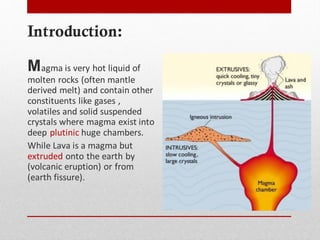
Magma is very hot liquid of
molten rocks (often mantle
derived melt) and contain other
constituents like gases ,
volatiles and solid suspended
crystals where magma exist into
deep plutinic huge chambers.
While Lava is a magma but
extruded onto the earth by
(volcanic eruption) or from
(earth fissure).
Magma composition:
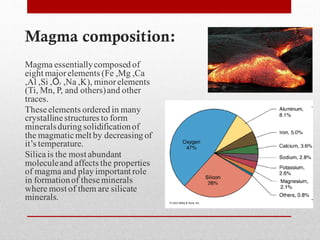
Magma essentiallycomposed of
eight majorelements (Fe ,Mg ,Ca
,Al ,Si ,O2 ,Na ,K), minorelements
(Ti, Mn, P, and others)and other
traces.
Theseelements ordered in many
crystallinestructures to form
mineralsduring solidificationof
the magmaticmelt by decreasing of
it’s temperature.
Silicais the most abundant
moleculeand affects the properties
of magma and play important role
in formationof theseminerals
where most of them are silicate
minerals.
Physical properties of magma:
1. Temperature
2. Density
3. Viscosity
4. Gas solubility
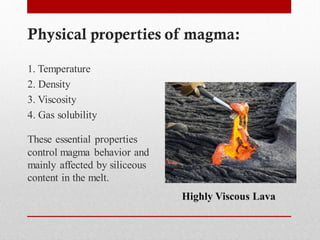
These essential properties
control magma behavior and
mainly affected by siliceous
content in the melt.
Highly Viscous Lava
Structure of silicates in the melt:
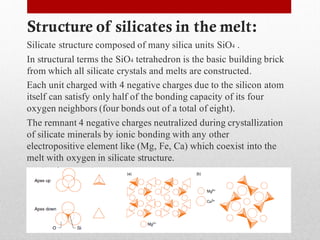
Silicate structure composed of many silica units SiO4 .
In structural terms the SiO4 tetrahedron is the basic building brick
from which all silicate crystals and melts are constructed.
Each unit charged with 4 negative charges due to the silicon atom
itself can satisfy only half of the bonding capacity of its four
oxygen neighbors (four bonds out of a total of eight).
The remnant 4 negative charges neutralized during crystallization
of silicate minerals by ionic bonding with any other
electropositive element like (Mg, Fe, Ca) which coexist into the
melt with oxygen in silicate structure.
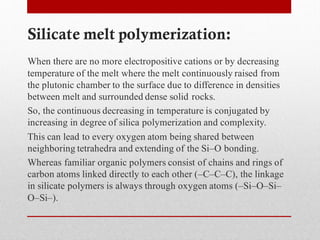
Silicate melt polymerization:
When there are no more electropositive cations or by decreasing
temperature of the melt where the melt continuously raised from
the plutonic chamber to the surface due to difference in densities
between melt and surrounded dense solid rocks.
So, the continuous decreasing in temperature is conjugated by
increasing in degree of silica polymerization and complexity.
This can lead to every oxygen atom being shared between
neighboring tetrahedra and extending of the Si–O bonding.
Whereas familiar organic polymers consist of chains and rings of
carbon atoms linked directly to each other (–C–C–C), the linkage
in silicate polymers is always through oxygen atoms (–Si–O–Si–
O–Si–).
Silicate melt polymerization:
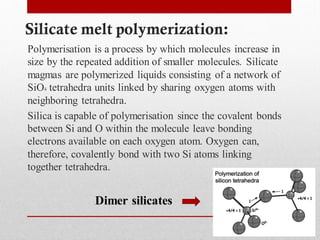
Polymerisation is a process by which molecules increase in
size by the repeated addition of smaller molecules. Silicate
magmas are polymerized liquids consisting of a network of
SiO4 tetrahedra units linked by sharing oxygen atoms with
neighboring tetrahedra.
Silica is capable of polymerisation since the covalent bonds
between Si and O within the molecule leave bonding
electrons available on each oxygen atom. Oxygen can,
therefore, covalently bond with two Si atoms linking
together tetrahedra.
Dimer silicates
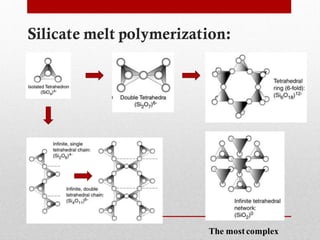
Silicate melt polymerization:
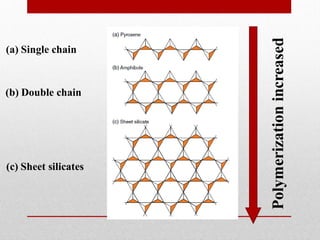
The mostcomplex
Polymerizationincreased
(a) Single chain
(b) Double chain
(c) Sheet silicates
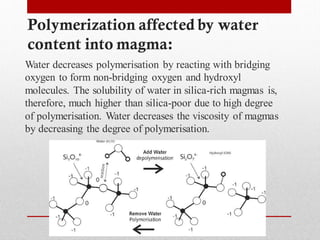
Polymerization affected by water
content into magma:
Water decreases polymerisation by reacting with bridging
oxygen to form non-bridging oxygen and hydroxyl
molecules. The solubility of water in silica-rich magmas is,
therefore, much higher than silica-poor due to high degree
of polymerisation. Water decreases the viscosity of magmas
by decreasing the degree of polymerisation.
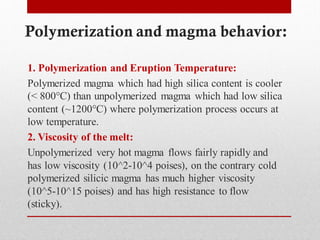
Polymerization and magma behavior:
1. Polymerization and Eruption Temperature:
Polymerized magma which had high silica content is cooler
(< 800°C) than unpolymerized magma which had low silica
content (~1200°C) where polymerization process occurs at
low temperature.
2. Viscosity of the melt:
Unpolymerized very hot magma flows fairly rapidly and
has low viscosity (10^2-10^4 poises), on the contrary cold
polymerized silicic magma has much higher viscosity
(10^5-10^15 poises) and has high resistance to flow
(sticky).
Polymerization and magma behavior:
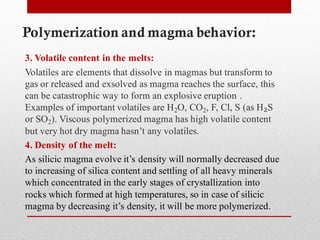
3. Volatile content in the melts:
Volatiles are elements that dissolve in magmas but transform to
gas or released and exsolved as magma reaches the surface, this
can be catastrophic way to form an explosive eruption .
Examples of important volatiles are H2O, CO2, F, Cl, S (as H₂S
or SO2). Viscous polymerized magma has high volatile content
but very hot dry magma hasn’t any volatiles.
4. Density of the melt:
As silicic magma evolve it’s density will normally decreased due
to increasing of silica content and settling of all heavy minerals
which concentrated in the early stages of crystallization into
rocks which formed at high temperatures, so in case of silicic
magma by decreasing it’s density, it will be more polymerized.
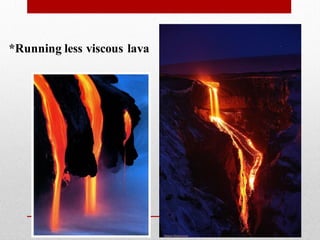
*Running less viscous lava
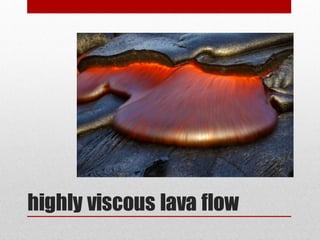
highly viscous lava flow
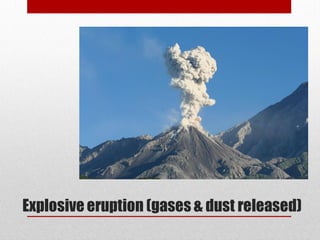
Explosive eruption (gases & dust released)
For further reading:
This reference is recommended:
Chemical Fundamentalsof Geology and
EnvironmentalGeoscienceby [Robin
Gill , 2015]3rd edition.
Reference downloadinglink:
ha9ll3si6http://www.mediafire.com/download/
/Chemical+Fundamentals+of+Geology+62chp2
BRobin5and+Environmental+Geoscience++%
-Geo+Pedia+Geo28D+%5%2015C+2+Gill+%
.pdf29Library%
Thank you
&
Best regards

Silica polymerization in igneous processes.

  • 1.
    Silicate Polymerization In IgneousProcesses By: Ahmed Tarek Mohamed Mahmoud @gmail.com887275ahmed.tarek.:mail-E Geology department Under supervision: prof. Amal Abd El-Maboud Professor of physical chemistry of macromolecules.
  • 2.
    Introduction: Magma is veryhot liquid of molten rocks (often mantle derived melt) and contain other constituents like gases , volatiles and solid suspended crystals where magma exist into deep plutinic huge chambers. While Lava is a magma but extruded onto the earth by (volcanic eruption) or from (earth fissure).
  • 3.
    Magma composition: Magma essentiallycomposedof eight majorelements (Fe ,Mg ,Ca ,Al ,Si ,O2 ,Na ,K), minorelements (Ti, Mn, P, and others)and other traces. Theseelements ordered in many crystallinestructures to form mineralsduring solidificationof the magmaticmelt by decreasing of it’s temperature. Silicais the most abundant moleculeand affects the properties of magma and play important role in formationof theseminerals where most of them are silicate minerals.
  • 4.
    Physical properties ofmagma: 1. Temperature 2. Density 3. Viscosity 4. Gas solubility These essential properties control magma behavior and mainly affected by siliceous content in the melt. Highly Viscous Lava
  • 5.
    Structure of silicatesin the melt: Silicate structure composed of many silica units SiO4 . In structural terms the SiO4 tetrahedron is the basic building brick from which all silicate crystals and melts are constructed. Each unit charged with 4 negative charges due to the silicon atom itself can satisfy only half of the bonding capacity of its four oxygen neighbors (four bonds out of a total of eight). The remnant 4 negative charges neutralized during crystallization of silicate minerals by ionic bonding with any other electropositive element like (Mg, Fe, Ca) which coexist into the melt with oxygen in silicate structure.
  • 6.
    Silicate melt polymerization: Whenthere are no more electropositive cations or by decreasing temperature of the melt where the melt continuously raised from the plutonic chamber to the surface due to difference in densities between melt and surrounded dense solid rocks. So, the continuous decreasing in temperature is conjugated by increasing in degree of silica polymerization and complexity. This can lead to every oxygen atom being shared between neighboring tetrahedra and extending of the Si–O bonding. Whereas familiar organic polymers consist of chains and rings of carbon atoms linked directly to each other (–C–C–C), the linkage in silicate polymers is always through oxygen atoms (–Si–O–Si– O–Si–).
  • 7.
    Silicate melt polymerization: Polymerisationis a process by which molecules increase in size by the repeated addition of smaller molecules. Silicate magmas are polymerized liquids consisting of a network of SiO4 tetrahedra units linked by sharing oxygen atoms with neighboring tetrahedra. Silica is capable of polymerisation since the covalent bonds between Si and O within the molecule leave bonding electrons available on each oxygen atom. Oxygen can, therefore, covalently bond with two Si atoms linking together tetrahedra. Dimer silicates
  • 8.
  • 9.
    Polymerizationincreased (a) Single chain (b)Double chain (c) Sheet silicates
  • 10.
    Polymerization affected bywater content into magma: Water decreases polymerisation by reacting with bridging oxygen to form non-bridging oxygen and hydroxyl molecules. The solubility of water in silica-rich magmas is, therefore, much higher than silica-poor due to high degree of polymerisation. Water decreases the viscosity of magmas by decreasing the degree of polymerisation.
  • 11.
    Polymerization and magmabehavior: 1. Polymerization and Eruption Temperature: Polymerized magma which had high silica content is cooler (< 800°C) than unpolymerized magma which had low silica content (~1200°C) where polymerization process occurs at low temperature. 2. Viscosity of the melt: Unpolymerized very hot magma flows fairly rapidly and has low viscosity (10^2-10^4 poises), on the contrary cold polymerized silicic magma has much higher viscosity (10^5-10^15 poises) and has high resistance to flow (sticky).
  • 12.
    Polymerization and magmabehavior: 3. Volatile content in the melts: Volatiles are elements that dissolve in magmas but transform to gas or released and exsolved as magma reaches the surface, this can be catastrophic way to form an explosive eruption . Examples of important volatiles are H2O, CO2, F, Cl, S (as H₂S or SO2). Viscous polymerized magma has high volatile content but very hot dry magma hasn’t any volatiles. 4. Density of the melt: As silicic magma evolve it’s density will normally decreased due to increasing of silica content and settling of all heavy minerals which concentrated in the early stages of crystallization into rocks which formed at high temperatures, so in case of silicic magma by decreasing it’s density, it will be more polymerized.
  • 13.
  • 14.
  • 15.
    Explosive eruption (gases& dust released)
  • 16.
    For further reading: Thisreference is recommended: Chemical Fundamentalsof Geology and EnvironmentalGeoscienceby [Robin Gill , 2015]3rd edition. Reference downloadinglink: ha9ll3si6http://www.mediafire.com/download/ /Chemical+Fundamentals+of+Geology+62chp2 BRobin5and+Environmental+Geoscience++% -Geo+Pedia+Geo28D+%5%2015C+2+Gill+% .pdf29Library%
  • 17.