SEMINAR ON
Properties of magma
Presented By:-
yadala Anji babu
2nd Sem, Applied Geology
DOS in Earth Science
Guided By:-
Dr. k. n. prakash narasimha
professor
DOS in Earth Science
 Introduction(magma)
 Types of magma
 Physical properties of magma
 Temperature
 Pressure
 Density
 Viscosity
 Chemical properties
 Chemical composition
 Volatiles
 Conclusion
 Reference
 Magma is a mixture of molten or semi-molten rock,
volatiles and solids that is found beneath the surface of
the Earth.
 Magma is a natural fluid rock material beneath the earth’s
crust, which may consolidate to form igneous rocks.
When it erupted to the surface, it is Lava.
 Several interrelated physical properties determine the
characteristics of magma, including chemical
composition,viscosity,dissolved gases, and temperature.
 Temperature
 Pressure
 Density
 Viscosity
 Chemical composition
 Volatiles
 The Temperature record for magmas in nature
are normally measured with an optical
pyrometer or at depth in lava lakes with a
thermocouple .
 The Temperature at a 10m depth in the basalt
lava lake on Kilauea volcano , Hawaii has
been measured as 3000c hotter then the 8600c
temperature measured near the surface.
 The Temperature of lava fountain was only 50
0 c below the temperature at a 10mts depth.
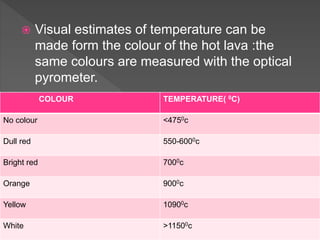
 Visual estimates of temperature can be
made form the colour of the hot lava :the
same colours are measured with the optical
pyrometer.
COLOUR TEMPERATURE( 0C)
No colour <4750c
Dull red 550-6000c
Bright red 7000c
Orange 9000c
Yellow 10900c
White >11500c
 Large range in eruption temperatures:
Komatiites(ultramafic lava): ~1400-1600°C
Basalts: e.g., Hawaiian basalt ~1200°C
Rhyolite: < 800°C
Carbonatites: down to <500° C
 Eruption temperatures relate to composition:
Mg-rich magma is hot
Si-rich magma is cold
 Eruption temperatures also strongly affect viscosity
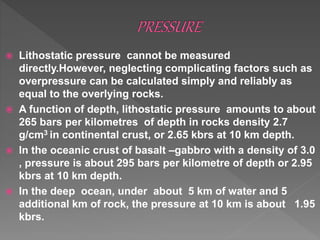
 Lithostatic pressure cannot be measured
directly.However, neglecting complicating factors such as
overpressure can be calculated simply and reliably as
equal to the overlying rocks.
 A function of depth, lithostatic pressure amounts to about
265 bars per kilometres of depth in rocks density 2.7
g/cm3 in continental crust, or 2.65 kbrs at 10 km depth.
 In the oceanic crust of basalt –gabbro with a density of 3.0
, pressure is about 295 bars per kilometre of depth or 2.95
kbrs at 10 km depth.
 In the deep ocean, under about 5 km of water and 5
additional km of rock, the pressure at 10 km is about 1.95
kbrs.
 The possibility of additional pressure resulting
from tectonic forces, especially at shallow
depths of a few kilometres where the rocks are
more rigid, has been considered by many works.
 Overpressure stresses at the base of the
lithosphere and in the oceanic ridge and
subduction zones, calculated from earthquake
magnitude and mechanisms , apparently amount
to only about 50 to 200 bars.
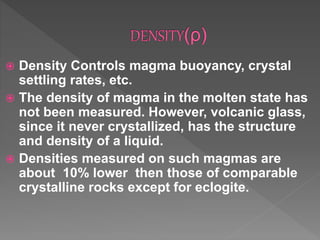
 Density Controls magma buoyancy, crystal
settling rates, etc.
 The density of magma in the molten state has
not been measured. However, volcanic glass,
since it never crystallized, has the structure
and density of a liquid.
 Densities measured on such magmas are
about 10% lower then those of comparable
crystalline rocks except for eclogite.
 viscosity is also one of the physical property
of magma, it is resistance to flow of magma.
Magmas having low viscosity can flow easily.
 viscosity is determined by the composition
and temperature of the magma.
 As the crystal form, the viscosity of resulting
melt- crystal mixture increases as they cools.
 Viscosity also depends on volatile content of
magma.
Melts near their melting point have structure similar to
the mineral that would crystallise from them.
Viscosity of magma depends on silica content of the
rock.
Basalt Rhyolite
High silica
Low silica
Low
viscosity
High
viscosity
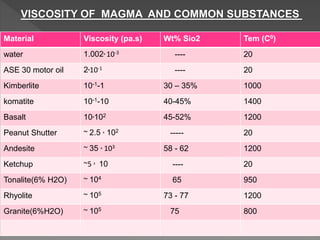
VISCOSITY OF MAGMA AND COMMON SUBSTANCES
Material Viscosity (pa.s) Wt% Sio2 Tem (C0)
water 1.002ₓ 10-3 ---- 20
ASE 30 motor oil 2ₓ10-1 ---- 20
Kimberlite 10-1-1 30 – 35% 1000
komatite 10-1-10 40-45% 1400
Basalt 10ₓ102 45-52% 1200
Peanut Shutter ~ 2.5 ₓ 102 ----- 20
Andesite ~ 35 ₓ 103 58 - 62 1200
Ketchup ~5 ₓ 10 ---- 20
Tonalite(6% H2O) ~ 104 65 950
Rhyolite ~ 105 73 - 77 1200
Granite(6%H2O) ~ 105 75 800
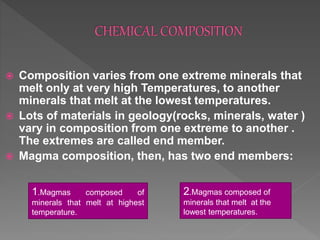
 Composition varies from one extreme minerals that
melt only at very high Temperatures, to another
minerals that melt at the lowest temperatures.
 Lots of materials in geology(rocks, minerals, water )
vary in composition from one extreme to another .
The extremes are called end member.
 Magma composition, then, has two end members:
1.Magmas composed of
minerals that melt at highest
temperature.
2.Magmas composed of
minerals that melt at the
lowest temperatures.
 Minerals that at the highest temperatures to be of
the independent tetrahedra and single –chain
silicate type, and Ca –rich plagioclase feldspars.
Remember that the important rock forming
minerals composed of independent tetrahedra is
olivine and that the important rock forming
minerals composed of single chains of tetrahedra
is pyroxene.
 Minerals that melt at the lowest temperatures tend
to be framework and sheet silicates , and Na –
rich plagioclase feldspars. Recall that the
important rock forming framework silicates are
quartz and potassium feldspars , and an
important rock forming sheet silicate mica.
 H2O most abundant volatile in most magmas.
 CO2 next most abundant volatile.
 In general, Basalt magmas are DRY, i.e. H2O < 0.5 wt%
 MORB = 0.25% H2O
 Hawaiian Tholeiite = 0.5% H2O
 Alkali Olivine Basalt = 0.9% H2O
 Andesites, Rhyolites, Granites: Higher Water Contents
 Paricutin Andesite = 2.2% H2O at 1100oC
 Granites/Rhyolites wide range H2O: 0.5% to 7% H2O by
weight.
 Water lowers viscosity: OH- ions act as Network
Modifers,
substitute for O2 in tetrahedra.
 Water lowers solids temperature: Effect greater at higher
 Several interrelated physical and chemical
properties determine the characteristics of
magma, and their environment of genesis.
 Physical properties includes temperature,
pressure, density, viscosity are important to
indicate type of eruption or path of genesis.
 Chemical properties like composition and
volatile content can change their mode of
crystallisation, mineral composition, and can
influence physical properties of the magma.
 Hyndman, 1985, Petrology of igneous and
metamorphic rocks, second edition Pp No: 123 -
131.
 John D.Winter,Principles of Igneous and
Metamorphic petrology, Second edition Pp No:54
– 56.
 Sambhu Nadh, 2013, Encyclopaedia of geology,
Pp No: 115 – 125.
 http://www.tulane.edu/~sanelson/eens211/magm
adiff.ht
 http://en.wikipedia.org/wiki/liquid immiscibility
THANK YOU

5_6055596470780821687.pptx

  • 1.
    SEMINAR ON Properties ofmagma Presented By:- yadala Anji babu 2nd Sem, Applied Geology DOS in Earth Science Guided By:- Dr. k. n. prakash narasimha professor DOS in Earth Science
  • 2.
     Introduction(magma)  Typesof magma  Physical properties of magma  Temperature  Pressure  Density  Viscosity  Chemical properties  Chemical composition  Volatiles  Conclusion  Reference
  • 3.
     Magma isa mixture of molten or semi-molten rock, volatiles and solids that is found beneath the surface of the Earth.  Magma is a natural fluid rock material beneath the earth’s crust, which may consolidate to form igneous rocks. When it erupted to the surface, it is Lava.  Several interrelated physical properties determine the characteristics of magma, including chemical composition,viscosity,dissolved gases, and temperature.
  • 4.
     Temperature  Pressure Density  Viscosity  Chemical composition  Volatiles
  • 5.
     The Temperaturerecord for magmas in nature are normally measured with an optical pyrometer or at depth in lava lakes with a thermocouple .  The Temperature at a 10m depth in the basalt lava lake on Kilauea volcano , Hawaii has been measured as 3000c hotter then the 8600c temperature measured near the surface.  The Temperature of lava fountain was only 50 0 c below the temperature at a 10mts depth.
  • 6.
     Visual estimatesof temperature can be made form the colour of the hot lava :the same colours are measured with the optical pyrometer. COLOUR TEMPERATURE( 0C) No colour <4750c Dull red 550-6000c Bright red 7000c Orange 9000c Yellow 10900c White >11500c
  • 7.
     Large rangein eruption temperatures: Komatiites(ultramafic lava): ~1400-1600°C Basalts: e.g., Hawaiian basalt ~1200°C Rhyolite: < 800°C Carbonatites: down to <500° C  Eruption temperatures relate to composition: Mg-rich magma is hot Si-rich magma is cold  Eruption temperatures also strongly affect viscosity
  • 8.
     Lithostatic pressurecannot be measured directly.However, neglecting complicating factors such as overpressure can be calculated simply and reliably as equal to the overlying rocks.  A function of depth, lithostatic pressure amounts to about 265 bars per kilometres of depth in rocks density 2.7 g/cm3 in continental crust, or 2.65 kbrs at 10 km depth.  In the oceanic crust of basalt –gabbro with a density of 3.0 , pressure is about 295 bars per kilometre of depth or 2.95 kbrs at 10 km depth.  In the deep ocean, under about 5 km of water and 5 additional km of rock, the pressure at 10 km is about 1.95 kbrs.
  • 9.
     The possibilityof additional pressure resulting from tectonic forces, especially at shallow depths of a few kilometres where the rocks are more rigid, has been considered by many works.  Overpressure stresses at the base of the lithosphere and in the oceanic ridge and subduction zones, calculated from earthquake magnitude and mechanisms , apparently amount to only about 50 to 200 bars.
  • 10.
     Density Controlsmagma buoyancy, crystal settling rates, etc.  The density of magma in the molten state has not been measured. However, volcanic glass, since it never crystallized, has the structure and density of a liquid.  Densities measured on such magmas are about 10% lower then those of comparable crystalline rocks except for eclogite.
  • 13.
     viscosity isalso one of the physical property of magma, it is resistance to flow of magma. Magmas having low viscosity can flow easily.  viscosity is determined by the composition and temperature of the magma.  As the crystal form, the viscosity of resulting melt- crystal mixture increases as they cools.  Viscosity also depends on volatile content of magma.
  • 14.
    Melts near theirmelting point have structure similar to the mineral that would crystallise from them. Viscosity of magma depends on silica content of the rock. Basalt Rhyolite High silica Low silica Low viscosity High viscosity
  • 15.
    VISCOSITY OF MAGMAAND COMMON SUBSTANCES Material Viscosity (pa.s) Wt% Sio2 Tem (C0) water 1.002ₓ 10-3 ---- 20 ASE 30 motor oil 2ₓ10-1 ---- 20 Kimberlite 10-1-1 30 – 35% 1000 komatite 10-1-10 40-45% 1400 Basalt 10ₓ102 45-52% 1200 Peanut Shutter ~ 2.5 ₓ 102 ----- 20 Andesite ~ 35 ₓ 103 58 - 62 1200 Ketchup ~5 ₓ 10 ---- 20 Tonalite(6% H2O) ~ 104 65 950 Rhyolite ~ 105 73 - 77 1200 Granite(6%H2O) ~ 105 75 800
  • 17.
     Composition variesfrom one extreme minerals that melt only at very high Temperatures, to another minerals that melt at the lowest temperatures.  Lots of materials in geology(rocks, minerals, water ) vary in composition from one extreme to another . The extremes are called end member.  Magma composition, then, has two end members: 1.Magmas composed of minerals that melt at highest temperature. 2.Magmas composed of minerals that melt at the lowest temperatures.
  • 18.
     Minerals thatat the highest temperatures to be of the independent tetrahedra and single –chain silicate type, and Ca –rich plagioclase feldspars. Remember that the important rock forming minerals composed of independent tetrahedra is olivine and that the important rock forming minerals composed of single chains of tetrahedra is pyroxene.  Minerals that melt at the lowest temperatures tend to be framework and sheet silicates , and Na – rich plagioclase feldspars. Recall that the important rock forming framework silicates are quartz and potassium feldspars , and an important rock forming sheet silicate mica.
  • 19.
     H2O mostabundant volatile in most magmas.  CO2 next most abundant volatile.  In general, Basalt magmas are DRY, i.e. H2O < 0.5 wt%  MORB = 0.25% H2O  Hawaiian Tholeiite = 0.5% H2O  Alkali Olivine Basalt = 0.9% H2O  Andesites, Rhyolites, Granites: Higher Water Contents  Paricutin Andesite = 2.2% H2O at 1100oC  Granites/Rhyolites wide range H2O: 0.5% to 7% H2O by weight.  Water lowers viscosity: OH- ions act as Network Modifers, substitute for O2 in tetrahedra.  Water lowers solids temperature: Effect greater at higher
  • 20.
     Several interrelatedphysical and chemical properties determine the characteristics of magma, and their environment of genesis.  Physical properties includes temperature, pressure, density, viscosity are important to indicate type of eruption or path of genesis.  Chemical properties like composition and volatile content can change their mode of crystallisation, mineral composition, and can influence physical properties of the magma.
  • 21.
     Hyndman, 1985,Petrology of igneous and metamorphic rocks, second edition Pp No: 123 - 131.  John D.Winter,Principles of Igneous and Metamorphic petrology, Second edition Pp No:54 – 56.  Sambhu Nadh, 2013, Encyclopaedia of geology, Pp No: 115 – 125.  http://www.tulane.edu/~sanelson/eens211/magm adiff.ht  http://en.wikipedia.org/wiki/liquid immiscibility
  • 22.