1
 Stands for Secure Internet Live Conferencing.


 Designed as a secure replacement for IRC (Internet
 Relay Chat).

 Stable implementations for clients and server Also
 has some features of instant messangers are
 available.
                                                       2
 Designed by Pekka Riikonen, started '96.
 Work stopped several times.
 1st public release in 2000.
 Silc-client 1.0 oct. 2003.
 Currently maturing of protocol.
 Protocol specs submitted to IETF, currently in a
  draft phase (will become RFC soon).(Internet
  eng.task force)
 Version 1 of silc, toolkit to follow soon.         3
 Protocol for authenticated and encrypted


 Live Conferencing


 Supports chat and instant messenger like systems.


                                                      4
 Instant Messaging [IM]


 Internet Relay Chat [IRC]


 Extensible Messaging And Presence Protocol
 [EMPP]

 Secure Internet Live Conferencing [SILC]
                                               5
 Instant messaging (IM) is a collection of technologies
 used for real-time text-based communication between
 two or more participants over the Internet, or other
 types of networks

 Weakness :-
         Security risks
         Compliance risks

         Inappropriate use
                                                           6
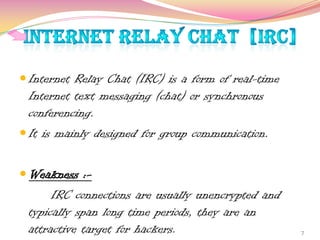
 Internet Relay Chat (IRC) is a form of real-time
  Internet text messaging (chat) or synchronous
  conferencing.
 It is mainly designed for group communication.


 Weakness :-
      IRC connections are usually unencrypted and
 typically span long time periods, they are an
 attractive target for hackers.                      7
 EMPP is an open-standard communications protocol for
  message-oriented middleware based on
  XML.(extensible markup language).
 Systems approach of development and application.
 Google Wave's federation protocol is an extension to the
  EMPP protocol.
 Weaknesses:-
    Presence data overhead
    In-band binary data transfer is inefficient
                                                         8
Key-Features:
 All messages are encrypted and authenticated.
 Keys managed by server or user.
 Messages are sent through server-net.
 File transfer via SFTP.


                                                  9
 SERVERS


 ROUTERS


 CLIENT


            10
11
 SILC PACKET PROTOCOL


 SILC KEY EXCHANGE [SKE] PROTOCOL


 SILC CONNECTION AUTHENTICATION
 PROTOCOL

                                     12
13
 The file transfer support in chat protocols are a absolute
  requirement nowadays, and chat protocol without one is no chat
  protocol at all.

 The support for file transfer in SILC has been designed so that
  using practically any file transfer protocol is possible.

 The file transfer protocol used in SILC protocol is the
  SSH File Transfer protocol (SFTP).
                                                              14
 The Secure Internet Live Conferencing (SILC)
 protocol is a new generation chat protocol that
 provides all the common conferencing services with
 strong support for security. It has wide range of
 security properties that should meet the highest
 levels of security requirements, while not forgetting
 easy of use. The network topology offers new
 architectural solution with better scalability over
 traditional chat protocols.
                                                         15
16

Silc

  • 1.
  • 2.
     Stands forSecure Internet Live Conferencing.  Designed as a secure replacement for IRC (Internet Relay Chat).  Stable implementations for clients and server Also has some features of instant messangers are available. 2
  • 3.
     Designed byPekka Riikonen, started '96.  Work stopped several times.  1st public release in 2000.  Silc-client 1.0 oct. 2003.  Currently maturing of protocol.  Protocol specs submitted to IETF, currently in a draft phase (will become RFC soon).(Internet eng.task force)  Version 1 of silc, toolkit to follow soon. 3
  • 4.
     Protocol forauthenticated and encrypted  Live Conferencing  Supports chat and instant messenger like systems. 4
  • 5.
     Instant Messaging[IM]  Internet Relay Chat [IRC]  Extensible Messaging And Presence Protocol [EMPP]  Secure Internet Live Conferencing [SILC] 5
  • 6.
     Instant messaging(IM) is a collection of technologies used for real-time text-based communication between two or more participants over the Internet, or other types of networks  Weakness :-  Security risks  Compliance risks  Inappropriate use 6
  • 7.
     Internet RelayChat (IRC) is a form of real-time Internet text messaging (chat) or synchronous conferencing.  It is mainly designed for group communication.  Weakness :- IRC connections are usually unencrypted and typically span long time periods, they are an attractive target for hackers. 7
  • 8.
     EMPP isan open-standard communications protocol for message-oriented middleware based on XML.(extensible markup language).  Systems approach of development and application.  Google Wave's federation protocol is an extension to the EMPP protocol.  Weaknesses:-  Presence data overhead  In-band binary data transfer is inefficient 8
  • 9.
    Key-Features:  All messagesare encrypted and authenticated.  Keys managed by server or user.  Messages are sent through server-net.  File transfer via SFTP. 9
  • 10.
  • 11.
  • 12.
     SILC PACKETPROTOCOL  SILC KEY EXCHANGE [SKE] PROTOCOL  SILC CONNECTION AUTHENTICATION PROTOCOL 12
  • 13.
  • 14.
     The filetransfer support in chat protocols are a absolute requirement nowadays, and chat protocol without one is no chat protocol at all.  The support for file transfer in SILC has been designed so that using practically any file transfer protocol is possible.  The file transfer protocol used in SILC protocol is the SSH File Transfer protocol (SFTP). 14
  • 15.
     The SecureInternet Live Conferencing (SILC) protocol is a new generation chat protocol that provides all the common conferencing services with strong support for security. It has wide range of security properties that should meet the highest levels of security requirements, while not forgetting easy of use. The network topology offers new architectural solution with better scalability over traditional chat protocols. 15
  • 16.