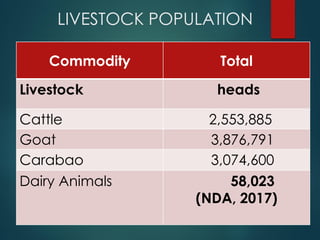
LIVESTOCK POPULATION
Commodity Total
Livestock
Swine
Cattle
Goat
Carabao
Commodity Total
Livestock heads
Cattle 2,553,885
Goat 3,876,791
Carabao 3,074,600
Dairy Animals 58,023
(NDA, 2017)
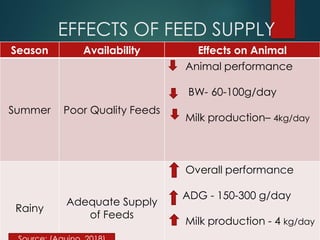
EFFECTS OF FEED SUPPLY
Season Availability Effects on Animal
Summer Poor Quality Feeds
Animal performance
BW- 60-100g/day
Milk production– 4kg/day
Rainy
Adequate Supply
of Feeds
Overall performance
ADG - 150-300 g/day
Milk production - 4 kg/day
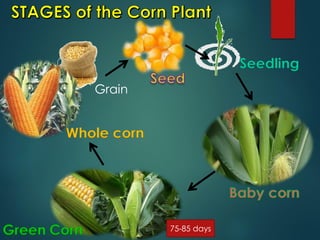
Seedling
Green Corn
Whole corn
Grain
75-85 days
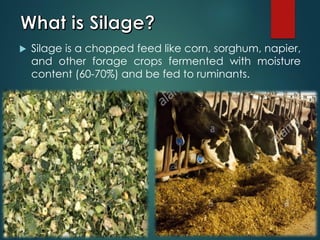
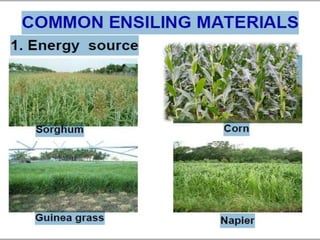
 Silage is a chopped feed like corn, sorghum, napier,
and other forage crops fermented with moisture
content (60-70%) and be fed to ruminants.
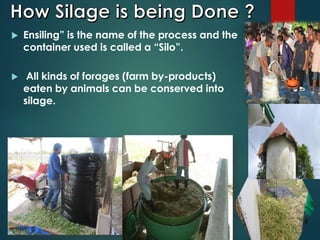
 Ensiling” is the name of the process and the
container used is called a “Silo”.
 All kinds of forages (farm by-products)
eaten by animals can be conserved into
silage.
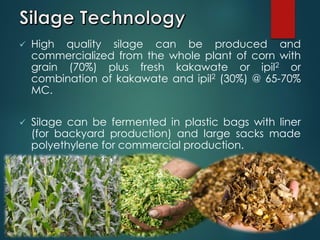
 High quality silage can be produced and
commercialized from the whole plant of corn with
grain (70%) plus fresh kakawate or ipil2 or
combination of kakawate and ipil2 (30%) @ 65-70%
MC.
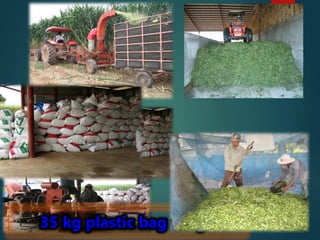
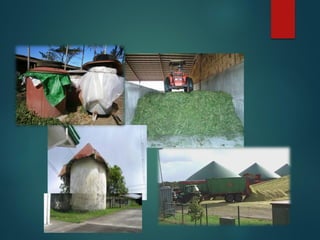
 Silage can be fermented in plastic bags with liner
(for backyard production) and large sacks made
polyethylene for commercial production.
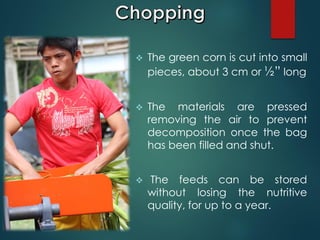
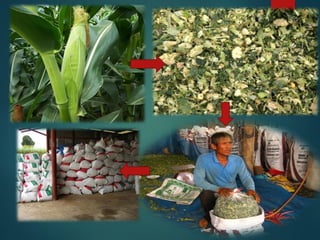
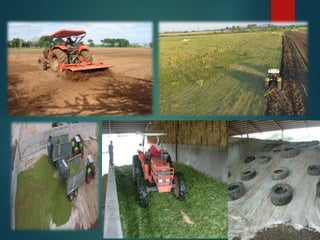
 The green corn is cut into small
pieces, about 3 cm or ½” long
 The materials are pressed
removing the air to prevent
decomposition once the bag
has been filled and shut.
 The feeds can be stored
without losing the nutritive
quality, for up to a year.
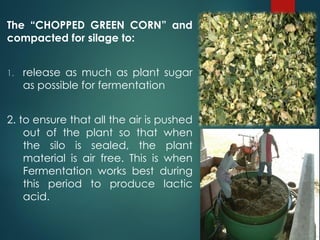
The “CHOPPED GREEN CORN” and
compacted for silage to:
1. release as much as plant sugar
as possible for fermentation
2. to ensure that all the air is pushed
out of the plant so that when
the silo is sealed, the plant
material is air free. This is when
Fermentation works best during
this period to produce lactic
acid.
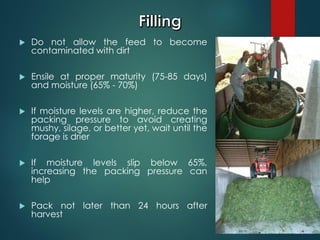
 Do not allow the feed to become
contaminated with dirt
 Ensile at proper maturity (75-85 days)
and moisture (65% - 70%)
 If moisture levels are higher, reduce the
packing pressure to avoid creating
mushy, silage, or better yet, wait until the
forage is drier
 If moisture levels slip below 65%,
increasing the packing pressure can
help
 Pack not later than 24 hours after
harvest
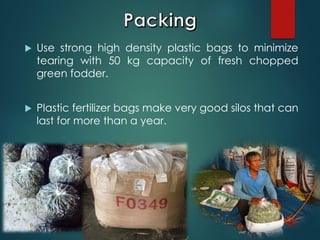
 Use strong high density plastic bags to minimize
tearing with 50 kg capacity of fresh chopped
green fodder.
 Plastic fertilizer bags make very good silos that can
last for more than a year.
 Leaning heavily on the forage
material will compact the silage
and seal it from air. Make sure
there is enough plastic to tie up,
so that it does not come free
from the twine.
 Tobacco twine or hay baling
twine is best for tying up the
bag. Seal tightly.
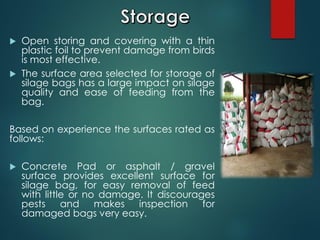
 Open storing and covering with a thin
plastic foil to prevent damage from birds
is most effective.
 The surface area selected for storage of
silage bags has a large impact on silage
quality and ease of feeding from the
bag.
Based on experience the surfaces rated as
follows:
 Concrete Pad or asphalt / gravel
surface provides excellent surface for
silage bag, for easy removal of feed
with little or no damage. It discourages
pests and makes inspection for
damaged bags very easy.
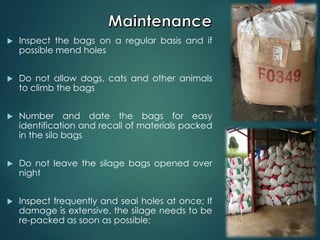
 Inspect the bags on a regular basis and if
possible mend holes
 Do not allow dogs, cats and other animals
to climb the bags
 Number and date the bags for easy
identification and recall of materials packed
in the silo bags
 Do not leave the silage bags opened over
night
 Inspect frequently and seal holes at once; If
damage is extensive, the silage needs to be
re-packed as soon as possible;
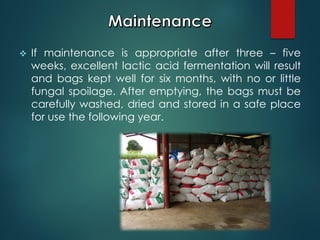
 If maintenance is appropriate after three – five
weeks, excellent lactic acid fermentation will result
and bags kept well for six months, with no or little
fungal spoilage. After emptying, the bags must be
carefully washed, dried and stored in a safe place
for use the following year.
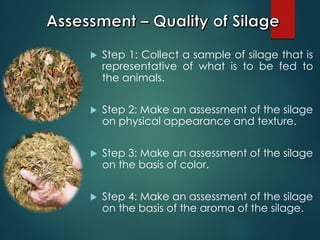
 Step 1: Collect a sample of silage that is
representative of what is to be fed to
the animals.
 Step 2: Make an assessment of the silage
on physical appearance and texture.
 Step 3: Make an assessment of the silage
on the basis of color.
 Step 4: Make an assessment of the silage
on the basis of the aroma of the silage.
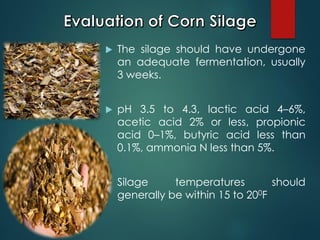
 The silage should have undergone
an adequate fermentation, usually
3 weeks.
 pH 3.5 to 4.3, lactic acid 4–6%,
acetic acid 2% or less, propionic
acid 0–1%, butyric acid less than
0.1%, ammonia N less than 5%.
 Silage temperatures should
generally be within 15 to 200F
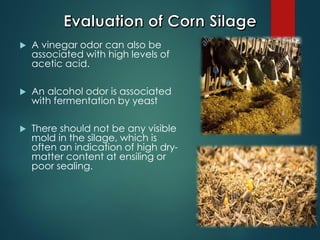
 A vinegar odor can also be
associated with high levels of
acetic acid.
 An alcohol odor is associated
with fermentation by yeast
 There should not be any visible
mold in the silage, which is
often an indication of high dry-
matter content at ensiling or
poor sealing.
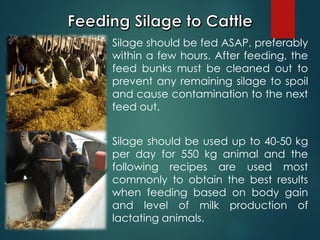
 Silage should be fed ASAP, preferably
within a few hours. After feeding, the
feed bunks must be cleaned out to
prevent any remaining silage to spoil
and cause contamination to the next
feed out.
 Silage should be used up to 40-50 kg
per day for 550 kg animal and the
following recipes are used most
commonly to obtain the best results
when feeding based on body gain
and level of milk production of
lactating animals.
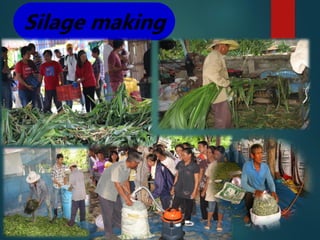
Silage making
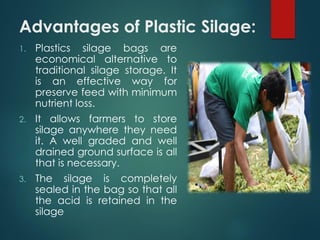
Advantages of Plastic Silage:
1. Plastics silage bags are
economical alternative to
traditional silage storage. It
is an effective way for
preserve feed with minimum
nutrient loss.
2. It allows farmers to store
silage anywhere they need
it. A well graded and well
drained ground surface is all
that is necessary.
3. The silage is completely
sealed in the bag so that all
the acid is retained in the
silage
Advantages of Plastic Silage
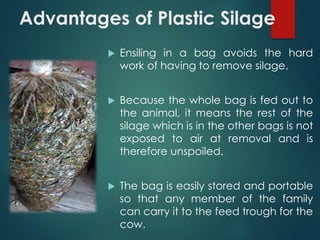
 Ensiling in a bag avoids the hard
work of having to remove silage.
 Because the whole bag is fed out to
the animal, it means the rest of the
silage which is in the other bags is not
exposed to air at removal and is
therefore unspoiled.
 The bag is easily stored and portable
so that any member of the family
can carry it to the feed trough for the
cow.
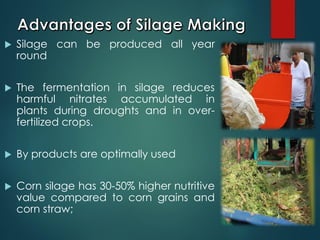
 Silage can be produced all year
round
 The fermentation in silage reduces
harmful nitrates accumulated in
plants during droughts and in over-
fertilized crops.
 By products are optimally used
 Corn silage has 30-50% higher nutritive
value compared to corn grains and
corn straw;
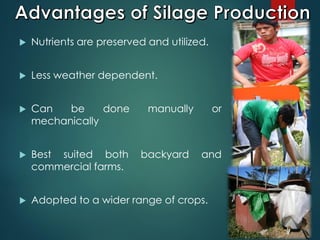
 Nutrients are preserved and utilized.
 Less weather dependent.
 Can be done manually or
mechanically
 Best suited both backyard and
commercial farms.
 Adopted to a wider range of crops.
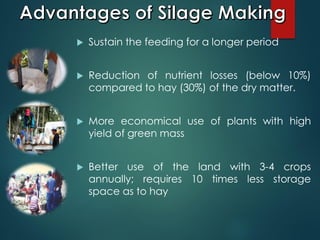
 Sustain the feeding for a longer period
 Reduction of nutrient losses (below 10%)
compared to hay (30%) of the dry matter.
 More economical use of plants with high
yield of green mass
 Better use of the land with 3-4 crops
annually; requires 10 times less storage
space as to hay
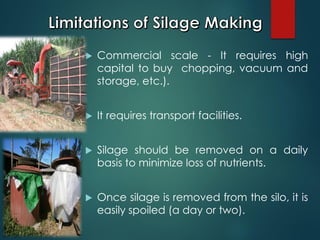
 Commercial scale - It requires high
capital to buy chopping, vacuum and
storage, etc.).
 It requires transport facilities.
 Silage should be removed on a daily
basis to minimize loss of nutrients.
 Once silage is removed from the silo, it is
easily spoiled (a day or two).
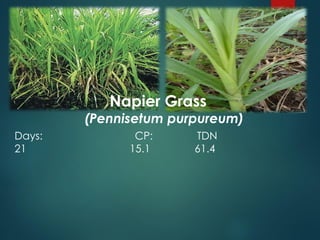
Days: CP: TDN
21 15.1 61.4
Napier Grass
(Pennisetum purpureum)
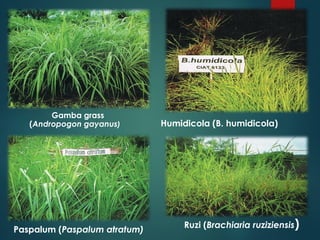
Gamba grass
(Andropogon gayanus)
Ruzi (Brachiaria ruziziensis)
Humidicola (B. humidicola)
Paspalum (Paspalum atratum)
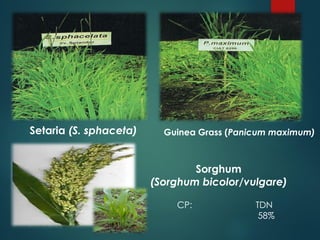
Setaria (S. sphaceta) Guinea Grass (Panicum maximum)
Sorghum
(Sorghum bicolor/vulgare)
CP: TDN
58%
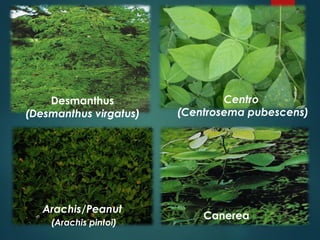
Arachis/Peanut
(Arachis pintoi)
Desmanthus
(Desmanthus virgatus)
Canerea
Centro
(Centrosema pubescens)
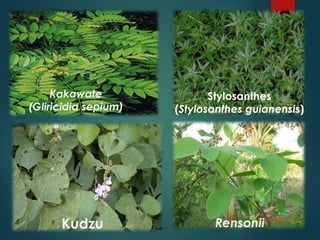
Stylosanthes
(Stylosanthes guianensis)
Kakawate
(Gliricidia sepium)
Kudzu Rensonii
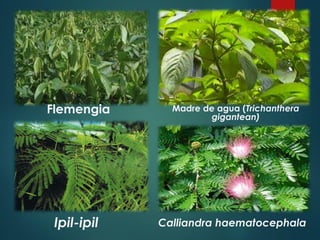
Flemengia
Ipil-ipil
Madre de agua (Trichanthera
gigantean)
Calliandra haematocephala
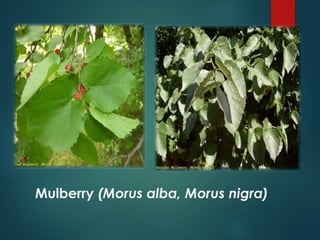
Mulberry (Morus alba, Morus nigra)
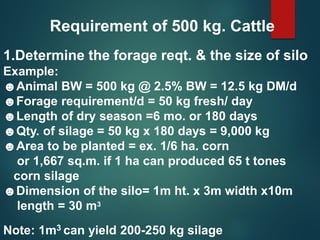
1.Determine the forage reqt. & the size of silo
Example:
☻Animal BW = 500 kg @ 2.5% BW = 12.5 kg DM/d
☻Forage requirement/d = 50 kg fresh/ day
☻Length of dry season =6 mo. or 180 days
☻Qty. of silage = 50 kg x 180 days = 9,000 kg
☻Area to be planted = ex. 1/6 ha. corn
or 1,667 sq.m. if 1 ha can produced 65 t tones
corn silage
☻Dimension of the silo= 1m ht. x 3m width x10m
length = 30 m3
Note: 1m3 can yield 200-250 kg silage
Requirement of 500 kg. Cattle
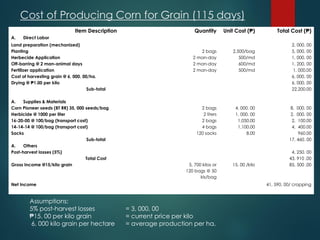
Cost of Producing Corn for Grain (115 days)
Assumptions:
5% post-harvest losses = 3, 000. 00
₱15. 00 per kilo grain = current price per kilo
6, 000 kilo grain per hectare = average production per ha.
Item Description Quantity Unit Cost (₱) Total Cost (₱)
A. Direct Labor
Land preparation (mechanized) 2, 000. 00
Planting 2 bags 2,500/bag 5, 000. 00
Herbecide Application 2 man-day 500/md 1, 000. 00
Off-barring @ 2 man-animal days 2 man-day 600/md 1, 200. 00
Fertilizer application 2 man-day 500/md 1, 000.00
Cost of harvesting grain @ 6, 000. 00/ha. 6, 000. 00
Drying @ ₱1.00 per kilo 6, 000. 00
Sub-total 22,200.00
A. Supplies & Materials
Corn Pioneer seeds (BT RR) 35, 000 seeds/bag 2 bags 4, 000. 00 8, 000. 00
Herbicide @ 1000 per liter 2 liters 1, 000. 00 2, 000. 00
16-20-00 @ 100/bag (transport cost) 2 bags 1,050.00 2, 100.00
14-14-14 @ 100/bag (transport cost) 4 bags 1,100.00 4, 400.00
Sacks 120 sacks 8.00 960.00
Sub-total 17, 460. 00
A. Others
Post-harvest losses (5%) 4, 250. 00
Total Cost 43, 910 .00
Gross Income @15/kilo grain 5, 700 kilos or
120 bags @ 50
kls/bag
15. 00 /kilo 85, 500 .00
Net Income 41, 590. 00/ cropping
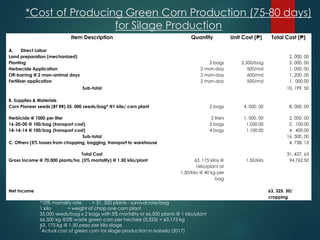
*Cost of Producing Green Corn Production (75-80 days)
for Silage Production
Item Description Quantity Unit Cost (₱) Total Cost (₱)
A. Direct Labor
Land preparation (mechanized) 2, 000. 00
Planting 2 bags 2,500/bag 5, 000. 00
Herbecide Application 2 man-day 500/md 1, 000. 00
Off-barring @ 2 man-animal days 2 man-day 600/md 1, 200. 00
Fertilizer application 2 man-day 500/md 1, 000.00
Sub-total 10, 199. 50
B. Supplies & Materials
Corn Pioneer seeds (BT RR) 35, 000 seeds/bag* @1 kilo/ corn plant 2 bags 4, 000. 00 8, 000. 00
Herbicide @ 1000 per liter 2 liters 1, 000. 00 2, 000. 00
16-20-00 @ 100/bag (transport cost) 2 bags 1,050.00 2, 100.00
14-14-14 @ 100/bag (transport cost) 4 bags 1,100.00 4, 400.00
Sub-total 16, 500. 00
C. Others (5% losses from chopping, bagging, transport to warehouse 4, 738. 13
Total Cost 31, 437. 63
Gross Income @ 70,000 plants/ha. (5% mortality) @ 1.50 kilo/plant 63, 175 kilos @
1kilo/plant at
1.50/kilo @ 40 kg per
bag
1.50/kilo 94,762.50
Net Income 63, 325. 50/
cropping
*10% mortality rate = 31, 500 plants - survival rate/bag
1 kilo = weight of chop one corn plant
35,000 seeds/bag x 2 bags with 5% mortality or 66,500 plants @ 1 kilo/plant
66,500 kg @5% waste green corn per hectare (3,325) = 63,175 kg
63, 175 kg @ 1.50 peso per kilo silage
*Actual cost of green corn for silage production in Isabela (2017)
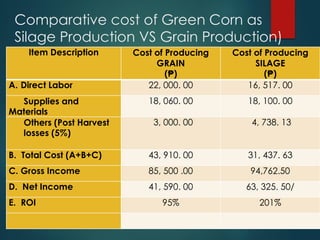
Comparative cost of Green Corn as
Silage Production VS Grain Production)
Item Description Cost of Producing
GRAIN
(₱)
Cost of Producing
SILAGE
(₱)
A. Direct Labor 22, 000. 00 16, 517. 00
Supplies and
Materials
18, 060. 00 18, 100. 00
Others (Post Harvest
losses (5%)
3, 000. 00 4, 738. 13
B. Total Cost (A+B+C) 43, 910. 00 31, 437. 63
C. Gross Income 85, 500 .00 94,762.50
D. Net Income 41, 590. 00 63, 325. 50/
E. ROI 95% 201%
References
 Https://www.britannica.com/topic/silage
 Advantage and limitation of silage making.
Kumar, R. June 18, 2016.
https://www.biotecharticles.com/Agriculture-
Article/Advantage-and-Limitation-of-Silage-
Making-3562.html
 Department of Trade and Industry Region 02
website. http://www.region2.dti.gov.ph/
 Silage technology

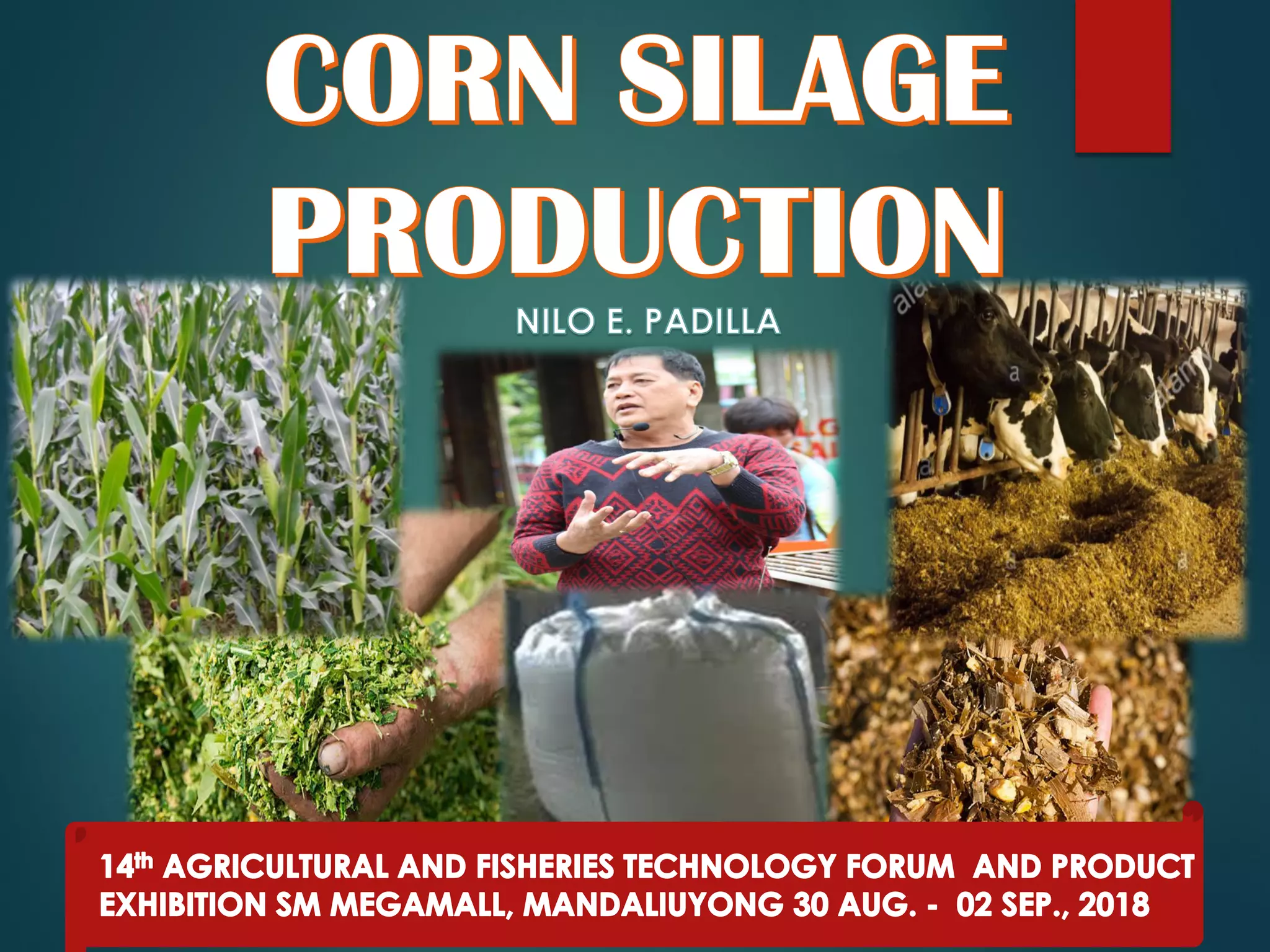
Corn Silage Production / Nilo Padilla

  • 2.
    LIVESTOCK POPULATION Commodity Total Livestock Swine Cattle Goat Carabao CommodityTotal Livestock heads Cattle 2,553,885 Goat 3,876,791 Carabao 3,074,600 Dairy Animals 58,023 (NDA, 2017)
  • 3.
    EFFECTS OF FEEDSUPPLY Season Availability Effects on Animal Summer Poor Quality Feeds Animal performance BW- 60-100g/day Milk production– 4kg/day Rainy Adequate Supply of Feeds Overall performance ADG - 150-300 g/day Milk production - 4 kg/day
  • 4.
  • 5.
     Silage isa chopped feed like corn, sorghum, napier, and other forage crops fermented with moisture content (60-70%) and be fed to ruminants.
  • 6.
     Ensiling” isthe name of the process and the container used is called a “Silo”.  All kinds of forages (farm by-products) eaten by animals can be conserved into silage.
  • 8.
     High qualitysilage can be produced and commercialized from the whole plant of corn with grain (70%) plus fresh kakawate or ipil2 or combination of kakawate and ipil2 (30%) @ 65-70% MC.  Silage can be fermented in plastic bags with liner (for backyard production) and large sacks made polyethylene for commercial production.
  • 9.
     The greencorn is cut into small pieces, about 3 cm or ½” long  The materials are pressed removing the air to prevent decomposition once the bag has been filled and shut.  The feeds can be stored without losing the nutritive quality, for up to a year.
  • 10.
    The “CHOPPED GREENCORN” and compacted for silage to: 1. release as much as plant sugar as possible for fermentation 2. to ensure that all the air is pushed out of the plant so that when the silo is sealed, the plant material is air free. This is when Fermentation works best during this period to produce lactic acid.
  • 11.
     Do notallow the feed to become contaminated with dirt  Ensile at proper maturity (75-85 days) and moisture (65% - 70%)  If moisture levels are higher, reduce the packing pressure to avoid creating mushy, silage, or better yet, wait until the forage is drier  If moisture levels slip below 65%, increasing the packing pressure can help  Pack not later than 24 hours after harvest
  • 12.
     Use stronghigh density plastic bags to minimize tearing with 50 kg capacity of fresh chopped green fodder.  Plastic fertilizer bags make very good silos that can last for more than a year.
  • 13.
     Leaning heavilyon the forage material will compact the silage and seal it from air. Make sure there is enough plastic to tie up, so that it does not come free from the twine.  Tobacco twine or hay baling twine is best for tying up the bag. Seal tightly.
  • 14.
     Open storingand covering with a thin plastic foil to prevent damage from birds is most effective.  The surface area selected for storage of silage bags has a large impact on silage quality and ease of feeding from the bag. Based on experience the surfaces rated as follows:  Concrete Pad or asphalt / gravel surface provides excellent surface for silage bag, for easy removal of feed with little or no damage. It discourages pests and makes inspection for damaged bags very easy.
  • 15.
     Inspect thebags on a regular basis and if possible mend holes  Do not allow dogs, cats and other animals to climb the bags  Number and date the bags for easy identification and recall of materials packed in the silo bags  Do not leave the silage bags opened over night  Inspect frequently and seal holes at once; If damage is extensive, the silage needs to be re-packed as soon as possible;
  • 16.
     If maintenanceis appropriate after three – five weeks, excellent lactic acid fermentation will result and bags kept well for six months, with no or little fungal spoilage. After emptying, the bags must be carefully washed, dried and stored in a safe place for use the following year.
  • 17.
     Step 1:Collect a sample of silage that is representative of what is to be fed to the animals.  Step 2: Make an assessment of the silage on physical appearance and texture.  Step 3: Make an assessment of the silage on the basis of color.  Step 4: Make an assessment of the silage on the basis of the aroma of the silage.
  • 18.
     The silageshould have undergone an adequate fermentation, usually 3 weeks.  pH 3.5 to 4.3, lactic acid 4–6%, acetic acid 2% or less, propionic acid 0–1%, butyric acid less than 0.1%, ammonia N less than 5%.  Silage temperatures should generally be within 15 to 200F
  • 19.
     A vinegarodor can also be associated with high levels of acetic acid.  An alcohol odor is associated with fermentation by yeast  There should not be any visible mold in the silage, which is often an indication of high dry- matter content at ensiling or poor sealing.
  • 20.
     Silage shouldbe fed ASAP, preferably within a few hours. After feeding, the feed bunks must be cleaned out to prevent any remaining silage to spoil and cause contamination to the next feed out.  Silage should be used up to 40-50 kg per day for 550 kg animal and the following recipes are used most commonly to obtain the best results when feeding based on body gain and level of milk production of lactating animals.
  • 23.
  • 25.
    Advantages of PlasticSilage: 1. Plastics silage bags are economical alternative to traditional silage storage. It is an effective way for preserve feed with minimum nutrient loss. 2. It allows farmers to store silage anywhere they need it. A well graded and well drained ground surface is all that is necessary. 3. The silage is completely sealed in the bag so that all the acid is retained in the silage
  • 26.
    Advantages of PlasticSilage  Ensiling in a bag avoids the hard work of having to remove silage.  Because the whole bag is fed out to the animal, it means the rest of the silage which is in the other bags is not exposed to air at removal and is therefore unspoiled.  The bag is easily stored and portable so that any member of the family can carry it to the feed trough for the cow.
  • 27.
     Silage canbe produced all year round  The fermentation in silage reduces harmful nitrates accumulated in plants during droughts and in over- fertilized crops.  By products are optimally used  Corn silage has 30-50% higher nutritive value compared to corn grains and corn straw;
  • 28.
     Nutrients arepreserved and utilized.  Less weather dependent.  Can be done manually or mechanically  Best suited both backyard and commercial farms.  Adopted to a wider range of crops.
  • 29.
     Sustain thefeeding for a longer period  Reduction of nutrient losses (below 10%) compared to hay (30%) of the dry matter.  More economical use of plants with high yield of green mass  Better use of the land with 3-4 crops annually; requires 10 times less storage space as to hay
  • 30.
     Commercial scale- It requires high capital to buy chopping, vacuum and storage, etc.).  It requires transport facilities.  Silage should be removed on a daily basis to minimize loss of nutrients.  Once silage is removed from the silo, it is easily spoiled (a day or two).
  • 32.
    Days: CP: TDN 2115.1 61.4 Napier Grass (Pennisetum purpureum)
  • 33.
    Gamba grass (Andropogon gayanus) Ruzi(Brachiaria ruziziensis) Humidicola (B. humidicola) Paspalum (Paspalum atratum)
  • 34.
    Setaria (S. sphaceta)Guinea Grass (Panicum maximum) Sorghum (Sorghum bicolor/vulgare) CP: TDN 58%
  • 35.
  • 36.
  • 37.
    Flemengia Ipil-ipil Madre de agua(Trichanthera gigantean) Calliandra haematocephala
  • 38.
  • 39.
    1.Determine the foragereqt. & the size of silo Example: ☻Animal BW = 500 kg @ 2.5% BW = 12.5 kg DM/d ☻Forage requirement/d = 50 kg fresh/ day ☻Length of dry season =6 mo. or 180 days ☻Qty. of silage = 50 kg x 180 days = 9,000 kg ☻Area to be planted = ex. 1/6 ha. corn or 1,667 sq.m. if 1 ha can produced 65 t tones corn silage ☻Dimension of the silo= 1m ht. x 3m width x10m length = 30 m3 Note: 1m3 can yield 200-250 kg silage Requirement of 500 kg. Cattle
  • 40.
    Cost of ProducingCorn for Grain (115 days) Assumptions: 5% post-harvest losses = 3, 000. 00 ₱15. 00 per kilo grain = current price per kilo 6, 000 kilo grain per hectare = average production per ha. Item Description Quantity Unit Cost (₱) Total Cost (₱) A. Direct Labor Land preparation (mechanized) 2, 000. 00 Planting 2 bags 2,500/bag 5, 000. 00 Herbecide Application 2 man-day 500/md 1, 000. 00 Off-barring @ 2 man-animal days 2 man-day 600/md 1, 200. 00 Fertilizer application 2 man-day 500/md 1, 000.00 Cost of harvesting grain @ 6, 000. 00/ha. 6, 000. 00 Drying @ ₱1.00 per kilo 6, 000. 00 Sub-total 22,200.00 A. Supplies & Materials Corn Pioneer seeds (BT RR) 35, 000 seeds/bag 2 bags 4, 000. 00 8, 000. 00 Herbicide @ 1000 per liter 2 liters 1, 000. 00 2, 000. 00 16-20-00 @ 100/bag (transport cost) 2 bags 1,050.00 2, 100.00 14-14-14 @ 100/bag (transport cost) 4 bags 1,100.00 4, 400.00 Sacks 120 sacks 8.00 960.00 Sub-total 17, 460. 00 A. Others Post-harvest losses (5%) 4, 250. 00 Total Cost 43, 910 .00 Gross Income @15/kilo grain 5, 700 kilos or 120 bags @ 50 kls/bag 15. 00 /kilo 85, 500 .00 Net Income 41, 590. 00/ cropping
  • 41.
    *Cost of ProducingGreen Corn Production (75-80 days) for Silage Production Item Description Quantity Unit Cost (₱) Total Cost (₱) A. Direct Labor Land preparation (mechanized) 2, 000. 00 Planting 2 bags 2,500/bag 5, 000. 00 Herbecide Application 2 man-day 500/md 1, 000. 00 Off-barring @ 2 man-animal days 2 man-day 600/md 1, 200. 00 Fertilizer application 2 man-day 500/md 1, 000.00 Sub-total 10, 199. 50 B. Supplies & Materials Corn Pioneer seeds (BT RR) 35, 000 seeds/bag* @1 kilo/ corn plant 2 bags 4, 000. 00 8, 000. 00 Herbicide @ 1000 per liter 2 liters 1, 000. 00 2, 000. 00 16-20-00 @ 100/bag (transport cost) 2 bags 1,050.00 2, 100.00 14-14-14 @ 100/bag (transport cost) 4 bags 1,100.00 4, 400.00 Sub-total 16, 500. 00 C. Others (5% losses from chopping, bagging, transport to warehouse 4, 738. 13 Total Cost 31, 437. 63 Gross Income @ 70,000 plants/ha. (5% mortality) @ 1.50 kilo/plant 63, 175 kilos @ 1kilo/plant at 1.50/kilo @ 40 kg per bag 1.50/kilo 94,762.50 Net Income 63, 325. 50/ cropping *10% mortality rate = 31, 500 plants - survival rate/bag 1 kilo = weight of chop one corn plant 35,000 seeds/bag x 2 bags with 5% mortality or 66,500 plants @ 1 kilo/plant 66,500 kg @5% waste green corn per hectare (3,325) = 63,175 kg 63, 175 kg @ 1.50 peso per kilo silage *Actual cost of green corn for silage production in Isabela (2017)
  • 42.
    Comparative cost ofGreen Corn as Silage Production VS Grain Production) Item Description Cost of Producing GRAIN (₱) Cost of Producing SILAGE (₱) A. Direct Labor 22, 000. 00 16, 517. 00 Supplies and Materials 18, 060. 00 18, 100. 00 Others (Post Harvest losses (5%) 3, 000. 00 4, 738. 13 B. Total Cost (A+B+C) 43, 910. 00 31, 437. 63 C. Gross Income 85, 500 .00 94,762.50 D. Net Income 41, 590. 00 63, 325. 50/ E. ROI 95% 201%
  • 45.
    References  Https://www.britannica.com/topic/silage  Advantageand limitation of silage making. Kumar, R. June 18, 2016. https://www.biotecharticles.com/Agriculture- Article/Advantage-and-Limitation-of-Silage- Making-3562.html  Department of Trade and Industry Region 02 website. http://www.region2.dti.gov.ph/  Silage technology