Traffic Signs
• The general principle of traffic signs is to make a
message known quickly, (70mph) accurately,
with minimum reading skills required.
• This should allow traffic to meet the goal of the
HTS. Safe, rapid, and efficient transportation.
• Poor signs, signal, and traffic markings can lead
to a break down in the system.
• They are recognizable by shape and color,
message and diagram.
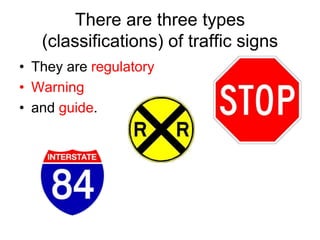
There are three types
(classifications) of traffic signs
• They are regulatory
• Warning
• and guide.
Regulatory signs
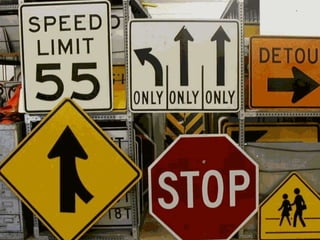
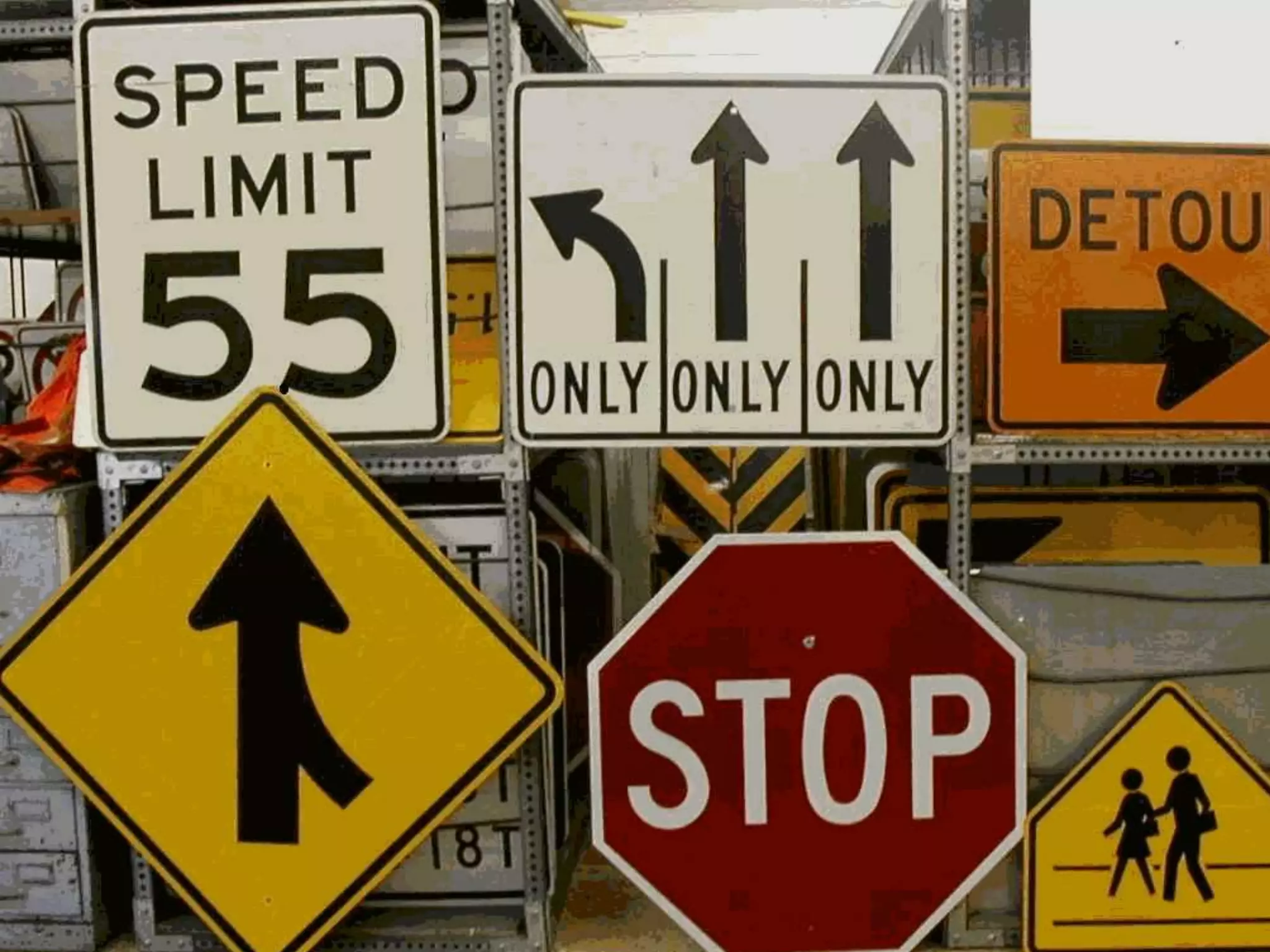
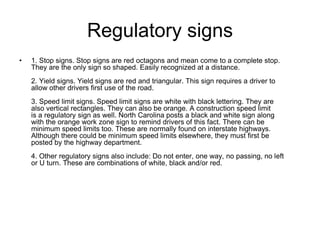
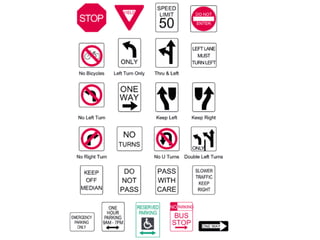
• 1. Stop signs. Stop signs are red octagons and mean come to a complete stop.
They are the only sign so shaped. Easily recognized at a distance.
2. Yield signs. Yield signs are red and triangular. This sign requires a driver to
allow other drivers first use of the road.
3. Speed limit signs. Speed limit signs are white with black lettering. They are
also vertical rectangles. They can also be orange. A construction speed limit
is a regulatory sign as well. North Carolina posts a black and white sign along
with the orange work zone sign to remind drivers of this fact. There can be
minimum speed limits too. These are normally found on interstate highways.
Although there could be minimum speed limits elsewhere, they must first be
posted by the highway department.
4. Other regulatory signs also include: Do not enter, one way, no passing, no left
or U turn. These are combinations of white, black and/or red.
Warning signs
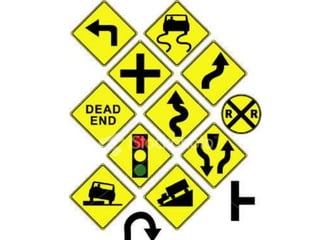
• Warning signs are information to warn drivers of hazards
they are about to encounter.
• They are usually yellow and diamond shaped. There are
messages to help drivers understand these hazards.
• Although these are not regulatory signs, not heeding the
warning may result in an accident and/or a citation for
driving too fast for existing conditions.
• There are several other shapes used for warning signs.
School zone warning signs are a pentagon. Railroad
warning signs are round.
• No passing signs are a pennant shaped sign and are
placed at the beginning of the no passing zone and on
the left side of the road to make them visible to drivers
trying to pass.
Guide signs
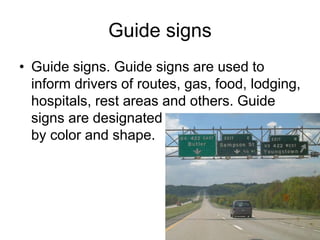
• Guide signs. Guide signs are used to
inform drivers of routes, gas, food, lodging,
hospitals, rest areas and others. Guide
signs are designated
by color and shape.
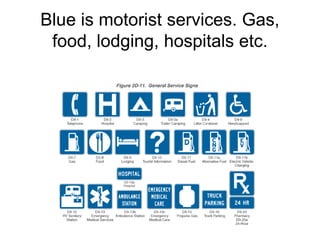
Blue is motorist services. Gas,
food, lodging, hospitals etc.
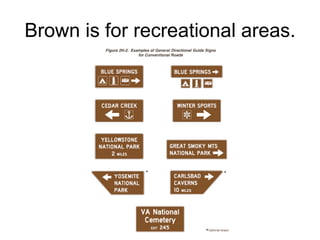
Brown is for recreational areas.
The Basic Speed Law
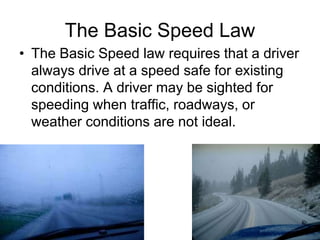
• The Basic Speed law requires that a driver
always drive at a speed safe for existing
conditions. A driver may be sighted for
speeding when traffic, roadways, or
weather conditions are not ideal.
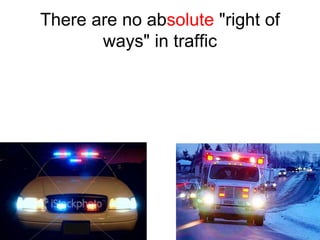
There are no absolute "right of
ways" in traffic
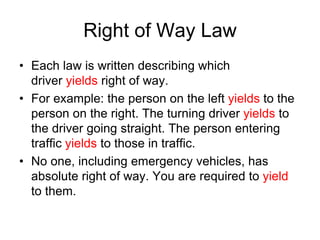
Right of Way Law
• Each law is written describing which
driver yields right of way.
• For example: the person on the left yields to the
person on the right. The turning driver yields to
the driver going straight. The person entering
traffic yields to those in traffic.
• No one, including emergency vehicles, has
absolute right of way. You are required to yield
to them.
The Highway Transportation
System. (HTS)
• The goal of the HTS is to provide safe,
rapid, and efficient transportation of
persons and goods from one location to
another, in an environmentally sound
fashion.
There are at least five types of
traffic light systems
• a. Progressive lights are set up so that traffic moving at the correct speed
will be able to keep moving as the lights change in sequence.
b. Traffic activated lights are designed to change according to traffic loads.
No traffic, no green light, many vehicles, longer green lights. The key to
efficient use of these lights is to know what and how each intersection is set
up. The use of computer assisted traffic lights are also traffic activated.
They try to anticipate the traffic coming, not react to traffic that has just
stopped.
c. Timed lights are the least expensive and therefore used in many smaller
communities. They are set for so many seconds green for each direction of
traffic.
d. Pedestrian activated lights are used at cross walks to aid their crossing of
busy streets.
e. Railroad grade crossing lights are used to warn drivers of trains in close
proximity to the crossing.
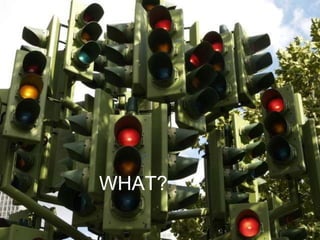
WHAT?
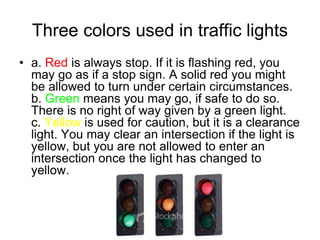
Three colors used in traffic lights
• a. Red is always stop. If it is flashing red, you
may go as if a stop sign. A solid red you might
be allowed to turn under certain circumstances.
b. Green means you may go, if safe to do so.
There is no right of way given by a green light.
c. Yellow is used for caution, but it is a clearance
light. You may clear an intersection if the light is
yellow, but you are not allowed to enter an
intersection once the light has changed to
yellow.
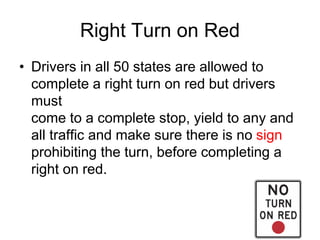
Right Turn on Red
• Drivers in all 50 states are allowed to
complete a right turn on red but drivers
must
come to a complete stop, yield to any and
all traffic and make sure there is no sign
prohibiting the turn, before completing a
right on red.
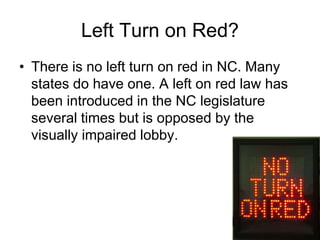
Left Turn on Red?
• There is no left turn on red in NC. Many
states do have one. A left on red law has
been introduced in the NC legislature
several times but is opposed by the
visually impaired lobby.
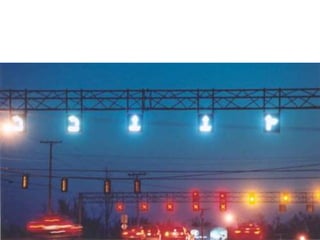
Multi-use Traffic Lanes
• In larger cities, the use of reversible lanes
increases the capacity of the existing
streets.
• Center lanes are reversed to allow heavy
traffic, in one direction or the other,
to have more lanes.
• These lanes are marked with a green
arrow or a red X above the
lane.
Pavement Markings
• Pavement markings, like signs and
signals, are designed to move traffic
safely, rapidly, and efficiently.
• Markings therefore, should communicate a
simple, clear message for all highway
users.
Color has meaning!
• Generally, yellow traffic markings are used
to separate traffic traveling in opposite
directions. White lines are for marking
sides of roadways, crosswalks, warnings
and to separate traffic traveling in the
same direction.
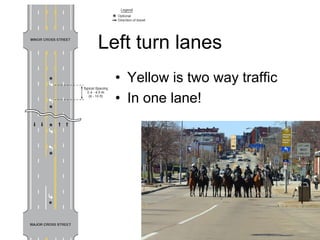
Left turn lanes
• Yellow is two way traffic
• In one lane!
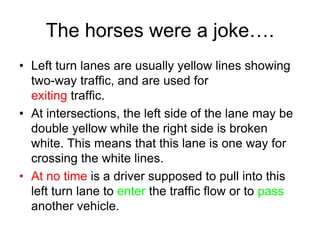
The horses were a joke….
• Left turn lanes are usually yellow lines showing
two-way traffic, and are used for
exiting traffic.
• At intersections, the left side of the lane may be
double yellow while the right side is broken
white. This means that this lane is one way for
crossing the white lines.
• At no time is a driver supposed to pull into this
left turn lane to enter the traffic flow or to pass
another vehicle.
School buses and the left turn lane.
• On a five lane street with a left turn lane,
you do not have to stop for the school bus
on the opposite which is stopped and
unloading children.
• The left turn lane is defined as a physical
barrier.
• The bus is NOT allowed to discharge
children which would have to cross the five
lanes.
Lane choice
• Drivers should choose a traffic lane with
fewest conflicts. Traveling in the right
hand lane is a courtesy in NC unless
passing or turning left.
• In heavy traffic either lane is legal.
crosswalks
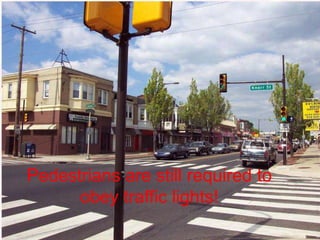
• White crosswalks are marked in several
different ways.
• Who yields right of way depends on traffic
lights and the type of marking. Standard
crosswalks with two lines, depend on
streets and lights. Bold markings are used
for increased visibility.
• Zebra markings are to tell drivers to yield.
Pedestrians are still required to
obey traffic lights!
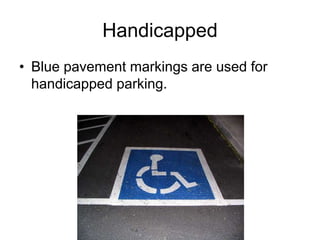
Handicapped
• Blue pavement markings are used for
handicapped parking.
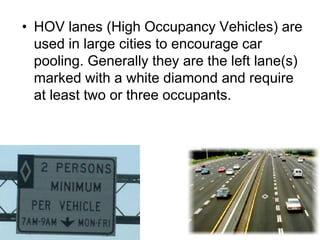
• HOV lanes (High Occupancy Vehicles) are
used in large cities to encourage car
pooling. Generally they are the left lane(s)
marked with a white diamond and require
at least two or three occupants.
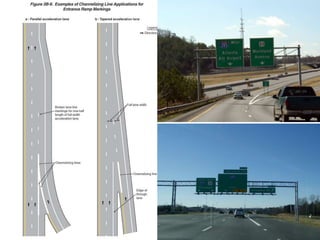
Entrance/exit ramps
• There are many types of interchanges
used in traffic.
• The cloverleaf, the trumpet, the weave.
• The biggest problems come from non-
traditional exchange. A left exit from a
freeway for example. Or going right off the
freeway to go left.
• Be ready for the unusual.
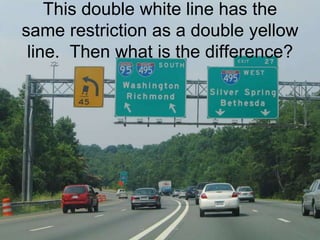
This double white line has the
same restriction as a double yellow
line. Then what is the difference?
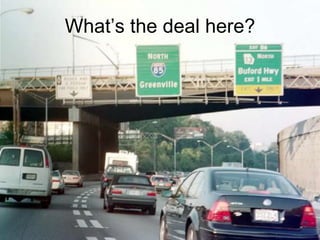
What’s the deal here?

Signs, Signals and Markings

  • 2.
    Traffic Signs • Thegeneral principle of traffic signs is to make a message known quickly, (70mph) accurately, with minimum reading skills required. • This should allow traffic to meet the goal of the HTS. Safe, rapid, and efficient transportation. • Poor signs, signal, and traffic markings can lead to a break down in the system. • They are recognizable by shape and color, message and diagram.
  • 3.
    There are threetypes (classifications) of traffic signs • They are regulatory • Warning • and guide.
  • 4.
    Regulatory signs • 1.Stop signs. Stop signs are red octagons and mean come to a complete stop. They are the only sign so shaped. Easily recognized at a distance. 2. Yield signs. Yield signs are red and triangular. This sign requires a driver to allow other drivers first use of the road. 3. Speed limit signs. Speed limit signs are white with black lettering. They are also vertical rectangles. They can also be orange. A construction speed limit is a regulatory sign as well. North Carolina posts a black and white sign along with the orange work zone sign to remind drivers of this fact. There can be minimum speed limits too. These are normally found on interstate highways. Although there could be minimum speed limits elsewhere, they must first be posted by the highway department. 4. Other regulatory signs also include: Do not enter, one way, no passing, no left or U turn. These are combinations of white, black and/or red.
  • 6.
    Warning signs • Warningsigns are information to warn drivers of hazards they are about to encounter. • They are usually yellow and diamond shaped. There are messages to help drivers understand these hazards. • Although these are not regulatory signs, not heeding the warning may result in an accident and/or a citation for driving too fast for existing conditions. • There are several other shapes used for warning signs. School zone warning signs are a pentagon. Railroad warning signs are round. • No passing signs are a pennant shaped sign and are placed at the beginning of the no passing zone and on the left side of the road to make them visible to drivers trying to pass.
  • 8.
    Guide signs • Guidesigns. Guide signs are used to inform drivers of routes, gas, food, lodging, hospitals, rest areas and others. Guide signs are designated by color and shape.
  • 9.
    Blue is motoristservices. Gas, food, lodging, hospitals etc.
  • 10.
    Brown is forrecreational areas.
  • 11.
    The Basic SpeedLaw • The Basic Speed law requires that a driver always drive at a speed safe for existing conditions. A driver may be sighted for speeding when traffic, roadways, or weather conditions are not ideal.
  • 12.
    There are noabsolute "right of ways" in traffic
  • 13.
    Right of WayLaw • Each law is written describing which driver yields right of way. • For example: the person on the left yields to the person on the right. The turning driver yields to the driver going straight. The person entering traffic yields to those in traffic. • No one, including emergency vehicles, has absolute right of way. You are required to yield to them.
  • 14.
    The Highway Transportation System.(HTS) • The goal of the HTS is to provide safe, rapid, and efficient transportation of persons and goods from one location to another, in an environmentally sound fashion.
  • 15.
    There are atleast five types of traffic light systems • a. Progressive lights are set up so that traffic moving at the correct speed will be able to keep moving as the lights change in sequence. b. Traffic activated lights are designed to change according to traffic loads. No traffic, no green light, many vehicles, longer green lights. The key to efficient use of these lights is to know what and how each intersection is set up. The use of computer assisted traffic lights are also traffic activated. They try to anticipate the traffic coming, not react to traffic that has just stopped. c. Timed lights are the least expensive and therefore used in many smaller communities. They are set for so many seconds green for each direction of traffic. d. Pedestrian activated lights are used at cross walks to aid their crossing of busy streets. e. Railroad grade crossing lights are used to warn drivers of trains in close proximity to the crossing.
  • 16.
  • 17.
    Three colors usedin traffic lights • a. Red is always stop. If it is flashing red, you may go as if a stop sign. A solid red you might be allowed to turn under certain circumstances. b. Green means you may go, if safe to do so. There is no right of way given by a green light. c. Yellow is used for caution, but it is a clearance light. You may clear an intersection if the light is yellow, but you are not allowed to enter an intersection once the light has changed to yellow.
  • 18.
    Right Turn onRed • Drivers in all 50 states are allowed to complete a right turn on red but drivers must come to a complete stop, yield to any and all traffic and make sure there is no sign prohibiting the turn, before completing a right on red.
  • 19.
    Left Turn onRed? • There is no left turn on red in NC. Many states do have one. A left on red law has been introduced in the NC legislature several times but is opposed by the visually impaired lobby.
  • 20.
    Multi-use Traffic Lanes •In larger cities, the use of reversible lanes increases the capacity of the existing streets. • Center lanes are reversed to allow heavy traffic, in one direction or the other, to have more lanes. • These lanes are marked with a green arrow or a red X above the lane.
  • 22.
    Pavement Markings • Pavementmarkings, like signs and signals, are designed to move traffic safely, rapidly, and efficiently. • Markings therefore, should communicate a simple, clear message for all highway users.
  • 23.
    Color has meaning! •Generally, yellow traffic markings are used to separate traffic traveling in opposite directions. White lines are for marking sides of roadways, crosswalks, warnings and to separate traffic traveling in the same direction.
  • 24.
    Left turn lanes •Yellow is two way traffic • In one lane!
  • 25.
    The horses werea joke…. • Left turn lanes are usually yellow lines showing two-way traffic, and are used for exiting traffic. • At intersections, the left side of the lane may be double yellow while the right side is broken white. This means that this lane is one way for crossing the white lines. • At no time is a driver supposed to pull into this left turn lane to enter the traffic flow or to pass another vehicle.
  • 26.
    School buses andthe left turn lane. • On a five lane street with a left turn lane, you do not have to stop for the school bus on the opposite which is stopped and unloading children. • The left turn lane is defined as a physical barrier. • The bus is NOT allowed to discharge children which would have to cross the five lanes.
  • 27.
    Lane choice • Driversshould choose a traffic lane with fewest conflicts. Traveling in the right hand lane is a courtesy in NC unless passing or turning left. • In heavy traffic either lane is legal.
  • 28.
    crosswalks • White crosswalksare marked in several different ways. • Who yields right of way depends on traffic lights and the type of marking. Standard crosswalks with two lines, depend on streets and lights. Bold markings are used for increased visibility. • Zebra markings are to tell drivers to yield.
  • 29.
    Pedestrians are stillrequired to obey traffic lights!
  • 30.
    Handicapped • Blue pavementmarkings are used for handicapped parking.
  • 31.
    • HOV lanes(High Occupancy Vehicles) are used in large cities to encourage car pooling. Generally they are the left lane(s) marked with a white diamond and require at least two or three occupants.
  • 32.
    Entrance/exit ramps • Thereare many types of interchanges used in traffic. • The cloverleaf, the trumpet, the weave. • The biggest problems come from non- traditional exchange. A left exit from a freeway for example. Or going right off the freeway to go left. • Be ready for the unusual.
  • 34.
    This double whiteline has the same restriction as a double yellow line. Then what is the difference?
  • 35.