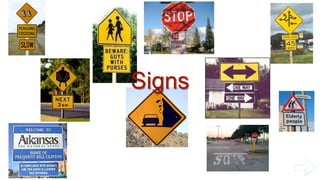
Signs
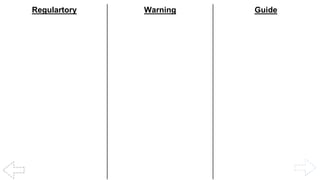
Regulartory Warning Guide
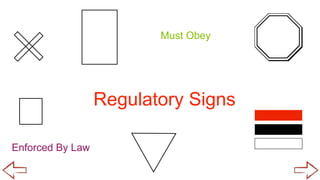
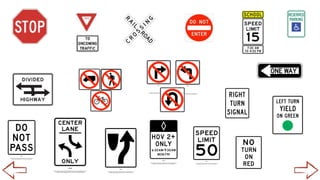
Regulatory Signs
Enforced By Law
Must Obey
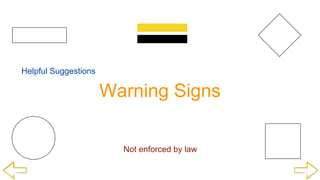
Warning Signs
Not enforced by law
Helpful Suggestions
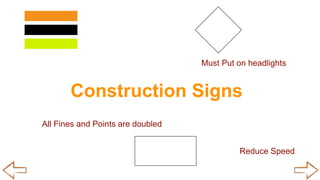
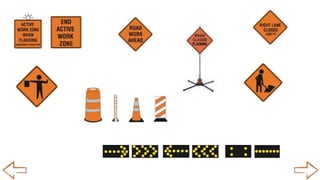
Construction Signs
All Fines and Points are doubled
Must Put on headlights
Reduce Speed
Guide Signs
1,000 MILES
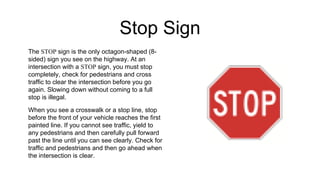
Stop Sign
The STOP sign is the only octagon-shaped (8-
sided) sign you see on the highway. At an
intersection with a STOP sign, you must stop
completely, check for pedestrians and cross
traffic to clear the intersection before you go
again. Slowing down without coming to a full
stop is illegal.
When you see a crosswalk or a stop line, stop
before the front of your vehicle reaches the first
painted line. If you cannot see traffic, yield to
any pedestrians and then carefully pull forward
past the line until you can see clearly. Check for
traffic and pedestrians and then go ahead when
the intersection is clear.
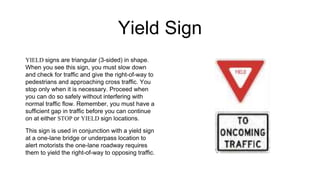
Yield Sign
YIELD signs are triangular (3-sided) in shape.
When you see this sign, you must slow down
and check for traffic and give the right-of-way to
pedestrians and approaching cross traffic. You
stop only when it is necessary. Proceed when
you can do so safely without interfering with
normal traffic flow. Remember, you must have a
sufficient gap in traffic before you can continue
on at either STOP or YIELD sign locations.
This sign is used in conjunction with a yield sign
at a one-lane bridge or underpass location to
alert motorists the one-lane roadway requires
them to yield the right-of-way to opposing traffic.
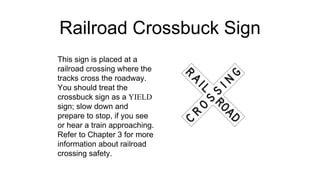
Railroad Crossbuck Sign
This sign is placed at a
railroad crossing where the
tracks cross the roadway.
You should treat the
crossbuck sign as a YIELD
sign; slow down and
prepare to stop, if you see
or hear a train approaching.
Refer to Chapter 3 for more
information about railroad
crossing safety.
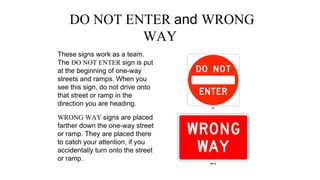
DO NOT ENTER and WRONG
WAY
These signs work as a team.
The DO NOT ENTER sign is put
at the beginning of one-way
streets and ramps. When you
see this sign, do not drive onto
that street or ramp in the
direction you are heading.
WRONG WAY signs are placed
farther down the one-way street
or ramp. They are placed there
to catch your attention, if you
accidentally turn onto the street
or ramp.
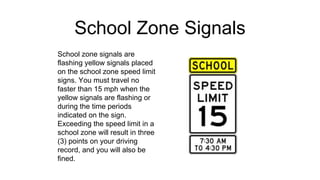
School Zone Signals
School zone signals are
flashing yellow signals placed
on the school zone speed limit
signs. You must travel no
faster than 15 mph when the
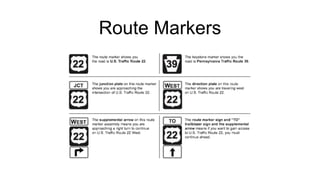
yellow signals are flashing or
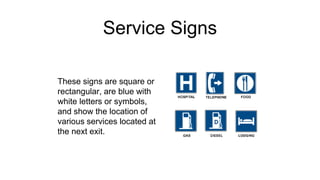
during the time periods
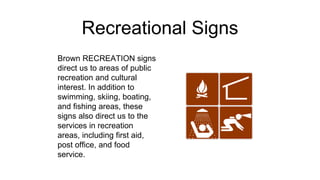
indicated on the sign.
Exceeding the speed limit in a
school zone will result in three
(3) points on your driving
record, and you will also be
fined.
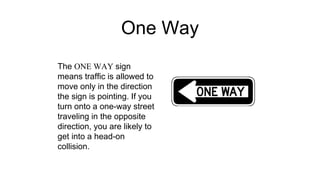
One Way
The ONE WAY sign
means traffic is allowed to
move only in the direction
the sign is pointing. If you
turn onto a one-way street
traveling in the opposite
direction, you are likely to
get into a head-on
collision.
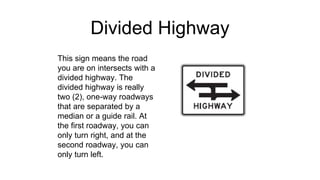
Divided Highway
This sign means the road
you are on intersects with a
divided highway. The
divided highway is really
two (2), one-way roadways
that are separated by a
median or a guide rail. At
the first roadway, you can
only turn right, and at the
second roadway, you can
only turn left.
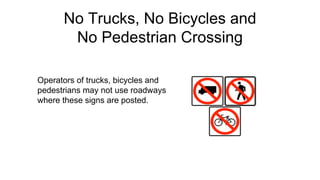
No Trucks, No Bicycles and
No Pedestrian Crossing
Operators of trucks, bicycles and
pedestrians may not use roadways
where these signs are posted.
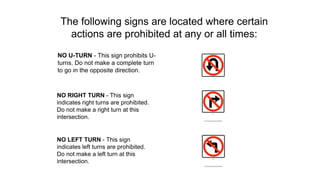
The following signs are located where certain
actions are prohibited at any or all times:
NO U-TURN - This sign prohibits U-
turns. Do not make a complete turn
to go in the opposite direction.
NO RIGHT TURN - This sign
indicates right turns are prohibited.
Do not make a right turn at this
intersection.
NO LEFT TURN - This sign
indicates left turns are prohibited.
Do not make a left turn at this
intersection.
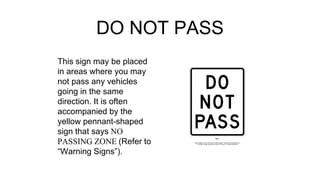
DO NOT PASS
This sign may be placed
in areas where you may
not pass any vehicles
going in the same
direction. It is often
accompanied by the
yellow pennant-shaped
sign that says NO
PASSING ZONE (Refer to
“Warning Signs”).
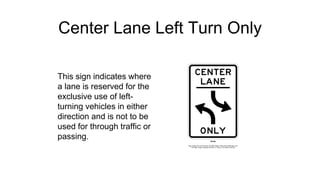
Center Lane Left Turn Only
This sign indicates where
a lane is reserved for the
exclusive use of left-
turning vehicles in either
direction and is not to be
used for through traffic or
passing.
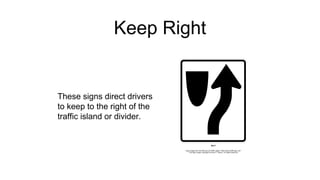
Keep Right
These signs direct drivers
to keep to the right of the
traffic island or divider.
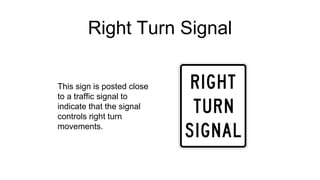
Right Turn Signal
This sign is posted close
to a traffic signal to
indicate that the signal
controls right turn
movements.
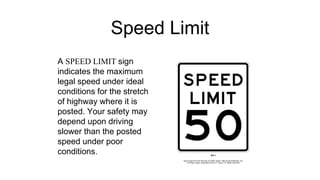
Speed Limit
A SPEED LIMIT sign
indicates the maximum
legal speed under ideal
conditions for the stretch
of highway where it is
posted. Your safety may
depend upon driving
slower than the posted
speed under poor
conditions.
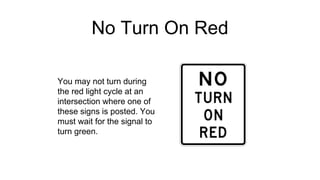
No Turn On Red
You may not turn during
the red light cycle at an
intersection where one of
these signs is posted. You
must wait for the signal to
turn green.
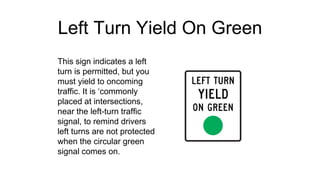
Left Turn Yield On Green
This sign indicates a left
turn is permitted, but you
must yield to oncoming
traffic. It is ‘commonly
placed at intersections,
near the left-turn traffic
signal, to remind drivers
left turns are not protected
when the circular green
signal comes on.
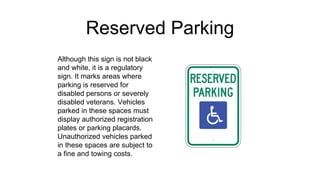
Reserved Parking
Although this sign is not black
and white, it is a regulatory
sign. It marks areas where
parking is reserved for
disabled persons or severely
disabled veterans. Vehicles
parked in these spaces must
display authorized registration
plates or parking placards.
Unauthorized vehicles parked
in these spaces are subject to
a fine and towing costs.
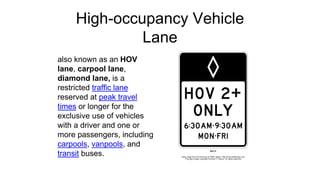
High-occupancy Vehicle
Lane
also known as an HOV
lane, carpool lane,
diamond lane, is a
restricted traffic lane
reserved at peak travel
times or longer for the
exclusive use of vehicles
with a driver and one or
more passengers, including
carpools, vanpools, and
transit buses.
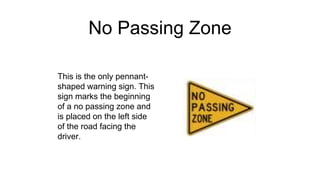
No Passing Zone
This is the only pennant-
shaped warning sign. This
sign marks the beginning
of a no passing zone and
is placed on the left side
of the road facing the
driver.
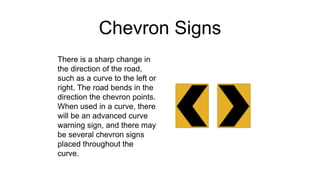
Chevron Signs
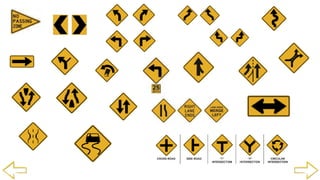
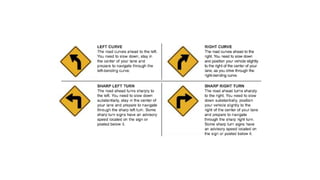
There is a sharp change in
the direction of the road,
such as a curve to the left or
right. The road bends in the
direction the chevron points.
When used in a curve, there
will be an advanced curve
warning sign, and there may
be several chevron signs
placed throughout the
curve.
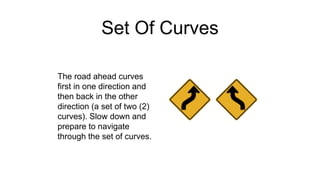
Set Of Curves
The road ahead curves
first in one direction and
then back in the other
direction (a set of two (2)
curves). Slow down and
prepare to navigate
through the set of curves.
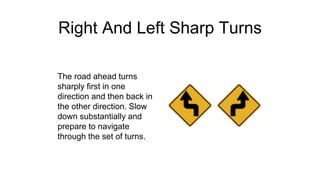
Right And Left Sharp Turns
The road ahead turns
sharply first in one
direction and then back in
the other direction. Slow
down substantially and
prepare to navigate
through the set of turns.
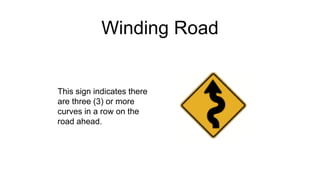
Winding Road
This sign indicates there
are three (3) or more
curves in a row on the
road ahead.
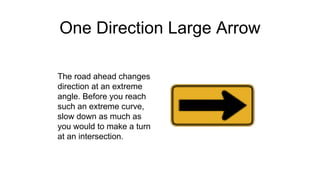
One Direction Large Arrow
The road ahead changes
direction at an extreme
angle. Before you reach
such an extreme curve,
slow down as much as
you would to make a turn
at an intersection.
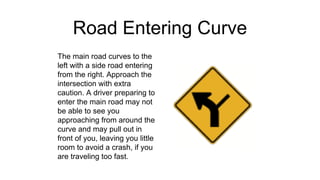
Road Entering Curve
The main road curves to the
left with a side road entering
from the right. Approach the
intersection with extra
caution. A driver preparing to
enter the main road may not
be able to see you
approaching from around the
curve and may pull out in
front of you, leaving you little
room to avoid a crash, if you
are traveling too fast.
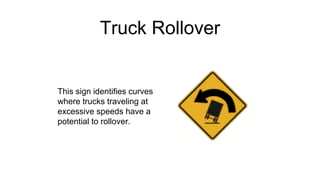
Truck Rollover
This sign identifies curves
where trucks traveling at
excessive speeds have a
potential to rollover.
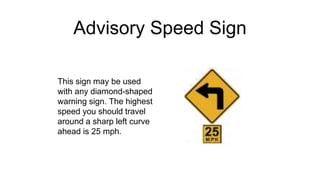
Advisory Speed Sign
This sign may be used
with any diamond-shaped
warning sign. The highest
speed you should travel
around a sharp left curve
ahead is 25 mph.
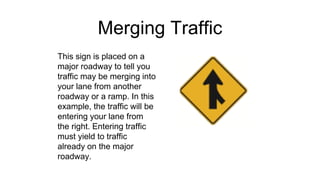
Merging Traffic
This sign is placed on a
major roadway to tell you
traffic may be merging into
your lane from another
roadway or a ramp. In this
example, the traffic will be
entering your lane from
the right. Entering traffic
must yield to traffic
already on the major
roadway.
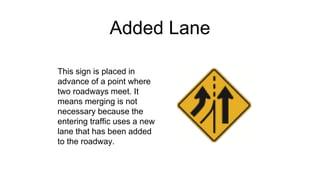
Added Lane
This sign is placed in
advance of a point where
two roadways meet. It
means merging is not
necessary because the
entering traffic uses a new
lane that has been added
to the roadway.
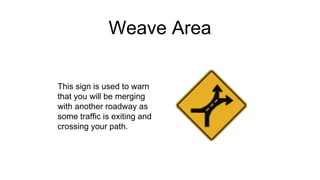
Weave Area
This sign is used to warn
that you will be merging
with another roadway as
some traffic is exiting and
crossing your path.
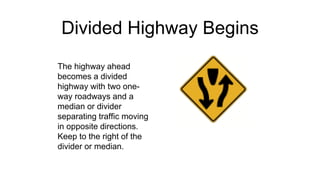
Divided Highway Begins
The highway ahead
becomes a divided
highway with two one-
way roadways and a
median or divider
separating traffic moving
in opposite directions.
Keep to the right of the
divider or median.
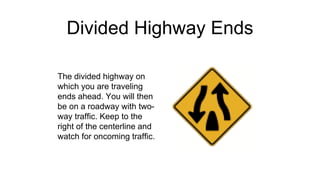
Divided Highway Ends
The divided highway on
which you are traveling
ends ahead. You will then
be on a roadway with two-
way traffic. Keep to the
right of the centerline and
watch for oncoming traffic.
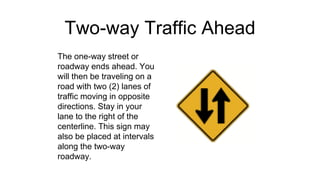
Two-way Traffic Ahead
The one-way street or
roadway ends ahead. You
will then be traveling on a
road with two (2) lanes of
traffic moving in opposite
directions. Stay in your
lane to the right of the
centerline. This sign may
also be placed at intervals
along the two-way
roadway.
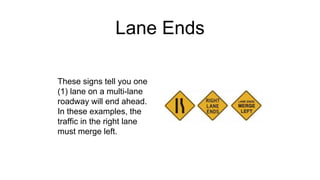
Lane Ends
These signs tell you one
(1) lane on a multi-lane
roadway will end ahead.
In these examples, the
traffic in the right lane
must merge left.
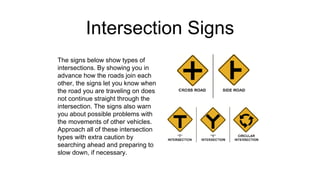
Intersection Signs
The signs below show types of
intersections. By showing you in
advance how the roads join each
other, the signs let you know when
the road you are traveling on does
not continue straight through the
intersection. The signs also warn
you about possible problems with
the movements of other vehicles.
Approach all of these intersection
types with extra caution by
searching ahead and preparing to
slow down, if necessary.
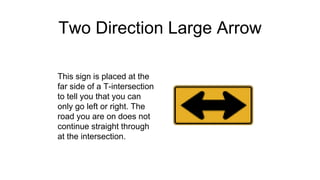
Two Direction Large Arrow
This sign is placed at the
far side of a T-intersection
to tell you that you can
only go left or right. The
road you are on does not
continue straight through
at the intersection.
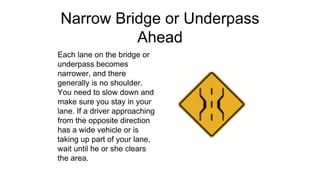
Narrow Bridge or Underpass
Ahead
Each lane on the bridge or
underpass becomes
narrower, and there
generally is no shoulder.
You need to slow down and
make sure you stay in your
lane. If a driver approaching
from the opposite direction
has a wide vehicle or is
taking up part of your lane,
wait until he or she clears
the area.
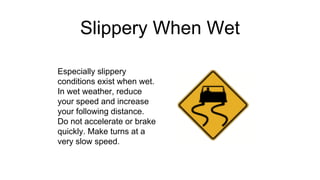
Slippery When Wet
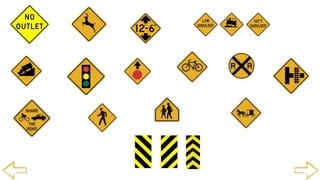
Especially slippery
conditions exist when wet.
In wet weather, reduce
your speed and increase
your following distance.
Do not accelerate or brake
quickly. Make turns at a
very slow speed.
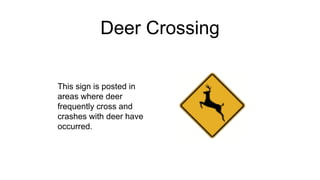
Deer Crossing
This sign is posted in
areas where deer
frequently cross and
crashes with deer have
occurred.
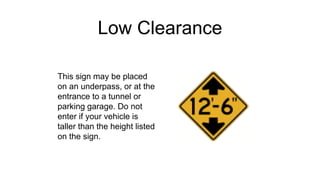
Low Clearance
This sign may be placed
on an underpass, or at the
entrance to a tunnel or
parking garage. Do not
enter if your vehicle is
taller than the height listed
on the sign.
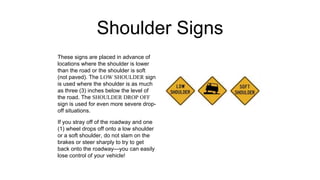
Shoulder Signs
These signs are placed in advance of
locations where the shoulder is lower
than the road or the shoulder is soft
(not paved). The LOW SHOULDER sign
is used where the shoulder is as much
as three (3) inches below the level of
the road. The SHOULDER DROP OFF
sign is used for even more severe drop-
off situations.
If you stray off of the roadway and one
(1) wheel drops off onto a low shoulder
or a soft shoulder, do not slam on the
brakes or steer sharply to try to get
back onto the roadway—you can easily
lose control of your vehicle!
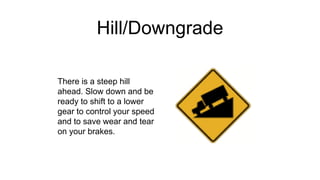
Hill/Downgrade
There is a steep hill
ahead. Slow down and be
ready to shift to a lower
gear to control your speed
and to save wear and tear
on your brakes.
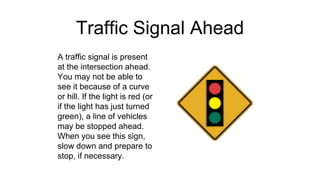
Traffic Signal Ahead
A traffic signal is present
at the intersection ahead.
You may not be able to
see it because of a curve
or hill. If the light is red (or
if the light has just turned
green), a line of vehicles
may be stopped ahead.
When you see this sign,
slow down and prepare to
stop, if necessary.
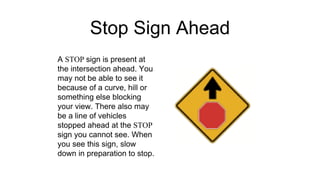
Stop Sign Ahead
A STOP sign is present at
the intersection ahead. You
may not be able to see it
because of a curve, hill or
something else blocking
your view. There also may
be a line of vehicles
stopped ahead at the STOP
sign you cannot see. When
you see this sign, slow
down in preparation to stop.
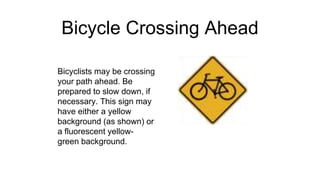
Bicycle Crossing Ahead
Bicyclists may be crossing
your path ahead. Be
prepared to slow down, if
necessary. This sign may
have either a yellow
background (as shown) or
a fluorescent yellow-
green background.
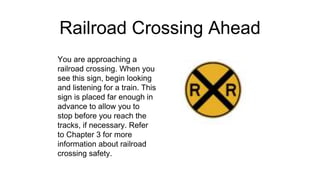
Railroad Crossing Ahead
You are approaching a
railroad crossing. When you
see this sign, begin looking
and listening for a train. This
sign is placed far enough in
advance to allow you to
stop before you reach the
tracks, if necessary. Refer
to Chapter 3 for more
information about railroad
crossing safety.
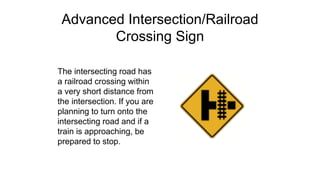
Advanced Intersection/Railroad
Crossing Sign
The intersecting road has
a railroad crossing within
a very short distance from
the intersection. If you are
planning to turn onto the
intersecting road and if a
train is approaching, be
prepared to stop.
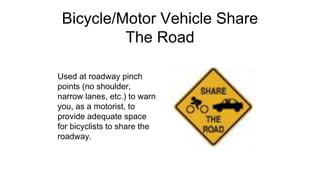
Bicycle/Motor Vehicle Share
The Road
Used at roadway pinch
points (no shoulder,
narrow lanes, etc.) to warn
you, as a motorist, to
provide adequate space
for bicyclists to share the
roadway.
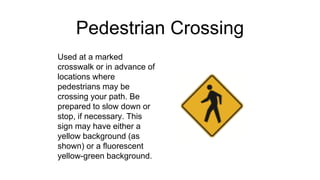
Pedestrian Crossing
Used at a marked
crosswalk or in advance of
locations where
pedestrians may be
crossing your path. Be
prepared to slow down or
stop, if necessary. This
sign may have either a
yellow background (as
shown) or a fluorescent
yellow-green background.
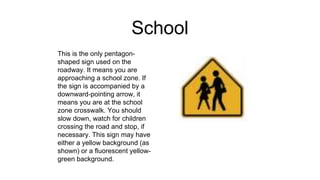
School
This is the only pentagon-
shaped sign used on the
roadway. It means you are
approaching a school zone. If
the sign is accompanied by a
downward-pointing arrow, it
means you are at the school
zone crosswalk. You should
slow down, watch for children
crossing the road and stop, if
necessary. This sign may have
either a yellow background (as
shown) or a fluorescent yellow-
green background.
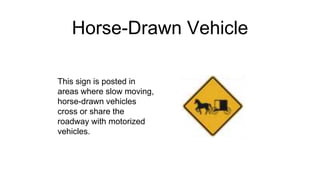
Horse-Drawn Vehicle
This sign is posted in
areas where slow moving,
horse-drawn vehicles
cross or share the
roadway with motorized
vehicles.
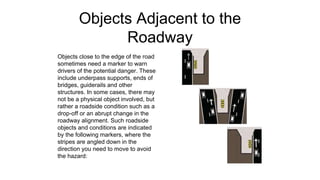
Objects Adjacent to the
Roadway
Objects close to the edge of the road
sometimes need a marker to warn
drivers of the potential danger. These
include underpass supports, ends of
bridges, guiderails and other
structures. In some cases, there may
not be a physical object involved, but
rather a roadside condition such as a
drop-off or an abrupt change in the
roadway alignment. Such roadside
objects and conditions are indicated
by the following markers, where the
stripes are angled down in the
direction you need to move to avoid
the hazard:
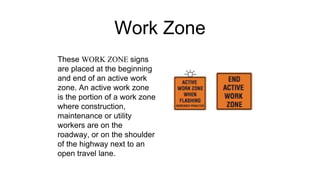
Work Zone
These WORK ZONE signs
are placed at the beginning
and end of an active work
zone. An active work zone
is the portion of a work zone
where construction,
maintenance or utility
workers are on the
roadway, or on the shoulder
of the highway next to an
open travel lane.
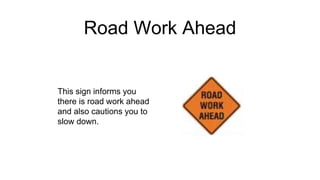
Road Work Ahead
This sign informs you
there is road work ahead
and also cautions you to
slow down.
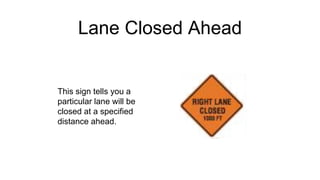
Lane Closed Ahead
This sign tells you a
particular lane will be
closed at a specified
distance ahead.
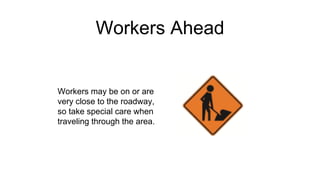
Workers Ahead
Workers may be on or are
very close to the roadway,
so take special care when
traveling through the area.
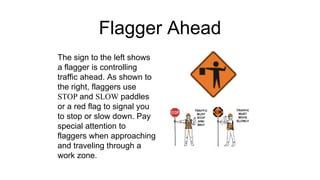
Flagger Ahead
The sign to the left shows
a flagger is controlling
traffic ahead. As shown to
the right, flaggers use
STOP and SLOW paddles
or a red flag to signal you
to stop or slow down. Pay
special attention to
flaggers when approaching
and traveling through a
work zone.
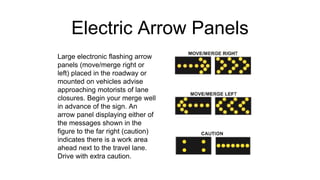
Electric Arrow Panels
Large electronic flashing arrow
panels (move/merge right or
left) placed in the roadway or
mounted on vehicles advise
approaching motorists of lane
closures. Begin your merge well
in advance of the sign. An
arrow panel displaying either of
the messages shown in the
figure to the far right (caution)
indicates there is a work area
ahead next to the travel lane.
Drive with extra caution.
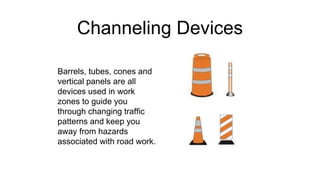
Channeling Devices
Barrels, tubes, cones and
vertical panels are all
devices used in work
zones to guide you
through changing traffic
patterns and keep you
away from hazards
associated with road work.
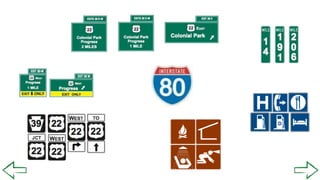
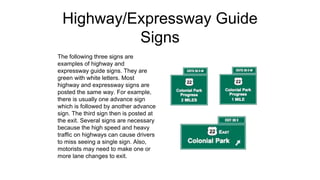
Highway/Expressway Guide
Signs
The following three signs are
examples of highway and
expressway guide signs. They are
green with white letters. Most
highway and expressway signs are
posted the same way. For example,
there is usually one advance sign
which is followed by another advance
sign. The third sign then is posted at
the exit. Several signs are necessary
because the high speed and heavy
traffic on highways can cause drivers
to miss seeing a single sign. Also,
motorists may need to make one or
more lane changes to exit.
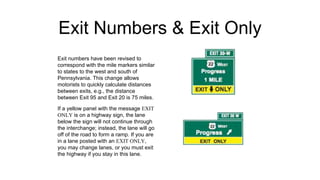
Exit Numbers & Exit Only
Exit numbers have been revised to
correspond with the mile markers similar
to states to the west and south of
Pennsylvania. This change allows
motorists to quickly calculate distances
between exits, e.g., the distance
between Exit 95 and Exit 20 is 75 miles.
If a yellow panel with the message EXIT
ONLY is on a highway sign, the lane
below the sign will not continue through
the interchange; instead, the lane will go
off of the road to form a ramp. If you are
in a lane posted with an EXIT ONLY,
you may change lanes, or you must exit
the highway if you stay in this lane.
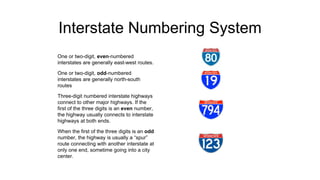
Interstate Numbering System
One or two-digit, even-numbered
interstates are generally east-west routes.
One or two-digit, odd-numbered
interstates are generally north-south
routes
Three-digit numbered interstate highways
connect to other major highways. If the
first of the three digits is an even number,
the highway usually connects to interstate
highways at both ends.
When the first of the three digits is an odd
number, the highway is usually a “spur”
route connecting with another interstate at
only one end, sometime going into a city
center.
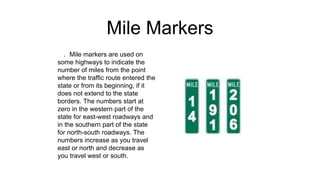
Mile Markers
. Mile markers are used on
some highways to indicate the
number of miles from the point
where the traffic route entered the
state or from its beginning, if it
does not extend to the state
borders. The numbers start at
zero in the western part of the
state for east-west roadways and
in the southern part of the state
for north-south roadways. The
numbers increase as you travel
east or north and decrease as
you travel west or south.
Route Markers
Service Signs
These signs are square or
rectangular, are blue with
white letters or symbols,
and show the location of
various services located at
the next exit.
Recreational Signs
Brown RECREATION signs
direct us to areas of public
recreation and cultural
interest. In addition to
swimming, skiing, boating,
and fishing areas, these
signs also direct us to the
services in recreation
areas, including first aid,
post office, and food
service.
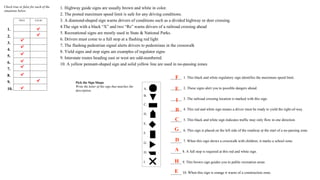
Check true or false for each of the
situations below.
______ 1. This black and white regulatory sign identifies the maximum speed limit.
______ 2. These signs alert you to possible dangers ahead.
______ 3. The railroad crossing location is marked with this sign.
______ 4. This red and white sign means a driver must be ready to yield the right-of-way.
______ 5. This black and white sign indicates traffic may only flow in one direction.
______ 6. This sign is placed on the left side of the roadway at the start of a no-passing zone.
______ 7. When this sign shows a crosswalk with children, it marks a school zone.
______ 8. A full stop is required at this red and white sign.
______ 9. This brown sign guides you to public recreation areas.
______ 10. When this sign is orange it warns of a construction zone.
A.
B.
C.
D.
E.
F.
G.
H.
I.
Pick the Sign Shape
Write the letter of the sign that matches the
description.
1. Highway guide signs are usually brown and white in color.
2. The posted maximum speed limit is safe for any driving conditions.
3. A diamond-shaped sign warns drivers of conditions such as a divided highway or deer crossing.
4.The sign with a black “X” and two “Rs” warns drivers of a railroad crossing ahead
5. Recreational signs are mostly used in State & National Parks.
6. Drivers must come to a full stop at a flashing red light
7. The flashing pedestrian signal alerts drivers to pedestrians in the crosswalk
8. Yield signs and stop signs are examples of regulator signs
9. Interstate routes heading east or west are odd-numbered.
10. A yellow pennant-shaped sign and solid yellow line are used in no-passing zones
TRUE FALSE
1.
2.
3.
4.
5.
6.
7.
8.
9.
10.
F
E
I
B
C
G
D
A
H
E

Signs

  • 1.
  • 2.
  • 3.
  • 5.
    Warning Signs Not enforcedby law Helpful Suggestions
  • 8.
    Construction Signs All Finesand Points are doubled Must Put on headlights Reduce Speed
  • 10.
  • 12.
    Stop Sign The STOPsign is the only octagon-shaped (8- sided) sign you see on the highway. At an intersection with a STOP sign, you must stop completely, check for pedestrians and cross traffic to clear the intersection before you go again. Slowing down without coming to a full stop is illegal. When you see a crosswalk or a stop line, stop before the front of your vehicle reaches the first painted line. If you cannot see traffic, yield to any pedestrians and then carefully pull forward past the line until you can see clearly. Check for traffic and pedestrians and then go ahead when the intersection is clear.
  • 13.
    Yield Sign YIELD signsare triangular (3-sided) in shape. When you see this sign, you must slow down and check for traffic and give the right-of-way to pedestrians and approaching cross traffic. You stop only when it is necessary. Proceed when you can do so safely without interfering with normal traffic flow. Remember, you must have a sufficient gap in traffic before you can continue on at either STOP or YIELD sign locations. This sign is used in conjunction with a yield sign at a one-lane bridge or underpass location to alert motorists the one-lane roadway requires them to yield the right-of-way to opposing traffic.
  • 14.
    Railroad Crossbuck Sign Thissign is placed at a railroad crossing where the tracks cross the roadway. You should treat the crossbuck sign as a YIELD sign; slow down and prepare to stop, if you see or hear a train approaching. Refer to Chapter 3 for more information about railroad crossing safety.
  • 15.
    DO NOT ENTERand WRONG WAY These signs work as a team. The DO NOT ENTER sign is put at the beginning of one-way streets and ramps. When you see this sign, do not drive onto that street or ramp in the direction you are heading. WRONG WAY signs are placed farther down the one-way street or ramp. They are placed there to catch your attention, if you accidentally turn onto the street or ramp.
  • 16.
    School Zone Signals Schoolzone signals are flashing yellow signals placed on the school zone speed limit signs. You must travel no faster than 15 mph when the yellow signals are flashing or during the time periods indicated on the sign. Exceeding the speed limit in a school zone will result in three (3) points on your driving record, and you will also be fined.
  • 17.
    One Way The ONEWAY sign means traffic is allowed to move only in the direction the sign is pointing. If you turn onto a one-way street traveling in the opposite direction, you are likely to get into a head-on collision.
  • 18.
    Divided Highway This signmeans the road you are on intersects with a divided highway. The divided highway is really two (2), one-way roadways that are separated by a median or a guide rail. At the first roadway, you can only turn right, and at the second roadway, you can only turn left.
  • 19.
    No Trucks, NoBicycles and No Pedestrian Crossing Operators of trucks, bicycles and pedestrians may not use roadways where these signs are posted.
  • 20.
    The following signsare located where certain actions are prohibited at any or all times: NO U-TURN - This sign prohibits U- turns. Do not make a complete turn to go in the opposite direction. NO RIGHT TURN - This sign indicates right turns are prohibited. Do not make a right turn at this intersection. NO LEFT TURN - This sign indicates left turns are prohibited. Do not make a left turn at this intersection.
  • 21.
    DO NOT PASS Thissign may be placed in areas where you may not pass any vehicles going in the same direction. It is often accompanied by the yellow pennant-shaped sign that says NO PASSING ZONE (Refer to “Warning Signs”).
  • 22.
    Center Lane LeftTurn Only This sign indicates where a lane is reserved for the exclusive use of left- turning vehicles in either direction and is not to be used for through traffic or passing.
  • 23.
    Keep Right These signsdirect drivers to keep to the right of the traffic island or divider.
  • 24.
    Right Turn Signal Thissign is posted close to a traffic signal to indicate that the signal controls right turn movements.
  • 25.
    Speed Limit A SPEEDLIMIT sign indicates the maximum legal speed under ideal conditions for the stretch of highway where it is posted. Your safety may depend upon driving slower than the posted speed under poor conditions.
  • 26.
    No Turn OnRed You may not turn during the red light cycle at an intersection where one of these signs is posted. You must wait for the signal to turn green.
  • 27.
    Left Turn YieldOn Green This sign indicates a left turn is permitted, but you must yield to oncoming traffic. It is ‘commonly placed at intersections, near the left-turn traffic signal, to remind drivers left turns are not protected when the circular green signal comes on.
  • 28.
    Reserved Parking Although thissign is not black and white, it is a regulatory sign. It marks areas where parking is reserved for disabled persons or severely disabled veterans. Vehicles parked in these spaces must display authorized registration plates or parking placards. Unauthorized vehicles parked in these spaces are subject to a fine and towing costs.
  • 29.
    High-occupancy Vehicle Lane also knownas an HOV lane, carpool lane, diamond lane, is a restricted traffic lane reserved at peak travel times or longer for the exclusive use of vehicles with a driver and one or more passengers, including carpools, vanpools, and transit buses.
  • 30.
    No Passing Zone Thisis the only pennant- shaped warning sign. This sign marks the beginning of a no passing zone and is placed on the left side of the road facing the driver.
  • 31.
    Chevron Signs There isa sharp change in the direction of the road, such as a curve to the left or right. The road bends in the direction the chevron points. When used in a curve, there will be an advanced curve warning sign, and there may be several chevron signs placed throughout the curve.
  • 33.
    Set Of Curves Theroad ahead curves first in one direction and then back in the other direction (a set of two (2) curves). Slow down and prepare to navigate through the set of curves.
  • 34.
    Right And LeftSharp Turns The road ahead turns sharply first in one direction and then back in the other direction. Slow down substantially and prepare to navigate through the set of turns.
  • 35.
    Winding Road This signindicates there are three (3) or more curves in a row on the road ahead.
  • 36.
    One Direction LargeArrow The road ahead changes direction at an extreme angle. Before you reach such an extreme curve, slow down as much as you would to make a turn at an intersection.
  • 37.
    Road Entering Curve Themain road curves to the left with a side road entering from the right. Approach the intersection with extra caution. A driver preparing to enter the main road may not be able to see you approaching from around the curve and may pull out in front of you, leaving you little room to avoid a crash, if you are traveling too fast.
  • 38.
    Truck Rollover This signidentifies curves where trucks traveling at excessive speeds have a potential to rollover.
  • 39.
    Advisory Speed Sign Thissign may be used with any diamond-shaped warning sign. The highest speed you should travel around a sharp left curve ahead is 25 mph.
  • 40.
    Merging Traffic This signis placed on a major roadway to tell you traffic may be merging into your lane from another roadway or a ramp. In this example, the traffic will be entering your lane from the right. Entering traffic must yield to traffic already on the major roadway.
  • 41.
    Added Lane This signis placed in advance of a point where two roadways meet. It means merging is not necessary because the entering traffic uses a new lane that has been added to the roadway.
  • 42.
    Weave Area This signis used to warn that you will be merging with another roadway as some traffic is exiting and crossing your path.
  • 43.
    Divided Highway Begins Thehighway ahead becomes a divided highway with two one- way roadways and a median or divider separating traffic moving in opposite directions. Keep to the right of the divider or median.
  • 44.
    Divided Highway Ends Thedivided highway on which you are traveling ends ahead. You will then be on a roadway with two- way traffic. Keep to the right of the centerline and watch for oncoming traffic.
  • 45.
    Two-way Traffic Ahead Theone-way street or roadway ends ahead. You will then be traveling on a road with two (2) lanes of traffic moving in opposite directions. Stay in your lane to the right of the centerline. This sign may also be placed at intervals along the two-way roadway.
  • 46.
    Lane Ends These signstell you one (1) lane on a multi-lane roadway will end ahead. In these examples, the traffic in the right lane must merge left.
  • 47.
    Intersection Signs The signsbelow show types of intersections. By showing you in advance how the roads join each other, the signs let you know when the road you are traveling on does not continue straight through the intersection. The signs also warn you about possible problems with the movements of other vehicles. Approach all of these intersection types with extra caution by searching ahead and preparing to slow down, if necessary.
  • 48.
    Two Direction LargeArrow This sign is placed at the far side of a T-intersection to tell you that you can only go left or right. The road you are on does not continue straight through at the intersection.
  • 49.
    Narrow Bridge orUnderpass Ahead Each lane on the bridge or underpass becomes narrower, and there generally is no shoulder. You need to slow down and make sure you stay in your lane. If a driver approaching from the opposite direction has a wide vehicle or is taking up part of your lane, wait until he or she clears the area.
  • 50.
    Slippery When Wet Especiallyslippery conditions exist when wet. In wet weather, reduce your speed and increase your following distance. Do not accelerate or brake quickly. Make turns at a very slow speed.
  • 51.
    Deer Crossing This signis posted in areas where deer frequently cross and crashes with deer have occurred.
  • 52.
    Low Clearance This signmay be placed on an underpass, or at the entrance to a tunnel or parking garage. Do not enter if your vehicle is taller than the height listed on the sign.
  • 53.
    Shoulder Signs These signsare placed in advance of locations where the shoulder is lower than the road or the shoulder is soft (not paved). The LOW SHOULDER sign is used where the shoulder is as much as three (3) inches below the level of the road. The SHOULDER DROP OFF sign is used for even more severe drop- off situations. If you stray off of the roadway and one (1) wheel drops off onto a low shoulder or a soft shoulder, do not slam on the brakes or steer sharply to try to get back onto the roadway—you can easily lose control of your vehicle!
  • 54.
    Hill/Downgrade There is asteep hill ahead. Slow down and be ready to shift to a lower gear to control your speed and to save wear and tear on your brakes.
  • 55.
    Traffic Signal Ahead Atraffic signal is present at the intersection ahead. You may not be able to see it because of a curve or hill. If the light is red (or if the light has just turned green), a line of vehicles may be stopped ahead. When you see this sign, slow down and prepare to stop, if necessary.
  • 56.
    Stop Sign Ahead ASTOP sign is present at the intersection ahead. You may not be able to see it because of a curve, hill or something else blocking your view. There also may be a line of vehicles stopped ahead at the STOP sign you cannot see. When you see this sign, slow down in preparation to stop.
  • 57.
    Bicycle Crossing Ahead Bicyclistsmay be crossing your path ahead. Be prepared to slow down, if necessary. This sign may have either a yellow background (as shown) or a fluorescent yellow- green background.
  • 58.
    Railroad Crossing Ahead Youare approaching a railroad crossing. When you see this sign, begin looking and listening for a train. This sign is placed far enough in advance to allow you to stop before you reach the tracks, if necessary. Refer to Chapter 3 for more information about railroad crossing safety.
  • 59.
    Advanced Intersection/Railroad Crossing Sign Theintersecting road has a railroad crossing within a very short distance from the intersection. If you are planning to turn onto the intersecting road and if a train is approaching, be prepared to stop.
  • 60.
    Bicycle/Motor Vehicle Share TheRoad Used at roadway pinch points (no shoulder, narrow lanes, etc.) to warn you, as a motorist, to provide adequate space for bicyclists to share the roadway.
  • 61.
    Pedestrian Crossing Used ata marked crosswalk or in advance of locations where pedestrians may be crossing your path. Be prepared to slow down or stop, if necessary. This sign may have either a yellow background (as shown) or a fluorescent yellow-green background.
  • 62.
    School This is theonly pentagon- shaped sign used on the roadway. It means you are approaching a school zone. If the sign is accompanied by a downward-pointing arrow, it means you are at the school zone crosswalk. You should slow down, watch for children crossing the road and stop, if necessary. This sign may have either a yellow background (as shown) or a fluorescent yellow- green background.
  • 63.
    Horse-Drawn Vehicle This signis posted in areas where slow moving, horse-drawn vehicles cross or share the roadway with motorized vehicles.
  • 64.
    Objects Adjacent tothe Roadway Objects close to the edge of the road sometimes need a marker to warn drivers of the potential danger. These include underpass supports, ends of bridges, guiderails and other structures. In some cases, there may not be a physical object involved, but rather a roadside condition such as a drop-off or an abrupt change in the roadway alignment. Such roadside objects and conditions are indicated by the following markers, where the stripes are angled down in the direction you need to move to avoid the hazard:
  • 65.
    Work Zone These WORKZONE signs are placed at the beginning and end of an active work zone. An active work zone is the portion of a work zone where construction, maintenance or utility workers are on the roadway, or on the shoulder of the highway next to an open travel lane.
  • 66.
    Road Work Ahead Thissign informs you there is road work ahead and also cautions you to slow down.
  • 67.
    Lane Closed Ahead Thissign tells you a particular lane will be closed at a specified distance ahead.
  • 68.
    Workers Ahead Workers maybe on or are very close to the roadway, so take special care when traveling through the area.
  • 69.
    Flagger Ahead The signto the left shows a flagger is controlling traffic ahead. As shown to the right, flaggers use STOP and SLOW paddles or a red flag to signal you to stop or slow down. Pay special attention to flaggers when approaching and traveling through a work zone.
  • 70.
    Electric Arrow Panels Largeelectronic flashing arrow panels (move/merge right or left) placed in the roadway or mounted on vehicles advise approaching motorists of lane closures. Begin your merge well in advance of the sign. An arrow panel displaying either of the messages shown in the figure to the far right (caution) indicates there is a work area ahead next to the travel lane. Drive with extra caution.
  • 71.
    Channeling Devices Barrels, tubes,cones and vertical panels are all devices used in work zones to guide you through changing traffic patterns and keep you away from hazards associated with road work.
  • 72.
    Highway/Expressway Guide Signs The followingthree signs are examples of highway and expressway guide signs. They are green with white letters. Most highway and expressway signs are posted the same way. For example, there is usually one advance sign which is followed by another advance sign. The third sign then is posted at the exit. Several signs are necessary because the high speed and heavy traffic on highways can cause drivers to miss seeing a single sign. Also, motorists may need to make one or more lane changes to exit.
  • 73.
    Exit Numbers &Exit Only Exit numbers have been revised to correspond with the mile markers similar to states to the west and south of Pennsylvania. This change allows motorists to quickly calculate distances between exits, e.g., the distance between Exit 95 and Exit 20 is 75 miles. If a yellow panel with the message EXIT ONLY is on a highway sign, the lane below the sign will not continue through the interchange; instead, the lane will go off of the road to form a ramp. If you are in a lane posted with an EXIT ONLY, you may change lanes, or you must exit the highway if you stay in this lane.
  • 74.
    Interstate Numbering System Oneor two-digit, even-numbered interstates are generally east-west routes. One or two-digit, odd-numbered interstates are generally north-south routes Three-digit numbered interstate highways connect to other major highways. If the first of the three digits is an even number, the highway usually connects to interstate highways at both ends. When the first of the three digits is an odd number, the highway is usually a “spur” route connecting with another interstate at only one end, sometime going into a city center.
  • 75.
    Mile Markers . Milemarkers are used on some highways to indicate the number of miles from the point where the traffic route entered the state or from its beginning, if it does not extend to the state borders. The numbers start at zero in the western part of the state for east-west roadways and in the southern part of the state for north-south roadways. The numbers increase as you travel east or north and decrease as you travel west or south.
  • 76.
  • 77.
    Service Signs These signsare square or rectangular, are blue with white letters or symbols, and show the location of various services located at the next exit.
  • 78.
    Recreational Signs Brown RECREATIONsigns direct us to areas of public recreation and cultural interest. In addition to swimming, skiing, boating, and fishing areas, these signs also direct us to the services in recreation areas, including first aid, post office, and food service.
  • 79.
    Check true orfalse for each of the situations below. ______ 1. This black and white regulatory sign identifies the maximum speed limit. ______ 2. These signs alert you to possible dangers ahead. ______ 3. The railroad crossing location is marked with this sign. ______ 4. This red and white sign means a driver must be ready to yield the right-of-way. ______ 5. This black and white sign indicates traffic may only flow in one direction. ______ 6. This sign is placed on the left side of the roadway at the start of a no-passing zone. ______ 7. When this sign shows a crosswalk with children, it marks a school zone. ______ 8. A full stop is required at this red and white sign. ______ 9. This brown sign guides you to public recreation areas. ______ 10. When this sign is orange it warns of a construction zone. A. B. C. D. E. F. G. H. I. Pick the Sign Shape Write the letter of the sign that matches the description. 1. Highway guide signs are usually brown and white in color. 2. The posted maximum speed limit is safe for any driving conditions. 3. A diamond-shaped sign warns drivers of conditions such as a divided highway or deer crossing. 4.The sign with a black “X” and two “Rs” warns drivers of a railroad crossing ahead 5. Recreational signs are mostly used in State & National Parks. 6. Drivers must come to a full stop at a flashing red light 7. The flashing pedestrian signal alerts drivers to pedestrians in the crosswalk 8. Yield signs and stop signs are examples of regulator signs 9. Interstate routes heading east or west are odd-numbered. 10. A yellow pennant-shaped sign and solid yellow line are used in no-passing zones TRUE FALSE 1. 2. 3. 4. 5. 6. 7. 8. 9. 10. F E I B C G D A H E