 Moazzam Arshad 2016-Uet-Qet.Swl-Elect-06
 Sohail Ahmad 2016-Uet-Qet.Swl-Elect-08
 Zain Zaeem 2016-Uet-Qet.Swl-Elect-02
 Farooq Ahmad 2016-Uet-Qet.Swl-Elect-05
The signals are detectable physical
quantities that vary with time, space
or any other independent variable or
variables.
 For Example:
Sine Wave
 Signals can be classified as:
 Continuous time Signals
 Discrete time Signals
 If the independent variable (t) is
continuous, then the corresponding
signal is continuous time signal.
 For Example:
 If the independent variable (t) takes
on only discrete values.
 For Example:
 Even and Odd Signals
 Energy and Power Signals
 Deterministic and Random Signal
 Periodic and APeriodic Signals
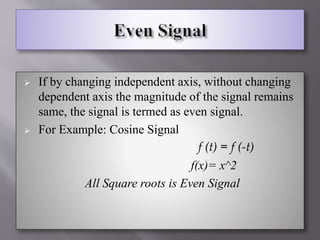
 If by changing independent axis, without changing
dependent axis the magnitude of the signal remains
same, the signal is termed as even signal.
 For Example: Cosine Signal
f (t) = f (-t)
f(x)= x^2
All Square roots is Even Signal
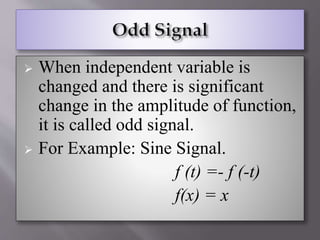
 When independent variable is
changed and there is significant
change in the amplitude of function,
it is called odd signal.
 For Example: Sine Signal.
f (t) =- f (-t)
f(x) = x
 Any signal squared and integrated
over time where it exists is energy
signal. Theses signals contain finite
amount of energy and zero power.
 Time average of energy signal is
Power signal, they contain infinite
energy.
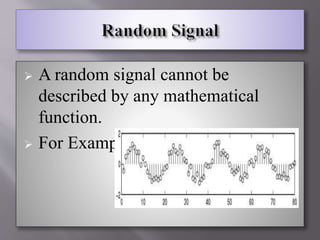
 A random signal cannot be
described by any mathematical
function.
 For Example:
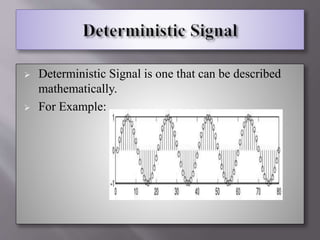
 Deterministic Signal is one that can be described
mathematically.
 For Example:
 Any continuous-time signal that
satisfies the condition: x(t+T) is a
periodic Signal. m1T1=m2T2 = Tₒ =
Fundamental period
 For Example: cos(tp/3)+sin(tp/4)
 T1=(2p)/(p/3)=6; T2 =(2p)/(p/4)=8;
 T1/T2=6/8 = (rational number) = m2/m1
 m1T1=m2T2 >Find m1 and m2
 6.4 = 3.8 = 24 = Tₒ
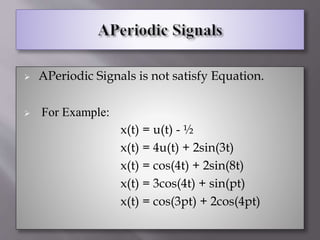
 APeriodic Signals is not satisfy Equation.
 For Example:
x(t) = u(t) - ½
x(t) = 4u(t) + 2sin(3t)
x(t) = cos(4t) + 2sin(8t)
x(t) = 3cos(4t) + sin(pt)
x(t) = cos(3pt) + 2cos(4pt)
A set of principles or procedures
according to which something is
done. An organized scheme or
method.
 For Example:
Robot Arm and Remote TV
Systems can be classified as:
 Linear and Non linear Systems
 Time Invariant Systems
 Causal and Non- Causal Systems
 Memory and Memory less Systems
 Stable and Unstable Systems
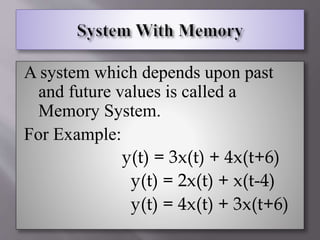
A system which depends upon past
and future values is called a
Memory System.
For Example:
y(t) = 3x(t) + 4x(t+6)
y(t) = 2x(t) + x(t-4)
y(t) = 4x(t) + 3x(t+6)
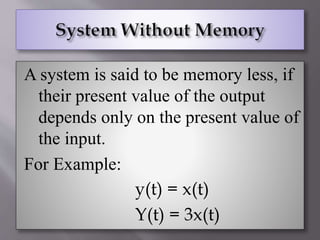
A system is said to be memory less, if
their present value of the output
depends only on the present value of
the input.
For Example:
y(t) = x(t)
Y(t) = 3x(t)
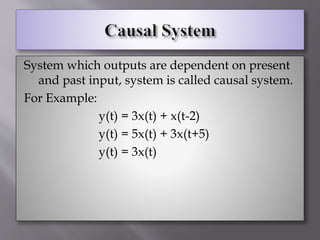
System which outputs are dependent on present
and past input, system is called causal system.
For Example:
y(t) = 3x(t) + x(t-2)
y(t) = 5x(t) + 3x(t+5)
y(t) = 3x(t)
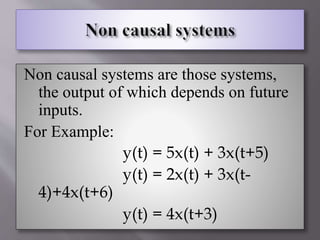
Non causal systems are those systems,
the output of which depends on future
inputs.
For Example:
y(t) = 5x(t) + 3x(t+5)
y(t) = 2x(t) + 3x(t-
4)+4x(t+6)
y(t) = 4x(t+3)
The End

Signal & system

  • 3.
     Moazzam Arshad2016-Uet-Qet.Swl-Elect-06  Sohail Ahmad 2016-Uet-Qet.Swl-Elect-08  Zain Zaeem 2016-Uet-Qet.Swl-Elect-02  Farooq Ahmad 2016-Uet-Qet.Swl-Elect-05
  • 4.
    The signals aredetectable physical quantities that vary with time, space or any other independent variable or variables.  For Example: Sine Wave
  • 5.
     Signals canbe classified as:  Continuous time Signals  Discrete time Signals
  • 6.
     If theindependent variable (t) is continuous, then the corresponding signal is continuous time signal.  For Example:
  • 7.
     If theindependent variable (t) takes on only discrete values.  For Example:
  • 8.
     Even andOdd Signals  Energy and Power Signals  Deterministic and Random Signal  Periodic and APeriodic Signals
  • 9.
     If bychanging independent axis, without changing dependent axis the magnitude of the signal remains same, the signal is termed as even signal.  For Example: Cosine Signal f (t) = f (-t) f(x)= x^2 All Square roots is Even Signal
  • 10.
     When independentvariable is changed and there is significant change in the amplitude of function, it is called odd signal.  For Example: Sine Signal. f (t) =- f (-t) f(x) = x
  • 11.
     Any signalsquared and integrated over time where it exists is energy signal. Theses signals contain finite amount of energy and zero power.  Time average of energy signal is Power signal, they contain infinite energy.
  • 12.
     A randomsignal cannot be described by any mathematical function.  For Example:
  • 13.
     Deterministic Signalis one that can be described mathematically.  For Example:
  • 14.
     Any continuous-timesignal that satisfies the condition: x(t+T) is a periodic Signal. m1T1=m2T2 = Tₒ = Fundamental period  For Example: cos(tp/3)+sin(tp/4)  T1=(2p)/(p/3)=6; T2 =(2p)/(p/4)=8;  T1/T2=6/8 = (rational number) = m2/m1  m1T1=m2T2 >Find m1 and m2  6.4 = 3.8 = 24 = Tₒ
  • 15.
     APeriodic Signalsis not satisfy Equation.  For Example: x(t) = u(t) - ½ x(t) = 4u(t) + 2sin(3t) x(t) = cos(4t) + 2sin(8t) x(t) = 3cos(4t) + sin(pt) x(t) = cos(3pt) + 2cos(4pt)
  • 16.
    A set ofprinciples or procedures according to which something is done. An organized scheme or method.  For Example: Robot Arm and Remote TV
  • 17.
    Systems can beclassified as:  Linear and Non linear Systems  Time Invariant Systems  Causal and Non- Causal Systems  Memory and Memory less Systems  Stable and Unstable Systems
  • 18.
    A system whichdepends upon past and future values is called a Memory System. For Example: y(t) = 3x(t) + 4x(t+6) y(t) = 2x(t) + x(t-4) y(t) = 4x(t) + 3x(t+6)
  • 19.
    A system issaid to be memory less, if their present value of the output depends only on the present value of the input. For Example: y(t) = x(t) Y(t) = 3x(t)
  • 20.
    System which outputsare dependent on present and past input, system is called causal system. For Example: y(t) = 3x(t) + x(t-2) y(t) = 5x(t) + 3x(t+5) y(t) = 3x(t)
  • 21.
    Non causal systemsare those systems, the output of which depends on future inputs. For Example: y(t) = 5x(t) + 3x(t+5) y(t) = 2x(t) + 3x(t- 4)+4x(t+6) y(t) = 4x(t+3)
  • 22.