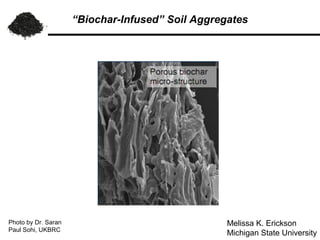
“Biochar-Infused” Soil Aggregates


Photo by Dr. Saran                                Melissa K. Erickson
Paul Sohi, UKBRC
                                                  Michigan State University
Carbon-Poor Soil vs. Native Carbon-Rich Soil


                     Nutrient-Poor         Oxisol Amended
                        Oxisol            Into Terra Preta

Photo courtesy of Bruno Glaser, 2000
Background: Charcoal Amended Soils Around
                 the World


                     Orissa,
                      India
                                     Hokkaido,
                                      Japan


                                      Uganda,
                                       Africa


Photos by Dr. N. Sai Bhaskar Reddy
Why Amend Soil with Charcoal?


    -Increased seed germination (~30% enhancement)
    -Increased plant growth (~24% greater shoot height)
    -Greater crop yields


Norman (1979)
ZechUNCCD.pdf, published by Dr. Bruno Glaser
Advantages of Bio-char in Soil


Enhances Soil Biologically, Chemically and Physically
    1. Prevents leaching of nutrients out of soil
    2. Increases available nutrients for plant growth
    3. Increases water retention
    4. Reduces the amount of fertilizer required
    5. Decreases N2O, CH4 and other greenhouse gas
        emissions from the soil
Advantages of Bio-char Amendment - Continued


Animal Feed
   1. Provides additional minerals
   2. Helps maintain a healthy digestive system
   3. Reduces animal methane production
   4. Reduces odor and ammonia emissions from manure slurry
Advantages of Natural Charcoal Amendment


Researchers at Iowa State investigating using charcoal and bio-
  oil to produce a charcoal/anhydrous ammonia fertilizer.
  They expect three significant results from their studies:

1. Farmers producing their own renewable energy to
   manufacture fertilizer for their fields.
2. Farming that improves soils because the added charcoal to
   promote soil organisms.
3. The charcoal sequestering carbon in the soil, thus reducing
   the amount of greenhouse gases in the atmosphere. It is
   estimated a 640-acre farm could retain the equivalent of
   1,800 tons of carbon dioxide in the soil. That's the annual
   emissions created by about 340 cars.
Types of Charcoal and Soil Analyzed


Research Approaches:

1. Charcoal: SAFFE, B.C. 550°C (500 grams), Lots 11 and 12
2. Soil texture: Wooster silt loam (fine-loamy, well-drained,
   mesic Typic Fragiudalf).
3. Soil aggregates were sampled at depths of 0 to 5 cm from
   fields subjected to conventional till (CT), no till (NT), and
   native forest (NF) ecosystems of a Wooster silt loam using
   the following aggregate sizes:

     NF (Native Forest):         1.0 – 5cm, > 9.5mm

     NT (No Till):               0 – 5cm, > 9.5mm

     CT (Conventional Till):     0 – 5cm, > 9.5mm
Wooster Soils Amended with Charcoal
              (wet/dry cycle-formed, 30% Charcoal shown)


1. Added mixtures of ground soil and
   30% charcoal by weight.
2. Filled sample cups with mixture and
   added six ml of water to 57mm
   aluminum dish.
3. Hydrated sample mixtures with water
   for 48 hours.
4. Removed water from samples and air
   dried for 24 hours.
5. Repeated steps two through four nine
   more times, for a total of ten cycles.
6. Inspected aggregate for structural
                                            Creation of aggregates from NF,
   integrity.                               NT and CT treatments mixed with
                                                     30% charcoal.
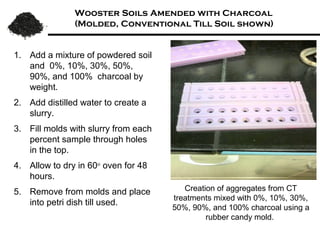
Wooster Soils Amended with Charcoal
                 (Molded, Conventional Till Soil as shown)


1. Added mixtures of powdered
   soil and 0%, 10%, 30%, 50%,
   90%, and 100% charcoal by
   weight.
2. Added distilled water to create
   a slurry.
3. Filled molds with slurry from
   each percent sample through
   holes in the top.
4. Dried in 60ο oven for 48 hours.
5. Removed from molds and
   stored in petri dish till used.   Molded synthetic aggregates from CT
                                     treatments mixed with 0%, 10%, 30%,
                                     50%, 90%, and 100% charcoal using a
                                             rubber candy mold.
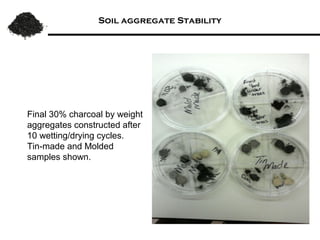
Soil aggregate Stability by Two methods


Display of soil aggregates
containing 30% charcoal;
constructed after 10
wetting/drying cycles.

Synthetic aggregates
constructed by wetting and
drying cycles (right) and
molded samples (left).
Farming that Improves the Environment


Robert C. Brown, Iowa State’s Bergles Professor in Thermal Science is
 also studying charcoal amendment of soils with the aim of implementing
 farming practices that actually improve the environment through
 responsible, sustainable soil amendment techniques. In his words:

“The conventional goal of good land stewardship is to minimize soil
 degradation and the amount of carbon released from the soil.”

“This new approach to agriculture has the goal of actually improving
 soils.”
                                  Source: http://www.buyactivatedcharcoal.om/natural_fertilizer


“In other words, producing and applying bio-char to soil would not only
 dramatically improve the soil and increase crop production, but also
 could provide a novel approach to establishing a significant, long-term
 sink for atmospheric carbon dioxide”
                             Johannes Lehman, in “Muck and Mystery: Bio-Char” website
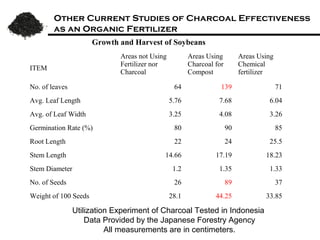
Current Studies of Charcoal Effectiveness
                    as an Organic Fertilizer
                      Growth and Harvest of Soybeans
                               Areas not using   Areas using    Areas Using
                                Fertilizer nor   Charcoal for    Chemical
ITEM
                                  Charcoal        Compost        fertilizer

No. of leaves                        64              139            71
Avg. Leaf Length cm                 5.76            7.68           6.04
Avg. of Leaf Width cm               3.25            4.08           3.26
Germination Rate (%)                 80                90           85
Root Length cm                       22                24          25.5
Stem Length cm                     14.66            17.19          18.23
Stem Diameter cm                     1.2            1.35           1.33
No. of Seeds                         26                89           37
Weight of 100 Seeds g               28.1            44.25          33.85

                Utilization Experiment of Charcoal Tested in Indonesia
                    Data Provided by the Japanese Forestry Agency
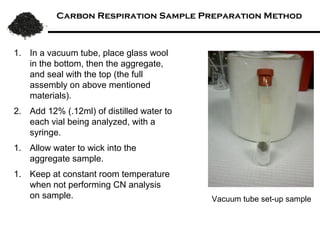
Carbon Respiration Sample Preparation Method


1. Convert vacuum tube into micro-
   respirometer. Place glass wool in
   the bottom, then the aggregate, and
   seal with the top with septum.
2. Add 12% distilled water to each vial
   being analyzed, using a syringe.

3. Equilibrate water within soil
   aggregate sample.

4. Flush respirometer with CO2 free air.

5. Maintain constant temperature
   during CO2 analysis of sample.          Micro-respirometer chamber
                                               with soil aggregate.
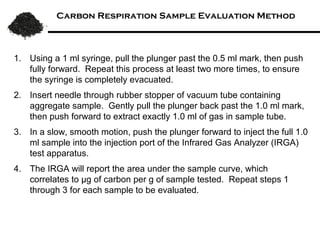
Carbon Respiration Sample Evaluation Method


1. Using a 1 ml syringe, pull the plunger past the 0.5 ml mark, then push
   fully forward. Repeat this process at least two more times, to ensure
   the syringe is completely evacuated.
2. Insert needle through rubber septum of respirometer containing
   aggregate sample. Gently pull the plunger back past the 1.0 ml mark,
   then push forward to extract exactly 1.0 ml of gas in sample tube.
3. In a slow, smooth motion, inject the full 1.0 ml sample into the injection
   port of the Infrared Gas Analyzer (IRGA).
4. The IRGA results are correlated to CO2 gas standards with accuracies
   of 1 microgram (µg). Repeat steps 1 through 3 for each sample to be
   evaluated.
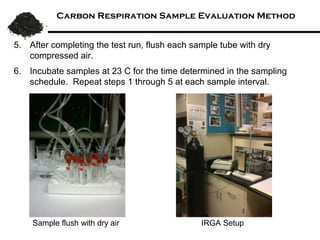
Carbon Respiration Sample Evaluation Method


5. After completing the test run, flush each sample tube with dry CO 2 free
   compressed air.
6. Incubate samples at 23 C for the time determined in the sampling
   schedule. Repeat steps 1 through 5 at each sample interval.


     Sample flushing manifold                  IRGA Setup
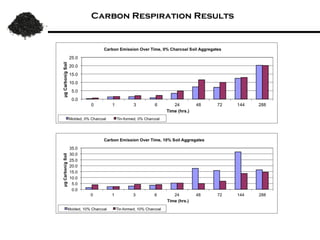
Carbon Dioxide Respiration Results
Carbon Dioxide Respiration Results, Continued
Aggregate Stability Conclusions

The Wooster Silt Loam soil from the Conventional Tillage (CT) areas
sampled exhibited a finer soil aggregate structure, compared to the
compaction seen in Native Forest (NF) and No-Till (NT) soil samples.
The finer CT soil structure allowed for greater penetration of the
introduced charcoal into the soil matrix than was observed with the NF
and NT soils.
The charcoal added to the soil matrix increased aggregate stability and
improved erosion resistance.
CO2 Respiration Conclusions


For 10% to 90% charcoal/soil aggregates, no significant variation in CO 2
respiration was observed for the first 24 hours of respiration data
collection, regardless of charcoal content or aggregate formation method.

For 10%, 30% and 50% charcoal/soil aggregates, molded sample CO 2
respiration after 48 hours exceeded that of the wet/dry cycle-formed
aggregates.

For pure charcoal aggregates in the same time frame, and 90%
charcoal/soil aggregates after 144 hours, wet/dry cycle-formed CO 2
respiration rate exceeded that of the molded samples.

It was observed that molded aggregates exhibited a more compact
nature, while wet/dry cycle-formed aggregates were looser and more
porous at all charcoal concentrations.
Acknowledgements


The researcher is very grateful for the cooperation and interest of Dr. Alvin Smucker
and the Soil Biophysics Laboratory, who supported and guided this study.

This research was supported and funded by Michigan State University College of
Agriculture and Natural Resources Undergraduate Research program.

The researcher wishes to thank her committee; Professor Alvin Smucker, Professor
Karen Renner, and Professor Sasha Kravchenko, and also her colleague and peer,
Hyen Chun, for their many hours of review and suggestions to the report and
presentation.
References

Cosentino, Diego Julian. (2006). “Organic matter contribution to aggregate stability in silty loam
cultivated soils. carbon input effects,” PhD thesis Matières organiques du sol, AgroParistech
2006INAP0041 p.186.

Cosentino, D., Claire Chenu, C., and Yves Le Bissonnais. (2006). “Aggregate stability and microbial
community dynamics under drying–wetting cycles in a silt loam soil,” Soil Biology and Biochemistry,
Volume 38, Issue 8, August 2006, Pages 2053-2062

Lehmann, J. (2007). “Bio-energy in the Black,” Front Ecol Environ 5(7): 381-387 (2007)

Lehmann, J., and M. Rondon. (2006). Biological Approaches to Sustainable Soil Systems .
http://soil.scijournals.org/cgi/content/full/69/6/1912

Liang, B., Lehmann, J., Solomona, D., Kinyangia, J., Grossman, J., O'Neilla, B., Skjemstadb, J.O.,
Thiesa, J., Luizãoc, F.J., Petersend, J., and E. G. Nevese. (2006). “Black Carbon Increases Cation
Exchange Capacity in Soils,” Soil Science Society of American Journal 70:1719-1730 (2006)
http://soil.scijournals.org/cgi/content/full/70/5/1719

Park, E.J., and A.J.M. Smucker. (2005). “Erosive Strengths of Concentric Regions within Soil
Macroaggregates,” Soil Science Society of American Journal 69:1912-1921 (2005).
http://soil.scijournals.org/cgi/content/full/69/6/1912

Park, E.J., and A.J.M. Smucker. (2005). “Saturated Hydraulic Conductivity and Porosity within
Macroaggregates Modified by Tillage,” Soil Science Society of American Journal 69:38–45 (2005).
http://soil.scijournals.org/cgi/reprint/69/1/38.pdf

"Biochar Infused" Soil Aggregates

  • 1.
    “Biochar-Infused” Soil Aggregates Photoby Dr. Saran Melissa K. Erickson Paul Sohi, UKBRC Michigan State University
  • 2.
    Carbon-Poor Soil vs.Native Carbon-Rich Soil Nutrient-Poor Oxisol Amended Oxisol Into Terra Preta Photo courtesy of Bruno Glaser, 2000
  • 3.
    Background: Charcoal AmendedSoils Around the World Orissa, India Hokkaido, Japan Uganda, Africa Photos by Dr. N. Sai Bhaskar Reddy
  • 4.
    Why Amend Soilwith Charcoal? -Increased seed germination (~30% enhancement) -Increased plant growth (~24% greater shoot height) -Greater crop yields Norman (1979) ZechUNCCD.pdf, published by Dr. Bruno Glaser
  • 5.
    Advantages of Bio-charin Soil Enhances Soil Biologically, Chemically and Physically 1. Prevents leaching of nutrients out of soil 2. Increases available nutrients for plant growth 3. Increases water retention 4. Reduces the amount of fertilizer required 5. Decreases N2O, CH4 and other greenhouse gas emissions from the soil
  • 6.
    Advantages of Bio-charAmendment - Continued Animal Feed 1. Provides additional minerals 2. Helps maintain a healthy digestive system 3. Reduces animal methane production 4. Reduces odor and ammonia emissions from manure slurry
  • 7.
    Advantages of NaturalCharcoal Amendment Researchers at Iowa State investigating using charcoal and bio- oil to produce a charcoal/anhydrous ammonia fertilizer. They expect three significant results from their studies: 1. Farmers producing their own renewable energy to manufacture fertilizer for their fields. 2. Farming that improves soils because the added charcoal to promote soil organisms. 3. The charcoal sequestering carbon in the soil, thus reducing the amount of greenhouse gases in the atmosphere. It is estimated a 640-acre farm could retain the equivalent of 1,800 tons of carbon dioxide in the soil. That's the annual emissions created by about 340 cars.
  • 8.
    Types of Charcoaland Soil Analyzed Research Approaches: 1. Charcoal: SAFFE, B.C. 550°C (500 grams), Lots 11 and 12 2. Soil texture: Wooster silt loam (fine-loamy, well-drained, mesic Typic Fragiudalf). 3. Soil aggregates were sampled at depths of 0 to 5 cm from fields subjected to conventional till (CT), no till (NT), and native forest (NF) ecosystems of a Wooster silt loam using the following aggregate sizes: NF (Native Forest): 1.0 – 5cm, > 9.5mm NT (No Till): 0 – 5cm, > 9.5mm CT (Conventional Till): 0 – 5cm, > 9.5mm
  • 9.
    Wooster Soils Amendedwith Charcoal (wet/dry cycle-formed, 30% Charcoal shown) 1. Added mixtures of ground soil and 30% charcoal by weight. 2. Filled sample cups with mixture and added six ml of water to 57mm aluminum dish. 3. Hydrated sample mixtures with water for 48 hours. 4. Removed water from samples and air dried for 24 hours. 5. Repeated steps two through four nine more times, for a total of ten cycles. 6. Inspected aggregate for structural Creation of aggregates from NF, integrity. NT and CT treatments mixed with 30% charcoal.
  • 10.
    Wooster Soils Amendedwith Charcoal (Molded, Conventional Till Soil as shown) 1. Added mixtures of powdered soil and 0%, 10%, 30%, 50%, 90%, and 100% charcoal by weight. 2. Added distilled water to create a slurry. 3. Filled molds with slurry from each percent sample through holes in the top. 4. Dried in 60ο oven for 48 hours. 5. Removed from molds and stored in petri dish till used. Molded synthetic aggregates from CT treatments mixed with 0%, 10%, 30%, 50%, 90%, and 100% charcoal using a rubber candy mold.
  • 11.
    Soil aggregate Stabilityby Two methods Display of soil aggregates containing 30% charcoal; constructed after 10 wetting/drying cycles. Synthetic aggregates constructed by wetting and drying cycles (right) and molded samples (left).
  • 12.
    Farming that Improvesthe Environment Robert C. Brown, Iowa State’s Bergles Professor in Thermal Science is also studying charcoal amendment of soils with the aim of implementing farming practices that actually improve the environment through responsible, sustainable soil amendment techniques. In his words: “The conventional goal of good land stewardship is to minimize soil degradation and the amount of carbon released from the soil.” “This new approach to agriculture has the goal of actually improving soils.” Source: http://www.buyactivatedcharcoal.om/natural_fertilizer “In other words, producing and applying bio-char to soil would not only dramatically improve the soil and increase crop production, but also could provide a novel approach to establishing a significant, long-term sink for atmospheric carbon dioxide” Johannes Lehman, in “Muck and Mystery: Bio-Char” website
  • 13.
    Current Studies ofCharcoal Effectiveness as an Organic Fertilizer Growth and Harvest of Soybeans Areas not using Areas using Areas Using Fertilizer nor Charcoal for Chemical ITEM Charcoal Compost fertilizer No. of leaves 64 139 71 Avg. Leaf Length cm 5.76 7.68 6.04 Avg. of Leaf Width cm 3.25 4.08 3.26 Germination Rate (%) 80 90 85 Root Length cm 22 24 25.5 Stem Length cm 14.66 17.19 18.23 Stem Diameter cm 1.2 1.35 1.33 No. of Seeds 26 89 37 Weight of 100 Seeds g 28.1 44.25 33.85 Utilization Experiment of Charcoal Tested in Indonesia Data Provided by the Japanese Forestry Agency
  • 14.
    Carbon Respiration SamplePreparation Method 1. Convert vacuum tube into micro- respirometer. Place glass wool in the bottom, then the aggregate, and seal with the top with septum. 2. Add 12% distilled water to each vial being analyzed, using a syringe. 3. Equilibrate water within soil aggregate sample. 4. Flush respirometer with CO2 free air. 5. Maintain constant temperature during CO2 analysis of sample. Micro-respirometer chamber with soil aggregate.
  • 15.
    Carbon Respiration SampleEvaluation Method 1. Using a 1 ml syringe, pull the plunger past the 0.5 ml mark, then push fully forward. Repeat this process at least two more times, to ensure the syringe is completely evacuated. 2. Insert needle through rubber septum of respirometer containing aggregate sample. Gently pull the plunger back past the 1.0 ml mark, then push forward to extract exactly 1.0 ml of gas in sample tube. 3. In a slow, smooth motion, inject the full 1.0 ml sample into the injection port of the Infrared Gas Analyzer (IRGA). 4. The IRGA results are correlated to CO2 gas standards with accuracies of 1 microgram (µg). Repeat steps 1 through 3 for each sample to be evaluated.
  • 16.
    Carbon Respiration SampleEvaluation Method 5. After completing the test run, flush each sample tube with dry CO 2 free compressed air. 6. Incubate samples at 23 C for the time determined in the sampling schedule. Repeat steps 1 through 5 at each sample interval. Sample flushing manifold IRGA Setup
  • 17.
  • 18.
    Carbon Dioxide RespirationResults, Continued
  • 19.
    Carbon Dioxide RespirationResults, Continued
  • 20.
    Aggregate Stability Conclusions TheWooster Silt Loam soil from the Conventional Tillage (CT) areas sampled exhibited a finer soil aggregate structure, compared to the compaction seen in Native Forest (NF) and No-Till (NT) soil samples. The finer CT soil structure allowed for greater penetration of the introduced charcoal into the soil matrix than was observed with the NF and NT soils. The charcoal added to the soil matrix increased aggregate stability and improved erosion resistance.
  • 21.
    CO2 Respiration Conclusions For10% to 90% charcoal/soil aggregates, no significant variation in CO 2 respiration was observed for the first 24 hours of respiration data collection, regardless of charcoal content or aggregate formation method. For 10%, 30% and 50% charcoal/soil aggregates, molded sample CO 2 respiration after 48 hours exceeded that of the wet/dry cycle-formed aggregates. For pure charcoal aggregates in the same time frame, and 90% charcoal/soil aggregates after 144 hours, wet/dry cycle-formed CO 2 respiration rate exceeded that of the molded samples. It was observed that molded aggregates exhibited a more compact nature, while wet/dry cycle-formed aggregates were looser and more porous at all charcoal concentrations.
  • 22.
    Acknowledgements The researcher isvery grateful for the cooperation and interest of Dr. Alvin Smucker and the Soil Biophysics Laboratory, who supported and guided this study. This research was supported and funded by Michigan State University College of Agriculture and Natural Resources Undergraduate Research program. The researcher wishes to thank her committee; Professor Alvin Smucker, Professor Karen Renner, and Professor Sasha Kravchenko, and also her colleague and peer, Hyen Chun, for their many hours of review and suggestions to the report and presentation.
  • 23.
    References Cosentino, Diego Julian.(2006). “Organic matter contribution to aggregate stability in silty loam cultivated soils. carbon input effects,” PhD thesis Matières organiques du sol, AgroParistech 2006INAP0041 p.186. Cosentino, D., Claire Chenu, C., and Yves Le Bissonnais. (2006). “Aggregate stability and microbial community dynamics under drying–wetting cycles in a silt loam soil,” Soil Biology and Biochemistry, Volume 38, Issue 8, August 2006, Pages 2053-2062 Lehmann, J. (2007). “Bio-energy in the Black,” Front Ecol Environ 5(7): 381-387 (2007) Lehmann, J., and M. Rondon. (2006). Biological Approaches to Sustainable Soil Systems . http://soil.scijournals.org/cgi/content/full/69/6/1912 Liang, B., Lehmann, J., Solomona, D., Kinyangia, J., Grossman, J., O'Neilla, B., Skjemstadb, J.O., Thiesa, J., Luizãoc, F.J., Petersend, J., and E. G. Nevese. (2006). “Black Carbon Increases Cation Exchange Capacity in Soils,” Soil Science Society of American Journal 70:1719-1730 (2006) http://soil.scijournals.org/cgi/content/full/70/5/1719 Park, E.J., and A.J.M. Smucker. (2005). “Erosive Strengths of Concentric Regions within Soil Macroaggregates,” Soil Science Society of American Journal 69:1912-1921 (2005). http://soil.scijournals.org/cgi/content/full/69/6/1912 Park, E.J., and A.J.M. Smucker. (2005). “Saturated Hydraulic Conductivity and Porosity within Macroaggregates Modified by Tillage,” Soil Science Society of American Journal 69:38–45 (2005). http://soil.scijournals.org/cgi/reprint/69/1/38.pdf