A 70 MHz CMOS Band-pass Sigma-Delta Analog-to-
     Digital Converter for Wireless Receivers


                   A thesis submitted to
   The Hong Kong University of Science and Technology
        in partial fulfillment of the requirements for
          the Degree of Master of Philosophy in
           Electrical and Electronic Engineering


                             by


                  Hsu Kuan Chun Issac

    Department of Electrical and Electronic Engineering


                  B.Eng. (Hons), HKUST


                        August 1999
A 70 MHz CMOS Band-pass Sigma-Delta Analog-to-Digital
              Converter for Wireless Receivers
                                by
                       Hsu Kuan Chun Issac


Approved by:


__________________________
Dr. Howard Cam Luong
Thesis Supervisor


__________________________
Dr. Mansun Chan
Thesis Examination Committee Member (Chairman)


__________________________
Dr. Wing-Hung Ki
Thesis Examination Committee Member


__________________________
Prof. Philip C.H. Chan
Head of Department

         Department of Electrical and Electronic Engineering
        The Hong Kong University of Science and Technology

                           August, 1999
A 70 MHz CMOS Band-pass Sigma-Delta Analog-to-Digital
                Converter for Wireless Receivers

                                           by
                               Hsu Kuan Chun Issac

                             for the degree of
       Master of Philosophy in Electrical and Electronic Engineering
        at The Hong Kong University of Science and Technology
                              in August 1999


                                 ABSTRACT

Analog-to-digital converters play an essential role in modern RF receiver design.

Conventional Nyquist converters require analog components that are precise and

highly immune to noise and interference. In contrast, oversampling converters can be

implemented using simple and high-tolerance analog components. Moreover,

sampling at high frequency eliminates the need for abrupt cutoffs in the analog anti-

aliasing filters. A technique of noise shaping is used in Σ∆ converters in addition to

oversampling to achieve a high-resolution conversion. A significant advantage of the

method is that analog signals are converted using simple and high-tolerance analog

circuits, usually a 1-bit comparator, and analog signal processing circuits having a

precision that is usually much less than the resolution of the overall converter.


In this thesis, a technique to design the Σ∆ converters for 70 MHz will be described.

Impulse-invariant-transformation is used to transform a discrete-time (z-domain)

loop-filter transfer function into continuous-time (s-domain). The continuous-time

loop-filter is then implemented using a transconductor-capacitor filter. A latched-type


                                                                                      i
comparator and a TSPC D Flip-flop are being used as the quantizer of the Σ∆

converter. Two second-order band-pass Σ∆ converters have been implemented in a

MOSIS HP 0.8µm CMOS technology and a MOSIS HP 0.5µm CMOS technology

respectively.


For the first converter, at supply voltage of 3 V, the maximum signal-to-noise-and-

distortion-ratio (SNDR) is measured to be 35.14 dB, which corresponds to a

resolution of 5.9 bits, at an input voltage being 0.17 V. The total current supply at 70

MHz is around 10 mA. For the second converter, at both supply voltages of 2.5 V and

3 V, the maximum SNDR is measured to be 42.0 dB, which corresponds to a

resolution of 7 bits, at an input voltage being around 0.2V. The total current supply at

70 MHz is 15.5 mA.


                                                                                      ii
Acknowledgements
I would like to take this opportunity to express my sincere gratitude to many

individuals who have given me a lot of supports during my two-year master program

in the HKUST. Without them, my research would not have been successfully

completed on time.

Firstly, I am indebted to my supervisor, Dr. Howard Luong, for his patience, valuable

guidance and encouragement throughout the entire research. He has taught me a lot,

given me his best support and shown his enthusiasm in helping me to solve technical

problems. He has also created an indispensable environment for me to conduct my

research work.

I would also like to thank Dr. Yueming Cai, for his technical advice and support in Σ∆

theory. He gave me a chance to know more about the Σ∆ system design and

considerations.

I would like to thank Frederick Kwok, Jack Chan, S.F. Luk, Joe Lai and Allen Ng for

their important technical supports in measurement setups and CAD tools.

I would also be very grateful to my friends, S.T. Yan, Chi-Wa Lo, David Leung,

Vincent Cheung, Toby Kan, Thomas Choi and Ronny Hui, in analog research

laboratory. They have shared their fun and experience with me from time to time. I

would also like to thank them for their technical discussions.

I would like to thank my parents for their love, support and patience.

Finally, I would like to thank Dr. Mansun Chan and Dr. W.H. Ki for being my thesis

examination committee.


                                                                                    iii
Table of Contents

ABSTRACT _________________________________________________________ i

Acknowledgements___________________________________________________ iii

Table of Contents ____________________________________________________ iv

List of Figures ______________________________________________________ vi

List of Tables ________________________________________________________x

Chapter 1 Introduction _______________________________________________1

  1.1 Analog-to-digital conversion ___________________________________________1

  1.2 Conventional RF receiver architectures _________________________________1

  1.3 Proposed single high-IF receiver architecture ____________________________3

  1.4 Specification of the ADC ______________________________________________4

  1.5 Organization of the thesis _____________________________________________5

Chapter 2 Σ∆ fundamentals ___________________________________________6

  2.1 Introduction ________________________________________________________6

  2.2 Quantization noise ___________________________________________________7

  2.3 Oversampling ADC and Σ∆ modulator _________________________________10

  2.4 Discrete-Time Low-pass Σ∆ modulation ________________________________12

  2.5 Discrete-Time Band-pass Σ∆ modulation _______________________________15

  2.6 Continuous-Time design and implementation of Band-pass Σ∆ modulator ___19

Chapter 3 System Design of the Σ∆ modulator ___________________________24

  3.1 Introduction _______________________________________________________24

  3.2 System level loop-filter design_________________________________________24

  3.3 Zero-delay Σ∆ modulator ____________________________________________30

  3.4 One-delay Σ∆ modulator _____________________________________________34

Chapter 4 Gm-cell designs for loop-filter________________________________37


                                                                               iv
4.1 Introduction _______________________________________________________37

  4.2 General differential pair Gm-cell ______________________________________37

  4.3 Source-degeneration Gm-cell _________________________________________38

  4.4 Triode-region Gm-cell _______________________________________________41

  4.5 Gm-C loop-filter implementation______________________________________45

Chapter 5 Quantizer Design __________________________________________49

  5.1 Introduction _______________________________________________________49

  5.2 Comparator Design _________________________________________________49

  5.3 D flip-flop Design ___________________________________________________54

  5.4 Feedback DAC Design_______________________________________________59

  5.5 Delay cells in one-delay Σ∆ modulator__________________________________60

  5.6 Quantizer simulation ________________________________________________61

Chapter 6 The Σ∆ modulator prototype _________________________________62

  6.1 Circuit simulation of zero-delay Σ∆ modulator __________________________62

  6.2 Layout of the zero-delay Σ∆ modulator _________________________________63

  6.3 Measurement results of the zero-delay Σ∆ modulator _____________________64

  6.4 Circuit simulation of one-delay Σ∆ modulator ___________________________70

  6.5 Layout of the one-delay Σ∆ modulator _________________________________73

  6.6 Measurement results of the one-delay Σ∆ modulator______________________75

  6.7 Summary of performances ___________________________________________82

Chapter 7 Conclusion _______________________________________________84

  7.1 Conclusion ________________________________________________________84

  7.2 Future Work_______________________________________________________85

References _________________________________________________________86


                                                                               v
List of Figures
Figure 1.1—Block diagram of a superheterodyne receiver.                                            2
Figure 1.2—Block diagram of direct-conversion receiver.                                            2
Figure 1.3—Block diagram of the proposed receiver architecture.                                    3
Figure 2.1–Conventional Nyquist-rate ADC blocks [1].                                               6
Figure 2.2–An example of a uniform multilevel quantization characteristic that is represented by
     linear gain G and an error e [1].                                                             8
Figure 2.3–Quantization noise power spectral density for Nyquist rate and oversampled
     conversion [2].                                                                            10
Figure 2.4—Block diagram of a Σ∆ modulator.                                                     11
Figure 2.5—Linearized model of the quantizer.                                                   12
Figure 2.6–Block diagram of a first-order Σ∆ modulator.                                         12
Figure 2.7—Linearized model block diagram of a first-order Σ∆ modulator.                        12
Figure 2.8–First-order Noise Transfer Function (NTF) magnitude spectrum in dB.                  13
Figure 2.9–Quantization Noise Spectrum. (a) Before first-order low-pass Σ∆ noise-shaping, (b)
     After first-order low-pass Σ∆ noise-shaping.                                               14
Figure 2.10–Block Diagram of a second-order band-pass Σ∆ modulator.                             16
Figure 2.11–The pole/zero locations for (a) low-pass and (b) band-pass Σ∆ modulator.            17
Figure 2.12–Second-order band-pass NTF magnitude spectrum in dB.                                17
Figure 2.13–Quantization Noise Spectrum. (a) Before second-order band-pass Σ∆ noise-shaping,
     (b) After second-order band-pass Σ∆ noise-shaping.                                         18
Figure 2.14–Block Diagram of a continuous-time Σ∆ modulator.                                    20
Figure 3.1—A single-ended Gm-C integrator.                                                      25
Figure 3.2—Fully-differential Gm-C integrators.                                                 26
Figure 3.3—Block diagram of the biquad filter described in equation ( 3.3 ).                    26
Figure 3.4—Gm-C implementation of the filter described in equation ( 3.3 ).                     26
Figure 3.5—Block diagram for loop-filter.                                                       27
Figure 3.6—Ideal magnitude and phase response of the loop-filter described in equation ( 2.15 ).
                                                                                                28
Figure 3.7—HSPICE simulation of the loop-filter described in equation ( 2.15 ).                 29
Figure 3.8—Ideal magnitude and phase response of the loop-filter described in equation ( 2.16 ).
                                                                                                29
Figure 3.9— HSPICE simulation of the loop-filter described in equation ( 2.16 ).                30
Figure 3.10—Full block diagram of continuous-time band-pass Σ∆ modulator.                       30
Figure 3.11—C simulation of zero-delay Σ∆ modulator with infinite-Q loop-filter.                31
Figure 3.12—C simulation of the zero-delay Σ∆ modulator with loop-filter Q=50.                  32
Figure 3.13—HSPICE ideal building block simulation of zero-delay Σ∆ modulator.                  32


                                                                                                vi
Figure 3.14—HSPICE building block simulation using ±500 mV linear range Gm-cells.             33
Figure 3.15—HSPICE building block simulation using ±100 mV linear range Gm-cells.             33
Figure 3.16—HSPICE ideal building block simulation for zero-delay Σ∆ modulator with 2.6 ns
     loop-delay.                                                                              34
Figure 3.17—C simulation of one-delay Σ∆ modulator with infinite-Q loop-filter.               35
Figure 3.18—C simulation of one-delay modulator with loop-filter Q=50.                        35
Figure 3.19—HSPICE ideal building block simulation of one-delay Σ∆ modulator with loop-filter
     Q=50.                                                                                    36
Figure 4.1—CMOS differential-pair.                                                            37
Figure 4.2—Source-degeneration CMOS differential-pair.                                        38
Figure 4.3—Designed source-degeneration Gm-cell.                                              39
Figure 4.4—Source-degeneration Gm-cell with NIC circuit.                                      40
Figure 4.5—HSPICE simulation result of the source-degeneration Gm-cell.                       41
Figure 4.6—Triode-region Gm-cell.                                                             41
Figure 4.7—Differential triode-region Gm-cell.                                                42
Figure 4.8—Fully differential triode-region Gm-cell.                                          43
Figure 4.9—Schematic of the designed Op-amp.                                                  43
Figure 4.10—HSPICE simulated AC response of the designed op-amp.                              44
Figure 4.11—HSPICE simulation result of the fully differential triode-region Gm-cell.         45
Figure 4.12—Circuit Level HSPICE simulation of the loop-filter as equation ( 2.15 ) with Q-
     tuning.                                                                                  46
Figure 4.13—1-dB Compression point and IIP3 of the filter using source-degeneration Gm-cells.
                                                                                              46
Figure 4.14—Circuit Level HSPICE simulation of the loop-filter as equation ( 2.16 ) with Q-
     tuning.                                                                                  47
Figure 4.15—1-dB Compression point and IIP3 of the filter using triode-region Gm-cells.       47
Figure 5.1—Schematic of the latched-type comparator.                                          50
Figure 5.2—Regenerative action of the latched-type comparator.                                51
Figure 5.3—HSPICE Simulation of the comparator (320 MHz Clock, 80 MHz sinusoidal input).
                                                                                              53
Figure 5.4—HSPICE Simulation of the comparator (320 MHz Clock, input testing vector).         53
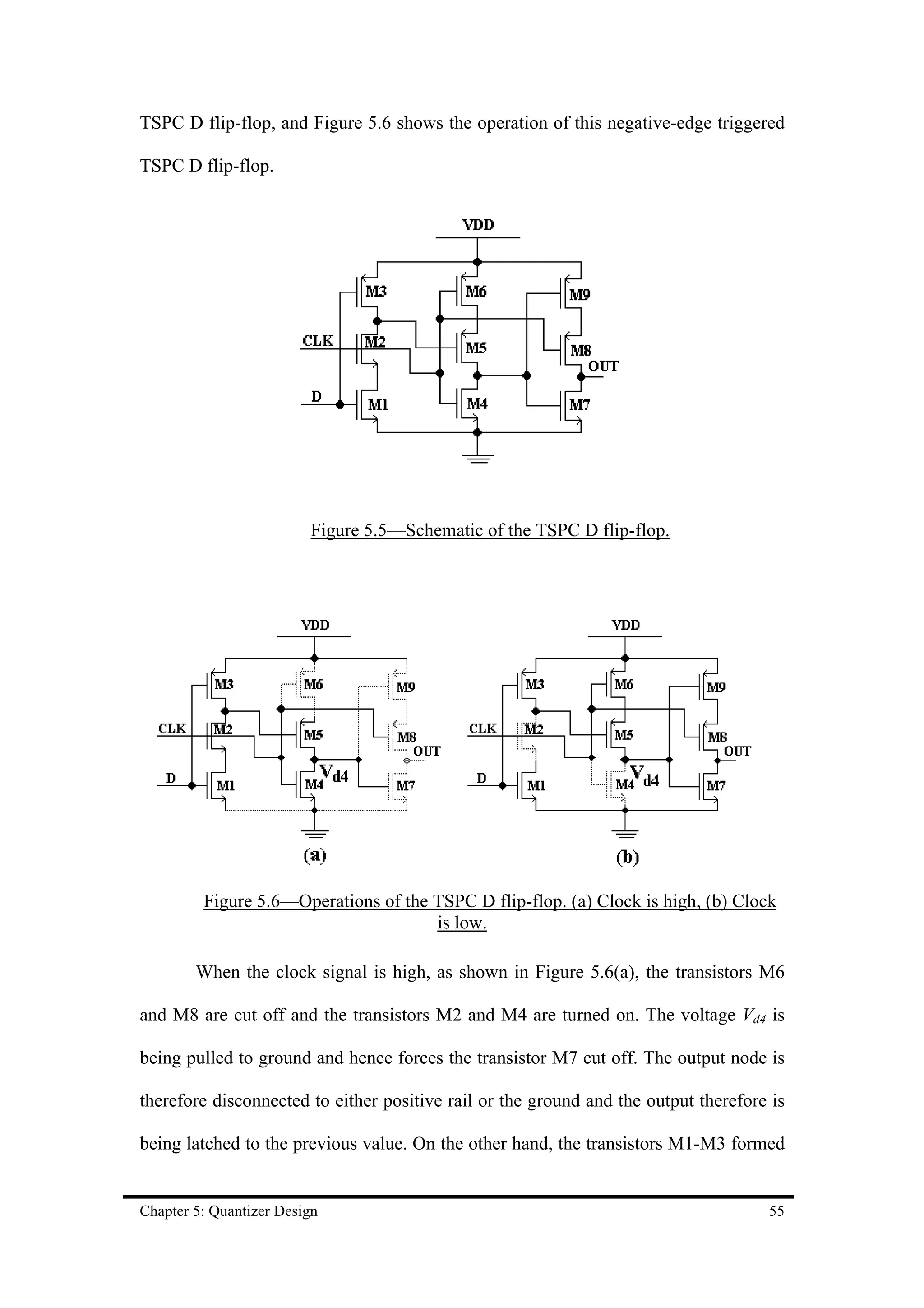
Figure 5.5—Schematic of the TSPC D flip-flop.                                                 55
Figure 5.6—Operations of the TSPC D flip-flop. (a) Clock is high, (b) Clock is low.           55
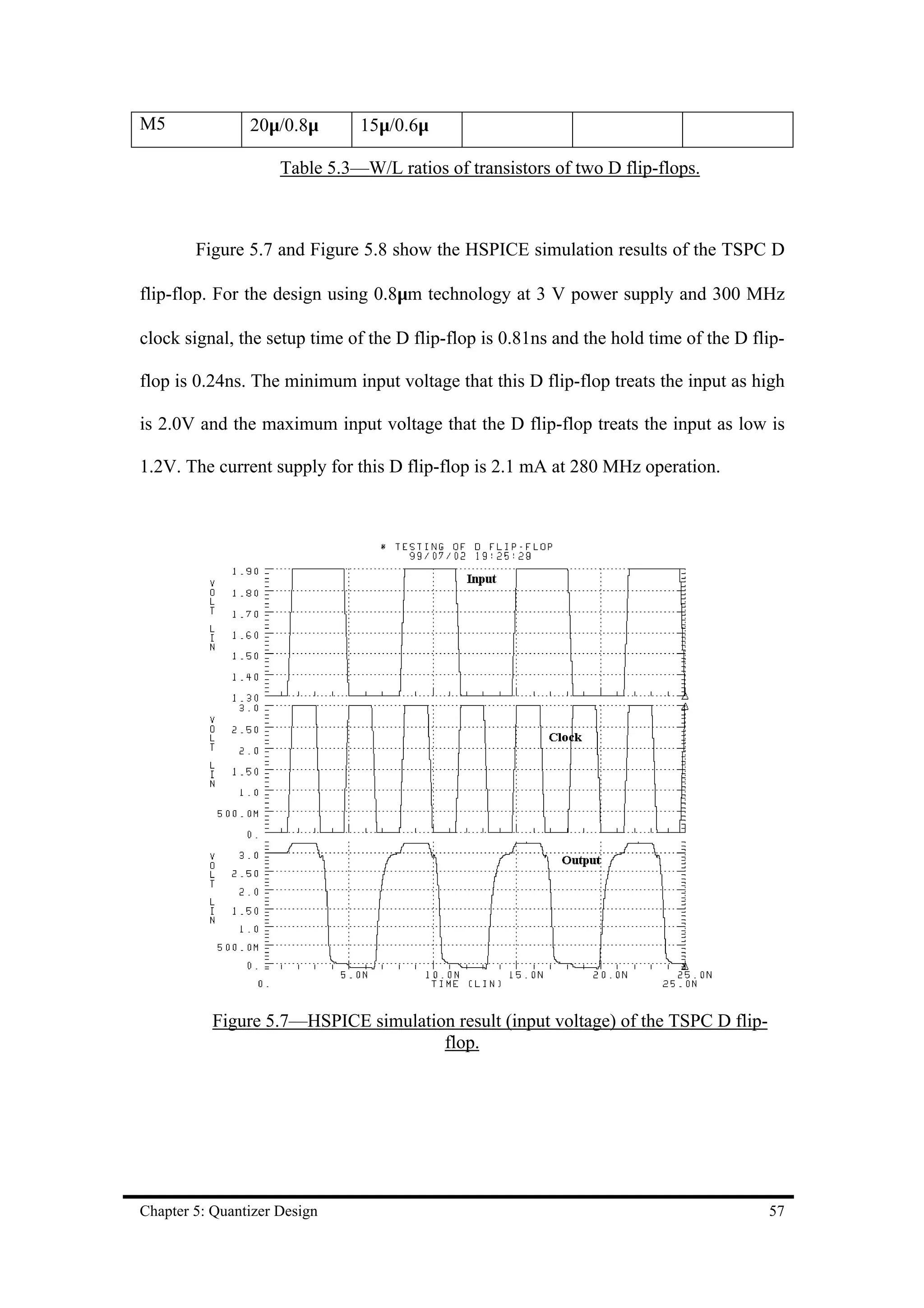
Figure 5.7—HSPICE simulation result (input voltage) of the TSPC D flip-flop.                  57
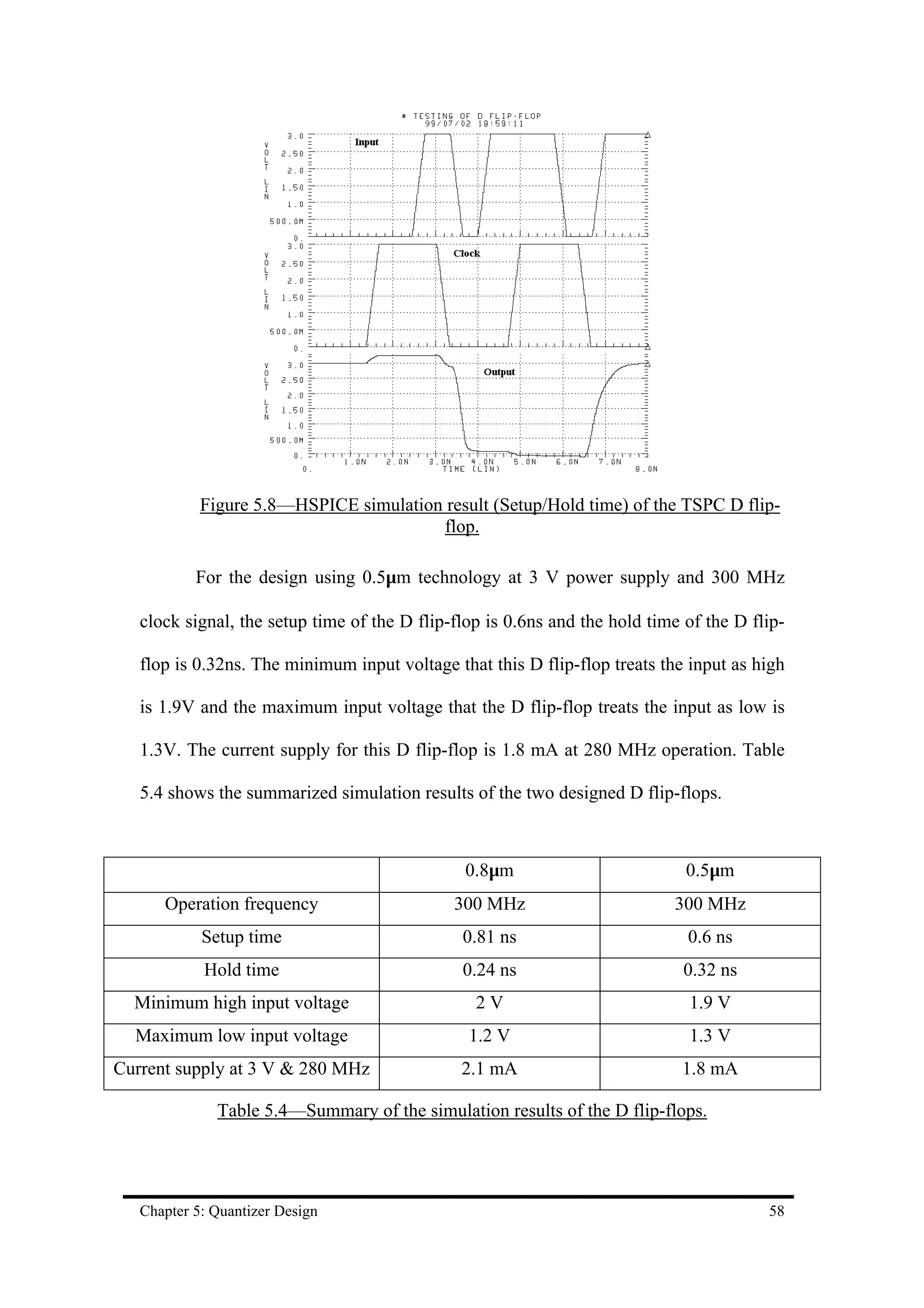
Figure 5.8—HSPICE simulation result (Setup/Hold time) of the TSPC D flip-flop.                58
Figure 5.9—Differential-pair as feedback DAC in the Σ∆ modulator.                             59
Figure 5.10—Simplified triode-region Gm-cell with feedback DAC transistor.                    60
Figure 5.11—HSPICE simulation result (sinusoidal 80 MHz input + 320 MHz Clock input) of the
     quantizer.                                                                               61


                                                                                              vii
Figure 5.12—HSPICE simulation result (input testing vector + 320 MHz Clock input) of the
     quantizer.                                                                                61
Figure 6.1—Circuit blocks in zero-delay Σ∆ modulator.                                          62
Figure 6.2—HSPICE circuit simulation of the zero-delay Σ∆ modulator.                           62
Figure 6.3—Layout of the Gm-C loop-filter using source-degeneration Gm-cells.                  63
Figure 6.4—Zero-delay Σ∆ modulator layout.                                                     63
Figure 6.5—Chip photo of the zero-delay Σ∆ modulator.                                          64
                                              µ
Figure 6.6—Frequency tuning ability of the 0.8µm loop-filter.                                  65
                                      µ
Figure 6.7—Q tuning ability of the 0.8µm loop-filter.                                          65
                       µ
Figure 6.8—Measured 0.8µm loop-filter linearity.                                               66
                                                           µ
Figure 6.9—Constant DC difference input measurement for 0.8µm comparator.                      67
                                                        µ
Figure 6.10—280 MHz sinusoidal input measurement for 0.8µm comparator.                         67
                                                  µ
Figure 6.11—400 MHz operation measurements for 0.8µm D flip-flop.                              68
                                                                µ
Figure 6.12—Minimum input high voltage level measurement for 0.8µm D flip-flop.                68
                                                               µ
Figure 6.13—Minimum input low voltage level measurement for 0.8µm D flip-flop.                 69
Figure 6.14—Measurement result of the zero-delay Σ∆ modulator.                                 69
Figure 6.15—SNDR vs input level for the zero-delay Σ∆ modulator.                               70
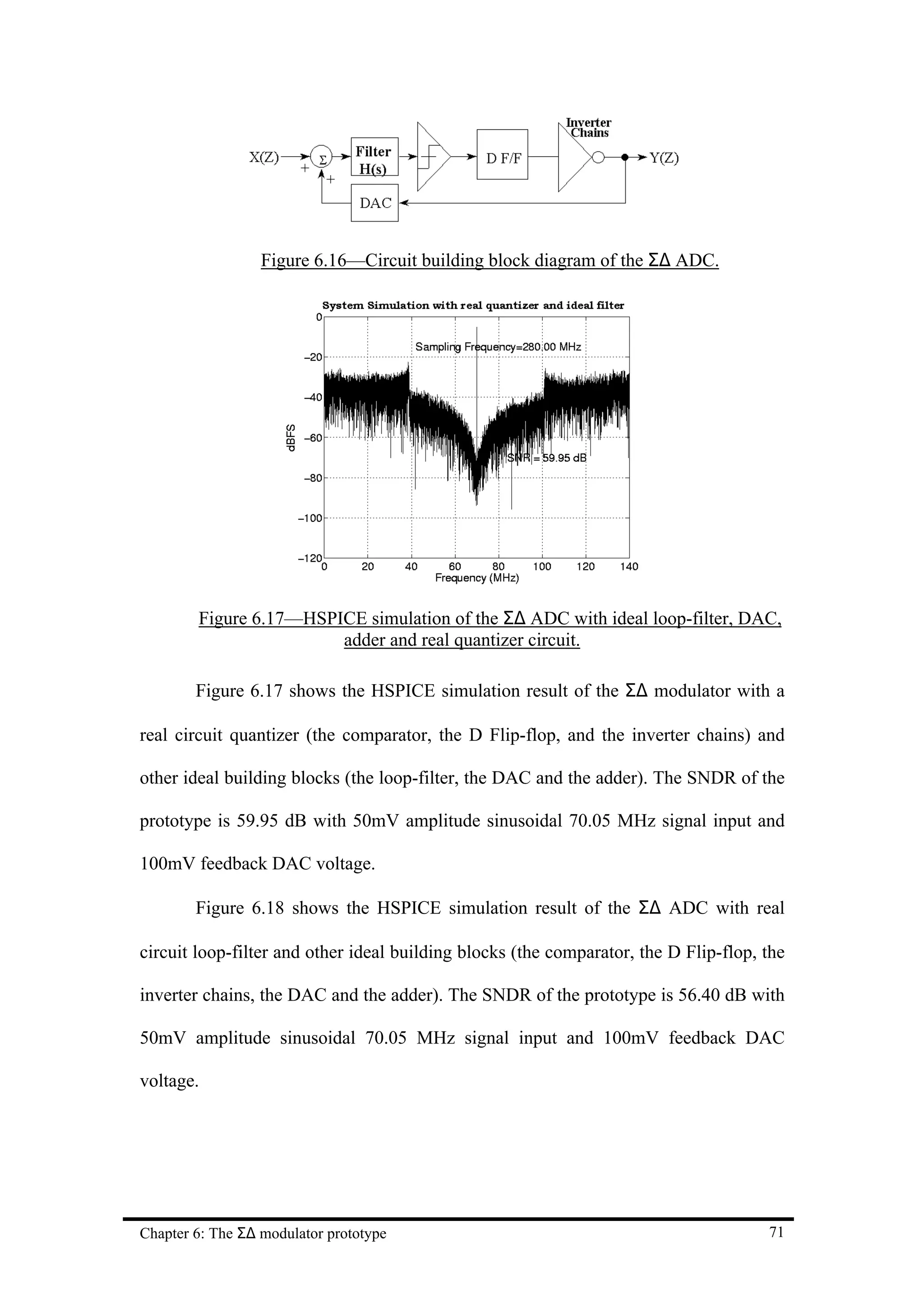
Figure 6.16—Circuit building block diagram of the Σ∆ ADC.                                      71
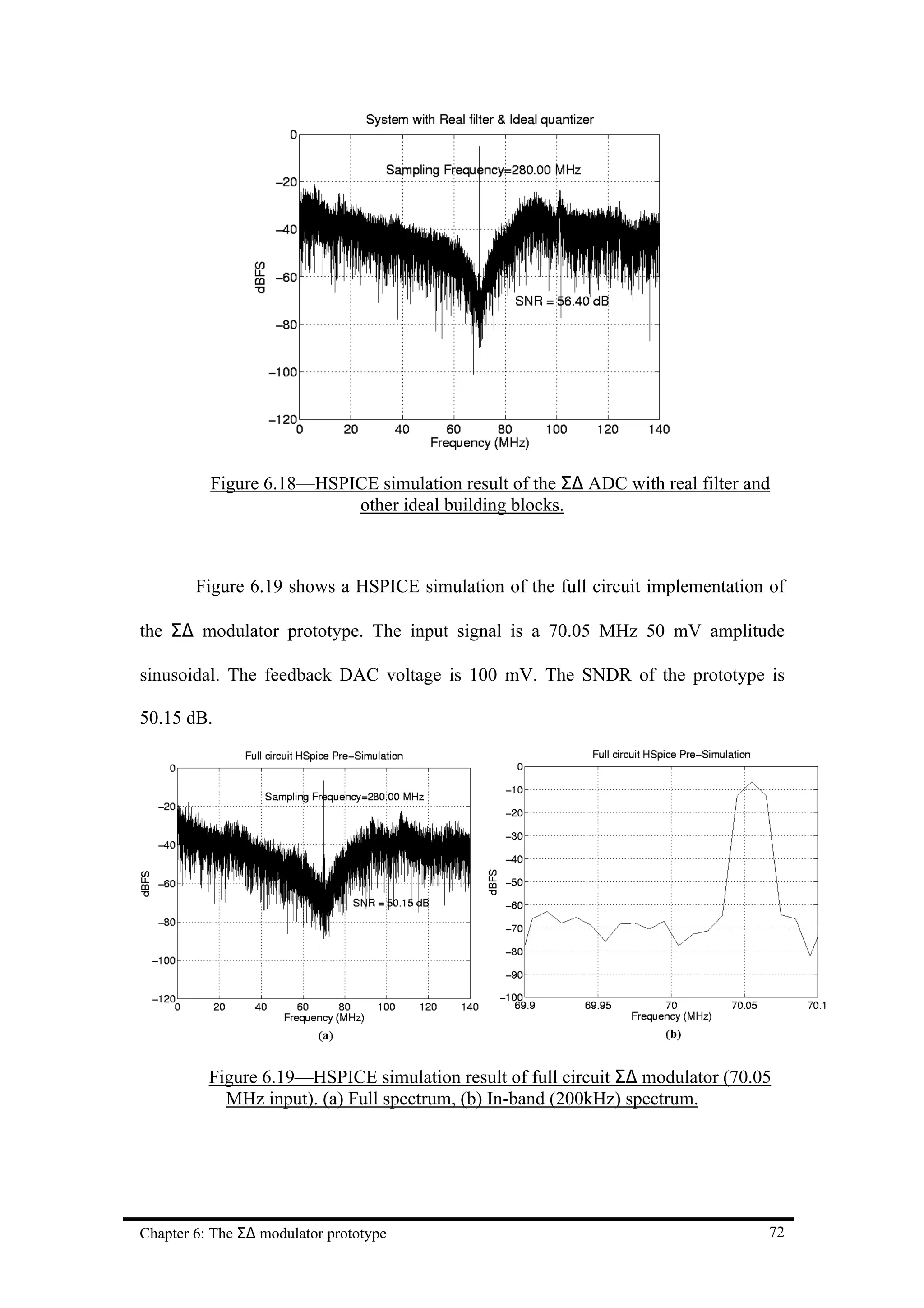
Figure 6.17—HSPICE simulation of the Σ∆ ADC with ideal loop-filter, DAC, adder and real
     quantizer circuit.                                                                        71
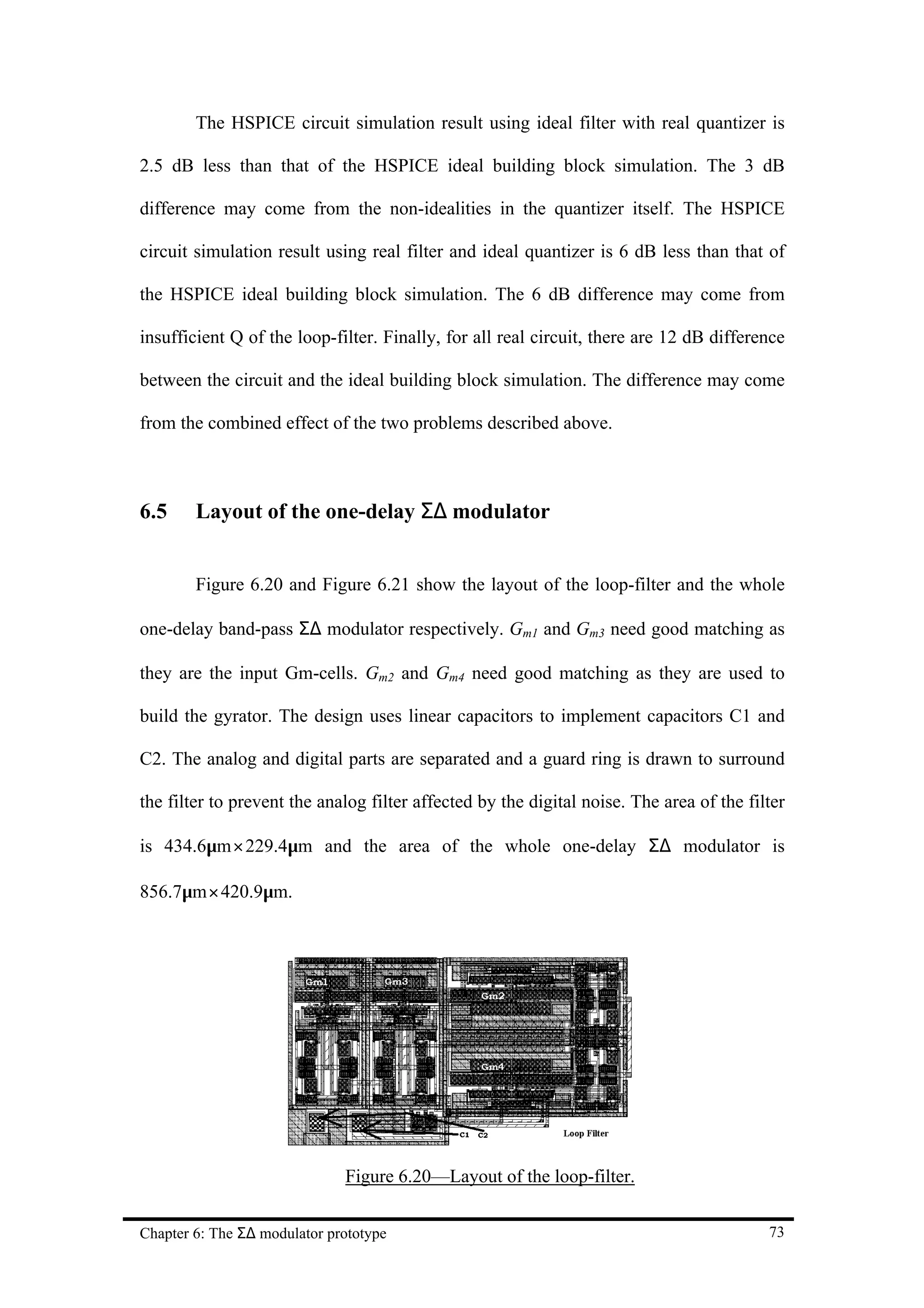
Figure 6.18—HSPICE simulation result of the Σ∆ ADC with real filter and other ideal building
     blocks.                                                                                   72
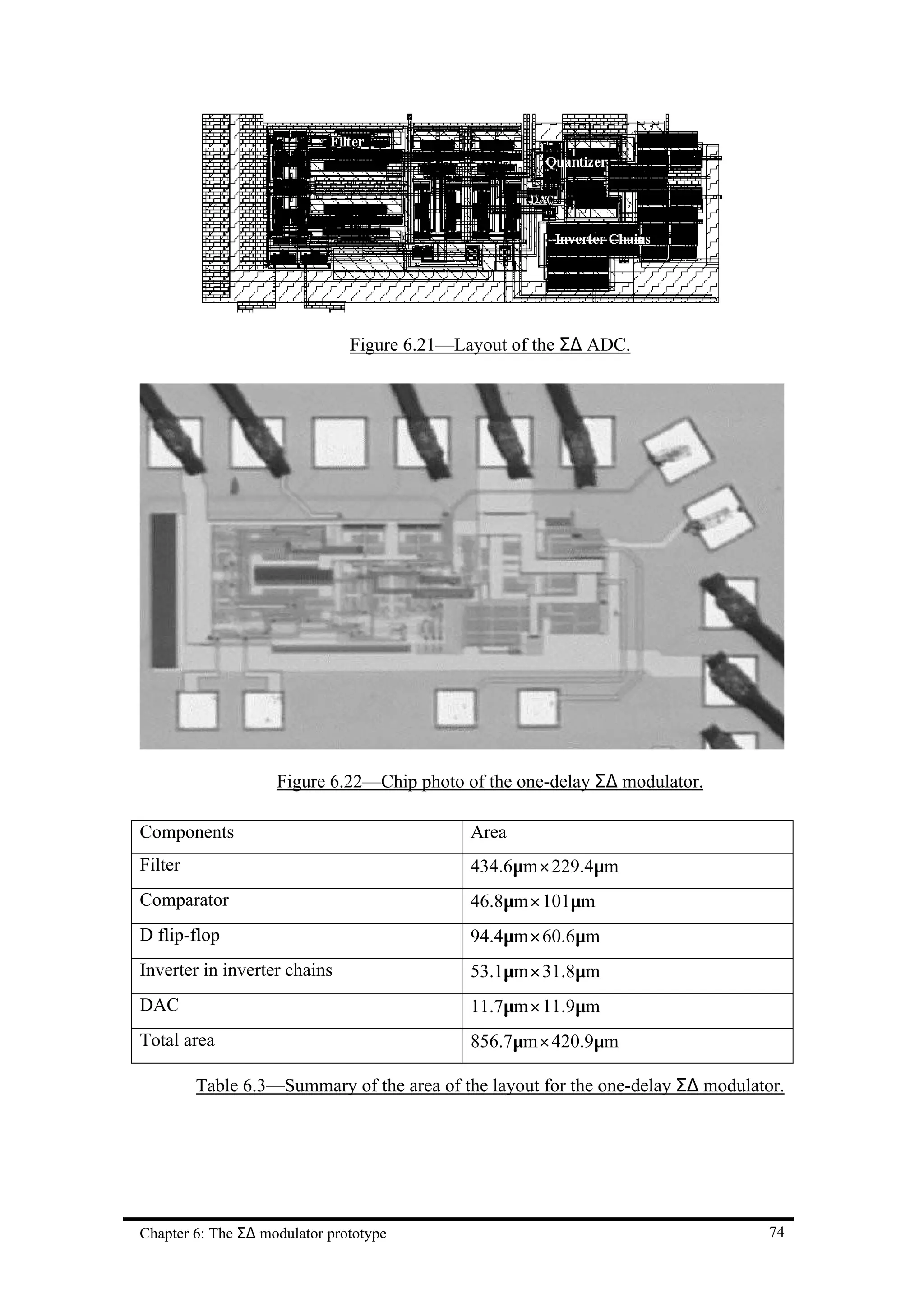
Figure 6.19—HSPICE simulation result of full circuit Σ∆ modulator (70.05 MHz input). (a) Full
     spectrum, (b) In-band (200kHz) spectrum.                                                  72
Figure 6.20—Layout of the loop-filter.                                                         73
Figure 6.21—Layout of the Σ∆ ADC.                                                              74
Figure 6.22—Chip photo of the one-delay Σ∆ modulator.                                          74
                                               µ
Figure 6.23—Frequency tuning ability of the 0.5µm loop-filter.                                 75
                                       µ
Figure 6.24—Q tuning ability of the 0.5µm loop-filter.                                         75
                        µ
Figure 6.25—Measured 0.5µm loop-filter linearity.                                              76
                                                            µ
Figure 6.26—Constant DC difference input measurement for 0.5µm comparator.                     77
                                                        µ
Figure 6.27—400 MHz sinusoidal input measurement for 0.5µm comparator.                         77
               µ
Figure 6.28—0.5µm comparator operating at 2.5 V power supply.                                  78
                                                  µ
Figure 6.29—400 MHz operation measurements for 0.5µm D flip-flop.                              79
                                                                µ
Figure 6.30—Minimum input high voltage level measurement for 0.5µm D flip-flop.                80
                                                               µ
Figure 6.31—Minimum input low voltage level measurement for 0.5µm D flip-flop.                 80
Figure 6.32—Measurement result of the one-delay Σ∆ modulator at 3 V power supply.              81
Figure 6.33—Measurement result of the one-delay Σ∆ modulator at 2.5 V power supply.            81


                                                                                           viii
Figure 6.34—SNDR vs input level for the one-delay Σ∆ modulator.   82


                                                                  ix
List of Tables
Table 1.1—Target specification of the Σ∆ ADC...................................................................................4
Table 4.1—Performance comparison between source-degeneration and triode-region Gm-cells.45
Table 4.2—Summary of the simulation results of the two loop-filters.............................................48
Table 5.1—W/L ratios of the transistors of the two comparators. ...................................................52
Table 5.2—Summary of simulated results of the latched-type comparators. .................................54
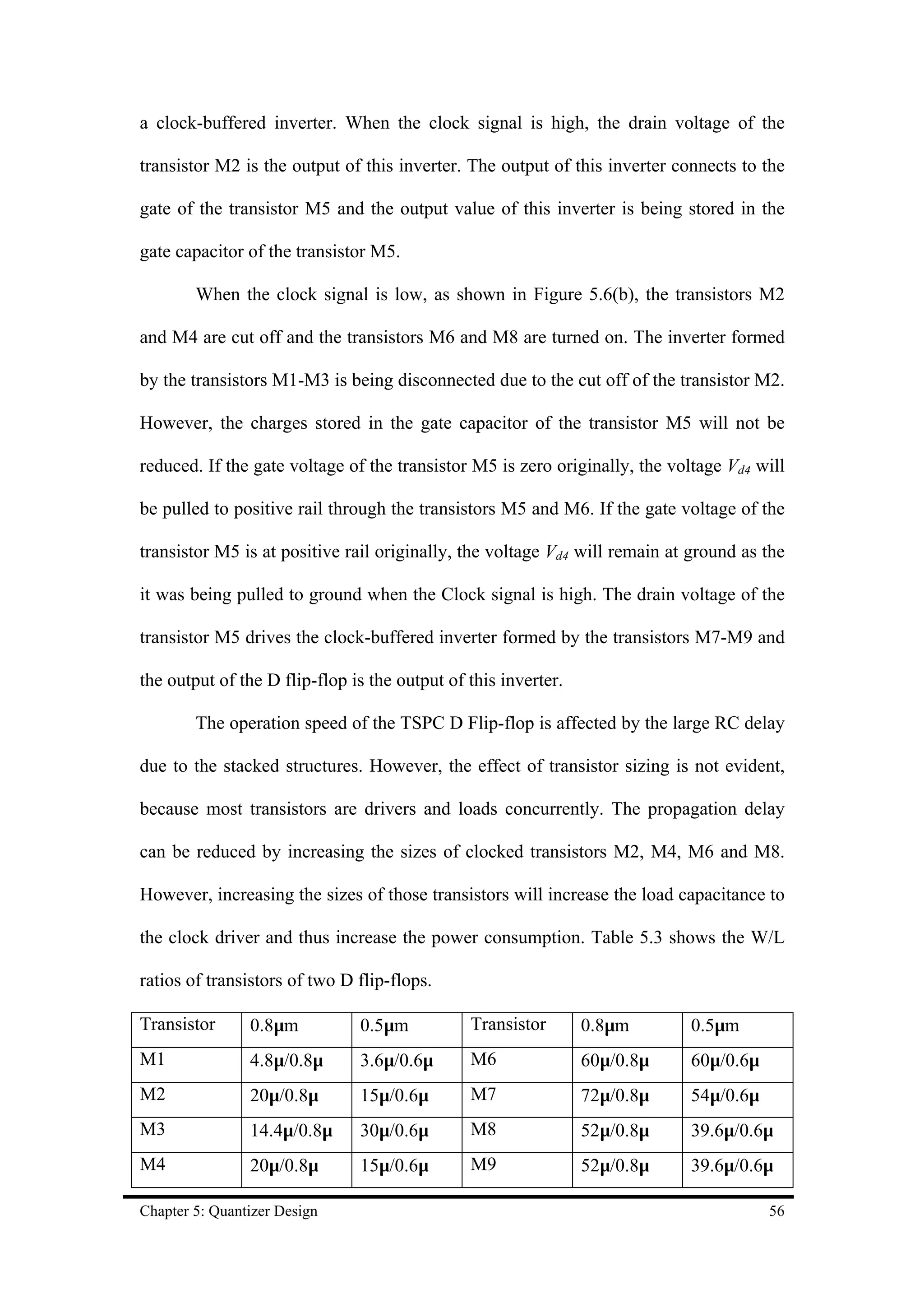
Table 5.3—W/L ratios of transistors of two D flip-flops. ..................................................................57
Table 5.4—Summary of the simulation results of the D flip-flops. ..................................................58
Table 5.5—Summary of the inverter sizes in the inverter chain. .....................................................60
Table 6.1—Summary of the area of the layout for the zero-delay Σ∆ modulator...........................64
                                                       µ
Table 6.2—Summary of the measurement results of the 0.8µm loop-filter.....................................66
Table 6.3—Summary of the area of the layout for the one-delay Σ∆ modulator. ...........................74
                                                       µ
Table 6.4—Summary of the measurement results of the 0.5µm loop-filter.....................................76
                                                  µ
Table 6.5—Summary of the measurement result of 0.5µm comparator. ........................................78
                                                  µ
Table 6.6—Summary of the measurement result of 0.5µm comparator operating at 2.5 V power
       supply. ..........................................................................................................................................79
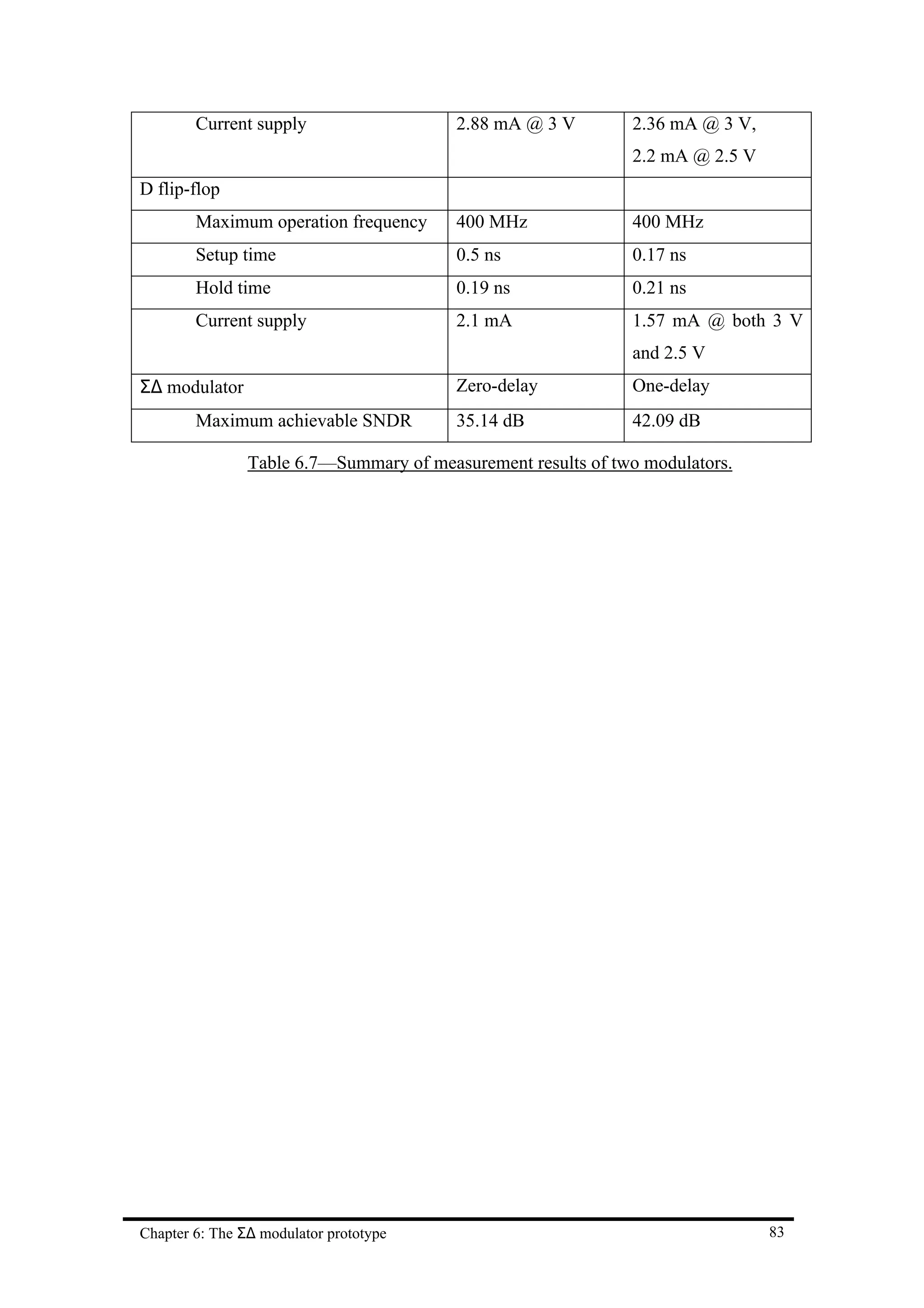
Table 6.7—Summary of measurement results of two modulators. ..................................................83
          Σ∆
Table 7.1—Σ∆ modulators performance comparison........................................................................84


                                                                                                                                                         x
Chapter 1                 Introduction

1.1     Analog-to-digital conversion


        Data converter is a key component in any electronic system. Real world

signals are inherently analog; however, the digital form of analog signals can be

processed using robust, flexible and reliable digital-signal-processing (DSP).

Therefore, analog-to-digital conversion becomes critical. Data converter is also a very

critical component in wireless receivers. Different radio-frequency (RF) receiver

architectures have different specifications on their analog-to-digital-converters

(ADCs). In Section 1.2, conventional RF receiver architectures will be described. In

Section 1.3, proposed architecture using continuous-time band-pass Σ∆ ADC will be

discussed. In Section 1.4, the specification of the ADC will be given. Finally, in

Section 1.5, the organization of the thesis will be described.


1.2     Conventional RF receiver architectures


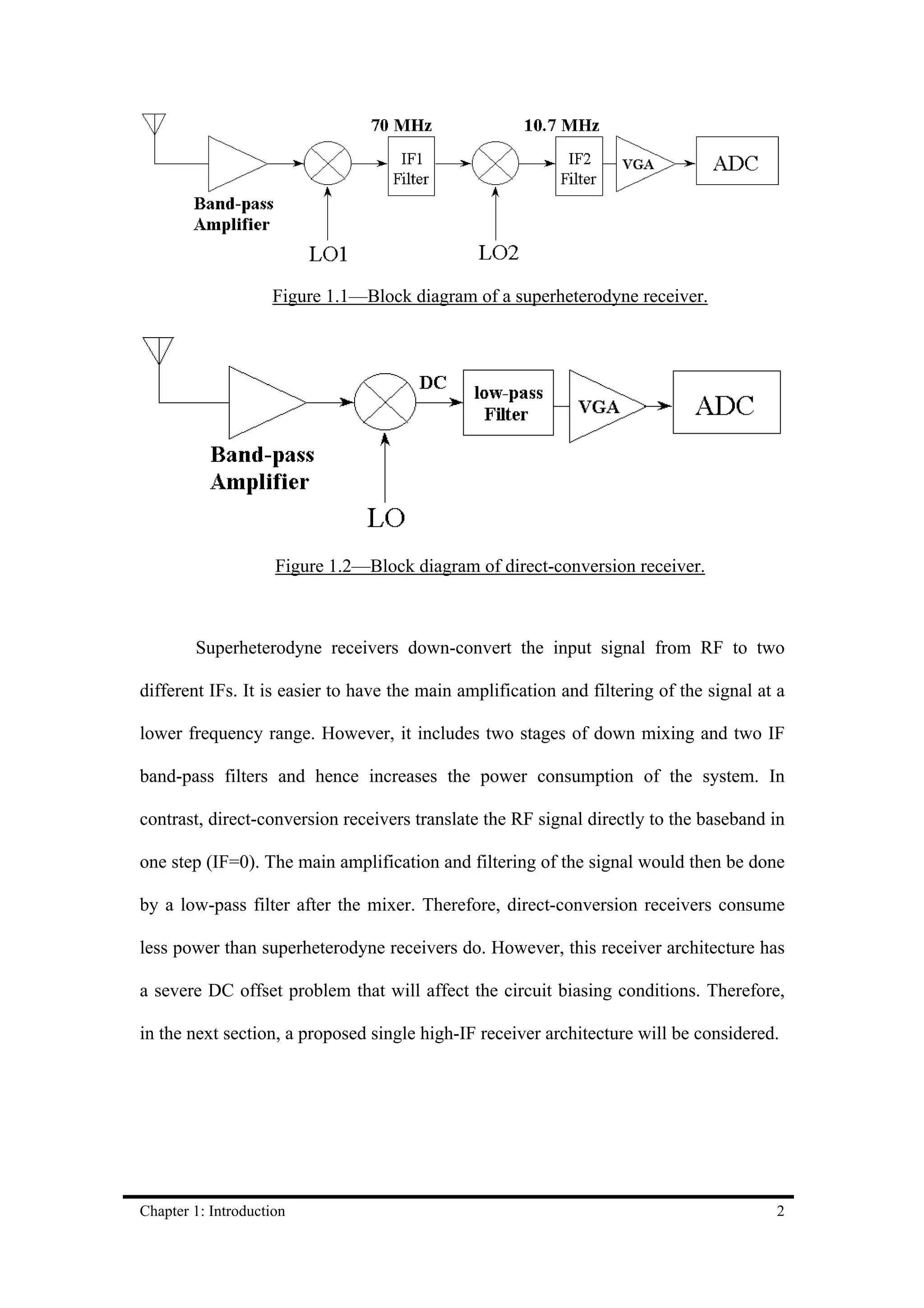
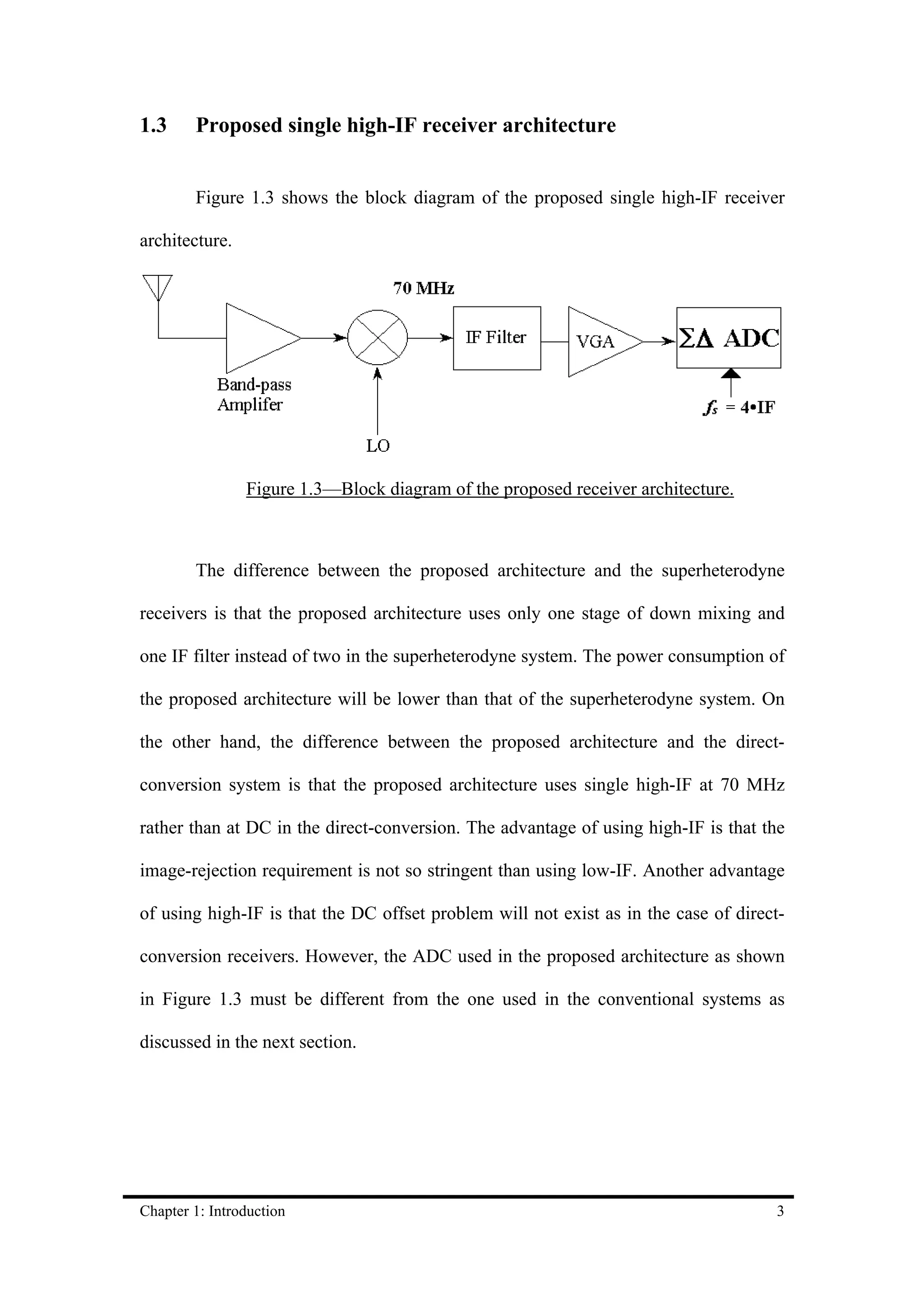
        There are two RF receiver architectures that are commonly used to implement

a wireless receiver: superheterodyne and direct-conversion. The superheterodyne

system requires mixers to translate the RF input to a intermediate-frequency (IF).

Major amplifications and filtering will be done at the IF stage. Block diagrams of a

superheterodyne receiver and a direct-conversion receiver are shown in Figure 1.1 and

Figure 1.2 respectively.


Chapter 1: Introduction                                                              1
Figure 1.1—Block diagram of a superheterodyne receiver.


                     Figure 1.2—Block diagram of direct-conversion receiver.


        Superheterodyne receivers down-convert the input signal from RF to two

different IFs. It is easier to have the main amplification and filtering of the signal at a

lower frequency range. However, it includes two stages of down mixing and two IF

band-pass filters and hence increases the power consumption of the system. In

contrast, direct-conversion receivers translate the RF signal directly to the baseband in

one step (IF=0). The main amplification and filtering of the signal would then be done

by a low-pass filter after the mixer. Therefore, direct-conversion receivers consume

less power than superheterodyne receivers do. However, this receiver architecture has

a severe DC offset problem that will affect the circuit biasing conditions. Therefore,

in the next section, a proposed single high-IF receiver architecture will be considered.


Chapter 1: Introduction                                                                  2
1.3     Proposed single high-IF receiver architecture


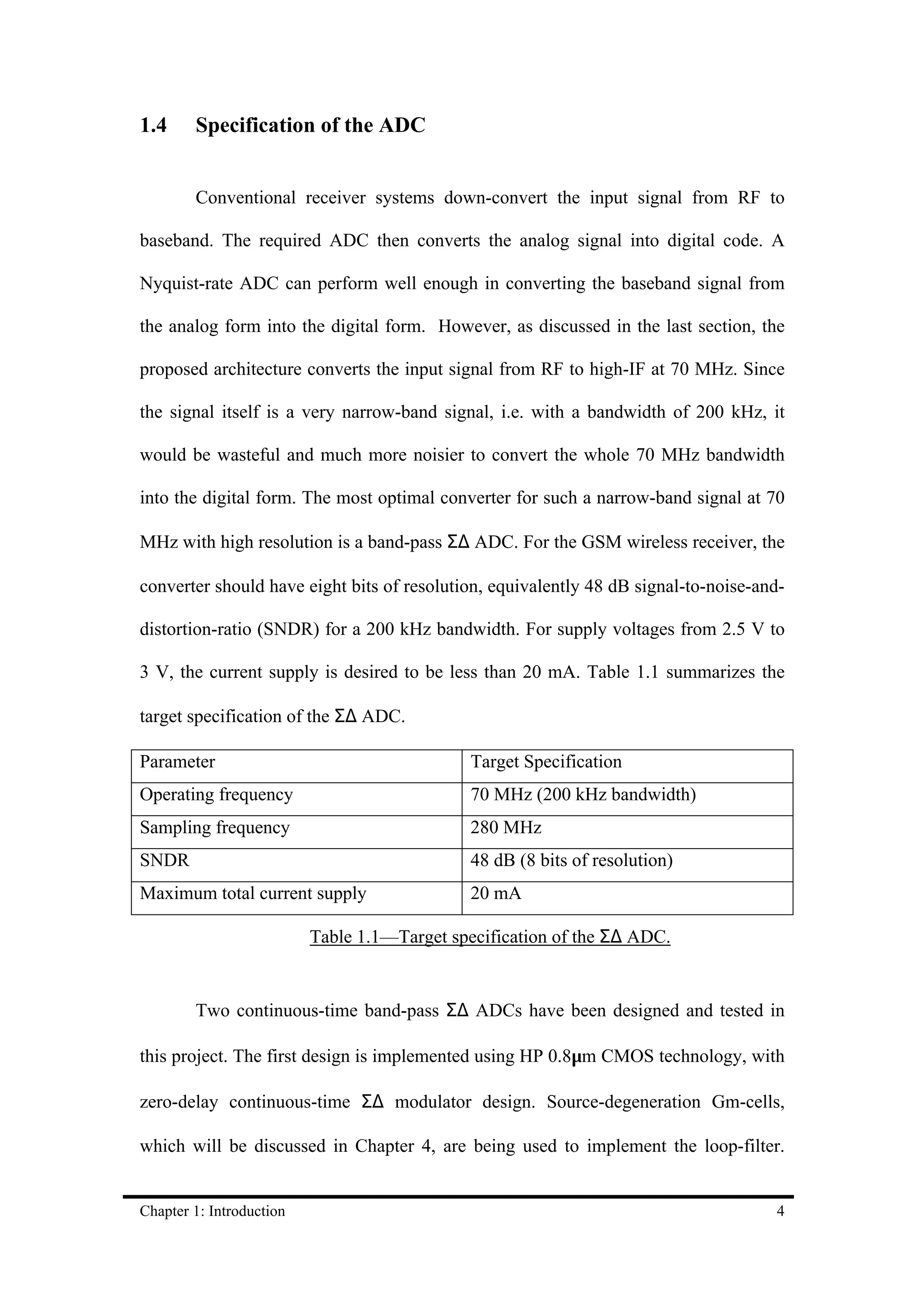
        Figure 1.3 shows the block diagram of the proposed single high-IF receiver

architecture.


                Figure 1.3—Block diagram of the proposed receiver architecture.


        The difference between the proposed architecture and the superheterodyne

receivers is that the proposed architecture uses only one stage of down mixing and

one IF filter instead of two in the superheterodyne system. The power consumption of

the proposed architecture will be lower than that of the superheterodyne system. On

the other hand, the difference between the proposed architecture and the direct-

conversion system is that the proposed architecture uses single high-IF at 70 MHz

rather than at DC in the direct-conversion. The advantage of using high-IF is that the

image-rejection requirement is not so stringent than using low-IF. Another advantage

of using high-IF is that the DC offset problem will not exist as in the case of direct-

conversion receivers. However, the ADC used in the proposed architecture as shown

in Figure 1.3 must be different from the one used in the conventional systems as

discussed in the next section.


Chapter 1: Introduction                                                              3
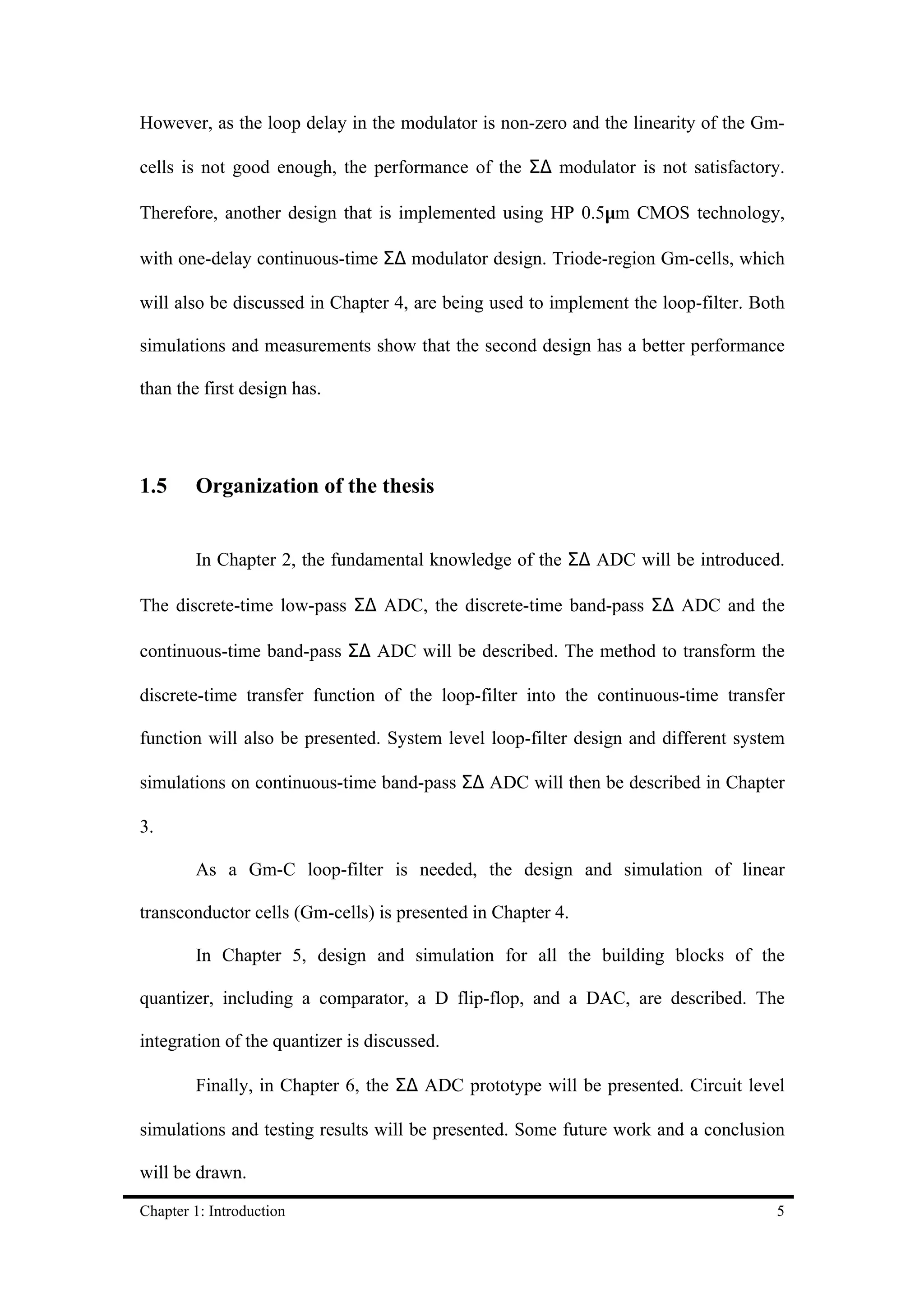
1.4     Specification of the ADC


        Conventional receiver systems down-convert the input signal from RF to

baseband. The required ADC then converts the analog signal into digital code. A

Nyquist-rate ADC can perform well enough in converting the baseband signal from

the analog form into the digital form. However, as discussed in the last section, the

proposed architecture converts the input signal from RF to high-IF at 70 MHz. Since

the signal itself is a very narrow-band signal, i.e. with a bandwidth of 200 kHz, it

would be wasteful and much more noisier to convert the whole 70 MHz bandwidth

into the digital form. The most optimal converter for such a narrow-band signal at 70

MHz with high resolution is a band-pass Σ∆ ADC. For the GSM wireless receiver, the

converter should have eight bits of resolution, equivalently 48 dB signal-to-noise-and-

distortion-ratio (SNDR) for a 200 kHz bandwidth. For supply voltages from 2.5 V to

3 V, the current supply is desired to be less than 20 mA. Table 1.1 summarizes the

target specification of the Σ∆ ADC.

Parameter                                     Target Specification
Operating frequency                           70 MHz (200 kHz bandwidth)
Sampling frequency                            280 MHz
SNDR                                          48 dB (8 bits of resolution)
Maximum total current supply                  20 mA

                          Table 1.1—Target specification of the Σ∆ ADC.


        Two continuous-time band-pass Σ∆ ADCs have been designed and tested in

this project. The first design is implemented using HP 0.8µm CMOS technology, with

zero-delay continuous-time Σ∆ modulator design. Source-degeneration Gm-cells,

which will be discussed in Chapter 4, are being used to implement the loop-filter.


Chapter 1: Introduction                                                              4
However, as the loop delay in the modulator is non-zero and the linearity of the Gm-

cells is not good enough, the performance of the Σ∆ modulator is not satisfactory.

Therefore, another design that is implemented using HP 0.5µm CMOS technology,

with one-delay continuous-time Σ∆ modulator design. Triode-region Gm-cells, which

will also be discussed in Chapter 4, are being used to implement the loop-filter. Both

simulations and measurements show that the second design has a better performance

than the first design has.


1.5     Organization of the thesis


        In Chapter 2, the fundamental knowledge of the Σ∆ ADC will be introduced.

The discrete-time low-pass Σ∆ ADC, the discrete-time band-pass Σ∆ ADC and the

continuous-time band-pass Σ∆ ADC will be described. The method to transform the

discrete-time transfer function of the loop-filter into the continuous-time transfer

function will also be presented. System level loop-filter design and different system

simulations on continuous-time band-pass Σ∆ ADC will then be described in Chapter

3.

        As a Gm-C loop-filter is needed, the design and simulation of linear

transconductor cells (Gm-cells) is presented in Chapter 4.

        In Chapter 5, design and simulation for all the building blocks of the

quantizer, including a comparator, a D flip-flop, and a DAC, are described. The

integration of the quantizer is discussed.

        Finally, in Chapter 6, the Σ∆ ADC prototype will be presented. Circuit level

simulations and testing results will be presented. Some future work and a conclusion

will be drawn.

Chapter 1: Introduction                                                             5
Chapter 2               Σ∆ fundamentals


2.1     Introduction [1],[2]


        It is often desirable to convert analog signals into the digital domain using an

analog-to-digital converter (ADC). In this chapter the main properties of Σ∆

techniques that are useful for converting signals between analog and digital formats

are reviewed. Σ∆ modulation has become popular for achieving high resolution. A

significant advantage of the method is that analog signals are converted using not only

simple and high-tolerance analog circuits but also analog signal processing circuits

having a precision that is usually much less than the resolution of the overall

converter.

        Conventional converters, as illustrated in Figure 2.1, are often difficult to

implement in fine-line VLSI technology with reasonably low power consumption.

These difficulties arise because conventional methods need analog components that

are precise and highly immune to noise and interference. However, the conversion

rate of conventional converters is Nyquist rate, i.e. sampling frequency is twice the

signal bandwidth. That is why conventional converters are usually referred to as

Nyquist converters.


                 Figure 2.1–Conventional Nyquist-rate ADC blocks [1].
Chapter 2: Σ∆ fundamentals                                                            6
The low-pass filter at the input to the encoder in Figure 2.1 attenuates high-

frequency noise and out-of-band signals to prevent them from aliasing into the desired

signal when sampled. The analog-to-digital circuit can take a number of different

forms such as flash converters for fast operation, successive-approximation converters

for moderate rates, and ramp converters for high resolution.

        Oversampling converters can use simple and high-tolerance analog

components for implementation, but they require fast and complex DSP stages. The

use of high-frequency modulation can eliminate the need for abrupt cutoffs in the

analog anti-aliasing filters at the input to the ADCs. Σ∆ converters use the technique

of noise shaping in addition to oversampling to allow high-resolution conversion of

relatively low bandwidth signals.

        This chapter is organized into five main sections. In Section 2.2, some basic

properties of the quantization noise are described. General oversampling ADC and Σ∆

modulator will be described in Section 2.3. Discrete-time low-pass Σ∆ modulation as

a technique for shaping the spectrum of quantization noise is introduced in Section

2.4. In Section 2.5 discrete-time band-pass Σ∆ modulation is explained, and in Section

2.6, the continuous-time design and implementation of band-pass Σ∆ modulator are

described.


2.2     Quantization noise [1],[2]


        Quantization in amplitude and sampling in time are the two main functions of

all digital modulators. Once sampled, the signal samples must also be quantized in

amplitude to a finite set of output values. The typical transfer characteristic of


Chapter 2: Σ∆ fundamentals                                                          7
quantizers or ADCs with an input signal sample x and an output y is shown in Figure

2.2.


  Figure 2.2–An example of a uniform multilevel quantization characteristic that is
                  represented by linear gain G and an error e [1].


        The quantizer, embedded in any ADC is a non-linear system, is difficult to

analyze. To make the analysis tractable, it is useful to represent the quantized signal

y[n] by a linear function Gx[n] with an error e[n]: that is, y[n]=Gx[n]+e[n]. The gain

G is the slope of the straight line passing through the center of the quantization

characteristic. In Figure 2.2, the level spacing ∆ is 2. So, the quantizer does not get

saturated when -6≤x[n]≤6 and the error is bounded by ±∆/2. This consideration

remains applicable to a two-level (single-bit) quantizer but, in this case, the choice of

gain G is arbitrary.

        To further simplify the analysis of the noise from the quantizer, the following

assumptions about the noise process and its statistics are traditionally made [3]:

1. The error sequence e[n] is a sample sequence of a stationary random process,

2. The error sequence is uncorrelated with the sequence x[n],


Chapter 2: Σ∆ fundamentals                                                             8
3. The random variables of the error process are uncorrelated; i.e. the error is a

    white-noise process,

4. The probability distribution of the error process is uniform over the range of

    quantization error.


        For a zero mean e[n], its variance σe2 or power is:

                                            ∆
                                        1 2 2         ∆2                          ( 2.1 )
                                        ∆ ∫− 2
                                 σe =          e de =
                                  2
                                             ∆
                                                      12


        When a quantized signal is sampled at frequency fs=1/T, all of its power folds

into the frequency band 0≤f<fs. Then, if the quantization noise is white, the spectral

density of the sampled noise is given by:


                                      σe
                                         2
                                                    2                             ( 2.2 )
                     E( f ) =              =σe
                                      fs            fs
                                         2


        We can use this result to analyze oversampling modulators. Consider a signal

lying in the frequency band 0≤f≤fB. The oversampling ratio (OSR), defined as the

ratio of the sampling frequency fs to the Nyquist frequency 2fB, is given by the integer:

                                              fs                                  ( 2.3 )
                                 OSR =
                                             2 fB


        Hence, the in-band quantization noise will be given by:


                                                 σ                                ( 2.4 )
                                                           2
                                             2f
              no = ∫
                       fB
                            E ( f )df = σ e ⋅ B = e
                2            2                  2
                     0                        fs OSR


Chapter 2: Σ∆ fundamentals                                                             9
Thus, we have the well-known result that oversampling reduces the in-band

quantization noise from ordinary quantization by the square root of the oversampling

ratio. Therefore, each doubling of the sampling frequency decreases the in-band noise

by 3 dB and thus increases the resolution by half a bit.

        Figure 2.3 shows the power spectral density, E(f), of the quantization noise for

Nyquist rate sampling with rate fs1 and oversampling rate fs2. For Nyquist rate

sampling where the signal band, fB=fs1/2, all the quantization noise power, represented

by the area of the tall shaded rectangle, occurs across the signal bandwidth. In the

oversampled case, the same noise power, represented by the area of the unshaded

rectangle has been spread over a bandwidth equal to the sampling frequency, fs2,

which is much greater than the signal bandwidth, fB. Only a relatively small fraction

of the total noise power falls in the band [-fB,fB], and the noise power outside the

signal band can be greatly attenuated with a digital low-pass filter following the ADC.


      Figure 2.3–Quantization noise power spectral density for Nyquist rate and
                            oversampled conversion [2].


2.3     Oversampling ADC and Σ∆ modulator [1],[2]


        A general way of writing the discrete-time domain output of an ADC is given

as Y(z)=X(z)Hx(z)+E(z)He(z), where Hx is the signal transfer function (STF) and He is

Chapter 2: Σ∆ fundamentals                                                           10
the noise transfer function (NTF). For oversampled conversion, we have

Hx(z)=He(z)=1. In fact, oversampled ADCs can be designed to incorporate noise

shaping, where Hx usually leaves the signal undisturbed but He shapes the noise to

allow a high resolution output. Oversampling reduces the quantization noise power in

the signal band by spreading the fixed quantization noise power over a bandwidth

much larger than the signal band as discussed in the last section. Noise shaping

further attenuates this noise in the signal band and amplifies it outside the signal band.

Consequently, this process of noise shaping by the Σ∆ modulator can be viewed as

pushing quantization noise power from the signal band to higher frequencies. The

modulator output could then be filtered to attenuate the out-of-band quantization

noise.

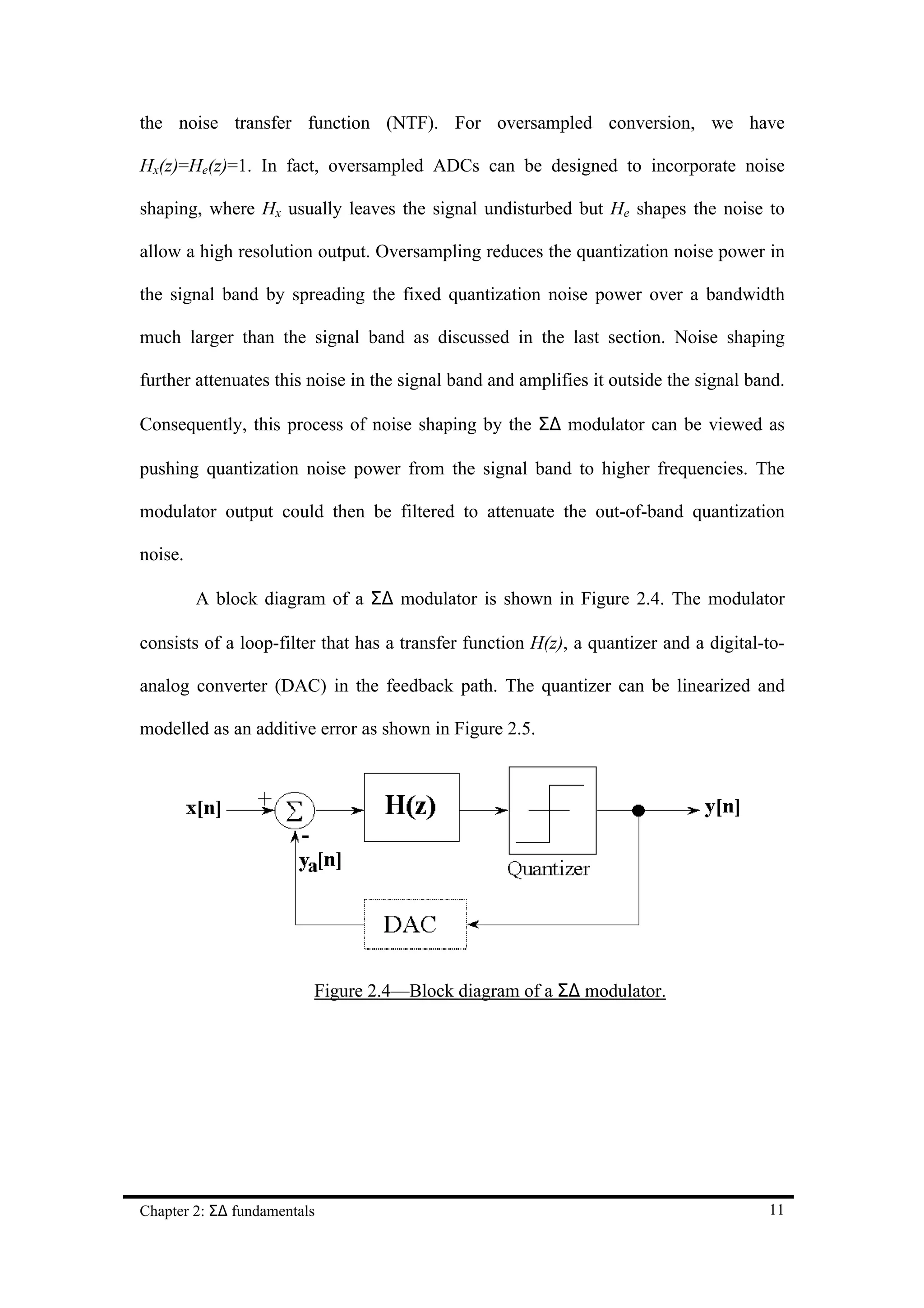
         A block diagram of a Σ∆ modulator is shown in Figure 2.4. The modulator

consists of a loop-filter that has a transfer function H(z), a quantizer and a digital-to-

analog converter (DAC) in the feedback path. The quantizer can be linearized and

modelled as an additive error as shown in Figure 2.5.


                         Figure 2.4—Block diagram of a Σ∆ modulator.


Chapter 2: Σ∆ fundamentals                                                             11
Figure 2.5—Linearized model of the quantizer.


2.4     Discrete-Time Low-pass Σ∆ modulation [1],[2]


        A block diagram of a first-order Σ∆ modulator is shown in Figure 2.6 and a

linearized version of the block diagram is shown in Figure 2.7.


                Figure 2.6–Block diagram of a first-order Σ∆ modulator.


          Figure 2.7—Linearized model block diagram of a first-order Σ∆ modulator.


        The signal that is being quantized is a filtered version of the difference

between the input x[n] and an analog representation, ya[n], of the quantized output,

Chapter 2: Σ∆ fundamentals                                                       12
y[n]. The loop-filter is a discrete-time integrator whose transfer function is H(z) =

z-1/(1-z-1). If the DAC is ideal, it is replaced by a unity gain transfer function. The

modulator output Y(z) in the frequency domain is then given by:

              Y ( z ) = X ( z ) ⋅ z −1 + E ( z ) ⋅ (1 − z −1 )                     ( 2.5 )


so that the STF Hx(z) is z-1 and the NTF He(z) is 1-z-1. The output is just a delayed

version of the signal plus a quantization noise shaped by a first-order differentiator (or

high-pass filter). Note that a zero gain is provided by the NTF at DC frequency. The

magnitude spectrum of a first-order Σ∆ noise transfer function (NTF) is plotted in

Figure 2.8. The frequency axis has been normalized with respect to the sampling

frequency, fs.


  Figure 2.8–First-order Noise Transfer Function (NTF) magnitude spectrum in dB.

        The in-band quantization noise after the noise-shaping will be given by:


Chapter 2: Σ∆ fundamentals                                                             13
fB
            no = ∫ E 2 ( f ) ⋅ 1 − z −1 df
              2                                 2

                      0

                                σe
                                    2

                  =∫
                       fB                      2
                                     ⋅ 1 − z −1 df
                      0         fs 2
                   2σ                2πf
                                2
                          fB
                  = e ⋅ ∫ (2 − 2 cos     )df                                  ( 2.6 )
                    fs   0            fs
                      4σ e          πf
                                2

                           ⋅ ∫ 2 sin df
                               fB
                  =
                       fs     0     fs
                      8σ e    f B πf
                                2

                  ≈        ⋅ ∫ ( ) 2 df              ( f B << f s )
                       fs 0 fs
                   σ ⋅ π2 2 f B 3
                            2

                  = e    ⋅(    )
                      3     fs
                      σe ⋅ π2
                            2
                                  1 3
                  =           ⋅(     )
                         3       OSR


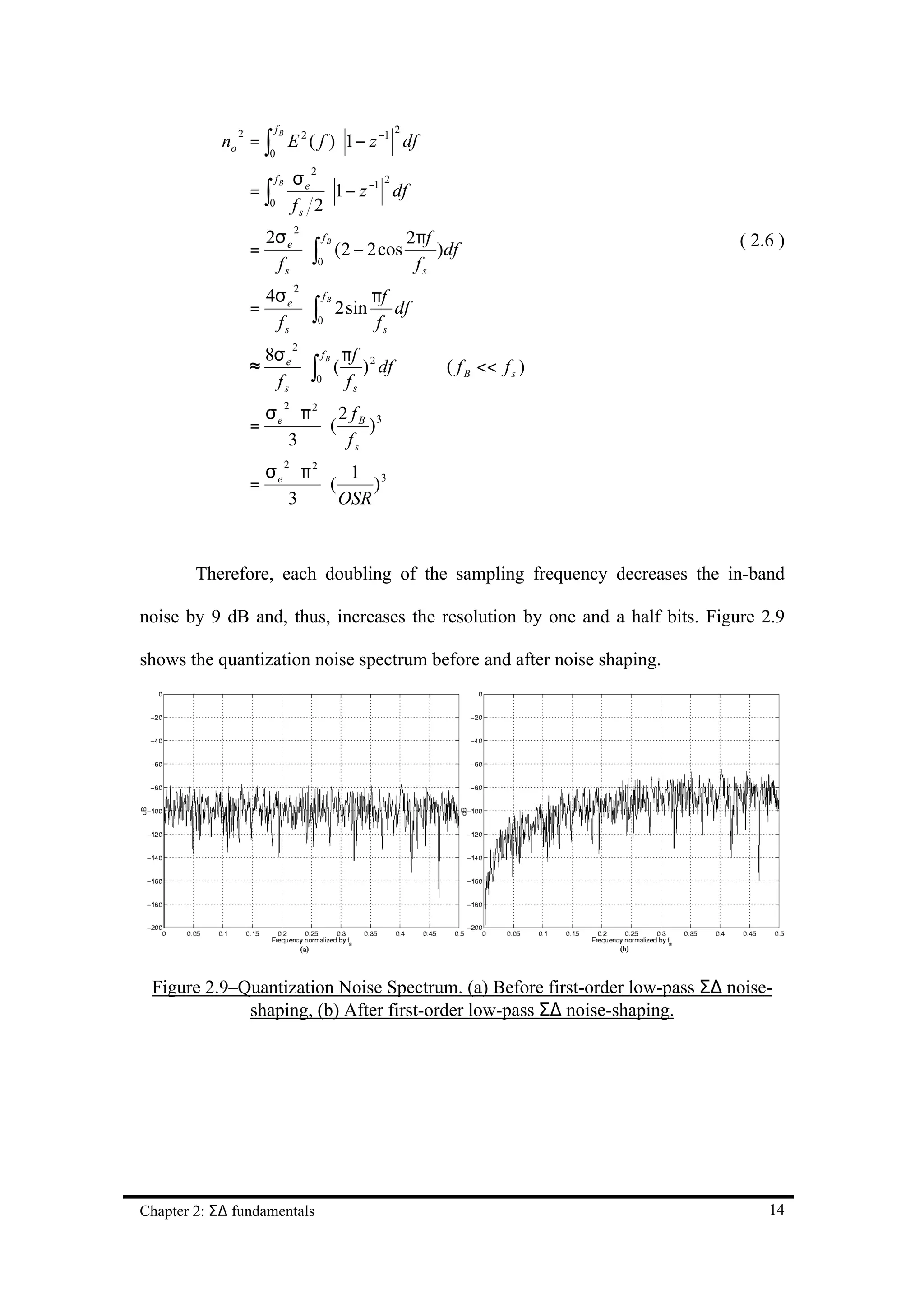
        Therefore, each doubling of the sampling frequency decreases the in-band

noise by 9 dB and, thus, increases the resolution by one and a half bits. Figure 2.9

shows the quantization noise spectrum before and after noise shaping.


 Figure 2.9–Quantization Noise Spectrum. (a) Before first-order low-pass Σ∆ noise-
             shaping, (b) After first-order low-pass Σ∆ noise-shaping.


Chapter 2: Σ∆ fundamentals                                                        14
2.5     Discrete-Time Band-pass Σ∆ modulation [1],[2]


        We have assumed that the sampling frequency, fs, is much greater than the

Nyquist rate. For low-pass signals, the highest frequency component is the signal

bandwidth fB. If a signal with a very narrow bandwidth fB is located at a center

frequency fc, its highest frequency component is then fc+fB/2. If fc is large, choosing a

fs much greater than the highest frequency would lead to an unreasonably large fs.

Band-pass Σ∆ modulation [4] allows high-resolution conversion of band-pass signals

if fs is much greater than the signal bandwidth fB, rather than the highest signal

frequency.

        Unlike low-pass Σ∆ modulators that realize NTF zeros at DC or low

frequencies on the unit circuit of the Z plane, band-pass modulators have NTFs that

realize zeros or notches at the center frequency, fc, in the signal band of interest, [fc-

fB/2, fc+fB/2]. Consequently, quantization noise that occurs over the signal band is

attenuated, and noise power is pushed outside this band. No matter where the signal

band is centered, the smaller the signal bandwidth relative to the sampling frequency,

there is less in-band noise power for a given NTF. Noise outside the signal band can

then be attenuated with a digital decimation filter and, so, high-resolution conversion

is possible for large oversampling ratio fs/2fB.

        Band-pass Σ∆ modulators operate in much the same manner as low-pass Σ∆

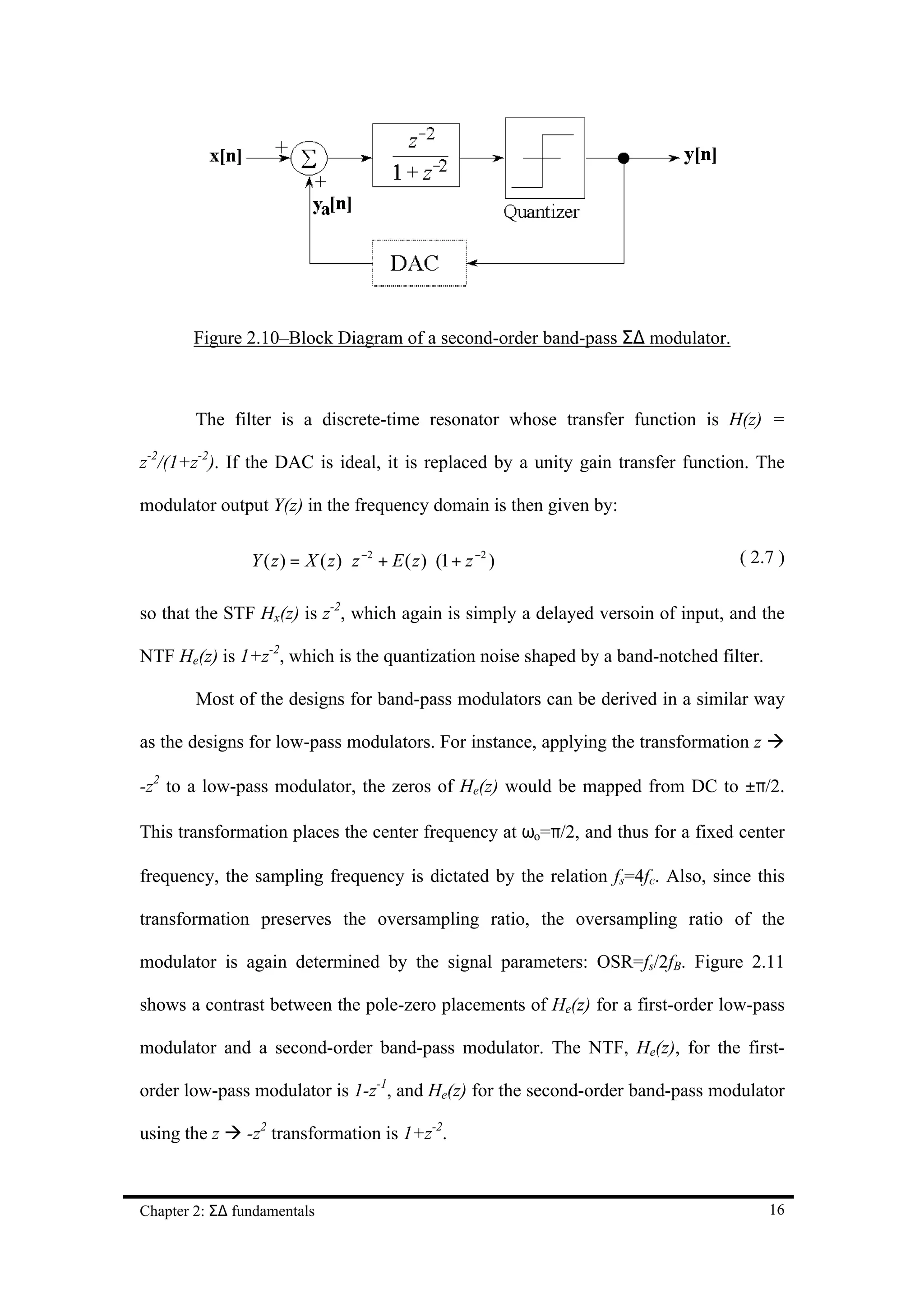
modulators. A band-pass Σ∆ modulator can be constructed by connecting a filter and

quantizer in a loop, as shown in Figure 2.10.


Chapter 2: Σ∆ fundamentals                                                             15
Figure 2.10–Block Diagram of a second-order band-pass Σ∆ modulator.


        The filter is a discrete-time resonator whose transfer function is H(z) =

z-2/(1+z-2). If the DAC is ideal, it is replaced by a unity gain transfer function. The

modulator output Y(z) in the frequency domain is then given by:

                Y ( z ) = X ( z ) ⋅ z −2 + E ( z ) ⋅ (1 + z −2 )                ( 2.7 )


so that the STF Hx(z) is z-2, which again is simply a delayed versoin of input, and the

NTF He(z) is 1+z-2, which is the quantization noise shaped by a band-notched filter.

        Most of the designs for band-pass modulators can be derived in a similar way

as the designs for low-pass modulators. For instance, applying the transformation z à

-z2 to a low-pass modulator, the zeros of He(z) would be mapped from DC to ±π/2.

This transformation places the center frequency at ωo=π/2, and thus for a fixed center

frequency, the sampling frequency is dictated by the relation fs=4fc. Also, since this

transformation preserves the oversampling ratio, the oversampling ratio of the

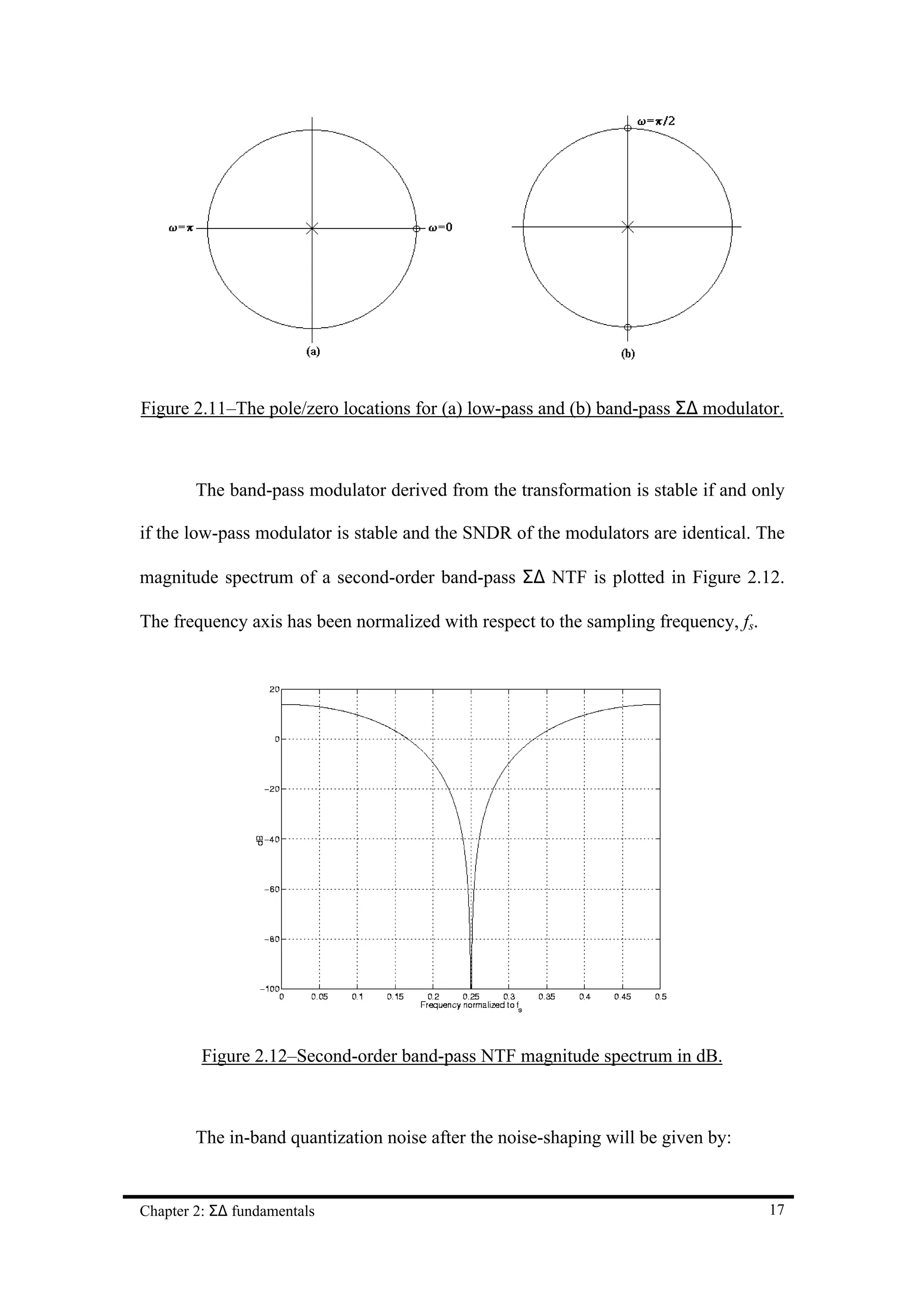
modulator is again determined by the signal parameters: OSR=fs/2fB. Figure 2.11

shows a contrast between the pole-zero placements of He(z) for a first-order low-pass

modulator and a second-order band-pass modulator. The NTF, He(z), for the first-

order low-pass modulator is 1-z-1, and He(z) for the second-order band-pass modulator

using the z à -z2 transformation is 1+z-2.


Chapter 2: Σ∆ fundamentals                                                             16
Figure 2.11–The pole/zero locations for (a) low-pass and (b) band-pass Σ∆ modulator.


        The band-pass modulator derived from the transformation is stable if and only

if the low-pass modulator is stable and the SNDR of the modulators are identical. The

magnitude spectrum of a second-order band-pass Σ∆ NTF is plotted in Figure 2.12.

The frequency axis has been normalized with respect to the sampling frequency, fs.


         Figure 2.12–Second-order band-pass NTF magnitude spectrum in dB.


        The in-band quantization noise after the noise-shaping will be given by:


Chapter 2: Σ∆ fundamentals                                                           17
fc + f B 2
        no = ∫
                                                    2
                                 E 2 ( f ) ⋅ 1 + z −2 df
           2
                   fc − f B 2

                                 σe
                                     2
                    fc + f B 2
               =∫
                                                 2
                                      ⋅ 1 + z − 2 df
                   fc − f B 2    fs 2
                2σ                         4πf
                          2
                      fc + f B 2
               = e ⋅∫           (2 + 2 cos     )df
                 fs  fc − f B 2             fs
                                                        fc + fB 2
                4σ               4πf
                          2
                           f                                                            ( 2.8 )
               = e ⋅ ( f + s sin     )
                 fs       4π      fs f
                                                           c − fB   2

                   4σ e                   4πf c     4πf B
                          2
                                 f
               =        ⋅{ f B + s [2 cos       sin       ]}
                    fs          4π         fs       2 fs
                4σ   f 4πf B         2πf B
                          2
                                                                                 fs
               = e ⋅ s ⋅[    − 2 sin       ]                            ( fc =      )
                 f s 4π   fs          fs                                         4
                   8σ e 2πf B 2πf B 1 2πf B 3
                          2

               =       ⋅[    −     + ⋅(    ) − ...]
                    4π    fs   fs   3!  fs
                 σe ⋅ π2
                      2
                             1 3
               ≈         ⋅(     )
                   3        OSR


        Therefore, each doubling of the sampling frequency decreases the in-band

noise by 9 dB and, thus, increases the resolution by one and a half bits. Figure 2.13

shows the quantization noise spectrum before and after the second-order band-pass

Σ∆ noise shaping.


  Figure 2.13–Quantization Noise Spectrum. (a) Before second-order band-pass Σ∆
         noise-shaping, (b) After second-order band-pass Σ∆ noise-shaping.

Chapter 2: Σ∆ fundamentals                                                                  18
2.6     Continuous-Time design and implementation of Band-pass Σ∆
        modulator [5],[6],[7]


        The discrete-time band-pass Σ∆ modulator eases the conversion of a band-pass

signal with a narrow bandwidth around the center frequency of the signal. However,

the switched-capacitor [8],[9],[10] or switched-current [11] implementation are

limited in that the sampling frequency of the modulators cannot be too high (usually

at under 100 MHz). Even using the double-sampling technique [12] or 2-path

technique [13],[14], the center frequency of the band-pass signal is still limited to

below 50 MHz. The modulator cannot operate at 70 MHz for high-IF conversion.

Therefore, a continuous-time design and implementation method for high-IF

conversion is worth investigating.

        In a discrete-time system or switched-capacitor design, due to the discrete-

time nature of the modulator design, the DAC output waveform in the feedback loop

of the Σ∆ modulator does not have much effect on the modulator performance. The

variations of the digital-to-analog signal during the clock period φ and φ’ are not seen

by a switched-capacitor filter. However, a continuous-time filter responds to an input

signal continuously, unlike the switched-capacitor filter that is discrete in nature.

Therefore, a continuous-time Σ∆ loop-filter has to be designed according to the DAC

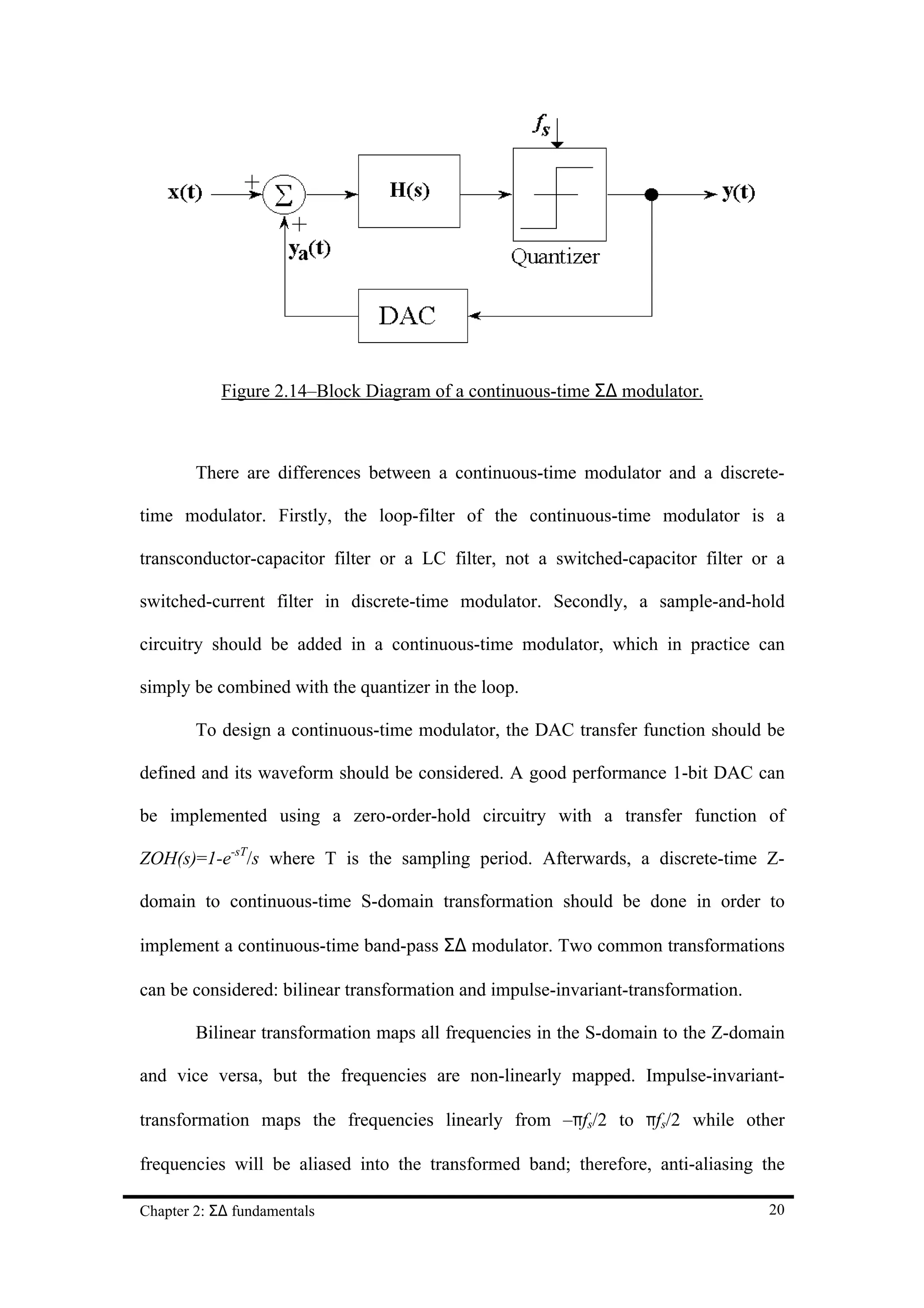
output waveform. Figure 2.14 shows the block diagram of a continuous-time Σ∆

modulator.


Chapter 2: Σ∆ fundamentals                                                           19
Figure 2.14–Block Diagram of a continuous-time Σ∆ modulator.


        There are differences between a continuous-time modulator and a discrete-

time modulator. Firstly, the loop-filter of the continuous-time modulator is a

transconductor-capacitor filter or a LC filter, not a switched-capacitor filter or a

switched-current filter in discrete-time modulator. Secondly, a sample-and-hold

circuitry should be added in a continuous-time modulator, which in practice can

simply be combined with the quantizer in the loop.

        To design a continuous-time modulator, the DAC transfer function should be

defined and its waveform should be considered. A good performance 1-bit DAC can

be implemented using a zero-order-hold circuitry with a transfer function of

ZOH(s)=1-e-sT/s where T is the sampling period. Afterwards, a discrete-time Z-

domain to continuous-time S-domain transformation should be done in order to

implement a continuous-time band-pass Σ∆ modulator. Two common transformations

can be considered: bilinear transformation and impulse-invariant-transformation.

        Bilinear transformation maps all frequencies in the S-domain to the Z-domain

and vice versa, but the frequencies are non-linearly mapped. Impulse-invariant-

transformation maps the frequencies linearly from –πfs/2 to πfs/2 while other

frequencies will be aliased into the transformed band; therefore, anti-aliasing the

Chapter 2: Σ∆ fundamentals                                                         20
signal is important when using this transformation. There is a 70 MHz band-pass IF

filter before the modulator that served the anti-aliasing filter purpose in our proposed

receiver. Therefore, for design simplicity, the impulse-invariant-transformation was

chosen:


                                         1 − e − sT                                       ( 2.9 )
                Z −1[ H ( z )] = L−1[               H ( s )]
                                             s               t = nT


where H(z) is the discrete-time transfer function of the loop-filter in the modulator,

H(s) is the continuous-time transfer function for the loop-filter, and 1-e-sT/s is the

transfer function of the DAC in the loop where T=1/fs.

        For a continuous-time loop-filter, H(s) has the form of

                                         N
                                                ak                                       ( 2.10 )
                           H ( s) = ∑
                                         k =1 s − s k


        Its impulse response is

                                   N                                                     ( 2.11 )
                         h(t ) = ∑ a k e sk T u (t )
                                  k =1


        After the convolution with the DAC,

                             heq (t ) = ZOH * h(t )
                                       +∞
                                    = ∫−∞ ZOH ⋅ h(t − τ)dτ
                                      ∫0 h(t − τ)dτ
                                        t
                                                                 when 0 ≤ t < T
                                      
                                      T
                                    = ∫0 h(t − τ)dτ              when t ≥ T
                                      0                         when t < 0
                                      
                                      
                                      t N         sk ( t −τ )
                                      ∫0 k∑1a k e             dτ       when 0 ≤ t < T
                                       =
                                    =
                                            N
                                      ∫T ∑ ak e sk (t −τ) dτ           when t ≥ T
                                       k =1
                                      
                                        0


Chapter 2: Σ∆ fundamentals                                                                    21
Hence,


                    N ak sk t − sk t                                                      ( 2.12 )
                   k∑1− s e (e − 1)                                   when 0 ≤ t < T
                   = k
        heq (t ) = 
                    ∑ ak e sk t (e − skT − 1)
                     N
                                                                       when t ≥ T
                   k =1− s k
                   


         Looking at samples of loop impulse response at sampling times t=nT,


                    0                          when 0 ≤ t < T                             ( 2.13 )
                    N
        heq (nT ) =      a
                    ∑ − sk e sk nT (e −skT − 1) when t ≥ T
                     k =1 k


        The z-domain loop transfer function of the loop then can be derived from the

above equivalent impulse response:

                     +∞                      +∞     N
                                                          a k sk nT − skT
        H ( z) =    ∑ h( n ) z − n = ∑ [ ∑
                    n = −∞                  n =1    k =1 − sk
                                                              e (e        − 1)]z − n
                     N                       +∞
                              a k − sk T
               = ∑[                      − 1)∑ (e skT z −1 ) n ]
                                                                                           ( 2.14 )
                                  (e
                    k =1     − sk            n =1
                     N
                          ak                   z −1
               =∑              (1 − e skT )          −1
                                                        where z k = e skT
                    k =1 − s k              1 − zk z
                                   N     ak ,eq z −1                    ak
              ∴ H ( z) = ∑                          −1
                                                         , a k ,eq =        (1 − e skT )
                                  k =1   1 − zk z                      − sk


        From the above, a continuous-time loop-filter can be designed from a discrete-

time loop-filter:

                                                        π                                  ( 2.15 )
                           −2                                            s−
                      z                       π        2T ]
         H ( z) =                 H ( s) = − [
                                 →
                    1 + z −2                 4T s 2 + ( π ) 2
                                                       2T

where T is the sampling period of the modulator, i.e. T=1/fs.


Chapter 2: Σ∆ fundamentals                                                                      22
Equation ( 2.15 ) assumes the loop delay for the Σ∆ modulator is zero.

However, in practical implementation, the quantizer is not delay-free. Therefore, if we

add more delay such that the total loop delay becomes exactly one sampling period T,

a digital delay z-1 is implemented in the loop. If we reserve this z-1 in the discrete-time

transfer function and implement the z-1 by digital delay cell,

                                                π                                  ( 2.16 )
                                           s+
                    z −1              π        2T ]
          H ( z) =          H (s) =
                           →           [
                   1+ z −2
                                     4T s 2 + ( π ) 2
                                               2T

        A continuous-time second-order band-pass Σ∆ modulator at 70 MHz can be

designed and implemented accordingly. The loop-filter can be implemented by a

transconductor-capacitor filter or a LC filter as mentioned above; the quantizer can be

implemented by a latched-type comparator; the ZOH circuit can be implemented by a

D flip-flop; the DAC can be implemented by a steering current source; and the

addition can be done using current addition.

        In this project, both zero-delay and one-delay band-pass Σ∆ modulator are

implemented. As we will describe in the following chapters, a zero-delay modulator is

implemented using 0.8µm technology and source-degeneration Gm-cells while a one-

delay modulator is implemented using 0.5µm technology and triode-region Gm-cells.


Chapter 2: Σ∆ fundamentals                                                              23
Chapter 3                System Design of the Σ∆ modulator

3.1     Introduction


        In Chapter 2, a continuous-time band-pass Σ∆ modulator design is discussed.

This chapter will focus on the system simulation using different programs for the Σ∆

modulator. C and HSPICE have been used for doing the system simulation using ideal

model for each building block. System level design for the loop-filter will be

discussed in Section 3.2. Then, two modulators will be described in the following

sections: the design and system simulation of the zero-delay Σ∆ modulator will be

described in Section 3.3, and the design and system simulation of the one-delay Σ∆

modulator will be described in Section 3.4.


3.2     System level loop-filter design


        In Chapter 2, the continuous-time band-pass Σ∆ modulator design requires a

continuous-time loop-filter with the transfer function either as equation ( 2.15 ) for

zero-delay modulator or as equation ( 2.16 ) for one-delay modulator. For continuous-

time analog operation, there exists three types of filter implementation methods: LC

filter, switched-capacitor filter and transconductor-capacitor (Gm-C) filter. The LC

filter implementation requires large values of inductance and capacitance, which are

not realistic for monolithic integration. As mentioned in Chapter 2, switched-capacitor

filters are too slow for 280 MHz sampling operation, therefore, only the Gm-C filter

can be considered for the loop-filter implementation.


Chapter 3: System Design of the Σ∆ modulator                                        24
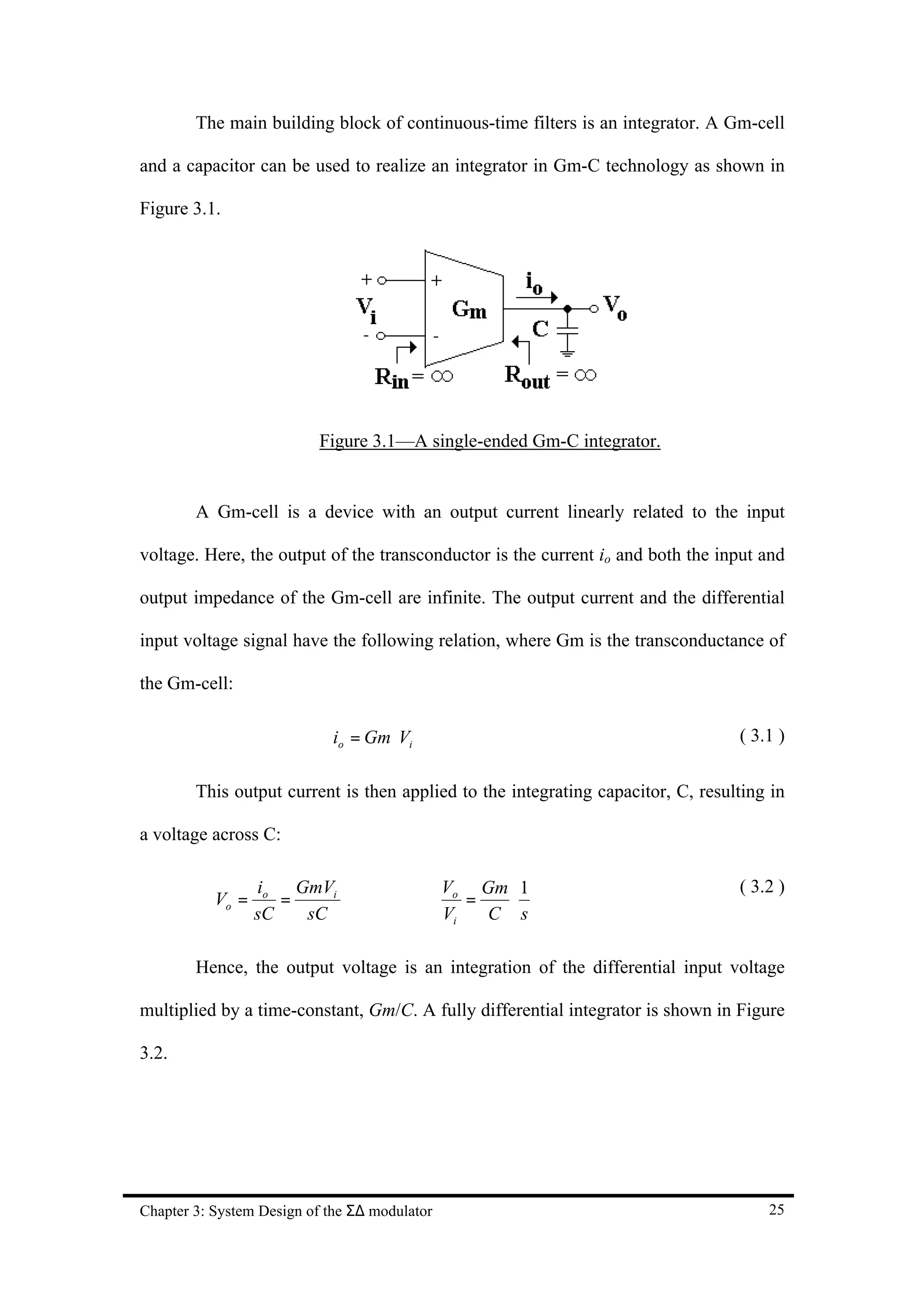
The main building block of continuous-time filters is an integrator. A Gm-cell

and a capacitor can be used to realize an integrator in Gm-C technology as shown in

Figure 3.1.


                           Figure 3.1—A single-ended Gm-C integrator.


        A Gm-cell is a device with an output current linearly related to the input

voltage. Here, the output of the transconductor is the current io and both the input and

output impedance of the Gm-cell are infinite. The output current and the differential

input voltage signal have the following relation, where Gm is the transconductance of

the Gm-cell:

                             io = Gm ⋅Vi                                          ( 3.1 )

        This output current is then applied to the integrating capacitor, C, resulting in

a voltage across C:

                  io GmVi                      Vo Gm 1                            ( 3.2 )
           Vo =      =              ⇒             =   ⋅
                  sC   sC                      Vi   C s

        Hence, the output voltage is an integration of the differential input voltage

multiplied by a time-constant, Gm/C. A fully differential integrator is shown in Figure

3.2.


Chapter 3: System Design of the Σ∆ modulator                                          25
Figure 3.2—Fully-differential Gm-C integrators.


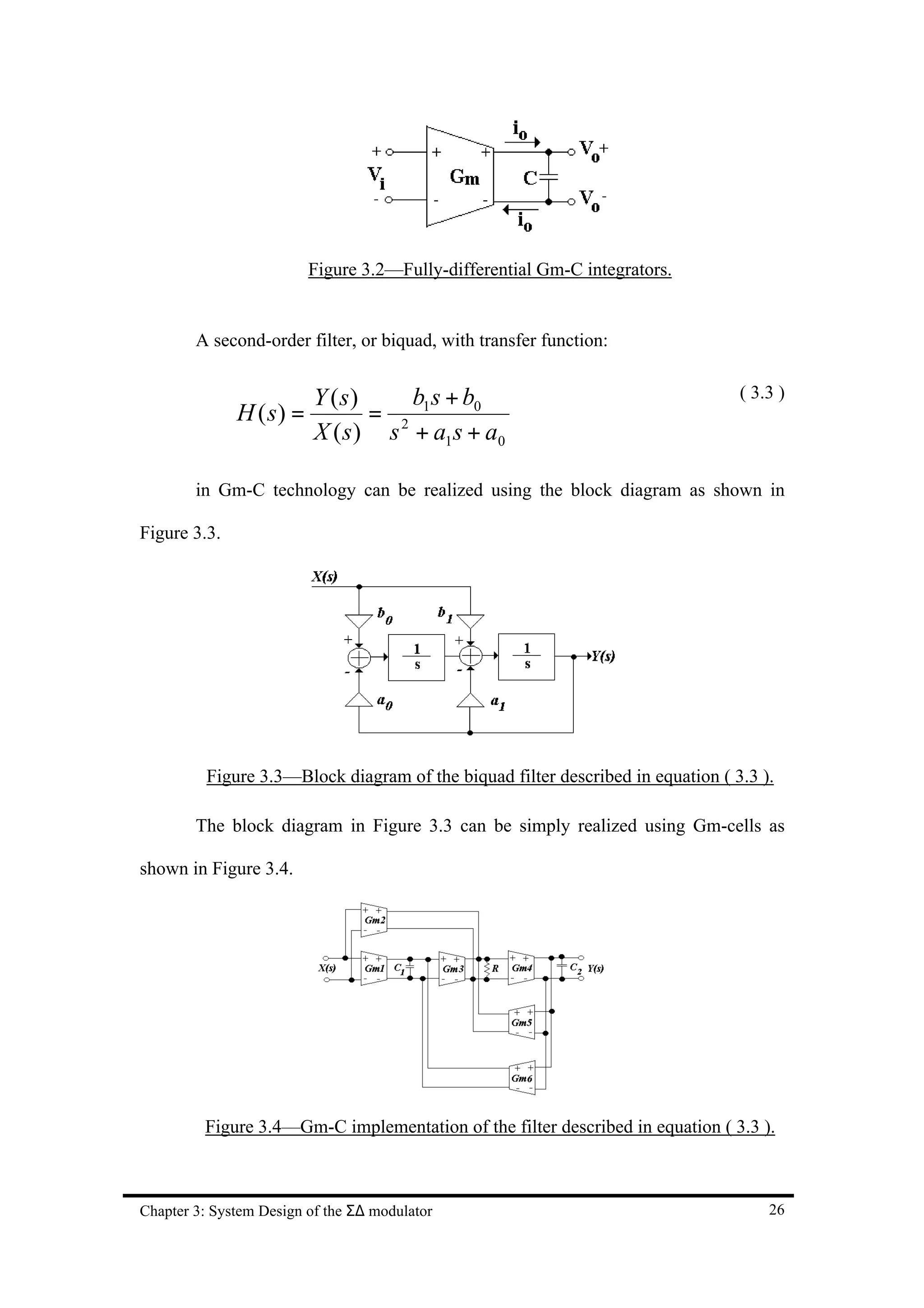
        A second-order filter, or biquad, with transfer function:


                          Y (s)     b s + b0                                     ( 3.3 )
              H ( s) =           = 2 1
                          X ( s ) s + a1 s + a0

        in Gm-C technology can be realized using the block diagram as shown in

Figure 3.3.


          Figure 3.3—Block diagram of the biquad filter described in equation ( 3.3 ).

        The block diagram in Figure 3.3 can be simply realized using Gm-cells as

shown in Figure 3.4.


         Figure 3.4—Gm-C implementation of the filter described in equation ( 3.3 ).


Chapter 3: System Design of the Σ∆ modulator                                         26
The corresponding transfer function is given by:


                    Gm2 ⋅ Gm4 ⋅ R    Gm1 ⋅ Gm3 ⋅ Gm4 ⋅ R                           ( 3.4 )
                                  s+
         Y (s)           C2                C1 ⋅ C 2
H ( s) =        =
         X ( s ) s 2 Gm5 ⋅ Gm4 ⋅ R s Gm3 ⋅ Gm6 ⋅ Gm4 ⋅ R
                    −                −
                           C2                C1 ⋅ C 2


        To implement the transfer function as equations ( 2.15 ) or ( 2.16 ), the

building block diagram in Figure 3.4 can be simplified as shown in Figure 3.5.


                            Figure 3.5—Block diagram for loop-filter.

        The transfer function of the loop-filter is:

                            Gm3     Gm1 ⋅ Gm2                                      ( 3.5 )
                                 s+
                    Y ( s)   C        C1 ⋅ C 2
           H ( s) =        = 2
                    X (s)         Gm2 ⋅ Gm4
                             s2 −
                                    C1 ⋅ C 2

        By equating coefficients in equations ( 2.15 ) or ( 2.16 ) and ( 3.5 ), the values

of the transconductances and capacitors can be chosen for the loop-filter

implementation.

        The ideal loop-filter response with transfer function as equation ( 2.15 ) for

zero-delay band-pass Σ∆ modulator is simulated using MATLAB and is being shown

in Figure 3.6. The loop-filter is a very high-Q band-pass filter with center frequency at


Chapter 3: System Design of the Σ∆ modulator                                           27
70 MHz. The phase of the filter at frequencies before 70 MHz is –135o. It is then

changed from –135o to 45o at 70 MHz abruptly, indicating a 180o phase shift.


    Figure 3.6—Ideal magnitude and phase response of the loop-filter described in
                                equation ( 2.15 ).

        The ideal response of the loop-filter can never be achieved, however, as the

Gm-cells are not ideal. We assumed the Gm-cell has infinite output impedance. In

fact, every Gm-cell has finite output impedance. The transfer function implemented as

equation ( 3.5 ) will be changed as follows:


                                       Gm3        Gm1 ⋅ Gm2            Gm3
                                             s +[              +                   ]
         Y (s)                          C2          C1 ⋅ C 2     ( R1 // R4 )C1C 2
H ( s) =       =
         X (s)                1               1               Gm2 ⋅ Gm4                      1
                 s2 +[                +               ]s + [−               +
                       ( R2 // R3 )C 2 ( R1 // R4 )C1            C1C 2        ( R2 // R3 )( R1 // R4 )C1C 2


                                                                                               ( 3.6 )

where Rx is the output impedance of the x-th Gm-cell.

        As shown in equation ( 3.6 ), if the output impedance of the Gm-cells is

infinite, equation ( 3.6 ) will then be simplified to equation ( 3.5 ). Using ideal

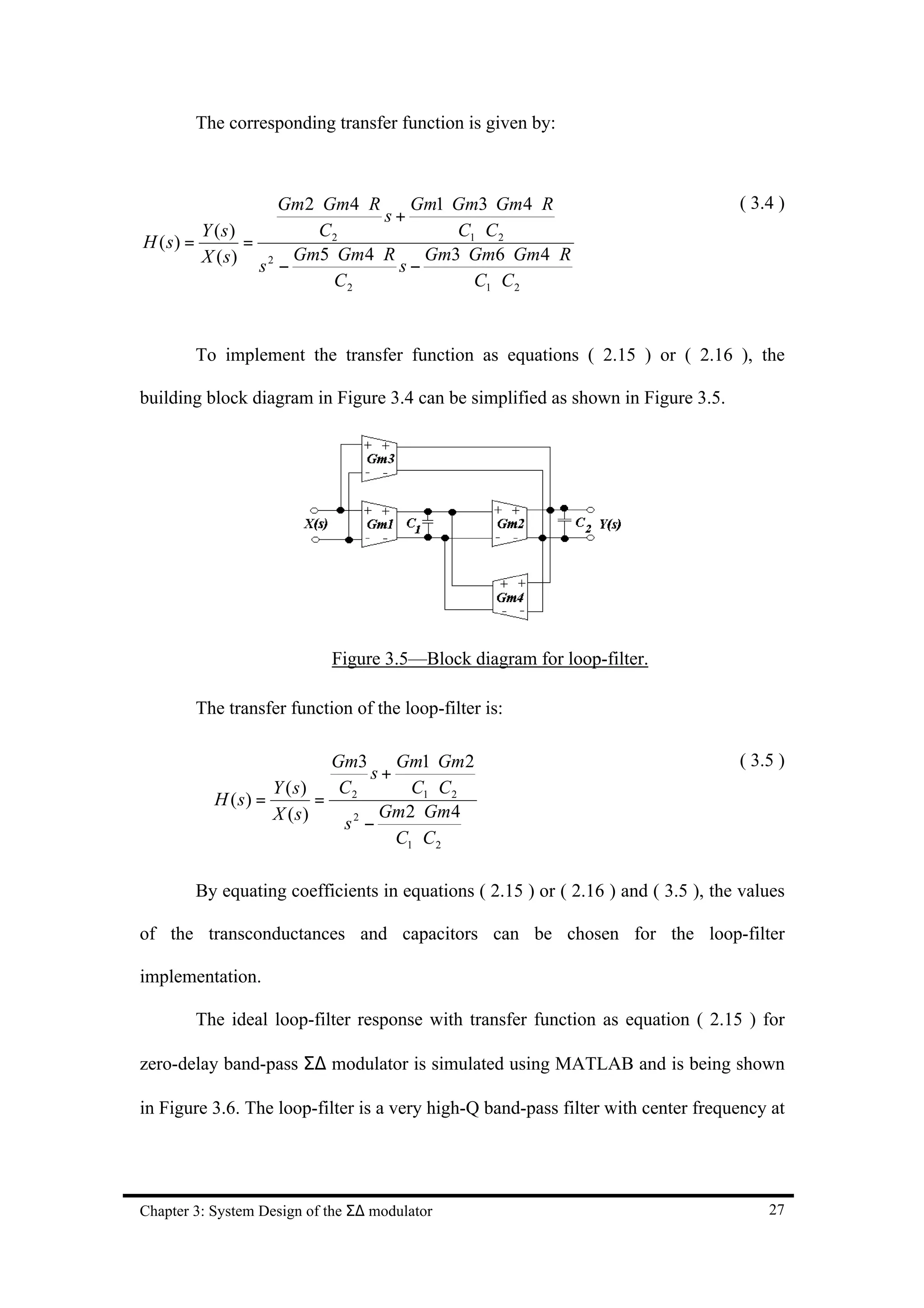
voltage-controlled-current-source (VCCS) in HSPICE with different output

impedances, the simulated magnitude and phase response is shown in Figure 3.7.

Chapter 3: System Design of the Σ∆ modulator                                                        28
Figure 3.7—HSPICE simulation of the loop-filter described in equation ( 2.15 ).

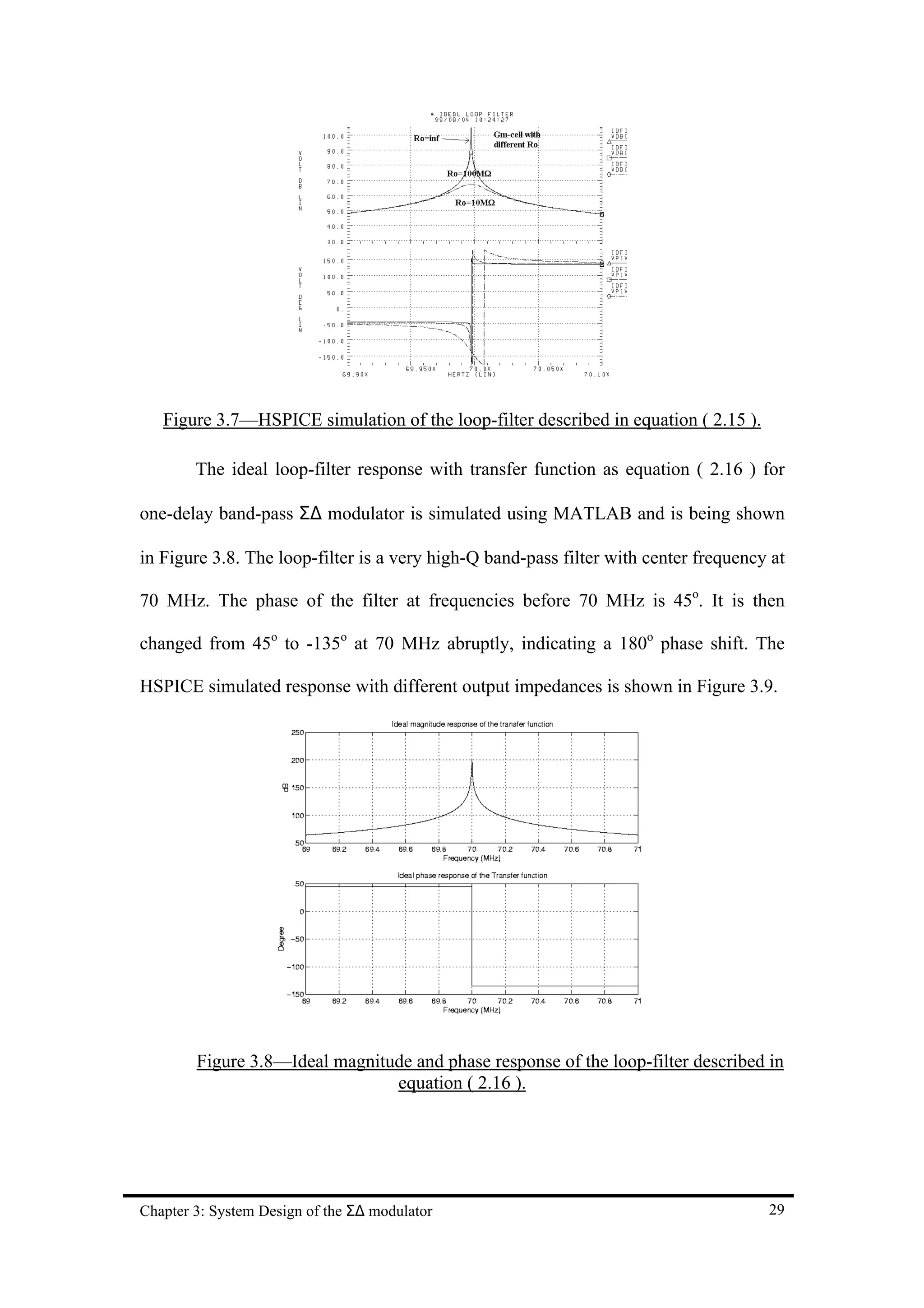
        The ideal loop-filter response with transfer function as equation ( 2.16 ) for

one-delay band-pass Σ∆ modulator is simulated using MATLAB and is being shown

in Figure 3.8. The loop-filter is a very high-Q band-pass filter with center frequency at

70 MHz. The phase of the filter at frequencies before 70 MHz is 45o. It is then

changed from 45o to -135o at 70 MHz abruptly, indicating a 180o phase shift. The

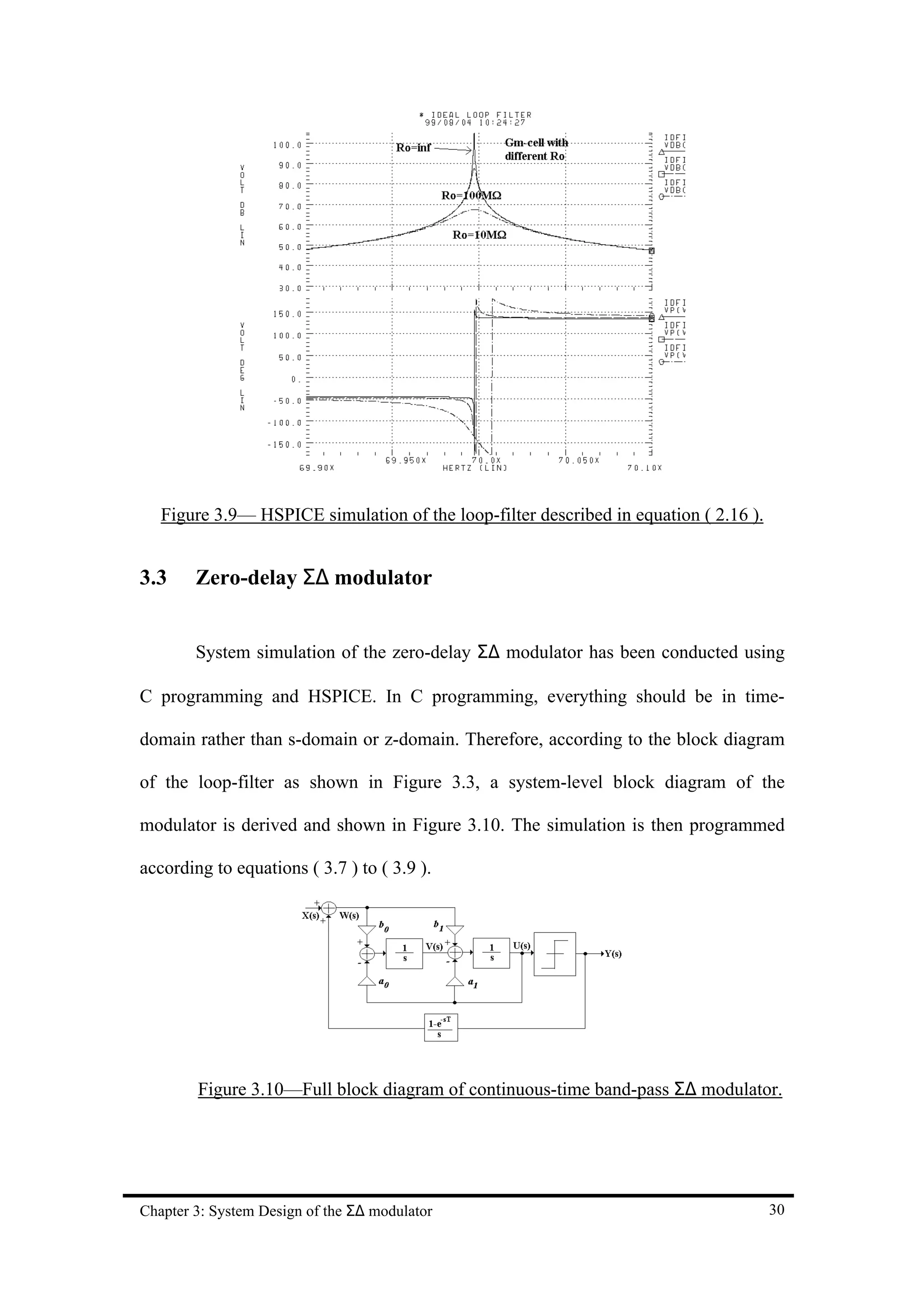
HSPICE simulated response with different output impedances is shown in Figure 3.9.


        Figure 3.8—Ideal magnitude and phase response of the loop-filter described in
                                equation ( 2.16 ).


Chapter 3: System Design of the Σ∆ modulator                                          29
Figure 3.9— HSPICE simulation of the loop-filter described in equation ( 2.16 ).


3.3     Zero-delay Σ∆ modulator


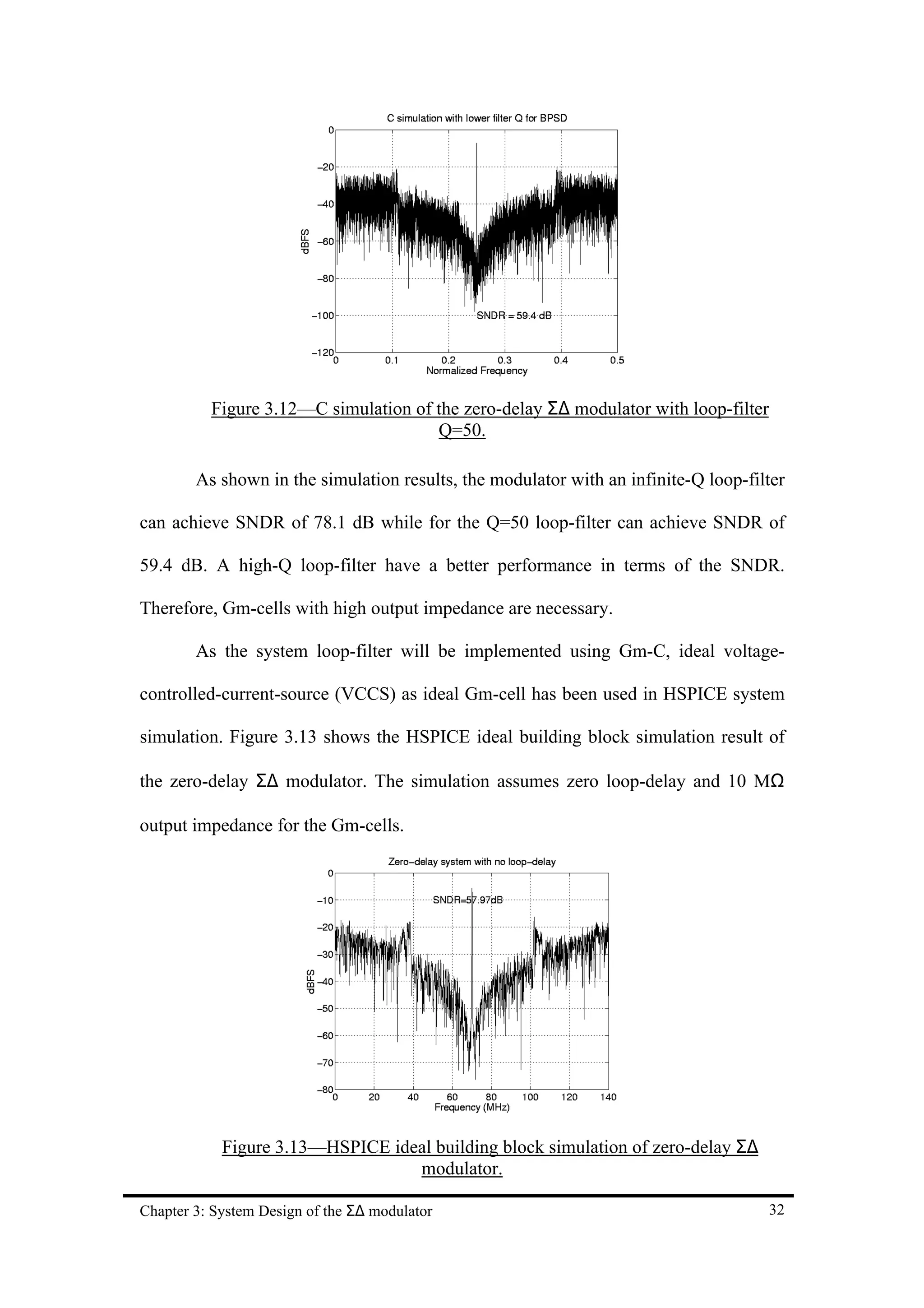
        System simulation of the zero-delay Σ∆ modulator has been conducted using

C programming and HSPICE. In C programming, everything should be in time-

domain rather than s-domain or z-domain. Therefore, according to the block diagram

of the loop-filter as shown in Figure 3.3, a system-level block diagram of the

modulator is derived and shown in Figure 3.10. The simulation is then programmed

according to equations ( 3.7 ) to ( 3.9 ).


        Figure 3.10—Full block diagram of continuous-time band-pass Σ∆ modulator.


Chapter 3: System Design of the Σ∆ modulator                                          30
^                                ( 3.7 )
                 y (k ) = sign[u (k )] = sign[u (kT )]

             ^          ^                       ^                 ^             ( 3.8 )
u (k + 1) = u (kT ) + y (kT ) ⋅ T + b1 ∫kT +1)T x(t )dt + ∫kT +1)T v(t )dt
                                        (k                 (k

                         ^
           − a1 ∫kT +1)T u (t )dt
                 (k


                 ^                  ^                         ^                 ( 3.9 )
 v( M + 1) = v( MTo ) − ao u ( MTo ) ⋅ ∆t + bo ∫MTo+1)To x(t )dt
                                                (M

                  ^
              + y (t ) ⋅ To
         Figure 3.11 shows the C simulation result of the zero-delay Σ∆ modulator. The

simulation assumes the loop-filter has an infinite Q and zero loop-delay. Another C

simulation assuming the loop-filter has a finite Q of 50 and zero loop-delay has

performed and the simulation result is shown in Figure 3.12.


          Figure 3.11—C simulation of zero-delay Σ∆ modulator with infinite-Q loop-
                                        filter.


Chapter 3: System Design of the Σ∆ modulator                                        31
Figure 3.12—C simulation of the zero-delay Σ∆ modulator with loop-filter
                                      Q=50.

        As shown in the simulation results, the modulator with an infinite-Q loop-filter

can achieve SNDR of 78.1 dB while for the Q=50 loop-filter can achieve SNDR of

59.4 dB. A high-Q loop-filter have a better performance in terms of the SNDR.

Therefore, Gm-cells with high output impedance are necessary.

        As the system loop-filter will be implemented using Gm-C, ideal voltage-

controlled-current-source (VCCS) as ideal Gm-cell has been used in HSPICE system

simulation. Figure 3.13 shows the HSPICE ideal building block simulation result of

the zero-delay Σ∆ modulator. The simulation assumes zero loop-delay and 10 MΩ

output impedance for the Gm-cells.


            Figure 3.13—HSPICE ideal building block simulation of zero-delay Σ∆
                                  modulator.

Chapter 3: System Design of the Σ∆ modulator                                         32
The Q value of the loop-filter for 10 MΩ output impedance Gm-cells is

around 500. The simulated SNDR of the system can achieve 57.97 dB.

        The above simulations assume the linear range of the Gm-cell is not limited.

However, it is unrealistic to have unlimited linear range Gm-cells. Unfortunately, not

only the Q of the loop-filter affects the performance of the modulator, but the linear

range of the Gm-cell also affects the performance of the modulator. Two non-linear

Gm-cell models are used for HSPICE simulation, one with ±500 mV linear range and

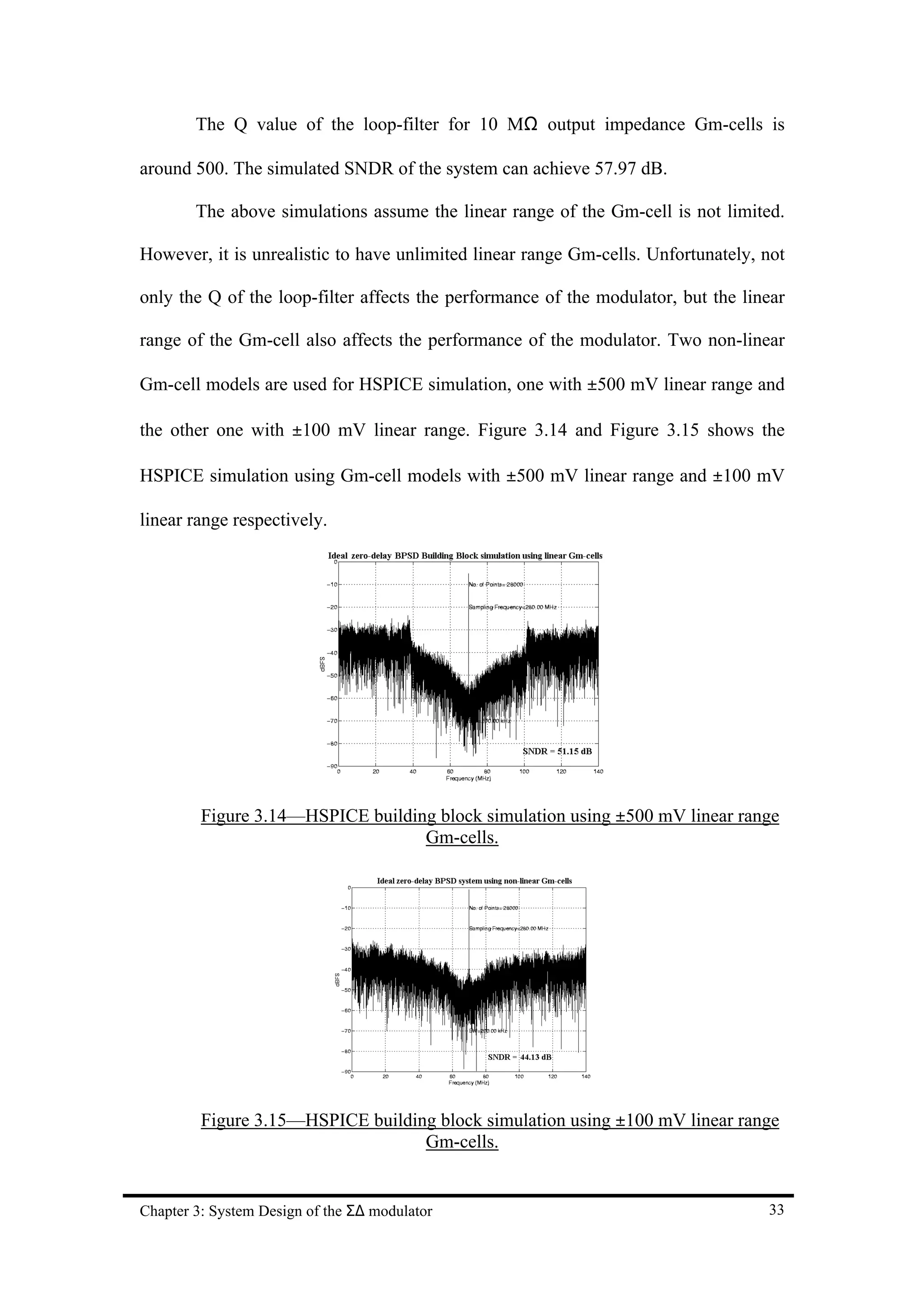
the other one with ±100 mV linear range. Figure 3.14 and Figure 3.15 shows the

HSPICE simulation using Gm-cell models with ±500 mV linear range and ±100 mV

linear range respectively.


         Figure 3.14—HSPICE building block simulation using ±500 mV linear range
                                   Gm-cells.


         Figure 3.15—HSPICE building block simulation using ±100 mV linear range
                                   Gm-cells.


Chapter 3: System Design of the Σ∆ modulator                                       33
The modulator with ±500 mV linear range Gm-cells can achieve 51.2 dB of

SNDR while the one with ±100mV linear range Gm-cells can achieve 44.1 dB only.

Therefore, Gm-cells with large linear range are needed for a high-performance

modulator.

        In all the simulations shown above, loop-delay of the system is assumed to be

zero. In practice, the loop-delay of the system cannot be zero. Figure 3.16 shows the

simulation result when the loop-delay of the modulator is 2.6 ns. The loop-delay

degrades the SNDR performance of the modulator [7]. The simulated SNDR is 44.84

dB. Since loop-delay is unavoidable in the modulator, it is better to make the loop-

delay to be exactly equal to one sampling period in order to change the design to one-

delay modulator.


           Figure 3.16—HSPICE ideal building block simulation for zero-delay Σ∆
                        modulator with 2.6 ns loop-delay.


3.4     One-delay Σ∆ modulator


        Figure 3.17 shows the C simulation result of the zero-delay Σ∆ modulator. The

simulation assumes the loop-filter has an infinite Q and zero loop-delay. Another C

simulation assuming the loop-filter has a finite Q of 50 and zero loop-delay has

performed and the simulation result is shown in Figure 3.18.

Chapter 3: System Design of the Σ∆ modulator                                       34
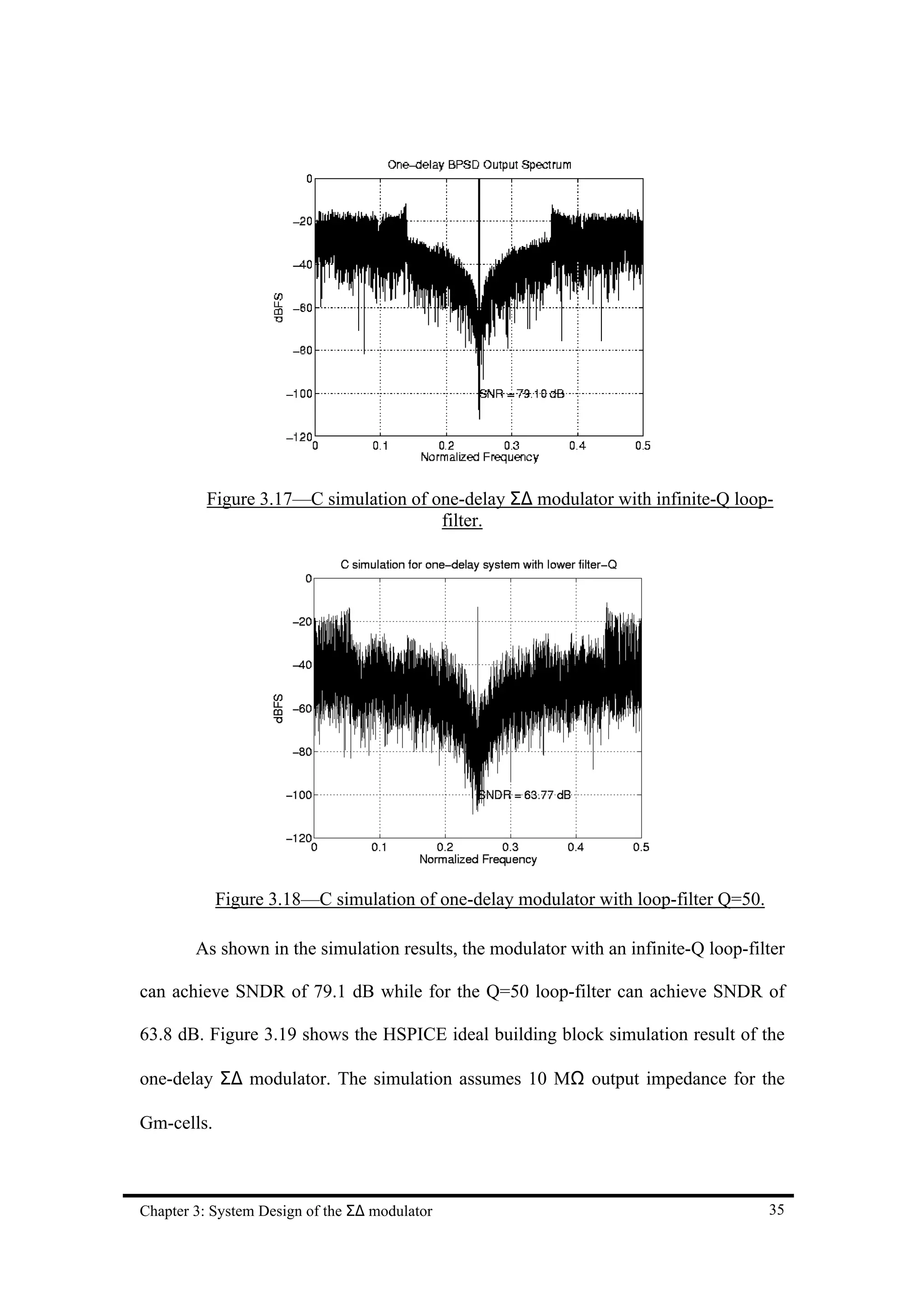
Figure 3.17—C simulation of one-delay Σ∆ modulator with infinite-Q loop-
                                       filter.


            Figure 3.18—C simulation of one-delay modulator with loop-filter Q=50.

        As shown in the simulation results, the modulator with an infinite-Q loop-filter

can achieve SNDR of 79.1 dB while for the Q=50 loop-filter can achieve SNDR of

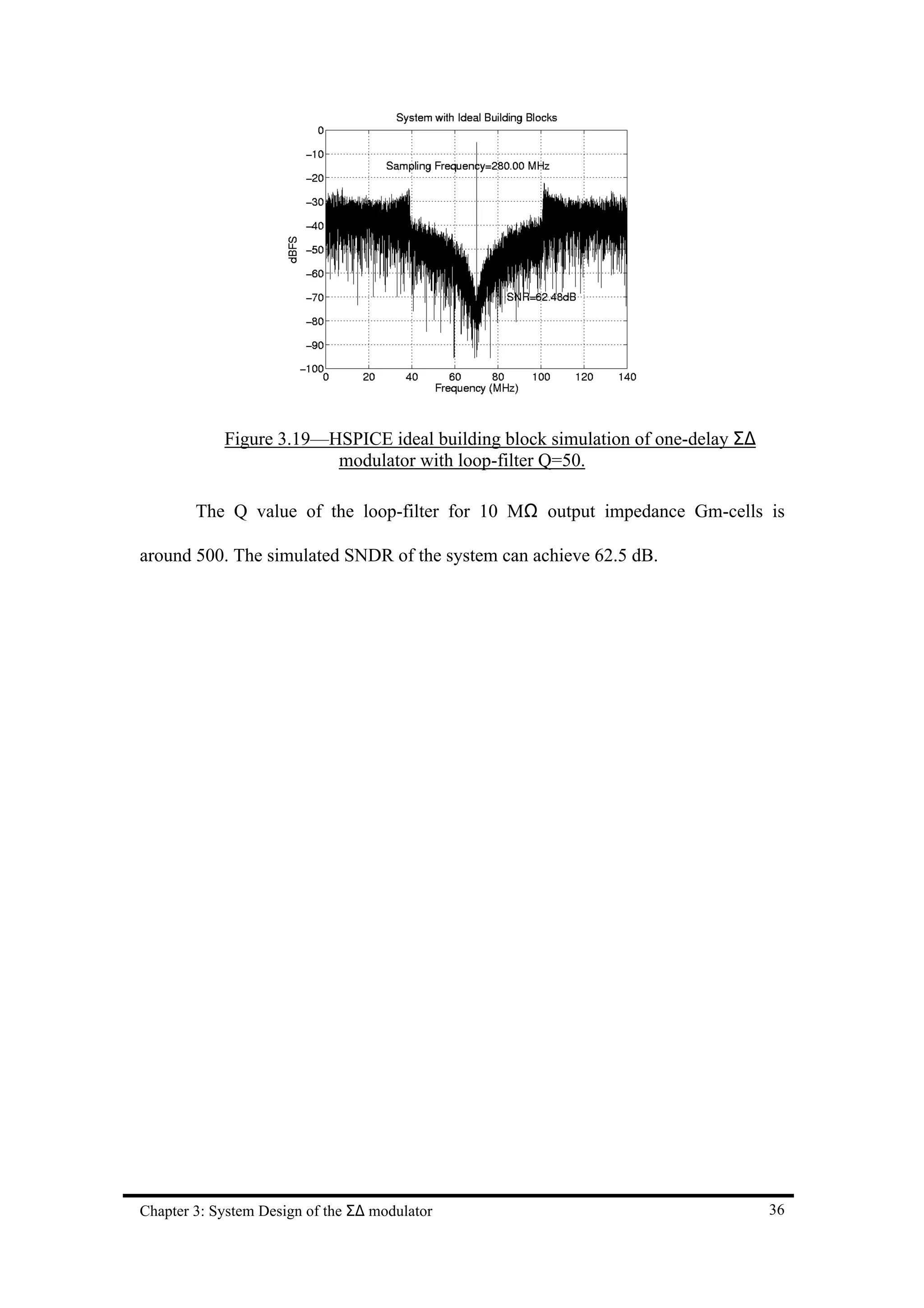
63.8 dB. Figure 3.19 shows the HSPICE ideal building block simulation result of the

one-delay Σ∆ modulator. The simulation assumes 10 MΩ output impedance for the

Gm-cells.


Chapter 3: System Design of the Σ∆ modulator                                         35
Figure 3.19—HSPICE ideal building block simulation of one-delay Σ∆
                         modulator with loop-filter Q=50.

        The Q value of the loop-filter for 10 MΩ output impedance Gm-cells is

around 500. The simulated SNDR of the system can achieve 62.5 dB.


Chapter 3: System Design of the Σ∆ modulator                                     36
Chapter 4                  Gm-cell designs for loop-filter

4.1      Introduction


         This chapter will focus on Gm-cell designs for the Gm-C loop filter. Three

types of Gm-cells will be discussed: general differential-pair Gm-cell in Section 4.2,

source-degeneration Gm-cell in Section 4.3, and triode-region Gm-cell in Section 4.4.

After the Gm-cell discussions, two Gm-C loop-filters implemented using source-

degeneration Gm-cells and triode-region Gm-cells will be described and compared in

Section 4.5.


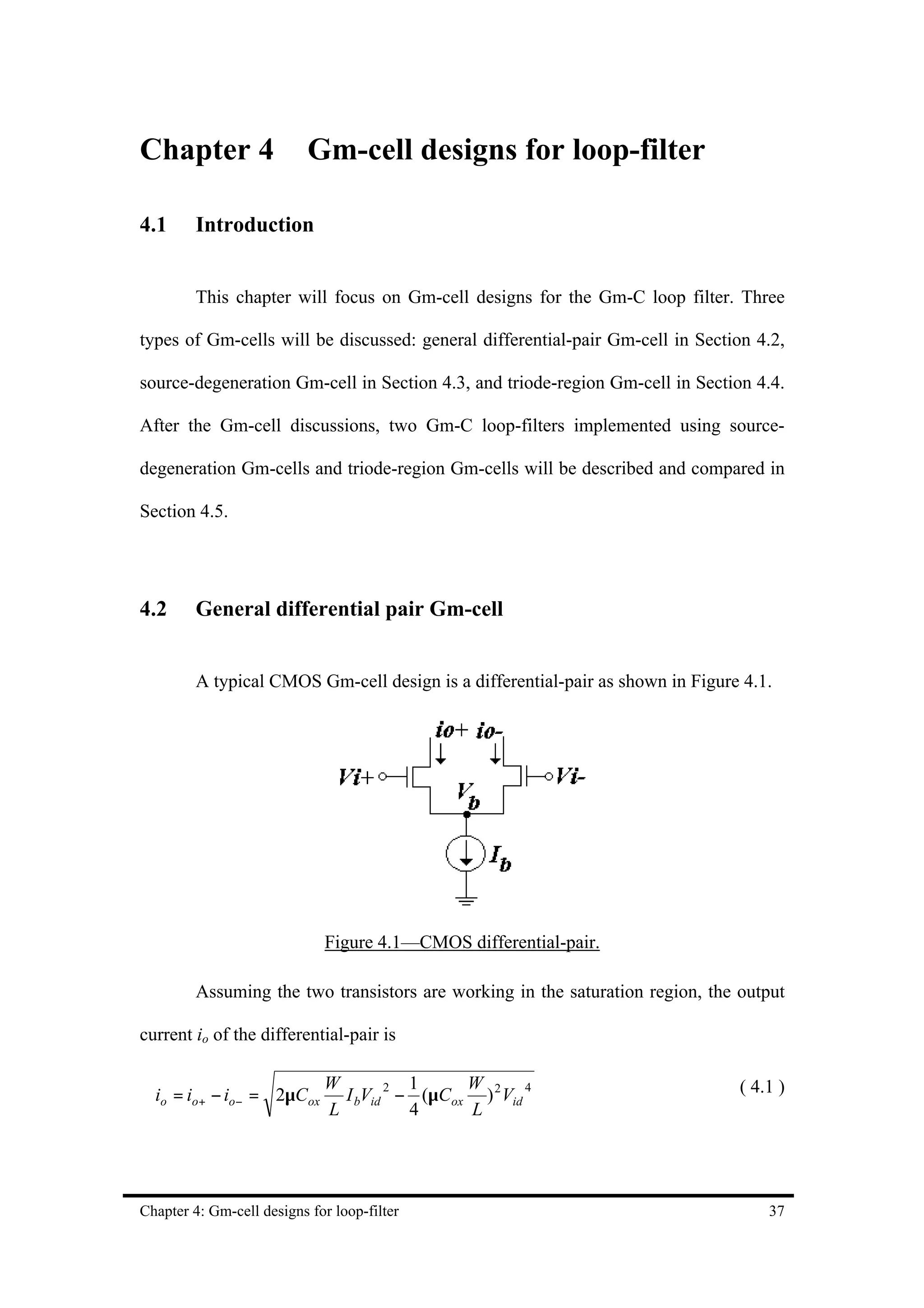
4.2      General differential pair Gm-cell


         A typical CMOS Gm-cell design is a differential-pair as shown in Figure 4.1.


                             Figure 4.1—CMOS differential-pair.

         Assuming the two transistors are working in the saturation region, the output

current io of the differential-pair is

                             W           1     W                                ( 4.1 )
  io = io+ − io− = 2µCox       I bVid 2 − (µCox ) 2 Vid 4
                             L           4     L


Chapter 4: Gm-cell designs for loop-filter                                          37
The Gm of the differential-pair is then

                ∂io
       Gm =                                                                     ( 4.2 )
               ∂Vid
                                             3
                                    W
                            3( µC ox ) 2
                     W              L V 2 + ...
            = 2 µC ox I b −              id
                     L          4 2I b


         From equation ( 4.2 ), for small input signals, the Gm is constant. However,

for large input signals, Gm drops and becomes non-linear. As a result, techniques for

linearizing Gm-cells are needed to be used.


4.3      Source-degeneration Gm-cell


         The first way to design a linear Gm-cell is source degeneration [17] as shown

in Figure 4.2.


                 Figure 4.2—Source-degeneration CMOS differential-pair.


         Gm of the degenerated differential-pair is

                                   gm                                           ( 4.3 )
                       Gm =
                               1 + gm ⋅ R
where gm is the transconductance of a single transistor. When gmR is much larger

than 1, the Gm of the degenerated-differential-pair can be approximated as 1/R.

Chapter 4: Gm-cell designs for loop-filter                                          38
However, it is unrealistic for a very large value of R to be implemented

monolithically. Therefore, triode region transistor is used to implement the

degeneration resistor R. The resistance of a triode region transistor is:

                                   1                                            ( 4.4 )
                 R=
                             W
                      µCox     (Vgs − Vt − Vds )
                             L


         A source-degeneration Gm-cell using 0.8µm technology has been designed.

The circuit schematic is shown in Figure 4.3.


                         Figure 4.3—Designed source-degeneration Gm-cell.

         It is desired to have very high output impedance, in the order of tens of MΩ,

for Gm-cells for high-Q filters. However, it is difficult to obtain. For the design as

shown in Figure 4.3, the output impedance is in the order of tens of kΩ, therefore, a

Q-tuning circuitry is needed to enhance the Q-value of the filter by increasing the

output impedance of the Gm-cell. A usual technique called negative-impedance-

compensation (NIC) [15] technique is used in Gm-C filter to increase the output

impedance of the Gm-cell. The source-degeneration Gm-cell with the NIC circuit is

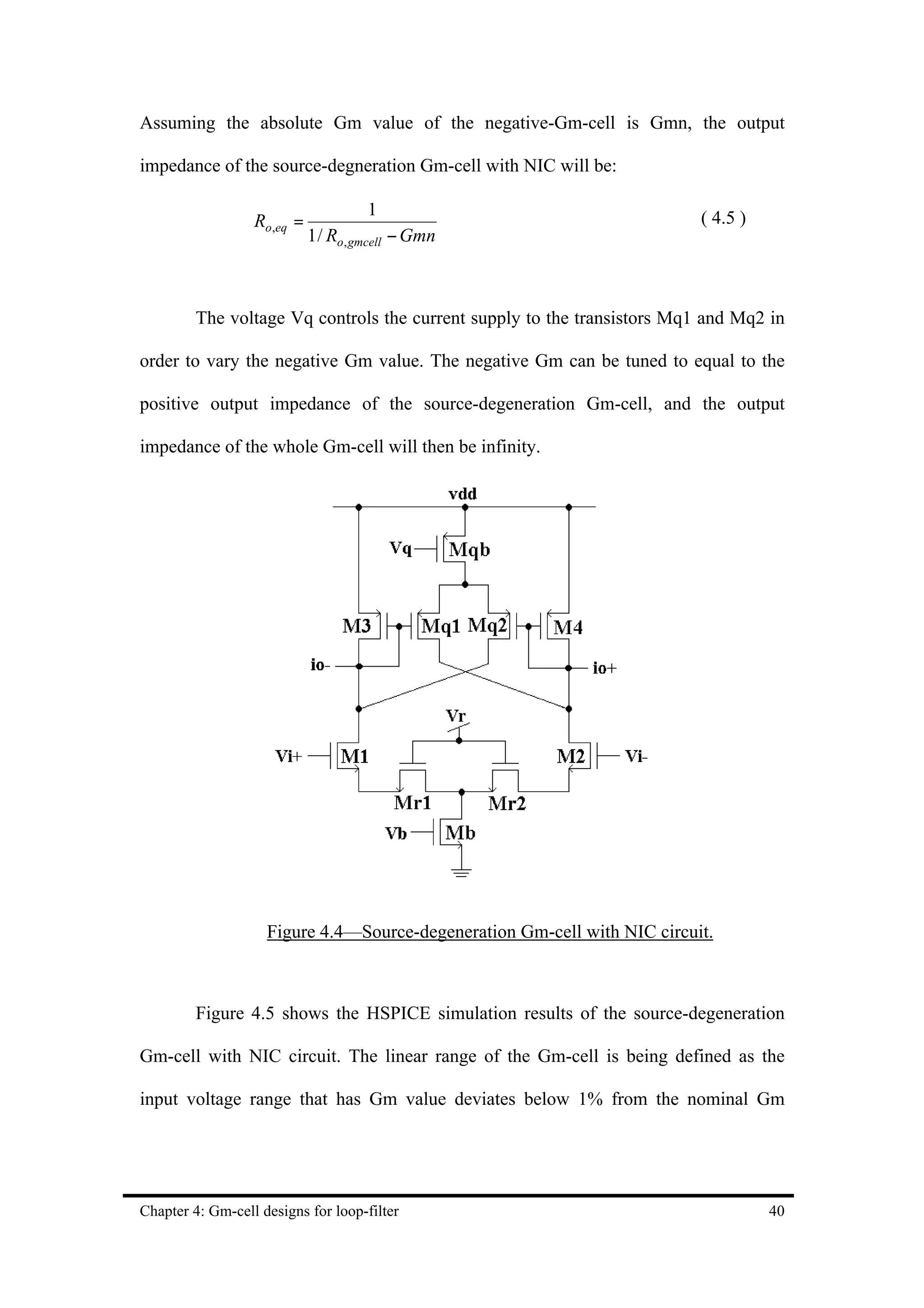
shown in Figure 4.4. The transistors Mqb, Mq1 and Mq2 formed a negative-Gm-cell.

Chapter 4: Gm-cell designs for loop-filter                                          39
Assuming the absolute Gm value of the negative-Gm-cell is Gmn, the output

impedance of the source-degneration Gm-cell with NIC will be:

                                     1
                  Ro,eq =                                                 ( 4.5 )
                            1 / Ro, gmcell − Gmn


         The voltage Vq controls the current supply to the transistors Mq1 and Mq2 in

order to vary the negative Gm value. The negative Gm can be tuned to equal to the

positive output impedance of the source-degeneration Gm-cell, and the output

impedance of the whole Gm-cell will then be infinity.


                    Figure 4.4—Source-degeneration Gm-cell with NIC circuit.


         Figure 4.5 shows the HSPICE simulation results of the source-degeneration

Gm-cell with NIC circuit. The linear range of the Gm-cell is being defined as the

input voltage range that has Gm value deviates below 1% from the nominal Gm


Chapter 4: Gm-cell designs for loop-filter                                          40
value. The linear range of this Gm-cell is around ±90mV with 3 V power supply. The

current supply to the Gm-cell is 0.75 mA.


           Figure 4.5—HSPICE simulation result of the source-degeneration Gm-cell.


4.4      Triode-region Gm-cell


         Another method of designing a linear Gm-cell is to use a triode-region

transistor [7],[16] as shown in Figure 4.6. The current of a triode-region transistor is

shown in equation ( 4.6 ) and the transconductance gm is shown in equation ( 4.7 ).


                              Figure 4.6—Triode-region Gm-cell.
Chapter 4: Gm-cell designs for loop-filter                                            41
W            V                                         ( 4.6 )
               I D = µCox     (Vgs − Vt − ds )Vds
                            L             2
                          ∂I D        W                                            ( 4.7 )
                   gm =        = µC ox Vds
                          ∂Vgs        L


         The op-amp in Figure 4.6 serves two functions. Firstly, it is used to control the

Vds of the transistor to be equal to Vc, so that the gm value can be proportional to a

constant voltage Vc. The reference voltage Vc should satisfy the following condition in

order to enforce the transistor to operate in the triode region:

                          Vc < Vgs − Vt                                            ( 4.8 )

         Secondly, it is used to enhance the output impedance of the Gm-cell. As the

op-amp is being used to fix the Vds of the triode-region transistor, the bandwidth

requirement of the op-amp is not stringent. However, the gain of the op-amp should

be reasonably large, so that the Vds of the triode-region transistor can follow the

control voltage Vc as close as possible.

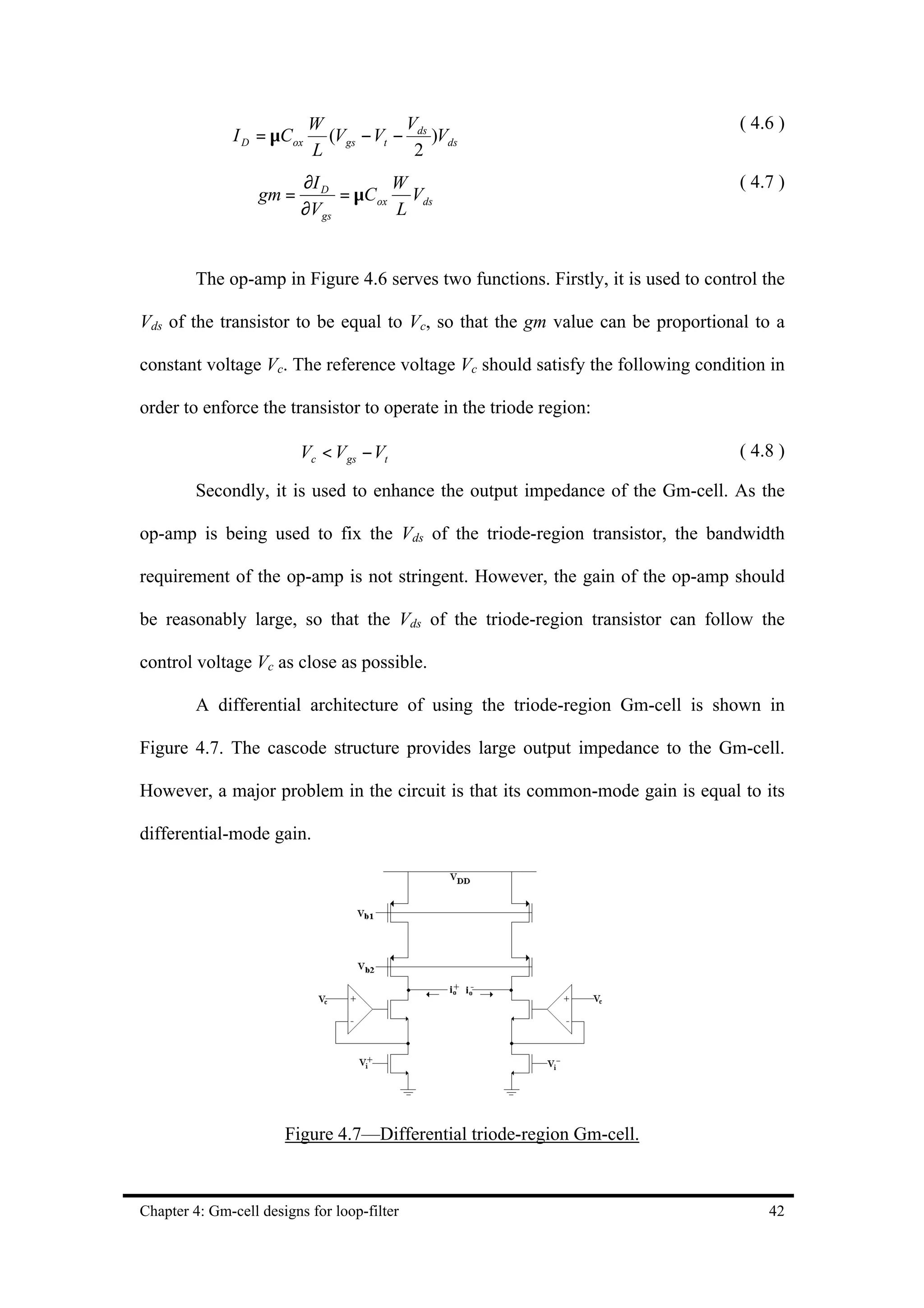
         A differential architecture of using the triode-region Gm-cell is shown in

Figure 4.7. The cascode structure provides large output impedance to the Gm-cell.

However, a major problem in the circuit is that its common-mode gain is equal to its

differential-mode gain.


                       Figure 4.7—Differential triode-region Gm-cell.


Chapter 4: Gm-cell designs for loop-filter                                             42
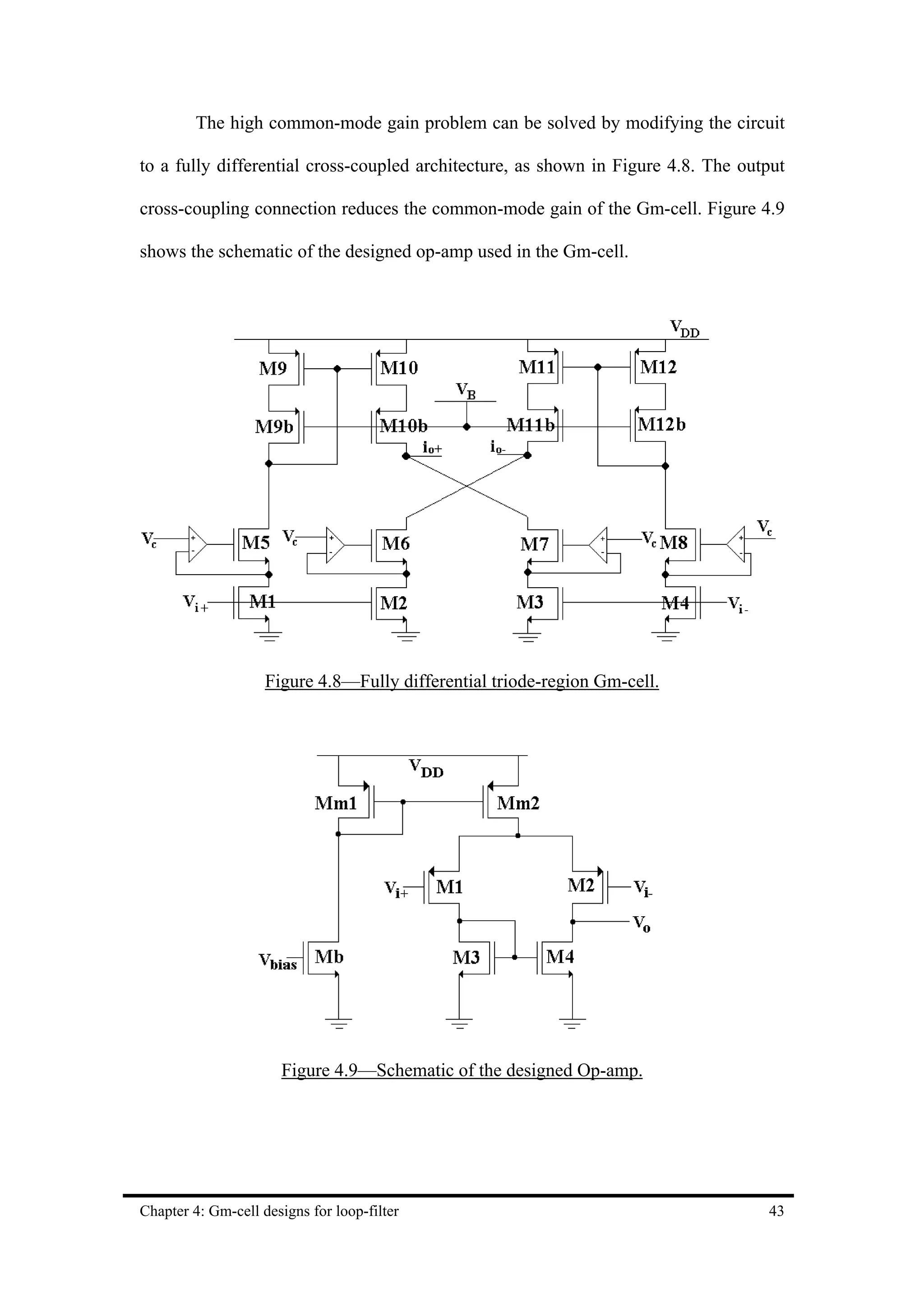
The high common-mode gain problem can be solved by modifying the circuit

to a fully differential cross-coupled architecture, as shown in Figure 4.8. The output

cross-coupling connection reduces the common-mode gain of the Gm-cell. Figure 4.9

shows the schematic of the designed op-amp used in the Gm-cell.


                    Figure 4.8—Fully differential triode-region Gm-cell.


                      Figure 4.9—Schematic of the designed Op-amp.


Chapter 4: Gm-cell designs for loop-filter                                         43
It is difficult to obtain very high output impedance for the triode-region Gm-

cell, too. For the design as shown in Figure 4.8, the output impedance is

approximately 1MΩ. Τhough the output impedance is already larger than the design

using the source-degeneration Gm-cell, it is still not high enough for the loop-filter

with a very high Q value. Therefore, a Q-tuning circuitry is still needed to enhance the

Q-value of the filter by increasing the output impedance of the Gm-cell. In the design

as shown in Figure 4.8, the output impedance of the Gm-cell is already negative due

to the output cross coupling connection. Therefore, a positive resistor can be used in

place of another linear negative Gm-cell. The positive resistor can be implemented

using a PMOS transistor operating in the triode-region. The resistance can be

controlled through the gate voltage of the PMOS transistor and hence the filter Q can

be tunable. A fully differential triode-region Gm-cell using 0.5µm technology has

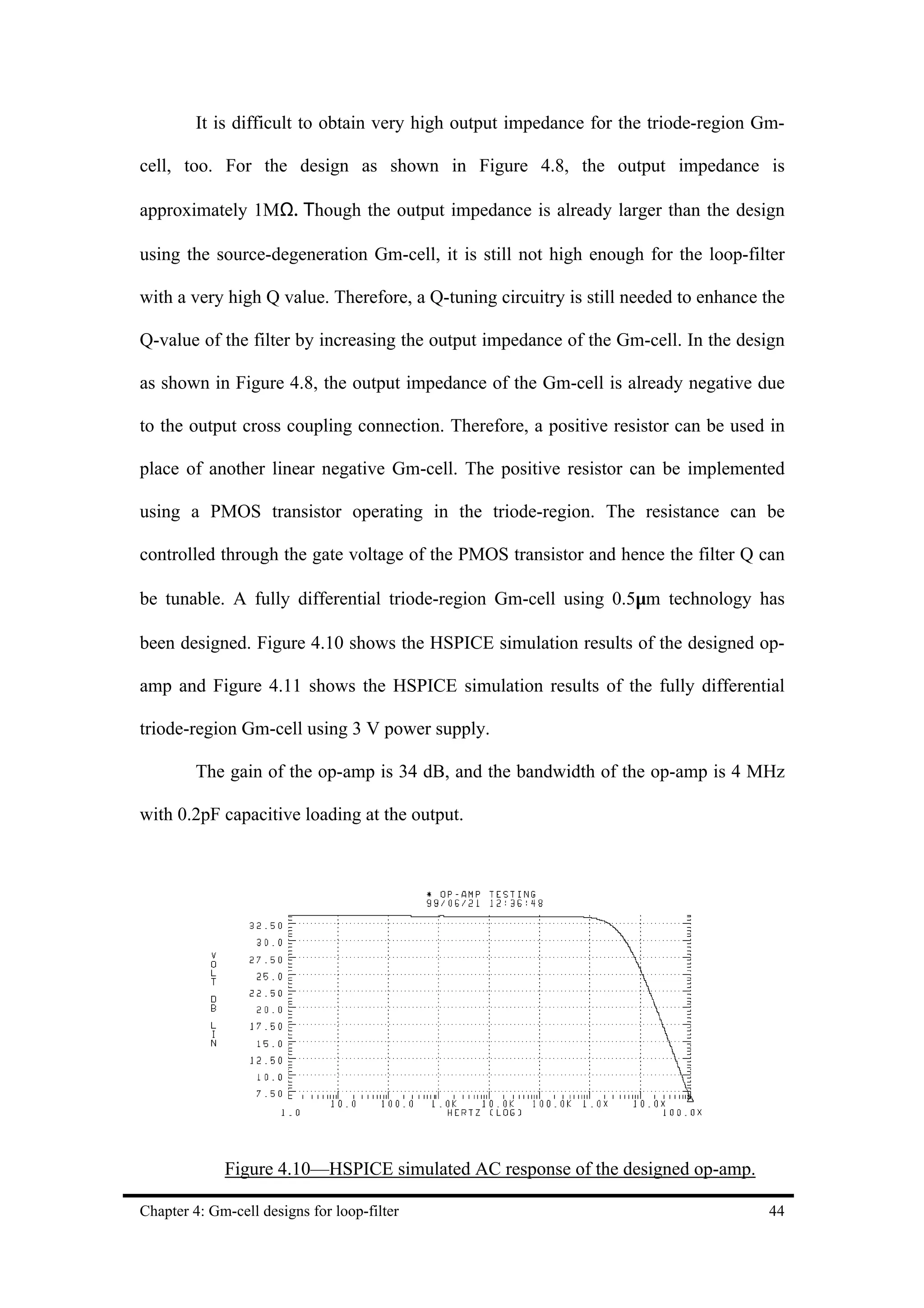
been designed. Figure 4.10 shows the HSPICE simulation results of the designed op-

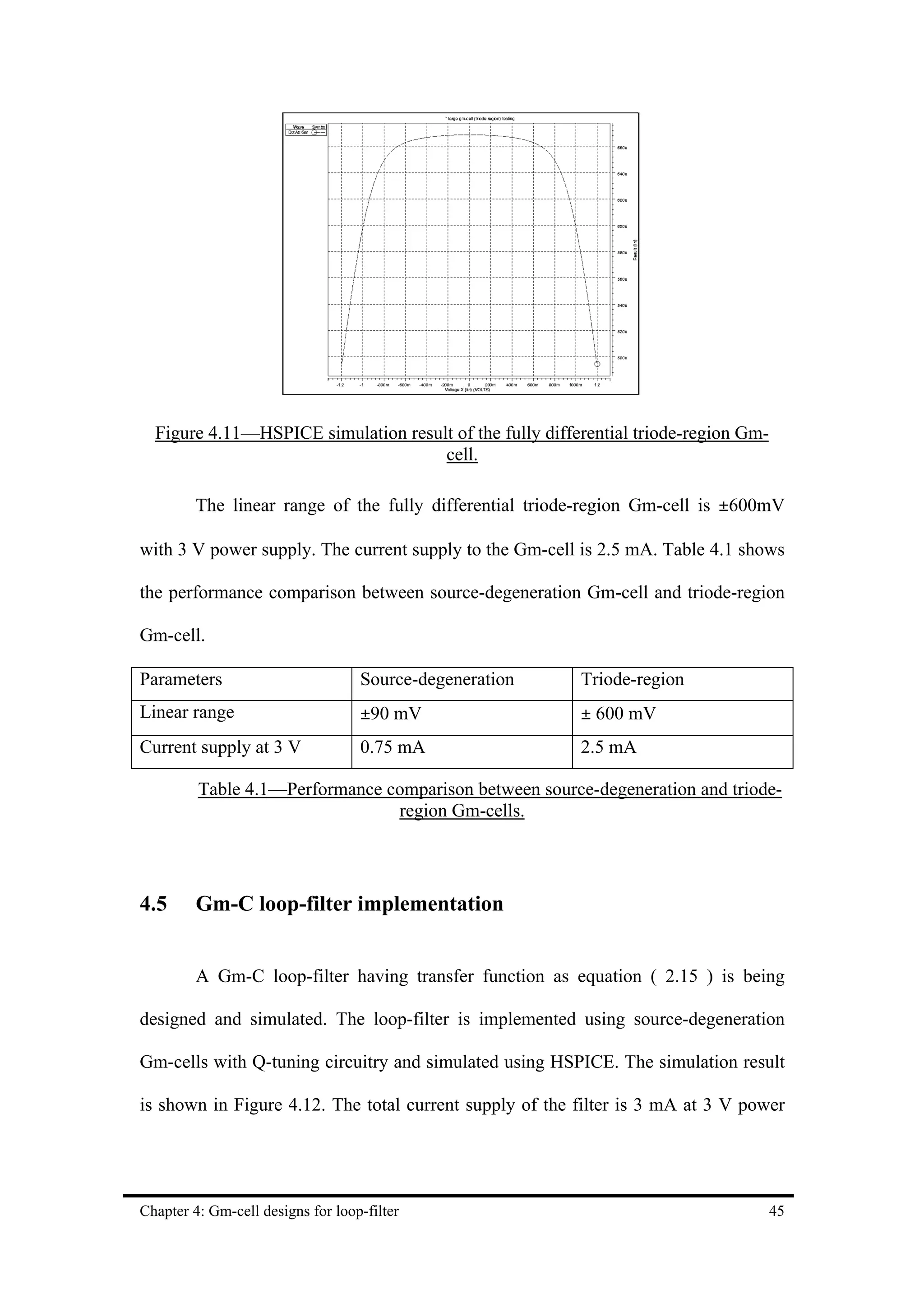
amp and Figure 4.11 shows the HSPICE simulation results of the fully differential

triode-region Gm-cell using 3 V power supply.

         The gain of the op-amp is 34 dB, and the bandwidth of the op-amp is 4 MHz

with 0.2pF capacitive loading at the output.


             Figure 4.10—HSPICE simulated AC response of the designed op-amp.

Chapter 4: Gm-cell designs for loop-filter                                           44
Figure 4.11—HSPICE simulation result of the fully differential triode-region Gm-
                                     cell.

         The linear range of the fully differential triode-region Gm-cell is ±600mV

with 3 V power supply. The current supply to the Gm-cell is 2.5 mA. Table 4.1 shows

the performance comparison between source-degeneration Gm-cell and triode-region

Gm-cell.

Parameters                         Source-degeneration   Triode-region
Linear range                       ±90 mV                ± 600 mV
Current supply at 3 V              0.75 mA               2.5 mA

         Table 4.1—Performance comparison between source-degeneration and triode-
                                region Gm-cells.


4.5      Gm-C loop-filter implementation


         A Gm-C loop-filter having transfer function as equation ( 2.15 ) is being

designed and simulated. The loop-filter is implemented using source-degeneration

Gm-cells with Q-tuning circuitry and simulated using HSPICE. The simulation result

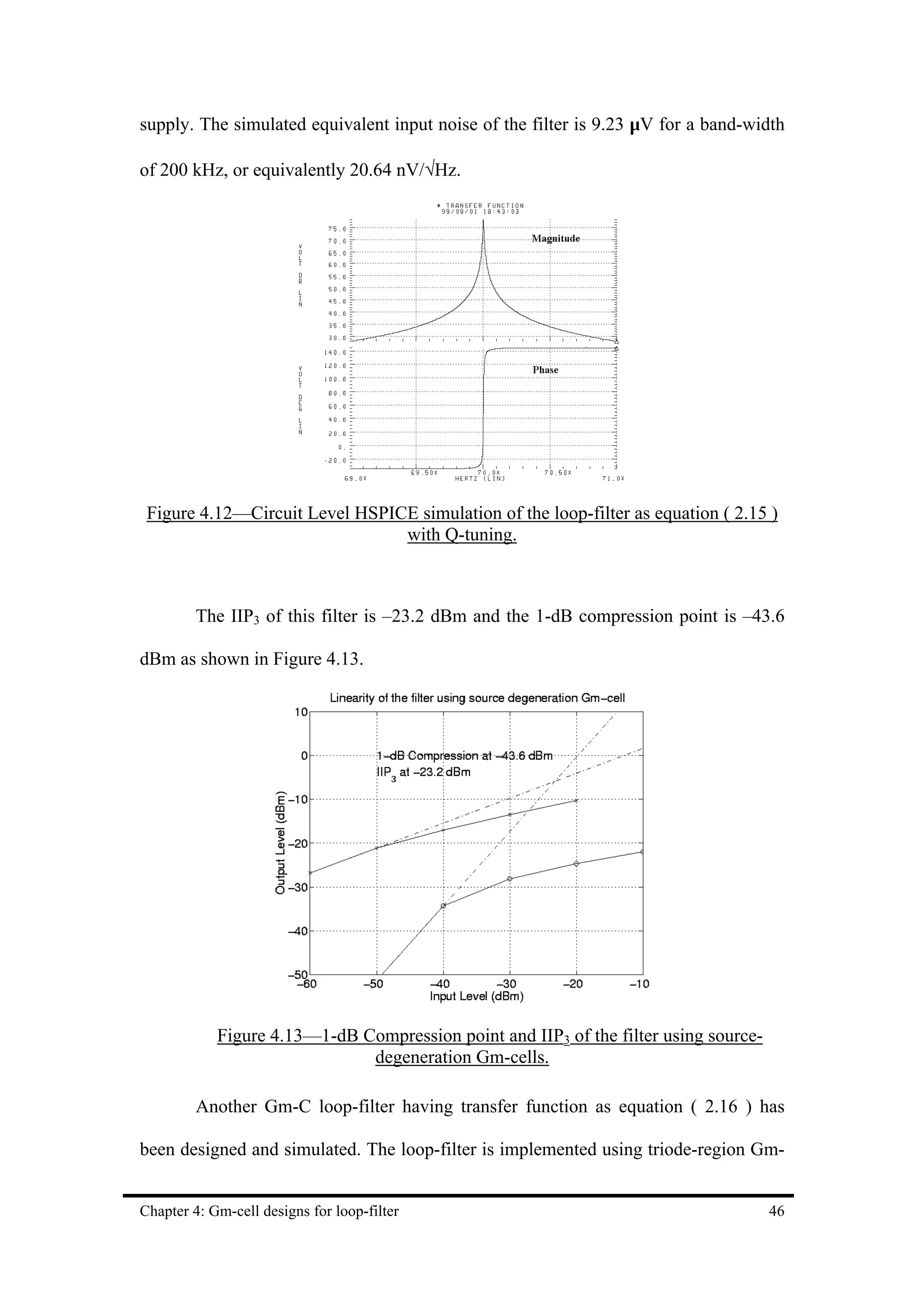
is shown in Figure 4.12. The total current supply of the filter is 3 mA at 3 V power


Chapter 4: Gm-cell designs for loop-filter                                           45
supply. The simulated equivalent input noise of the filter is 9.23 µV for a band-width

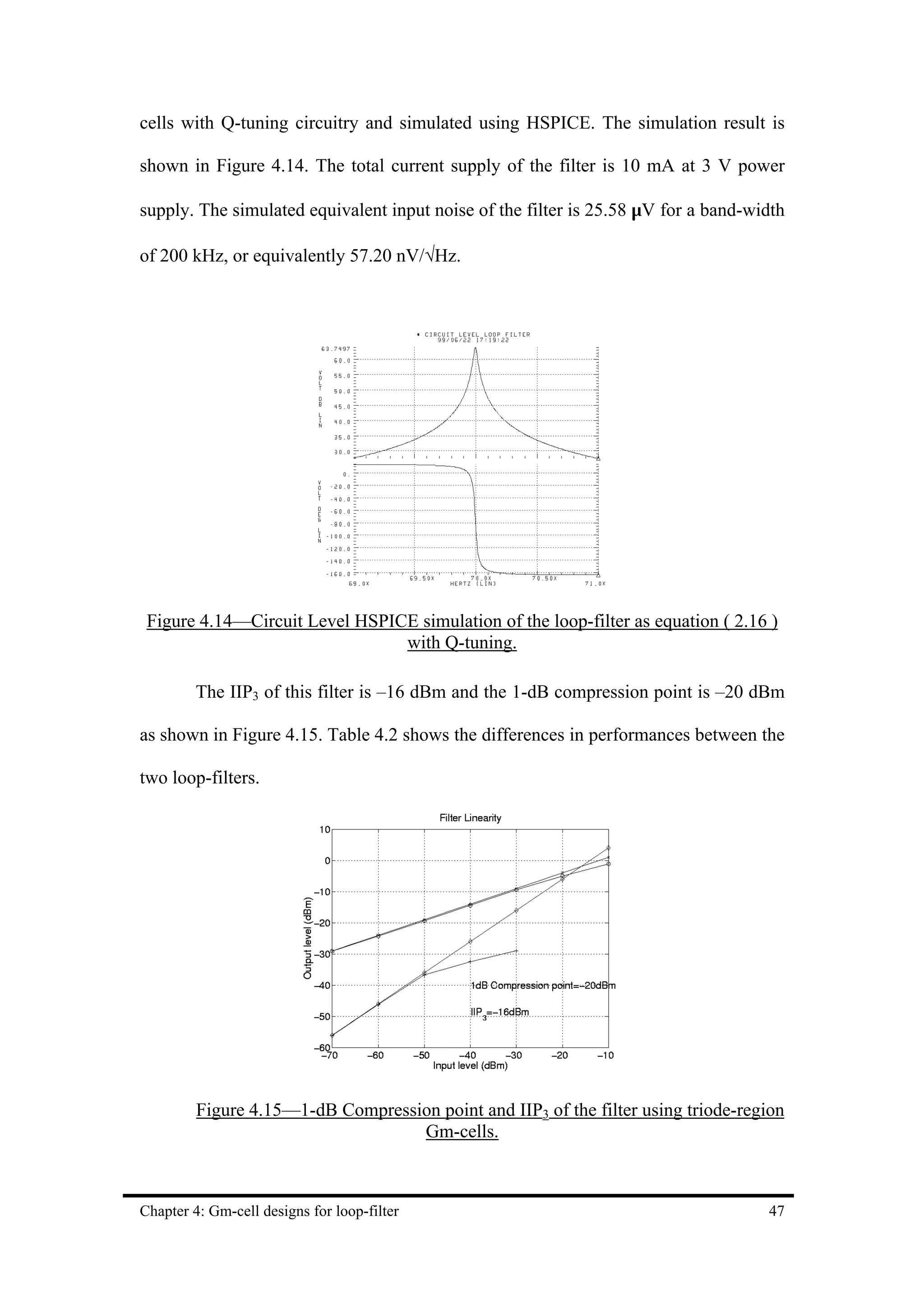
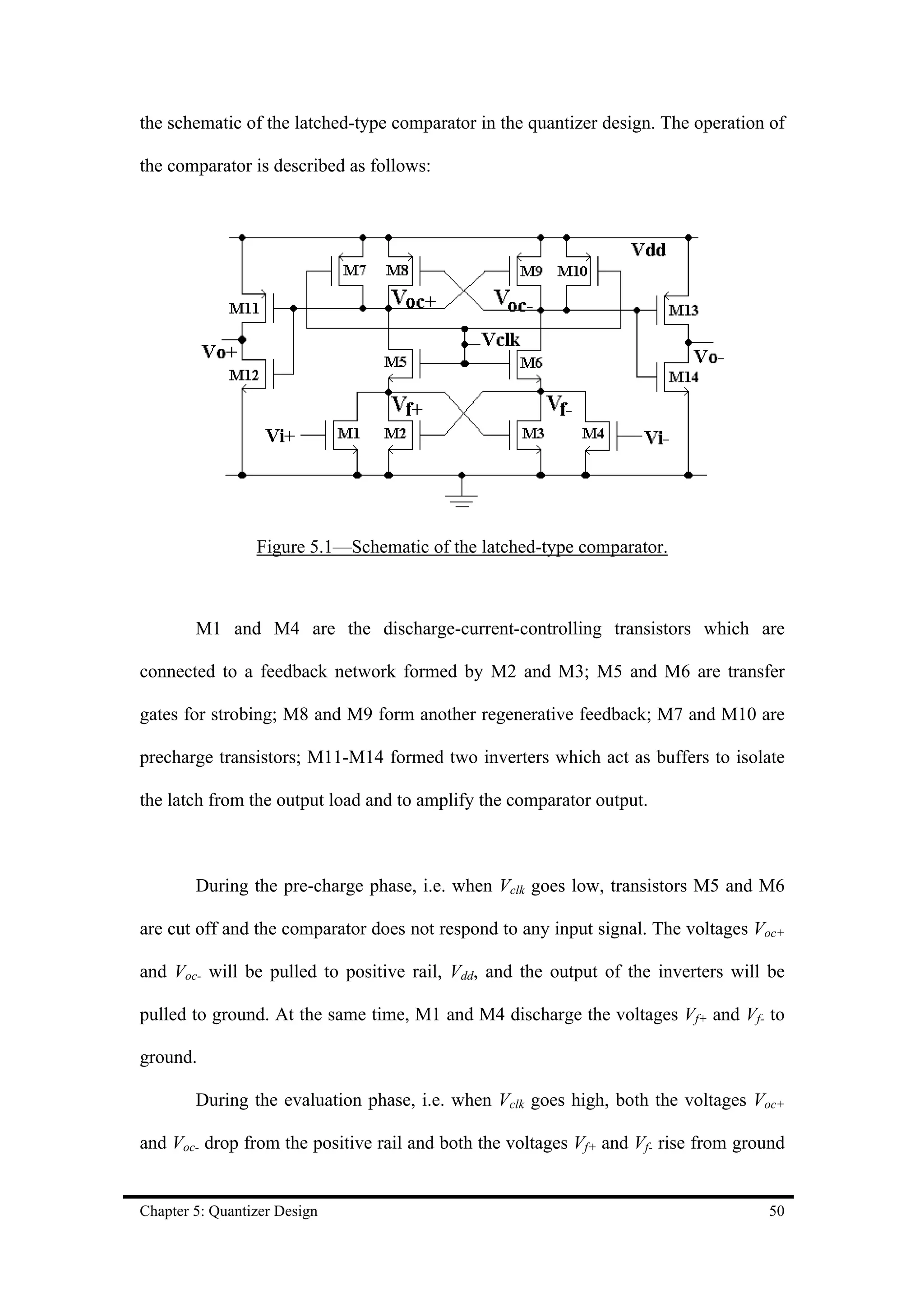
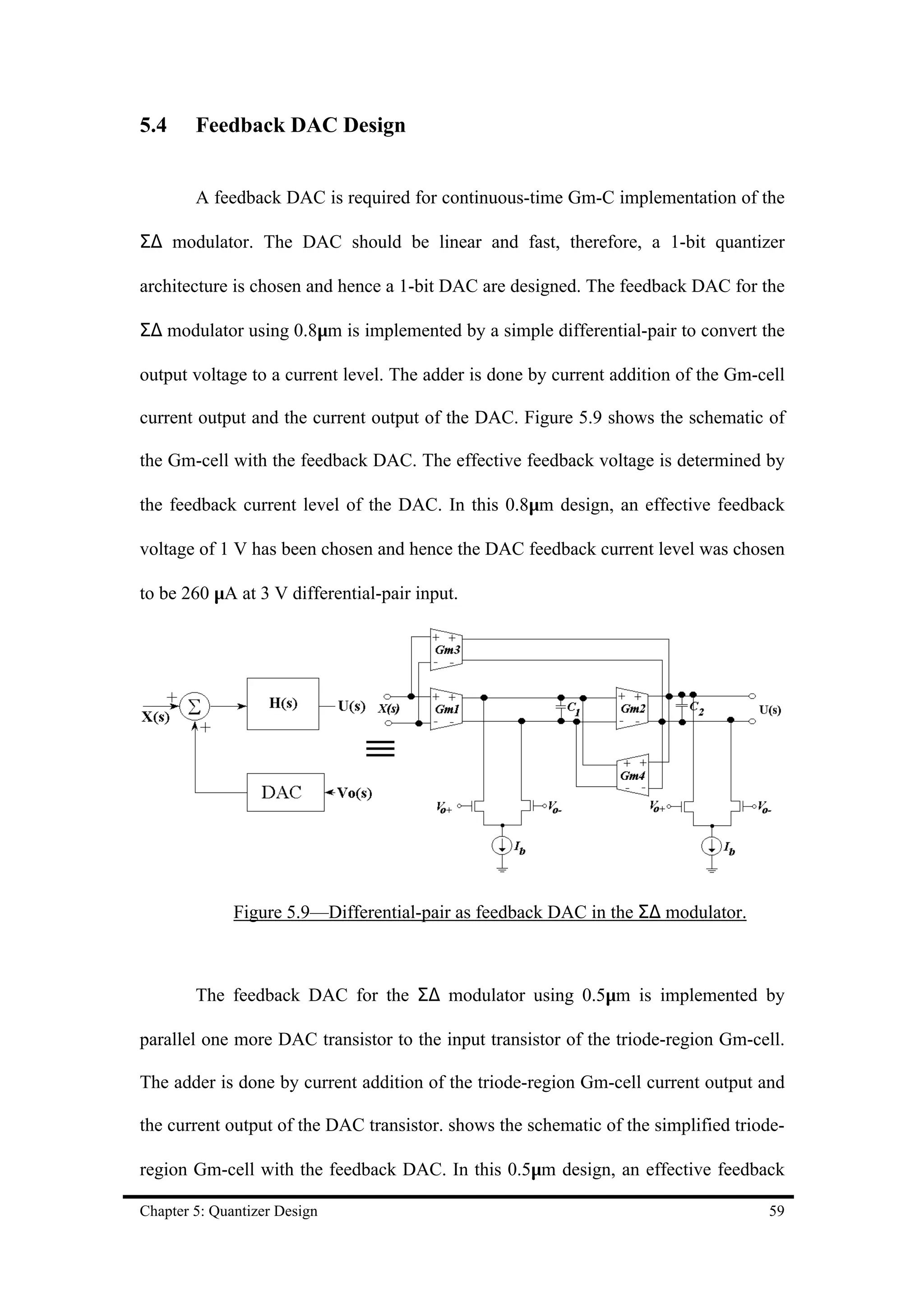
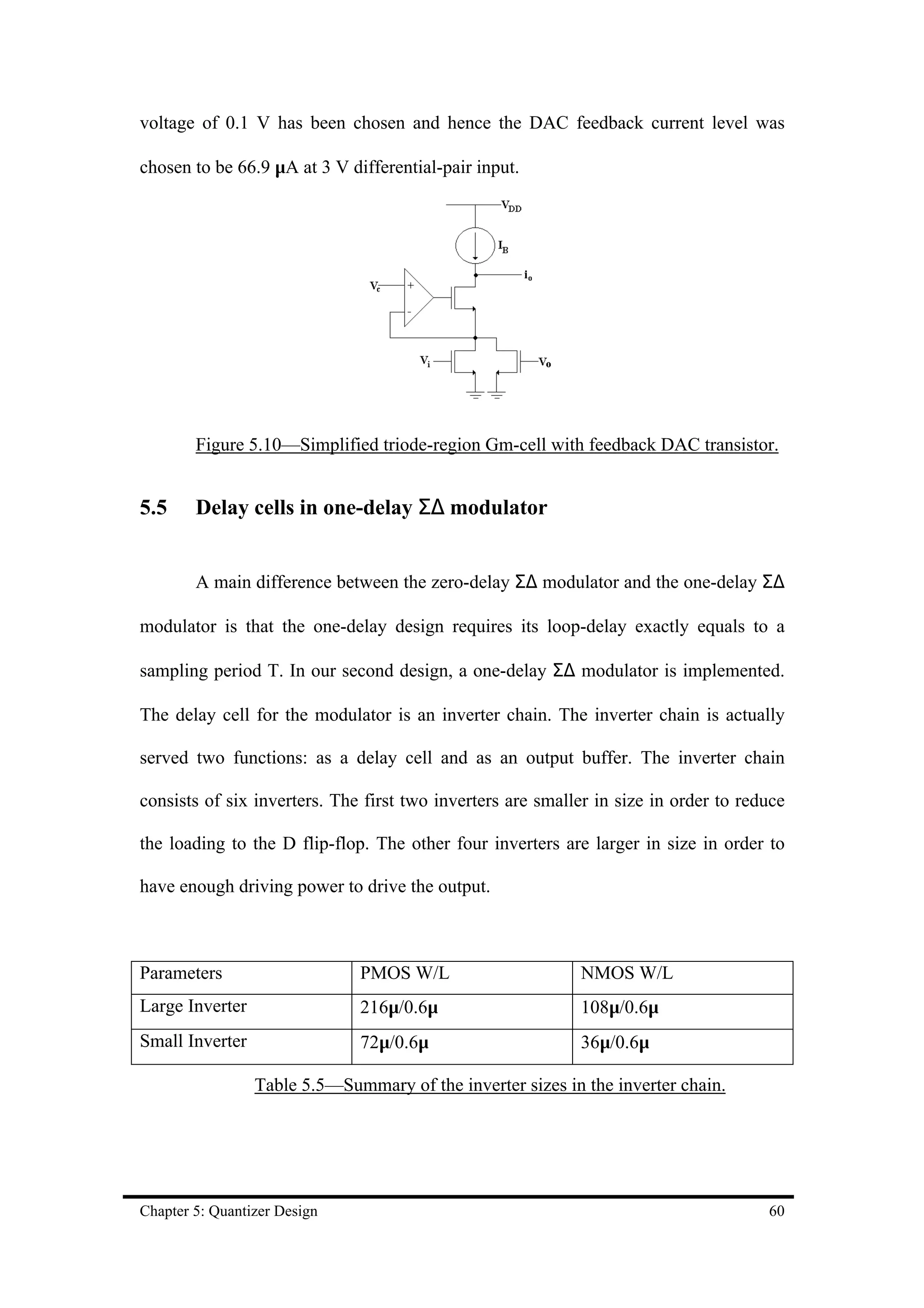
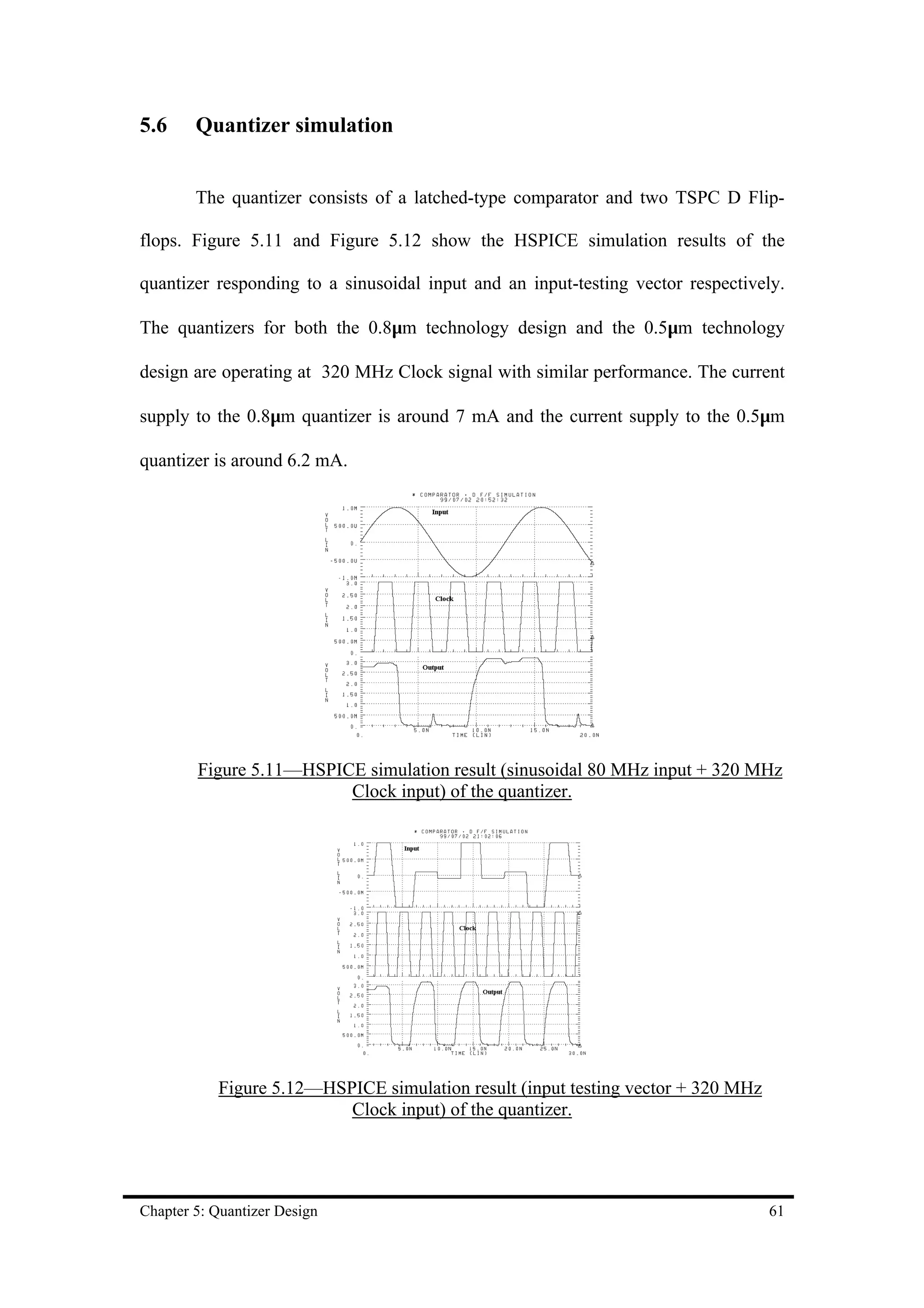
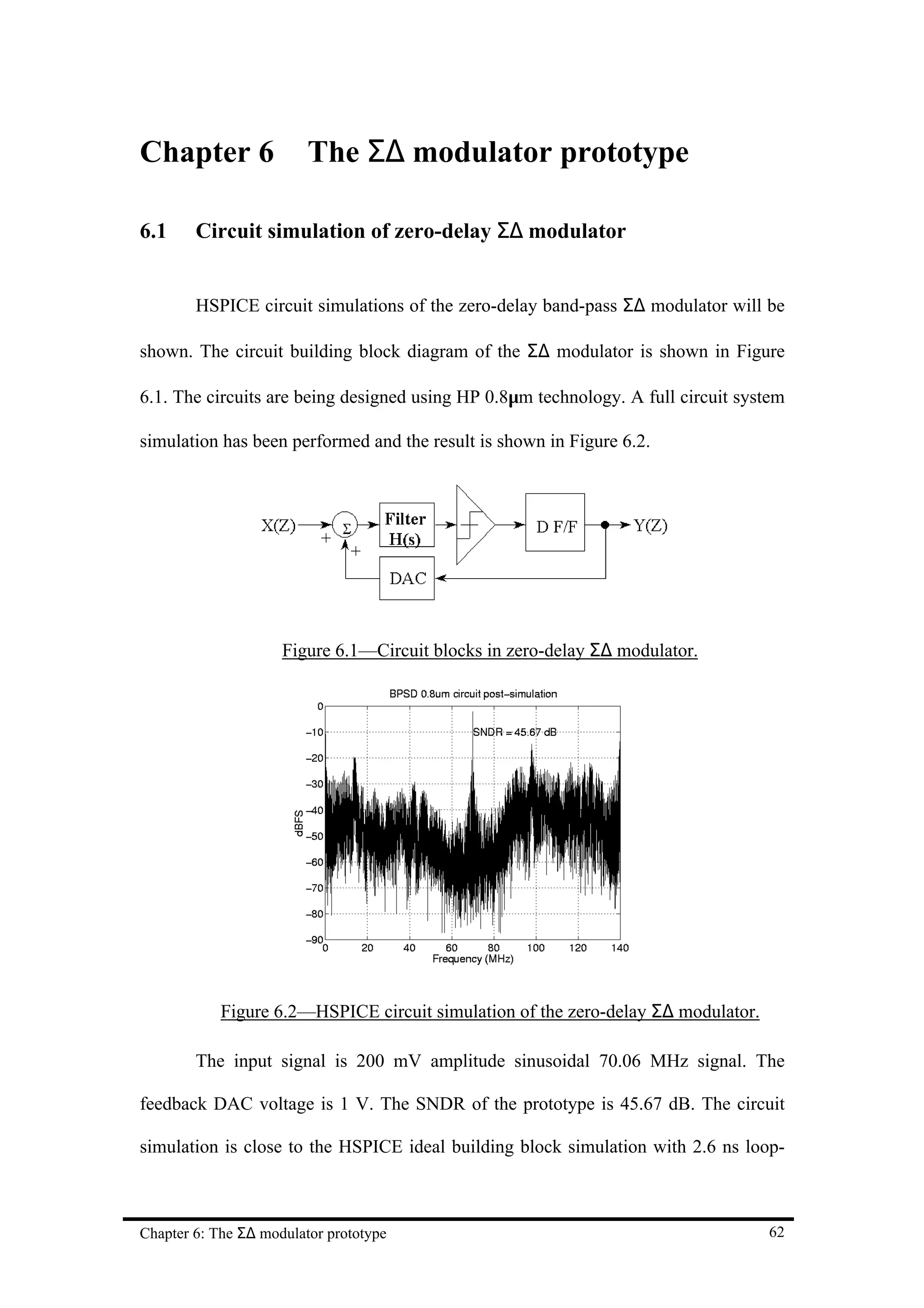
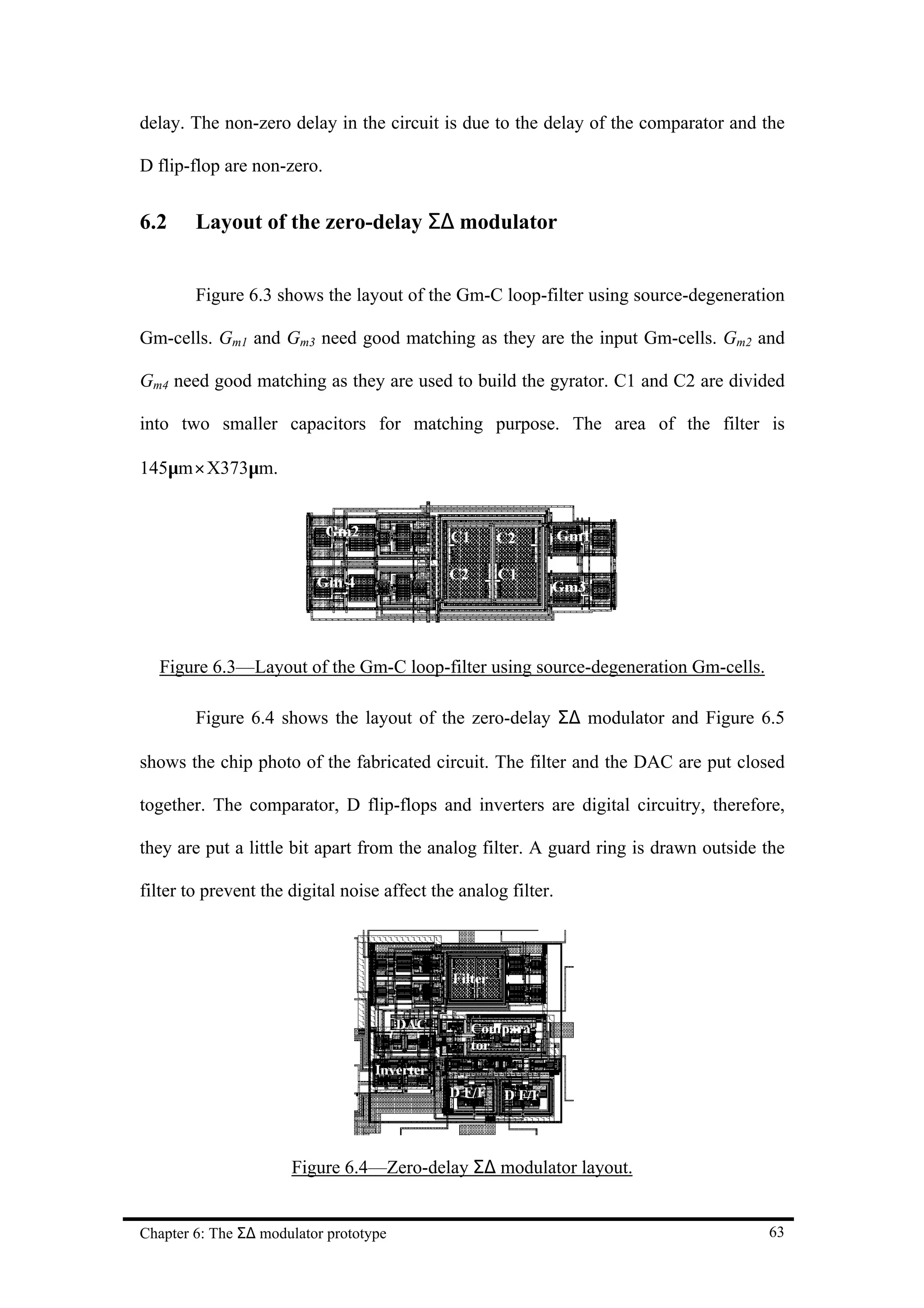
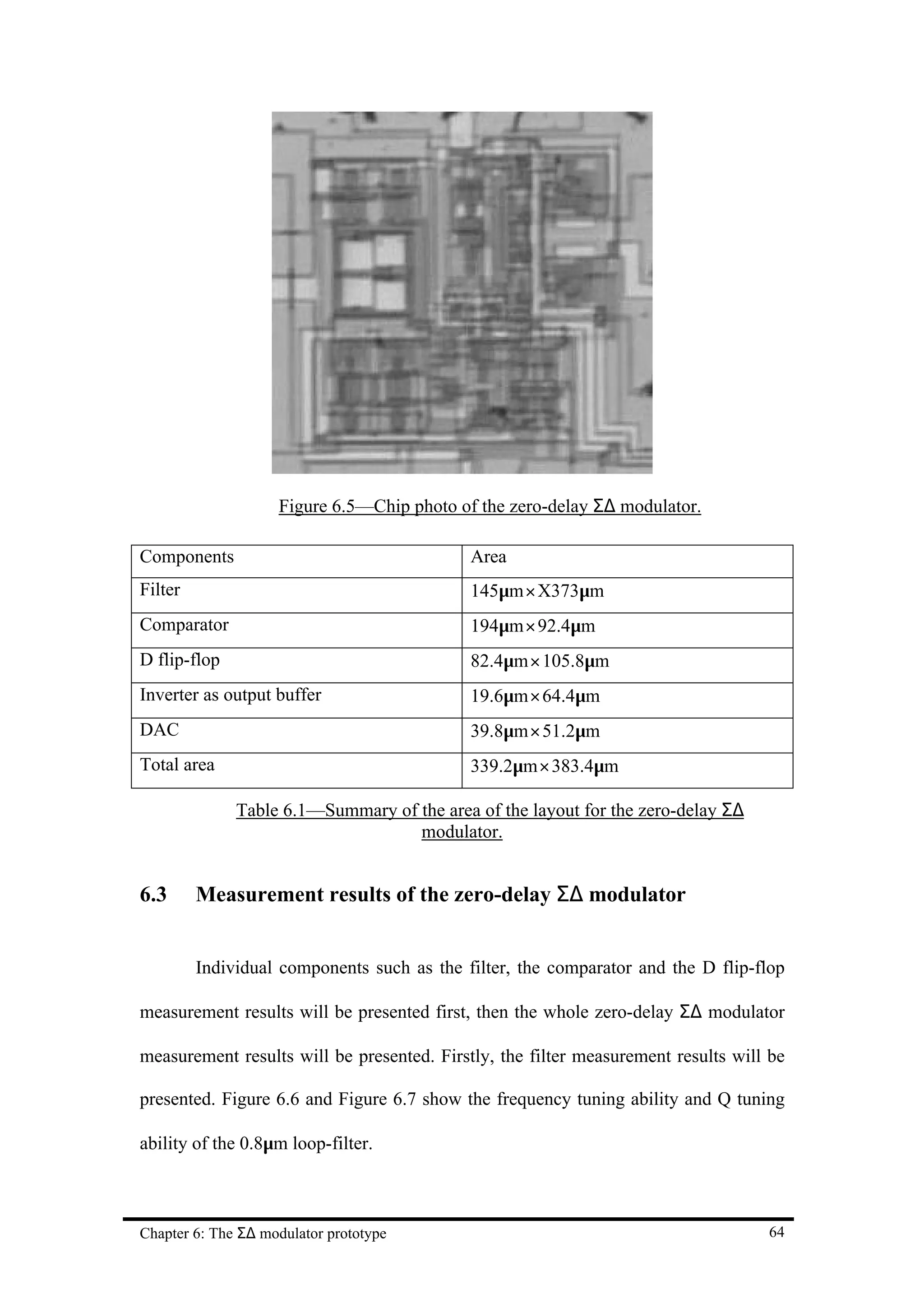
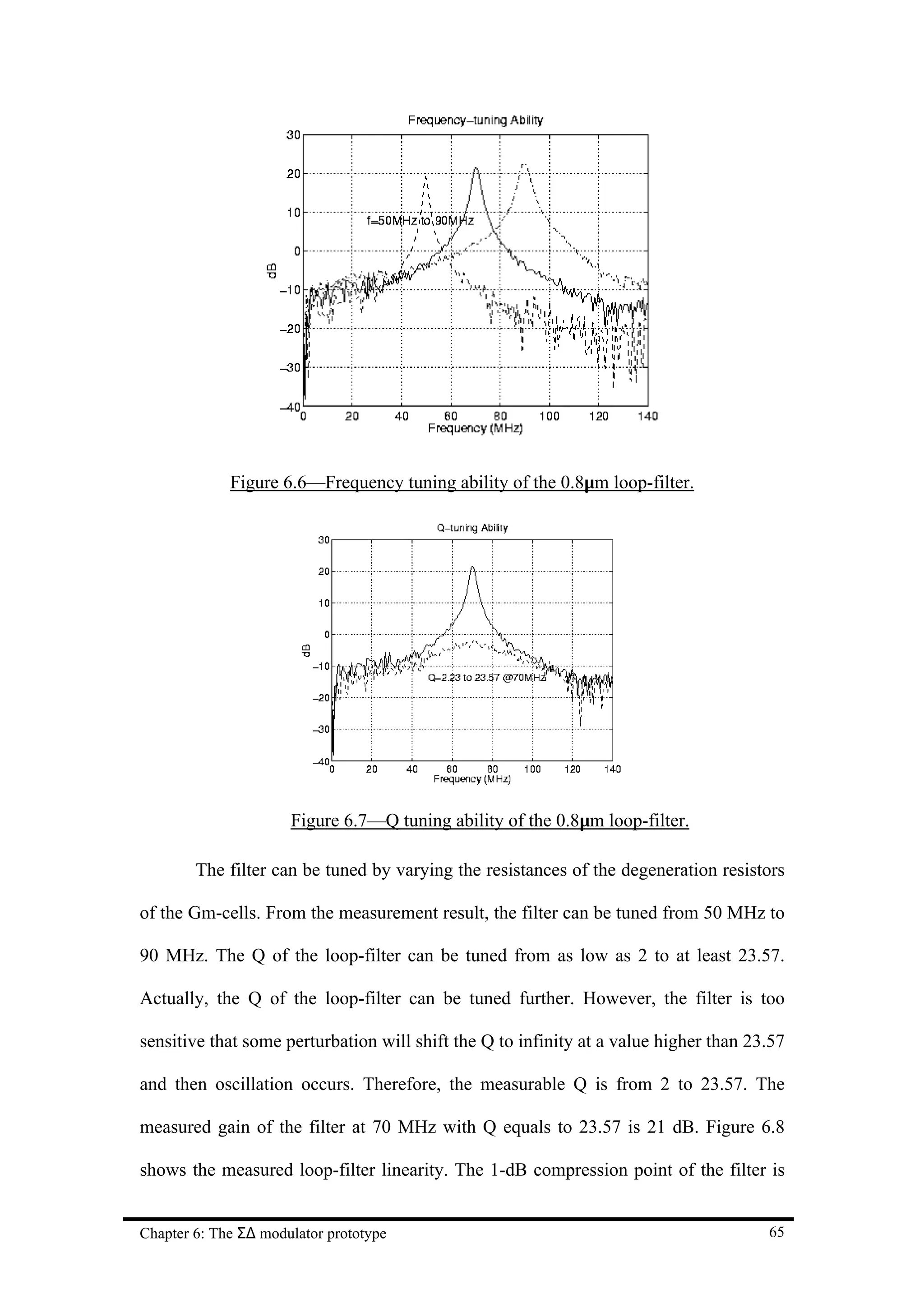
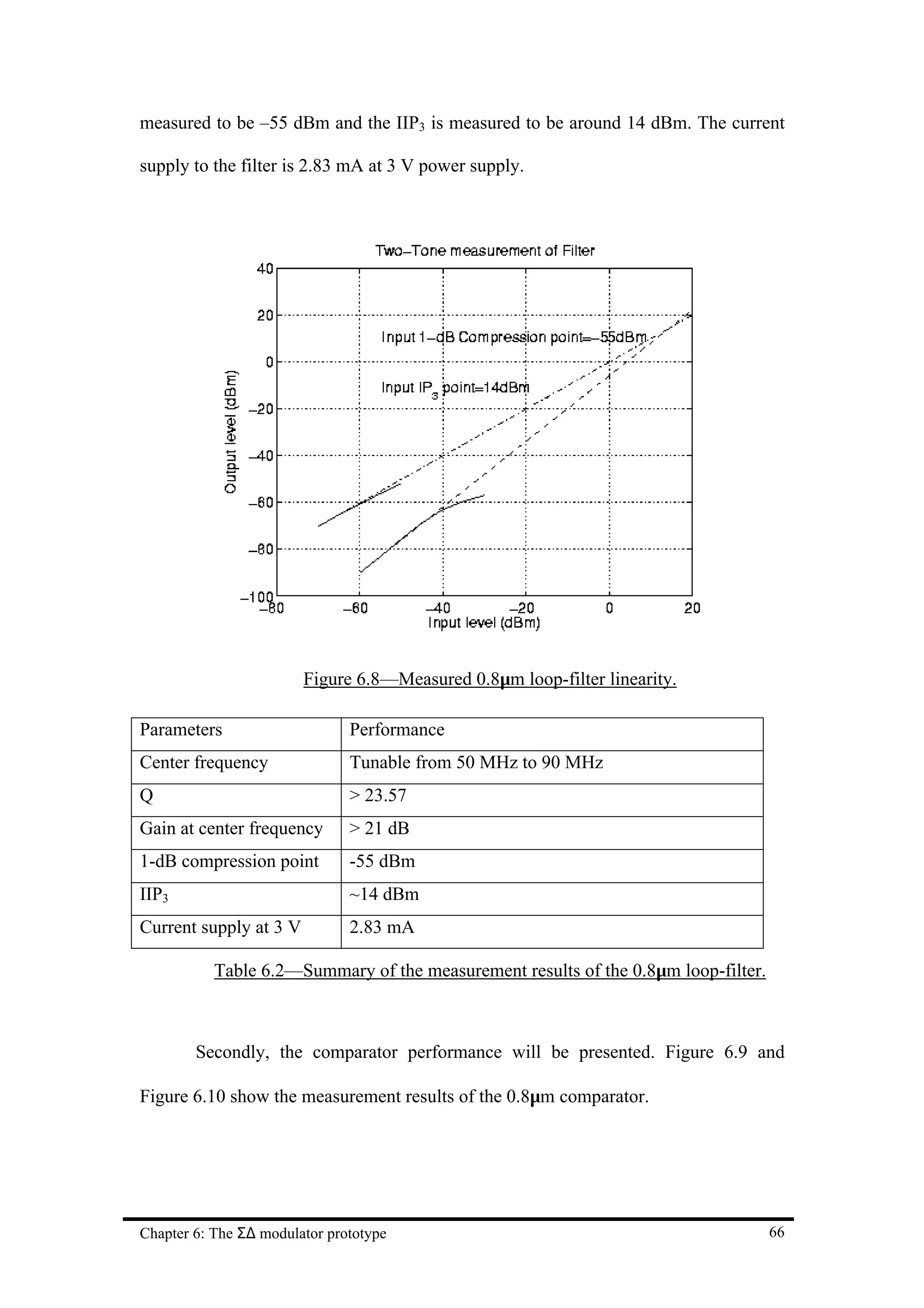
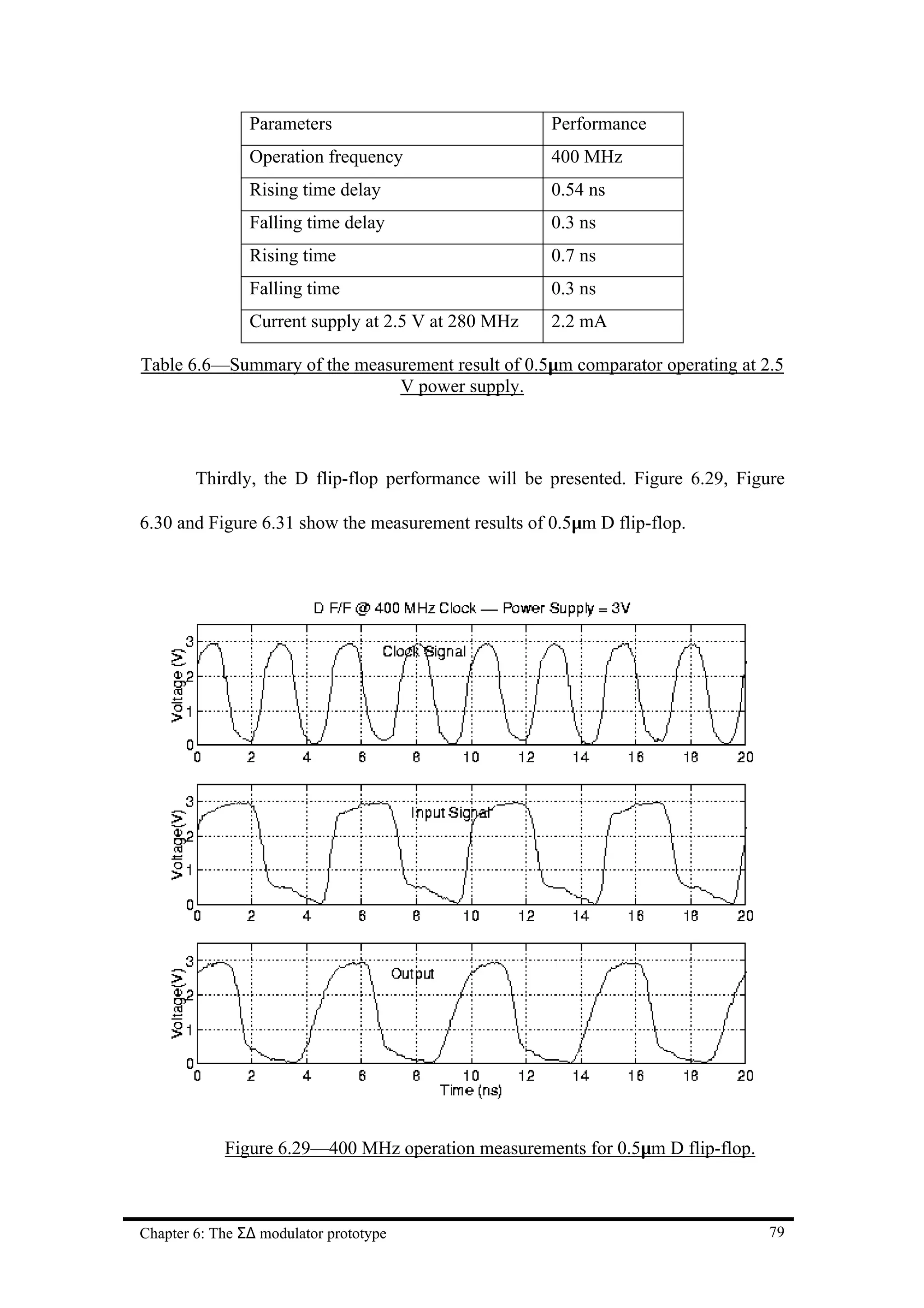
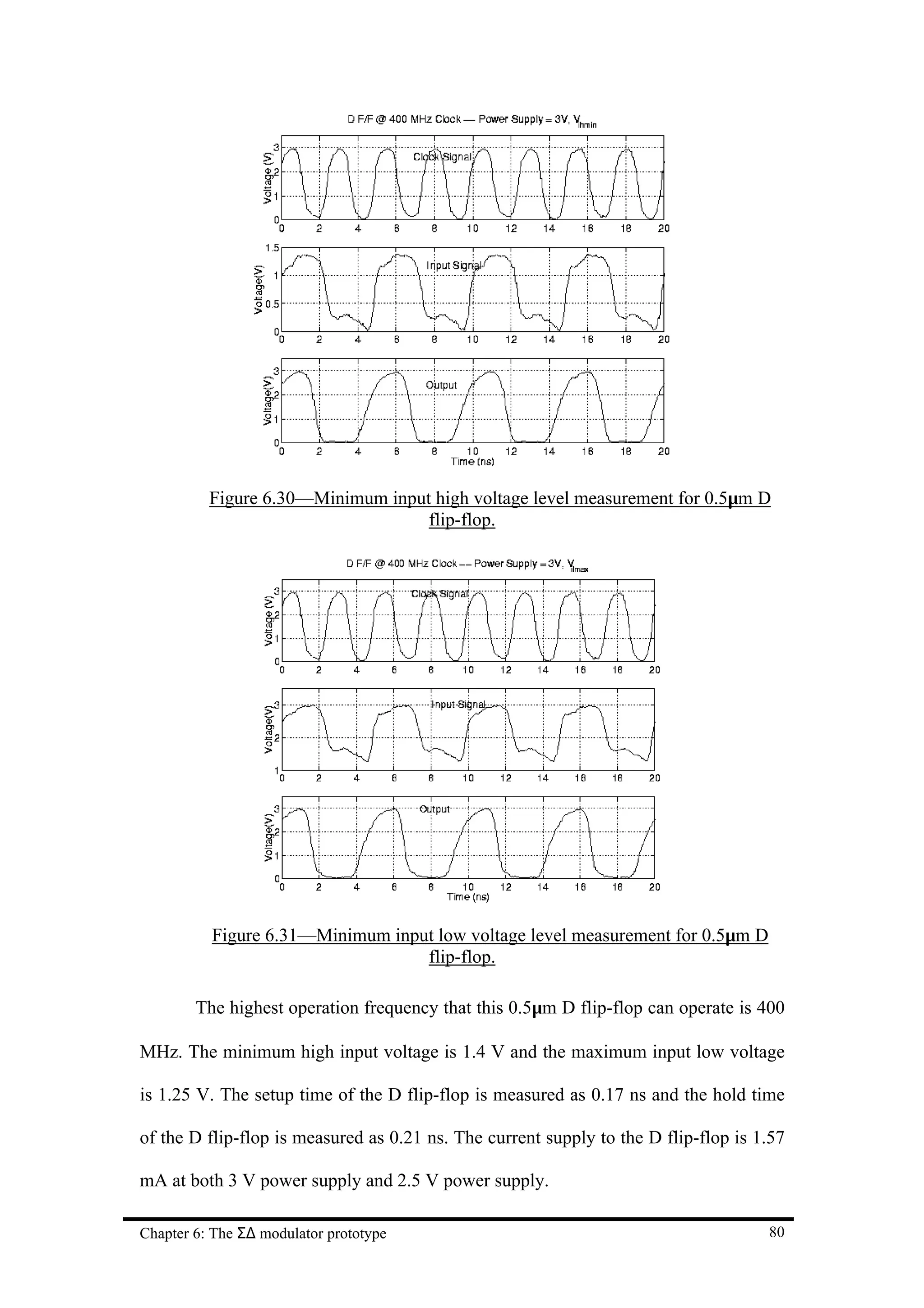
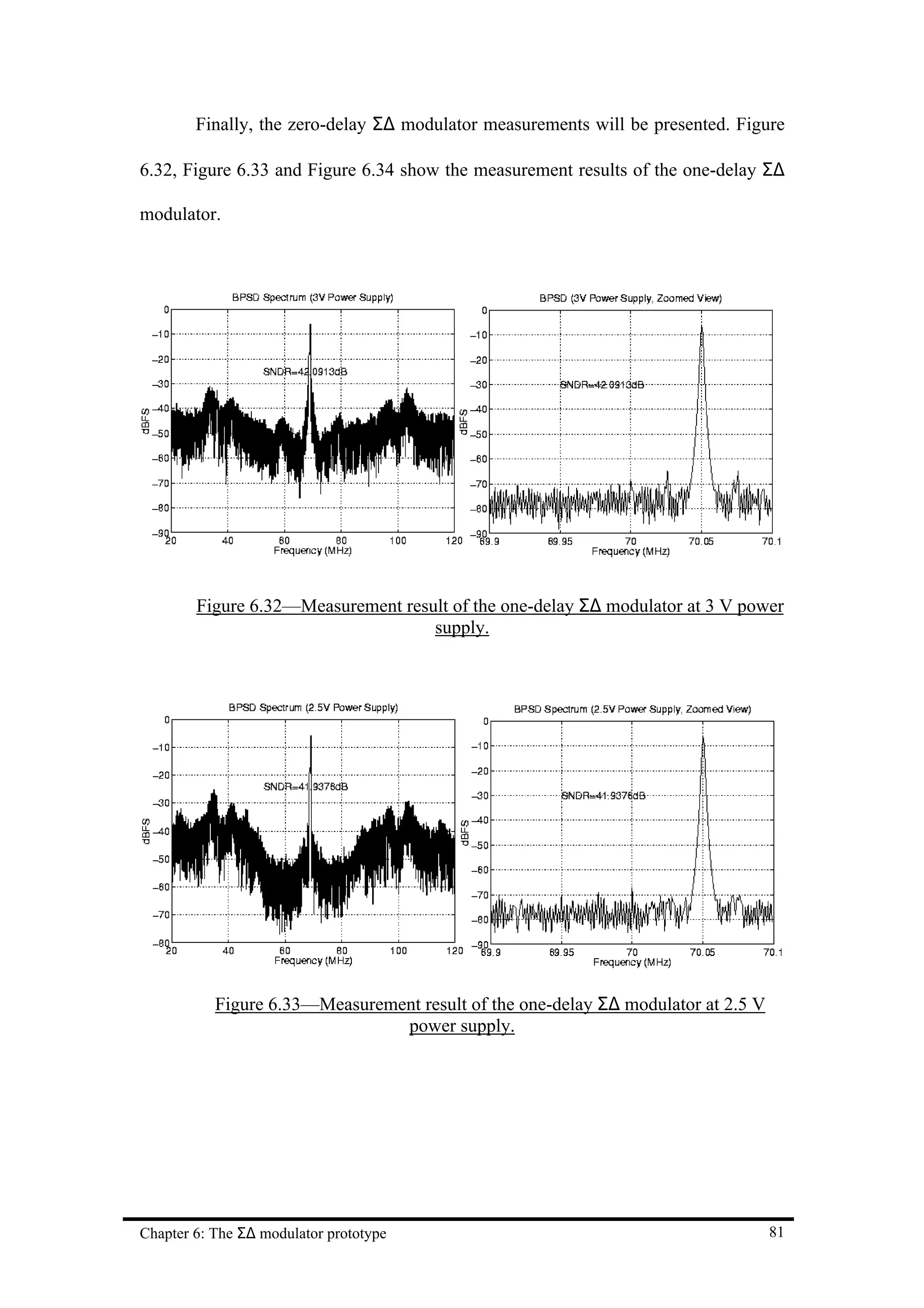
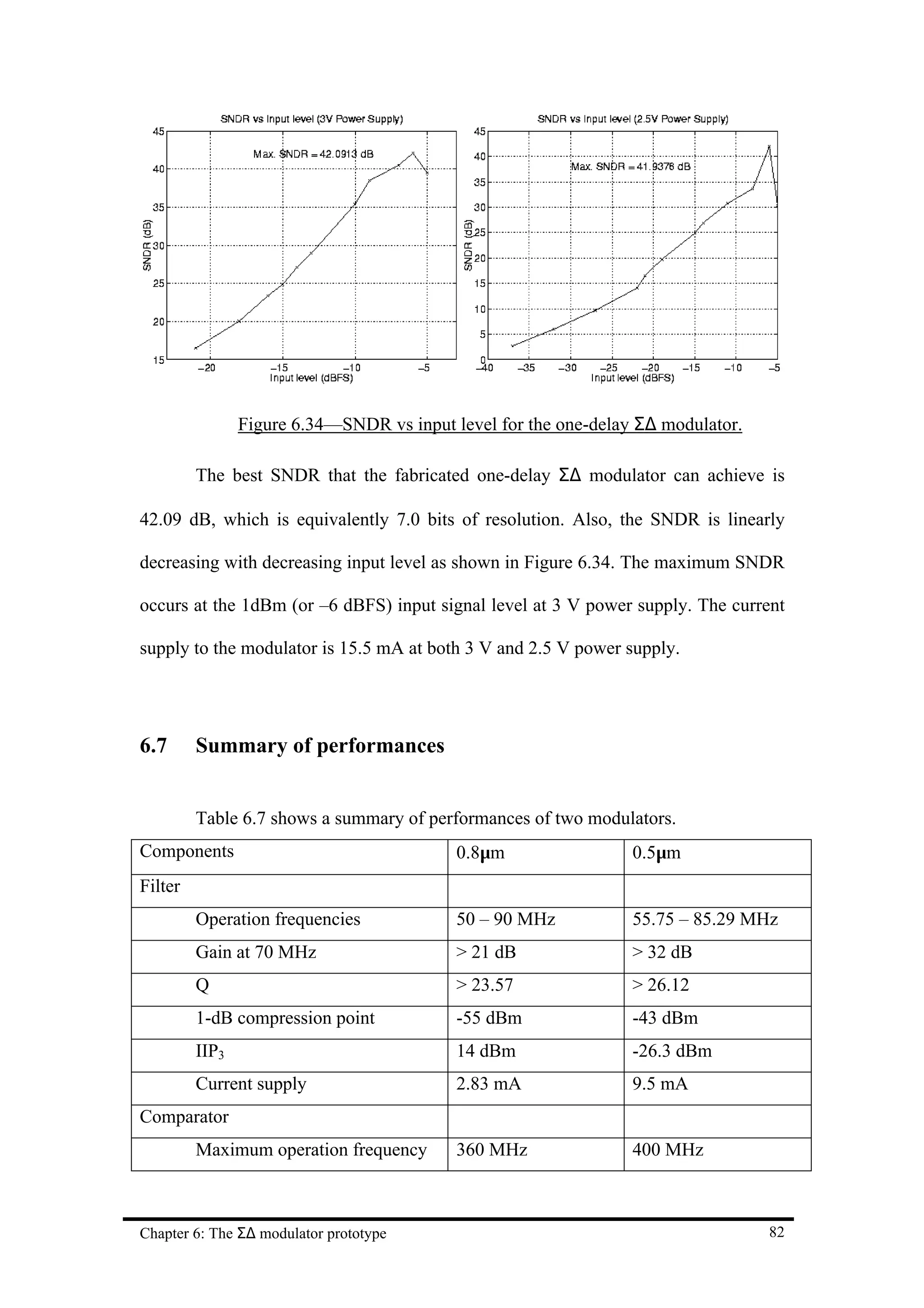
of 200 kHz, or equivalently 20.64 nV/√Hz.


 Figure 4.12—Circuit Level HSPICE simulation of the loop-filter as equation ( 2.15 )
                                with Q-tuning.


         The IIP3 of this filter is –23.2 dBm and the 1-dB compression point is –43.6

dBm as shown in Figure 4.13.


            Figure 4.13—1-dB Compression point and IIP3 of the filter using source-
                              degeneration Gm-cells.

         Another Gm-C loop-filter having transfer function as equation ( 2.16 ) has

been designed and simulated. The loop-filter is implemented using triode-region Gm-


Chapter 4: Gm-cell designs for loop-filter                                            46
cells with Q-tuning circuitry and simulated using HSPICE. The simulation result is

shown in Figure 4.14. The total current supply of the filter is 10 mA at 3 V power

supply. The simulated equivalent input noise of the filter is 25.58 µV for a band-width

of 200 kHz, or equivalently 57.20 nV/√Hz.


 Figure 4.14—Circuit Level HSPICE simulation of the loop-filter as equation ( 2.16 )
                                with Q-tuning.

         The IIP3 of this filter is –16 dBm and the 1-dB compression point is –20 dBm

as shown in Figure 4.15. Table 4.2 shows the differences in performances between the

two loop-filters.


         Figure 4.15—1-dB Compression point and IIP3 of the filter using triode-region
                                   Gm-cells.


Chapter 4: Gm-cell designs for loop-filter                                          47
Parameters  Design                Source-degeneration       Triode-region
Center frequency                   70 MHz                    70 MHz
Gain at center frequency           77 dB                     63.75 dB
Q                                  > 100                     > 100
1-dB compression point             -43.6 dBm                 -20 dBm
IIP3                               -23.2 dBm                 -16 dBm
Equivalent input noise             9.23 µV or 20.64 nV/√Hz   25.58 µV or 57.20 nV/√Hz
Total current supply               3 mA                      10 mA

              Table 4.2—Summary of the simulation results of the two loop-filters.

         The current supply to the loop-filter implemented using source-degeneration

Gm-cells is less than that implemented using triode-region Gm-cells. The reason is

that the triode-region Gm-cells need extra current for op-amp biases. The noise of the

loop-filter using source-degeneration is better than that using triode-region. The

reason is that the triode-region MOS transistors are noisier than saturation-region

MOS transistors. However, as the linear range of the Gm-cells using the triode-region

is much larger than that using source-degeneration. Therefore, the linearity of the

loop-filter implemented using triode-region transistor is better than that implemented

using source-degeneration.


Chapter 4: Gm-cell designs for loop-filter                                           48
Chapter 5                Quantizer Design

5.1     Introduction


        A core component of any analog-to-digital converter (ADC) is a quantizer. As

mentioned in Chapter 2, Nyquist converters need precise analog components in their

conversion circuits. Typically, a quantizer design includes a very precise sample-and-

hold circuit and a high-accuracy comparator working at Nyquist sampling frequency.

The accuracy requirement of the comparator depends on the accuracy requirement of

the converter, e.g. an 8-bit ADC requires a comparator with at least 8-bit accuracy. In

contrast, in Σ∆ modulators, the comparator is required to work at a high oversampling

frequency but its resolution can be as small as 1 bit. Therefore, the comparator design

in Σ∆ modulators focuses more on a high-speed operation instead of accuracy.


        In Section 5.2, a latched-type comparator for the quantizer design will be

described. As mentioned in Chapter 2, the quantized signal should be a non-return-to-

zero (NRZ) waveform, therefore a zero-order-hold (ZOH) circuit is needed. In

Section 5.3, a true-single-phase-clock (TSPC) D flip-flop for the ZOH circuit will be

described. Finally, a simple feedback DAC design and the HSPICE simulation of the

whole quantizer will be shown in Sections 5.4 and 5.6 respectively.


5.2     Comparator Design


        To combine the sample-and-hold function and the comparator function in a

quantizer, the latched-type comparator [18],[19] is the best choice. Figure 5.1 depicts

Chapter 5: Quantizer Design                                                         49
the schematic of the latched-type comparator in the quantizer design. The operation of

the comparator is described as follows:


                 Figure 5.1—Schematic of the latched-type comparator.


        M1 and M4 are the discharge-current-controlling transistors which are

connected to a feedback network formed by M2 and M3; M5 and M6 are transfer

gates for strobing; M8 and M9 form another regenerative feedback; M7 and M10 are

precharge transistors; M11-M14 formed two inverters which act as buffers to isolate

the latch from the output load and to amplify the comparator output.


        During the pre-charge phase, i.e. when Vclk goes low, transistors M5 and M6

are cut off and the comparator does not respond to any input signal. The voltages Voc+

and Voc- will be pulled to positive rail, Vdd, and the output of the inverters will be

pulled to ground. At the same time, M1 and M4 discharge the voltages Vf+ and Vf- to

ground.

        During the evaluation phase, i.e. when Vclk goes high, both the voltages Voc+

and Voc- drop from the positive rail and both the voltages Vf+ and Vf- rise from ground


Chapter 5: Quantizer Design                                                         50
initially. If the voltage at Vi+ is higher than that at Vi-, M1 draws more current than

M4. Thus, Voc+ drops faster than Voc- and Vf- rises faster than Vf+. As Voc+ drops a

threshold voltage below Vdd, M9 turns on and charge Voc- to high level while Voc+

keeps going to ground as shown in Figure 5.2. Also, as Vf- rises a threshold voltage

above ground, M2 turns on and discharge Vf+ to ground while Vf- keeps rising to Vdd.


            Figure 5.2—Regenerative action of the latched-type comparator.


        The regenerative action of M8 and M9 together with that of M2 and M3 pulls

Voc+ to ground and pulls Voc- to positive rail. Hence, following the inverters M11-

M14, Vo+ is pulled to positive rail and Vo- is pulled to ground. The operation for the

case when the voltage at Vi- is higher than that at Vi+ is similar.

        In designing the W/L ratios of the transistors for the comparator,

considerations have to be made for high-speed operation. The delay of the whole

comparator determines the fastest operation frequency of the comparator. The delay

Chapter 5: Quantizer Design                                                         51
of the comparator, tdelay, can be divided into two parts: the comparator core delay, tdc,

and the inverter delay, tdi:

                       t delay = t dc + t di                                        ( 5.1 )

        For high-speed operation, the sizes of transistors M5 and M6 should be large

enough so that their resistance values are minimal but should be small enough at the

same time to reduce the capacitance in order to have minimal tdc. The sizes of

transistors M1 and M4 should be large enough to ensure quick response to the input

signal, but small enough for minimal gate capacitances for high-speed operation. The

sizes of transistors M2, M3, M8 and M9 should be small enough for high-speed

operation, but large enough for quick regenerative action. Finally, the inverter

transistors M11-M14 should be large enough for driving the output load to reduce the

tdi, but small enough for minimal gate-capacitances to reduce the tdc.

        Table 5.1 shows the W/L ratios of the transistors of the two designs of the

comparator.

Transistor      0.8µm               0.5µm        Transistor   0.8µm         0.5µm
M1              9.6µ/0.8µ           7.2µ/0.6µ    M8           64µ/0.8µ      33.6µ/0.6µ
M2              20µ/0.8µ            30µ/0.6µ     M9           64µ/0.8µ      33.6µ/0.6µ
M3              20µ/0.8µ            30µ/0.6µ     M10          59.2µ/0.8µ    44.4µ/0.6µ
M4              9.6µ/0.8µ           7.2µ/0.6µ    M11          59.2µ/0.8µ    44.4µ/0.6µ
M5              59.2µ/0.8µ          24µ/0.6µ     M12          19.2µ/0.8µ    14.4µ/0.6µ
M6              59.2µ/0.8µ          24µ/0.6µ     M13          59.2µ/0.8µ    44.4µ/0.6µ
M7              59.2µ/0.8µ          44.4µ/0.6µ   M14          19.2µ/0.8µ    14.4µ/0.6µ

                Table 5.1—W/L ratios of the transistors of the two comparators.


        Figure 5.3 and Figure 5.4 shows the HSPICE simulation results of the

comparator under different testing conditions. 3 V power supply and 0.5pF output


Chapter 5: Quantizer Design                                                             52
capacitive loading are used in the simulations. The input testing vector in Figure 5.4 is

chosen in such a way that all the worst-case input situations are covered.


    Figure 5.3—HSPICE Simulation of the comparator (320 MHz Clock, 80 MHz
                              sinusoidal input).


  Figure 5.4—HSPICE Simulation of the comparator (320 MHz Clock, input testing
                                   vector).


Chapter 5: Quantizer Design                                                           53
For the design using 0.8µm technology, the rising time delay, tdr, from the

clock to the output is 0.95ns. The falling time delay, tdf, from the clock to the output is

0.53ns. The rising time, tr, of the output is 0.73ns and the falling time, tf, of the output

is 0.28ns. The total current supply of the comparator is 3 mA at operation frequency

of 280 MHz and 3 V power supply.

        For the design using 0.5µm technology, the rising time delay, tdr, from the

clock to the output is 0.83ns. The falling time delay, tdf, from the clock to the output is

0.27ns. The rising time, tr, of the output is 0.62ns and the falling time, tf, of the output

is 0.15ns. The total current supply of the comparator is 2.6 mA at operation frequency

of 280 MHz and 3 V power supply. Table 5.2 shows the summary of the simulated

results of two designed latched-type comparators.

                                                0.8µm               0.5µm
      Operation frequency                       320 MHz             320 MHz
      Rising time delay                         0.95 ns             0.83 ns
      Falling time delay                        0.53 ns             0.27 ns
      Rising time                               0.73 ns             0.62 ns
      Falling time                              0.28 ns             0.15 ns
      Current supply at 3 V at 280 MHz          3 mA                2.6 mA

      Table 5.2—Summary of simulated results of the latched-type comparators.


5.3     D flip-flop Design


        In order to convert the return-to-zero (RZ) output of the comparator to a NRZ

output, a D flip-flop is added after the latched-type comparator. It is too slow for

usual static D flip-flop to be used in a 280 MHz sampling system, therefore, a TSPC

D flip-flop [20],[21] is chosen. Figure 5.5 shows the schematic of the design of the


Chapter 5: Quantizer Design                                                              54
TSPC D flip-flop, and Figure 5.6 shows the operation of this negative-edge triggered

TSPC D flip-flop.


                         Figure 5.5—Schematic of the TSPC D flip-flop.


         Figure 5.6—Operations of the TSPC D flip-flop. (a) Clock is high, (b) Clock
                                      is low.

        When the clock signal is high, as shown in Figure 5.6(a), the transistors M6

and M8 are cut off and the transistors M2 and M4 are turned on. The voltage Vd4 is

being pulled to ground and hence forces the transistor M7 cut off. The output node is

therefore disconnected to either positive rail or the ground and the output therefore is

being latched to the previous value. On the other hand, the transistors M1-M3 formed


Chapter 5: Quantizer Design                                                          55
a clock-buffered inverter. When the clock signal is high, the drain voltage of the

transistor M2 is the output of this inverter. The output of this inverter connects to the

gate of the transistor M5 and the output value of this inverter is being stored in the

gate capacitor of the transistor M5.

        When the clock signal is low, as shown in Figure 5.6(b), the transistors M2

and M4 are cut off and the transistors M6 and M8 are turned on. The inverter formed

by the transistors M1-M3 is being disconnected due to the cut off of the transistor M2.

However, the charges stored in the gate capacitor of the transistor M5 will not be

reduced. If the gate voltage of the transistor M5 is zero originally, the voltage Vd4 will

be pulled to positive rail through the transistors M5 and M6. If the gate voltage of the

transistor M5 is at positive rail originally, the voltage Vd4 will remain at ground as the

it was being pulled to ground when the Clock signal is high. The drain voltage of the

transistor M5 drives the clock-buffered inverter formed by the transistors M7-M9 and

the output of the D flip-flop is the output of this inverter.

        The operation speed of the TSPC D Flip-flop is affected by the large RC delay

due to the stacked structures. However, the effect of transistor sizing is not evident,

because most transistors are drivers and loads concurrently. The propagation delay

can be reduced by increasing the sizes of clocked transistors M2, M4, M6 and M8.

However, increasing the sizes of those transistors will increase the load capacitance to

the clock driver and thus increase the power consumption. Table 5.3 shows the W/L

ratios of transistors of two D flip-flops.

Transistor      0.8µm          0.5µm           Transistor       0.8µm       0.5µm
M1              4.8µ/0.8µ      3.6µ/0.6µ       M6               60µ/0.8µ    60µ/0.6µ
M2              20µ/0.8µ       15µ/0.6µ        M7               72µ/0.8µ    54µ/0.6µ
M3              14.4µ/0.8µ     30µ/0.6µ        M8               52µ/0.8µ    39.6µ/0.6µ
M4              20µ/0.8µ       15µ/0.6µ        M9               52µ/0.8µ    39.6µ/0.6µ

Chapter 5: Quantizer Design                                                            56
M5              20µ/0.8µ       15µ/0.6µ

                     Table 5.3—W/L ratios of transistors of two D flip-flops.


        Figure 5.7 and Figure 5.8 show the HSPICE simulation results of the TSPC D

flip-flop. For the design using 0.8µm technology at 3 V power supply and 300 MHz

clock signal, the setup time of the D flip-flop is 0.81ns and the hold time of the D flip-

flop is 0.24ns. The minimum input voltage that this D flip-flop treats the input as high

is 2.0V and the maximum input voltage that the D flip-flop treats the input as low is

1.2V. The current supply for this D flip-flop is 2.1 mA at 280 MHz operation.


           Figure 5.7—HSPICE simulation result (input voltage) of the TSPC D flip-
                                      flop.


Chapter 5: Quantizer Design                                                            57
Figure 5.8—HSPICE simulation result (Setup/Hold time) of the TSPC D flip-
                                        flop.

           For the design using 0.5µm technology at 3 V power supply and 300 MHz

   clock signal, the setup time of the D flip-flop is 0.6ns and the hold time of the D flip-

   flop is 0.32ns. The minimum input voltage that this D flip-flop treats the input as high

   is 1.9V and the maximum input voltage that the D flip-flop treats the input as low is

   1.3V. The current supply for this D flip-flop is 1.8 mA at 280 MHz operation. Table

   5.4 shows the summarized simulation results of the two designed D flip-flops.


                                               0.8µm                          0.5µm
      Operation frequency                     300 MHz                       300 MHz
            Setup time                         0.81 ns                        0.6 ns
            Hold time                          0.24 ns                        0.32 ns
  Minimum high input voltage                     2V                           1.9 V
  Maximum low input voltage                     1.2 V                         1.3 V
Current supply at 3 V & 280 MHz                2.1 mA                        1.8 mA

              Table 5.4—Summary of the simulation results of the D flip-flops.


   Chapter 5: Quantizer Design                                                           58
5.4     Feedback DAC Design


        A feedback DAC is required for continuous-time Gm-C implementation of the

Σ∆ modulator. The DAC should be linear and fast, therefore, a 1-bit quantizer

architecture is chosen and hence a 1-bit DAC are designed. The feedback DAC for the

Σ∆ modulator using 0.8µm is implemented by a simple differential-pair to convert the

output voltage to a current level. The adder is done by current addition of the Gm-cell

current output and the current output of the DAC. Figure 5.9 shows the schematic of

the Gm-cell with the feedback DAC. The effective feedback voltage is determined by

the feedback current level of the DAC. In this 0.8µm design, an effective feedback

voltage of 1 V has been chosen and hence the DAC feedback current level was chosen

to be 260 µA at 3 V differential-pair input.


              Figure 5.9—Differential-pair as feedback DAC in the Σ∆ modulator.


        The feedback DAC for the Σ∆ modulator using 0.5µm is implemented by

parallel one more DAC transistor to the input transistor of the triode-region Gm-cell.

The adder is done by current addition of the triode-region Gm-cell current output and

the current output of the DAC transistor. shows the schematic of the simplified triode-

region Gm-cell with the feedback DAC. In this 0.5µm design, an effective feedback

Chapter 5: Quantizer Design                                                         59
voltage of 0.1 V has been chosen and hence the DAC feedback current level was

chosen to be 66.9 µA at 3 V differential-pair input.


        Figure 5.10—Simplified triode-region Gm-cell with feedback DAC transistor.


5.5     Delay cells in one-delay Σ∆ modulator


        A main difference between the zero-delay Σ∆ modulator and the one-delay Σ∆

modulator is that the one-delay design requires its loop-delay exactly equals to a

sampling period T. In our second design, a one-delay Σ∆ modulator is implemented.

The delay cell for the modulator is an inverter chain. The inverter chain is actually

served two functions: as a delay cell and as an output buffer. The inverter chain

consists of six inverters. The first two inverters are smaller in size in order to reduce

the loading to the D flip-flop. The other four inverters are larger in size in order to

have enough driving power to drive the output.


Parameters                    PMOS W/L                      NMOS W/L
Large Inverter                216µ/0.6µ                     108µ/0.6µ
Small Inverter                72µ/0.6µ                      36µ/0.6µ

                 Table 5.5—Summary of the inverter sizes in the inverter chain.


Chapter 5: Quantizer Design                                                           60
5.6     Quantizer simulation


        The quantizer consists of a latched-type comparator and two TSPC D Flip-

flops. Figure 5.11 and Figure 5.12 show the HSPICE simulation results of the

quantizer responding to a sinusoidal input and an input-testing vector respectively.

The quantizers for both the 0.8µm technology design and the 0.5µm technology

design are operating at 320 MHz Clock signal with similar performance. The current

supply to the 0.8µm quantizer is around 7 mA and the current supply to the 0.5µm

quantizer is around 6.2 mA.


        Figure 5.11—HSPICE simulation result (sinusoidal 80 MHz input + 320 MHz
                         Clock input) of the quantizer.


           Figure 5.12—HSPICE simulation result (input testing vector + 320 MHz
                          Clock input) of the quantizer.


Chapter 5: Quantizer Design                                                       61
Chapter 6                The Σ∆ modulator prototype

6.1     Circuit simulation of zero-delay Σ∆ modulator


        HSPICE circuit simulations of the zero-delay band-pass Σ∆ modulator will be

shown. The circuit building block diagram of the Σ∆ modulator is shown in Figure

6.1. The circuits are being designed using HP 0.8µm technology. A full circuit system

simulation has been performed and the result is shown in Figure 6.2.


                     Figure 6.1—Circuit blocks in zero-delay Σ∆ modulator.


            Figure 6.2—HSPICE circuit simulation of the zero-delay Σ∆ modulator.

        The input signal is 200 mV amplitude sinusoidal 70.06 MHz signal. The

feedback DAC voltage is 1 V. The SNDR of the prototype is 45.67 dB. The circuit

simulation is close to the HSPICE ideal building block simulation with 2.6 ns loop-


Chapter 6: The Σ∆ modulator prototype                                              62
delay. The non-zero delay in the circuit is due to the delay of the comparator and the

D flip-flop are non-zero.


6.2     Layout of the zero-delay Σ∆ modulator


        Figure 6.3 shows the layout of the Gm-C loop-filter using source-degeneration

Gm-cells. Gm1 and Gm3 need good matching as they are the input Gm-cells. Gm2 and

Gm4 need good matching as they are used to build the gyrator. C1 and C2 are divided

into two smaller capacitors for matching purpose. The area of the filter is

145µm× X373µm.


  Figure 6.3—Layout of the Gm-C loop-filter using source-degeneration Gm-cells.

        Figure 6.4 shows the layout of the zero-delay Σ∆ modulator and Figure 6.5

shows the chip photo of the fabricated circuit. The filter and the DAC are put closed

together. The comparator, D flip-flops and inverters are digital circuitry, therefore,

they are put a little bit apart from the analog filter. A guard ring is drawn outside the

filter to prevent the digital noise affect the analog filter.


                      Figure 6.4—Zero-delay Σ∆ modulator layout.


Chapter 6: The Σ∆ modulator prototype                                                 63
Figure 6.5—Chip photo of the zero-delay Σ∆ modulator.

Components                                  Area
Filter                                      145µm× X373µm
Comparator                                  194µm× 92.4µm
D flip-flop                                 82.4µm× 105.8µm
Inverter as output buffer                   19.6µm× 64.4µm
DAC                                         39.8µm× 51.2µm
Total area                                  339.2µm× 383.4µm

              Table 6.1—Summary of the area of the layout for the zero-delay Σ∆
                                   modulator.


6.3      Measurement results of the zero-delay Σ∆ modulator


         Individual components such as the filter, the comparator and the D flip-flop

measurement results will be presented first, then the whole zero-delay Σ∆ modulator

measurement results will be presented. Firstly, the filter measurement results will be

presented. Figure 6.6 and Figure 6.7 show the frequency tuning ability and Q tuning

ability of the 0.8µm loop-filter.


Chapter 6: The Σ∆ modulator prototype                                              64
Figure 6.6—Frequency tuning ability of the 0.8µm loop-filter.


                      Figure 6.7—Q tuning ability of the 0.8µm loop-filter.

        The filter can be tuned by varying the resistances of the degeneration resistors

of the Gm-cells. From the measurement result, the filter can be tuned from 50 MHz to

90 MHz. The Q of the loop-filter can be tuned from as low as 2 to at least 23.57.

Actually, the Q of the loop-filter can be tuned further. However, the filter is too

sensitive that some perturbation will shift the Q to infinity at a value higher than 23.57

and then oscillation occurs. Therefore, the measurable Q is from 2 to 23.57. The

measured gain of the filter at 70 MHz with Q equals to 23.57 is 21 dB. Figure 6.8

shows the measured loop-filter linearity. The 1-dB compression point of the filter is


Chapter 6: The Σ∆ modulator prototype                                                  65
measured to be –55 dBm and the IIP3 is measured to be around 14 dBm. The current

supply to the filter is 2.83 mA at 3 V power supply.


                        Figure 6.8—Measured 0.8µm loop-filter linearity.

Parameters                     Performance
Center frequency               Tunable from 50 MHz to 90 MHz
Q                              > 23.57
Gain at center frequency       > 21 dB
1-dB compression point         -55 dBm
IIP3                           ~14 dBm
Current supply at 3 V          2.83 mA

           Table 6.2—Summary of the measurement results of the 0.8µm loop-filter.


        Secondly, the comparator performance will be presented. Figure 6.9 and

Figure 6.10 show the measurement results of the 0.8µm comparator.


Chapter 6: The Σ∆ modulator prototype                                               66
Figure 6.9—Constant DC difference input measurement for 0.8µm
                                    comparator.


         Figure 6.10—280 MHz sinusoidal input measurement for 0.8µm comparator.


        The minimum DC difference input that the comparator could detect is 80 mV.

And the highest operation frequency for the comparator is 360 MHz. Since an inverter

has been added after the comparator, the measured output is inverted compared to the


Chapter 6: The Σ∆ modulator prototype                                            67
output from the circuit simulations as shown in Figure 5.3. The current supply to the

comparator is 2.88 mA.

        Thirdly, the D flip-flop performance will be presented. Figure 6.11, Figure

6.12 and Figure 6.13 show the measurement results of 0.8µm D flip-flop.


            Figure 6.11—400 MHz operation measurements for 0.8µm D flip-flop.


          Figure 6.12—Minimum input high voltage level measurement for 0.8µm D
                                   flip-flop.


Chapter 6: The Σ∆ modulator prototype                                             68
Figure 6.13—Minimum input low voltage level measurement for 0.8µm D
                                  flip-flop.

        The highest operation frequency that this 0.8µm D flip-flop can operate is 400

MHz. The minimum high input voltage is 1.78 V and the maximum input low voltage

is 1.35 V. The setup time of the D flip-flop is measured as 0.5 ns and the hold time of

the D flip-flop is measured as 0.19 ns. The current supply of the D flip-flop is 2.1 mA.

        Finally, the zero-delay Σ∆ modulator measurements will be presented. Figure

6.14 and Figure 6.15 show the measurement results of the zero-delay Σ∆ modulator.


               Figure 6.14—Measurement result of the zero-delay Σ∆ modulator.


Chapter 6: The Σ∆ modulator prototype                                                69
Figure 6.15—SNDR vs input level for the zero-delay Σ∆ modulator.

        The best SNDR that the fabricated zero-delay Σ∆ modulator can achieve is

35.14 dB, which is equivalently 5.9 bits of resolution. Also, the SNDR is linearly

decreasing with decreasing input level. The maximum SNDR occurs at the 170 mV

input signal level. The current supply to the modulator is around 10 mA.


6.4     Circuit simulation of one-delay Σ∆ modulator


        In this section, several HSPICE simulations of the band-pass Σ∆ ADC

prototype will be shown. The circuit building block diagram of the Σ∆ ADC is shown

in Figure 6.16. The following prototypes are being simulated:

        •   the comparator and the D flip-flop are real circuits; the Gm-cells, the DAC

            and the adder are ideal elements.

        •   the Gm-cells are real circuits; the comparator, the D flip-flop, the DAC

            and the adder are ideal elements.

        •   all building blocks are real circuits.


Chapter 6: The Σ∆ modulator prototype                                               70
Figure 6.16—Circuit building block diagram of the Σ∆ ADC.


        Figure 6.17—HSPICE simulation of the Σ∆ ADC with ideal loop-filter, DAC,
                        adder and real quantizer circuit.

        Figure 6.17 shows the HSPICE simulation result of the Σ∆ modulator with a

real circuit quantizer (the comparator, the D Flip-flop, and the inverter chains) and

other ideal building blocks (the loop-filter, the DAC and the adder). The SNDR of the

prototype is 59.95 dB with 50mV amplitude sinusoidal 70.05 MHz signal input and

100mV feedback DAC voltage.

        Figure 6.18 shows the HSPICE simulation result of the Σ∆ ADC with real

circuit loop-filter and other ideal building blocks (the comparator, the D Flip-flop, the

inverter chains, the DAC and the adder). The SNDR of the prototype is 56.40 dB with

50mV amplitude sinusoidal 70.05 MHz signal input and 100mV feedback DAC

voltage.


Chapter 6: The Σ∆ modulator prototype                                                 71
Figure 6.18—HSPICE simulation result of the Σ∆ ADC with real filter and
                          other ideal building blocks.


        Figure 6.19 shows a HSPICE simulation of the full circuit implementation of

the Σ∆ modulator prototype. The input signal is a 70.05 MHz 50 mV amplitude

sinusoidal. The feedback DAC voltage is 100 mV. The SNDR of the prototype is

50.15 dB.


          Figure 6.19—HSPICE simulation result of full circuit Σ∆ modulator (70.05
            MHz input). (a) Full spectrum, (b) In-band (200kHz) spectrum.


Chapter 6: The Σ∆ modulator prototype                                            72
The HSPICE circuit simulation result using ideal filter with real quantizer is

2.5 dB less than that of the HSPICE ideal building block simulation. The 3 dB

difference may come from the non-idealities in the quantizer itself. The HSPICE

circuit simulation result using real filter and ideal quantizer is 6 dB less than that of

the HSPICE ideal building block simulation. The 6 dB difference may come from

insufficient Q of the loop-filter. Finally, for all real circuit, there are 12 dB difference

between the circuit and the ideal building block simulation. The difference may come

from the combined effect of the two problems described above.


6.5     Layout of the one-delay Σ∆ modulator


        Figure 6.20 and Figure 6.21 show the layout of the loop-filter and the whole

one-delay band-pass Σ∆ modulator respectively. Gm1 and Gm3 need good matching as

they are the input Gm-cells. Gm2 and Gm4 need good matching as they are used to

build the gyrator. The design uses linear capacitors to implement capacitors C1 and

C2. The analog and digital parts are separated and a guard ring is drawn to surround

the filter to prevent the analog filter affected by the digital noise. The area of the filter

is 434.6µm × 229.4µm and the area of the whole one-delay Σ∆ modulator is

856.7µm× 420.9µm.


                              Figure 6.20—Layout of the loop-filter.


Chapter 6: The Σ∆ modulator prototype                                                     73
Figure 6.21—Layout of the Σ∆ ADC.


                    Figure 6.22—Chip photo of the one-delay Σ∆ modulator.

Components                                   Area
Filter                                       434.6µm× 229.4µm
Comparator                                   46.8µm× 101µm
D flip-flop                                  94.4µm× 60.6µm
Inverter in inverter chains                  53.1µm× 31.8µm
DAC                                          11.7µm× 11.9µm
Total area                                   856.7µm× 420.9µm

         Table 6.3—Summary of the area of the layout for the one-delay Σ∆ modulator.


Chapter 6: The Σ∆ modulator prototype                                             74
6.6     Measurement results of the one-delay Σ∆ modulator


        Individual components such as the filter, the comparator and the D flip-flop

measurement results will be presented first, then the whole one-delay Σ∆ modulator

measurement results will be presented. Firstly, the filter measurement results will be

presented. Figure 6.23 and Figure 6.24 show the frequency tuning ability and Q

tuning ability of the 0.5µm loop-filter.


            Figure 6.23—Frequency tuning ability of the 0.5µm loop-filter.


                     Figure 6.24—Q tuning ability of the 0.5µm loop-filter.


Chapter 6: The Σ∆ modulator prototype                                              75
The filter can be tuned by varying the reference voltage Vc of the of the Gm-

cells. From the measurement result, the filter can be tuned from 55.75 MHz to 85.29

MHz. The Q of the loop-filter can be tuned from as low as 6 to at least 26.12.

Actually, the Q of the loop-filter can be tuned further. However, the filter is too

sensitive that some perturbation will shift the Q to infinity at a value higher than 26.12

and then oscillation occurs. Therefore, the measurable Q is from 6 to 26.12. The

measured gain of the filter at 70 MHz with Q equals to 26.12 is 32 dB. Figure 6.25

shows the measured loop-filter linearity. The 1-dB compression point of the filter is

measured to be –43 dBm and the IIP3 is measured to be –26.3 dBm. The current

supply to the filter is 9.5 mA at 3 V power supply.


                       Figure 6.25—Measured 0.5µm loop-filter linearity.

Parameters                     Performance
Center frequency               Tunable from 55.75 MHz to 85.29 MHz
Q                              > 26.12
Gain at center frequency       > 32 dB
1-dB compression point         -43 dBm
IIP3                           -26.3 dBm
Current supply at 3 V          9.5 mA

           Table 6.4—Summary of the measurement results of the 0.5µm loop-filter.


Chapter 6: The Σ∆ modulator prototype                                                  76
Secondly, the comparator performance will be presented. Figure 6.26 and

Figure 6.27 show the measurement results of the 0.5µm comparator.


              Figure 6.26—Constant DC difference input measurement for 0.5µm
                                   comparator.


         Figure 6.27—400 MHz sinusoidal input measurement for 0.5µm comparator.

        The minimum DC difference input that the comparator could detect is 30 mV.

And the highest operation frequency for the comparator is 400 MHz. The rising time

delay tdr and the falling time delay tdf, of the comparator is measured as 0.4 ns and 0.2


Chapter 6: The Σ∆ modulator prototype                                                 77
ns respectively. The rising time and the falling time is measured as 0.5 ns and 0.2 ns

respectively. The current supply at 3 V at 280 MHz operation is 2.36 mA.

                Parameters                            Performance
                Operation frequency                   400 MHz
                Rising time delay                     0.4 ns
                Falling time delay                    0.2 ns
                Rising time                           0.5 ns
                Falling time                          0.2 ns
                Current supply at 3 V at 280 MHz      2.36 mA

             Table 6.5—Summary of the measurement result of 0.5µm comparator.

        The comparator can also operate under 2.5 V power supply, Figure 6.28 shows

the measurement result of the comparator operating at 2.5 V power supply. Table 6.6

shows the summary of the measurement result of 0.5µm comparator operating at 2.5

V power supply.


               Figure 6.28—0.5µm comparator operating at 2.5 V power supply.


Chapter 6: The Σ∆ modulator prototype                                              78
Parameters                           Performance
                Operation frequency                  400 MHz
                Rising time delay                    0.54 ns
                Falling time delay                   0.3 ns
                Rising time                          0.7 ns
                Falling time                         0.3 ns
                Current supply at 2.5 V at 280 MHz   2.2 mA

Table 6.6—Summary of the measurement result of 0.5µm comparator operating at 2.5
                              V power supply.


        Thirdly, the D flip-flop performance will be presented. Figure 6.29, Figure

6.30 and Figure 6.31 show the measurement results of 0.5µm D flip-flop.


            Figure 6.29—400 MHz operation measurements for 0.5µm D flip-flop.


Chapter 6: The Σ∆ modulator prototype                                            79
Figure 6.30—Minimum input high voltage level measurement for 0.5µm D
                                   flip-flop.


          Figure 6.31—Minimum input low voltage level measurement for 0.5µm D
                                  flip-flop.

        The highest operation frequency that this 0.5µm D flip-flop can operate is 400

MHz. The minimum high input voltage is 1.4 V and the maximum input low voltage

is 1.25 V. The setup time of the D flip-flop is measured as 0.17 ns and the hold time

of the D flip-flop is measured as 0.21 ns. The current supply to the D flip-flop is 1.57

mA at both 3 V power supply and 2.5 V power supply.

Chapter 6: The Σ∆ modulator prototype                                                80
Finally, the zero-delay Σ∆ modulator measurements will be presented. Figure

6.32, Figure 6.33 and Figure 6.34 show the measurement results of the one-delay Σ∆

modulator.


        Figure 6.32—Measurement result of the one-delay Σ∆ modulator at 3 V power
                                    supply.


           Figure 6.33—Measurement result of the one-delay Σ∆ modulator at 2.5 V
                                power supply.


Chapter 6: The Σ∆ modulator prototype                                              81
Figure 6.34—SNDR vs input level for the one-delay Σ∆ modulator.

         The best SNDR that the fabricated one-delay Σ∆ modulator can achieve is

42.09 dB, which is equivalently 7.0 bits of resolution. Also, the SNDR is linearly

decreasing with decreasing input level as shown in Figure 6.34. The maximum SNDR

occurs at the 1dBm (or –6 dBFS) input signal level at 3 V power supply. The current

supply to the modulator is 15.5 mA at both 3 V and 2.5 V power supply.


6.7      Summary of performances


         Table 6.7 shows a summary of performances of two modulators.
Components                                 0.8µm                 0.5µm
Filter
         Operation frequencies             50 – 90 MHz           55.75 – 85.29 MHz
         Gain at 70 MHz                    > 21 dB               > 32 dB
         Q                                 > 23.57               > 26.12
         1-dB compression point            -55 dBm               -43 dBm
         IIP3                              14 dBm                -26.3 dBm
         Current supply                    2.83 mA               9.5 mA
Comparator
         Maximum operation frequency       360 MHz               400 MHz


Chapter 6: The Σ∆ modulator prototype                                             82
Current supply                   2.88 mA @ 3 V        2.36 mA @ 3 V,
                                                              2.2 mA @ 2.5 V
D flip-flop
        Maximum operation frequency      400 MHz              400 MHz
        Setup time                       0.5 ns               0.17 ns
        Hold time                        0.19 ns              0.21 ns
        Current supply                   2.1 mA               1.57 mA @ both 3 V
                                                              and 2.5 V
Σ∆ modulator                             Zero-delay           One-delay
        Maximum achievable SNDR          35.14 dB             42.09 dB

                Table 6.7—Summary of measurement results of two modulators.


Chapter 6: The Σ∆ modulator prototype                                          83
Chapter 7                Conclusion

      7.1     Conclusion


              Two 70 MHz second-order continuous-time band-pass Σ∆ modulators have

      been fabricated and tested using 0.8µm and 0.5µm CMOS technology. They show out

      a high-speed data conversion at IF equals to 70 MHz. The current supply to the circuit

      is small implies the power consumption of the circuit is small also. Measured SNDR

      for 0.8µm design is 35.14 dB (5.9 bits of resolution) and for 0.5µm design is 42.09 dB

      (7 bits of resolution). However, there are some problems in the circuit.

              The problem of the 0.8µm design are the non-symmetrical noise-shape and the

      low measured SNDR. The problems are due to the following reasons:

              •     insufficient linear range of the Gm-cell, and

              •     excess loop-delay in zero-delay modulator design.


Design         fB             IF       SNDR        Power            Vdd     # of orders      Process
                                                                              th
1 [24]      200 kHz      100 MHz       45 dB      330 mW       2.7/3.3 V     4 -order     0.5µm CMOS
2 [25]      200 kHz      950 MHz       49 dB      135 mW            5V      2nd-order     0.5µm Bipolar
3 [12]      2 MHz         40 MHz       45 dB       65 mW            3.3 V    4th-order    0.5µm CMOS
 My         200 kHz       70 MHz       42 dB       47 mW            3V      2nd-order     0.5µm CMOS
design                                41.9 dB      35 mW            2.5 V

                              Table 7.1—Σ∆ modulators performance comparison.

              Table 7.1 shows a performance comparison between different designs and my

      design. As not much work on 70 MHz modulator has been reported, a direct

      comparison cannot be made. However, we can still compare the performances of

      different modulators correspondingly.


      Chapter 7: Conclusion                                                                  84
My design can operate at 2.5 V power supply with only 35 mW power

dissipation, which is small compared to other designs. Also, my design can achieve 42

dB SNDR by using only 2nd-order architecture, which is already comparable to other

4th-order designs.


7.2     Future Work


        There are two possible future work that can be done to improve the Σ∆

modulator. Firstly, a fourth-order band-pass Σ∆ modulator may be worth for

consideration as fourth-order band-pass Σ∆ modulator has better performance in terms

of SNDR than second-order one. Secondly, a variable delay-cell can be introduced in

the loop in order to adjust the loop-delay and study the loop-delay effect on the

modulator. Thirdly, DAC feedback level (DAC gain) of the modulator system should

be studied in detail.

        Another future work is to integrate the modulator with the other building

blocks of a wireless receiver to demonstrate the advantages of band-pass data

conversion. This work is being done currently and another fabrication will be

submitted in a soon time.


Chapter 7: Conclusion                                                             85
References
[1] S. R. Norsworthy, R. Schreier & G. C. Temes, “Delta-Sigma Data Converters:
     Theory, Design, and Simulation”, IEEE Press, 1998.
[2] P. M. Aziz, H. V. Sorensen, & J. V. Spiegel, “An Overview of Sigma-Delta
     Converters”, IEEE Signal Processing Magazine, pp.61-84, Jan. 1996.
[3] A. Oppenheim & R. Schafer, “Discrete Time Signal Processing”, Prentice-Hall,
     1989.
[4] R. Schreier & M. Snelgrove, “Band-pass Sigma-Delta modulation”, Electronics
     Letters, pp.1560-1561, Feb. 1991.
[5] O. Shoaei & W. M. Snelgrove, “Optimal (bandpass) Continuous-time Σ∆
     modulator”, Proceedings of IEEE International Symp. on Circuits & Systems,
     vol. 5, pp.489-492, 1994.
[6] O. Shoaei & W. M. Snelgrove, “Design & Implementation of a Tunable 40 MHz
     – 70 MHz Gm-C Bandpass ∆Σ Modulator”, IEEE Trans. on Circuits & Systems
     II, vol. 44, no. 7, pp.521-530, July 1997.
[7] O. Shoaei, “Continuous-time Delta-Sigma A/D Converters for high-speed
     applications”, Ph.D. dissertation, Carleton Univ., Ottawa, Ont., Canada, Feb.
     1996.
[8] S. Jantzi, R. Schreier & M. Snelgrove, “Band-pass Sigma-Delta Analog-to-
     Digital Conversion”, IEEE Trans. on Circuits & Systems, vol. 38, no. 11,
     pp.1406-1409, Nov. 1991.
[9] F. W. Singor & W. M. Snelgrove, “Switched-Capacitor Band-pass Delta-Sigma
     A/D Modulation at 10.7 MHz”, IEEE J. of Solid-State Circuits, vol. 30, no. 3,
     pp.184-192, March 1995.
[10] S. A. Jantzi, W. M. Snelgrove & P. F. Ferguson, “A Fourth-order Bandpass
     Sigma-Delta Modulator”, IEEE J. of Solid-State Circuits, vol. 28, no. 3, pp.282-
     291, March 1993.
[11] L. Luh, J. Choma & J. Draper, “A 50-MHz Continuous-time switched-current
     Σ∆ modulator”, Proceedings of IEEE International Symp. on Circuits &
     Systems, June 1998.


References                                                                        86
[12] S. Bazarjani & M. Snelgrove, “A 40 MHz IF Fourth-order Double-Sampled SC
     Bandpass Σ∆ Modulator”, Proceedings of IEEE International Symp. on Circuits
     & Systems, June 1997.
[13] A. K. Ong & B. A. Wooley, “A two-path bandpass Sigma Delta modulator for
     digital IF extraction at 20 MHz”, IEEE International Solid-State Circuit
     Conferecne 1997, Feb. 1997.
[14] A. K. Ong & B. A. Wooley, “A two-path bandpass Sigma Delta modulator for
     digital IF extraction at 20 MHz”, IEEE J. of Solid-State Circuits, vol. 32, no. 12,
     pp.1920-34, Dec. 1997.
[15] J. E. Kardontchik, “Introduction to the design of Transconductor-Capacitor
     Filters”, Kluwer Academic Publishers, 1992.
[16] D. A. Johns & K. Martin, “Analog Integrated Circuit Design”, Wiley, 1997.
[17] P. R. Gray & R. G. Meyer, “Analysis & Design of Analog Integrated Circuits”,
     3rd. Ed., Wiley, 1993.
[18] A. Yukawa, “A CMOS 8-bit high-speed A/D converter IC”, IEEE J. of Solid-
     State Circuits, vol. no. SC-20, no. 3, June 1985.
[19] J. Ho & H. Luong, “A 3-V 1.47mW 120-MHz Comparator for Use in Pipeline
     ADC”, Proceedings of IEEE Asia-Pacific Conference on Circuits and Systems
     96, pp. 413-416, Nov. 1996.
[20] J. Yuan & C. Svensson, “High-speed CMOS circuit technique”, IEEE J. of
     Solid-State Circuits, vol. 24, no. 2, pp.62-70, 1989.
[21] B. Chang, J. Park & W. Kin, “A 1.2 GHz CMOS Dual-Modulus Prescaler Using
     New Dynamic D-Type Flip-Flops”, IEEE J. of Solid-State Circuits, vol. 31, no.
     5, pp. 749-752, May 1996.
[22] R. M. Gray, “Oversampled Σ∆ modulation”, IEEE Trans. on Communication,
     vol. COM-35, pp.481-489, Apr. 1987.
[23] R. M. Gray, “Quantization noise spectra”, IEEE Trans. on Information Theory,
     vol. IT-36, pp.1220-44, Nov. 1990.
[24] H. Tao & J. M. Khoury, “A 100 MHz IF, 400 MSamples/s CMOS Direct-
     Conversion Bandpass Σ∆ Modulator”, IEEE International Solid-State Circuit
     Conferecne 1999, Feb. 1999.


References                                                                           87
[25] W. Gao & W. M. Snelgrove, “A 950 MHz IF Second-Order Integrated LC
     Bandpass Delta-Sigma Modulator”, IEEE J. of Solid-State Circuits, vol. 33, no.
     5, May 1998.


References                                                                      88

Sigma delta adc

  • 1.
    A 70 MHzCMOS Band-pass Sigma-Delta Analog-to- Digital Converter for Wireless Receivers A thesis submitted to The Hong Kong University of Science and Technology in partial fulfillment of the requirements for the Degree of Master of Philosophy in Electrical and Electronic Engineering by Hsu Kuan Chun Issac Department of Electrical and Electronic Engineering B.Eng. (Hons), HKUST August 1999
  • 2.
    A 70 MHzCMOS Band-pass Sigma-Delta Analog-to-Digital Converter for Wireless Receivers by Hsu Kuan Chun Issac Approved by: __________________________ Dr. Howard Cam Luong Thesis Supervisor __________________________ Dr. Mansun Chan Thesis Examination Committee Member (Chairman) __________________________ Dr. Wing-Hung Ki Thesis Examination Committee Member __________________________ Prof. Philip C.H. Chan Head of Department Department of Electrical and Electronic Engineering The Hong Kong University of Science and Technology August, 1999
  • 3.
    A 70 MHzCMOS Band-pass Sigma-Delta Analog-to-Digital Converter for Wireless Receivers by Hsu Kuan Chun Issac for the degree of Master of Philosophy in Electrical and Electronic Engineering at The Hong Kong University of Science and Technology in August 1999 ABSTRACT Analog-to-digital converters play an essential role in modern RF receiver design. Conventional Nyquist converters require analog components that are precise and highly immune to noise and interference. In contrast, oversampling converters can be implemented using simple and high-tolerance analog components. Moreover, sampling at high frequency eliminates the need for abrupt cutoffs in the analog anti- aliasing filters. A technique of noise shaping is used in Σ∆ converters in addition to oversampling to achieve a high-resolution conversion. A significant advantage of the method is that analog signals are converted using simple and high-tolerance analog circuits, usually a 1-bit comparator, and analog signal processing circuits having a precision that is usually much less than the resolution of the overall converter. In this thesis, a technique to design the Σ∆ converters for 70 MHz will be described. Impulse-invariant-transformation is used to transform a discrete-time (z-domain) loop-filter transfer function into continuous-time (s-domain). The continuous-time loop-filter is then implemented using a transconductor-capacitor filter. A latched-type i
  • 4.
    comparator and aTSPC D Flip-flop are being used as the quantizer of the Σ∆ converter. Two second-order band-pass Σ∆ converters have been implemented in a MOSIS HP 0.8µm CMOS technology and a MOSIS HP 0.5µm CMOS technology respectively. For the first converter, at supply voltage of 3 V, the maximum signal-to-noise-and- distortion-ratio (SNDR) is measured to be 35.14 dB, which corresponds to a resolution of 5.9 bits, at an input voltage being 0.17 V. The total current supply at 70 MHz is around 10 mA. For the second converter, at both supply voltages of 2.5 V and 3 V, the maximum SNDR is measured to be 42.0 dB, which corresponds to a resolution of 7 bits, at an input voltage being around 0.2V. The total current supply at 70 MHz is 15.5 mA. ii
  • 5.
    Acknowledgements I would liketo take this opportunity to express my sincere gratitude to many individuals who have given me a lot of supports during my two-year master program in the HKUST. Without them, my research would not have been successfully completed on time. Firstly, I am indebted to my supervisor, Dr. Howard Luong, for his patience, valuable guidance and encouragement throughout the entire research. He has taught me a lot, given me his best support and shown his enthusiasm in helping me to solve technical problems. He has also created an indispensable environment for me to conduct my research work. I would also like to thank Dr. Yueming Cai, for his technical advice and support in Σ∆ theory. He gave me a chance to know more about the Σ∆ system design and considerations. I would like to thank Frederick Kwok, Jack Chan, S.F. Luk, Joe Lai and Allen Ng for their important technical supports in measurement setups and CAD tools. I would also be very grateful to my friends, S.T. Yan, Chi-Wa Lo, David Leung, Vincent Cheung, Toby Kan, Thomas Choi and Ronny Hui, in analog research laboratory. They have shared their fun and experience with me from time to time. I would also like to thank them for their technical discussions. I would like to thank my parents for their love, support and patience. Finally, I would like to thank Dr. Mansun Chan and Dr. W.H. Ki for being my thesis examination committee. iii
  • 6.
    Table of Contents ABSTRACT_________________________________________________________ i Acknowledgements___________________________________________________ iii Table of Contents ____________________________________________________ iv List of Figures ______________________________________________________ vi List of Tables ________________________________________________________x Chapter 1 Introduction _______________________________________________1 1.1 Analog-to-digital conversion ___________________________________________1 1.2 Conventional RF receiver architectures _________________________________1 1.3 Proposed single high-IF receiver architecture ____________________________3 1.4 Specification of the ADC ______________________________________________4 1.5 Organization of the thesis _____________________________________________5 Chapter 2 Σ∆ fundamentals ___________________________________________6 2.1 Introduction ________________________________________________________6 2.2 Quantization noise ___________________________________________________7 2.3 Oversampling ADC and Σ∆ modulator _________________________________10 2.4 Discrete-Time Low-pass Σ∆ modulation ________________________________12 2.5 Discrete-Time Band-pass Σ∆ modulation _______________________________15 2.6 Continuous-Time design and implementation of Band-pass Σ∆ modulator ___19 Chapter 3 System Design of the Σ∆ modulator ___________________________24 3.1 Introduction _______________________________________________________24 3.2 System level loop-filter design_________________________________________24 3.3 Zero-delay Σ∆ modulator ____________________________________________30 3.4 One-delay Σ∆ modulator _____________________________________________34 Chapter 4 Gm-cell designs for loop-filter________________________________37 iv
  • 7.
    4.1 Introduction _______________________________________________________37 4.2 General differential pair Gm-cell ______________________________________37 4.3 Source-degeneration Gm-cell _________________________________________38 4.4 Triode-region Gm-cell _______________________________________________41 4.5 Gm-C loop-filter implementation______________________________________45 Chapter 5 Quantizer Design __________________________________________49 5.1 Introduction _______________________________________________________49 5.2 Comparator Design _________________________________________________49 5.3 D flip-flop Design ___________________________________________________54 5.4 Feedback DAC Design_______________________________________________59 5.5 Delay cells in one-delay Σ∆ modulator__________________________________60 5.6 Quantizer simulation ________________________________________________61 Chapter 6 The Σ∆ modulator prototype _________________________________62 6.1 Circuit simulation of zero-delay Σ∆ modulator __________________________62 6.2 Layout of the zero-delay Σ∆ modulator _________________________________63 6.3 Measurement results of the zero-delay Σ∆ modulator _____________________64 6.4 Circuit simulation of one-delay Σ∆ modulator ___________________________70 6.5 Layout of the one-delay Σ∆ modulator _________________________________73 6.6 Measurement results of the one-delay Σ∆ modulator______________________75 6.7 Summary of performances ___________________________________________82 Chapter 7 Conclusion _______________________________________________84 7.1 Conclusion ________________________________________________________84 7.2 Future Work_______________________________________________________85 References _________________________________________________________86 v
  • 8.
    List of Figures Figure1.1—Block diagram of a superheterodyne receiver. 2 Figure 1.2—Block diagram of direct-conversion receiver. 2 Figure 1.3—Block diagram of the proposed receiver architecture. 3 Figure 2.1–Conventional Nyquist-rate ADC blocks [1]. 6 Figure 2.2–An example of a uniform multilevel quantization characteristic that is represented by linear gain G and an error e [1]. 8 Figure 2.3–Quantization noise power spectral density for Nyquist rate and oversampled conversion [2]. 10 Figure 2.4—Block diagram of a Σ∆ modulator. 11 Figure 2.5—Linearized model of the quantizer. 12 Figure 2.6–Block diagram of a first-order Σ∆ modulator. 12 Figure 2.7—Linearized model block diagram of a first-order Σ∆ modulator. 12 Figure 2.8–First-order Noise Transfer Function (NTF) magnitude spectrum in dB. 13 Figure 2.9–Quantization Noise Spectrum. (a) Before first-order low-pass Σ∆ noise-shaping, (b) After first-order low-pass Σ∆ noise-shaping. 14 Figure 2.10–Block Diagram of a second-order band-pass Σ∆ modulator. 16 Figure 2.11–The pole/zero locations for (a) low-pass and (b) band-pass Σ∆ modulator. 17 Figure 2.12–Second-order band-pass NTF magnitude spectrum in dB. 17 Figure 2.13–Quantization Noise Spectrum. (a) Before second-order band-pass Σ∆ noise-shaping, (b) After second-order band-pass Σ∆ noise-shaping. 18 Figure 2.14–Block Diagram of a continuous-time Σ∆ modulator. 20 Figure 3.1—A single-ended Gm-C integrator. 25 Figure 3.2—Fully-differential Gm-C integrators. 26 Figure 3.3—Block diagram of the biquad filter described in equation ( 3.3 ). 26 Figure 3.4—Gm-C implementation of the filter described in equation ( 3.3 ). 26 Figure 3.5—Block diagram for loop-filter. 27 Figure 3.6—Ideal magnitude and phase response of the loop-filter described in equation ( 2.15 ). 28 Figure 3.7—HSPICE simulation of the loop-filter described in equation ( 2.15 ). 29 Figure 3.8—Ideal magnitude and phase response of the loop-filter described in equation ( 2.16 ). 29 Figure 3.9— HSPICE simulation of the loop-filter described in equation ( 2.16 ). 30 Figure 3.10—Full block diagram of continuous-time band-pass Σ∆ modulator. 30 Figure 3.11—C simulation of zero-delay Σ∆ modulator with infinite-Q loop-filter. 31 Figure 3.12—C simulation of the zero-delay Σ∆ modulator with loop-filter Q=50. 32 Figure 3.13—HSPICE ideal building block simulation of zero-delay Σ∆ modulator. 32 vi
  • 9.
    Figure 3.14—HSPICE buildingblock simulation using ±500 mV linear range Gm-cells. 33 Figure 3.15—HSPICE building block simulation using ±100 mV linear range Gm-cells. 33 Figure 3.16—HSPICE ideal building block simulation for zero-delay Σ∆ modulator with 2.6 ns loop-delay. 34 Figure 3.17—C simulation of one-delay Σ∆ modulator with infinite-Q loop-filter. 35 Figure 3.18—C simulation of one-delay modulator with loop-filter Q=50. 35 Figure 3.19—HSPICE ideal building block simulation of one-delay Σ∆ modulator with loop-filter Q=50. 36 Figure 4.1—CMOS differential-pair. 37 Figure 4.2—Source-degeneration CMOS differential-pair. 38 Figure 4.3—Designed source-degeneration Gm-cell. 39 Figure 4.4—Source-degeneration Gm-cell with NIC circuit. 40 Figure 4.5—HSPICE simulation result of the source-degeneration Gm-cell. 41 Figure 4.6—Triode-region Gm-cell. 41 Figure 4.7—Differential triode-region Gm-cell. 42 Figure 4.8—Fully differential triode-region Gm-cell. 43 Figure 4.9—Schematic of the designed Op-amp. 43 Figure 4.10—HSPICE simulated AC response of the designed op-amp. 44 Figure 4.11—HSPICE simulation result of the fully differential triode-region Gm-cell. 45 Figure 4.12—Circuit Level HSPICE simulation of the loop-filter as equation ( 2.15 ) with Q- tuning. 46 Figure 4.13—1-dB Compression point and IIP3 of the filter using source-degeneration Gm-cells. 46 Figure 4.14—Circuit Level HSPICE simulation of the loop-filter as equation ( 2.16 ) with Q- tuning. 47 Figure 4.15—1-dB Compression point and IIP3 of the filter using triode-region Gm-cells. 47 Figure 5.1—Schematic of the latched-type comparator. 50 Figure 5.2—Regenerative action of the latched-type comparator. 51 Figure 5.3—HSPICE Simulation of the comparator (320 MHz Clock, 80 MHz sinusoidal input). 53 Figure 5.4—HSPICE Simulation of the comparator (320 MHz Clock, input testing vector). 53 Figure 5.5—Schematic of the TSPC D flip-flop. 55 Figure 5.6—Operations of the TSPC D flip-flop. (a) Clock is high, (b) Clock is low. 55 Figure 5.7—HSPICE simulation result (input voltage) of the TSPC D flip-flop. 57 Figure 5.8—HSPICE simulation result (Setup/Hold time) of the TSPC D flip-flop. 58 Figure 5.9—Differential-pair as feedback DAC in the Σ∆ modulator. 59 Figure 5.10—Simplified triode-region Gm-cell with feedback DAC transistor. 60 Figure 5.11—HSPICE simulation result (sinusoidal 80 MHz input + 320 MHz Clock input) of the quantizer. 61 vii
  • 10.
    Figure 5.12—HSPICE simulationresult (input testing vector + 320 MHz Clock input) of the quantizer. 61 Figure 6.1—Circuit blocks in zero-delay Σ∆ modulator. 62 Figure 6.2—HSPICE circuit simulation of the zero-delay Σ∆ modulator. 62 Figure 6.3—Layout of the Gm-C loop-filter using source-degeneration Gm-cells. 63 Figure 6.4—Zero-delay Σ∆ modulator layout. 63 Figure 6.5—Chip photo of the zero-delay Σ∆ modulator. 64 µ Figure 6.6—Frequency tuning ability of the 0.8µm loop-filter. 65 µ Figure 6.7—Q tuning ability of the 0.8µm loop-filter. 65 µ Figure 6.8—Measured 0.8µm loop-filter linearity. 66 µ Figure 6.9—Constant DC difference input measurement for 0.8µm comparator. 67 µ Figure 6.10—280 MHz sinusoidal input measurement for 0.8µm comparator. 67 µ Figure 6.11—400 MHz operation measurements for 0.8µm D flip-flop. 68 µ Figure 6.12—Minimum input high voltage level measurement for 0.8µm D flip-flop. 68 µ Figure 6.13—Minimum input low voltage level measurement for 0.8µm D flip-flop. 69 Figure 6.14—Measurement result of the zero-delay Σ∆ modulator. 69 Figure 6.15—SNDR vs input level for the zero-delay Σ∆ modulator. 70 Figure 6.16—Circuit building block diagram of the Σ∆ ADC. 71 Figure 6.17—HSPICE simulation of the Σ∆ ADC with ideal loop-filter, DAC, adder and real quantizer circuit. 71 Figure 6.18—HSPICE simulation result of the Σ∆ ADC with real filter and other ideal building blocks. 72 Figure 6.19—HSPICE simulation result of full circuit Σ∆ modulator (70.05 MHz input). (a) Full spectrum, (b) In-band (200kHz) spectrum. 72 Figure 6.20—Layout of the loop-filter. 73 Figure 6.21—Layout of the Σ∆ ADC. 74 Figure 6.22—Chip photo of the one-delay Σ∆ modulator. 74 µ Figure 6.23—Frequency tuning ability of the 0.5µm loop-filter. 75 µ Figure 6.24—Q tuning ability of the 0.5µm loop-filter. 75 µ Figure 6.25—Measured 0.5µm loop-filter linearity. 76 µ Figure 6.26—Constant DC difference input measurement for 0.5µm comparator. 77 µ Figure 6.27—400 MHz sinusoidal input measurement for 0.5µm comparator. 77 µ Figure 6.28—0.5µm comparator operating at 2.5 V power supply. 78 µ Figure 6.29—400 MHz operation measurements for 0.5µm D flip-flop. 79 µ Figure 6.30—Minimum input high voltage level measurement for 0.5µm D flip-flop. 80 µ Figure 6.31—Minimum input low voltage level measurement for 0.5µm D flip-flop. 80 Figure 6.32—Measurement result of the one-delay Σ∆ modulator at 3 V power supply. 81 Figure 6.33—Measurement result of the one-delay Σ∆ modulator at 2.5 V power supply. 81 viii
  • 11.
    Figure 6.34—SNDR vsinput level for the one-delay Σ∆ modulator. 82 ix
  • 12.
    List of Tables Table1.1—Target specification of the Σ∆ ADC...................................................................................4 Table 4.1—Performance comparison between source-degeneration and triode-region Gm-cells.45 Table 4.2—Summary of the simulation results of the two loop-filters.............................................48 Table 5.1—W/L ratios of the transistors of the two comparators. ...................................................52 Table 5.2—Summary of simulated results of the latched-type comparators. .................................54 Table 5.3—W/L ratios of transistors of two D flip-flops. ..................................................................57 Table 5.4—Summary of the simulation results of the D flip-flops. ..................................................58 Table 5.5—Summary of the inverter sizes in the inverter chain. .....................................................60 Table 6.1—Summary of the area of the layout for the zero-delay Σ∆ modulator...........................64 µ Table 6.2—Summary of the measurement results of the 0.8µm loop-filter.....................................66 Table 6.3—Summary of the area of the layout for the one-delay Σ∆ modulator. ...........................74 µ Table 6.4—Summary of the measurement results of the 0.5µm loop-filter.....................................76 µ Table 6.5—Summary of the measurement result of 0.5µm comparator. ........................................78 µ Table 6.6—Summary of the measurement result of 0.5µm comparator operating at 2.5 V power supply. ..........................................................................................................................................79 Table 6.7—Summary of measurement results of two modulators. ..................................................83 Σ∆ Table 7.1—Σ∆ modulators performance comparison........................................................................84 x
  • 13.
    Chapter 1 Introduction 1.1 Analog-to-digital conversion Data converter is a key component in any electronic system. Real world signals are inherently analog; however, the digital form of analog signals can be processed using robust, flexible and reliable digital-signal-processing (DSP). Therefore, analog-to-digital conversion becomes critical. Data converter is also a very critical component in wireless receivers. Different radio-frequency (RF) receiver architectures have different specifications on their analog-to-digital-converters (ADCs). In Section 1.2, conventional RF receiver architectures will be described. In Section 1.3, proposed architecture using continuous-time band-pass Σ∆ ADC will be discussed. In Section 1.4, the specification of the ADC will be given. Finally, in Section 1.5, the organization of the thesis will be described. 1.2 Conventional RF receiver architectures There are two RF receiver architectures that are commonly used to implement a wireless receiver: superheterodyne and direct-conversion. The superheterodyne system requires mixers to translate the RF input to a intermediate-frequency (IF). Major amplifications and filtering will be done at the IF stage. Block diagrams of a superheterodyne receiver and a direct-conversion receiver are shown in Figure 1.1 and Figure 1.2 respectively. Chapter 1: Introduction 1
  • 14.
    Figure 1.1—Block diagramof a superheterodyne receiver. Figure 1.2—Block diagram of direct-conversion receiver. Superheterodyne receivers down-convert the input signal from RF to two different IFs. It is easier to have the main amplification and filtering of the signal at a lower frequency range. However, it includes two stages of down mixing and two IF band-pass filters and hence increases the power consumption of the system. In contrast, direct-conversion receivers translate the RF signal directly to the baseband in one step (IF=0). The main amplification and filtering of the signal would then be done by a low-pass filter after the mixer. Therefore, direct-conversion receivers consume less power than superheterodyne receivers do. However, this receiver architecture has a severe DC offset problem that will affect the circuit biasing conditions. Therefore, in the next section, a proposed single high-IF receiver architecture will be considered. Chapter 1: Introduction 2
  • 15.
    1.3 Proposed single high-IF receiver architecture Figure 1.3 shows the block diagram of the proposed single high-IF receiver architecture. Figure 1.3—Block diagram of the proposed receiver architecture. The difference between the proposed architecture and the superheterodyne receivers is that the proposed architecture uses only one stage of down mixing and one IF filter instead of two in the superheterodyne system. The power consumption of the proposed architecture will be lower than that of the superheterodyne system. On the other hand, the difference between the proposed architecture and the direct- conversion system is that the proposed architecture uses single high-IF at 70 MHz rather than at DC in the direct-conversion. The advantage of using high-IF is that the image-rejection requirement is not so stringent than using low-IF. Another advantage of using high-IF is that the DC offset problem will not exist as in the case of direct- conversion receivers. However, the ADC used in the proposed architecture as shown in Figure 1.3 must be different from the one used in the conventional systems as discussed in the next section. Chapter 1: Introduction 3
  • 16.
    1.4 Specification of the ADC Conventional receiver systems down-convert the input signal from RF to baseband. The required ADC then converts the analog signal into digital code. A Nyquist-rate ADC can perform well enough in converting the baseband signal from the analog form into the digital form. However, as discussed in the last section, the proposed architecture converts the input signal from RF to high-IF at 70 MHz. Since the signal itself is a very narrow-band signal, i.e. with a bandwidth of 200 kHz, it would be wasteful and much more noisier to convert the whole 70 MHz bandwidth into the digital form. The most optimal converter for such a narrow-band signal at 70 MHz with high resolution is a band-pass Σ∆ ADC. For the GSM wireless receiver, the converter should have eight bits of resolution, equivalently 48 dB signal-to-noise-and- distortion-ratio (SNDR) for a 200 kHz bandwidth. For supply voltages from 2.5 V to 3 V, the current supply is desired to be less than 20 mA. Table 1.1 summarizes the target specification of the Σ∆ ADC. Parameter Target Specification Operating frequency 70 MHz (200 kHz bandwidth) Sampling frequency 280 MHz SNDR 48 dB (8 bits of resolution) Maximum total current supply 20 mA Table 1.1—Target specification of the Σ∆ ADC. Two continuous-time band-pass Σ∆ ADCs have been designed and tested in this project. The first design is implemented using HP 0.8µm CMOS technology, with zero-delay continuous-time Σ∆ modulator design. Source-degeneration Gm-cells, which will be discussed in Chapter 4, are being used to implement the loop-filter. Chapter 1: Introduction 4
  • 17.
    However, as theloop delay in the modulator is non-zero and the linearity of the Gm- cells is not good enough, the performance of the Σ∆ modulator is not satisfactory. Therefore, another design that is implemented using HP 0.5µm CMOS technology, with one-delay continuous-time Σ∆ modulator design. Triode-region Gm-cells, which will also be discussed in Chapter 4, are being used to implement the loop-filter. Both simulations and measurements show that the second design has a better performance than the first design has. 1.5 Organization of the thesis In Chapter 2, the fundamental knowledge of the Σ∆ ADC will be introduced. The discrete-time low-pass Σ∆ ADC, the discrete-time band-pass Σ∆ ADC and the continuous-time band-pass Σ∆ ADC will be described. The method to transform the discrete-time transfer function of the loop-filter into the continuous-time transfer function will also be presented. System level loop-filter design and different system simulations on continuous-time band-pass Σ∆ ADC will then be described in Chapter 3. As a Gm-C loop-filter is needed, the design and simulation of linear transconductor cells (Gm-cells) is presented in Chapter 4. In Chapter 5, design and simulation for all the building blocks of the quantizer, including a comparator, a D flip-flop, and a DAC, are described. The integration of the quantizer is discussed. Finally, in Chapter 6, the Σ∆ ADC prototype will be presented. Circuit level simulations and testing results will be presented. Some future work and a conclusion will be drawn. Chapter 1: Introduction 5
  • 18.
    Chapter 2 Σ∆ fundamentals 2.1 Introduction [1],[2] It is often desirable to convert analog signals into the digital domain using an analog-to-digital converter (ADC). In this chapter the main properties of Σ∆ techniques that are useful for converting signals between analog and digital formats are reviewed. Σ∆ modulation has become popular for achieving high resolution. A significant advantage of the method is that analog signals are converted using not only simple and high-tolerance analog circuits but also analog signal processing circuits having a precision that is usually much less than the resolution of the overall converter. Conventional converters, as illustrated in Figure 2.1, are often difficult to implement in fine-line VLSI technology with reasonably low power consumption. These difficulties arise because conventional methods need analog components that are precise and highly immune to noise and interference. However, the conversion rate of conventional converters is Nyquist rate, i.e. sampling frequency is twice the signal bandwidth. That is why conventional converters are usually referred to as Nyquist converters. Figure 2.1–Conventional Nyquist-rate ADC blocks [1]. Chapter 2: Σ∆ fundamentals 6
  • 19.
    The low-pass filterat the input to the encoder in Figure 2.1 attenuates high- frequency noise and out-of-band signals to prevent them from aliasing into the desired signal when sampled. The analog-to-digital circuit can take a number of different forms such as flash converters for fast operation, successive-approximation converters for moderate rates, and ramp converters for high resolution. Oversampling converters can use simple and high-tolerance analog components for implementation, but they require fast and complex DSP stages. The use of high-frequency modulation can eliminate the need for abrupt cutoffs in the analog anti-aliasing filters at the input to the ADCs. Σ∆ converters use the technique of noise shaping in addition to oversampling to allow high-resolution conversion of relatively low bandwidth signals. This chapter is organized into five main sections. In Section 2.2, some basic properties of the quantization noise are described. General oversampling ADC and Σ∆ modulator will be described in Section 2.3. Discrete-time low-pass Σ∆ modulation as a technique for shaping the spectrum of quantization noise is introduced in Section 2.4. In Section 2.5 discrete-time band-pass Σ∆ modulation is explained, and in Section 2.6, the continuous-time design and implementation of band-pass Σ∆ modulator are described. 2.2 Quantization noise [1],[2] Quantization in amplitude and sampling in time are the two main functions of all digital modulators. Once sampled, the signal samples must also be quantized in amplitude to a finite set of output values. The typical transfer characteristic of Chapter 2: Σ∆ fundamentals 7
  • 20.
    quantizers or ADCswith an input signal sample x and an output y is shown in Figure 2.2. Figure 2.2–An example of a uniform multilevel quantization characteristic that is represented by linear gain G and an error e [1]. The quantizer, embedded in any ADC is a non-linear system, is difficult to analyze. To make the analysis tractable, it is useful to represent the quantized signal y[n] by a linear function Gx[n] with an error e[n]: that is, y[n]=Gx[n]+e[n]. The gain G is the slope of the straight line passing through the center of the quantization characteristic. In Figure 2.2, the level spacing ∆ is 2. So, the quantizer does not get saturated when -6≤x[n]≤6 and the error is bounded by ±∆/2. This consideration remains applicable to a two-level (single-bit) quantizer but, in this case, the choice of gain G is arbitrary. To further simplify the analysis of the noise from the quantizer, the following assumptions about the noise process and its statistics are traditionally made [3]: 1. The error sequence e[n] is a sample sequence of a stationary random process, 2. The error sequence is uncorrelated with the sequence x[n], Chapter 2: Σ∆ fundamentals 8
  • 21.
    3. The randomvariables of the error process are uncorrelated; i.e. the error is a white-noise process, 4. The probability distribution of the error process is uniform over the range of quantization error. For a zero mean e[n], its variance σe2 or power is: ∆ 1 2 2 ∆2 ( 2.1 ) ∆ ∫− 2 σe = e de = 2 ∆ 12 When a quantized signal is sampled at frequency fs=1/T, all of its power folds into the frequency band 0≤f<fs. Then, if the quantization noise is white, the spectral density of the sampled noise is given by: σe 2 2 ( 2.2 ) E( f ) = =σe fs fs 2 We can use this result to analyze oversampling modulators. Consider a signal lying in the frequency band 0≤f≤fB. The oversampling ratio (OSR), defined as the ratio of the sampling frequency fs to the Nyquist frequency 2fB, is given by the integer: fs ( 2.3 ) OSR = 2 fB Hence, the in-band quantization noise will be given by: σ ( 2.4 ) 2 2f no = ∫ fB E ( f )df = σ e ⋅ B = e 2 2 2 0 fs OSR Chapter 2: Σ∆ fundamentals 9
  • 22.
    Thus, we havethe well-known result that oversampling reduces the in-band quantization noise from ordinary quantization by the square root of the oversampling ratio. Therefore, each doubling of the sampling frequency decreases the in-band noise by 3 dB and thus increases the resolution by half a bit. Figure 2.3 shows the power spectral density, E(f), of the quantization noise for Nyquist rate sampling with rate fs1 and oversampling rate fs2. For Nyquist rate sampling where the signal band, fB=fs1/2, all the quantization noise power, represented by the area of the tall shaded rectangle, occurs across the signal bandwidth. In the oversampled case, the same noise power, represented by the area of the unshaded rectangle has been spread over a bandwidth equal to the sampling frequency, fs2, which is much greater than the signal bandwidth, fB. Only a relatively small fraction of the total noise power falls in the band [-fB,fB], and the noise power outside the signal band can be greatly attenuated with a digital low-pass filter following the ADC. Figure 2.3–Quantization noise power spectral density for Nyquist rate and oversampled conversion [2]. 2.3 Oversampling ADC and Σ∆ modulator [1],[2] A general way of writing the discrete-time domain output of an ADC is given as Y(z)=X(z)Hx(z)+E(z)He(z), where Hx is the signal transfer function (STF) and He is Chapter 2: Σ∆ fundamentals 10
  • 23.
    the noise transferfunction (NTF). For oversampled conversion, we have Hx(z)=He(z)=1. In fact, oversampled ADCs can be designed to incorporate noise shaping, where Hx usually leaves the signal undisturbed but He shapes the noise to allow a high resolution output. Oversampling reduces the quantization noise power in the signal band by spreading the fixed quantization noise power over a bandwidth much larger than the signal band as discussed in the last section. Noise shaping further attenuates this noise in the signal band and amplifies it outside the signal band. Consequently, this process of noise shaping by the Σ∆ modulator can be viewed as pushing quantization noise power from the signal band to higher frequencies. The modulator output could then be filtered to attenuate the out-of-band quantization noise. A block diagram of a Σ∆ modulator is shown in Figure 2.4. The modulator consists of a loop-filter that has a transfer function H(z), a quantizer and a digital-to- analog converter (DAC) in the feedback path. The quantizer can be linearized and modelled as an additive error as shown in Figure 2.5. Figure 2.4—Block diagram of a Σ∆ modulator. Chapter 2: Σ∆ fundamentals 11
  • 24.
    Figure 2.5—Linearized modelof the quantizer. 2.4 Discrete-Time Low-pass Σ∆ modulation [1],[2] A block diagram of a first-order Σ∆ modulator is shown in Figure 2.6 and a linearized version of the block diagram is shown in Figure 2.7. Figure 2.6–Block diagram of a first-order Σ∆ modulator. Figure 2.7—Linearized model block diagram of a first-order Σ∆ modulator. The signal that is being quantized is a filtered version of the difference between the input x[n] and an analog representation, ya[n], of the quantized output, Chapter 2: Σ∆ fundamentals 12
  • 25.
    y[n]. The loop-filteris a discrete-time integrator whose transfer function is H(z) = z-1/(1-z-1). If the DAC is ideal, it is replaced by a unity gain transfer function. The modulator output Y(z) in the frequency domain is then given by: Y ( z ) = X ( z ) ⋅ z −1 + E ( z ) ⋅ (1 − z −1 ) ( 2.5 ) so that the STF Hx(z) is z-1 and the NTF He(z) is 1-z-1. The output is just a delayed version of the signal plus a quantization noise shaped by a first-order differentiator (or high-pass filter). Note that a zero gain is provided by the NTF at DC frequency. The magnitude spectrum of a first-order Σ∆ noise transfer function (NTF) is plotted in Figure 2.8. The frequency axis has been normalized with respect to the sampling frequency, fs. Figure 2.8–First-order Noise Transfer Function (NTF) magnitude spectrum in dB. The in-band quantization noise after the noise-shaping will be given by: Chapter 2: Σ∆ fundamentals 13
  • 26.
    fB no = ∫ E 2 ( f ) ⋅ 1 − z −1 df 2 2 0 σe 2 =∫ fB 2 ⋅ 1 − z −1 df 0 fs 2 2σ 2πf 2 fB = e ⋅ ∫ (2 − 2 cos )df ( 2.6 ) fs 0 fs 4σ e πf 2 ⋅ ∫ 2 sin df fB = fs 0 fs 8σ e f B πf 2 ≈ ⋅ ∫ ( ) 2 df ( f B << f s ) fs 0 fs σ ⋅ π2 2 f B 3 2 = e ⋅( ) 3 fs σe ⋅ π2 2 1 3 = ⋅( ) 3 OSR Therefore, each doubling of the sampling frequency decreases the in-band noise by 9 dB and, thus, increases the resolution by one and a half bits. Figure 2.9 shows the quantization noise spectrum before and after noise shaping. Figure 2.9–Quantization Noise Spectrum. (a) Before first-order low-pass Σ∆ noise- shaping, (b) After first-order low-pass Σ∆ noise-shaping. Chapter 2: Σ∆ fundamentals 14
  • 27.
    2.5 Discrete-Time Band-pass Σ∆ modulation [1],[2] We have assumed that the sampling frequency, fs, is much greater than the Nyquist rate. For low-pass signals, the highest frequency component is the signal bandwidth fB. If a signal with a very narrow bandwidth fB is located at a center frequency fc, its highest frequency component is then fc+fB/2. If fc is large, choosing a fs much greater than the highest frequency would lead to an unreasonably large fs. Band-pass Σ∆ modulation [4] allows high-resolution conversion of band-pass signals if fs is much greater than the signal bandwidth fB, rather than the highest signal frequency. Unlike low-pass Σ∆ modulators that realize NTF zeros at DC or low frequencies on the unit circuit of the Z plane, band-pass modulators have NTFs that realize zeros or notches at the center frequency, fc, in the signal band of interest, [fc- fB/2, fc+fB/2]. Consequently, quantization noise that occurs over the signal band is attenuated, and noise power is pushed outside this band. No matter where the signal band is centered, the smaller the signal bandwidth relative to the sampling frequency, there is less in-band noise power for a given NTF. Noise outside the signal band can then be attenuated with a digital decimation filter and, so, high-resolution conversion is possible for large oversampling ratio fs/2fB. Band-pass Σ∆ modulators operate in much the same manner as low-pass Σ∆ modulators. A band-pass Σ∆ modulator can be constructed by connecting a filter and quantizer in a loop, as shown in Figure 2.10. Chapter 2: Σ∆ fundamentals 15
  • 28.
    Figure 2.10–Block Diagramof a second-order band-pass Σ∆ modulator. The filter is a discrete-time resonator whose transfer function is H(z) = z-2/(1+z-2). If the DAC is ideal, it is replaced by a unity gain transfer function. The modulator output Y(z) in the frequency domain is then given by: Y ( z ) = X ( z ) ⋅ z −2 + E ( z ) ⋅ (1 + z −2 ) ( 2.7 ) so that the STF Hx(z) is z-2, which again is simply a delayed versoin of input, and the NTF He(z) is 1+z-2, which is the quantization noise shaped by a band-notched filter. Most of the designs for band-pass modulators can be derived in a similar way as the designs for low-pass modulators. For instance, applying the transformation z à -z2 to a low-pass modulator, the zeros of He(z) would be mapped from DC to ±π/2. This transformation places the center frequency at ωo=π/2, and thus for a fixed center frequency, the sampling frequency is dictated by the relation fs=4fc. Also, since this transformation preserves the oversampling ratio, the oversampling ratio of the modulator is again determined by the signal parameters: OSR=fs/2fB. Figure 2.11 shows a contrast between the pole-zero placements of He(z) for a first-order low-pass modulator and a second-order band-pass modulator. The NTF, He(z), for the first- order low-pass modulator is 1-z-1, and He(z) for the second-order band-pass modulator using the z à -z2 transformation is 1+z-2. Chapter 2: Σ∆ fundamentals 16
  • 29.
    Figure 2.11–The pole/zerolocations for (a) low-pass and (b) band-pass Σ∆ modulator. The band-pass modulator derived from the transformation is stable if and only if the low-pass modulator is stable and the SNDR of the modulators are identical. The magnitude spectrum of a second-order band-pass Σ∆ NTF is plotted in Figure 2.12. The frequency axis has been normalized with respect to the sampling frequency, fs. Figure 2.12–Second-order band-pass NTF magnitude spectrum in dB. The in-band quantization noise after the noise-shaping will be given by: Chapter 2: Σ∆ fundamentals 17
  • 30.
    fc + fB 2 no = ∫ 2 E 2 ( f ) ⋅ 1 + z −2 df 2 fc − f B 2 σe 2 fc + f B 2 =∫ 2 ⋅ 1 + z − 2 df fc − f B 2 fs 2 2σ 4πf 2 fc + f B 2 = e ⋅∫ (2 + 2 cos )df fs fc − f B 2 fs fc + fB 2 4σ 4πf 2 f ( 2.8 ) = e ⋅ ( f + s sin ) fs 4π fs f c − fB 2 4σ e 4πf c 4πf B 2 f = ⋅{ f B + s [2 cos sin ]} fs 4π fs 2 fs 4σ f 4πf B 2πf B 2 fs = e ⋅ s ⋅[ − 2 sin ] ( fc = ) f s 4π fs fs 4 8σ e 2πf B 2πf B 1 2πf B 3 2 = ⋅[ − + ⋅( ) − ...] 4π fs fs 3! fs σe ⋅ π2 2 1 3 ≈ ⋅( ) 3 OSR Therefore, each doubling of the sampling frequency decreases the in-band noise by 9 dB and, thus, increases the resolution by one and a half bits. Figure 2.13 shows the quantization noise spectrum before and after the second-order band-pass Σ∆ noise shaping. Figure 2.13–Quantization Noise Spectrum. (a) Before second-order band-pass Σ∆ noise-shaping, (b) After second-order band-pass Σ∆ noise-shaping. Chapter 2: Σ∆ fundamentals 18
  • 31.
    2.6 Continuous-Time design and implementation of Band-pass Σ∆ modulator [5],[6],[7] The discrete-time band-pass Σ∆ modulator eases the conversion of a band-pass signal with a narrow bandwidth around the center frequency of the signal. However, the switched-capacitor [8],[9],[10] or switched-current [11] implementation are limited in that the sampling frequency of the modulators cannot be too high (usually at under 100 MHz). Even using the double-sampling technique [12] or 2-path technique [13],[14], the center frequency of the band-pass signal is still limited to below 50 MHz. The modulator cannot operate at 70 MHz for high-IF conversion. Therefore, a continuous-time design and implementation method for high-IF conversion is worth investigating. In a discrete-time system or switched-capacitor design, due to the discrete- time nature of the modulator design, the DAC output waveform in the feedback loop of the Σ∆ modulator does not have much effect on the modulator performance. The variations of the digital-to-analog signal during the clock period φ and φ’ are not seen by a switched-capacitor filter. However, a continuous-time filter responds to an input signal continuously, unlike the switched-capacitor filter that is discrete in nature. Therefore, a continuous-time Σ∆ loop-filter has to be designed according to the DAC output waveform. Figure 2.14 shows the block diagram of a continuous-time Σ∆ modulator. Chapter 2: Σ∆ fundamentals 19
  • 32.
    Figure 2.14–Block Diagramof a continuous-time Σ∆ modulator. There are differences between a continuous-time modulator and a discrete- time modulator. Firstly, the loop-filter of the continuous-time modulator is a transconductor-capacitor filter or a LC filter, not a switched-capacitor filter or a switched-current filter in discrete-time modulator. Secondly, a sample-and-hold circuitry should be added in a continuous-time modulator, which in practice can simply be combined with the quantizer in the loop. To design a continuous-time modulator, the DAC transfer function should be defined and its waveform should be considered. A good performance 1-bit DAC can be implemented using a zero-order-hold circuitry with a transfer function of ZOH(s)=1-e-sT/s where T is the sampling period. Afterwards, a discrete-time Z- domain to continuous-time S-domain transformation should be done in order to implement a continuous-time band-pass Σ∆ modulator. Two common transformations can be considered: bilinear transformation and impulse-invariant-transformation. Bilinear transformation maps all frequencies in the S-domain to the Z-domain and vice versa, but the frequencies are non-linearly mapped. Impulse-invariant- transformation maps the frequencies linearly from –πfs/2 to πfs/2 while other frequencies will be aliased into the transformed band; therefore, anti-aliasing the Chapter 2: Σ∆ fundamentals 20
  • 33.
    signal is importantwhen using this transformation. There is a 70 MHz band-pass IF filter before the modulator that served the anti-aliasing filter purpose in our proposed receiver. Therefore, for design simplicity, the impulse-invariant-transformation was chosen: 1 − e − sT ( 2.9 ) Z −1[ H ( z )] = L−1[ H ( s )] s t = nT where H(z) is the discrete-time transfer function of the loop-filter in the modulator, H(s) is the continuous-time transfer function for the loop-filter, and 1-e-sT/s is the transfer function of the DAC in the loop where T=1/fs. For a continuous-time loop-filter, H(s) has the form of N ak ( 2.10 ) H ( s) = ∑ k =1 s − s k Its impulse response is N ( 2.11 ) h(t ) = ∑ a k e sk T u (t ) k =1 After the convolution with the DAC, heq (t ) = ZOH * h(t ) +∞ = ∫−∞ ZOH ⋅ h(t − τ)dτ ∫0 h(t − τ)dτ t when 0 ≤ t < T  T = ∫0 h(t − τ)dτ when t ≥ T 0 when t < 0   t N sk ( t −τ ) ∫0 k∑1a k e dτ when 0 ≤ t < T  = = N ∫T ∑ ak e sk (t −τ) dτ when t ≥ T  k =1  0 Chapter 2: Σ∆ fundamentals 21
  • 34.
    Hence,  N ak sk t − sk t ( 2.12 ) k∑1− s e (e − 1) when 0 ≤ t < T = k heq (t ) =   ∑ ak e sk t (e − skT − 1) N when t ≥ T k =1− s k  Looking at samples of loop impulse response at sampling times t=nT, 0 when 0 ≤ t < T ( 2.13 ) N heq (nT ) =  a ∑ − sk e sk nT (e −skT − 1) when t ≥ T  k =1 k The z-domain loop transfer function of the loop then can be derived from the above equivalent impulse response: +∞ +∞ N a k sk nT − skT H ( z) = ∑ h( n ) z − n = ∑ [ ∑ n = −∞ n =1 k =1 − sk e (e − 1)]z − n N +∞ a k − sk T = ∑[ − 1)∑ (e skT z −1 ) n ] ( 2.14 ) (e k =1 − sk n =1 N ak z −1 =∑ (1 − e skT ) −1 where z k = e skT k =1 − s k 1 − zk z N ak ,eq z −1 ak ∴ H ( z) = ∑ −1 , a k ,eq = (1 − e skT ) k =1 1 − zk z − sk From the above, a continuous-time loop-filter can be designed from a discrete- time loop-filter: π ( 2.15 ) −2 s− z π 2T ] H ( z) =  H ( s) = − [ → 1 + z −2 4T s 2 + ( π ) 2 2T where T is the sampling period of the modulator, i.e. T=1/fs. Chapter 2: Σ∆ fundamentals 22
  • 35.
    Equation ( 2.15) assumes the loop delay for the Σ∆ modulator is zero. However, in practical implementation, the quantizer is not delay-free. Therefore, if we add more delay such that the total loop delay becomes exactly one sampling period T, a digital delay z-1 is implemented in the loop. If we reserve this z-1 in the discrete-time transfer function and implement the z-1 by digital delay cell, π ( 2.16 ) s+ z −1 π 2T ] H ( z) =  H (s) = → [ 1+ z −2 4T s 2 + ( π ) 2 2T A continuous-time second-order band-pass Σ∆ modulator at 70 MHz can be designed and implemented accordingly. The loop-filter can be implemented by a transconductor-capacitor filter or a LC filter as mentioned above; the quantizer can be implemented by a latched-type comparator; the ZOH circuit can be implemented by a D flip-flop; the DAC can be implemented by a steering current source; and the addition can be done using current addition. In this project, both zero-delay and one-delay band-pass Σ∆ modulator are implemented. As we will describe in the following chapters, a zero-delay modulator is implemented using 0.8µm technology and source-degeneration Gm-cells while a one- delay modulator is implemented using 0.5µm technology and triode-region Gm-cells. Chapter 2: Σ∆ fundamentals 23
  • 36.
    Chapter 3 System Design of the Σ∆ modulator 3.1 Introduction In Chapter 2, a continuous-time band-pass Σ∆ modulator design is discussed. This chapter will focus on the system simulation using different programs for the Σ∆ modulator. C and HSPICE have been used for doing the system simulation using ideal model for each building block. System level design for the loop-filter will be discussed in Section 3.2. Then, two modulators will be described in the following sections: the design and system simulation of the zero-delay Σ∆ modulator will be described in Section 3.3, and the design and system simulation of the one-delay Σ∆ modulator will be described in Section 3.4. 3.2 System level loop-filter design In Chapter 2, the continuous-time band-pass Σ∆ modulator design requires a continuous-time loop-filter with the transfer function either as equation ( 2.15 ) for zero-delay modulator or as equation ( 2.16 ) for one-delay modulator. For continuous- time analog operation, there exists three types of filter implementation methods: LC filter, switched-capacitor filter and transconductor-capacitor (Gm-C) filter. The LC filter implementation requires large values of inductance and capacitance, which are not realistic for monolithic integration. As mentioned in Chapter 2, switched-capacitor filters are too slow for 280 MHz sampling operation, therefore, only the Gm-C filter can be considered for the loop-filter implementation. Chapter 3: System Design of the Σ∆ modulator 24
  • 37.
    The main buildingblock of continuous-time filters is an integrator. A Gm-cell and a capacitor can be used to realize an integrator in Gm-C technology as shown in Figure 3.1. Figure 3.1—A single-ended Gm-C integrator. A Gm-cell is a device with an output current linearly related to the input voltage. Here, the output of the transconductor is the current io and both the input and output impedance of the Gm-cell are infinite. The output current and the differential input voltage signal have the following relation, where Gm is the transconductance of the Gm-cell: io = Gm ⋅Vi ( 3.1 ) This output current is then applied to the integrating capacitor, C, resulting in a voltage across C: io GmVi Vo Gm 1 ( 3.2 ) Vo = = ⇒ = ⋅ sC sC Vi C s Hence, the output voltage is an integration of the differential input voltage multiplied by a time-constant, Gm/C. A fully differential integrator is shown in Figure 3.2. Chapter 3: System Design of the Σ∆ modulator 25
  • 38.
    Figure 3.2—Fully-differential Gm-Cintegrators. A second-order filter, or biquad, with transfer function: Y (s) b s + b0 ( 3.3 ) H ( s) = = 2 1 X ( s ) s + a1 s + a0 in Gm-C technology can be realized using the block diagram as shown in Figure 3.3. Figure 3.3—Block diagram of the biquad filter described in equation ( 3.3 ). The block diagram in Figure 3.3 can be simply realized using Gm-cells as shown in Figure 3.4. Figure 3.4—Gm-C implementation of the filter described in equation ( 3.3 ). Chapter 3: System Design of the Σ∆ modulator 26
  • 39.
    The corresponding transferfunction is given by: Gm2 ⋅ Gm4 ⋅ R Gm1 ⋅ Gm3 ⋅ Gm4 ⋅ R ( 3.4 ) s+ Y (s) C2 C1 ⋅ C 2 H ( s) = = X ( s ) s 2 Gm5 ⋅ Gm4 ⋅ R s Gm3 ⋅ Gm6 ⋅ Gm4 ⋅ R − − C2 C1 ⋅ C 2 To implement the transfer function as equations ( 2.15 ) or ( 2.16 ), the building block diagram in Figure 3.4 can be simplified as shown in Figure 3.5. Figure 3.5—Block diagram for loop-filter. The transfer function of the loop-filter is: Gm3 Gm1 ⋅ Gm2 ( 3.5 ) s+ Y ( s) C C1 ⋅ C 2 H ( s) = = 2 X (s) Gm2 ⋅ Gm4 s2 − C1 ⋅ C 2 By equating coefficients in equations ( 2.15 ) or ( 2.16 ) and ( 3.5 ), the values of the transconductances and capacitors can be chosen for the loop-filter implementation. The ideal loop-filter response with transfer function as equation ( 2.15 ) for zero-delay band-pass Σ∆ modulator is simulated using MATLAB and is being shown in Figure 3.6. The loop-filter is a very high-Q band-pass filter with center frequency at Chapter 3: System Design of the Σ∆ modulator 27
  • 40.
    70 MHz. Thephase of the filter at frequencies before 70 MHz is –135o. It is then changed from –135o to 45o at 70 MHz abruptly, indicating a 180o phase shift. Figure 3.6—Ideal magnitude and phase response of the loop-filter described in equation ( 2.15 ). The ideal response of the loop-filter can never be achieved, however, as the Gm-cells are not ideal. We assumed the Gm-cell has infinite output impedance. In fact, every Gm-cell has finite output impedance. The transfer function implemented as equation ( 3.5 ) will be changed as follows: Gm3 Gm1 ⋅ Gm2 Gm3 s +[ + ] Y (s) C2 C1 ⋅ C 2 ( R1 // R4 )C1C 2 H ( s) = = X (s) 1 1 Gm2 ⋅ Gm4 1 s2 +[ + ]s + [− + ( R2 // R3 )C 2 ( R1 // R4 )C1 C1C 2 ( R2 // R3 )( R1 // R4 )C1C 2 ( 3.6 ) where Rx is the output impedance of the x-th Gm-cell. As shown in equation ( 3.6 ), if the output impedance of the Gm-cells is infinite, equation ( 3.6 ) will then be simplified to equation ( 3.5 ). Using ideal voltage-controlled-current-source (VCCS) in HSPICE with different output impedances, the simulated magnitude and phase response is shown in Figure 3.7. Chapter 3: System Design of the Σ∆ modulator 28
  • 41.
    Figure 3.7—HSPICE simulationof the loop-filter described in equation ( 2.15 ). The ideal loop-filter response with transfer function as equation ( 2.16 ) for one-delay band-pass Σ∆ modulator is simulated using MATLAB and is being shown in Figure 3.8. The loop-filter is a very high-Q band-pass filter with center frequency at 70 MHz. The phase of the filter at frequencies before 70 MHz is 45o. It is then changed from 45o to -135o at 70 MHz abruptly, indicating a 180o phase shift. The HSPICE simulated response with different output impedances is shown in Figure 3.9. Figure 3.8—Ideal magnitude and phase response of the loop-filter described in equation ( 2.16 ). Chapter 3: System Design of the Σ∆ modulator 29
  • 42.
    Figure 3.9— HSPICEsimulation of the loop-filter described in equation ( 2.16 ). 3.3 Zero-delay Σ∆ modulator System simulation of the zero-delay Σ∆ modulator has been conducted using C programming and HSPICE. In C programming, everything should be in time- domain rather than s-domain or z-domain. Therefore, according to the block diagram of the loop-filter as shown in Figure 3.3, a system-level block diagram of the modulator is derived and shown in Figure 3.10. The simulation is then programmed according to equations ( 3.7 ) to ( 3.9 ). Figure 3.10—Full block diagram of continuous-time band-pass Σ∆ modulator. Chapter 3: System Design of the Σ∆ modulator 30
  • 43.
    ^ ( 3.7 ) y (k ) = sign[u (k )] = sign[u (kT )] ^ ^ ^ ^ ( 3.8 ) u (k + 1) = u (kT ) + y (kT ) ⋅ T + b1 ∫kT +1)T x(t )dt + ∫kT +1)T v(t )dt (k (k ^ − a1 ∫kT +1)T u (t )dt (k ^ ^ ^ ( 3.9 ) v( M + 1) = v( MTo ) − ao u ( MTo ) ⋅ ∆t + bo ∫MTo+1)To x(t )dt (M ^ + y (t ) ⋅ To Figure 3.11 shows the C simulation result of the zero-delay Σ∆ modulator. The simulation assumes the loop-filter has an infinite Q and zero loop-delay. Another C simulation assuming the loop-filter has a finite Q of 50 and zero loop-delay has performed and the simulation result is shown in Figure 3.12. Figure 3.11—C simulation of zero-delay Σ∆ modulator with infinite-Q loop- filter. Chapter 3: System Design of the Σ∆ modulator 31
  • 44.
    Figure 3.12—C simulationof the zero-delay Σ∆ modulator with loop-filter Q=50. As shown in the simulation results, the modulator with an infinite-Q loop-filter can achieve SNDR of 78.1 dB while for the Q=50 loop-filter can achieve SNDR of 59.4 dB. A high-Q loop-filter have a better performance in terms of the SNDR. Therefore, Gm-cells with high output impedance are necessary. As the system loop-filter will be implemented using Gm-C, ideal voltage- controlled-current-source (VCCS) as ideal Gm-cell has been used in HSPICE system simulation. Figure 3.13 shows the HSPICE ideal building block simulation result of the zero-delay Σ∆ modulator. The simulation assumes zero loop-delay and 10 MΩ output impedance for the Gm-cells. Figure 3.13—HSPICE ideal building block simulation of zero-delay Σ∆ modulator. Chapter 3: System Design of the Σ∆ modulator 32
  • 45.
    The Q valueof the loop-filter for 10 MΩ output impedance Gm-cells is around 500. The simulated SNDR of the system can achieve 57.97 dB. The above simulations assume the linear range of the Gm-cell is not limited. However, it is unrealistic to have unlimited linear range Gm-cells. Unfortunately, not only the Q of the loop-filter affects the performance of the modulator, but the linear range of the Gm-cell also affects the performance of the modulator. Two non-linear Gm-cell models are used for HSPICE simulation, one with ±500 mV linear range and the other one with ±100 mV linear range. Figure 3.14 and Figure 3.15 shows the HSPICE simulation using Gm-cell models with ±500 mV linear range and ±100 mV linear range respectively. Figure 3.14—HSPICE building block simulation using ±500 mV linear range Gm-cells. Figure 3.15—HSPICE building block simulation using ±100 mV linear range Gm-cells. Chapter 3: System Design of the Σ∆ modulator 33
  • 46.
    The modulator with±500 mV linear range Gm-cells can achieve 51.2 dB of SNDR while the one with ±100mV linear range Gm-cells can achieve 44.1 dB only. Therefore, Gm-cells with large linear range are needed for a high-performance modulator. In all the simulations shown above, loop-delay of the system is assumed to be zero. In practice, the loop-delay of the system cannot be zero. Figure 3.16 shows the simulation result when the loop-delay of the modulator is 2.6 ns. The loop-delay degrades the SNDR performance of the modulator [7]. The simulated SNDR is 44.84 dB. Since loop-delay is unavoidable in the modulator, it is better to make the loop- delay to be exactly equal to one sampling period in order to change the design to one- delay modulator. Figure 3.16—HSPICE ideal building block simulation for zero-delay Σ∆ modulator with 2.6 ns loop-delay. 3.4 One-delay Σ∆ modulator Figure 3.17 shows the C simulation result of the zero-delay Σ∆ modulator. The simulation assumes the loop-filter has an infinite Q and zero loop-delay. Another C simulation assuming the loop-filter has a finite Q of 50 and zero loop-delay has performed and the simulation result is shown in Figure 3.18. Chapter 3: System Design of the Σ∆ modulator 34
  • 47.
    Figure 3.17—C simulationof one-delay Σ∆ modulator with infinite-Q loop- filter. Figure 3.18—C simulation of one-delay modulator with loop-filter Q=50. As shown in the simulation results, the modulator with an infinite-Q loop-filter can achieve SNDR of 79.1 dB while for the Q=50 loop-filter can achieve SNDR of 63.8 dB. Figure 3.19 shows the HSPICE ideal building block simulation result of the one-delay Σ∆ modulator. The simulation assumes 10 MΩ output impedance for the Gm-cells. Chapter 3: System Design of the Σ∆ modulator 35
  • 48.
    Figure 3.19—HSPICE idealbuilding block simulation of one-delay Σ∆ modulator with loop-filter Q=50. The Q value of the loop-filter for 10 MΩ output impedance Gm-cells is around 500. The simulated SNDR of the system can achieve 62.5 dB. Chapter 3: System Design of the Σ∆ modulator 36
  • 49.
    Chapter 4 Gm-cell designs for loop-filter 4.1 Introduction This chapter will focus on Gm-cell designs for the Gm-C loop filter. Three types of Gm-cells will be discussed: general differential-pair Gm-cell in Section 4.2, source-degeneration Gm-cell in Section 4.3, and triode-region Gm-cell in Section 4.4. After the Gm-cell discussions, two Gm-C loop-filters implemented using source- degeneration Gm-cells and triode-region Gm-cells will be described and compared in Section 4.5. 4.2 General differential pair Gm-cell A typical CMOS Gm-cell design is a differential-pair as shown in Figure 4.1. Figure 4.1—CMOS differential-pair. Assuming the two transistors are working in the saturation region, the output current io of the differential-pair is W 1 W ( 4.1 ) io = io+ − io− = 2µCox I bVid 2 − (µCox ) 2 Vid 4 L 4 L Chapter 4: Gm-cell designs for loop-filter 37
  • 50.
    The Gm ofthe differential-pair is then ∂io Gm = ( 4.2 ) ∂Vid 3 W 3( µC ox ) 2 W L V 2 + ... = 2 µC ox I b − id L 4 2I b From equation ( 4.2 ), for small input signals, the Gm is constant. However, for large input signals, Gm drops and becomes non-linear. As a result, techniques for linearizing Gm-cells are needed to be used. 4.3 Source-degeneration Gm-cell The first way to design a linear Gm-cell is source degeneration [17] as shown in Figure 4.2. Figure 4.2—Source-degeneration CMOS differential-pair. Gm of the degenerated differential-pair is gm ( 4.3 ) Gm = 1 + gm ⋅ R where gm is the transconductance of a single transistor. When gmR is much larger than 1, the Gm of the degenerated-differential-pair can be approximated as 1/R. Chapter 4: Gm-cell designs for loop-filter 38
  • 51.
    However, it isunrealistic for a very large value of R to be implemented monolithically. Therefore, triode region transistor is used to implement the degeneration resistor R. The resistance of a triode region transistor is: 1 ( 4.4 ) R= W µCox (Vgs − Vt − Vds ) L A source-degeneration Gm-cell using 0.8µm technology has been designed. The circuit schematic is shown in Figure 4.3. Figure 4.3—Designed source-degeneration Gm-cell. It is desired to have very high output impedance, in the order of tens of MΩ, for Gm-cells for high-Q filters. However, it is difficult to obtain. For the design as shown in Figure 4.3, the output impedance is in the order of tens of kΩ, therefore, a Q-tuning circuitry is needed to enhance the Q-value of the filter by increasing the output impedance of the Gm-cell. A usual technique called negative-impedance- compensation (NIC) [15] technique is used in Gm-C filter to increase the output impedance of the Gm-cell. The source-degeneration Gm-cell with the NIC circuit is shown in Figure 4.4. The transistors Mqb, Mq1 and Mq2 formed a negative-Gm-cell. Chapter 4: Gm-cell designs for loop-filter 39
  • 52.
    Assuming the absoluteGm value of the negative-Gm-cell is Gmn, the output impedance of the source-degneration Gm-cell with NIC will be: 1 Ro,eq = ( 4.5 ) 1 / Ro, gmcell − Gmn The voltage Vq controls the current supply to the transistors Mq1 and Mq2 in order to vary the negative Gm value. The negative Gm can be tuned to equal to the positive output impedance of the source-degeneration Gm-cell, and the output impedance of the whole Gm-cell will then be infinity. Figure 4.4—Source-degeneration Gm-cell with NIC circuit. Figure 4.5 shows the HSPICE simulation results of the source-degeneration Gm-cell with NIC circuit. The linear range of the Gm-cell is being defined as the input voltage range that has Gm value deviates below 1% from the nominal Gm Chapter 4: Gm-cell designs for loop-filter 40
  • 53.
    value. The linearrange of this Gm-cell is around ±90mV with 3 V power supply. The current supply to the Gm-cell is 0.75 mA. Figure 4.5—HSPICE simulation result of the source-degeneration Gm-cell. 4.4 Triode-region Gm-cell Another method of designing a linear Gm-cell is to use a triode-region transistor [7],[16] as shown in Figure 4.6. The current of a triode-region transistor is shown in equation ( 4.6 ) and the transconductance gm is shown in equation ( 4.7 ). Figure 4.6—Triode-region Gm-cell. Chapter 4: Gm-cell designs for loop-filter 41
  • 54.
    W V ( 4.6 ) I D = µCox (Vgs − Vt − ds )Vds L 2 ∂I D W ( 4.7 ) gm = = µC ox Vds ∂Vgs L The op-amp in Figure 4.6 serves two functions. Firstly, it is used to control the Vds of the transistor to be equal to Vc, so that the gm value can be proportional to a constant voltage Vc. The reference voltage Vc should satisfy the following condition in order to enforce the transistor to operate in the triode region: Vc < Vgs − Vt ( 4.8 ) Secondly, it is used to enhance the output impedance of the Gm-cell. As the op-amp is being used to fix the Vds of the triode-region transistor, the bandwidth requirement of the op-amp is not stringent. However, the gain of the op-amp should be reasonably large, so that the Vds of the triode-region transistor can follow the control voltage Vc as close as possible. A differential architecture of using the triode-region Gm-cell is shown in Figure 4.7. The cascode structure provides large output impedance to the Gm-cell. However, a major problem in the circuit is that its common-mode gain is equal to its differential-mode gain. Figure 4.7—Differential triode-region Gm-cell. Chapter 4: Gm-cell designs for loop-filter 42
  • 55.
    The high common-modegain problem can be solved by modifying the circuit to a fully differential cross-coupled architecture, as shown in Figure 4.8. The output cross-coupling connection reduces the common-mode gain of the Gm-cell. Figure 4.9 shows the schematic of the designed op-amp used in the Gm-cell. Figure 4.8—Fully differential triode-region Gm-cell. Figure 4.9—Schematic of the designed Op-amp. Chapter 4: Gm-cell designs for loop-filter 43
  • 56.
    It is difficultto obtain very high output impedance for the triode-region Gm- cell, too. For the design as shown in Figure 4.8, the output impedance is approximately 1MΩ. Τhough the output impedance is already larger than the design using the source-degeneration Gm-cell, it is still not high enough for the loop-filter with a very high Q value. Therefore, a Q-tuning circuitry is still needed to enhance the Q-value of the filter by increasing the output impedance of the Gm-cell. In the design as shown in Figure 4.8, the output impedance of the Gm-cell is already negative due to the output cross coupling connection. Therefore, a positive resistor can be used in place of another linear negative Gm-cell. The positive resistor can be implemented using a PMOS transistor operating in the triode-region. The resistance can be controlled through the gate voltage of the PMOS transistor and hence the filter Q can be tunable. A fully differential triode-region Gm-cell using 0.5µm technology has been designed. Figure 4.10 shows the HSPICE simulation results of the designed op- amp and Figure 4.11 shows the HSPICE simulation results of the fully differential triode-region Gm-cell using 3 V power supply. The gain of the op-amp is 34 dB, and the bandwidth of the op-amp is 4 MHz with 0.2pF capacitive loading at the output. Figure 4.10—HSPICE simulated AC response of the designed op-amp. Chapter 4: Gm-cell designs for loop-filter 44
  • 57.
    Figure 4.11—HSPICE simulationresult of the fully differential triode-region Gm- cell. The linear range of the fully differential triode-region Gm-cell is ±600mV with 3 V power supply. The current supply to the Gm-cell is 2.5 mA. Table 4.1 shows the performance comparison between source-degeneration Gm-cell and triode-region Gm-cell. Parameters Source-degeneration Triode-region Linear range ±90 mV ± 600 mV Current supply at 3 V 0.75 mA 2.5 mA Table 4.1—Performance comparison between source-degeneration and triode- region Gm-cells. 4.5 Gm-C loop-filter implementation A Gm-C loop-filter having transfer function as equation ( 2.15 ) is being designed and simulated. The loop-filter is implemented using source-degeneration Gm-cells with Q-tuning circuitry and simulated using HSPICE. The simulation result is shown in Figure 4.12. The total current supply of the filter is 3 mA at 3 V power Chapter 4: Gm-cell designs for loop-filter 45
  • 58.
    supply. The simulatedequivalent input noise of the filter is 9.23 µV for a band-width of 200 kHz, or equivalently 20.64 nV/√Hz. Figure 4.12—Circuit Level HSPICE simulation of the loop-filter as equation ( 2.15 ) with Q-tuning. The IIP3 of this filter is –23.2 dBm and the 1-dB compression point is –43.6 dBm as shown in Figure 4.13. Figure 4.13—1-dB Compression point and IIP3 of the filter using source- degeneration Gm-cells. Another Gm-C loop-filter having transfer function as equation ( 2.16 ) has been designed and simulated. The loop-filter is implemented using triode-region Gm- Chapter 4: Gm-cell designs for loop-filter 46
  • 59.
    cells with Q-tuningcircuitry and simulated using HSPICE. The simulation result is shown in Figure 4.14. The total current supply of the filter is 10 mA at 3 V power supply. The simulated equivalent input noise of the filter is 25.58 µV for a band-width of 200 kHz, or equivalently 57.20 nV/√Hz. Figure 4.14—Circuit Level HSPICE simulation of the loop-filter as equation ( 2.16 ) with Q-tuning. The IIP3 of this filter is –16 dBm and the 1-dB compression point is –20 dBm as shown in Figure 4.15. Table 4.2 shows the differences in performances between the two loop-filters. Figure 4.15—1-dB Compression point and IIP3 of the filter using triode-region Gm-cells. Chapter 4: Gm-cell designs for loop-filter 47
  • 60.
    Parameters Design Source-degeneration Triode-region Center frequency 70 MHz 70 MHz Gain at center frequency 77 dB 63.75 dB Q > 100 > 100 1-dB compression point -43.6 dBm -20 dBm IIP3 -23.2 dBm -16 dBm Equivalent input noise 9.23 µV or 20.64 nV/√Hz 25.58 µV or 57.20 nV/√Hz Total current supply 3 mA 10 mA Table 4.2—Summary of the simulation results of the two loop-filters. The current supply to the loop-filter implemented using source-degeneration Gm-cells is less than that implemented using triode-region Gm-cells. The reason is that the triode-region Gm-cells need extra current for op-amp biases. The noise of the loop-filter using source-degeneration is better than that using triode-region. The reason is that the triode-region MOS transistors are noisier than saturation-region MOS transistors. However, as the linear range of the Gm-cells using the triode-region is much larger than that using source-degeneration. Therefore, the linearity of the loop-filter implemented using triode-region transistor is better than that implemented using source-degeneration. Chapter 4: Gm-cell designs for loop-filter 48
  • 61.
    Chapter 5 Quantizer Design 5.1 Introduction A core component of any analog-to-digital converter (ADC) is a quantizer. As mentioned in Chapter 2, Nyquist converters need precise analog components in their conversion circuits. Typically, a quantizer design includes a very precise sample-and- hold circuit and a high-accuracy comparator working at Nyquist sampling frequency. The accuracy requirement of the comparator depends on the accuracy requirement of the converter, e.g. an 8-bit ADC requires a comparator with at least 8-bit accuracy. In contrast, in Σ∆ modulators, the comparator is required to work at a high oversampling frequency but its resolution can be as small as 1 bit. Therefore, the comparator design in Σ∆ modulators focuses more on a high-speed operation instead of accuracy. In Section 5.2, a latched-type comparator for the quantizer design will be described. As mentioned in Chapter 2, the quantized signal should be a non-return-to- zero (NRZ) waveform, therefore a zero-order-hold (ZOH) circuit is needed. In Section 5.3, a true-single-phase-clock (TSPC) D flip-flop for the ZOH circuit will be described. Finally, a simple feedback DAC design and the HSPICE simulation of the whole quantizer will be shown in Sections 5.4 and 5.6 respectively. 5.2 Comparator Design To combine the sample-and-hold function and the comparator function in a quantizer, the latched-type comparator [18],[19] is the best choice. Figure 5.1 depicts Chapter 5: Quantizer Design 49
  • 62.
    the schematic ofthe latched-type comparator in the quantizer design. The operation of the comparator is described as follows: Figure 5.1—Schematic of the latched-type comparator. M1 and M4 are the discharge-current-controlling transistors which are connected to a feedback network formed by M2 and M3; M5 and M6 are transfer gates for strobing; M8 and M9 form another regenerative feedback; M7 and M10 are precharge transistors; M11-M14 formed two inverters which act as buffers to isolate the latch from the output load and to amplify the comparator output. During the pre-charge phase, i.e. when Vclk goes low, transistors M5 and M6 are cut off and the comparator does not respond to any input signal. The voltages Voc+ and Voc- will be pulled to positive rail, Vdd, and the output of the inverters will be pulled to ground. At the same time, M1 and M4 discharge the voltages Vf+ and Vf- to ground. During the evaluation phase, i.e. when Vclk goes high, both the voltages Voc+ and Voc- drop from the positive rail and both the voltages Vf+ and Vf- rise from ground Chapter 5: Quantizer Design 50
  • 63.
    initially. If thevoltage at Vi+ is higher than that at Vi-, M1 draws more current than M4. Thus, Voc+ drops faster than Voc- and Vf- rises faster than Vf+. As Voc+ drops a threshold voltage below Vdd, M9 turns on and charge Voc- to high level while Voc+ keeps going to ground as shown in Figure 5.2. Also, as Vf- rises a threshold voltage above ground, M2 turns on and discharge Vf+ to ground while Vf- keeps rising to Vdd. Figure 5.2—Regenerative action of the latched-type comparator. The regenerative action of M8 and M9 together with that of M2 and M3 pulls Voc+ to ground and pulls Voc- to positive rail. Hence, following the inverters M11- M14, Vo+ is pulled to positive rail and Vo- is pulled to ground. The operation for the case when the voltage at Vi- is higher than that at Vi+ is similar. In designing the W/L ratios of the transistors for the comparator, considerations have to be made for high-speed operation. The delay of the whole comparator determines the fastest operation frequency of the comparator. The delay Chapter 5: Quantizer Design 51
  • 64.
    of the comparator,tdelay, can be divided into two parts: the comparator core delay, tdc, and the inverter delay, tdi: t delay = t dc + t di ( 5.1 ) For high-speed operation, the sizes of transistors M5 and M6 should be large enough so that their resistance values are minimal but should be small enough at the same time to reduce the capacitance in order to have minimal tdc. The sizes of transistors M1 and M4 should be large enough to ensure quick response to the input signal, but small enough for minimal gate capacitances for high-speed operation. The sizes of transistors M2, M3, M8 and M9 should be small enough for high-speed operation, but large enough for quick regenerative action. Finally, the inverter transistors M11-M14 should be large enough for driving the output load to reduce the tdi, but small enough for minimal gate-capacitances to reduce the tdc. Table 5.1 shows the W/L ratios of the transistors of the two designs of the comparator. Transistor 0.8µm 0.5µm Transistor 0.8µm 0.5µm M1 9.6µ/0.8µ 7.2µ/0.6µ M8 64µ/0.8µ 33.6µ/0.6µ M2 20µ/0.8µ 30µ/0.6µ M9 64µ/0.8µ 33.6µ/0.6µ M3 20µ/0.8µ 30µ/0.6µ M10 59.2µ/0.8µ 44.4µ/0.6µ M4 9.6µ/0.8µ 7.2µ/0.6µ M11 59.2µ/0.8µ 44.4µ/0.6µ M5 59.2µ/0.8µ 24µ/0.6µ M12 19.2µ/0.8µ 14.4µ/0.6µ M6 59.2µ/0.8µ 24µ/0.6µ M13 59.2µ/0.8µ 44.4µ/0.6µ M7 59.2µ/0.8µ 44.4µ/0.6µ M14 19.2µ/0.8µ 14.4µ/0.6µ Table 5.1—W/L ratios of the transistors of the two comparators. Figure 5.3 and Figure 5.4 shows the HSPICE simulation results of the comparator under different testing conditions. 3 V power supply and 0.5pF output Chapter 5: Quantizer Design 52
  • 65.
    capacitive loading areused in the simulations. The input testing vector in Figure 5.4 is chosen in such a way that all the worst-case input situations are covered. Figure 5.3—HSPICE Simulation of the comparator (320 MHz Clock, 80 MHz sinusoidal input). Figure 5.4—HSPICE Simulation of the comparator (320 MHz Clock, input testing vector). Chapter 5: Quantizer Design 53
  • 66.
    For the designusing 0.8µm technology, the rising time delay, tdr, from the clock to the output is 0.95ns. The falling time delay, tdf, from the clock to the output is 0.53ns. The rising time, tr, of the output is 0.73ns and the falling time, tf, of the output is 0.28ns. The total current supply of the comparator is 3 mA at operation frequency of 280 MHz and 3 V power supply. For the design using 0.5µm technology, the rising time delay, tdr, from the clock to the output is 0.83ns. The falling time delay, tdf, from the clock to the output is 0.27ns. The rising time, tr, of the output is 0.62ns and the falling time, tf, of the output is 0.15ns. The total current supply of the comparator is 2.6 mA at operation frequency of 280 MHz and 3 V power supply. Table 5.2 shows the summary of the simulated results of two designed latched-type comparators. 0.8µm 0.5µm Operation frequency 320 MHz 320 MHz Rising time delay 0.95 ns 0.83 ns Falling time delay 0.53 ns 0.27 ns Rising time 0.73 ns 0.62 ns Falling time 0.28 ns 0.15 ns Current supply at 3 V at 280 MHz 3 mA 2.6 mA Table 5.2—Summary of simulated results of the latched-type comparators. 5.3 D flip-flop Design In order to convert the return-to-zero (RZ) output of the comparator to a NRZ output, a D flip-flop is added after the latched-type comparator. It is too slow for usual static D flip-flop to be used in a 280 MHz sampling system, therefore, a TSPC D flip-flop [20],[21] is chosen. Figure 5.5 shows the schematic of the design of the Chapter 5: Quantizer Design 54
  • 67.
    TSPC D flip-flop,and Figure 5.6 shows the operation of this negative-edge triggered TSPC D flip-flop. Figure 5.5—Schematic of the TSPC D flip-flop. Figure 5.6—Operations of the TSPC D flip-flop. (a) Clock is high, (b) Clock is low. When the clock signal is high, as shown in Figure 5.6(a), the transistors M6 and M8 are cut off and the transistors M2 and M4 are turned on. The voltage Vd4 is being pulled to ground and hence forces the transistor M7 cut off. The output node is therefore disconnected to either positive rail or the ground and the output therefore is being latched to the previous value. On the other hand, the transistors M1-M3 formed Chapter 5: Quantizer Design 55
  • 68.
    a clock-buffered inverter.When the clock signal is high, the drain voltage of the transistor M2 is the output of this inverter. The output of this inverter connects to the gate of the transistor M5 and the output value of this inverter is being stored in the gate capacitor of the transistor M5. When the clock signal is low, as shown in Figure 5.6(b), the transistors M2 and M4 are cut off and the transistors M6 and M8 are turned on. The inverter formed by the transistors M1-M3 is being disconnected due to the cut off of the transistor M2. However, the charges stored in the gate capacitor of the transistor M5 will not be reduced. If the gate voltage of the transistor M5 is zero originally, the voltage Vd4 will be pulled to positive rail through the transistors M5 and M6. If the gate voltage of the transistor M5 is at positive rail originally, the voltage Vd4 will remain at ground as the it was being pulled to ground when the Clock signal is high. The drain voltage of the transistor M5 drives the clock-buffered inverter formed by the transistors M7-M9 and the output of the D flip-flop is the output of this inverter. The operation speed of the TSPC D Flip-flop is affected by the large RC delay due to the stacked structures. However, the effect of transistor sizing is not evident, because most transistors are drivers and loads concurrently. The propagation delay can be reduced by increasing the sizes of clocked transistors M2, M4, M6 and M8. However, increasing the sizes of those transistors will increase the load capacitance to the clock driver and thus increase the power consumption. Table 5.3 shows the W/L ratios of transistors of two D flip-flops. Transistor 0.8µm 0.5µm Transistor 0.8µm 0.5µm M1 4.8µ/0.8µ 3.6µ/0.6µ M6 60µ/0.8µ 60µ/0.6µ M2 20µ/0.8µ 15µ/0.6µ M7 72µ/0.8µ 54µ/0.6µ M3 14.4µ/0.8µ 30µ/0.6µ M8 52µ/0.8µ 39.6µ/0.6µ M4 20µ/0.8µ 15µ/0.6µ M9 52µ/0.8µ 39.6µ/0.6µ Chapter 5: Quantizer Design 56
  • 69.
    M5 20µ/0.8µ 15µ/0.6µ Table 5.3—W/L ratios of transistors of two D flip-flops. Figure 5.7 and Figure 5.8 show the HSPICE simulation results of the TSPC D flip-flop. For the design using 0.8µm technology at 3 V power supply and 300 MHz clock signal, the setup time of the D flip-flop is 0.81ns and the hold time of the D flip- flop is 0.24ns. The minimum input voltage that this D flip-flop treats the input as high is 2.0V and the maximum input voltage that the D flip-flop treats the input as low is 1.2V. The current supply for this D flip-flop is 2.1 mA at 280 MHz operation. Figure 5.7—HSPICE simulation result (input voltage) of the TSPC D flip- flop. Chapter 5: Quantizer Design 57
  • 70.
    Figure 5.8—HSPICE simulationresult (Setup/Hold time) of the TSPC D flip- flop. For the design using 0.5µm technology at 3 V power supply and 300 MHz clock signal, the setup time of the D flip-flop is 0.6ns and the hold time of the D flip- flop is 0.32ns. The minimum input voltage that this D flip-flop treats the input as high is 1.9V and the maximum input voltage that the D flip-flop treats the input as low is 1.3V. The current supply for this D flip-flop is 1.8 mA at 280 MHz operation. Table 5.4 shows the summarized simulation results of the two designed D flip-flops. 0.8µm 0.5µm Operation frequency 300 MHz 300 MHz Setup time 0.81 ns 0.6 ns Hold time 0.24 ns 0.32 ns Minimum high input voltage 2V 1.9 V Maximum low input voltage 1.2 V 1.3 V Current supply at 3 V & 280 MHz 2.1 mA 1.8 mA Table 5.4—Summary of the simulation results of the D flip-flops. Chapter 5: Quantizer Design 58
  • 71.
    5.4 Feedback DAC Design A feedback DAC is required for continuous-time Gm-C implementation of the Σ∆ modulator. The DAC should be linear and fast, therefore, a 1-bit quantizer architecture is chosen and hence a 1-bit DAC are designed. The feedback DAC for the Σ∆ modulator using 0.8µm is implemented by a simple differential-pair to convert the output voltage to a current level. The adder is done by current addition of the Gm-cell current output and the current output of the DAC. Figure 5.9 shows the schematic of the Gm-cell with the feedback DAC. The effective feedback voltage is determined by the feedback current level of the DAC. In this 0.8µm design, an effective feedback voltage of 1 V has been chosen and hence the DAC feedback current level was chosen to be 260 µA at 3 V differential-pair input. Figure 5.9—Differential-pair as feedback DAC in the Σ∆ modulator. The feedback DAC for the Σ∆ modulator using 0.5µm is implemented by parallel one more DAC transistor to the input transistor of the triode-region Gm-cell. The adder is done by current addition of the triode-region Gm-cell current output and the current output of the DAC transistor. shows the schematic of the simplified triode- region Gm-cell with the feedback DAC. In this 0.5µm design, an effective feedback Chapter 5: Quantizer Design 59
  • 72.
    voltage of 0.1V has been chosen and hence the DAC feedback current level was chosen to be 66.9 µA at 3 V differential-pair input. Figure 5.10—Simplified triode-region Gm-cell with feedback DAC transistor. 5.5 Delay cells in one-delay Σ∆ modulator A main difference between the zero-delay Σ∆ modulator and the one-delay Σ∆ modulator is that the one-delay design requires its loop-delay exactly equals to a sampling period T. In our second design, a one-delay Σ∆ modulator is implemented. The delay cell for the modulator is an inverter chain. The inverter chain is actually served two functions: as a delay cell and as an output buffer. The inverter chain consists of six inverters. The first two inverters are smaller in size in order to reduce the loading to the D flip-flop. The other four inverters are larger in size in order to have enough driving power to drive the output. Parameters PMOS W/L NMOS W/L Large Inverter 216µ/0.6µ 108µ/0.6µ Small Inverter 72µ/0.6µ 36µ/0.6µ Table 5.5—Summary of the inverter sizes in the inverter chain. Chapter 5: Quantizer Design 60
  • 73.
    5.6 Quantizer simulation The quantizer consists of a latched-type comparator and two TSPC D Flip- flops. Figure 5.11 and Figure 5.12 show the HSPICE simulation results of the quantizer responding to a sinusoidal input and an input-testing vector respectively. The quantizers for both the 0.8µm technology design and the 0.5µm technology design are operating at 320 MHz Clock signal with similar performance. The current supply to the 0.8µm quantizer is around 7 mA and the current supply to the 0.5µm quantizer is around 6.2 mA. Figure 5.11—HSPICE simulation result (sinusoidal 80 MHz input + 320 MHz Clock input) of the quantizer. Figure 5.12—HSPICE simulation result (input testing vector + 320 MHz Clock input) of the quantizer. Chapter 5: Quantizer Design 61
  • 74.
    Chapter 6 The Σ∆ modulator prototype 6.1 Circuit simulation of zero-delay Σ∆ modulator HSPICE circuit simulations of the zero-delay band-pass Σ∆ modulator will be shown. The circuit building block diagram of the Σ∆ modulator is shown in Figure 6.1. The circuits are being designed using HP 0.8µm technology. A full circuit system simulation has been performed and the result is shown in Figure 6.2. Figure 6.1—Circuit blocks in zero-delay Σ∆ modulator. Figure 6.2—HSPICE circuit simulation of the zero-delay Σ∆ modulator. The input signal is 200 mV amplitude sinusoidal 70.06 MHz signal. The feedback DAC voltage is 1 V. The SNDR of the prototype is 45.67 dB. The circuit simulation is close to the HSPICE ideal building block simulation with 2.6 ns loop- Chapter 6: The Σ∆ modulator prototype 62
  • 75.
    delay. The non-zerodelay in the circuit is due to the delay of the comparator and the D flip-flop are non-zero. 6.2 Layout of the zero-delay Σ∆ modulator Figure 6.3 shows the layout of the Gm-C loop-filter using source-degeneration Gm-cells. Gm1 and Gm3 need good matching as they are the input Gm-cells. Gm2 and Gm4 need good matching as they are used to build the gyrator. C1 and C2 are divided into two smaller capacitors for matching purpose. The area of the filter is 145µm× X373µm. Figure 6.3—Layout of the Gm-C loop-filter using source-degeneration Gm-cells. Figure 6.4 shows the layout of the zero-delay Σ∆ modulator and Figure 6.5 shows the chip photo of the fabricated circuit. The filter and the DAC are put closed together. The comparator, D flip-flops and inverters are digital circuitry, therefore, they are put a little bit apart from the analog filter. A guard ring is drawn outside the filter to prevent the digital noise affect the analog filter. Figure 6.4—Zero-delay Σ∆ modulator layout. Chapter 6: The Σ∆ modulator prototype 63
  • 76.
    Figure 6.5—Chip photoof the zero-delay Σ∆ modulator. Components Area Filter 145µm× X373µm Comparator 194µm× 92.4µm D flip-flop 82.4µm× 105.8µm Inverter as output buffer 19.6µm× 64.4µm DAC 39.8µm× 51.2µm Total area 339.2µm× 383.4µm Table 6.1—Summary of the area of the layout for the zero-delay Σ∆ modulator. 6.3 Measurement results of the zero-delay Σ∆ modulator Individual components such as the filter, the comparator and the D flip-flop measurement results will be presented first, then the whole zero-delay Σ∆ modulator measurement results will be presented. Firstly, the filter measurement results will be presented. Figure 6.6 and Figure 6.7 show the frequency tuning ability and Q tuning ability of the 0.8µm loop-filter. Chapter 6: The Σ∆ modulator prototype 64
  • 77.
    Figure 6.6—Frequency tuningability of the 0.8µm loop-filter. Figure 6.7—Q tuning ability of the 0.8µm loop-filter. The filter can be tuned by varying the resistances of the degeneration resistors of the Gm-cells. From the measurement result, the filter can be tuned from 50 MHz to 90 MHz. The Q of the loop-filter can be tuned from as low as 2 to at least 23.57. Actually, the Q of the loop-filter can be tuned further. However, the filter is too sensitive that some perturbation will shift the Q to infinity at a value higher than 23.57 and then oscillation occurs. Therefore, the measurable Q is from 2 to 23.57. The measured gain of the filter at 70 MHz with Q equals to 23.57 is 21 dB. Figure 6.8 shows the measured loop-filter linearity. The 1-dB compression point of the filter is Chapter 6: The Σ∆ modulator prototype 65
  • 78.
    measured to be–55 dBm and the IIP3 is measured to be around 14 dBm. The current supply to the filter is 2.83 mA at 3 V power supply. Figure 6.8—Measured 0.8µm loop-filter linearity. Parameters Performance Center frequency Tunable from 50 MHz to 90 MHz Q > 23.57 Gain at center frequency > 21 dB 1-dB compression point -55 dBm IIP3 ~14 dBm Current supply at 3 V 2.83 mA Table 6.2—Summary of the measurement results of the 0.8µm loop-filter. Secondly, the comparator performance will be presented. Figure 6.9 and Figure 6.10 show the measurement results of the 0.8µm comparator. Chapter 6: The Σ∆ modulator prototype 66
  • 79.
    Figure 6.9—Constant DCdifference input measurement for 0.8µm comparator. Figure 6.10—280 MHz sinusoidal input measurement for 0.8µm comparator. The minimum DC difference input that the comparator could detect is 80 mV. And the highest operation frequency for the comparator is 360 MHz. Since an inverter has been added after the comparator, the measured output is inverted compared to the Chapter 6: The Σ∆ modulator prototype 67
  • 80.
    output from thecircuit simulations as shown in Figure 5.3. The current supply to the comparator is 2.88 mA. Thirdly, the D flip-flop performance will be presented. Figure 6.11, Figure 6.12 and Figure 6.13 show the measurement results of 0.8µm D flip-flop. Figure 6.11—400 MHz operation measurements for 0.8µm D flip-flop. Figure 6.12—Minimum input high voltage level measurement for 0.8µm D flip-flop. Chapter 6: The Σ∆ modulator prototype 68
  • 81.
    Figure 6.13—Minimum inputlow voltage level measurement for 0.8µm D flip-flop. The highest operation frequency that this 0.8µm D flip-flop can operate is 400 MHz. The minimum high input voltage is 1.78 V and the maximum input low voltage is 1.35 V. The setup time of the D flip-flop is measured as 0.5 ns and the hold time of the D flip-flop is measured as 0.19 ns. The current supply of the D flip-flop is 2.1 mA. Finally, the zero-delay Σ∆ modulator measurements will be presented. Figure 6.14 and Figure 6.15 show the measurement results of the zero-delay Σ∆ modulator. Figure 6.14—Measurement result of the zero-delay Σ∆ modulator. Chapter 6: The Σ∆ modulator prototype 69
  • 82.
    Figure 6.15—SNDR vsinput level for the zero-delay Σ∆ modulator. The best SNDR that the fabricated zero-delay Σ∆ modulator can achieve is 35.14 dB, which is equivalently 5.9 bits of resolution. Also, the SNDR is linearly decreasing with decreasing input level. The maximum SNDR occurs at the 170 mV input signal level. The current supply to the modulator is around 10 mA. 6.4 Circuit simulation of one-delay Σ∆ modulator In this section, several HSPICE simulations of the band-pass Σ∆ ADC prototype will be shown. The circuit building block diagram of the Σ∆ ADC is shown in Figure 6.16. The following prototypes are being simulated: • the comparator and the D flip-flop are real circuits; the Gm-cells, the DAC and the adder are ideal elements. • the Gm-cells are real circuits; the comparator, the D flip-flop, the DAC and the adder are ideal elements. • all building blocks are real circuits. Chapter 6: The Σ∆ modulator prototype 70
  • 83.
    Figure 6.16—Circuit buildingblock diagram of the Σ∆ ADC. Figure 6.17—HSPICE simulation of the Σ∆ ADC with ideal loop-filter, DAC, adder and real quantizer circuit. Figure 6.17 shows the HSPICE simulation result of the Σ∆ modulator with a real circuit quantizer (the comparator, the D Flip-flop, and the inverter chains) and other ideal building blocks (the loop-filter, the DAC and the adder). The SNDR of the prototype is 59.95 dB with 50mV amplitude sinusoidal 70.05 MHz signal input and 100mV feedback DAC voltage. Figure 6.18 shows the HSPICE simulation result of the Σ∆ ADC with real circuit loop-filter and other ideal building blocks (the comparator, the D Flip-flop, the inverter chains, the DAC and the adder). The SNDR of the prototype is 56.40 dB with 50mV amplitude sinusoidal 70.05 MHz signal input and 100mV feedback DAC voltage. Chapter 6: The Σ∆ modulator prototype 71
  • 84.
    Figure 6.18—HSPICE simulationresult of the Σ∆ ADC with real filter and other ideal building blocks. Figure 6.19 shows a HSPICE simulation of the full circuit implementation of the Σ∆ modulator prototype. The input signal is a 70.05 MHz 50 mV amplitude sinusoidal. The feedback DAC voltage is 100 mV. The SNDR of the prototype is 50.15 dB. Figure 6.19—HSPICE simulation result of full circuit Σ∆ modulator (70.05 MHz input). (a) Full spectrum, (b) In-band (200kHz) spectrum. Chapter 6: The Σ∆ modulator prototype 72
  • 85.
    The HSPICE circuitsimulation result using ideal filter with real quantizer is 2.5 dB less than that of the HSPICE ideal building block simulation. The 3 dB difference may come from the non-idealities in the quantizer itself. The HSPICE circuit simulation result using real filter and ideal quantizer is 6 dB less than that of the HSPICE ideal building block simulation. The 6 dB difference may come from insufficient Q of the loop-filter. Finally, for all real circuit, there are 12 dB difference between the circuit and the ideal building block simulation. The difference may come from the combined effect of the two problems described above. 6.5 Layout of the one-delay Σ∆ modulator Figure 6.20 and Figure 6.21 show the layout of the loop-filter and the whole one-delay band-pass Σ∆ modulator respectively. Gm1 and Gm3 need good matching as they are the input Gm-cells. Gm2 and Gm4 need good matching as they are used to build the gyrator. The design uses linear capacitors to implement capacitors C1 and C2. The analog and digital parts are separated and a guard ring is drawn to surround the filter to prevent the analog filter affected by the digital noise. The area of the filter is 434.6µm × 229.4µm and the area of the whole one-delay Σ∆ modulator is 856.7µm× 420.9µm. Figure 6.20—Layout of the loop-filter. Chapter 6: The Σ∆ modulator prototype 73
  • 86.
    Figure 6.21—Layout ofthe Σ∆ ADC. Figure 6.22—Chip photo of the one-delay Σ∆ modulator. Components Area Filter 434.6µm× 229.4µm Comparator 46.8µm× 101µm D flip-flop 94.4µm× 60.6µm Inverter in inverter chains 53.1µm× 31.8µm DAC 11.7µm× 11.9µm Total area 856.7µm× 420.9µm Table 6.3—Summary of the area of the layout for the one-delay Σ∆ modulator. Chapter 6: The Σ∆ modulator prototype 74
  • 87.
    6.6 Measurement results of the one-delay Σ∆ modulator Individual components such as the filter, the comparator and the D flip-flop measurement results will be presented first, then the whole one-delay Σ∆ modulator measurement results will be presented. Firstly, the filter measurement results will be presented. Figure 6.23 and Figure 6.24 show the frequency tuning ability and Q tuning ability of the 0.5µm loop-filter. Figure 6.23—Frequency tuning ability of the 0.5µm loop-filter. Figure 6.24—Q tuning ability of the 0.5µm loop-filter. Chapter 6: The Σ∆ modulator prototype 75
  • 88.
    The filter canbe tuned by varying the reference voltage Vc of the of the Gm- cells. From the measurement result, the filter can be tuned from 55.75 MHz to 85.29 MHz. The Q of the loop-filter can be tuned from as low as 6 to at least 26.12. Actually, the Q of the loop-filter can be tuned further. However, the filter is too sensitive that some perturbation will shift the Q to infinity at a value higher than 26.12 and then oscillation occurs. Therefore, the measurable Q is from 6 to 26.12. The measured gain of the filter at 70 MHz with Q equals to 26.12 is 32 dB. Figure 6.25 shows the measured loop-filter linearity. The 1-dB compression point of the filter is measured to be –43 dBm and the IIP3 is measured to be –26.3 dBm. The current supply to the filter is 9.5 mA at 3 V power supply. Figure 6.25—Measured 0.5µm loop-filter linearity. Parameters Performance Center frequency Tunable from 55.75 MHz to 85.29 MHz Q > 26.12 Gain at center frequency > 32 dB 1-dB compression point -43 dBm IIP3 -26.3 dBm Current supply at 3 V 9.5 mA Table 6.4—Summary of the measurement results of the 0.5µm loop-filter. Chapter 6: The Σ∆ modulator prototype 76
  • 89.
    Secondly, the comparatorperformance will be presented. Figure 6.26 and Figure 6.27 show the measurement results of the 0.5µm comparator. Figure 6.26—Constant DC difference input measurement for 0.5µm comparator. Figure 6.27—400 MHz sinusoidal input measurement for 0.5µm comparator. The minimum DC difference input that the comparator could detect is 30 mV. And the highest operation frequency for the comparator is 400 MHz. The rising time delay tdr and the falling time delay tdf, of the comparator is measured as 0.4 ns and 0.2 Chapter 6: The Σ∆ modulator prototype 77
  • 90.
    ns respectively. Therising time and the falling time is measured as 0.5 ns and 0.2 ns respectively. The current supply at 3 V at 280 MHz operation is 2.36 mA. Parameters Performance Operation frequency 400 MHz Rising time delay 0.4 ns Falling time delay 0.2 ns Rising time 0.5 ns Falling time 0.2 ns Current supply at 3 V at 280 MHz 2.36 mA Table 6.5—Summary of the measurement result of 0.5µm comparator. The comparator can also operate under 2.5 V power supply, Figure 6.28 shows the measurement result of the comparator operating at 2.5 V power supply. Table 6.6 shows the summary of the measurement result of 0.5µm comparator operating at 2.5 V power supply. Figure 6.28—0.5µm comparator operating at 2.5 V power supply. Chapter 6: The Σ∆ modulator prototype 78
  • 91.
    Parameters Performance Operation frequency 400 MHz Rising time delay 0.54 ns Falling time delay 0.3 ns Rising time 0.7 ns Falling time 0.3 ns Current supply at 2.5 V at 280 MHz 2.2 mA Table 6.6—Summary of the measurement result of 0.5µm comparator operating at 2.5 V power supply. Thirdly, the D flip-flop performance will be presented. Figure 6.29, Figure 6.30 and Figure 6.31 show the measurement results of 0.5µm D flip-flop. Figure 6.29—400 MHz operation measurements for 0.5µm D flip-flop. Chapter 6: The Σ∆ modulator prototype 79
  • 92.
    Figure 6.30—Minimum inputhigh voltage level measurement for 0.5µm D flip-flop. Figure 6.31—Minimum input low voltage level measurement for 0.5µm D flip-flop. The highest operation frequency that this 0.5µm D flip-flop can operate is 400 MHz. The minimum high input voltage is 1.4 V and the maximum input low voltage is 1.25 V. The setup time of the D flip-flop is measured as 0.17 ns and the hold time of the D flip-flop is measured as 0.21 ns. The current supply to the D flip-flop is 1.57 mA at both 3 V power supply and 2.5 V power supply. Chapter 6: The Σ∆ modulator prototype 80
  • 93.
    Finally, the zero-delayΣ∆ modulator measurements will be presented. Figure 6.32, Figure 6.33 and Figure 6.34 show the measurement results of the one-delay Σ∆ modulator. Figure 6.32—Measurement result of the one-delay Σ∆ modulator at 3 V power supply. Figure 6.33—Measurement result of the one-delay Σ∆ modulator at 2.5 V power supply. Chapter 6: The Σ∆ modulator prototype 81
  • 94.
    Figure 6.34—SNDR vsinput level for the one-delay Σ∆ modulator. The best SNDR that the fabricated one-delay Σ∆ modulator can achieve is 42.09 dB, which is equivalently 7.0 bits of resolution. Also, the SNDR is linearly decreasing with decreasing input level as shown in Figure 6.34. The maximum SNDR occurs at the 1dBm (or –6 dBFS) input signal level at 3 V power supply. The current supply to the modulator is 15.5 mA at both 3 V and 2.5 V power supply. 6.7 Summary of performances Table 6.7 shows a summary of performances of two modulators. Components 0.8µm 0.5µm Filter Operation frequencies 50 – 90 MHz 55.75 – 85.29 MHz Gain at 70 MHz > 21 dB > 32 dB Q > 23.57 > 26.12 1-dB compression point -55 dBm -43 dBm IIP3 14 dBm -26.3 dBm Current supply 2.83 mA 9.5 mA Comparator Maximum operation frequency 360 MHz 400 MHz Chapter 6: The Σ∆ modulator prototype 82
  • 95.
    Current supply 2.88 mA @ 3 V 2.36 mA @ 3 V, 2.2 mA @ 2.5 V D flip-flop Maximum operation frequency 400 MHz 400 MHz Setup time 0.5 ns 0.17 ns Hold time 0.19 ns 0.21 ns Current supply 2.1 mA 1.57 mA @ both 3 V and 2.5 V Σ∆ modulator Zero-delay One-delay Maximum achievable SNDR 35.14 dB 42.09 dB Table 6.7—Summary of measurement results of two modulators. Chapter 6: The Σ∆ modulator prototype 83
  • 96.
    Chapter 7 Conclusion 7.1 Conclusion Two 70 MHz second-order continuous-time band-pass Σ∆ modulators have been fabricated and tested using 0.8µm and 0.5µm CMOS technology. They show out a high-speed data conversion at IF equals to 70 MHz. The current supply to the circuit is small implies the power consumption of the circuit is small also. Measured SNDR for 0.8µm design is 35.14 dB (5.9 bits of resolution) and for 0.5µm design is 42.09 dB (7 bits of resolution). However, there are some problems in the circuit. The problem of the 0.8µm design are the non-symmetrical noise-shape and the low measured SNDR. The problems are due to the following reasons: • insufficient linear range of the Gm-cell, and • excess loop-delay in zero-delay modulator design. Design fB IF SNDR Power Vdd # of orders Process th 1 [24] 200 kHz 100 MHz 45 dB 330 mW 2.7/3.3 V 4 -order 0.5µm CMOS 2 [25] 200 kHz 950 MHz 49 dB 135 mW 5V 2nd-order 0.5µm Bipolar 3 [12] 2 MHz 40 MHz 45 dB 65 mW 3.3 V 4th-order 0.5µm CMOS My 200 kHz 70 MHz 42 dB 47 mW 3V 2nd-order 0.5µm CMOS design 41.9 dB 35 mW 2.5 V Table 7.1—Σ∆ modulators performance comparison. Table 7.1 shows a performance comparison between different designs and my design. As not much work on 70 MHz modulator has been reported, a direct comparison cannot be made. However, we can still compare the performances of different modulators correspondingly. Chapter 7: Conclusion 84
  • 97.
    My design canoperate at 2.5 V power supply with only 35 mW power dissipation, which is small compared to other designs. Also, my design can achieve 42 dB SNDR by using only 2nd-order architecture, which is already comparable to other 4th-order designs. 7.2 Future Work There are two possible future work that can be done to improve the Σ∆ modulator. Firstly, a fourth-order band-pass Σ∆ modulator may be worth for consideration as fourth-order band-pass Σ∆ modulator has better performance in terms of SNDR than second-order one. Secondly, a variable delay-cell can be introduced in the loop in order to adjust the loop-delay and study the loop-delay effect on the modulator. Thirdly, DAC feedback level (DAC gain) of the modulator system should be studied in detail. Another future work is to integrate the modulator with the other building blocks of a wireless receiver to demonstrate the advantages of band-pass data conversion. This work is being done currently and another fabrication will be submitted in a soon time. Chapter 7: Conclusion 85
  • 98.
    References [1] S. R.Norsworthy, R. Schreier & G. C. Temes, “Delta-Sigma Data Converters: Theory, Design, and Simulation”, IEEE Press, 1998. [2] P. M. Aziz, H. V. Sorensen, & J. V. Spiegel, “An Overview of Sigma-Delta Converters”, IEEE Signal Processing Magazine, pp.61-84, Jan. 1996. [3] A. Oppenheim & R. Schafer, “Discrete Time Signal Processing”, Prentice-Hall, 1989. [4] R. Schreier & M. Snelgrove, “Band-pass Sigma-Delta modulation”, Electronics Letters, pp.1560-1561, Feb. 1991. [5] O. Shoaei & W. M. Snelgrove, “Optimal (bandpass) Continuous-time Σ∆ modulator”, Proceedings of IEEE International Symp. on Circuits & Systems, vol. 5, pp.489-492, 1994. [6] O. Shoaei & W. M. Snelgrove, “Design & Implementation of a Tunable 40 MHz – 70 MHz Gm-C Bandpass ∆Σ Modulator”, IEEE Trans. on Circuits & Systems II, vol. 44, no. 7, pp.521-530, July 1997. [7] O. Shoaei, “Continuous-time Delta-Sigma A/D Converters for high-speed applications”, Ph.D. dissertation, Carleton Univ., Ottawa, Ont., Canada, Feb. 1996. [8] S. Jantzi, R. Schreier & M. Snelgrove, “Band-pass Sigma-Delta Analog-to- Digital Conversion”, IEEE Trans. on Circuits & Systems, vol. 38, no. 11, pp.1406-1409, Nov. 1991. [9] F. W. Singor & W. M. Snelgrove, “Switched-Capacitor Band-pass Delta-Sigma A/D Modulation at 10.7 MHz”, IEEE J. of Solid-State Circuits, vol. 30, no. 3, pp.184-192, March 1995. [10] S. A. Jantzi, W. M. Snelgrove & P. F. Ferguson, “A Fourth-order Bandpass Sigma-Delta Modulator”, IEEE J. of Solid-State Circuits, vol. 28, no. 3, pp.282- 291, March 1993. [11] L. Luh, J. Choma & J. Draper, “A 50-MHz Continuous-time switched-current Σ∆ modulator”, Proceedings of IEEE International Symp. on Circuits & Systems, June 1998. References 86
  • 99.
    [12] S. Bazarjani& M. Snelgrove, “A 40 MHz IF Fourth-order Double-Sampled SC Bandpass Σ∆ Modulator”, Proceedings of IEEE International Symp. on Circuits & Systems, June 1997. [13] A. K. Ong & B. A. Wooley, “A two-path bandpass Sigma Delta modulator for digital IF extraction at 20 MHz”, IEEE International Solid-State Circuit Conferecne 1997, Feb. 1997. [14] A. K. Ong & B. A. Wooley, “A two-path bandpass Sigma Delta modulator for digital IF extraction at 20 MHz”, IEEE J. of Solid-State Circuits, vol. 32, no. 12, pp.1920-34, Dec. 1997. [15] J. E. Kardontchik, “Introduction to the design of Transconductor-Capacitor Filters”, Kluwer Academic Publishers, 1992. [16] D. A. Johns & K. Martin, “Analog Integrated Circuit Design”, Wiley, 1997. [17] P. R. Gray & R. G. Meyer, “Analysis & Design of Analog Integrated Circuits”, 3rd. Ed., Wiley, 1993. [18] A. Yukawa, “A CMOS 8-bit high-speed A/D converter IC”, IEEE J. of Solid- State Circuits, vol. no. SC-20, no. 3, June 1985. [19] J. Ho & H. Luong, “A 3-V 1.47mW 120-MHz Comparator for Use in Pipeline ADC”, Proceedings of IEEE Asia-Pacific Conference on Circuits and Systems 96, pp. 413-416, Nov. 1996. [20] J. Yuan & C. Svensson, “High-speed CMOS circuit technique”, IEEE J. of Solid-State Circuits, vol. 24, no. 2, pp.62-70, 1989. [21] B. Chang, J. Park & W. Kin, “A 1.2 GHz CMOS Dual-Modulus Prescaler Using New Dynamic D-Type Flip-Flops”, IEEE J. of Solid-State Circuits, vol. 31, no. 5, pp. 749-752, May 1996. [22] R. M. Gray, “Oversampled Σ∆ modulation”, IEEE Trans. on Communication, vol. COM-35, pp.481-489, Apr. 1987. [23] R. M. Gray, “Quantization noise spectra”, IEEE Trans. on Information Theory, vol. IT-36, pp.1220-44, Nov. 1990. [24] H. Tao & J. M. Khoury, “A 100 MHz IF, 400 MSamples/s CMOS Direct- Conversion Bandpass Σ∆ Modulator”, IEEE International Solid-State Circuit Conferecne 1999, Feb. 1999. References 87
  • 100.
    [25] W. Gao& W. M. Snelgrove, “A 950 MHz IF Second-Order Integrated LC Bandpass Delta-Sigma Modulator”, IEEE J. of Solid-State Circuits, vol. 33, no. 5, May 1998. References 88