SICKLE-CELL
ANAEMIA &
THALASSAEMIAS
Dr Akshay Shetty
Asst. Professor
SSRAMCH INCHAL
SICKLE-CELL
ANEMIA
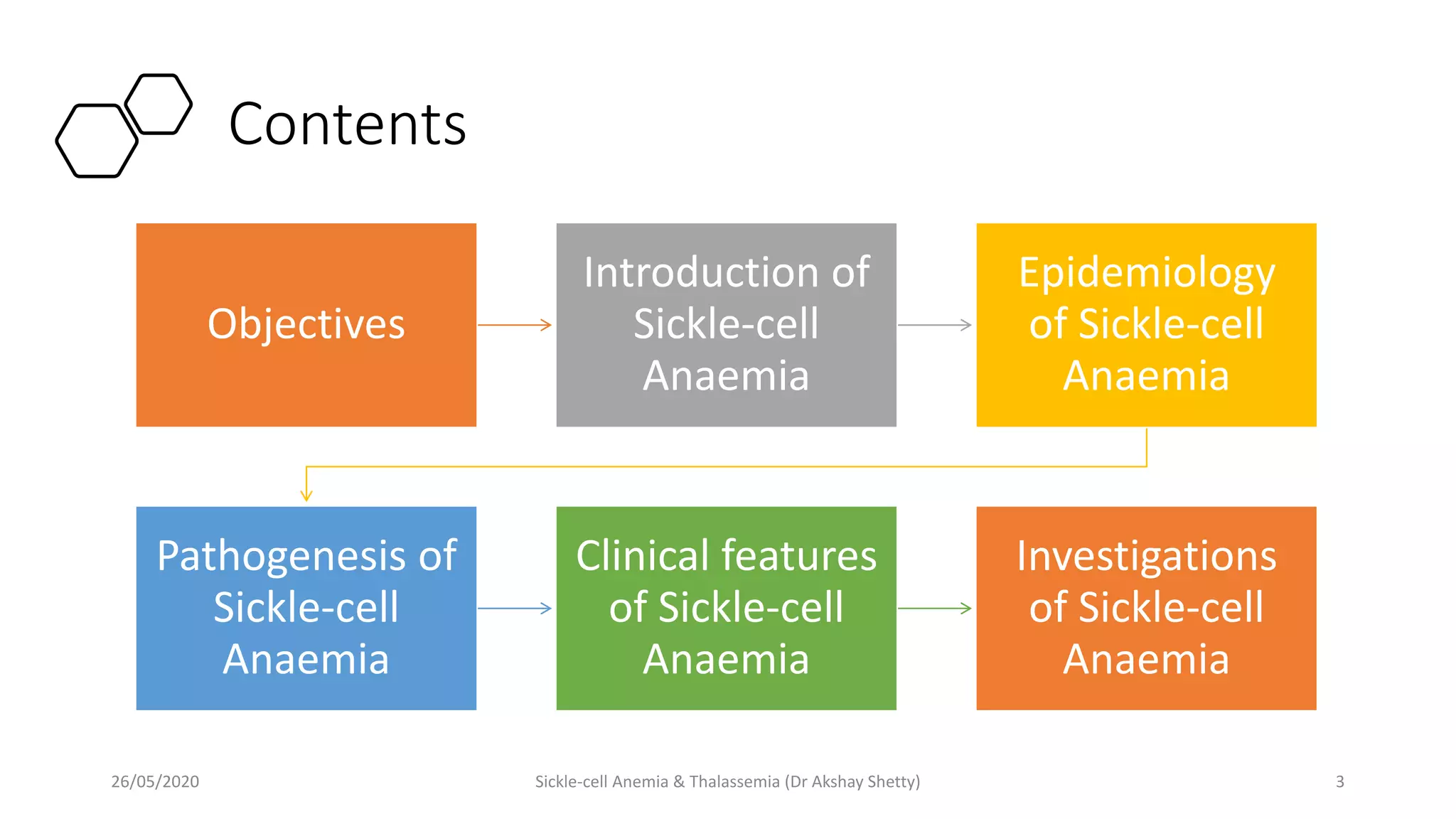
Contents
Objectives
Introduction of
Sickle-cell
Anaemia
Epidemiology
of Sickle-cell
Anaemia
Pathogenesis of
Sickle-cell
Anaemia
Clinical features
of Sickle-cell
Anaemia
Investigations
of Sickle-cell
Anaemia
26/05/2020 Sickle-cell Anemia & Thalassemia (Dr Akshay Shetty) 3
Contd…
Introduction
of
Thalassemia
Types of
Thalassemia
Alpha-
thalassaemia
Beta-
thalassaemia
Summary References
26/05/2020 Sickle-cell Anemia & Thalassemia (Dr Akshay Shetty) 4
Objectives
By the end of the presentation the students must be able to---
• Discuss Introduction of Sickle-cell Anaemia
• State Epidemiology of Sickle-cell Anaemia
• Explain Pathogenesis of Sickle-cell Anaemia
• Enumerate Clinical features of Sickle-cell Anaemia
• Quote Investigations of Sickle-cell Anaemia
• Discuss Introduction of Thalassemia
• Classify Types of Thalassemia
• Discuss Alpha-thalassaemia
• Discuss Beta-thalassaemia
26/05/2020 Sickle-cell Anemia & Thalassemia (Dr Akshay Shetty) 5
Introduction of Sickle-
cell Anaemia
• Sickle-cell disease results from a single glutamic acid
to valine substitution at position 6 of the beta globin
polypeptide chain.
• It is inherited as an autosomal recessive trait.
• Homozygotes only produce abnormal beta chains that
make haemoglobin S (HbS, termed SS), and this
results in the clinical syndrome of sickle-cell disease.
• Heterozygotes produce a mixture of normal and
abnormal beta chains that make normal HbA and HbS
(termed AS), and this results in the clinically
asymptomatic sickle trait.
26/05/2020 Sickle-cell Anemia & Thalassemia (Dr Akshay Shetty) 6
Epidemiology of Sickle-cell
Anaemia
• The geographical distribution of sickle-cell anaemia and
the other common haemoglobinopathies.
• The greatest prevalence of haemoglobinopathies occurs
in tropical Africa, where the heterozygote frequency is
over 20%.
• In black American populations, sickle-cell trait has a
frequency of 8%.
• Individuals with sickle-cell trait are relatively resistant to
the lethal effects of falciparum malaria in early
childhood.
26/05/2020 Sickle-cell Anemia & Thalassemia (Dr Akshay Shetty) 7
Contd..
26/05/2020 Sickle-cell Anemia & Thalassemia (Dr Akshay Shetty) 8
Pathogenesis of Sickle-cell
Anaemia
• When haemoglobin S is deoxygenated, the molecules of
haemoglobin polymerise to form pseudocrystalline structures
known as 'tactoids’.
• These distort the red cell membrane and produce
characteristic sickle-shaped cells.
• The polymerisation is reversible when reoxygenation occurs.
• The distortion of the red cell membrane, however, may
become permanent and the red cell 'irreversibly sickled’.
26/05/2020 Sickle-cell Anemia & Thalassemia (Dr Akshay Shetty) 9
Contd…
• The greater the concentration of sickle-cell
haemoglobin in the individual cell, the more easily
tactoids are formed, but this process may be
enhanced or retarded by the presence of other
haemoglobins.
• Thus haemoglobin C participates in the
polymerisation more readily than haemoglobin A,
whereas haemoglobin F strongly inhibits
polymerisation
26/05/2020 Sickle-cell Anemia & Thalassemia (Dr Akshay Shetty) 10
Clinical features of Sickle-cell Anaemia
26/05/2020 Sickle-cell Anemia & Thalassemia (Dr Akshay Shetty) 11
Investigations of Sickle-cell
Anaemia
• The blood film shows sickle cells, target cells and
features of hyposplenism.
• A reticulocytosis is present.
• The presence of HbS can be demonstrated by exposing
red cells to a reducing agent such as sodium dithionite;
HbA gives a clear solution, whereas HbS polymerises to
produce a turbid solution.
• The definitive diagnosis requires haemoglobin
electrophoresis to demonstrate no HbA, 2-20% HbF and
the predominance of HbS.
26/05/2020 Sickle-cell Anemia & Thalassemia (Dr Akshay Shetty) 12
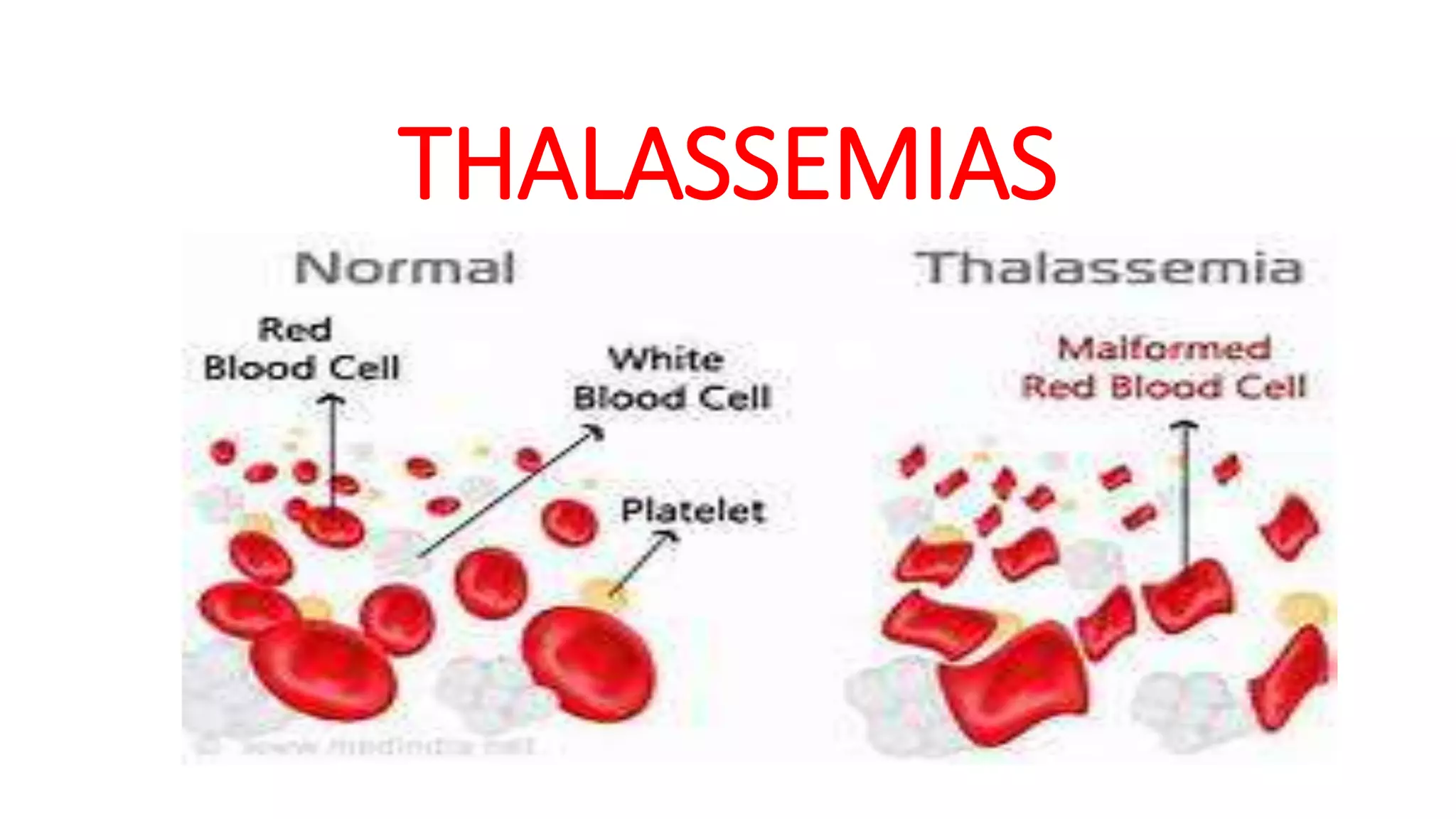
THALASSEMIAS
Introduction of Thalassemia
• Thalassaemia is an inherited impairment of
haemoglobin production, in which there is partial or
complete failure to synthesise a specific type of globin
chain.
• In alpha-thalassaemia, the alpha genes are deleted; loss
of one gene (α-/α) or both genes (α-/α-) from each
chromosome 16 may occur, in association with the
production of some or no alpha globin chains.
• In beta-thalassaemia defective production usually
results from disabling point mutations causing no (β0) or
reduced (β-) beta chain production.
26/05/2020 Sickle-cell Anemia & Thalassemia (Dr Akshay Shetty) 14
Types of Thalassemia
Alpha-thalassaemia
Beta-thalassaemia
26/05/2020 Sickle-cell Anemia & Thalassemia (Dr Akshay Shetty) 15
Alpha-thalassaemia
• The reduction or absence of alpha-chain synthesis is
common in Southeast Asia.
• There are two alpha gene loci on chromosome 16 and
therefore four alpha genes. If one is deleted there is
no clinical effect.
• If two are deleted there may be a mild hypochromic
anaemia.
• If three are deleted the patient has haemoglobin H
disease and if all four are deleted the baby is stillborn
(hydrops fetalis).
26/05/2020 Sickle-cell Anemia & Thalassemia (Dr Akshay Shetty) 16
Contd…
Age and sex
incidence Both sexes from birth onward
Genetics
Two alpha-chain genes from each parent
Presentation
• Hydrops fetalis if all genes deleted
• Haemoglobin H if three genes deleted
• Mild hypochromic microcytic anaemia if two genes
deleted
26/05/2020 Sickle-cell Anemia & Thalassemia (Dr Akshay Shetty) 17
Beta-thalassaemia
• Failure to synthesise beta chains (beta-thalassaemia) is
the most common type of thalassaemia and is seen in
highest frequency in the Mediterranean area.
• Heterozygotes have thalassaemia minor, a condition in
which there is usually mild anaemia and little or no
clinical disability.
• Homozygotes (thalassaemia major) either are unable to
synthesise haemoglobin A or at best produce very little
and, after the first 4 months of life, develop a profound
hypochromic anaemia.
26/05/2020 Sickle-cell Anemia & Thalassemia (Dr Akshay Shetty) 18
Contd…
Major
• Profound hypochromic anaemia
• Evidence of severe red cell dysplasia
• Erythroblastosis
• Absence or gross reduction of the amount of
haemoglobin A
• Raised levels of haemoglobin F
• Evidence that both parents have thalassaemia minor
26/05/2020 Sickle-cell Anemia & Thalassemia (Dr Akshay Shetty) 19
Contd…
Minor
• Mild anaemia
• Microcytic hypochromic erythrocytes (not iron-deficient)
• Some target cells
• Punctate basophilia
• Raised resistance of erythrocytes to osmotic lysis
• Raised haemoglobin A2 fraction
• Evidence that one parent has thalassaemia minor
26/05/2020 Sickle-cell Anemia & Thalassemia (Dr Akshay Shetty) 20
Summary
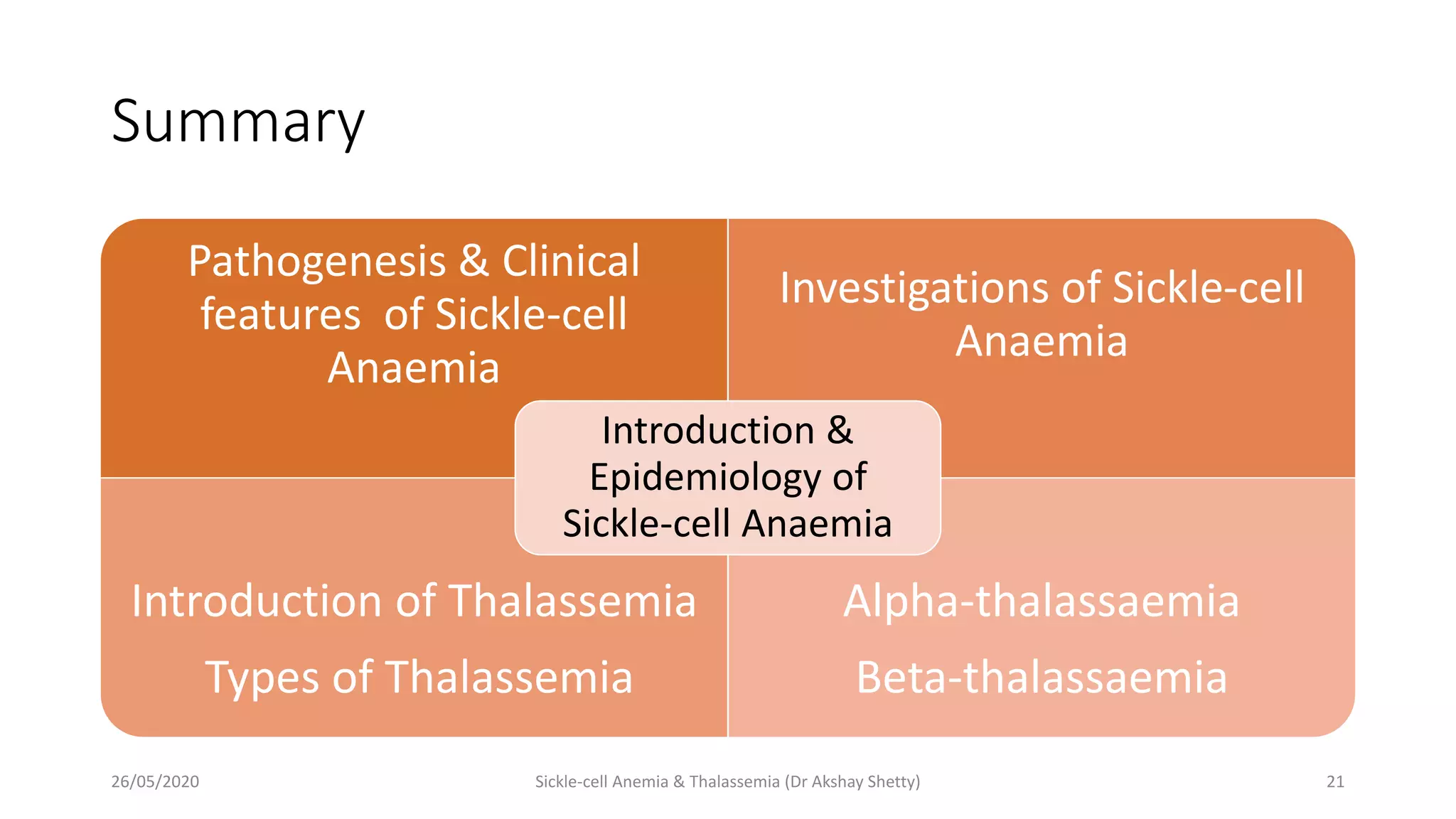
Pathogenesis & Clinical
features of Sickle-cell
Anaemia
Investigations of Sickle-cell
Anaemia
Introduction of Thalassemia
Types of Thalassemia
Alpha-thalassaemia
Beta-thalassaemia
Introduction &
Epidemiology of
Sickle-cell Anaemia
26/05/2020 Sickle-cell Anemia & Thalassemia (Dr Akshay Shetty) 21
References
• Davidson Principles Of Medicine & Practice Of
Medicine .20th Ed.
26/05/2020 Sickle-cell Anemia & Thalassemia (Dr Akshay Shetty) 22
THANK YOU
26/05/2020 Sickle-cell Anemia & Thalassemia (Dr Akshay Shetty) 23

Sickle cell Anemia & thalassemia

  • 1.
    SICKLE-CELL ANAEMIA & THALASSAEMIAS Dr AkshayShetty Asst. Professor SSRAMCH INCHAL
  • 2.
  • 3.
    Contents Objectives Introduction of Sickle-cell Anaemia Epidemiology of Sickle-cell Anaemia Pathogenesisof Sickle-cell Anaemia Clinical features of Sickle-cell Anaemia Investigations of Sickle-cell Anaemia 26/05/2020 Sickle-cell Anemia & Thalassemia (Dr Akshay Shetty) 3
  • 4.
  • 5.
    Objectives By the endof the presentation the students must be able to--- • Discuss Introduction of Sickle-cell Anaemia • State Epidemiology of Sickle-cell Anaemia • Explain Pathogenesis of Sickle-cell Anaemia • Enumerate Clinical features of Sickle-cell Anaemia • Quote Investigations of Sickle-cell Anaemia • Discuss Introduction of Thalassemia • Classify Types of Thalassemia • Discuss Alpha-thalassaemia • Discuss Beta-thalassaemia 26/05/2020 Sickle-cell Anemia & Thalassemia (Dr Akshay Shetty) 5
  • 6.
    Introduction of Sickle- cellAnaemia • Sickle-cell disease results from a single glutamic acid to valine substitution at position 6 of the beta globin polypeptide chain. • It is inherited as an autosomal recessive trait. • Homozygotes only produce abnormal beta chains that make haemoglobin S (HbS, termed SS), and this results in the clinical syndrome of sickle-cell disease. • Heterozygotes produce a mixture of normal and abnormal beta chains that make normal HbA and HbS (termed AS), and this results in the clinically asymptomatic sickle trait. 26/05/2020 Sickle-cell Anemia & Thalassemia (Dr Akshay Shetty) 6
  • 7.
    Epidemiology of Sickle-cell Anaemia •The geographical distribution of sickle-cell anaemia and the other common haemoglobinopathies. • The greatest prevalence of haemoglobinopathies occurs in tropical Africa, where the heterozygote frequency is over 20%. • In black American populations, sickle-cell trait has a frequency of 8%. • Individuals with sickle-cell trait are relatively resistant to the lethal effects of falciparum malaria in early childhood. 26/05/2020 Sickle-cell Anemia & Thalassemia (Dr Akshay Shetty) 7
  • 8.
    Contd.. 26/05/2020 Sickle-cell Anemia& Thalassemia (Dr Akshay Shetty) 8
  • 9.
    Pathogenesis of Sickle-cell Anaemia •When haemoglobin S is deoxygenated, the molecules of haemoglobin polymerise to form pseudocrystalline structures known as 'tactoids’. • These distort the red cell membrane and produce characteristic sickle-shaped cells. • The polymerisation is reversible when reoxygenation occurs. • The distortion of the red cell membrane, however, may become permanent and the red cell 'irreversibly sickled’. 26/05/2020 Sickle-cell Anemia & Thalassemia (Dr Akshay Shetty) 9
  • 10.
    Contd… • The greaterthe concentration of sickle-cell haemoglobin in the individual cell, the more easily tactoids are formed, but this process may be enhanced or retarded by the presence of other haemoglobins. • Thus haemoglobin C participates in the polymerisation more readily than haemoglobin A, whereas haemoglobin F strongly inhibits polymerisation 26/05/2020 Sickle-cell Anemia & Thalassemia (Dr Akshay Shetty) 10
  • 11.
    Clinical features ofSickle-cell Anaemia 26/05/2020 Sickle-cell Anemia & Thalassemia (Dr Akshay Shetty) 11
  • 12.
    Investigations of Sickle-cell Anaemia •The blood film shows sickle cells, target cells and features of hyposplenism. • A reticulocytosis is present. • The presence of HbS can be demonstrated by exposing red cells to a reducing agent such as sodium dithionite; HbA gives a clear solution, whereas HbS polymerises to produce a turbid solution. • The definitive diagnosis requires haemoglobin electrophoresis to demonstrate no HbA, 2-20% HbF and the predominance of HbS. 26/05/2020 Sickle-cell Anemia & Thalassemia (Dr Akshay Shetty) 12
  • 13.
  • 14.
    Introduction of Thalassemia •Thalassaemia is an inherited impairment of haemoglobin production, in which there is partial or complete failure to synthesise a specific type of globin chain. • In alpha-thalassaemia, the alpha genes are deleted; loss of one gene (α-/α) or both genes (α-/α-) from each chromosome 16 may occur, in association with the production of some or no alpha globin chains. • In beta-thalassaemia defective production usually results from disabling point mutations causing no (β0) or reduced (β-) beta chain production. 26/05/2020 Sickle-cell Anemia & Thalassemia (Dr Akshay Shetty) 14
  • 15.
    Types of Thalassemia Alpha-thalassaemia Beta-thalassaemia 26/05/2020Sickle-cell Anemia & Thalassemia (Dr Akshay Shetty) 15
  • 16.
    Alpha-thalassaemia • The reductionor absence of alpha-chain synthesis is common in Southeast Asia. • There are two alpha gene loci on chromosome 16 and therefore four alpha genes. If one is deleted there is no clinical effect. • If two are deleted there may be a mild hypochromic anaemia. • If three are deleted the patient has haemoglobin H disease and if all four are deleted the baby is stillborn (hydrops fetalis). 26/05/2020 Sickle-cell Anemia & Thalassemia (Dr Akshay Shetty) 16
  • 17.
    Contd… Age and sex incidenceBoth sexes from birth onward Genetics Two alpha-chain genes from each parent Presentation • Hydrops fetalis if all genes deleted • Haemoglobin H if three genes deleted • Mild hypochromic microcytic anaemia if two genes deleted 26/05/2020 Sickle-cell Anemia & Thalassemia (Dr Akshay Shetty) 17
  • 18.
    Beta-thalassaemia • Failure tosynthesise beta chains (beta-thalassaemia) is the most common type of thalassaemia and is seen in highest frequency in the Mediterranean area. • Heterozygotes have thalassaemia minor, a condition in which there is usually mild anaemia and little or no clinical disability. • Homozygotes (thalassaemia major) either are unable to synthesise haemoglobin A or at best produce very little and, after the first 4 months of life, develop a profound hypochromic anaemia. 26/05/2020 Sickle-cell Anemia & Thalassemia (Dr Akshay Shetty) 18
  • 19.
    Contd… Major • Profound hypochromicanaemia • Evidence of severe red cell dysplasia • Erythroblastosis • Absence or gross reduction of the amount of haemoglobin A • Raised levels of haemoglobin F • Evidence that both parents have thalassaemia minor 26/05/2020 Sickle-cell Anemia & Thalassemia (Dr Akshay Shetty) 19
  • 20.
    Contd… Minor • Mild anaemia •Microcytic hypochromic erythrocytes (not iron-deficient) • Some target cells • Punctate basophilia • Raised resistance of erythrocytes to osmotic lysis • Raised haemoglobin A2 fraction • Evidence that one parent has thalassaemia minor 26/05/2020 Sickle-cell Anemia & Thalassemia (Dr Akshay Shetty) 20
  • 21.
    Summary Pathogenesis & Clinical featuresof Sickle-cell Anaemia Investigations of Sickle-cell Anaemia Introduction of Thalassemia Types of Thalassemia Alpha-thalassaemia Beta-thalassaemia Introduction & Epidemiology of Sickle-cell Anaemia 26/05/2020 Sickle-cell Anemia & Thalassemia (Dr Akshay Shetty) 21
  • 22.
    References • Davidson PrinciplesOf Medicine & Practice Of Medicine .20th Ed. 26/05/2020 Sickle-cell Anemia & Thalassemia (Dr Akshay Shetty) 22
  • 23.
    THANK YOU 26/05/2020 Sickle-cellAnemia & Thalassemia (Dr Akshay Shetty) 23