Foresight modeling to guide sustainable intensification
of smallholder systems
Dolapo Enahoro
Agricultural Economist, ILRI
International Conference on Integrated Systems
International Institute for Tropical Agriculture, Ibadan, Nigeria
March 3 - 6, 2015
Road Map
 Background to GFSF project
 Approach to quantitative modeling in
GFSF project
 Some results and relevance to sustainable
intensification of agricultural systems
 Limitations of the global modeling
framework
 Links to farm level approaches and
introduction of BioSight project
 Discussion
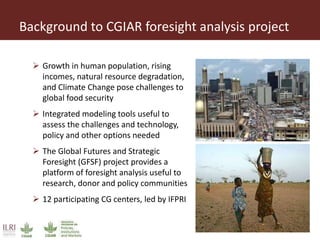
Background to CGIAR foresight analysis project
 Growth in human population, rising
incomes, natural resource degradation,
and Climate Change pose challenges to
global food security
 Integrated modeling tools useful to
assess the challenges and technology,
policy and other options needed
 The Global Futures and Strategic
Foresight (GFSF) project provides a
platform of foresight analysis useful to
research, donor and policy communities
 12 participating CG centers, led by IFPRI
GFSF approach to quantitative modeling
System of linked simulation models of global agriculture
• IMPACT multi-country, multi-market economic model
• Water model (hydrology, water basin management, crop water stress)
• Crop simulation models (DSSAT);
• Livestock, Fish modules
Long-run ex ante scenario analysis
• Demand, supply and trade of agricultural commodities
• Technology, investment, policy options
• Climate Change effects and adaptation strategies
Global economic assessments of Promising Technologies
• High yield, drought , heat tolerance traits in virtual crop varieties
• Breed, feed and animal health solutions to livestock yield gaps
Projections for Agricultural Commodities
IMPACT projections to 2050
(Rosegrant et al.,):
• Expansion in demand for meat,
dairy, cereals, livestock feeds
• Higher prices of major
agricultural commodities
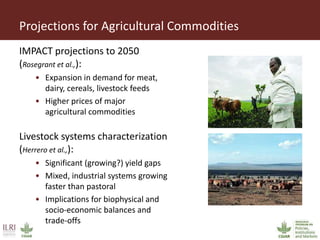
Livestock systems characterization
(Herrero et al.,):
• Significant (growing?) yield gaps
• Mixed, industrial systems growing
faster than pastoral
• Implications for biophysical and
socio-economic balances and
trade-offs
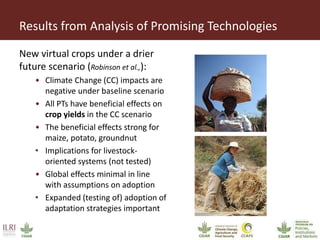
Results from Analysis of Promising Technologies
New virtual crops under a drier
future scenario (Robinson et al.,):
• Climate Change (CC) impacts are
negative under baseline scenario
• All PTs have beneficial effects on
crop yields in the CC scenario
• The beneficial effects strong for
maize, potato, groundnut
• Implications for livestock-
oriented systems (not tested)
• Global effects minimal in line
with assumptions on adoption
• Expanded (testing of) adoption of
adaptation strategies important
Relevance to Sustainable Intensification and
Smallholder Agriculture
Foresight Assessments useful in:
 discussion on pathways to food security in the future
 bridging local and global dynamics e.g., through the improved
disaggregation plus international trade features of the models
 testing the roles and ex ante impacts of candidate technologies,
investments, policies
 Virtual cultivars assessed under PT platform directly applicable to smallholder
agriculture in the selected countries and regions
 assessing systems and regions for growth potential and response to
shocks e.g., through improved production system characterization
 some trade-off assessment relevant at the macro-scale
• regional competition for biomass as food, feed, energy stock
• natural resource issues related to intensification
• economic benefits to consumers and producers
Limitations of the global modeling framework
Generally:
• Expected loss of technical detail on production processes
• Dichotomy between theory and empirics can be more marked
• Data availability, consistency and aggregation issues may be more
pronounced; resources and coordination typically more involving
Specific to model applicability:
• Focus is on international trade and relevant commodities
• Joint (production and consumption) decision-making characteristic of
many smallholder systems not captured
• Important crop-livestock interactions, production-environment
linkages not captured
• Gender dimensions largely difficult to capture
Improving capacity of the modeling framework
Ongoing
 Model and data validation including using micro/meso data
 Expanded country, region and commodity sets
 Enhanced supply-side specification to better reflect
heterogeneity (e.g., of livestock production systems)
Proposed
 Strengthen links to methodologies and tools better able to
make use of micro-data (example, BioSight project)
 Adapt agronomic modeling tools used to simulate virtual
crops so they can better capture intensification strategies
(especially w.r.t. crop-livestock linkages)
BioSight Project on Sustainable Intensification
• Funded by CGIAR research program on Policies, Institutes and Markets
• Combines biophysical and economic analysis to directly address key
synergies and trade-offs of alternative ag intensification strategies
• Links methodologies addressing intensification of crop and livestock
production systems and links with environment impacts
• Uses household-specific micro-data (from AfricaRISING or other);
• Quantitative analysis set-up allows for modular linkage of production
response to household consumption & economic behavior
• Scope of analysis: farm-level mostly, with possibilities to aggregate up
• Plan to expand to include aquaculture & agro-forestry prodn systems
• Focus is on the short-to-medium term
• Partnering with CG (and non-CG) analysts to create actionable policy
recommendations around sustainable agricultural intensification
Discussion
 What can global foresight analysis contribute to the research for
impact agenda on sustainable intensification of agriculture?
 What can it not contribute?
 What role is there in the research for impact portfolio on Sustainable
Intensification and Smallholder Agriculture, for a platform like the
Global Futures and Strategic Foresights project?
Global Futures and Strategic Foresights Project is supported by:
Bill and Melinda Gates Foundation
CGIAR research program on Climate Change, Agriculture and
Food Security (CCAFS)
CGIAR program on Policies, Institutions and Markets (PIM)
In Collaboration with:
The University of Florida; national research systems (various)
Acknowledgements
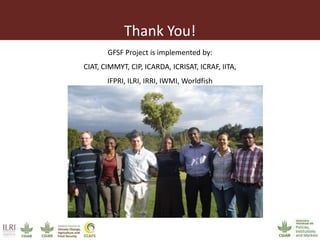
Thank You!
GFSF Project is implemented by:
CIAT, CIMMYT, CIP, ICARDA, ICRISAT, ICRAF, IITA,
IFPRI, ILRI, IRRI, IWMI, Worldfish
The presentation has a Creative Commons licence. You are free to re-use or distribute this work, provided credit is given to ILRI.
better lives through livestock
ilri.org

Foresight modeling to guide sustainable intensification of smallholder systems

  • 1.
    Foresight modeling toguide sustainable intensification of smallholder systems Dolapo Enahoro Agricultural Economist, ILRI International Conference on Integrated Systems International Institute for Tropical Agriculture, Ibadan, Nigeria March 3 - 6, 2015
  • 2.
    Road Map  Backgroundto GFSF project  Approach to quantitative modeling in GFSF project  Some results and relevance to sustainable intensification of agricultural systems  Limitations of the global modeling framework  Links to farm level approaches and introduction of BioSight project  Discussion
  • 3.
    Background to CGIARforesight analysis project  Growth in human population, rising incomes, natural resource degradation, and Climate Change pose challenges to global food security  Integrated modeling tools useful to assess the challenges and technology, policy and other options needed  The Global Futures and Strategic Foresight (GFSF) project provides a platform of foresight analysis useful to research, donor and policy communities  12 participating CG centers, led by IFPRI
  • 4.
    GFSF approach toquantitative modeling System of linked simulation models of global agriculture • IMPACT multi-country, multi-market economic model • Water model (hydrology, water basin management, crop water stress) • Crop simulation models (DSSAT); • Livestock, Fish modules Long-run ex ante scenario analysis • Demand, supply and trade of agricultural commodities • Technology, investment, policy options • Climate Change effects and adaptation strategies Global economic assessments of Promising Technologies • High yield, drought , heat tolerance traits in virtual crop varieties • Breed, feed and animal health solutions to livestock yield gaps
  • 5.
    Projections for AgriculturalCommodities IMPACT projections to 2050 (Rosegrant et al.,): • Expansion in demand for meat, dairy, cereals, livestock feeds • Higher prices of major agricultural commodities Livestock systems characterization (Herrero et al.,): • Significant (growing?) yield gaps • Mixed, industrial systems growing faster than pastoral • Implications for biophysical and socio-economic balances and trade-offs
  • 6.
    Results from Analysisof Promising Technologies New virtual crops under a drier future scenario (Robinson et al.,): • Climate Change (CC) impacts are negative under baseline scenario • All PTs have beneficial effects on crop yields in the CC scenario • The beneficial effects strong for maize, potato, groundnut • Implications for livestock- oriented systems (not tested) • Global effects minimal in line with assumptions on adoption • Expanded (testing of) adoption of adaptation strategies important
  • 7.
    Relevance to SustainableIntensification and Smallholder Agriculture Foresight Assessments useful in:  discussion on pathways to food security in the future  bridging local and global dynamics e.g., through the improved disaggregation plus international trade features of the models  testing the roles and ex ante impacts of candidate technologies, investments, policies  Virtual cultivars assessed under PT platform directly applicable to smallholder agriculture in the selected countries and regions  assessing systems and regions for growth potential and response to shocks e.g., through improved production system characterization  some trade-off assessment relevant at the macro-scale • regional competition for biomass as food, feed, energy stock • natural resource issues related to intensification • economic benefits to consumers and producers
  • 8.
    Limitations of theglobal modeling framework Generally: • Expected loss of technical detail on production processes • Dichotomy between theory and empirics can be more marked • Data availability, consistency and aggregation issues may be more pronounced; resources and coordination typically more involving Specific to model applicability: • Focus is on international trade and relevant commodities • Joint (production and consumption) decision-making characteristic of many smallholder systems not captured • Important crop-livestock interactions, production-environment linkages not captured • Gender dimensions largely difficult to capture
  • 9.
    Improving capacity ofthe modeling framework Ongoing  Model and data validation including using micro/meso data  Expanded country, region and commodity sets  Enhanced supply-side specification to better reflect heterogeneity (e.g., of livestock production systems) Proposed  Strengthen links to methodologies and tools better able to make use of micro-data (example, BioSight project)  Adapt agronomic modeling tools used to simulate virtual crops so they can better capture intensification strategies (especially w.r.t. crop-livestock linkages)
  • 10.
    BioSight Project onSustainable Intensification • Funded by CGIAR research program on Policies, Institutes and Markets • Combines biophysical and economic analysis to directly address key synergies and trade-offs of alternative ag intensification strategies • Links methodologies addressing intensification of crop and livestock production systems and links with environment impacts • Uses household-specific micro-data (from AfricaRISING or other); • Quantitative analysis set-up allows for modular linkage of production response to household consumption & economic behavior • Scope of analysis: farm-level mostly, with possibilities to aggregate up • Plan to expand to include aquaculture & agro-forestry prodn systems • Focus is on the short-to-medium term • Partnering with CG (and non-CG) analysts to create actionable policy recommendations around sustainable agricultural intensification
  • 11.
    Discussion  What canglobal foresight analysis contribute to the research for impact agenda on sustainable intensification of agriculture?  What can it not contribute?  What role is there in the research for impact portfolio on Sustainable Intensification and Smallholder Agriculture, for a platform like the Global Futures and Strategic Foresights project?
  • 12.
    Global Futures andStrategic Foresights Project is supported by: Bill and Melinda Gates Foundation CGIAR research program on Climate Change, Agriculture and Food Security (CCAFS) CGIAR program on Policies, Institutions and Markets (PIM) In Collaboration with: The University of Florida; national research systems (various) Acknowledgements
  • 13.
    Thank You! GFSF Projectis implemented by: CIAT, CIMMYT, CIP, ICARDA, ICRISAT, ICRAF, IITA, IFPRI, ILRI, IRRI, IWMI, Worldfish
  • 14.
    The presentation hasa Creative Commons licence. You are free to re-use or distribute this work, provided credit is given to ILRI. better lives through livestock ilri.org