Ideal Gas LawPV = nRTApplication of PV=nRTDensity Molecular Mass
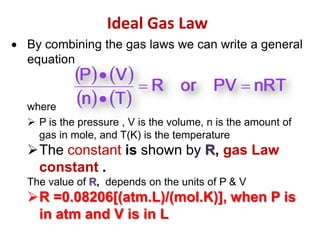
Ideal Gas LawBy combining the gas laws we can write a general equationwhereP is the pressure , V is the volume, n is the amount of gas in mole, and T(K) is the temperature
The constant is shown byR, gas Law constant . The value of R,  depends on the units of P & VR =0.08206[(atm.L)/(mol.K)], when P is in atm and V is in LExample: How many moles of gas are in a basketball with total pressure 24.3 psi, volume of 3.24 L at 25°C?V = 3.24 L, 	P = 24.3 psi, 	t = 25 °C  and 	n=? Mol
T(K) = 273.15+ t(0C)		1atm= 14.7 psi
R= 0.08206 (atm.L)/(mol.K)	21Knowing  PV= nRT, Rearrange the equation to :3
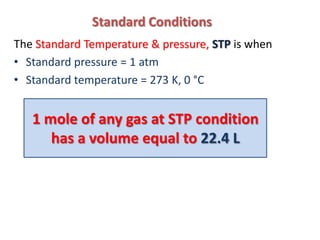
Standard ConditionsThe Standard Temperature & pressure, STP is whenStandard pressure = 1 atmStandard temperature = 273 K, 0 °C1 mole of any gas at STP condition has a volume equal to 22.4 L
Molar Volume = Volume of 1 mole of a gasSolving the ideal gas equation for the volume of 1 mole of any gas at STP gives a volume of 22.4 L1 mole of a gas has 6.022x10²³ molecules of gas6.022x1023 molecules of gas occupies a volume of 22.4L at STPMolar volume of a gas at STP is 22.4 LOne mole of different gases have the same volume at same temperature and pressure, but have different masses
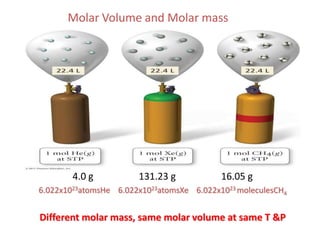
Molar Volume and Molar mass4.0 g                   131.23 g                   16.05 g6.022x1023atomsHe6.022x1023atomsXe    6.022x10²³ moleculesCH4Different molar mass, same molar volume at same T &P
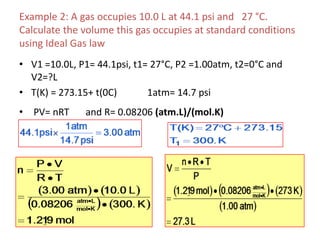
Example 2: A gas occupies 10.0 L at 44.1 psi and   27 °C.  Calculate the volume this gas occupies at standard conditions using Ideal Gas lawV1 =10.0L, P1= 44.1psi, t1= 27°C, P2 =1.00atm, t2=0°C and V2=?LT(K) = 273.15+ t(0C)	1atm= 14.7 psi PV= nRT	 and R= 0.08206 (atm.L)/(mol.K)
Example 2: Calculate the volume occupied by 637 g of SO2 (MM 64.07) at 6.08 x 10⁴ mmHg and –23 °CmSO2 = 637 g, P = 6.08 x 10⁴ mmHg, t= −23 °C,  &V=?L1 atm= 760 mmHg	1 mole of SO2 = 64.07 g SO2  T(K) = 273.15+ t(0C)	 PV= nRT	 &  R= 0.08206 (atm.L)/(mol.K)
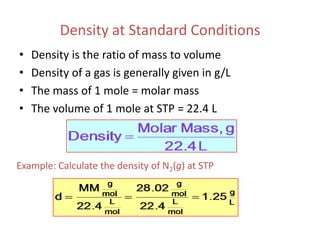
Density at Standard ConditionsDensity is the ratio of mass to volumeDensity of a gas is generally given in g/LThe mass of 1 mole = molar massThe volume of 1 mole at STP = 22.4 LExample: Calculate the density of N2(g) at STP
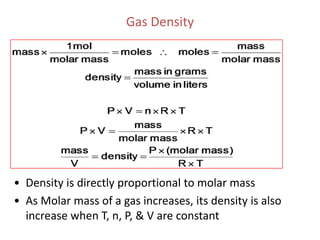
Gas DensityDensity is directly proportional to molar mass
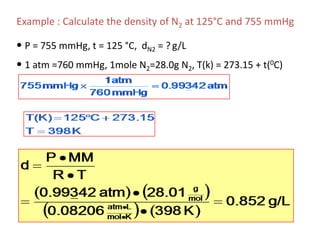
As Molar mass of a gas increases, its density is also increase when T, n, P, & V are constant Example : Calculate the density of N2 at 125°C and 755 mmHg P = 755 mmHg, t = 125 °C,  dN2 = ?g/L
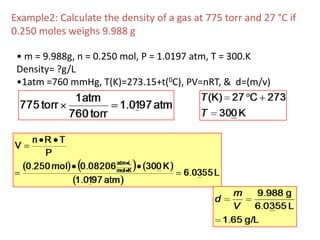
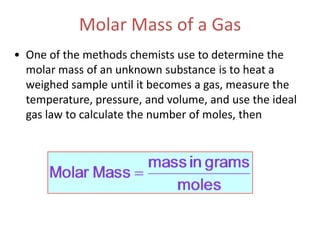
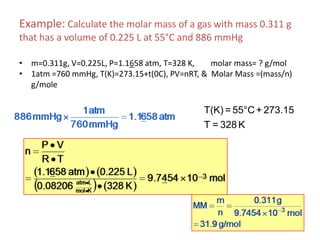
 1 atm =760 mmHg, 1mole N2=28.0g N2, T(k) = 273.15 + t(0C)Example2: Calculate the density of a gas at 775 torr and 27 °C if  0.250 moles weighs 9.988 g m = 9.988g, n = 0.250 mol, P = 1.0197 atm, T = 300.K Density= ?g/L1atm =760 mmHg, T(K)=273.15+t(0C), PV=nRT, &  d=(m/v)Molar Mass of a GasOne of the methods chemists use to determine the molar mass of an unknown substance is to heat a weighed sample until it becomes a gas, measure the temperature, pressure, and volume, and use the ideal gas law to calculate the number of moles, thenExample: Calculate the molar mass of a gas with mass 0.311 g that has a volume of 0.225 L at 55°C and 886 mmHgm=0.311g, V=0.225L, P=1.1658 atm, T=328 K,        molar mass= ? g/mol1atm =760 mmHg, T(K)=273.15+t(0C), PV=nRT, &  Molar Mass =(mass/n) g/mole
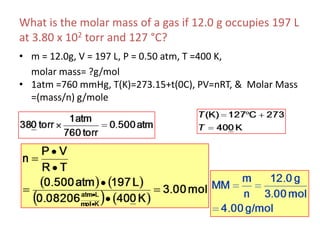
What is the molar mass of a gas if 12.0 g occupies 197 L at 3.80 x 10² torr and 127 °C?m = 12.0g, V = 197 L, P = 0.50 atm, T =400 K, 	molar mass= ?g/mol1atm =760 mmHg, T(K)=273.15+t(0C), PV=nRT, &  Molar Mass =(mass/n) g/mole

Ideal gas law practice mccpot

  • 1.
    Ideal Gas LawPV= nRTApplication of PV=nRTDensity Molecular Mass
  • 2.
    Ideal Gas LawBycombining the gas laws we can write a general equationwhereP is the pressure , V is the volume, n is the amount of gas in mole, and T(K) is the temperature
  • 3.
    The constant isshown byR, gas Law constant . The value of R, depends on the units of P & VR =0.08206[(atm.L)/(mol.K)], when P is in atm and V is in LExample: How many moles of gas are in a basketball with total pressure 24.3 psi, volume of 3.24 L at 25°C?V = 3.24 L, P = 24.3 psi, t = 25 °C and n=? Mol
  • 4.
    T(K) = 273.15+t(0C) 1atm= 14.7 psi
  • 5.
    R= 0.08206 (atm.L)/(mol.K) 21Knowing PV= nRT, Rearrange the equation to :3
  • 6.
    Standard ConditionsThe StandardTemperature & pressure, STP is whenStandard pressure = 1 atmStandard temperature = 273 K, 0 °C1 mole of any gas at STP condition has a volume equal to 22.4 L
  • 7.
    Molar Volume =Volume of 1 mole of a gasSolving the ideal gas equation for the volume of 1 mole of any gas at STP gives a volume of 22.4 L1 mole of a gas has 6.022x10²³ molecules of gas6.022x1023 molecules of gas occupies a volume of 22.4L at STPMolar volume of a gas at STP is 22.4 LOne mole of different gases have the same volume at same temperature and pressure, but have different masses
  • 8.
    Molar Volume andMolar mass4.0 g 131.23 g 16.05 g6.022x1023atomsHe6.022x1023atomsXe 6.022x10²³ moleculesCH4Different molar mass, same molar volume at same T &P
  • 9.
    Example 2: Agas occupies 10.0 L at 44.1 psi and 27 °C. Calculate the volume this gas occupies at standard conditions using Ideal Gas lawV1 =10.0L, P1= 44.1psi, t1= 27°C, P2 =1.00atm, t2=0°C and V2=?LT(K) = 273.15+ t(0C) 1atm= 14.7 psi PV= nRT and R= 0.08206 (atm.L)/(mol.K)
  • 10.
    Example 2: Calculatethe volume occupied by 637 g of SO2 (MM 64.07) at 6.08 x 10⁴ mmHg and –23 °CmSO2 = 637 g, P = 6.08 x 10⁴ mmHg, t= −23 °C, &V=?L1 atm= 760 mmHg 1 mole of SO2 = 64.07 g SO2 T(K) = 273.15+ t(0C) PV= nRT & R= 0.08206 (atm.L)/(mol.K)
  • 11.
    Density at StandardConditionsDensity is the ratio of mass to volumeDensity of a gas is generally given in g/LThe mass of 1 mole = molar massThe volume of 1 mole at STP = 22.4 LExample: Calculate the density of N2(g) at STP
  • 12.
    Gas DensityDensity isdirectly proportional to molar mass
  • 13.
    As Molar massof a gas increases, its density is also increase when T, n, P, & V are constant Example : Calculate the density of N2 at 125°C and 755 mmHg P = 755 mmHg, t = 125 °C, dN2 = ?g/L
  • 14.
    1 atm=760 mmHg, 1mole N2=28.0g N2, T(k) = 273.15 + t(0C)Example2: Calculate the density of a gas at 775 torr and 27 °C if 0.250 moles weighs 9.988 g m = 9.988g, n = 0.250 mol, P = 1.0197 atm, T = 300.K Density= ?g/L1atm =760 mmHg, T(K)=273.15+t(0C), PV=nRT, & d=(m/v)Molar Mass of a GasOne of the methods chemists use to determine the molar mass of an unknown substance is to heat a weighed sample until it becomes a gas, measure the temperature, pressure, and volume, and use the ideal gas law to calculate the number of moles, thenExample: Calculate the molar mass of a gas with mass 0.311 g that has a volume of 0.225 L at 55°C and 886 mmHgm=0.311g, V=0.225L, P=1.1658 atm, T=328 K, molar mass= ? g/mol1atm =760 mmHg, T(K)=273.15+t(0C), PV=nRT, & Molar Mass =(mass/n) g/mole
  • 15.
    What is themolar mass of a gas if 12.0 g occupies 197 L at 3.80 x 10² torr and 127 °C?m = 12.0g, V = 197 L, P = 0.50 atm, T =400 K, molar mass= ?g/mol1atm =760 mmHg, T(K)=273.15+t(0C), PV=nRT, & Molar Mass =(mass/n) g/mole