SENIOR HIGH SCHOOL(SHS)
VOUCHER PROGRAM
POLICY OBJECTIVES
1. From a pragmatic perspective, vouchers will reduce the institutional
pressures on the Department;
2. Engaging the private sector through vouchers would also minimize
capital costs associated with constructing and equipping classrooms
and laboratories; and
3. The subsidy would lessen the financial impact on colleges and
universities which will experience reduced enrollment in the initial
years of the SHS program.
PURPOSE OF THE SHS SUBSIDY
PROGRAM:
1. Enhance school diversity, dynamism and empowerment, and enable
choice of students and their families leading, ultimately, to the very
purpose of the K-12 reform: relevant and high quality education;
2. Vouchers can impact substantially by increasing the diversity of
providers beyond the current configuration at the elementary and
JHS levels;
3. DepEd would like to establish a system that provides greater choice
and makes this choice available even to those who do not have the
financial means to support their children’s education on their own.
DESIGN PARAMETERS
• is easily scalable and accommodate more that a million students in 2
years’ time
• minimizes discretion and conflict of interest situations and other
governance related issues
• is efficient from a public fiscal standpoint
• is equitable and allows poor students to participate
• has built-in accountability mechanisms that lead to improvement of
quality
• is administratively simple and feasible, provided appropriate systems
are in place
STUDENT ELIGIBILITY
• All Grade 10 JHS completers from public and private schools in the
country
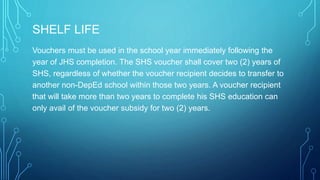
SHELF LIFE
Vouchers must be used in the school year immediately following the
year of JHS completion. The SHS voucher shall cover two (2) years of
SHS, regardless of whether the voucher recipient decides to transfer to
another non-DepEd school within those two years. A voucher recipient
that will take more than two years to complete his SHS education can
only avail of the voucher subsidy for two (2) years.
PROVIDER ELIGIBILITY
All non-DepEd schools with an SHS permit for the DepEd can accept
voucher students. Vouchers can be redeemed in any region and the
value is determined by the location of the non-DepEd SHS.
TOP-UPS
• Non-DepEd providers will be allowed to charge a top-up in cases
where the voucher subsidy is less than the tuition the charge. To
mitigate the impact on the least affluent students, DepEd enjoins non-
DepEd schools to minimize the the top-up by providing additional
subsidies or by partnering with LGUs and industry to share the top-up
burden.
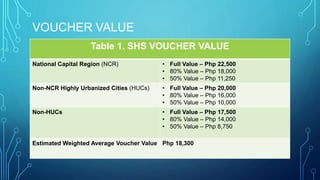
VOUCHER VALUE
Table 1. SHS VOUCHER VALUE
National Capital Region (NCR) • Full Value – Php 22,500
• 80% Value – Php 18,000
• 50% Value – Php 11,250
Non-NCR Highly Urbanized Cities (HUCs) • Full Value – Php 20,000
• 80% Value – Php 16,000
• 50% Value – Php 10,000
Non-HUCs • Full Value – Php 17,500
• 80% Value – Php 14,000
• 50% Value – Php 8,750
Estimated Weighted Average Voucher Value Php 18,300
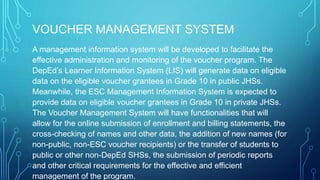
VOUCHER MANAGEMENT SYSTEM
A management information system will be developed to facilitate the
effective administration and monitoring of the voucher program. The
DepEd’s Learner Information System (LIS) will generate data on eligible
data on the eligible voucher grantees in Grade 10 in public JHSs.
Meanwhile, the ESC Management Information System is expected to
provide data on eligible voucher grantees in Grade 10 in private JHSs.
The Voucher Management System will have functionalities that will
allow for the online submission of enrollment and billing statements, the
cross-checking of names and other data, the addition of new names (for
non-public, non-ESC voucher recipients) or the transfer of students to
public or other non-DepEd SHSs, the submission of periodic reports
and other critical requirements for the effective and efficient
management of the program.
THANK YOU!

SHS-VOUCHER-PROGRAM.pptx

  • 1.
  • 2.
    POLICY OBJECTIVES 1. Froma pragmatic perspective, vouchers will reduce the institutional pressures on the Department; 2. Engaging the private sector through vouchers would also minimize capital costs associated with constructing and equipping classrooms and laboratories; and 3. The subsidy would lessen the financial impact on colleges and universities which will experience reduced enrollment in the initial years of the SHS program.
  • 3.
    PURPOSE OF THESHS SUBSIDY PROGRAM: 1. Enhance school diversity, dynamism and empowerment, and enable choice of students and their families leading, ultimately, to the very purpose of the K-12 reform: relevant and high quality education; 2. Vouchers can impact substantially by increasing the diversity of providers beyond the current configuration at the elementary and JHS levels; 3. DepEd would like to establish a system that provides greater choice and makes this choice available even to those who do not have the financial means to support their children’s education on their own.
  • 4.
    DESIGN PARAMETERS • iseasily scalable and accommodate more that a million students in 2 years’ time • minimizes discretion and conflict of interest situations and other governance related issues • is efficient from a public fiscal standpoint • is equitable and allows poor students to participate • has built-in accountability mechanisms that lead to improvement of quality • is administratively simple and feasible, provided appropriate systems are in place
  • 5.
    STUDENT ELIGIBILITY • AllGrade 10 JHS completers from public and private schools in the country
  • 6.
    SHELF LIFE Vouchers mustbe used in the school year immediately following the year of JHS completion. The SHS voucher shall cover two (2) years of SHS, regardless of whether the voucher recipient decides to transfer to another non-DepEd school within those two years. A voucher recipient that will take more than two years to complete his SHS education can only avail of the voucher subsidy for two (2) years.
  • 7.
    PROVIDER ELIGIBILITY All non-DepEdschools with an SHS permit for the DepEd can accept voucher students. Vouchers can be redeemed in any region and the value is determined by the location of the non-DepEd SHS.
  • 8.
    TOP-UPS • Non-DepEd providerswill be allowed to charge a top-up in cases where the voucher subsidy is less than the tuition the charge. To mitigate the impact on the least affluent students, DepEd enjoins non- DepEd schools to minimize the the top-up by providing additional subsidies or by partnering with LGUs and industry to share the top-up burden.
  • 9.
    VOUCHER VALUE Table 1.SHS VOUCHER VALUE National Capital Region (NCR) • Full Value – Php 22,500 • 80% Value – Php 18,000 • 50% Value – Php 11,250 Non-NCR Highly Urbanized Cities (HUCs) • Full Value – Php 20,000 • 80% Value – Php 16,000 • 50% Value – Php 10,000 Non-HUCs • Full Value – Php 17,500 • 80% Value – Php 14,000 • 50% Value – Php 8,750 Estimated Weighted Average Voucher Value Php 18,300
  • 10.
    VOUCHER MANAGEMENT SYSTEM Amanagement information system will be developed to facilitate the effective administration and monitoring of the voucher program. The DepEd’s Learner Information System (LIS) will generate data on eligible data on the eligible voucher grantees in Grade 10 in public JHSs. Meanwhile, the ESC Management Information System is expected to provide data on eligible voucher grantees in Grade 10 in private JHSs. The Voucher Management System will have functionalities that will allow for the online submission of enrollment and billing statements, the cross-checking of names and other data, the addition of new names (for non-public, non-ESC voucher recipients) or the transfer of students to public or other non-DepEd SHSs, the submission of periodic reports and other critical requirements for the effective and efficient management of the program.
  • 11.