​
The Strengthened​
Senior High School Program​
Shaping Paper
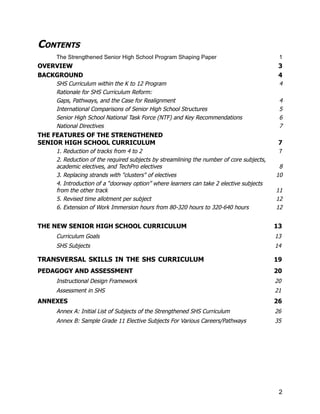
CONTENTS
The Strengthened Senior High School Program Shaping Paper​ 1
OVERVIEW​ 3
BACKGROUND​ 4
SHS Curriculum within the K to 12 Program ​ 4
Rationale for SHS Curriculum Reform:
Gaps, Pathways, and the Case for Realignment​ 4
International Comparisons of Senior High School Structures ​ 5
Senior High School National Task Force (NTF) and Key Recommendations​ 6
National Directives​ 7
THE FEATURES OF THE STRENGTHENED ​
SENIOR HIGH SCHOOL CURRICULUM​ 7
1. Reduction of tracks from 4 to 2​ 7
2. Reduction of the required subjects by streamlining the number of core subjects,
academic electives, and TechPro electives​ 8
3. Replacing strands with "clusters" of electives​ 10
4. Introduction of a “doorway option” where learners can take 2 elective subjects​
from the other track​ 11
5. Revised time allotment per subject​ 12
6. Extension of Work Immersion hours from 80-320 hours to 320-640 hours​ 12
THE NEW SENIOR HIGH SCHOOL CURRICULUM​ 13
Curriculum Goals​ 13
SHS Subjects​ 14
TRANSVERSAL SKILLS IN THE SHS CURRICULUM​ 19
PEDAGOGY AND ASSESSMENT​ 20
Instructional Design Framework​ 20
Assessment in SHS​ 21
ANNEXES​ 26
Annex A: Initial List of Subjects of the Strengthened SHS Curriculum​ 26
Annex B: Sample Grade 11 Elective Subjects For Various Careers/Pathways​ 35
2
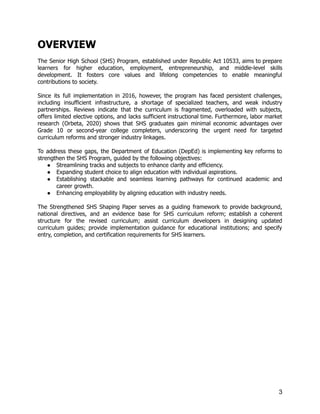
OVERVIEW
The Senior High School (SHS) Program, established under Republic Act 10533, aims to prepare
learners for higher education, employment, entrepreneurship, and middle-level skills
development. It fosters core values and lifelong competencies to enable meaningful
contributions to society.
Since its full implementation in 2016, however, the program has faced persistent challenges,
including insufficient infrastructure, a shortage of specialized teachers, and weak industry
partnerships. Reviews indicate that the curriculum is fragmented, overloaded with subjects,
offers limited elective options, and lacks sufficient instructional time. Furthermore, labor market
research (Orbeta, 2020) shows that SHS graduates gain minimal economic advantages over
Grade 10 or second-year college completers, underscoring the urgent need for targeted
curriculum reforms and stronger industry linkages.
To address these gaps, the Department of Education (DepEd) is implementing key reforms to
strengthen the SHS Program, guided by the following objectives:
●​ Streamlining tracks and subjects to enhance clarity and efficiency.
●​ Expanding student choice to align education with individual aspirations.
●​ Establishing stackable and seamless learning pathways for continued academic and
career growth.
●​ Enhancing employability by aligning education with industry needs.
The Strengthened SHS Shaping Paper serves as a guiding framework to provide background,
national directives, and an evidence base for SHS curriculum reform; establish a coherent
structure for the revised curriculum; assist curriculum developers in designing updated
curriculum guides; provide implementation guidance for educational institutions; and specify
entry, completion, and certification requirements for SHS learners.
3
BACKGROUND
SHS Curriculum within the K to 12 Program
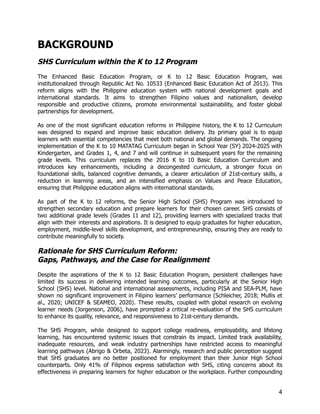
The Enhanced Basic Education Program, or K to 12 Basic Education Program, was
institutionalized through Republic Act No. 10533 (Enhanced Basic Education Act of 2013). This
reform aligns with the Philippine education system with national development goals and
international standards. It aims to strengthen Filipino values and nationalism, develop
responsible and productive citizens, promote environmental sustainability, and foster global
partnerships for development.
As one of the most significant education reforms in Philippine history, the K to 12 Curriculum
was designed to expand and improve basic education delivery. Its primary goal is to equip
learners with essential competencies that meet both national and global demands. The ongoing
implementation of the K to 10 MATATAG Curriculum began in School Year (SY) 2024-2025 with
Kindergarten, and Grades 1, 4, and 7 and will continue in subsequent years for the remaining
grade levels. This curriculum replaces the 2016 K to 10 Basic Education Curriculum and
introduces key enhancements, including a decongested curriculum, a stronger focus on
foundational skills, balanced cognitive demands, a clearer articulation of 21st-century skills, a
reduction in learning areas, and an intensified emphasis on Values and Peace Education,
ensuring that Philippine education aligns with international standards.
As part of the K to 12 reforms, the Senior High School (SHS) Program was introduced to
strengthen secondary education and prepare learners for their chosen career. SHS consists of
two additional grade levels (Grades 11 and 12), providing learners with specialized tracks that
align with their interests and aspirations. It is designed to equip graduates for higher education,
employment, middle-level skills development, and entrepreneurship, ensuring they are ready to
contribute meaningfully to society.
Rationale for SHS Curriculum Reform:
Gaps, Pathways, and the Case for Realignment
Despite the aspirations of the K to 12 Basic Education Program, persistent challenges have
limited its success in delivering intended learning outcomes, particularly at the Senior High
School (SHS) level. National and international assessments, including PISA and SEA-PLM, have
shown no significant improvement in Filipino learners’ performance (Schleicher, 2018; Mullis et
al., 2020; UNICEF & SEAMEO, 2020). These results, coupled with global research on evolving
learner needs (Jorgenson, 2006), have prompted a critical re-evaluation of the SHS curriculum
to enhance its quality, relevance, and responsiveness to 21st-century demands.
The SHS Program, while designed to support college readiness, employability, and lifelong
learning, has encountered systemic issues that constrain its impact. Limited track availability,
inadequate resources, and weak industry partnerships have restricted access to meaningful
learning pathways (Abrigo & Orbeta, 2023). Alarmingly, research and public perception suggest
that SHS graduates are no better positioned for employment than their Junior High School
counterparts. Only 41% of Filipinos express satisfaction with SHS, citing concerns about its
effectiveness in preparing learners for higher education or the workplace. Further compounding
4
these challenges is the observed misalignment between curricular expectations and learners’
actual capabilities, which is highlighted in an ACTRC study that found nearly half of SHS
teachers unable to cover even half of the prescribed competencies due to time constraints and
unrealistic curriculum loads.
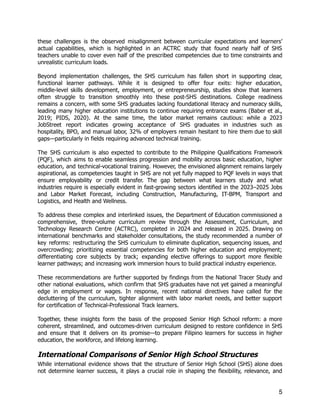
Beyond implementation challenges, the SHS curriculum has fallen short in supporting clear,
functional learner pathways. While it is designed to offer four exits: higher education,
middle-level skills development, employment, or entrepreneurship, studies show that learners
often struggle to transition smoothly into these post-SHS destinations. College readiness
remains a concern, with some SHS graduates lacking foundational literacy and numeracy skills,
leading many higher education institutions to continue requiring entrance exams (Baber et al.,
2019; PIDS, 2020). At the same time, the labor market remains cautious: while a 2023
JobStreet report indicates growing acceptance of SHS graduates in industries such as
hospitality, BPO, and manual labor, 32% of employers remain hesitant to hire them due to skill
gaps—particularly in fields requiring advanced technical training.
The SHS curriculum is also expected to contribute to the Philippine Qualifications Framework
(PQF), which aims to enable seamless progression and mobility across basic education, higher
education, and technical-vocational training. However, the envisioned alignment remains largely
aspirational, as competencies taught in SHS are not yet fully mapped to PQF levels in ways that
ensure employability or credit transfer. The gap between what learners study and what
industries require is especially evident in fast-growing sectors identified in the 2023–2025 Jobs
and Labor Market Forecast, including Construction, Manufacturing, IT-BPM, Transport and
Logistics, and Health and Wellness.
To address these complex and interlinked issues, the Department of Education commissioned a
comprehensive, three-volume curriculum review through the Assessment, Curriculum, and
Technology Research Centre (ACTRC), completed in 2024 and released in 2025. Drawing on
international benchmarks and stakeholder consultations, the study recommended a number of
key reforms: restructuring the SHS curriculum to eliminate duplication, sequencing issues, and
overcrowding; prioritizing essential competencies for both higher education and employment;
differentiating core subjects by track; expanding elective offerings to support more flexible
learner pathways; and increasing work immersion hours to build practical industry experience.
These recommendations are further supported by findings from the National Tracer Study and
other national evaluations, which confirm that SHS graduates have not yet gained a meaningful
edge in employment or wages. In response, recent national directives have called for the
decluttering of the curriculum, tighter alignment with labor market needs, and better support
for certification of Technical-Professional Track learners.
Together, these insights form the basis of the proposed Senior High School reform: a more
coherent, streamlined, and outcomes-driven curriculum designed to restore confidence in SHS
and ensure that it delivers on its promise—to prepare Filipino learners for success in higher
education, the workforce, and lifelong learning.
International Comparisons of Senior High School Structures
While international evidence shows that the structure of Senior High School (SHS) alone does
not determine learner success, it plays a crucial role in shaping the flexibility, relevance, and
5
coherence of a learner's educational experience. Recognizing this, the Department of Education
carefully reviewed various SHS models around the world to inform its proposed structural
reforms.
A comparative analysis conducted by the Assessment, Curriculum, and Technology Research
Centre (ACTRC) found that most countries organize SHS into two primary pathways: General
Academic and Vocational/Technical. In systems where additional subdivisions exist, such as
workplace- vs. school-based vocational streams (e.g., Poland, Malaysia)—the goal remains
consistent: to provide learners with a clear, navigable path toward further education or direct
employment.
Countries like Germany and Taiwan demonstrate the value of flexibility within structured
systems, offering learners options to shift between or blend academic and vocational courses.
Meanwhile, Singapore’s Full Subject-Based Banding (Full SBB) eliminates rigid tracks altogether,
allowing learners to take subjects at varying levels based on interest and ability. Despite these
differences, a common thread in successful systems is the deliberate balance between structure
and choice, ensuring foundational competencies while honoring learner agency.
International employment data supports this approach. Personalized systems (e.g., Canada,
New Zealand, the US) tend to report lower long-term unemployment rates among secondary
graduates, while structured systems with robust vocational programs (e.g., Switzerland, Austria)
maintain low NEET (Not in Education, Employment, or Training) rates. This suggests that
neither structure nor flexibility alone guarantee success; rather, it is how a system strategically
integrates both that matters.
Guided by this insight, the Philippine SHS structure is being revised to adopt two main
pathways—Academic and Technical-Professional—with expanded elective options, a streamlined
set of core subjects, and a “doorway option” that allows cross-track exploration. This revised
structure is not simply a replication of global models but a contextualized response to our
learners’ needs, informed by evidence from ACTRC studies, the National Tracer Study, and
national directives to declutter, deepen, and diversify SHS offerings.
In sum, the proposed structure balances clarity of learner pathways with the flexibility to
explore, ensuring that Filipino SHS graduates are not only academically prepared but also better
aligned with higher education, employment, and lifelong learning opportunities.
Senior High School National Task Force (NTF) and Key
Recommendations
To address implementation issues in SHS, the Department of Education (DepEd) created the
Senior High School National Task Force through DepEd Memorandum No. 028, s. 2023 on May
11, 2023. The NTF assessed the effectiveness of SHS in both DepEd and non-DepEd schools
and provided 13 key recommendations, seven of which directly inform the shaping of the
revised SHS Curriculum. These are:
1.​ Select a refined SHS model that considers challenges and lessons from its initial
implementation;
2.​ Review curriculum implementation to assess content mastery, competency proficiency,
and attainment of 21st-century skills;
6
3.​ Strengthen DepEd-TESDA coordination in implementing the
Technical-Vocational-Livelihood (TVL) track;
4.​ Update guidelines for schools on proposing and periodically reviewing SHS program
offerings;
5.​ Develop an exit assessment for Alternative Learning System (ALS) SHS learners.
6.​ Incorporate learner-centered assessments into ALS evaluation; and
7.​ Review Work Immersion Program guidelines in collaboration with government and
private sector partners.
These recommendations support the goals outlined in the 2022-2030 Basic Education
Development Plan (BEDP) and AmBisyon Natin 2040, reaffirming the critical role of SHS in
national development.
National Directives
President Ferdinand R. Marcos Jr., in his State of the Nation Address, called for an education
system that produces critical thinkers, problem solvers, and future-ready learners:
"Our system of education must be strategically calibrated to make sure that our
youth are not only taught to become literate; but, it must also consciously develop
them into problem-solvers, and into critical thinkers – hungry for success and ready
for the future."
In response, Department of Education (DepEd) Secretary Sonny Angara announced in
November 2024 a commitment to streamline and strengthen the SHS Curriculum. The goal is to
make learning more focused, efficient, and relevant by reducing core subjects, expanding
electives, and strengthening industry partnerships to better support learner’s career aspirations.
Streamlining the curriculum entails simplifying, refining, and reorganizing content to enhance its
focus, efficiency, and relevance to meet modern educational and industry demands. In a 2024
Palace Press Briefing, Secretary Angara affirmed the Department of Education’s commitment to
supporting learners’ career aspirations by strengthening industry partnerships to improve their
employability. He underscored that reducing the number of core subjects and expanding flexible
pathways through electives will ensure greater alignment between the curriculum and learners’
chosen career tracks.
THE FEATURES OF THE STRENGTHENED
SENIOR HIGH SCHOOL CURRICULUM
Driven by national directives and guided by reviews and international benchmarks, the following
are the key features of the Strengthened Senior High School Curriculum.
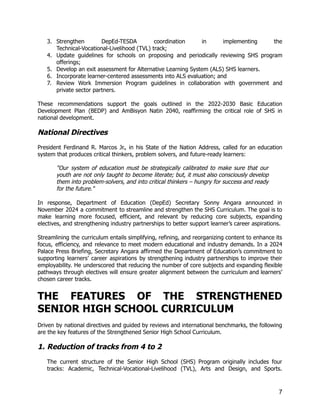
1.​Reduction of tracks from 4 to 2
The current structure of the Senior High School (SHS) Program originally includes four
tracks: Academic, Technical-Vocational-Livelihood (TVL), Arts and Design, and Sports.
7
Considering national directives and the review of the SHS Program, however, these tracks
shall be streamlined into two main educational pathways: the Academic Track and the
Technical-Professional Track – a shift that aligns more closely with global practices.
The Technical-Professional Track shall continue to offer practical, industry-relevant skills
training for learners who prefer alternative postsecondary pathways such as employment,
entrepreneurship, or middle-level skills development. The track was renamed to highlight its
professionalism and elevate its public perception, positioning it as a viable, prestigious, and
future-ready option alongside the Academic Track. Beyond this rebranding, the track aims to
empower both teachers and learners by equipping educators with updated tools, industry
exposure, and specialized training, and by enabling learners to graduate with the
confidence, competence, and qualifications to thrive in the workforce or start their own
enterprises. This reflects the Department of Education’s commitment to honoring diverse
learner aspirations and building a highly skilled and empowered Filipino workforce.
2.​Reduction of the required subjects by streamlining the number
of core subjects, academic electives, and TechPro electives
As part of the SHS curriculum refinement, the number of required subjects has been
significantly reduced through the streamlining of core subjects, academic electives, and
technical-professional (TechPro) electives. Previously, learners were expected to complete a
total of 31 subjects throughout Senior High School. Under the revised structure, learners will
now be required to complete about 7 to 23 subjects consisting of 5 core subjects and at
least 9 electives (totaling 960 hours) for those in the Academic Track, or at least 2 TechPro
electives (totaling 640 hours) along with work immersion (at least 320 hours) for those in
the Technical-Professional Track. The minimum number of electives ensures that learners
meet the minimum competencies and qualifications needed for higher education,
employment, and entrepreneurship after graduation. However, a learner may take additional
electives beyond the minimum requirement, provided that his/her total stay in school does
not exceed 30 hours per week.
Elective subjects in Senior High School (SHS) are specialized courses chosen by learners
within their selected track (Academic or Technical-Professional), offering them flexibility and
the opportunity to explore the courses based on their interest and aspirations. Consequently,
these subjects are designed to develop specific skills and competencies aligned with career
interests, academic goals, and industry demands.
The elective subjects are grouped into clusters to help learners choose more easily and
wisely. As these clusters of electives are organized by themes, e.g., arts, sciences, business,
8
learners can focus on areas that match their interest or future careers, simplifying the
decision-process of learners and supporting both their academic and career goals.
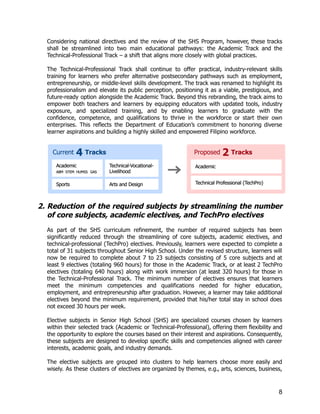
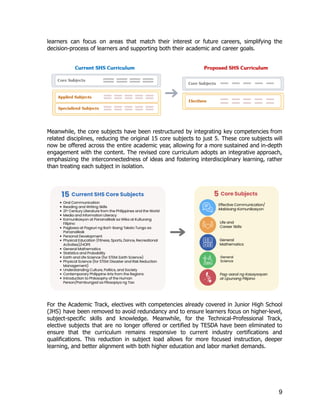
Meanwhile, the core subjects have been restructured by integrating key competencies from
related disciplines, reducing the original 15 core subjects to just 5. These core subjects will
now be offered across the entire academic year, allowing for a more sustained and in-depth
engagement with the content. The revised core curriculum adopts an integrative approach,
emphasizing the interconnectedness of ideas and fostering interdisciplinary learning, rather
than treating each subject in isolation.
For the Academic Track, electives with competencies already covered in Junior High School
(JHS) have been removed to avoid redundancy and to ensure learners focus on higher-level,
subject-specific skills and knowledge. Meanwhile, for the Technical-Professional Track,
elective subjects that are no longer offered or certified by TESDA have been eliminated to
ensure that the curriculum remains responsive to current industry certifications and
qualifications. This reduction in subject load allows for more focused instruction, deeper
learning, and better alignment with both higher education and labor market demands.
9
3.​Replacing strands with "clusters" of electives
Strands shall also be removed in the revised SHS Program to promote greater flexibility and
learner choice by eliminating the rigid grouping of subjects within the Academic and
Technical-Professional Tracks. This shift allows learners to explore a wider range of subjects
based on their interests, career goals, and evolving competencies, fostering a more
personalized learning experience. By aligning with international best practices, where
high-performing education systems avoid strand restrictions, this reform better equips
Filipino learners with diverse skills for higher education, employment, and lifelong learning.
The four curricular exits of the SHS program: higher education, employment,
entrepreneurship, and middle-level skills development shall remain in place notwithstanding
modifications to the track offerings. These exits shall ensure that learners are provided with
multiple options after graduation, whether they decide to pursue further studies, get a
technical skill certification, establish their own business, or become part of the workforce.
Offering Arts and Design (A&D) and Sports Tracks, formerly standalone tracks, under the
Academic Track is responsive to the findings of the 2018 Senior High School Tracer Study,
which revealed that 81% of SHS graduates pursued higher education, supporting the
argument that most learners opt for academic pathways.
Hence, learners interested in Arts & Design (A&D) and Sports will take the Academic Track
instead and choose A&D/S “electives.” Teachers who were previously teaching specialized
and applied subjects under the Arts & Design Track and Sports Track will now teach
“electives” related to Arts & Design and Sports, which are all under the academic track.
Previously, learners needed to take specialized subjects based on their strands. In the new
model, learners can take electives from any cluster of subjects. Schools may now offer a
variety of electives that are not tied to specific "strands." For example, learners interested in
Arts and Design (A&D) and Sports will take the Academic Track and choose Arts, Social
Sciences, and Humanities or Sports, Health, and Wellness “electives”. Likewise, teachers
who were previously teaching specialized and applied subjects under the Arts and Design
Track and Sports Track will now teach “electives” related to Arts, Social Sciences, and
Humanities or Sports, Health, and Wellness, which are all under the Academic Track.
Clusters of Electives
Academic Electives
•​ Arts, Social Sciences, and Humanities
•​ Science, Technology, Engineering, and Mathematics
•​ Sports, Health, and Wellness
•​ Business and Entrepreneurship
•​ Field Experience
TechPro Electives
•​ Aesthetic, Wellness, and Human Care
•​ Agri-Fishery Business and Food Innovation
•​ Artisanry and Creative Enterprise
10
•​ Automotive and Small Engine Technologies
•​ Construction and Building Technologies
•​ Creative Arts and Design Technologies
•​ Hospitality and Tourism
•​ Industrial Technologies
•​ ICT Support and Computer Programming Technologies
•​ Maritime Transport
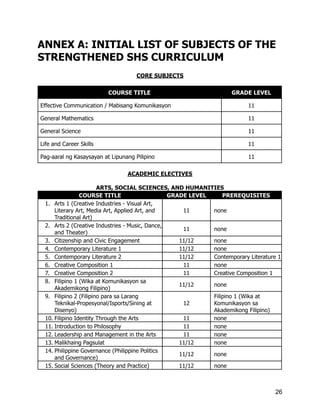
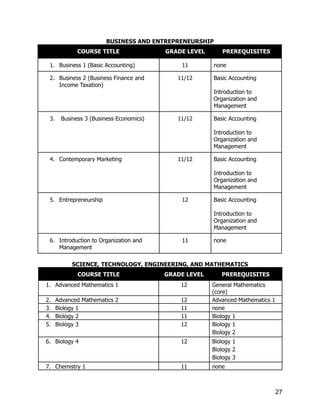
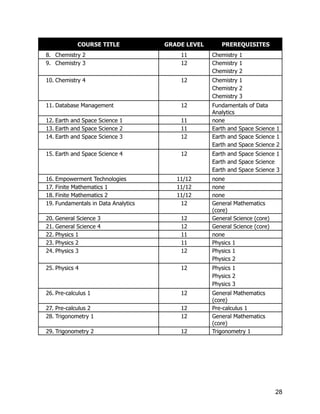
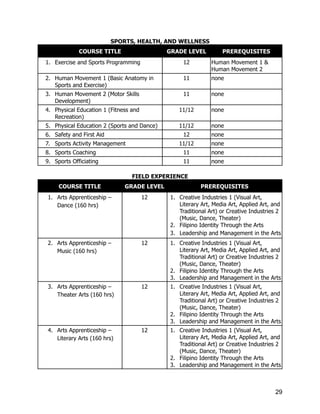
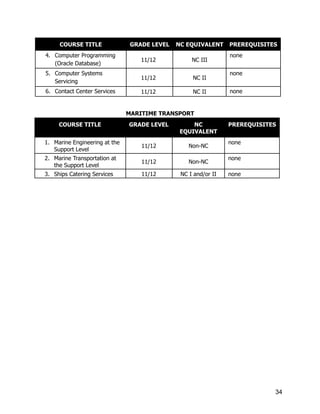
A clustering of electives can be found in Annex A.
4.​Introduction of a “doorway option” where learners can take 2
elective subjects from the other track
To promote greater flexibility and learner agency within the revised Senior High School
curriculum, a “doorway option” is introduced, allowing learners to take 1 to 2 elective
subjects from a track other than the one they originally chose. While learners are still
required to formally select their track (i.e., either Academic or Technical-Professional) at the
start of Grade 11, the doorway option provides them with the opportunity to explore
subjects outside their chosen track, broadening their skill sets and career exposure.
This innovation responds to the realities of learners’ interests and evolving aspirations. For
example, an Academic Track - learner interested in entrepreneurship may take a TechPro
elective of Agricultural Crops Production (NC II) or Food Processing (NC II), while a TechPro
Track learner may opt to take a subject Basic Accounting or Contemporary Marketing from
the Academic Track. This cross-track mobility serves as an exploratory mechanism – a
“doorway” to other disciplines – without requiring a full shift in track.
The doorway option not only supports holistic development but also enhances
interdisciplinary learning, making learners more adaptable to both academic and real-world
contexts. It recognizes that interests and aptitudes may evolve, and it empowers learners to
11
customize their SHS experience based on their emerging goals, whether toward
employment, entrepreneurship, or higher education.
5.​Revised time allotment per subject
To support the streamlined structure of the revised Senior High School curriculum, the time
allotment per subject has been adjusted to ensure sufficient depth of learning while
maintaining curriculum efficiency. The revised time allocations are designed to maximize
instructional time, allow for more focused delivery of content, and provide flexibility in
scheduling across semesters and grade levels. These adjustments also reflect the
differentiated nature of the Academic and Technical-Professional tracks, balancing
foundational knowledge, specialization, and practical application.
●​ Core = 160 hours offered in one year/two semesters
●​ Academic electives = 80 hours offered in one semester
●​ Grade 11 TechPro electives = 320 hours in one year
●​ Grade 12 TechPro electives = 320 hours in one semester
6.​Extension of Work Immersion hours from 80-320 hours to
320-640 hours
Work Immersion as a subject in the SHS Curriculum involves hands-on experience or work
simulation in which learners can apply their competencies and acquire knowledge relevant
to their track. A significant enhancement in the strengthened Senior High School Program is
the extension of Work Immersion hours from the current 80 to 320 hours to a more
intensive 320 to 640 hours. This extension is designed to provide learners, particularly those
in the Technical-Professional Track, with more meaningful, hands-on experience in
real-world workplace settings, better preparing them for immediate employment or further
skills training after graduation.
The Work Immersion in the Strengthened SHS Curriculum requires a minimum of 320 hours,
giving learners ample time to gain a deeper understanding and acquire additional skills in
their respective industries. Work Immersion is mandatory for all learners under the TechPro
track. For Academic Track, they may opt to take electives under Field Experience as
counterpart of Work Immersion. One of these is Field Exposure which is a structured
learning experience that immerses learners in real-world environments relevant to their field
of interest for a minimum of 320 hours, or Design and Innovations for 160 hours.
When offered on a full-time basis (i.e., 8 hours per day on consecutive days), the extended
work immersion may span one to two academic quarters, allowing learners to become
deeply involved in work processes and industry-standard practices. This setup mirrors the
structure of actual employment and helps bridge the gap between school and the
workplace. It also provides ample time for learners to demonstrate and refine the
competencies they have acquired in their elective subjects.
In the revised program, work immersion will be mandatory for all TechPro learners, ensuring
alignment with industry demands and TESDA qualifications. For learners in the Academic
Track, work immersion remains optional, recognizing that their chosen pathways are more
12
likely to lead to higher education. However, the option is still available for those who wish to
gain professional exposure in areas such as research, business, or
communication—depending on their interest and career goals.
Learners in both tracks (Academic and TechPro) have the option to take an elective under
Field Experience, a cluster of courses designed to provide hands-on activities and
community engagements that allow students to apply their knowledge and skills in
real-world contexts.
One of the electives under Field Experience is Field Exposure. This structured learning
experience immerses students in actual environments relevant to their field of specialization,
enabling them to:
●​ demonstrate industry-specific competencies and apply theoretical knowledge in a
supervised real-world setting;
●​ enhance their technical expertise and practical skills;
●​ strengthen their communication and interpersonal skills, fostering collaboration and
adaptability; and
●​ develop positive work habits, professional attitudes, and a deep appreciation for the
value of work.
Electives under the Field Experience cluster may be taken during either the first or second
semester of Grade 12, depending on the school's implementation plan. However, Field
Exposure is best scheduled in the final semester of Grade 12, when students have already
gained the necessary foundational knowledge and technical skills from their core and
specialized subjects. This approach ensures that learners are well-prepared to apply their
learning effectively in real-world or community-based settings.
THE NEW SENIOR HIGH SCHOOL CURRICULUM
Curriculum Goals
The Strengthened SHS Program is aligned with the international benchmarks and national
educational goals, preparing learners for higher education, the workforce, and lifelong learning.
This enables teachers to design lessons and assessments that foster mastery and deeper
understanding of the lessons, ensuring that the learners gain 21st
century skills including critical
thinking and problem-solving abilities required for success in the real world.
Key Stage 4 Standards
At the end of Grade 12, learners are expected to demonstrate mastery of essential academic
and technical skills that enable them to think critically, solve complex problems, and engage in
lifelong learning. They are equipped with global competence, values, and 21st-century skills
13
aligned with international standards allowing them to adapt to a dynamic, globalized
environment. They are prepared for further education, vocational and technical careers, creative
arts, sports, and entrepreneurial ventures to contribute meaningfully as productive and
responsible citizens.
Academic Track Standards
At the end of Grade 12, learners demonstrate interdisciplinary knowledge, skills, and values
across accountancy, business, management, humanities, social sciences, science, technology,
engineering, mathematics, sports, health, arts, and design. They apply critical thinking,
creativity, ethical decision-making, and 21st-century skills to address socio-economic, scientific,
cultural, and professional challenges while contributing to national development and engaging
with both local and global contexts.
Technical-Professional Track Standards
At the end of Grade 12, learners demonstrate mastery of technical knowledge, skills, and
attitudes across various sectors, including agriculture and fishery, family and consumer science,
industrial arts, information and communications technology, and maritime services. They apply
industry-based competencies aligned with national and international standards, showcasing
readiness for specialized careers, lifelong employability, and the capacity to contribute
effectively to the nation’s economic development.
SHS Subjects
Core Subjects
Unlike the previous structure, which featured core, applied, and specialized subjects, the new
SHS curriculum design shall exclusively emphasize core and elective subject offerings. With this
modification, learners shall be able to focus on developing the fundamental skills needed for the
curriculum exits, resulting in a more concentrated and in-depth learning experience.
This change is aligned with the SHS structure of the majority of academically high-achieving
nations, whose curriculum consists of only five to six core subjects supplemented by electives
chosen by the learners depending on their interests and aptitude. For example, a typical
structure might consist of six core subjects with two specialized electives, or five core subjects
plus two electives. The redesigned SHS curriculum minimizes overlaps and simplifies learning
areas in accordance with this global approach.
TABLE 1
Core Subject Descriptions
EFFECTIVE
COMMUNICATION/
MABISANG
KOMUNIKASYON
Effective Communication / Mabisang Komunikasyon is a core subject for
all Grade 11 learners, designed to develop communicative competence in
both English and Filipino across four key contexts: personal and
interpersonal, social and cultural, academic and training, and professional
and work settings. Grounded in relevant expectations of the B2 level of
14
the Common European Framework of Reference (CEFR), the subject
equips learners to participate actively in spoken, written, and multimodal
communicative events with confidence, clarity, and cultural sensitivity. It
emphasizes strategic language use, tone and structure appropriateness,
media and information literacy, and ethical communication practices.
Through reflective practice and purposeful interaction, each learner is
envisioned to develop into a responsible, adaptive, and globally
competent communicator.
Built on a dual-language framework, this subject treats English and
Filipino as parallel yet complementary strands. Each is delivered
separately by a dedicated teacher with 80 instructional hours per school
year. Instruction is customized to the specific language, ensuring depth
of learning, accuracy in assessment, and the development of transferable
skills. In this way, the subject fosters bilingual communicative
competence, a foundation for global readiness and civic participation in a
multilingual society.
Unlike models that fuse English and Filipino into a single hybrid course,
this approach is better described as integrative: it maintains the distinct
integrity of each language while aligning their outcomes toward a shared
vision. Instruction in English and Filipino is viewed to intersect at the
levels of concept and practice. This lends the learning environment for
advanced communicative strategies such as translanguaging, which
students may use mindfully and purposefully in assessment and real-life
situations.
Content-wise, the curriculum is organized around four progressive
domains, starting with communication in familiar, personal contexts and
moving outward to broader, public, and future engagements. Each
quarter encourages learners to explore increasingly complex interactions
while developing the reflective habits and feedback-driven growth
necessary to refine their communication skills over time. The course also
contributes directly to the Department of Education’s 21st Century Skills
Framework, strengthening not only literacy and collaboration but also
intercultural sensitivity, digital fluency, and ethical responsibility.
By the end of the course, learners are expected to:
●​ Adapt communication strategies effectively;
●​ Engage in extended communicative events with confidence and
purpose;
●​ Utilize digital tools and platforms responsibly to enhance
expression and interaction; and
●​ Reflect on their growth as communicators, using feedback to
improve and prepare for future communication demands
Ang Mabisang Komunikasyon / Effective Communication ay isang
pangunahing kurso para sa lahat ng mag-aaral ng Baitang 11 na
dinisenyo upang linangin ang kanilang kakayahang komunikatibo sa
15
Filipino at sa Ingles na nakabatay sa mga inaasahan ng Antas B2 ng
Common European Framework of Reference (CEFR), at sa apat na
pangunahing konteksto: personal at interpersonal, sosyal at kultural,
akademiko at pampagsasanay, at propesyonal at pantrabaho. Inihahanda
ng kurso ang mga mag-aaral na aktibong makilahok sa mga pasalita,
pasulat, at multimodal na sitwasyong komunikatibo nang may tiwala sa
sarili, kalinawan ng pagpapahayag, at pagiging sensitibo sa kultura ng
iba. Binibigyang-diin ng kurso ang estratehikong paggamit ng wika,
kaangkupan ng bokabularyo, tono at estruktura, literasing pangmidya at
pang-impormasyon, at mga kilos pangkomunikasyong angkop sa mga
gawi at halagahang Pilipino. Sa replektibong paggamit ng wika at
malayuning pakikipagtalastasan, nalilinang ng mga mag-aaral ang
kanilang pagkakakilanlan bilang responsableng mga tagapagpahayag na
may kakayahang sumabay at umangkop sa globalisadong mundo.
Gumagamit ng framework na dual-track, magkasabay na itinuturo ng
kurso ang Filipino at Ingles sa paraang komplementaryo sa isa’t isa. May
kani-kaniya mang gurong nakatalaga sa pagtuturo ng bawat wika sa loob
ng 80 oras kada taong panuruan, nagkakaisa naman sila sa hangaring
mapaunlad ang kakayahang komunikatibo ng mga mag-aaral. Iniaayon
ang pagtuturo sa kalikasan ng bawat wika kaya natitiyak ang lalim ng
pagkatuto, katumpakan ng pagtataya, at paglinang sa mga kakayahang
naisasalin sa mga mag-aaral. Sa ganitong paraan, napauunlad ng
asignatura ang bilingguwal na kakayahang komunikatibo – isang
pundasyon sa kahandaang sumabay sa globalisadong mundo at aktibong
makilahok sa isang lipunang multilingguwal.
Hindi tulad ng mga modelong pinagsasanib lang ang Filipino at Ingles
bilang isang kursong may magkahalong wika, gumagamit ang Mabisang
Komunikasyon ng dulog integratibo: pinananatili nito ang kani-kaniyang
integridad ng bawat wika habang tinitiyak na nakatuon ang mga
bungang nais matamo sa iisang hangarin. Batay ito sa paniniwalang ang
pagtuturo ng Filipino at Ingles ay nagtatagpo rin sa mga antas
estruktural at konseptuwal, hindi lang sa antas lingguwistiko. Ito ang
maghahanda sa mga mag-aaral sa progresibo na estratehiyang
komunikatibo gaya ng translanguaging na magagamit nila nang maláy at
naaayon sa tiyak na layunin sa mga gawaing pampagtataya at sa mga
totoong sitwasyon sa buhay.
Pagdating sa nilalaman, binalangkas ang kurikulum nang papaunlad ayon
sa apat na domeyn: nagsisimula ang komunikasyon sa mga kontekstong
pamilyar at personal at lumalawig tungo sa mas malalawak, pampubliko,
at panghinaharap na mga sitwasyon. Hinihikayat ng bawat markahan ang
mga mag-aaral na pag-isipan kung paano tutugon sa mga interaksiyon
lalong nagiging komplikado habang nililinang ang mga gawing
magpapaisip at magpapalago sa kanila batay sa feedback. Mahalaga ang
mga ito upang unti-unting mahasa ang kanilang kasanayang
komunikatibo sa paglipas ng panahon. Direkta ring nag-aambag ang
kursong Mabisang Komunikasyon sa 21st Century Skills Framework ng
16
Kagawaran ng Edukasyon na nagpapatibay hindi lang sa literasi at
kolaborasyon kundi maging sa pagkakaroon ng sensibilidad sa ibang
kultura, pagtatamo ng kahusayang dihital, at pagkakaroon ng
pananagutang etikal.
Sa pagtatapos ng kurso, ang mga mag-aaral ay inaasahang:
a.​ nagagamit nang mabisa ang mga estratehiyang komunikatibo,
kasama na ang maláy na pagpili ng gagamiting wika at tono ayon
sa konteksto;
b.​ nakikilahok sa mas malalawak na sitwasyong komunikatibo nang
may tiwala sa sarili at tiyak na layunin;
c.​ nagagamit nang responsable ang iba’t ibang kasangkapan at
platapormang dihital upang mapabuti ang pagpapahayag at
interaksyon; at
d.​ napagninilayan ang paglago nila bilang mga tagapagpahayag na
gumagamit ng feedback upang mapabuti ang sarili at
makapaghanda sa mga pangangailangang komunikatibo sa
hinaharap.
Tinutulungan ng kursong ito ang mga mag-aaral, hindi lang upang
magtagumpay sa antas akademiko at propesyonal kundi upang
magkaroon din ng makabuluhang pakikilahok sa isang malawak at
nagbabagong mundo.
GENERAL
MATHEMATICS
This course deepens learners’ understanding of concepts and techniques
drawn from numbers and algebra, geometry and measurement, and
statistics. It aims to strengthen their mathematical reasoning,
problem-solving, critical thinking skills, and statistical analysis essential to
their preparation for professional and creative work, research, innovation
in a specialized field, and various career opportunities. It emphasizes
applying quantitative methods in real-life and structured academic and
professional settings, providing them opportunities to excel and adapt to
diverse environments independently and collaboratively. It refines their
ability to analyze real-world data, make informed decisions, and
effectively communicate results using appropriate language and
technology, making them ready for various educational and employment
pathways.
GENERAL SCIENCE
This course uses a multidisciplinary approach to equip learners with the
essential scientific knowledge, skills, and capabilities to meet the
challenges of living and working in a rapidly changing and advancing
Philippine society. The course aims to provide learners with the
fundamental scientific competencies to help shape a sustainable future
for themselves, their communities, and the planet. The course focuses on
understanding and applying the scientific models, theories, and laws that
relate to everyday life and work, as well as how these impact the
Philippines as a significant contributor to the world. The curriculum uses
a transdisciplinary approach to understand how the study of Physics,
Chemistry, Biology, and Earth and Space Science interact to explain
natural phenomena and how they can be utilized to advance the
17
Philippines’ economy. The course builds on learners’ experiences and
understandings of scientific phenomena to support them to be scientific
and technological thinkers who can propose and solve problems through
scientific observation, data gathering, meaning-making, and effectively
communicating evidence-based conclusions. Learners will develop
practical, scientific, and critical thinking skills through individual and
collaborative scientific investigations and research, preparing them to
pursue further education and careers in various fields or contribute
meaningfully to a science-driven workforce.
LIFE AND CAREER
SKILLS
This course explores interconnectedness of the science of personal
development, health and wellness, and career readiness that develops
life skills for self-determination, adaptability, resilience, and leadership to
engage responsibly in the workplace and community. It equips learners
with personal, physical, social, and career development competencies in
preparation for their transition to various pathways.
PAG-AARAL NG
KASAYSAYAN AT
LIPUNANG PILIPINO
Nakatuon ang kursong ito sa pagsusuri ng mga isyu at usaping
panlipunan at pangkasaysayan gamit ang dulog tematiko, multikultural,
at interdisiplinaryo. Layunin nitong higit na mapalalim at mapagyaman
ang kamalayang pangkasaysayan, Pilipino, at panlikás-kayang pag-unlad
upang mapaigting at maitaguyod ang kahusayang sibiko na mahalaga sa
pagiging isang mapanagutang mamamayan ng Pilipinas at ng daigdig.
Elective Subjects
Elective subjects in Senior High School (SHS) are specialized courses chosen by learners within
their selected track (Academic or Technical-Professional). These subjects are designed to
develop specific skills and competencies aligned with career interests, academic goals, and
industry demands.
Unlike college electives, which offer a broad range of courses for academic exploration, SHS
electives are directly linked to the learner’s chosen pathway, focusing on skill development,
industry readiness, or advanced academic preparation. They are time-bound (typically 80 hours
per semester for academic electives and 320 hours for TechPro electives) and standards-based,
ensuring that students gain practical knowledge essential for higher education, employment,
entrepreneurship, or middle-level skills development.
The availability of elective subjects may vary depending on learner preferences, school capacity
and resources, and prevailing industry needs. Additionally, elective clusters may be expanded
based on context-specific demands. Schools are encouraged to align elective offerings with the
evolving educational landscape to better equip learners for future challenges.
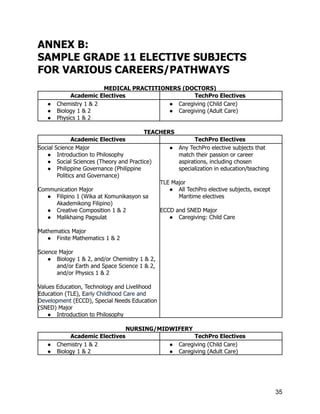
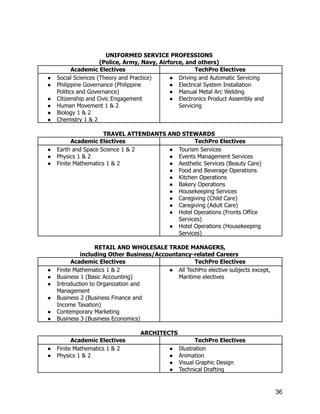
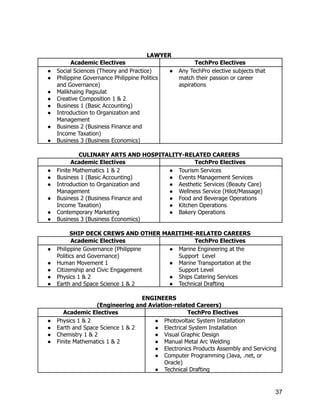
The list of electives can be found in Annex A. Sample career pathways and electives can be
found in Annex B.
18
TRANSVERSAL SKILLS IN THE SHS CURRICULUM
The Department of Education’s vision remains steadfast: holistically developed Filipino learners
equipped with transversal skills or also known as 21st-century skills. These skills—encompassing
essential knowledge, competencies, values, and attributes—are critical for learners to thrive in
today’s rapidly evolving world of work and life. The 21st Century Skills Framework, drawn from
both international and local competency models, reflects the realities of an increasingly
interconnected, technology-driven, and complex global landscape.
Anchored in DepEd’s core values of Maka-Diyos, Makatao, Makakalikasan, at Makabansa, the
development of these skills empowers learners to realize their full potential and contribute to
building a cohesive and progressive nation—one that upholds socio-political stability, economic
prosperity, sustainability, and unity in diversity. This framework serves as a guiding force across
all levels of DepEd governance, ensuring that these essential skills are intentionally and
consistently developed throughout basic education.
The framework identifies four key domains of 21st-century skills, as articulated in DepEd Order
No. 21, s. 2019:
●​ Information, Media, and Technology Skills
●​ Learning and Innovation Skills
●​ Communication Skills
●​ Life and Career Skills
In the context of the Strengthened Senior High School (SHS) Curriculum, the intentional
development of transversal skills—also known as 21st-century skills—is central to both core and
elective subjects. These skills cut across academic and technical disciplines, ensuring that SHS
graduates are not only academically competent but also adaptable, innovative, and
future-ready.
The core subjects namely, Effective Communication, General Mathematics, General Science,
Pag-aaral ng Kasaysayan at Lipunang Pilipino, and Life and Career Skills are designed to develop
learners’ competencies like critical thinking, collaboration, ethical reasoning, intercultural
understanding, digital literacy, and problem-solving. These subjects offer all learners, regardless
of track, with a shared foundation and opportunities to apply learning in authentic and
real-world contexts. Elective subjects provide learners with the opportunity to enhance their
knowledge and skills by tailoring them to their interests, abilities, and desired career paths,
including higher education, employment, entrepreneurship, or middle-level skills. These subjects
further reinforce transversal skills by requiring learners to be immersed in complex tasks, exhibit
initiative, and make informed and responsible decisions within their chosen endeavor.
Ultimately, the design of learning experiences in SHS must guarantee that both core and
elective subjects actively integrate opportunities for learners to develop and exercise
21st-century skills. By doing so, the Strengthened SHS Curriculum fulfills its promise: to equip
every Filipino learner with the skills, values, and mindset needed for lifelong learning,
meaningful work, and responsible citizenship in a dynamic global society.
19
PEDAGOGY AND ASSESSMENT
The Instructional Design Framework of SHS
The Strengthened Senior High School Instructional Design Framework (SHS IDF)
offers a structured approach to teaching and learning, emphasizing purposefulness, alignment,
and responsiveness to diverse learner needs. Building upon the Revised K-to-10 Curriculum IDF,
the SHS IDF retains core principles while refining them to align with the Strengthened SHS
curriculum. It prioritizes constructive alignment, ensuring that learning objectives, instructional
strategies, and assessments are interconnected. This approach fosters competency-based,
engaging lessons, which establishes a systematic method for lesson planning and delivery.
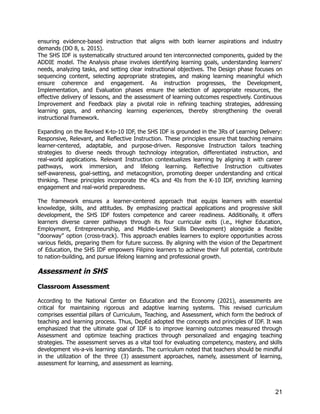
Figure 1: Strengthened Senior High School Curriculum Instructional Design Framework
The foundation of this SHS IDF is an integrated instructional process comprising three
interrelated key elements: curriculum, teaching, and assessment, with an emphasis on the basic
requirement of constructive alignment. The curriculum, guided by Republic Act 10533
(Enhanced Basic Education Act of 2013), emphasizes research-based, spiral, and contextualized
learning that develops 21st-century skills and industry-aligned competencies. Teaching follows
the 10 parts of the Daily Lessons, categorized into themes: Activating Prior Knowledge,
Instituting New Knowledge, and Demonstrating Knowledge and Skills (DepEd Order No. 42, s.
2016). Assessment, both formative and summative, continuously monitor learner progress,
20
ensuring evidence-based instruction that aligns with both learner aspirations and industry
demands (DO 8, s. 2015).
The SHS IDF is systematically structured around ten interconnected components, guided by the
ADDIE model. The Analysis phase involves identifying learning goals, understanding learners'
needs, analyzing tasks, and setting clear instructional objectives. The Design phase focuses on
sequencing content, selecting appropriate strategies, and making learning meaningful which
ensure coherence and engagement. As instruction progresses, the Development,
Implementation, and Evaluation phases ensure the selection of appropriate resources, the
effective delivery of lessons, and the assessment of learning outcomes respectively. Continuous
Improvement and Feedback play a pivotal role in refining teaching strategies, addressing
learning gaps, and enhancing learning experiences, thereby strengthening the overall
instructional framework.
Expanding on the Revised K-to-10 IDF, the SHS IDF is grounded in the 3Rs of Learning Delivery:
Responsive, Relevant, and Reflective Instruction. These principles ensure that teaching remains
learner-centered, adaptable, and purpose-driven. Responsive Instruction tailors teaching
strategies to diverse needs through technology integration, differentiated instruction, and
real-world applications. Relevant Instruction contextualizes learning by aligning it with career
pathways, work immersion, and lifelong learning. Reflective Instruction cultivates
self-awareness, goal-setting, and metacognition, promoting deeper understanding and critical
thinking. These principles incorporate the 4Cs and 4Is from the K-10 IDF, enriching learning
engagement and real-world preparedness.
The framework ensures a learner-centered approach that equips learners with essential
knowledge, skills, and attitudes. By emphasizing practical applications and progressive skill
development, the SHS IDF fosters competence and career readiness. Additionally, it offers
learners diverse career pathways through its four curricular exits (i.e., Higher Education,
Employment, Entrepreneurship, and Middle-Level Skills Development) alongside a flexible
“doorway” option (cross-track). This approach enables learners to explore opportunities across
various fields, preparing them for future success. By aligning with the vision of the Department
of Education, the SHS IDF empowers Filipino learners to achieve their full potential, contribute
to nation-building, and pursue lifelong learning and professional growth.
Assessment in SHS
Classroom Assessment
According to the National Center on Education and the Economy (2021), assessments are
critical for maintaining rigorous and adaptive learning systems. This revised curriculum
comprises essential pillars of Curriculum, Teaching, and Assessment, which form the bedrock of
teaching and learning process. Thus, DepEd adopted the concepts and principles of IDF. It was
emphasized that the ultimate goal of IDF is to improve learning outcomes measured through
Assessment and optimize teaching practices through personalized and engaging teaching
strategies. The assessment serves as a vital tool for evaluating competency, mastery, and skills
development vis-a-vis learning standards. The curriculum noted that teachers should be mindful
in the utilization of the three (3) assessment approaches, namely, assessment of learning,
assessment for learning, and assessment as learning.
21
More so, the IDF focuses on optimal learning, which helps teachers to understand how learners
in basic education learn best. Through this framework, teachers are empowered and expected
to prepare learners to manage academic rigor and train them to be independent lifelong
learners.
In addition, this framework intends to equip teachers on the strategic and effective delivery of
curriculum instructions ensuring quality learning experiences and opportunities. For IDF noting
the significance of integrating the essential key features of the MATATAG Curriculum in the
teaching and learning process such as focus on the foundational skills, balanced cognitive
demand, emphasis on 21st
century skills, integration of values formation and peace, education,
and alignment with the international standards.
Using this framework, the type of classroom assessment should reflect what learners must know
and be able to demonstrate what they know through the tasks and activities that foster the
attainment of the desired learning competencies of the curriculum and position learning tasks
with standardized achievement examinations such as National Achievement Test.
In preparation for the national assessments, this framework contours the intention to facilitate
the acquisition of curriculum competencies and standards in order to gear learners in
demonstrating their mastery of key competencies and knowledge in various subjects. This
assessment determines if the graduating learners are meeting the learning standards indicated
in the senior high school curriculum.
The findings of these assessments help to provide relevant technical assistance in the
preparation of programs that may address learning needs. This claim has been indicated in
DepEd Order 29, s. 2017 Section 5: Assessment Data Utilization and on how assessment plays a
pivotal role in directing the course of action and policy decision-making of the basic education.
Systems Assessment
In accordance with Section 5: Assessment Data Utilization of DepEd Order No. 29, s. 2017,
assessment data derived from internal and external assessments shall be utilized in the
planning, monitoring, and evaluation cycles, serving as critical input for decision-making
processes across DepEd's governance levels. System performance assessment results should
connect with program delivery to benefit all learners and support school improvement plans.
The system assessment will play a pivotal role in gauging the system performance to facilitate
the continuous improvement of the teaching-learning process and learners’ development within
the revised Senior High School (SHS) curriculum. The National Achievement Test (NAT) at Grade
12 should be explicitly aligned with the intended revised SHS curriculum which will cover the
Core Subjects and different subject groups. NAT is an essential tool that will provide
data-driven insights to inform educational practices and policy decisions. Hence, timely and
complete data is a crucial feature that will enhance the transparency and accountability across
all levels of DepEd governance.
Moreover, NAT will measure not only student learning outcomes but also the effectiveness of
the curriculum in addressing the diverse needs of learners across the country. Results will serve
as benchmarks for evaluating the revised SHS curriculum, highlighting strengths and identifying
challenges that require targeted interventions. By systematically analyzing these assessment
22
results, educators and policymakers can gain a nuanced understanding of the factors
influencing student success or underachievement. This analysis is crucial for ensuring the SHS
curriculum remains relevant and responsive to the evolving demands of higher education and
the workforce.
In addition, the integration of standard setting within these assessments will be vital for
establishing clear performance expectations. Proficiency levels, determined through Item
Response Theory (IRT) techniques, categorize student abilities across a continuum. Learners
are grouped into levels—such as "below basic," "basic," "proficient," and "advanced"—with each
level representing increasingly complex knowledge and skills. IRT simultaneously estimates both
student ability and item difficulty. For each level, learners are expected to correctly answer a
certain percentage of items. For instance, learners at the bottom of a level answer about 52%
of the items correctly, while those at the top answer approximately 70%. This method ensures
that proficiency levels reflect not only a student's ability to solve tasks at their current level but
also their performance on easier and more difficult items. By reporting achievement data in
terms of proficiency levels, student performance can be interpreted with greater precision. This
allows educators to offer targeted support to learners who are struggling and to foster a culture
of continuous improvement through the sharing of best practices.
Finally, NAT can help promote equity within the education system by revealing achievement
gaps among various demographic groups. The results will inform strategies to address
disparities in educational access and quality, leading to the development of targeted support
programs for underperforming schools or specific student populations.
23
REFERENCES
Black, P., & Wiliam, D. (2018). Classroom assessment and pedagogy. Assessment in Education:
Principles, Policy & Practice. doi:10.1080/0969594X.2018.1441807
Black, P., & Wiliam, D. (2010). Inside the black box: Raising standards through classroom
assessment. Phi Delta Kappan, 92(1), 81-90.doi:10.1177/003172171009200119
Brookhart, S. M. (2020, August). What grading and assessment practices could schools use in
the year ahead? PACE, Stanford Graduate School of Education, and Answer Lab, USC Rossier.
https://theanswerlab.rossier.usc.edu/wpcontent/uploads/2020/09/Answer-Lab-Grading-20200
9-v1.pdf
Cagasan, L., Care, E., Robertson, P., & Luo, R. (2020). Developing a formative assessment
protocol to examine formative assessment practices in the Philippines. Assessment in
Education: Principles, Policy & Practice. doi:10.1080/10627197.2020.1766960
Christodoulou, D. (2017). Making good progress?: The future of assessment for learning. Oxford
University Press.
Darling-Hammond, L., Herman, J., Pellegrino, J., et al. (2013). Criteria for high quality
assessment. Stanford CA: Stanford Center for Opportunity Policy in Education.
Department of Education (2016). Edukasyong Pantahanan at Pangkabuhayan and Technology
and Livelihood Education Curriculum Guide. Pasig City: DepEd
Department of Education. (2016). K to 12 Gabay Pangkurikulum ng Filipino. Pasig City: DepEd
Department of Education (2016). Mathematics Curriculum Guide. Pasig City: DepEd.
Department of Education (2016). Science Curriculum Guide. Pasig City: DepEd.
Department of Education Order No. 31, s. 2020. Interim guidelines for assessment and grading
in light of the Basic Education Learning Continuity Plan. Pasig City: DepEd.
Department of Education Order No. 21, s. 2019. Policy guidelines on the K-12 Basic Education
Program. Pasig City: DepEd.
Department of Education Order No. 27, s. 2017. Research management guidelines. Pasig City:
DepEd.
Department of Education Order No. 55, s. 2016. Policy guidelines on the national assessment of
student learning for the K to 12 Basic Education Program. Pasig City: DepEd.
Department of Education Order No. 8, s. 2015. Policy guidelines on classroom assessment for
the K to 12 Basic Education Program. Pasig City: DepEd.
Enhanced Basic Education Act of 2013, RA 10533 (2013).
Executive Order No. 83, s. 2012. Institutionalization of the Philippine Qualifications Framework.
Manila: Malacanan. Frost & Sullivan. (2016). World‘s top global mega trends to 2025 and
implications to business, society, and cultures. Macro to Micro Implications of Mega Trends
for the World. https://www.thegeniusworks.com/wp
content/uploads/2016/01/Megatrends-2025-Frost-and-Sullivan.pdf
GMRC and Values Education Law, RA 11476 (2020).
Jorgenson, O. (2006). Why curriculum change is difficult and necessary. Independent School.
https://www.nais.org/magazine/independent
school/summer-2006/why-curriculum-change-is-difficult-and-necessary/
Marope, M., Griffin, P., & Gallagher, C. (2017). Future competences and the future of curriculum.
http://www.ibe.unesco.org/en/news/document-future competences-and-future-curriculum
McKinsey & Company. (2017). Jobs lost, jobs gained: Workforce transitions in a time of
automation. https://www.mckinsey.com/mgi/
Missouri Baptist University (n.d.). The Big Idea. https://www.mobap.edu/wp
content/uploads/2013/03/The_Big_Idea.pdf
24
Mullis, I., Martin, M., Foy, P., Kelly, D. & Fishbein, B. (2020). TIMSS 2019 International Results in
Mathematics and Science. https://timssandpirls.bc.edu/timss2019/international-results/
National Commission for Culture and the Arts. (2020). A study on Filipino values: A primer.
Manila: NCCA
OECD. (2020). The futures of education and skills: Education 2030. Retrieved from
https://www.oecd.org/education/2030/E2030%20Position%20Paper%20(0 5.04.2018).pdf
Robertson, P., Bustos, T., Rickards, F., Ferido, M., Bagui, L., Dela Cruz, J., & Kheang, T. (2020).
Review of the intended curriculum. Quezon City: Assessment Curriculum and Technology
Research Centre (ACTRC)
Robertson, P., Ferido, M., Bustos, T., (2024). Senior High School Curriculum Review: Phase 1, Vol
3. Synthesised findings and recommended models. Assessment Curriculum and Technology
Research Centre (ACTRC)
Robertson, P., Koh, S., Sun, SZ. (2024). Senior High School Curriculum Review: Phase 1 Volume
1 International Comparison. Assessment Curriculum and Technology Research Centre
(ACTRC)
Robertson, P., Kheang, T., Bustos, T., Rickards, F., Ferido, M., Cagasan, L., Cruz, J. Dela, Vergara,
J., & Nepomuceno, J. (2021). Review of the Attained Curriculum. Assessment Curriculum and
Technology Research Centre (ACTRC)
Schleicher, A. (2018). PISA 2018: Insights and interpretations.
https://www.oecd.org/pisa/PISA%202018%20Insights%20and%20Interpret
ations%20FINAL%20PDF.pdf
UNESCO. (n.d.). Standards-based curriculum. http://www.ibe.unesco.org/en/glossary-curriculum
terminology/s/standards-based-curriculum
UNICEF & SEAMEO. (2020). SEA-PLM 2019 Main Regional Report Summary: Children’s learning
in 6 Southeast Asian countries. Bangkok, Thailand: United Nations Children’s Fund (UNICEF)
& Southeast Asian Ministers of Education Organization (SEAMEO) – SEA-PLM Secretariat.
World Bank (2016). Assessing basic education service delivery in the Philippines: The Philippines
public education expenditure tracking and quantitative service delivery study.
http://documents1.worldbank.org/curated/en/507531468325807323/pdf/
AUS6799-REVISED-PH-PETS-QSDS-Final-Report.pdf
World Manufacturing Forum. (2019). The World Manufacturing Forum report: Skills for the
future of manufacturing. https://worldmanufacturing.org/wp
content/uploads/WorldManufacturingFoundation2019-Report.pdf
25
ANNEX A: INITIAL LIST OF SUBJECTS OF THE
STRENGTHENED SHS CURRICULUM
CORE SUBJECTS
COURSE TITLE GRADE LEVEL
Effective Communication / Mabisang Komunikasyon 11
General Mathematics 11
General Science 11
Life and Career Skills 11
Pag-aaral ng Kasaysayan at Lipunang Pilipino 11
ACADEMIC ELECTIVES
ARTS, SOCIAL SCIENCES, AND HUMANITIES
COURSE TITLE GRADE LEVEL PREREQUISITES
1.​ Arts 1 (Creative Industries - Visual Art,
Literary Art, Media Art, Applied Art, and
Traditional Art)
11 none
2.​ Arts 2 (Creative Industries - Music, Dance,
and Theater)
11 none
3.​ Citizenship and Civic Engagement 11/12 none
4.​ Contemporary Literature 1 11/12 none
5.​ Contemporary Literature 2 11/12 Contemporary Literature 1
6.​ Creative Composition 1 11 none
7.​ Creative Composition 2 11 Creative Composition 1
8.​ Filipino 1 (Wika at Komunikasyon sa
Akademikong Filipino)
11/12 none
9.​ Filipino 2 (Filipino para sa Larang
Teknikal-Propesyonal/Isports/Sining at
Disenyo)
12
Filipino 1 (Wika at
Komunikasyon sa
Akademikong Filipino)
10.​Filipino Identity Through the Arts 11 none
11.​Introduction to Philosophy 11 none
12.​Leadership and Management in the Arts 11 none
13.​Malikhaing Pagsulat 11/12 none
14.​Philippine Governance (Philippine Politics
and Governance)
11/12 none
15.​Social Sciences (Theory and Practice) 11/12 none
26
BUSINESS AND ENTREPRENEURSHIP
COURSE TITLE GRADE LEVEL PREREQUISITES
1.​ Business 1 (Basic Accounting) 11 none
2.​ Business 2 (Business Finance and
Income Taxation)
11/12 Basic Accounting
Introduction to
Organization and
Management
3.​ Business 3 (Business Economics) 11/12 Basic Accounting
Introduction to
Organization and
Management
4.​ Contemporary Marketing 11/12 Basic Accounting
Introduction to
Organization and
Management
5.​ Entrepreneurship 12 Basic Accounting
Introduction to
Organization and
Management
6.​ Introduction to Organization and
Management
11 none
SCIENCE, TECHNOLOGY, ENGINEERING, AND MATHEMATICS
COURSE TITLE GRADE LEVEL PREREQUISITES
1.​ Advanced Mathematics 1 12 General Mathematics
(core)
2.​ Advanced Mathematics 2 12 Advanced Mathematics 1
3.​ Biology 1 11 none
4.​ Biology 2 11 Biology 1
5.​ Biology 3 12 Biology 1
Biology 2
6.​ Biology 4 12 Biology 1
Biology 2
Biology 3
7.​ Chemistry 1 11 none
27
COURSE TITLE GRADE LEVEL PREREQUISITES
8.​ Chemistry 2 11 Chemistry 1
9.​ Chemistry 3 12 Chemistry 1
Chemistry 2
10.​Chemistry 4 12 Chemistry 1
Chemistry 2
Chemistry 3
11.​Database Management 12 Fundamentals of Data
Analytics
12.​Earth and Space Science 1 11 none
13.​Earth and Space Science 2 11 Earth and Space Science 1
14.​Earth and Space Science 3 12 Earth and Space Science 1
Earth and Space Science 2
15.​Earth and Space Science 4 12 Earth and Space Science 1
Earth and Space Science
Earth and Space Science 3
16.​Empowerment Technologies 11/12 none
17.​Finite Mathematics 1 11/12 none
18.​Finite Mathematics 2 11/12 none
19.​Fundamentals in Data Analytics 12 General Mathematics
(core)
20.​General Science 3 12 General Science (core)
21.​General Science 4 12 General Science (core)
22.​Physics 1 11 none
23.​Physics 2 11 Physics 1
24.​Physics 3 12 Physics 1
Physics 2
25.​Physics 4 12 Physics 1
Physics 2
Physics 3
26.​Pre-calculus 1 12 General Mathematics
(core)
27.​Pre-calculus 2 12 Pre-calculus 1
28.​Trigonometry 1 12 General Mathematics
(core)
29.​Trigonometry 2 12 Trigonometry 1
28
SPORTS, HEALTH, AND WELLNESS
COURSE TITLE GRADE LEVEL PREREQUISITES
1.​ Exercise and Sports Programming 12 Human Movement 1 &
Human Movement 2
2.​ Human Movement 1 (Basic Anatomy in
Sports and Exercise)
11 none
3.​ Human Movement 2 (Motor Skills
Development)
11 none
4.​ Physical Education 1 (Fitness and
Recreation)
11/12 none
5.​ Physical Education 2 (Sports and Dance) 11/12 none
6.​ Safety and First Aid 12 none
7.​ Sports Activity Management 11/12 none
8.​ Sports Coaching 11 none
9.​ Sports Officiating 11 none
FIELD EXPERIENCE
COURSE TITLE GRADE LEVEL PREREQUISITES
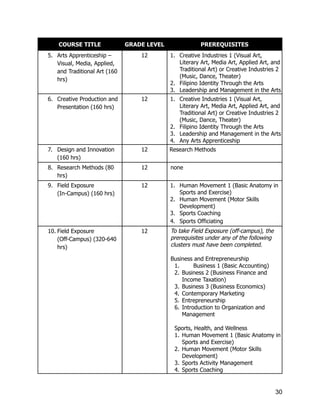
1.​ Arts Apprenticeship –
Dance (160 hrs)
12 1.​ Creative Industries 1 (Visual Art,
Literary Art, Media Art, Applied Art, and
Traditional Art) or Creative Industries 2
(Music, Dance, Theater)
2.​ Filipino Identity Through the Arts
3.​ Leadership and Management in the Arts
2.​ Arts Apprenticeship –
Music (160 hrs)
12 1.​ Creative Industries 1 (Visual Art,
Literary Art, Media Art, Applied Art, and
Traditional Art) or Creative Industries 2
(Music, Dance, Theater)
2.​ Filipino Identity Through the Arts
3.​ Leadership and Management in the Arts
3.​ Arts Apprenticeship –
Theater Arts (160 hrs)
12 1.​ Creative Industries 1 (Visual Art,
Literary Art, Media Art, Applied Art, and
Traditional Art) or Creative Industries 2
(Music, Dance, Theater)
2.​ Filipino Identity Through the Arts
3.​ Leadership and Management in the Arts
4.​ Arts Apprenticeship –
Literary Arts (160 hrs)
12 1.​ Creative Industries 1 (Visual Art,
Literary Art, Media Art, Applied Art, and
Traditional Art) or Creative Industries 2
(Music, Dance, Theater)
2.​ Filipino Identity Through the Arts
3.​ Leadership and Management in the Arts
29
COURSE TITLE GRADE LEVEL PREREQUISITES
5.​ Arts Apprenticeship –
Visual, Media, Applied,
and Traditional Art (160
hrs)
12 1.​ Creative Industries 1 (Visual Art,
Literary Art, Media Art, Applied Art, and
Traditional Art) or Creative Industries 2
(Music, Dance, Theater)
2.​ Filipino Identity Through the Arts
3.​ Leadership and Management in the Arts
6.​ Creative Production and
Presentation (160 hrs)
12 1.​ Creative Industries 1 (Visual Art,
Literary Art, Media Art, Applied Art, and
Traditional Art) or Creative Industries 2
(Music, Dance, Theater)
2.​ Filipino Identity Through the Arts
3.​ Leadership and Management in the Arts
4.​ Any Arts Apprenticeship
7.​ Design and Innovation
(160 hrs)
12 Research Methods
8.​ Research Methods (80
hrs)
12 none
9.​ Field Exposure
(In-Campus) (160 hrs)
12 1.​ Human Movement 1 (Basic Anatomy in
Sports and Exercise)
2.​ Human Movement (Motor Skills
Development)
3.​ Sports Coaching
4.​ Sports Officiating
10.​Field Exposure
(Off-Campus) (320-640
hrs)
12 To take Field Exposure (off-campus), the
prerequisites under any of the following
clusters must have been completed.
Business and Entrepreneurship
1.​ Business 1 (Basic Accounting)
2.​Business 2 (Business Finance and
Income Taxation)
3.​Business 3 (Business Economics)
4.​Contemporary Marketing
5.​Entrepreneurship
6.​Introduction to Organization and
Management
Sports, Health, and Wellness
1.​Human Movement 1 (Basic Anatomy in
Sports and Exercise)
2.​Human Movement (Motor Skills
Development)
3.​Sports Activity Management
4.​Sports Coaching
30
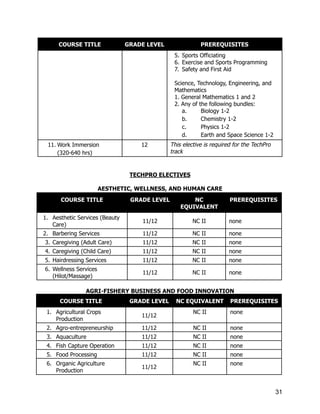
COURSE TITLE GRADE LEVEL PREREQUISITES
5.​Sports Officiating
6.​Exercise and Sports Programming
7.​ Safety and First Aid
Science, Technology, Engineering, and
Mathematics
1. General Mathematics 1 and 2
2. Any of the following bundles:
a.​ Biology 1-2
b.​ Chemistry 1-2
c.​ Physics 1-2
d.​ Earth and Space Science 1-2
11.​Work Immersion
(320-640 hrs)
12 This elective is required for the TechPro
track
TECHPRO ELECTIVES
AESTHETIC, WELLNESS, AND HUMAN CARE
COURSE TITLE GRADE LEVEL NC
EQUIVALENT
PREREQUISITES
1.​ Aesthetic Services (Beauty
Care)
11/12 NC II none
2.​ Barbering Services 11/12 NC II none
3.​Caregiving (Adult Care) 11/12 NC II none
4.​Caregiving (Child Care) 11/12 NC II none
5.​Hairdressing Services 11/12 NC II none
6.​Wellness Services
(Hilot/Massage)
11/12 NC II none
AGRI-FISHERY BUSINESS AND FOOD INNOVATION
COURSE TITLE GRADE LEVEL NC EQUIVALENT PREREQUISITES
1.​ Agricultural Crops
Production
11/12
NC II none
2.​ Agro-entrepreneurship 11/12 NC II none
3.​ Aquaculture 11/12 NC II none
4.​ Fish Capture Operation 11/12 NC II none
5.​ Food Processing 11/12 NC II none
6.​ Organic Agriculture
Production
11/12
NC II none
31
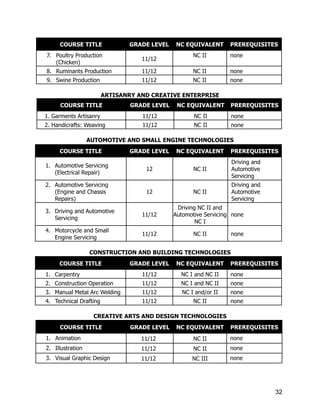
COURSE TITLE GRADE LEVEL NC EQUIVALENT PREREQUISITES
7.​ Poultry Production
(Chicken)
11/12
NC II none
8.​ Ruminants Production 11/12 NC II none
9.​ Swine Production 11/12 NC II none
ARTISANRY AND CREATIVE ENTERPRISE
COURSE TITLE GRADE LEVEL NC EQUIVALENT PREREQUISITES
1. Garments Artisanry 11/12 NC II none
2. Handicrafts: Weaving 11/12 NC II none
AUTOMOTIVE AND SMALL ENGINE TECHNOLOGIES
COURSE TITLE GRADE LEVEL NC EQUIVALENT PREREQUISITES
1.​ Automotive Servicing
(Electrical Repair)
12 NC II
Driving and
Automotive
Servicing
2.​ Automotive Servicing
(Engine and Chassis
Repairs)
12 NC II
Driving and
Automotive
Servicing
3.​ Driving and Automotive
Servicing
11/12
Driving NC II and
Automotive Servicing
NC I
none
4.​ Motorcycle and Small
Engine Servicing
11/12 NC II none
CONSTRUCTION AND BUILDING TECHNOLOGIES
COURSE TITLE GRADE LEVEL NC EQUIVALENT PREREQUISITES
1.​ Carpentry 11/12 NC I and NC II none
2.​ Construction Operation 11/12 NC I and NC II none
3.​ Manual Metal Arc Welding 11/12 NC I and/or II none
4.​ Technical Drafting 11/12 NC II none
CREATIVE ARTS AND DESIGN TECHNOLOGIES
32
COURSE TITLE GRADE LEVEL NC EQUIVALENT PREREQUISITES
1.​ Animation 11/12 NC II none
2.​ Illustration 11/12 NC II none
3.​ Visual Graphic Design 11/12 NC III none
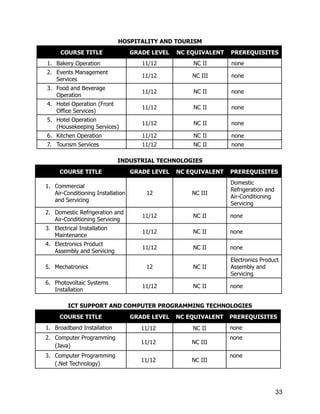
HOSPITALITY AND TOURISM
COURSE TITLE GRADE LEVEL NC EQUIVALENT PREREQUISITES
1.​ Bakery Operation 11/12 NC II none
2.​ Events Management
Services
11/12 NC III none
3.​ Food and Beverage
Operation
11/12 NC II none
4.​ Hotel Operation (Front
Office Services)
11/12 NC II none
5.​ Hotel Operation
(Housekeeping Services)
11/12 NC II none
6.​ Kitchen Operation 11/12 NC II none
7.​ Tourism Services 11/12 NC II none
INDUSTRIAL TECHNOLOGIES
COURSE TITLE GRADE LEVEL NC EQUIVALENT PREREQUISITES
1.​ Commercial
Air-Conditioning Installation
and Servicing
12 NC III
Domestic
Refrigeration and
Air-Conditioning
Servicing
2.​ Domestic Refrigeration and
Air-Conditioning Servicing
11/12 NC II none
3.​ Electrical Installation
Maintenance
11/12 NC II none
4.​ Electronics Product
Assembly and Servicing
11/12 NC II none
5.​ Mechatronics 12 NC II
Electronics Product
Assembly and
Servicing
6.​ Photovoltaic Systems
Installation
11/12 NC II none
ICT SUPPORT AND COMPUTER PROGRAMMING TECHNOLOGIES
33
COURSE TITLE GRADE LEVEL NC EQUIVALENT PREREQUISITES
1.​ Broadband Installation 11/12 NC II none
2.​ Computer Programming
(Java)
11/12 NC III
none
3.​ Computer Programming
(.Net Technology)
11/12 NC III
none
​
MARITIME TRANSPORT
34
COURSE TITLE GRADE LEVEL NC EQUIVALENT PREREQUISITES
4.​ Computer Programming
(Oracle Database)
11/12 NC III
none
5.​ Computer Systems
Servicing
11/12 NC II
none
6.​ Contact Center Services 11/12 NC II none
COURSE TITLE GRADE LEVEL NC
EQUIVALENT
PREREQUISITES
1.​ Marine Engineering at the
Support Level
11/12 Non-NC
none
2.​ Marine Transportation at
the Support Level
11/12 Non-NC
none
3.​ Ships Catering Services 11/12 NC I and/or II none
ANNEX B: ​
SAMPLE GRADE 11 ELECTIVE SUBJECTS​
FOR VARIOUS CAREERS/PATHWAYS
MEDICAL PRACTITIONERS (DOCTORS)
Academic Electives TechPro Electives
●​ Chemistry 1 & 2
●​ Biology 1 & 2
●​ Physics 1 & 2
●​ Caregiving (Child Care)
●​ Caregiving (Adult Care)
TEACHERS
Academic Electives TechPro Electives
Social Science Major
●​ Introduction to Philosophy
●​ Social Sciences (Theory and Practice)
●​ Philippine Governance (Philippine
Politics and Governance)
Communication Major
●​ Filipino 1 (Wika at Komunikasyon sa
Akademikong Filipino)
●​ Creative Composition 1 & 2
●​ Malikhaing Pagsulat
Mathematics Major
●​ Finite Mathematics 1 & 2
Science Major
●​ Biology 1 & 2, and/or Chemistry 1 & 2,
and/or Earth and Space Science 1 & 2,
and/or Physics 1 & 2
Values Education, Technology and Livelihood
Education (TLE), Early Childhood Care and
Development (ECCD), Special Needs Education
(SNED) Major
●​ Introduction to Philosophy
●​ Any TechPro elective subjects that
match their passion or career
aspirations, including chosen
specialization in education/teaching
TLE Major
●​ All TechPro elective subjects, except
Maritime electives
ECCD and SNED Major
●​ Caregiving: Child Care
NURSING/MIDWIFERY
Academic Electives TechPro Electives
●​ Chemistry 1 & 2
●​ Biology 1 & 2
●​ Caregiving (Child Care)
●​ Caregiving (Adult Care)
35
UNIFORMED SERVICE PROFESSIONS
(Police, Army, Navy, Airforce, and others)
Academic Electives TechPro Electives
●​ Social Sciences (Theory and Practice)
●​ Philippine Governance (Philippine
Politics and Governance)
●​ Citizenship and Civic Engagement
●​ Human Movement 1 & 2
●​ Biology 1 & 2
●​ Chemistry 1 & 2
●​ Driving and Automatic Servicing
●​ Electrical System Installation
●​ Manual Metal Arc Welding
●​ Electronics Product Assembly and
Servicing
TRAVEL ATTENDANTS AND STEWARDS
Academic Electives TechPro Electives
●​ Earth and Space Science 1 & 2
●​ Physics 1 & 2
●​ Finite Mathematics 1 & 2
●​ Tourism Services
●​ Events Management Services
●​ Aesthetic Services (Beauty Care)
●​ Food and Beverage Operations
●​ Kitchen Operations
●​ Bakery Operations
●​ Housekeeping Services
●​ Caregiving (Child Care)
●​ Caregiving (Adult Care)
●​ Hotel Operations (Fronts Office
Services)
●​ Hotel Operations (Housekeeping
Services)
RETAIL AND WHOLESALE TRADE MANAGERS, ​
including Other Business/Accountancy-related Careers
Academic Electives TechPro Electives
●​ Finite Mathematics 1 & 2
●​ Business 1 (Basic Accounting)
●​ Introduction to Organization and
Management
●​ Business 2 (Business Finance and
Income Taxation)
●​ Contemporary Marketing
●​ Business 3 (Business Economics)
●​ All TechPro elective subjects except,
Maritime electives
ARCHITECTS
Academic Electives TechPro Electives
●​ Finite Mathematics 1 & 2
●​ Physics 1 & 2
●​ Illustration
●​ Animation
●​ Visual Graphic Design
●​ Technical Drafting
36
LAWYER
Academic Electives TechPro Electives
●​ Social Sciences (Theory and Practice)
●​ Philippine Governance Philippine Politics
and Governance)
●​ Malikhaing Pagsulat
●​ Creative Composition 1 & 2
●​ Business 1 (Basic Accounting)
●​ Introduction to Organization and
Management
●​ Business 2 (Business Finance and
Income Taxation)
●​ Business 3 (Business Economics)
●​ Any TechPro elective subjects that
match their passion or career
aspirations
CULINARY ARTS AND HOSPITALITY-RELATED CAREERS
Academic Electives TechPro Electives
●​ Finite Mathematics 1 & 2
●​ Business 1 (Basic Accounting)
●​ Introduction to Organization and
Management
●​ Business 2 (Business Finance and
Income Taxation)
●​ Contemporary Marketing
●​ Business 3 (Business Economics)
●​ Tourism Services
●​ Events Management Services
●​ Aesthetic Services (Beauty Care)
●​ Wellness Service (Hilot/Massage)
●​ Food and Beverage Operations
●​ Kitchen Operations
●​ Bakery Operations
SHIP DECK CREWS AND OTHER MARITIME-RELATED CAREERS
Academic Electives TechPro Electives
●​ Philippine Governance (Philippine
Politics and Governance)
●​ Human Movement 1
●​ Citizenship and Civic Engagement
●​ Physics 1 & 2
●​ Earth and Space Science 1 & 2
●​ Marine Engineering at the
Support Level
●​ Marine Transportation at the
Support Level
●​ Ships Catering Services
●​ Technical Drafting
ENGINEERS
(Engineering and Aviation-related Careers)
Academic Electives TechPro Electives
●​ Physics 1 & 2
●​ Earth and Space Science 1 & 2
●​ Chemistry 1 & 2
●​ Finite Mathematics 1 & 2
●​ Photovoltaic System Installation
●​ Electrical System Installation
●​ Visual Graphic Design
●​ Manual Metal Arc Welding
●​ Electronics Products Assembly and Servicing
●​ Computer Programming (Java, .net, or
Oracle)
●​ Technical Drafting
37
ICT PROFESSIONALS
Academic Electives TechPro Electives
●​ Finite Mathematics 1 & 2
●​ Chemistry 1 & 2
●​ Earth and Space Science 1 & 2
●​ Physics 1 & 2
●​ Animation
●​ Broadband Installation
●​ Computer Programming (Java)
●​ Computer Programming (Oracle)
●​ Computer Systems Servicing
●​ Contact Center Services
●​ Illustration
●​ Computer Programming (.Net Technology)
●​ Visual Graphic Design
SCIENCE- INCLINED CAREERS
Academic Electives TechPro Electives
●​ Finite Mathematics 1 & 2
●​ Biology 1 & 2
●​ Chemistry 1 & 2
●​ Earth and Space Science 1 & 2
●​ Physics 1 & 2
●​ Any TechPro elective subject that match
their passion or career aspirations,
including chosen specialization
38

The Strengthened Senior High School Program Shaping Paper

  • 1.
    ​ The Strengthened​ Senior HighSchool Program​ Shaping Paper
  • 2.
    CONTENTS The Strengthened SeniorHigh School Program Shaping Paper​ 1 OVERVIEW​ 3 BACKGROUND​ 4 SHS Curriculum within the K to 12 Program ​ 4 Rationale for SHS Curriculum Reform: Gaps, Pathways, and the Case for Realignment​ 4 International Comparisons of Senior High School Structures ​ 5 Senior High School National Task Force (NTF) and Key Recommendations​ 6 National Directives​ 7 THE FEATURES OF THE STRENGTHENED ​ SENIOR HIGH SCHOOL CURRICULUM​ 7 1. Reduction of tracks from 4 to 2​ 7 2. Reduction of the required subjects by streamlining the number of core subjects, academic electives, and TechPro electives​ 8 3. Replacing strands with "clusters" of electives​ 10 4. Introduction of a “doorway option” where learners can take 2 elective subjects​ from the other track​ 11 5. Revised time allotment per subject​ 12 6. Extension of Work Immersion hours from 80-320 hours to 320-640 hours​ 12 THE NEW SENIOR HIGH SCHOOL CURRICULUM​ 13 Curriculum Goals​ 13 SHS Subjects​ 14 TRANSVERSAL SKILLS IN THE SHS CURRICULUM​ 19 PEDAGOGY AND ASSESSMENT​ 20 Instructional Design Framework​ 20 Assessment in SHS​ 21 ANNEXES​ 26 Annex A: Initial List of Subjects of the Strengthened SHS Curriculum​ 26 Annex B: Sample Grade 11 Elective Subjects For Various Careers/Pathways​ 35 2
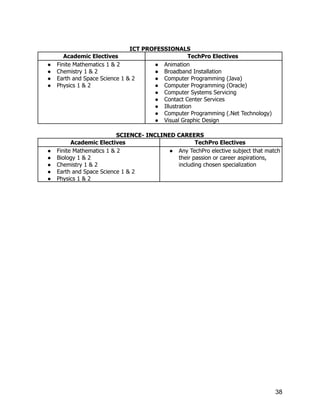
  • 3.
    OVERVIEW The Senior HighSchool (SHS) Program, established under Republic Act 10533, aims to prepare learners for higher education, employment, entrepreneurship, and middle-level skills development. It fosters core values and lifelong competencies to enable meaningful contributions to society. Since its full implementation in 2016, however, the program has faced persistent challenges, including insufficient infrastructure, a shortage of specialized teachers, and weak industry partnerships. Reviews indicate that the curriculum is fragmented, overloaded with subjects, offers limited elective options, and lacks sufficient instructional time. Furthermore, labor market research (Orbeta, 2020) shows that SHS graduates gain minimal economic advantages over Grade 10 or second-year college completers, underscoring the urgent need for targeted curriculum reforms and stronger industry linkages. To address these gaps, the Department of Education (DepEd) is implementing key reforms to strengthen the SHS Program, guided by the following objectives: ●​ Streamlining tracks and subjects to enhance clarity and efficiency. ●​ Expanding student choice to align education with individual aspirations. ●​ Establishing stackable and seamless learning pathways for continued academic and career growth. ●​ Enhancing employability by aligning education with industry needs. The Strengthened SHS Shaping Paper serves as a guiding framework to provide background, national directives, and an evidence base for SHS curriculum reform; establish a coherent structure for the revised curriculum; assist curriculum developers in designing updated curriculum guides; provide implementation guidance for educational institutions; and specify entry, completion, and certification requirements for SHS learners. 3
  • 4.
    BACKGROUND SHS Curriculum withinthe K to 12 Program The Enhanced Basic Education Program, or K to 12 Basic Education Program, was institutionalized through Republic Act No. 10533 (Enhanced Basic Education Act of 2013). This reform aligns with the Philippine education system with national development goals and international standards. It aims to strengthen Filipino values and nationalism, develop responsible and productive citizens, promote environmental sustainability, and foster global partnerships for development. As one of the most significant education reforms in Philippine history, the K to 12 Curriculum was designed to expand and improve basic education delivery. Its primary goal is to equip learners with essential competencies that meet both national and global demands. The ongoing implementation of the K to 10 MATATAG Curriculum began in School Year (SY) 2024-2025 with Kindergarten, and Grades 1, 4, and 7 and will continue in subsequent years for the remaining grade levels. This curriculum replaces the 2016 K to 10 Basic Education Curriculum and introduces key enhancements, including a decongested curriculum, a stronger focus on foundational skills, balanced cognitive demands, a clearer articulation of 21st-century skills, a reduction in learning areas, and an intensified emphasis on Values and Peace Education, ensuring that Philippine education aligns with international standards. As part of the K to 12 reforms, the Senior High School (SHS) Program was introduced to strengthen secondary education and prepare learners for their chosen career. SHS consists of two additional grade levels (Grades 11 and 12), providing learners with specialized tracks that align with their interests and aspirations. It is designed to equip graduates for higher education, employment, middle-level skills development, and entrepreneurship, ensuring they are ready to contribute meaningfully to society. Rationale for SHS Curriculum Reform: Gaps, Pathways, and the Case for Realignment Despite the aspirations of the K to 12 Basic Education Program, persistent challenges have limited its success in delivering intended learning outcomes, particularly at the Senior High School (SHS) level. National and international assessments, including PISA and SEA-PLM, have shown no significant improvement in Filipino learners’ performance (Schleicher, 2018; Mullis et al., 2020; UNICEF & SEAMEO, 2020). These results, coupled with global research on evolving learner needs (Jorgenson, 2006), have prompted a critical re-evaluation of the SHS curriculum to enhance its quality, relevance, and responsiveness to 21st-century demands. The SHS Program, while designed to support college readiness, employability, and lifelong learning, has encountered systemic issues that constrain its impact. Limited track availability, inadequate resources, and weak industry partnerships have restricted access to meaningful learning pathways (Abrigo & Orbeta, 2023). Alarmingly, research and public perception suggest that SHS graduates are no better positioned for employment than their Junior High School counterparts. Only 41% of Filipinos express satisfaction with SHS, citing concerns about its effectiveness in preparing learners for higher education or the workplace. Further compounding 4
  • 5.
    these challenges isthe observed misalignment between curricular expectations and learners’ actual capabilities, which is highlighted in an ACTRC study that found nearly half of SHS teachers unable to cover even half of the prescribed competencies due to time constraints and unrealistic curriculum loads. Beyond implementation challenges, the SHS curriculum has fallen short in supporting clear, functional learner pathways. While it is designed to offer four exits: higher education, middle-level skills development, employment, or entrepreneurship, studies show that learners often struggle to transition smoothly into these post-SHS destinations. College readiness remains a concern, with some SHS graduates lacking foundational literacy and numeracy skills, leading many higher education institutions to continue requiring entrance exams (Baber et al., 2019; PIDS, 2020). At the same time, the labor market remains cautious: while a 2023 JobStreet report indicates growing acceptance of SHS graduates in industries such as hospitality, BPO, and manual labor, 32% of employers remain hesitant to hire them due to skill gaps—particularly in fields requiring advanced technical training. The SHS curriculum is also expected to contribute to the Philippine Qualifications Framework (PQF), which aims to enable seamless progression and mobility across basic education, higher education, and technical-vocational training. However, the envisioned alignment remains largely aspirational, as competencies taught in SHS are not yet fully mapped to PQF levels in ways that ensure employability or credit transfer. The gap between what learners study and what industries require is especially evident in fast-growing sectors identified in the 2023–2025 Jobs and Labor Market Forecast, including Construction, Manufacturing, IT-BPM, Transport and Logistics, and Health and Wellness. To address these complex and interlinked issues, the Department of Education commissioned a comprehensive, three-volume curriculum review through the Assessment, Curriculum, and Technology Research Centre (ACTRC), completed in 2024 and released in 2025. Drawing on international benchmarks and stakeholder consultations, the study recommended a number of key reforms: restructuring the SHS curriculum to eliminate duplication, sequencing issues, and overcrowding; prioritizing essential competencies for both higher education and employment; differentiating core subjects by track; expanding elective offerings to support more flexible learner pathways; and increasing work immersion hours to build practical industry experience. These recommendations are further supported by findings from the National Tracer Study and other national evaluations, which confirm that SHS graduates have not yet gained a meaningful edge in employment or wages. In response, recent national directives have called for the decluttering of the curriculum, tighter alignment with labor market needs, and better support for certification of Technical-Professional Track learners. Together, these insights form the basis of the proposed Senior High School reform: a more coherent, streamlined, and outcomes-driven curriculum designed to restore confidence in SHS and ensure that it delivers on its promise—to prepare Filipino learners for success in higher education, the workforce, and lifelong learning. International Comparisons of Senior High School Structures While international evidence shows that the structure of Senior High School (SHS) alone does not determine learner success, it plays a crucial role in shaping the flexibility, relevance, and 5
  • 6.
    coherence of alearner's educational experience. Recognizing this, the Department of Education carefully reviewed various SHS models around the world to inform its proposed structural reforms. A comparative analysis conducted by the Assessment, Curriculum, and Technology Research Centre (ACTRC) found that most countries organize SHS into two primary pathways: General Academic and Vocational/Technical. In systems where additional subdivisions exist, such as workplace- vs. school-based vocational streams (e.g., Poland, Malaysia)—the goal remains consistent: to provide learners with a clear, navigable path toward further education or direct employment. Countries like Germany and Taiwan demonstrate the value of flexibility within structured systems, offering learners options to shift between or blend academic and vocational courses. Meanwhile, Singapore’s Full Subject-Based Banding (Full SBB) eliminates rigid tracks altogether, allowing learners to take subjects at varying levels based on interest and ability. Despite these differences, a common thread in successful systems is the deliberate balance between structure and choice, ensuring foundational competencies while honoring learner agency. International employment data supports this approach. Personalized systems (e.g., Canada, New Zealand, the US) tend to report lower long-term unemployment rates among secondary graduates, while structured systems with robust vocational programs (e.g., Switzerland, Austria) maintain low NEET (Not in Education, Employment, or Training) rates. This suggests that neither structure nor flexibility alone guarantee success; rather, it is how a system strategically integrates both that matters. Guided by this insight, the Philippine SHS structure is being revised to adopt two main pathways—Academic and Technical-Professional—with expanded elective options, a streamlined set of core subjects, and a “doorway option” that allows cross-track exploration. This revised structure is not simply a replication of global models but a contextualized response to our learners’ needs, informed by evidence from ACTRC studies, the National Tracer Study, and national directives to declutter, deepen, and diversify SHS offerings. In sum, the proposed structure balances clarity of learner pathways with the flexibility to explore, ensuring that Filipino SHS graduates are not only academically prepared but also better aligned with higher education, employment, and lifelong learning opportunities. Senior High School National Task Force (NTF) and Key Recommendations To address implementation issues in SHS, the Department of Education (DepEd) created the Senior High School National Task Force through DepEd Memorandum No. 028, s. 2023 on May 11, 2023. The NTF assessed the effectiveness of SHS in both DepEd and non-DepEd schools and provided 13 key recommendations, seven of which directly inform the shaping of the revised SHS Curriculum. These are: 1.​ Select a refined SHS model that considers challenges and lessons from its initial implementation; 2.​ Review curriculum implementation to assess content mastery, competency proficiency, and attainment of 21st-century skills; 6
  • 7.
    3.​ Strengthen DepEd-TESDAcoordination in implementing the Technical-Vocational-Livelihood (TVL) track; 4.​ Update guidelines for schools on proposing and periodically reviewing SHS program offerings; 5.​ Develop an exit assessment for Alternative Learning System (ALS) SHS learners. 6.​ Incorporate learner-centered assessments into ALS evaluation; and 7.​ Review Work Immersion Program guidelines in collaboration with government and private sector partners. These recommendations support the goals outlined in the 2022-2030 Basic Education Development Plan (BEDP) and AmBisyon Natin 2040, reaffirming the critical role of SHS in national development. National Directives President Ferdinand R. Marcos Jr., in his State of the Nation Address, called for an education system that produces critical thinkers, problem solvers, and future-ready learners: "Our system of education must be strategically calibrated to make sure that our youth are not only taught to become literate; but, it must also consciously develop them into problem-solvers, and into critical thinkers – hungry for success and ready for the future." In response, Department of Education (DepEd) Secretary Sonny Angara announced in November 2024 a commitment to streamline and strengthen the SHS Curriculum. The goal is to make learning more focused, efficient, and relevant by reducing core subjects, expanding electives, and strengthening industry partnerships to better support learner’s career aspirations. Streamlining the curriculum entails simplifying, refining, and reorganizing content to enhance its focus, efficiency, and relevance to meet modern educational and industry demands. In a 2024 Palace Press Briefing, Secretary Angara affirmed the Department of Education’s commitment to supporting learners’ career aspirations by strengthening industry partnerships to improve their employability. He underscored that reducing the number of core subjects and expanding flexible pathways through electives will ensure greater alignment between the curriculum and learners’ chosen career tracks. THE FEATURES OF THE STRENGTHENED SENIOR HIGH SCHOOL CURRICULUM Driven by national directives and guided by reviews and international benchmarks, the following are the key features of the Strengthened Senior High School Curriculum. 1.​Reduction of tracks from 4 to 2 The current structure of the Senior High School (SHS) Program originally includes four tracks: Academic, Technical-Vocational-Livelihood (TVL), Arts and Design, and Sports. 7
  • 8.
    Considering national directivesand the review of the SHS Program, however, these tracks shall be streamlined into two main educational pathways: the Academic Track and the Technical-Professional Track – a shift that aligns more closely with global practices. The Technical-Professional Track shall continue to offer practical, industry-relevant skills training for learners who prefer alternative postsecondary pathways such as employment, entrepreneurship, or middle-level skills development. The track was renamed to highlight its professionalism and elevate its public perception, positioning it as a viable, prestigious, and future-ready option alongside the Academic Track. Beyond this rebranding, the track aims to empower both teachers and learners by equipping educators with updated tools, industry exposure, and specialized training, and by enabling learners to graduate with the confidence, competence, and qualifications to thrive in the workforce or start their own enterprises. This reflects the Department of Education’s commitment to honoring diverse learner aspirations and building a highly skilled and empowered Filipino workforce. 2.​Reduction of the required subjects by streamlining the number of core subjects, academic electives, and TechPro electives As part of the SHS curriculum refinement, the number of required subjects has been significantly reduced through the streamlining of core subjects, academic electives, and technical-professional (TechPro) electives. Previously, learners were expected to complete a total of 31 subjects throughout Senior High School. Under the revised structure, learners will now be required to complete about 7 to 23 subjects consisting of 5 core subjects and at least 9 electives (totaling 960 hours) for those in the Academic Track, or at least 2 TechPro electives (totaling 640 hours) along with work immersion (at least 320 hours) for those in the Technical-Professional Track. The minimum number of electives ensures that learners meet the minimum competencies and qualifications needed for higher education, employment, and entrepreneurship after graduation. However, a learner may take additional electives beyond the minimum requirement, provided that his/her total stay in school does not exceed 30 hours per week. Elective subjects in Senior High School (SHS) are specialized courses chosen by learners within their selected track (Academic or Technical-Professional), offering them flexibility and the opportunity to explore the courses based on their interest and aspirations. Consequently, these subjects are designed to develop specific skills and competencies aligned with career interests, academic goals, and industry demands. The elective subjects are grouped into clusters to help learners choose more easily and wisely. As these clusters of electives are organized by themes, e.g., arts, sciences, business, 8
  • 9.
    learners can focuson areas that match their interest or future careers, simplifying the decision-process of learners and supporting both their academic and career goals. Meanwhile, the core subjects have been restructured by integrating key competencies from related disciplines, reducing the original 15 core subjects to just 5. These core subjects will now be offered across the entire academic year, allowing for a more sustained and in-depth engagement with the content. The revised core curriculum adopts an integrative approach, emphasizing the interconnectedness of ideas and fostering interdisciplinary learning, rather than treating each subject in isolation. For the Academic Track, electives with competencies already covered in Junior High School (JHS) have been removed to avoid redundancy and to ensure learners focus on higher-level, subject-specific skills and knowledge. Meanwhile, for the Technical-Professional Track, elective subjects that are no longer offered or certified by TESDA have been eliminated to ensure that the curriculum remains responsive to current industry certifications and qualifications. This reduction in subject load allows for more focused instruction, deeper learning, and better alignment with both higher education and labor market demands. 9
  • 10.
    3.​Replacing strands with"clusters" of electives Strands shall also be removed in the revised SHS Program to promote greater flexibility and learner choice by eliminating the rigid grouping of subjects within the Academic and Technical-Professional Tracks. This shift allows learners to explore a wider range of subjects based on their interests, career goals, and evolving competencies, fostering a more personalized learning experience. By aligning with international best practices, where high-performing education systems avoid strand restrictions, this reform better equips Filipino learners with diverse skills for higher education, employment, and lifelong learning. The four curricular exits of the SHS program: higher education, employment, entrepreneurship, and middle-level skills development shall remain in place notwithstanding modifications to the track offerings. These exits shall ensure that learners are provided with multiple options after graduation, whether they decide to pursue further studies, get a technical skill certification, establish their own business, or become part of the workforce. Offering Arts and Design (A&D) and Sports Tracks, formerly standalone tracks, under the Academic Track is responsive to the findings of the 2018 Senior High School Tracer Study, which revealed that 81% of SHS graduates pursued higher education, supporting the argument that most learners opt for academic pathways. Hence, learners interested in Arts & Design (A&D) and Sports will take the Academic Track instead and choose A&D/S “electives.” Teachers who were previously teaching specialized and applied subjects under the Arts & Design Track and Sports Track will now teach “electives” related to Arts & Design and Sports, which are all under the academic track. Previously, learners needed to take specialized subjects based on their strands. In the new model, learners can take electives from any cluster of subjects. Schools may now offer a variety of electives that are not tied to specific "strands." For example, learners interested in Arts and Design (A&D) and Sports will take the Academic Track and choose Arts, Social Sciences, and Humanities or Sports, Health, and Wellness “electives”. Likewise, teachers who were previously teaching specialized and applied subjects under the Arts and Design Track and Sports Track will now teach “electives” related to Arts, Social Sciences, and Humanities or Sports, Health, and Wellness, which are all under the Academic Track. Clusters of Electives Academic Electives •​ Arts, Social Sciences, and Humanities •​ Science, Technology, Engineering, and Mathematics •​ Sports, Health, and Wellness •​ Business and Entrepreneurship •​ Field Experience TechPro Electives •​ Aesthetic, Wellness, and Human Care •​ Agri-Fishery Business and Food Innovation •​ Artisanry and Creative Enterprise 10
  • 11.
    •​ Automotive andSmall Engine Technologies •​ Construction and Building Technologies •​ Creative Arts and Design Technologies •​ Hospitality and Tourism •​ Industrial Technologies •​ ICT Support and Computer Programming Technologies •​ Maritime Transport A clustering of electives can be found in Annex A. 4.​Introduction of a “doorway option” where learners can take 2 elective subjects from the other track To promote greater flexibility and learner agency within the revised Senior High School curriculum, a “doorway option” is introduced, allowing learners to take 1 to 2 elective subjects from a track other than the one they originally chose. While learners are still required to formally select their track (i.e., either Academic or Technical-Professional) at the start of Grade 11, the doorway option provides them with the opportunity to explore subjects outside their chosen track, broadening their skill sets and career exposure. This innovation responds to the realities of learners’ interests and evolving aspirations. For example, an Academic Track - learner interested in entrepreneurship may take a TechPro elective of Agricultural Crops Production (NC II) or Food Processing (NC II), while a TechPro Track learner may opt to take a subject Basic Accounting or Contemporary Marketing from the Academic Track. This cross-track mobility serves as an exploratory mechanism – a “doorway” to other disciplines – without requiring a full shift in track. The doorway option not only supports holistic development but also enhances interdisciplinary learning, making learners more adaptable to both academic and real-world contexts. It recognizes that interests and aptitudes may evolve, and it empowers learners to 11
  • 12.
    customize their SHSexperience based on their emerging goals, whether toward employment, entrepreneurship, or higher education. 5.​Revised time allotment per subject To support the streamlined structure of the revised Senior High School curriculum, the time allotment per subject has been adjusted to ensure sufficient depth of learning while maintaining curriculum efficiency. The revised time allocations are designed to maximize instructional time, allow for more focused delivery of content, and provide flexibility in scheduling across semesters and grade levels. These adjustments also reflect the differentiated nature of the Academic and Technical-Professional tracks, balancing foundational knowledge, specialization, and practical application. ●​ Core = 160 hours offered in one year/two semesters ●​ Academic electives = 80 hours offered in one semester ●​ Grade 11 TechPro electives = 320 hours in one year ●​ Grade 12 TechPro electives = 320 hours in one semester 6.​Extension of Work Immersion hours from 80-320 hours to 320-640 hours Work Immersion as a subject in the SHS Curriculum involves hands-on experience or work simulation in which learners can apply their competencies and acquire knowledge relevant to their track. A significant enhancement in the strengthened Senior High School Program is the extension of Work Immersion hours from the current 80 to 320 hours to a more intensive 320 to 640 hours. This extension is designed to provide learners, particularly those in the Technical-Professional Track, with more meaningful, hands-on experience in real-world workplace settings, better preparing them for immediate employment or further skills training after graduation. The Work Immersion in the Strengthened SHS Curriculum requires a minimum of 320 hours, giving learners ample time to gain a deeper understanding and acquire additional skills in their respective industries. Work Immersion is mandatory for all learners under the TechPro track. For Academic Track, they may opt to take electives under Field Experience as counterpart of Work Immersion. One of these is Field Exposure which is a structured learning experience that immerses learners in real-world environments relevant to their field of interest for a minimum of 320 hours, or Design and Innovations for 160 hours. When offered on a full-time basis (i.e., 8 hours per day on consecutive days), the extended work immersion may span one to two academic quarters, allowing learners to become deeply involved in work processes and industry-standard practices. This setup mirrors the structure of actual employment and helps bridge the gap between school and the workplace. It also provides ample time for learners to demonstrate and refine the competencies they have acquired in their elective subjects. In the revised program, work immersion will be mandatory for all TechPro learners, ensuring alignment with industry demands and TESDA qualifications. For learners in the Academic Track, work immersion remains optional, recognizing that their chosen pathways are more 12
  • 13.
    likely to leadto higher education. However, the option is still available for those who wish to gain professional exposure in areas such as research, business, or communication—depending on their interest and career goals. Learners in both tracks (Academic and TechPro) have the option to take an elective under Field Experience, a cluster of courses designed to provide hands-on activities and community engagements that allow students to apply their knowledge and skills in real-world contexts. One of the electives under Field Experience is Field Exposure. This structured learning experience immerses students in actual environments relevant to their field of specialization, enabling them to: ●​ demonstrate industry-specific competencies and apply theoretical knowledge in a supervised real-world setting; ●​ enhance their technical expertise and practical skills; ●​ strengthen their communication and interpersonal skills, fostering collaboration and adaptability; and ●​ develop positive work habits, professional attitudes, and a deep appreciation for the value of work. Electives under the Field Experience cluster may be taken during either the first or second semester of Grade 12, depending on the school's implementation plan. However, Field Exposure is best scheduled in the final semester of Grade 12, when students have already gained the necessary foundational knowledge and technical skills from their core and specialized subjects. This approach ensures that learners are well-prepared to apply their learning effectively in real-world or community-based settings. THE NEW SENIOR HIGH SCHOOL CURRICULUM Curriculum Goals The Strengthened SHS Program is aligned with the international benchmarks and national educational goals, preparing learners for higher education, the workforce, and lifelong learning. This enables teachers to design lessons and assessments that foster mastery and deeper understanding of the lessons, ensuring that the learners gain 21st century skills including critical thinking and problem-solving abilities required for success in the real world. Key Stage 4 Standards At the end of Grade 12, learners are expected to demonstrate mastery of essential academic and technical skills that enable them to think critically, solve complex problems, and engage in lifelong learning. They are equipped with global competence, values, and 21st-century skills 13
  • 14.
    aligned with internationalstandards allowing them to adapt to a dynamic, globalized environment. They are prepared for further education, vocational and technical careers, creative arts, sports, and entrepreneurial ventures to contribute meaningfully as productive and responsible citizens. Academic Track Standards At the end of Grade 12, learners demonstrate interdisciplinary knowledge, skills, and values across accountancy, business, management, humanities, social sciences, science, technology, engineering, mathematics, sports, health, arts, and design. They apply critical thinking, creativity, ethical decision-making, and 21st-century skills to address socio-economic, scientific, cultural, and professional challenges while contributing to national development and engaging with both local and global contexts. Technical-Professional Track Standards At the end of Grade 12, learners demonstrate mastery of technical knowledge, skills, and attitudes across various sectors, including agriculture and fishery, family and consumer science, industrial arts, information and communications technology, and maritime services. They apply industry-based competencies aligned with national and international standards, showcasing readiness for specialized careers, lifelong employability, and the capacity to contribute effectively to the nation’s economic development. SHS Subjects Core Subjects Unlike the previous structure, which featured core, applied, and specialized subjects, the new SHS curriculum design shall exclusively emphasize core and elective subject offerings. With this modification, learners shall be able to focus on developing the fundamental skills needed for the curriculum exits, resulting in a more concentrated and in-depth learning experience. This change is aligned with the SHS structure of the majority of academically high-achieving nations, whose curriculum consists of only five to six core subjects supplemented by electives chosen by the learners depending on their interests and aptitude. For example, a typical structure might consist of six core subjects with two specialized electives, or five core subjects plus two electives. The redesigned SHS curriculum minimizes overlaps and simplifies learning areas in accordance with this global approach. TABLE 1 Core Subject Descriptions EFFECTIVE COMMUNICATION/ MABISANG KOMUNIKASYON Effective Communication / Mabisang Komunikasyon is a core subject for all Grade 11 learners, designed to develop communicative competence in both English and Filipino across four key contexts: personal and interpersonal, social and cultural, academic and training, and professional and work settings. Grounded in relevant expectations of the B2 level of 14
  • 15.
    the Common EuropeanFramework of Reference (CEFR), the subject equips learners to participate actively in spoken, written, and multimodal communicative events with confidence, clarity, and cultural sensitivity. It emphasizes strategic language use, tone and structure appropriateness, media and information literacy, and ethical communication practices. Through reflective practice and purposeful interaction, each learner is envisioned to develop into a responsible, adaptive, and globally competent communicator. Built on a dual-language framework, this subject treats English and Filipino as parallel yet complementary strands. Each is delivered separately by a dedicated teacher with 80 instructional hours per school year. Instruction is customized to the specific language, ensuring depth of learning, accuracy in assessment, and the development of transferable skills. In this way, the subject fosters bilingual communicative competence, a foundation for global readiness and civic participation in a multilingual society. Unlike models that fuse English and Filipino into a single hybrid course, this approach is better described as integrative: it maintains the distinct integrity of each language while aligning their outcomes toward a shared vision. Instruction in English and Filipino is viewed to intersect at the levels of concept and practice. This lends the learning environment for advanced communicative strategies such as translanguaging, which students may use mindfully and purposefully in assessment and real-life situations. Content-wise, the curriculum is organized around four progressive domains, starting with communication in familiar, personal contexts and moving outward to broader, public, and future engagements. Each quarter encourages learners to explore increasingly complex interactions while developing the reflective habits and feedback-driven growth necessary to refine their communication skills over time. The course also contributes directly to the Department of Education’s 21st Century Skills Framework, strengthening not only literacy and collaboration but also intercultural sensitivity, digital fluency, and ethical responsibility. By the end of the course, learners are expected to: ●​ Adapt communication strategies effectively; ●​ Engage in extended communicative events with confidence and purpose; ●​ Utilize digital tools and platforms responsibly to enhance expression and interaction; and ●​ Reflect on their growth as communicators, using feedback to improve and prepare for future communication demands Ang Mabisang Komunikasyon / Effective Communication ay isang pangunahing kurso para sa lahat ng mag-aaral ng Baitang 11 na dinisenyo upang linangin ang kanilang kakayahang komunikatibo sa 15
  • 16.
    Filipino at saIngles na nakabatay sa mga inaasahan ng Antas B2 ng Common European Framework of Reference (CEFR), at sa apat na pangunahing konteksto: personal at interpersonal, sosyal at kultural, akademiko at pampagsasanay, at propesyonal at pantrabaho. Inihahanda ng kurso ang mga mag-aaral na aktibong makilahok sa mga pasalita, pasulat, at multimodal na sitwasyong komunikatibo nang may tiwala sa sarili, kalinawan ng pagpapahayag, at pagiging sensitibo sa kultura ng iba. Binibigyang-diin ng kurso ang estratehikong paggamit ng wika, kaangkupan ng bokabularyo, tono at estruktura, literasing pangmidya at pang-impormasyon, at mga kilos pangkomunikasyong angkop sa mga gawi at halagahang Pilipino. Sa replektibong paggamit ng wika at malayuning pakikipagtalastasan, nalilinang ng mga mag-aaral ang kanilang pagkakakilanlan bilang responsableng mga tagapagpahayag na may kakayahang sumabay at umangkop sa globalisadong mundo. Gumagamit ng framework na dual-track, magkasabay na itinuturo ng kurso ang Filipino at Ingles sa paraang komplementaryo sa isa’t isa. May kani-kaniya mang gurong nakatalaga sa pagtuturo ng bawat wika sa loob ng 80 oras kada taong panuruan, nagkakaisa naman sila sa hangaring mapaunlad ang kakayahang komunikatibo ng mga mag-aaral. Iniaayon ang pagtuturo sa kalikasan ng bawat wika kaya natitiyak ang lalim ng pagkatuto, katumpakan ng pagtataya, at paglinang sa mga kakayahang naisasalin sa mga mag-aaral. Sa ganitong paraan, napauunlad ng asignatura ang bilingguwal na kakayahang komunikatibo – isang pundasyon sa kahandaang sumabay sa globalisadong mundo at aktibong makilahok sa isang lipunang multilingguwal. Hindi tulad ng mga modelong pinagsasanib lang ang Filipino at Ingles bilang isang kursong may magkahalong wika, gumagamit ang Mabisang Komunikasyon ng dulog integratibo: pinananatili nito ang kani-kaniyang integridad ng bawat wika habang tinitiyak na nakatuon ang mga bungang nais matamo sa iisang hangarin. Batay ito sa paniniwalang ang pagtuturo ng Filipino at Ingles ay nagtatagpo rin sa mga antas estruktural at konseptuwal, hindi lang sa antas lingguwistiko. Ito ang maghahanda sa mga mag-aaral sa progresibo na estratehiyang komunikatibo gaya ng translanguaging na magagamit nila nang maláy at naaayon sa tiyak na layunin sa mga gawaing pampagtataya at sa mga totoong sitwasyon sa buhay. Pagdating sa nilalaman, binalangkas ang kurikulum nang papaunlad ayon sa apat na domeyn: nagsisimula ang komunikasyon sa mga kontekstong pamilyar at personal at lumalawig tungo sa mas malalawak, pampubliko, at panghinaharap na mga sitwasyon. Hinihikayat ng bawat markahan ang mga mag-aaral na pag-isipan kung paano tutugon sa mga interaksiyon lalong nagiging komplikado habang nililinang ang mga gawing magpapaisip at magpapalago sa kanila batay sa feedback. Mahalaga ang mga ito upang unti-unting mahasa ang kanilang kasanayang komunikatibo sa paglipas ng panahon. Direkta ring nag-aambag ang kursong Mabisang Komunikasyon sa 21st Century Skills Framework ng 16
  • 17.
    Kagawaran ng Edukasyonna nagpapatibay hindi lang sa literasi at kolaborasyon kundi maging sa pagkakaroon ng sensibilidad sa ibang kultura, pagtatamo ng kahusayang dihital, at pagkakaroon ng pananagutang etikal. Sa pagtatapos ng kurso, ang mga mag-aaral ay inaasahang: a.​ nagagamit nang mabisa ang mga estratehiyang komunikatibo, kasama na ang maláy na pagpili ng gagamiting wika at tono ayon sa konteksto; b.​ nakikilahok sa mas malalawak na sitwasyong komunikatibo nang may tiwala sa sarili at tiyak na layunin; c.​ nagagamit nang responsable ang iba’t ibang kasangkapan at platapormang dihital upang mapabuti ang pagpapahayag at interaksyon; at d.​ napagninilayan ang paglago nila bilang mga tagapagpahayag na gumagamit ng feedback upang mapabuti ang sarili at makapaghanda sa mga pangangailangang komunikatibo sa hinaharap. Tinutulungan ng kursong ito ang mga mag-aaral, hindi lang upang magtagumpay sa antas akademiko at propesyonal kundi upang magkaroon din ng makabuluhang pakikilahok sa isang malawak at nagbabagong mundo. GENERAL MATHEMATICS This course deepens learners’ understanding of concepts and techniques drawn from numbers and algebra, geometry and measurement, and statistics. It aims to strengthen their mathematical reasoning, problem-solving, critical thinking skills, and statistical analysis essential to their preparation for professional and creative work, research, innovation in a specialized field, and various career opportunities. It emphasizes applying quantitative methods in real-life and structured academic and professional settings, providing them opportunities to excel and adapt to diverse environments independently and collaboratively. It refines their ability to analyze real-world data, make informed decisions, and effectively communicate results using appropriate language and technology, making them ready for various educational and employment pathways. GENERAL SCIENCE This course uses a multidisciplinary approach to equip learners with the essential scientific knowledge, skills, and capabilities to meet the challenges of living and working in a rapidly changing and advancing Philippine society. The course aims to provide learners with the fundamental scientific competencies to help shape a sustainable future for themselves, their communities, and the planet. The course focuses on understanding and applying the scientific models, theories, and laws that relate to everyday life and work, as well as how these impact the Philippines as a significant contributor to the world. The curriculum uses a transdisciplinary approach to understand how the study of Physics, Chemistry, Biology, and Earth and Space Science interact to explain natural phenomena and how they can be utilized to advance the 17
  • 18.
    Philippines’ economy. Thecourse builds on learners’ experiences and understandings of scientific phenomena to support them to be scientific and technological thinkers who can propose and solve problems through scientific observation, data gathering, meaning-making, and effectively communicating evidence-based conclusions. Learners will develop practical, scientific, and critical thinking skills through individual and collaborative scientific investigations and research, preparing them to pursue further education and careers in various fields or contribute meaningfully to a science-driven workforce. LIFE AND CAREER SKILLS This course explores interconnectedness of the science of personal development, health and wellness, and career readiness that develops life skills for self-determination, adaptability, resilience, and leadership to engage responsibly in the workplace and community. It equips learners with personal, physical, social, and career development competencies in preparation for their transition to various pathways. PAG-AARAL NG KASAYSAYAN AT LIPUNANG PILIPINO Nakatuon ang kursong ito sa pagsusuri ng mga isyu at usaping panlipunan at pangkasaysayan gamit ang dulog tematiko, multikultural, at interdisiplinaryo. Layunin nitong higit na mapalalim at mapagyaman ang kamalayang pangkasaysayan, Pilipino, at panlikás-kayang pag-unlad upang mapaigting at maitaguyod ang kahusayang sibiko na mahalaga sa pagiging isang mapanagutang mamamayan ng Pilipinas at ng daigdig. Elective Subjects Elective subjects in Senior High School (SHS) are specialized courses chosen by learners within their selected track (Academic or Technical-Professional). These subjects are designed to develop specific skills and competencies aligned with career interests, academic goals, and industry demands. Unlike college electives, which offer a broad range of courses for academic exploration, SHS electives are directly linked to the learner’s chosen pathway, focusing on skill development, industry readiness, or advanced academic preparation. They are time-bound (typically 80 hours per semester for academic electives and 320 hours for TechPro electives) and standards-based, ensuring that students gain practical knowledge essential for higher education, employment, entrepreneurship, or middle-level skills development. The availability of elective subjects may vary depending on learner preferences, school capacity and resources, and prevailing industry needs. Additionally, elective clusters may be expanded based on context-specific demands. Schools are encouraged to align elective offerings with the evolving educational landscape to better equip learners for future challenges. The list of electives can be found in Annex A. Sample career pathways and electives can be found in Annex B. 18
  • 19.
    TRANSVERSAL SKILLS INTHE SHS CURRICULUM The Department of Education’s vision remains steadfast: holistically developed Filipino learners equipped with transversal skills or also known as 21st-century skills. These skills—encompassing essential knowledge, competencies, values, and attributes—are critical for learners to thrive in today’s rapidly evolving world of work and life. The 21st Century Skills Framework, drawn from both international and local competency models, reflects the realities of an increasingly interconnected, technology-driven, and complex global landscape. Anchored in DepEd’s core values of Maka-Diyos, Makatao, Makakalikasan, at Makabansa, the development of these skills empowers learners to realize their full potential and contribute to building a cohesive and progressive nation—one that upholds socio-political stability, economic prosperity, sustainability, and unity in diversity. This framework serves as a guiding force across all levels of DepEd governance, ensuring that these essential skills are intentionally and consistently developed throughout basic education. The framework identifies four key domains of 21st-century skills, as articulated in DepEd Order No. 21, s. 2019: ●​ Information, Media, and Technology Skills ●​ Learning and Innovation Skills ●​ Communication Skills ●​ Life and Career Skills In the context of the Strengthened Senior High School (SHS) Curriculum, the intentional development of transversal skills—also known as 21st-century skills—is central to both core and elective subjects. These skills cut across academic and technical disciplines, ensuring that SHS graduates are not only academically competent but also adaptable, innovative, and future-ready. The core subjects namely, Effective Communication, General Mathematics, General Science, Pag-aaral ng Kasaysayan at Lipunang Pilipino, and Life and Career Skills are designed to develop learners’ competencies like critical thinking, collaboration, ethical reasoning, intercultural understanding, digital literacy, and problem-solving. These subjects offer all learners, regardless of track, with a shared foundation and opportunities to apply learning in authentic and real-world contexts. Elective subjects provide learners with the opportunity to enhance their knowledge and skills by tailoring them to their interests, abilities, and desired career paths, including higher education, employment, entrepreneurship, or middle-level skills. These subjects further reinforce transversal skills by requiring learners to be immersed in complex tasks, exhibit initiative, and make informed and responsible decisions within their chosen endeavor. Ultimately, the design of learning experiences in SHS must guarantee that both core and elective subjects actively integrate opportunities for learners to develop and exercise 21st-century skills. By doing so, the Strengthened SHS Curriculum fulfills its promise: to equip every Filipino learner with the skills, values, and mindset needed for lifelong learning, meaningful work, and responsible citizenship in a dynamic global society. 19
  • 20.
    PEDAGOGY AND ASSESSMENT TheInstructional Design Framework of SHS The Strengthened Senior High School Instructional Design Framework (SHS IDF) offers a structured approach to teaching and learning, emphasizing purposefulness, alignment, and responsiveness to diverse learner needs. Building upon the Revised K-to-10 Curriculum IDF, the SHS IDF retains core principles while refining them to align with the Strengthened SHS curriculum. It prioritizes constructive alignment, ensuring that learning objectives, instructional strategies, and assessments are interconnected. This approach fosters competency-based, engaging lessons, which establishes a systematic method for lesson planning and delivery. Figure 1: Strengthened Senior High School Curriculum Instructional Design Framework The foundation of this SHS IDF is an integrated instructional process comprising three interrelated key elements: curriculum, teaching, and assessment, with an emphasis on the basic requirement of constructive alignment. The curriculum, guided by Republic Act 10533 (Enhanced Basic Education Act of 2013), emphasizes research-based, spiral, and contextualized learning that develops 21st-century skills and industry-aligned competencies. Teaching follows the 10 parts of the Daily Lessons, categorized into themes: Activating Prior Knowledge, Instituting New Knowledge, and Demonstrating Knowledge and Skills (DepEd Order No. 42, s. 2016). Assessment, both formative and summative, continuously monitor learner progress, 20
  • 21.
    ensuring evidence-based instructionthat aligns with both learner aspirations and industry demands (DO 8, s. 2015). The SHS IDF is systematically structured around ten interconnected components, guided by the ADDIE model. The Analysis phase involves identifying learning goals, understanding learners' needs, analyzing tasks, and setting clear instructional objectives. The Design phase focuses on sequencing content, selecting appropriate strategies, and making learning meaningful which ensure coherence and engagement. As instruction progresses, the Development, Implementation, and Evaluation phases ensure the selection of appropriate resources, the effective delivery of lessons, and the assessment of learning outcomes respectively. Continuous Improvement and Feedback play a pivotal role in refining teaching strategies, addressing learning gaps, and enhancing learning experiences, thereby strengthening the overall instructional framework. Expanding on the Revised K-to-10 IDF, the SHS IDF is grounded in the 3Rs of Learning Delivery: Responsive, Relevant, and Reflective Instruction. These principles ensure that teaching remains learner-centered, adaptable, and purpose-driven. Responsive Instruction tailors teaching strategies to diverse needs through technology integration, differentiated instruction, and real-world applications. Relevant Instruction contextualizes learning by aligning it with career pathways, work immersion, and lifelong learning. Reflective Instruction cultivates self-awareness, goal-setting, and metacognition, promoting deeper understanding and critical thinking. These principles incorporate the 4Cs and 4Is from the K-10 IDF, enriching learning engagement and real-world preparedness. The framework ensures a learner-centered approach that equips learners with essential knowledge, skills, and attitudes. By emphasizing practical applications and progressive skill development, the SHS IDF fosters competence and career readiness. Additionally, it offers learners diverse career pathways through its four curricular exits (i.e., Higher Education, Employment, Entrepreneurship, and Middle-Level Skills Development) alongside a flexible “doorway” option (cross-track). This approach enables learners to explore opportunities across various fields, preparing them for future success. By aligning with the vision of the Department of Education, the SHS IDF empowers Filipino learners to achieve their full potential, contribute to nation-building, and pursue lifelong learning and professional growth. Assessment in SHS Classroom Assessment According to the National Center on Education and the Economy (2021), assessments are critical for maintaining rigorous and adaptive learning systems. This revised curriculum comprises essential pillars of Curriculum, Teaching, and Assessment, which form the bedrock of teaching and learning process. Thus, DepEd adopted the concepts and principles of IDF. It was emphasized that the ultimate goal of IDF is to improve learning outcomes measured through Assessment and optimize teaching practices through personalized and engaging teaching strategies. The assessment serves as a vital tool for evaluating competency, mastery, and skills development vis-a-vis learning standards. The curriculum noted that teachers should be mindful in the utilization of the three (3) assessment approaches, namely, assessment of learning, assessment for learning, and assessment as learning. 21
  • 22.
    More so, theIDF focuses on optimal learning, which helps teachers to understand how learners in basic education learn best. Through this framework, teachers are empowered and expected to prepare learners to manage academic rigor and train them to be independent lifelong learners. In addition, this framework intends to equip teachers on the strategic and effective delivery of curriculum instructions ensuring quality learning experiences and opportunities. For IDF noting the significance of integrating the essential key features of the MATATAG Curriculum in the teaching and learning process such as focus on the foundational skills, balanced cognitive demand, emphasis on 21st century skills, integration of values formation and peace, education, and alignment with the international standards. Using this framework, the type of classroom assessment should reflect what learners must know and be able to demonstrate what they know through the tasks and activities that foster the attainment of the desired learning competencies of the curriculum and position learning tasks with standardized achievement examinations such as National Achievement Test. In preparation for the national assessments, this framework contours the intention to facilitate the acquisition of curriculum competencies and standards in order to gear learners in demonstrating their mastery of key competencies and knowledge in various subjects. This assessment determines if the graduating learners are meeting the learning standards indicated in the senior high school curriculum. The findings of these assessments help to provide relevant technical assistance in the preparation of programs that may address learning needs. This claim has been indicated in DepEd Order 29, s. 2017 Section 5: Assessment Data Utilization and on how assessment plays a pivotal role in directing the course of action and policy decision-making of the basic education. Systems Assessment In accordance with Section 5: Assessment Data Utilization of DepEd Order No. 29, s. 2017, assessment data derived from internal and external assessments shall be utilized in the planning, monitoring, and evaluation cycles, serving as critical input for decision-making processes across DepEd's governance levels. System performance assessment results should connect with program delivery to benefit all learners and support school improvement plans. The system assessment will play a pivotal role in gauging the system performance to facilitate the continuous improvement of the teaching-learning process and learners’ development within the revised Senior High School (SHS) curriculum. The National Achievement Test (NAT) at Grade 12 should be explicitly aligned with the intended revised SHS curriculum which will cover the Core Subjects and different subject groups. NAT is an essential tool that will provide data-driven insights to inform educational practices and policy decisions. Hence, timely and complete data is a crucial feature that will enhance the transparency and accountability across all levels of DepEd governance. Moreover, NAT will measure not only student learning outcomes but also the effectiveness of the curriculum in addressing the diverse needs of learners across the country. Results will serve as benchmarks for evaluating the revised SHS curriculum, highlighting strengths and identifying challenges that require targeted interventions. By systematically analyzing these assessment 22
  • 23.
    results, educators andpolicymakers can gain a nuanced understanding of the factors influencing student success or underachievement. This analysis is crucial for ensuring the SHS curriculum remains relevant and responsive to the evolving demands of higher education and the workforce. In addition, the integration of standard setting within these assessments will be vital for establishing clear performance expectations. Proficiency levels, determined through Item Response Theory (IRT) techniques, categorize student abilities across a continuum. Learners are grouped into levels—such as "below basic," "basic," "proficient," and "advanced"—with each level representing increasingly complex knowledge and skills. IRT simultaneously estimates both student ability and item difficulty. For each level, learners are expected to correctly answer a certain percentage of items. For instance, learners at the bottom of a level answer about 52% of the items correctly, while those at the top answer approximately 70%. This method ensures that proficiency levels reflect not only a student's ability to solve tasks at their current level but also their performance on easier and more difficult items. By reporting achievement data in terms of proficiency levels, student performance can be interpreted with greater precision. This allows educators to offer targeted support to learners who are struggling and to foster a culture of continuous improvement through the sharing of best practices. Finally, NAT can help promote equity within the education system by revealing achievement gaps among various demographic groups. The results will inform strategies to address disparities in educational access and quality, leading to the development of targeted support programs for underperforming schools or specific student populations. 23
  • 24.
    REFERENCES Black, P., &Wiliam, D. (2018). Classroom assessment and pedagogy. Assessment in Education: Principles, Policy & Practice. doi:10.1080/0969594X.2018.1441807 Black, P., & Wiliam, D. (2010). Inside the black box: Raising standards through classroom assessment. Phi Delta Kappan, 92(1), 81-90.doi:10.1177/003172171009200119 Brookhart, S. M. (2020, August). What grading and assessment practices could schools use in the year ahead? PACE, Stanford Graduate School of Education, and Answer Lab, USC Rossier. https://theanswerlab.rossier.usc.edu/wpcontent/uploads/2020/09/Answer-Lab-Grading-20200 9-v1.pdf Cagasan, L., Care, E., Robertson, P., & Luo, R. (2020). Developing a formative assessment protocol to examine formative assessment practices in the Philippines. Assessment in Education: Principles, Policy & Practice. doi:10.1080/10627197.2020.1766960 Christodoulou, D. (2017). Making good progress?: The future of assessment for learning. Oxford University Press. Darling-Hammond, L., Herman, J., Pellegrino, J., et al. (2013). Criteria for high quality assessment. Stanford CA: Stanford Center for Opportunity Policy in Education. Department of Education (2016). Edukasyong Pantahanan at Pangkabuhayan and Technology and Livelihood Education Curriculum Guide. Pasig City: DepEd Department of Education. (2016). K to 12 Gabay Pangkurikulum ng Filipino. Pasig City: DepEd Department of Education (2016). Mathematics Curriculum Guide. Pasig City: DepEd. Department of Education (2016). Science Curriculum Guide. Pasig City: DepEd. Department of Education Order No. 31, s. 2020. Interim guidelines for assessment and grading in light of the Basic Education Learning Continuity Plan. Pasig City: DepEd. Department of Education Order No. 21, s. 2019. Policy guidelines on the K-12 Basic Education Program. Pasig City: DepEd. Department of Education Order No. 27, s. 2017. Research management guidelines. Pasig City: DepEd. Department of Education Order No. 55, s. 2016. Policy guidelines on the national assessment of student learning for the K to 12 Basic Education Program. Pasig City: DepEd. Department of Education Order No. 8, s. 2015. Policy guidelines on classroom assessment for the K to 12 Basic Education Program. Pasig City: DepEd. Enhanced Basic Education Act of 2013, RA 10533 (2013). Executive Order No. 83, s. 2012. Institutionalization of the Philippine Qualifications Framework. Manila: Malacanan. Frost & Sullivan. (2016). World‘s top global mega trends to 2025 and implications to business, society, and cultures. Macro to Micro Implications of Mega Trends for the World. https://www.thegeniusworks.com/wp content/uploads/2016/01/Megatrends-2025-Frost-and-Sullivan.pdf GMRC and Values Education Law, RA 11476 (2020). Jorgenson, O. (2006). Why curriculum change is difficult and necessary. Independent School. https://www.nais.org/magazine/independent school/summer-2006/why-curriculum-change-is-difficult-and-necessary/ Marope, M., Griffin, P., & Gallagher, C. (2017). Future competences and the future of curriculum. http://www.ibe.unesco.org/en/news/document-future competences-and-future-curriculum McKinsey & Company. (2017). Jobs lost, jobs gained: Workforce transitions in a time of automation. https://www.mckinsey.com/mgi/ Missouri Baptist University (n.d.). The Big Idea. https://www.mobap.edu/wp content/uploads/2013/03/The_Big_Idea.pdf 24
  • 25.
    Mullis, I., Martin,M., Foy, P., Kelly, D. & Fishbein, B. (2020). TIMSS 2019 International Results in Mathematics and Science. https://timssandpirls.bc.edu/timss2019/international-results/ National Commission for Culture and the Arts. (2020). A study on Filipino values: A primer. Manila: NCCA OECD. (2020). The futures of education and skills: Education 2030. Retrieved from https://www.oecd.org/education/2030/E2030%20Position%20Paper%20(0 5.04.2018).pdf Robertson, P., Bustos, T., Rickards, F., Ferido, M., Bagui, L., Dela Cruz, J., & Kheang, T. (2020). Review of the intended curriculum. Quezon City: Assessment Curriculum and Technology Research Centre (ACTRC) Robertson, P., Ferido, M., Bustos, T., (2024). Senior High School Curriculum Review: Phase 1, Vol 3. Synthesised findings and recommended models. Assessment Curriculum and Technology Research Centre (ACTRC) Robertson, P., Koh, S., Sun, SZ. (2024). Senior High School Curriculum Review: Phase 1 Volume 1 International Comparison. Assessment Curriculum and Technology Research Centre (ACTRC) Robertson, P., Kheang, T., Bustos, T., Rickards, F., Ferido, M., Cagasan, L., Cruz, J. Dela, Vergara, J., & Nepomuceno, J. (2021). Review of the Attained Curriculum. Assessment Curriculum and Technology Research Centre (ACTRC) Schleicher, A. (2018). PISA 2018: Insights and interpretations. https://www.oecd.org/pisa/PISA%202018%20Insights%20and%20Interpret ations%20FINAL%20PDF.pdf UNESCO. (n.d.). Standards-based curriculum. http://www.ibe.unesco.org/en/glossary-curriculum terminology/s/standards-based-curriculum UNICEF & SEAMEO. (2020). SEA-PLM 2019 Main Regional Report Summary: Children’s learning in 6 Southeast Asian countries. Bangkok, Thailand: United Nations Children’s Fund (UNICEF) & Southeast Asian Ministers of Education Organization (SEAMEO) – SEA-PLM Secretariat. World Bank (2016). Assessing basic education service delivery in the Philippines: The Philippines public education expenditure tracking and quantitative service delivery study. http://documents1.worldbank.org/curated/en/507531468325807323/pdf/ AUS6799-REVISED-PH-PETS-QSDS-Final-Report.pdf World Manufacturing Forum. (2019). The World Manufacturing Forum report: Skills for the future of manufacturing. https://worldmanufacturing.org/wp content/uploads/WorldManufacturingFoundation2019-Report.pdf 25
  • 26.
    ANNEX A: INITIALLIST OF SUBJECTS OF THE STRENGTHENED SHS CURRICULUM CORE SUBJECTS COURSE TITLE GRADE LEVEL Effective Communication / Mabisang Komunikasyon 11 General Mathematics 11 General Science 11 Life and Career Skills 11 Pag-aaral ng Kasaysayan at Lipunang Pilipino 11 ACADEMIC ELECTIVES ARTS, SOCIAL SCIENCES, AND HUMANITIES COURSE TITLE GRADE LEVEL PREREQUISITES 1.​ Arts 1 (Creative Industries - Visual Art, Literary Art, Media Art, Applied Art, and Traditional Art) 11 none 2.​ Arts 2 (Creative Industries - Music, Dance, and Theater) 11 none 3.​ Citizenship and Civic Engagement 11/12 none 4.​ Contemporary Literature 1 11/12 none 5.​ Contemporary Literature 2 11/12 Contemporary Literature 1 6.​ Creative Composition 1 11 none 7.​ Creative Composition 2 11 Creative Composition 1 8.​ Filipino 1 (Wika at Komunikasyon sa Akademikong Filipino) 11/12 none 9.​ Filipino 2 (Filipino para sa Larang Teknikal-Propesyonal/Isports/Sining at Disenyo) 12 Filipino 1 (Wika at Komunikasyon sa Akademikong Filipino) 10.​Filipino Identity Through the Arts 11 none 11.​Introduction to Philosophy 11 none 12.​Leadership and Management in the Arts 11 none 13.​Malikhaing Pagsulat 11/12 none 14.​Philippine Governance (Philippine Politics and Governance) 11/12 none 15.​Social Sciences (Theory and Practice) 11/12 none 26
  • 27.
    BUSINESS AND ENTREPRENEURSHIP COURSETITLE GRADE LEVEL PREREQUISITES 1.​ Business 1 (Basic Accounting) 11 none 2.​ Business 2 (Business Finance and Income Taxation) 11/12 Basic Accounting Introduction to Organization and Management 3.​ Business 3 (Business Economics) 11/12 Basic Accounting Introduction to Organization and Management 4.​ Contemporary Marketing 11/12 Basic Accounting Introduction to Organization and Management 5.​ Entrepreneurship 12 Basic Accounting Introduction to Organization and Management 6.​ Introduction to Organization and Management 11 none SCIENCE, TECHNOLOGY, ENGINEERING, AND MATHEMATICS COURSE TITLE GRADE LEVEL PREREQUISITES 1.​ Advanced Mathematics 1 12 General Mathematics (core) 2.​ Advanced Mathematics 2 12 Advanced Mathematics 1 3.​ Biology 1 11 none 4.​ Biology 2 11 Biology 1 5.​ Biology 3 12 Biology 1 Biology 2 6.​ Biology 4 12 Biology 1 Biology 2 Biology 3 7.​ Chemistry 1 11 none 27
  • 28.
    COURSE TITLE GRADELEVEL PREREQUISITES 8.​ Chemistry 2 11 Chemistry 1 9.​ Chemistry 3 12 Chemistry 1 Chemistry 2 10.​Chemistry 4 12 Chemistry 1 Chemistry 2 Chemistry 3 11.​Database Management 12 Fundamentals of Data Analytics 12.​Earth and Space Science 1 11 none 13.​Earth and Space Science 2 11 Earth and Space Science 1 14.​Earth and Space Science 3 12 Earth and Space Science 1 Earth and Space Science 2 15.​Earth and Space Science 4 12 Earth and Space Science 1 Earth and Space Science Earth and Space Science 3 16.​Empowerment Technologies 11/12 none 17.​Finite Mathematics 1 11/12 none 18.​Finite Mathematics 2 11/12 none 19.​Fundamentals in Data Analytics 12 General Mathematics (core) 20.​General Science 3 12 General Science (core) 21.​General Science 4 12 General Science (core) 22.​Physics 1 11 none 23.​Physics 2 11 Physics 1 24.​Physics 3 12 Physics 1 Physics 2 25.​Physics 4 12 Physics 1 Physics 2 Physics 3 26.​Pre-calculus 1 12 General Mathematics (core) 27.​Pre-calculus 2 12 Pre-calculus 1 28.​Trigonometry 1 12 General Mathematics (core) 29.​Trigonometry 2 12 Trigonometry 1 28
  • 29.
    SPORTS, HEALTH, ANDWELLNESS COURSE TITLE GRADE LEVEL PREREQUISITES 1.​ Exercise and Sports Programming 12 Human Movement 1 & Human Movement 2 2.​ Human Movement 1 (Basic Anatomy in Sports and Exercise) 11 none 3.​ Human Movement 2 (Motor Skills Development) 11 none 4.​ Physical Education 1 (Fitness and Recreation) 11/12 none 5.​ Physical Education 2 (Sports and Dance) 11/12 none 6.​ Safety and First Aid 12 none 7.​ Sports Activity Management 11/12 none 8.​ Sports Coaching 11 none 9.​ Sports Officiating 11 none FIELD EXPERIENCE COURSE TITLE GRADE LEVEL PREREQUISITES 1.​ Arts Apprenticeship – Dance (160 hrs) 12 1.​ Creative Industries 1 (Visual Art, Literary Art, Media Art, Applied Art, and Traditional Art) or Creative Industries 2 (Music, Dance, Theater) 2.​ Filipino Identity Through the Arts 3.​ Leadership and Management in the Arts 2.​ Arts Apprenticeship – Music (160 hrs) 12 1.​ Creative Industries 1 (Visual Art, Literary Art, Media Art, Applied Art, and Traditional Art) or Creative Industries 2 (Music, Dance, Theater) 2.​ Filipino Identity Through the Arts 3.​ Leadership and Management in the Arts 3.​ Arts Apprenticeship – Theater Arts (160 hrs) 12 1.​ Creative Industries 1 (Visual Art, Literary Art, Media Art, Applied Art, and Traditional Art) or Creative Industries 2 (Music, Dance, Theater) 2.​ Filipino Identity Through the Arts 3.​ Leadership and Management in the Arts 4.​ Arts Apprenticeship – Literary Arts (160 hrs) 12 1.​ Creative Industries 1 (Visual Art, Literary Art, Media Art, Applied Art, and Traditional Art) or Creative Industries 2 (Music, Dance, Theater) 2.​ Filipino Identity Through the Arts 3.​ Leadership and Management in the Arts 29
  • 30.
    COURSE TITLE GRADELEVEL PREREQUISITES 5.​ Arts Apprenticeship – Visual, Media, Applied, and Traditional Art (160 hrs) 12 1.​ Creative Industries 1 (Visual Art, Literary Art, Media Art, Applied Art, and Traditional Art) or Creative Industries 2 (Music, Dance, Theater) 2.​ Filipino Identity Through the Arts 3.​ Leadership and Management in the Arts 6.​ Creative Production and Presentation (160 hrs) 12 1.​ Creative Industries 1 (Visual Art, Literary Art, Media Art, Applied Art, and Traditional Art) or Creative Industries 2 (Music, Dance, Theater) 2.​ Filipino Identity Through the Arts 3.​ Leadership and Management in the Arts 4.​ Any Arts Apprenticeship 7.​ Design and Innovation (160 hrs) 12 Research Methods 8.​ Research Methods (80 hrs) 12 none 9.​ Field Exposure (In-Campus) (160 hrs) 12 1.​ Human Movement 1 (Basic Anatomy in Sports and Exercise) 2.​ Human Movement (Motor Skills Development) 3.​ Sports Coaching 4.​ Sports Officiating 10.​Field Exposure (Off-Campus) (320-640 hrs) 12 To take Field Exposure (off-campus), the prerequisites under any of the following clusters must have been completed. Business and Entrepreneurship 1.​ Business 1 (Basic Accounting) 2.​Business 2 (Business Finance and Income Taxation) 3.​Business 3 (Business Economics) 4.​Contemporary Marketing 5.​Entrepreneurship 6.​Introduction to Organization and Management Sports, Health, and Wellness 1.​Human Movement 1 (Basic Anatomy in Sports and Exercise) 2.​Human Movement (Motor Skills Development) 3.​Sports Activity Management 4.​Sports Coaching 30
  • 31.
    COURSE TITLE GRADELEVEL PREREQUISITES 5.​Sports Officiating 6.​Exercise and Sports Programming 7.​ Safety and First Aid Science, Technology, Engineering, and Mathematics 1. General Mathematics 1 and 2 2. Any of the following bundles: a.​ Biology 1-2 b.​ Chemistry 1-2 c.​ Physics 1-2 d.​ Earth and Space Science 1-2 11.​Work Immersion (320-640 hrs) 12 This elective is required for the TechPro track TECHPRO ELECTIVES AESTHETIC, WELLNESS, AND HUMAN CARE COURSE TITLE GRADE LEVEL NC EQUIVALENT PREREQUISITES 1.​ Aesthetic Services (Beauty Care) 11/12 NC II none 2.​ Barbering Services 11/12 NC II none 3.​Caregiving (Adult Care) 11/12 NC II none 4.​Caregiving (Child Care) 11/12 NC II none 5.​Hairdressing Services 11/12 NC II none 6.​Wellness Services (Hilot/Massage) 11/12 NC II none AGRI-FISHERY BUSINESS AND FOOD INNOVATION COURSE TITLE GRADE LEVEL NC EQUIVALENT PREREQUISITES 1.​ Agricultural Crops Production 11/12 NC II none 2.​ Agro-entrepreneurship 11/12 NC II none 3.​ Aquaculture 11/12 NC II none 4.​ Fish Capture Operation 11/12 NC II none 5.​ Food Processing 11/12 NC II none 6.​ Organic Agriculture Production 11/12 NC II none 31
  • 32.
    COURSE TITLE GRADELEVEL NC EQUIVALENT PREREQUISITES 7.​ Poultry Production (Chicken) 11/12 NC II none 8.​ Ruminants Production 11/12 NC II none 9.​ Swine Production 11/12 NC II none ARTISANRY AND CREATIVE ENTERPRISE COURSE TITLE GRADE LEVEL NC EQUIVALENT PREREQUISITES 1. Garments Artisanry 11/12 NC II none 2. Handicrafts: Weaving 11/12 NC II none AUTOMOTIVE AND SMALL ENGINE TECHNOLOGIES COURSE TITLE GRADE LEVEL NC EQUIVALENT PREREQUISITES 1.​ Automotive Servicing (Electrical Repair) 12 NC II Driving and Automotive Servicing 2.​ Automotive Servicing (Engine and Chassis Repairs) 12 NC II Driving and Automotive Servicing 3.​ Driving and Automotive Servicing 11/12 Driving NC II and Automotive Servicing NC I none 4.​ Motorcycle and Small Engine Servicing 11/12 NC II none CONSTRUCTION AND BUILDING TECHNOLOGIES COURSE TITLE GRADE LEVEL NC EQUIVALENT PREREQUISITES 1.​ Carpentry 11/12 NC I and NC II none 2.​ Construction Operation 11/12 NC I and NC II none 3.​ Manual Metal Arc Welding 11/12 NC I and/or II none 4.​ Technical Drafting 11/12 NC II none CREATIVE ARTS AND DESIGN TECHNOLOGIES 32 COURSE TITLE GRADE LEVEL NC EQUIVALENT PREREQUISITES 1.​ Animation 11/12 NC II none 2.​ Illustration 11/12 NC II none 3.​ Visual Graphic Design 11/12 NC III none
  • 33.
    HOSPITALITY AND TOURISM COURSETITLE GRADE LEVEL NC EQUIVALENT PREREQUISITES 1.​ Bakery Operation 11/12 NC II none 2.​ Events Management Services 11/12 NC III none 3.​ Food and Beverage Operation 11/12 NC II none 4.​ Hotel Operation (Front Office Services) 11/12 NC II none 5.​ Hotel Operation (Housekeeping Services) 11/12 NC II none 6.​ Kitchen Operation 11/12 NC II none 7.​ Tourism Services 11/12 NC II none INDUSTRIAL TECHNOLOGIES COURSE TITLE GRADE LEVEL NC EQUIVALENT PREREQUISITES 1.​ Commercial Air-Conditioning Installation and Servicing 12 NC III Domestic Refrigeration and Air-Conditioning Servicing 2.​ Domestic Refrigeration and Air-Conditioning Servicing 11/12 NC II none 3.​ Electrical Installation Maintenance 11/12 NC II none 4.​ Electronics Product Assembly and Servicing 11/12 NC II none 5.​ Mechatronics 12 NC II Electronics Product Assembly and Servicing 6.​ Photovoltaic Systems Installation 11/12 NC II none ICT SUPPORT AND COMPUTER PROGRAMMING TECHNOLOGIES 33 COURSE TITLE GRADE LEVEL NC EQUIVALENT PREREQUISITES 1.​ Broadband Installation 11/12 NC II none 2.​ Computer Programming (Java) 11/12 NC III none 3.​ Computer Programming (.Net Technology) 11/12 NC III none
  • 34.
    ​ MARITIME TRANSPORT 34 COURSE TITLEGRADE LEVEL NC EQUIVALENT PREREQUISITES 4.​ Computer Programming (Oracle Database) 11/12 NC III none 5.​ Computer Systems Servicing 11/12 NC II none 6.​ Contact Center Services 11/12 NC II none COURSE TITLE GRADE LEVEL NC EQUIVALENT PREREQUISITES 1.​ Marine Engineering at the Support Level 11/12 Non-NC none 2.​ Marine Transportation at the Support Level 11/12 Non-NC none 3.​ Ships Catering Services 11/12 NC I and/or II none
  • 35.
    ANNEX B: ​ SAMPLEGRADE 11 ELECTIVE SUBJECTS​ FOR VARIOUS CAREERS/PATHWAYS MEDICAL PRACTITIONERS (DOCTORS) Academic Electives TechPro Electives ●​ Chemistry 1 & 2 ●​ Biology 1 & 2 ●​ Physics 1 & 2 ●​ Caregiving (Child Care) ●​ Caregiving (Adult Care) TEACHERS Academic Electives TechPro Electives Social Science Major ●​ Introduction to Philosophy ●​ Social Sciences (Theory and Practice) ●​ Philippine Governance (Philippine Politics and Governance) Communication Major ●​ Filipino 1 (Wika at Komunikasyon sa Akademikong Filipino) ●​ Creative Composition 1 & 2 ●​ Malikhaing Pagsulat Mathematics Major ●​ Finite Mathematics 1 & 2 Science Major ●​ Biology 1 & 2, and/or Chemistry 1 & 2, and/or Earth and Space Science 1 & 2, and/or Physics 1 & 2 Values Education, Technology and Livelihood Education (TLE), Early Childhood Care and Development (ECCD), Special Needs Education (SNED) Major ●​ Introduction to Philosophy ●​ Any TechPro elective subjects that match their passion or career aspirations, including chosen specialization in education/teaching TLE Major ●​ All TechPro elective subjects, except Maritime electives ECCD and SNED Major ●​ Caregiving: Child Care NURSING/MIDWIFERY Academic Electives TechPro Electives ●​ Chemistry 1 & 2 ●​ Biology 1 & 2 ●​ Caregiving (Child Care) ●​ Caregiving (Adult Care) 35
  • 36.
    UNIFORMED SERVICE PROFESSIONS (Police,Army, Navy, Airforce, and others) Academic Electives TechPro Electives ●​ Social Sciences (Theory and Practice) ●​ Philippine Governance (Philippine Politics and Governance) ●​ Citizenship and Civic Engagement ●​ Human Movement 1 & 2 ●​ Biology 1 & 2 ●​ Chemistry 1 & 2 ●​ Driving and Automatic Servicing ●​ Electrical System Installation ●​ Manual Metal Arc Welding ●​ Electronics Product Assembly and Servicing TRAVEL ATTENDANTS AND STEWARDS Academic Electives TechPro Electives ●​ Earth and Space Science 1 & 2 ●​ Physics 1 & 2 ●​ Finite Mathematics 1 & 2 ●​ Tourism Services ●​ Events Management Services ●​ Aesthetic Services (Beauty Care) ●​ Food and Beverage Operations ●​ Kitchen Operations ●​ Bakery Operations ●​ Housekeeping Services ●​ Caregiving (Child Care) ●​ Caregiving (Adult Care) ●​ Hotel Operations (Fronts Office Services) ●​ Hotel Operations (Housekeeping Services) RETAIL AND WHOLESALE TRADE MANAGERS, ​ including Other Business/Accountancy-related Careers Academic Electives TechPro Electives ●​ Finite Mathematics 1 & 2 ●​ Business 1 (Basic Accounting) ●​ Introduction to Organization and Management ●​ Business 2 (Business Finance and Income Taxation) ●​ Contemporary Marketing ●​ Business 3 (Business Economics) ●​ All TechPro elective subjects except, Maritime electives ARCHITECTS Academic Electives TechPro Electives ●​ Finite Mathematics 1 & 2 ●​ Physics 1 & 2 ●​ Illustration ●​ Animation ●​ Visual Graphic Design ●​ Technical Drafting 36
  • 37.
    LAWYER Academic Electives TechProElectives ●​ Social Sciences (Theory and Practice) ●​ Philippine Governance Philippine Politics and Governance) ●​ Malikhaing Pagsulat ●​ Creative Composition 1 & 2 ●​ Business 1 (Basic Accounting) ●​ Introduction to Organization and Management ●​ Business 2 (Business Finance and Income Taxation) ●​ Business 3 (Business Economics) ●​ Any TechPro elective subjects that match their passion or career aspirations CULINARY ARTS AND HOSPITALITY-RELATED CAREERS Academic Electives TechPro Electives ●​ Finite Mathematics 1 & 2 ●​ Business 1 (Basic Accounting) ●​ Introduction to Organization and Management ●​ Business 2 (Business Finance and Income Taxation) ●​ Contemporary Marketing ●​ Business 3 (Business Economics) ●​ Tourism Services ●​ Events Management Services ●​ Aesthetic Services (Beauty Care) ●​ Wellness Service (Hilot/Massage) ●​ Food and Beverage Operations ●​ Kitchen Operations ●​ Bakery Operations SHIP DECK CREWS AND OTHER MARITIME-RELATED CAREERS Academic Electives TechPro Electives ●​ Philippine Governance (Philippine Politics and Governance) ●​ Human Movement 1 ●​ Citizenship and Civic Engagement ●​ Physics 1 & 2 ●​ Earth and Space Science 1 & 2 ●​ Marine Engineering at the Support Level ●​ Marine Transportation at the Support Level ●​ Ships Catering Services ●​ Technical Drafting ENGINEERS (Engineering and Aviation-related Careers) Academic Electives TechPro Electives ●​ Physics 1 & 2 ●​ Earth and Space Science 1 & 2 ●​ Chemistry 1 & 2 ●​ Finite Mathematics 1 & 2 ●​ Photovoltaic System Installation ●​ Electrical System Installation ●​ Visual Graphic Design ●​ Manual Metal Arc Welding ●​ Electronics Products Assembly and Servicing ●​ Computer Programming (Java, .net, or Oracle) ●​ Technical Drafting 37
  • 38.
    ICT PROFESSIONALS Academic ElectivesTechPro Electives ●​ Finite Mathematics 1 & 2 ●​ Chemistry 1 & 2 ●​ Earth and Space Science 1 & 2 ●​ Physics 1 & 2 ●​ Animation ●​ Broadband Installation ●​ Computer Programming (Java) ●​ Computer Programming (Oracle) ●​ Computer Systems Servicing ●​ Contact Center Services ●​ Illustration ●​ Computer Programming (.Net Technology) ●​ Visual Graphic Design SCIENCE- INCLINED CAREERS Academic Electives TechPro Electives ●​ Finite Mathematics 1 & 2 ●​ Biology 1 & 2 ●​ Chemistry 1 & 2 ●​ Earth and Space Science 1 & 2 ●​ Physics 1 & 2 ●​ Any TechPro elective subject that match their passion or career aspirations, including chosen specialization 38