LEARNING OBJECTIVES
At theend of Module 2, you are expected to:
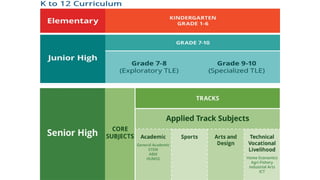
Understand the curricular characteristics of the four Senior High School tracks’
specific strands and their respective possible career paths; and
Identify possible tracks and strands you will want to pursue through emphasis on their
self-awareness.
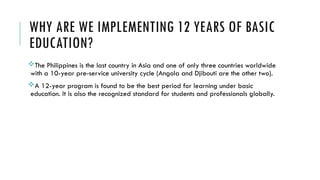
WHY ARE WEIMPLEMENTING 12 YEARS OF BASIC
EDUCATION?
The Philippines is the last country in Asia and one of only three countries worldwide
with a 10-year pre-service university cycle (Angola and Djibouti are the other two).
A 12-year program is found to be the best period for learning under basic
education. It is also the recognized standard for students and professionals globally.
12.
HOW WILL THEK TO 12 AFFECT THE COLLEGE
CURRICULUM?
The College General Education Curriculum will have fewer units. Subjects that have
been taken up in Basic Education will be removed from the College Education
curriculum.
Details of the new General Education Curriculum may be found in CHED
Memorandum Order No. 20, series of 2013.
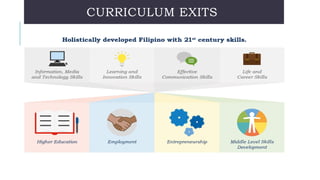
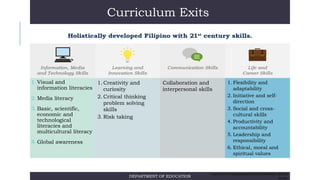
Curriculum Exits
DEPARTMENT OFEDUCATION
1. Visual and
information literacies
2. Media literacy
3. Basic, scientific,
economic and
technological
literacies and
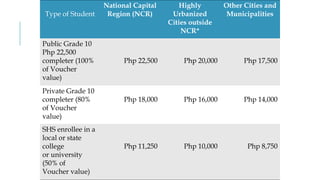
multicultural literacy
4. Global awareness
1. Creativity and
curiosity
2. Critical thinking
problem solving
skills
3. Risk taking
Collaboration and
interpersonal skills
1. Flexibility and
adaptability
2. Initiative and self-
direction
3. Social and cross-
cultural skills
4. Productivity and
accountability
5. Leadership and
responsibility
6. Ethical, moral and
spiritual values
AS OF 02/17/14 SPECIAL MANCOM MEETING ON SHS PREPARATIONS. FOR DEPED
USE ONLY
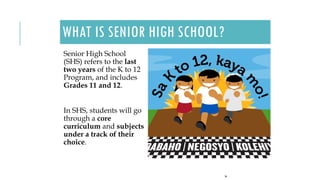
WHAT IS SENIORHIGH SCHOOL?
Senior High School
(SHS) refers to the last
two years of the K to 12
Program, and includes
Grades 11 and 12.
In SHS, students will go
through a core
curriculum and subjects
under a track of their
choice.
16
17.
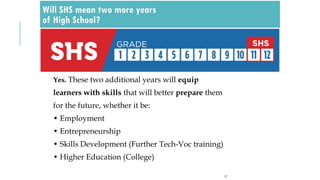
Will SHS meantwo more years
of High School?
Yes. These two additional years will equip
learners with skills that will better prepare them
for the future, whether it be:
• Employment
• Entrepreneurship
• Skills Development (Further Tech-Voc training)
• Higher Education (College)
17
18.
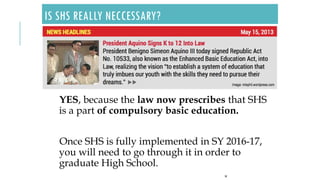
IS SHS REALLYNECCESSARY?
YES, because the law now prescribes that SHS
is a part of compulsory basic education.
Once SHS is fully implemented in SY 2016-17,
you will need to go through it in order to
graduate High School.
18
19.
Technically, it’s yourchoice. But you won’t get a High School
diploma.
You will be called a Grade 10 completer, but you will miss out
on the benefits of a full High School graduate.
19
What if I do not want to go to SHS?
20.
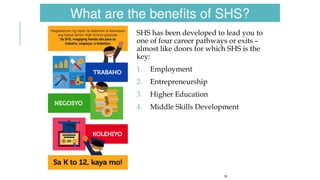
SHS has beendeveloped to lead you to
one of four career pathways or exits –
almost like doors for which SHS is the
key:
1. Employment
2. Entrepreneurship
3. Higher Education
4. Middle Skills Development
20
What are the benefits of SHS?
21.
EMPLOYMENT
21
Learners are moreprepared for work
• For technical and vocational careers, you
will already be able to apply for TESDA
Certificates.
• For most choices, private company
partners are ready to take you on for
immersion (work and gain experience while
studying), training and hiring.
22.
ENTREPRENEURSHIP
22
You will beequipped with
the skills to either start
your own business, or
continue running your
family business.
23.
HIGHER EDUCATION
23
Some Collegeand University
core subjects have now been
integrated into SHS, which
means less repetition.
If you do go to college, the
subjects you take on will be
more focused and more
relevant to your chosen course.
24.
Middle Skills Development
•This benefit applies to Technical and
Vocational careers. While at SHS, you will
already learn specialized skills.
• Continuing education at other Tech-Voc
institutions means being able to get to more
advanced subjects faster.
25.
Will the additionaltwo years
of High School mean
additional expenses?
25
• NOT NECESSARILY. SHS “completes”
basic education by making sure that the
high school graduate is equipped for work,
entrepreneurship, or higher education.
• This is a step up from the 10-year cycle
where high school graduates still need
further education (and expenses) to be
ready for the world.
26.
26
• SHS willbe offered free in public
schools and there will be a voucher
program in place for public junior high
school completers as well as ESC
beneficiaries of private high schools
should they choose to take SHS in private
institutions.
• This means that the burden of expenses
for the additional two years need not be
completely shouldered by parents.
Additional expenses?
27.
What is VoucherProgram?
27
• It provides subsidies to students who wish to
enroll in a private or non-DepEd Senior High
School.
• All Grade 10 completers from public schools
and all Grade 10 completers in private high
schools who are Education Service Contracting
(ESC) grantees automatically get one.
• Private high school Grade 10 completers who
are not ESC grantees can apply for one as well.
28.
Will I needa Voucher if I enroll in a public
SHS?
28
NO, you will not need a voucher subsidy
because public high schools do not have tuition
fees.
29.
How much willmy Voucher
be worth?
29
• It varies depending on what type of high
school student you are and where the SHS
you plan to enroll at is located.
• Public Grade 10 Students get 100% of the
voucher value.
o Private Grade 10 Students who are ESC
grantees get 80% of the Voucher value.
30.
MY VOUCHER’S WORTH?
Regardlessif you’re a Grade 10 completer from a public or
private Junior High School, if you enroll in a local or state college
or university, you get 50% of the voucher value.
Your teacher or Guidance Counselor can help you compute your
exact voucher value. The table on the next page may also guide
you.
30
31.
31
Type of Student
NationalCapital
Region (NCR)
Highly
Urbanized
Cities outside
NCR*
Other Cities and
Municipalities
Public Grade 10
Php 22,500
completer (100%
of Voucher
value)
Php 22,500 Php 20,000 Php 17,500
Private Grade 10
completer (80%
of Voucher
value)
Php 18,000 Php 16,000 Php 14,000
SHS enrollee in a
local or state
college
or university
(50% of
Voucher value)
Php 11,250 Php 10,000 Php 8,750
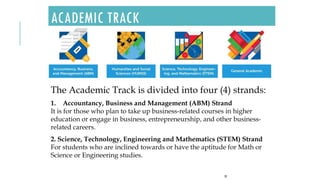
ACADEMIC TRACK
33
The AcademicTrack is divided into four (4) strands:
1. Accountancy, Business and Management (ABM) Strand
It is for those who plan to take up business-related courses in higher
education or engage in business, entrepreneurship, and other business-
related careers.
2. Science, Technology, Engineering and Mathematics (STEM) Strand
For students who are inclined towards or have the aptitude for Math or
Science or Engineering studies.
34.
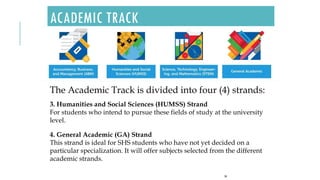
ACADEMIC TRACK
34
The AcademicTrack is divided into four (4) strands:
3. Humanities and Social Sciences (HUMSS) Strand
For students who intend to pursue these fields of study at the university
level.
4. General Academic (GA) Strand
This strand is ideal for SHS students who have not yet decided on a
particular specialization. It will offer subjects selected from the different
academic strands.
35.
TECHNICAL VOCATIONAL LIVELIHOOD
35
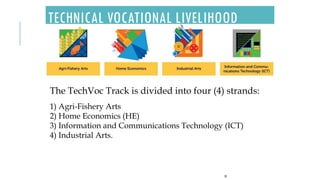
TheTechVoc Track is divided into four (4) strands:
1) Agri-Fishery Arts
2) Home Economics (HE)
3) Information and Communications Technology (ICT)
4) Industrial Arts.
36.
TECHNICAL VOCATIONAL LIVELIHOOD
Theseare aligned with the Technology and Livelihood Education (TLE)
Learning Area in Grades 7 to 10.
Each TVL strand offers various specializations that may or may not have a
National Certificate (NC) equivalent from the Technical Education and Skills
Development Authority (TESDA).
36
37.
TECHNICAL VOCATIONAL LIVELIHOOD
37
•The time allocation per TVL specialization is aligned with the
TESDA Training Regulations-Based Courses and is in multiples
of 80 hours following the conventions for SHS subjects.
• Therefore, each TVL specialization is designed to fit into the 80-
hour blocks of time.
• TLE and TVL specializations may be taken between Grades 9 to 12.
Schools may offer specializations from the four strands as long as
the prescribed number of hours for each specialization is met.
• Curriculum Maps may then be modified according to
specializations offered by a school.
38.
IT IS VERYIMPORTANT TO
BE
COMPLETELY
INFORMED.
There is discomfort in uncertainty
and in what we do not
39.
Self-awareness help youobey your heart when making decisions.
Obedience
Decision-making skills are useful everyday.
Prudence
Knowing and accepting oneself takes time.
Patience
40.
ASSIGNMENT
1. Color YourInterests
COLOR THE BOX containing a statement that matches your interests, preferences and
inclination. You can color AS MANY AS YOU WANT.
Please be reminded of the DESIGNATED COLOR for each box placed beside the statement.
41.
ASSIGNMENT
2. Journal Entry#2
Guide Questions
How did you find the activity(the mystery box)?
Have you ever been uncertain in your life? How did
you cope with it?
Did you find the session helpful in deciding for an
SHS track?
How did you find the information you have learned
on Senior High School?
How did you find the two tracks? Did they catch your
interests?
ROUND 1
How manyyears are added to High
School because of the Senior High
School Program?
Two (2) years
45.
ROUND 2
What areyou called when you finished
Grade 10 but does not want to enroll in
SHS?
Grade 10 completer
46.
ROUND 3
There arefour exits after finishing SHS.
Name two (2).
Employment
Entrepreneurship
Higher Education
Middle Skills Development
47.
ROUND 4
How muchdoes it cost to enrol in SHS in
public schools?
NONE because its FREE
48.
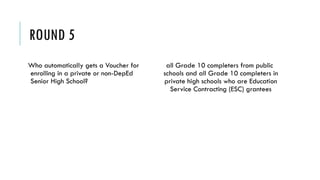
ROUND 5
Who automaticallygets a Voucher for
enrolling in a private or non-DepEd
Senior High School?
all Grade 10 completers from public
schools and all Grade 10 completers in
private high schools who are Education
Service Contracting (ESC) grantees
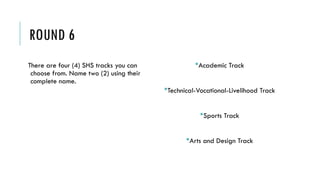
49.
ROUND 6
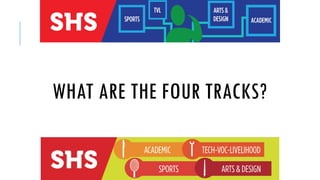
There arefour (4) SHS tracks you can
choose from. Name two (2) using their
complete name.
Academic Track
Technical-Vocational-Livelihood Track
Sports Track
Arts and Design Track
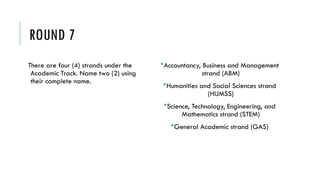
50.
ROUND 7
There arefour (4) strands under the
Academic Track. Name two (2) using
their complete name.
Accountancy, Business and Management
strand (ABM)
Humanities and Social Sciences strand
(HUMSS)
Science, Technology, Engineering, and
Mathematics strand (STEM)
General Academic strand (GAS)
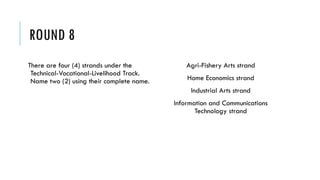
51.
ROUND 8
There arefour (4) strands under the
Technical-Vocational-Livelihood Track.
Name two (2) using their complete name.
Agri-Fishery Arts strand
Home Economics strand
Industrial Arts strand
Information and Communications
Technology strand
52.
ROUND 9
Why isSHS mandatory for all Filipino
students?
It is a law that has been signed by the
President of the Philippines
53.
ROUND 10
What isTESDA’s role in the TVL Track? TVL courses offered may or may not have
a National Certificate (NC) equivalent
from the Technical Education and Skills
Development Authority (TESDA)
54.
IT IS VERYIMPORTANT TO
BE
COMPLETELY
INFORMED.
There is discomfort in uncertainty
and in what we do not
55.
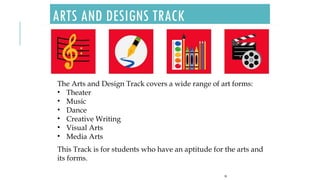
ARTS AND DESIGNSTRACK
55
The Arts and Design Track covers a wide range of art forms:
• Theater
• Music
• Dance
• Creative Writing
• Visual Arts
• Media Arts
This Track is for students who have an aptitude for the arts and
its forms.
56.
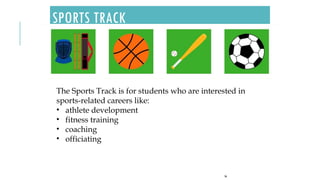
SPORTS TRACK
56
The SportsTrack is for students who are interested in
sports-related careers like:
• athlete development
• fitness training
• coaching
• officiating
ASSIGNMENT
1. My FirstResume
Follow the format
It could be handwritten, typewritten or encoded
59.
ASSIGNMENT
2. Journal Entry#3
Guide Questions
How do you find the activities we had today?
What part of the session did you enjoy the most?
Do you find the session helpful in deciding for an SHS track?
How do you find the last two tracks? Did they catch your interest?
Do you already have an idea of which track you will pursue?
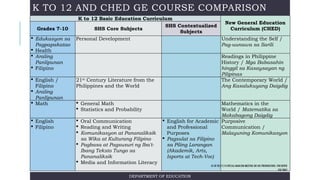
K TO 12AND CHED GE COURSE COMPARISON
DEPARTMENT OF EDUCATION
K to 12 Basic Education Curriculum
New General Education
Curriculum (CHED)
Grades 7-10 SHS Core Subjects
SHS Contextualized
Subjects
Edukasyon sa
Pagpapakatao
Health
Personal Development Understanding the Self /
Pag-uunawa sa Sarili
Araling
Panlipunan
Filipino
Readings in Philippine
History / Mga Babasahin
hinggil sa Kasaysayan ng
Pilipinas
English /
Filipino
Araling
Panlipunan
21st
Century Literature from the
Philippines and the World
The Contemporary World /
Ang Kasalukuyang Daigdig
Math General Math
Statistics and Probability
Mathematics in the
World / Matematika sa
Makabagong Daigdig
English
Filipino
Oral Communication
Reading and Writing
Komunikasyon at Pananaliksik
sa Wika at Kulturang Filipino
Pagbasa at Pagsusuri ng Iba't-
Ibang Teksto Tungo sa
Pananaliksik
Media and Information Literacy
English for Academic
and Professional
Purposes
Pagsulat sa Filipino
sa Piling Larangan
(Akademik, Arts,
Isports at Tech-Voc)
Purposive
Communication /
Malayuning Komunikasyon
AS OF 02/17/14 SPECIAL MANCOM MEETING ON SHS PREPARATIONS. FOR DEPED
USE ONLY
62.
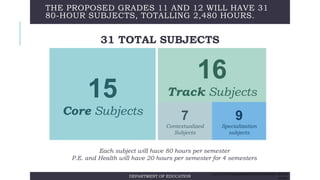
THE PROPOSED GRADES11 AND 12 WILL HAVE 31
80-HOUR SUBJECTS, TOTALLING 2,480 HOURS.
15
Core Subjects
16
Track Subjects
7
Contextualized
Subjects
9
Specialization
subjects
31 TOTAL SUBJECTS
Each subject will have 80 hours per semester
P.E. and Health will have 20 hours per semester for 4 semesters
DEPARTMENT OF EDUCATION
AS OF 02/17/14 SPECIAL MANCOM MEETING ON SHS PREPARATIONS. FOR DEPED
USE ONLY
63.
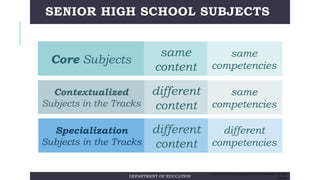
Core Subjects
Contextualized
Subjects inthe Tracks
Specialization
Subjects in the Tracks
DEPARTMENT OF EDUCATION
same
competencies
same
competencies
different
competencies
same
content
different
content
different
content
SENIOR HIGH SCHOOL SUBJECTS
AS OF 02/17/14 SPECIAL MANCOM MEETING ON SHS PREPARATIONS. FOR DEPED
USE ONLY
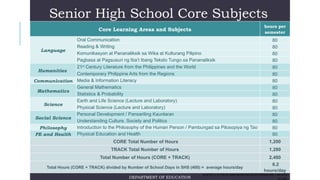
Senior High SchoolCore Subjects
Core Learning Areas and Subjects
hours per
semester
Language
Oral Communication 80
Reading & Writing 80
Komunikasyon at Pananaliksik sa Wika at Kulturang Pilipino 80
Pagbasa at Pagsusuri ng Iba’t Ibang Teksto Tungo sa Pananaliksik 80
Humanities
21st
Century Literature from the Philippines and the World 80
Contemporary Philippine Arts from the Regions 80
Communication Media & Information Literacy 80
Mathematics
General Mathematics 80
Statistics & Probability 80
Science
Earth and Life Science (Lecture and Laboratory) 80
Physical Science (Lecture and Laboratory) 80
Social Science
Personal Development / Pansariling Kaunlaran 80
Understanding Culture, Society and Politics 80
Philosophy Introduction to the Philosophy of the Human Person / Pambungad sa Pilosopiya ng Tao 80
PE and Health Physical Education and Health 80
CORE Total Number of Hours 1,200
TRACK Total Number of Hours 1,280
Total Number of Hours (CORE + TRACK) 2,480
Total Hours (CORE + TRACK) divided by Number of School Days in SHS (400) = average hours/day
6.2
hours/day
DEPARTMENT OF EDUCATION
AS OF 02/17/14 SPECIAL MANCOM MEETING ON SHS PREPARATIONS. FOR DEPED
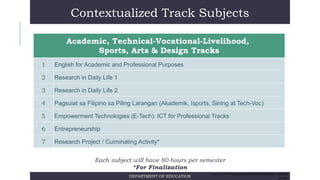
Each subject willhave 80 hours per semester
*For Finalization
Contextualized Track Subjects
DEPARTMENT OF EDUCATION
Academic, Technical-Vocational-Livelihood,
Sports, Arts & Design Tracks
1 English for Academic and Professional Purposes
2 Research in Daily Life 1
3 Research in Daily Life 2
4 Pagsulat sa Filipino sa Piling Larangan (Akademik, Isports, Sining at Tech-Voc)
5 Empowerment Technologies (E-Tech): ICT for Professional Tracks
6 Entrepreneurship
7 Research Project / Culminating Activity*
AS OF 02/17/14 SPECIAL MANCOM MEETING ON SHS PREPARATIONS. FOR DEPED
USE ONLY
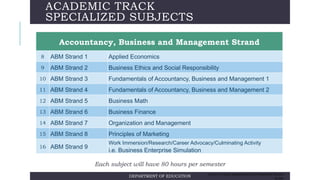
ACADEMIC TRACK
SPECIALIZED SUBJECTS
Accountancy,Business and Management Strand
8 ABM Strand 1 Applied Economics
9 ABM Strand 2 Business Ethics and Social Responsibility
10 ABM Strand 3 Fundamentals of Accountancy, Business and Management 1
11 ABM Strand 4 Fundamentals of Accountancy, Business and Management 2
12 ABM Strand 5 Business Math
13 ABM Strand 6 Business Finance
14 ABM Strand 7 Organization and Management
15 ABM Strand 8 Principles of Marketing
16 ABM Strand 9
Work Immersion/Research/Career Advocacy/Culminating Activity
i.e. Business Enterprise Simulation
Each subject will have 80 hours per semester
DEPARTMENT OF EDUCATION AS OF 02/17/14 SPECIAL MANCOM MEETING ON SHS PREPARATIONS. FOR DEPED
USE ONLY
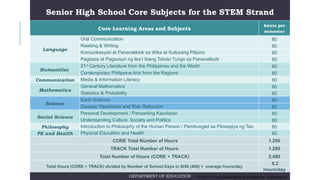
Senior High SchoolCore Subjects for the STEM Strand
DEPARTMENT OF EDUCATION
Core Learning Areas and Subjects
hours per
semester
Language
Oral Communication 80
Reading & Writing 80
Komunikasyon at Pananaliksik sa Wika at Kulturang Pilipino 80
Pagbasa at Pagsusuri ng Iba’t Ibang Teksto Tungo sa Pananaliksik 80
Humanities
21st
Century Literature from the Philippines and the World 80
Contemporary Philippine Arts from the Regions 80
Communication Media & Information Literacy 80
Mathematics
General Mathematics 80
Statistics & Probability 80
Science
Earth Science 80
Disaster Readiness and Risk Reduction 80
Social Science
Personal Development / Pansariling Kaunlaran 80
Understanding Culture, Society and Politics 80
Philosophy Introduction to Philosophy of the Human Person / Pambungad sa Pilosopiya ng Tao 80
PE and Health Physical Education and Health 80
CORE Total Number of Hours 1,200
TRACK Total Number of Hours 1,280
Total Number of Hours (CORE + TRACK) 2,480
Total Hours (CORE + TRACK) divided by Number of School Days in SHS (400) = average hours/day
6.2
hours/day
DEPARTMENT OF EDUCATION AS OF 02/17/14 SPECIAL MANCOM MEETING ON SHS PREPARATIONS. FOR DEPED USE ONLY
72.
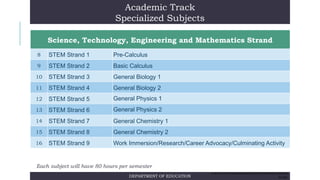
Academic Track
Specialized Subjects
Science,Technology, Engineering and Mathematics Strand
8 STEM Strand 1 Pre-Calculus
9 STEM Strand 2 Basic Calculus
10 STEM Strand 3 General Biology 1
11 STEM Strand 4 General Biology 2
12 STEM Strand 5 General Physics 1
13 STEM Strand 6 General Physics 2
14 STEM Strand 7 General Chemistry 1
15 STEM Strand 8 General Chemistry 2
16 STEM Strand 9 Work Immersion/Research/Career Advocacy/Culminating Activity
Each subject will have 80 hours per semester
DEPARTMENT OF EDUCATION
AS OF 02/17/14 SPECIAL MANCOM MEETING ON SHS PREPARATIONS. FOR DEPED
USE ONLY
ACADEMIC TRACK
SPECIALIZED SUBJECTS
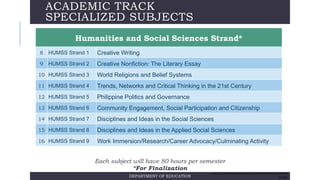
Humanitiesand Social Sciences Strand*
8 HUMSS Strand 1 Creative Writing
9 HUMSS Strand 2 Creative Nonfiction: The Literary Essay
10 HUMSS Strand 3 World Religions and Belief Systems
11 HUMSS Strand 4 Trends, Networks and Critical Thinking in the 21st Century
12 HUMSS Strand 5 Philippine Politics and Governance
13 HUMSS Strand 6 Community Engagement, Social Participation and Citizenship
14 HUMSS Strand 7 Disciplines and Ideas in the Social Sciences
15 HUMSS Strand 8 Disciplines and Ideas in the Applied Social Sciences
16 HUMSS Strand 9 Work Immersion/Research/Career Advocacy/Culminating Activity
Each subject will have 80 hours per semester
*For Finalization
DEPARTMENT OF EDUCATION
AS OF 02/17/14 SPECIAL MANCOM MEETING ON SHS PREPARATIONS. FOR DEPED
USE ONLY
ACADEMIC TRACK
SPECIALIZED SUBJECTS
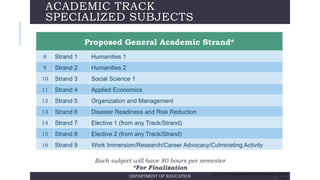
ProposedGeneral Academic Strand*
8 Strand 1 Humanities 1
9 Strand 2 Humanities 2
10 Strand 3 Social Science 1
11 Strand 4 Applied Economics
12 Strand 5 Organization and Management
13 Strand 6 Disaster Readiness and Risk Reduction
14 Strand 7 Elective 1 (from any Track/Strand)
15 Strand 8 Elective 2 (from any Track/Strand)
16 Strand 9 Work Immersion/Research/Career Advocacy/Culminating Activity
Each subject will have 80 hours per semester
*For Finalization
DEPARTMENT OF EDUCATION
AS OF 02/17/14 SPECIAL MANCOM MEETING ON SHS PREPARATIONS. FOR DEPED
USE ONLY
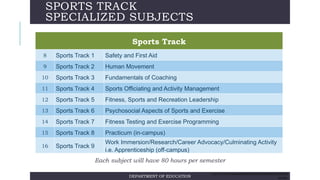
SPORTS TRACK
SPECIALIZED SUBJECTS
Eachsubject will have 80 hours per semester
DEPARTMENT OF EDUCATION
Sports Track
8 Sports Track 1 Safety and First Aid
9 Sports Track 2 Human Movement
10 Sports Track 3 Fundamentals of Coaching
11 Sports Track 4 Sports Officiating and Activity Management
12 Sports Track 5 Fitness, Sports and Recreation Leadership
13 Sports Track 6 Psychosocial Aspects of Sports and Exercise
14 Sports Track 7 Fitness Testing and Exercise Programming
15 Sports Track 8 Practicum (in-campus)
16 Sports Track 9
Work Immersion/Research/Career Advocacy/Culminating Activity
i.e. Apprenticeship (off-campus)
AS OF 02/17/14 SPECIAL MANCOM MEETING ON SHS PREPARATIONS. FOR DEPED
USE ONLY
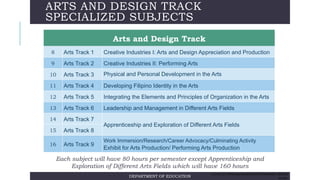
ARTS AND DESIGNTRACK
SPECIALIZED SUBJECTS
Each subject will have 80 hours per semester except Apprenticeship and
Exploration of Different Arts Fields which will have 160 hours
DEPARTMENT OF EDUCATION
Arts and Design Track
8 Arts Track 1 Creative Industries I: Arts and Design Appreciation and Production
9 Arts Track 2 Creative Industries II: Performing Arts
10 Arts Track 3 Physical and Personal Development in the Arts
11 Arts Track 4 Developing Filipino Identity in the Arts
12 Arts Track 5 Integrating the Elements and Principles of Organization in the Arts
13 Arts Track 6 Leadership and Management in Different Arts Fields
14 Arts Track 7
Apprenticeship and Exploration of Different Arts Fields
15 Arts Track 8
16 Arts Track 9
Work Immersion/Research/Career Advocacy/Culminating Activity
Exhibit for Arts Production/ Performing Arts Production
AS OF 02/17/14 SPECIAL MANCOM MEETING ON SHS PREPARATIONS. FOR DEPED
USE ONLY
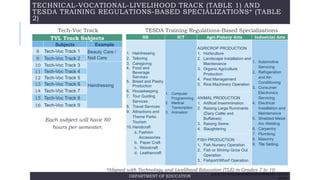
TECHNICAL-VOCATIONAL-LIVELIHOOD TRACK (TABLE1) AND
TESDA TRAINING REGULATIONS-BASED SPECIALIZATIONS* (TABLE
2)
HE ICT Agri-Fishery Arts Industrial Arts
1. Hairdressing
2. Tailoring
3. Caregiving
4. Food and
Beverage
Services
5. Bread and Pastry
Production
6. Housekeeping
7. Tour Guiding
Services
8. Travel Services
9. Attractions and
Theme Parks
Tourism
10.Handicraft
a. Fashion
Accessories
b. Paper Craft
c. Woodcraft
d. Leathercraft
1. Computer
Programming
2. Medical
Transcription
3. Animation
AGRICROP PRODUCTION
1. Horticulture
2. Landscape Installation and
Maintenance
3. Organic Agriculture
Production
4. Pest Management
5. Rice Machinery Operation
1. Automotive
Servicing
2. Refrigeration
and Air-
Conditioning
3. Consumer
Electronics
Servicing
4. Electrical
Installation and
Maintenance
5. Shielded Metal-
Arc Welding
6. Carpentry
7. Plumbing
8. Masonry
9. Tile Setting
ANIMAL PRODUCTION
1. Artifical Insemmination
2. Raising Large Ruminants
(Dairy Cattle and
Buffaloes)
3. Raising Swine
4. Slaughtering
FISH PRODUCTION
1. Fish Nursery Operation
2. Fish or Shrimp Grow Out
Operation
3. Fishport/Wharf Operation
Tech-Voc Track TESDA Training Regulations-Based Specializations
TVL Track Subjects
Subjects Example
8 Tech-Voc Track 1 Beauty Care /
Nail Care
9 Tech-Voc Track 2
10 Tech-Voc Track 3
Hairdressing
11 Tech-Voc Track 4
12 Tech-Voc Track 5
13 Tech-Voc Track 6
14 Tech-Voc Track 7
15 Tech-Voc Track 8
16 Tech-Voc Track 9
DEPARTMENT OF EDUCATION
Each subject will have 80
hours per semester.
*Aligned with Technology and Livelihood Education (TLE) in Grades 7 to 10.
AS OF 02/17/14 SPECIAL MANCOM MEETING ON SHS PREPARATIONS. FOR DEPED
USE ONLY
83.
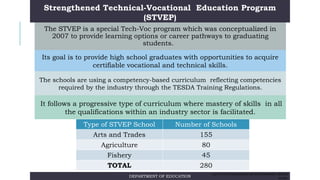
The STVEP isa special Tech-Voc program which was conceptualized in
2007 to provide learning options or career pathways to graduating
students.
Strengthened Technical-Vocational Education Program
(STVEP)
DEPARTMENT OF EDUCATION
It follows a progressive type of curriculum where mastery of skills in all
the qualifications within an industry sector is facilitated.
Its goal is to provide high school graduates with opportunities to acquire
certifiable vocational and technical skills.
The schools are using a competency-based curriculum reflecting competencies
required by the industry through the TESDA Training Regulations.
Type of STVEP School Number of Schools
Arts and Trades 155
Agriculture 80
Fishery 45
TOTAL 280
AS OF 02/17/14 SPECIAL MANCOM MEETING ON SHS PREPARATIONS. FOR DEPED
USE ONLY
86.
As of 02/17/14Special ManCom Meeting on SHS Preparations. For DEPED US
E ONLY
Thank You Very Much!
87.
As of 02/17/14Special ManCom Meeting on SHS Preparations. For DEPED US
E ONLY
bit.ly/kto12curriculum
kto12@deped.gov.ph
Editor's Notes
#14
All these skills are embedded in the curriculum. The skills are developed bit by bit through the learning competencies and performance standards of all the different subjects.
Above is our example
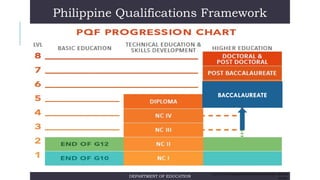
#15 The K-12 curriculum is hinged on the PQF. It has two levels articulating expected skills that a grade 10 and grade 12 student should have.
#60 Good morning everyone. The Department of Education is now finalizing its efforts towards the implementation of the K to 12 Senior High School Program in 2016. We at DepEd Regional Office are one with these efforts and all our preparations are aligned with the national mandates. I’m glad that I was given the opportunity to be part of this gathering. This is also our way of communicating correct information and updates about the K to 12 Program.
#61 The K-12 Curriculum connects with the New General Education Curriculum of CHED
For ex. G 7-10’s “Edukasyon sa Pagpapakatao” and SHS’s “Personal Development” connects with the “Understanding the Self” of CHED
This is done to prepare the learners for college
#62 SHS has 2 grades, Gr 11 and 12.
There are 31 subjects with 80 hours per course totalling 2,480 hours for all 31.
The 15 Core and Contextualized subjects are connected with the new GE Curriculum of CHED. These prepare the student for college.
The 16 track subjects are further aggregated in to 2 categories. The 16 comprise the TRACK: 7 Contextualized and 9 specialization subjects.
#63 Core Subjects have the same content and same competencies.
Contextualized subjects in the tracks have different content but the same competencies.
For ex. English for Academic and Professional Purposes is different on the business side as compared to the academic side. If one’s in business, the English used is more on communication side. If one’s on the higher ed track, the English used is more for research, etc. In other words, it’s still English but the content is just different.
“We’re learning competencies using different content. Remember how we said that children are still too young to decide on their careers? With this, we are giving the children a chance to change their minds. Filipino is Filipino wherever you apply it. Research is research wherever you apply it. Kung ginawa nating specialized lahat, we are not cutting the child some slack. There are many who just want specialized tracks, but we are not producing factory workers. We’re not developing dressmakers. We are developing critical thinkers who can do dresses. It’s not the other way around. We’re not ‘tech-vocalizing’ education, we are adding tech-voc to high school.
Specialization subjects in the tracks have different content and different competencies.
#64 An understanding of the development PROCESS of the K to 12 curriculum is important for decision-making of actors on the ground.
The best curricula is CONTEXTUALIZED by those implementing it.
Presented today is the curriculum which will be implemented in schools
#65 Localization of the Core subjects can be done in the regions, by the regions.
In the Engineering and Mathematics strand, their mathematics are different from the rest of the math of other tracks.
PE and Health is the only subject that is spread across the 4 semesters/ 2 years, 20 hours each. Reason: SHS is the stage where a lot of teenage pregnancies and adolescent reporductive health issues are at its peak. There is a need to guide the learners througout this stage.
#66 An understanding of the development PROCESS of the K to 12 curriculum is important for decision-making of actors on the ground.
The best curricula is CONTEXTUALIZED by those implementing it.
Presented today is the curriculum which will be implemented in schools
#67 Research is the simple kind, not the dissertation kind of research.
Research in Daily life 1: Qualitative
Research in Daily life 2: Quantitative
Example for E-Tech: Drafting- Autocad, Excel- Business
Entrepreneurship is there for the graduates’ practical use. Also part of the 4 exits for SHS.
Research: Must be aligned to the track/ strand, for contextualization.
The goal: to give students enough time to decide what they really want to do as they graduate SHS.
#68 An understanding of the development PROCESS of the K to 12 curriculum is important for decision-making of actors on the ground.
The best curricula is CONTEXTUALIZED by those implementing it.
Presented today is the curriculum which will be implemented in schools
#69 ABM is formerly called BAM. It was changed to ABM so as not to give HS students a means of creating sarcastic comments on “BAM” or “bum” or “drop-out”.
What’s signifcant in this strand is the introduction of business ethics and social responsibility. It emphasizes that ethics should have an early foundation because tertiary core courses in business focus more on integration of ethics and application on specific topics and complex management cases.
#70 The ABM subjects aren’t entirely new ones. In fact, they’ve been embedded within the lower grades such as EsP, AP, Sci, Filipino, and Math
#80 One of the basic problems of businessmen in small businesses is that they cannot apply for a loan because they do not have the necessary documents. So as early as grade 12, our students are taught the necessary skills in order to prepare for such later on.
#86 An understanding of the development PROCESS of the K to 12 curriculum is important for decision-making of actors on the ground.
The best curricula is CONTEXTUALIZED by those implementing it.
Presented today is the curriculum which will be implemented in schools
#87 Though all students take the core, students taking up STEM will be taking 2 different subjects in the Sci core learning area which are: 1) Earth Science 2) Disaster Readiness and Risk Reduction
#88 The premise is when one passes the STEM track, one can go to Engineering or Chemistry or Physics. Particularly to Engineering, they can only take in students who took Calculus-based physics. For students who decide that they want to take engineering and but don’t take the STEM, they’ll have to take bridging classes in College.
This strand is for those students who wish to pursue a technically-related field in math and science. It is also for those interested in engineering, computer science, ec.
#89 These slides show a curriculum map of the content as discussed in the lower grade levels and how they are taken in different degrees of complexity.
As the requirements for STEM subjects are higher, this will really impact the kind of the teachers that are to be hired
#97 Impact of content on hiring of teachers: When hiring physics teachers, these subjects must be taken into consideration because they are not the usual topics that have been offered before.
#100 An understanding of the development PROCESS of the K to 12 curriculum is important for decision-making of actors on the ground.
The best curricula is CONTEXTUALIZED by those implementing it.
Presented today is the curriculum which will be implemented in schools
#101 What is central to the HUMMS is that it is clear what the child wants when s/he wants to take in College.
RA 10533 provides a window of 5 years so that one can get graduates of specialized courses to teach in Basic Education.
One must imagine who the teachers for the specific strand will be and how many.
#102 An understanding of the development PROCESS of the K to 12 curriculum is important for decision-making of actors on the ground.
The best curricula is CONTEXTUALIZED by those implementing it.
Presented today is the curriculum which will be implemented in schools
#103 General Academic Strand: no major; most useful for those who are still exploring possibilities for the future
This may also be a good starting point for schools that are just starting out, especially for those who might be needing time to complete the SHS requirements. This is a good incubation for both the school and the student.
The electives may be electives for TVL or for Academic BAM or HUMMS, etc.
All these strands come from existing strands.
#104 An understanding of the development PROCESS of the K to 12 curriculum is important for decision-making of actors on the ground.
The best curricula is CONTEXTUALIZED by those implementing it.
Presented today is the curriculum which will be implemented in schools
#105 SPORTS REQUIREMENTS
Focus more on sports science rather than the sport because the span of an athlete’s career isn’t too long.
Exploring other aspects of sports gives the learners more options.
Leadership and management: head must understand the sport too
Human movement = biomechanics
Track 7 is marketable in the Spa industries
“What we’re trying to do is to “grow up” programs. You don’t create something new out of nowhere. You find a strength and you scale it up.” This means that SPS Schools will have to “grow up” into Sports Track Schools since they already have the teachers and facilities.
#106 An understanding of the development PROCESS of the K to 12 curriculum is important for decision-making of actors on the ground.
The best curricula is CONTEXTUALIZED by those implementing it.
Presented today is the curriculum which will be implemented in schools
#107 Special Programs for Arts high schools grow up to be this SHS track.
Focus more on the arts and design related career opportunities rather than just the artist
An understanding of the arts industry is vital for those venturing into the arts field. This will teach them how to market themselves and earn using their talents/skills.
The track has to be in a form where the instrument and the skill is taught.
Subject 14 and 15: The crafters of the curriculum who came from NCAA and masters in the Arts, their assumption is that the regions have living artists in the communities. Thus, these people must be allowed to teach their craft– to teach learners about their epics, how to weave patterns, how to build terraces, etc.
#108 An understanding of the development PROCESS of the K to 12 curriculum is important for decision-making of actors on the ground.
The best curricula is CONTEXTUALIZED by those implementing it.
Presented today is the curriculum which will be implemented in schools
#111 This is an example of how the courses have been plotted from Junior High School to SHS
There are a number of NCs that a student can get
Caregiving: required to be taken starting grade 7
Stand-alone courses: boxes with only one course inside; does not need a prerequisite.