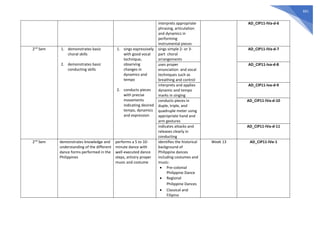
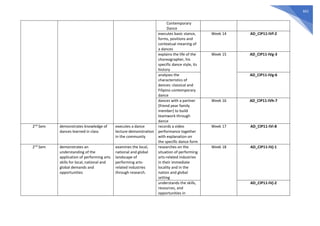
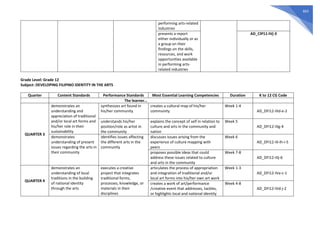
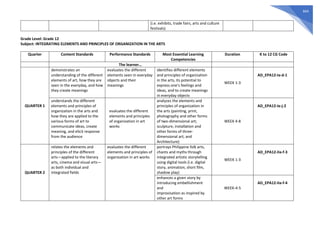
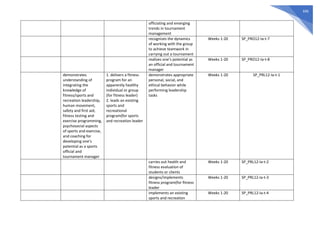
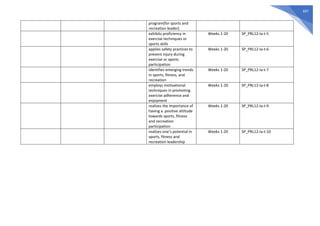
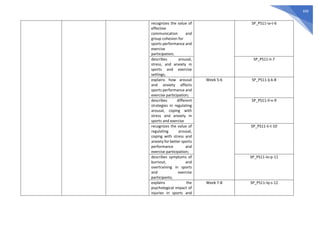
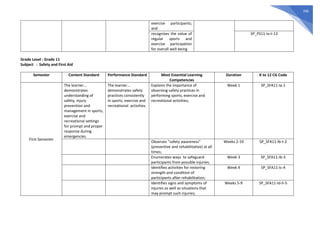
571
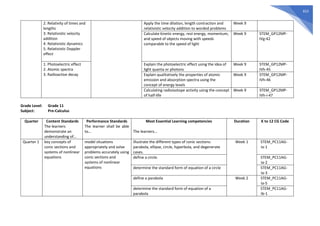
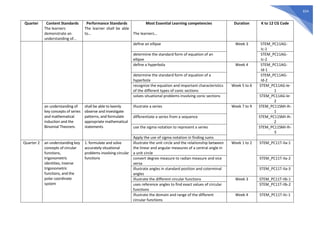
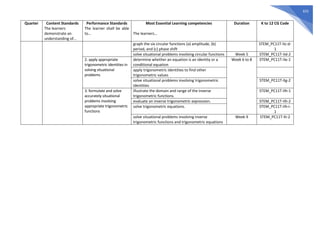
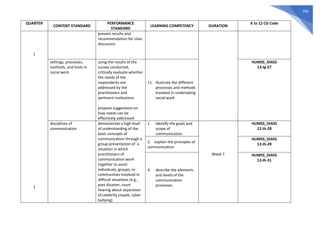
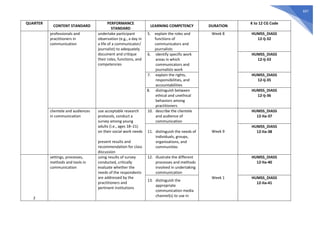
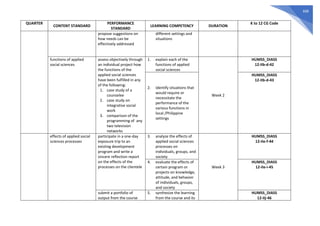
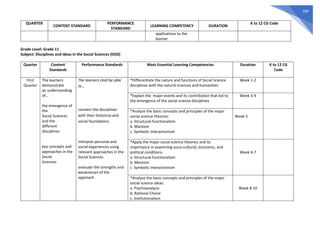
572
573
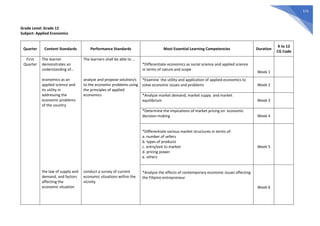
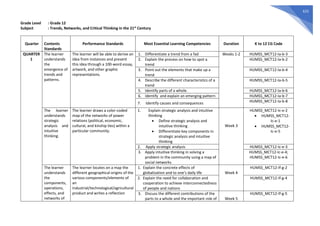
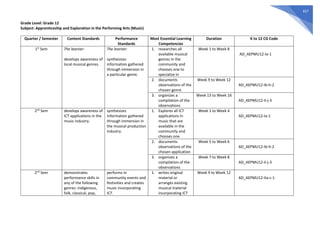
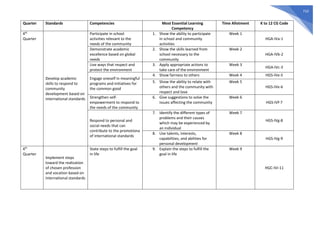
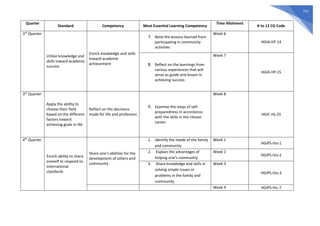
Grade Level: Grade 12
Subject: Applied Economics
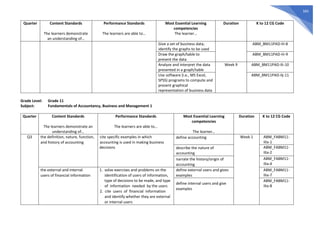
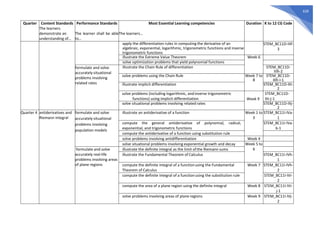
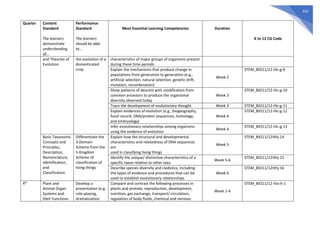
Quarter Content Standards Performance Standards Most Essential Learning Competencies Duration
K to 12
CG Code
First
Quarter
The learner
demonstrates an
understanding of…
economics as an
applied science and
its utility in
addressing the
economic problems
of the country
the law of supply and
demand, and factors
affecting the
economic situation
The learners shall be able to …
analyze and propose solution/s
to the economic problems using
the principles of applied
economics
conduct a survey of current
economic situations within the
vicinity
*Differentiate economics as social science and applied science
in terms of nature and scope
Week 1
*Examine the utility and application of applied economics to
solve economic issues and problems Week 2
*Analyze market demand, market suppy and market
equilibrium Week 3
*Determine the impications of market pricing on economic
decision-making Week 4
*Differentiate various market structures in terms of:
a. number of sellers
b. types of products
c. entry/exit to market
d. pricing power
e. others
Week 5
*Analyze the effects of contemporary economic issues affecting
the Filipino entrepreneur
Week 6
574
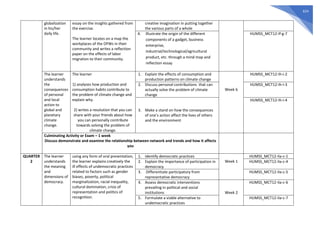
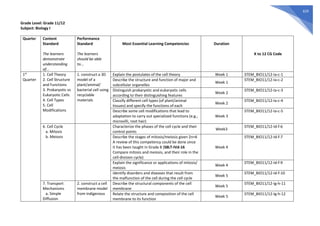
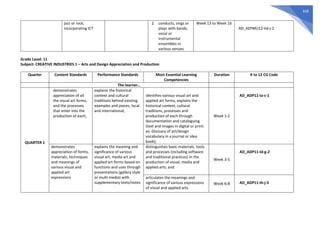
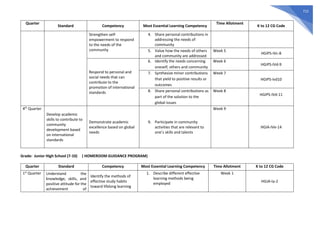
Quarter Content Standards Performance Standards Most Essential Learning Competencies Duration
K to 12
CG Code
industry analysis, its
principles, tools, and
techniques leading to
the identification of
business
opportunities
various
socioeconomic
impacts of business
on the following
sectors: consumer,
supplier and
investors,
government,
households, and
international trade
apply tools and techniques for
business opportunities like the
SWOT/TOWS analysis
conduct a survey of macro and
micro environments affecting
business in a locality
conduct a socioeconomic
impact study on consumers
(new product and services);
suppliers; investors (capital,
income) government (tax
revenues, poverty alleviation,
basic services); households
(standard of living,
employment) and international
trade (exports and imports of
goods and services) leading to
options in venturing into a
business
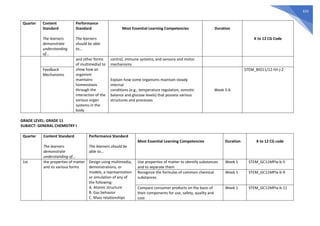
*Analyze different principles, tools, and techniques in creating
a business
Week 7
*Apply business principles, tools, and techniques in
participating in various types of industries in the locality
Weeks 8-
9
*Explain the effects of the various socio-economic factors
affecting business and industry
Week 10
* Evaluate the viability and impacts of business on the
community
Weeks
11-12
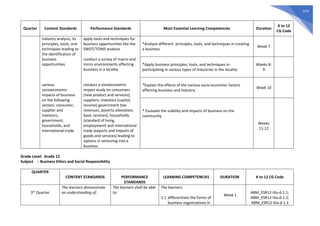
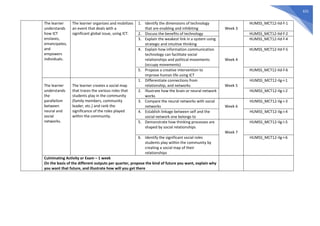
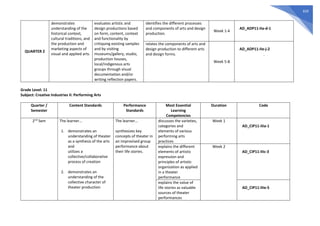
Grade Level: Grade 12
Subject : Business Ethics and Social Responsibility
QUARTER
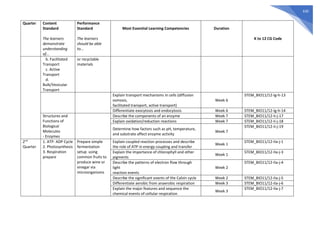
CONTENT STANDARDS PERFORMANCE
STANDARDS
LEARNING COMPETENCIES DURATION K to 12 CG Code
3rd
Quarter
The learners demonstrate
an understanding of:
The learners shall be able
to:
The learners:
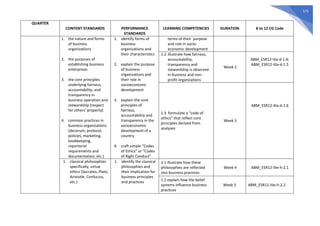
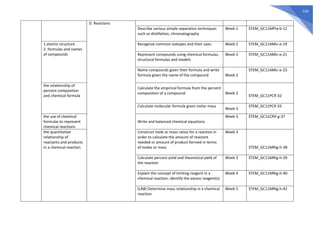
1.1 differentiate the forms of
business organizations in
Week 1
ABM_ESR12-IIIa-d-1.1;
ABM_ESR12-IIIa-d-1.2;
ABM_ESR12-IIIa-d-1.3
575
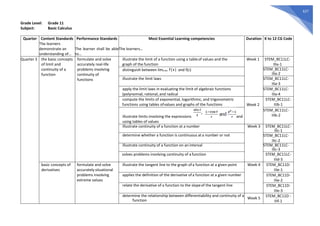
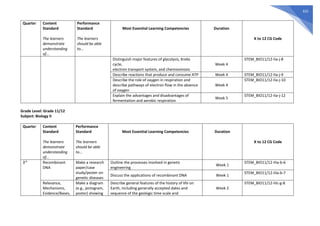
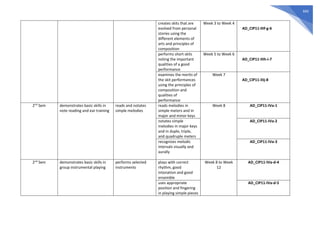
QUARTER
CONTENT STANDARDS PERFORMANCE
STANDARDS
LEARNING COMPETENCIES DURATION K to 12 CG Code
1. the nature and forms
of business
organizations
2. the purposes of
establishing business
enterprises
3. the core principles
underlying fairness,
accountability, and
transparency in
business operation and
stewardship (respect
for others’ property)
4. common practices in
business organizations
(decorum, protocol,
policies, marketing,
bookkeeping,
reportorial
requirements and
documentation, etc.)
1. identify forms of
business
organizations and
their characteristics
2. explain the purpose
of business
organizations and
their role in
socioeconomic
development
3. explain the core
principles of
fairness,
accountability and
transparency in the
socioeconomic
development of a
country
4. craft simple “Codes
of Ethics” or “Codes
of Right Conduct”
terms of their purpose
and role in socio-
economic development
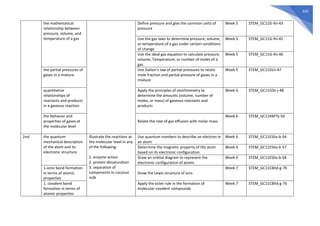
1.2 illustrate how fairness,
accountability,
transparency and
stewardship is observed
in business and non-
profit organizations
Week 2
ABM_ESR12-IIIa-d-1.4;
ABM_ESR12-IIIa-d-1.5
1.3 formulate a “code of
ethics” that reflect core
principles derived from
analyses
Week 3
ABM_ESR12-IIIa-d-1.6
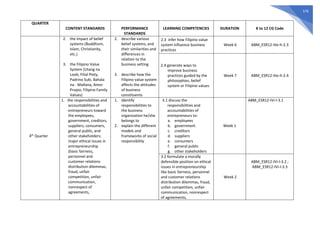
1. classical philosophies
specifically, virtue
ethics (Socrates, Plato,
Aristotle, Confucius,
etc.)
1. identify the classical
philosophies and
their implication for
business principles
and practices
2.1 illustrate how these
philosophies are reflected
into business practices
Week 4 ABM_ESR12-IIIe-h-2.1
2.2 explain how the belief
systems influence business
practices
Week 5 ABM_ESR12-IIIe-h-2.2
576
QUARTER
CONTENT STANDARDS PERFORMANCE
STANDARDS
LEARNING COMPETENCIES DURATION K to 12 CG Code
2. the impact of belief
systems (Buddhism,
Islam, Christianity,
etc.)
3. the Filipino Value
System (Utang na
Loob, Filial Piety,
Padrino Suki, Bahala
na - Mañana, Amor
Propio, Filipino Family
Values)
2. describe various
belief systems, and
their similarities and
differences in
relation to the
business setting
3. describe how the
Filipino value system
affects the attitudes
of business
constituents
2.3 infer how Filipino value
system influence business
practices
Week 6 ABM_ESR12-IIIe-h-2.3
2.4 generate ways to
improve business
practices guided by the
philosophies, belief
system or Filipino values
Week 7 ABM_ESR12-IIIe-h-2.4
4th
Quarter
1. the responsibilities and
accountabilities of
entrepreneurs toward
the employees,
government, creditors,
suppliers, consumers,
general public, and
other stakeholders;
major ethical issues in
entrepreneurship
(basic fairness,
personnel and
customer relations
distribution dilemmas,
fraud, unfair
competition, unfair
communication,
nonrespect of
agreements,
1. identify
responsibilities to
the business
organization he/she
belongs to
2. explain the different
models and
frameworks of social
responsibility
3.1 discuss the
responsibilities and
accountabilities of
entrepreneurs to:
a. employees
b. government
c. creditors
d. suppliers
e. consumers
f. general public
g. other stakeholders
Week 1
ABM_ESR12-IVi-l-3.1
3.2 formulate a morally
defensible position on ethical
issues in entrepreneurship
like basic fairness, personnel
and customer relations
distribution dilemmas, fraud,
unfair competition, unfair
communication, nonrespect
of agreements,
Week 2
ABM_ESR12-IVi-l-3.2 ;
ABM_ESR12-IVi-l-3.3
577
QUARTER
CONTENT STANDARDS PERFORMANCE
STANDARDS
LEARNING COMPETENCIES DURATION K to 12 CG Code
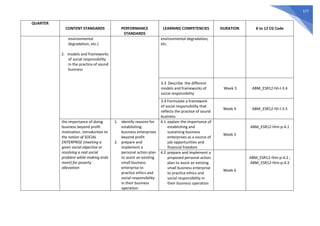
environmental
degradation, etc.)
2. models and frameworks
of social responsibility
in the practice of sound
business
environmental degradation,
etc.
3.3 Describe the different
models and frameworks of
social responsibility
Week 3 ABM_ESR12-IVi-l-3.4
3.4 Formulate a framework
of social responsibility that
reflects the practice of sound
business
Week 4 ABM_ESR12-IVi-l-3.5
the importance of doing
business beyond profit
motivation. Introduction to
the notion of SOCIAL
ENTERPRISE (meeting a
given social objective or
resolving a real social
problem while making ends
meet) for poverty
alleviation
1. identify reasons for
establishing
business enterprises
beyond profit
2. prepare and
implement a
personal action plan
to assist an existing
small business
enterprise to
practice ethics and
social responsibility
in their business
operation
4.1 explain the importance of
establishing and
sustaining business
enterprises as a source of
job opportunities and
financial freedom
Week 5
ABM_ESR12-IVm-p-4.1
4.2 prepare and implement a
proposed personal action
plan to assist an existing
small business enterprise
to practice ethics and
social responsibility in
their business operation
Week 6
ABM_ESR12-IVm-p-4.2 ;
ABM_ESR12-IVm-p-4.3
578
Grade Level: Grade 12
Subject: Business Finance
Quarter Content Standards
The learners demonstrate an
understanding of…
Performance Standards
The learners are able to…
Most Essential Learning
competencies
The learner…
Duration K to 12 CG Code
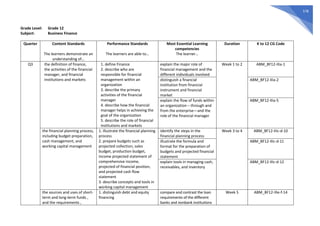
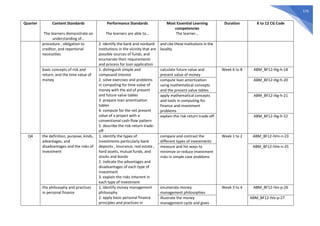
Q3 the definition of finance,
the activities of the financial
manager, and financial
institutions and markets
1. define Finance
2. describe who are
responsible for financial
management within an
organization
3. describe the primary
activities of the financial
manager
4. describe how the financial
manager helps in achieving the
goal of the organization
5. describe the role of financial
institutions and markets
explain the major role of
financial management and the
different individuals involved
Week 1 to 2 ABM_BF12-IIIa-1
distinguish a financial
institution from financial
instrument and financial
market
ABM_BF12-IIIa-2
explain the flow of funds within
an organization – through and
from the enterprise—and the
role of the financial manager
ABM_BF12-IIIa-5
the financial planning process,
including budget preparation,
cash management, and
working capital management
1. illustrate the financial planning
process
2. prepare budgets such as
projected collection, sales
budget, production budget,
income projected statement of
comprehensive income,
projected of financial position,
and projected cash flow
statement
3. describe concepts and tools in
working capital management
identify the steps in the
financial planning process
Week 3 to 4 ABM_BF12-IIIc-d-10
illustrate the formula and
format for the preparation of
budgets and projected financial
statement
ABM_BF12-IIIc-d-11
explain tools in managing cash,
receivables, and inventory
ABM_BF12-IIIc-d-12
the sources and uses of short-
term and long-term funds ,
and the requirements ,
1. distinguish debt and equity
financing
compare and contrast the loan
requirements of the different
banks and nonbank institutions
Week 5 ABM_BF12-IIIe-f-14
579
Quarter Content Standards
The learners demonstrate an
understanding of…
Performance Standards
The learners are able to…
Most Essential Learning
competencies
The learner…
Duration K to 12 CG Code
procedure , obligation to
creditor, and reportorial
necessities
2. identify the bank and nonbank
institutions in the vicinity that are
possible sources of funds, and
enumerate their requirements
and process for loan application
and cite these institutions in the
locality
basic concepts of risk and
return, and the time value of
money
1. distinguish simple and
compound interest
2. solve exercises and problems
in computing for time value of
money with the aid of present
and future value tables
3. prepare loan amortization
tables
4. compute for the net present
value of a project with a
conventional cash-flow pattern
5. describe the risk-return trade-
off
calculate future value and
present value of money
Week 6 to 8 ABM_BF12-IIIg-h-18
compute loan amortization
using mathematical concepts
and the present value tables
ABM_BF12-IIIg-h-20
apply mathematical concepts
and tools in computing for
finance and investment
problems
ABM_BF12-IIIg-h-21
explain the risk-return trade-off ABM_BF12-IIIg-h-22
Q4 the definition, purpose, kinds,
advantages, and
disadvantages and the risks of
investment
1. identify the types of
investments particularly bank
deposits , insurance, real estate ,
hard assets, mutual funds, and
stocks and bonds
2. indicate the advantages and
disadvantages of each type of
investment
3. explain the risks inherent in
each type of investment
compare and contrast the
different types of investments
Week 1 to 2 ABM_BF12-IVm-n-23
measure and list ways to
minimize or reduce investment
risks in simple case problems
ABM_BF12-IVm-n-25
the philosophy and practices
in personal finance
1. identify money management
philosophy
2. apply basic personal finance
principles and practices in
enumerate money
management philosophies
Week 3 to 4 ABM_BF12-IVo-p-26
illustrate the money
management cycle and gives
ABM_BF12-IVo-p-27
580
Quarter Content Standards
The learners demonstrate an
understanding of…
Performance Standards
The learners are able to…
Most Essential Learning
competencies
The learner…
Duration K to 12 CG Code
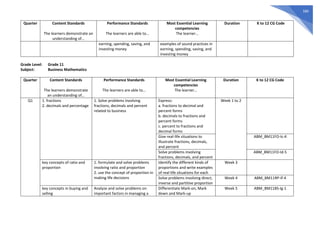
earning, spending, saving, and
investing money
examples of sound practices in
earning, spending, saving, and
investing money
Grade Level: Grade 11
Subject: Business Mathematics
Quarter Content Standards
The learners demonstrate
an understanding of…
Performance Standards
The learners are able to…
Most Essential Learning
competencies
The learner…
Duration K to 12 CG Code
Q1 1. fractions
2. decimals and percentage
1. Solve problems involving
fractions, decimals and percent
related to business
Express:
a. fractions to decimal and
percent forms
b. decimals to fractions and
percent forms
c. percent to fractions and
decimal forms
Week 1 to 2
Give real-life situations to
illustrate fractions, decimals,
and percent
ABM_BM11FO-Ic-4
Solve problems involving
fractions, decimals, and percent
ABM_BM11FO-Id-5
key concepts of ratio and
proportion
1. formulate and solve problems
involving ratio and proportion
2. use the concept of proportion in
making life decisions
Identify the different kinds of
proportions and write examples
of real-life situations for each
Week 3
Solve problems involving direct,
inverse and partitive proportion
Week 4 ABM_BM11RP-If-4
key concepts in buying and
selling
Analyze and solve problems on
important factors in managing a
Differentiate Mark-on, Mark
down and Mark-up
Week 5 ABM_BM11BS-Ig-1
581
Quarter Content Standards
The learners demonstrate
an understanding of…
Performance Standards
The learners are able to…
Most Essential Learning
competencies
The learner…
Duration K to 12 CG Code
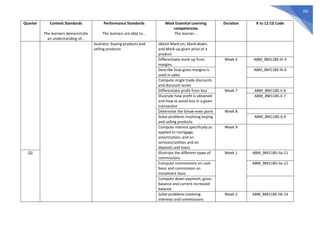
business: buying products and
selling products
obtain Mark-on, Mark-down,
and Mark-up given price of a
product
Differentiate mark-up from
margins
Week 6 ABM_BM11BS-Ih-3
Describe how gross margins is
used in sales
ABM_BM11BS-Ih-4
Compute single trade discounts
and discount series
Differentiate profit from loss Week 7 ABM_BM11BS-Ii-6
Illustrate how profit is obtained
and how to avoid loss in a given
transaction
ABM_BM11BS-Ii-7
Determine the break-even point Week 8
Solve problems involving buying
and selling products
ABM_BM11BS-Ij-9
Compute interest specifically as
applied to mortgage,
amortization, and on
services/utilities and on
deposits and loans
Week 9
Q2 Illustrate the different types of
commissions
Week 1 ABM_BM11BS-IIa-11
Compute commissions on cash
basis and commission on
instalment basis
ABM_BM11BS-IIa-12
Compute down payment, gross
balance and current increased
balance
Solve problems involving
interests and commissions
Week 2 ABM_BM11BS-IIb-14
582
Quarter Content Standards
The learners demonstrate
an understanding of…
Performance Standards
The learners are able to…
Most Essential Learning
competencies
The learner…
Duration K to 12 CG Code
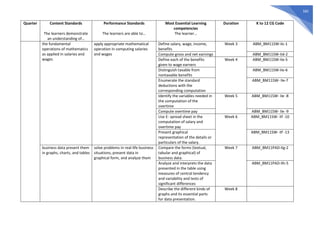
the fundamental
operations of mathematics
as applied in salaries and
wages
apply appropriate mathematical
operation in computing salaries
and wages
Define salary, wage, income,
benefits
Week 3 ABM_BM11SW-IIc-1
Compute gross and net earnings ABM_BM11SW-IId-2
Define each of the benefits
given to wage earners
Week 4 ABM_BM11SW-IIe-5
Distinguish taxable from
nontaxable benefits
ABM_BM11SW-IIe-6
Enumerate the standard
deductions with the
corresponding computation
ABM_BM11SW- IIe-7
Identify the variables needed in
the computation of the
overtime
Week 5 ABM_BM11SW- IIe -8
Compute overtime pay ABM_BM11SW- IIe -9
Use E- spread sheet in the
computation of salary and
overtime pay
Week 6 ABM_BM11SW- IIf -10
Present graphical
representation of the details or
particulars of the salary.
ABM_BM11SW- IIf -13
business data present them
in graphs, charts, and tables
solve problems in real-life business
situations, present data in
graphical form, and analyze them
Compare the forms (textual,
tabular and graphical) of
business data.
Week 7 ABM_BM11PAD-IIg-2
Analyze and interprets the data
presented in the table using
measures of central tendency
and variability and tests of
significant differences
ABM_BM11PAD-IIh-5
Describe the different kinds of
graphs and its essential parts
for data presentation.
Week 8
583
Quarter Content Standards
The learners demonstrate
an understanding of…
Performance Standards
The learners are able to…
Most Essential Learning
competencies
The learner…
Duration K to 12 CG Code
Give a set of business data;
identify the graphs to be used
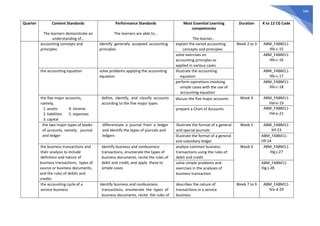
ABM_BM11PAD-IIi-8
Draw the graph/table to
present the data
ABM_BM11PAD-IIi-9
Analyze and interpret the data
presented in a graph/table
Week 9 ABM_BM11PAD-IIi-10
Use software (i.e., MS Excel,
SPSS) programs to compute and
present graphical
representation of business data
ABM_BM11PAD-IIj-11
Grade Level: Grade 11
Subject: Fundamentals of Accountancy, Business and Management 1
Quarter Content Standards
The learners demonstrate an
understanding of…
Performance Standards
The learners are able to…
Most Essential Learning
competencies
The learner…
Duration K to 12 CG Code
Q3 the definition, nature, function,
and history of accounting
cite specific examples in which
accounting is used in making business
decisions
define accounting Week 1 ABM_FABM11-
IIIa-1
describe the nature of
accounting
ABM_FABM11-
IIIa-2
narrate the history/origin of
accounting
ABM_FABM11-
IIIa-4
the external and internal
users of financial information
1. solve exercises and problems on the
identification of users of information,
type of decisions to be made, and type
of information needed by the users
2. cite users of financial information
and identify whether they are external
or internal users
define external users and gives
examples
ABM_FABM11-
IIIa-7
define internal users and give
examples
ABM_FABM11-
IIIa-8
584
Quarter Content Standards
The learners demonstrate an
understanding of…
Performance Standards
The learners are able to…
Most Essential Learning
competencies
The learner…
Duration K to 12 CG Code
accounting concepts and
principles
identify generally accepted accounting
principles
explain the varied accounting
concepts and principles
Week 2 to 3 ABM_FABM11-
IIIb-c-15
solve exercises on
accounting principles as
applied in various cases
ABM_FABM11-
IIIb-c-16
the accounting equation solve problems applying the accounting
equation
illustrate the accounting
equation
ABM_FABM11-
IIIb-c-17
perform operations involving
simple cases with the use of
accounting equation
ABM_FABM11-
IIIb-c-18
the five major accounts,
namely,
1.assets 4. income
2.liabilities 5. expenses
3.capital
define, identify, and classify accounts
according to the five major types
discuss the five major accounts Week 4 ABM_FABM11-
IIId-e-19
prepare a Chart of Accounts ABM_FABM11-
IIId-e-21
the two major types of books
of accounts, namely, journal
and ledger
differentiate a journal from a ledger
and identify the types of journals and
ledgers
illustrate the format of a general
and special journals
Week 5 ABM_FABM11-
IIIf-23
illustrate the format of a general
and subsidiary ledger
ABM_FABM11-
IIIf-24
the business transactions and
their analysis to include
definition and nature of
business transactions, types of
source or business documents,
and the rules of debits and
credits
identify business and nonbusiness
transactions, enumerate the types of
business documents, recite the rules of
debit and credit, and apply these to
simple cases
analyze common business
transactions using the rules of
debit and credit
Week 6 ABM_FABM11-
IIIg-j-27
solve simple problems and
exercises in the analyses of
business transaction
ABM_FABM11-
IIIg-j-28
the accounting cycle of a
service business
identify business and nonbusiness
transactions, enumerate the types of
business documents, recite the rules of
describes the nature of
transactions in a service
business
Week 7 to 9 ABM_FABM11-
IVa-d-29
585
Quarter Content Standards
The learners demonstrate an
understanding of…
Performance Standards
The learners are able to…
Most Essential Learning
competencies
The learner…
Duration K to 12 CG Code
debit and credit, and apply these in
simple cases
records transactions of a service
business in the general journal
ABM_FABM11-
IVa-d -30
posts transactions in the ledger ABM_FABM11-
IVa-d -31
prepares a trial balance ABM_FABM11-
IVa-d -32
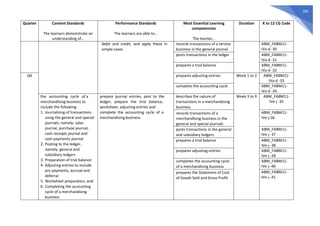
Q4 prepares adjusting entries Week 1 to 2 ABM_FABM11-
IVa-d -33
complete the accounting cycle ABM_FABM11-
IVa-d -34
the accounting cycle of a
merchandising business to
include the following:
1. Journalizing of transactions
using the general and special
journals, namely: sales
journal, purchase journal,
cash receipts journal and
cash payments journal
2. Posting to the ledger,
namely: general and
subsidiary ledgers
3. Preparation of trial balance
4. Adjusting entries to include
pre payments, accrual and
deferral
5. Worksheet preparation, and
6. Completing the accounting
cycle of a merchandising
business
prepare journal entries, post to the
ledger, prepare the trial balance,
worksheet, adjusting entries and
complete the accounting cycle of a
merchandising business.
describes the nature of
transactions in a merchandising
business
Week 3 to 9 ABM_FABM11-
IVe-j -35
records transactions of a
merchandising business in the
general and special journals
ABM_FABM11-
IVe-j-36
posts transactions in the general
and subsidiary ledgers
ABM_FABM11-
IVe-j -37
prepares a trial balance ABM_FABM11-
IVe-j -38
prepares adjusting entries ABM_FABM11-
IVe-j -39
completes the accounting cycle
of a merchandising business
ABM_FABM11-
IVe-j -40
prepares the Statement of Cost
of Goods Sold and Gross Profit
ABM_FABM11-
IVe-j -41
586
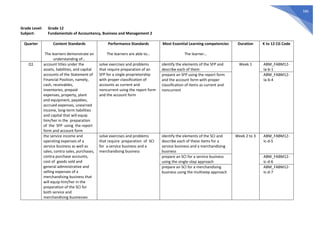
Grade Level: Grade 12
Subject: Fundamentals of Accountancy, Business and Management 2
Quarter Content Standards
The learners demonstrate an
understanding of…
Performance Standards
The learners are able to…
Most Essential Learning competencies
The learner…
Duration K to 12 CG Code
Q1 account titles under the
assets, liabilities, and capital
accounts of the Statement of
Financial Position, namely,
cash, receivables,
inventories, prepaid
expenses, property, plant
and equipment, payables,
accrued expenses, unearned
income, long-term liabilities
and capital that will equip
him/her in the preparation
of the SFP using the report
form and account form
solve exercises and problems
that require preparation of an
SFP for a single proprietorship
with proper classification of
accounts as current and
noncurrent using the report form
and the account form
identify the elements of the SFP and
describe each of them
Week 1 ABM_FABM12-
Ia-b-1
prepare an SFP using the report form
and the account form with proper
classification of items as current and
noncurrent
ABM_FABM12-
Ia-b-4
the service income and
operating expenses of a
service business as well as
sales, contra sales, purchases,
contra purchase accounts,
cost of goods sold and
general administrative and
selling expenses of a
merchandising business that
will equip him/her in the
preparation of the SCI for
both service and
merchandising businesses
solve exercises and problems
that require preparation of SCI
for a service business and a
merchandising business
identify the elements of the SCI and
describe each of these items for a
service business and a merchandising
business
Week 2 to 3 ABM_FABM12-
Ic-d-5
prepare an SCI for a service business
using the single-step approach
ABM_FABM12-
Ic-d-6
prepare an SCI for a merchandising
business using the multistep approach
ABM_FABM12-
Ic-d-7
587
Quarter Content Standards
The learners demonstrate an
understanding of…
Performance Standards
The learners are able to…
Most Essential Learning competencies
The learner…
Duration K to 12 CG Code
the forms of business
organization,
namely, single proprietorship,
partnership, and corporation,
and the structure of a SCE of a
single proprietorship that will
equip him/her in the
preparation of the said
financial report
solve exercises and problems
that require preparation of an
SCE for a single proprietorship
prepare an SCE for a single
proprietorship
Week 4 BM_FABM12-Ie-9
the components and the
structure of a CFS that will
equip him/her in the
preparation of the said
financial report
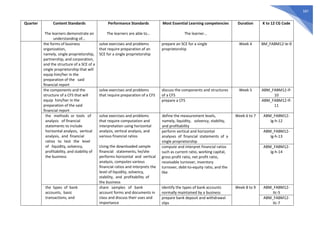
solve exercises and problems
that require preparation of a CFS
discuss the components and structures
of a CFS
Week 5 ABM_FABM12-If-
10
prepare a CFS ABM_FABM12-If-
11
the methods or tools of
analysis of financial
statements to include
horizontal analysis, vertical
analysis, and financial
ratios to test the level
of liquidity, solvency,
profitability, and stability of
the business
solve exercises and problems
that require computation and
interpretation using horizontal
analysis, vertical analysis, and
various financial ratios
Using the downloaded sample
financial statements, he/she
performs horizontal and vertical
analysis, computes various
financial ratios and interprets the
level of liquidity, solvency,
stability, and profitability of
the business
define the measurement levels,
namely, liquidity, solvency, stability,
and profitability
Week 6 to 7 ABM_FABM12-
Ig-h-12
perform vertical and horizontal
analyses of financial statements of a
single proprietorship
ABM_FABM12-
Ig-h-13
compute and interpret financial ratios
such as current ratio, working capital,
gross profit ratio, net profit ratio,
receivable turnover, inventory
turnover, debt-to-equity ratio, and the
like
ABM_FABM12-
Ig-h-14
the types of bank
accounts, basic
transactions, and
share samples of bank
account forms and documents in
class and discuss their uses and
importance
identify the types of bank accounts
normally maintained by a business
Week 8 to 9 ABM_FABM12-
IIc-5
prepare bank deposit and withdrawal
slips
ABM_FABM12-
IIc-7
588
Quarter Content Standards
The learners demonstrate an
understanding of…
Performance Standards
The learners are able to…
Most Essential Learning competencies
The learner…
Duration K to 12 CG Code
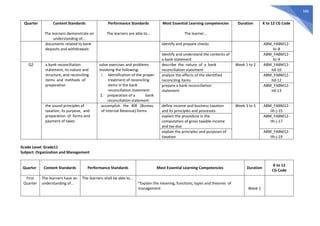
documents related to bank
deposits and withdrawals
identify and prepare checks ABM_FABM12-
IIc-8
identify and understand the contents of
a bank statement
ABM_FABM12-
IIc-9
Q2 a bank reconciliation
statement, its nature and
structure, and reconciling
items and methods of
preparation
solve exercises and problems
involving the following:
1. Identification of the proper
treatment of reconciling
items in the bank
reconciliation statement
2. preparation of a bank
reconciliation statement
describe the nature of a bank
reconciliation statement
Week 1 to 2 ABM_FABM12-
IId-10
analyze the effects of the identified
reconciling items
ABM_FABM12-
IId-12
prepare a bank reconciliation
statement
ABM_FABM12-
IId-13
the sound principles of
taxation, its purpose, and
preparation of forms and
payment of taxes
accomplish the BIR (Bureau
of Internal Revenue) forms
define income and business taxation
and its principles and processes
Week 3 to 5 ABM_FABM12-
IIh-j-15
explain the procedure in the
computation of gross taxable income
and tax due
ABM_FABM12-
IIh-j-17
explain the principles and purposes of
taxation
ABM_FABM12-
IIh-j-19
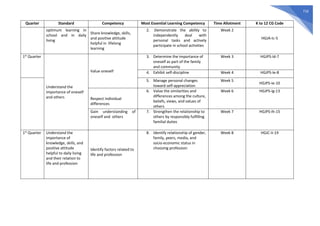
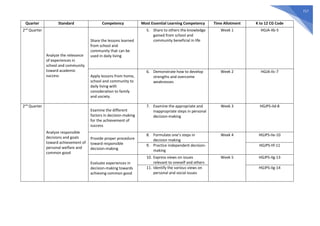
Grade Level: Grade11
Subject: Organization and Management
Quarter Content Standards Performance Standards Most Essential Learning Competencies Duration
K to 12
CG Code
First
Quarter
The learners have an
understanding of…
The learners shall be able to…
*Explain the meaning, functions, types and theories of
management Week 1
589
Quarter Content Standards Performance Standards Most Essential Learning Competencies Duration
K to 12
CG Code
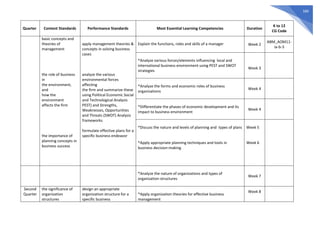
basic concepts and
theories of
management
the role of business
in
the environment,
and
how the
environment
affects the firm
the importance of
planning concepts in
business success
apply management theories &
concepts in solving business
cases
analyze the various
environmental forces
affecting
the firm and summarize these
using Political Economic Social
and Technological Analysis
PEST) and Strengths,
Weaknesses, Opportunities
and Threats (SWOT) Analysis
frameworks
formulate effective plans for a
specific business endeavor
Explain the functions, roles and skills of a manager Week 2
ABM_AOM11-
Ia-b-3
*Analyze various forces/elements influencing local and
international business environment using PEST and SWOT
strategies
Week 3
*Analyze the forms and economic roles of business
organizations
Week 4
*Differentiate the phases of economic development and its
impact to business environment
Week 4
*Discuss the nature and levels of planning and types of plans
*Apply appropriate planning techniques and tools in
business decision-making
Week 5
Week 6
*Analyze the nature of organizations and types of
organization structures
Week 7
Second
Quarter
the significance of
organization
structures
design an appropriate
organization structure for a
specific business
*Apply organization theories for effective business
management
Week 8
590
Quarter Content Standards Performance Standards Most Essential Learning Competencies Duration
K to 12
CG Code
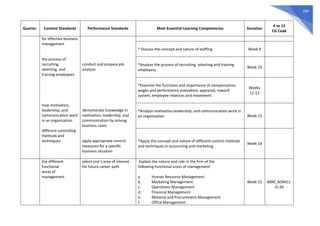
for effective business
management
the process of
recruiting,
selecting, and
training employees
how motivation,
leadership, and
communication work
in an organization
different controlling
methods and
techniques
conduct and prepare job
analysis
demonstrate knowledge in
motivation, leadership, and
communication by solving
business cases
apply appropriate control
measures for a specific
business situation
* Discuss the concept and nature of staffing Week 9
*Analyze the process of recruiting, selecting and training
employess
Week 10
*Examine the functions and importance of compensation,
wages and performance evaluation, appraisal, reward
system, employee relations and movement
Weeks
11-12
*Analyze motivation,leadership, and communication work in
an organization Week 13
*Apply the concept and nature of different control methods
and techniques in accounting and marketing
Week 14
the different
functional
areas of
management
select one’s area of interest
for future career path
Explain the nature and role in the firm of the
following functional areas of management:
a. Human Resource Management
b. Marketing Management
c. Operations Management
d. Financial Management
e. Material and Procurement Management
f. Office Management
Week 15 ABM_AOM11-
IIi-39
591
Quarter Content Standards Performance Standards Most Essential Learning Competencies Duration
K to 12
CG Code
g. Information & Communication Technology
Management
the basic concepts of
small-family business
initiate an appropriate small-
family business
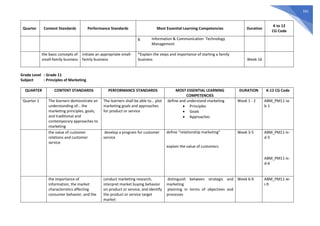
*Explain the steps and importance of starting a family
business Week 16
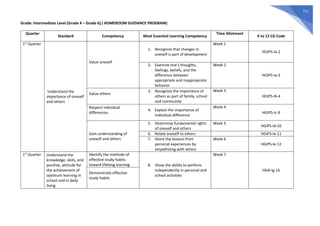
Grade Level : Grade 11
Subject : Principles of Marketing
QUARTER CONTENT STANDARDS PERFORMANCE STANDARDS MOST ESSENTIAL LEARNING
COMPETENCIES
DURATION K-12 CG Code
Quarter 1 The learners demonstrate an
understanding of… the
marketing principles, goals,
and traditional and
contemporary approaches to
marketing
The learners shall be able to… plot
marketing goals and approaches
for product or service
define and understand marketing
• Principles
• Goals
• Approaches
Week 1 - 2 ABM_PM11-Ia-
b-1
the value of customer
relations and customer
service
develop a program for customer
service
define “relationship marketing”
explain the value of customers
Week 3-5 ABM_PM11-Ic-
d-5
ABM_PM11-Ic-
d-6
the importance of
information, the market
characteristics affecting
consumer behavior, and the
conduct marketing research,
interpret market buying behavior
on product or service, and identify
the product or service target
market
distinguish between strategic and
marketing
planning in terms of objectives and
processes
Week 6-9 ABM_PM11-Ie-
i-9
592
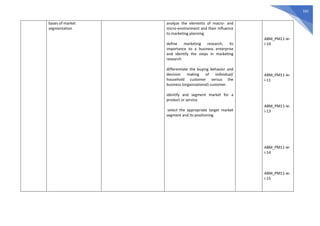
bases of market
segmentation
analyze the elements of macro- and
micro-environment and their influence
to marketing planning
define marketing research, its
importance to a business enterprise
and identify the steps in marketing
research
differentiate the buying behavior and
decision making of individual/
household customer versus the
business (organizational) customer
identify and segment market for a
product or service
select the appropriate target market
segment and its positioning
ABM_PM11-Ie-
i-10
ABM_PM11-Ie-
i-11
ABM_PM11-Ie-
i-13
ABM_PM11-Ie-
i-14
ABM_PM11-Ie-
i-15
593
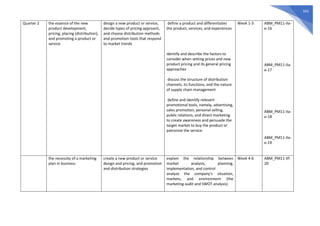
Quarter 2 the essence of the new
product development,
pricing, placing (distribution),
and promoting a product or
service
design a new product or service,
decide types of pricing approach,
and choose distribution methods
and promotion tools that respond
to market trends
define a product and differentiates
the product, services, and experiences
identify and describe the factors to
consider when setting prices and new
product pricing and its general pricing
approaches
discuss the structure of distribution
channels, its functions, and the nature
of supply chain management
define and identify relevant
promotional tools, namely, advertising,
sales promotion, personal selling,
public relations, and direct marketing
to create awareness and persuade the
target market to buy the product or
patronize the service
Week 1-3 ABM_PM11-IIa-
e-16
ABM_PM11-IIa-
e-17
ABM_PM11-IIa-
e-18
ABM_PM11-IIa-
e-19
the necessity of a marketing
plan in business
create a new product or service
design and pricing, and promotion
and distribution strategies
explain the relationship between
market analysis, planning,
implementation, and control
analyze the company’s situation,
markets, and environment (the
marketing audit and SWOT analysis)
Week 4-6 ABM_PM11-IIf-
20
594
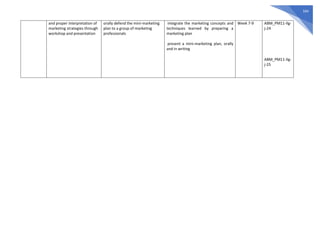
and proper interpretation of
marketing strategies through
workshop and presentation
orally defend the mini-marketing
plan to a group of marketing
professionals
integrate the marketing concepts and
techniques learned by preparing a
marketing plan
present a mini-marketing plan, orally
and in writing
Week 7-9 ABM_PM11-IIg-
j-24
ABM_PM11-IIg-
j-25
595
596
Grade Level : Grade 12
Subject : Community Engagement, Solidarity, and Citizenship (CSC)
QUARTER CONTENT
STANDARD
PERFORMANCE
STANDARD
LEARNING COMPETENCY DURATION
K to 12 CG Code
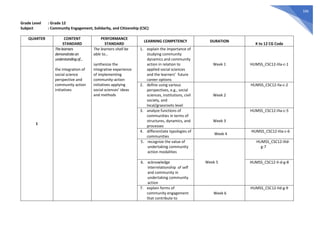
1
Thelearners
demonstratean
understandingof...
the integration of
social science
perspective and
community action
initiatives
The learners shall be
able to…
synthesize the
integrative experience
of implementing
community-action
initiatives applying
social sciences’ ideas
and methods
1. explain the importance of
studying community
dynamics and community
action in relation to
applied social sciences
and the learners’ future
career options
Week 1 HUMSS_CSC12-IIIa-c-1
2. define using various
perspectives, e.g., social
sciences, institutions, civil
society, and
local/grassroots level
Week 2
HUMSS_CSC12-IIa-c-2
3. analyze functions of
communities in terms of
structures, dynamics, and
processes
Week 3
HUMSS_CSC12-IIIa-c-5
4. differentiate typologies of
communities
Week 4
HUMSS_CSC12-IIIa-c-6
5. recognize the value of
undertaking community
action modalities
Week 5
HUMSS_CSC12-IIId-
g-7
6. acknowledge
interrelationship of self
and community in
undertaking community
action
HUMSS_CSC12-II-d-g-8
7. explain forms of
community engagement
that contribute to
Week 6
HUMSS_CSC12-IId-g-9
597
QUARTER CONTENT
STANDARD
PERFORMANCE
STANDARD
LEARNING COMPETENCY DURATION
K to 12 CG Code
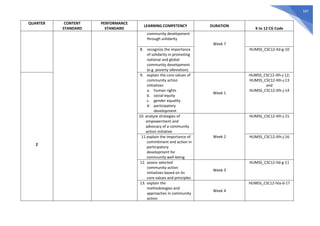
community development
through solidarity
Week 7
8. recognize the importance
of solidarity in promoting
national and global
community development
(e.g. poverty alleviation)
HUMSS_CSC12-IId-g-10
2
9. explain the core values of
community action
initiatives
a. human rights
b. social equity
c. gender equality
d. participatory
development
Week 1
HUMSS_CSC12-IIIh-j-12;
HUMSS_CSC12-IIIh-j-13
and
HUMSS_CSC12-IIIh-j-14
10. analyze strategies of
empowerment and
advocacy of a community
action initiative
Week 2
HUMSS_CSC12-IIIh-j-15
11.explain the importance of
commitment and action in
participatory
development for
community well-being
HUMSS_CSC12-IIIh-j-16
12. assess selected
community-action
initiatives based on its
core values and principles
Week 3
HUMSS_CSC12-IId-g-11
13. explain the
methodologies and
approaches in community
action
Week 4
HUMSS_CSC12-IVa-d-17
598
QUARTER CONTENT
STANDARD
PERFORMANCE
STANDARD
LEARNING COMPETENCY DURATION
K to 12 CG Code
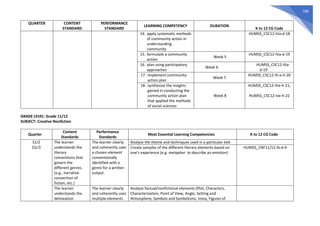
14. apply systematic methods
of community action in
understanding
community
HUMSS_CSC12-IVa-d-18
15. formulate a community
action
Week 5
HUMSS_CSC12-IVa-d-19
16. plan using participatory
approaches
Week 6
HUMSS_CSC12-IVa-
d-19
17. implement community-
action plan
Week 7
HUMSS_CSC12-IV-e-h-20
18. synthesize the insights
gained in conducting the
community action plan
that applied the methods
of social sciences
Week 8
HUMSS_CSC12-IVe-h-21;
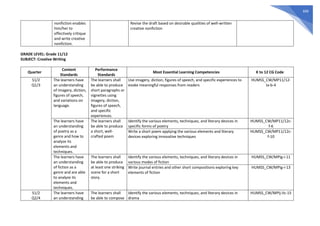
HUMSS_CSC12-Ive-h-22
GRADE LEVEL: Grade 11/12
SUBJECT: Creative Nonfiction
Quarter
Content
Standards
Performance
Standards
Most Essential Learning Competencies K to 12 CG Code
S1/2
Q1/3
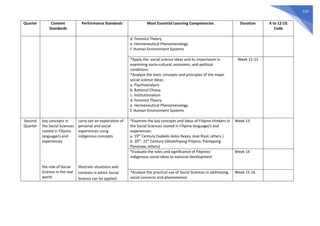
The learner
understands the
literary
conventions that
govern the
different genres.
(e.g., narrative
convention of
fiction, etc.)
The learner clearly
and coherently uses
a chosen element
conventionally
identified with a
genre for a written
output.
Analyze the theme and techniques used in a particular text
Create samples of the different literary elements based on
one’s experience (e.g. metaphor to describe an emotion)
HUMSS_CNF11/12-Ib-d-4
The learner
understands the
delineation
The learner clearly
and coherently uses
multiple elements
Analyze factual/nonfictional elements (Plot, Characters,
Characterization, Point of View, Angle, Setting and
Atmosphere, Symbols and Symbolisms, Irony, Figures of
599
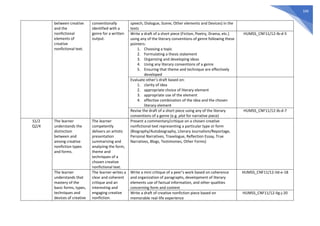
between creative
and the
nonfictional
elements of
creative
nonfictional text.
conventionally
identified with a
genre for a written
output.
speech, Dialogue, Scene, Other elements and Devices) in the
texts
Write a draft of a short piece (Fiction, Poetry, Drama, etc.)
using any of the literary conventions of genre following these
pointers:
1. Choosing a topic
2. Formulating a thesis statement
3. Organizing and developing ideas
4. Using any literary conventions of a genre
5. Ensuring that theme and technique are effectively
developed
HUMSS_CNF11/12-Ib-d-5
Evaluate other’s draft based on:
1. clarity of idea
2. appropriate choice of literary element
3. appropriate use of the element
4. effective combination of the idea and the chosen
literary element
Revise the draft of a short piece using any of the literary
conventions of a genre (e.g. plot for narrative piece)
HUMSS_CNF11/12-Ib-d-7
S1/2
Q2/4
The learner
understands the
distinction
between and
among creative
nonfiction types
and forms.
The learner
competently
delivers an artistic
presentation
summarizing and
analyzing the form,
theme and
techniques of a
chosen creative
nonfictional text.
Present a commentary/critique on a chosen creative
nonfictional text representing a particular type or form
(Biography/Autobiography, Literary Journalism/Reportage,
Personal Narratives, Travelogue, Reflection Essay, True
Narratives, Blogs, Testimonies, Other Forms)
The learner
understands that
mastery of the
basic forms, types,
techniques and
devices of creative
The learner writes a
clear and coherent
critique and an
interesting and
engaging creative
nonfiction.
Write a mini critique of a peer’s work based on coherence
and organization of paragraphs, development of literary
elements use of factual information, and other qualities
concerning form and content
HUMSS_CNF11/12-IId-e-18
Write a draft of creative nonfiction piece based on
memorable real-life experience
HUMSS_CNF11/12-IIg-j-20
600
nonfiction enables
him/her to
effectively critique
and write creative
nonfiction.
Revise the draft based on desirable qualities of well-written
creative nonfiction
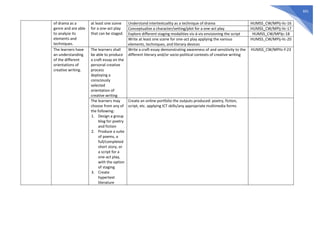
GRADE LEVEL: Grade 11/12
SUBJECT: Creative Writing
Quarter
Content
Standards
Performance
Standards
Most Essential Learning Competencies K to 12 CG Code
S1/2
Q1/3
The learners have
an understanding
of imagery, diction,
figures of speech,
and variations on
language.
The learners shall
be able to produce
short paragraphs or
vignettes using
imagery, diction,
figures of speech,
and specific
experiences.
Use imagery, diction, figures of speech, and specific experiences to
evoke meaningful responses from readers
HUMSS_CW/MP11/12-
Ia-b-4
The learners have
an understanding
of poetry as a
genre and how to
analyze its
elements and
techniques.
The learners shall
be able to produce
a short, well-
crafted poem
Identify the various elements, techniques, and literary devices in
specific forms of poetry
HUMSS_CW/MP11/12c-
f-6
Write a short poem applying the various elements and literary
devices exploring innovative techniques
HUMSS_CW/MP11/12c-
f-10
The learners have
an understanding
of fiction as a
genre and are able
to analyze its
elements and
techniques.
The learners shall
be able to produce
at least one striking
scene for a short
story.
Identify the various elements, techniques, and literary devices in
various modes of fiction
HUMSS_CW/MPIg-i-11
Write journal entries and other short compositions exploring key
elements of fiction
HUMSS_CW/MPIg-i-13
S1/2
Q2/4
The learners have
an understanding
The learners shall
be able to compose
Identify the various elements, techniques, and literary devices in
drama
HUMSS_CW/MPIj-IIc-15
601
of drama as a
genre and are able
to analyze its
elements and
techniques.
at least one scene
for a one-act play
that can be staged.
Understand intertextuality as a technique of drama HUMSS_CW/MPIj-IIc-16
Conceptualize a character/setting/plot for a one-act play HUMSS_CW/MPIj-IIc-17
Explore different staging modalities vis-à-vis envisioning the script HUMSS_CW/MPIjc-18
Write at least one scene for one-act play applying the various
elements, techniques, and literary devices
HUMSS_CW/MPIj-IIc-20
The learners have
an understanding
of the different
orientations of
creative writing.
The learners shall
be able to produce
a craft essay on the
personal creative
process
deploying a
consciously
selected
orientation of
creative writing
Write a craft essay demonstrating awareness of and sensitivity to the
different literary and/or socio-political contexts of creative writing
HUMSS_CW/MPIIc-f-23
The learners may
choose from any of
the following:
1. Design a group
blog for poetry
and fiction
2. Produce a suite
of poems, a
full/completed
short story, or
a script for a
one-act play,
with the option
of staging
3. Create
hypertext
literature
Create an online portfolio the outputs produced: poetry, fiction,
script, etc. applying ICT skills/any appropriate multimedia forms
602
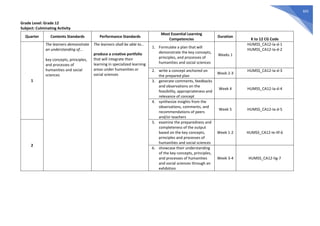
Grade Level: Grade 12
Subject: Culminating Activity
Quarter Contents Standards Performance Standards
Most Essential Learning
Competencies
Duration
K to 12 CG Code
1
The learners demonstrate
an understanding of…
key concepts, principles,
and processes of
humanities and social
sciences
The learners shall be able to…
produce a creative portfolio
that will integrate their
learning in specialized learning
areas under humanities or
social sciences
1. Formulate a plan that will
demonstrate the key concepts,
principles, and processes of
humanities and social sciences
Weeks 1
HUMSS_CA12-Ia-d-1
HUMSS_CA12-Ia-d-2
2. write a concept anchored on
the prepared plan
Week 2-3
HUMSS_CA12-Ia-d-3
3. generate comments, feedbacks
and observations on the
feasibility, appropriateness and
relevance of concept
Week 4 HUMSS_CA12-Ia-d-4
4. synthesize insights from the
observations, comments, and
recommendations of peers
and/or teachers
Week 5 HUMSS_CA12-Ia-d-5
2
5. examine the preparedness and
completeness of the output
based on the key concepts,
principles and processes of
humanities and social sciences
Week 1-2 HUMSS_CA12-Ie-IIf-6
6. showcase their understanding
of the key concepts, principles,
and processes of humanities
and social sciences through an
exhibition
Week 3-4 HUMSS_CA12-IIg-7
603
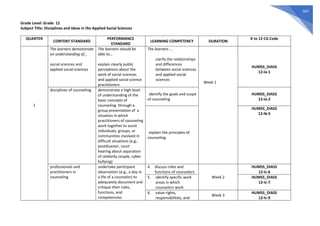
Grade Level: Grade 12
Subject Title: Disciplines and Ideas in the Applied Social Sciences
QUARTER
CONTENT STANDARD
PERFORMANCE
STANDARD
LEARNING COMPETENCY DURATION
K to 12 CG Code
1
The learners demonstrate
an understanding of…
social sciences and
applied social sciences
The learners should be
able to…
explain clearly public
perceptions about the
work of social sciences
and applied social science
practitioners
The learners ...
clarify the relationships
and differences
between social sciences
and applied social
sciences
Week 1
1
W
e
e
k
1
1
1
1
HUMSS_DIASS
12-Ia-1
disciplines of counseling demonstrate a high level
of understanding of the
basic concepts of
counseling through a
group presentation of a
situation in which
practitioners of counseling
work together to assist
individuals, groups, or
communities involved in
difficult situations (e.g.,
postdisaster, court
hearing about separation
of celebrity couple, cyber
bullying)
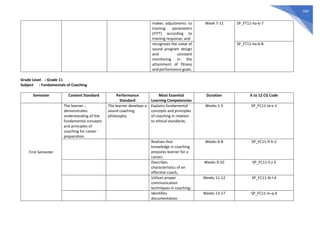
identify the goals and scope
of counseling
HUMSS_DIASS
12-Ia-2
explain the principles of
counseling
HUMSS_DIASS
12-Ib-5
professionals and
practitioners in
counseling
undertake participant
observation (e.g., a day in
a life of a counselor) to
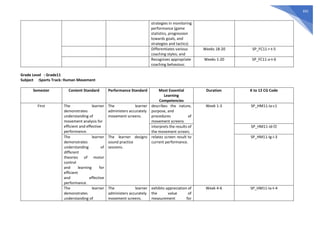
adequately document and
critique their roles,
functions, and
competencies
4. discuss roles and
functions of counselors
Week 2
HUMSS_DIASS
12-Ic-6
5. identify specific work
areas in which
counselors work
HUMSS_DIASS
12-Ic-7
6. value rights,
responsibilities, and
Week 3
HUMSS_DIASS
12-Ic-9
604
QUARTER
CONTENT STANDARD
PERFORMANCE
STANDARD
LEARNING COMPETENCY DURATION
K to 12 CG Code
accountabilities of
counselors
7. distinguish between
ethical and unethical
behaviors among
counselors
HUMSS_DIASS
12-Ic-10
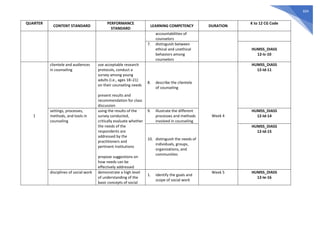
1
clientele and audiences
in counseling
use acceptable research
protocols, conduct a
survey among young
adults (i.e., ages 18–21)
on their counseling needs
present results and
recommendation for class
discussion
8. describe the clientele
of counseling
Week 4
HUMSS_DIASS
12-Id-11
settings, processes,
methods, and tools in
counseling
using the results of the
survey conducted,
critically evaluate whether
the needs of the
respondents are
addressed by the
practitioners and
pertinent institutions
propose suggestions on
how needs can be
effectively addressed
9. illustrate the different
processes and methods
involved in counseling
HUMSS_DIASS
12-Id-14
10. distinguish the needs of
individuals, groups,
organizations, and
communities
HUMSS_DIASS
12-Id-15
disciplines of social work demonstrate a high level
of understanding of the
basic concepts of social
1. identify the goals and
scope of social work
Week 5 HUMSS_DIASS
12-Ie-16
605
QUARTER
CONTENT STANDARD
PERFORMANCE
STANDARD
LEARNING COMPETENCY DURATION
K to 12 CG Code
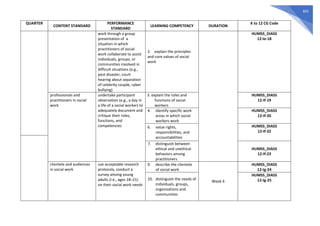
work through a group
presentation of a
situation in which
practitioners of social
work collaborate to assist
individuals, groups, or
communities involved in
difficult situations (e.g.,
post disaster, court
hearing about separation
of celebrity couple, cyber
bullying)
2. explain the principles
and core values of social
work
HUMSS_DIASS
12-Ie-18
professionals and
practitioners in social
work
undertake participant
observation (e.g., a day in
a life of a social worker) to
adequately document and
critique their roles,
functions, and
competencies
3. explain the roles and
functions of social
workers
HUMSS_DIASS
12-If-19
4. identify specific work
areas in which social
workers work
HUMSS_DIASS
12-If-20
6. value rights,
responsibilities, and
accountabilities
HUMSS_DIASS
12-If-22
7. distinguish between
ethical and unethical
behaviors among
practitioners
HUMSS_DIASS
12-If-23
clientele and audiences
in social work
use acceptable research
protocols, conduct a
survey among young
adults (i.e., ages 18–21)
on their social work needs
9. describe the clientele
of social work
Week 6
HUMSS_DIASS
12-Ig-24
10. distinguish the needs of
individuals, groups,
organizations and
communities
HUMSS_DIASS
12-Ig-25
606
QUARTER
CONTENT STANDARD
PERFORMANCE
STANDARD
LEARNING COMPETENCY DURATION
K to 12 CG Code
1
1
present results and
recommendation for class
discussion
settings, processes,
methods, and tools in
social work
using the results of the
survey conducted,
critically evaluate whether
the needs of the
respondents are
addressed by the
practitioners and
pertinent institutions
propose suggestions on
how needs can be
effectively addressed
11. illustrate the different
processes and methods
involved in undertaking
social work
HUMSS_DIASS
12-Ig-27
disciplines of
communication
demonstrate a high level
of understanding of the
basic concepts of
communication through a
group presentation of a
situation in which
practitioners of
communication work
together to assist
individuals, groups, or
communities involved in
difficult situations (e.g.,
post disaster, court
hearing about separation
of celebrity couple, cyber
bullying)
1. identify the goals and
scope of
communication
Week 7
HUMSS_DIASS
12-Ih-28
2. explain the principles of
communication
HUMSS_DIASS
12-Ih-29
4. describe the elements
and levels of the
communication
processes
HUMSS_DIASS
12-Ih-31
607
QUARTER
CONTENT STANDARD
PERFORMANCE
STANDARD
LEARNING COMPETENCY DURATION
K to 12 CG Code
professionals and
practitioners in
communication
undertake participant
observation (e.g., a day in
a life of a communicator/
journalist) to adequately
document and critique
their roles, functions, and
competencies
5. explain the roles and
functions of
communicators and
journalists
Week 8 HUMSS_DIASS
12-Ij-32
6. identify specific work
areas in which
communicators and
journalists work
HUMSS_DIASS
12-Ij-33
7. explain the rights,
responsibilities, and
accountabilities
HUMSS_DIASS
12-Ij-35
8. distinguish between
ethical and unethical
behaviors among
practitioners
HUMSS_DIASS
12-Ij-36
clientele and audiences
in communication
use acceptable research
protocols, conduct a
survey among young
adults (i.e., ages 18–21)
on their social work needs
present results and
recommendation for class
discussion
10. describe the clientele
and audience of
communication
Week 9
HUMSS_DIASS
12-IIa-37
11. distinguish the needs of
individuals, groups,
organizations, and
communities
HUMSS_DIASS
12-IIa-38
2
settings, processes,
methods and tools in
communication
using results of survey
conducted, critically
evaluate whether the
needs of the respondents
are addressed by the
practitioners and
pertinent institutions
12. illustrate the different
processes and methods
involved in undertaking
communication
Week 1
HUMSS_DIASS
12-IIa-40
13. distinguish the
appropriate
communication media
channel(s) to use in
HUMSS_DIASS
12-IIa-41
608
QUARTER
CONTENT STANDARD
PERFORMANCE
STANDARD
LEARNING COMPETENCY DURATION
K to 12 CG Code
propose suggestions on
how needs can be
effectively addressed
different settings and
situations
functions of applied
social sciences
assess objectively through
an individual project how
the functions of the
applied social sciences
have been fulfilled in any
of the following:
1. case study of a
counselee
2. case study on
integrative social
work
3. comparison of the
programming of any
two television
networks
1. explain each of the
functions of applied
social sciences
Week 2
HUMSS_DIASS
12-IIb-d-42
2. identify situations that
would require or
necessitate the
performance of the
various functions in
local /Philippine
settings
HUMSS_DIASS
12-IIb-d-43
effects of applied social
sciences processes
participate in a one-day
exposure trip to an
existing development
program and write a
sincere reflection report
on the effects of the
processes on the clientele
3. analyze the effects of
applied social sciences
processes on
individuals, groups, and
society
Week 3
HUMSS_DIASS
12-IIe-f-44
4. evaluate the effects of
certain program or
projects on knowledge,
attitude, and behavior
of individuals, groups,
and society
HUMSS_DIASS
12-IIe-i-45
submit a portfolio of
output from the course
5. synthesize the learning
from the course and its
HUMSS_DIASS
12-IIj-46
609
QUARTER
CONTENT STANDARD
PERFORMANCE
STANDARD
LEARNING COMPETENCY DURATION
K to 12 CG Code
applications to the
learner
Grade Level: Grade 11
Subject: Disciplines and Ideas in the Social Sciences (DISS)
Quarter Content
Standards
Performance Standards Most Essential Learning Competencies Duration K to 12 CG
Code
First
Quarter
The learners
demonstrate
an understanding
of…
the emergence of
the
Social Sciences
and the
different
disciplines
key concepts and
approaches in the
Social
Sciences
The learners shall be able
to…
connect the disciplines
with their historical and
social foundations
interpret personal and
social experiences using
relevant approaches in the
Social Sciences
evaluate the strengths and
weaknesses of the
approach
*Differentiate the nature and functions of Social Science
disciplines with the natural sciences and humanities
Week 1-2
*Explain the major events and its contribution that led to
the emergence of the social science disciplines
Week 3-4
*Analyze the basic concepts and principles of the major
social science theories:
a. Structural-functionalism
b. Marxism
c. Symbolic Interactionism
Week 5
*Apply the major social science theories and its
importance in examining socio-cultural, economic, and
political conditions.
a. Structural-functionalism
b. Marxism
c. Symbolic Interactionism
Week 6-7
*Analyze the basic concepts and principles of the major
social science ideas:
a. Psychoanalysis
b. Rational Choice
c. Institutionalism
Week 8-10
610
Quarter Content
Standards
Performance Standards Most Essential Learning Competencies Duration K to 12 CG
Code
d. Feminist Theory
e. Hermeneutical Phenomenology
f. Human-Environment Systems
*Apply the social science ideas and its importance in
examining socio-cultural, economic, and political
conditions.
*Analyze the basic concepts and principles of the major
social science ideas:
a. Psychoanalysis
b. Rational Choice
c. Institutionalism
d. Feminist Theory
e. Hermeneutical Phenomenology
f. Human-Environment Systems
Week 11-12
Second
Quarter
key concepts in
the Social Sciences
rooted in Filipino
language/s and
experiences
the role of Social
Science in the real
world
carry out an exploration of
personal and social
experiences using
indigenous concepts
illustrate situations and
contexts in which Social
Science can be applied
*Examine the key concepts and ideas of Filipino thinkers in
the Social Sciences rooted in Filipino language/s and
experiences:
a. 19th
Century (Isabelo delos Reyes, Jose Rizal, others )
b. 20th
- 21st
Century (Sikolohiyang Pilipino, Pantayong
Pananaw, others)
Week 13
*Evaluate the roles and significance of Filipinos’
indigenous social ideas to national development
Week 14
*Analyze the practical use of Social Sciences in addressing
social concerns and phenomenon
Week 15-16
611
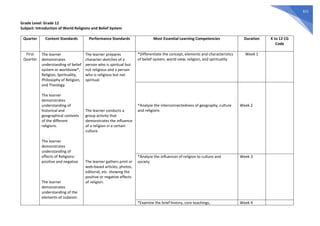
Grade Level: Grade 12
Subject: Introduction of World Religions and Belief System
Quarter Content Standards Performance Standards Most Essential Learning Competencies Duration K to 12 CG
Code
First
Quarter
The learner
demonstrates
understanding of belief
system or worldview*,
Religion, Spirituality,
Philosophy of Religion,
and Theology.
The learner
demonstrates
understanding of
historical and
geographical contexts
of the different
religions.
The learner
demonstrates
understanding of
effects of Religions:
positive and negative.
The learner
demonstrates
understanding of the
elements of Judaism:
The learner prepares
character sketches of a
person who is spiritual but
not religious and a person
who is religious but not
spiritual.
The learner conducts a
group activity that
demonstrates the influence
of a religion in a certain
culture.
The learner gathers print or
web-based articles, photos,
editorial, etc. showing the
positive or negative effects
of religion.
*Differentiate the concept, elements and characteristics
of belief system, world view, religion, and spirituality
Week 1
*Analyze the interconnectedness of geography, culture
and religions
Week 2
*Analyze the influences of religion to culture and
society
Week 3
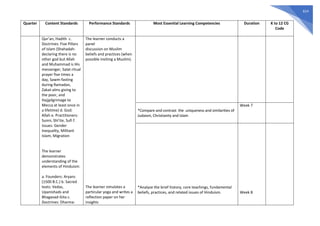
*Examine the brief history, core teachings, Week 4
612
Quarter Content Standards Performance Standards Most Essential Learning Competencies Duration K to 12 CG
Code
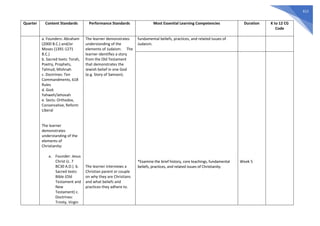
a. Founders: Abraham
(2000 B.C.) and/or
Moses (1391-1271
B.C.)
b. Sacred texts: Torah,
Poetry, Prophets,
Talmud, Mishnah
c. Doctrines: Ten
Commandments, 618
Rules
d. God:
Yahweh/Jehovah
e. Sects: Orthodox,
Conservative, Reform
Liberal
The learner
demonstrates
understanding of the
elements of
Christianity:
a. Founder: Jesus
Christ (c. 7
BC30 A.D.) b.
Sacred texts:
Bible (Old
Testament and
New
Testament) c.
Doctrines:
Trinity, Virgin
The learner demonstrates
understanding of the
elements of Judaism: The
learner identifies a story
from the Old Testament
that demonstrates the
Jewish belief in one God
(e.g. Story of Samson).
The learner interviews a
Christian parent or couple
on why they are Christians
and what beliefs and
practices they adhere to.
fundamental beliefs, practices, and related issues of
Judaism.
*Examine the brief history, core teachings, fundamental
beliefs, practices, and related issues of Christianity.
Week 5
613
Quarter Content Standards Performance Standards Most Essential Learning Competencies Duration K to 12 CG
Code
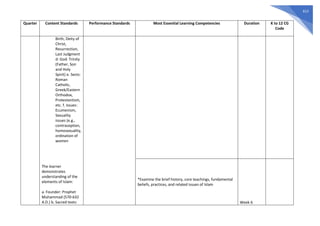
Birth, Deity of
Christ,
Resurrection,
Last Judgment
d: God: Trinity
(Father, Son
and Holy
Spirit) e. Sects:
Roman
Catholic,
Greek/Eastern
Orthodox,
Protestantism,
etc. f. Issues:
Ecumenism,
Sexuality
issues (e.g.,
contraception,
homosexuality,
ordination of
women
The learner
demonstrates
understanding of the
elements of Islam:
a. Founder: Prophet
Muhammad (570-632
A.D.) b. Sacred texts:
*Examine the brief history, core teachings, fundamental
beliefs, practices, and related issues of Islam
Week 6
614
Quarter Content Standards Performance Standards Most Essential Learning Competencies Duration K to 12 CG
Code
Qur’an, Hadith c.
Doctrines: Five Pillars
of Islam (Shahadah-
declaring there is no
other god but Allah
and Muhammad is His
messenger, Salat-ritual
prayer five times a
day, Sawm-fasting
during Ramadan,
Zakat-alms giving to
the poor, and
Hajjpilgrimage to
Mecca at least once in
a lifetime) d. God:
Allah e. Practitioners:
Sunni, Shi’ite, Sufi f.
Issues: Gender
Inequality, Militant
Islam, Migration
The learner
demonstrates
understanding of the
elements of Hinduism:
a. Founders: Aryans
(1500 B.C.) b. Sacred
texts: Vedas,
Upanishads and
Bhagavad-Gita c.
Doctrines: Dharma-
The learner conducts a
panel
discussion on Muslim
beliefs and practices (when
possible inviting a Muslim).
The learner simulates a
particular yoga and writes a
reflection paper on her
insights
*Compare and contrast the uniqueness and similarities of
Judaism, Christianity and Islam
Week 7
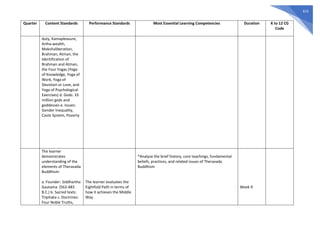
*Analyze the brief history, core teachings, fundamental
beliefs, practices, and related issues of Hinduism. Week 8
615
Quarter Content Standards Performance Standards Most Essential Learning Competencies Duration K to 12 CG
Code
duty, Kamapleasure,
Artha-wealth,
Mokshaliberation,
Brahman, Atman, the
Identification of
Brahman and Atman,
the Four Yogas (Yoga
of Knowledge, Yoga of
Work, Yoga of
Devotion or Love, and
Yoga of Psychological
Exercises) d. Gods: 33
million gods and
goddesses e. Issues:
Gender Inequality,
Caste System, Poverty
The learner
demonstrates
understanding of the
elements of Theravada
Buddhism:
a. Founder: Siddhartha
Gautama (563-483
B.C.) b. Sacred texts:
Tripitaka c. Doctrines:
Four Noble Truths,
The learner evaluates the
Eightfold Path in terms of
how it achieves the Middle
Way
*Analyze the brief history, core teachings, fundamental
beliefs, practices, and related issues of Theravada
Buddhism
Week 9
616
Quarter Content Standards Performance Standards Most Essential Learning Competencies Duration K to 12 CG
Code
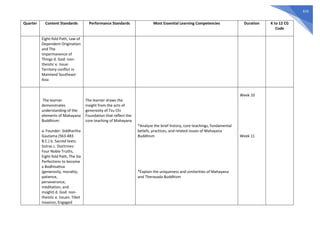
Eight-fold Path, Law of
Dependent Origination
and The
Impermanence of
Things d. God: non-
theistic e. Issue:
Territory conflict in
Mainland Southeast
Asia
The learner
demonstrates
understanding of the
elements of Mahayana
Buddhism:
a. Founder: Siddhartha
Gautama (563-483
B.C.) b. Sacred texts:
Sutras c. Doctrines:
Four Noble Truths,
Eight-fold Path, The Six
Perfections to become
a Bodhisattva
(generosity, morality,
patience,
perseverance,
meditation, and
insight) d. God: non-
theistic e. Issues: Tibet
invasion, Engaged
The learner draws the
insight from the acts of
generosity of Tzu Chi
Foundation that reflect the
core teaching of Mahayana
*Analyze the brief history, core teachings, fundamental
beliefs, practices, and related issues of Mahayana
Buddhism
*Explain the uniqueness and similarities of Mahayana
and Theravada Buddhism
Week 10
Week 11
617
Quarter Content Standards Performance Standards Most Essential Learning Competencies Duration K to 12 CG
Code
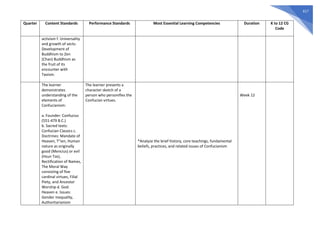
activism f. Universality
and growth of sects:
Development of
Buddhism to Zen
(Chan) Buddhism as
the fruit of its
encounter with
Taoism.
The learner
demonstrates
understanding of the
elements of
Confucianism:
a. Founder: Confucius
(551-479 B.C.)
b. Sacred texts:
Confucian Classics c.
Doctrines: Mandate of
Heaven, T”ien, Human
nature as originally
good (Mencius) or evil
(Hsun Tze),
Rectification of Names,
The Moral Way
consisting of five
cardinal virtues, Filial
Piety, and Ancestor
Worship d. God:
Heaven e. Issues:
Gender inequality,
Authoritarianism
The learner presents a
character sketch of a
person who personifies the
Confucian virtues.
*Analyze the brief history, core teachings, fundamental
beliefs, practices, and related issues of Confucianism
Week 12
618
Quarter Content Standards Performance Standards Most Essential Learning Competencies Duration K to 12 CG
Code
The learner
demonstrates
understanding of the
elements of Taoism: a.
Founder: Lao Tzu (604
B.C. - ?) b. Sacred
texts: Tao Te Ching,
Book of Chuang Tze c.
Doctrines: Wu-Wei,
Law of Reversion,
Following nature d.
Tao as the Origin of all
Beings, unnameable
and eternal e. Issues:
Inaction, Superstitious
practices,
Environmentalism
The learner identifies the
things she can do without
by making an inventory of
personal belongings (e.g.
things in the bedroom) and
writes a reflection on
Taoism based on the result
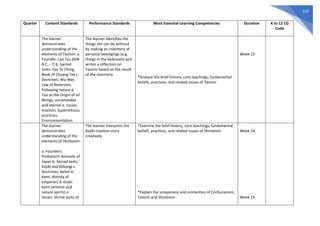
of the inventory.
*Analyze the brief history, core teachings, fundamental
beliefs, practices, and related issues of Taoism
Week 13
The learner
demonstrates
understanding of the
elements of Shintoism:
a. Founders:
Prehistoric Animists of
Japan b. Sacred texts:
Kojiki and Nihongi c.
Doctrines: belief in
kami, divinity of
emperors d. Gods:
kami (animist and
nature spirits) e.
Issues: Shrine visits of
The learner interprets the
Kojiki creation story
creatively.
*Examine the brief history, core teachings, fundamental
beliefs, practices, and related issues of Shintoism
*Explain the uniqueness and similarities of Confucianism,
Taoism and Shintoism
Week 14
Week 15
619
Quarter Content Standards Performance Standards Most Essential Learning Competencies Duration K to 12 CG
Code
Japanese prime
minister
Grade Level: Grade 11/12
Subject: Malikhaing Pagsulat
Quarter Content
Standards
(Pamantayang
Pangnilalaman)
Performance
Standards
(Pamantayan sa
Pagganap)
Most Essential Learning Competencies Duration
K to 12 CG Code
1st Quarter Nauunawaan ng
mag aaral ang
pagbuo ng imahe,
diksyon, mga
tayutay at pag-iiba-
iba (variations) ng
wika
Ang mag - aaral ay
makakasulat ng
maiikling talata o
mga vignette na
gumagamit ng
diksyon,pagbuo ng
imahe, mga
tayutay at mga
espesipikong
karanasan
Natutukoy ang pagkakaiba ng makathaing
pagsulat sa iba pang anyo ng pagsulat
Week 1-
2
HUMSS_CW/MP11/12-
Iab-1
Naiuugnay ang mga ideya mula sa mga
karanasan*
Week 1-
2
HUMSS_CW/MP11/12-
Iab-2
Nagagamit ang wika upang mag-udyok ng
mga emosyunal at intelektwal na tugon
mula sa mambabasa
Week 1-
2
HUMSS_CW/MP11/12-
Iab-3
Nagagamit ang pagbuo ng imahe, diksyon,
mga tayutay, at mga tiyak na karanasan
Week 1-2 HUMSS_CW/MP11/12-Iab-
4
Nauunawaan ng
mag aaral ang tula
bilang isang anyo at
nasusuri ang mga
elemento/sangkap
at teknik nito
Ang mag - aaral ay
makasusulat ng
maikli at masining
na tula
Natutukoy ang iba’t ibang elemento, mga
teknik, at kagamitang pampanitikan sa
panulaan*
Week 3-
6
HUMSS_CW/MP11/12c-f6
Natutukoy ang mga tiyak na anyo at
kumbensyon sa panulaan*
Week 3-
6
HUMSS_CW/MP11/12c-f6
Nakagagamit ng piling mga elemento sa
panulaan sa maikling pagsasanay sa
pagsulat
Week 3-
6
HUMSS_CW/MP11/12c-f8
Nakatutuklas ng mga makabagong teknik sa Week 3- HUMSS_CW/MP11/12c-f9
620
pagsulat ng tula 6
Nakasusulat ng tula gamit ng iba’t ibang
elemento, teknik, at literary devices
Week 3-
6
HUMSS_CW/MP11/12c-
f10
Nauunawaan ng
mag aaral ang
maikling kuwento
bilang isang anyo at
nasusuri ang mga
elemento/sangkap
at teknik nito
Ang mag - aaral ay
makasusulat ng
isang tampok na
eksena/tagpo para
sa isang maikling
kuwento
Natutukoy ang iba’t ibang elemento, teknik,
at literary devices maikling kuwento
(piksyon)
Week 7-
8
HUMSS_CW/MPIg-i-11
Natutukoy ang iba’t ibang istilo ng
pagkakabuo ng maikling kuwento (piksyon)
Week 7-
8
HUMSS_CW/MPIg-i-12
Nakasusulat ng dyornal at ilang maikling
pagsasanay na gumagamit ng mga
pangunahing elemento ng maikling kuwento
(piksyon)*
Week 7-
8
HUMSS_CW/MPIg-i-13
Nakasusulat ng isang maikling tagpo gamit
ang iba’t ibang elemento, teknik at literary
devices*
Week 7-
8
HUMSS_CW/MPIg-i-1
2nd
Quarter Nauunawaan ng
mag aaral ang dula
bilang isang anyo at
nasusuri ang mga
elemento/sangkap
nito
Ang mag - aaral ay
makabubuo ng
isang tagpo/eksena
para sa isang
iisahing-yugtong
dula na
maisasatanghalan
Natutukoy ang iba’t ibang elemento, teknik,
at literary devices ng isang dula
Week 1-
3
HUMSS_CW/MPIj-IIc-15
Nauunawaan ang intertekstwalidad bilang
isang teknik ng dula
Week 1-
3
HUMSS_CW/MPIj-IIc-16
Nakabubuo ng tauhan, tagpuan, banghay ng
iisahing- yugtong dula
Week 1-
3
HUMSS_CW/MPIj-IIc-17
Nagagamit ang iba’t ibang paraan ng
pagtatanghal batay sa inaasahang
kalalabasan ng binuong iskrip
Week 1-
3
HUMSS_CW/MPIjc-18
Nakasusulat ng maikling pagsasanay gamit
ang tauhan, diyalogo, banghay, at iba pang
elemento ng dula
Week 1-
3
HUMSS_CW/MPIj-IIc-19
Nakasusulat ng isang tagpo para sa iisahing-
yugtong dula gamit ang iba’t ibang
elemento, teknik, at literary devices
Week 1-
3
HUMSS_CW/MPIj-IIc-20
Nauunawaan ng
mag aaral ang iba’t
ibang oryentasyon
ng malikhaing
pagsulat
Ang mag - aaral ay
makabubuo ng
craft essay ukol sa
personal at
malikhaing proseso
Nasusuri ang malikhaing akda sa
kontekstong pampanitikan at
sosyopolitikal*
Week 4-
5
HUMSS_CW/MPIIc-f-21
Naipapamalas ang kamalayan at
sensitibidad sa iba’t ibang oryentasyon ng
Week 4-
5
HUMSS_CW/MPIIc-f-22
621
na malay na
gumagamit ng
piniling
oryentasyon sa
malikhaing
pagsulat
malikhaing pagsulat
Nakasusulat ng isang sanaysay Week 4-
5
HUMSS_CW/MPIIc-f-23
Nakabubuo ng blog na pangkatan para sa
tula at/o maikling kuwento (piksyon) gamit
ang kasanayang pang- ICT at iba pang
angkop na anyong multimedia.
Week 6-
8
HUMSS_CW/MPIIg-j-24
Natutukoy ang iba’t ibang paraan ng
publishing media para sa paglalathala ng
manuskripto
Week 6-
8
HUMSS_CW/MPIIg-j-25
Natutukoy ang mga posibilidad ng mga
intertekstwal na anyo
Week 6-
8
HUMSS_CW/MPIIg-j-26
Nakasusulat ng antololohiya/koleksyon ng
mga tula, isang maikling kuwento, o iskrip
para sa iisahing- yugtong dula
Week 6-
8
HUMSS_CW/MPIIg-j-27
Grade Level: Grade 12
Subject: Philippine Politics and Governance
Quarter Contents Standards Performance
Standards
Most Essential Learning
Competencies
Duration K to 12 CG
Code
First Quarter Demonstrate an understanding of
politics and political science,
governance, political ideologies,
power, states, nations, and
globalization
Clearly identify
a specific
political
phenomenon
and how it can
be studied
*Explain the concept, relationship and
importance of politics, governance
and government
Week 1
Differentiate the political ideologies Week 2-3 HUMSS_PG12-
Ib-c-7
*Analyze the nature,
dimensions/types, and consequences
of power
Week 4
622
*Analyze the relationship among
nations and states in the context of
globalization
Week 5-6
Demonstrate an understanding of the
historical background of Philippine
democratic politics, the executive, the
legislative, the judiciary, and
decentralization and local governance
Explain the roles
of different
political
institutions
*Analyze the evolution of Philippine
politics and governance
Week 7-8
*Analyze the roles and powers of the
executive branch of the government
Week 9
*Differentiate the roles and
responsibilities of the Philippine
Senate and the House of
Representatives
Week 10
Second Quarter *Analyze the roles and responsibilities
of the Philippine Judiciary
Week 11
Explain the roles and functions of
Local Government Unit (LGU)
Week 12 HUMSS_PG12-
IIa-b-2
Demonstrate an understanding of
elections and political and civil society
and social movements
Analyze the
interactions
between state
and society
Analyze the nature of elections and
political parties in the Philippines
Week 13 HUMSS_PG12-
IIc-d-9
*Explain the concept, role, and
contributions of civil society societies
and social movements to Philippine
democracy
Week 14
Demonstrate an understanding of
citizenship
Propose a
project on
political
engagement
and youth
empowerment
*Explain the importance of active
citizenship
Week 15
*Explain issues and programs related
to political engagement and youth
empowerment
Week 16
623
Grade Level : Grade 12
Subject : Trends, Networks, and Critical Thinking in the 21st
Century
Quarter Contents
Standards
Performance Standards Most Essential Learning Competencies Duration K to 12 CG Code
QUARTER
1
The learner
understands
the
emergence of
trends and
patterns.
The learner will be able to derive an
idea from instances and present
this idea through a 100-word essay,
artwork, and other graphic
representations.
1. Differentiate a trend from a fad Weeks 1-2 HUMSS_MCT12-Ia-b-3
2. Explain the process on how to spot a
trend
HUMSS_MCT12-Ia-b-2
3. Point out the elements that make up a
trend
HUMSS_MCT12-Ia-b-4
4. Describe the different characteristics of a
trend
HUMSS_MCT12-Ia-b-5
5. Identify parts of a whole. HUMSS_MCT12-Ia-b-6
6. Identify and explain an emerging pattern HUMSS_MCT12-Ia-b-7
7. Identify causes and consequences HUMSS_MCT12-Ia-b-8
The learner
understands
strategic
analysis and
intuitive
thinking.
The learner draws a color-coded
map of the networks of power
relations (political, economic,
cultural, and kinship ties) within a
particular community.
1. Explain strategic analysis and intuitive
thinking
• Define strategic analysis and
intuitive thinking
• Differentiate key components in
strategic analysis and intuitive
thinking
Week 3
HUMSS_MCT12-Ic-e-2
• HUMSS_MCT12-
Ic-e-1
• HUMSS_MCT12-
Ic-e-5
2. Apply strategic analysis HUMSS_MCT12-Ic-e-3
3. Apply intuitive thinking in solving a
problem in the community using a map of
social networks
HUMSS_MCT12-Ic-e-4;
HUMSS_MCT12-Ic-e-6
The learner
understands
the
components,
operations,
effects, and
networks of
The learner locates on a map the
different geographical origins of the
various components/elements of
an
industrial/technological/agricultural
product and writes a reflection
1. Explain the concrete effects of
globalization and to one’s daily life Week 4
HUMSS_MCT12-If-g-2
2. Explain the need for collaboration and
cooperation to achieve interconnectedness
of people and nations
HUMSS_MCT12-If-g-4
3. Discuss the different contributions of the
parts to a whole and the important role of Week 5
HUMSS_MCT12-If-g-5
624
globalization
in his/her
daily life.
essay on the insights gathered from
the exercise.
The learner locates on a map the
workplaces of the OFWs in their
community and writes a reflection
paper on the effects of labor
migration to their community.
creative imagination in putting together
the various parts of a whole
4. Illustrate the origin of the different
components of a gadget, business
enterprise,
industrial/technological/agricultural
product, etc. through a mind map and
reflection essay
HUMSS_MCT12-If-g-7
The learner
understands
the
consequences
of personal
and local
action to
global and
planetary
climate
change.
The learner
1) analyzes how production and
consumption habits contribute to
the problem of climate change and
explain why.
2) writes a resolution that you can
share with your friends about how
you can personally contribute
towards solving the problem of
climate change.
1. Explain the effects of consumption and
production patterns on climate change
Week 6
HUMSS_MCT12-Ih-i-2
2. Discuss personal contributions that can
actually solve the problem of climate
change
HUMSS_MCT12-Ih-i-3
3. Make a stand on how the consequences
of one’s action affect the lives of others
and the environment
HUMSS_MCT12-Ih-i-4
Culminating Activity or Exam – 1 week
Discuss demonstrate and examine the relationship between network and trends and how it affects
you
QUARTER
2
The learner
understands
the meaning
and
dimensions of
democracy.
using any form of oral presentation,
the learner explains creatively the
ill effects of undemocratic practices
related to factors such as gender
biases, poverty, political
marginalization, racial inequality,
cultural domination, crisis of
representation and politics of
recognition.
1. Identify democratic practices
Week 1
HUMSS_MCT12-IIa-c-1
2. Explain the importance of participation in
democracy
HUMSS_MCT12-IIa-c-4
3. Differentiate participatory from
representative democracy
HUMSS_MCT12-IIa-c-5
4. Assess democratic interventions
prevailing in political and social
institutions Week 2
HUMSS_MCT12-IIa-c-6
5. Formulate a viable alternative to
undemocratic practices
HUMSS_MCT12-IIa-c-7
625
The learner
understands
how ICT
enslaves,
emancipates,
and
empowers
individuals.
The learner organizes and mobilizes
an event that deals with a
significant global issue, using ICT.
1. Identify the dimensions of technology
that are enabling and inhibiting Week 3
HUMSS_MCT12-IId-f-1
2. Discuss the benefits of technology HUMSS_MCT12-IId-f-2
3. Explain the weakest link in a system using
strategic and intuitive thinking
HUMSS_MCT12-IId-f-4
4. Explain how information communication
technology can facilitate social
relationships and political movements
(occupy movements)
Week 4
HUMSS_MCT12-IId-f-5
5. Propose a creative intervention to
improve human life using ICT
HUMSS_MCT12-IId-f-6
The learner
understands
the
parallelism
between
neural and
social
networks.
The learner creates a social map
that traces the various roles that
students play in the community
(family members, community
leader, etc.) and rank the
significance of the roles played
within the community.
1. Differentiate connections from
relationship, and networks Week 5
HUMSS_MCT12-IIg-i-1
2. Illustrate how the brain or neural network
works
HUMSS_MCT12-IIg-i-2
3. Compare the neural networks with social
networks Week 6
HUMSS_MCT12-IIg-i-3
4. Establish linkage between self and the
social network one belongs to
HUMSS_MCT12-IIg-i-4
5. Demonstrate how thinking processes are
shaped by social relationships
Week 7
HUMSS_MCT12-IIg-i-5
6. Identify the significant social roles
students play within the community by
creating a social map of their
relationships
HUMSS_MCT12-IIg-i-6
Culminating Activity or Exam – 1 week
On the basis of the different outputs per quarter, propose the kind of future you want, explain why
you want that future, and illustrate how will you get there
626
627
Grade Level: Grade 11
Subject: Basic Calculus
Quarter Content Standards
The learners
demonstrate an
understanding of…
Performance Standards
The learner shall be able
to…
Most Essential Learning competencies
The learners…
Duration K to 12 CG Code
Quarter 3 the basic concepts
of limit and
continuity of a
function
formulate and solve
accurately real-life
problems involving
continuity of
functions
illustrate the limit of a function using a tableof values and the
graph of the function
Week 1 STEM_BC11LC-
IIIa-1
distinguish between limx→c f(x) and f(c) STEM_BC11LC-
IIIa-2
illustrate the limit laws STEM_BC11LC-
IIIa-3
apply the limit laws in evaluating the limit of algebraic functions
(polynomial, rational, and radical
STEM_BC11LC-
IIIa-4
compute the limits of exponential, logarithmic, and trigonometric
functions using tables ofvalues and graphs of the functions Week 2
STEM_BC11LC-
IIIb-1
illustrate limits involving the expressions and
using tables of values
STEM_BC11LC-
IIIb-2
illustrate continuity of a function at a number Week 3 STEM_BC11LC-
IIIc-1
determine whether a function is continuous ata number or not STEM_BC11LC-
IIIc-2
illustrate continuity of a function on an interval STEM_BC11LC-
IIIc-3
solves problems involving continuity of a function STEM_BC11LC-
IIId-3
basic concepts of
derivatives
formulate and solve
accurately situational
problems involving
extreme values
illustrate the tangent line to the graph ofa function at a given point Week 4 STEM_BC11D-
IIIe-1
applies the definition of the derivative ofa function at a given number STEM_BC11D-
IIIe-2
relate the derivative of a function to the slopeof the tangent line STEM_BC11D-
IIIe-3
determine the relationship between differentiability and continuity of a
function
Week 5
STEM_BC11D -
IIIf-1
628
Quarter Content Standards
The learners
demonstrate an
understanding of…
Performance Standards
The learner shall be able
to…
Most Essential Learning competencies
The learners…
Duration K to 12 CG Code
apply the differentiation rules in computing the derivative of an
algebraic, exponential, logarithmic, trigonometric functions and inverse
trigonometric functions
STEM_BC11D-IIIf-
3
illustrate the Extreme Value Theorem Week 6
solve optimization problems that yield polynomial functions
formulate and solve
accurately situational
problems involving
related rates
illustrate the Chain Rule of differentiation STEM_BC11D-
IIIh-2
solve problems using the Chain Rule Week 7 to
8
STEM_BC11D-
IIIh-i-1
illustrate implicit differentiation STEM_BC11D-IIIi-
2
solve problems (including logarithmic, andinverse trigonometric
functions) using implicit differentiation Week 9
STEM_BC11D-
IIIi-j-1
solve situational problems involving related rates STEM_BC11D-IIIj-
2
Quarter 4 antiderivatives and
Riemann integral
formulate and solve
accurately situational
problems involving
population models
illustrate an antiderivative of a function Week 1 to
3
STEM_BC11I-IVa-
1
compute the general antiderivative of polynomial, radical,
exponential, and trigonometric functions
STEM_BC11I-IVa-
b-1
compute the antiderivative of a function using substitution rule
solve problems involving antidifferentiation Week 4
solve situational problems involving exponential growth and decay Week 5 to
6
formulate and solve
accurately real-life
problems involving areas
of plane regions
illustrate the definite integral as the limit ofthe Riemann sums
illustrate the Fundamental Theorem of Calculus STEM_BC11I-IVh-
1
compute the definite integral of a functionusing the Fundamental
Theorem of Calculus
Week 7 STEM_BC11I-IVh-
2
compute the definite integral of a functionusing the substitution rule STEM_BC11I-IVi-
2
compute the area of a plane region using the definite integral Week 8 STEM_BC11I-IVi-
j-1
solve problems involving areas of plane regions Week 9 STEM_BC11I-IVj-
2
629
Grade Level: Grade 11/12
Subject: Biology I
Quarter Content
Standard
The learners
demonstrate
understanding
of...
Performance
Standard
The learners
should be able
to...
Most Essential Learning Competencies Duration
K to 12 CG Code
1st
Quarter
1. Cell Theory
2. Cell Structure
and Functions
3. Prokaryotic vs
Eukaryotic Cells
4. Cell Types
5. Cell
Modifications
1. construct a 3D
model of a
plant/animal/
bacterial cell using
recyclable
materials
Explain the postulates of the cell theory Week 1 STEM_BIO11/12-Ia-c-1
Describe the structure and function of major and
subcellular organelles
Week 1
STEM_BIO11/12-Ia-c-2
Distinguish prokaryotic and eukaryotic cells
according to their distinguishing features
Week 2
STEM_BIO11/12-Ia-c-3
Classify different cell types (of plant/animal
tissues) and specify the functions of each
Week 2
STEM_BIO11/12-Ia-c-4
Describe some cell modifications that lead to
adaptation to carry out specialized functions (e.g.,
microvilli, root hair)
Week 3
STEM_BIO11/12-Ia-c-5
6. Cell Cycle
a. Mitosis
b. Meiosis
Characterize the phases of the cell cycle and their
control points
Week3
STEM_BIO11/12-Id-f-6
Describe the stages of mitosis/meiosis given 2n=6
A review of this competency could be done since
it has been taught in Grade 8 (S8LT-IVd-16
Compare mitosis and meiosis, and their role in the
cell-division cycle)
Week 4
STEM_BIO11/12-Id-f-7
Explain the significance or applications of mitosis/
meiosis
Week 4
STEM_BIO11/12-Id-f-9
Identify disorders and diseases that result from
the malfunction of the cell during the cell cycle
Week 5
STEM_BIO11/12-Id-f-10
7. Transport
Mechanisms
a. Simple
Diffusion
2. construct a cell
membrane model
from indigenous
Describe the structural components of the cell
membrane
Week 5
STEM_BIO11/12-Ig-h-11
Relate the structure and composition of the cell
membrane to its function
Week 5
STEM_BIO11/12-Ig-h-12
630
Quarter Content
Standard
The learners
demonstrate
understanding
of...
Performance
Standard
The learners
should be able
to...
Most Essential Learning Competencies Duration
K to 12 CG Code
b. Facilitated
Transport
c. Active
Transport
d.
Bulk/Vesicular
Transport
or recyclable
materials
Explain transport mechanisms in cells (diffusion
osmosis,
facilitated transport, active transport)
Week 6
STEM_BIO11/12-Ig-h-13
Differentiate exocytosis and endocytosis Week 6 STEM_BIO11/12-Ig-h-14
Structures and
Functions of
Biological
Molecules
- Enzymes
Describe the components of an enzyme Week 7 STEM_BIO11/12-Ii-j-17
Explain oxidation/reduction reactions Week 7 STEM_BIO11/12-Ii-j-18
Determine how factors such as pH, temperature,
and substrate affect enzyme activity
Week 7
STEM_BIO11/12-Ii-j-19
2nd
Quarter
1. ATP- ADP Cycle
2. Photosynthesis
3. Respiration
prepare
Prepare simple
fermentation
setup using
common fruits to
produce wine or
vinegar via
microorganisms
Explain coupled reaction processes and describe
the role of ATP in energy coupling and transfer
Week 1
STEM_BIO11/12-IIa-j-1
Explain the importance of chlorophyll and other
pigments
Week 1
STEM_BIO11/12-IIa-j-3
Describe the patterns of electron flow through
light
reaction events
Week 2
STEM_BIO11/12-IIa-j-4
Describe the significant events of the Calvin cycle Week 2 STEM_BIO11/12-IIa-j-5
Differentiate aerobic from anaerobic respiration Week 3 STEM_BIO11/12-IIa-j-6
Explain the major features and sequence the
chemical events of cellular respiration
Week 3
STEM_BIO11/12-IIa-j-7
631
Quarter Content
Standard
The learners
demonstrate
understanding
of...
Performance
Standard
The learners
should be able
to...
Most Essential Learning Competencies Duration
K to 12 CG Code
Distinguish major features of glycolysis, Krebs
cycle,
electron transport system, and chemiosmosis
Week 4
STEM_BIO11/12-IIa-j-8
Describe reactions that produce and consume ATP Week 4 STEM_BIO11/12-IIa-j-9
Describe the role of oxygen in respiration and
describe pathways of electron flow in the absence
of oxygen
Week 4
STEM_BIO11/12-IIa-j-10
Explain the advantages and disadvantages of
fermentation and aerobic respiration
Week 5
STEM_BIO11/12-IIa-j-12
Grade Level: Grade 11/12
Subject: Biology II
Quarter Content
Standard
The learners
demonstrate
understanding
of...
Performance
Standard
The learners
should be able
to...
Most Essential Learning Competencies Duration
K to 12 CG Code
3rd
Recombinant
DNA
Make a research
paper/case
study/poster on
genetic diseases
Outline the processes involved in genetic
engineering
Week 1
STEM_BIO11/12-IIIa-b-6
Discuss the applications of recombinant DNA Week 1
STEM_BIO11/12-IIIa-b-7
Relevance,
Mechanisms,
Evidence/Bases,
Make a diagram
(e.g., pictogram,
poster) showing
Describe general features of the history of life on
Earth, including generally accepted dates and
sequence of the geologic time scale and
Week 2
STEM_BIO11/12-IIIc-g-8
632
Quarter Content
Standard
The learners
demonstrate
understanding
of...
Performance
Standard
The learners
should be able
to...
Most Essential Learning Competencies Duration
K to 12 CG Code
and Theories of
Evolution
the evolution of a
domesticated
crop
characteristics of major groups of organisms present
during these time periods
Explain the mechanisms that produce change in
populations from generation to generation (e.g.,
artificial selection, natural selection, genetic drift,
mutation, recombination)
Week 2
STEM_BIO11/12-IIIc-g-9
Show patterns of descent with modification from
common ancestors to produce the organismal
diversity observed today
Week 3
STEM_BIO11/12-IIIc-g-10
Trace the development of evolutionary thought Week 3 STEM_BIO11/12-IIIc-g-11
Explain evidences of evolution (e.g., biogeography,
fossil record, DNA/protein sequences, homology,
and embryology)
Week 4
STEM_BIO11/12-IIIc-g-12
Infer evolutionary relationships among organisms
using the evidence of evolution
Week 4
STEM_BIO11/12-IIIc-g-13
Basic Taxonomic
Concepts and
Principles,
Description,
Nomenclature,
Identification,
and
Classification
Differentiate the
3-Domain
Scheme from the
5-Kingdom
Scheme of
classification of
living things
Explain how the structural and developmental
characteristics and relatedness of DNA sequences
are
used in classifying living things
Week 5
STEM_BIO11/12IIIhj-14
Identify the unique/ distinctive characteristics of a
specific taxon relative to other taxa
Week 5-6
STEM_BIO11/12IIIhj-15
Describe species diversity and cladistics, including
the types of evidence and procedures that can be
used to establish evolutionary relationships
Week 6
STEM_BIO11/12IIIhj-16
4th
Plant and
Animal Organ
Systems and
their Functions
Develop a
presentation (e.g.
role-playing,
dramatization
Compare and contrast the following processes in
plants and animals: reproduction, development,
nutrition, gas exchange, transport/ circulation,
regulation of body fluids, chemical and nervous
Week 1-4
STEM_BIO11/12-IVa-h-1
633
Quarter Content
Standard
The learners
demonstrate
understanding
of...
Performance
Standard
The learners
should be able
to...
Most Essential Learning Competencies Duration
K to 12 CG Code
and other forms
of multimedia) to
show how an
organism
maintains
homeostasis
through the
interaction of the
various organ
systems in the
body
control, immune systems, and sensory and motor
mechanisms
Feedback
Mechanisms
Explain how some organisms maintain steady
internal
conditions (e.g., temperature regulation, osmotic
balance and glucose levels) that possess various
structures and processes
Week 5-6
STEM_BIO11/12-IVi-j-2
GRADE LEVEL: GRADE 11
SUBJECT: GENERAL CHEMISTRY I
Quarter Content Standard
The learners
demonstrate
understanding of...
Performance Standard
The learners should be
able to...
Most Essential Learning Competencies Duration K to 12 CG code
1st the properties of matter
and its various forms
Design using multimedia,
demonstrations, or
models, a representation
or simulation of any of
the following:
A. Atomic structure
B. Gas behavior
C. Mass relationships
Use properties of matter to identify substances
and to separate them
Week 1 STEM_GC11MPIa-b-5
Recognize the formulas of common chemical
substances
Week 1 STEM_GC11MPIa-b-9
Compare consumer products on the basis of
their components for use, safety, quality and
cost
Week 1 STEM_GC11MPIa-b-11
634
D. Reactions
Describe various simple separation techniques
such as distillation, chromatography
Week 1 STEM_GC11MPIa-b-12
1.atomic structure
2. formulas and names
of compounds
Recognize common isotopes and their uses. Week 2 STEM_GC11AMIc-e-19
Represent compounds using chemical formulas,
structural formulas and models
Week 2 STEM_GC11AMIc-e-21
Name compounds given their formula and write
formula given the name of the compound Week 2
STEM_GC11AMIc-e-23
the relationship of
percent composition
and chemical formula
Calculate the empirical formula from the percent
composition of a compound Week 2
STEM_GC11PCIf-32
Calculate molecular formula given molar mass
Week 3
STEM_GC11PCIf-33
the use of chemical
formulas to represent
chemical reactions
Write and balanced chemical equations
Week 3 STEM_GC11CRIf-g-37
the quantitative
relationship of
reactants and products
in a chemical reaction
Construct mole or mass ratios for a reaction in
order to calculate the amount of reactant
needed or amount of product formed in terms
of moles or mass
Week 3
STEM_GC11MRIg-h-38
Calculate percent yield and theoretical yield of
the reaction
Week 3 STEM_GC11MRIg-h-39
Explain the concept of limiting reagent in a
chemical reaction; identify the excess reagent(s)
Week 4 STEM_GC11MRIg-h-40
(LAB) Determine mass relationship in a chemical
reaction
Week 5 STEM_GC11MRIg-h-42
635
the mathematical
relationship between
pressure, volume, and
temperature of a gas
Define pressure and give the common units of
pressure
Week 5 STEM_GC11G-Ihi-43
Use the gas laws to determine pressure, volume,
or temperature of a gas under certain conditions
of change
Week 5 STEM_GC11G-Ihi-45
Use the ideal gas equation to calculate pressure,
volume, Temperature, or number of moles of a
gas
Week 5 STEM_GC11G-Ihi-46
the partial pressures of
gases in a mixture
Use Dalton’s law of partial pressures to relate
mole fraction and partial pressure of gases in a
mixture
Week 5 STEM_GC11DLIi-47
quantitative
relationships of
reactants and products
in a gaseous reaction
Apply the principles of stoichiometry to
determine the amounts (volume, number of
moles, or mass) of gaseous reactants and
products
Week 6 STEM_GC11GSIi-j-48
the behavior and
properties of gases at
the molecular level
Relate the rate of gas effusion with molar mass
Week 6 STEM_GC11KMTIj-50
2nd the quantum
mechanical description
of the atom and its
electronic structure
Illustrate the reactions at
the molecular level in any
of the following:
1. enzyme action
2. protein denaturation
3. separation of
components in coconut
milk
Use quantum numbers to describe an electron in
an atom
Week 6 STEM_GC11ESIIa-b-54
Determine the magnetic property of the atom
based on its electronic configuration
Week 6 STEM_GC11ESIIa-b-57
Draw an orbital diagram to represent the
electronic configuration of atoms
Week 6 STEM_GC11ESIIa-b-58
1.ionic bond formation
in terms of atomic
properties
Draw the Lewis structure of ions
Week 7 STEM_GC11CBIId-g-70
1. covalent bond
formation in terms of
atomic properties
Apply the octet rule in the formation of
molecular covalent compounds
Week 7 STEM_GC11CBIId-g-76
636
2. the properties of
molecular covalent
compounds in relation
to their structure
Write the formula of molecular compounds
formed by the nonmetallic elements of the
representative block
Week 7 STEM_GC11CBIId-g-77
Draw Lewis structure of molecular covalent
compounds
Week 7 STEM_GC11CBIId-g-78
Describe the geometry of simple compounds
Week 7 STEM_GC11CBIId-g-81
Determine the polarity of simple molecules
Week 8 STEM_GC11CBIId-g-82
the properties of
organic compounds and
polymers in terms of
their structure
Describe the different functional groups
Week 8 STEM_GC11OCIIg-j-87
Describe structural isomerism; give examples
Week 8 STEM_GC11OCIIg-j-89
Describe some simple reactions of organic
compounds: combustion of organic fuels,
addition, condensation, and saponification of
fats
Week 8 STEM_GC11OCIIg-j-90
Describe the formation and structure of
polymers
Week 8 STEM_GC11OCIIg-j-91
Explain the properties of some polymers in
terms of their structure
Week 8 STEM_GC11OCIIg-j-93
Describe the structure of proteins, nucleic acids,
lipids, and carbohydrates, and relate them to
their function
Week 8 STEM_GC11OCIIg-j-95
Describe the preparation of selected organic
compounds
Week 8 STEM_GC11OCIIg-j-97
637
GRADE LEVEL: GRADE 11
SUBJECT: GENERAL CHEMISTRY 2
Quarter Content Standard
The learners
demonstrate
understanding of...
Performance Standard
The learners should be
able to...
Most Essential Learning Competencies Duration K to 12 CG Code
1st 1. the properties of
liquids and solids to
the nature of forces
between particles
2. phase changes in
terms of the
accompanying
changes in energy
and forces between
particles
Design a simple
investigation to
determine the effect on
boiling point or freezing
point when a solid is
dissolved in water
Use the kinetic molecular model to explain
properties of liquids and solids
Week 1 STEM_GC11IMFIIIa-c-99
Describe and differentiate the types of
intermolecular forces
Week 1 STEM_GC11IMFIIIa-c-100
Describe the following properties of liquids, and
explain the effect of intermolecular forces on
these properties: surface tension, viscosity, vapor
pressure, boiling point, and molar heat of
vaporization
Week 1 STEM_GC11IMFIIIa-c-102
Explain the properties of water with its molecular
structure and intermolecular forces
Week 1 STEM_GC11IMFIIIa-c-103
Describe the difference in structure of crystalline
and amorphous solids
Week 1 STEM_GC11IMFIIIa-c-104
Interpret the phase diagram of water and carbon
dioxide
Week 2 STEM_GC11IMFIIIa-c-107
Determine and explain the heating and cooling
curve of a substance
Week 2 STEM_GC11IMFIIIa-c-109
properties of
solutions, solubility,
and the
stoichiometry of
reactions in solutions
Use different ways of expressing concentration of
solutions: percent by mass, mole fraction,
molarity, molality, percent by volume, percent by
mass, ppm
Week 2 STEM_GC11PPIIId-f-111
Perform stoichiometric calculations for reactions
in solution
Week 2 STEM_GC11PPIIId-f-112
Describe the effect of concentration on the
colligative properties of solutions
Week 2 STEM_GC11PPIIId-f-115
638
Differentiate the colligative properties of
nonelectrolyte solutions and of electrolyte
solutions
Week 3 STEM_GC11PPIIId-f-116
Calculate boiling point elevation and freezing
point depression from the concentration of a
solute in a solution
Week 3 STEM_GC11PPIIId-f-117
Calculate molar mass from colligative property
data
Week 3 STEM_GC11PPIIId-f-118
Describe laboratory procedures in determining
concentration of solutions
Week 3 STEM_GC11PPIIId-f-119
energy changes in
chemical reactions
Explain the first law of thermodynamics
Week 3 STEM_GC11TCIIIg-i-124
Explain enthalpy of a reaction Week 3 STEM_GC11TCIIIg-i-125
Calculate the change in enthalpy of a given
reaction using Hess Law
STEM_GC11TCIIIg-i-127
1. the rate of a
reaction and the
various factors that
influence it
2. the collision theory
Describe how various factors influence the rate
of a reaction
Week 4 STEM_GC11CKIIIi-j-130
Differentiate zero, first-, and second-order
reactions
Week 4 STEM_GC11CKIIIi-j-132
Explain reactions qualitatively in terms of
molecular collisions
Week 4 STEM_GC11CKIIIi-j-136
Explain activation energy and how a catalyst
affects the reaction rate
Week 4 STEM_GC11CKIIIi-j-137
Cite and differentiate the types of catalysts
Week 4 STEM_GC11CKIIIi-j-138
2nd spontaneous change,
entropy, and free
energy
Prepare a poster on a
specific application of
one of the following:
A. Acid-base equilibrium
B. Electrochemistry
Include in the poster the
concepts, principles,
and chemical reactions
involved, and diagrams
Predict the spontaneity of a process based on
entropy
Week 5 STEM_GC11CTIVa-b-140
Explain the second law of thermodynamics and
its significance
Week 5 STEM_GC11CTIVa-b-142
Use Gibbs’ free energy to determine the direction
of a reaction
Week 5 STEM_GC11CTIVa-b-143
Chemical equilibrium
and Le Chatelier’s
Principle
Explain chemical equilibrium in terms of the
reaction rates of the forward and the reverse
reaction
Week 5 STEM_GC11CEIVb-e-145
639
of processes and other
relevant materials
Calculate equilibrium constant and the pressure
or concentration of reactants or products in an
equilibrium mixture
Week 5 STEM_GC11CEIVb-e-148
State the Le Chatelier’s principle and apply it
qualitatively to describe the effect of changes in
pressure, concentration and temperature on a
system at equilibrium
Week 5 STEM_GC11CEIVb-e-149
1. acid-base
equilibrium and its
applications to the
pH of solutions and
the use of buffer
solutions
2. solubility
equilibrium and its
applications
Define Bronsted acids and bases
Week 6 STEM_GC11ABIVf-g-153
Discuss the acid-base property of water
Week 6 STEM_GC11ABIVf-g-154
Calculate ph from the concentration of hydrogen
ion or hydroxide ions in aqueous solutions
Week 6 STEM_GC11ABIVf-g-156
Describe how a buffer solution maintains its ph
Week 6 STEM_GC11ABIVf-g-160
Calculate the ph of a buffer solution using the
Henderson Hasselbalch equation
Week 6 STEM_GC11ABIVf-g-161
Redox reactions as
applied to galvanic
and electrolytic cells
Define oxidation and reduction reactions
Week 7 STEM_GC11ABIVf-g-169
Balance redox reactions using the change in
oxidation number method
Week 7 STEM_GC11ABIVf-g-170
Identify the reaction occurring in the different
parts of the cell
Week 8 STEM_GC11ABIVf-g-172
Define reduction potential, oxidation potential,
and cell potential
STEM_GC11ABIVf-g-176
Calculate the standard cell potential
Week 8 STEM_GC11ABIVf-g-178
Relate the value of the cell potential to the
feasibility of using the cell to generate an electric
current
Week 8 STEM_GC11ABIVf-g-179
Describe the electrochemistry involved in some
common batteries:
a. Leclanche dry cell
b. Button batteries
c. Fuel cells
Week 8
STEM_GC11ABIVf-g-180
640
d. Lead storage battery
Apply electrochemical principles to explain
corrosion
Week 8 STEM_GC11ABIVf-g-181
Explain the electrode reactions during electrolysis
Week 8 STEM_GC11ABIVf-g-182
Describe the reactions in some commercial
electrolytic processes
Week 8 STEM_GC11ABIVf-g-183
GRADE LEVEL : GRADE 12
SUBJECT: GENERAL PHYSICS 1
Quarter Content Standard
The learners demonstrate
understanding of...
Performance Standard
The learners should be able
to...
Most Essential Learning Competencies Duration Code
1st 1. The effect of instruments
on
measurements
2. Uncertainties and
deviations in measurement
3. Sources and types of
error
Solve, using experimental
and theoretical
approaches, multi-
concept, rich-content
problems involving
measurement, vectors,
motion in 1D and 2D,
Newton’s Laws, Work,
Energy, Center of Mass,
momentum, impulse and
collisions
Solve measurement problems involving
conversion of units, expression of
measurements in scientific notation
Week 1 STEM_GP12EU-Ia-
1
Differentiate accuracy from precision Week 1 STEM_GP12EU-Ia-
2
Differentiate random errors from systematic
errors
Week 1 STEM_GP12EU-Ia-
3
Estimate errors from multiple measurements of
a physical quantity using variance
Week 1 STEM_GP12EU-Ia-
5
Vectors and vector
addition
Differentiate vector and scalar quantities Week 1 STEM_GP12V-Ia-8
Perform addition of vectors Week 1 STEM_GP12V-Ia-9
Rewrite a vector in component form Week 1 STEM_GP12V-Ia-
10
1. Position, time,
distance, displacement,
speed, average velocity,
instantaneous velocity
2. Average acceleration,
and instantaneous
acceleration
Convert a verbal description of a physical
situation involving uniform acceleration in one
dimension into a mathematical description
Week 2 STEM_GP12Kin-Ib-
12
Interpret displacement and velocity,
respectively, as areas under velocity vs. time
and acceleration vs. time curves
Week 2 STEM_GP12KIN-
Ib-14
641
3. Uniformly accelerated
linear motion
3. Free-fall motion
4. 1D Uniform Acceleration
Problems
Interpret velocity and acceleration, respectively,
as slopes of position vs. time and velocity vs.
time curves
Week 2 STEM_GP12KIN-
Ib-15
Construct velocity vs. time and acceleration vs.
time graphs, respectively, corresponding to a
given position vs. time-graph and velocity vs.
time graph and vice versa
Week 2 STEM_GP12KIN-
Ib-16
Solve for unknown quantities in equations
involving one-dimensional uniformly accelerated
motion , including free fall motion
Week 2 STEM_GP12KIN-
Ib-17
Solve problems involving one-dimensional
motion with constant acceleration in contexts
such as, but not limited to, the “tail-gating
phenomenon”, pursuit, rocket launch, and free-
fall problems
Week 2 STEM_GP12KIN-
Ib-19
Relative motion
1. Position, distance,
displacement, speed,
average velocity,
instantaneous velocity,
average acceleration, and
instantaneous acceleration
in 2- and 3- dimensions
2. Projectile Motion
3. Circular Motion
Describe motion using the concept of relative
velocities in 1D and 2D
Week 3 STEM_GP12KIN-Ic-
20
Deduce the consequences of the independence
of vertical and horizontal components of
projectile motion
Week 3 STEM_GP12KIN-Ic-
22
Calculate range, time of flight, and maximum
heights of projectiles
Week 3 STEM_GP12KIN-Ic-
23
Infer quantities associated with circular motion
such as tangential velocity, centripetal
acceleration, tangential acceleration, radius of
curvature
Week 3 STEM_GP12KIN-Ic-
25
Solve problems involving two dimensional
motion in contexts such as, but not limited to
ledge jumping, movie stunts, basketball, safe
locations during firework displays, and Ferris
wheels
Week 3 STEM_GP12KIN-Ic-
26
1. Newton’s Law’s of
Motion
Define inertial frames of reference Week 4 STEM_GP12N-Id-
28
642
2. Inertial Reference
Frames
3. Action at a distance
forces
4. Types of contact forces:
tension, normal force,
kinetic and static friction,
fluid resistance
5. Action-Reaction Pairs
6. Free-Body Diagrams
7. Applications of Newton’s
Laws to single-body and
multibody dynamics
8. Problem solving using
Newton’s Laws
Identify action-reaction pairs Week 4 STEM_GP12N-Id-
31
Draw free-body diagrams Week 4 STEM_GP12N-Id-
32
Apply Newton’s 1st law to obtain quantitative
and qualitative conclusions about the contact
and noncontact forces acting on a body in
equilibrium
Week 4 STEM_GP12N-Ie-
33
Differentiate the properties of static friction and
kinetic friction
Week 4 STEM_GP12N-Ie-
34
Apply Newton’s 2nd law and kinematics to
obtain quantitative and qualitative conclusions
about the velocity and acceleration of one or
more bodies, and the contact and noncontact
forces acting on one or more bodies
Week 5 STEM_GP12N-Ie-
36
Solve problems using Newton’s Laws of motion
in contexts such as, but not limited to, ropes and
pulleys, the design of mobile sculptures,
transport of loads on conveyor belts, force
needed to move stalled vehicles, determination
of safe driving speeds on banked curved roads
Week 5 STEM_GP12N-Ie-
38
1. Dot or Scalar Product
2. Work done by a force
3. Work-energy relation
4. Kinetic energy
5. Power
6. Conservative and
nonconservative forces
7. Gravitational potential
energy
8. Elastic potential energy
9. Equilibria and potential
energy diagrams
10. Energy Conservation,
Work, and Power Problems
Calculate the dot or scalar product of vectors Week 5 STEM_GP12WE-If-
40
Determine the work done by a force acting on a
system
Week 5 STEM_GP12WE-If-
41
Define work as a scalar or dot product of force
and displacement
Week 6 STEM_GP12WE-If-
42
Interpret the work done by a force in one-
dimension as an area under a Force vs. Position
curve
Week 6 STEM_GP12WE-If-
43
Relate the gravitational potential energy of a
system or object to the configuration of the
system
Week 6 STEM_GP12WE-Ig-
48
Relate the elastic potential energy of a system
or object to the configuration of the system
Week 6 STEM_GP12WE-Ig-
49
643
Explain the properties and the effects of
conservative forces
Week 6 STEM_GP12WE-Ig-
50
Use potential energy diagrams to infer force;
stable, unstable, and neutral equilibria; and
turning points
Week 7 STEM_GP12WE-Ig-
53
Solve problems involving work, energy, and
power in contexts such as, but not limited to,
bungee jumping, design of roller-coasters,
number of people required to build structures
such as the Great Pyramids and the rice
terraces; power and energy requirements of
human activities such as sleeping vs. sitting vs.
standing, running vs. walking.
Week 7 STEM_GP12WE-Ih-
i- 55
1. Center of mass
2. Momentum
3. Impulse
4. Impulse-momentum
relation
5. Law of conservation of
momentum
6. Collisions
7. Center of Mass, Impulse,
Momentum, and Collision
Problems
Differentiate center of mass and geometric
center
Week 7 STEM_GP12WE-Ih-
i- 56
Relate the motion of center of mass of a system
to the momentum and net external force acting
on the system
Week 7 STEM_GP12MMIC-
Ih- 57
Relate the momentum, impulse, force, and time
of contact in a system
Week 8 STEM_GP12MMIC-
Ih- 58
Compare and contrast elastic and inelastic
collisions
Week 8 STEM_GP12MMIC-
Ii- 60
Apply the concept of restitution coefficient in
collisions
Week 8 STEM_GP12MMIC-
Ii- 61
Solve problems involving center of mass,
impulse, and momentum in contexts such as,
but not limited to, rocket motion, vehicle
collisions, and ping-pong.
Week 8 STEM_GP12MMIC-
Ii- 63
2nd 1. Moment of inertia
2. Angular position, angular
velocity, angular
acceleration 3. Torque
4. Static equilibrium
5. Rotational kinematics
Calculate the moment of inertia about a given
axis of single-object and multiple-object systems
Week 1 STEM_GP12RED-
IIa-1
Calculate magnitude and direction of torque
using the definition of torque as a cross product
Week 1 STEM_GP12RED-
IIa-3
Describe rotational quantities using vectors Week 1 STEM_GP12RED-
IIa-4
644
6. Work done by a torque Determine whether a system is in static
equilibrium or not
Week 1 STEM_GP12RED-
IIa-5
Apply the rotational kinematic relations for
systems with constant angular accelerations
Week 1 STEM_GP12RED-
IIa-6
Determine angular momentum of different
systems
Week 1 STEM_GP12RED-
IIa-9
Apply the torque-angular momentum relation Week 1 STEM_GP12RED-
IIa- 10
Solve static equilibrium problems in contexts
but not limited to see-saws, cable-hinge-strut-
system, leaning ladders, and weighing a heavy
suitcase using a small bathroom scale
Week 1 STEM_GP12RED-
IIa-8
1. Newton’s Law of
Universal Gravitation
2. Gravitational field
3. Gravitational potential
energy
4. Orbits
5. Kepler’s laws of
planetary motion
Use Newton’s law of gravitation to infer
gravitational force, weight, and acceleration due
to gravity
Week 2 STEM_GP12G-IIb-
16
Discuss the physical significance of gravitational
field
Week 2 STEM_GP12Red-
IIb- 18
Apply the concept of gravitational potential
energy in physics problems
Week 2 STEM_GP12Red-
IIb- 19
Calculate quantities related to planetary or
satellite motion
Week 2 STEM_GP12Red-
IIb- 20
For circular orbits, relate Kepler’s third law of
planetary motion to Newton’s law of gravitation
and centripetal acceleration
Week 3 STEM_GP12G-IIc-
22
1. Periodic Motion
2. Simple harmonic motion:
spring-mass system, simple
pendulum
3. Damped and Driven
oscillation
4. Periodic Motion
experiment
5. Mechanical waves
Relate the amplitude, frequency, angular
frequency, period, displacement, velocity, and
acceleration of oscillating systems
Week 3 STEM_GP12PM-
IIc-24
Recognize the necessary conditions for an object
to undergo simple harmonic motion
Week 3 STEM_GP12PM-
IIc-25
Calculate the period and the frequency of spring
mass, simple pendulum, and physical pendulum
Week 3 STEM_GP12PM-
IIc-27
Differentiate underdamped, overdamped, and
critically damped motion
Week 4 STEM_GP12PM-
IId-28
645
Define mechanical wave, longitudinal wave,
transverse wave, periodic wave, and sinusoidal
wave
Week 4 STEM_GP12PM-
IId-31
From a given sinusoidal wave function infer the
speed, wavelength, frequency, period, direction,
and wave number
Week 4 STEM_GP12PM-
IId-32
1. Sound
2. Wave Intensity
3. Interference and beats
4. Standing waves
5. Doppler effect
Apply the inverse-square relation between the
intensity of waves and the distance from the
source
Week 4 STEM_GP12MWS-
IIe- 34
Describe qualitatively and quantitatively the
superposition of waves
Week 5 STEM_GP12MWS-
IIe- 35
Apply the condition for standing waves on a
string
Week 5 STEM_GP12MWS-
IIe- 36
Relate the frequency (source dependent) and
wavelength of sound with the motion of the
source and the listener
Week 5 TEM_GP12MWS-
IIe- 37
1. Specific gravity
2. Pressure
3. Pressure vs. Depth
Relation
4. Pascal’s principle
5. Buoyancy and
Archimedes’ Principle
6. Bernoulli’s principle
Relate density, specific gravity, mass, and
volume to each other
Week 5 STEM_GP12FM-IIf-
40
Relate pressure to area and force Week 6 STEM_GP12FM-IIf-
41
Relate pressure to fluid density and depth Week 6 STEM_GP12FM-IIf-
42
Apply Pascal’s principle in analyzing fluids in
various systems
Week 6 STEM_GP12FM-IIf-
43
Apply the concept of buoyancy and Archimedes’
principle
Week 6 STEM_GP12FM-IIf-
44
Apply Bernoulli’s principle and continuity
equation, whenever appropriate, to infer
relations involving pressure, elevation, speed,
and flux
Week 7 STEM_GP12FM-IIf-
46
1. Zeroth law of
thermodynamics and
Temperature measurement
Explain the connection between the Zeroth Law
of Thermodynamics, temperature, thermal
equilibrium, and temperature scales
Week 7 STEM_GP12TH-IIg-
49
646
2. Thermal expansion
3. Heat and heat capacity
Convert temperatures and temperature
differences in the following scales: Fahrenheit,
Celsius, Kelvin
Week 7 STEM_GP12TH-IIg-
50
Define coefficient of thermal expansion and
coefficient of volume expansion
Week 7 STEM_GP12TH-IIg-
51
Calculate volume or length changes of solids due
to changes in temperature
Week 7 STEM_GP12TH-IIg-
52
Solve problems involving temperature, thermal
expansion, heat capacity, heat transfer, and
thermal equilibrium in contexts such as, but not
limited to, the design of bridges and train rails
using steel, relative severity of steam burns and
water burns, thermal insulation, sizes of stars,
and surface temperatures of planets
Week 7 STEM_GP12TH-IIg-
53
1. Ideal gas law
2. Internal energy of an
ideal gas
3. Heat capacity of an
ideal gas
4. Thermodynamic
systems
5. Work done during
volume changes
6. 1st law of
thermodynamics
7. Thermodynamic
processes: adiabatic,
isothermal, isobaric,
isochoric
8. Heat engines
9. Engine cycles
10. Entropy
11. 2nd law of
Thermodynamics
Enumerate the properties of an ideal gas Week 8 STEM_GP12GLT-
IIh- 57
Solve problems involving ideal gas equations in
contexts such as, but not limited to, the design
of metal containers for compressed gases
Week 8 STEM_GP12GLT-
IIh- 58
Interpret PV diagrams of a thermodynamic
process
Week 8 STEM_GP12GLT-
IIh- 60
Compute the work done by a gas using dW=PdV Week 8 STEM_GP12GLT-
IIh- 61
State the relationship between changes internal
energy, work done, and thermal energy supplied
through the First Law of Thermodynamics
Week 8 STEM_GP12GLT-
IIh- 62
Differentiate the following thermodynamic
processes and show them on a PV diagram:
isochoric, isobaric, isothermal, adiabatic, and
cyclic
Week 8 STEM_GP12GLT-
IIh- 63
Calculate the efficiency of a heat engine Week 8 STEM_GP12GLT-
IIi-67
Describe reversible and irreversible processes Week 8 STEM_GP12GLT-
IIi-68
647
12. Reversible and
irreversible processes
Explain how entropy is a measure of disorder Week 8 STEM_GP12GLT-
IIi-69
State the 2nd Law of Thermodynamics Week 8 STEM_GP12GLT-
IIi-70
Calculate entropy changes for various processes
e.g., isothermal process, free expansion,
constant pressure process, etc.
Week 8 STEM_GP12GLT-
IIi-71
GRADE LEVEL : GRADE 12
SUBJECT: GENERAL PHYSICS 2
Quarter Content Standard
The learners demonstrate
understanding of...
Performance Standard
The learners should be able
to...
Most Essential Learning Competencies Duration Code
3rd 1. Electric charge
2. Insulators and
conductors
3. Coulomb’s Law
4. Electric forces and fields
5. Electric field
calculations
6. Charges on conductors
7. Electric flux and Gauss’s
Law
8. Electric charge, dipoles,
force, field, and flux
problems
Use theoretical and
experimental approaches
to solve multi-concept and
rich-context problems
involving electricity and
magnetism
Describe using a diagram charging by rubbing and
charging by induction
Week 1 STEM_GP12EM-
IIIa-1
Explain the role of electron transfer in
electrostatic charging by rubbing
Week 1 STEM_GP12EM-
IIIa-2
Describe experiments to show electrostatic
charging by induction
Week 1 STEM_GP12EM-
IIIa-3
Calculate the net electric force on a point charge
exerted by a system of point charges
Week 1 STEM_GP12EM-
IIIa-6
Describe an electric field as a region in which an
electric charge experiences a force
Week 1 STEM_GP12EM-
IIIa-7
Calculate the electric field due to a system of
point charges using Coulomb’s law and the
superposition principle
Week 1 STEM_GP12EM-
IIIa-10
Calculate electric flux Week 1 STEM_GP12EM-
IIIb-12
Use Gauss’s law to infer electric field due to
uniformly distributed charges on long wires,
spheres, and large plates
Week 2 STEM_GP12EM-
IIIb-13
Solve problems involving electric charges, dipoles,
forces, fields, and flux in contexts such as, but not
Week 2 STEM_GP12EM-
IIIb-14
648
limited to, systems of point charges, electrical
breakdown of air, charged pendulums,
electrostatic ink-jet printers
1. Electric potential energy
2. Electric potential
3. Equipotential surfaces
4. Electric field as a
potential gradient
5. Electric potential
Relate the electric potential with work, potential
energy, and electric field
Week 2 STEM_GP12EM-
IIIb-15
Determine the electric potential function at any
point due to highly symmetric continuous- charge
distributions
Week 2 STEM_GP12EM-
IIIc-17
infer the direction and strength of electric field
vector, nature of the electric field sources, and
electrostatic potential surfaces given the
equipotential lines
Week 3 STEM_GP12EM-
IIIc-18
Calculate the electric field in the region given a
mathematical function describing its potential in a
region of space
Week 3 STEM_GP12EM-
IIIc-20
Solve problems involving electric potential energy
and electric potentials in contexts such as, but not
limited to, electron guns in CRT TV picture tubes
and Van de Graaff generators
Week 3 STEM_GP12EM-
IIIc-22
1. Capacitance and
capacitors a. Capacitors in
series and parallel
b. Energy stored and
electric-field energy in
capacitors
2. Dielectrics
Deduce the effects of simple capacitors (e.g.,
parallel-plate, spherical, cylindrical) on the
capacitance, charge, and potential difference
when the size, potential difference, or charge is
changed
Week 3 STEM_GP12EM-
IIId-23
Calculate the equivalent capacitance of a network
of capacitors connected in series/parallel
Week 3 STEM_GP12EM-
IIId-24
Determine the total charge, the charge on, and
the potential difference across each capacitor in
the network given the capacitors connected in
series/parallel
Week 4 STEM_GP12EM-
IIId-25
Determine the potential energy stored inside the
capacitor given the geometry and the potential
difference across the capacitor
Week 4 STEM_GP12EM-
IIId-26
649
Describe the effects of inserting dielectric
materials on the capacitance, charge, and electric
field of a capacitor
Week 4 STEM_GP12EM-
IIId-29
Solve problems involving capacitors and
dielectrics in contexts such as, but not limited to,
charged plates, batteries, and camera flashlamps.
Week 5 STEM_GP12EM-
IIId-30
1. Current, resistivity, and
resistance
2. Ohm’s law
3. Energy and power in
electric circuits
4. Electrical safety
Distinguish between conventional current and
electron flow
Week 5 STEM_GP12EM-
IIId-32
Apply the relationship charge = current x time to
new situations or to solve related problems
Week 5 STEM_GP12EM-
IIIe-33
Describe the effect of temperature increase on
the resistance of a metallic conductor
Week 5 STEM_GP12EM-
IIIe-35
Describe the ability of a material to conduct
current in terms of resistivity and conductivity
Week 5 STEM_GP12EM-
IIIe-36
Apply the relationship of the proportionality
between resistance and the length and cross-
sectional area of a wire to solve problems
Week 5 STEM_GP12EM-
IIIe-37
Differentiate ohmic and non-ohmic materials in
terms of their I-V curves
Week 5 STEM_GP12EM-
IIIe-38
Differentiate emf of a source and potential
difference (PD) across a circuit
Week 5 STEM_GP12EM-
IIIe-40
Given an emf source connected to a resistor,
determine the power supplied or dissipated by
each element in a circuit
Week 5 STEM_GP12EM-
IIIe-42
Solve problems involving current, resistivity,
resistance, and Ohm’s law in contexts such as, but
not limited to, batteries and bulbs, household
wiring, and selection of fuses.
Week 5 STEM_GP12EM-
IIIe-44
Devices for measuring
currents and voltages
Operate devices for measuring currents and
voltages
Week 5 STEM_GP12EM-
IIIe-45
Draw circuit diagrams with power sources (cell or
battery), switches, lamps, resistors (fixed and
variable) fuses, ammeters and voltmeters
Week 5 STEM_GP12EM-
IIIf-47
650
1. Resistors in series and
parallel
2. Kirchhoff’s rules
3. R-C circuits
Evaluate the equivalent resistance, current, and
voltage in a given network of resistors connected
in series and/or parallel
Week 6 STEM_GP12EM-
IIIg-48
Calculate the current and voltage through and
across circuit elements using Kirchhoff’s loop and
junction rules (at most 2 loops only)
Week 6 STEM_GP12EM-
IIIg-49
Solve problems involving the calculation of
currents and potential difference in circuits
consisting of batteries, resistors and capacitors.
Week 6 STEM_GP12EM-
IIIg-51
1. Magnetic fields
2. Lorentz Force
3. Motion of charge
particles in electric and
magnetic fields
4. Magnetic forces on
current-carrying wires
Differentiate electric interactions from magnetic
interactions
Week 6 STEM_GP12EM-
IIIh-54
Evaluate the total magnetic flux through an open
surface
Week 6 STEM_GP12EM-
IIIh-55
Describe the motion of a charged particle in a
magnetic field in terms of its speed, acceleration,
cyclotron radius, cyclotron frequency, and kinetic
energy
Week 6 STEM_GP12EM-
IIIh-58
Evaluate the magnetic force on an arbitrary wire
segment placed in a uniform magnetic field
Week 6 STEM_GP12EM-
IIIh-59
1. Biot-Savart Law
2. Ampere’s Law
Evaluate the magnetic field vector at a given point
in space due to a moving point charge, an
infinitesimal current element, or a straight
current-carrying conductor
Week 7 STEM_GP12EM-
IIIh-60
Calculate the magnetic field due to one or more
straight wire conductors using the superposition
principle
Week 7 STEM_GP12EM-
IIIi-62
Calculate the force per unit length on a current
carrying wire due to the magnetic field produced
by other current-carrying wires
Week 7 STEM_GP12EM-
IIIi-63
Evaluate the magnetic field vector at any point
along the axis of a circular current loop
Week 7 STEM_GP12EM-
IIIi-64
Solve problems involving magnetic fields, forces
due to magnetic fields and the motion of charges
and current-carrying wires in contexts such as,
but not limited to, determining the strength of
Week 7 STEM_GP12EM-
IIIi-66
651
Earth’s magnetic field, mass spectrometers, and
solenoids.
4th 1. Magnetic induction
2. Faraday’s Law
3. Alternating current, LC
circuits, and other
applications of magnetic
induction
1. Use theoretical and,
when feasible,
experimental approaches
to solve multiconcept, rich-
context problems using
concepts from
electromagnetic waves,
optics, relativity, and
atomic and nuclear theory
2. Apply ideas from atomic
and nuclear physics in
contexts such as, but not
limited to, radiation
shielding and inferring the
composition of stars
Identify the factors that affect the magnitude of
the induced emf and the magnitude and direction
of the induced current (Faraday’s Law)
Week 7 STEM_GP12EM-
IVa-1
Compare and contrast electrostatic electric field
and non-electrostatic/induced electric field
Week 7 STEM_GP12EM-
IVa-3
Calculate the induced emf in a closed loop due to
a time-varying magnetic flux using Faraday’s Law
Week 7 STEM_GP12EM-
IVa-4
Describe the direction of the induced electric
field, magnetic field, and current on a
conducting/nonconducting loop using Lenz’s Law
Week 8 STEM_GP12EM-
IVa-5
Compare and contrast alternating current (AC)
and direct current (DC)
Week 8 STEM_GP12EM-
IVb-6
Characterize the properties (stored energy and
time-dependence of charges, currents, and
voltages) of an LC circuit
Week 8 STEM_GP12EM-
IVb-8
1. Maxwell’s synthesis of
electricity, magnetism,
and optics
2. EM waves and light
3. Law of Reflection
4. Law of Refraction
(Snell’s
Law)
5. Polarization (Malus’s
Law)
7. Applications of
reflection,
refraction, dispersion, and
polarization
Relate the properties of EM wave (wavelength,
frequency, speed) and the properties of vacuum
and optical medium (permittivity, permeability,
and index of refraction)
Week 8 STEM_GP12OPT-
IVb-12
Explain the conditions for total internal reflection Week 8 STEM_GP12OPT-
IVb-14
Explain the phenomenon of dispersion by relating
to Snell’s Law
Week 8 STEM_GP12OPT-
IVb-16
Calculate the intensity of the transmitted light
after passing through a series of polarizers
applying Malus’s Law
Week 8 STEM_GP12OPT-
IVc-18
Solve problems involving reflection, refraction,
dispersion, and polarization in contexts such as,
but not limited to, (polarizing) sunglasses,
atmospheric haloes, and rainbows
Week 8 STEM_GP12OPT-
IVc-21
652
1. Reflection and
refraction at plane and
spherical surfaces
2. Mirrors
3. Thin lens
4. Geometric optics
Explain image formation as an application of
reflection, refraction, and paraxial approximation
Week 8 STEM_GP12OPT-
IVd-22
Relate properties of mirrors and lenses (radii of
curvature, focal length, index of refraction [for
lenses]) to image and object distance and sizes
Week 8 STEM_GP12OPT-
IVd-23
Determine graphically and mathematically the
type (virtual/real), magnification, location, and
orientation of image of a point and extended
object produced by a plane or spherical mirror
Week 8 STEM_GP12OPT-
IVd-24
Determine graphically and mathematically the
type (virtual/real), magnification, location/
apparent depth, and orientation of image of a
point and extended object produced by a lens or
series of lenses
Week 8 STEM_GP12OPT-
IVd-27
Apply the principles of geometric optics to discuss
image formation by the eye, and correction of
common vision defects
Week 8 STEM_GP12OPT-
IVd-28
1. Huygens’ Principle
2. Two-source
interference of
light
3. Intensity in interference
patterns
4. Interference in thin
films
5. Diffraction from single-
slits
Determine the conditions (superposition, path
and phase difference, polarization, amplitude) for
interference to occur emphasizing the properties
of a laser as a monochromatic and coherent light
source
Week 9 STEM_GP12OPT-
IVf-32
Relate the geometry of the two-slit experiment
set up (slit separation, and screen-to-slit distance)
and properties of light (wavelength) to the
properties of the interference pattern (width,
location, and intensity)
Week 9 STEM_GP12OPT-
IVf-33
Relate the geometry of the diffraction experiment
setup (slit size, and screen- to-slit distance) and
properties of light (wavelength) to the properties
of the diffraction pattern (width, location, and
intensity of the fringes)
Week 9 STEM_GP12OPT-
IVf-35
1. Postulates of Special
Relativity
State the postulates of Special Relativity and their
consequences
Week 9 STEM_GP12MP-
IVg-39
653
2. Relativity of times and
lengths
3. Relativistic velocity
addition
4. Relativistic dynamics
5. Relativistic Doppler
effect
Apply the time dilation, length contraction and
relativistic velocity addition to worded problems
Week 9
Calculate kinetic energy, rest energy, momentum,
and speed of objects moving with speeds
comparable to the speed of light
Week 9 STEM_GP12MP-
IVg-42
1. Photoelectric effect
2. Atomic spectra
3. Radioactive decay
Explain the photoelectric effect using the idea of
light quanta or photons
Week 9 STEM_GP12MP-
IVh-45
Explain qualitatively the properties of atomic
emission and absorption spectra using the
concept of energy levels
Week 9 STEM_GP12MP-
IVh-46
Calculating radioisotope activity using the concept
of half-life
Week 9 STEM_GP12MP-
IVh-i-47
Grade Level: Grade 11
Subject: Pre-Calculus
Quarter Content Standards
The learners
demonstrate an
understanding of…
Performance Standards
The learner shall be able
to…
Most Essential Learning competencies
The learners…
Duration K to 12 CG Code
Quarter 1 key concepts of
conic sections and
systems of nonlinear
equations
model situations
appropriately and solve
problems accurately using
conic sections and
systems of nonlinear
equations
illustrate the different types of conic sections:
parabola, ellipse, circle, hyperbola, and degenerate
cases.
Week 1 STEM_PC11AG-
Ia-1
define a circle. STEM_PC11AG-
Ia-2
determine the standard form of equation of a circle STEM_PC11AG-
Ia-3
define a parabola Week 2 STEM_PC11AG-
Ia-5
determine the standard form of equation of a
parabola
STEM_PC11AG-
Ib-1
654
Quarter Content Standards
The learners
demonstrate an
understanding of…
Performance Standards
The learner shall be able
to…
Most Essential Learning competencies
The learners…
Duration K to 12 CG Code
define an ellipse Week 3 STEM_PC11AG-
Ic-1
determine the standard form of equation of an
ellipse
STEM_PC11AG-
Ic-2
define a hyperbola Week 4 STEM_PC11AG-
Id-1
determine the standard form of equation of a
hyperbola
STEM_PC11AG-
Id-2
recognize the equation and important characteristics
of the different types of conic sections
Week 5 to 6 STEM_PC11AG-Ie-
1
solves situational problems involving conic sections STEM_PC11AG-Ie-
2
an understanding of
key concepts of series
and mathematical
induction and the
Binomial Theorem.
shall be able to keenly
observe and investigate
patterns, and formulate
appropriate mathematical
statements
Illustrate a series Week 7 to 9 STEM_PC11SMI-Ih-
1
differentiate a series from a sequence STEM_PC11SMI-Ih-
2
use the sigma notation to represent a series STEM_PC11SMI-Ih-
3
Apply the use of sigma notation in finding sums
Quarter 2 an understanding key
concepts of circular
functions,
trigonometric
identities, inverse
trigonometric
functions, and the
polar coordinate
system
1. formulate and solve
accurately situational
problems involving circular
functions
illustrate the unit circle and the relationship between
the linear and angular measures of a central angle in
a unit circle
Week 1 to 2 STEM_PC11T-IIa-1
convert degree measure to radian measure and vice
versa
STEM_PC11T-IIa-2
illustrate angles in standard position and coterminal
angles
STEM_PC11T-IIa-3
illustrate the different circular functions Week 3 STEM_PC11T-IIb-1
uses reference angles to find exact values of circular
functions
STEM_PC11T-IIb-2
illustrate the domain and range of the different
circular functions
Week 4 STEM_PC11T-IIc-1
655
Quarter Content Standards
The learners
demonstrate an
understanding of…
Performance Standards
The learner shall be able
to…
Most Essential Learning competencies
The learners…
Duration K to 12 CG Code
graph the six circular functions (a) amplitude, (b)
period, and (c) phase shift
STEM_PC11T-IIc-d-
1
solve situational problems involving circular functions Week 5 STEM_PC11T-IId-2
2. apply appropriate
trigonometric identities in
solving situational
problems
determine whether an equation is an identity or a
conditional equation
Week 6 to 8 STEM_PC11T-IIe-1
apply trigonometric identities to find other
trigonometric values
solve situational problems involving trigonometric
identities
STEM_PC11T-IIg-2
3. formulate and solve
accurately situational
problems involving
appropriate trigonometric
functions
illustrate the domain and range of the inverse
trigonometric functions.
STEM_PC11T-IIh-1
evaluate an inverse trigonometric expression. STEM_PC11T-IIh-2
solve trigonometric equations. STEM_PC11T-IIh-i-
1
solve situational problems involving inverse
trigonometric functions and trigonometric equations
Week 9 STEM_PC11T-IIi-2
656
657
Grade Level: Grade 12
Subject: Apprenticeship and Exploration in the Performing Arts (Music)
Quarter / Semester Content Standards Performance
Standards
Most Essential Learning
Competencies
Duration K to 12 CG Code
1st
Sem The learner:
develops awareness of
local musical genres.
The learner:
synthesizes
information gathered
through immersion in
a particular genre.
1. researches all
available musical
genres in the
community and
chooses one to
specialize in
Week 1 to Week 8
AD_AEPMU12-Ia-1
2. documents
observations of the
chosen genre
Week 9 to Week 12
AD_AEPMU12-Ib-h-2
3. organizes a
compilation of the
observations
Week 13 to Week 16
AD_AEPMU12-Ii-j-3
2nd
Sem develops awareness of
ICT applications in the
music industry.
synthesizes
information gathered
through immersion in
the musical production
industry.
1. Explores all ICT
applications in
music that are
available in the
community and
chooses one
Week 1 to Week 4
AD_AEPMU12-Ia-1
2. documents
observations of the
chosen application
Week 5 to Week 6
AD_AEPMU12-Ib-h-2
3. organizes a
compilation of the
observations
Week 7 to Week 8
AD_AEPMU12-Ii-j-3
2nd
Sem demonstrates
performance skills in
any of the following
genres: indigenous,
folk, classical, pop,
performs in
community events and
festivities and creates
music incorporating
ICT.
1. writes original
material or
arranges existing
musical material
incorporating ICT
Week 9 to Week 12
AD_AEPMU12-IIa-c-1
658
jazz or rock,
incorporating ICT
2. conducts, sings or
plays with bands,
vocal or
instrumental
ensembles in
various venues
Week 13 to Week 16
AD_AEPMU12-IId-j-2
Grade Level: 11
Subject: CREATIVE INDUSTRIES 1 – Arts and Design Appreciation and Production
Quarter Content Standards Performance Standards Most Essential Learning
Competencies
Duration K to 12 CG Code
The learner…
QUARTER 1
demonstrates
appreciation of all
the visual art forms,
and the processes
that enter into the
production of each;
explains the historical
context and cultural
traditions behind existing
examples and pieces, local
and international;
identifies various visual art and
applied art forms, explains the
historical context, cultural
traditions, processes and
production of each through
documentation and cataloguing
(text and images in digital or print:
ex. Glossary of art/design
vocabulary in a journal or idea
book);
Week 1-2
AD_ADP11-Ia-c-1
demonstrates
appreciation of forms,
materials, techniques
and meanings of
various visual and
applied art
expressions
explains the meaning and
significance of various
visual art, media art and
applied art forms based on
functions and uses through
presentations (gallery style
or multi media) with
supplementary texts/notes
distinguishes basic materials, tools
and processes (including software
and traditional practices) in the
production of visual, media and
applied arts; and
Week 3-5
AD_ADP11-Id-g-2
articulates the meanings and
significance of various expressions
of visual and applied arts.
Week 6-8 AD_ADP11-Ih-j-3
659
QUARTER 2
demonstrates
understanding of the
historical context,
cultural traditions, and
the production and
marketing aspects of
visual and applied arts.
evaluates artistic and
design productions based
on form, content, context
and functionality by
critiquing existing samples
and by visiting
museums/gallery, studio,
production houses,
local/indigenous arts
groups through visual
documentation and/or
writing reflection papers.
identifies the different processes
and components of arts and design
production.
Week 1-4
AD_ADP11-IIa-d-1
relates the components of arts and
design production to different arts
and design forms.
Week 5-8
AD_ADP11-IIe-j-2
.
Grade Level: 11
Subject: Creative Industries II: Performing Arts
Quarter /
Semester
Content Standards Performance
Standards
Most Essential
Learning
Competencies
Duration Code
2nd
Sem The learner…
1. demonstrates an
understanding of theater
as a synthesis of the arts
and
utilizes a
collective/collaborative
process of creation
2. demonstrates an
understanding of the
collective character of
theater production
The learner…
synthesizes key
concepts of theater in
an improvised group
performance about
their life stories.
discusses the varieties,
categories and
elements of various
performing arts
practices
Week 1
AD_CIP11-IIIa-1
explains the different
elements of artistic
expression and
principles of artistic
organization as applied
in a theater
performance
Week 2
AD_CIP11-IIIc-3
explains the value of
life stories as valuable
sources of theater
performances
AD_CIP11-IIIe-5
660
creates skits that are
evolved from personal
stories using the
different elements of
arts and principles of
composition
Week 3 to Week 4
AD_CIP11-IIIf-g-6
performs short skits
noting the important
qualities of a good
performance
Week 5 to Week 6
AD_CIP11-IIIh-i-7
examines the merits of
the skit performances
using the principles of
composition and
qualities of
performance
Week 7
AD_CIP11-IIIj-8
2nd
Sem demonstrates basic skills in
note reading and ear training
reads and notates
simple melodies
reads melodies in
simple meters and in
major and minor keys
Week 8 AD_CIP11-IVa-1
notates simple
melodies in major keys
and in duple, triple,
and quadruple meters
AD_CIP11-IVa-2
recognizes melodic
intervals visually and
aurally
AD_CIP11-IVa-3
2nd
Sem demonstrates basic skills in
group instrumental playing
performs selected
instruments
plays with correct
rhythm, good
intonation and good
ensemble
Week 8 to Week
12
AD_CIP11-IVa-d-4
uses appropriate
position and fingering
in playing simple pieces
AD_CIP11-IVa-d-5
661
interprets appropriate
phrasing, articulation
and dynamics in
performing
instrumental pieces
AD_CIP11-IVa-d-6
2nd
Sem 1. demonstrates basic
choral skills
2. demonstrates basic
conducting skills
1. sings expressively
with good vocal
technique,
observing
changes in
dynamics and
tempo
2. conducts pieces
with precise
movements
indicating desired
tempo, dynamics
and expression
sings simple 2- or 3-
part choral
arrangements
AD_CIP11-IVa-d-7
uses proper
enunciation and vocal
techniques such as
breathing and control
AD_CIP11-Iva-d-8
interprets and applies
dynamic and tempo
marks in singing
AD_CIP11-Iva-d-9
conducts pieces in
duple, triple, and
quadruple meter using
appropriate hand and
arm gestures
AD_CIP11-IVa-d-10
indicates attacks and
releases clearly in
conducting
AD_CIP11-IVa-d-11
2nd
Sem demonstrates knowledge and
understanding of the different
dance forms performed in the
Philippines
performs a 5 to 10-
minute dance with
well-executed dance
steps, artistry proper
music and costume
identifies the historical
background of
Philippine dances
including costumes and
music:
• Pre-colonial
Philippine Dance
• Regional
Philippine Dances
• Classical and
Filipino
Week 13 AD_CIP11-IVe-1
662
Contemporary
Dance
executes basic stance,
forms, positions and
contextual meaning of
a dances
Week 14 AD_CIP11-IVf-2
explains the life of the
choreographer, his
specific dance style, its
history
Week 15 AD_CIP11-IVg-3
analyzes the
characteristics of
dances: classical and
Filipino contemporary
dance
AD_CIP11-IVg-6
dances with a partner
(friend pear family
member) to build
teamwork through
dance
Week 16 AD_CIP11-IVh-7
2nd
Sem demonstrates knowledge of
dances learned in class
executes a dance
lecture-demonstration
in the community
records a video
performance together
with explanation on
the specific dance form
Week 17 AD_CIP11-IVi-8
2nd
Sem demonstrates an
understanding of the
application of performing arts
skills for local, national and
global demands and
opportunities
examines the local,
national and global
landscape of
performing arts-
related industries
through research.
researches on the
situation of performing
arts-related industries
in their immediate
locality and in the
nation and global
setting
Week 18 AD_CIP11-IVj-1
understands the skills,
resources, and
opportunities in
AD_CIP11-IVj-2
663
performing arts-related
industries
presents a report
either individually or as
a group on their
findings on the skills,
resources, and work
opportunities available
in performing arts-
related industries
AD_CIP11-IVj-3
Grade Level: Grade 12
Subject: DEVELOPING FILIPINO IDENTITY IN THE ARTS
Quarter Content Standards Performance Standards Most Essential Learning Competencies Duration K to 12 CG Code
The learner…
QUARTER 3
demonstrates an
understanding and
appreciation of traditional
and/or local art forms and
his/her role in their
sustainability
synthesizes art found in
his/her community
creates a cultural map of his/her
community
Week 1-4
AD_DFI12-IIId-e-2
understands his/her
position/role as artist in
the community
explains the concept of self in relation to
culture and arts in the community and
nation
Week 5
AD_DFI12-IIIg-4
demonstrates
understanding of present
issues regarding the arts in
their community
identifies issues affecting
the different arts in the
community
discusses issues arising from the
experience of culture mapping with
peers
Week 6
AD_DFI12-III-Ih-i-5
proposes possible ideas that could
address these issues related to culture
and arts in the community
Week 7-8
AD_DFI12-IIIj-6
QUARTER 4
demonstrates an
understanding of local
traditions in the building
of national identity
through the arts
executes a creative
project that integrates
traditional forms,
processes, knowledge, or
materials in their
disciplines
articulates the process of appropriation
and integration of traditional and/or
local art forms into his/her own art work
Week 1-3
AD_DFI12-IVa-c-1
creates a work of art/performance
/creative event that addresses, tackles,
or highlights local and national identity
Week 4-8
AD_DFI12-IVd-j-2
664
(i.e. exhibits, trade fairs, arts and culture
festivals)
Grade Level: Grade 12
Subject: INTEGRATING ELEMENTS AND PRINCIPLES OF ORGANIZATION IN THE ARTS
Quarter Content Standards Performance Standards Most Essential Learning
Competencies
Duration K to 12 CG Code
The learner…
QUARTER 1
demonstrates an
understanding of the different
elements of art, how they are
seen in the everyday, and how
they create meanings
evaluates the different
elements seen in everyday
objects and their
meanings
identifies different elements
and principles of organization
in the arts, its potential to
express one’s feelings and
ideas, and to create meanings
in everyday objects
WEEK 1-3
AD_EPA12-Ia-d-1
understands the different
elements and principles of
organization in the arts and
how they are applied to the
various forms of art to
communicate ideas, create
meaning, and elicit response
from the audience
evaluates the different
elements and principles
of organization in art
works
analyzes the elements and
principles of organization in
the arts (painting, print,
photography and other forms
of two-dimensional art;
sculpture, installation and
other forms of three-
dimensional art; and
Architecture)
WEEK 4-8
AD_EPA12-Ie-j-2
QUARTER 2
relates the elements and
principles of the different
arts—applied to the literary
arts, cinema and visual arts—
as both individual and
integrated fields
evaluates the different
elements and principles of
organization in art works
portrays Philippine folk arts,
chants and myths through
integrated artistic storytelling
using digital tools (i.e. digital
story, animation, short film,
shadow play)
WEEK 1-3
AD_EPA12-IIa-f-3
enhances a given story by
introducing embellishment
and
improvisation as inspired by
other art forms
WEEK-4-5
AD_EPA12-IIa-f-4
665
demonstrates the ability to
communicate feelings and
ideas, and creates meanings
through the manipulation of
the elements and the
principles of the arts in
selected forms of creative
expression
manipulates the elements
and principles of
organization in the arts in
order to communicate
ideas, express emotions,
and create meanings
creates an art work that
applies the knowledge of their
specialization
WEEK 6-8
AD_EPA12-IIg-j-5
Grade Level: Grade 12
Subject: Leadership and Management in Different Arts and Fields
Quarter Content Standards Performance Standards Most Essential Learning
Competencies
Duration K to 12 CG Code
2nd
SEM/
QUARTER 3
The learner…
demonstrates values towards
arts discipline and integrity
The learner…
makes a self-assessment
checklist that measures
personal strength and
weaknesses
The learner…
1. explains the Personnel
Development Course on
knowing the self as an Arts
student, which exhibits
discipline (time, excellence, and
finance) and integrity, personal
strengths, weaknesses, and
challenges in terms of multiple
intelligences exercises in
relation to ARTS and other
Fields
WEEK 1 AD_LMA12-
IIIa-1
AD_LMA12-
IIIa-2
AD_LMA12-
IIIa-3
AD_LMA12-
IIIa-4
demonstrates an
understanding of time
discipline and excellence and
establishes standards
records active participation
to exhibit time discipline
and excellence
2. explains the importance of
time management in day to day
life in relation to punctuality in
attendance in class and other
activities and in submission of
requirements
WEEK 1 D_LMA12-
IIIa-5
AD_LMA12-
IIIa-6
666
3. practices self-improvement
standards in relation to his/her
comprehension of the demands
of the Philippine Qualifications
Framework (PQF) and ASEAN
Qualifications Framework
(AQF), and the habit of striving
for professional excellence (i.e.
“pwede pa” instead of “pwede
na”)
WEEK 1 AD_LMA12-
IIIa-7
AD_LMA12-
IIIa-8
AD_LMA12-
IIIa-9
demonstrates an
understanding of the
principles of management
using the elements of arts
recognizes the uniqueness
of each art elements:
harmony, balance, rhythm,
contrast and unity
4. relates the art elements in
management (i.e. harmony,
balance, line, form, repetition,
etc./Ed Morato’s)
WEEK 2 AD_LMA12-
IIIb-10
AD_LMA12-
IIIb-11
demonstrates an
understanding of the different
art institutions and allied
disciplines
Develops a deeper
understanding of Philippine
art and cultural forms in the
community
5. explains the importance of
Philippine art and cultural
forms inthe community
WEEK 2 AD_LMA12-IIIb-12
6. conducts cultural mapping (
from Research 1 and 2 )
WEEK 2 AD_LMA12-IIIb-13
7. identifies, enumerates and
locates different
Philippine organizations /
content providers of art and
cultural resources (Libraries,
sources, websites,etc.)
WEEK 2 AD_LMA12-IIIb-14
develops an understanding and
awareness arts and cultural
organizations, their role and
functions in the community in
both contemporary and
traditional forms
participates/involves
oneself in an arts and
cultural organization in the
community and
understands its role/
functions
8. makes a report on the ff:
a. basic output of the
research/basic cultural mapping
of arts
b. cultural organizations in
the community
WEEK 3 D_LMA12-IIIb-15
667
c. group or organizations in
the creative industry value
chain as well as core and related
industries
9. demonstrates an
appreciation of arts and cultural
organizations
WEEK 3 AD_LMA12-IIIb-17
10. Discuss the ff:
a. arts and cultural
organizational structures, both
contemporary and traditional
forms
b. the contributions of national
and local arts organizations
c. the importance of arts
organization in the community
d. different traditional arts
organizations (i.e. Council of
elders)
WEEK 3 AD_LMA12-IIIb-18
AD_LMA12-IIIb-19
AD_LMA12-IIIb-20
AD_LMA12-IIIb-21
2nd
SEM/
QUARTER 3
demonstrates an
understanding of the roles of
the human resource in the
creative industry: creative,
production and technical staff
recognizes and establishes
awareness of the different
artists and cultural workers
in the performing arts,
visual, media arts and
design forms
11. distinguishes the different
artists and cultural workers of
projects of the different
art/cultural forms and the roles
of these artists and cultural
workers
WEEK 3 AD_LMA12-IIIb-22
demonstrates an
understanding and
awareness of the artists in
the different traditional art
and cultural forms
12. understands the different
traditional artists and cultural
workers of the different cultural
art forms and the roles of the
human resource of the different
traditional art and cultural
forms
WEEK 3 AD_LMA12-IIIc-24
668
develops comprehensive
documentations of the arts
event (appreciates content
documentation, archiving and
preservation)
documents the event
following procedures
13. collects data for
documentation using the
appropriate media to document
event
WEEK 4 AD_LMA12-0a-t-26
demonstrates an
understanding and awareness
of applying the processes of
"artistic creation" such as
brainstorming, creative
visualization, imagination
conducts /participates in
opportunity-seeking
processes and creativity-
inducing exercises in
problem solving
14. discusses creative processes
and creativity-inducing
exercises in problem solving
through:
- unfreezing exercises
- tableau exercises
- ideation and creating solutions
in the problem-solving exercises
WEEK 5 AD_LMA12-IIId-28
15. demonstrates awareness
and appreciation of
"opportunity seeking"
processes for product
development, and the different
"opportunity seeking"
processes in problem solving
exercises, etc.
WEEK 5 AD_LMA12-IIId-30
2nd
SEM/
QUARTER 3
demonstrates an
understanding of project
conceptualization by
presenting a simple proposal
applying elements in planning
the project proposal for the
performing arts, visual arts and
media art forms
makes a proposal and
designs a concept for an arts
program/event; establishes
the event’s objectives
16. explains the ff:
a. the elements in a project
proposal, including the
establishment of objectives
b. the importance of project
planning for arts organizations
c. the different stages of project
planning for the performing
arts, visual arts and media art
forms
d. the key stages/ scheduled
time frame of proposed project
/arts event
WEEK 5 AD_LMA12-IIId-32
AD_LMA12-IIIe-34
AD_LMA12-IIIe-35
669
17. records day to day work in
progress
WEEK 5 AD_LMA12-IIIe-36
demonstrates discipline in
handling finances of self
demonstrates an
understanding of the creative
work environment as an
employee and/or as a
freelance/ project-based
employee
exhibits proficiency in basic
business communication
skills
18. discusses/ explains the
following topics:
a. fiscal responsibility and
accountability
b. discipline in handling finances
of self: budgeting, savings
c. management of funds and
accountability for the expenses
of the self
d. how to develop abilities to
maintain positive self-image
e. discipline in handling finances
of others: responsibility and
accountability
f. how to build and maintain
positive self-image and
relationships and work
g. how work contributes to
individuals and to the
organization
WEEK 6-7 AD_LMA12-IIIf-37
AD_LMA12-IIIf-38
AD_LMA12-IIIf-39
AD_LMA12-IIIf-40
AD_LMA12-IIIf-41
AD_LMA12-IIIf-42
AD_LMA12-IIIf-43
AD_LMA12-IIIf-44
2nd
SEM/
QUARTER 3
demonstrates knowledge and
understanding of basic
business communication skills
demonstrates appreciation of
the self as an employee in an
organization
builds collaborative/
teamwork
19. exhibits/demonstrates the
following in the
accomplishment of all these
assigned tasks in class:
a. efficiency in reviewing
business communications: job
application, resume writing for
WEEK 6-7 AD_LMA12-IIIf-45
670
understands one's role in the
organization
the arts, a consumer complaint,
sponsorship letters, etc.
b. documentation and
recognition of the fact that each
one’s work contributes to the
individuals and to the
organization
demonstrates a deep
understanding and
appreciation of the different
types of projects of the
different performing arts, and
of visual, media art and design
forms
decides on an appropriate
project type for the art
event
20. describes the different
project types
WEEK 6-7 AD_LMA12-IIIg-j-52
21. discusses in groups the
following topics:
a. different types of projects of
the various art forms to the type
of needs and availability of
resources
b. the different types of projects
of the different performing,
visual, media art and design
forms
c. relationship of the different
types of projects of the various
art forms to the type of needs
and availability of resources
WEEK 6-7 AD_LMA12-IIIg-j-53
AD_LMA12-IIIg-j-54
AD_LMA12-IIIg-j-55
2nd
SEM/
QUARTER 3
demonstrates awareness and
understanding of the different
cultural traditional forms
relates the different types
of projects of the various art
forms to the context of the
community
22. identifies the uniqueness of
the different cultural traditional
forms
WEEK 8 AD_LMA12-IIIg-j-56
671
demonstrates an
understanding of the
production management
process of the different
performing, visual, media and
art design forms
develops an appreciation and
understanding of the different
arts venues for the art events
and their space requirements
develops an understanding of
programming concepts
identifies the different budget
items for different art
develops concrete
production logistical
requirements
demonstrates knowledge of
coordination skills
coordinates effectively
among production
personnel: artists,
production and technical
staff
identifies appropriate
venues for particular art
events
schedules the program of
art events/activities
relates the budget items to
the different art forms
23. Reports by group the
following Programming and
Production topics:
a. how to make a checklist of
production requirements, both
staffing and physical production
requirements
b. identification of physical
production requirements
production venue, production
design (sets, props)
c. how to connect project
requirements to potential
project resources
d. identification of the different
types of materials/equipment
used in each type of project
e. relationship of the different
possible venues for possible art
events based on production
requirements
f. analysis of the different
budget items; costs out a
production budget
WEEK 8 AD_LMA12-IIIg-j-57
AD_LMA12-IIIg-j-58
AD_LMA12-IIIg-j-60
AD_LMA12-IIIg-j-61
AD_LMA12-IIIg-j-62
AD_LMA12-IIIg-j-63
AD_LMA12-IIIg-j-67
672
2ND
SEM/
QUARTER 4
analyzes the different budget
items for different art forms
makes a project budget and
an expense=income report
for the art event
24. makes an expense-income
financial report
WEEK 1 AD_LMA12-IIIg-j-68
explores the creative work
environment as an employee
and as a freelance/project
hiree
builds and maintains
positive self-image and
relationships and work
25. role-plays in class how
economic and social needs
influence the nature and
structure of work
WEEK 1 AD_LMA12-IVa-1
demonstrates an
understanding of the role of
technology in managing the
arts
applies technologies to
management processes
applies the different types
of technological programs
in managing the arts
26. identifies the appropriate
technologies for certain
management processes (i.e.
typography, graphic design),
and proper technological
programs to be used in the art
event
WEEK 2 AD_LMA12-IVa-2
AD_LMA12-IVa-3
27. exhibits awareness and
understanding of technology in
managing the arts:
a. web, internet, social
media)
applies ICT program managing
the arts database, power point,
graphics
WEEK 2 AD_LMA12-IVa-5
673
demonstrates an
understanding of the 4Ps of
Marketing
demonstrates understanding
and awareness
applying the different forms of
communication to promote art
events
demonstrates an
understanding of the
communication process
(SMCR)
understands and analyzes
the 4Ps of Marketing
determines the use of
different forms of
communication to promote
the art event
writes a communications
proposal on how to
promote and market the art
event:
school level and community
based/level
28. produces the following
through their outputs on
Marketing and Arts Events:
a. the 4Ps of Marketing of an
arts event
b. different communication
forms to promote art events:
- print ads (flyers &invitations)
- posters and tarpaulins
- advertisements
c. the different communication
elements (SMCR)
d. application of the
appropriate communication
forms/org to promote the art
event
e. mapping of the available
communication forms/
organization in the area
f. how to explore the different
communication forms/orgs in
the area
WEEK 2 AD_LMA12-IVb-d-6
AD_LMA12-IVb-d-7
AD_LMA12-IVb-d-8
AD_LMA12-IVb-d-9
AD_LMA12-IVb-d-10
AD_LMA12-IVb-d-11
demonstrates understanding
and creativity in marketing
communication
develops marketing
messages using different
forms of technologies to
promote the art event
29. writes a brief information to
promote and market the event
WEEK 3 AD_LMA12-IVb-d-12
demonstrates awareness and
understanding of audience
demographics
makes an audience survey
design applying the basic
sales strategy
30. identifies, explores the
different technologies to
promote the art event
WEEK 3 AD_LMA12-IVb-d-13
674
develops awareness and
understanding of the basic
sales strategies
comprehends principles
behind ticketing (budget
income=expense report)
develops awareness and
understanding of the basic
laws governing arts and culture
Basic standard deductions: SSS,
Philhealth, etc
determines ticket pricing
for the event
relates/ translates the laws
on to practical applications
performs basic application
of certain laws: e.g Oplan
Bantay Sining/Kultura:.
identifying (possible)
violations of these laws
such as sale of pirated
DVDs, disrespect of cultural
treasures etc.
includes tax systems
(deductions) in the financial
transactions of the art event
31. explains/discusses the
following Marketing topics:
a. basic audience analysis
b. relationship of demographics
to audience behavior towards
art forms
c. identification of the different
audience survey designs
d. the importance of conducting
audience survey design
e. identification of the basic
sales strategies
f. the appropriate ticket price
for the particular event:
- Fund Raisings
- Arts for a Cause
g. complies to the laws—
identification of (possible)
violations in their communities
h. identification and reporting
of (possible) violations in their
communities of basic
constitutional rights:
-- Freedom of Expression
-- Intellectual Property Rights
-- National Heritage Law
-- Indigenous People's Rights
Law
-- Basic Taxation Systems:
Income Tax, VAT, etc.
WEEK 4-5
WEEK 4-5
D_LMA12-IVb-d-14
AD_LMA12-IVb-d-15
AD_LMA12-IVb-d-16
AD_LMA12-IVb-d-17
AD_LMA12-IVb-d-18
AD_LMA12-IVb-d-19
AD_LMA12-IVe-20
AD_LMA12-IVe-21
675
applies TINs from BIR;
prepare applications for
SSS, PhilHealth ,etc.
32. Basic understanding of the
tax system and required
government deductions (SSS,
Philhealth, Pagibig)
AD_LMA12-IVe-22
2ND
SEM/
QUARTER 4
understands the self and
his/her role in the creation of
the artistic product or service
demonstrates an
understanding of leadership
structures and practices in the
community
develops a “self
challenging” attitude
translates leadership
structures to managing an
arts event
translates leadership by
example to their own
leadership of their team/s
33. Role-plays the following
topics in class:
a. standards of excellence for
his/her creation
b. good personal work habits
c. understanding of leadership
structures and practices in the
community
d. decision making skills
e. recognizing artists,
managers/leaders in the school
and in the community
WEEK 6 AD_LMA12-IVe-23
AD_LMA12-IVe-24
AD_ LMA12-IVe-25
AD_LMA12-IVe-26
AD_LMA12-IVe-27
676
demonstrates understanding
and awareness of the
importance of supervision,
monitoring and anticipation
awareness of the importance
of supervision, monitoring and
anticipation
develops risk management
tools (anticipates problems)
34. explains
/compares/contrasts the
different management
styles/skills of an arts event in
consideration of the possible
unforeseen
problems/situations that may
arise
WEEK 6-8 AD_LMA12-IVf-i-28
AD_LMA12-IVf-i-29
35. creates a video footages or
role-play of the following topics
using their mobile phones and
other available gadgets for this
simple production:
a. understanding of control in
leadership as well as crisis
management, (“show must go
on”, “expect the unexpected”)
b. understanding of authority,
supervision, control in
leadership
c. basic communication and
negotiation skills towards an
environment of tolerance
d. understanding of control in
leadership
e. understands conflict
management
AD_LMA12-IVf-i-30
AD_LMA12-IVf-i-31
AD_LMA12-IVf-i-32
AD_LMA12-IVf-i-33
AD_LMA12-IVj-34
2ND
SEM/
QUARTER 4
demonstrates an
understanding of how to use
the data gathered based on the
results of the survey for
collects, tabulates and
reports the results of the
audience survey
36. conducts and reports
audience surveys
WEEK 6-8 AD_LMA12-IVj-35
677
demonstrates appreciation for
analysis of project evaluation
and criticism
evaluates the project
objectively and makes
recommendations
37. Role-play the following
topics in Project Evaluation:
a. appreciation and nurturing of
audience feedback
b. how to develop positive
criticism skills for evaluation
(objective and subjective)
c. demonstration of positive
attitude towards criticisms
d. self-challenging attitude to
self-criticism
WEEK 6-8 AD_LMA12-IVj-36
AD_LMA12-IVj-37
AD_LMA12-IVj-38
AD_LMA12-IVj-39
Grade Level: Grade 12
Subject: PHYSICAL AND PERSONAL DEVELOPMENT IN THE ARTS
Quarter Content Standards Performance Standards Most Essential Learning
Competencies
Duration K to 12 CG Code
The learner…
QUARTER 1
demonstrates an
understanding of how the
body functions in the creative
work environment
displays a knowledge of
movements and habits
that help prevent injuries
related to art forms
identifies the parts of the body
involved in the
creation/performance of
different art forms
WEEK 1-2
AD_PPD12-Ia-c-1
identifies hazardous materials,
industry-related injuries and
their causes used in art
production
WEEK 3-4
AD_PPD12-If-g-3
practices basic first-aid
measures according to hazards
during art production
WEEK 5-6 AD_PPD12-Ii-j-5
shows knowledge of the
maintenance of physical
and personal well-being
develops proper personal
hygiene regimen suitable for
the art form
WEEK 7-8 AD_PPD12-Ih-4
QUARTER 2
applies safety and
professional practices in the
creative work environment
executes proper physical
exercises in a classroom
setting
demonstrates different warm-
ups and exercises for the
performing arts to prevent
WEEK 1-2
AD_PPD12-IIa-b-1
678
injury and encourage
professional longevity
demonstrates an
understanding of the
professional tools and a
good working
environment
produces a working resume
draft that contains his/her
basic profile and artistic skills
WEEK 3
AD_PPD12-IId-3
researches and writes a report
on the local and international
market conditions related to a
specific art form
WEEK 4-5
AD_PPD12-IIe-f-4
assesses the safety and
security of a particular creative
work environment
WEEK 6
AD_PPD12-IIg-h-5
designs a hypothetical creative
workplace that is hygienic and
free of hazardous materials
WEEK 7-8
AD_PPD12-IIi-j-6
Grade Level: Grade 12
Subject: PRODUCTION IN THE PERFORMING ARTS
Quarter Content Standards Performance Standards Most Essential Learning
Competencies
Duration K to 12 CG Code
The learner…
2nd
SEM/
QUARTER 3
demonstrates an
understanding of the range of
processes, structures and
functions in the field of
performing arts
plans and organizes
pre-production
processes by
designing a working
timetable, developing
the working script,
conducting and
documenting
production meetings
and preliminary
identifies the various
departments as well as
designs an organizational
structure in a theater
production
WEEK 1
AD_PPA12-IIIa-1
identifies the possible
careers associated with the
performing arts field by
undergoing the process of a
production
AD_PPA12-IIIa-2
679
outputs from the
various production
teams
conceptualizes a chosen
material for staging which
may include reworking of a
pre-existing material or
creating an original piece
WEEK 2-4
AD_PPA12-IIIb-d-3
collaborates with other art
disciplines AD_PPA12-IIIb-d-4
creates music, dance and
designs appropriate to the
production concept
AD_PPA12-IIIb-d-5
recognizes local heritage and
folk tradition or other artistic
forms that may be used in
staging a chosen piece
AD_PPA12-IIIb-d-6
identifies appropriate
performance venue
develops the initial part of
theatrical performance either
by way of text analysis or by
engaging into stage
experimentations and
improvisations
WEEK 5-8
AD_PPA12-IIIe-j-8
designs the physical action and
movement on stage of the
theatrical performance through
blockings and other
appropriate techniques for
staging and execution
AD_PPA12-IIIe-j-9
rehearses musical numbers
with singers, dancers and
accompaniment
AD_PPA12-IIIe-j-10
prepares production and
technical requirements such as
sets, lights, sounds, costumes,
props and multimedia
AD_PPA12-IIIe-j-11
680
devises marketing strategies
for production
AD_PPA12-IIIe-j-11
2nd
SEM/
QUARTER 4
demonstrates an understanding
of the range of processes,
structures and functions in the
field of performing arts
showcases creative
collaboration in the
performing arts
exemplified in the pre-
production processes,
actual performance, and
post-performance
finalizes the integration of the
different production
components
WEEK 1-5
AD_PPA12-IVa-g-1
incorporates the criticisms and
proposals for production
enhancement
AD_PPA12-Iva-g-2
performs with a level of
mastery
WEEK 6
AD_PPA12-IVh-3
evaluates the whole learning
experience on an individual
and organizational level WEEK 7-8
AD_PPA12-IVi-j-4
produces documentation of
the performance
AD_PPA12-IVi-j-5
681
682
Grade: Grade 12
Sports Track: Apprenticeship (Off-Campus)
Semester Content Standard Performance
Standard
Most Essential Learning
Competencies
Duration K to 12 CG Code
Second Semester
(Student Athlete
Enhancement)
The learner
demonstrates
understanding of
integrating the
knowledge of safety
and first aid human
movement,
psychosocial aspects
of sports and
exercise, fitness
testing and exercise
programming for
developing sports
potential.
The learner shows
measureable
improvement in set
performance
parameter.
1. assesses own performance
for goal setting
Weeks 1-20 SP_APA12-IIa-t-1
2. designs a personal training
program
Weeks 1-20 SP_APA12-IIa-t-2
3. exhibits mastery of sports
skills
Weeks 1-20 SP_APA12-IIa-t-3
4. displays improvement of
personal best performance
Weeks 1-20 SP_APA12-IIa-t-4
5. applies safety practices to
prevent deconditioning as
a result of injury
Weeks 1-20 SP_APA12-IIa-t-5
6. identifies emerging trends
in training
Weeks 1-20 SP_APA12-IIa-t-6
7. employs stress
management techniques
to cope with training and
competition demands
Weeks 1-20 SP_APA12-IIa-t-7
683
8. applies psychosocial
techniques achieves sport-
life balance
Weeks 1-20 SP_APA12-IIa-t-8
9. realizes the importance of
having positive attitude
towards sports
participation
Weeks 1-20 SP_APA12-IIa-t-9
10. realizes one’s potential
through sports
participation
Weeks 1-20 SP_APA12-IIa-t-10
Practice Coaching
demonstrates
understanding of
integrating the
knowledge of
coaching, safety and
first aid, human
movement,
psychosocial aspects
of sports and
exercise, fitness
testing and exercise
programming for
developing one’s
potential as a coach
assists competently
the coach of in-
campus sports team
(varsity and club)
1. demonstrates appropriate
personal, social, and
ethical behavior while
coaching
Weeks 1-20 SP_APC12-IIa-t-1
2. utilizes management skills
during
games/competitions
Weeks 1-20 SP_APC12-IIa-t-2
3. articulates personal
coaching philosophy
Weeks 1-20 SP_APC12-IIa-t-3
4. provides assessment tools
options for the coach
Weeks 1-20 SP_APC12-IIa-t-4
5. carries out assessment of
team members under
coach supervision
Weeks 1-20 SP_APC12-IIa-t-5
684
6. implements training
program designed by the
coach
Weeks 1-20 SP_APC12-IIa-t-6
7. documents player
performance during
games, progression
towards goals, and
strategies and tactics of
opposing teams
Weeks 1-20 SP_APC12-IIa-t-7
8. observes safety practices
to prevent deconditioning
of team members as a
result of injury
Weeks 1-20 SP_APC12-IIa-t-8
9. identifies emerging trends
in training and coaching
Weeks 1-20 SP_APC12-IIa-t-9
10. recommends psychosocial
strategies (goal setting,
team building activities
and stress management)
Weeks 1-20 SP_APC12-IIa-t-10
11. realizes one’s potential as
a coach through sports
participation
Weeks 1-20 SP_APC12-IIa-t-11
Practice officiating
and tournament
management
demonstrates
understanding of
integrating the
knowledge of
officiating and activity
management, safety
and first aid,
psychosocial aspects
of sports and exercise
for developing one’s
potential as a sports
official and
tournament manager
manages
competently a sports
tournament
1. Demonstrates appropriate
personal, social and ethical
behavior while officiating
Weeks 1-20 SP_APO12-IIa-t-1
685
2. utilizes proper
communication techniques
in officiating and
tournament management
Weeks 1-20 SP_APO12-IIa-t-2
3. applies safety practices to
prevent injuries during the
conduct of the tournament
Weeks 1-20 SP_APO12-IIa-t-3
4. implements a tournament
plan
Weeks 1-20 SP_APO12-IIa-t-4
5. conducts post-event
evaluation
Weeks 1-20 SP_APO12-IIa-t-5
6. identifies recent
developments in
officiating and emerging
trends in tournament
management
Weeks 1-20 SP_APO12-IIa-t-6
7. recognizes the dynamics of
working with the group to
achieve teamwork in
carrying out a tournament
Weeks 1-20 SP_APO12-IIa-t-7
8. realizes one’s potential as
an official and tournament
manager
Weeks 1-20 SP_APO12-IIa-t-8
Fitness/Sports and
Recreation leader
demonstrates
understanding of
integrating the
knowledge of
fitness/sports and
recreation leadership,
human movement,
safety and first aid,
fitness testing and
exercise
programming,
psychosocial aspects
1.delivers a fitness
program for an
apparently healthy
individual or group
(for fitness leader)
2. leads an existing
sports and
recreational
program(for sports
and recreation
leader)
Weeks 1-20
686
of sports and
exercise, and
coaching for
developing one’s
potential as a sports
official and
tournament manager
1. demonstrates appropriate
personal, social, and
ethical behavior while
performing leadership
tasks
Weeks 1-20 SP_APL12-IIa-t-1
2. carries out health and
fitness evaluation of
students or clients
Weeks 1-20 SP_APL12-IIa-t-2
3. designs/implements
fitness program(for fitness
leader)
Weeks 1-20 SP_APL12-IIa-t-3
4. implements an existing
sports and recreation
program(for sports and
recreation leader)
Weeks 1-20 SP_APL12-IIa-t-4
5. exhibits proficiency in
exercise techniques or
sports skills
Weeks 1-20 SP_APL12-IIa-t-5
6. applies safety practices to
prevent injury during
exercise or sports
participation
Weeks 1-20 SP_APL12-IIa-t-6
7. identifies emerging trends
in sports, fitness, and
recreation
Weeks 1-20 SP_APL12-IIa-t-7
8. employs motivational
techniques in promoting
Weeks 1-20 SP_APL12-IIa-t-8
687
exercise adherence and
enjoyment
9. realizes the importance of
having a positive attitude
towards sports, fitness and
recreation participation
Weeks 1-20 SP_APL12-IIa-t-9
10. realizes one’s potential in
sports, fitness and
recreation leadership
Weeks 1-20 SP_APL12-IIa-t-10
Grade: Grade12
Sports Track: Fitness, Sports and Recreation Leadership
Semester Content Standard Performance Standard Most Essential
Learning Competencies
Duration K to 12 CG Code
First Semester The learner...
demonstrates
understanding of the
basic
principles of, and
techniques in, fitness,
sports and recreation
instruction and
leadership
for carrying out safe
and
effective programs in
exercise, sports and
recreation.
The learner...
implements with
confidence a
short-term program in
exercise/sports and
recreation for a healthy
individual or group.
practices quality
leadership in the
conduct
of fitness, sports and
recreation activities
Week 1 SP_LS12-Ia-1
administers a pre-
participation screening
SP_LS12-Ia-2
explains the different
components of an
exercise program
SP_LS12-Ia-3
demonstrates safe and
effective
exercise/sports
techniques
SP_LS12-Ia-4
uses appropriate
cueing, motivation,
instruction, feedback
and teaching
techniques in delivering
SP_LS12-Ia-5
688
exercise/sports
programs for an
individual or groupfor
monitors exercise
intensity for safe and
effective fitness
performance
SP_LS12-Ia-6
designs a balanced
exercise program for an
apparently healthy
individual or group
SP_LS12-Ia-7
identifies existing
sports and recreation
programs (summer
camps, sports clinics,
etc.);
Week 2 SP_LS12-Ia-8
demonstrates basic
knowledge of first aid
and/or initial
assessment of common
injuries;
SP_LS12-Ia-9
values the importance
of the basic principles
and techniques of
fitness, sports and
recreation instructions
and leadership for
delivering safe and
effective
exercise/sports and
recreation programs;
and
SP_LS12-Ia-10
realizes the value of
professional ethics,
responsibilities, and
standards
SP_LS12-Ia-11
689
Grade: Grade11
Sports Track: Fitness Testing and Basic Exercise Programming
Semester Content Standard Performance
Standard
Most Essential
Learning
Competencies
Duration K to 12 CG Code
Second Semester The learner...
demonstrates
understanding of the
concept of testing to
formulate/adopt basic
fitness
The learner...
administers accurately
appropriate basic
exercise
programs for different
fitness
and performance goals
distinguishes the
proper tests for specific
fitness parameters
Week 1-2 SP_FT11-IIa-b-1
demonstrates the
correct performance of
fitness test procedures
SP_FT11-IIa-b-2
evaluates test results
based on age, exercise
readiness (PAR-Q), and
physical activity status
SP_FT11-IIa-b-3
realizes the importance
of test results as a
means to set fitness or
performance goals,
formulate exercise
programs, and monitor
progress;
Week 3-6 SP_FT11-IIa-b-4
devises exercise
programs based on set
fitness or performance
goals and fitness test
results using the
principles of specificity,
overload, progression,
individuality, recovery,
and variety
SP_FT11-IIa-b-5
illustrates the proper
performance of the
exercises;
SP_FT11-IIa-b-6
690
makes adjustments to
training parameters
(FITT) according to
training response; and
Week 7-11 SP_FT11-IIa-b-7
recognizes the value of
sound program design
and constant
monitoring in the
attainment of fitness
and performance goals.
SP_FT11-IIa-b-8
Grade Level : Grade 11
Subject : Fundamentals of Coaching
Semester Content Standard Performance
Standard
Most Essential
Learning Competencies
Duration K to 12 CG Code
First Semester
The learner...
demonstrates
understanding of the
fundamental concepts
and principles of
coaching for career
preparation.
The learner develops a
sound coaching
philosophy.
Explains fundamental
concepts and principles
of coaching in relation
to ethical standards;
Weeks 1-5 SP_FC11-Ia-e-1
Realizes that
knowledge in coaching
prepares learner for a
career;
Weeks 6-8 SP_FC11-If-h-2
Describes
characteristics of an
effective coach;
Weeks 9-10 SP_FC11-Ii-j-3
Utilizes proper
communication
techniques in coaching;
Weeks 11-12 SP_FC11-Ik-l-4
Identifies
documentation
Weeks 13-17 SP_FC11-In-q-4
691
strategies in monitoring
performance (game
statistics, progression
towards goals, and
strategies and tactics)
Differentiates various
coaching styles; and
Weeks 18-20 SP_FC11-r-t-5
Recognizes appropriate
coaching behaviour.
Weeks 1-20 SP_FC11-a-t-6
Grade Level : Grade11
Subject :Sports Track: Human Movement
Semester Content Standard Performance Standard Most Essential
Learning
Competencies
Duration K to 12 CG Code
First The learner
demonstrates
understanding of
movement analysis for
efficient and effective
performance.
The learner
administers accurately
movement screens.
describes the nature,
purpose, and
procedures of
movement screens
Week 1-3 SP_HM11-Ia-c1
interprets the results of
the movement screen;
SP_HM11-Id-f2
The learner
demonstrates
understanding of
different
theories of motor
control
and learning for
efficient
and effective
performance.
The learner designs
sound practice
sessions.
relates screen result to
current performance.
SP_HM11-Ig-i-3
The learner
demonstrates
understanding of
The learner
administers accurately
movement screens.
exhibits appreciation of
the value of
measurement for
Week 4-6 SP_HM11-Ia-t-4
692
movement analysis for
efficient and effective
performance
efficient and effective
performance;
explains the different
theories of motor
control and learning
SP_HM11-Ij-k-5
The learner
demonstrates
understanding of
different
theories of motor
control
and learning for
efficient
and effective
performance.
The learner designs
sound practice
sessions.
identifies course of
action appropriate for
various needs and skill
levels;
SP_HM11-Il-n-6
The learner
demonstrates
understanding of
movement analysis for
efficient and effective
performance.
The learner
administers accurately
movement screens.
modifies course of
action based on
feedback; and
Week 7-9 SP_HM11-Io-t-7
recognizes the value of
quality of practice for
efficient and effective
performance.
SP_HM11-Ia-t-8
GradeLevel : Grade 12
Subject :Sports Track: Practicum (In-Campus)
Semester Content Standard Performance
Standard
Most Essential Learning
Competencies
Duration K to 12 CG Code
First Semester
The learner
demonstrates
understanding of
integrating the
knowledge of safety
and first aid, human
movement,
The learner shows
measureable
improvement in set
performance
parameter
assesses own performance
for goal setting
Weeks 1-20 SP_PRA12-Ia-t-1
693
psychosocial aspects
of sports and exercise,
fitness testing and
exercise programming
for developing sports
potential
designs a personal training
program
Weeks 1-20 SP_PRA12-Ia-t-2
exhibits mastery of sports
skills
Weeks 1-20 SP_PRA12-Ia-t-3
displays improvement of
personal best
performance
Weeks 1-20 SP_PRA12-Ia-t-4
applies safety practices to
prevent deconditioning as
a result of injury
Weeks 1-20 SP_PRA12-Ia-t-5
identifies emerging trends
in training
Weeks 1-20 SP_PRA12-Ia-t-6
employs stress
management techniques
to cope with training and
competition demands
Weeks 1-20 SP_PRA12-Ia-t-7
applies psychosocial
techniques achieves sport
life balance
Weeks 1-20 SP_PRA12-Ia-t-8
realizes the importance of
having positive attitude
towards sports
participation
Weeks 1-20 SP_PRA12-Ia-t-9
realizes one’s potential
through sports
participation
Weeks 1-20 SP_PRA12-Ia-t-10
Practice Coaching demonstrates
understanding of
integrating the
assists competently
the coach of in-
Demonstrates appropriate
personal, social, and
Weeks 1-20 SP_PRC12-Ia-t-1
694
knowledge of
coaching, safety and
first aid, human
movement,
psychosocial aspects
of sports and exercise,
fitness testing and
exercise programming
for developing one’s
potential as a coach
campus sports team
(varsity and club
ethical behavior while
coaching
utilizes management skills
during
games/competitions
Weeks 1-20 SP_PRC12-Ia-t-2
articulates personal
coaching philosophy
Weeks 1-20 SP_PRC12-Ia-t-3
provides assessment tools
options for the coach
Weeks 1-20 SP_PRC12-Ia-t-4
carries out assessment of
team members under
coach supervision
Weeks 1-20 SP_PRC12-Ia-t-5
implements training
program designed by the
coach
Weeks 1-20 SP_PRC12-Ia-t-6
documents player
performance during
games, progression
towards goals, and
strategies and tactics of
opposing teams
Weeks 1-20 SP_PRC12-Ia-t-7
observes safety practices
to prevent deconditioning
of team members as a
result of injury
Weeks 1-20 SP_PRC12-Ia-t-8
identifies emerging trends
in training and coaching
Weeks 1-20 SP_PRC12-Ia-t-9
695
recommend psychosocial
strategies (goal setting,
team building activities
and stress management)
Weeks 1-20 SP_PRC12-Ia-t-10
realizes one’s potential as
a coach through sports
participation
Weeks 1-20 SP_PRC12-Ia-t-11
demonstrates
understanding of
integrating the
knowledge of
officiating and activity
management, safety
and first aid,
psychosocial aspects
of sports and exercise
for developing one’s
potential as a sports
official and
tournament manager
manages competently
a sports tournament
demonstrates appropriate
personal, social, and
ethical behavior while
officiating
Weeks 1-20 SP_PRO12-Ia-t-1
utilizes proper
communication
techniques in officiating
and tournament
management
Weeks 1-20 SP_PRO12-Ia-t-2
applies safety practices to
prevent injuries during the
conduct of the
tournament
SP_PRO12-Ia-t-3
implements a tournament
plan
Weeks 1-20 SP_PRO12-Ia-t-4
conducts post-event
evaluation
Weeks 1-20 SP_PRO12-Ia-t-5
identifies recent
developments in
Weeks 1-20 SP_PRO12-Ia-t-6
696
officiating and emerging
trends in tournament
management
recognizes the dynamics
of working with the group
to achieve teamwork in
carrying out a tournament
Weeks 1-20 SP_PRO12-Ia-t-7
realizes one’s potential as
an official and tournament
manager
Weeks 1-20 SP_PRO12-Ia-t-8
demonstrates
understanding of
integrating the
knowledge of
fitness/sports and
recreation leadership,
human movement,
safety and first aid,
fitness testing and
exercise programming,
psychosocial aspects
of sports and exercise,
and coaching for
developing one’s
potential as a sports
official and
tournament manager
1. delivers a fitness
program for an
apparently healthy
individual or group
(for fitness leader)
2. leads an existing
sports and
recreational
program(for sports
and recreation leader
demonstrates appropriate
personal, social, and
ethical behavior while
performing leadership
tasks
Weeks 1-20 SP_PRL12-Ia-t-1
carries out health and
fitness evaluation of
students or clients
Weeks 1-20 SP_PRL12-Ia-t-2
designs/implements
fitness program(for fitness
leader
Weeks 1-20 SP_PRL12-Ia-t-3
implements an existing
sports and recreation
Weeks 1-20 SP_PRL12-Ia-t-4
697
program(for sports and
recreation leader)
exhibits proficiency in
exercise techniques or
sports skills
Weeks 1-20 SP_PRL12-Ia-t-5
applies safety practices to
prevent injury during
exercise or sports
participation
Weeks 1-20 SP_PRL12-Ia-t-6
identifies emerging trends
in sports, fitness, and
recreation
Weeks 1-20 SP_PRL12-Ia-t-7
employs motivational
techniques in promoting
exercise adherence and
enjoyment
Weeks 1-20 SP_PRL12-Ia-t-8
realizes the importance of
having a positive attitude
towards sports, fitness
and recreation
participation
Weeks 1-20 SP_PRL12-Ia-t-9
realizes one’s potential in
sports, fitness and
recreation leadership
Weeks 1-20 SP_PRL12-Ia-t-10
698
Grade Level :Grade 11
Subject :Psychosocial Aspects of Sports and Exercise
Semester Content Standard Performance Standard Most Essential
Learning Competencies
Duration K to 12 CG Code
First The learner
demonstrates
understanding of basic
psychosocial theories
and
concepts in sports and
exercise for
performance
enhancement and
adherence.
The learner completes
a portfolio
consisting of journals,
work
sheets, interview
reports,
reflection papers and
information materials
regarding the
psychological
benefits of regular
sports and
exercise participation.
1.explains how
different types of
motivation
affect sports
performance and
exercise
participation
Week 1-2 SP_PS11-Ia-b-1
2.uses motivational
strategies to encourage
sports and exercise
participation;
SP_PS11-Ic-d-2
3.recognizes the value
of effective
communication and
group cohesion for
sports performance and
exercise
participation
SP_PS11-Ia-t-3
4.explains the
importance of group
structure, role clarity
and acceptance for
effective team
functioning
SP_PS11-Ie-f-4
Week 3-4
discusses the effects of
group cohesion in
sports performance and
exercise participation;
SP_PS11-Ig-h-5
699
recognizes the value of
effective
communication and
group cohesion for
sports performance and
exercise
participation;
SP_PS11-ia-t-6
describes arousal,
stress, and anxiety in
sports and exercise
settings;
SP_PS11-Ii-7
explains how arousal
and anxiety affects
sports performance and
exercise participation;
Week 5-6 SP_PS11-Ij-k-8
describes different
strategies in regulating
arousal, coping with
stress and anxiety in
sports and exercise
SP_PS11-Il-n-9
recognizes the value of
regulating arousal,
coping with stress and
anxiety for better sports
performance and
exercise participation;
SP_PS11-Ii-t-10
describes symptoms of
burnout, and
overtraining in sports
and exercise
participants;
SP_PS11-Io-p-11
explains the
psychological impact of
injuries in sports and
Week 7-8 SP_PS11-Iq-s-12
700
exercise participants;
and
recognizes the value of
regular sports and
exercise participation
for overall well-being
SP_PS11-Ia-t-13
Grade Level : Grade 11
Subject : Safety and First Aid
Semester Content Standard Performance Standard Most Essential Learning
Competencies
Duration K to 12 CG Code
First Semester
The learner...
demonstrates
understanding of
safety, injury
prevention and
management in sports,
exercise and
recreational settings
for prompt and proper
response during
emergencies.
The learner...
demonstrates safety
practices consistently
in sports, exercise and
recreational activities.
Explains the importance of
observing safety practices in
performing sports, exercise and
recreational activities;
Week 1 SP_SFA11-Ia-1
Observes “safety awareness”
(preventive and rehabilitative) at all
times;
Weeks 2-19 SP_SFA11-Ib-t-2
Enumerates ways to safeguard
participants from possible injuries;
Week 3 SP_SFA11-Ib-3
Identifies activities for restoring
strength and condition of
participants after rehabilitation;
Week 4 SP_SFA11-Ic-4
Identifies signs and symptoms of
injuries as well as situations that
may prompt such injuries;
Weeks 5-9 SP_SFA11-Id-h-5
701
Identifies situations requiring
prompt response for safety rescue
and transfer;
Weeks 10-13 SP_SFA11-Ii-l6
Performs appropriate and correct
procedures during disaster and
emergencies in sports, exercises
and recreational settings
(simulations);
Weeks 14-17 SP_SFA11-Im-p-7
Prepares first kits and equipment; Weeks 18-19 SP_SFA11-Iq-r-8
Develops an emergency plan
involving personnel; and
Weeks 20-21 SP_SFA11-Is-t-9
Recognizes the value of safety,
injury prevention and
management in sports and exercise
settings for prompt and proper
response during emergencies.
Weeks 1-21 SP_SFA11-Ia-t-10
GradeLevel : Grade 11
Subject :Sports Officiating and Activity Management
Semester Content Standard Performance Standard Most Essential Learning
Competencies
Duration K to 12 CG Code
Second Semester
The learner...
demonstrates
understanding of the
fundamental principles,
and concepts of sports
officiating for effective
conduct of
games/competitions.
The learner...
officiates with authority
in interscholastic
games/competitions.
Identifies fundamental concepts,
principles, skills and mechanics of
sports officiating
Weeks 1-3 SP_SO11-IIa-c-1
Explains officiating mechanics of
the sport
Weeks 4-5 SP_SO11-IId-e-2
Interprets rules of the sport; Weeks 6-7 SP_SO11-IIf-g-3
702
Demonstrates appropriate
personal, social, and ethical
behavior while officiating
Weeks 1-10 SP_SO11-IIa-j-4
Utilizes management skills during
games/competitions;
Weeks 8-9 SP_SO11-IIh-i-5
Analyses own performance after
a game/competition; and
Week 10 SP_SO11-IIj-6
Values the importance of
understanding sports officiating
leading towards a career
Weeks 1-10 SP_SO11-IIa-j-7
demonstrates
understanding of the
fundamental concepts of
management for the
effective conduct of
sports, fitness and
recreation events.
accomplishes a
comprehensive activity
management portfolio
Identifies fundamental concepts
of activity management
Week 11 SP_AM11-IIk-1
Assesses the feasibility of a
sports/fitness/recreation even
Weeks 12-13 SP_AM11-IIl-m-2
Identifies the elements of an
event plan
Week 14 SP_AM11-IIn-3
Utilizes promotional strategies to
market the event
Week 15 SP_AM11-IIo-4
Devices evaluation techniques to
gauge the success of the event
Weeks 16-17 SP_AM11-IIp-q-5
Designs a plan for a
sports/fitness/recreation event
Weeks 18-20 SP_AM11-IIr-t-6
Recognizes the value of careful
planning and implementation for
effective conduct of a
sports/fitness/recreation event.
Weeks 1-20 SP_AM11-IIa-t-7
703
704
Grade Level: Kindergarten ( HOMEROOM GUIDANCE PROGRAM)
Quarter Standards Competencies Most Essential Learning Competency Time Allotment K to 12 CG Code
1st
Quarter
Understand the
importance of oneself
and others
Value oneself
1. Identify one’s strengths,
weaknesses, interests, talents,
abilities, hobbies and values
Week 1
HGKPS-Id.2-7
Value others
2. Recognize oneself as an important
part of the family and community
Week 2 HGKPS-If.2-11
3. Determine the different family
members
Week 3
HGKPS-Ig.1-12
4. Show effective ways of relating
with other people
Week 4
HGKPS-Ig.2-13
Respect individual
differences
5. Show effective ways in relating
with others and community
Week 5
HGKPS-Ih.2-14
Gain understanding of
oneself and others
6. Identify the importance of oneself
as a member of family and
community
Week 6
HGKPS-Ii.1-15
2nd
Quarter Analyze responsible
decisions and goals
toward achievement of
personal welfare and
common good
Provide proper steps
toward responsible
decision-making
1. State own contribution to the
solution for issues concerning
the family and school
Week 1
HGKPS-IIe.2-7
2. Share views about home and
school
Week 2
HGKPS-IIf.1-8
Evaluate experiences in
decision-making towards
achieving common good
3. Identify the possible
consequences of decisions to
oneself and others
Week 3
HGKPS-IIf.2-9
705
Quarter Standards Competencies Most Essential Learning Competency Time Allotment K to 12 CG Code
4. Determine the consequences of
decisions based on different
conditions or situations
Week 4
HGKPS-IIg.1-10
HGKPS-IIg.2-10
2nd
Quarter
Analyze the relationship
of one’s skills and
experiences in choosing a
profession, vocation and
future plans
Understand the
importance of guidance
from parents or guardians
and significant adults in
choosing a profession,
vocation and future plans
5. Cite the importance of
guidance from
parents/guardians in choosing
ones profession and vocation
Week 5
HGKC-IIi.1-12
Strengthen the connection
among knowledge, skills
and roles of parents or
guardians and significant
adults in choosing a
profession, vocation and
future plans
6. Enumerate abilities toward the
selection of ones profession,
vocation and future plans
Week 6
HGKC-IIj.2-14
3rd
Quarter
Apply ability to protect
oneself and others
towards effective ways of
problem-solving
Apply effective ways of
protecting oneself and
others
1. Identify the people who can
help to protect oneself and
others
Week 1
HGKPS-IIIc.1-4
2. Share experiences and attitude
relevant to protecting oneself
and others at home and in
school
Week 2
HGKPS-IIIc.2-5
HGKPS-IIId.1-5
3. Show skills to protect oneself at
all times
Week 3 HGKPS-IIId.2-6
HGKPS-IIIe.1-6
Share skills helpful to solve
problems
4. Determine the different ways in
solving problems that involved
oneself and others
Week 4
HGKPS-IIIg.2-10
706
Quarter Standards Competencies Most Essential Learning Competency Time Allotment K to 12 CG Code
5. Solve problems that involved
oneself and others
Week 5 HGKPS-IIIh.1-11
HGKPS-IIIh.2-11
3rd
Quarter
Apply the ability to
choose their own field
based on the different
factors toward achieving
goals in life
Describe the chosen field
6. State the characteristics and
tasks of desired profession
Week 6
HGKC-IIIi.1-12
4th
Quarter Develop academic skills
to respond to community
development based on
international standards
Participate in school
activities relevant to the
needs of the community
1. Demonstrate abilities and
willingness to take part in
school or community activities
Week 1
HGKA-IVa.1-1
Enrich ability to share
oneself to respond to
international standards
Engage oneself in
meaningful programs and
initiatives for the common
good
2. Demonstrate proper ways to
interact with others and
community
Week 2
HGK-PS- IV-e.2-6
Strengthen self-
empowerment to respond
to the needs of the
community
3. Offer suggestions to solve or
address issues affecting the
community
Week 3
HGK-PS-IV-f.1-7
Respond to personal and
social needs that can
contribute to the
promotion of international
standards
4. Determine the different
problems and its causes a
person might experience
Week 4
HGK-PS- IV-g.1-8
5. Utilize talents, interests, skills
and to improve oneself
Week 5
HGK-PS-IV-g.2-9
707
Quarter Standards Competencies Most Essential Learning Competency Time Allotment K to 12 CG Code
4th
Quarter Implement steps toward
the realization of chosen
profession and vocation
based on international
standards
State steps to fulfill the
goal in life
6. Describe the goals in life
Week 6
HGK-C- IV-i.1-11
Grade Level: Primary Level (Grade 1 – Grade 3)
Quarter Standards Competencies Most Essential Learning
Competency
Time Allotment K to 12 CG Code
1st
Quarter
Understand the
importance of oneself
and others
Value oneself
1. Recognize the basic rights and
responsibilities of a child
Week 1
HGPS-Id-7
2. Identify personal strengths,
weaknesses, talents, abilities,
interests, and values
Week 2
HGPS-Id-8
Value others
3. Recognize oneself as an
important part of the family and
community
Week 3
HGPS-Ie-11
4. Show effective ways of relating
with other people
Week 4
HGPS-Ie-13
Respect individual
differences
5. Identify the similarities and
differences of individuals (in
terms of appearance, culture,
beliefs, views, and values)
Week 5
HGPS-If-14
6. Identify different structures of
the family
Week 6
HGPS-If-15
708
Quarter Standards Competencies Most Essential Learning
Competency
Time Allotment K to 12 CG Code
1st
Quarter
Gain understanding of
oneself and others
7. Identify the importance of
oneself as part of the family
and community
Week 7
HGPS-Ig-17
8. Practice effective ways in
relating with others and
community
Week 8
HGPS-Ig-18
2nd
Quarter
Analyze the relevance
of experiences in
school and community
toward academic
success
Share the lessons learned
from school and community
that can be used in daily
living
1. Enumerate the lessons learned
from school and community
activities
Week 1
HGA-IIb-2
Apply lessons from home,
school and community to
daily living with
consideration to family and
society
2. Share lessons from personal
experiences gained from family
and society beneficial to
academic success
Week 2
HGA-IIc-3
2nd
Quarter
Analyze responsible
decisions and goals
toward achievement of
personal welfare and
common good
Examine the different factors
in decision-making for the
achievement of success
3. State the different factors in
decision-making
Week 3 HGPS-IId-4
4. Describe the connection of the
different factors in decision-
making
Week 4
HGPS-IIe-5
Provide proper steps toward
responsible decision-making
5. Identify the procedure in
decision-making
Week 5
HGPS-IIf-6
6. Contribute to the solution for
issues concerning the family and
the school
Week 6
HGPS-IIf-7
Evaluate experiences in
decision-making towards
achieving common good
7. Identify the outcomes of
decision-making based on
different conditions or situations
Week 7
HGPS-IIg-10
709
Quarter Standards Competencies Most Essential Learning
Competency
Time Allotment K to 12 CG Code
Strengthen the connection
among knowledge, skills and
roles of parents or guardians
and significant adults in
choosing a profession,
vocation and future plans
8. Enumerate the advantages of
knowing the connection of
choosing profession and
vocation with the knowledge,
competencies and experiences
guided by the parents,
guardians, and significant others
Week 8
HGC-IIj-14
3rd
Quarter
Utilize knowledge and
skills toward academic
success
Prepare using knowledge and
skills toward academic
success
1. Cite ways to accomplish the
assigned tasks
Week 1
HGA-IIIc-3
2. Make a daily schedule Week 2 HGA-IIIc-4
3rd
Quarter
Apply ability to protect
oneself and other
towards effective ways
of problem-solving
Apply effective ways of
protecting oneself and others
3. Identify the people who can
help in taking care of oneself
and others
Week 3
HGS-IIId-5
4. Share experiences and attitude
relevant to protecting oneself
and others at home and in
school
Week 4
HGS-IIId-6
Live effective ways in
resolving issues that involve
oneself and others
5. Identify the different ways of
solving problems concerning
oneself and others
Week 5
HGS-IIIe-7
6. Solve problems concerning
oneself and others
Week 6
HGS-IIIe-8
Share skills helpful to solve
problems
7. Identify good and bad things for
others based on the golden rule
Week 7
HGS-IIIf-9
8. Analyze good and bad things for
oneself and for others
Week 8
HGS-IIIf-10
710
Quarter Standards Competencies Most Essential Learning
Competency
Time Allotment K to 12 CG Code
4th
Quarter
Develop academic
skills to respond to
community
development based on
international standards
Participate in school
activities relevant to the
needs of the community
1. Show the ability to participate
in school and community
activities
Week 1
HGA-IVa-1
Demonstrate academic
excellence based on global
needs
2. Show the skills learned from
school necessary to the
community
Week 2
HGA-IVb-2
Live ways that respect and
protect the environment
3. Apply appropriate actions to
take care of the environment
Week 3
HGA-IVc-3
Engage oneself in meaningful
programs and initiatives for
the common good
4. Show fairness to others Week 4 HGS-IVe-5
5. Show the ability to relate with
others and the community with
respect and love
Week 5
HGS-IVe-6
Strengthen self-
empowerment to respond to
the needs of the community
6. Give suggestions to solve the
issues affecting the community
Week 6
HGS-IVf-7
Respond to personal and
social needs that can
contribute to the promotiona
of international standards
7. Identify the different types of
problems and their causes
which may be experienced by
an individual
Week 7
HGS-IVg-8
8. Use talents, interests,
capabilities, and abilities for
personal development
Week 8
HGS-IVg-9
4th
Quarter
Implement steps
toward the realization
of chosen profession
and vocation based on
international standards
State steps to fulfill the goal
in life
9. Explain the steps to fulfill the
goal in life
Week 9
HGC-IVi-11
711
Grade: Intermediate Level (Grade 4 – Grade 6) ( HOMEROOM GUIDANCE PROGRAM)
Quarter
Standard Competency Most Essential Learning Competency
Time Allotment
K to 12 CG Code
1st
Quarter
Understand the
importance of oneself
and others
Value oneself
1. Recognize that changes in
oneself is part of development
Week 1
HGIPS-Ia-2
2. Examine one’s thoughts,
feelings, beliefs, and the
difference between
appropriate and inappropriate
behavior
Week 2
HGIPS-Ia-3
Value others
3. Recognize the importance of
others as part of family, school
and community
Week 3
HGIPS-Ib-4
Respect individual
differences
4. Explain the importance of
individual difference
Week 4
HGIPS-Ic-9
Gain understanding of
oneself and others
5. Determine fundamental rights
of oneself and others
Week 5
HGIPS-Id-10
6. Relate oneself to others HGIPS-Ie-11
7. Share the lessons from
personal experiences by
empathizing with others
Week 6
HGIPS-Ie-12
1st
Quarter Understand the
knowledge, skills, and
positive, attitude for
the achievement of
optimum learning in
school and in daily
living
Identify the methods of
effective study habits
toward lifelong learning 8. Show the ability to perform
independently in personal and
school activities
Week 7
HGA-Ig-16
Demonstrate effective
study habits
712
Quarter
Standard Competency Most Essential Learning Competency
Time Allotment
K to 12 CG Code
9. Share the advantages of
effective study habits using
personal experiences
Week 8
HGIA-Ig-17
2nd
Quarter
Analyze responsible
decisions and goals
toward achievement
of personal welfare
and common good
Provide proper procedure
toward responsible
decision-making
1. Examine the procedures or steps
in decision-making
Week 1
HGIPS-IIb-5
2. Share personal contribution as
part of the solution to family and
school issues
Week 2
HGIPS-IIb-6
Evaluate experiences in
decision-making toward
achieving common good
3. Evaluate the outcomes of
decisions based on the different
conditions and circumstances
Week 3
HGIPS-IIc-7
4. Make appropriate decisions to
achieve the common good
HGIPS-IIc-8
5. Share lessons from experiences
which help in decision-making
Week 4
HGIPS-IIc-9
Analyze the relevance
of experiences in
school and
community toward
academic success
Share the lessons learned
from school and community
that can be used in daily
living
6. Enumerate possible contributions
to the family and school
community based on the lessons
learned in school
Week 5
HGIA-IIe-13
Apply lessons from home,
school and community to
daily living with
consideration to family and
society
7. Participate in community
activities through the acquisition
of academic knowledge and skills
Week 6
HGIA-IIf-16
713
Quarter
Standard Competency Most Essential Learning Competency
Time Allotment
K to 12 CG Code
2nd
Quarter
Analyze the
relationship of one’s
skills and experiences
in choosing
profession, vocation
and future plans
Understand the importance
of guidance from parents or
guardians and significant
adults in choosing a
profession, vocation and
future plans
8. Enumerate the importance of the
guidance of parents, guardians
and significant adults in choosing
profession and vocation
Week 7
HG IC-IIh-21
3rd
Quarter
Apply ability to
protect oneself and
others towards
effective ways of
problem-solving
Apply effective ways of
protecting oneself and
others
1. Share the ability to protect
personal and private
information in social media
Week 1
HGIPS-IIIb-3
2. Practice personal care and
safety lessons in times of needs
Week 2
HGIPS-IIIb-4
Live effective ways in
resolving issues that involve
oneself and others
3. Increase the level of ability to
appropriately address personal
and social issues
Week 3
HGIPS-IIIc-7
Share skills that can help in
solving problems
4. Identify different skills that
others may benefit from
Week 4
HGIPS-IIId-8
5. Explain the significance of
seeking or rendering help in
solving problems
HGIPS-IIId-9
6. Participate in effective ways of
solving problems concerning
family, school and community
Week 5
HGIPS-IIId-10
714
Quarter
Standard Competency Most Essential Learning Competency
Time Allotment
K to 12 CG Code
3rd
Quarter
Utilize knowledge and
skills toward academic
success
Enrich knowledge and skills
toward academic
achievement
7. Note the lessons learned from
participating in community
activities
Week 6
HGIA-IIIf-14
8. Reflect on the learnings from
various experiences that will
serve as guide and lesson in
achieving success
Week 7
HGIA-IIIf-15
3rd
Quarter
Apply the ability to
choose their field
based on the different
factors toward
achieving goals in life
Reflect on the decisions
made for life and profession
9. Examine the steps of self-
preparedness in accordance
with the skills in the chosen
career
Week 8
HGIC-IIIj-25
4th
Quarter
Enrich ability to share
oneself to respond to
international
standards
Share one’s abilities for the
development of others and
community
1. Identify the needs of the family
and community
Week 1
HGIPS-IVa-1
2. Explain the advantages of
helping one’s community
Week 2
HGIPS-IVa-2
3. Share knowledge and skills in
solving simple issues or
problems in the family and
community
Week 3
HGIPS-IVa-3
Week 4 HGIPS-IVc-7
715
Quarter
Standard Competency Most Essential Learning Competency
Time Allotment
K to 12 CG Code
Strengthen self-
empowerment to respond
to the needs of the
community
4. Share personal contributions in
addressing the needs of
community
5. Value how the needs of others
and community are addressed
Week 5
HGIPS-IVc-8
Respond to personal and
social needs that can
contribute to the
promotion of international
standards
6. Identify the needs concerning
oneself, others and community
Week 6
HGIPS-IVd-9
7. Synthesize minor contributions
that yield to positive results or
outcomes
Week 7
HGIPS-Ivd10
8. Share personal contributions as
part of the solution to the
global issues
Week 8
HGIPS-IVd-11
4th
Quarter
Develop academic
skills to contribute to
community
development based
on international
standards
Demonstrate academic
excellence based on global
needs
9. Participate in community
activities that are relevant to
one’s skills and talents
Week 9
HGIA-IVe-14
Grade: Junior High School (7-10) ( HOMEROOM GUIDANCE PROGRAM)
Quarter Standard Competency Most Essential Learning Competency Time Allotment K to 12 CG Code
1st
Quarter Understand the
knowledge, skills, and
positive attitude for the
achievement of
Identify the methods of
effective study habits
toward lifelong learning
1. Describe different effective
learning methods being
employed
Week 1
HGJA-Ia-2
716
Quarter Standard Competency Most Essential Learning Competency Time Allotment K to 12 CG Code
optimum learning in
school and in daily
living
Share knowledge, skills,
and positive attitude
helpful in lifelong
learning
2. Demonstrate the ability to
independently deal with
personal tasks and actively
participate in school activities
Week 2
HGJA-Ic-5
1st
Quarter
Understand the
importance of oneself
and others
Value oneself
3. Determine the importance of
oneself as part of the family
and community
Week 3 HGJPS-Id-7
4. Exhibit self-discipline Week 4 HGJPS-Ie-8
5. Manage personal changes
toward self-appreciation
Week 5
HGJPS-Ie-10
Respect individual
differences
6. Value the similarities and
differences among the culture,
beliefs, views, and values of
others
Week 6 HGJPS-Ig-13
Gain understanding of
oneself and others
7. Strengthen the relationship to
others by responsibly fulfilling
familial duties
Week 7 HGJPS-Ih-15
1st
Quarter Understand the
importance of
knowledge, skills, and
positive attitude
helpful to daily living
and their relation to
life and profession
Identify factors related to
life and profession
8. Identify relationship of gender,
family, peers, media, and
socio-economic status in
choosing profession
Week 8 HGJC-Ii-19
717
Quarter Standard Competency Most Essential Learning Competency Time Allotment K to 12 CG Code
2nd
Quarter
Analyze the relevance
of experiences in
school and community
toward academic
success
Share the lessons learned
from school and
community that can be
used in daily living
5. Share to others the knowledge
gained from school and
community beneficial in life
Week 1 HGJA-IIb-5
Apply lessons from home,
school and community to
daily living with
consideration to family
and society
6. Demonstrate how to develop
strengths and overcome
weaknesses
Week 2 HGJA-IIc-7
2nd
Quarter
Analyze responsible
decisions and goals
toward achievement of
personal welfare and
common good
Examine the different
factors in decision-making
for the achievement of
success
7. Examine the appropriate and
inappropriate steps in personal
decision-making
Week 3 HGJPS-IId-8
Provide proper procedure
toward responsible
decision-making
8. Formulate one’s steps in
decision making
Week 4 HGJPS-IIe-10
9. Practice independent decision-
making
HGJPS-IIf-11
Evaluate experiences in
decision-making towards
achieving common good
10. Express views on issues
relevant to oneself and others
Week 5 HGJPS-IIg-13
11. Identify the various views on
personal and social issues
HGJPS-IIg-14
718
Quarter Standard Competency Most Essential Learning Competency Time Allotment K to 12 CG Code
2nd
Quarter
Analyze the
relationship of one’s
skills and experiences
in choosing a
profession, vocation
and future plans
Understand the
importance of guidance
from parents or guardians
and significant others in
choosing a profession,
vocation and future plans
12. Identify the important aspects
to be considered in choosing a
profession, vocation, and the
future
Week 6 HGJC-IIi-18
Relate the choice of
profession, vocation and
future plans to one’s
skills, competencies, and
the roles of
parents/guardians and
significant adults
13. Analyze personal abilities and
experiences
Week 7 HGJC-IIj-20
14. Recognize the important
opinions of parents, guardians,
and significant others to make
meaningful decisions
Week 8 HGJC-IIj-21
3rd
Quarter
Apply the ability to
protect oneself and
others toward effective
ways of problem-
solving
Apply effective ways of
protecting oneself and
others
1. Perform duties for oneself and
for others
Week 1
HGJPS-IIIc-8
2. Realize the advantages and
importance of being
responsible for oneself and for
others
Week 2
HGJPS-IIIc-9
Live effective ways in
resolving issues that
involve oneself and
others
3. Relate the effective ways in
solving problems
Week 3 HGJPS-IIIc-10
Share skills helpful to
solve problems
4. Participate in responding to
life challenges
Week 4 HGJPS-IIId-12
5. Respond to the needs of the
community toward peace
Week 5 HGJPS-IIId-14
3rd
Quarter Apply the ability to
choose their own field
based on the different
Describe the chosen field
6. State one’s meaningful
characteristics relevant to the
chosen career
Week 6 HGJC-IIIf-16
719
Quarter Standard Competency Most Essential Learning Competency Time Allotment K to 12 CG Code
factors toward
achieving goals in life Decide for life and
profession
7. Explain the connection of
work, needs of the society,
and global economy
Week 7 HGJC-IIIg-17
Reflect on the decisions
made for life and
profession
8. Respond to the required
expertise of certain industry,
and of other types of jobs
Week 8 HGJC-IIIj-20
4th
Quarter
Develop academic skills
to respond to
community
development based on
international standards
Demonstrate academic
excellence based on the
global needs
1. Express initiative in extending
help to the community
Week 1
HGJA-IVb-3
2. Give comments or suggestions
for the welfare of the
community
Week 2
HGJA-IVb-4
Live ways that respect and
protect the environment
3. Show concern to the
environment using knowledge
and skills
Week 3
HGJA-IVb-5
4th
Quarter
Enrich the ability to
share oneself to
respond to
international standards
Share one’s abilities for
the development of
others and community
4. Show adaptive behavior to the
new changes in the community
Week 4
HGJPS-IVc-8
5. Participate in the advocacies of
the community toward
progress
HGJPS-IVc-9
Engage oneself in
meaningful programs and
initiatives for the common
good
6. Reflect on the importance of
one’s involvement in resolving
the different issues of the
community
Week 5
HGJPS-IVd-10
Week 6
HGJPS-IVd-13
720
Quarter Standard Competency Most Essential Learning Competency Time Allotment K to 12 CG Code
Strengthen self-
empowerment to respond
to the needs of the
community
7. Show optimism in dealing with
life challenges
Respond to personal and
social needs that can
contribute to the
promotion of
international standards
8. Contribute meaningful ways
on how to be the catalyst of
change
Week 7
HGJPS-IVe-18
4th
Quarter
Implement the steps
toward the realization
of chosen profession
and vocation based on
international
standards
State steps to fulfill the
goal in life
9. Relate the relevance of
decision-making in track and
strand selection to planning,
and to the transition to next
grade/ level toward the future
goals
Week 8
HGJC-IVh-22
Outline plans for the
chosen profession,
vocation and the future
10. Compare the helpful ways on
how to attain desired
profession or vocation
HGJC-IVi-23
721
Grades: Senior High School (Grade 11 – Grade 12)
Quarter Competencies Most Essential Learning Competency Time Allotment K to 12 CG Code
First Quarter
Value oneself
4. Identify strengths and weaknesses
Week 1
HGSPS-Ie-4
5. Exhibit the importance of oneself in
the following aspects:
5.1. physical and physiological
5.2. psychological
5.3. intellectual
5.4. spiritual
5.5 social
HGSPS-Ie-5
Value others
6. Exhibit the importance of others in the
following aspects:
6.1. physical and physiological
6.2. psychological
6.3. intellectual
6.4. spiritual
6.5 social
Week 2
HGSPS-If-6
Respect individual differences
7. Demonstrate acceptance of others
without discrimination
Week 3
HGSPS-Ig-7
8. Show respect to others in:
8.1. words
8.2. actions
8.3. objective view
HGSPS-Ig-8
Gain understanding of oneself and others
9. Explain that oneself and others are
capable to commit right and wrong
actions or decisions
Week 4
HGSPS-Ih-9
10. Demonstrate the appropriate
response to other’s actions or decisions
HGSPS-Ih-10
Second Quarter
Examine the different factors in decision-making
for the achievement of success
1. Manage factors in sound
decision-making:
1.1 Oneself
1.2 Family
1.3 School
1.4 Peers / Fellow
Week 1
HGSPS-IIe-5
722
Quarter Competencies Most Essential Learning Competency Time Allotment K to 12 CG Code
1.5 Church / Faith
1.6 Media and Technology
1.7 Government
2. Make a right decision based on:
2.1 Information
2.2 Situation
2.3 advice of from more
knowledgeable other (MKO)
Week 2
HGSPS-IIf-6
Provide proper procedure toward responsible
decision-making
3. Explain the importance of steps
for meaningful decision-making
Week 3
HGSPS-IIg-7
Evaluate the experiences in decision-making
toward achieving common good
4. Discuss how personal
experiences in decision-making
impact oneself and others
HGSPS-IIg-8
Third Quarter
Apply effective ways of protecting oneself and
others
1. Recognize human rights with the
accountability to protect oneself
and others
Week 1
HGSPS-IIId-5
2. Analyze the laws that protect
oneself and others like but not
limited to the following:
2.1 Anti-Bullying Act (RA 10627)
2.2 Child Protection Policy (DO No
40 s 2012)
2.3 Violence Against Women and
their Children
(RA 9262)
2.4 Anti-Sexual Harassment Act (RA
7877)
2.5 Anti-Rape Law (RA No 8353)
2.6 Cyber Crime Law (RA 10175)
2.7 Gender and Development
Millennial Development (DM 88 s
2016, DO 27 s 2013)
2.8 Dangerous Drug Acts of 2002 (RA
9165)
Week 2
HGSPS-IIIe-6
723
Quarter Competencies Most Essential Learning Competency Time Allotment K to 12 CG Code
2.9 Reproductive Health Law
(RA10354)
6.10 Family Code (EO 209)
Live effective ways in resolving issues that involve
oneself and others
7. Show optimism in facing life
challenges and problems
Week 3
HGSPS-IIIf-7
Share skills helpful to solve problems
8. Express personal abilities in solving
problems using lessons learned
through self-evaluation
Week 4
HGSPS-IIIg-8
Fourth Quarter
Share one’s abilities for the development of
others and community
1. Participate in the community
activities using the acquired skills
Week 1
HGSPS-IVd-4
Engage oneself in meaningful programs and
initiatives for the common good
2. Organize projects for fellow youth,
aiming to enhance and develop skills
beneficial to the community
development which includes but not
limited to the following:
5.1 gift-giving
5.2 tree planting
5.3 feeding program
5.4 clean and green
5.5 traditional Filipino games
Week 2
HGSPS-IVe-5
Strengthen self-empowerment to respond to the
needs of the community
3. Conduct ways on how to influence
fellow youth to participate in civic
projects
Week 3
HGSPS-IVf-6
Respond to personal and social needs that can
contribute to the promotion of international
standards
4. Show ways on how to develop
oneself as a role model helpful to
others
Week 4
HGSPS-IVg-7

SHS SPECIALIZED SUBJECTS MELCs.pdf

  • 1.
  • 2.
  • 3.
    573 Grade Level: Grade12 Subject: Applied Economics Quarter Content Standards Performance Standards Most Essential Learning Competencies Duration K to 12 CG Code First Quarter The learner demonstrates an understanding of… economics as an applied science and its utility in addressing the economic problems of the country the law of supply and demand, and factors affecting the economic situation The learners shall be able to … analyze and propose solution/s to the economic problems using the principles of applied economics conduct a survey of current economic situations within the vicinity *Differentiate economics as social science and applied science in terms of nature and scope Week 1 *Examine the utility and application of applied economics to solve economic issues and problems Week 2 *Analyze market demand, market suppy and market equilibrium Week 3 *Determine the impications of market pricing on economic decision-making Week 4 *Differentiate various market structures in terms of: a. number of sellers b. types of products c. entry/exit to market d. pricing power e. others Week 5 *Analyze the effects of contemporary economic issues affecting the Filipino entrepreneur Week 6
  • 4.
    574 Quarter Content StandardsPerformance Standards Most Essential Learning Competencies Duration K to 12 CG Code industry analysis, its principles, tools, and techniques leading to the identification of business opportunities various socioeconomic impacts of business on the following sectors: consumer, supplier and investors, government, households, and international trade apply tools and techniques for business opportunities like the SWOT/TOWS analysis conduct a survey of macro and micro environments affecting business in a locality conduct a socioeconomic impact study on consumers (new product and services); suppliers; investors (capital, income) government (tax revenues, poverty alleviation, basic services); households (standard of living, employment) and international trade (exports and imports of goods and services) leading to options in venturing into a business *Analyze different principles, tools, and techniques in creating a business Week 7 *Apply business principles, tools, and techniques in participating in various types of industries in the locality Weeks 8- 9 *Explain the effects of the various socio-economic factors affecting business and industry Week 10 * Evaluate the viability and impacts of business on the community Weeks 11-12 Grade Level: Grade 12 Subject : Business Ethics and Social Responsibility QUARTER CONTENT STANDARDS PERFORMANCE STANDARDS LEARNING COMPETENCIES DURATION K to 12 CG Code 3rd Quarter The learners demonstrate an understanding of: The learners shall be able to: The learners: 1.1 differentiate the forms of business organizations in Week 1 ABM_ESR12-IIIa-d-1.1; ABM_ESR12-IIIa-d-1.2; ABM_ESR12-IIIa-d-1.3
  • 5.
    575 QUARTER CONTENT STANDARDS PERFORMANCE STANDARDS LEARNINGCOMPETENCIES DURATION K to 12 CG Code 1. the nature and forms of business organizations 2. the purposes of establishing business enterprises 3. the core principles underlying fairness, accountability, and transparency in business operation and stewardship (respect for others’ property) 4. common practices in business organizations (decorum, protocol, policies, marketing, bookkeeping, reportorial requirements and documentation, etc.) 1. identify forms of business organizations and their characteristics 2. explain the purpose of business organizations and their role in socioeconomic development 3. explain the core principles of fairness, accountability and transparency in the socioeconomic development of a country 4. craft simple “Codes of Ethics” or “Codes of Right Conduct” terms of their purpose and role in socio- economic development 1.2 illustrate how fairness, accountability, transparency and stewardship is observed in business and non- profit organizations Week 2 ABM_ESR12-IIIa-d-1.4; ABM_ESR12-IIIa-d-1.5 1.3 formulate a “code of ethics” that reflect core principles derived from analyses Week 3 ABM_ESR12-IIIa-d-1.6 1. classical philosophies specifically, virtue ethics (Socrates, Plato, Aristotle, Confucius, etc.) 1. identify the classical philosophies and their implication for business principles and practices 2.1 illustrate how these philosophies are reflected into business practices Week 4 ABM_ESR12-IIIe-h-2.1 2.2 explain how the belief systems influence business practices Week 5 ABM_ESR12-IIIe-h-2.2
  • 6.
    576 QUARTER CONTENT STANDARDS PERFORMANCE STANDARDS LEARNINGCOMPETENCIES DURATION K to 12 CG Code 2. the impact of belief systems (Buddhism, Islam, Christianity, etc.) 3. the Filipino Value System (Utang na Loob, Filial Piety, Padrino Suki, Bahala na - Mañana, Amor Propio, Filipino Family Values) 2. describe various belief systems, and their similarities and differences in relation to the business setting 3. describe how the Filipino value system affects the attitudes of business constituents 2.3 infer how Filipino value system influence business practices Week 6 ABM_ESR12-IIIe-h-2.3 2.4 generate ways to improve business practices guided by the philosophies, belief system or Filipino values Week 7 ABM_ESR12-IIIe-h-2.4 4th Quarter 1. the responsibilities and accountabilities of entrepreneurs toward the employees, government, creditors, suppliers, consumers, general public, and other stakeholders; major ethical issues in entrepreneurship (basic fairness, personnel and customer relations distribution dilemmas, fraud, unfair competition, unfair communication, nonrespect of agreements, 1. identify responsibilities to the business organization he/she belongs to 2. explain the different models and frameworks of social responsibility 3.1 discuss the responsibilities and accountabilities of entrepreneurs to: a. employees b. government c. creditors d. suppliers e. consumers f. general public g. other stakeholders Week 1 ABM_ESR12-IVi-l-3.1 3.2 formulate a morally defensible position on ethical issues in entrepreneurship like basic fairness, personnel and customer relations distribution dilemmas, fraud, unfair competition, unfair communication, nonrespect of agreements, Week 2 ABM_ESR12-IVi-l-3.2 ; ABM_ESR12-IVi-l-3.3
  • 7.
    577 QUARTER CONTENT STANDARDS PERFORMANCE STANDARDS LEARNINGCOMPETENCIES DURATION K to 12 CG Code environmental degradation, etc.) 2. models and frameworks of social responsibility in the practice of sound business environmental degradation, etc. 3.3 Describe the different models and frameworks of social responsibility Week 3 ABM_ESR12-IVi-l-3.4 3.4 Formulate a framework of social responsibility that reflects the practice of sound business Week 4 ABM_ESR12-IVi-l-3.5 the importance of doing business beyond profit motivation. Introduction to the notion of SOCIAL ENTERPRISE (meeting a given social objective or resolving a real social problem while making ends meet) for poverty alleviation 1. identify reasons for establishing business enterprises beyond profit 2. prepare and implement a personal action plan to assist an existing small business enterprise to practice ethics and social responsibility in their business operation 4.1 explain the importance of establishing and sustaining business enterprises as a source of job opportunities and financial freedom Week 5 ABM_ESR12-IVm-p-4.1 4.2 prepare and implement a proposed personal action plan to assist an existing small business enterprise to practice ethics and social responsibility in their business operation Week 6 ABM_ESR12-IVm-p-4.2 ; ABM_ESR12-IVm-p-4.3
  • 8.
    578 Grade Level: Grade12 Subject: Business Finance Quarter Content Standards The learners demonstrate an understanding of… Performance Standards The learners are able to… Most Essential Learning competencies The learner… Duration K to 12 CG Code Q3 the definition of finance, the activities of the financial manager, and financial institutions and markets 1. define Finance 2. describe who are responsible for financial management within an organization 3. describe the primary activities of the financial manager 4. describe how the financial manager helps in achieving the goal of the organization 5. describe the role of financial institutions and markets explain the major role of financial management and the different individuals involved Week 1 to 2 ABM_BF12-IIIa-1 distinguish a financial institution from financial instrument and financial market ABM_BF12-IIIa-2 explain the flow of funds within an organization – through and from the enterprise—and the role of the financial manager ABM_BF12-IIIa-5 the financial planning process, including budget preparation, cash management, and working capital management 1. illustrate the financial planning process 2. prepare budgets such as projected collection, sales budget, production budget, income projected statement of comprehensive income, projected of financial position, and projected cash flow statement 3. describe concepts and tools in working capital management identify the steps in the financial planning process Week 3 to 4 ABM_BF12-IIIc-d-10 illustrate the formula and format for the preparation of budgets and projected financial statement ABM_BF12-IIIc-d-11 explain tools in managing cash, receivables, and inventory ABM_BF12-IIIc-d-12 the sources and uses of short- term and long-term funds , and the requirements , 1. distinguish debt and equity financing compare and contrast the loan requirements of the different banks and nonbank institutions Week 5 ABM_BF12-IIIe-f-14
  • 9.
    579 Quarter Content Standards Thelearners demonstrate an understanding of… Performance Standards The learners are able to… Most Essential Learning competencies The learner… Duration K to 12 CG Code procedure , obligation to creditor, and reportorial necessities 2. identify the bank and nonbank institutions in the vicinity that are possible sources of funds, and enumerate their requirements and process for loan application and cite these institutions in the locality basic concepts of risk and return, and the time value of money 1. distinguish simple and compound interest 2. solve exercises and problems in computing for time value of money with the aid of present and future value tables 3. prepare loan amortization tables 4. compute for the net present value of a project with a conventional cash-flow pattern 5. describe the risk-return trade- off calculate future value and present value of money Week 6 to 8 ABM_BF12-IIIg-h-18 compute loan amortization using mathematical concepts and the present value tables ABM_BF12-IIIg-h-20 apply mathematical concepts and tools in computing for finance and investment problems ABM_BF12-IIIg-h-21 explain the risk-return trade-off ABM_BF12-IIIg-h-22 Q4 the definition, purpose, kinds, advantages, and disadvantages and the risks of investment 1. identify the types of investments particularly bank deposits , insurance, real estate , hard assets, mutual funds, and stocks and bonds 2. indicate the advantages and disadvantages of each type of investment 3. explain the risks inherent in each type of investment compare and contrast the different types of investments Week 1 to 2 ABM_BF12-IVm-n-23 measure and list ways to minimize or reduce investment risks in simple case problems ABM_BF12-IVm-n-25 the philosophy and practices in personal finance 1. identify money management philosophy 2. apply basic personal finance principles and practices in enumerate money management philosophies Week 3 to 4 ABM_BF12-IVo-p-26 illustrate the money management cycle and gives ABM_BF12-IVo-p-27
  • 10.
    580 Quarter Content Standards Thelearners demonstrate an understanding of… Performance Standards The learners are able to… Most Essential Learning competencies The learner… Duration K to 12 CG Code earning, spending, saving, and investing money examples of sound practices in earning, spending, saving, and investing money Grade Level: Grade 11 Subject: Business Mathematics Quarter Content Standards The learners demonstrate an understanding of… Performance Standards The learners are able to… Most Essential Learning competencies The learner… Duration K to 12 CG Code Q1 1. fractions 2. decimals and percentage 1. Solve problems involving fractions, decimals and percent related to business Express: a. fractions to decimal and percent forms b. decimals to fractions and percent forms c. percent to fractions and decimal forms Week 1 to 2 Give real-life situations to illustrate fractions, decimals, and percent ABM_BM11FO-Ic-4 Solve problems involving fractions, decimals, and percent ABM_BM11FO-Id-5 key concepts of ratio and proportion 1. formulate and solve problems involving ratio and proportion 2. use the concept of proportion in making life decisions Identify the different kinds of proportions and write examples of real-life situations for each Week 3 Solve problems involving direct, inverse and partitive proportion Week 4 ABM_BM11RP-If-4 key concepts in buying and selling Analyze and solve problems on important factors in managing a Differentiate Mark-on, Mark down and Mark-up Week 5 ABM_BM11BS-Ig-1
  • 11.
    581 Quarter Content Standards Thelearners demonstrate an understanding of… Performance Standards The learners are able to… Most Essential Learning competencies The learner… Duration K to 12 CG Code business: buying products and selling products obtain Mark-on, Mark-down, and Mark-up given price of a product Differentiate mark-up from margins Week 6 ABM_BM11BS-Ih-3 Describe how gross margins is used in sales ABM_BM11BS-Ih-4 Compute single trade discounts and discount series Differentiate profit from loss Week 7 ABM_BM11BS-Ii-6 Illustrate how profit is obtained and how to avoid loss in a given transaction ABM_BM11BS-Ii-7 Determine the break-even point Week 8 Solve problems involving buying and selling products ABM_BM11BS-Ij-9 Compute interest specifically as applied to mortgage, amortization, and on services/utilities and on deposits and loans Week 9 Q2 Illustrate the different types of commissions Week 1 ABM_BM11BS-IIa-11 Compute commissions on cash basis and commission on instalment basis ABM_BM11BS-IIa-12 Compute down payment, gross balance and current increased balance Solve problems involving interests and commissions Week 2 ABM_BM11BS-IIb-14
  • 12.
    582 Quarter Content Standards Thelearners demonstrate an understanding of… Performance Standards The learners are able to… Most Essential Learning competencies The learner… Duration K to 12 CG Code the fundamental operations of mathematics as applied in salaries and wages apply appropriate mathematical operation in computing salaries and wages Define salary, wage, income, benefits Week 3 ABM_BM11SW-IIc-1 Compute gross and net earnings ABM_BM11SW-IId-2 Define each of the benefits given to wage earners Week 4 ABM_BM11SW-IIe-5 Distinguish taxable from nontaxable benefits ABM_BM11SW-IIe-6 Enumerate the standard deductions with the corresponding computation ABM_BM11SW- IIe-7 Identify the variables needed in the computation of the overtime Week 5 ABM_BM11SW- IIe -8 Compute overtime pay ABM_BM11SW- IIe -9 Use E- spread sheet in the computation of salary and overtime pay Week 6 ABM_BM11SW- IIf -10 Present graphical representation of the details or particulars of the salary. ABM_BM11SW- IIf -13 business data present them in graphs, charts, and tables solve problems in real-life business situations, present data in graphical form, and analyze them Compare the forms (textual, tabular and graphical) of business data. Week 7 ABM_BM11PAD-IIg-2 Analyze and interprets the data presented in the table using measures of central tendency and variability and tests of significant differences ABM_BM11PAD-IIh-5 Describe the different kinds of graphs and its essential parts for data presentation. Week 8
  • 13.
    583 Quarter Content Standards Thelearners demonstrate an understanding of… Performance Standards The learners are able to… Most Essential Learning competencies The learner… Duration K to 12 CG Code Give a set of business data; identify the graphs to be used ABM_BM11PAD-IIi-8 Draw the graph/table to present the data ABM_BM11PAD-IIi-9 Analyze and interpret the data presented in a graph/table Week 9 ABM_BM11PAD-IIi-10 Use software (i.e., MS Excel, SPSS) programs to compute and present graphical representation of business data ABM_BM11PAD-IIj-11 Grade Level: Grade 11 Subject: Fundamentals of Accountancy, Business and Management 1 Quarter Content Standards The learners demonstrate an understanding of… Performance Standards The learners are able to… Most Essential Learning competencies The learner… Duration K to 12 CG Code Q3 the definition, nature, function, and history of accounting cite specific examples in which accounting is used in making business decisions define accounting Week 1 ABM_FABM11- IIIa-1 describe the nature of accounting ABM_FABM11- IIIa-2 narrate the history/origin of accounting ABM_FABM11- IIIa-4 the external and internal users of financial information 1. solve exercises and problems on the identification of users of information, type of decisions to be made, and type of information needed by the users 2. cite users of financial information and identify whether they are external or internal users define external users and gives examples ABM_FABM11- IIIa-7 define internal users and give examples ABM_FABM11- IIIa-8
  • 14.
    584 Quarter Content Standards Thelearners demonstrate an understanding of… Performance Standards The learners are able to… Most Essential Learning competencies The learner… Duration K to 12 CG Code accounting concepts and principles identify generally accepted accounting principles explain the varied accounting concepts and principles Week 2 to 3 ABM_FABM11- IIIb-c-15 solve exercises on accounting principles as applied in various cases ABM_FABM11- IIIb-c-16 the accounting equation solve problems applying the accounting equation illustrate the accounting equation ABM_FABM11- IIIb-c-17 perform operations involving simple cases with the use of accounting equation ABM_FABM11- IIIb-c-18 the five major accounts, namely, 1.assets 4. income 2.liabilities 5. expenses 3.capital define, identify, and classify accounts according to the five major types discuss the five major accounts Week 4 ABM_FABM11- IIId-e-19 prepare a Chart of Accounts ABM_FABM11- IIId-e-21 the two major types of books of accounts, namely, journal and ledger differentiate a journal from a ledger and identify the types of journals and ledgers illustrate the format of a general and special journals Week 5 ABM_FABM11- IIIf-23 illustrate the format of a general and subsidiary ledger ABM_FABM11- IIIf-24 the business transactions and their analysis to include definition and nature of business transactions, types of source or business documents, and the rules of debits and credits identify business and nonbusiness transactions, enumerate the types of business documents, recite the rules of debit and credit, and apply these to simple cases analyze common business transactions using the rules of debit and credit Week 6 ABM_FABM11- IIIg-j-27 solve simple problems and exercises in the analyses of business transaction ABM_FABM11- IIIg-j-28 the accounting cycle of a service business identify business and nonbusiness transactions, enumerate the types of business documents, recite the rules of describes the nature of transactions in a service business Week 7 to 9 ABM_FABM11- IVa-d-29
  • 15.
    585 Quarter Content Standards Thelearners demonstrate an understanding of… Performance Standards The learners are able to… Most Essential Learning competencies The learner… Duration K to 12 CG Code debit and credit, and apply these in simple cases records transactions of a service business in the general journal ABM_FABM11- IVa-d -30 posts transactions in the ledger ABM_FABM11- IVa-d -31 prepares a trial balance ABM_FABM11- IVa-d -32 Q4 prepares adjusting entries Week 1 to 2 ABM_FABM11- IVa-d -33 complete the accounting cycle ABM_FABM11- IVa-d -34 the accounting cycle of a merchandising business to include the following: 1. Journalizing of transactions using the general and special journals, namely: sales journal, purchase journal, cash receipts journal and cash payments journal 2. Posting to the ledger, namely: general and subsidiary ledgers 3. Preparation of trial balance 4. Adjusting entries to include pre payments, accrual and deferral 5. Worksheet preparation, and 6. Completing the accounting cycle of a merchandising business prepare journal entries, post to the ledger, prepare the trial balance, worksheet, adjusting entries and complete the accounting cycle of a merchandising business. describes the nature of transactions in a merchandising business Week 3 to 9 ABM_FABM11- IVe-j -35 records transactions of a merchandising business in the general and special journals ABM_FABM11- IVe-j-36 posts transactions in the general and subsidiary ledgers ABM_FABM11- IVe-j -37 prepares a trial balance ABM_FABM11- IVe-j -38 prepares adjusting entries ABM_FABM11- IVe-j -39 completes the accounting cycle of a merchandising business ABM_FABM11- IVe-j -40 prepares the Statement of Cost of Goods Sold and Gross Profit ABM_FABM11- IVe-j -41
  • 16.
    586 Grade Level: Grade12 Subject: Fundamentals of Accountancy, Business and Management 2 Quarter Content Standards The learners demonstrate an understanding of… Performance Standards The learners are able to… Most Essential Learning competencies The learner… Duration K to 12 CG Code Q1 account titles under the assets, liabilities, and capital accounts of the Statement of Financial Position, namely, cash, receivables, inventories, prepaid expenses, property, plant and equipment, payables, accrued expenses, unearned income, long-term liabilities and capital that will equip him/her in the preparation of the SFP using the report form and account form solve exercises and problems that require preparation of an SFP for a single proprietorship with proper classification of accounts as current and noncurrent using the report form and the account form identify the elements of the SFP and describe each of them Week 1 ABM_FABM12- Ia-b-1 prepare an SFP using the report form and the account form with proper classification of items as current and noncurrent ABM_FABM12- Ia-b-4 the service income and operating expenses of a service business as well as sales, contra sales, purchases, contra purchase accounts, cost of goods sold and general administrative and selling expenses of a merchandising business that will equip him/her in the preparation of the SCI for both service and merchandising businesses solve exercises and problems that require preparation of SCI for a service business and a merchandising business identify the elements of the SCI and describe each of these items for a service business and a merchandising business Week 2 to 3 ABM_FABM12- Ic-d-5 prepare an SCI for a service business using the single-step approach ABM_FABM12- Ic-d-6 prepare an SCI for a merchandising business using the multistep approach ABM_FABM12- Ic-d-7
  • 17.
    587 Quarter Content Standards Thelearners demonstrate an understanding of… Performance Standards The learners are able to… Most Essential Learning competencies The learner… Duration K to 12 CG Code the forms of business organization, namely, single proprietorship, partnership, and corporation, and the structure of a SCE of a single proprietorship that will equip him/her in the preparation of the said financial report solve exercises and problems that require preparation of an SCE for a single proprietorship prepare an SCE for a single proprietorship Week 4 BM_FABM12-Ie-9 the components and the structure of a CFS that will equip him/her in the preparation of the said financial report solve exercises and problems that require preparation of a CFS discuss the components and structures of a CFS Week 5 ABM_FABM12-If- 10 prepare a CFS ABM_FABM12-If- 11 the methods or tools of analysis of financial statements to include horizontal analysis, vertical analysis, and financial ratios to test the level of liquidity, solvency, profitability, and stability of the business solve exercises and problems that require computation and interpretation using horizontal analysis, vertical analysis, and various financial ratios Using the downloaded sample financial statements, he/she performs horizontal and vertical analysis, computes various financial ratios and interprets the level of liquidity, solvency, stability, and profitability of the business define the measurement levels, namely, liquidity, solvency, stability, and profitability Week 6 to 7 ABM_FABM12- Ig-h-12 perform vertical and horizontal analyses of financial statements of a single proprietorship ABM_FABM12- Ig-h-13 compute and interpret financial ratios such as current ratio, working capital, gross profit ratio, net profit ratio, receivable turnover, inventory turnover, debt-to-equity ratio, and the like ABM_FABM12- Ig-h-14 the types of bank accounts, basic transactions, and share samples of bank account forms and documents in class and discuss their uses and importance identify the types of bank accounts normally maintained by a business Week 8 to 9 ABM_FABM12- IIc-5 prepare bank deposit and withdrawal slips ABM_FABM12- IIc-7
  • 18.
    588 Quarter Content Standards Thelearners demonstrate an understanding of… Performance Standards The learners are able to… Most Essential Learning competencies The learner… Duration K to 12 CG Code documents related to bank deposits and withdrawals identify and prepare checks ABM_FABM12- IIc-8 identify and understand the contents of a bank statement ABM_FABM12- IIc-9 Q2 a bank reconciliation statement, its nature and structure, and reconciling items and methods of preparation solve exercises and problems involving the following: 1. Identification of the proper treatment of reconciling items in the bank reconciliation statement 2. preparation of a bank reconciliation statement describe the nature of a bank reconciliation statement Week 1 to 2 ABM_FABM12- IId-10 analyze the effects of the identified reconciling items ABM_FABM12- IId-12 prepare a bank reconciliation statement ABM_FABM12- IId-13 the sound principles of taxation, its purpose, and preparation of forms and payment of taxes accomplish the BIR (Bureau of Internal Revenue) forms define income and business taxation and its principles and processes Week 3 to 5 ABM_FABM12- IIh-j-15 explain the procedure in the computation of gross taxable income and tax due ABM_FABM12- IIh-j-17 explain the principles and purposes of taxation ABM_FABM12- IIh-j-19 Grade Level: Grade11 Subject: Organization and Management Quarter Content Standards Performance Standards Most Essential Learning Competencies Duration K to 12 CG Code First Quarter The learners have an understanding of… The learners shall be able to… *Explain the meaning, functions, types and theories of management Week 1
  • 19.
    589 Quarter Content StandardsPerformance Standards Most Essential Learning Competencies Duration K to 12 CG Code basic concepts and theories of management the role of business in the environment, and how the environment affects the firm the importance of planning concepts in business success apply management theories & concepts in solving business cases analyze the various environmental forces affecting the firm and summarize these using Political Economic Social and Technological Analysis PEST) and Strengths, Weaknesses, Opportunities and Threats (SWOT) Analysis frameworks formulate effective plans for a specific business endeavor Explain the functions, roles and skills of a manager Week 2 ABM_AOM11- Ia-b-3 *Analyze various forces/elements influencing local and international business environment using PEST and SWOT strategies Week 3 *Analyze the forms and economic roles of business organizations Week 4 *Differentiate the phases of economic development and its impact to business environment Week 4 *Discuss the nature and levels of planning and types of plans *Apply appropriate planning techniques and tools in business decision-making Week 5 Week 6 *Analyze the nature of organizations and types of organization structures Week 7 Second Quarter the significance of organization structures design an appropriate organization structure for a specific business *Apply organization theories for effective business management Week 8
  • 20.
    590 Quarter Content StandardsPerformance Standards Most Essential Learning Competencies Duration K to 12 CG Code for effective business management the process of recruiting, selecting, and training employees how motivation, leadership, and communication work in an organization different controlling methods and techniques conduct and prepare job analysis demonstrate knowledge in motivation, leadership, and communication by solving business cases apply appropriate control measures for a specific business situation * Discuss the concept and nature of staffing Week 9 *Analyze the process of recruiting, selecting and training employess Week 10 *Examine the functions and importance of compensation, wages and performance evaluation, appraisal, reward system, employee relations and movement Weeks 11-12 *Analyze motivation,leadership, and communication work in an organization Week 13 *Apply the concept and nature of different control methods and techniques in accounting and marketing Week 14 the different functional areas of management select one’s area of interest for future career path Explain the nature and role in the firm of the following functional areas of management: a. Human Resource Management b. Marketing Management c. Operations Management d. Financial Management e. Material and Procurement Management f. Office Management Week 15 ABM_AOM11- IIi-39
  • 21.
    591 Quarter Content StandardsPerformance Standards Most Essential Learning Competencies Duration K to 12 CG Code g. Information & Communication Technology Management the basic concepts of small-family business initiate an appropriate small- family business *Explain the steps and importance of starting a family business Week 16 Grade Level : Grade 11 Subject : Principles of Marketing QUARTER CONTENT STANDARDS PERFORMANCE STANDARDS MOST ESSENTIAL LEARNING COMPETENCIES DURATION K-12 CG Code Quarter 1 The learners demonstrate an understanding of… the marketing principles, goals, and traditional and contemporary approaches to marketing The learners shall be able to… plot marketing goals and approaches for product or service define and understand marketing • Principles • Goals • Approaches Week 1 - 2 ABM_PM11-Ia- b-1 the value of customer relations and customer service develop a program for customer service define “relationship marketing” explain the value of customers Week 3-5 ABM_PM11-Ic- d-5 ABM_PM11-Ic- d-6 the importance of information, the market characteristics affecting consumer behavior, and the conduct marketing research, interpret market buying behavior on product or service, and identify the product or service target market distinguish between strategic and marketing planning in terms of objectives and processes Week 6-9 ABM_PM11-Ie- i-9
  • 22.
    592 bases of market segmentation analyzethe elements of macro- and micro-environment and their influence to marketing planning define marketing research, its importance to a business enterprise and identify the steps in marketing research differentiate the buying behavior and decision making of individual/ household customer versus the business (organizational) customer identify and segment market for a product or service select the appropriate target market segment and its positioning ABM_PM11-Ie- i-10 ABM_PM11-Ie- i-11 ABM_PM11-Ie- i-13 ABM_PM11-Ie- i-14 ABM_PM11-Ie- i-15
  • 23.
    593 Quarter 2 theessence of the new product development, pricing, placing (distribution), and promoting a product or service design a new product or service, decide types of pricing approach, and choose distribution methods and promotion tools that respond to market trends define a product and differentiates the product, services, and experiences identify and describe the factors to consider when setting prices and new product pricing and its general pricing approaches discuss the structure of distribution channels, its functions, and the nature of supply chain management define and identify relevant promotional tools, namely, advertising, sales promotion, personal selling, public relations, and direct marketing to create awareness and persuade the target market to buy the product or patronize the service Week 1-3 ABM_PM11-IIa- e-16 ABM_PM11-IIa- e-17 ABM_PM11-IIa- e-18 ABM_PM11-IIa- e-19 the necessity of a marketing plan in business create a new product or service design and pricing, and promotion and distribution strategies explain the relationship between market analysis, planning, implementation, and control analyze the company’s situation, markets, and environment (the marketing audit and SWOT analysis) Week 4-6 ABM_PM11-IIf- 20
  • 24.
    594 and proper interpretationof marketing strategies through workshop and presentation orally defend the mini-marketing plan to a group of marketing professionals integrate the marketing concepts and techniques learned by preparing a marketing plan present a mini-marketing plan, orally and in writing Week 7-9 ABM_PM11-IIg- j-24 ABM_PM11-IIg- j-25
  • 25.
  • 26.
    596 Grade Level :Grade 12 Subject : Community Engagement, Solidarity, and Citizenship (CSC) QUARTER CONTENT STANDARD PERFORMANCE STANDARD LEARNING COMPETENCY DURATION K to 12 CG Code 1 Thelearners demonstratean understandingof... the integration of social science perspective and community action initiatives The learners shall be able to… synthesize the integrative experience of implementing community-action initiatives applying social sciences’ ideas and methods 1. explain the importance of studying community dynamics and community action in relation to applied social sciences and the learners’ future career options Week 1 HUMSS_CSC12-IIIa-c-1 2. define using various perspectives, e.g., social sciences, institutions, civil society, and local/grassroots level Week 2 HUMSS_CSC12-IIa-c-2 3. analyze functions of communities in terms of structures, dynamics, and processes Week 3 HUMSS_CSC12-IIIa-c-5 4. differentiate typologies of communities Week 4 HUMSS_CSC12-IIIa-c-6 5. recognize the value of undertaking community action modalities Week 5 HUMSS_CSC12-IIId- g-7 6. acknowledge interrelationship of self and community in undertaking community action HUMSS_CSC12-II-d-g-8 7. explain forms of community engagement that contribute to Week 6 HUMSS_CSC12-IId-g-9
  • 27.
    597 QUARTER CONTENT STANDARD PERFORMANCE STANDARD LEARNING COMPETENCYDURATION K to 12 CG Code community development through solidarity Week 7 8. recognize the importance of solidarity in promoting national and global community development (e.g. poverty alleviation) HUMSS_CSC12-IId-g-10 2 9. explain the core values of community action initiatives a. human rights b. social equity c. gender equality d. participatory development Week 1 HUMSS_CSC12-IIIh-j-12; HUMSS_CSC12-IIIh-j-13 and HUMSS_CSC12-IIIh-j-14 10. analyze strategies of empowerment and advocacy of a community action initiative Week 2 HUMSS_CSC12-IIIh-j-15 11.explain the importance of commitment and action in participatory development for community well-being HUMSS_CSC12-IIIh-j-16 12. assess selected community-action initiatives based on its core values and principles Week 3 HUMSS_CSC12-IId-g-11 13. explain the methodologies and approaches in community action Week 4 HUMSS_CSC12-IVa-d-17
  • 28.
    598 QUARTER CONTENT STANDARD PERFORMANCE STANDARD LEARNING COMPETENCYDURATION K to 12 CG Code 14. apply systematic methods of community action in understanding community HUMSS_CSC12-IVa-d-18 15. formulate a community action Week 5 HUMSS_CSC12-IVa-d-19 16. plan using participatory approaches Week 6 HUMSS_CSC12-IVa- d-19 17. implement community- action plan Week 7 HUMSS_CSC12-IV-e-h-20 18. synthesize the insights gained in conducting the community action plan that applied the methods of social sciences Week 8 HUMSS_CSC12-IVe-h-21; HUMSS_CSC12-Ive-h-22 GRADE LEVEL: Grade 11/12 SUBJECT: Creative Nonfiction Quarter Content Standards Performance Standards Most Essential Learning Competencies K to 12 CG Code S1/2 Q1/3 The learner understands the literary conventions that govern the different genres. (e.g., narrative convention of fiction, etc.) The learner clearly and coherently uses a chosen element conventionally identified with a genre for a written output. Analyze the theme and techniques used in a particular text Create samples of the different literary elements based on one’s experience (e.g. metaphor to describe an emotion) HUMSS_CNF11/12-Ib-d-4 The learner understands the delineation The learner clearly and coherently uses multiple elements Analyze factual/nonfictional elements (Plot, Characters, Characterization, Point of View, Angle, Setting and Atmosphere, Symbols and Symbolisms, Irony, Figures of
  • 29.
    599 between creative and the nonfictional elementsof creative nonfictional text. conventionally identified with a genre for a written output. speech, Dialogue, Scene, Other elements and Devices) in the texts Write a draft of a short piece (Fiction, Poetry, Drama, etc.) using any of the literary conventions of genre following these pointers: 1. Choosing a topic 2. Formulating a thesis statement 3. Organizing and developing ideas 4. Using any literary conventions of a genre 5. Ensuring that theme and technique are effectively developed HUMSS_CNF11/12-Ib-d-5 Evaluate other’s draft based on: 1. clarity of idea 2. appropriate choice of literary element 3. appropriate use of the element 4. effective combination of the idea and the chosen literary element Revise the draft of a short piece using any of the literary conventions of a genre (e.g. plot for narrative piece) HUMSS_CNF11/12-Ib-d-7 S1/2 Q2/4 The learner understands the distinction between and among creative nonfiction types and forms. The learner competently delivers an artistic presentation summarizing and analyzing the form, theme and techniques of a chosen creative nonfictional text. Present a commentary/critique on a chosen creative nonfictional text representing a particular type or form (Biography/Autobiography, Literary Journalism/Reportage, Personal Narratives, Travelogue, Reflection Essay, True Narratives, Blogs, Testimonies, Other Forms) The learner understands that mastery of the basic forms, types, techniques and devices of creative The learner writes a clear and coherent critique and an interesting and engaging creative nonfiction. Write a mini critique of a peer’s work based on coherence and organization of paragraphs, development of literary elements use of factual information, and other qualities concerning form and content HUMSS_CNF11/12-IId-e-18 Write a draft of creative nonfiction piece based on memorable real-life experience HUMSS_CNF11/12-IIg-j-20
  • 30.
    600 nonfiction enables him/her to effectivelycritique and write creative nonfiction. Revise the draft based on desirable qualities of well-written creative nonfiction GRADE LEVEL: Grade 11/12 SUBJECT: Creative Writing Quarter Content Standards Performance Standards Most Essential Learning Competencies K to 12 CG Code S1/2 Q1/3 The learners have an understanding of imagery, diction, figures of speech, and variations on language. The learners shall be able to produce short paragraphs or vignettes using imagery, diction, figures of speech, and specific experiences. Use imagery, diction, figures of speech, and specific experiences to evoke meaningful responses from readers HUMSS_CW/MP11/12- Ia-b-4 The learners have an understanding of poetry as a genre and how to analyze its elements and techniques. The learners shall be able to produce a short, well- crafted poem Identify the various elements, techniques, and literary devices in specific forms of poetry HUMSS_CW/MP11/12c- f-6 Write a short poem applying the various elements and literary devices exploring innovative techniques HUMSS_CW/MP11/12c- f-10 The learners have an understanding of fiction as a genre and are able to analyze its elements and techniques. The learners shall be able to produce at least one striking scene for a short story. Identify the various elements, techniques, and literary devices in various modes of fiction HUMSS_CW/MPIg-i-11 Write journal entries and other short compositions exploring key elements of fiction HUMSS_CW/MPIg-i-13 S1/2 Q2/4 The learners have an understanding The learners shall be able to compose Identify the various elements, techniques, and literary devices in drama HUMSS_CW/MPIj-IIc-15
  • 31.
    601 of drama asa genre and are able to analyze its elements and techniques. at least one scene for a one-act play that can be staged. Understand intertextuality as a technique of drama HUMSS_CW/MPIj-IIc-16 Conceptualize a character/setting/plot for a one-act play HUMSS_CW/MPIj-IIc-17 Explore different staging modalities vis-à-vis envisioning the script HUMSS_CW/MPIjc-18 Write at least one scene for one-act play applying the various elements, techniques, and literary devices HUMSS_CW/MPIj-IIc-20 The learners have an understanding of the different orientations of creative writing. The learners shall be able to produce a craft essay on the personal creative process deploying a consciously selected orientation of creative writing Write a craft essay demonstrating awareness of and sensitivity to the different literary and/or socio-political contexts of creative writing HUMSS_CW/MPIIc-f-23 The learners may choose from any of the following: 1. Design a group blog for poetry and fiction 2. Produce a suite of poems, a full/completed short story, or a script for a one-act play, with the option of staging 3. Create hypertext literature Create an online portfolio the outputs produced: poetry, fiction, script, etc. applying ICT skills/any appropriate multimedia forms
  • 32.
    602 Grade Level: Grade12 Subject: Culminating Activity Quarter Contents Standards Performance Standards Most Essential Learning Competencies Duration K to 12 CG Code 1 The learners demonstrate an understanding of… key concepts, principles, and processes of humanities and social sciences The learners shall be able to… produce a creative portfolio that will integrate their learning in specialized learning areas under humanities or social sciences 1. Formulate a plan that will demonstrate the key concepts, principles, and processes of humanities and social sciences Weeks 1 HUMSS_CA12-Ia-d-1 HUMSS_CA12-Ia-d-2 2. write a concept anchored on the prepared plan Week 2-3 HUMSS_CA12-Ia-d-3 3. generate comments, feedbacks and observations on the feasibility, appropriateness and relevance of concept Week 4 HUMSS_CA12-Ia-d-4 4. synthesize insights from the observations, comments, and recommendations of peers and/or teachers Week 5 HUMSS_CA12-Ia-d-5 2 5. examine the preparedness and completeness of the output based on the key concepts, principles and processes of humanities and social sciences Week 1-2 HUMSS_CA12-Ie-IIf-6 6. showcase their understanding of the key concepts, principles, and processes of humanities and social sciences through an exhibition Week 3-4 HUMSS_CA12-IIg-7
  • 33.
    603 Grade Level: Grade12 Subject Title: Disciplines and Ideas in the Applied Social Sciences QUARTER CONTENT STANDARD PERFORMANCE STANDARD LEARNING COMPETENCY DURATION K to 12 CG Code 1 The learners demonstrate an understanding of… social sciences and applied social sciences The learners should be able to… explain clearly public perceptions about the work of social sciences and applied social science practitioners The learners ... clarify the relationships and differences between social sciences and applied social sciences Week 1 1 W e e k 1 1 1 1 HUMSS_DIASS 12-Ia-1 disciplines of counseling demonstrate a high level of understanding of the basic concepts of counseling through a group presentation of a situation in which practitioners of counseling work together to assist individuals, groups, or communities involved in difficult situations (e.g., postdisaster, court hearing about separation of celebrity couple, cyber bullying) identify the goals and scope of counseling HUMSS_DIASS 12-Ia-2 explain the principles of counseling HUMSS_DIASS 12-Ib-5 professionals and practitioners in counseling undertake participant observation (e.g., a day in a life of a counselor) to adequately document and critique their roles, functions, and competencies 4. discuss roles and functions of counselors Week 2 HUMSS_DIASS 12-Ic-6 5. identify specific work areas in which counselors work HUMSS_DIASS 12-Ic-7 6. value rights, responsibilities, and Week 3 HUMSS_DIASS 12-Ic-9
  • 34.
    604 QUARTER CONTENT STANDARD PERFORMANCE STANDARD LEARNING COMPETENCYDURATION K to 12 CG Code accountabilities of counselors 7. distinguish between ethical and unethical behaviors among counselors HUMSS_DIASS 12-Ic-10 1 clientele and audiences in counseling use acceptable research protocols, conduct a survey among young adults (i.e., ages 18–21) on their counseling needs present results and recommendation for class discussion 8. describe the clientele of counseling Week 4 HUMSS_DIASS 12-Id-11 settings, processes, methods, and tools in counseling using the results of the survey conducted, critically evaluate whether the needs of the respondents are addressed by the practitioners and pertinent institutions propose suggestions on how needs can be effectively addressed 9. illustrate the different processes and methods involved in counseling HUMSS_DIASS 12-Id-14 10. distinguish the needs of individuals, groups, organizations, and communities HUMSS_DIASS 12-Id-15 disciplines of social work demonstrate a high level of understanding of the basic concepts of social 1. identify the goals and scope of social work Week 5 HUMSS_DIASS 12-Ie-16
  • 35.
    605 QUARTER CONTENT STANDARD PERFORMANCE STANDARD LEARNING COMPETENCYDURATION K to 12 CG Code work through a group presentation of a situation in which practitioners of social work collaborate to assist individuals, groups, or communities involved in difficult situations (e.g., post disaster, court hearing about separation of celebrity couple, cyber bullying) 2. explain the principles and core values of social work HUMSS_DIASS 12-Ie-18 professionals and practitioners in social work undertake participant observation (e.g., a day in a life of a social worker) to adequately document and critique their roles, functions, and competencies 3. explain the roles and functions of social workers HUMSS_DIASS 12-If-19 4. identify specific work areas in which social workers work HUMSS_DIASS 12-If-20 6. value rights, responsibilities, and accountabilities HUMSS_DIASS 12-If-22 7. distinguish between ethical and unethical behaviors among practitioners HUMSS_DIASS 12-If-23 clientele and audiences in social work use acceptable research protocols, conduct a survey among young adults (i.e., ages 18–21) on their social work needs 9. describe the clientele of social work Week 6 HUMSS_DIASS 12-Ig-24 10. distinguish the needs of individuals, groups, organizations and communities HUMSS_DIASS 12-Ig-25
  • 36.
    606 QUARTER CONTENT STANDARD PERFORMANCE STANDARD LEARNING COMPETENCYDURATION K to 12 CG Code 1 1 present results and recommendation for class discussion settings, processes, methods, and tools in social work using the results of the survey conducted, critically evaluate whether the needs of the respondents are addressed by the practitioners and pertinent institutions propose suggestions on how needs can be effectively addressed 11. illustrate the different processes and methods involved in undertaking social work HUMSS_DIASS 12-Ig-27 disciplines of communication demonstrate a high level of understanding of the basic concepts of communication through a group presentation of a situation in which practitioners of communication work together to assist individuals, groups, or communities involved in difficult situations (e.g., post disaster, court hearing about separation of celebrity couple, cyber bullying) 1. identify the goals and scope of communication Week 7 HUMSS_DIASS 12-Ih-28 2. explain the principles of communication HUMSS_DIASS 12-Ih-29 4. describe the elements and levels of the communication processes HUMSS_DIASS 12-Ih-31
  • 37.
    607 QUARTER CONTENT STANDARD PERFORMANCE STANDARD LEARNING COMPETENCYDURATION K to 12 CG Code professionals and practitioners in communication undertake participant observation (e.g., a day in a life of a communicator/ journalist) to adequately document and critique their roles, functions, and competencies 5. explain the roles and functions of communicators and journalists Week 8 HUMSS_DIASS 12-Ij-32 6. identify specific work areas in which communicators and journalists work HUMSS_DIASS 12-Ij-33 7. explain the rights, responsibilities, and accountabilities HUMSS_DIASS 12-Ij-35 8. distinguish between ethical and unethical behaviors among practitioners HUMSS_DIASS 12-Ij-36 clientele and audiences in communication use acceptable research protocols, conduct a survey among young adults (i.e., ages 18–21) on their social work needs present results and recommendation for class discussion 10. describe the clientele and audience of communication Week 9 HUMSS_DIASS 12-IIa-37 11. distinguish the needs of individuals, groups, organizations, and communities HUMSS_DIASS 12-IIa-38 2 settings, processes, methods and tools in communication using results of survey conducted, critically evaluate whether the needs of the respondents are addressed by the practitioners and pertinent institutions 12. illustrate the different processes and methods involved in undertaking communication Week 1 HUMSS_DIASS 12-IIa-40 13. distinguish the appropriate communication media channel(s) to use in HUMSS_DIASS 12-IIa-41
  • 38.
    608 QUARTER CONTENT STANDARD PERFORMANCE STANDARD LEARNING COMPETENCYDURATION K to 12 CG Code propose suggestions on how needs can be effectively addressed different settings and situations functions of applied social sciences assess objectively through an individual project how the functions of the applied social sciences have been fulfilled in any of the following: 1. case study of a counselee 2. case study on integrative social work 3. comparison of the programming of any two television networks 1. explain each of the functions of applied social sciences Week 2 HUMSS_DIASS 12-IIb-d-42 2. identify situations that would require or necessitate the performance of the various functions in local /Philippine settings HUMSS_DIASS 12-IIb-d-43 effects of applied social sciences processes participate in a one-day exposure trip to an existing development program and write a sincere reflection report on the effects of the processes on the clientele 3. analyze the effects of applied social sciences processes on individuals, groups, and society Week 3 HUMSS_DIASS 12-IIe-f-44 4. evaluate the effects of certain program or projects on knowledge, attitude, and behavior of individuals, groups, and society HUMSS_DIASS 12-IIe-i-45 submit a portfolio of output from the course 5. synthesize the learning from the course and its HUMSS_DIASS 12-IIj-46
  • 39.
    609 QUARTER CONTENT STANDARD PERFORMANCE STANDARD LEARNING COMPETENCYDURATION K to 12 CG Code applications to the learner Grade Level: Grade 11 Subject: Disciplines and Ideas in the Social Sciences (DISS) Quarter Content Standards Performance Standards Most Essential Learning Competencies Duration K to 12 CG Code First Quarter The learners demonstrate an understanding of… the emergence of the Social Sciences and the different disciplines key concepts and approaches in the Social Sciences The learners shall be able to… connect the disciplines with their historical and social foundations interpret personal and social experiences using relevant approaches in the Social Sciences evaluate the strengths and weaknesses of the approach *Differentiate the nature and functions of Social Science disciplines with the natural sciences and humanities Week 1-2 *Explain the major events and its contribution that led to the emergence of the social science disciplines Week 3-4 *Analyze the basic concepts and principles of the major social science theories: a. Structural-functionalism b. Marxism c. Symbolic Interactionism Week 5 *Apply the major social science theories and its importance in examining socio-cultural, economic, and political conditions. a. Structural-functionalism b. Marxism c. Symbolic Interactionism Week 6-7 *Analyze the basic concepts and principles of the major social science ideas: a. Psychoanalysis b. Rational Choice c. Institutionalism Week 8-10
  • 40.
    610 Quarter Content Standards Performance StandardsMost Essential Learning Competencies Duration K to 12 CG Code d. Feminist Theory e. Hermeneutical Phenomenology f. Human-Environment Systems *Apply the social science ideas and its importance in examining socio-cultural, economic, and political conditions. *Analyze the basic concepts and principles of the major social science ideas: a. Psychoanalysis b. Rational Choice c. Institutionalism d. Feminist Theory e. Hermeneutical Phenomenology f. Human-Environment Systems Week 11-12 Second Quarter key concepts in the Social Sciences rooted in Filipino language/s and experiences the role of Social Science in the real world carry out an exploration of personal and social experiences using indigenous concepts illustrate situations and contexts in which Social Science can be applied *Examine the key concepts and ideas of Filipino thinkers in the Social Sciences rooted in Filipino language/s and experiences: a. 19th Century (Isabelo delos Reyes, Jose Rizal, others ) b. 20th - 21st Century (Sikolohiyang Pilipino, Pantayong Pananaw, others) Week 13 *Evaluate the roles and significance of Filipinos’ indigenous social ideas to national development Week 14 *Analyze the practical use of Social Sciences in addressing social concerns and phenomenon Week 15-16
  • 41.
    611 Grade Level: Grade12 Subject: Introduction of World Religions and Belief System Quarter Content Standards Performance Standards Most Essential Learning Competencies Duration K to 12 CG Code First Quarter The learner demonstrates understanding of belief system or worldview*, Religion, Spirituality, Philosophy of Religion, and Theology. The learner demonstrates understanding of historical and geographical contexts of the different religions. The learner demonstrates understanding of effects of Religions: positive and negative. The learner demonstrates understanding of the elements of Judaism: The learner prepares character sketches of a person who is spiritual but not religious and a person who is religious but not spiritual. The learner conducts a group activity that demonstrates the influence of a religion in a certain culture. The learner gathers print or web-based articles, photos, editorial, etc. showing the positive or negative effects of religion. *Differentiate the concept, elements and characteristics of belief system, world view, religion, and spirituality Week 1 *Analyze the interconnectedness of geography, culture and religions Week 2 *Analyze the influences of religion to culture and society Week 3 *Examine the brief history, core teachings, Week 4
  • 42.
    612 Quarter Content StandardsPerformance Standards Most Essential Learning Competencies Duration K to 12 CG Code a. Founders: Abraham (2000 B.C.) and/or Moses (1391-1271 B.C.) b. Sacred texts: Torah, Poetry, Prophets, Talmud, Mishnah c. Doctrines: Ten Commandments, 618 Rules d. God: Yahweh/Jehovah e. Sects: Orthodox, Conservative, Reform Liberal The learner demonstrates understanding of the elements of Christianity: a. Founder: Jesus Christ (c. 7 BC30 A.D.) b. Sacred texts: Bible (Old Testament and New Testament) c. Doctrines: Trinity, Virgin The learner demonstrates understanding of the elements of Judaism: The learner identifies a story from the Old Testament that demonstrates the Jewish belief in one God (e.g. Story of Samson). The learner interviews a Christian parent or couple on why they are Christians and what beliefs and practices they adhere to. fundamental beliefs, practices, and related issues of Judaism. *Examine the brief history, core teachings, fundamental beliefs, practices, and related issues of Christianity. Week 5
  • 43.
    613 Quarter Content StandardsPerformance Standards Most Essential Learning Competencies Duration K to 12 CG Code Birth, Deity of Christ, Resurrection, Last Judgment d: God: Trinity (Father, Son and Holy Spirit) e. Sects: Roman Catholic, Greek/Eastern Orthodox, Protestantism, etc. f. Issues: Ecumenism, Sexuality issues (e.g., contraception, homosexuality, ordination of women The learner demonstrates understanding of the elements of Islam: a. Founder: Prophet Muhammad (570-632 A.D.) b. Sacred texts: *Examine the brief history, core teachings, fundamental beliefs, practices, and related issues of Islam Week 6
  • 44.
    614 Quarter Content StandardsPerformance Standards Most Essential Learning Competencies Duration K to 12 CG Code Qur’an, Hadith c. Doctrines: Five Pillars of Islam (Shahadah- declaring there is no other god but Allah and Muhammad is His messenger, Salat-ritual prayer five times a day, Sawm-fasting during Ramadan, Zakat-alms giving to the poor, and Hajjpilgrimage to Mecca at least once in a lifetime) d. God: Allah e. Practitioners: Sunni, Shi’ite, Sufi f. Issues: Gender Inequality, Militant Islam, Migration The learner demonstrates understanding of the elements of Hinduism: a. Founders: Aryans (1500 B.C.) b. Sacred texts: Vedas, Upanishads and Bhagavad-Gita c. Doctrines: Dharma- The learner conducts a panel discussion on Muslim beliefs and practices (when possible inviting a Muslim). The learner simulates a particular yoga and writes a reflection paper on her insights *Compare and contrast the uniqueness and similarities of Judaism, Christianity and Islam Week 7 *Analyze the brief history, core teachings, fundamental beliefs, practices, and related issues of Hinduism. Week 8
  • 45.
    615 Quarter Content StandardsPerformance Standards Most Essential Learning Competencies Duration K to 12 CG Code duty, Kamapleasure, Artha-wealth, Mokshaliberation, Brahman, Atman, the Identification of Brahman and Atman, the Four Yogas (Yoga of Knowledge, Yoga of Work, Yoga of Devotion or Love, and Yoga of Psychological Exercises) d. Gods: 33 million gods and goddesses e. Issues: Gender Inequality, Caste System, Poverty The learner demonstrates understanding of the elements of Theravada Buddhism: a. Founder: Siddhartha Gautama (563-483 B.C.) b. Sacred texts: Tripitaka c. Doctrines: Four Noble Truths, The learner evaluates the Eightfold Path in terms of how it achieves the Middle Way *Analyze the brief history, core teachings, fundamental beliefs, practices, and related issues of Theravada Buddhism Week 9
  • 46.
    616 Quarter Content StandardsPerformance Standards Most Essential Learning Competencies Duration K to 12 CG Code Eight-fold Path, Law of Dependent Origination and The Impermanence of Things d. God: non- theistic e. Issue: Territory conflict in Mainland Southeast Asia The learner demonstrates understanding of the elements of Mahayana Buddhism: a. Founder: Siddhartha Gautama (563-483 B.C.) b. Sacred texts: Sutras c. Doctrines: Four Noble Truths, Eight-fold Path, The Six Perfections to become a Bodhisattva (generosity, morality, patience, perseverance, meditation, and insight) d. God: non- theistic e. Issues: Tibet invasion, Engaged The learner draws the insight from the acts of generosity of Tzu Chi Foundation that reflect the core teaching of Mahayana *Analyze the brief history, core teachings, fundamental beliefs, practices, and related issues of Mahayana Buddhism *Explain the uniqueness and similarities of Mahayana and Theravada Buddhism Week 10 Week 11
  • 47.
    617 Quarter Content StandardsPerformance Standards Most Essential Learning Competencies Duration K to 12 CG Code activism f. Universality and growth of sects: Development of Buddhism to Zen (Chan) Buddhism as the fruit of its encounter with Taoism. The learner demonstrates understanding of the elements of Confucianism: a. Founder: Confucius (551-479 B.C.) b. Sacred texts: Confucian Classics c. Doctrines: Mandate of Heaven, T”ien, Human nature as originally good (Mencius) or evil (Hsun Tze), Rectification of Names, The Moral Way consisting of five cardinal virtues, Filial Piety, and Ancestor Worship d. God: Heaven e. Issues: Gender inequality, Authoritarianism The learner presents a character sketch of a person who personifies the Confucian virtues. *Analyze the brief history, core teachings, fundamental beliefs, practices, and related issues of Confucianism Week 12
  • 48.
    618 Quarter Content StandardsPerformance Standards Most Essential Learning Competencies Duration K to 12 CG Code The learner demonstrates understanding of the elements of Taoism: a. Founder: Lao Tzu (604 B.C. - ?) b. Sacred texts: Tao Te Ching, Book of Chuang Tze c. Doctrines: Wu-Wei, Law of Reversion, Following nature d. Tao as the Origin of all Beings, unnameable and eternal e. Issues: Inaction, Superstitious practices, Environmentalism The learner identifies the things she can do without by making an inventory of personal belongings (e.g. things in the bedroom) and writes a reflection on Taoism based on the result of the inventory. *Analyze the brief history, core teachings, fundamental beliefs, practices, and related issues of Taoism Week 13 The learner demonstrates understanding of the elements of Shintoism: a. Founders: Prehistoric Animists of Japan b. Sacred texts: Kojiki and Nihongi c. Doctrines: belief in kami, divinity of emperors d. Gods: kami (animist and nature spirits) e. Issues: Shrine visits of The learner interprets the Kojiki creation story creatively. *Examine the brief history, core teachings, fundamental beliefs, practices, and related issues of Shintoism *Explain the uniqueness and similarities of Confucianism, Taoism and Shintoism Week 14 Week 15
  • 49.
    619 Quarter Content StandardsPerformance Standards Most Essential Learning Competencies Duration K to 12 CG Code Japanese prime minister Grade Level: Grade 11/12 Subject: Malikhaing Pagsulat Quarter Content Standards (Pamantayang Pangnilalaman) Performance Standards (Pamantayan sa Pagganap) Most Essential Learning Competencies Duration K to 12 CG Code 1st Quarter Nauunawaan ng mag aaral ang pagbuo ng imahe, diksyon, mga tayutay at pag-iiba- iba (variations) ng wika Ang mag - aaral ay makakasulat ng maiikling talata o mga vignette na gumagamit ng diksyon,pagbuo ng imahe, mga tayutay at mga espesipikong karanasan Natutukoy ang pagkakaiba ng makathaing pagsulat sa iba pang anyo ng pagsulat Week 1- 2 HUMSS_CW/MP11/12- Iab-1 Naiuugnay ang mga ideya mula sa mga karanasan* Week 1- 2 HUMSS_CW/MP11/12- Iab-2 Nagagamit ang wika upang mag-udyok ng mga emosyunal at intelektwal na tugon mula sa mambabasa Week 1- 2 HUMSS_CW/MP11/12- Iab-3 Nagagamit ang pagbuo ng imahe, diksyon, mga tayutay, at mga tiyak na karanasan Week 1-2 HUMSS_CW/MP11/12-Iab- 4 Nauunawaan ng mag aaral ang tula bilang isang anyo at nasusuri ang mga elemento/sangkap at teknik nito Ang mag - aaral ay makasusulat ng maikli at masining na tula Natutukoy ang iba’t ibang elemento, mga teknik, at kagamitang pampanitikan sa panulaan* Week 3- 6 HUMSS_CW/MP11/12c-f6 Natutukoy ang mga tiyak na anyo at kumbensyon sa panulaan* Week 3- 6 HUMSS_CW/MP11/12c-f6 Nakagagamit ng piling mga elemento sa panulaan sa maikling pagsasanay sa pagsulat Week 3- 6 HUMSS_CW/MP11/12c-f8 Nakatutuklas ng mga makabagong teknik sa Week 3- HUMSS_CW/MP11/12c-f9
  • 50.
    620 pagsulat ng tula6 Nakasusulat ng tula gamit ng iba’t ibang elemento, teknik, at literary devices Week 3- 6 HUMSS_CW/MP11/12c- f10 Nauunawaan ng mag aaral ang maikling kuwento bilang isang anyo at nasusuri ang mga elemento/sangkap at teknik nito Ang mag - aaral ay makasusulat ng isang tampok na eksena/tagpo para sa isang maikling kuwento Natutukoy ang iba’t ibang elemento, teknik, at literary devices maikling kuwento (piksyon) Week 7- 8 HUMSS_CW/MPIg-i-11 Natutukoy ang iba’t ibang istilo ng pagkakabuo ng maikling kuwento (piksyon) Week 7- 8 HUMSS_CW/MPIg-i-12 Nakasusulat ng dyornal at ilang maikling pagsasanay na gumagamit ng mga pangunahing elemento ng maikling kuwento (piksyon)* Week 7- 8 HUMSS_CW/MPIg-i-13 Nakasusulat ng isang maikling tagpo gamit ang iba’t ibang elemento, teknik at literary devices* Week 7- 8 HUMSS_CW/MPIg-i-1 2nd Quarter Nauunawaan ng mag aaral ang dula bilang isang anyo at nasusuri ang mga elemento/sangkap nito Ang mag - aaral ay makabubuo ng isang tagpo/eksena para sa isang iisahing-yugtong dula na maisasatanghalan Natutukoy ang iba’t ibang elemento, teknik, at literary devices ng isang dula Week 1- 3 HUMSS_CW/MPIj-IIc-15 Nauunawaan ang intertekstwalidad bilang isang teknik ng dula Week 1- 3 HUMSS_CW/MPIj-IIc-16 Nakabubuo ng tauhan, tagpuan, banghay ng iisahing- yugtong dula Week 1- 3 HUMSS_CW/MPIj-IIc-17 Nagagamit ang iba’t ibang paraan ng pagtatanghal batay sa inaasahang kalalabasan ng binuong iskrip Week 1- 3 HUMSS_CW/MPIjc-18 Nakasusulat ng maikling pagsasanay gamit ang tauhan, diyalogo, banghay, at iba pang elemento ng dula Week 1- 3 HUMSS_CW/MPIj-IIc-19 Nakasusulat ng isang tagpo para sa iisahing- yugtong dula gamit ang iba’t ibang elemento, teknik, at literary devices Week 1- 3 HUMSS_CW/MPIj-IIc-20 Nauunawaan ng mag aaral ang iba’t ibang oryentasyon ng malikhaing pagsulat Ang mag - aaral ay makabubuo ng craft essay ukol sa personal at malikhaing proseso Nasusuri ang malikhaing akda sa kontekstong pampanitikan at sosyopolitikal* Week 4- 5 HUMSS_CW/MPIIc-f-21 Naipapamalas ang kamalayan at sensitibidad sa iba’t ibang oryentasyon ng Week 4- 5 HUMSS_CW/MPIIc-f-22
  • 51.
    621 na malay na gumagamitng piniling oryentasyon sa malikhaing pagsulat malikhaing pagsulat Nakasusulat ng isang sanaysay Week 4- 5 HUMSS_CW/MPIIc-f-23 Nakabubuo ng blog na pangkatan para sa tula at/o maikling kuwento (piksyon) gamit ang kasanayang pang- ICT at iba pang angkop na anyong multimedia. Week 6- 8 HUMSS_CW/MPIIg-j-24 Natutukoy ang iba’t ibang paraan ng publishing media para sa paglalathala ng manuskripto Week 6- 8 HUMSS_CW/MPIIg-j-25 Natutukoy ang mga posibilidad ng mga intertekstwal na anyo Week 6- 8 HUMSS_CW/MPIIg-j-26 Nakasusulat ng antololohiya/koleksyon ng mga tula, isang maikling kuwento, o iskrip para sa iisahing- yugtong dula Week 6- 8 HUMSS_CW/MPIIg-j-27 Grade Level: Grade 12 Subject: Philippine Politics and Governance Quarter Contents Standards Performance Standards Most Essential Learning Competencies Duration K to 12 CG Code First Quarter Demonstrate an understanding of politics and political science, governance, political ideologies, power, states, nations, and globalization Clearly identify a specific political phenomenon and how it can be studied *Explain the concept, relationship and importance of politics, governance and government Week 1 Differentiate the political ideologies Week 2-3 HUMSS_PG12- Ib-c-7 *Analyze the nature, dimensions/types, and consequences of power Week 4
  • 52.
    622 *Analyze the relationshipamong nations and states in the context of globalization Week 5-6 Demonstrate an understanding of the historical background of Philippine democratic politics, the executive, the legislative, the judiciary, and decentralization and local governance Explain the roles of different political institutions *Analyze the evolution of Philippine politics and governance Week 7-8 *Analyze the roles and powers of the executive branch of the government Week 9 *Differentiate the roles and responsibilities of the Philippine Senate and the House of Representatives Week 10 Second Quarter *Analyze the roles and responsibilities of the Philippine Judiciary Week 11 Explain the roles and functions of Local Government Unit (LGU) Week 12 HUMSS_PG12- IIa-b-2 Demonstrate an understanding of elections and political and civil society and social movements Analyze the interactions between state and society Analyze the nature of elections and political parties in the Philippines Week 13 HUMSS_PG12- IIc-d-9 *Explain the concept, role, and contributions of civil society societies and social movements to Philippine democracy Week 14 Demonstrate an understanding of citizenship Propose a project on political engagement and youth empowerment *Explain the importance of active citizenship Week 15 *Explain issues and programs related to political engagement and youth empowerment Week 16
  • 53.
    623 Grade Level :Grade 12 Subject : Trends, Networks, and Critical Thinking in the 21st Century Quarter Contents Standards Performance Standards Most Essential Learning Competencies Duration K to 12 CG Code QUARTER 1 The learner understands the emergence of trends and patterns. The learner will be able to derive an idea from instances and present this idea through a 100-word essay, artwork, and other graphic representations. 1. Differentiate a trend from a fad Weeks 1-2 HUMSS_MCT12-Ia-b-3 2. Explain the process on how to spot a trend HUMSS_MCT12-Ia-b-2 3. Point out the elements that make up a trend HUMSS_MCT12-Ia-b-4 4. Describe the different characteristics of a trend HUMSS_MCT12-Ia-b-5 5. Identify parts of a whole. HUMSS_MCT12-Ia-b-6 6. Identify and explain an emerging pattern HUMSS_MCT12-Ia-b-7 7. Identify causes and consequences HUMSS_MCT12-Ia-b-8 The learner understands strategic analysis and intuitive thinking. The learner draws a color-coded map of the networks of power relations (political, economic, cultural, and kinship ties) within a particular community. 1. Explain strategic analysis and intuitive thinking • Define strategic analysis and intuitive thinking • Differentiate key components in strategic analysis and intuitive thinking Week 3 HUMSS_MCT12-Ic-e-2 • HUMSS_MCT12- Ic-e-1 • HUMSS_MCT12- Ic-e-5 2. Apply strategic analysis HUMSS_MCT12-Ic-e-3 3. Apply intuitive thinking in solving a problem in the community using a map of social networks HUMSS_MCT12-Ic-e-4; HUMSS_MCT12-Ic-e-6 The learner understands the components, operations, effects, and networks of The learner locates on a map the different geographical origins of the various components/elements of an industrial/technological/agricultural product and writes a reflection 1. Explain the concrete effects of globalization and to one’s daily life Week 4 HUMSS_MCT12-If-g-2 2. Explain the need for collaboration and cooperation to achieve interconnectedness of people and nations HUMSS_MCT12-If-g-4 3. Discuss the different contributions of the parts to a whole and the important role of Week 5 HUMSS_MCT12-If-g-5
  • 54.
    624 globalization in his/her daily life. essayon the insights gathered from the exercise. The learner locates on a map the workplaces of the OFWs in their community and writes a reflection paper on the effects of labor migration to their community. creative imagination in putting together the various parts of a whole 4. Illustrate the origin of the different components of a gadget, business enterprise, industrial/technological/agricultural product, etc. through a mind map and reflection essay HUMSS_MCT12-If-g-7 The learner understands the consequences of personal and local action to global and planetary climate change. The learner 1) analyzes how production and consumption habits contribute to the problem of climate change and explain why. 2) writes a resolution that you can share with your friends about how you can personally contribute towards solving the problem of climate change. 1. Explain the effects of consumption and production patterns on climate change Week 6 HUMSS_MCT12-Ih-i-2 2. Discuss personal contributions that can actually solve the problem of climate change HUMSS_MCT12-Ih-i-3 3. Make a stand on how the consequences of one’s action affect the lives of others and the environment HUMSS_MCT12-Ih-i-4 Culminating Activity or Exam – 1 week Discuss demonstrate and examine the relationship between network and trends and how it affects you QUARTER 2 The learner understands the meaning and dimensions of democracy. using any form of oral presentation, the learner explains creatively the ill effects of undemocratic practices related to factors such as gender biases, poverty, political marginalization, racial inequality, cultural domination, crisis of representation and politics of recognition. 1. Identify democratic practices Week 1 HUMSS_MCT12-IIa-c-1 2. Explain the importance of participation in democracy HUMSS_MCT12-IIa-c-4 3. Differentiate participatory from representative democracy HUMSS_MCT12-IIa-c-5 4. Assess democratic interventions prevailing in political and social institutions Week 2 HUMSS_MCT12-IIa-c-6 5. Formulate a viable alternative to undemocratic practices HUMSS_MCT12-IIa-c-7
  • 55.
    625 The learner understands how ICT enslaves, emancipates, and empowers individuals. Thelearner organizes and mobilizes an event that deals with a significant global issue, using ICT. 1. Identify the dimensions of technology that are enabling and inhibiting Week 3 HUMSS_MCT12-IId-f-1 2. Discuss the benefits of technology HUMSS_MCT12-IId-f-2 3. Explain the weakest link in a system using strategic and intuitive thinking HUMSS_MCT12-IId-f-4 4. Explain how information communication technology can facilitate social relationships and political movements (occupy movements) Week 4 HUMSS_MCT12-IId-f-5 5. Propose a creative intervention to improve human life using ICT HUMSS_MCT12-IId-f-6 The learner understands the parallelism between neural and social networks. The learner creates a social map that traces the various roles that students play in the community (family members, community leader, etc.) and rank the significance of the roles played within the community. 1. Differentiate connections from relationship, and networks Week 5 HUMSS_MCT12-IIg-i-1 2. Illustrate how the brain or neural network works HUMSS_MCT12-IIg-i-2 3. Compare the neural networks with social networks Week 6 HUMSS_MCT12-IIg-i-3 4. Establish linkage between self and the social network one belongs to HUMSS_MCT12-IIg-i-4 5. Demonstrate how thinking processes are shaped by social relationships Week 7 HUMSS_MCT12-IIg-i-5 6. Identify the significant social roles students play within the community by creating a social map of their relationships HUMSS_MCT12-IIg-i-6 Culminating Activity or Exam – 1 week On the basis of the different outputs per quarter, propose the kind of future you want, explain why you want that future, and illustrate how will you get there
  • 56.
  • 57.
    627 Grade Level: Grade11 Subject: Basic Calculus Quarter Content Standards The learners demonstrate an understanding of… Performance Standards The learner shall be able to… Most Essential Learning competencies The learners… Duration K to 12 CG Code Quarter 3 the basic concepts of limit and continuity of a function formulate and solve accurately real-life problems involving continuity of functions illustrate the limit of a function using a tableof values and the graph of the function Week 1 STEM_BC11LC- IIIa-1 distinguish between limx→c f(x) and f(c) STEM_BC11LC- IIIa-2 illustrate the limit laws STEM_BC11LC- IIIa-3 apply the limit laws in evaluating the limit of algebraic functions (polynomial, rational, and radical STEM_BC11LC- IIIa-4 compute the limits of exponential, logarithmic, and trigonometric functions using tables ofvalues and graphs of the functions Week 2 STEM_BC11LC- IIIb-1 illustrate limits involving the expressions and using tables of values STEM_BC11LC- IIIb-2 illustrate continuity of a function at a number Week 3 STEM_BC11LC- IIIc-1 determine whether a function is continuous ata number or not STEM_BC11LC- IIIc-2 illustrate continuity of a function on an interval STEM_BC11LC- IIIc-3 solves problems involving continuity of a function STEM_BC11LC- IIId-3 basic concepts of derivatives formulate and solve accurately situational problems involving extreme values illustrate the tangent line to the graph ofa function at a given point Week 4 STEM_BC11D- IIIe-1 applies the definition of the derivative ofa function at a given number STEM_BC11D- IIIe-2 relate the derivative of a function to the slopeof the tangent line STEM_BC11D- IIIe-3 determine the relationship between differentiability and continuity of a function Week 5 STEM_BC11D - IIIf-1
  • 58.
    628 Quarter Content Standards Thelearners demonstrate an understanding of… Performance Standards The learner shall be able to… Most Essential Learning competencies The learners… Duration K to 12 CG Code apply the differentiation rules in computing the derivative of an algebraic, exponential, logarithmic, trigonometric functions and inverse trigonometric functions STEM_BC11D-IIIf- 3 illustrate the Extreme Value Theorem Week 6 solve optimization problems that yield polynomial functions formulate and solve accurately situational problems involving related rates illustrate the Chain Rule of differentiation STEM_BC11D- IIIh-2 solve problems using the Chain Rule Week 7 to 8 STEM_BC11D- IIIh-i-1 illustrate implicit differentiation STEM_BC11D-IIIi- 2 solve problems (including logarithmic, andinverse trigonometric functions) using implicit differentiation Week 9 STEM_BC11D- IIIi-j-1 solve situational problems involving related rates STEM_BC11D-IIIj- 2 Quarter 4 antiderivatives and Riemann integral formulate and solve accurately situational problems involving population models illustrate an antiderivative of a function Week 1 to 3 STEM_BC11I-IVa- 1 compute the general antiderivative of polynomial, radical, exponential, and trigonometric functions STEM_BC11I-IVa- b-1 compute the antiderivative of a function using substitution rule solve problems involving antidifferentiation Week 4 solve situational problems involving exponential growth and decay Week 5 to 6 formulate and solve accurately real-life problems involving areas of plane regions illustrate the definite integral as the limit ofthe Riemann sums illustrate the Fundamental Theorem of Calculus STEM_BC11I-IVh- 1 compute the definite integral of a functionusing the Fundamental Theorem of Calculus Week 7 STEM_BC11I-IVh- 2 compute the definite integral of a functionusing the substitution rule STEM_BC11I-IVi- 2 compute the area of a plane region using the definite integral Week 8 STEM_BC11I-IVi- j-1 solve problems involving areas of plane regions Week 9 STEM_BC11I-IVj- 2
  • 59.
    629 Grade Level: Grade11/12 Subject: Biology I Quarter Content Standard The learners demonstrate understanding of... Performance Standard The learners should be able to... Most Essential Learning Competencies Duration K to 12 CG Code 1st Quarter 1. Cell Theory 2. Cell Structure and Functions 3. Prokaryotic vs Eukaryotic Cells 4. Cell Types 5. Cell Modifications 1. construct a 3D model of a plant/animal/ bacterial cell using recyclable materials Explain the postulates of the cell theory Week 1 STEM_BIO11/12-Ia-c-1 Describe the structure and function of major and subcellular organelles Week 1 STEM_BIO11/12-Ia-c-2 Distinguish prokaryotic and eukaryotic cells according to their distinguishing features Week 2 STEM_BIO11/12-Ia-c-3 Classify different cell types (of plant/animal tissues) and specify the functions of each Week 2 STEM_BIO11/12-Ia-c-4 Describe some cell modifications that lead to adaptation to carry out specialized functions (e.g., microvilli, root hair) Week 3 STEM_BIO11/12-Ia-c-5 6. Cell Cycle a. Mitosis b. Meiosis Characterize the phases of the cell cycle and their control points Week3 STEM_BIO11/12-Id-f-6 Describe the stages of mitosis/meiosis given 2n=6 A review of this competency could be done since it has been taught in Grade 8 (S8LT-IVd-16 Compare mitosis and meiosis, and their role in the cell-division cycle) Week 4 STEM_BIO11/12-Id-f-7 Explain the significance or applications of mitosis/ meiosis Week 4 STEM_BIO11/12-Id-f-9 Identify disorders and diseases that result from the malfunction of the cell during the cell cycle Week 5 STEM_BIO11/12-Id-f-10 7. Transport Mechanisms a. Simple Diffusion 2. construct a cell membrane model from indigenous Describe the structural components of the cell membrane Week 5 STEM_BIO11/12-Ig-h-11 Relate the structure and composition of the cell membrane to its function Week 5 STEM_BIO11/12-Ig-h-12
  • 60.
    630 Quarter Content Standard The learners demonstrate understanding of... Performance Standard Thelearners should be able to... Most Essential Learning Competencies Duration K to 12 CG Code b. Facilitated Transport c. Active Transport d. Bulk/Vesicular Transport or recyclable materials Explain transport mechanisms in cells (diffusion osmosis, facilitated transport, active transport) Week 6 STEM_BIO11/12-Ig-h-13 Differentiate exocytosis and endocytosis Week 6 STEM_BIO11/12-Ig-h-14 Structures and Functions of Biological Molecules - Enzymes Describe the components of an enzyme Week 7 STEM_BIO11/12-Ii-j-17 Explain oxidation/reduction reactions Week 7 STEM_BIO11/12-Ii-j-18 Determine how factors such as pH, temperature, and substrate affect enzyme activity Week 7 STEM_BIO11/12-Ii-j-19 2nd Quarter 1. ATP- ADP Cycle 2. Photosynthesis 3. Respiration prepare Prepare simple fermentation setup using common fruits to produce wine or vinegar via microorganisms Explain coupled reaction processes and describe the role of ATP in energy coupling and transfer Week 1 STEM_BIO11/12-IIa-j-1 Explain the importance of chlorophyll and other pigments Week 1 STEM_BIO11/12-IIa-j-3 Describe the patterns of electron flow through light reaction events Week 2 STEM_BIO11/12-IIa-j-4 Describe the significant events of the Calvin cycle Week 2 STEM_BIO11/12-IIa-j-5 Differentiate aerobic from anaerobic respiration Week 3 STEM_BIO11/12-IIa-j-6 Explain the major features and sequence the chemical events of cellular respiration Week 3 STEM_BIO11/12-IIa-j-7
  • 61.
    631 Quarter Content Standard The learners demonstrate understanding of... Performance Standard Thelearners should be able to... Most Essential Learning Competencies Duration K to 12 CG Code Distinguish major features of glycolysis, Krebs cycle, electron transport system, and chemiosmosis Week 4 STEM_BIO11/12-IIa-j-8 Describe reactions that produce and consume ATP Week 4 STEM_BIO11/12-IIa-j-9 Describe the role of oxygen in respiration and describe pathways of electron flow in the absence of oxygen Week 4 STEM_BIO11/12-IIa-j-10 Explain the advantages and disadvantages of fermentation and aerobic respiration Week 5 STEM_BIO11/12-IIa-j-12 Grade Level: Grade 11/12 Subject: Biology II Quarter Content Standard The learners demonstrate understanding of... Performance Standard The learners should be able to... Most Essential Learning Competencies Duration K to 12 CG Code 3rd Recombinant DNA Make a research paper/case study/poster on genetic diseases Outline the processes involved in genetic engineering Week 1 STEM_BIO11/12-IIIa-b-6 Discuss the applications of recombinant DNA Week 1 STEM_BIO11/12-IIIa-b-7 Relevance, Mechanisms, Evidence/Bases, Make a diagram (e.g., pictogram, poster) showing Describe general features of the history of life on Earth, including generally accepted dates and sequence of the geologic time scale and Week 2 STEM_BIO11/12-IIIc-g-8
  • 62.
    632 Quarter Content Standard The learners demonstrate understanding of... Performance Standard Thelearners should be able to... Most Essential Learning Competencies Duration K to 12 CG Code and Theories of Evolution the evolution of a domesticated crop characteristics of major groups of organisms present during these time periods Explain the mechanisms that produce change in populations from generation to generation (e.g., artificial selection, natural selection, genetic drift, mutation, recombination) Week 2 STEM_BIO11/12-IIIc-g-9 Show patterns of descent with modification from common ancestors to produce the organismal diversity observed today Week 3 STEM_BIO11/12-IIIc-g-10 Trace the development of evolutionary thought Week 3 STEM_BIO11/12-IIIc-g-11 Explain evidences of evolution (e.g., biogeography, fossil record, DNA/protein sequences, homology, and embryology) Week 4 STEM_BIO11/12-IIIc-g-12 Infer evolutionary relationships among organisms using the evidence of evolution Week 4 STEM_BIO11/12-IIIc-g-13 Basic Taxonomic Concepts and Principles, Description, Nomenclature, Identification, and Classification Differentiate the 3-Domain Scheme from the 5-Kingdom Scheme of classification of living things Explain how the structural and developmental characteristics and relatedness of DNA sequences are used in classifying living things Week 5 STEM_BIO11/12IIIhj-14 Identify the unique/ distinctive characteristics of a specific taxon relative to other taxa Week 5-6 STEM_BIO11/12IIIhj-15 Describe species diversity and cladistics, including the types of evidence and procedures that can be used to establish evolutionary relationships Week 6 STEM_BIO11/12IIIhj-16 4th Plant and Animal Organ Systems and their Functions Develop a presentation (e.g. role-playing, dramatization Compare and contrast the following processes in plants and animals: reproduction, development, nutrition, gas exchange, transport/ circulation, regulation of body fluids, chemical and nervous Week 1-4 STEM_BIO11/12-IVa-h-1
  • 63.
    633 Quarter Content Standard The learners demonstrate understanding of... Performance Standard Thelearners should be able to... Most Essential Learning Competencies Duration K to 12 CG Code and other forms of multimedia) to show how an organism maintains homeostasis through the interaction of the various organ systems in the body control, immune systems, and sensory and motor mechanisms Feedback Mechanisms Explain how some organisms maintain steady internal conditions (e.g., temperature regulation, osmotic balance and glucose levels) that possess various structures and processes Week 5-6 STEM_BIO11/12-IVi-j-2 GRADE LEVEL: GRADE 11 SUBJECT: GENERAL CHEMISTRY I Quarter Content Standard The learners demonstrate understanding of... Performance Standard The learners should be able to... Most Essential Learning Competencies Duration K to 12 CG code 1st the properties of matter and its various forms Design using multimedia, demonstrations, or models, a representation or simulation of any of the following: A. Atomic structure B. Gas behavior C. Mass relationships Use properties of matter to identify substances and to separate them Week 1 STEM_GC11MPIa-b-5 Recognize the formulas of common chemical substances Week 1 STEM_GC11MPIa-b-9 Compare consumer products on the basis of their components for use, safety, quality and cost Week 1 STEM_GC11MPIa-b-11
  • 64.
    634 D. Reactions Describe varioussimple separation techniques such as distillation, chromatography Week 1 STEM_GC11MPIa-b-12 1.atomic structure 2. formulas and names of compounds Recognize common isotopes and their uses. Week 2 STEM_GC11AMIc-e-19 Represent compounds using chemical formulas, structural formulas and models Week 2 STEM_GC11AMIc-e-21 Name compounds given their formula and write formula given the name of the compound Week 2 STEM_GC11AMIc-e-23 the relationship of percent composition and chemical formula Calculate the empirical formula from the percent composition of a compound Week 2 STEM_GC11PCIf-32 Calculate molecular formula given molar mass Week 3 STEM_GC11PCIf-33 the use of chemical formulas to represent chemical reactions Write and balanced chemical equations Week 3 STEM_GC11CRIf-g-37 the quantitative relationship of reactants and products in a chemical reaction Construct mole or mass ratios for a reaction in order to calculate the amount of reactant needed or amount of product formed in terms of moles or mass Week 3 STEM_GC11MRIg-h-38 Calculate percent yield and theoretical yield of the reaction Week 3 STEM_GC11MRIg-h-39 Explain the concept of limiting reagent in a chemical reaction; identify the excess reagent(s) Week 4 STEM_GC11MRIg-h-40 (LAB) Determine mass relationship in a chemical reaction Week 5 STEM_GC11MRIg-h-42
  • 65.
    635 the mathematical relationship between pressure,volume, and temperature of a gas Define pressure and give the common units of pressure Week 5 STEM_GC11G-Ihi-43 Use the gas laws to determine pressure, volume, or temperature of a gas under certain conditions of change Week 5 STEM_GC11G-Ihi-45 Use the ideal gas equation to calculate pressure, volume, Temperature, or number of moles of a gas Week 5 STEM_GC11G-Ihi-46 the partial pressures of gases in a mixture Use Dalton’s law of partial pressures to relate mole fraction and partial pressure of gases in a mixture Week 5 STEM_GC11DLIi-47 quantitative relationships of reactants and products in a gaseous reaction Apply the principles of stoichiometry to determine the amounts (volume, number of moles, or mass) of gaseous reactants and products Week 6 STEM_GC11GSIi-j-48 the behavior and properties of gases at the molecular level Relate the rate of gas effusion with molar mass Week 6 STEM_GC11KMTIj-50 2nd the quantum mechanical description of the atom and its electronic structure Illustrate the reactions at the molecular level in any of the following: 1. enzyme action 2. protein denaturation 3. separation of components in coconut milk Use quantum numbers to describe an electron in an atom Week 6 STEM_GC11ESIIa-b-54 Determine the magnetic property of the atom based on its electronic configuration Week 6 STEM_GC11ESIIa-b-57 Draw an orbital diagram to represent the electronic configuration of atoms Week 6 STEM_GC11ESIIa-b-58 1.ionic bond formation in terms of atomic properties Draw the Lewis structure of ions Week 7 STEM_GC11CBIId-g-70 1. covalent bond formation in terms of atomic properties Apply the octet rule in the formation of molecular covalent compounds Week 7 STEM_GC11CBIId-g-76
  • 66.
    636 2. the propertiesof molecular covalent compounds in relation to their structure Write the formula of molecular compounds formed by the nonmetallic elements of the representative block Week 7 STEM_GC11CBIId-g-77 Draw Lewis structure of molecular covalent compounds Week 7 STEM_GC11CBIId-g-78 Describe the geometry of simple compounds Week 7 STEM_GC11CBIId-g-81 Determine the polarity of simple molecules Week 8 STEM_GC11CBIId-g-82 the properties of organic compounds and polymers in terms of their structure Describe the different functional groups Week 8 STEM_GC11OCIIg-j-87 Describe structural isomerism; give examples Week 8 STEM_GC11OCIIg-j-89 Describe some simple reactions of organic compounds: combustion of organic fuels, addition, condensation, and saponification of fats Week 8 STEM_GC11OCIIg-j-90 Describe the formation and structure of polymers Week 8 STEM_GC11OCIIg-j-91 Explain the properties of some polymers in terms of their structure Week 8 STEM_GC11OCIIg-j-93 Describe the structure of proteins, nucleic acids, lipids, and carbohydrates, and relate them to their function Week 8 STEM_GC11OCIIg-j-95 Describe the preparation of selected organic compounds Week 8 STEM_GC11OCIIg-j-97
  • 67.
    637 GRADE LEVEL: GRADE11 SUBJECT: GENERAL CHEMISTRY 2 Quarter Content Standard The learners demonstrate understanding of... Performance Standard The learners should be able to... Most Essential Learning Competencies Duration K to 12 CG Code 1st 1. the properties of liquids and solids to the nature of forces between particles 2. phase changes in terms of the accompanying changes in energy and forces between particles Design a simple investigation to determine the effect on boiling point or freezing point when a solid is dissolved in water Use the kinetic molecular model to explain properties of liquids and solids Week 1 STEM_GC11IMFIIIa-c-99 Describe and differentiate the types of intermolecular forces Week 1 STEM_GC11IMFIIIa-c-100 Describe the following properties of liquids, and explain the effect of intermolecular forces on these properties: surface tension, viscosity, vapor pressure, boiling point, and molar heat of vaporization Week 1 STEM_GC11IMFIIIa-c-102 Explain the properties of water with its molecular structure and intermolecular forces Week 1 STEM_GC11IMFIIIa-c-103 Describe the difference in structure of crystalline and amorphous solids Week 1 STEM_GC11IMFIIIa-c-104 Interpret the phase diagram of water and carbon dioxide Week 2 STEM_GC11IMFIIIa-c-107 Determine and explain the heating and cooling curve of a substance Week 2 STEM_GC11IMFIIIa-c-109 properties of solutions, solubility, and the stoichiometry of reactions in solutions Use different ways of expressing concentration of solutions: percent by mass, mole fraction, molarity, molality, percent by volume, percent by mass, ppm Week 2 STEM_GC11PPIIId-f-111 Perform stoichiometric calculations for reactions in solution Week 2 STEM_GC11PPIIId-f-112 Describe the effect of concentration on the colligative properties of solutions Week 2 STEM_GC11PPIIId-f-115
  • 68.
    638 Differentiate the colligativeproperties of nonelectrolyte solutions and of electrolyte solutions Week 3 STEM_GC11PPIIId-f-116 Calculate boiling point elevation and freezing point depression from the concentration of a solute in a solution Week 3 STEM_GC11PPIIId-f-117 Calculate molar mass from colligative property data Week 3 STEM_GC11PPIIId-f-118 Describe laboratory procedures in determining concentration of solutions Week 3 STEM_GC11PPIIId-f-119 energy changes in chemical reactions Explain the first law of thermodynamics Week 3 STEM_GC11TCIIIg-i-124 Explain enthalpy of a reaction Week 3 STEM_GC11TCIIIg-i-125 Calculate the change in enthalpy of a given reaction using Hess Law STEM_GC11TCIIIg-i-127 1. the rate of a reaction and the various factors that influence it 2. the collision theory Describe how various factors influence the rate of a reaction Week 4 STEM_GC11CKIIIi-j-130 Differentiate zero, first-, and second-order reactions Week 4 STEM_GC11CKIIIi-j-132 Explain reactions qualitatively in terms of molecular collisions Week 4 STEM_GC11CKIIIi-j-136 Explain activation energy and how a catalyst affects the reaction rate Week 4 STEM_GC11CKIIIi-j-137 Cite and differentiate the types of catalysts Week 4 STEM_GC11CKIIIi-j-138 2nd spontaneous change, entropy, and free energy Prepare a poster on a specific application of one of the following: A. Acid-base equilibrium B. Electrochemistry Include in the poster the concepts, principles, and chemical reactions involved, and diagrams Predict the spontaneity of a process based on entropy Week 5 STEM_GC11CTIVa-b-140 Explain the second law of thermodynamics and its significance Week 5 STEM_GC11CTIVa-b-142 Use Gibbs’ free energy to determine the direction of a reaction Week 5 STEM_GC11CTIVa-b-143 Chemical equilibrium and Le Chatelier’s Principle Explain chemical equilibrium in terms of the reaction rates of the forward and the reverse reaction Week 5 STEM_GC11CEIVb-e-145
  • 69.
    639 of processes andother relevant materials Calculate equilibrium constant and the pressure or concentration of reactants or products in an equilibrium mixture Week 5 STEM_GC11CEIVb-e-148 State the Le Chatelier’s principle and apply it qualitatively to describe the effect of changes in pressure, concentration and temperature on a system at equilibrium Week 5 STEM_GC11CEIVb-e-149 1. acid-base equilibrium and its applications to the pH of solutions and the use of buffer solutions 2. solubility equilibrium and its applications Define Bronsted acids and bases Week 6 STEM_GC11ABIVf-g-153 Discuss the acid-base property of water Week 6 STEM_GC11ABIVf-g-154 Calculate ph from the concentration of hydrogen ion or hydroxide ions in aqueous solutions Week 6 STEM_GC11ABIVf-g-156 Describe how a buffer solution maintains its ph Week 6 STEM_GC11ABIVf-g-160 Calculate the ph of a buffer solution using the Henderson Hasselbalch equation Week 6 STEM_GC11ABIVf-g-161 Redox reactions as applied to galvanic and electrolytic cells Define oxidation and reduction reactions Week 7 STEM_GC11ABIVf-g-169 Balance redox reactions using the change in oxidation number method Week 7 STEM_GC11ABIVf-g-170 Identify the reaction occurring in the different parts of the cell Week 8 STEM_GC11ABIVf-g-172 Define reduction potential, oxidation potential, and cell potential STEM_GC11ABIVf-g-176 Calculate the standard cell potential Week 8 STEM_GC11ABIVf-g-178 Relate the value of the cell potential to the feasibility of using the cell to generate an electric current Week 8 STEM_GC11ABIVf-g-179 Describe the electrochemistry involved in some common batteries: a. Leclanche dry cell b. Button batteries c. Fuel cells Week 8 STEM_GC11ABIVf-g-180
  • 70.
    640 d. Lead storagebattery Apply electrochemical principles to explain corrosion Week 8 STEM_GC11ABIVf-g-181 Explain the electrode reactions during electrolysis Week 8 STEM_GC11ABIVf-g-182 Describe the reactions in some commercial electrolytic processes Week 8 STEM_GC11ABIVf-g-183 GRADE LEVEL : GRADE 12 SUBJECT: GENERAL PHYSICS 1 Quarter Content Standard The learners demonstrate understanding of... Performance Standard The learners should be able to... Most Essential Learning Competencies Duration Code 1st 1. The effect of instruments on measurements 2. Uncertainties and deviations in measurement 3. Sources and types of error Solve, using experimental and theoretical approaches, multi- concept, rich-content problems involving measurement, vectors, motion in 1D and 2D, Newton’s Laws, Work, Energy, Center of Mass, momentum, impulse and collisions Solve measurement problems involving conversion of units, expression of measurements in scientific notation Week 1 STEM_GP12EU-Ia- 1 Differentiate accuracy from precision Week 1 STEM_GP12EU-Ia- 2 Differentiate random errors from systematic errors Week 1 STEM_GP12EU-Ia- 3 Estimate errors from multiple measurements of a physical quantity using variance Week 1 STEM_GP12EU-Ia- 5 Vectors and vector addition Differentiate vector and scalar quantities Week 1 STEM_GP12V-Ia-8 Perform addition of vectors Week 1 STEM_GP12V-Ia-9 Rewrite a vector in component form Week 1 STEM_GP12V-Ia- 10 1. Position, time, distance, displacement, speed, average velocity, instantaneous velocity 2. Average acceleration, and instantaneous acceleration Convert a verbal description of a physical situation involving uniform acceleration in one dimension into a mathematical description Week 2 STEM_GP12Kin-Ib- 12 Interpret displacement and velocity, respectively, as areas under velocity vs. time and acceleration vs. time curves Week 2 STEM_GP12KIN- Ib-14
  • 71.
    641 3. Uniformly accelerated linearmotion 3. Free-fall motion 4. 1D Uniform Acceleration Problems Interpret velocity and acceleration, respectively, as slopes of position vs. time and velocity vs. time curves Week 2 STEM_GP12KIN- Ib-15 Construct velocity vs. time and acceleration vs. time graphs, respectively, corresponding to a given position vs. time-graph and velocity vs. time graph and vice versa Week 2 STEM_GP12KIN- Ib-16 Solve for unknown quantities in equations involving one-dimensional uniformly accelerated motion , including free fall motion Week 2 STEM_GP12KIN- Ib-17 Solve problems involving one-dimensional motion with constant acceleration in contexts such as, but not limited to, the “tail-gating phenomenon”, pursuit, rocket launch, and free- fall problems Week 2 STEM_GP12KIN- Ib-19 Relative motion 1. Position, distance, displacement, speed, average velocity, instantaneous velocity, average acceleration, and instantaneous acceleration in 2- and 3- dimensions 2. Projectile Motion 3. Circular Motion Describe motion using the concept of relative velocities in 1D and 2D Week 3 STEM_GP12KIN-Ic- 20 Deduce the consequences of the independence of vertical and horizontal components of projectile motion Week 3 STEM_GP12KIN-Ic- 22 Calculate range, time of flight, and maximum heights of projectiles Week 3 STEM_GP12KIN-Ic- 23 Infer quantities associated with circular motion such as tangential velocity, centripetal acceleration, tangential acceleration, radius of curvature Week 3 STEM_GP12KIN-Ic- 25 Solve problems involving two dimensional motion in contexts such as, but not limited to ledge jumping, movie stunts, basketball, safe locations during firework displays, and Ferris wheels Week 3 STEM_GP12KIN-Ic- 26 1. Newton’s Law’s of Motion Define inertial frames of reference Week 4 STEM_GP12N-Id- 28
  • 72.
    642 2. Inertial Reference Frames 3.Action at a distance forces 4. Types of contact forces: tension, normal force, kinetic and static friction, fluid resistance 5. Action-Reaction Pairs 6. Free-Body Diagrams 7. Applications of Newton’s Laws to single-body and multibody dynamics 8. Problem solving using Newton’s Laws Identify action-reaction pairs Week 4 STEM_GP12N-Id- 31 Draw free-body diagrams Week 4 STEM_GP12N-Id- 32 Apply Newton’s 1st law to obtain quantitative and qualitative conclusions about the contact and noncontact forces acting on a body in equilibrium Week 4 STEM_GP12N-Ie- 33 Differentiate the properties of static friction and kinetic friction Week 4 STEM_GP12N-Ie- 34 Apply Newton’s 2nd law and kinematics to obtain quantitative and qualitative conclusions about the velocity and acceleration of one or more bodies, and the contact and noncontact forces acting on one or more bodies Week 5 STEM_GP12N-Ie- 36 Solve problems using Newton’s Laws of motion in contexts such as, but not limited to, ropes and pulleys, the design of mobile sculptures, transport of loads on conveyor belts, force needed to move stalled vehicles, determination of safe driving speeds on banked curved roads Week 5 STEM_GP12N-Ie- 38 1. Dot or Scalar Product 2. Work done by a force 3. Work-energy relation 4. Kinetic energy 5. Power 6. Conservative and nonconservative forces 7. Gravitational potential energy 8. Elastic potential energy 9. Equilibria and potential energy diagrams 10. Energy Conservation, Work, and Power Problems Calculate the dot or scalar product of vectors Week 5 STEM_GP12WE-If- 40 Determine the work done by a force acting on a system Week 5 STEM_GP12WE-If- 41 Define work as a scalar or dot product of force and displacement Week 6 STEM_GP12WE-If- 42 Interpret the work done by a force in one- dimension as an area under a Force vs. Position curve Week 6 STEM_GP12WE-If- 43 Relate the gravitational potential energy of a system or object to the configuration of the system Week 6 STEM_GP12WE-Ig- 48 Relate the elastic potential energy of a system or object to the configuration of the system Week 6 STEM_GP12WE-Ig- 49
  • 73.
    643 Explain the propertiesand the effects of conservative forces Week 6 STEM_GP12WE-Ig- 50 Use potential energy diagrams to infer force; stable, unstable, and neutral equilibria; and turning points Week 7 STEM_GP12WE-Ig- 53 Solve problems involving work, energy, and power in contexts such as, but not limited to, bungee jumping, design of roller-coasters, number of people required to build structures such as the Great Pyramids and the rice terraces; power and energy requirements of human activities such as sleeping vs. sitting vs. standing, running vs. walking. Week 7 STEM_GP12WE-Ih- i- 55 1. Center of mass 2. Momentum 3. Impulse 4. Impulse-momentum relation 5. Law of conservation of momentum 6. Collisions 7. Center of Mass, Impulse, Momentum, and Collision Problems Differentiate center of mass and geometric center Week 7 STEM_GP12WE-Ih- i- 56 Relate the motion of center of mass of a system to the momentum and net external force acting on the system Week 7 STEM_GP12MMIC- Ih- 57 Relate the momentum, impulse, force, and time of contact in a system Week 8 STEM_GP12MMIC- Ih- 58 Compare and contrast elastic and inelastic collisions Week 8 STEM_GP12MMIC- Ii- 60 Apply the concept of restitution coefficient in collisions Week 8 STEM_GP12MMIC- Ii- 61 Solve problems involving center of mass, impulse, and momentum in contexts such as, but not limited to, rocket motion, vehicle collisions, and ping-pong. Week 8 STEM_GP12MMIC- Ii- 63 2nd 1. Moment of inertia 2. Angular position, angular velocity, angular acceleration 3. Torque 4. Static equilibrium 5. Rotational kinematics Calculate the moment of inertia about a given axis of single-object and multiple-object systems Week 1 STEM_GP12RED- IIa-1 Calculate magnitude and direction of torque using the definition of torque as a cross product Week 1 STEM_GP12RED- IIa-3 Describe rotational quantities using vectors Week 1 STEM_GP12RED- IIa-4
  • 74.
    644 6. Work doneby a torque Determine whether a system is in static equilibrium or not Week 1 STEM_GP12RED- IIa-5 Apply the rotational kinematic relations for systems with constant angular accelerations Week 1 STEM_GP12RED- IIa-6 Determine angular momentum of different systems Week 1 STEM_GP12RED- IIa-9 Apply the torque-angular momentum relation Week 1 STEM_GP12RED- IIa- 10 Solve static equilibrium problems in contexts but not limited to see-saws, cable-hinge-strut- system, leaning ladders, and weighing a heavy suitcase using a small bathroom scale Week 1 STEM_GP12RED- IIa-8 1. Newton’s Law of Universal Gravitation 2. Gravitational field 3. Gravitational potential energy 4. Orbits 5. Kepler’s laws of planetary motion Use Newton’s law of gravitation to infer gravitational force, weight, and acceleration due to gravity Week 2 STEM_GP12G-IIb- 16 Discuss the physical significance of gravitational field Week 2 STEM_GP12Red- IIb- 18 Apply the concept of gravitational potential energy in physics problems Week 2 STEM_GP12Red- IIb- 19 Calculate quantities related to planetary or satellite motion Week 2 STEM_GP12Red- IIb- 20 For circular orbits, relate Kepler’s third law of planetary motion to Newton’s law of gravitation and centripetal acceleration Week 3 STEM_GP12G-IIc- 22 1. Periodic Motion 2. Simple harmonic motion: spring-mass system, simple pendulum 3. Damped and Driven oscillation 4. Periodic Motion experiment 5. Mechanical waves Relate the amplitude, frequency, angular frequency, period, displacement, velocity, and acceleration of oscillating systems Week 3 STEM_GP12PM- IIc-24 Recognize the necessary conditions for an object to undergo simple harmonic motion Week 3 STEM_GP12PM- IIc-25 Calculate the period and the frequency of spring mass, simple pendulum, and physical pendulum Week 3 STEM_GP12PM- IIc-27 Differentiate underdamped, overdamped, and critically damped motion Week 4 STEM_GP12PM- IId-28
  • 75.
    645 Define mechanical wave,longitudinal wave, transverse wave, periodic wave, and sinusoidal wave Week 4 STEM_GP12PM- IId-31 From a given sinusoidal wave function infer the speed, wavelength, frequency, period, direction, and wave number Week 4 STEM_GP12PM- IId-32 1. Sound 2. Wave Intensity 3. Interference and beats 4. Standing waves 5. Doppler effect Apply the inverse-square relation between the intensity of waves and the distance from the source Week 4 STEM_GP12MWS- IIe- 34 Describe qualitatively and quantitatively the superposition of waves Week 5 STEM_GP12MWS- IIe- 35 Apply the condition for standing waves on a string Week 5 STEM_GP12MWS- IIe- 36 Relate the frequency (source dependent) and wavelength of sound with the motion of the source and the listener Week 5 TEM_GP12MWS- IIe- 37 1. Specific gravity 2. Pressure 3. Pressure vs. Depth Relation 4. Pascal’s principle 5. Buoyancy and Archimedes’ Principle 6. Bernoulli’s principle Relate density, specific gravity, mass, and volume to each other Week 5 STEM_GP12FM-IIf- 40 Relate pressure to area and force Week 6 STEM_GP12FM-IIf- 41 Relate pressure to fluid density and depth Week 6 STEM_GP12FM-IIf- 42 Apply Pascal’s principle in analyzing fluids in various systems Week 6 STEM_GP12FM-IIf- 43 Apply the concept of buoyancy and Archimedes’ principle Week 6 STEM_GP12FM-IIf- 44 Apply Bernoulli’s principle and continuity equation, whenever appropriate, to infer relations involving pressure, elevation, speed, and flux Week 7 STEM_GP12FM-IIf- 46 1. Zeroth law of thermodynamics and Temperature measurement Explain the connection between the Zeroth Law of Thermodynamics, temperature, thermal equilibrium, and temperature scales Week 7 STEM_GP12TH-IIg- 49
  • 76.
    646 2. Thermal expansion 3.Heat and heat capacity Convert temperatures and temperature differences in the following scales: Fahrenheit, Celsius, Kelvin Week 7 STEM_GP12TH-IIg- 50 Define coefficient of thermal expansion and coefficient of volume expansion Week 7 STEM_GP12TH-IIg- 51 Calculate volume or length changes of solids due to changes in temperature Week 7 STEM_GP12TH-IIg- 52 Solve problems involving temperature, thermal expansion, heat capacity, heat transfer, and thermal equilibrium in contexts such as, but not limited to, the design of bridges and train rails using steel, relative severity of steam burns and water burns, thermal insulation, sizes of stars, and surface temperatures of planets Week 7 STEM_GP12TH-IIg- 53 1. Ideal gas law 2. Internal energy of an ideal gas 3. Heat capacity of an ideal gas 4. Thermodynamic systems 5. Work done during volume changes 6. 1st law of thermodynamics 7. Thermodynamic processes: adiabatic, isothermal, isobaric, isochoric 8. Heat engines 9. Engine cycles 10. Entropy 11. 2nd law of Thermodynamics Enumerate the properties of an ideal gas Week 8 STEM_GP12GLT- IIh- 57 Solve problems involving ideal gas equations in contexts such as, but not limited to, the design of metal containers for compressed gases Week 8 STEM_GP12GLT- IIh- 58 Interpret PV diagrams of a thermodynamic process Week 8 STEM_GP12GLT- IIh- 60 Compute the work done by a gas using dW=PdV Week 8 STEM_GP12GLT- IIh- 61 State the relationship between changes internal energy, work done, and thermal energy supplied through the First Law of Thermodynamics Week 8 STEM_GP12GLT- IIh- 62 Differentiate the following thermodynamic processes and show them on a PV diagram: isochoric, isobaric, isothermal, adiabatic, and cyclic Week 8 STEM_GP12GLT- IIh- 63 Calculate the efficiency of a heat engine Week 8 STEM_GP12GLT- IIi-67 Describe reversible and irreversible processes Week 8 STEM_GP12GLT- IIi-68
  • 77.
    647 12. Reversible and irreversibleprocesses Explain how entropy is a measure of disorder Week 8 STEM_GP12GLT- IIi-69 State the 2nd Law of Thermodynamics Week 8 STEM_GP12GLT- IIi-70 Calculate entropy changes for various processes e.g., isothermal process, free expansion, constant pressure process, etc. Week 8 STEM_GP12GLT- IIi-71 GRADE LEVEL : GRADE 12 SUBJECT: GENERAL PHYSICS 2 Quarter Content Standard The learners demonstrate understanding of... Performance Standard The learners should be able to... Most Essential Learning Competencies Duration Code 3rd 1. Electric charge 2. Insulators and conductors 3. Coulomb’s Law 4. Electric forces and fields 5. Electric field calculations 6. Charges on conductors 7. Electric flux and Gauss’s Law 8. Electric charge, dipoles, force, field, and flux problems Use theoretical and experimental approaches to solve multi-concept and rich-context problems involving electricity and magnetism Describe using a diagram charging by rubbing and charging by induction Week 1 STEM_GP12EM- IIIa-1 Explain the role of electron transfer in electrostatic charging by rubbing Week 1 STEM_GP12EM- IIIa-2 Describe experiments to show electrostatic charging by induction Week 1 STEM_GP12EM- IIIa-3 Calculate the net electric force on a point charge exerted by a system of point charges Week 1 STEM_GP12EM- IIIa-6 Describe an electric field as a region in which an electric charge experiences a force Week 1 STEM_GP12EM- IIIa-7 Calculate the electric field due to a system of point charges using Coulomb’s law and the superposition principle Week 1 STEM_GP12EM- IIIa-10 Calculate electric flux Week 1 STEM_GP12EM- IIIb-12 Use Gauss’s law to infer electric field due to uniformly distributed charges on long wires, spheres, and large plates Week 2 STEM_GP12EM- IIIb-13 Solve problems involving electric charges, dipoles, forces, fields, and flux in contexts such as, but not Week 2 STEM_GP12EM- IIIb-14
  • 78.
    648 limited to, systemsof point charges, electrical breakdown of air, charged pendulums, electrostatic ink-jet printers 1. Electric potential energy 2. Electric potential 3. Equipotential surfaces 4. Electric field as a potential gradient 5. Electric potential Relate the electric potential with work, potential energy, and electric field Week 2 STEM_GP12EM- IIIb-15 Determine the electric potential function at any point due to highly symmetric continuous- charge distributions Week 2 STEM_GP12EM- IIIc-17 infer the direction and strength of electric field vector, nature of the electric field sources, and electrostatic potential surfaces given the equipotential lines Week 3 STEM_GP12EM- IIIc-18 Calculate the electric field in the region given a mathematical function describing its potential in a region of space Week 3 STEM_GP12EM- IIIc-20 Solve problems involving electric potential energy and electric potentials in contexts such as, but not limited to, electron guns in CRT TV picture tubes and Van de Graaff generators Week 3 STEM_GP12EM- IIIc-22 1. Capacitance and capacitors a. Capacitors in series and parallel b. Energy stored and electric-field energy in capacitors 2. Dielectrics Deduce the effects of simple capacitors (e.g., parallel-plate, spherical, cylindrical) on the capacitance, charge, and potential difference when the size, potential difference, or charge is changed Week 3 STEM_GP12EM- IIId-23 Calculate the equivalent capacitance of a network of capacitors connected in series/parallel Week 3 STEM_GP12EM- IIId-24 Determine the total charge, the charge on, and the potential difference across each capacitor in the network given the capacitors connected in series/parallel Week 4 STEM_GP12EM- IIId-25 Determine the potential energy stored inside the capacitor given the geometry and the potential difference across the capacitor Week 4 STEM_GP12EM- IIId-26
  • 79.
    649 Describe the effectsof inserting dielectric materials on the capacitance, charge, and electric field of a capacitor Week 4 STEM_GP12EM- IIId-29 Solve problems involving capacitors and dielectrics in contexts such as, but not limited to, charged plates, batteries, and camera flashlamps. Week 5 STEM_GP12EM- IIId-30 1. Current, resistivity, and resistance 2. Ohm’s law 3. Energy and power in electric circuits 4. Electrical safety Distinguish between conventional current and electron flow Week 5 STEM_GP12EM- IIId-32 Apply the relationship charge = current x time to new situations or to solve related problems Week 5 STEM_GP12EM- IIIe-33 Describe the effect of temperature increase on the resistance of a metallic conductor Week 5 STEM_GP12EM- IIIe-35 Describe the ability of a material to conduct current in terms of resistivity and conductivity Week 5 STEM_GP12EM- IIIe-36 Apply the relationship of the proportionality between resistance and the length and cross- sectional area of a wire to solve problems Week 5 STEM_GP12EM- IIIe-37 Differentiate ohmic and non-ohmic materials in terms of their I-V curves Week 5 STEM_GP12EM- IIIe-38 Differentiate emf of a source and potential difference (PD) across a circuit Week 5 STEM_GP12EM- IIIe-40 Given an emf source connected to a resistor, determine the power supplied or dissipated by each element in a circuit Week 5 STEM_GP12EM- IIIe-42 Solve problems involving current, resistivity, resistance, and Ohm’s law in contexts such as, but not limited to, batteries and bulbs, household wiring, and selection of fuses. Week 5 STEM_GP12EM- IIIe-44 Devices for measuring currents and voltages Operate devices for measuring currents and voltages Week 5 STEM_GP12EM- IIIe-45 Draw circuit diagrams with power sources (cell or battery), switches, lamps, resistors (fixed and variable) fuses, ammeters and voltmeters Week 5 STEM_GP12EM- IIIf-47
  • 80.
    650 1. Resistors inseries and parallel 2. Kirchhoff’s rules 3. R-C circuits Evaluate the equivalent resistance, current, and voltage in a given network of resistors connected in series and/or parallel Week 6 STEM_GP12EM- IIIg-48 Calculate the current and voltage through and across circuit elements using Kirchhoff’s loop and junction rules (at most 2 loops only) Week 6 STEM_GP12EM- IIIg-49 Solve problems involving the calculation of currents and potential difference in circuits consisting of batteries, resistors and capacitors. Week 6 STEM_GP12EM- IIIg-51 1. Magnetic fields 2. Lorentz Force 3. Motion of charge particles in electric and magnetic fields 4. Magnetic forces on current-carrying wires Differentiate electric interactions from magnetic interactions Week 6 STEM_GP12EM- IIIh-54 Evaluate the total magnetic flux through an open surface Week 6 STEM_GP12EM- IIIh-55 Describe the motion of a charged particle in a magnetic field in terms of its speed, acceleration, cyclotron radius, cyclotron frequency, and kinetic energy Week 6 STEM_GP12EM- IIIh-58 Evaluate the magnetic force on an arbitrary wire segment placed in a uniform magnetic field Week 6 STEM_GP12EM- IIIh-59 1. Biot-Savart Law 2. Ampere’s Law Evaluate the magnetic field vector at a given point in space due to a moving point charge, an infinitesimal current element, or a straight current-carrying conductor Week 7 STEM_GP12EM- IIIh-60 Calculate the magnetic field due to one or more straight wire conductors using the superposition principle Week 7 STEM_GP12EM- IIIi-62 Calculate the force per unit length on a current carrying wire due to the magnetic field produced by other current-carrying wires Week 7 STEM_GP12EM- IIIi-63 Evaluate the magnetic field vector at any point along the axis of a circular current loop Week 7 STEM_GP12EM- IIIi-64 Solve problems involving magnetic fields, forces due to magnetic fields and the motion of charges and current-carrying wires in contexts such as, but not limited to, determining the strength of Week 7 STEM_GP12EM- IIIi-66
  • 81.
    651 Earth’s magnetic field,mass spectrometers, and solenoids. 4th 1. Magnetic induction 2. Faraday’s Law 3. Alternating current, LC circuits, and other applications of magnetic induction 1. Use theoretical and, when feasible, experimental approaches to solve multiconcept, rich- context problems using concepts from electromagnetic waves, optics, relativity, and atomic and nuclear theory 2. Apply ideas from atomic and nuclear physics in contexts such as, but not limited to, radiation shielding and inferring the composition of stars Identify the factors that affect the magnitude of the induced emf and the magnitude and direction of the induced current (Faraday’s Law) Week 7 STEM_GP12EM- IVa-1 Compare and contrast electrostatic electric field and non-electrostatic/induced electric field Week 7 STEM_GP12EM- IVa-3 Calculate the induced emf in a closed loop due to a time-varying magnetic flux using Faraday’s Law Week 7 STEM_GP12EM- IVa-4 Describe the direction of the induced electric field, magnetic field, and current on a conducting/nonconducting loop using Lenz’s Law Week 8 STEM_GP12EM- IVa-5 Compare and contrast alternating current (AC) and direct current (DC) Week 8 STEM_GP12EM- IVb-6 Characterize the properties (stored energy and time-dependence of charges, currents, and voltages) of an LC circuit Week 8 STEM_GP12EM- IVb-8 1. Maxwell’s synthesis of electricity, magnetism, and optics 2. EM waves and light 3. Law of Reflection 4. Law of Refraction (Snell’s Law) 5. Polarization (Malus’s Law) 7. Applications of reflection, refraction, dispersion, and polarization Relate the properties of EM wave (wavelength, frequency, speed) and the properties of vacuum and optical medium (permittivity, permeability, and index of refraction) Week 8 STEM_GP12OPT- IVb-12 Explain the conditions for total internal reflection Week 8 STEM_GP12OPT- IVb-14 Explain the phenomenon of dispersion by relating to Snell’s Law Week 8 STEM_GP12OPT- IVb-16 Calculate the intensity of the transmitted light after passing through a series of polarizers applying Malus’s Law Week 8 STEM_GP12OPT- IVc-18 Solve problems involving reflection, refraction, dispersion, and polarization in contexts such as, but not limited to, (polarizing) sunglasses, atmospheric haloes, and rainbows Week 8 STEM_GP12OPT- IVc-21
  • 82.
    652 1. Reflection and refractionat plane and spherical surfaces 2. Mirrors 3. Thin lens 4. Geometric optics Explain image formation as an application of reflection, refraction, and paraxial approximation Week 8 STEM_GP12OPT- IVd-22 Relate properties of mirrors and lenses (radii of curvature, focal length, index of refraction [for lenses]) to image and object distance and sizes Week 8 STEM_GP12OPT- IVd-23 Determine graphically and mathematically the type (virtual/real), magnification, location, and orientation of image of a point and extended object produced by a plane or spherical mirror Week 8 STEM_GP12OPT- IVd-24 Determine graphically and mathematically the type (virtual/real), magnification, location/ apparent depth, and orientation of image of a point and extended object produced by a lens or series of lenses Week 8 STEM_GP12OPT- IVd-27 Apply the principles of geometric optics to discuss image formation by the eye, and correction of common vision defects Week 8 STEM_GP12OPT- IVd-28 1. Huygens’ Principle 2. Two-source interference of light 3. Intensity in interference patterns 4. Interference in thin films 5. Diffraction from single- slits Determine the conditions (superposition, path and phase difference, polarization, amplitude) for interference to occur emphasizing the properties of a laser as a monochromatic and coherent light source Week 9 STEM_GP12OPT- IVf-32 Relate the geometry of the two-slit experiment set up (slit separation, and screen-to-slit distance) and properties of light (wavelength) to the properties of the interference pattern (width, location, and intensity) Week 9 STEM_GP12OPT- IVf-33 Relate the geometry of the diffraction experiment setup (slit size, and screen- to-slit distance) and properties of light (wavelength) to the properties of the diffraction pattern (width, location, and intensity of the fringes) Week 9 STEM_GP12OPT- IVf-35 1. Postulates of Special Relativity State the postulates of Special Relativity and their consequences Week 9 STEM_GP12MP- IVg-39
  • 83.
    653 2. Relativity oftimes and lengths 3. Relativistic velocity addition 4. Relativistic dynamics 5. Relativistic Doppler effect Apply the time dilation, length contraction and relativistic velocity addition to worded problems Week 9 Calculate kinetic energy, rest energy, momentum, and speed of objects moving with speeds comparable to the speed of light Week 9 STEM_GP12MP- IVg-42 1. Photoelectric effect 2. Atomic spectra 3. Radioactive decay Explain the photoelectric effect using the idea of light quanta or photons Week 9 STEM_GP12MP- IVh-45 Explain qualitatively the properties of atomic emission and absorption spectra using the concept of energy levels Week 9 STEM_GP12MP- IVh-46 Calculating radioisotope activity using the concept of half-life Week 9 STEM_GP12MP- IVh-i-47 Grade Level: Grade 11 Subject: Pre-Calculus Quarter Content Standards The learners demonstrate an understanding of… Performance Standards The learner shall be able to… Most Essential Learning competencies The learners… Duration K to 12 CG Code Quarter 1 key concepts of conic sections and systems of nonlinear equations model situations appropriately and solve problems accurately using conic sections and systems of nonlinear equations illustrate the different types of conic sections: parabola, ellipse, circle, hyperbola, and degenerate cases. Week 1 STEM_PC11AG- Ia-1 define a circle. STEM_PC11AG- Ia-2 determine the standard form of equation of a circle STEM_PC11AG- Ia-3 define a parabola Week 2 STEM_PC11AG- Ia-5 determine the standard form of equation of a parabola STEM_PC11AG- Ib-1
  • 84.
    654 Quarter Content Standards Thelearners demonstrate an understanding of… Performance Standards The learner shall be able to… Most Essential Learning competencies The learners… Duration K to 12 CG Code define an ellipse Week 3 STEM_PC11AG- Ic-1 determine the standard form of equation of an ellipse STEM_PC11AG- Ic-2 define a hyperbola Week 4 STEM_PC11AG- Id-1 determine the standard form of equation of a hyperbola STEM_PC11AG- Id-2 recognize the equation and important characteristics of the different types of conic sections Week 5 to 6 STEM_PC11AG-Ie- 1 solves situational problems involving conic sections STEM_PC11AG-Ie- 2 an understanding of key concepts of series and mathematical induction and the Binomial Theorem. shall be able to keenly observe and investigate patterns, and formulate appropriate mathematical statements Illustrate a series Week 7 to 9 STEM_PC11SMI-Ih- 1 differentiate a series from a sequence STEM_PC11SMI-Ih- 2 use the sigma notation to represent a series STEM_PC11SMI-Ih- 3 Apply the use of sigma notation in finding sums Quarter 2 an understanding key concepts of circular functions, trigonometric identities, inverse trigonometric functions, and the polar coordinate system 1. formulate and solve accurately situational problems involving circular functions illustrate the unit circle and the relationship between the linear and angular measures of a central angle in a unit circle Week 1 to 2 STEM_PC11T-IIa-1 convert degree measure to radian measure and vice versa STEM_PC11T-IIa-2 illustrate angles in standard position and coterminal angles STEM_PC11T-IIa-3 illustrate the different circular functions Week 3 STEM_PC11T-IIb-1 uses reference angles to find exact values of circular functions STEM_PC11T-IIb-2 illustrate the domain and range of the different circular functions Week 4 STEM_PC11T-IIc-1
  • 85.
    655 Quarter Content Standards Thelearners demonstrate an understanding of… Performance Standards The learner shall be able to… Most Essential Learning competencies The learners… Duration K to 12 CG Code graph the six circular functions (a) amplitude, (b) period, and (c) phase shift STEM_PC11T-IIc-d- 1 solve situational problems involving circular functions Week 5 STEM_PC11T-IId-2 2. apply appropriate trigonometric identities in solving situational problems determine whether an equation is an identity or a conditional equation Week 6 to 8 STEM_PC11T-IIe-1 apply trigonometric identities to find other trigonometric values solve situational problems involving trigonometric identities STEM_PC11T-IIg-2 3. formulate and solve accurately situational problems involving appropriate trigonometric functions illustrate the domain and range of the inverse trigonometric functions. STEM_PC11T-IIh-1 evaluate an inverse trigonometric expression. STEM_PC11T-IIh-2 solve trigonometric equations. STEM_PC11T-IIh-i- 1 solve situational problems involving inverse trigonometric functions and trigonometric equations Week 9 STEM_PC11T-IIi-2
  • 86.
  • 87.
    657 Grade Level: Grade12 Subject: Apprenticeship and Exploration in the Performing Arts (Music) Quarter / Semester Content Standards Performance Standards Most Essential Learning Competencies Duration K to 12 CG Code 1st Sem The learner: develops awareness of local musical genres. The learner: synthesizes information gathered through immersion in a particular genre. 1. researches all available musical genres in the community and chooses one to specialize in Week 1 to Week 8 AD_AEPMU12-Ia-1 2. documents observations of the chosen genre Week 9 to Week 12 AD_AEPMU12-Ib-h-2 3. organizes a compilation of the observations Week 13 to Week 16 AD_AEPMU12-Ii-j-3 2nd Sem develops awareness of ICT applications in the music industry. synthesizes information gathered through immersion in the musical production industry. 1. Explores all ICT applications in music that are available in the community and chooses one Week 1 to Week 4 AD_AEPMU12-Ia-1 2. documents observations of the chosen application Week 5 to Week 6 AD_AEPMU12-Ib-h-2 3. organizes a compilation of the observations Week 7 to Week 8 AD_AEPMU12-Ii-j-3 2nd Sem demonstrates performance skills in any of the following genres: indigenous, folk, classical, pop, performs in community events and festivities and creates music incorporating ICT. 1. writes original material or arranges existing musical material incorporating ICT Week 9 to Week 12 AD_AEPMU12-IIa-c-1
  • 88.
    658 jazz or rock, incorporatingICT 2. conducts, sings or plays with bands, vocal or instrumental ensembles in various venues Week 13 to Week 16 AD_AEPMU12-IId-j-2 Grade Level: 11 Subject: CREATIVE INDUSTRIES 1 – Arts and Design Appreciation and Production Quarter Content Standards Performance Standards Most Essential Learning Competencies Duration K to 12 CG Code The learner… QUARTER 1 demonstrates appreciation of all the visual art forms, and the processes that enter into the production of each; explains the historical context and cultural traditions behind existing examples and pieces, local and international; identifies various visual art and applied art forms, explains the historical context, cultural traditions, processes and production of each through documentation and cataloguing (text and images in digital or print: ex. Glossary of art/design vocabulary in a journal or idea book); Week 1-2 AD_ADP11-Ia-c-1 demonstrates appreciation of forms, materials, techniques and meanings of various visual and applied art expressions explains the meaning and significance of various visual art, media art and applied art forms based on functions and uses through presentations (gallery style or multi media) with supplementary texts/notes distinguishes basic materials, tools and processes (including software and traditional practices) in the production of visual, media and applied arts; and Week 3-5 AD_ADP11-Id-g-2 articulates the meanings and significance of various expressions of visual and applied arts. Week 6-8 AD_ADP11-Ih-j-3
  • 89.
    659 QUARTER 2 demonstrates understanding ofthe historical context, cultural traditions, and the production and marketing aspects of visual and applied arts. evaluates artistic and design productions based on form, content, context and functionality by critiquing existing samples and by visiting museums/gallery, studio, production houses, local/indigenous arts groups through visual documentation and/or writing reflection papers. identifies the different processes and components of arts and design production. Week 1-4 AD_ADP11-IIa-d-1 relates the components of arts and design production to different arts and design forms. Week 5-8 AD_ADP11-IIe-j-2 . Grade Level: 11 Subject: Creative Industries II: Performing Arts Quarter / Semester Content Standards Performance Standards Most Essential Learning Competencies Duration Code 2nd Sem The learner… 1. demonstrates an understanding of theater as a synthesis of the arts and utilizes a collective/collaborative process of creation 2. demonstrates an understanding of the collective character of theater production The learner… synthesizes key concepts of theater in an improvised group performance about their life stories. discusses the varieties, categories and elements of various performing arts practices Week 1 AD_CIP11-IIIa-1 explains the different elements of artistic expression and principles of artistic organization as applied in a theater performance Week 2 AD_CIP11-IIIc-3 explains the value of life stories as valuable sources of theater performances AD_CIP11-IIIe-5
  • 90.
    660 creates skits thatare evolved from personal stories using the different elements of arts and principles of composition Week 3 to Week 4 AD_CIP11-IIIf-g-6 performs short skits noting the important qualities of a good performance Week 5 to Week 6 AD_CIP11-IIIh-i-7 examines the merits of the skit performances using the principles of composition and qualities of performance Week 7 AD_CIP11-IIIj-8 2nd Sem demonstrates basic skills in note reading and ear training reads and notates simple melodies reads melodies in simple meters and in major and minor keys Week 8 AD_CIP11-IVa-1 notates simple melodies in major keys and in duple, triple, and quadruple meters AD_CIP11-IVa-2 recognizes melodic intervals visually and aurally AD_CIP11-IVa-3 2nd Sem demonstrates basic skills in group instrumental playing performs selected instruments plays with correct rhythm, good intonation and good ensemble Week 8 to Week 12 AD_CIP11-IVa-d-4 uses appropriate position and fingering in playing simple pieces AD_CIP11-IVa-d-5
  • 91.
    661 interprets appropriate phrasing, articulation anddynamics in performing instrumental pieces AD_CIP11-IVa-d-6 2nd Sem 1. demonstrates basic choral skills 2. demonstrates basic conducting skills 1. sings expressively with good vocal technique, observing changes in dynamics and tempo 2. conducts pieces with precise movements indicating desired tempo, dynamics and expression sings simple 2- or 3- part choral arrangements AD_CIP11-IVa-d-7 uses proper enunciation and vocal techniques such as breathing and control AD_CIP11-Iva-d-8 interprets and applies dynamic and tempo marks in singing AD_CIP11-Iva-d-9 conducts pieces in duple, triple, and quadruple meter using appropriate hand and arm gestures AD_CIP11-IVa-d-10 indicates attacks and releases clearly in conducting AD_CIP11-IVa-d-11 2nd Sem demonstrates knowledge and understanding of the different dance forms performed in the Philippines performs a 5 to 10- minute dance with well-executed dance steps, artistry proper music and costume identifies the historical background of Philippine dances including costumes and music: • Pre-colonial Philippine Dance • Regional Philippine Dances • Classical and Filipino Week 13 AD_CIP11-IVe-1
  • 92.
    662 Contemporary Dance executes basic stance, forms,positions and contextual meaning of a dances Week 14 AD_CIP11-IVf-2 explains the life of the choreographer, his specific dance style, its history Week 15 AD_CIP11-IVg-3 analyzes the characteristics of dances: classical and Filipino contemporary dance AD_CIP11-IVg-6 dances with a partner (friend pear family member) to build teamwork through dance Week 16 AD_CIP11-IVh-7 2nd Sem demonstrates knowledge of dances learned in class executes a dance lecture-demonstration in the community records a video performance together with explanation on the specific dance form Week 17 AD_CIP11-IVi-8 2nd Sem demonstrates an understanding of the application of performing arts skills for local, national and global demands and opportunities examines the local, national and global landscape of performing arts- related industries through research. researches on the situation of performing arts-related industries in their immediate locality and in the nation and global setting Week 18 AD_CIP11-IVj-1 understands the skills, resources, and opportunities in AD_CIP11-IVj-2
  • 93.
    663 performing arts-related industries presents areport either individually or as a group on their findings on the skills, resources, and work opportunities available in performing arts- related industries AD_CIP11-IVj-3 Grade Level: Grade 12 Subject: DEVELOPING FILIPINO IDENTITY IN THE ARTS Quarter Content Standards Performance Standards Most Essential Learning Competencies Duration K to 12 CG Code The learner… QUARTER 3 demonstrates an understanding and appreciation of traditional and/or local art forms and his/her role in their sustainability synthesizes art found in his/her community creates a cultural map of his/her community Week 1-4 AD_DFI12-IIId-e-2 understands his/her position/role as artist in the community explains the concept of self in relation to culture and arts in the community and nation Week 5 AD_DFI12-IIIg-4 demonstrates understanding of present issues regarding the arts in their community identifies issues affecting the different arts in the community discusses issues arising from the experience of culture mapping with peers Week 6 AD_DFI12-III-Ih-i-5 proposes possible ideas that could address these issues related to culture and arts in the community Week 7-8 AD_DFI12-IIIj-6 QUARTER 4 demonstrates an understanding of local traditions in the building of national identity through the arts executes a creative project that integrates traditional forms, processes, knowledge, or materials in their disciplines articulates the process of appropriation and integration of traditional and/or local art forms into his/her own art work Week 1-3 AD_DFI12-IVa-c-1 creates a work of art/performance /creative event that addresses, tackles, or highlights local and national identity Week 4-8 AD_DFI12-IVd-j-2
  • 94.
    664 (i.e. exhibits, tradefairs, arts and culture festivals) Grade Level: Grade 12 Subject: INTEGRATING ELEMENTS AND PRINCIPLES OF ORGANIZATION IN THE ARTS Quarter Content Standards Performance Standards Most Essential Learning Competencies Duration K to 12 CG Code The learner… QUARTER 1 demonstrates an understanding of the different elements of art, how they are seen in the everyday, and how they create meanings evaluates the different elements seen in everyday objects and their meanings identifies different elements and principles of organization in the arts, its potential to express one’s feelings and ideas, and to create meanings in everyday objects WEEK 1-3 AD_EPA12-Ia-d-1 understands the different elements and principles of organization in the arts and how they are applied to the various forms of art to communicate ideas, create meaning, and elicit response from the audience evaluates the different elements and principles of organization in art works analyzes the elements and principles of organization in the arts (painting, print, photography and other forms of two-dimensional art; sculpture, installation and other forms of three- dimensional art; and Architecture) WEEK 4-8 AD_EPA12-Ie-j-2 QUARTER 2 relates the elements and principles of the different arts—applied to the literary arts, cinema and visual arts— as both individual and integrated fields evaluates the different elements and principles of organization in art works portrays Philippine folk arts, chants and myths through integrated artistic storytelling using digital tools (i.e. digital story, animation, short film, shadow play) WEEK 1-3 AD_EPA12-IIa-f-3 enhances a given story by introducing embellishment and improvisation as inspired by other art forms WEEK-4-5 AD_EPA12-IIa-f-4
  • 95.
    665 demonstrates the abilityto communicate feelings and ideas, and creates meanings through the manipulation of the elements and the principles of the arts in selected forms of creative expression manipulates the elements and principles of organization in the arts in order to communicate ideas, express emotions, and create meanings creates an art work that applies the knowledge of their specialization WEEK 6-8 AD_EPA12-IIg-j-5 Grade Level: Grade 12 Subject: Leadership and Management in Different Arts and Fields Quarter Content Standards Performance Standards Most Essential Learning Competencies Duration K to 12 CG Code 2nd SEM/ QUARTER 3 The learner… demonstrates values towards arts discipline and integrity The learner… makes a self-assessment checklist that measures personal strength and weaknesses The learner… 1. explains the Personnel Development Course on knowing the self as an Arts student, which exhibits discipline (time, excellence, and finance) and integrity, personal strengths, weaknesses, and challenges in terms of multiple intelligences exercises in relation to ARTS and other Fields WEEK 1 AD_LMA12- IIIa-1 AD_LMA12- IIIa-2 AD_LMA12- IIIa-3 AD_LMA12- IIIa-4 demonstrates an understanding of time discipline and excellence and establishes standards records active participation to exhibit time discipline and excellence 2. explains the importance of time management in day to day life in relation to punctuality in attendance in class and other activities and in submission of requirements WEEK 1 D_LMA12- IIIa-5 AD_LMA12- IIIa-6
  • 96.
    666 3. practices self-improvement standardsin relation to his/her comprehension of the demands of the Philippine Qualifications Framework (PQF) and ASEAN Qualifications Framework (AQF), and the habit of striving for professional excellence (i.e. “pwede pa” instead of “pwede na”) WEEK 1 AD_LMA12- IIIa-7 AD_LMA12- IIIa-8 AD_LMA12- IIIa-9 demonstrates an understanding of the principles of management using the elements of arts recognizes the uniqueness of each art elements: harmony, balance, rhythm, contrast and unity 4. relates the art elements in management (i.e. harmony, balance, line, form, repetition, etc./Ed Morato’s) WEEK 2 AD_LMA12- IIIb-10 AD_LMA12- IIIb-11 demonstrates an understanding of the different art institutions and allied disciplines Develops a deeper understanding of Philippine art and cultural forms in the community 5. explains the importance of Philippine art and cultural forms inthe community WEEK 2 AD_LMA12-IIIb-12 6. conducts cultural mapping ( from Research 1 and 2 ) WEEK 2 AD_LMA12-IIIb-13 7. identifies, enumerates and locates different Philippine organizations / content providers of art and cultural resources (Libraries, sources, websites,etc.) WEEK 2 AD_LMA12-IIIb-14 develops an understanding and awareness arts and cultural organizations, their role and functions in the community in both contemporary and traditional forms participates/involves oneself in an arts and cultural organization in the community and understands its role/ functions 8. makes a report on the ff: a. basic output of the research/basic cultural mapping of arts b. cultural organizations in the community WEEK 3 D_LMA12-IIIb-15
  • 97.
    667 c. group ororganizations in the creative industry value chain as well as core and related industries 9. demonstrates an appreciation of arts and cultural organizations WEEK 3 AD_LMA12-IIIb-17 10. Discuss the ff: a. arts and cultural organizational structures, both contemporary and traditional forms b. the contributions of national and local arts organizations c. the importance of arts organization in the community d. different traditional arts organizations (i.e. Council of elders) WEEK 3 AD_LMA12-IIIb-18 AD_LMA12-IIIb-19 AD_LMA12-IIIb-20 AD_LMA12-IIIb-21 2nd SEM/ QUARTER 3 demonstrates an understanding of the roles of the human resource in the creative industry: creative, production and technical staff recognizes and establishes awareness of the different artists and cultural workers in the performing arts, visual, media arts and design forms 11. distinguishes the different artists and cultural workers of projects of the different art/cultural forms and the roles of these artists and cultural workers WEEK 3 AD_LMA12-IIIb-22 demonstrates an understanding and awareness of the artists in the different traditional art and cultural forms 12. understands the different traditional artists and cultural workers of the different cultural art forms and the roles of the human resource of the different traditional art and cultural forms WEEK 3 AD_LMA12-IIIc-24
  • 98.
    668 develops comprehensive documentations ofthe arts event (appreciates content documentation, archiving and preservation) documents the event following procedures 13. collects data for documentation using the appropriate media to document event WEEK 4 AD_LMA12-0a-t-26 demonstrates an understanding and awareness of applying the processes of "artistic creation" such as brainstorming, creative visualization, imagination conducts /participates in opportunity-seeking processes and creativity- inducing exercises in problem solving 14. discusses creative processes and creativity-inducing exercises in problem solving through: - unfreezing exercises - tableau exercises - ideation and creating solutions in the problem-solving exercises WEEK 5 AD_LMA12-IIId-28 15. demonstrates awareness and appreciation of "opportunity seeking" processes for product development, and the different "opportunity seeking" processes in problem solving exercises, etc. WEEK 5 AD_LMA12-IIId-30 2nd SEM/ QUARTER 3 demonstrates an understanding of project conceptualization by presenting a simple proposal applying elements in planning the project proposal for the performing arts, visual arts and media art forms makes a proposal and designs a concept for an arts program/event; establishes the event’s objectives 16. explains the ff: a. the elements in a project proposal, including the establishment of objectives b. the importance of project planning for arts organizations c. the different stages of project planning for the performing arts, visual arts and media art forms d. the key stages/ scheduled time frame of proposed project /arts event WEEK 5 AD_LMA12-IIId-32 AD_LMA12-IIIe-34 AD_LMA12-IIIe-35
  • 99.
    669 17. records dayto day work in progress WEEK 5 AD_LMA12-IIIe-36 demonstrates discipline in handling finances of self demonstrates an understanding of the creative work environment as an employee and/or as a freelance/ project-based employee exhibits proficiency in basic business communication skills 18. discusses/ explains the following topics: a. fiscal responsibility and accountability b. discipline in handling finances of self: budgeting, savings c. management of funds and accountability for the expenses of the self d. how to develop abilities to maintain positive self-image e. discipline in handling finances of others: responsibility and accountability f. how to build and maintain positive self-image and relationships and work g. how work contributes to individuals and to the organization WEEK 6-7 AD_LMA12-IIIf-37 AD_LMA12-IIIf-38 AD_LMA12-IIIf-39 AD_LMA12-IIIf-40 AD_LMA12-IIIf-41 AD_LMA12-IIIf-42 AD_LMA12-IIIf-43 AD_LMA12-IIIf-44 2nd SEM/ QUARTER 3 demonstrates knowledge and understanding of basic business communication skills demonstrates appreciation of the self as an employee in an organization builds collaborative/ teamwork 19. exhibits/demonstrates the following in the accomplishment of all these assigned tasks in class: a. efficiency in reviewing business communications: job application, resume writing for WEEK 6-7 AD_LMA12-IIIf-45
  • 100.
    670 understands one's rolein the organization the arts, a consumer complaint, sponsorship letters, etc. b. documentation and recognition of the fact that each one’s work contributes to the individuals and to the organization demonstrates a deep understanding and appreciation of the different types of projects of the different performing arts, and of visual, media art and design forms decides on an appropriate project type for the art event 20. describes the different project types WEEK 6-7 AD_LMA12-IIIg-j-52 21. discusses in groups the following topics: a. different types of projects of the various art forms to the type of needs and availability of resources b. the different types of projects of the different performing, visual, media art and design forms c. relationship of the different types of projects of the various art forms to the type of needs and availability of resources WEEK 6-7 AD_LMA12-IIIg-j-53 AD_LMA12-IIIg-j-54 AD_LMA12-IIIg-j-55 2nd SEM/ QUARTER 3 demonstrates awareness and understanding of the different cultural traditional forms relates the different types of projects of the various art forms to the context of the community 22. identifies the uniqueness of the different cultural traditional forms WEEK 8 AD_LMA12-IIIg-j-56
  • 101.
    671 demonstrates an understanding ofthe production management process of the different performing, visual, media and art design forms develops an appreciation and understanding of the different arts venues for the art events and their space requirements develops an understanding of programming concepts identifies the different budget items for different art develops concrete production logistical requirements demonstrates knowledge of coordination skills coordinates effectively among production personnel: artists, production and technical staff identifies appropriate venues for particular art events schedules the program of art events/activities relates the budget items to the different art forms 23. Reports by group the following Programming and Production topics: a. how to make a checklist of production requirements, both staffing and physical production requirements b. identification of physical production requirements production venue, production design (sets, props) c. how to connect project requirements to potential project resources d. identification of the different types of materials/equipment used in each type of project e. relationship of the different possible venues for possible art events based on production requirements f. analysis of the different budget items; costs out a production budget WEEK 8 AD_LMA12-IIIg-j-57 AD_LMA12-IIIg-j-58 AD_LMA12-IIIg-j-60 AD_LMA12-IIIg-j-61 AD_LMA12-IIIg-j-62 AD_LMA12-IIIg-j-63 AD_LMA12-IIIg-j-67
  • 102.
    672 2ND SEM/ QUARTER 4 analyzes thedifferent budget items for different art forms makes a project budget and an expense=income report for the art event 24. makes an expense-income financial report WEEK 1 AD_LMA12-IIIg-j-68 explores the creative work environment as an employee and as a freelance/project hiree builds and maintains positive self-image and relationships and work 25. role-plays in class how economic and social needs influence the nature and structure of work WEEK 1 AD_LMA12-IVa-1 demonstrates an understanding of the role of technology in managing the arts applies technologies to management processes applies the different types of technological programs in managing the arts 26. identifies the appropriate technologies for certain management processes (i.e. typography, graphic design), and proper technological programs to be used in the art event WEEK 2 AD_LMA12-IVa-2 AD_LMA12-IVa-3 27. exhibits awareness and understanding of technology in managing the arts: a. web, internet, social media) applies ICT program managing the arts database, power point, graphics WEEK 2 AD_LMA12-IVa-5
  • 103.
    673 demonstrates an understanding ofthe 4Ps of Marketing demonstrates understanding and awareness applying the different forms of communication to promote art events demonstrates an understanding of the communication process (SMCR) understands and analyzes the 4Ps of Marketing determines the use of different forms of communication to promote the art event writes a communications proposal on how to promote and market the art event: school level and community based/level 28. produces the following through their outputs on Marketing and Arts Events: a. the 4Ps of Marketing of an arts event b. different communication forms to promote art events: - print ads (flyers &invitations) - posters and tarpaulins - advertisements c. the different communication elements (SMCR) d. application of the appropriate communication forms/org to promote the art event e. mapping of the available communication forms/ organization in the area f. how to explore the different communication forms/orgs in the area WEEK 2 AD_LMA12-IVb-d-6 AD_LMA12-IVb-d-7 AD_LMA12-IVb-d-8 AD_LMA12-IVb-d-9 AD_LMA12-IVb-d-10 AD_LMA12-IVb-d-11 demonstrates understanding and creativity in marketing communication develops marketing messages using different forms of technologies to promote the art event 29. writes a brief information to promote and market the event WEEK 3 AD_LMA12-IVb-d-12 demonstrates awareness and understanding of audience demographics makes an audience survey design applying the basic sales strategy 30. identifies, explores the different technologies to promote the art event WEEK 3 AD_LMA12-IVb-d-13
  • 104.
    674 develops awareness and understandingof the basic sales strategies comprehends principles behind ticketing (budget income=expense report) develops awareness and understanding of the basic laws governing arts and culture Basic standard deductions: SSS, Philhealth, etc determines ticket pricing for the event relates/ translates the laws on to practical applications performs basic application of certain laws: e.g Oplan Bantay Sining/Kultura:. identifying (possible) violations of these laws such as sale of pirated DVDs, disrespect of cultural treasures etc. includes tax systems (deductions) in the financial transactions of the art event 31. explains/discusses the following Marketing topics: a. basic audience analysis b. relationship of demographics to audience behavior towards art forms c. identification of the different audience survey designs d. the importance of conducting audience survey design e. identification of the basic sales strategies f. the appropriate ticket price for the particular event: - Fund Raisings - Arts for a Cause g. complies to the laws— identification of (possible) violations in their communities h. identification and reporting of (possible) violations in their communities of basic constitutional rights: -- Freedom of Expression -- Intellectual Property Rights -- National Heritage Law -- Indigenous People's Rights Law -- Basic Taxation Systems: Income Tax, VAT, etc. WEEK 4-5 WEEK 4-5 D_LMA12-IVb-d-14 AD_LMA12-IVb-d-15 AD_LMA12-IVb-d-16 AD_LMA12-IVb-d-17 AD_LMA12-IVb-d-18 AD_LMA12-IVb-d-19 AD_LMA12-IVe-20 AD_LMA12-IVe-21
  • 105.
    675 applies TINs fromBIR; prepare applications for SSS, PhilHealth ,etc. 32. Basic understanding of the tax system and required government deductions (SSS, Philhealth, Pagibig) AD_LMA12-IVe-22 2ND SEM/ QUARTER 4 understands the self and his/her role in the creation of the artistic product or service demonstrates an understanding of leadership structures and practices in the community develops a “self challenging” attitude translates leadership structures to managing an arts event translates leadership by example to their own leadership of their team/s 33. Role-plays the following topics in class: a. standards of excellence for his/her creation b. good personal work habits c. understanding of leadership structures and practices in the community d. decision making skills e. recognizing artists, managers/leaders in the school and in the community WEEK 6 AD_LMA12-IVe-23 AD_LMA12-IVe-24 AD_ LMA12-IVe-25 AD_LMA12-IVe-26 AD_LMA12-IVe-27
  • 106.
    676 demonstrates understanding and awarenessof the importance of supervision, monitoring and anticipation awareness of the importance of supervision, monitoring and anticipation develops risk management tools (anticipates problems) 34. explains /compares/contrasts the different management styles/skills of an arts event in consideration of the possible unforeseen problems/situations that may arise WEEK 6-8 AD_LMA12-IVf-i-28 AD_LMA12-IVf-i-29 35. creates a video footages or role-play of the following topics using their mobile phones and other available gadgets for this simple production: a. understanding of control in leadership as well as crisis management, (“show must go on”, “expect the unexpected”) b. understanding of authority, supervision, control in leadership c. basic communication and negotiation skills towards an environment of tolerance d. understanding of control in leadership e. understands conflict management AD_LMA12-IVf-i-30 AD_LMA12-IVf-i-31 AD_LMA12-IVf-i-32 AD_LMA12-IVf-i-33 AD_LMA12-IVj-34 2ND SEM/ QUARTER 4 demonstrates an understanding of how to use the data gathered based on the results of the survey for collects, tabulates and reports the results of the audience survey 36. conducts and reports audience surveys WEEK 6-8 AD_LMA12-IVj-35
  • 107.
    677 demonstrates appreciation for analysisof project evaluation and criticism evaluates the project objectively and makes recommendations 37. Role-play the following topics in Project Evaluation: a. appreciation and nurturing of audience feedback b. how to develop positive criticism skills for evaluation (objective and subjective) c. demonstration of positive attitude towards criticisms d. self-challenging attitude to self-criticism WEEK 6-8 AD_LMA12-IVj-36 AD_LMA12-IVj-37 AD_LMA12-IVj-38 AD_LMA12-IVj-39 Grade Level: Grade 12 Subject: PHYSICAL AND PERSONAL DEVELOPMENT IN THE ARTS Quarter Content Standards Performance Standards Most Essential Learning Competencies Duration K to 12 CG Code The learner… QUARTER 1 demonstrates an understanding of how the body functions in the creative work environment displays a knowledge of movements and habits that help prevent injuries related to art forms identifies the parts of the body involved in the creation/performance of different art forms WEEK 1-2 AD_PPD12-Ia-c-1 identifies hazardous materials, industry-related injuries and their causes used in art production WEEK 3-4 AD_PPD12-If-g-3 practices basic first-aid measures according to hazards during art production WEEK 5-6 AD_PPD12-Ii-j-5 shows knowledge of the maintenance of physical and personal well-being develops proper personal hygiene regimen suitable for the art form WEEK 7-8 AD_PPD12-Ih-4 QUARTER 2 applies safety and professional practices in the creative work environment executes proper physical exercises in a classroom setting demonstrates different warm- ups and exercises for the performing arts to prevent WEEK 1-2 AD_PPD12-IIa-b-1
  • 108.
    678 injury and encourage professionallongevity demonstrates an understanding of the professional tools and a good working environment produces a working resume draft that contains his/her basic profile and artistic skills WEEK 3 AD_PPD12-IId-3 researches and writes a report on the local and international market conditions related to a specific art form WEEK 4-5 AD_PPD12-IIe-f-4 assesses the safety and security of a particular creative work environment WEEK 6 AD_PPD12-IIg-h-5 designs a hypothetical creative workplace that is hygienic and free of hazardous materials WEEK 7-8 AD_PPD12-IIi-j-6 Grade Level: Grade 12 Subject: PRODUCTION IN THE PERFORMING ARTS Quarter Content Standards Performance Standards Most Essential Learning Competencies Duration K to 12 CG Code The learner… 2nd SEM/ QUARTER 3 demonstrates an understanding of the range of processes, structures and functions in the field of performing arts plans and organizes pre-production processes by designing a working timetable, developing the working script, conducting and documenting production meetings and preliminary identifies the various departments as well as designs an organizational structure in a theater production WEEK 1 AD_PPA12-IIIa-1 identifies the possible careers associated with the performing arts field by undergoing the process of a production AD_PPA12-IIIa-2
  • 109.
    679 outputs from the variousproduction teams conceptualizes a chosen material for staging which may include reworking of a pre-existing material or creating an original piece WEEK 2-4 AD_PPA12-IIIb-d-3 collaborates with other art disciplines AD_PPA12-IIIb-d-4 creates music, dance and designs appropriate to the production concept AD_PPA12-IIIb-d-5 recognizes local heritage and folk tradition or other artistic forms that may be used in staging a chosen piece AD_PPA12-IIIb-d-6 identifies appropriate performance venue develops the initial part of theatrical performance either by way of text analysis or by engaging into stage experimentations and improvisations WEEK 5-8 AD_PPA12-IIIe-j-8 designs the physical action and movement on stage of the theatrical performance through blockings and other appropriate techniques for staging and execution AD_PPA12-IIIe-j-9 rehearses musical numbers with singers, dancers and accompaniment AD_PPA12-IIIe-j-10 prepares production and technical requirements such as sets, lights, sounds, costumes, props and multimedia AD_PPA12-IIIe-j-11
  • 110.
    680 devises marketing strategies forproduction AD_PPA12-IIIe-j-11 2nd SEM/ QUARTER 4 demonstrates an understanding of the range of processes, structures and functions in the field of performing arts showcases creative collaboration in the performing arts exemplified in the pre- production processes, actual performance, and post-performance finalizes the integration of the different production components WEEK 1-5 AD_PPA12-IVa-g-1 incorporates the criticisms and proposals for production enhancement AD_PPA12-Iva-g-2 performs with a level of mastery WEEK 6 AD_PPA12-IVh-3 evaluates the whole learning experience on an individual and organizational level WEEK 7-8 AD_PPA12-IVi-j-4 produces documentation of the performance AD_PPA12-IVi-j-5
  • 111.
  • 112.
    682 Grade: Grade 12 SportsTrack: Apprenticeship (Off-Campus) Semester Content Standard Performance Standard Most Essential Learning Competencies Duration K to 12 CG Code Second Semester (Student Athlete Enhancement) The learner demonstrates understanding of integrating the knowledge of safety and first aid human movement, psychosocial aspects of sports and exercise, fitness testing and exercise programming for developing sports potential. The learner shows measureable improvement in set performance parameter. 1. assesses own performance for goal setting Weeks 1-20 SP_APA12-IIa-t-1 2. designs a personal training program Weeks 1-20 SP_APA12-IIa-t-2 3. exhibits mastery of sports skills Weeks 1-20 SP_APA12-IIa-t-3 4. displays improvement of personal best performance Weeks 1-20 SP_APA12-IIa-t-4 5. applies safety practices to prevent deconditioning as a result of injury Weeks 1-20 SP_APA12-IIa-t-5 6. identifies emerging trends in training Weeks 1-20 SP_APA12-IIa-t-6 7. employs stress management techniques to cope with training and competition demands Weeks 1-20 SP_APA12-IIa-t-7
  • 113.
    683 8. applies psychosocial techniquesachieves sport- life balance Weeks 1-20 SP_APA12-IIa-t-8 9. realizes the importance of having positive attitude towards sports participation Weeks 1-20 SP_APA12-IIa-t-9 10. realizes one’s potential through sports participation Weeks 1-20 SP_APA12-IIa-t-10 Practice Coaching demonstrates understanding of integrating the knowledge of coaching, safety and first aid, human movement, psychosocial aspects of sports and exercise, fitness testing and exercise programming for developing one’s potential as a coach assists competently the coach of in- campus sports team (varsity and club) 1. demonstrates appropriate personal, social, and ethical behavior while coaching Weeks 1-20 SP_APC12-IIa-t-1 2. utilizes management skills during games/competitions Weeks 1-20 SP_APC12-IIa-t-2 3. articulates personal coaching philosophy Weeks 1-20 SP_APC12-IIa-t-3 4. provides assessment tools options for the coach Weeks 1-20 SP_APC12-IIa-t-4 5. carries out assessment of team members under coach supervision Weeks 1-20 SP_APC12-IIa-t-5
  • 114.
    684 6. implements training programdesigned by the coach Weeks 1-20 SP_APC12-IIa-t-6 7. documents player performance during games, progression towards goals, and strategies and tactics of opposing teams Weeks 1-20 SP_APC12-IIa-t-7 8. observes safety practices to prevent deconditioning of team members as a result of injury Weeks 1-20 SP_APC12-IIa-t-8 9. identifies emerging trends in training and coaching Weeks 1-20 SP_APC12-IIa-t-9 10. recommends psychosocial strategies (goal setting, team building activities and stress management) Weeks 1-20 SP_APC12-IIa-t-10 11. realizes one’s potential as a coach through sports participation Weeks 1-20 SP_APC12-IIa-t-11 Practice officiating and tournament management demonstrates understanding of integrating the knowledge of officiating and activity management, safety and first aid, psychosocial aspects of sports and exercise for developing one’s potential as a sports official and tournament manager manages competently a sports tournament 1. Demonstrates appropriate personal, social and ethical behavior while officiating Weeks 1-20 SP_APO12-IIa-t-1
  • 115.
    685 2. utilizes proper communicationtechniques in officiating and tournament management Weeks 1-20 SP_APO12-IIa-t-2 3. applies safety practices to prevent injuries during the conduct of the tournament Weeks 1-20 SP_APO12-IIa-t-3 4. implements a tournament plan Weeks 1-20 SP_APO12-IIa-t-4 5. conducts post-event evaluation Weeks 1-20 SP_APO12-IIa-t-5 6. identifies recent developments in officiating and emerging trends in tournament management Weeks 1-20 SP_APO12-IIa-t-6 7. recognizes the dynamics of working with the group to achieve teamwork in carrying out a tournament Weeks 1-20 SP_APO12-IIa-t-7 8. realizes one’s potential as an official and tournament manager Weeks 1-20 SP_APO12-IIa-t-8 Fitness/Sports and Recreation leader demonstrates understanding of integrating the knowledge of fitness/sports and recreation leadership, human movement, safety and first aid, fitness testing and exercise programming, psychosocial aspects 1.delivers a fitness program for an apparently healthy individual or group (for fitness leader) 2. leads an existing sports and recreational program(for sports and recreation leader) Weeks 1-20
  • 116.
    686 of sports and exercise,and coaching for developing one’s potential as a sports official and tournament manager 1. demonstrates appropriate personal, social, and ethical behavior while performing leadership tasks Weeks 1-20 SP_APL12-IIa-t-1 2. carries out health and fitness evaluation of students or clients Weeks 1-20 SP_APL12-IIa-t-2 3. designs/implements fitness program(for fitness leader) Weeks 1-20 SP_APL12-IIa-t-3 4. implements an existing sports and recreation program(for sports and recreation leader) Weeks 1-20 SP_APL12-IIa-t-4 5. exhibits proficiency in exercise techniques or sports skills Weeks 1-20 SP_APL12-IIa-t-5 6. applies safety practices to prevent injury during exercise or sports participation Weeks 1-20 SP_APL12-IIa-t-6 7. identifies emerging trends in sports, fitness, and recreation Weeks 1-20 SP_APL12-IIa-t-7 8. employs motivational techniques in promoting Weeks 1-20 SP_APL12-IIa-t-8
  • 117.
    687 exercise adherence and enjoyment 9.realizes the importance of having a positive attitude towards sports, fitness and recreation participation Weeks 1-20 SP_APL12-IIa-t-9 10. realizes one’s potential in sports, fitness and recreation leadership Weeks 1-20 SP_APL12-IIa-t-10 Grade: Grade12 Sports Track: Fitness, Sports and Recreation Leadership Semester Content Standard Performance Standard Most Essential Learning Competencies Duration K to 12 CG Code First Semester The learner... demonstrates understanding of the basic principles of, and techniques in, fitness, sports and recreation instruction and leadership for carrying out safe and effective programs in exercise, sports and recreation. The learner... implements with confidence a short-term program in exercise/sports and recreation for a healthy individual or group. practices quality leadership in the conduct of fitness, sports and recreation activities Week 1 SP_LS12-Ia-1 administers a pre- participation screening SP_LS12-Ia-2 explains the different components of an exercise program SP_LS12-Ia-3 demonstrates safe and effective exercise/sports techniques SP_LS12-Ia-4 uses appropriate cueing, motivation, instruction, feedback and teaching techniques in delivering SP_LS12-Ia-5
  • 118.
    688 exercise/sports programs for an individualor groupfor monitors exercise intensity for safe and effective fitness performance SP_LS12-Ia-6 designs a balanced exercise program for an apparently healthy individual or group SP_LS12-Ia-7 identifies existing sports and recreation programs (summer camps, sports clinics, etc.); Week 2 SP_LS12-Ia-8 demonstrates basic knowledge of first aid and/or initial assessment of common injuries; SP_LS12-Ia-9 values the importance of the basic principles and techniques of fitness, sports and recreation instructions and leadership for delivering safe and effective exercise/sports and recreation programs; and SP_LS12-Ia-10 realizes the value of professional ethics, responsibilities, and standards SP_LS12-Ia-11
  • 119.
    689 Grade: Grade11 Sports Track:Fitness Testing and Basic Exercise Programming Semester Content Standard Performance Standard Most Essential Learning Competencies Duration K to 12 CG Code Second Semester The learner... demonstrates understanding of the concept of testing to formulate/adopt basic fitness The learner... administers accurately appropriate basic exercise programs for different fitness and performance goals distinguishes the proper tests for specific fitness parameters Week 1-2 SP_FT11-IIa-b-1 demonstrates the correct performance of fitness test procedures SP_FT11-IIa-b-2 evaluates test results based on age, exercise readiness (PAR-Q), and physical activity status SP_FT11-IIa-b-3 realizes the importance of test results as a means to set fitness or performance goals, formulate exercise programs, and monitor progress; Week 3-6 SP_FT11-IIa-b-4 devises exercise programs based on set fitness or performance goals and fitness test results using the principles of specificity, overload, progression, individuality, recovery, and variety SP_FT11-IIa-b-5 illustrates the proper performance of the exercises; SP_FT11-IIa-b-6
  • 120.
    690 makes adjustments to trainingparameters (FITT) according to training response; and Week 7-11 SP_FT11-IIa-b-7 recognizes the value of sound program design and constant monitoring in the attainment of fitness and performance goals. SP_FT11-IIa-b-8 Grade Level : Grade 11 Subject : Fundamentals of Coaching Semester Content Standard Performance Standard Most Essential Learning Competencies Duration K to 12 CG Code First Semester The learner... demonstrates understanding of the fundamental concepts and principles of coaching for career preparation. The learner develops a sound coaching philosophy. Explains fundamental concepts and principles of coaching in relation to ethical standards; Weeks 1-5 SP_FC11-Ia-e-1 Realizes that knowledge in coaching prepares learner for a career; Weeks 6-8 SP_FC11-If-h-2 Describes characteristics of an effective coach; Weeks 9-10 SP_FC11-Ii-j-3 Utilizes proper communication techniques in coaching; Weeks 11-12 SP_FC11-Ik-l-4 Identifies documentation Weeks 13-17 SP_FC11-In-q-4
  • 121.
    691 strategies in monitoring performance(game statistics, progression towards goals, and strategies and tactics) Differentiates various coaching styles; and Weeks 18-20 SP_FC11-r-t-5 Recognizes appropriate coaching behaviour. Weeks 1-20 SP_FC11-a-t-6 Grade Level : Grade11 Subject :Sports Track: Human Movement Semester Content Standard Performance Standard Most Essential Learning Competencies Duration K to 12 CG Code First The learner demonstrates understanding of movement analysis for efficient and effective performance. The learner administers accurately movement screens. describes the nature, purpose, and procedures of movement screens Week 1-3 SP_HM11-Ia-c1 interprets the results of the movement screen; SP_HM11-Id-f2 The learner demonstrates understanding of different theories of motor control and learning for efficient and effective performance. The learner designs sound practice sessions. relates screen result to current performance. SP_HM11-Ig-i-3 The learner demonstrates understanding of The learner administers accurately movement screens. exhibits appreciation of the value of measurement for Week 4-6 SP_HM11-Ia-t-4
  • 122.
    692 movement analysis for efficientand effective performance efficient and effective performance; explains the different theories of motor control and learning SP_HM11-Ij-k-5 The learner demonstrates understanding of different theories of motor control and learning for efficient and effective performance. The learner designs sound practice sessions. identifies course of action appropriate for various needs and skill levels; SP_HM11-Il-n-6 The learner demonstrates understanding of movement analysis for efficient and effective performance. The learner administers accurately movement screens. modifies course of action based on feedback; and Week 7-9 SP_HM11-Io-t-7 recognizes the value of quality of practice for efficient and effective performance. SP_HM11-Ia-t-8 GradeLevel : Grade 12 Subject :Sports Track: Practicum (In-Campus) Semester Content Standard Performance Standard Most Essential Learning Competencies Duration K to 12 CG Code First Semester The learner demonstrates understanding of integrating the knowledge of safety and first aid, human movement, The learner shows measureable improvement in set performance parameter assesses own performance for goal setting Weeks 1-20 SP_PRA12-Ia-t-1
  • 123.
    693 psychosocial aspects of sportsand exercise, fitness testing and exercise programming for developing sports potential designs a personal training program Weeks 1-20 SP_PRA12-Ia-t-2 exhibits mastery of sports skills Weeks 1-20 SP_PRA12-Ia-t-3 displays improvement of personal best performance Weeks 1-20 SP_PRA12-Ia-t-4 applies safety practices to prevent deconditioning as a result of injury Weeks 1-20 SP_PRA12-Ia-t-5 identifies emerging trends in training Weeks 1-20 SP_PRA12-Ia-t-6 employs stress management techniques to cope with training and competition demands Weeks 1-20 SP_PRA12-Ia-t-7 applies psychosocial techniques achieves sport life balance Weeks 1-20 SP_PRA12-Ia-t-8 realizes the importance of having positive attitude towards sports participation Weeks 1-20 SP_PRA12-Ia-t-9 realizes one’s potential through sports participation Weeks 1-20 SP_PRA12-Ia-t-10 Practice Coaching demonstrates understanding of integrating the assists competently the coach of in- Demonstrates appropriate personal, social, and Weeks 1-20 SP_PRC12-Ia-t-1
  • 124.
    694 knowledge of coaching, safetyand first aid, human movement, psychosocial aspects of sports and exercise, fitness testing and exercise programming for developing one’s potential as a coach campus sports team (varsity and club ethical behavior while coaching utilizes management skills during games/competitions Weeks 1-20 SP_PRC12-Ia-t-2 articulates personal coaching philosophy Weeks 1-20 SP_PRC12-Ia-t-3 provides assessment tools options for the coach Weeks 1-20 SP_PRC12-Ia-t-4 carries out assessment of team members under coach supervision Weeks 1-20 SP_PRC12-Ia-t-5 implements training program designed by the coach Weeks 1-20 SP_PRC12-Ia-t-6 documents player performance during games, progression towards goals, and strategies and tactics of opposing teams Weeks 1-20 SP_PRC12-Ia-t-7 observes safety practices to prevent deconditioning of team members as a result of injury Weeks 1-20 SP_PRC12-Ia-t-8 identifies emerging trends in training and coaching Weeks 1-20 SP_PRC12-Ia-t-9
  • 125.
    695 recommend psychosocial strategies (goalsetting, team building activities and stress management) Weeks 1-20 SP_PRC12-Ia-t-10 realizes one’s potential as a coach through sports participation Weeks 1-20 SP_PRC12-Ia-t-11 demonstrates understanding of integrating the knowledge of officiating and activity management, safety and first aid, psychosocial aspects of sports and exercise for developing one’s potential as a sports official and tournament manager manages competently a sports tournament demonstrates appropriate personal, social, and ethical behavior while officiating Weeks 1-20 SP_PRO12-Ia-t-1 utilizes proper communication techniques in officiating and tournament management Weeks 1-20 SP_PRO12-Ia-t-2 applies safety practices to prevent injuries during the conduct of the tournament SP_PRO12-Ia-t-3 implements a tournament plan Weeks 1-20 SP_PRO12-Ia-t-4 conducts post-event evaluation Weeks 1-20 SP_PRO12-Ia-t-5 identifies recent developments in Weeks 1-20 SP_PRO12-Ia-t-6
  • 126.
    696 officiating and emerging trendsin tournament management recognizes the dynamics of working with the group to achieve teamwork in carrying out a tournament Weeks 1-20 SP_PRO12-Ia-t-7 realizes one’s potential as an official and tournament manager Weeks 1-20 SP_PRO12-Ia-t-8 demonstrates understanding of integrating the knowledge of fitness/sports and recreation leadership, human movement, safety and first aid, fitness testing and exercise programming, psychosocial aspects of sports and exercise, and coaching for developing one’s potential as a sports official and tournament manager 1. delivers a fitness program for an apparently healthy individual or group (for fitness leader) 2. leads an existing sports and recreational program(for sports and recreation leader demonstrates appropriate personal, social, and ethical behavior while performing leadership tasks Weeks 1-20 SP_PRL12-Ia-t-1 carries out health and fitness evaluation of students or clients Weeks 1-20 SP_PRL12-Ia-t-2 designs/implements fitness program(for fitness leader Weeks 1-20 SP_PRL12-Ia-t-3 implements an existing sports and recreation Weeks 1-20 SP_PRL12-Ia-t-4
  • 127.
    697 program(for sports and recreationleader) exhibits proficiency in exercise techniques or sports skills Weeks 1-20 SP_PRL12-Ia-t-5 applies safety practices to prevent injury during exercise or sports participation Weeks 1-20 SP_PRL12-Ia-t-6 identifies emerging trends in sports, fitness, and recreation Weeks 1-20 SP_PRL12-Ia-t-7 employs motivational techniques in promoting exercise adherence and enjoyment Weeks 1-20 SP_PRL12-Ia-t-8 realizes the importance of having a positive attitude towards sports, fitness and recreation participation Weeks 1-20 SP_PRL12-Ia-t-9 realizes one’s potential in sports, fitness and recreation leadership Weeks 1-20 SP_PRL12-Ia-t-10
  • 128.
    698 Grade Level :Grade11 Subject :Psychosocial Aspects of Sports and Exercise Semester Content Standard Performance Standard Most Essential Learning Competencies Duration K to 12 CG Code First The learner demonstrates understanding of basic psychosocial theories and concepts in sports and exercise for performance enhancement and adherence. The learner completes a portfolio consisting of journals, work sheets, interview reports, reflection papers and information materials regarding the psychological benefits of regular sports and exercise participation. 1.explains how different types of motivation affect sports performance and exercise participation Week 1-2 SP_PS11-Ia-b-1 2.uses motivational strategies to encourage sports and exercise participation; SP_PS11-Ic-d-2 3.recognizes the value of effective communication and group cohesion for sports performance and exercise participation SP_PS11-Ia-t-3 4.explains the importance of group structure, role clarity and acceptance for effective team functioning SP_PS11-Ie-f-4 Week 3-4 discusses the effects of group cohesion in sports performance and exercise participation; SP_PS11-Ig-h-5
  • 129.
    699 recognizes the valueof effective communication and group cohesion for sports performance and exercise participation; SP_PS11-ia-t-6 describes arousal, stress, and anxiety in sports and exercise settings; SP_PS11-Ii-7 explains how arousal and anxiety affects sports performance and exercise participation; Week 5-6 SP_PS11-Ij-k-8 describes different strategies in regulating arousal, coping with stress and anxiety in sports and exercise SP_PS11-Il-n-9 recognizes the value of regulating arousal, coping with stress and anxiety for better sports performance and exercise participation; SP_PS11-Ii-t-10 describes symptoms of burnout, and overtraining in sports and exercise participants; SP_PS11-Io-p-11 explains the psychological impact of injuries in sports and Week 7-8 SP_PS11-Iq-s-12
  • 130.
    700 exercise participants; and recognizes thevalue of regular sports and exercise participation for overall well-being SP_PS11-Ia-t-13 Grade Level : Grade 11 Subject : Safety and First Aid Semester Content Standard Performance Standard Most Essential Learning Competencies Duration K to 12 CG Code First Semester The learner... demonstrates understanding of safety, injury prevention and management in sports, exercise and recreational settings for prompt and proper response during emergencies. The learner... demonstrates safety practices consistently in sports, exercise and recreational activities. Explains the importance of observing safety practices in performing sports, exercise and recreational activities; Week 1 SP_SFA11-Ia-1 Observes “safety awareness” (preventive and rehabilitative) at all times; Weeks 2-19 SP_SFA11-Ib-t-2 Enumerates ways to safeguard participants from possible injuries; Week 3 SP_SFA11-Ib-3 Identifies activities for restoring strength and condition of participants after rehabilitation; Week 4 SP_SFA11-Ic-4 Identifies signs and symptoms of injuries as well as situations that may prompt such injuries; Weeks 5-9 SP_SFA11-Id-h-5
  • 131.
    701 Identifies situations requiring promptresponse for safety rescue and transfer; Weeks 10-13 SP_SFA11-Ii-l6 Performs appropriate and correct procedures during disaster and emergencies in sports, exercises and recreational settings (simulations); Weeks 14-17 SP_SFA11-Im-p-7 Prepares first kits and equipment; Weeks 18-19 SP_SFA11-Iq-r-8 Develops an emergency plan involving personnel; and Weeks 20-21 SP_SFA11-Is-t-9 Recognizes the value of safety, injury prevention and management in sports and exercise settings for prompt and proper response during emergencies. Weeks 1-21 SP_SFA11-Ia-t-10 GradeLevel : Grade 11 Subject :Sports Officiating and Activity Management Semester Content Standard Performance Standard Most Essential Learning Competencies Duration K to 12 CG Code Second Semester The learner... demonstrates understanding of the fundamental principles, and concepts of sports officiating for effective conduct of games/competitions. The learner... officiates with authority in interscholastic games/competitions. Identifies fundamental concepts, principles, skills and mechanics of sports officiating Weeks 1-3 SP_SO11-IIa-c-1 Explains officiating mechanics of the sport Weeks 4-5 SP_SO11-IId-e-2 Interprets rules of the sport; Weeks 6-7 SP_SO11-IIf-g-3
  • 132.
    702 Demonstrates appropriate personal, social,and ethical behavior while officiating Weeks 1-10 SP_SO11-IIa-j-4 Utilizes management skills during games/competitions; Weeks 8-9 SP_SO11-IIh-i-5 Analyses own performance after a game/competition; and Week 10 SP_SO11-IIj-6 Values the importance of understanding sports officiating leading towards a career Weeks 1-10 SP_SO11-IIa-j-7 demonstrates understanding of the fundamental concepts of management for the effective conduct of sports, fitness and recreation events. accomplishes a comprehensive activity management portfolio Identifies fundamental concepts of activity management Week 11 SP_AM11-IIk-1 Assesses the feasibility of a sports/fitness/recreation even Weeks 12-13 SP_AM11-IIl-m-2 Identifies the elements of an event plan Week 14 SP_AM11-IIn-3 Utilizes promotional strategies to market the event Week 15 SP_AM11-IIo-4 Devices evaluation techniques to gauge the success of the event Weeks 16-17 SP_AM11-IIp-q-5 Designs a plan for a sports/fitness/recreation event Weeks 18-20 SP_AM11-IIr-t-6 Recognizes the value of careful planning and implementation for effective conduct of a sports/fitness/recreation event. Weeks 1-20 SP_AM11-IIa-t-7
  • 133.
  • 134.
    704 Grade Level: Kindergarten( HOMEROOM GUIDANCE PROGRAM) Quarter Standards Competencies Most Essential Learning Competency Time Allotment K to 12 CG Code 1st Quarter Understand the importance of oneself and others Value oneself 1. Identify one’s strengths, weaknesses, interests, talents, abilities, hobbies and values Week 1 HGKPS-Id.2-7 Value others 2. Recognize oneself as an important part of the family and community Week 2 HGKPS-If.2-11 3. Determine the different family members Week 3 HGKPS-Ig.1-12 4. Show effective ways of relating with other people Week 4 HGKPS-Ig.2-13 Respect individual differences 5. Show effective ways in relating with others and community Week 5 HGKPS-Ih.2-14 Gain understanding of oneself and others 6. Identify the importance of oneself as a member of family and community Week 6 HGKPS-Ii.1-15 2nd Quarter Analyze responsible decisions and goals toward achievement of personal welfare and common good Provide proper steps toward responsible decision-making 1. State own contribution to the solution for issues concerning the family and school Week 1 HGKPS-IIe.2-7 2. Share views about home and school Week 2 HGKPS-IIf.1-8 Evaluate experiences in decision-making towards achieving common good 3. Identify the possible consequences of decisions to oneself and others Week 3 HGKPS-IIf.2-9
  • 135.
    705 Quarter Standards CompetenciesMost Essential Learning Competency Time Allotment K to 12 CG Code 4. Determine the consequences of decisions based on different conditions or situations Week 4 HGKPS-IIg.1-10 HGKPS-IIg.2-10 2nd Quarter Analyze the relationship of one’s skills and experiences in choosing a profession, vocation and future plans Understand the importance of guidance from parents or guardians and significant adults in choosing a profession, vocation and future plans 5. Cite the importance of guidance from parents/guardians in choosing ones profession and vocation Week 5 HGKC-IIi.1-12 Strengthen the connection among knowledge, skills and roles of parents or guardians and significant adults in choosing a profession, vocation and future plans 6. Enumerate abilities toward the selection of ones profession, vocation and future plans Week 6 HGKC-IIj.2-14 3rd Quarter Apply ability to protect oneself and others towards effective ways of problem-solving Apply effective ways of protecting oneself and others 1. Identify the people who can help to protect oneself and others Week 1 HGKPS-IIIc.1-4 2. Share experiences and attitude relevant to protecting oneself and others at home and in school Week 2 HGKPS-IIIc.2-5 HGKPS-IIId.1-5 3. Show skills to protect oneself at all times Week 3 HGKPS-IIId.2-6 HGKPS-IIIe.1-6 Share skills helpful to solve problems 4. Determine the different ways in solving problems that involved oneself and others Week 4 HGKPS-IIIg.2-10
  • 136.
    706 Quarter Standards CompetenciesMost Essential Learning Competency Time Allotment K to 12 CG Code 5. Solve problems that involved oneself and others Week 5 HGKPS-IIIh.1-11 HGKPS-IIIh.2-11 3rd Quarter Apply the ability to choose their own field based on the different factors toward achieving goals in life Describe the chosen field 6. State the characteristics and tasks of desired profession Week 6 HGKC-IIIi.1-12 4th Quarter Develop academic skills to respond to community development based on international standards Participate in school activities relevant to the needs of the community 1. Demonstrate abilities and willingness to take part in school or community activities Week 1 HGKA-IVa.1-1 Enrich ability to share oneself to respond to international standards Engage oneself in meaningful programs and initiatives for the common good 2. Demonstrate proper ways to interact with others and community Week 2 HGK-PS- IV-e.2-6 Strengthen self- empowerment to respond to the needs of the community 3. Offer suggestions to solve or address issues affecting the community Week 3 HGK-PS-IV-f.1-7 Respond to personal and social needs that can contribute to the promotion of international standards 4. Determine the different problems and its causes a person might experience Week 4 HGK-PS- IV-g.1-8 5. Utilize talents, interests, skills and to improve oneself Week 5 HGK-PS-IV-g.2-9
  • 137.
    707 Quarter Standards CompetenciesMost Essential Learning Competency Time Allotment K to 12 CG Code 4th Quarter Implement steps toward the realization of chosen profession and vocation based on international standards State steps to fulfill the goal in life 6. Describe the goals in life Week 6 HGK-C- IV-i.1-11 Grade Level: Primary Level (Grade 1 – Grade 3) Quarter Standards Competencies Most Essential Learning Competency Time Allotment K to 12 CG Code 1st Quarter Understand the importance of oneself and others Value oneself 1. Recognize the basic rights and responsibilities of a child Week 1 HGPS-Id-7 2. Identify personal strengths, weaknesses, talents, abilities, interests, and values Week 2 HGPS-Id-8 Value others 3. Recognize oneself as an important part of the family and community Week 3 HGPS-Ie-11 4. Show effective ways of relating with other people Week 4 HGPS-Ie-13 Respect individual differences 5. Identify the similarities and differences of individuals (in terms of appearance, culture, beliefs, views, and values) Week 5 HGPS-If-14 6. Identify different structures of the family Week 6 HGPS-If-15
  • 138.
    708 Quarter Standards CompetenciesMost Essential Learning Competency Time Allotment K to 12 CG Code 1st Quarter Gain understanding of oneself and others 7. Identify the importance of oneself as part of the family and community Week 7 HGPS-Ig-17 8. Practice effective ways in relating with others and community Week 8 HGPS-Ig-18 2nd Quarter Analyze the relevance of experiences in school and community toward academic success Share the lessons learned from school and community that can be used in daily living 1. Enumerate the lessons learned from school and community activities Week 1 HGA-IIb-2 Apply lessons from home, school and community to daily living with consideration to family and society 2. Share lessons from personal experiences gained from family and society beneficial to academic success Week 2 HGA-IIc-3 2nd Quarter Analyze responsible decisions and goals toward achievement of personal welfare and common good Examine the different factors in decision-making for the achievement of success 3. State the different factors in decision-making Week 3 HGPS-IId-4 4. Describe the connection of the different factors in decision- making Week 4 HGPS-IIe-5 Provide proper steps toward responsible decision-making 5. Identify the procedure in decision-making Week 5 HGPS-IIf-6 6. Contribute to the solution for issues concerning the family and the school Week 6 HGPS-IIf-7 Evaluate experiences in decision-making towards achieving common good 7. Identify the outcomes of decision-making based on different conditions or situations Week 7 HGPS-IIg-10
  • 139.
    709 Quarter Standards CompetenciesMost Essential Learning Competency Time Allotment K to 12 CG Code Strengthen the connection among knowledge, skills and roles of parents or guardians and significant adults in choosing a profession, vocation and future plans 8. Enumerate the advantages of knowing the connection of choosing profession and vocation with the knowledge, competencies and experiences guided by the parents, guardians, and significant others Week 8 HGC-IIj-14 3rd Quarter Utilize knowledge and skills toward academic success Prepare using knowledge and skills toward academic success 1. Cite ways to accomplish the assigned tasks Week 1 HGA-IIIc-3 2. Make a daily schedule Week 2 HGA-IIIc-4 3rd Quarter Apply ability to protect oneself and other towards effective ways of problem-solving Apply effective ways of protecting oneself and others 3. Identify the people who can help in taking care of oneself and others Week 3 HGS-IIId-5 4. Share experiences and attitude relevant to protecting oneself and others at home and in school Week 4 HGS-IIId-6 Live effective ways in resolving issues that involve oneself and others 5. Identify the different ways of solving problems concerning oneself and others Week 5 HGS-IIIe-7 6. Solve problems concerning oneself and others Week 6 HGS-IIIe-8 Share skills helpful to solve problems 7. Identify good and bad things for others based on the golden rule Week 7 HGS-IIIf-9 8. Analyze good and bad things for oneself and for others Week 8 HGS-IIIf-10
  • 140.
    710 Quarter Standards CompetenciesMost Essential Learning Competency Time Allotment K to 12 CG Code 4th Quarter Develop academic skills to respond to community development based on international standards Participate in school activities relevant to the needs of the community 1. Show the ability to participate in school and community activities Week 1 HGA-IVa-1 Demonstrate academic excellence based on global needs 2. Show the skills learned from school necessary to the community Week 2 HGA-IVb-2 Live ways that respect and protect the environment 3. Apply appropriate actions to take care of the environment Week 3 HGA-IVc-3 Engage oneself in meaningful programs and initiatives for the common good 4. Show fairness to others Week 4 HGS-IVe-5 5. Show the ability to relate with others and the community with respect and love Week 5 HGS-IVe-6 Strengthen self- empowerment to respond to the needs of the community 6. Give suggestions to solve the issues affecting the community Week 6 HGS-IVf-7 Respond to personal and social needs that can contribute to the promotiona of international standards 7. Identify the different types of problems and their causes which may be experienced by an individual Week 7 HGS-IVg-8 8. Use talents, interests, capabilities, and abilities for personal development Week 8 HGS-IVg-9 4th Quarter Implement steps toward the realization of chosen profession and vocation based on international standards State steps to fulfill the goal in life 9. Explain the steps to fulfill the goal in life Week 9 HGC-IVi-11
  • 141.
    711 Grade: Intermediate Level(Grade 4 – Grade 6) ( HOMEROOM GUIDANCE PROGRAM) Quarter Standard Competency Most Essential Learning Competency Time Allotment K to 12 CG Code 1st Quarter Understand the importance of oneself and others Value oneself 1. Recognize that changes in oneself is part of development Week 1 HGIPS-Ia-2 2. Examine one’s thoughts, feelings, beliefs, and the difference between appropriate and inappropriate behavior Week 2 HGIPS-Ia-3 Value others 3. Recognize the importance of others as part of family, school and community Week 3 HGIPS-Ib-4 Respect individual differences 4. Explain the importance of individual difference Week 4 HGIPS-Ic-9 Gain understanding of oneself and others 5. Determine fundamental rights of oneself and others Week 5 HGIPS-Id-10 6. Relate oneself to others HGIPS-Ie-11 7. Share the lessons from personal experiences by empathizing with others Week 6 HGIPS-Ie-12 1st Quarter Understand the knowledge, skills, and positive, attitude for the achievement of optimum learning in school and in daily living Identify the methods of effective study habits toward lifelong learning 8. Show the ability to perform independently in personal and school activities Week 7 HGA-Ig-16 Demonstrate effective study habits
  • 142.
    712 Quarter Standard Competency MostEssential Learning Competency Time Allotment K to 12 CG Code 9. Share the advantages of effective study habits using personal experiences Week 8 HGIA-Ig-17 2nd Quarter Analyze responsible decisions and goals toward achievement of personal welfare and common good Provide proper procedure toward responsible decision-making 1. Examine the procedures or steps in decision-making Week 1 HGIPS-IIb-5 2. Share personal contribution as part of the solution to family and school issues Week 2 HGIPS-IIb-6 Evaluate experiences in decision-making toward achieving common good 3. Evaluate the outcomes of decisions based on the different conditions and circumstances Week 3 HGIPS-IIc-7 4. Make appropriate decisions to achieve the common good HGIPS-IIc-8 5. Share lessons from experiences which help in decision-making Week 4 HGIPS-IIc-9 Analyze the relevance of experiences in school and community toward academic success Share the lessons learned from school and community that can be used in daily living 6. Enumerate possible contributions to the family and school community based on the lessons learned in school Week 5 HGIA-IIe-13 Apply lessons from home, school and community to daily living with consideration to family and society 7. Participate in community activities through the acquisition of academic knowledge and skills Week 6 HGIA-IIf-16
  • 143.
    713 Quarter Standard Competency MostEssential Learning Competency Time Allotment K to 12 CG Code 2nd Quarter Analyze the relationship of one’s skills and experiences in choosing profession, vocation and future plans Understand the importance of guidance from parents or guardians and significant adults in choosing a profession, vocation and future plans 8. Enumerate the importance of the guidance of parents, guardians and significant adults in choosing profession and vocation Week 7 HG IC-IIh-21 3rd Quarter Apply ability to protect oneself and others towards effective ways of problem-solving Apply effective ways of protecting oneself and others 1. Share the ability to protect personal and private information in social media Week 1 HGIPS-IIIb-3 2. Practice personal care and safety lessons in times of needs Week 2 HGIPS-IIIb-4 Live effective ways in resolving issues that involve oneself and others 3. Increase the level of ability to appropriately address personal and social issues Week 3 HGIPS-IIIc-7 Share skills that can help in solving problems 4. Identify different skills that others may benefit from Week 4 HGIPS-IIId-8 5. Explain the significance of seeking or rendering help in solving problems HGIPS-IIId-9 6. Participate in effective ways of solving problems concerning family, school and community Week 5 HGIPS-IIId-10
  • 144.
    714 Quarter Standard Competency MostEssential Learning Competency Time Allotment K to 12 CG Code 3rd Quarter Utilize knowledge and skills toward academic success Enrich knowledge and skills toward academic achievement 7. Note the lessons learned from participating in community activities Week 6 HGIA-IIIf-14 8. Reflect on the learnings from various experiences that will serve as guide and lesson in achieving success Week 7 HGIA-IIIf-15 3rd Quarter Apply the ability to choose their field based on the different factors toward achieving goals in life Reflect on the decisions made for life and profession 9. Examine the steps of self- preparedness in accordance with the skills in the chosen career Week 8 HGIC-IIIj-25 4th Quarter Enrich ability to share oneself to respond to international standards Share one’s abilities for the development of others and community 1. Identify the needs of the family and community Week 1 HGIPS-IVa-1 2. Explain the advantages of helping one’s community Week 2 HGIPS-IVa-2 3. Share knowledge and skills in solving simple issues or problems in the family and community Week 3 HGIPS-IVa-3 Week 4 HGIPS-IVc-7
  • 145.
    715 Quarter Standard Competency MostEssential Learning Competency Time Allotment K to 12 CG Code Strengthen self- empowerment to respond to the needs of the community 4. Share personal contributions in addressing the needs of community 5. Value how the needs of others and community are addressed Week 5 HGIPS-IVc-8 Respond to personal and social needs that can contribute to the promotion of international standards 6. Identify the needs concerning oneself, others and community Week 6 HGIPS-IVd-9 7. Synthesize minor contributions that yield to positive results or outcomes Week 7 HGIPS-Ivd10 8. Share personal contributions as part of the solution to the global issues Week 8 HGIPS-IVd-11 4th Quarter Develop academic skills to contribute to community development based on international standards Demonstrate academic excellence based on global needs 9. Participate in community activities that are relevant to one’s skills and talents Week 9 HGIA-IVe-14 Grade: Junior High School (7-10) ( HOMEROOM GUIDANCE PROGRAM) Quarter Standard Competency Most Essential Learning Competency Time Allotment K to 12 CG Code 1st Quarter Understand the knowledge, skills, and positive attitude for the achievement of Identify the methods of effective study habits toward lifelong learning 1. Describe different effective learning methods being employed Week 1 HGJA-Ia-2
  • 146.
    716 Quarter Standard CompetencyMost Essential Learning Competency Time Allotment K to 12 CG Code optimum learning in school and in daily living Share knowledge, skills, and positive attitude helpful in lifelong learning 2. Demonstrate the ability to independently deal with personal tasks and actively participate in school activities Week 2 HGJA-Ic-5 1st Quarter Understand the importance of oneself and others Value oneself 3. Determine the importance of oneself as part of the family and community Week 3 HGJPS-Id-7 4. Exhibit self-discipline Week 4 HGJPS-Ie-8 5. Manage personal changes toward self-appreciation Week 5 HGJPS-Ie-10 Respect individual differences 6. Value the similarities and differences among the culture, beliefs, views, and values of others Week 6 HGJPS-Ig-13 Gain understanding of oneself and others 7. Strengthen the relationship to others by responsibly fulfilling familial duties Week 7 HGJPS-Ih-15 1st Quarter Understand the importance of knowledge, skills, and positive attitude helpful to daily living and their relation to life and profession Identify factors related to life and profession 8. Identify relationship of gender, family, peers, media, and socio-economic status in choosing profession Week 8 HGJC-Ii-19
  • 147.
    717 Quarter Standard CompetencyMost Essential Learning Competency Time Allotment K to 12 CG Code 2nd Quarter Analyze the relevance of experiences in school and community toward academic success Share the lessons learned from school and community that can be used in daily living 5. Share to others the knowledge gained from school and community beneficial in life Week 1 HGJA-IIb-5 Apply lessons from home, school and community to daily living with consideration to family and society 6. Demonstrate how to develop strengths and overcome weaknesses Week 2 HGJA-IIc-7 2nd Quarter Analyze responsible decisions and goals toward achievement of personal welfare and common good Examine the different factors in decision-making for the achievement of success 7. Examine the appropriate and inappropriate steps in personal decision-making Week 3 HGJPS-IId-8 Provide proper procedure toward responsible decision-making 8. Formulate one’s steps in decision making Week 4 HGJPS-IIe-10 9. Practice independent decision- making HGJPS-IIf-11 Evaluate experiences in decision-making towards achieving common good 10. Express views on issues relevant to oneself and others Week 5 HGJPS-IIg-13 11. Identify the various views on personal and social issues HGJPS-IIg-14
  • 148.
    718 Quarter Standard CompetencyMost Essential Learning Competency Time Allotment K to 12 CG Code 2nd Quarter Analyze the relationship of one’s skills and experiences in choosing a profession, vocation and future plans Understand the importance of guidance from parents or guardians and significant others in choosing a profession, vocation and future plans 12. Identify the important aspects to be considered in choosing a profession, vocation, and the future Week 6 HGJC-IIi-18 Relate the choice of profession, vocation and future plans to one’s skills, competencies, and the roles of parents/guardians and significant adults 13. Analyze personal abilities and experiences Week 7 HGJC-IIj-20 14. Recognize the important opinions of parents, guardians, and significant others to make meaningful decisions Week 8 HGJC-IIj-21 3rd Quarter Apply the ability to protect oneself and others toward effective ways of problem- solving Apply effective ways of protecting oneself and others 1. Perform duties for oneself and for others Week 1 HGJPS-IIIc-8 2. Realize the advantages and importance of being responsible for oneself and for others Week 2 HGJPS-IIIc-9 Live effective ways in resolving issues that involve oneself and others 3. Relate the effective ways in solving problems Week 3 HGJPS-IIIc-10 Share skills helpful to solve problems 4. Participate in responding to life challenges Week 4 HGJPS-IIId-12 5. Respond to the needs of the community toward peace Week 5 HGJPS-IIId-14 3rd Quarter Apply the ability to choose their own field based on the different Describe the chosen field 6. State one’s meaningful characteristics relevant to the chosen career Week 6 HGJC-IIIf-16
  • 149.
    719 Quarter Standard CompetencyMost Essential Learning Competency Time Allotment K to 12 CG Code factors toward achieving goals in life Decide for life and profession 7. Explain the connection of work, needs of the society, and global economy Week 7 HGJC-IIIg-17 Reflect on the decisions made for life and profession 8. Respond to the required expertise of certain industry, and of other types of jobs Week 8 HGJC-IIIj-20 4th Quarter Develop academic skills to respond to community development based on international standards Demonstrate academic excellence based on the global needs 1. Express initiative in extending help to the community Week 1 HGJA-IVb-3 2. Give comments or suggestions for the welfare of the community Week 2 HGJA-IVb-4 Live ways that respect and protect the environment 3. Show concern to the environment using knowledge and skills Week 3 HGJA-IVb-5 4th Quarter Enrich the ability to share oneself to respond to international standards Share one’s abilities for the development of others and community 4. Show adaptive behavior to the new changes in the community Week 4 HGJPS-IVc-8 5. Participate in the advocacies of the community toward progress HGJPS-IVc-9 Engage oneself in meaningful programs and initiatives for the common good 6. Reflect on the importance of one’s involvement in resolving the different issues of the community Week 5 HGJPS-IVd-10 Week 6 HGJPS-IVd-13
  • 150.
    720 Quarter Standard CompetencyMost Essential Learning Competency Time Allotment K to 12 CG Code Strengthen self- empowerment to respond to the needs of the community 7. Show optimism in dealing with life challenges Respond to personal and social needs that can contribute to the promotion of international standards 8. Contribute meaningful ways on how to be the catalyst of change Week 7 HGJPS-IVe-18 4th Quarter Implement the steps toward the realization of chosen profession and vocation based on international standards State steps to fulfill the goal in life 9. Relate the relevance of decision-making in track and strand selection to planning, and to the transition to next grade/ level toward the future goals Week 8 HGJC-IVh-22 Outline plans for the chosen profession, vocation and the future 10. Compare the helpful ways on how to attain desired profession or vocation HGJC-IVi-23
  • 151.
    721 Grades: Senior HighSchool (Grade 11 – Grade 12) Quarter Competencies Most Essential Learning Competency Time Allotment K to 12 CG Code First Quarter Value oneself 4. Identify strengths and weaknesses Week 1 HGSPS-Ie-4 5. Exhibit the importance of oneself in the following aspects: 5.1. physical and physiological 5.2. psychological 5.3. intellectual 5.4. spiritual 5.5 social HGSPS-Ie-5 Value others 6. Exhibit the importance of others in the following aspects: 6.1. physical and physiological 6.2. psychological 6.3. intellectual 6.4. spiritual 6.5 social Week 2 HGSPS-If-6 Respect individual differences 7. Demonstrate acceptance of others without discrimination Week 3 HGSPS-Ig-7 8. Show respect to others in: 8.1. words 8.2. actions 8.3. objective view HGSPS-Ig-8 Gain understanding of oneself and others 9. Explain that oneself and others are capable to commit right and wrong actions or decisions Week 4 HGSPS-Ih-9 10. Demonstrate the appropriate response to other’s actions or decisions HGSPS-Ih-10 Second Quarter Examine the different factors in decision-making for the achievement of success 1. Manage factors in sound decision-making: 1.1 Oneself 1.2 Family 1.3 School 1.4 Peers / Fellow Week 1 HGSPS-IIe-5
  • 152.
    722 Quarter Competencies MostEssential Learning Competency Time Allotment K to 12 CG Code 1.5 Church / Faith 1.6 Media and Technology 1.7 Government 2. Make a right decision based on: 2.1 Information 2.2 Situation 2.3 advice of from more knowledgeable other (MKO) Week 2 HGSPS-IIf-6 Provide proper procedure toward responsible decision-making 3. Explain the importance of steps for meaningful decision-making Week 3 HGSPS-IIg-7 Evaluate the experiences in decision-making toward achieving common good 4. Discuss how personal experiences in decision-making impact oneself and others HGSPS-IIg-8 Third Quarter Apply effective ways of protecting oneself and others 1. Recognize human rights with the accountability to protect oneself and others Week 1 HGSPS-IIId-5 2. Analyze the laws that protect oneself and others like but not limited to the following: 2.1 Anti-Bullying Act (RA 10627) 2.2 Child Protection Policy (DO No 40 s 2012) 2.3 Violence Against Women and their Children (RA 9262) 2.4 Anti-Sexual Harassment Act (RA 7877) 2.5 Anti-Rape Law (RA No 8353) 2.6 Cyber Crime Law (RA 10175) 2.7 Gender and Development Millennial Development (DM 88 s 2016, DO 27 s 2013) 2.8 Dangerous Drug Acts of 2002 (RA 9165) Week 2 HGSPS-IIIe-6
  • 153.
    723 Quarter Competencies MostEssential Learning Competency Time Allotment K to 12 CG Code 2.9 Reproductive Health Law (RA10354) 6.10 Family Code (EO 209) Live effective ways in resolving issues that involve oneself and others 7. Show optimism in facing life challenges and problems Week 3 HGSPS-IIIf-7 Share skills helpful to solve problems 8. Express personal abilities in solving problems using lessons learned through self-evaluation Week 4 HGSPS-IIIg-8 Fourth Quarter Share one’s abilities for the development of others and community 1. Participate in the community activities using the acquired skills Week 1 HGSPS-IVd-4 Engage oneself in meaningful programs and initiatives for the common good 2. Organize projects for fellow youth, aiming to enhance and develop skills beneficial to the community development which includes but not limited to the following: 5.1 gift-giving 5.2 tree planting 5.3 feeding program 5.4 clean and green 5.5 traditional Filipino games Week 2 HGSPS-IVe-5 Strengthen self-empowerment to respond to the needs of the community 3. Conduct ways on how to influence fellow youth to participate in civic projects Week 3 HGSPS-IVf-6 Respond to personal and social needs that can contribute to the promotion of international standards 4. Show ways on how to develop oneself as a role model helpful to others Week 4 HGSPS-IVg-7