DESCRIPTIVE AND
NARRATIVE WRITING
SHOWING VS TELLING
AND
DESCRIPTIVE STRATEGIES
DESCRIPTIVE AND NARRATIVE WRITING
This presentation is about…
* Showing vs. Telling—using details
* Using point of view, intended effect,
connotation, figurative language, and
selective details to influence your reader.
DESCRIPTIVE AND NARRATIVE WRITING
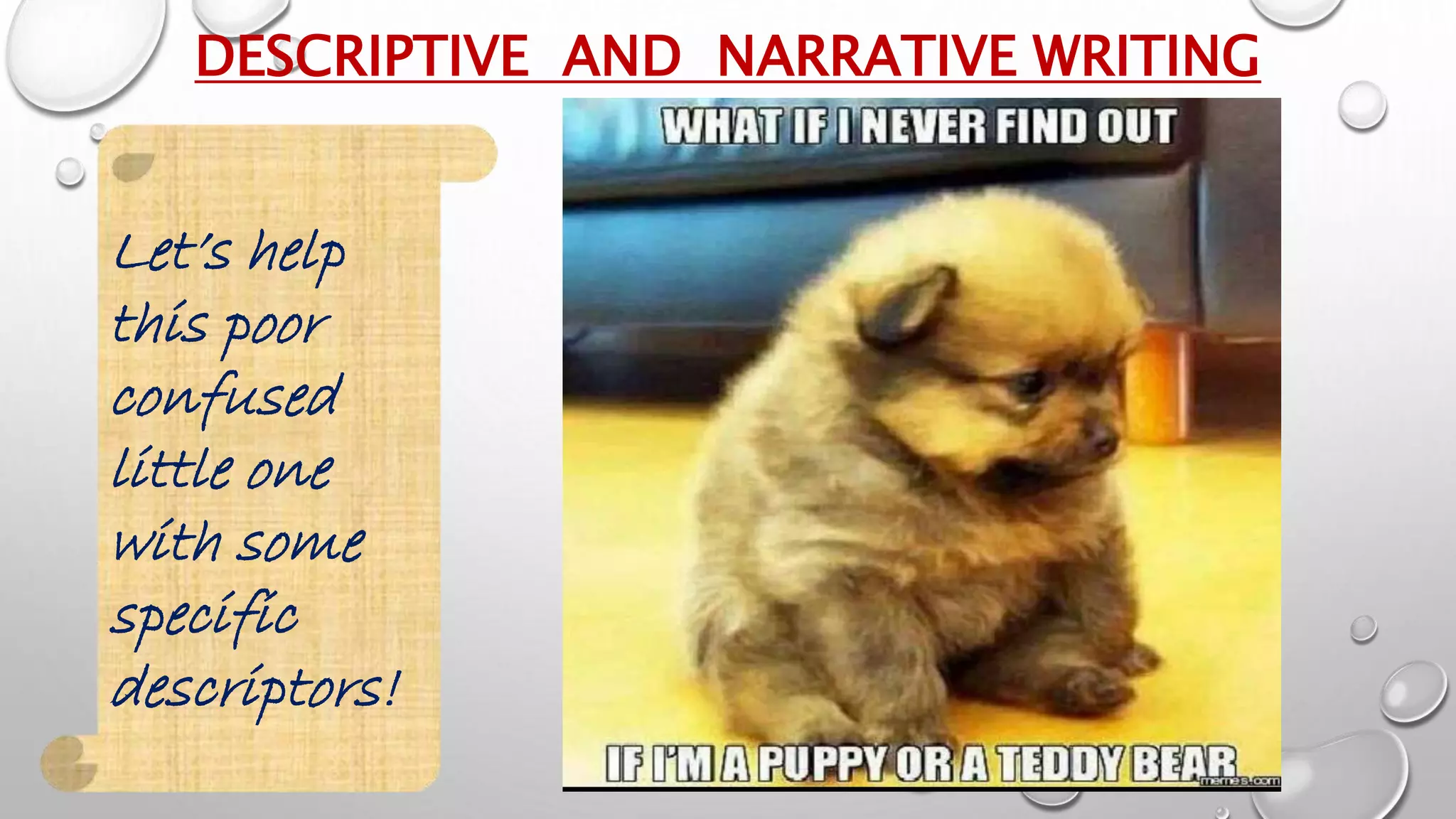
Let’s help
this poor
confused
little one
with some
specific
descriptors!
I CONCEPTS FOR DESCRIPTIVE WRITING
• DESCRIBING ** MEANS
• “TO COPY IN WRITING”...TO RECREATE THE REAL WORLD WITH
WORDS
• 1—NAMING THE OBSERVABLE FEATURES AND EXACT ACTIONS
• WITH PRECISE NOUNS
• AND SPECIFIC ACTION VERBS
• 2—DETAILING THE SPECIFICS OF NAMING
• (ADJECTIVE, ADVERBS)
• SIZE, QUANTITY, LOCATION, MATERIAL COMPOSITION,
C SHOWING VS
TELLING
Telling Showing
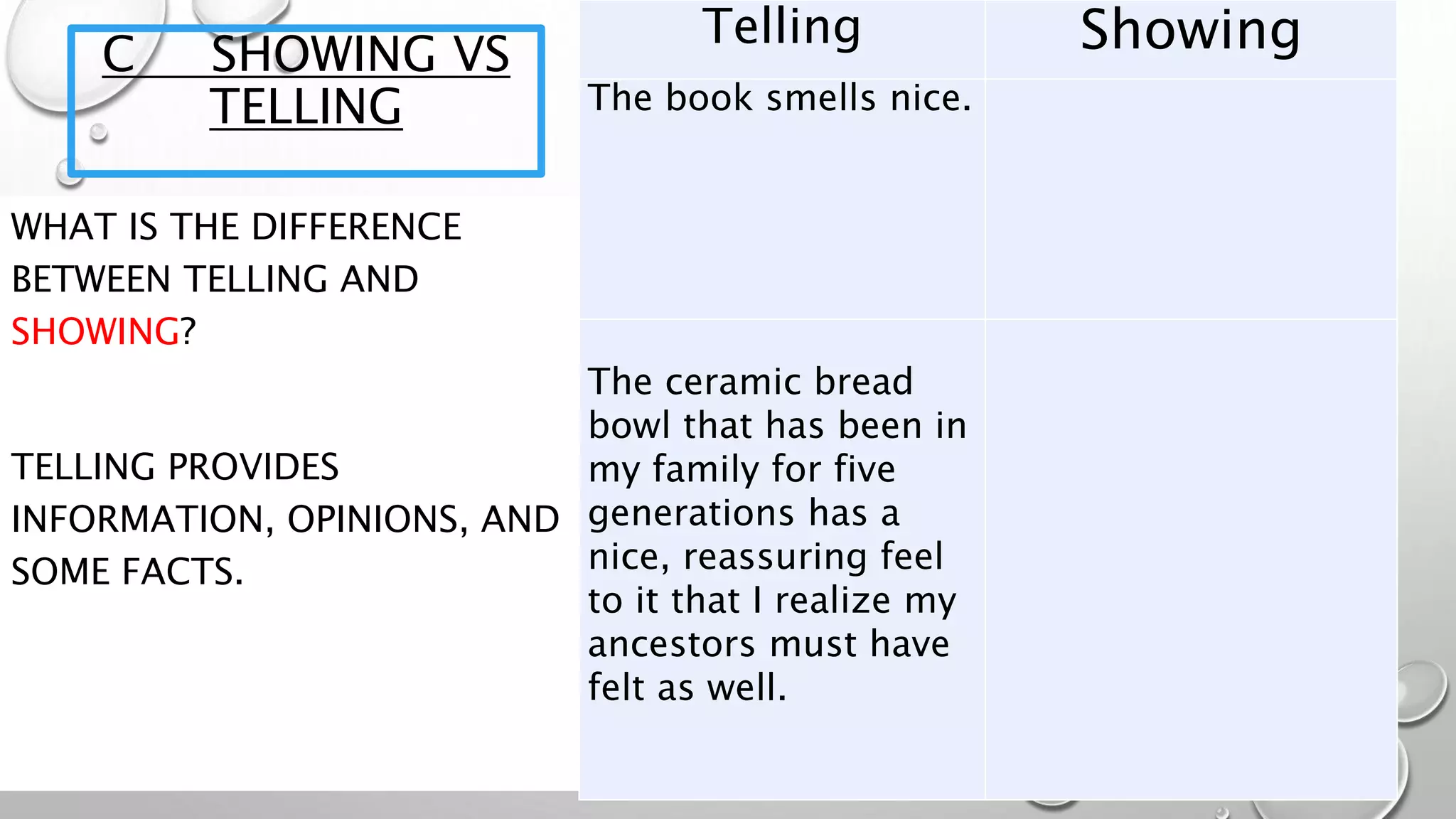
The book smells nice.
The ceramic bread
bowl that has been in
my family for five
generations has a
nice, reassuring feel
to it that I realize my
ancestors must have
felt as well.
WHAT IS THE DIFFERENCE
BETWEEN TELLING AND
SHOWING?
TELLING PROVIDES
INFORMATION, OPINIONS, AND
SOME FACTS.
C SHOWING VS
TELLING
Telling Showing
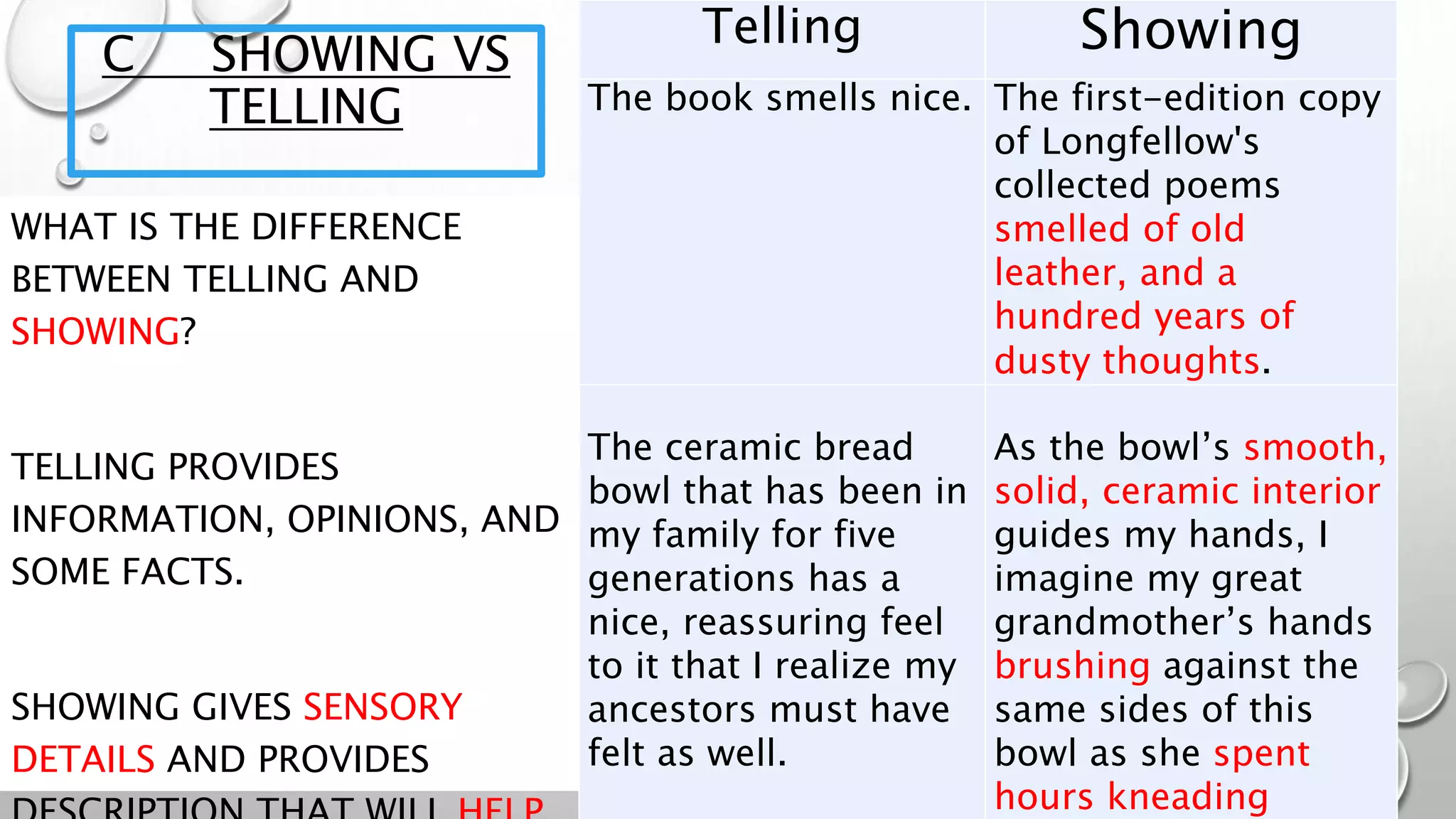
The book smells nice. The first-edition copy
of Longfellow's
collected poems
smelled of old
leather, and a
hundred years of
dusty thoughts.
The ceramic bread
bowl that has been in
my family for five
generations has a
nice, reassuring feel
to it that I realize my
ancestors must have
felt as well.
As the bowl’s smooth,
solid, ceramic interior
guides my hands, I
imagine my great
grandmother’s hands
brushing against the
same sides of this
bowl as she spent
hours kneading
WHAT IS THE DIFFERENCE
BETWEEN TELLING AND
SHOWING?
TELLING PROVIDES
INFORMATION, OPINIONS, AND
SOME FACTS.
SHOWING GIVES SENSORY
DETAILS AND PROVIDES
D LADDER OF
ABSTRACTION
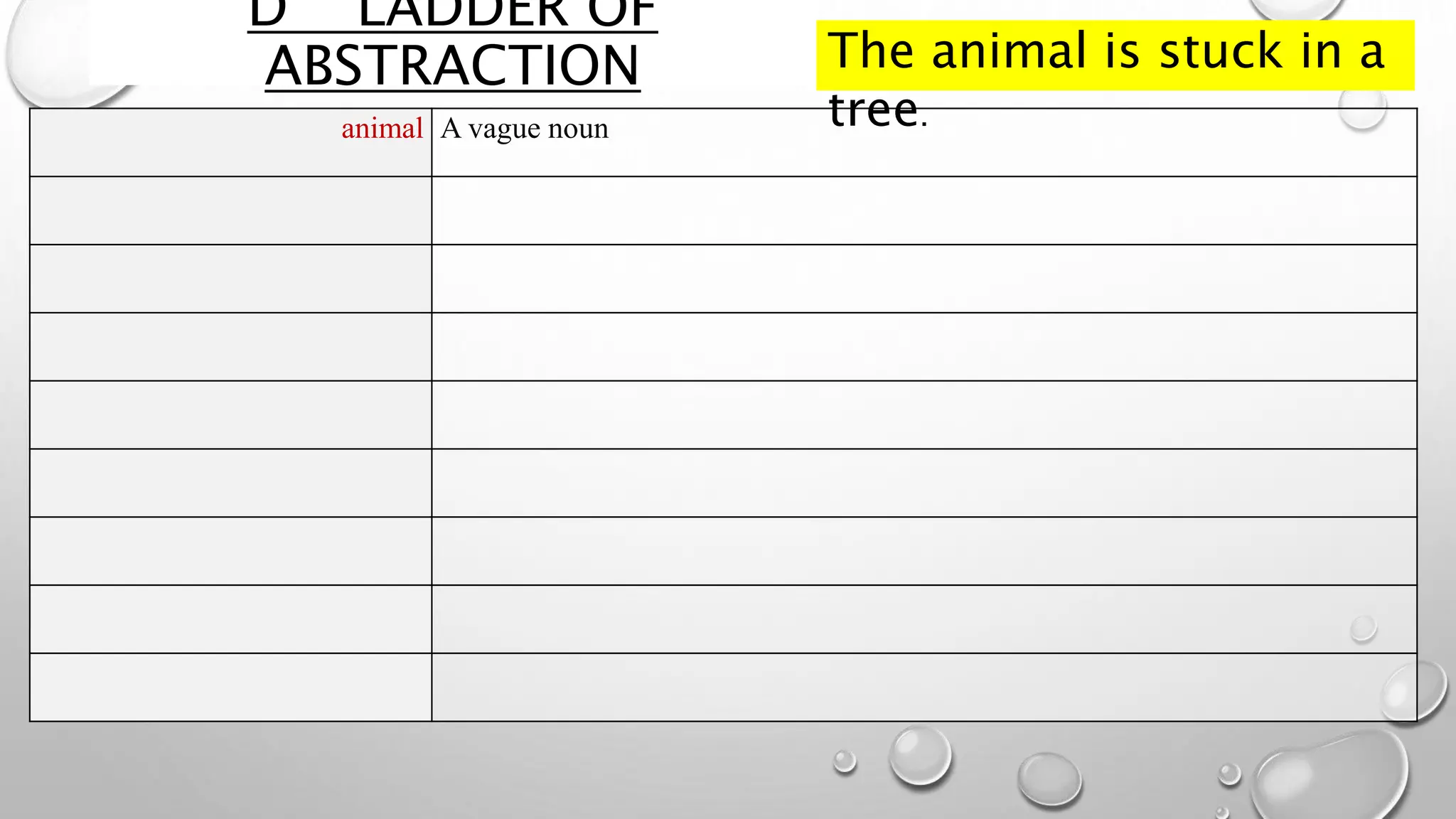
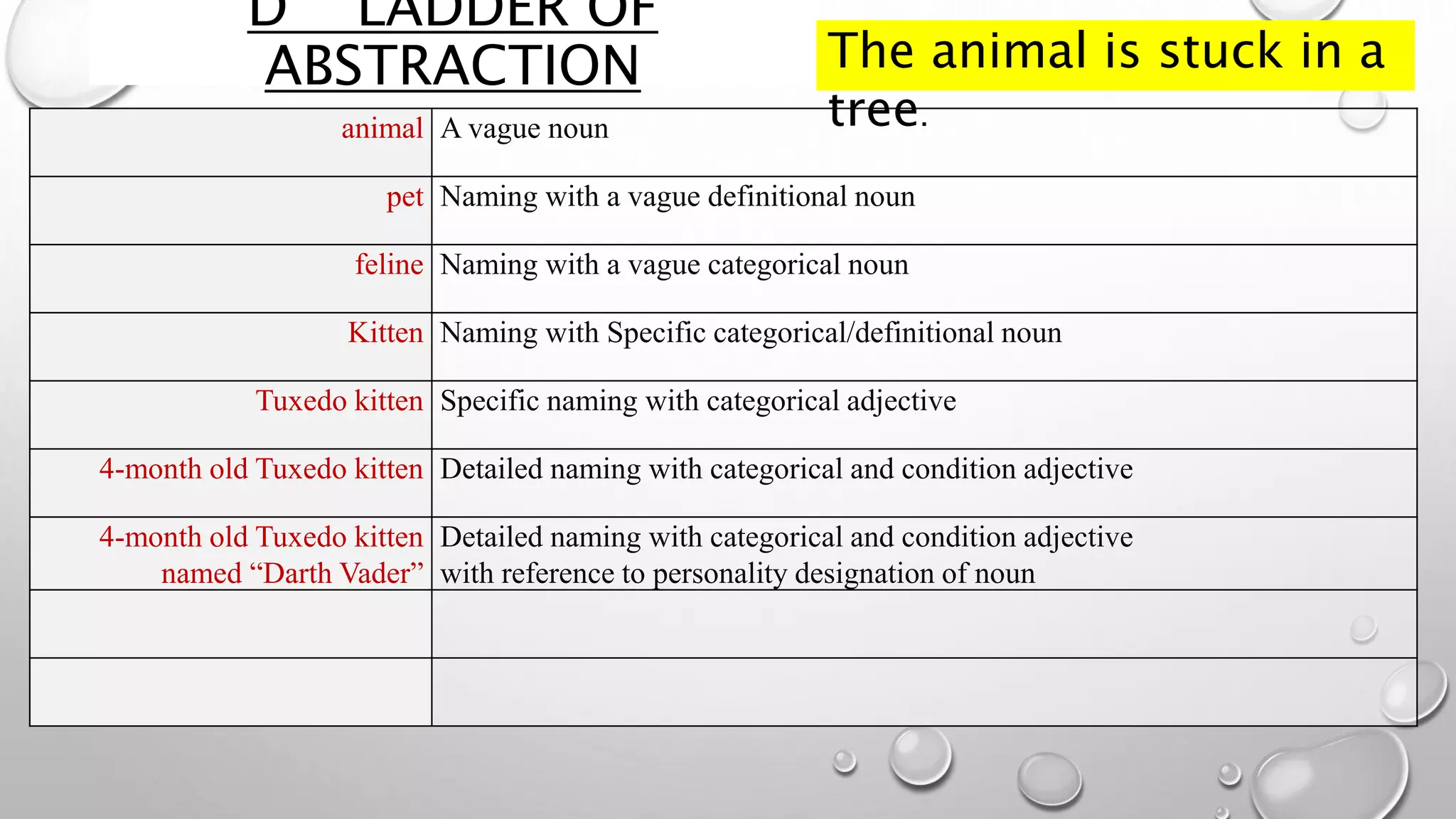
animal A vague noun
The animal is stuck in a
tree.
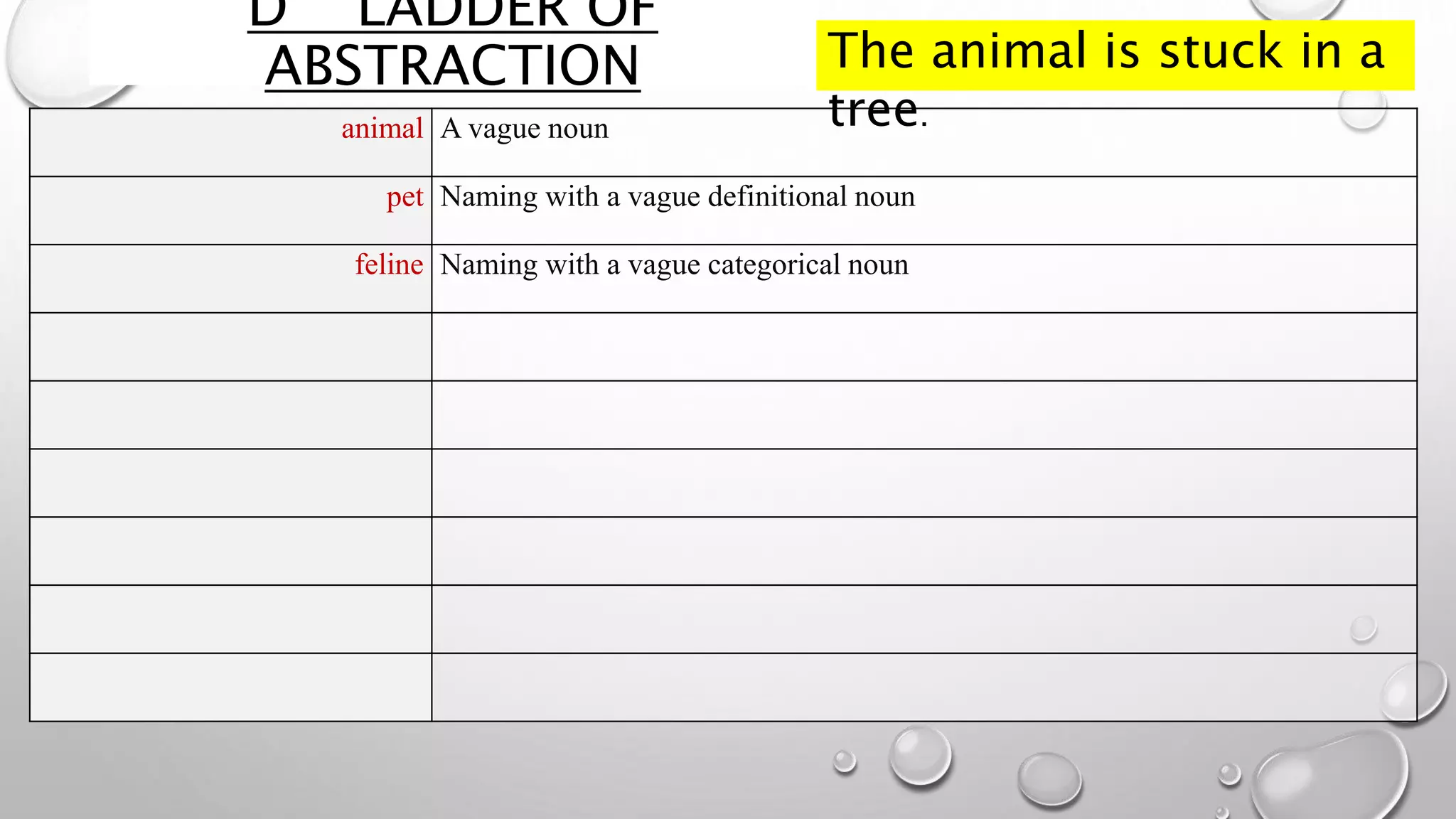
D LADDER OF
ABSTRACTION
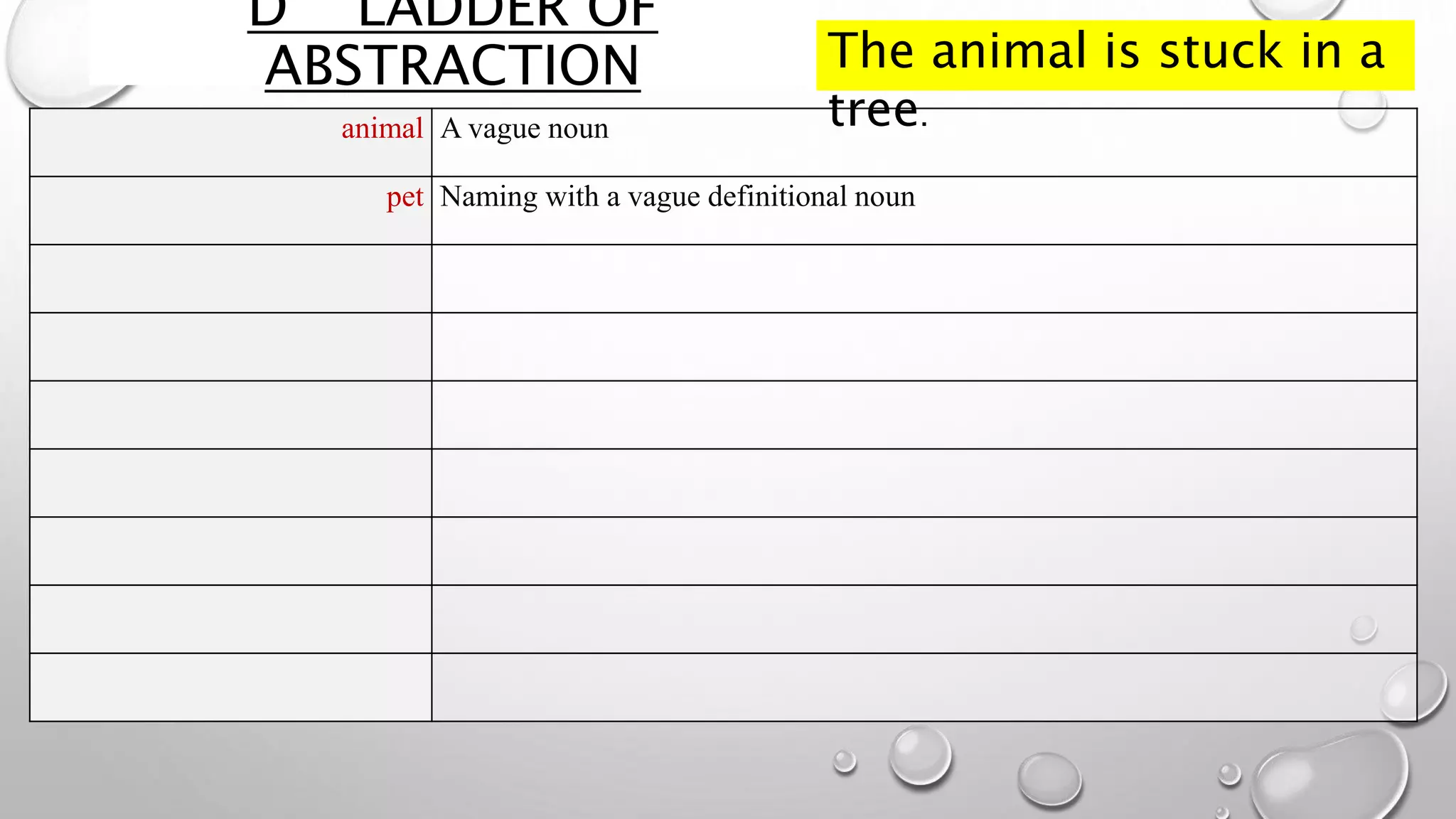
animal A vague noun
pet Naming with a vague definitional noun
The animal is stuck in a
tree.
D LADDER OF
ABSTRACTION
animal A vague noun
pet Naming with a vague definitional noun
feline Naming with a vague categorical noun
The animal is stuck in a
tree.
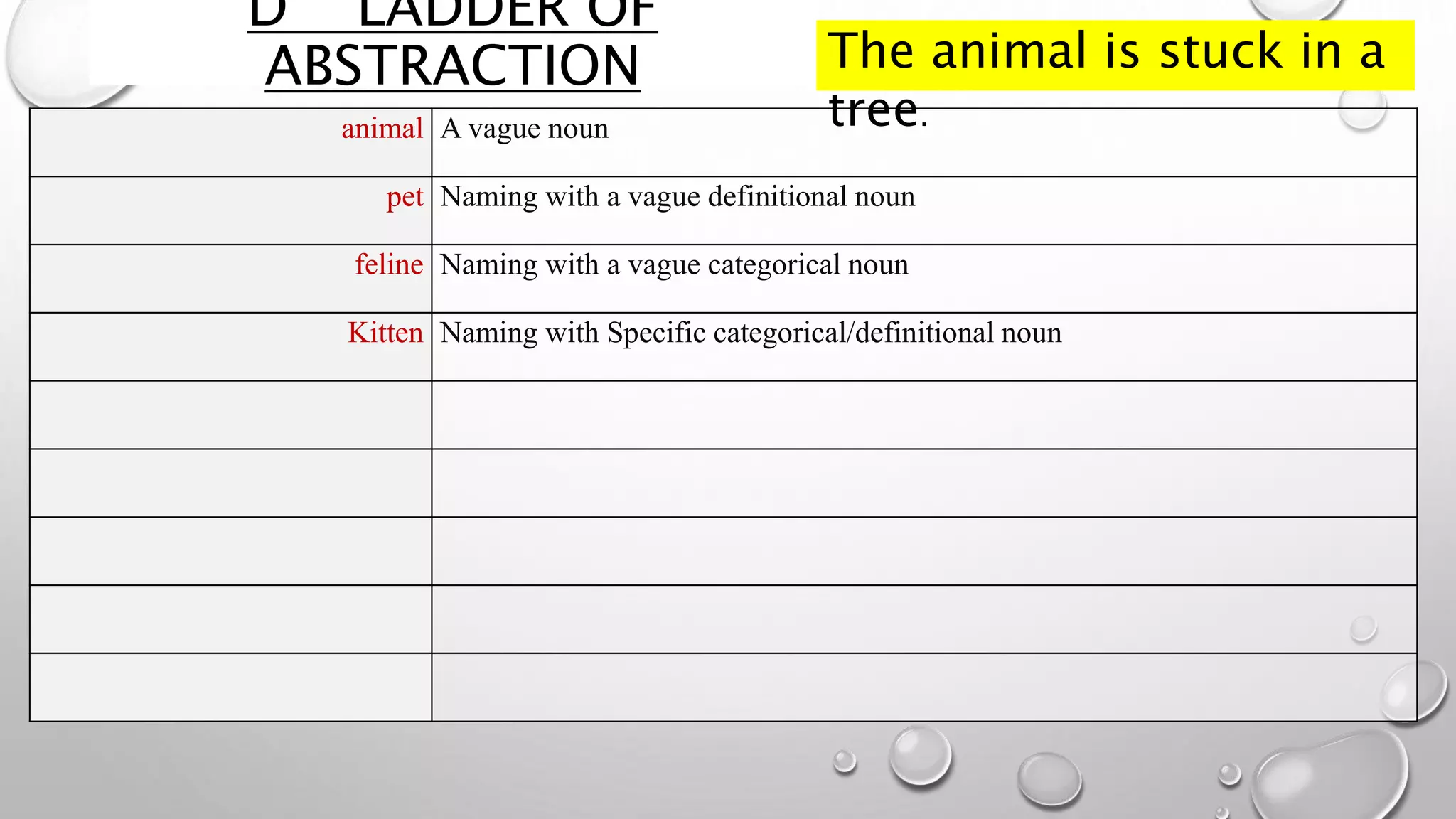
D LADDER OF
ABSTRACTION
animal A vague noun
pet Naming with a vague definitional noun
feline Naming with a vague categorical noun
Kitten Naming with Specific categorical/definitional noun
The animal is stuck in a
tree.
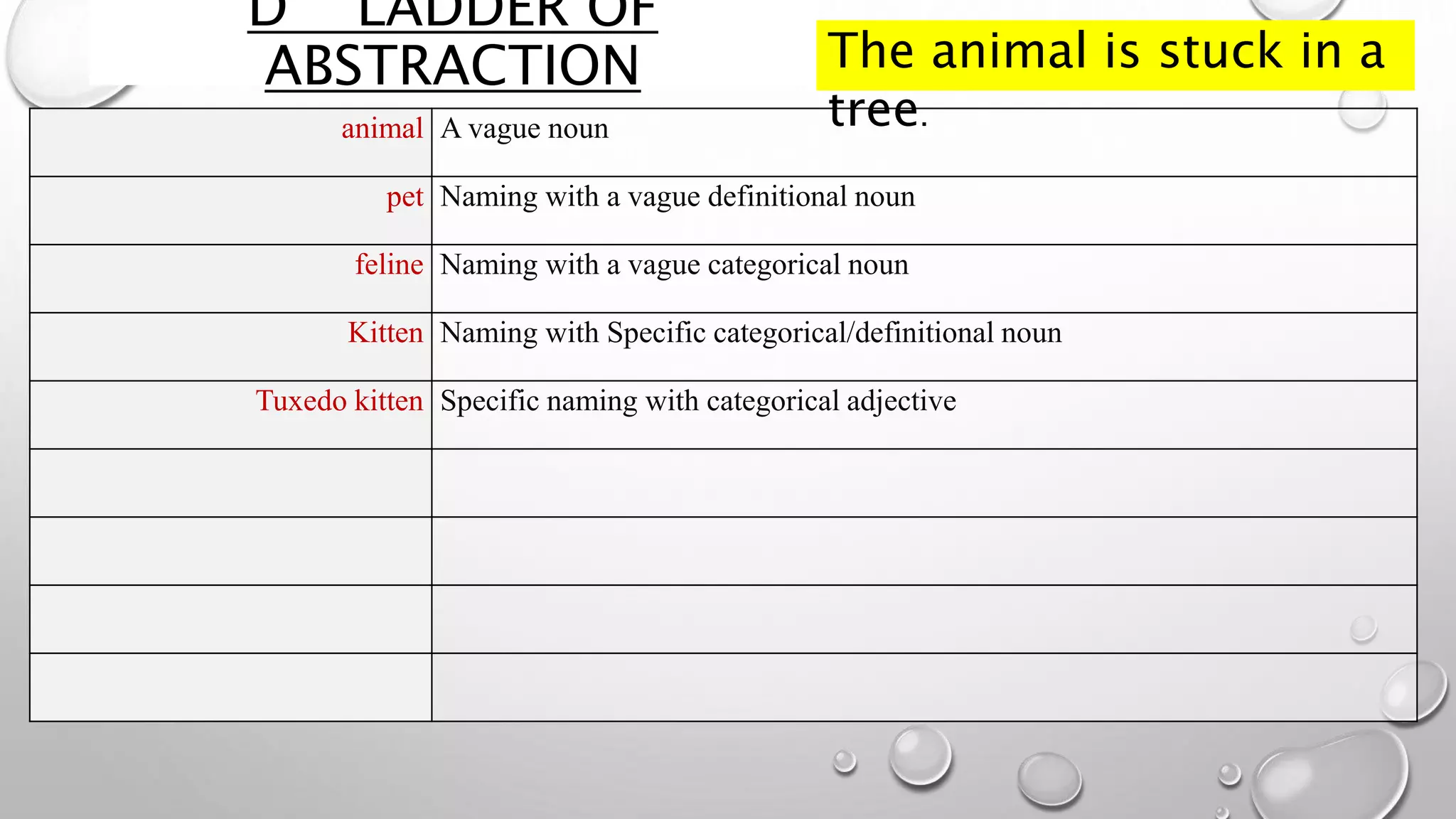
D LADDER OF
ABSTRACTION
animal A vague noun
pet Naming with a vague definitional noun
feline Naming with a vague categorical noun
Kitten Naming with Specific categorical/definitional noun
Tuxedo kitten Specific naming with categorical adjective
The animal is stuck in a
tree.
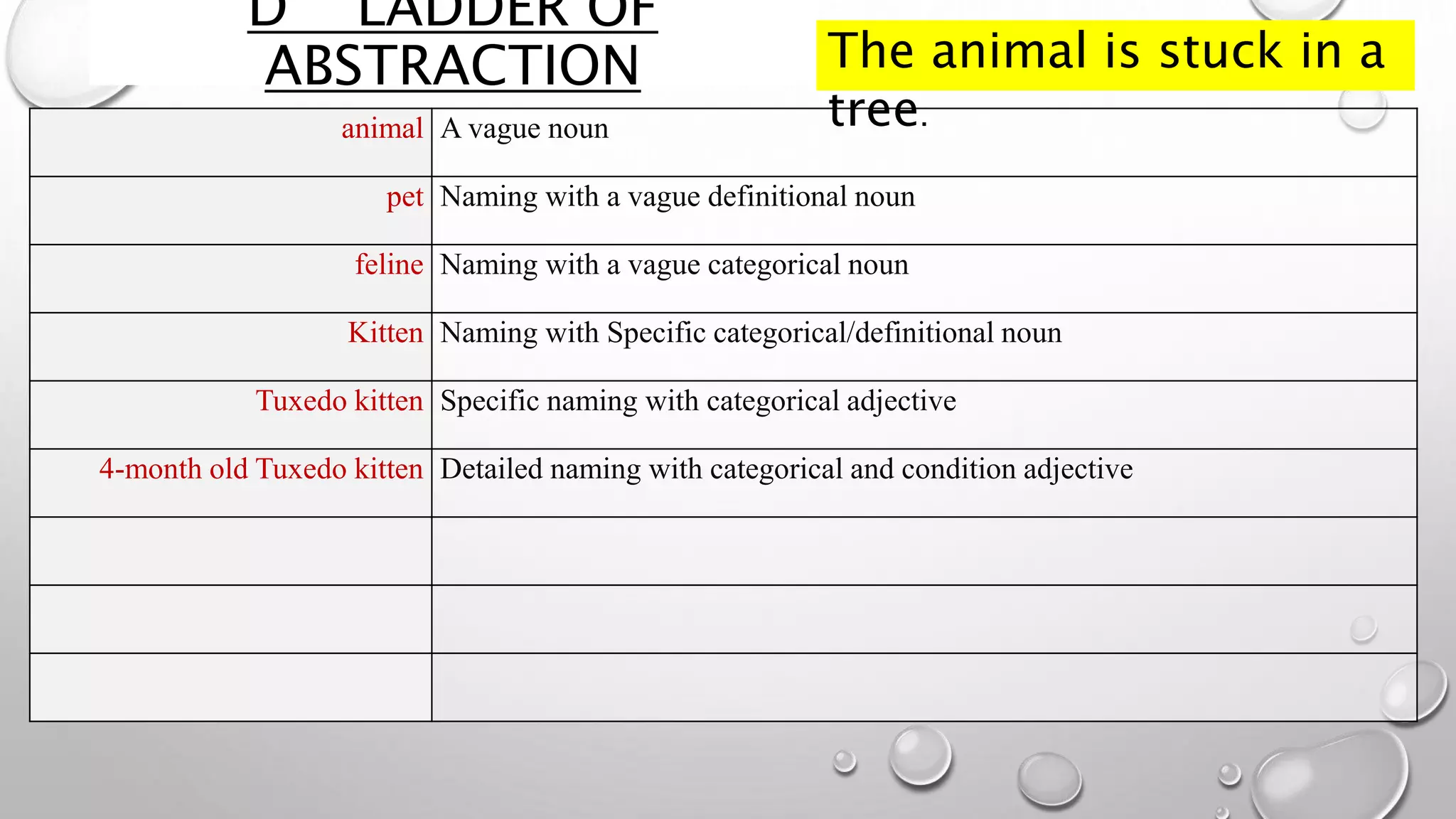
D LADDER OF
ABSTRACTION
animal A vague noun
pet Naming with a vague definitional noun
feline Naming with a vague categorical noun
Kitten Naming with Specific categorical/definitional noun
Tuxedo kitten Specific naming with categorical adjective
4-month old Tuxedo kitten Detailed naming with categorical and condition adjective
The animal is stuck in a
tree.
D LADDER OF
ABSTRACTION
animal A vague noun
pet Naming with a vague definitional noun
feline Naming with a vague categorical noun
Kitten Naming with Specific categorical/definitional noun
Tuxedo kitten Specific naming with categorical adjective
4-month old Tuxedo kitten Detailed naming with categorical and condition adjective
4-month old Tuxedo kitten
named “Darth Vader”
Detailed naming with categorical and condition adjective
with reference to personality designation of noun
The animal is stuck in a
tree.
D LADDER OF
ABSTRACTION
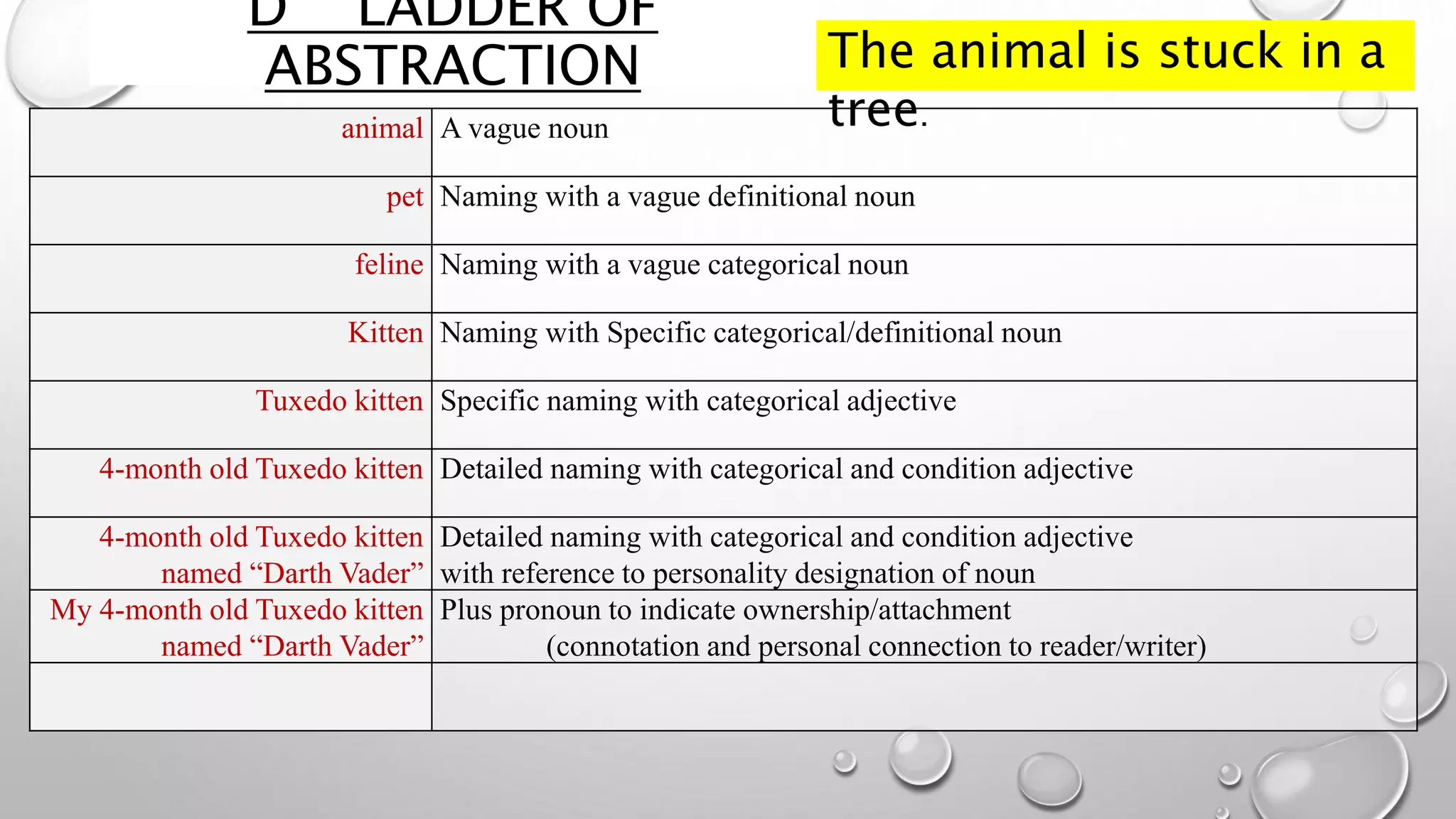
animal A vague noun
pet Naming with a vague definitional noun
feline Naming with a vague categorical noun
Kitten Naming with Specific categorical/definitional noun
Tuxedo kitten Specific naming with categorical adjective
4-month old Tuxedo kitten Detailed naming with categorical and condition adjective
4-month old Tuxedo kitten
named “Darth Vader”
Detailed naming with categorical and condition adjective
with reference to personality designation of noun
My 4-month old Tuxedo kitten
named “Darth Vader”
Plus pronoun to indicate ownership/attachment
(connotation and personal connection to reader/writer)
The animal is stuck in a
tree.
D LADDER OF
ABSTRACTION
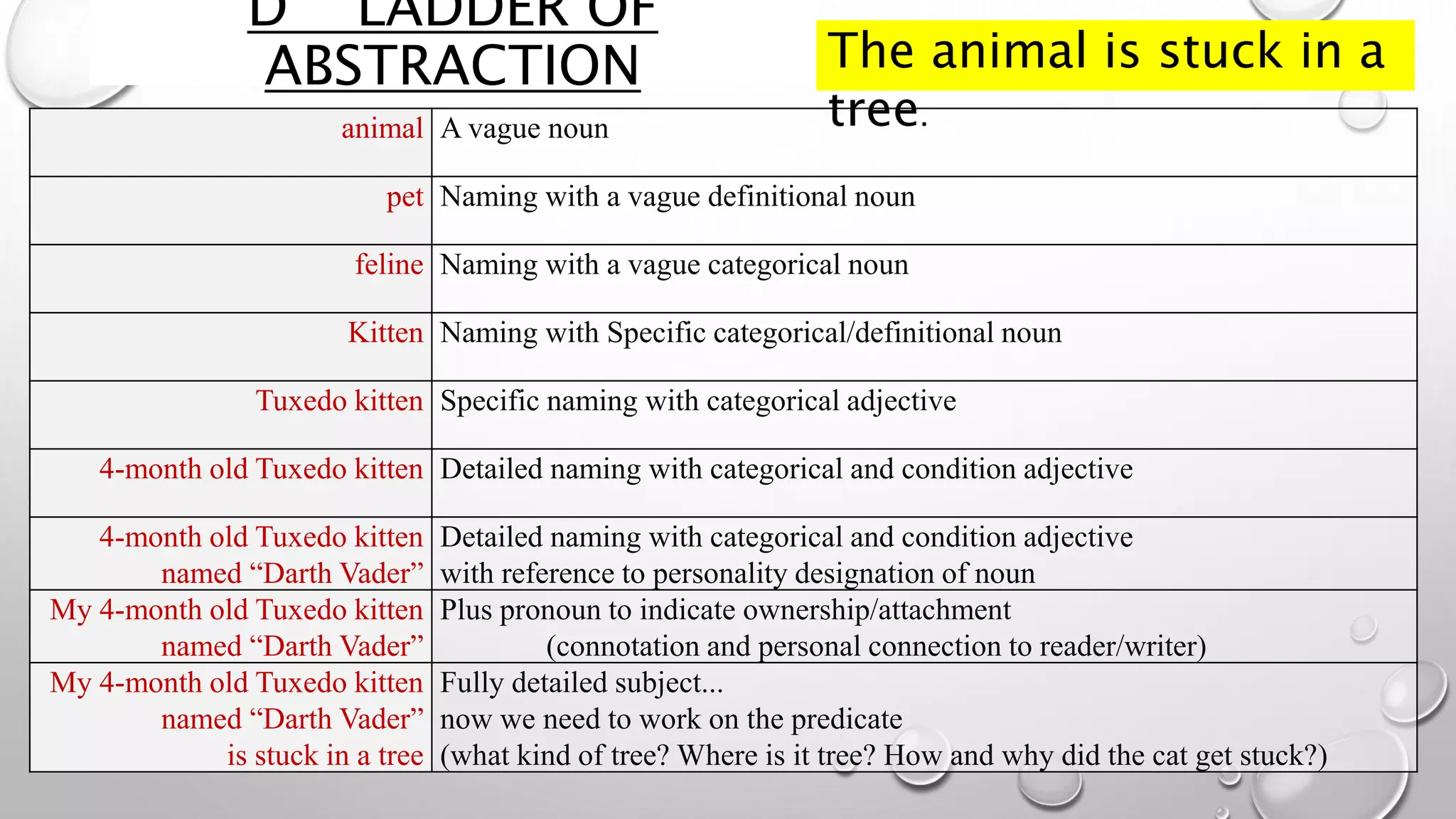
animal A vague noun
pet Naming with a vague definitional noun
feline Naming with a vague categorical noun
Kitten Naming with Specific categorical/definitional noun
Tuxedo kitten Specific naming with categorical adjective
4-month old Tuxedo kitten Detailed naming with categorical and condition adjective
4-month old Tuxedo kitten
named “Darth Vader”
Detailed naming with categorical and condition adjective
with reference to personality designation of noun
My 4-month old Tuxedo kitten
named “Darth Vader”
Plus pronoun to indicate ownership/attachment
(connotation and personal connection to reader/writer)
My 4-month old Tuxedo kitten
named “Darth Vader”
is stuck in a tree
Fully detailed subject...
now we need to work on the predicate
(what kind of tree? Where is it tree? How and why did the cat get stuck?)
The animal is stuck in a
tree.
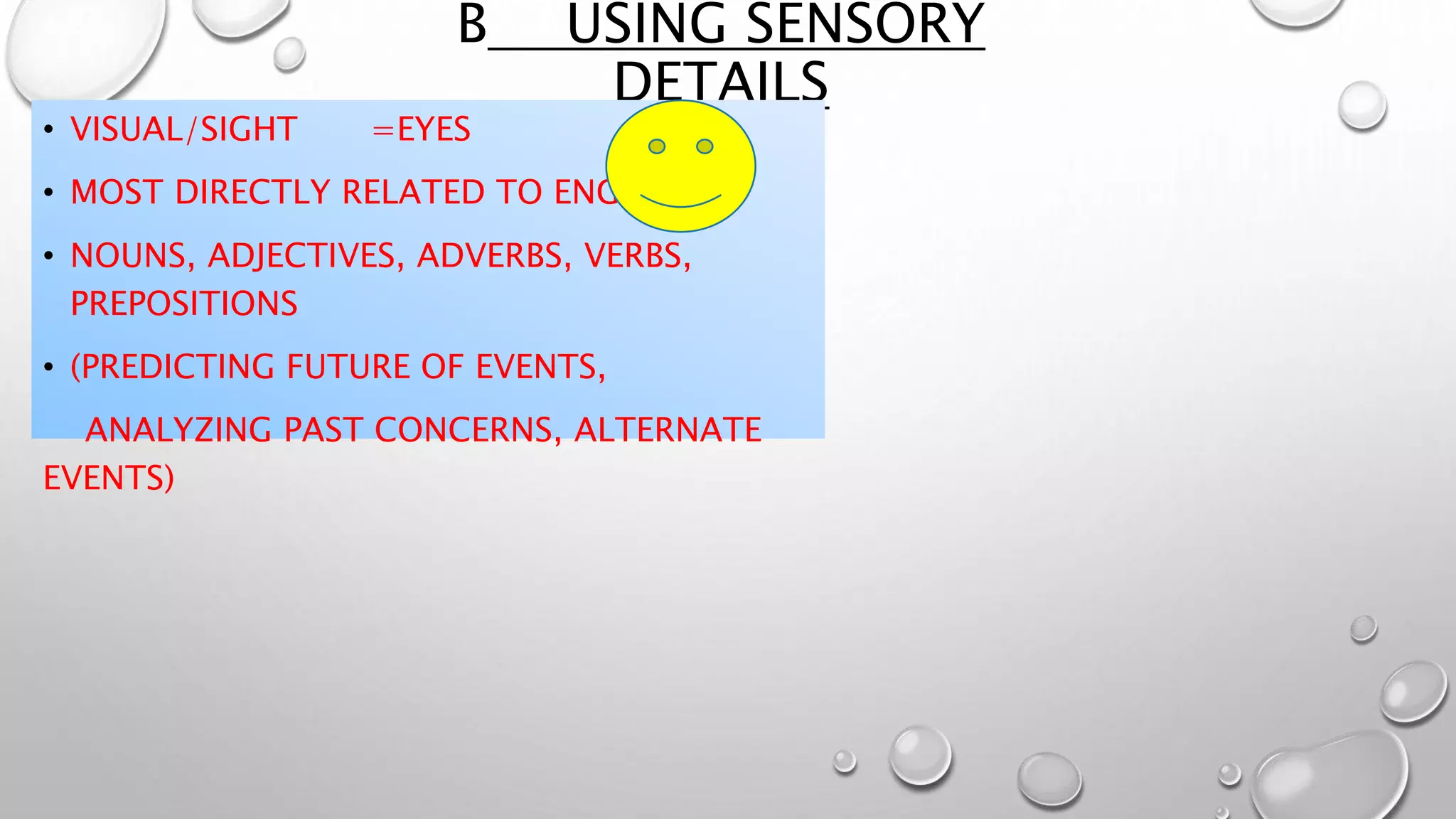
B USING SENSORY
DETAILS
• VISUAL/SIGHT =EYES
• MOST DIRECTLY RELATED TO ENGLISH
• NOUNS, ADJECTIVES, ADVERBS, VERBS,
PREPOSITIONS
• (PREDICTING FUTURE OF EVENTS,
ANALYZING PAST CONCERNS, ALTERNATE
EVENTS)
B USING SENSORY
DETAILS
• VISUAL/SIGHT =EYES
• MOST DIRECTLY RELATED TO ENGLISH
• NOUNS, ADJECTIVES, ADVERBS, VERBS,
PREPOSITIONS
• (PREDICTING FUTURE OF EVENTS,
ANALYZING PAST CONCERNS, ALTERNATE
EVENTS)
• HEAR/SOUND =EARS
• ALSO DIRECTLY RELATED TO ENGLISH
• NOUNS (NAMES OF SOUNDS)
ADJECTIVES, ADVERBS (DETAILS)
• (GOOD OR BAD EVENT
ATMOSPHERE…QUALITATIVE/RELATIVE)
B USING SENSORY
DETAILS
• VISUAL/SIGHT =EYES
• MOST DIRECTLY RELATED TO ENGLISH
• NOUNS, ADJECTIVES, ADVERBS, VERBS,
PREPOSITIONS
• (PREDICTING FUTURE OF EVENTS,
ANALYZING PAST CONCERNS, ALTERNATE
EVENTS)
• HEAR/SOUND =EARS
• ALSO DIRECTLY RELATED TO ENGLISH
• NOUNS (NAMES OF SOUNDS)
ADJECTIVES, ADVERBS (DETAILS)
• (GOOD OR BAD EVENT
ATMOSPHERE…QUALITATIVE/RELATIVE)
B USING SENSORY
DETAILS
• VISUAL/SIGHT =EYES
• MOST DIRECTLY RELATED TO ENGLISH
• NOUNS, ADJECTIVES, ADVERBS, VERBS,
PREPOSITIONS
• (PREDICTING FUTURE OF EVENTS,
ANALYZING PAST CONCERNS, ALTERNATE
EVENTS)
• HEAR/SOUND =EARS
• ALSO DIRECTLY RELATED TO ENGLISH
• NOUNS (NAMES OF SOUNDS)
ADJECTIVES, ADVERBS (DETAILS)
• (GOOD OR BAD EVENT
ATMOSPHERE…QUALITATIVE/RELATIVE)
Smell = nose (also anticipation of good/bad event, malicious intent)
Taste = mouth (also music, art, literature, men, women,
fashion==comparison)
** Smell and Taste are not as directly related to English.
DECRIPTIVE WRITING STRATEGIES
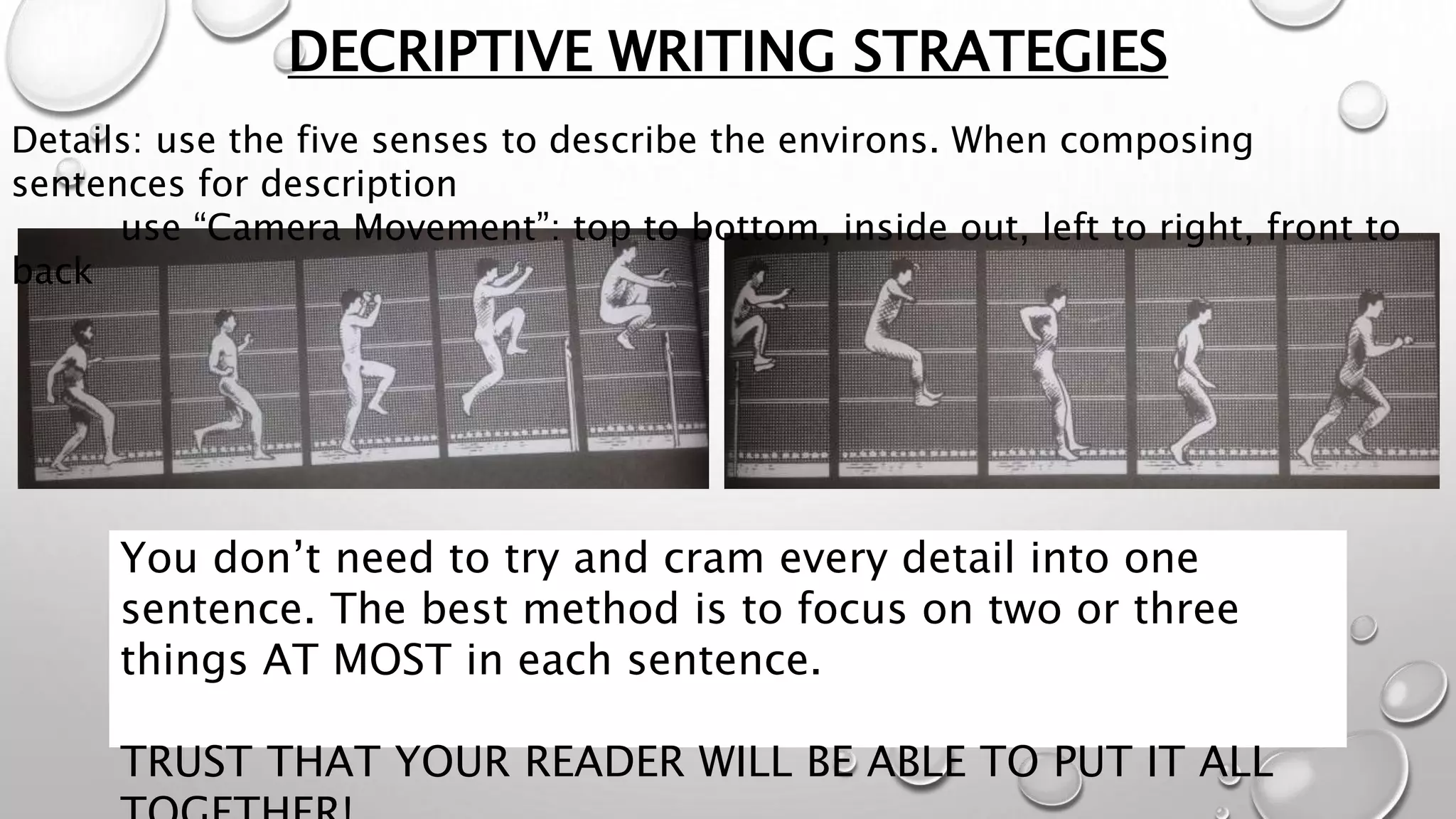
Details: use the five senses to describe the environs. When composing
sentences for description
use “Camera Movement”: top to bottom, inside out, left to right, front to
back
You don’t need to try and cram every detail into one
sentence. The best method is to focus on two or three
things AT MOST in each sentence.
TRUST THAT YOUR READER WILL BE ABLE TO PUT IT ALL
DECRIPTIVE WRITING STRATEGIES
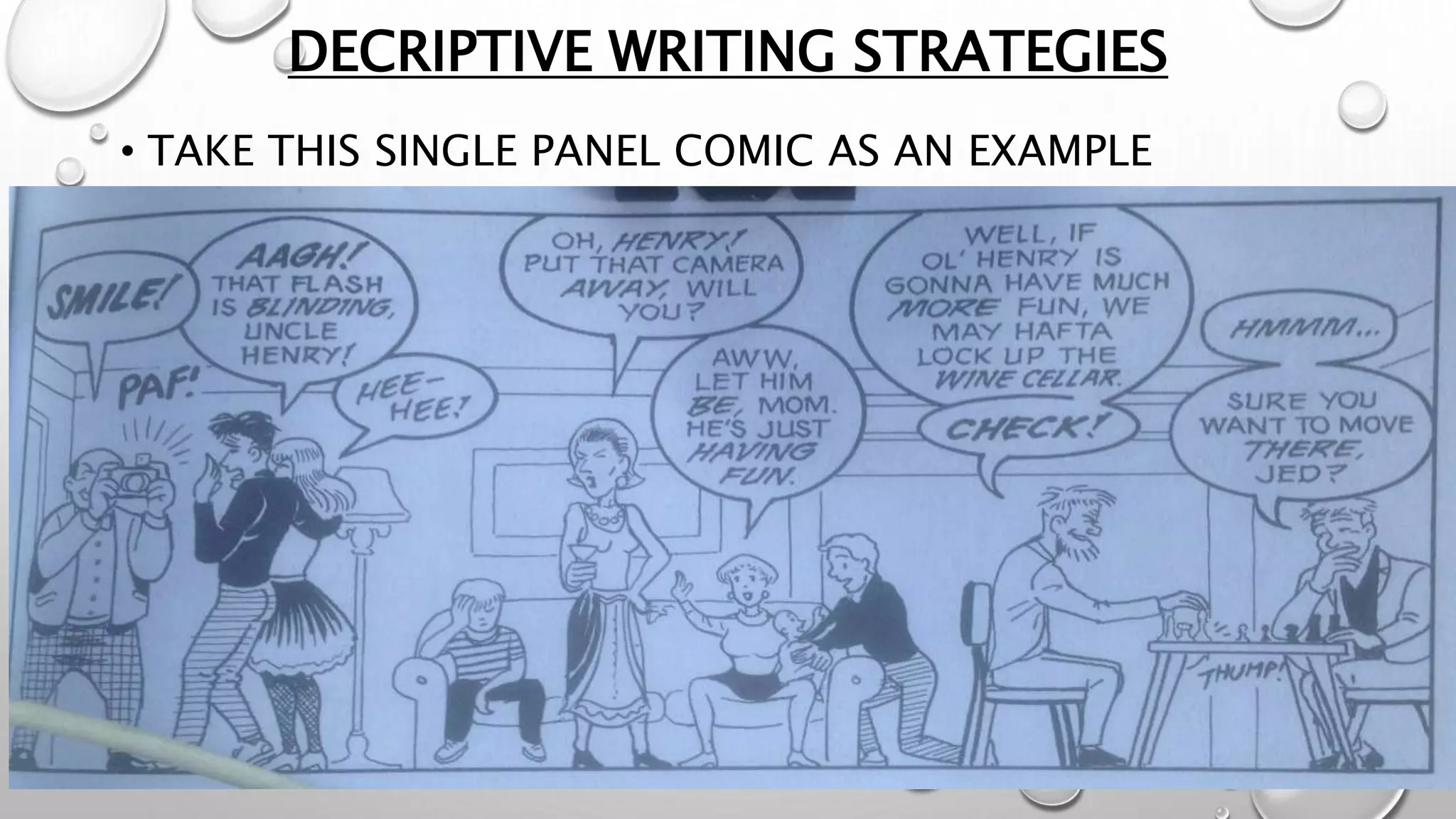
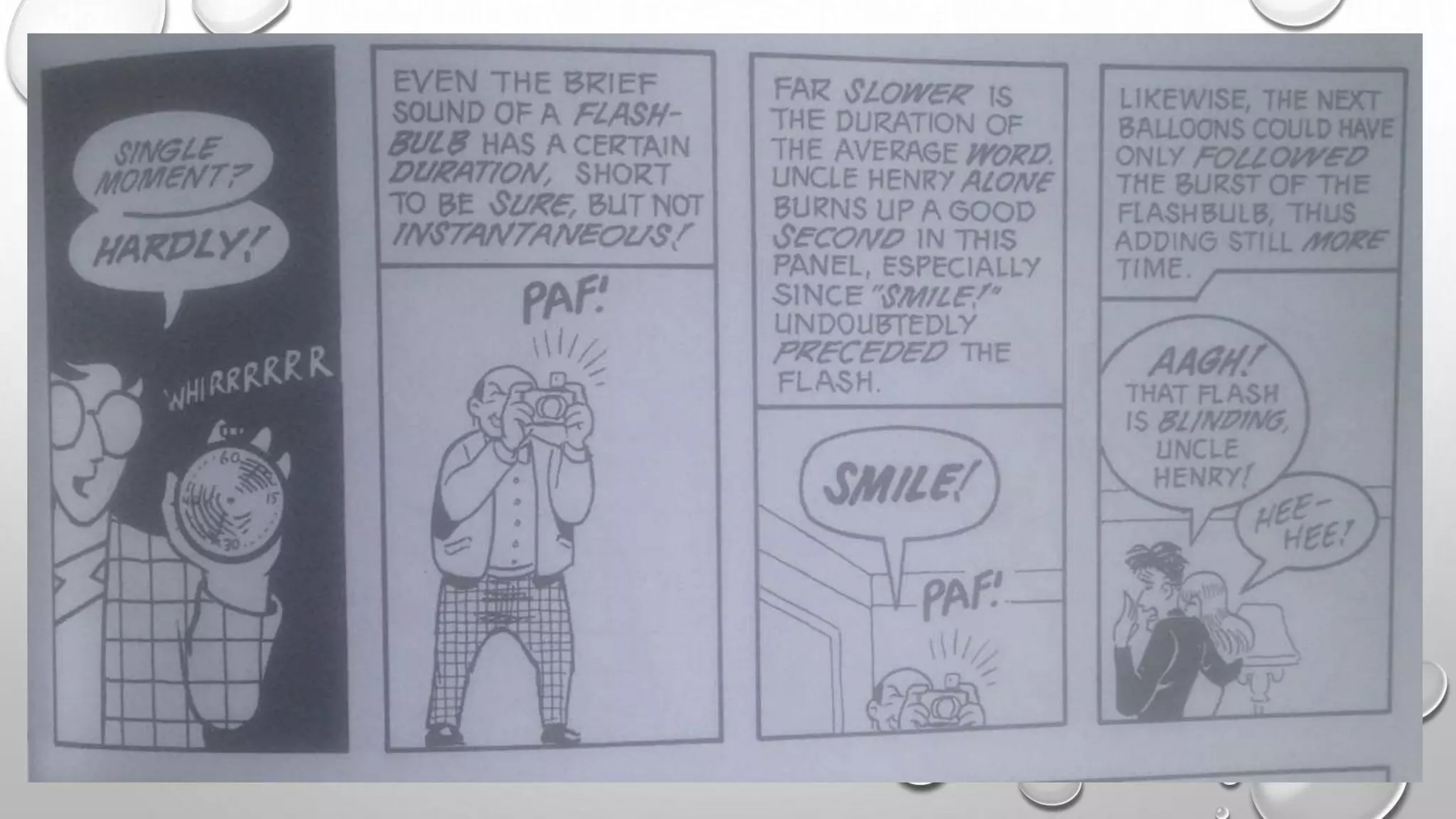
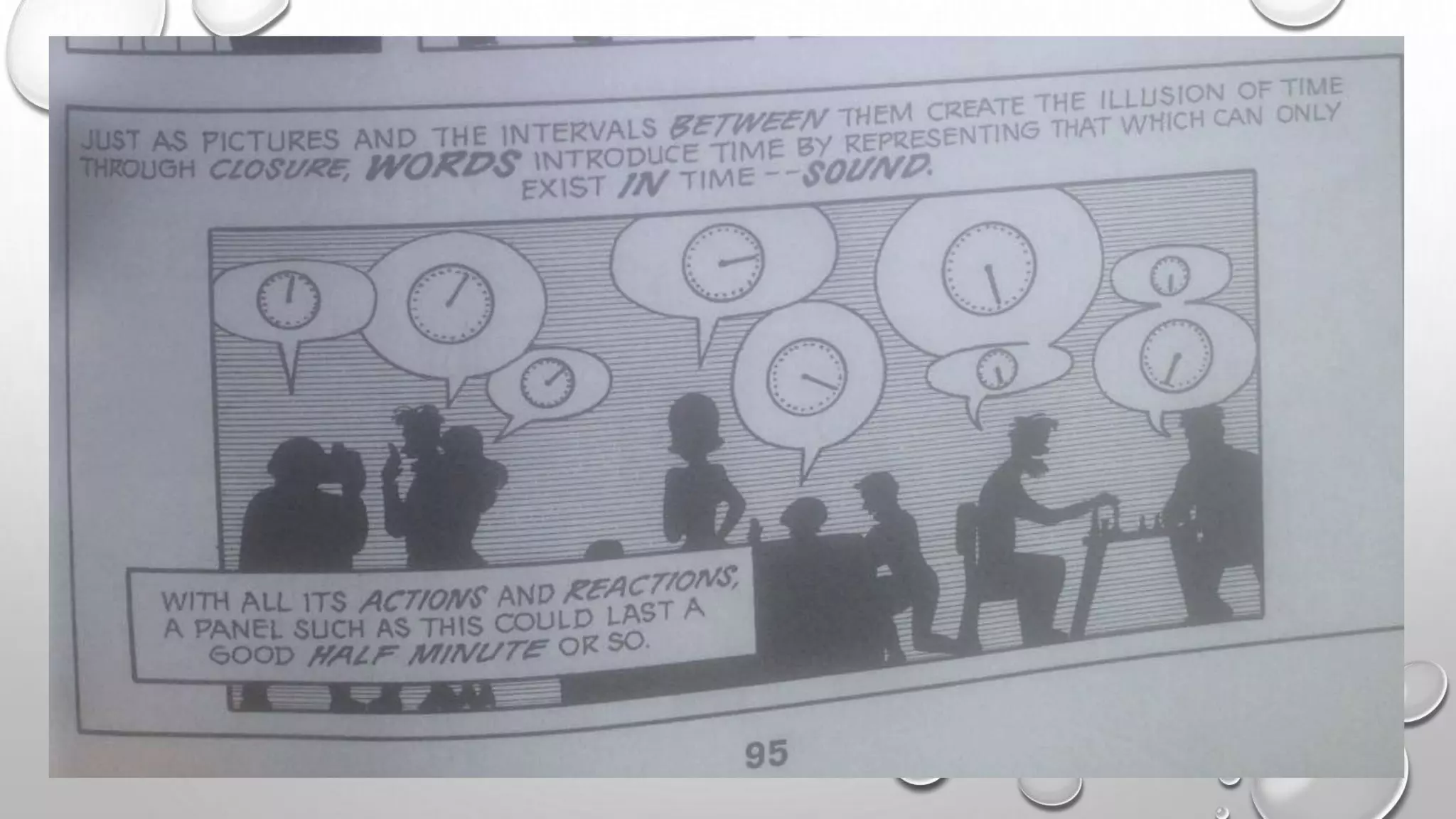
• TAKE THIS SINGLE PANEL COMIC AS AN EXAMPLE
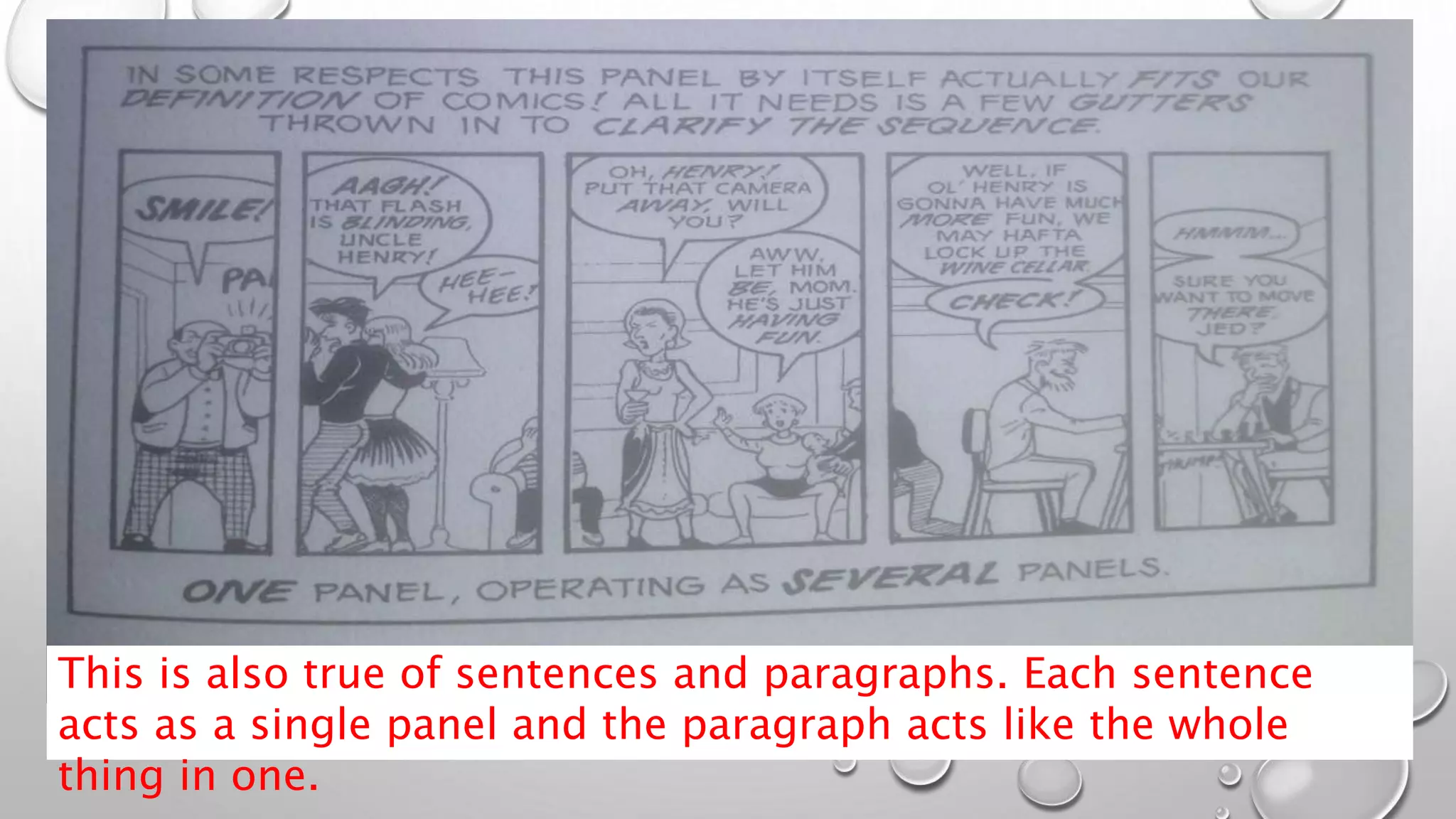
This is also true of sentences and paragraphs. Each sentence
acts as a single panel and the paragraph acts like the whole
thing in one.
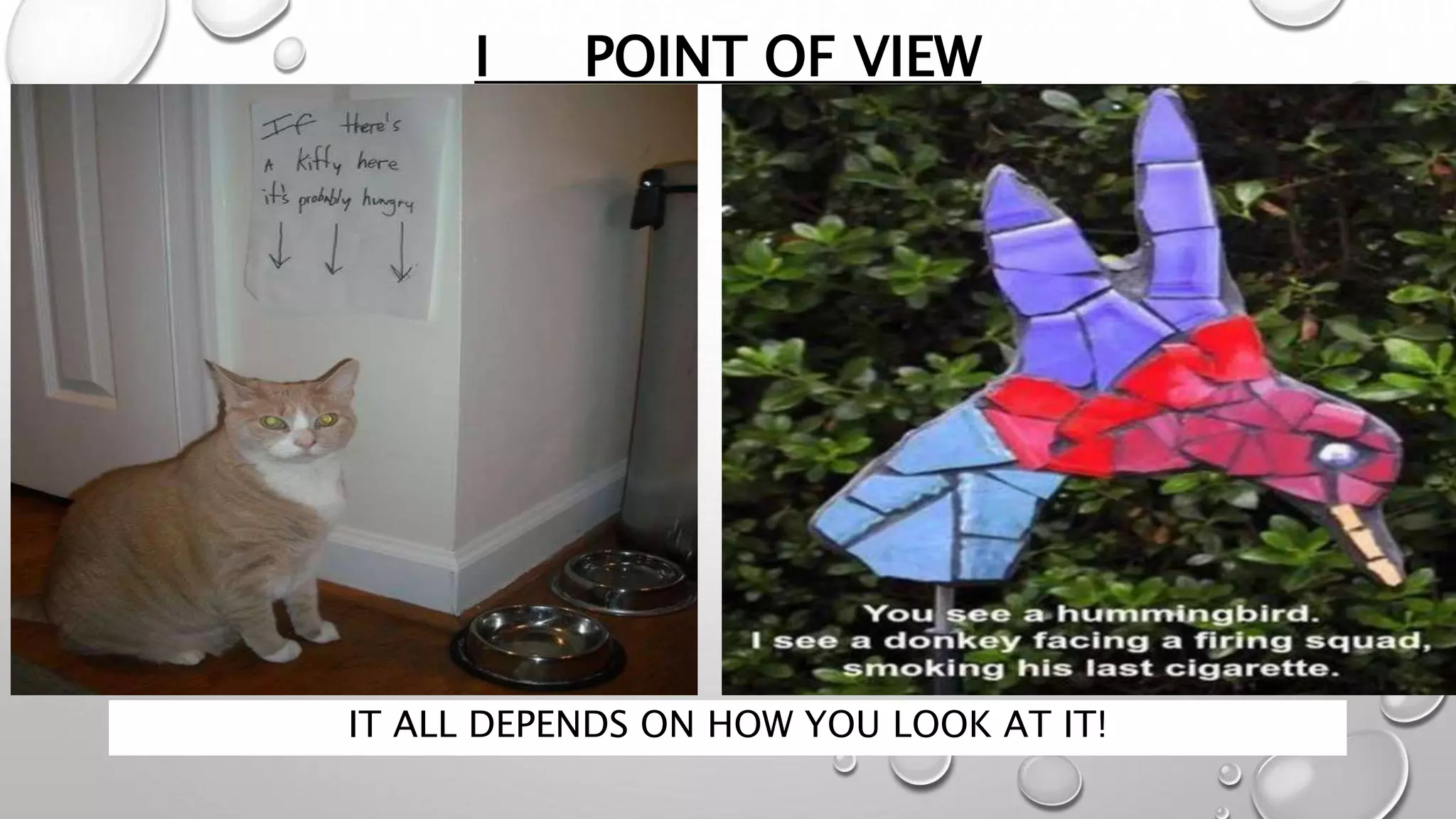
I POINT OF VIEW
IT ALL DEPENDS ON HOW YOU LOOK AT IT!
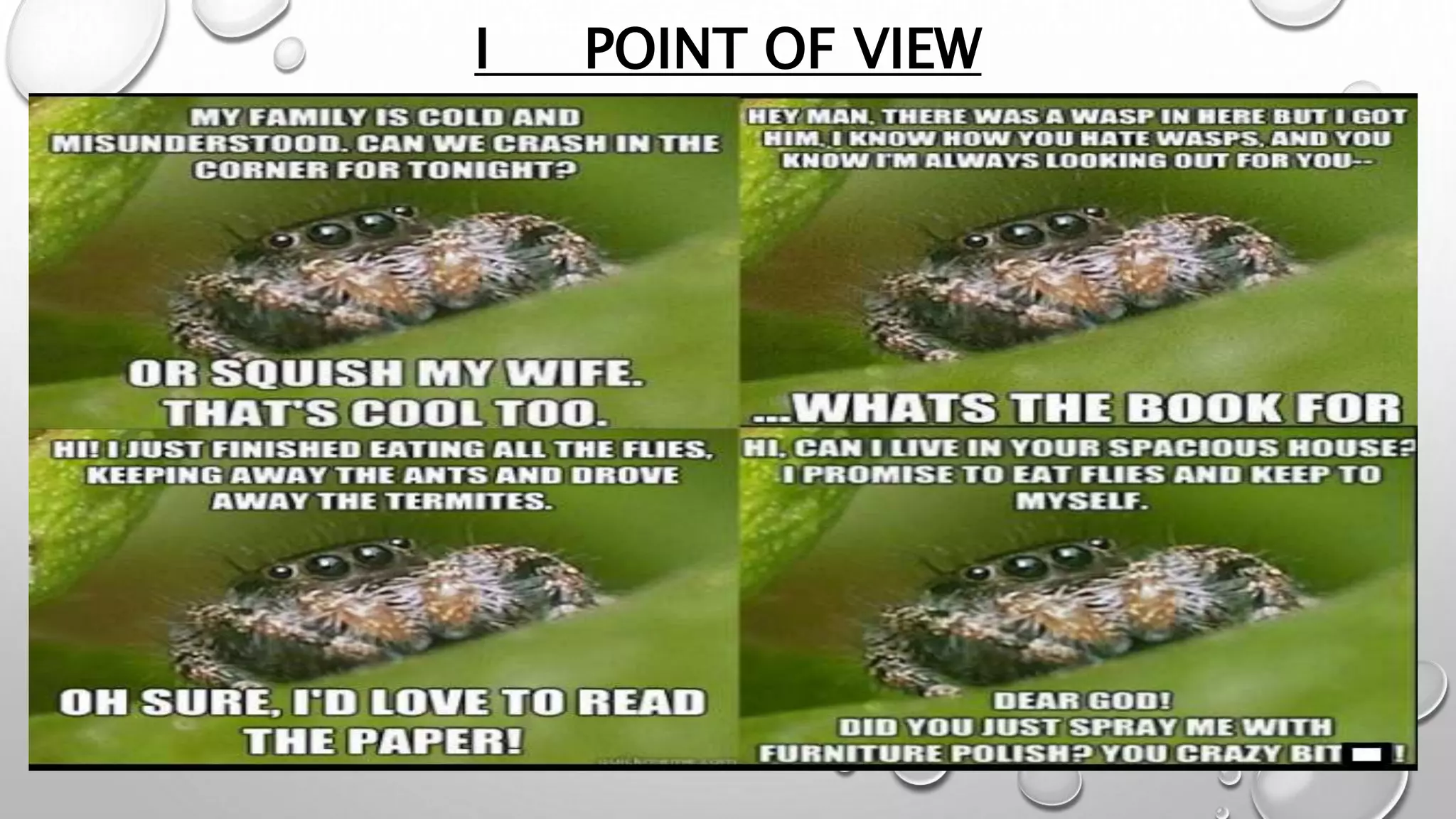
I POINT OF VIEW
II CREATING THE INTENDED EFFECT
• JON KRAKAUER INTO THIN AIR
• CHAPTER1 BEGINS: “STRADDLING THE TOP OF
THE WORLD, ONE FOOT IN CHINA AND THE
OTHER IN NEPAL, I CLEARED THE ICE FROM MY
OXYGEN MASK, HUNCHED A SHOULDER
AGAINST THE WIND, AND STARED ABSENTLY
DOWN AT THE VASTNESS OF TIBET.”
• CHAPTER 1 ENDS WITH:
• “NOBODY SUSPECTED THAT BY THE END OF
THAT LONG DAY, EVERY MINUTE WOULD
**—creating a mood or atmosphere to reinforce the writer’s purpose
**—fill the reader’s imagination with details
**—accumulated connotations, naming, detailing, comparing, and
sensory language
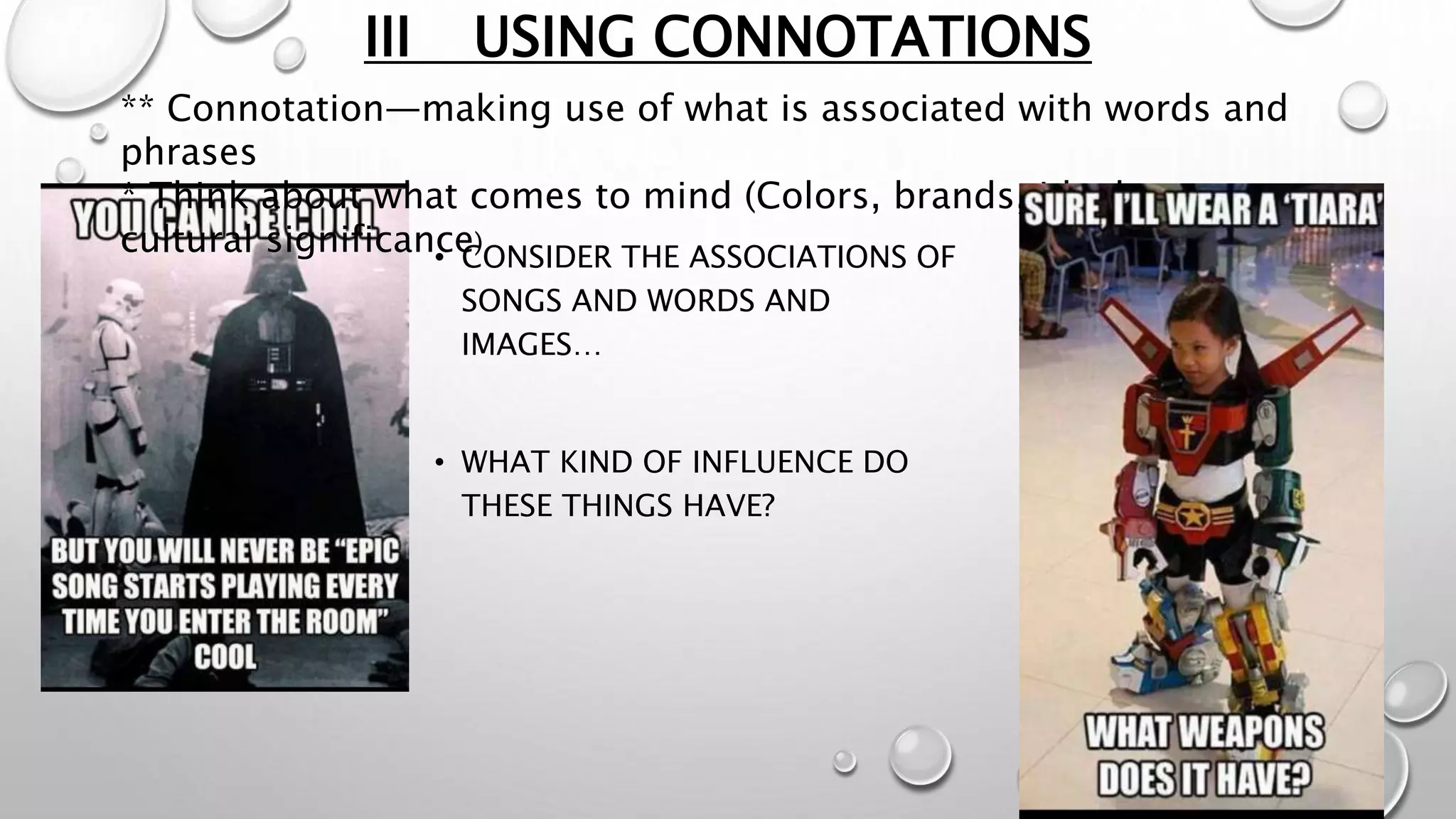
III USING CONNOTATIONS
** Connotation—making use of what is associated with words and
phrases
* Think about what comes to mind (Colors, brands, ideology,
cultural significance)
• CONSIDER THE ASSOCIATIONS OF
SONGS AND WORDS AND
IMAGES…
• WHAT KIND OF INFLUENCE DO
THESE THINGS HAVE?
III USING CONNOTATIONS
** Connotation—making use of what is associated with words and
phrases
* Think about what comes to mind (Colors, brands, ideology,
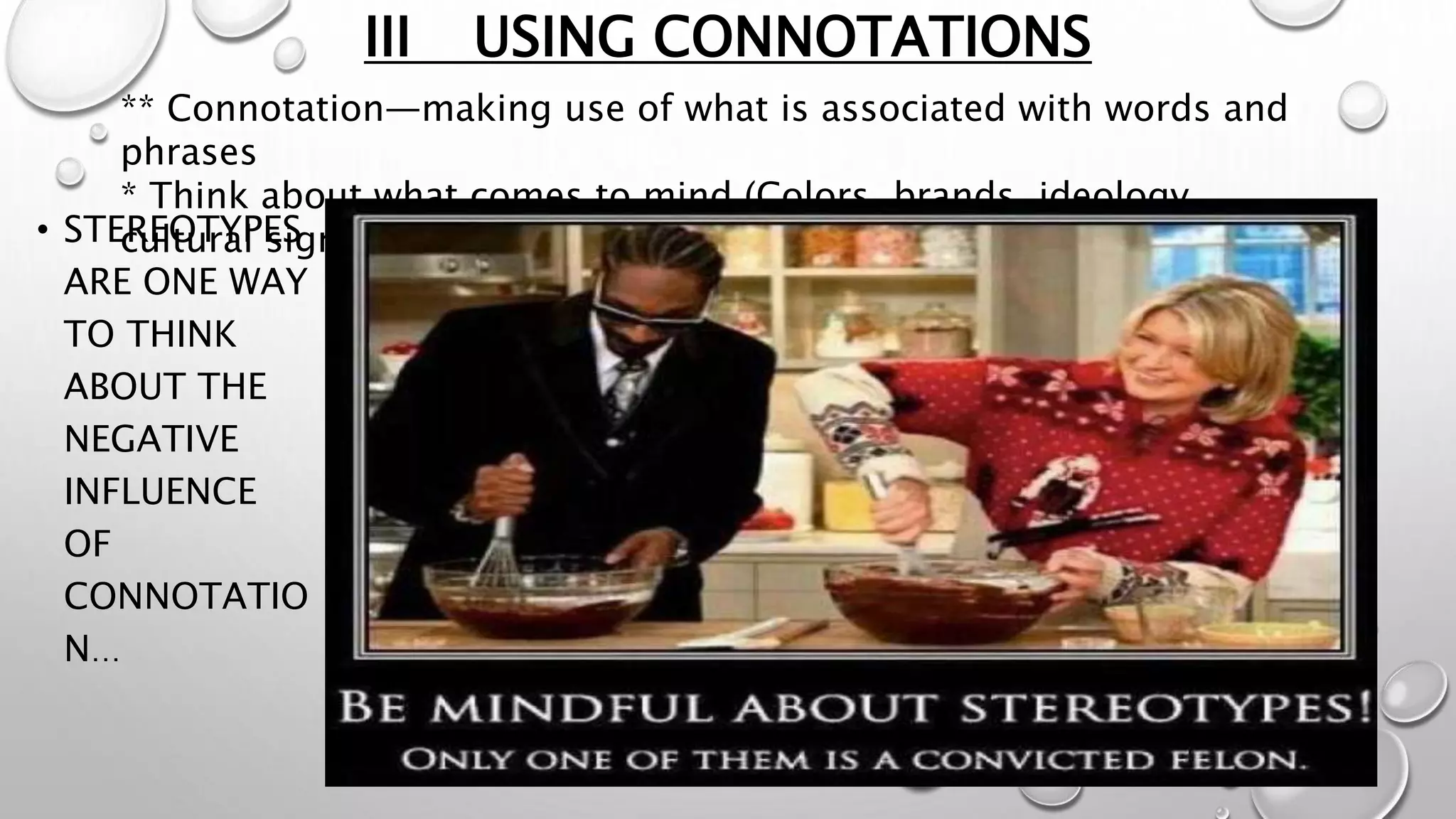
cultural significance)• STEREOTYPES
ARE ONE WAY
TO THINK
ABOUT THE
NEGATIVE
INFLUENCE
OF
CONNOTATIO
N…
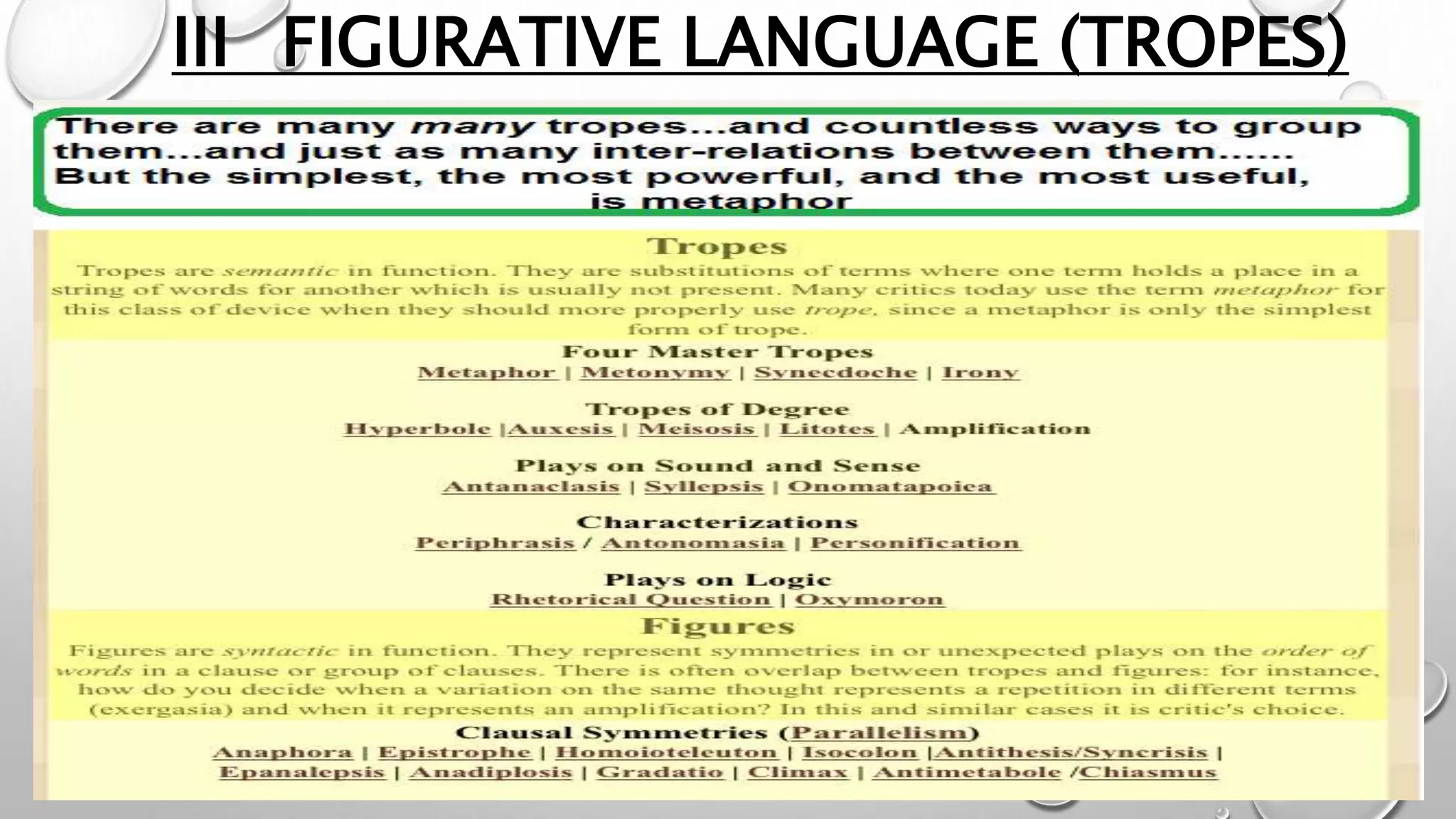
III FIGURATIVE LANGUAGE (TROPES)
III FIGURATIVE LANGUAGE
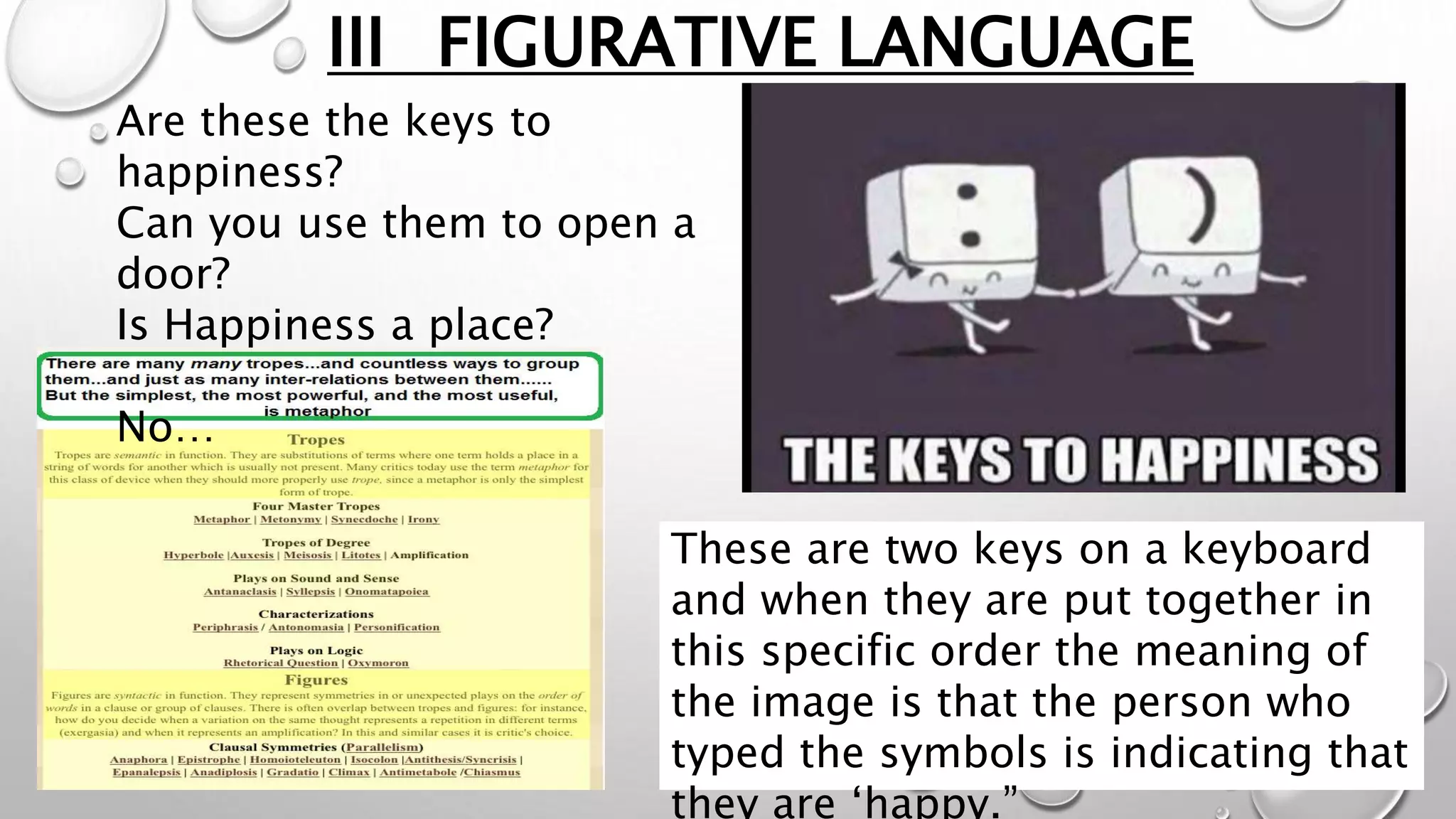
These are two keys on a keyboard
and when they are put together in
this specific order the meaning of
the image is that the person who
typed the symbols is indicating that
they are ‘happy.”
Are these the keys to
happiness?
Can you use them to open a
door?
Is Happiness a place?
No…
III FIGURATIVE LANGUAGE (TROPES)
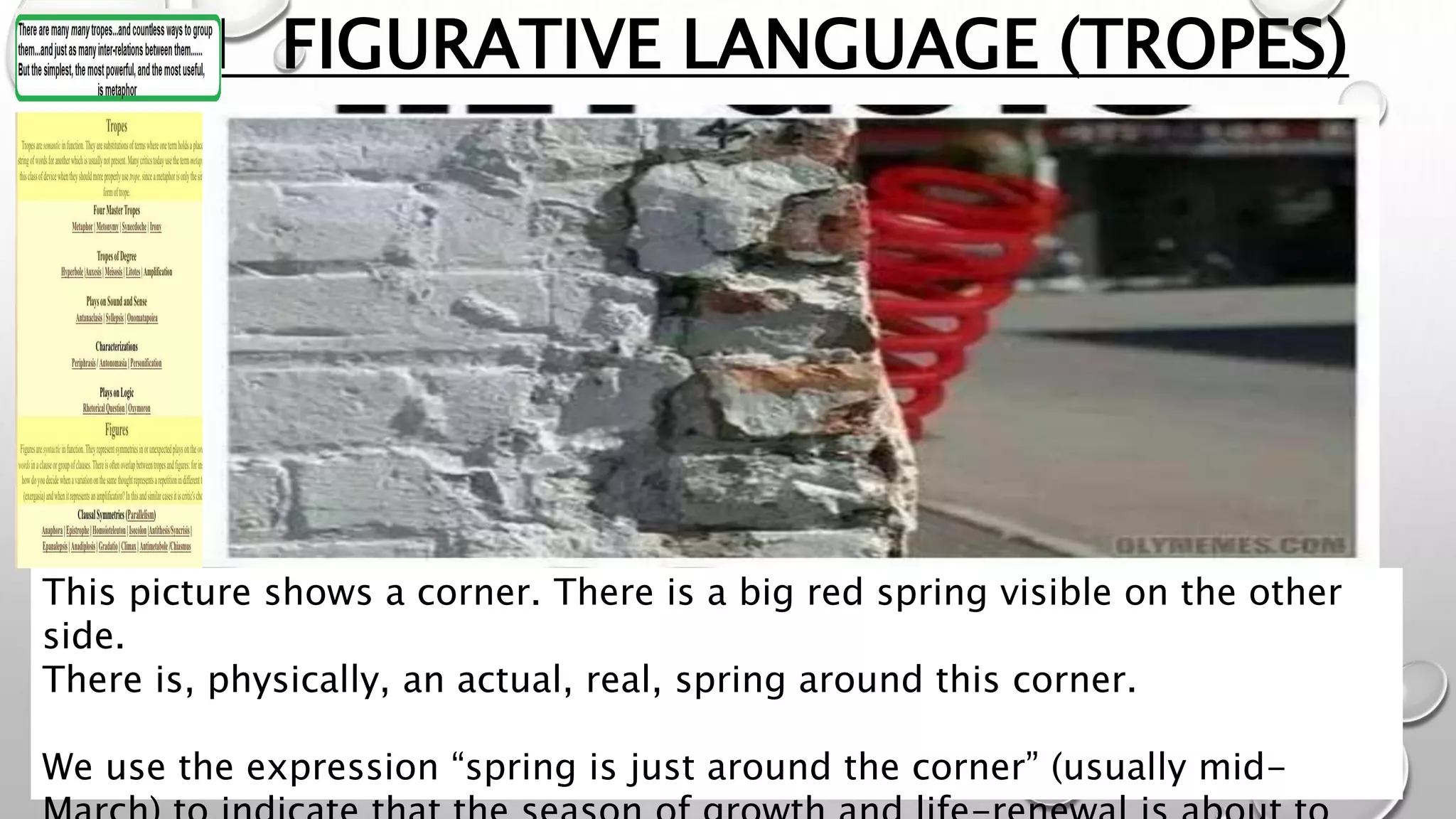
This picture shows a corner. There is a big red spring visible on the other
side.
There is, physically, an actual, real, spring around this corner.
We use the expression “spring is just around the corner” (usually mid-
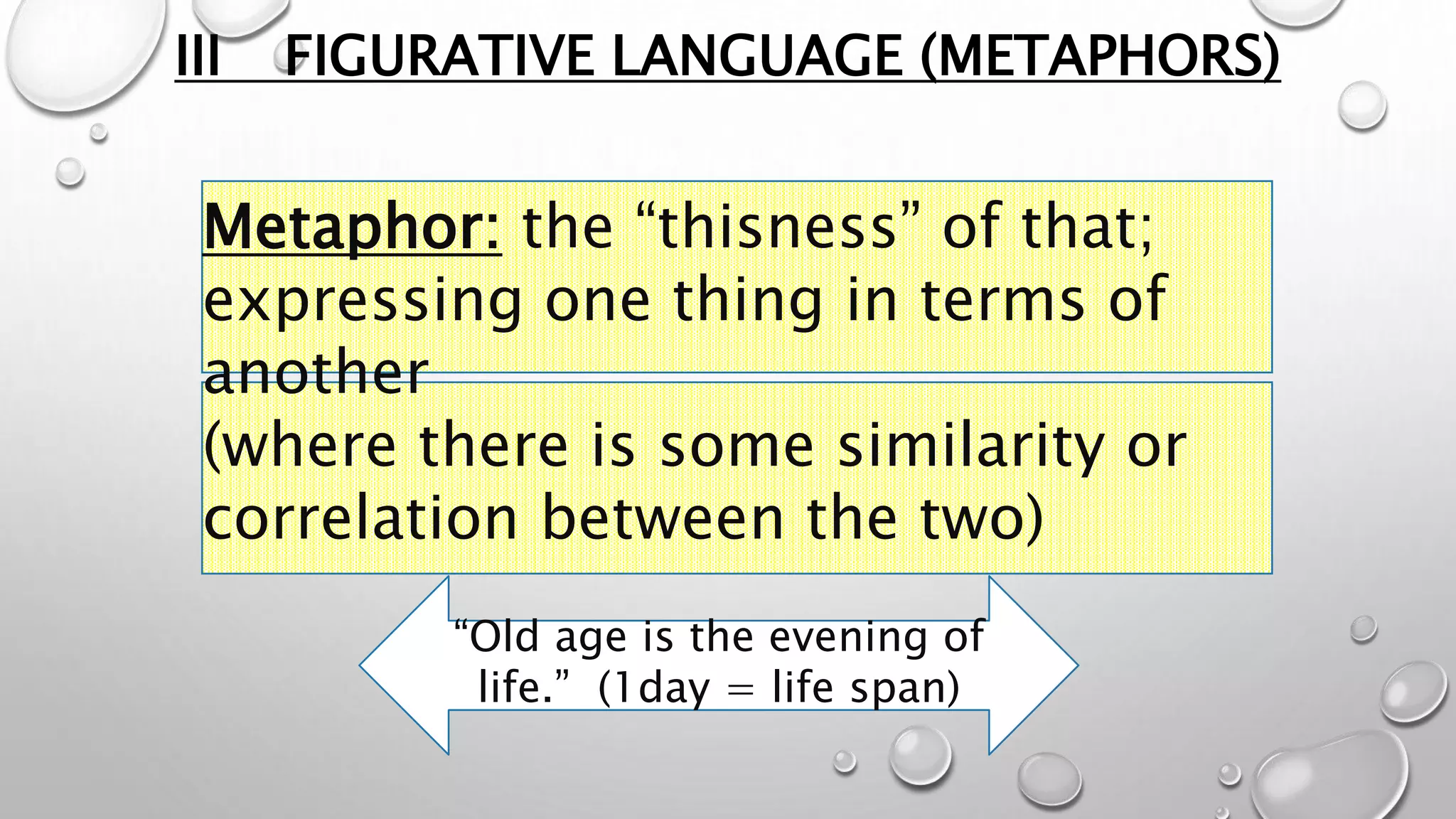
III FIGURATIVE LANGUAGE (METAPHORS)
Metaphor: the “thisness” of that;
expressing one thing in terms of
another
(where there is some similarity or
correlation between the two)
“Old age is the evening of
life.” (1day = life span)
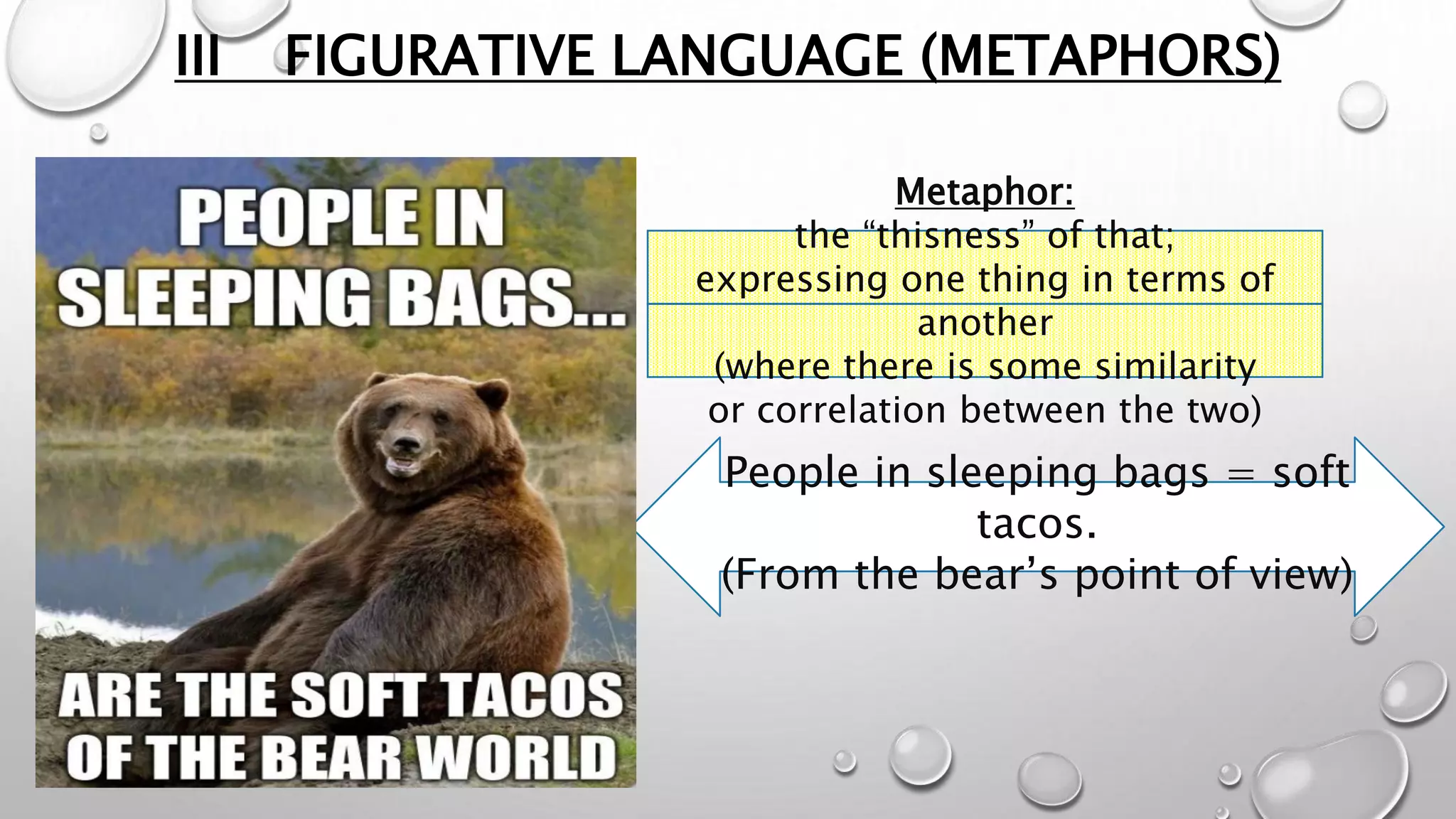
III FIGURATIVE LANGUAGE (METAPHORS)
Metaphor:
the “thisness” of that;
expressing one thing in terms of
another
(where there is some similarity
or correlation between the two)
People in sleeping bags = soft
tacos.
(From the bear’s point of view)
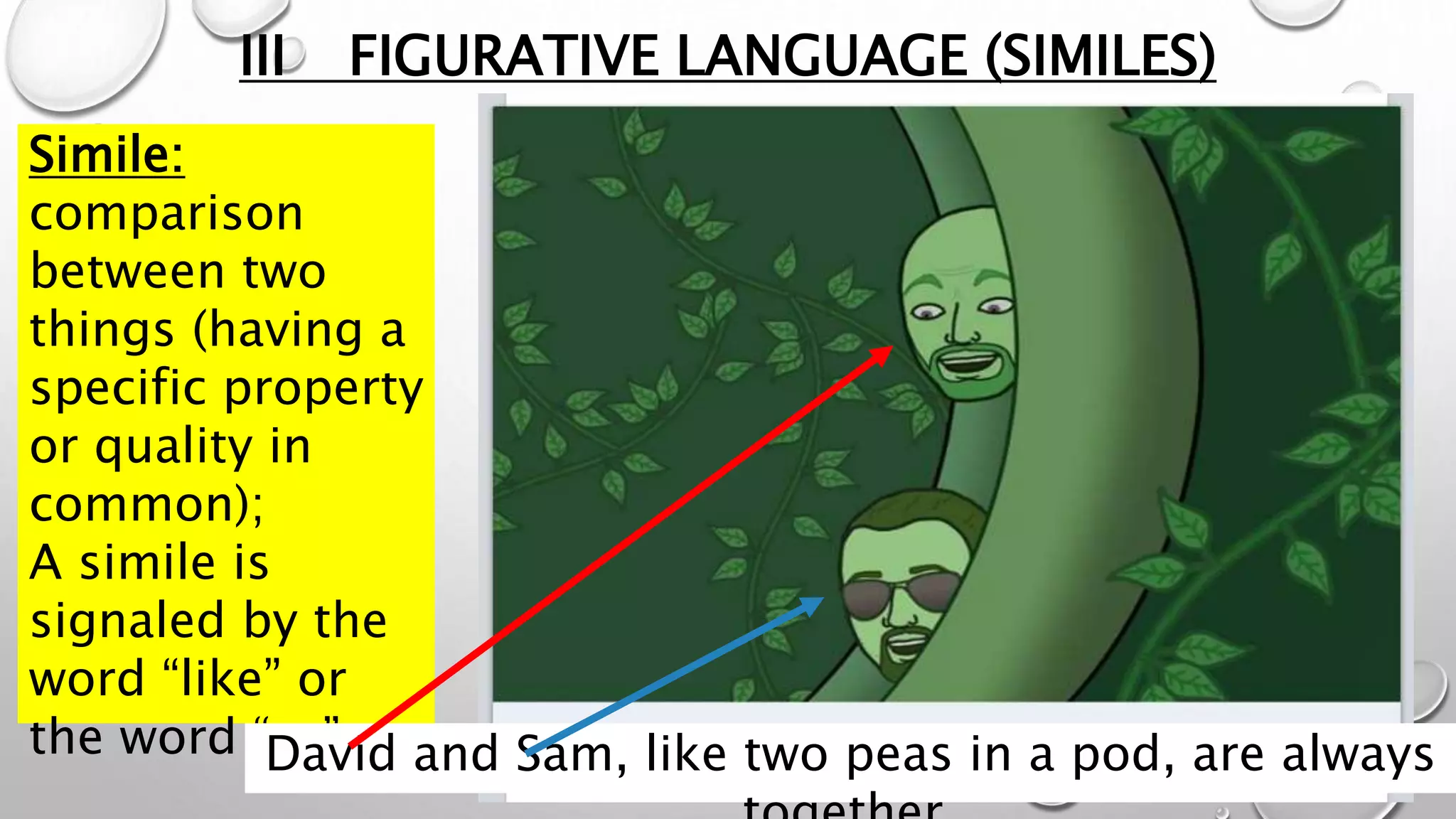
III FIGURATIVE LANGUAGE (SIMILES)
Simile:
comparison
between two
things (having a
specific property
or quality in
common);
A simile is
signaled by the
word “like” or
the word “as”David and Sam, like two peas in a pod, are always
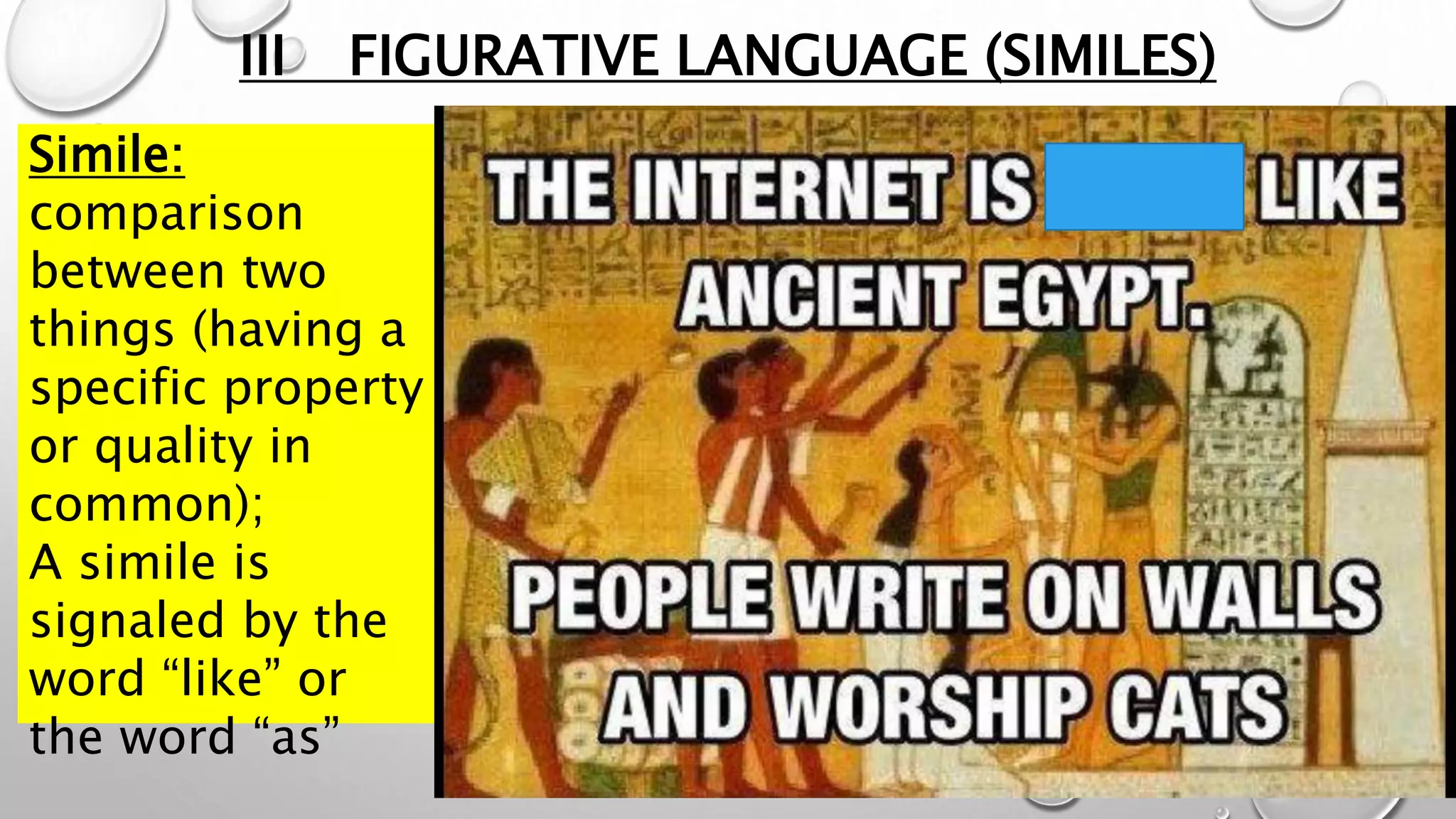
III FIGURATIVE LANGUAGE (SIMILES)
Simile:
comparison
between two
things (having a
specific property
or quality in
common);
A simile is
signaled by the
word “like” or
the word “as”
IV: SELECTING AND OMITTING DETAILS
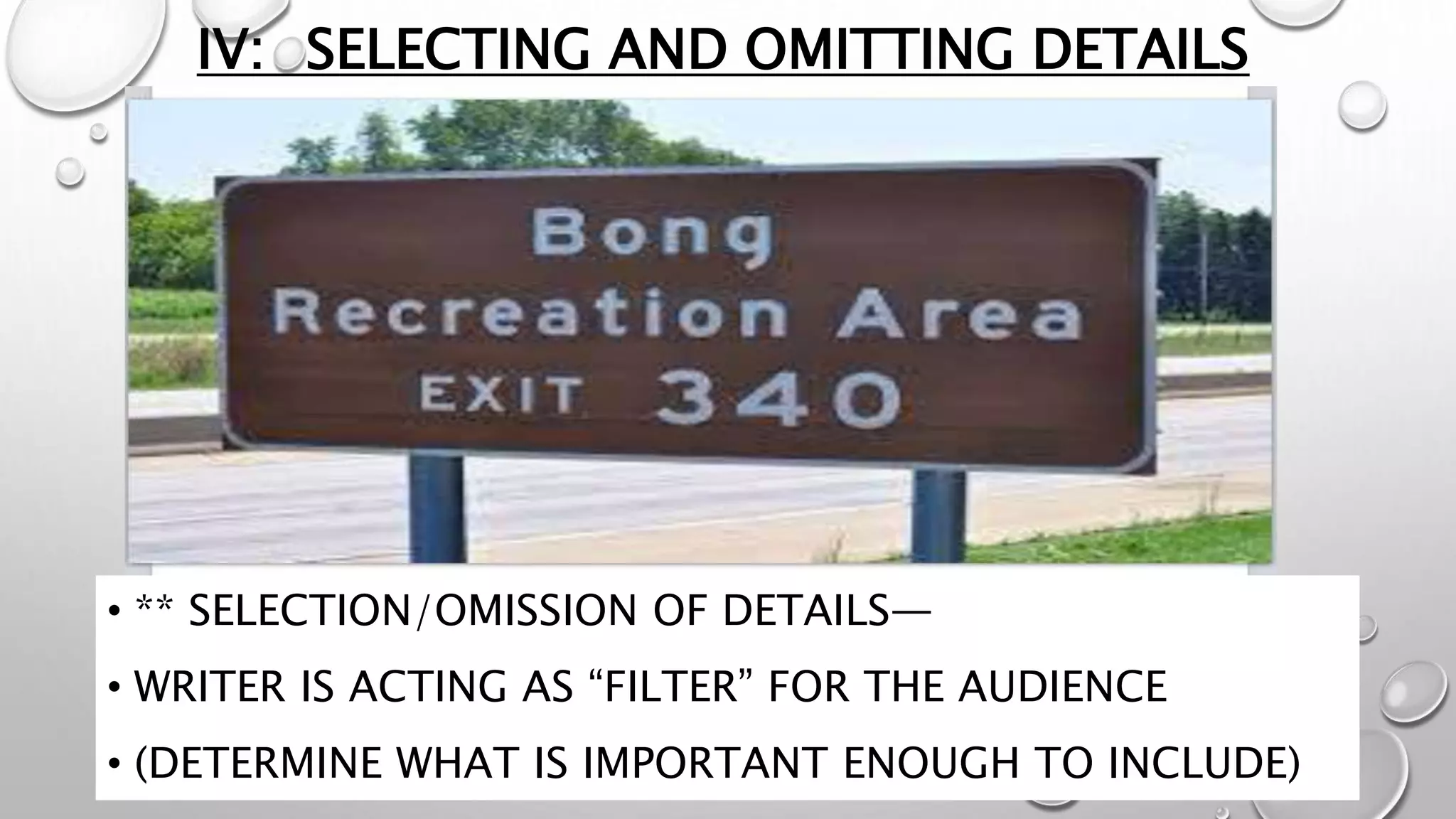
• ** SELECTION/OMISSION OF DETAILS—
• WRITER IS ACTING AS “FILTER” FOR THE AUDIENCE
• (DETERMINE WHAT IS IMPORTANT ENOUGH TO INCLUDE)
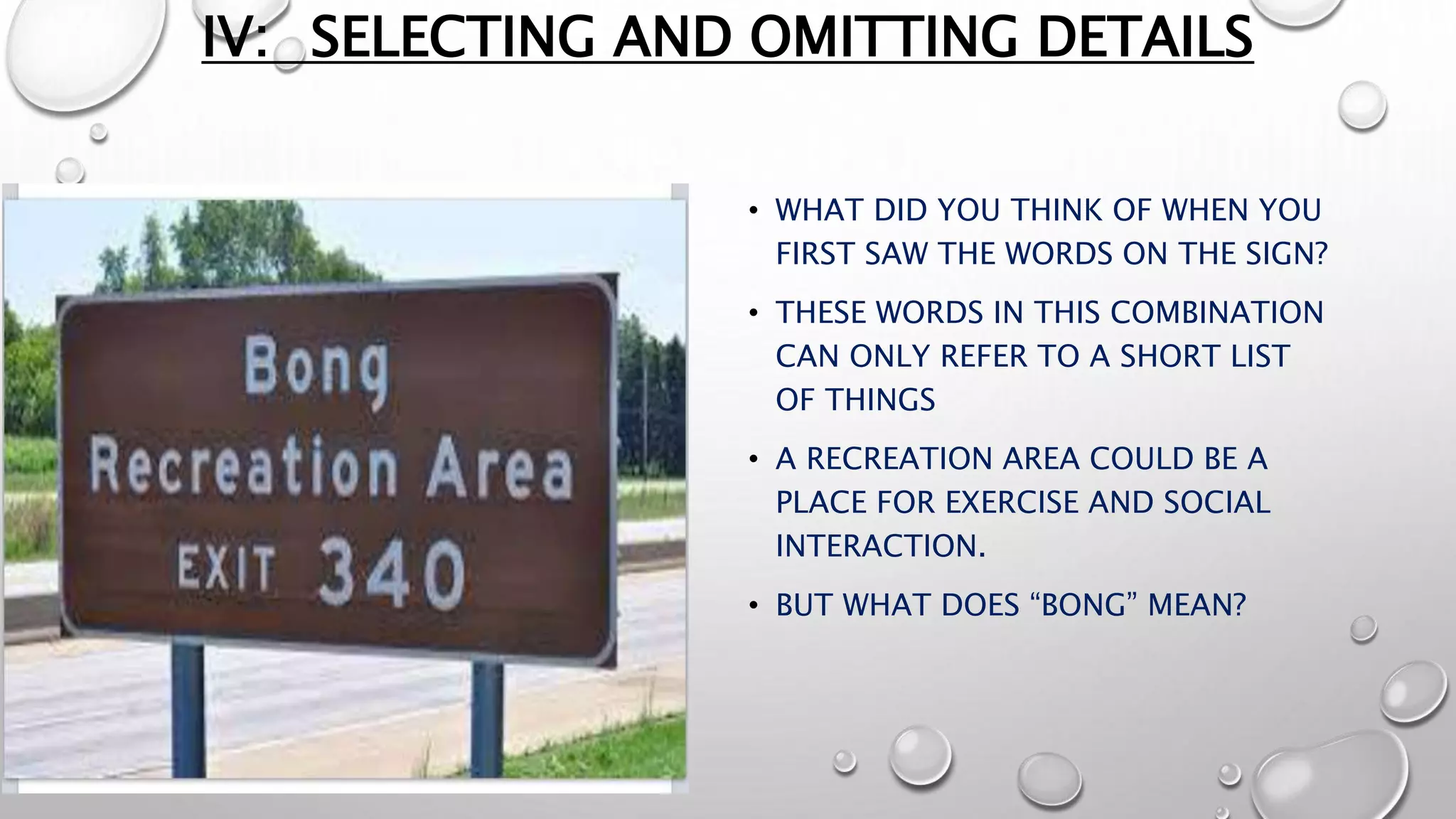
IV: SELECTING AND OMITTING DETAILS
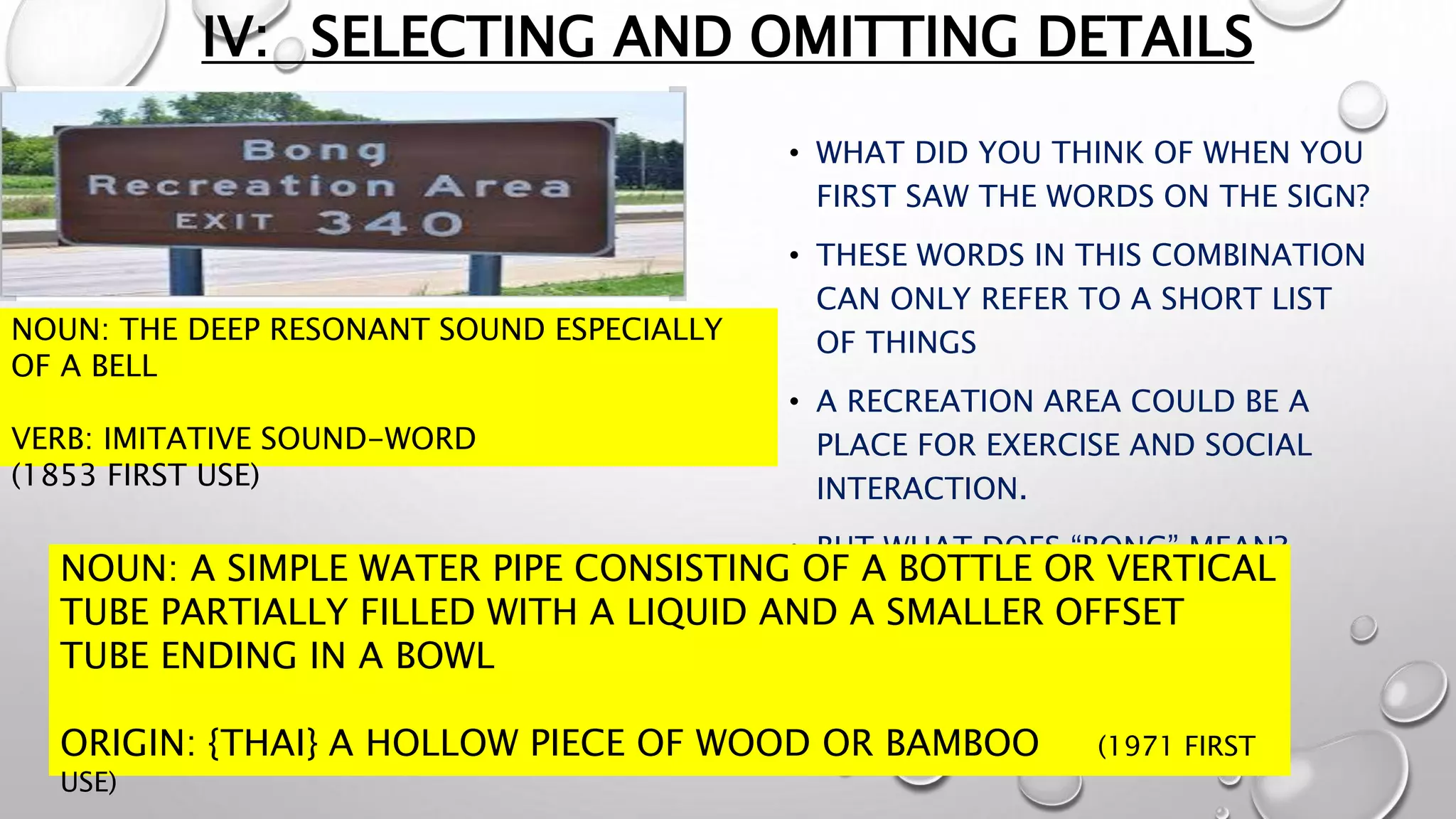
• WHAT DID YOU THINK OF WHEN YOU
FIRST SAW THE WORDS ON THE SIGN?
• THESE WORDS IN THIS COMBINATION
CAN ONLY REFER TO A SHORT LIST
OF THINGS
• A RECREATION AREA COULD BE A
PLACE FOR EXERCISE AND SOCIAL
INTERACTION.
• BUT WHAT DOES “BONG” MEAN?
IV: SELECTING AND OMITTING DETAILS
• WHAT DID YOU THINK OF WHEN YOU
FIRST SAW THE WORDS ON THE SIGN?
• THESE WORDS IN THIS COMBINATION
CAN ONLY REFER TO A SHORT LIST
OF THINGS
• A RECREATION AREA COULD BE A
PLACE FOR EXERCISE AND SOCIAL
INTERACTION.
• BUT WHAT DOES “BONG” MEAN?
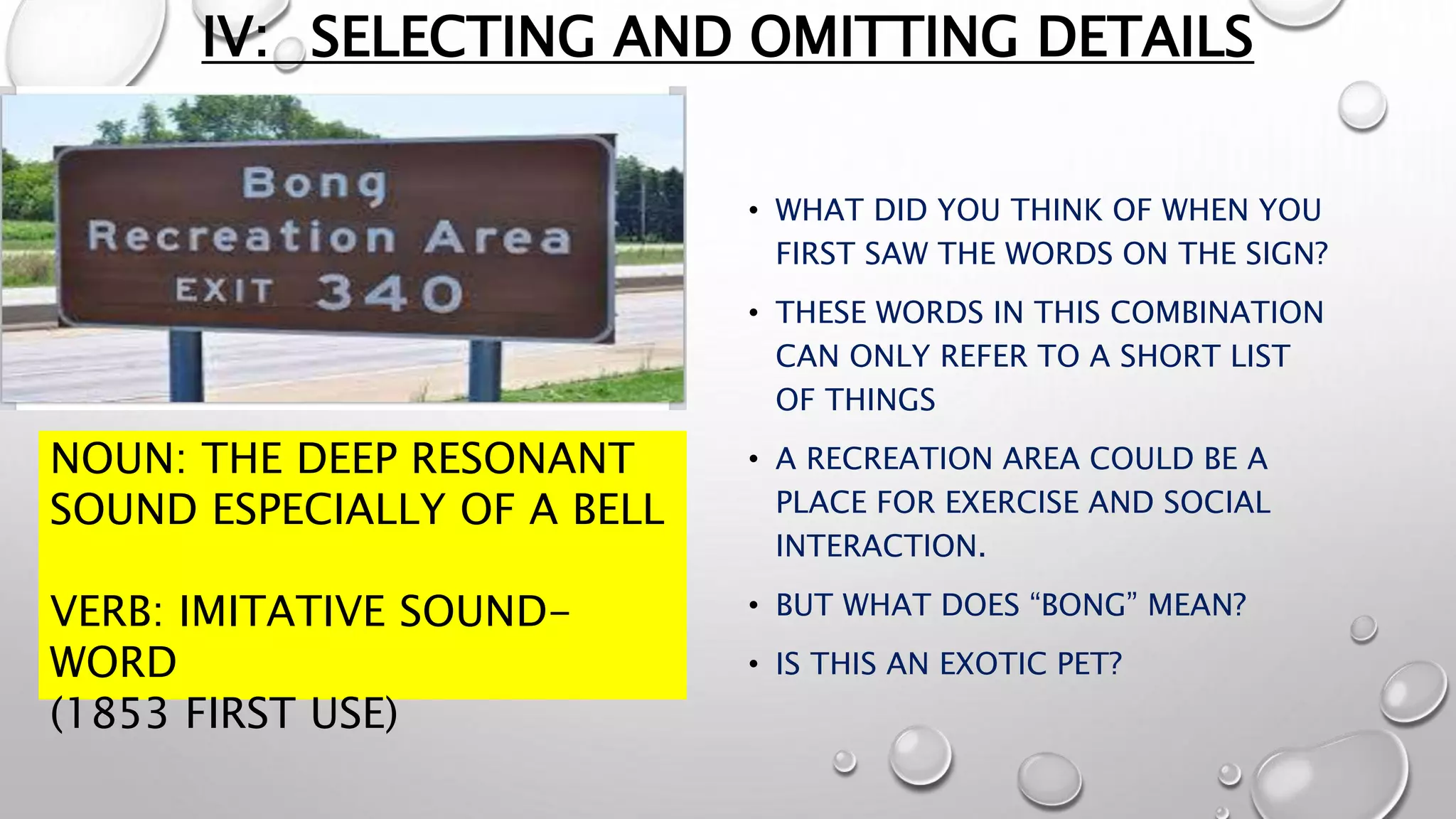
• IS THIS AN EXOTIC PET?
NOUN: THE DEEP RESONANT
SOUND ESPECIALLY OF A BELL
VERB: IMITATIVE SOUND-
WORD
(1853 FIRST USE)
IV: SELECTING AND OMITTING DETAILS
• WHAT DID YOU THINK OF WHEN YOU
FIRST SAW THE WORDS ON THE SIGN?
• THESE WORDS IN THIS COMBINATION
CAN ONLY REFER TO A SHORT LIST
OF THINGS
• A RECREATION AREA COULD BE A
PLACE FOR EXERCISE AND SOCIAL
INTERACTION.
• BUT WHAT DOES “BONG” MEAN?
• IS THIS AN EXOTIC PET?
NOUN: THE DEEP RESONANT SOUND ESPECIALLY
OF A BELL
VERB: IMITATIVE SOUND-WORD
(1853 FIRST USE)
NOUN: A SIMPLE WATER PIPE CONSISTING OF A BOTTLE OR VERTICAL
TUBE PARTIALLY FILLED WITH A LIQUID AND A SMALLER OFFSET
TUBE ENDING IN A BOWL
ORIGIN: {THAI} A HOLLOW PIECE OF WOOD OR BAMBOO (1971 FIRST
USE)
IV: SELECTING AND OMITTING DETAILS
• WHAT DID YOU THINK OF WHEN YOU
FIRST SAW THE WORDS ON THE SIGN?
• THESE WORDS IN THIS COMBINATION
CAN ONLY REFER TO A SHORT LIST
OF THINGS
• A RECREATION AREA COULD BE A
PLACE FOR EXERCISE AND SOCIAL
INTERACTION.
• BUT WHAT DOES “BONG” MEAN?
• IS THIS AN EXOTIC PET?
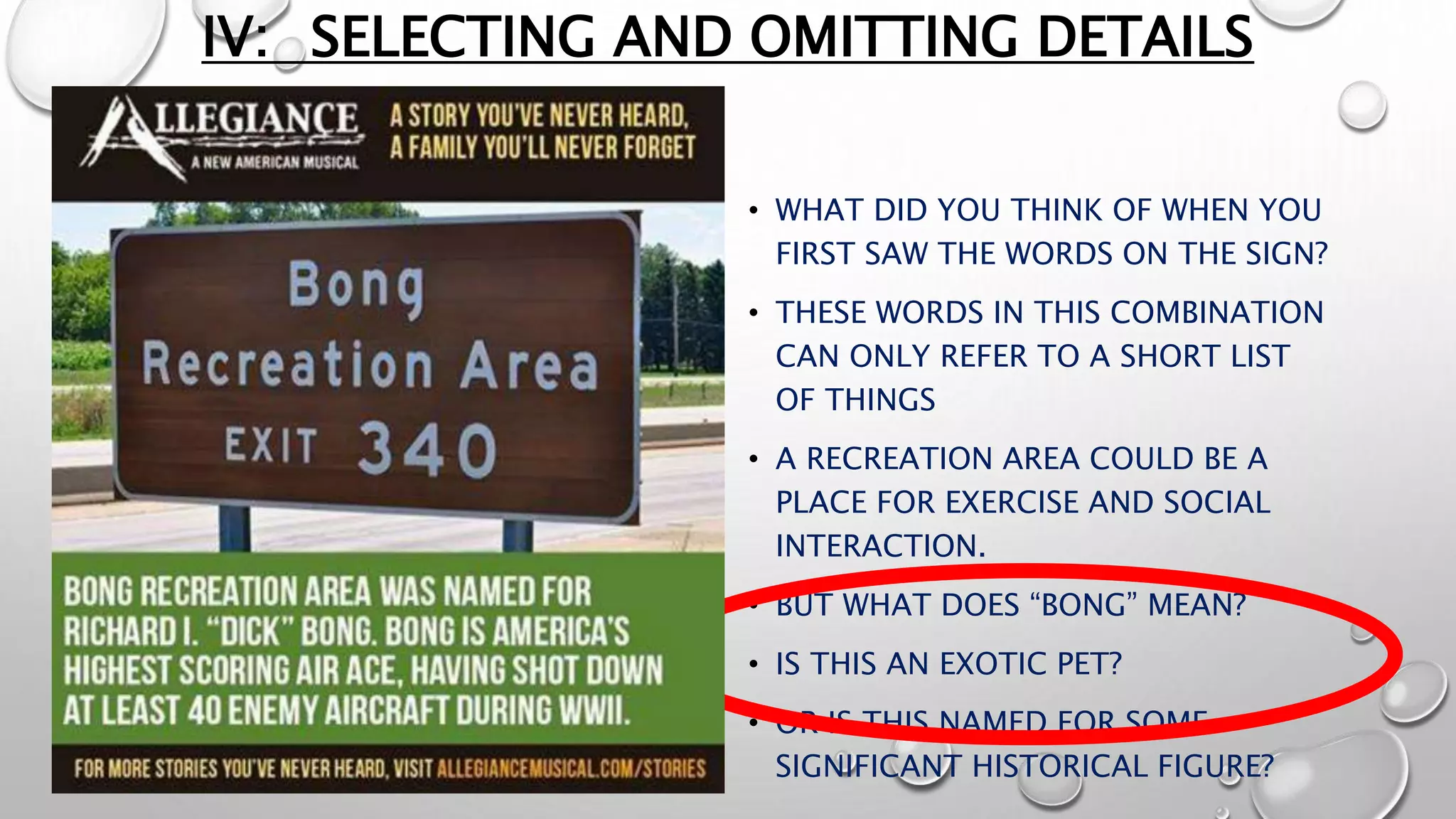
• OR IS THIS NAMED FOR SOME
SIGNIFICANT HISTORICAL FIGURE?
IV: SELECTING AND OMITTING DETAILS
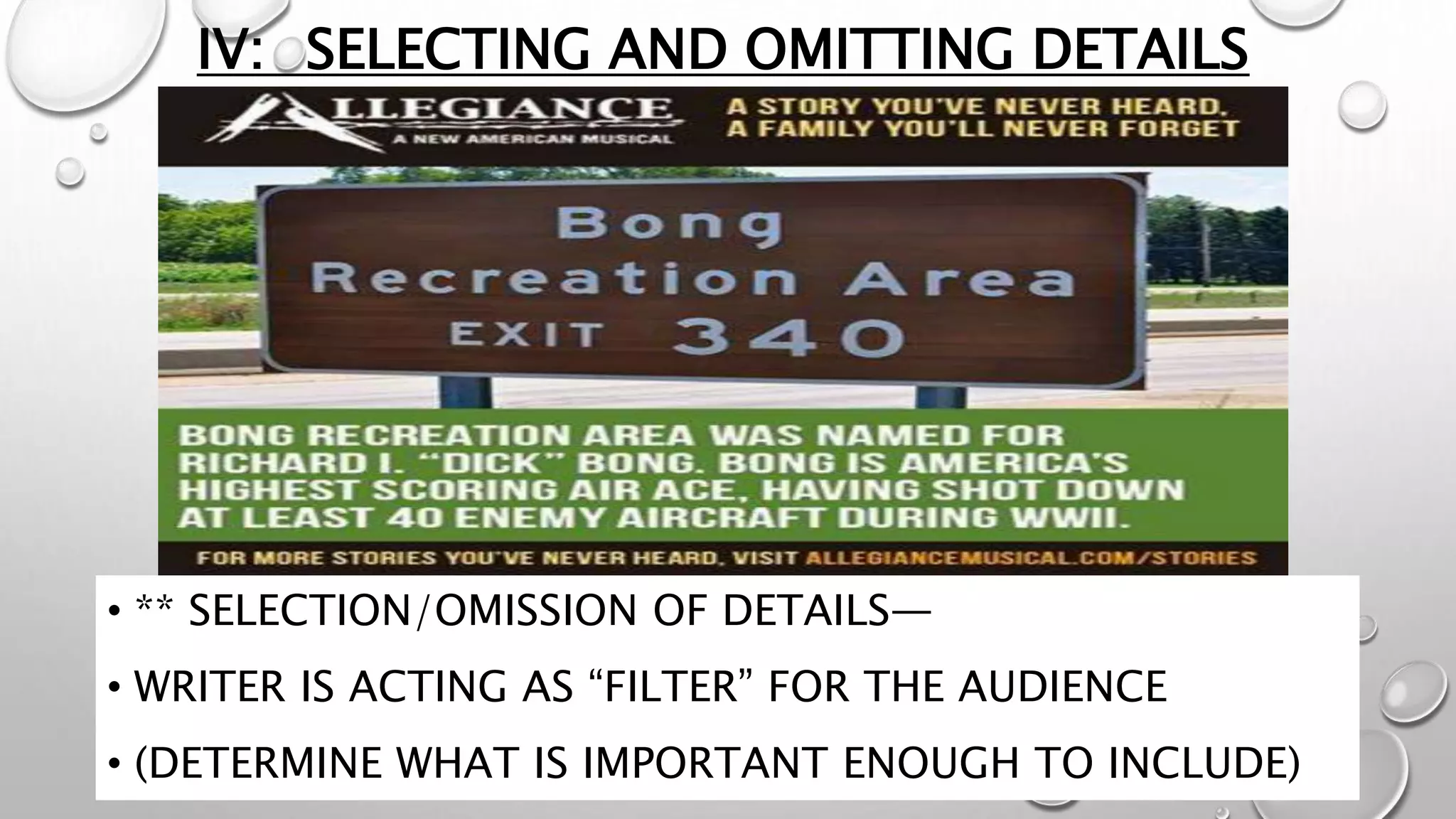
• ** SELECTION/OMISSION OF DETAILS—
• WRITER IS ACTING AS “FILTER” FOR THE AUDIENCE
• (DETERMINE WHAT IS IMPORTANT ENOUGH TO INCLUDE)
FINIS
• IF YOU HAVE QUESTIONS OR COMMENTS
ABOUT THIS PRESENTATION, POST TO
THE DISCUSSION BOARD OR CONTACT
THE INSTRUCTOR
DESCRIPTIVE AND
NARRATIVE WRITING
SHOWING VS TELLING
AND
DESCRIPTIVE STRATEGIES
This presentation created by Paul Brown
February 2015

Showing VS Telling and Descriptive writing strategies

  • 1.
    DESCRIPTIVE AND NARRATIVE WRITING SHOWINGVS TELLING AND DESCRIPTIVE STRATEGIES
  • 2.
    DESCRIPTIVE AND NARRATIVEWRITING This presentation is about… * Showing vs. Telling—using details * Using point of view, intended effect, connotation, figurative language, and selective details to influence your reader.
  • 3.
    DESCRIPTIVE AND NARRATIVEWRITING Let’s help this poor confused little one with some specific descriptors!
  • 4.
    I CONCEPTS FORDESCRIPTIVE WRITING • DESCRIBING ** MEANS • “TO COPY IN WRITING”...TO RECREATE THE REAL WORLD WITH WORDS • 1—NAMING THE OBSERVABLE FEATURES AND EXACT ACTIONS • WITH PRECISE NOUNS • AND SPECIFIC ACTION VERBS • 2—DETAILING THE SPECIFICS OF NAMING • (ADJECTIVE, ADVERBS) • SIZE, QUANTITY, LOCATION, MATERIAL COMPOSITION,
  • 5.
    C SHOWING VS TELLING TellingShowing The book smells nice. The ceramic bread bowl that has been in my family for five generations has a nice, reassuring feel to it that I realize my ancestors must have felt as well. WHAT IS THE DIFFERENCE BETWEEN TELLING AND SHOWING? TELLING PROVIDES INFORMATION, OPINIONS, AND SOME FACTS.
  • 6.
    C SHOWING VS TELLING TellingShowing The book smells nice. The first-edition copy of Longfellow's collected poems smelled of old leather, and a hundred years of dusty thoughts. The ceramic bread bowl that has been in my family for five generations has a nice, reassuring feel to it that I realize my ancestors must have felt as well. As the bowl’s smooth, solid, ceramic interior guides my hands, I imagine my great grandmother’s hands brushing against the same sides of this bowl as she spent hours kneading WHAT IS THE DIFFERENCE BETWEEN TELLING AND SHOWING? TELLING PROVIDES INFORMATION, OPINIONS, AND SOME FACTS. SHOWING GIVES SENSORY DETAILS AND PROVIDES
  • 7.
    D LADDER OF ABSTRACTION animalA vague noun The animal is stuck in a tree.
  • 8.
    D LADDER OF ABSTRACTION animalA vague noun pet Naming with a vague definitional noun The animal is stuck in a tree.
  • 9.
    D LADDER OF ABSTRACTION animalA vague noun pet Naming with a vague definitional noun feline Naming with a vague categorical noun The animal is stuck in a tree.
  • 10.
    D LADDER OF ABSTRACTION animalA vague noun pet Naming with a vague definitional noun feline Naming with a vague categorical noun Kitten Naming with Specific categorical/definitional noun The animal is stuck in a tree.
  • 11.
    D LADDER OF ABSTRACTION animalA vague noun pet Naming with a vague definitional noun feline Naming with a vague categorical noun Kitten Naming with Specific categorical/definitional noun Tuxedo kitten Specific naming with categorical adjective The animal is stuck in a tree.
  • 12.
    D LADDER OF ABSTRACTION animalA vague noun pet Naming with a vague definitional noun feline Naming with a vague categorical noun Kitten Naming with Specific categorical/definitional noun Tuxedo kitten Specific naming with categorical adjective 4-month old Tuxedo kitten Detailed naming with categorical and condition adjective The animal is stuck in a tree.
  • 13.
    D LADDER OF ABSTRACTION animalA vague noun pet Naming with a vague definitional noun feline Naming with a vague categorical noun Kitten Naming with Specific categorical/definitional noun Tuxedo kitten Specific naming with categorical adjective 4-month old Tuxedo kitten Detailed naming with categorical and condition adjective 4-month old Tuxedo kitten named “Darth Vader” Detailed naming with categorical and condition adjective with reference to personality designation of noun The animal is stuck in a tree.
  • 14.
    D LADDER OF ABSTRACTION animalA vague noun pet Naming with a vague definitional noun feline Naming with a vague categorical noun Kitten Naming with Specific categorical/definitional noun Tuxedo kitten Specific naming with categorical adjective 4-month old Tuxedo kitten Detailed naming with categorical and condition adjective 4-month old Tuxedo kitten named “Darth Vader” Detailed naming with categorical and condition adjective with reference to personality designation of noun My 4-month old Tuxedo kitten named “Darth Vader” Plus pronoun to indicate ownership/attachment (connotation and personal connection to reader/writer) The animal is stuck in a tree.
  • 15.
    D LADDER OF ABSTRACTION animalA vague noun pet Naming with a vague definitional noun feline Naming with a vague categorical noun Kitten Naming with Specific categorical/definitional noun Tuxedo kitten Specific naming with categorical adjective 4-month old Tuxedo kitten Detailed naming with categorical and condition adjective 4-month old Tuxedo kitten named “Darth Vader” Detailed naming with categorical and condition adjective with reference to personality designation of noun My 4-month old Tuxedo kitten named “Darth Vader” Plus pronoun to indicate ownership/attachment (connotation and personal connection to reader/writer) My 4-month old Tuxedo kitten named “Darth Vader” is stuck in a tree Fully detailed subject... now we need to work on the predicate (what kind of tree? Where is it tree? How and why did the cat get stuck?) The animal is stuck in a tree.
  • 16.
    B USING SENSORY DETAILS •VISUAL/SIGHT =EYES • MOST DIRECTLY RELATED TO ENGLISH • NOUNS, ADJECTIVES, ADVERBS, VERBS, PREPOSITIONS • (PREDICTING FUTURE OF EVENTS, ANALYZING PAST CONCERNS, ALTERNATE EVENTS)
  • 17.
    B USING SENSORY DETAILS •VISUAL/SIGHT =EYES • MOST DIRECTLY RELATED TO ENGLISH • NOUNS, ADJECTIVES, ADVERBS, VERBS, PREPOSITIONS • (PREDICTING FUTURE OF EVENTS, ANALYZING PAST CONCERNS, ALTERNATE EVENTS) • HEAR/SOUND =EARS • ALSO DIRECTLY RELATED TO ENGLISH • NOUNS (NAMES OF SOUNDS) ADJECTIVES, ADVERBS (DETAILS) • (GOOD OR BAD EVENT ATMOSPHERE…QUALITATIVE/RELATIVE)
  • 18.
    B USING SENSORY DETAILS •VISUAL/SIGHT =EYES • MOST DIRECTLY RELATED TO ENGLISH • NOUNS, ADJECTIVES, ADVERBS, VERBS, PREPOSITIONS • (PREDICTING FUTURE OF EVENTS, ANALYZING PAST CONCERNS, ALTERNATE EVENTS) • HEAR/SOUND =EARS • ALSO DIRECTLY RELATED TO ENGLISH • NOUNS (NAMES OF SOUNDS) ADJECTIVES, ADVERBS (DETAILS) • (GOOD OR BAD EVENT ATMOSPHERE…QUALITATIVE/RELATIVE)
  • 19.
    B USING SENSORY DETAILS •VISUAL/SIGHT =EYES • MOST DIRECTLY RELATED TO ENGLISH • NOUNS, ADJECTIVES, ADVERBS, VERBS, PREPOSITIONS • (PREDICTING FUTURE OF EVENTS, ANALYZING PAST CONCERNS, ALTERNATE EVENTS) • HEAR/SOUND =EARS • ALSO DIRECTLY RELATED TO ENGLISH • NOUNS (NAMES OF SOUNDS) ADJECTIVES, ADVERBS (DETAILS) • (GOOD OR BAD EVENT ATMOSPHERE…QUALITATIVE/RELATIVE) Smell = nose (also anticipation of good/bad event, malicious intent) Taste = mouth (also music, art, literature, men, women, fashion==comparison) ** Smell and Taste are not as directly related to English.
  • 20.
    DECRIPTIVE WRITING STRATEGIES Details:use the five senses to describe the environs. When composing sentences for description use “Camera Movement”: top to bottom, inside out, left to right, front to back You don’t need to try and cram every detail into one sentence. The best method is to focus on two or three things AT MOST in each sentence. TRUST THAT YOUR READER WILL BE ABLE TO PUT IT ALL
  • 21.
    DECRIPTIVE WRITING STRATEGIES •TAKE THIS SINGLE PANEL COMIC AS AN EXAMPLE
  • 24.
    This is alsotrue of sentences and paragraphs. Each sentence acts as a single panel and the paragraph acts like the whole thing in one.
  • 25.
    I POINT OFVIEW IT ALL DEPENDS ON HOW YOU LOOK AT IT!
  • 26.
  • 27.
    II CREATING THEINTENDED EFFECT • JON KRAKAUER INTO THIN AIR • CHAPTER1 BEGINS: “STRADDLING THE TOP OF THE WORLD, ONE FOOT IN CHINA AND THE OTHER IN NEPAL, I CLEARED THE ICE FROM MY OXYGEN MASK, HUNCHED A SHOULDER AGAINST THE WIND, AND STARED ABSENTLY DOWN AT THE VASTNESS OF TIBET.” • CHAPTER 1 ENDS WITH: • “NOBODY SUSPECTED THAT BY THE END OF THAT LONG DAY, EVERY MINUTE WOULD **—creating a mood or atmosphere to reinforce the writer’s purpose **—fill the reader’s imagination with details **—accumulated connotations, naming, detailing, comparing, and sensory language
  • 28.
    III USING CONNOTATIONS **Connotation—making use of what is associated with words and phrases * Think about what comes to mind (Colors, brands, ideology, cultural significance) • CONSIDER THE ASSOCIATIONS OF SONGS AND WORDS AND IMAGES… • WHAT KIND OF INFLUENCE DO THESE THINGS HAVE?
  • 29.
    III USING CONNOTATIONS **Connotation—making use of what is associated with words and phrases * Think about what comes to mind (Colors, brands, ideology, cultural significance)• STEREOTYPES ARE ONE WAY TO THINK ABOUT THE NEGATIVE INFLUENCE OF CONNOTATIO N…
  • 30.
  • 31.
    III FIGURATIVE LANGUAGE Theseare two keys on a keyboard and when they are put together in this specific order the meaning of the image is that the person who typed the symbols is indicating that they are ‘happy.” Are these the keys to happiness? Can you use them to open a door? Is Happiness a place? No…
  • 32.
    III FIGURATIVE LANGUAGE(TROPES) This picture shows a corner. There is a big red spring visible on the other side. There is, physically, an actual, real, spring around this corner. We use the expression “spring is just around the corner” (usually mid-
  • 33.
    III FIGURATIVE LANGUAGE(METAPHORS) Metaphor: the “thisness” of that; expressing one thing in terms of another (where there is some similarity or correlation between the two) “Old age is the evening of life.” (1day = life span)
  • 34.
    III FIGURATIVE LANGUAGE(METAPHORS) Metaphor: the “thisness” of that; expressing one thing in terms of another (where there is some similarity or correlation between the two) People in sleeping bags = soft tacos. (From the bear’s point of view)
  • 35.
    III FIGURATIVE LANGUAGE(SIMILES) Simile: comparison between two things (having a specific property or quality in common); A simile is signaled by the word “like” or the word “as”David and Sam, like two peas in a pod, are always
  • 36.
    III FIGURATIVE LANGUAGE(SIMILES) Simile: comparison between two things (having a specific property or quality in common); A simile is signaled by the word “like” or the word “as”
  • 37.
    IV: SELECTING ANDOMITTING DETAILS • ** SELECTION/OMISSION OF DETAILS— • WRITER IS ACTING AS “FILTER” FOR THE AUDIENCE • (DETERMINE WHAT IS IMPORTANT ENOUGH TO INCLUDE)
  • 38.
    IV: SELECTING ANDOMITTING DETAILS • WHAT DID YOU THINK OF WHEN YOU FIRST SAW THE WORDS ON THE SIGN? • THESE WORDS IN THIS COMBINATION CAN ONLY REFER TO A SHORT LIST OF THINGS • A RECREATION AREA COULD BE A PLACE FOR EXERCISE AND SOCIAL INTERACTION. • BUT WHAT DOES “BONG” MEAN?
  • 39.
    IV: SELECTING ANDOMITTING DETAILS • WHAT DID YOU THINK OF WHEN YOU FIRST SAW THE WORDS ON THE SIGN? • THESE WORDS IN THIS COMBINATION CAN ONLY REFER TO A SHORT LIST OF THINGS • A RECREATION AREA COULD BE A PLACE FOR EXERCISE AND SOCIAL INTERACTION. • BUT WHAT DOES “BONG” MEAN? • IS THIS AN EXOTIC PET? NOUN: THE DEEP RESONANT SOUND ESPECIALLY OF A BELL VERB: IMITATIVE SOUND- WORD (1853 FIRST USE)
  • 40.
    IV: SELECTING ANDOMITTING DETAILS • WHAT DID YOU THINK OF WHEN YOU FIRST SAW THE WORDS ON THE SIGN? • THESE WORDS IN THIS COMBINATION CAN ONLY REFER TO A SHORT LIST OF THINGS • A RECREATION AREA COULD BE A PLACE FOR EXERCISE AND SOCIAL INTERACTION. • BUT WHAT DOES “BONG” MEAN? • IS THIS AN EXOTIC PET? NOUN: THE DEEP RESONANT SOUND ESPECIALLY OF A BELL VERB: IMITATIVE SOUND-WORD (1853 FIRST USE) NOUN: A SIMPLE WATER PIPE CONSISTING OF A BOTTLE OR VERTICAL TUBE PARTIALLY FILLED WITH A LIQUID AND A SMALLER OFFSET TUBE ENDING IN A BOWL ORIGIN: {THAI} A HOLLOW PIECE OF WOOD OR BAMBOO (1971 FIRST USE)
  • 41.
    IV: SELECTING ANDOMITTING DETAILS • WHAT DID YOU THINK OF WHEN YOU FIRST SAW THE WORDS ON THE SIGN? • THESE WORDS IN THIS COMBINATION CAN ONLY REFER TO A SHORT LIST OF THINGS • A RECREATION AREA COULD BE A PLACE FOR EXERCISE AND SOCIAL INTERACTION. • BUT WHAT DOES “BONG” MEAN? • IS THIS AN EXOTIC PET? • OR IS THIS NAMED FOR SOME SIGNIFICANT HISTORICAL FIGURE?
  • 42.
    IV: SELECTING ANDOMITTING DETAILS • ** SELECTION/OMISSION OF DETAILS— • WRITER IS ACTING AS “FILTER” FOR THE AUDIENCE • (DETERMINE WHAT IS IMPORTANT ENOUGH TO INCLUDE)
  • 43.
    FINIS • IF YOUHAVE QUESTIONS OR COMMENTS ABOUT THIS PRESENTATION, POST TO THE DISCUSSION BOARD OR CONTACT THE INSTRUCTOR
  • 44.
    DESCRIPTIVE AND NARRATIVE WRITING SHOWINGVS TELLING AND DESCRIPTIVE STRATEGIES This presentation created by Paul Brown February 2015