Bellringer…
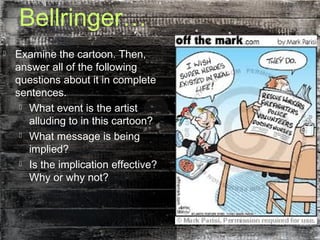
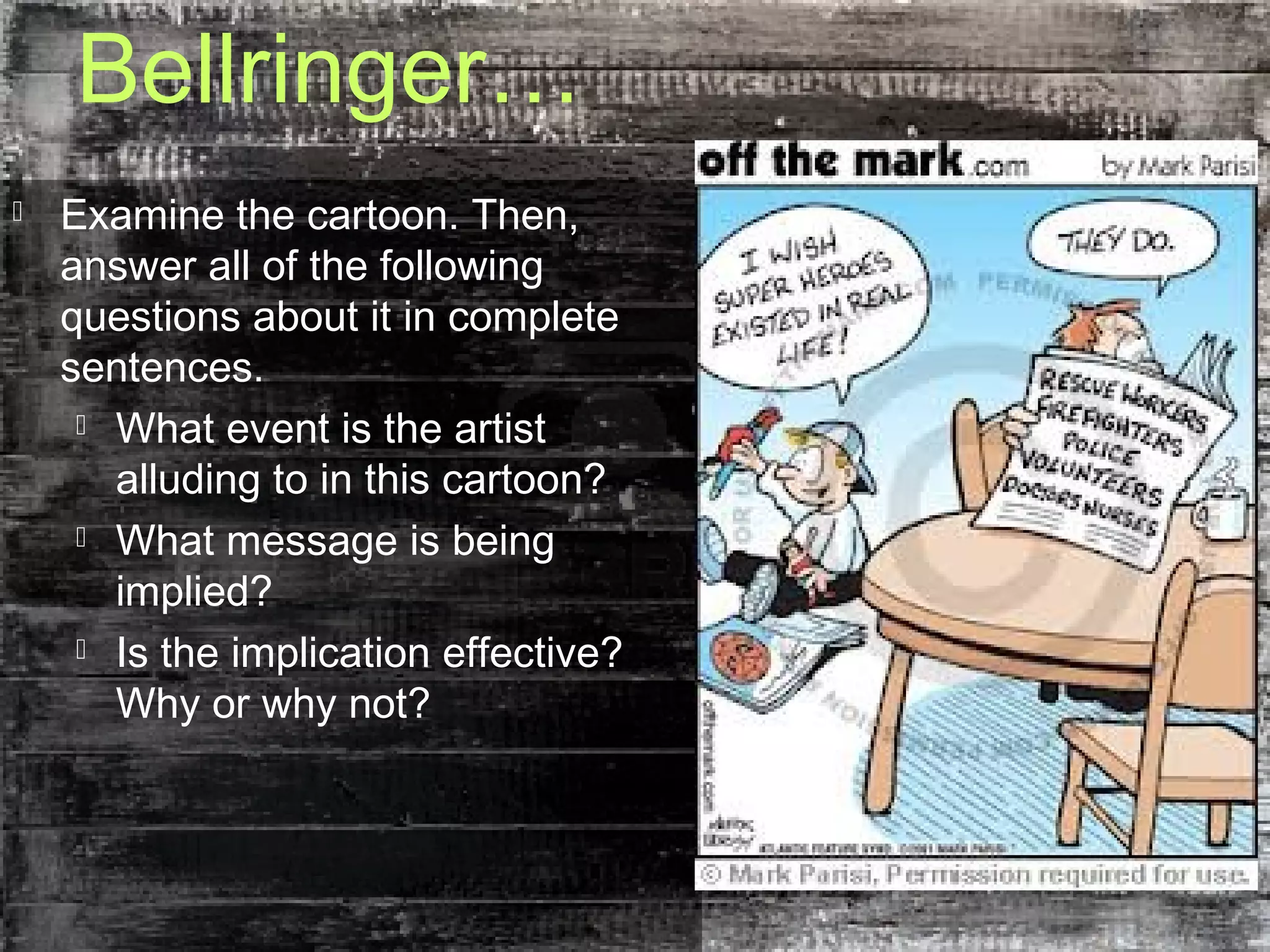
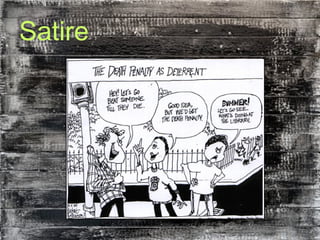
 Examine the cartoon. Then,
answer all of the following
questions about it in complete
sentences.
 What event is the artist
alluding to in this cartoon?
 What message is being
implied?
 Is the implication effective?
Why or why not?
Introduction to
Satire
The Art of Indirect
Persuasion
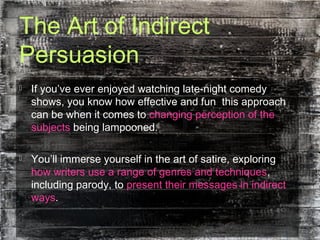
 If you’ve ever enjoyed watching late-night comedy
shows, you know how effective and fun this approach
can be when it comes to changing perception of the
subjects being lampooned.
 You’ll immerse yourself in the art of satire, exploring
how writers use a range of genres and techniques,
including parody, to present their messages in indirect
ways.
The Art of Indirect
Persuasion
 Additionally, you’ll explore how diction and syntax can
be used to create humor as well as a wide range of
satirical tones.
 Finally, you’ll explore how satirists manipulate and
parody the conventions and content of other formats
and genres to advance their purposes as writers.
Satire
 Satire is a literary genre that uses irony, wit,
and sometimes sarcasm to expose
humanity’s vices and foibles, giving impetus,
or momentum, to change or reform through
ridicule.
 It is a manner of writing that mixes a critical
attitude with wit and humor in an effort to
improve mankind and human institutions.
Satire
 While some writers and commentators use a
serious tone to persuade their audiences to
accept their perspective on various issues,
some writers specifically use humor to
convey a serious message.
7
What is Satire?
 Though he laughs, the satirist tells the truth
 Compels readers to look at a sight they
missed or shunned - move them to protest
 Through laughter, aims to cure folly and
punish evil
8
Two Types of Satirists
 Optimist
 Likes people, but thinks they are
rather blind and foolish
 Tells the truth with a smile
 Cures people of their ignorance
 Writes in order to heal
9
Two Types of Satirists
Pessimist
Loves individuals, hates
mankind
Aim is to wound, to punish,
to destroy
Juvenalian satire
Satire
Types of Direct Satire
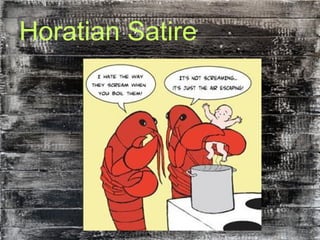
 Horatian satire is a type of direct
satire which pokes fun at human foibles
with a witty even indulgent tone.
 Juvenalian satire is a type of direct
satire which denounces, sometimes
with invective, human vice and error in
dignified and solemn tones.
Horatian Satire
 This type of satire is named after the Roman satirist
Horatian.
 It seeks to criticize, rather than attack, immorality or
stupidity.
 In general, Horatian satire is gentler, more sympathetic, and
more tolerant of human folly.
 Unlike Juvenalian satire, it serves to make us laugh at
human folly as opposed to holding our failures up for
needling.
 Horatian satire tends to ridicule human folly in general or by
type rather than attack specific persons.
 It tends to produce a smile.
13
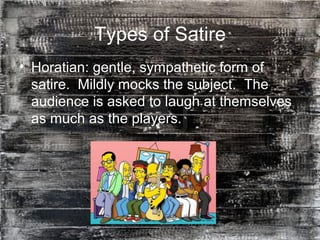
Types of Satire
• Horatian: gentle, sympathetic form of
satire. Mildly mocks the subject. The
audience is asked to laugh at themselves
as much as the players.
Horatian Satire
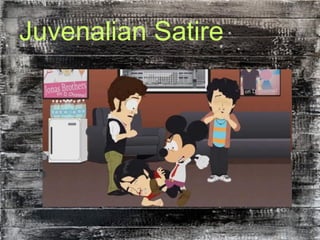
Juvenalian Satire
 This type of satire is named after the Roman satirist
Juvenal.
 It is harsher than Horatian satire because it often
attacks and shows contempt for people.
 Often, it seeks to address some evil in society
through scorn and ridicule.
 The Juvenalian satirist approaches his work in a
more serious manner and uses dignified language to
attack erroneous thinking or vice.
 In this way Juvenalian satire evokes feelings of
scorn, shock, and righteous indignation in the mind
of the reader.
Juvenalian Satire
Characteristics of
Satiric Writing
 The following slides describe the various
characteristics that often appear in satiric
writing.
 As you read the literature in the remainder
of this unit, your goal will be to identify and
analyze these characteristics and their
effect on the various texts.
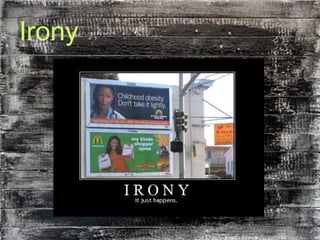
Irony
 Irony is a mode of expression, through
words (verbal irony) or events (irony of
situation), conveying a reality different
from and usually opposite to appearance
or expectation.
 The surprise recognition by the audience
often produces a comic effect, making
irony often funny.
Irony
 When a text intended to be ironic does not
seen as such, the effect can be
disastrous.
 To be an effective piece of sustained
irony, there must be some sort of
audience tip-off, through style, tone, use of
clear exaggeration, or other device.
Irony
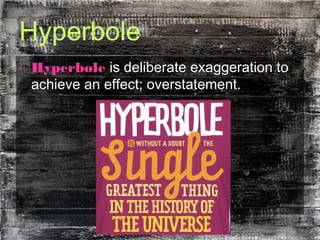
Hyperbole
 Hyperbole is deliberate exaggeration to
achieve an effect; overstatement.
Litotes
 Litotes are a form of understatement that involves
making an affirmative point by denying its opposite.
 For Example:
 “Being tortured with fire must have been somewhat
uncomfortable.”
 “Rap videos with dancers in them are not uncommon.“
 “There are a few Starbucks in America."
Caricature
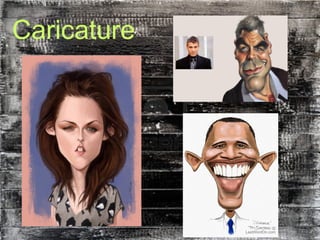
 A caricature is an exaggeration or other
distortion of an individual's prominent
features or characteristics to the point of
making that individual appear ridiculous.
 The term is applied more often to graphic
representations than to literary ones.
24
Forms of Satire
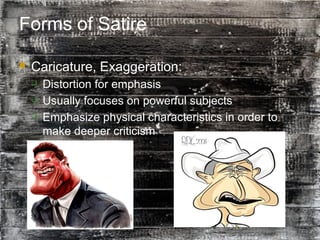
 Caricature, Exaggeration:
 Distortion for emphasis
 Usually focuses on powerful subjects
 Emphasize physical characteristics in order to
make deeper criticism
Caricature
Wit
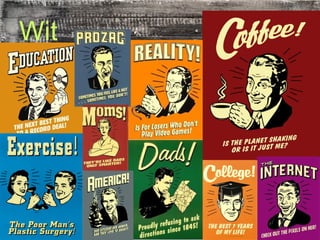
 Wit is most commonly understood as clever
expression, whether aggressive or harmless;
that is, with or without derogatory intent toward
someone or something in particular.
 We also tend to think of wit as being
characterized by a mocking or paradoxical
quality, evoking laughter through apt phrasing.
Wit
Sarcasm
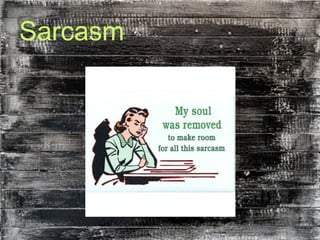
 Sarcasm is intentional derision, generally
directed at another person and intended to hurt.
 The term comes from a Greek word meaning “to
tear flesh like dogs” and signifies a cutting
remark.
 Sarcasm usually involves obvious, verbal irony,
achieving its effect by jeeringly stating the
opposite of what is meant so as to heighten the
insult.
Sarcasm
30
Ridicule
 Ridicule is the use of words intended to
belittle a person or idea and arouse
contemptuous laughter.
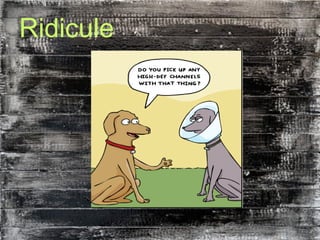
 The goal is to condemn or criticize by
making the thing, idea, or person seem
laughable and ridiculous.
Ridicule
Parody
 A parody is an imitation of an author or
his/her work with the idea of ridiculing the
author, his/her ideas, or the work itself.
 A parodist exploits the peculiarities of an
author’s expression—the propensity to
use too many parentheses, certain favorite
words, or other elements of the author’s
style.
34
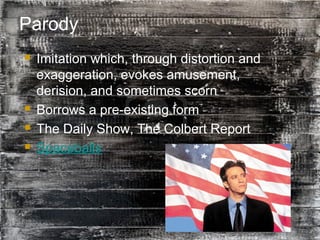
Parody
 Imitation which, through distortion and
exaggeration, evokes amusement,
derision, and sometimes scorn
 Borrows a pre-existing form
 The Daily Show, The Colbert Report
 Spaceballs
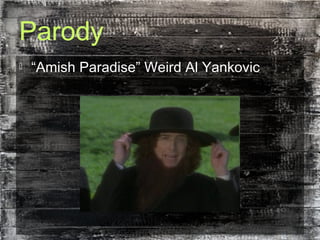
Parody
 “Amish Paradise” Weird Al Yankovic
Invective
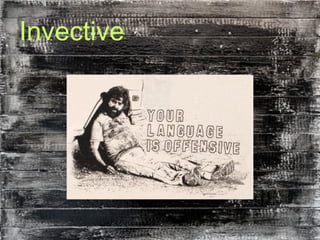
 Invective is speech or writing that abuses,
denounces, or attacks. It can be directed against
a person, cause, idea, or system.
 It employs a heavy use of negative emotive
language.
 For Example: “I cannot but conclude the bulk of
your natives to be the most pernicious race of
little odious vermin that nature ever suffered to
crawl upon the surface of the earth.” (Swift,
Gulliver’s Travels)
Invective
38
Invective:
 Direct attack
 Stated without irony or sarcasm
 Do not have to figure out what the
satirist is trying to say
 Dennis Miller, Chris Rock, George
Carlin
Assignment
 Watch the following video:
 http://youtu.be/OSXNU1_bouc
 1. As you watch, jot down all of the
various characteristics of satire you see
in the video.
 2. Then, determine whether the video is
Horatian or Juvenalian satire and write
a sentence or two explaining why.

Introduction to satire

  • 1.
    Bellringer…  Examine thecartoon. Then, answer all of the following questions about it in complete sentences.  What event is the artist alluding to in this cartoon?  What message is being implied?  Is the implication effective? Why or why not?
  • 2.
  • 3.
    The Art ofIndirect Persuasion  If you’ve ever enjoyed watching late-night comedy shows, you know how effective and fun this approach can be when it comes to changing perception of the subjects being lampooned.  You’ll immerse yourself in the art of satire, exploring how writers use a range of genres and techniques, including parody, to present their messages in indirect ways.
  • 4.
    The Art ofIndirect Persuasion  Additionally, you’ll explore how diction and syntax can be used to create humor as well as a wide range of satirical tones.  Finally, you’ll explore how satirists manipulate and parody the conventions and content of other formats and genres to advance their purposes as writers.
  • 5.
    Satire  Satire isa literary genre that uses irony, wit, and sometimes sarcasm to expose humanity’s vices and foibles, giving impetus, or momentum, to change or reform through ridicule.  It is a manner of writing that mixes a critical attitude with wit and humor in an effort to improve mankind and human institutions.
  • 6.
    Satire  While somewriters and commentators use a serious tone to persuade their audiences to accept their perspective on various issues, some writers specifically use humor to convey a serious message.
  • 7.
    7 What is Satire? Though he laughs, the satirist tells the truth  Compels readers to look at a sight they missed or shunned - move them to protest  Through laughter, aims to cure folly and punish evil
  • 8.
    8 Two Types ofSatirists  Optimist  Likes people, but thinks they are rather blind and foolish  Tells the truth with a smile  Cures people of their ignorance  Writes in order to heal
  • 9.
    9 Two Types ofSatirists Pessimist Loves individuals, hates mankind Aim is to wound, to punish, to destroy Juvenalian satire
  • 10.
  • 11.
    Types of DirectSatire  Horatian satire is a type of direct satire which pokes fun at human foibles with a witty even indulgent tone.  Juvenalian satire is a type of direct satire which denounces, sometimes with invective, human vice and error in dignified and solemn tones.
  • 12.
    Horatian Satire  Thistype of satire is named after the Roman satirist Horatian.  It seeks to criticize, rather than attack, immorality or stupidity.  In general, Horatian satire is gentler, more sympathetic, and more tolerant of human folly.  Unlike Juvenalian satire, it serves to make us laugh at human folly as opposed to holding our failures up for needling.  Horatian satire tends to ridicule human folly in general or by type rather than attack specific persons.  It tends to produce a smile.
  • 13.
    13 Types of Satire •Horatian: gentle, sympathetic form of satire. Mildly mocks the subject. The audience is asked to laugh at themselves as much as the players.
  • 14.
  • 15.
    Juvenalian Satire  Thistype of satire is named after the Roman satirist Juvenal.  It is harsher than Horatian satire because it often attacks and shows contempt for people.  Often, it seeks to address some evil in society through scorn and ridicule.  The Juvenalian satirist approaches his work in a more serious manner and uses dignified language to attack erroneous thinking or vice.  In this way Juvenalian satire evokes feelings of scorn, shock, and righteous indignation in the mind of the reader.
  • 16.
  • 17.
    Characteristics of Satiric Writing The following slides describe the various characteristics that often appear in satiric writing.  As you read the literature in the remainder of this unit, your goal will be to identify and analyze these characteristics and their effect on the various texts.
  • 18.
    Irony  Irony isa mode of expression, through words (verbal irony) or events (irony of situation), conveying a reality different from and usually opposite to appearance or expectation.  The surprise recognition by the audience often produces a comic effect, making irony often funny.
  • 19.
    Irony  When atext intended to be ironic does not seen as such, the effect can be disastrous.  To be an effective piece of sustained irony, there must be some sort of audience tip-off, through style, tone, use of clear exaggeration, or other device.
  • 20.
  • 21.
    Hyperbole  Hyperbole isdeliberate exaggeration to achieve an effect; overstatement.
  • 22.
    Litotes  Litotes area form of understatement that involves making an affirmative point by denying its opposite.  For Example:  “Being tortured with fire must have been somewhat uncomfortable.”  “Rap videos with dancers in them are not uncommon.“  “There are a few Starbucks in America."
  • 23.
    Caricature  A caricatureis an exaggeration or other distortion of an individual's prominent features or characteristics to the point of making that individual appear ridiculous.  The term is applied more often to graphic representations than to literary ones.
  • 24.
    24 Forms of Satire Caricature, Exaggeration:  Distortion for emphasis  Usually focuses on powerful subjects  Emphasize physical characteristics in order to make deeper criticism
  • 25.
  • 26.
    Wit  Wit ismost commonly understood as clever expression, whether aggressive or harmless; that is, with or without derogatory intent toward someone or something in particular.  We also tend to think of wit as being characterized by a mocking or paradoxical quality, evoking laughter through apt phrasing.
  • 27.
  • 28.
    Sarcasm  Sarcasm isintentional derision, generally directed at another person and intended to hurt.  The term comes from a Greek word meaning “to tear flesh like dogs” and signifies a cutting remark.  Sarcasm usually involves obvious, verbal irony, achieving its effect by jeeringly stating the opposite of what is meant so as to heighten the insult.
  • 29.
  • 30.
  • 31.
    Ridicule  Ridicule isthe use of words intended to belittle a person or idea and arouse contemptuous laughter.  The goal is to condemn or criticize by making the thing, idea, or person seem laughable and ridiculous.
  • 32.
  • 33.
    Parody  A parodyis an imitation of an author or his/her work with the idea of ridiculing the author, his/her ideas, or the work itself.  A parodist exploits the peculiarities of an author’s expression—the propensity to use too many parentheses, certain favorite words, or other elements of the author’s style.
  • 34.
    34 Parody  Imitation which,through distortion and exaggeration, evokes amusement, derision, and sometimes scorn  Borrows a pre-existing form  The Daily Show, The Colbert Report  Spaceballs
  • 35.
  • 36.
    Invective  Invective isspeech or writing that abuses, denounces, or attacks. It can be directed against a person, cause, idea, or system.  It employs a heavy use of negative emotive language.  For Example: “I cannot but conclude the bulk of your natives to be the most pernicious race of little odious vermin that nature ever suffered to crawl upon the surface of the earth.” (Swift, Gulliver’s Travels)
  • 37.
  • 38.
    38 Invective:  Direct attack Stated without irony or sarcasm  Do not have to figure out what the satirist is trying to say  Dennis Miller, Chris Rock, George Carlin
  • 39.
    Assignment  Watch thefollowing video:  http://youtu.be/OSXNU1_bouc  1. As you watch, jot down all of the various characteristics of satire you see in the video.  2. Then, determine whether the video is Horatian or Juvenalian satire and write a sentence or two explaining why.