DEFINITION:
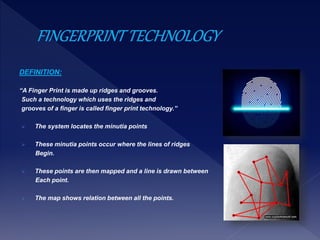
“A Finger Print is made up ridges and grooves.
Such a technology which uses the ridges and
grooves of a finger is called finger print technology.”
 The system locates the minutia points
 These minutia points occur where the lines of ridges
Begin.
 These points are then mapped and a line is drawn between
Each point.
 The map shows relation between all the points.
HISTORY OF FINGERPRINT TECHNOLOGY:
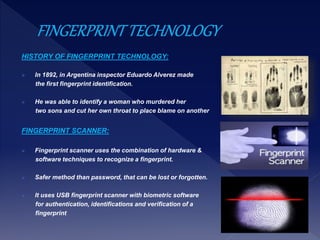
 In 1892, in Argentina inspector Eduardo Alverez made
the first fingerprint identification.
 He was able to identify a woman who murdered her
two sons and cut her own throat to place blame on another
FINGERPRINT SCANNER:
 Fingerprint scanner uses the combination of hardware &
software techniques to recognize a fingerprint.
 Safer method than password, that can be lost or forgotten.
 It uses USB fingerprint scanner with biometric software
for authentication, identifications and verification of a
fingerprint
TYPES OF SENSORS USED IN FINGERPRINT
SCANNER:
 Capacitive sensors
 Optical sensors
 Thermal sensors
 Rf sensors
 Ultrasonic sensors
WORKING OF FINGERPRINT SCANNER:
There are two main ways of scanning fingers:
 optical scanning
 capacitive scanning
OPTICAL SCANNING:
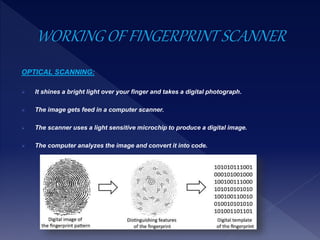
 It shines a bright light over your finger and takes a digital photograph.
 The image gets feed in a computer scanner.
 The scanner uses a light sensitive microchip to produce a digital image.
 The computer analyzes the image and convert it into code.
CAPACITIVE SCANNING:
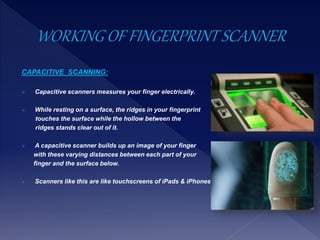
 Capacitive scanners measures your finger electrically.
 While resting on a surface, the ridges in your fingerprint
touches the surface while the hollow between the
ridges stands clear out of it.
 A capacitive scanner builds up an image of your finger
with these varying distances between each part of your
finger and the surface below.
 Scanners like this are like touchscreens of iPads & iPhones
IDENTITY ACCESS MANAGEMENT:
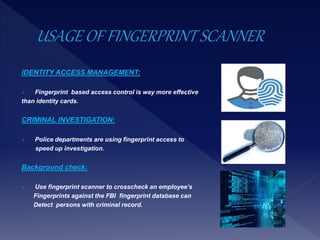
 Fingerprint based access control is way more effective
than identity cards.
CRIMINAL INVESTIGATION:
 Police departments are using fingerprint access to
speed up investigation.
Background check:
 Use fingerprint scanner to crosscheck an employee’s
Fingerprints against the FBI fingerprint database can
Detect persons with criminal record.
EDUCATION:
 Fingerprint scanners can be used to regulate students’
Attendance instead of using student cards.
SMART PHONES:
 Modern phones have fingerprint technology for unlocking
Purposes instead of passwords. It makes phones more secure.
REDUCING CARBON FOOTPRINT:
 Biometric based technology is eco friendly. It eliminates the
need of id cards and reduces plastic waste.
 IDENTITY CARD SOLUTIONS:
 Fingerprint based access control is more effective than traditional identity cards in both
enrollment and operational conditions
 HOSPITALS AND CLINICS:
 Fingerprint readers are put at the entrance of all areas and wards of hospital for
identification of patients and staff members
 GYMS AND FITNESS CENTERS:
 In gyms and fitness centers a fingerprint based authentication system increases
convenience as members do not need to carry membership cards and keys , and risk
losing them
 Improved security
 Improved customer experience
 Cannot be forgotten or lost
 Easy to use
 Require little space
 Large amount of existing data to allow background and
watch list checks
 Mature technology
 Long term stability
 Large database exists
 Uniqueness
 Universality
 User friendliness
 Comfort
Disadvantages of finger print technology are:
 Inability to enroll some users
 Affected by skin conditions
 Association with forensic applications costly
 Privacy concerns of criminal implications
 Environment and usage can affect measurement
 Systems are not 100% accurate
 Require integration and additional hardware
 Cannot be reset when compromise
Worldleading fingerprint technolopgy

Worldleading fingerprint technolopgy

  • 4.
    DEFINITION: “A Finger Printis made up ridges and grooves. Such a technology which uses the ridges and grooves of a finger is called finger print technology.”  The system locates the minutia points  These minutia points occur where the lines of ridges Begin.  These points are then mapped and a line is drawn between Each point.  The map shows relation between all the points.
  • 5.
    HISTORY OF FINGERPRINTTECHNOLOGY:  In 1892, in Argentina inspector Eduardo Alverez made the first fingerprint identification.  He was able to identify a woman who murdered her two sons and cut her own throat to place blame on another FINGERPRINT SCANNER:  Fingerprint scanner uses the combination of hardware & software techniques to recognize a fingerprint.  Safer method than password, that can be lost or forgotten.  It uses USB fingerprint scanner with biometric software for authentication, identifications and verification of a fingerprint
  • 6.
    TYPES OF SENSORSUSED IN FINGERPRINT SCANNER:  Capacitive sensors  Optical sensors  Thermal sensors  Rf sensors  Ultrasonic sensors WORKING OF FINGERPRINT SCANNER: There are two main ways of scanning fingers:  optical scanning  capacitive scanning
  • 7.
    OPTICAL SCANNING:  Itshines a bright light over your finger and takes a digital photograph.  The image gets feed in a computer scanner.  The scanner uses a light sensitive microchip to produce a digital image.  The computer analyzes the image and convert it into code.
  • 8.
    CAPACITIVE SCANNING:  Capacitivescanners measures your finger electrically.  While resting on a surface, the ridges in your fingerprint touches the surface while the hollow between the ridges stands clear out of it.  A capacitive scanner builds up an image of your finger with these varying distances between each part of your finger and the surface below.  Scanners like this are like touchscreens of iPads & iPhones
  • 9.
    IDENTITY ACCESS MANAGEMENT: Fingerprint based access control is way more effective than identity cards. CRIMINAL INVESTIGATION:  Police departments are using fingerprint access to speed up investigation. Background check:  Use fingerprint scanner to crosscheck an employee’s Fingerprints against the FBI fingerprint database can Detect persons with criminal record.
  • 10.
    EDUCATION:  Fingerprint scannerscan be used to regulate students’ Attendance instead of using student cards. SMART PHONES:  Modern phones have fingerprint technology for unlocking Purposes instead of passwords. It makes phones more secure. REDUCING CARBON FOOTPRINT:  Biometric based technology is eco friendly. It eliminates the need of id cards and reduces plastic waste.
  • 11.
     IDENTITY CARDSOLUTIONS:  Fingerprint based access control is more effective than traditional identity cards in both enrollment and operational conditions  HOSPITALS AND CLINICS:  Fingerprint readers are put at the entrance of all areas and wards of hospital for identification of patients and staff members  GYMS AND FITNESS CENTERS:  In gyms and fitness centers a fingerprint based authentication system increases convenience as members do not need to carry membership cards and keys , and risk losing them
  • 12.
     Improved security Improved customer experience  Cannot be forgotten or lost  Easy to use  Require little space  Large amount of existing data to allow background and watch list checks  Mature technology  Long term stability  Large database exists  Uniqueness  Universality  User friendliness  Comfort
  • 13.
    Disadvantages of fingerprint technology are:  Inability to enroll some users  Affected by skin conditions  Association with forensic applications costly  Privacy concerns of criminal implications  Environment and usage can affect measurement  Systems are not 100% accurate  Require integration and additional hardware  Cannot be reset when compromise