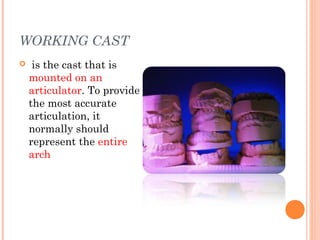
WORKING CAST
 is the cast that is
mounted on an
articulator. To provide
the most accurate
articulation, it
normally should
represent the entire
arch
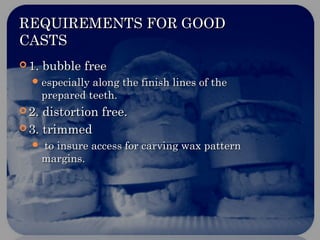
REQUIREMENTS FOR GOODREQUIREMENTS FOR GOOD
CASTSCASTS
 1. bubble free1. bubble free
 especially along the finish lines of theespecially along the finish lines of the

prepared teeth.prepared teeth.
 2. distortion free.2. distortion free.
 3. trimmed3. trimmed
 to insure access for carving wax patternto insure access for carving wax pattern
margins.margins.
WORKING CAST WITH A
SEPARATE DIE
WORKING CAST WITH A SEPARATE
DIE
 disadvantages
 wax pattern must be transferred from one to the
other
 internal adaptation
 obtained from
 separate impressions
 pouring an elastomeric full-arch impression twice
 first cast is used for fabrication of the die
IMPRESSION POURING
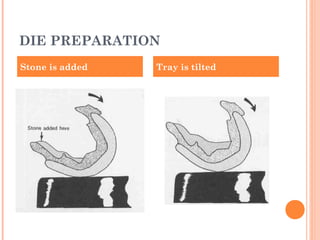
DIE PREPARATION
Stone is added Tray is tilted
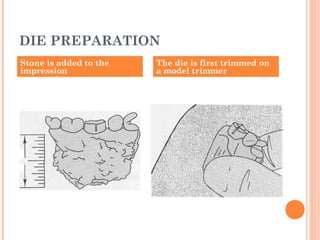
DIE PREPARATION
Stone is added to the
impression
The die is first trimmed on
a model trimmer
DIE PREPARATION
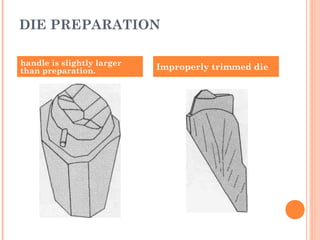
handle is slightly larger
than preparation. Improperly trimmed die
DIE PREPARATION
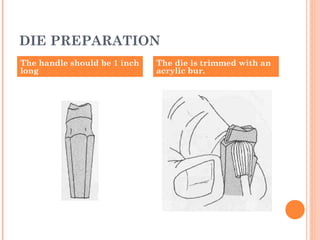
The handle should be 1 inch
long
The die is trimmed with an
acrylic bur.
DIE PREPARATION
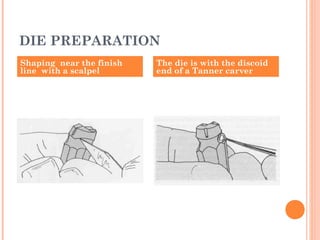
Shaping near the finish
line with a scalpel
The die is with the discoid
end of a Tanner carver
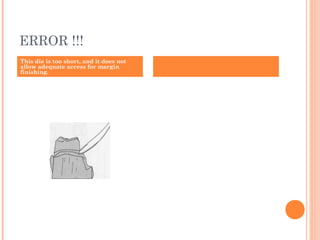
ERROR !!!
This die is too short, and it does not
allow adequate access for margin
finishing.
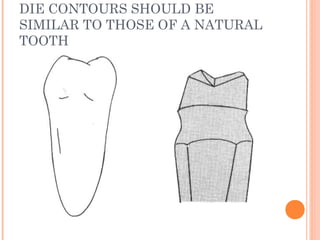
DIE CONTOURS SHOULD BE
SIMILAR TO THOSE OF A NATURAL
TOOTH
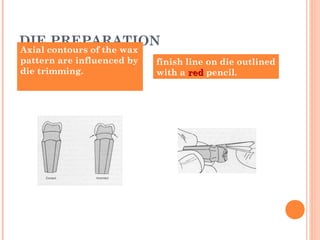
DIE PREPARATION
Axial contours of the wax
pattern are influenced by
die trimming.
finish line on die outlined
with a redred pencil.
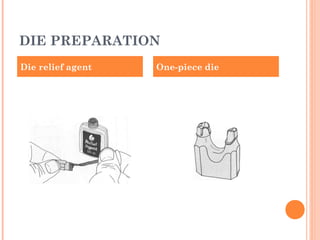
DIE PREPARATION
Die relief agent One-piece die
WORKING CAST WITH A
REMOVABLE DIE
IF A REMOVABLE DIE SYSTEM IS
USED, IT SHOULD SATISFY THESE
REQUIREMENTS17
 The dies must return to their exact original
positions.
 2. The dies must remain stable, even when
inverted.
 3. The cast containing the dies must be easy to
mount on an articulator
WORKING CAST WITH A
REMOVABLE DIE
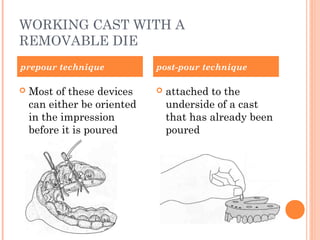
 Most of these devices
can either be oriented
in the impression
before it is poured
 attached to the
underside of a cast
that has already been
poured
prepour technique post-pour technique
WORKING CAST WITH A
REMOVABLE DIE
 1. Straight dowel pin
 2. Curved dowel pin
 3. Pindex system
 4. Di-Lok tray
 5. Accutrac
TYPESOFANTIROTATIONAL
DEVICESUSEDFORREMOVABLE
DIES
A, flat-sided
single
dowel;
B, single
curved
dowel;
C, double
straight
dowels with
a common
head;
D, two
separate
parallel
dowels;
E, keyed
plastic outer
tray
STRAIGHT DOWEL PIN
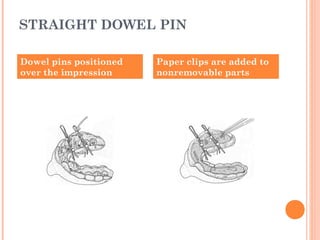
Dowel pins positioned
over the impression
Paper clips are added to
nonremovable parts
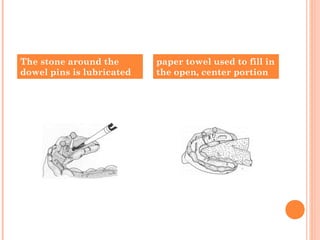
The stone around the
dowel pins is lubricated
paper towel used to fill in
the open, center portion
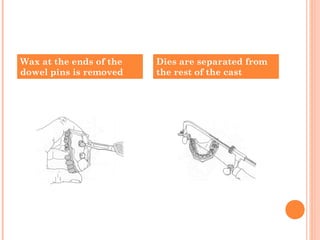
Wax at the ends of the
dowel pins is removed
Dies are separated from
the rest of the cast
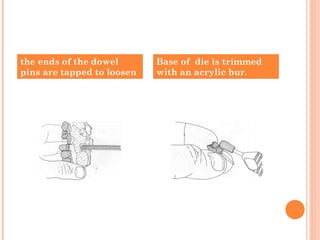
the ends of the dowel
pins are tapped to loosen
Base of die is trimmed
with an acrylic bur.
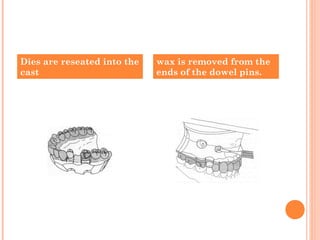
Dies are reseated into the
cast
wax is removed from the
ends of the dowel pins.
PART 2
ANY QUESTION ?
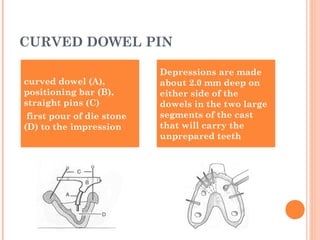
CURVED DOWEL PIN
curved dowel (A),
positioning bar (B),
straight pins (C)
first pour of die stone
(D) to the impression
Depressions are made
about 2.0 mm deep on
either side of the
dowels in the two large
segments of the cast
that will carry the
unprepared teeth
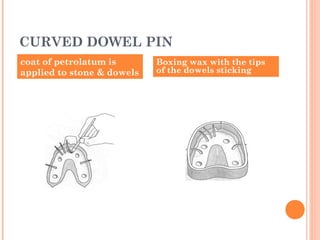
CURVED DOWEL PIN
coat of petrolatum is
applied to stone & dowels
Boxing wax with the tips
of the dowels sticking
CURVED DOWEL PIN
CURVED DOWEL PIN
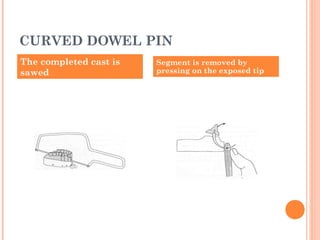
The completed cast is
sawed
Segment is removed by
pressing on the exposed tip
CEMENTED CURVED PIN
CEMENTED CURVED PIN
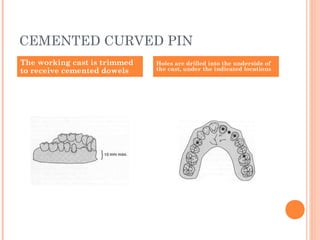
The working cast is trimmed
to receive cemented dowels
Holes are drilled into the underside of
the cast, under the indicated locations
CEMENTED CURVED PIN
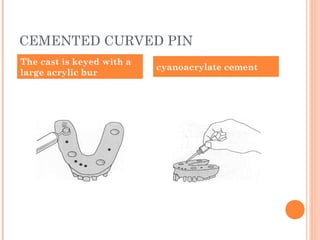
The cast is keyed with a
large acrylic bur
cyanoacrylate cement
CEMENTED CURVED PIN
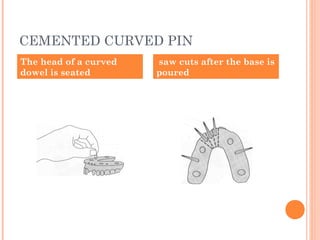
The head of a curved
dowel is seated
saw cuts after the base is
poured
PINDEX SYSTEM
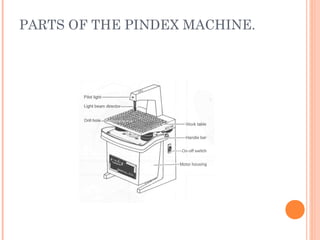
PARTS OF THE PINDEX MACHINE.
PINDEX SYSTEM
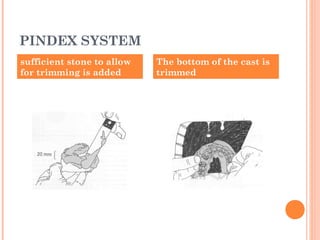
sufficient stone to allow
for trimming is added
The bottom of the cast is
trimmed
PINDEX SYSTEM
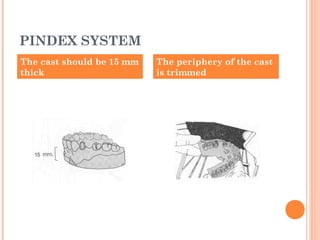
The cast should be 15 mm
thick
The periphery of the cast
is trimmed
PINDEX SYSTEM
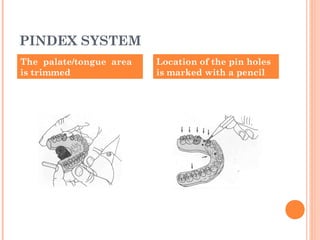
The palate/tongue area
is trimmed
Location of the pin holes
is marked with a pencil
PINDEX SYSTEM
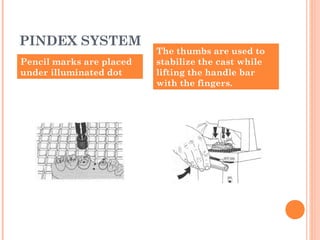
Pencil marks are placed
under illuminated dot
The thumbs are used to
stabilize the cast while
lifting the handle bar
with the fingers.
PINDEX SYSTEM
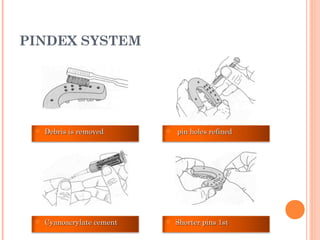
 Debris is removedDebris is removed  pin holes refinedpin holes refined
 Shorter pins 1stShorter pins 1st Cyanoacrylate cementCyanoacrylate cement
PINDEX SYSTEM
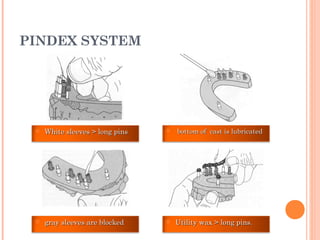
 White sleeves > long pinsWhite sleeves > long pins  bottom of cast is lubricatedbottom of cast is lubricated
 Utility wax > long pins.Utility wax > long pins. gray sleeves are blockedgray sleeves are blocked
PINDEX SYSTEM
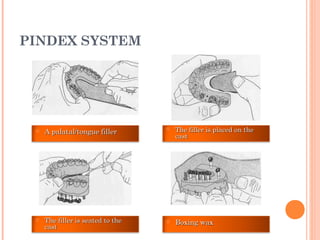
 A palatal/tongue fillerA palatal/tongue filler  The filler is placed on theThe filler is placed on the
castcast
 Boxing waxBoxing wax The filler is seated to theThe filler is seated to the
castcast
PINDEX SYSTEM
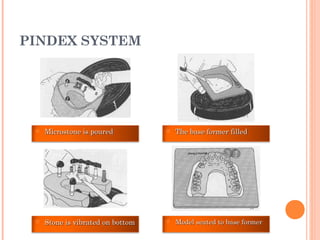
 Microstone is pouredMicrostone is poured  The base former filledThe base former filled
 Model seated to base formerModel seated to base former Stone is vibrated on bottomStone is vibrated on bottom
PINDEX SYSTEM
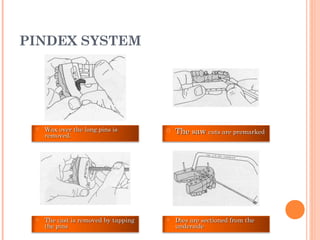
 Wax over the long pins isWax over the long pins is
removed.removed.
 The sawThe saw cuts are premarkedcuts are premarked
 Dies are sectioned from theDies are sectioned from the
undersideunderside
 The cast is removed by tappingThe cast is removed by tapping
the pinsthe pins
PINDEX SYSTEM
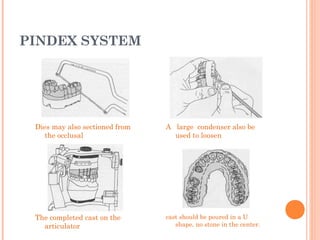
Dies may also sectioned from
the occlusal
A large condenser also be
used to loosen
cast should be poured in a U
shape, no stone in the center.
The completed cast on the
articulator
PINDEX SYSTEM
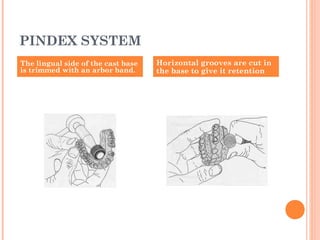
The lingual side of the cast base
is trimmed with an arbor band.
Horizontal grooves are cut in
the base to give it retention
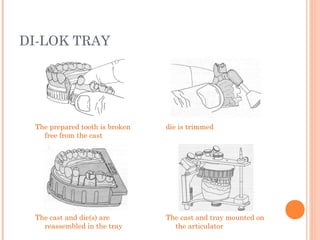
DI-LOK TRAY
DI-LOK TRAY
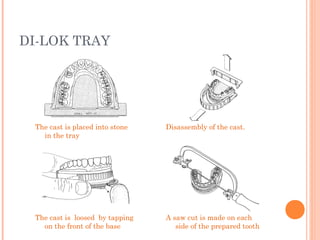
The cast is placed into stone
in the tray
Disassembly of the cast.
A saw cut is made on each
side of the prepared tooth
The cast is loosed by tapping
on the front of the base
DI-LOK TRAY
The prepared tooth is broken
free from the cast
die is trimmed
The cast and tray mounted on
the articulator
The cast and die(s) are
reassembled in the tray
‫دندان‬ ‫مارژین‬ ‫که‬‫ک‬‫ک‬ ‫کورتی‬‫ک‬‫ص‬ ‫در‬‫دندان‬ ‫مارژین‬ ‫که‬‫ک‬‫ک‬ ‫کورتی‬‫ک‬‫ص‬ ‫در‬
‫مجاور‬ ‫دندان‬ ‫به‬ ‫خورده‬ ‫تراش‬‫مجاور‬ ‫دندان‬ ‫به‬ ‫خورده‬ ‫تراش‬
‫دای‬ ‫تکنیک‬ ‫کدام‬ ‫کد‬‫ک‬‫باش‬ ‫کک‬‫ک‬‫نزدی‬‫دای‬ ‫تکنیک‬ ‫کدام‬ ‫کد‬‫ک‬‫باش‬ ‫کک‬‫ک‬‫نزدی‬
‫؟‬ ‫دارد‬ ‫ترجیح‬‫؟‬ ‫دارد‬ ‫ترجیح‬

shlinberg casts and die 87-9-5

  • 3.
    WORKING CAST  isthe cast that is mounted on an articulator. To provide the most accurate articulation, it normally should represent the entire arch
  • 4.
    REQUIREMENTS FOR GOODREQUIREMENTSFOR GOOD CASTSCASTS  1. bubble free1. bubble free  especially along the finish lines of theespecially along the finish lines of the prepared teeth.prepared teeth.  2. distortion free.2. distortion free.  3. trimmed3. trimmed  to insure access for carving wax patternto insure access for carving wax pattern margins.margins.
  • 5.
    WORKING CAST WITHA SEPARATE DIE
  • 6.
    WORKING CAST WITHA SEPARATE DIE  disadvantages  wax pattern must be transferred from one to the other  internal adaptation  obtained from  separate impressions  pouring an elastomeric full-arch impression twice  first cast is used for fabrication of the die
  • 7.
  • 8.
    DIE PREPARATION Stone isadded Tray is tilted
  • 9.
    DIE PREPARATION Stone isadded to the impression The die is first trimmed on a model trimmer
  • 10.
    DIE PREPARATION handle isslightly larger than preparation. Improperly trimmed die
  • 11.
    DIE PREPARATION The handleshould be 1 inch long The die is trimmed with an acrylic bur.
  • 12.
    DIE PREPARATION Shaping nearthe finish line with a scalpel The die is with the discoid end of a Tanner carver
  • 13.
    ERROR !!! This dieis too short, and it does not allow adequate access for margin finishing.
  • 14.
    DIE CONTOURS SHOULDBE SIMILAR TO THOSE OF A NATURAL TOOTH
  • 15.
    DIE PREPARATION Axial contoursof the wax pattern are influenced by die trimming. finish line on die outlined with a redred pencil.
  • 16.
    DIE PREPARATION Die reliefagent One-piece die
  • 17.
    WORKING CAST WITHA REMOVABLE DIE
  • 18.
    IF A REMOVABLEDIE SYSTEM IS USED, IT SHOULD SATISFY THESE REQUIREMENTS17  The dies must return to their exact original positions.  2. The dies must remain stable, even when inverted.  3. The cast containing the dies must be easy to mount on an articulator
  • 19.
    WORKING CAST WITHA REMOVABLE DIE  Most of these devices can either be oriented in the impression before it is poured  attached to the underside of a cast that has already been poured prepour technique post-pour technique
  • 20.
    WORKING CAST WITHA REMOVABLE DIE  1. Straight dowel pin  2. Curved dowel pin  3. Pindex system  4. Di-Lok tray  5. Accutrac
  • 21.
    TYPESOFANTIROTATIONAL DEVICESUSEDFORREMOVABLE DIES A, flat-sided single dowel; B, single curved dowel; C,double straight dowels with a common head; D, two separate parallel dowels; E, keyed plastic outer tray
  • 22.
    STRAIGHT DOWEL PIN Dowelpins positioned over the impression Paper clips are added to nonremovable parts
  • 23.
    The stone aroundthe dowel pins is lubricated paper towel used to fill in the open, center portion
  • 24.
    Wax at theends of the dowel pins is removed Dies are separated from the rest of the cast
  • 25.
    the ends ofthe dowel pins are tapped to loosen Base of die is trimmed with an acrylic bur.
  • 26.
    Dies are reseatedinto the cast wax is removed from the ends of the dowel pins.
  • 27.
  • 28.
  • 29.
  • 30.
    curved dowel (A), positioningbar (B), straight pins (C) first pour of die stone (D) to the impression Depressions are made about 2.0 mm deep on either side of the dowels in the two large segments of the cast that will carry the unprepared teeth CURVED DOWEL PIN
  • 31.
    coat of petrolatumis applied to stone & dowels Boxing wax with the tips of the dowels sticking CURVED DOWEL PIN
  • 32.
    CURVED DOWEL PIN Thecompleted cast is sawed Segment is removed by pressing on the exposed tip
  • 33.
  • 34.
    CEMENTED CURVED PIN Theworking cast is trimmed to receive cemented dowels Holes are drilled into the underside of the cast, under the indicated locations
  • 35.
    CEMENTED CURVED PIN Thecast is keyed with a large acrylic bur cyanoacrylate cement
  • 36.
    CEMENTED CURVED PIN Thehead of a curved dowel is seated saw cuts after the base is poured
  • 37.
  • 38.
    PARTS OF THEPINDEX MACHINE.
  • 39.
    PINDEX SYSTEM sufficient stoneto allow for trimming is added The bottom of the cast is trimmed
  • 40.
    PINDEX SYSTEM The castshould be 15 mm thick The periphery of the cast is trimmed
  • 41.
    PINDEX SYSTEM The palate/tonguearea is trimmed Location of the pin holes is marked with a pencil
  • 42.
    PINDEX SYSTEM Pencil marksare placed under illuminated dot The thumbs are used to stabilize the cast while lifting the handle bar with the fingers.
  • 43.
    PINDEX SYSTEM  Debrisis removedDebris is removed  pin holes refinedpin holes refined  Shorter pins 1stShorter pins 1st Cyanoacrylate cementCyanoacrylate cement
  • 44.
    PINDEX SYSTEM  Whitesleeves > long pinsWhite sleeves > long pins  bottom of cast is lubricatedbottom of cast is lubricated  Utility wax > long pins.Utility wax > long pins. gray sleeves are blockedgray sleeves are blocked
  • 45.
    PINDEX SYSTEM  Apalatal/tongue fillerA palatal/tongue filler  The filler is placed on theThe filler is placed on the castcast  Boxing waxBoxing wax The filler is seated to theThe filler is seated to the castcast
  • 46.
    PINDEX SYSTEM  Microstoneis pouredMicrostone is poured  The base former filledThe base former filled  Model seated to base formerModel seated to base former Stone is vibrated on bottomStone is vibrated on bottom
  • 47.
    PINDEX SYSTEM  Waxover the long pins isWax over the long pins is removed.removed.  The sawThe saw cuts are premarkedcuts are premarked  Dies are sectioned from theDies are sectioned from the undersideunderside  The cast is removed by tappingThe cast is removed by tapping the pinsthe pins
  • 48.
    PINDEX SYSTEM Dies mayalso sectioned from the occlusal A large condenser also be used to loosen cast should be poured in a U shape, no stone in the center. The completed cast on the articulator
  • 49.
    PINDEX SYSTEM The lingualside of the cast base is trimmed with an arbor band. Horizontal grooves are cut in the base to give it retention
  • 50.
  • 51.
    DI-LOK TRAY The castis placed into stone in the tray Disassembly of the cast. A saw cut is made on each side of the prepared tooth The cast is loosed by tapping on the front of the base
  • 52.
    DI-LOK TRAY The preparedtooth is broken free from the cast die is trimmed The cast and tray mounted on the articulator The cast and die(s) are reassembled in the tray
  • 54.
    ‫دندان‬ ‫مارژین‬ ‫که‬‫ک‬‫ک‬‫کورتی‬‫ک‬‫ص‬ ‫در‬‫دندان‬ ‫مارژین‬ ‫که‬‫ک‬‫ک‬ ‫کورتی‬‫ک‬‫ص‬ ‫در‬ ‫مجاور‬ ‫دندان‬ ‫به‬ ‫خورده‬ ‫تراش‬‫مجاور‬ ‫دندان‬ ‫به‬ ‫خورده‬ ‫تراش‬ ‫دای‬ ‫تکنیک‬ ‫کدام‬ ‫کد‬‫ک‬‫باش‬ ‫کک‬‫ک‬‫نزدی‬‫دای‬ ‫تکنیک‬ ‫کدام‬ ‫کد‬‫ک‬‫باش‬ ‫کک‬‫ک‬‫نزدی‬ ‫؟‬ ‫دارد‬ ‫ترجیح‬‫؟‬ ‫دارد‬ ‫ترجیح‬