


Underlying problems and Way forward of Shipbuilding Engineering in
Bangladesh
6/10/2015 1
Rasedul Islam Sagor
ID: 14307002
Course name : ART 102
Program: BSME
Section:F
Dated: 18/10/2014
6/10/2015 2
Introduction of Shipbuilding Engineering.
History of Shipbuilding in Bangladesh.
Potentials of Shipbuilding in Bangladesh.
Capacity development in Bangladesh.
Prospects of Shipbuilding in Bangladesh.
Conclusion.
6/10/2015 3
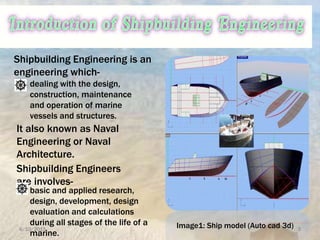
Shipbuilding Engineering is an
engineering which-
dealing with the design,
construction, maintenance
and operation of marine
vessels and structures.
It also known as Naval
Engineering or Naval
Architecture.
Shipbuilding Engineers
are involves-
basic and applied research,
design, development, design
evaluation and calculations
during all stages of the life of a
marine.
Image1: Ship model (Auto cad 3d)
6/10/2015 4
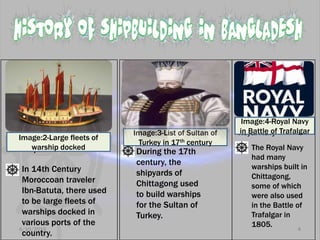
Image:1- large fleets of
warships docked
In 14th Century
Moroccoan traveler
Ibn-Batuta, there used
to be large fleets of
warships docked in
various ports of the
country.
Image:3-List of Sultan of
Turkey in (1755-1825)
During the 17th
century, the
shipyards of
Chittagong used
to build warships
for the Sultan of
Turkey.
Image:4:Logo of
Royal Navy
The Royal Navy
had many
warships built in
Chittagong,
some of which
were also used
in the Battle of
Trafalgar in
1805.
2Image:2-Large fleets of
warship docked
Image:3-List of Sultan of
Turkey in 17th century
Image:4-Royal Navy
in Battle of Trafalgar
6/10/2015 5
Image:5-Khulna
Shipyard
Khulna Shipyard,
the first modern
shipyard of
Bangladesh, was
established in 1957.
The shipyard was
later nationalized
and came under
the control of
Bangladesh Navy
in 1999.
Image:6-Mitsui
Engineering and
Shipbuilding
Industry
In 1979,
the sector
received its
first foreign
investment
after the
independe
nce of
Banglades
h when
Mitsui
Engineerin
g and
By the
2000s,
several more
private
shipyards
were
established
and in 2008,
Bangladesh
became a
ship
exporting
Image:7-German Buyer
take their Ship from
Bangladesh.Shipbuilding
formed a
joint venture
with High
Speed
Shipyard of
Bangladesh
to establish
a shipyard at
Fatullah,
Narayanganj.
Bangla
desh
India Singapore South
Korea
Japan Italy France Norway Finlan
d
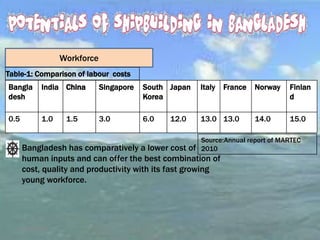
0.5 1.0 1.5 3.0 6.0 12.0 13.0 13.0 14.0 15.0
6/10/2015 6
Workforce
Table-1: Comparison of labour costs
Bangladesh has comparatively a lower cost of
human inputs and can offer the best combination of
cost, quality and productivity with its fast growing
young workforce.
Source:Annual report of MARTEC
2010
Country Weighted labour
rate
Weighted
productibity
Weighted average
output cost
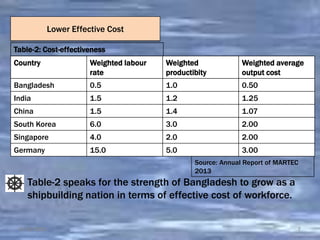
Bangladesh 0.5 1.0 0.50
India 1.5 1.2 1.25
China 1.5 1.4 1.07
South Korea 6.0 3.0 2.00
Singapore 4.0 2.0 2.00
Germany 15.0 5.0 3.00
6/10/2015 7
Lower Effective Cost
Table-2: Cost-effectiveness
Table-2 speaks for the strength of Bangladesh to grow as a
shipbuilding nation in terms of effective cost of workforce.
Source: Annual Report of MARTEC
2013
6/10/2015 8
50
60
75808080
100107114
200200200
180
190
250
35
5052555554
657075808283
110
121
200
0
50
100
150
200
250
300
2000
2001
2002
2003
2004
2005
2006
2007
2008
2009
2010
2011
2012
2013
2014
Demand of
World
Trade(DWT)
Supply by
Global
Shipyard
figure-1:Demand & Supply in
World Shipping Trade
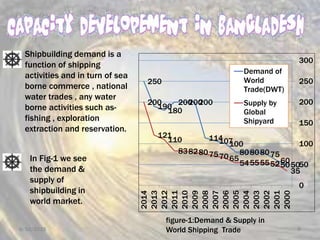
Shipbuilding demand is a
function of shipping
activities and in turn of sea
borne commerce , national
water trades , any water
borne activities such as-
fishing , exploration
extraction and reservation.
In Fig-1 we see
the demand &
supply of
shipbuilding in
world market.
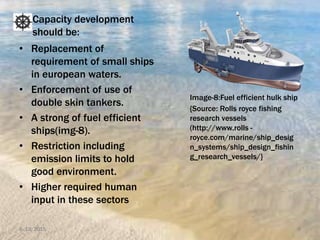
• Replacement of
requirement of small ships
in european waters.
• Enforcement of use of
double skin tankers.
• A strong of fuel efficient
ships(img-8).
• Restriction including
emission limits to hold
good environment.
• Higher required human
input in these sectors
6/10/2015 9
Capacity development
should be:
Image-8:Fuel efficient hulk ship
{Source: Rolls royce fishing
research vessels
(http://www.rolls -
royce.com/marine/ship_desig
n_systems/ship_design_fishin
g_research_vessels/}
6/10/2015 10
1
5
10
15
20
25
30
33
37
45
50
0
10
20
30
40
50
60
Growth patterns
Growth
patterns
Num
ber
of
unit
ship
yard
s
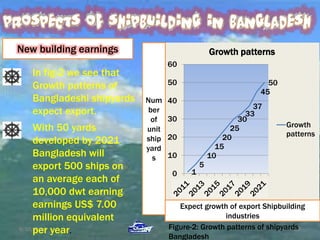
Expect growth of export Shipbuilding
industries
Figure-2: Growth patterns of shipyards
Bangladesh
In fig-2 we see that
Growth patterns of
Bangladeshi shipyards
expect export.
With 50 yards
developed by 2021
Bangladesh will
export 500 ships on
an average each of
10,000 dwt earning
earnings US$ 7.00
million equivalent
per year.
New building earnings
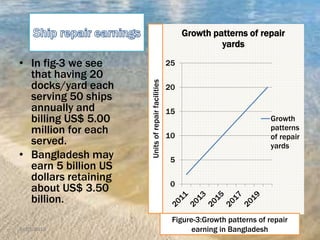
• In fig-3 we see
that having 20
docks/yard each
serving 50 ships
annually and
billing US$ 5.00
million for each
served.
• Bangladesh may
earn 5 billion US
dollars retaining
about US$ 3.50
billion.
0
5
10
15
20
25
Growth patterns of repair
yards
Growth
patterns
of repair
yards
6/10/2015
Unitsofrepairfacilities
Figure-3:Growth patterns of repair
earning in Bangladesh
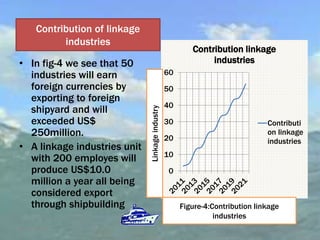
• In fig-4 we see that 50
industries will earn
foreign currencies by
exporting to foreign
shipyard and will
exceeded US$
250million.
• A linkage industries unit
with 200 employes will
produce US$10.0
million a year all being
considered export
through shipbuilding
0
10
20
30
40
50
60
Contribution linkage
industries
Contributi
on linkage
industries
6/10/2015 12
Contribution of linkage
industries
Linkageindustry
Figure-4:Contribution linkage
industries
6/10/2015 13
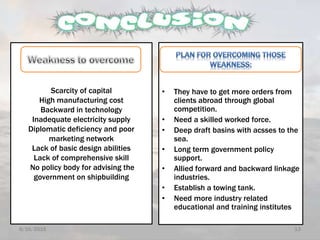
Scarcity of capital
High manufacturing cost
Backward in technology
Inadequate electricity supply
Diplomatic deficiency and poor
marketing network
Lack of basic design abilities
Lack of comprehensive skill
No policy body for advising the
government on shipbuilding
• They have to get more orders from
clients abroad through global
competition.
• Need a skilled worked force.
• Deep draft basins with acsses to the
sea.
• Long term government policy
support.
• Allied forward and backward linkage
industries.
• Establish a towing tank.
• Need more industry related
educational and training institutes

Shipbuilding engineering developement in bangladesh

  • 1.
    Underlying problems andWay forward of Shipbuilding Engineering in Bangladesh 6/10/2015 1 Rasedul Islam Sagor ID: 14307002 Course name : ART 102 Program: BSME Section:F Dated: 18/10/2014
  • 2.
    6/10/2015 2 Introduction ofShipbuilding Engineering. History of Shipbuilding in Bangladesh. Potentials of Shipbuilding in Bangladesh. Capacity development in Bangladesh. Prospects of Shipbuilding in Bangladesh. Conclusion.
  • 3.
    6/10/2015 3 Shipbuilding Engineeringis an engineering which- dealing with the design, construction, maintenance and operation of marine vessels and structures. It also known as Naval Engineering or Naval Architecture. Shipbuilding Engineers are involves- basic and applied research, design, development, design evaluation and calculations during all stages of the life of a marine. Image1: Ship model (Auto cad 3d)
  • 4.
    6/10/2015 4 Image:1- largefleets of warships docked In 14th Century Moroccoan traveler Ibn-Batuta, there used to be large fleets of warships docked in various ports of the country. Image:3-List of Sultan of Turkey in (1755-1825) During the 17th century, the shipyards of Chittagong used to build warships for the Sultan of Turkey. Image:4:Logo of Royal Navy The Royal Navy had many warships built in Chittagong, some of which were also used in the Battle of Trafalgar in 1805. 2Image:2-Large fleets of warship docked Image:3-List of Sultan of Turkey in 17th century Image:4-Royal Navy in Battle of Trafalgar
  • 5.
    6/10/2015 5 Image:5-Khulna Shipyard Khulna Shipyard, thefirst modern shipyard of Bangladesh, was established in 1957. The shipyard was later nationalized and came under the control of Bangladesh Navy in 1999. Image:6-Mitsui Engineering and Shipbuilding Industry In 1979, the sector received its first foreign investment after the independe nce of Banglades h when Mitsui Engineerin g and By the 2000s, several more private shipyards were established and in 2008, Bangladesh became a ship exporting Image:7-German Buyer take their Ship from Bangladesh.Shipbuilding formed a joint venture with High Speed Shipyard of Bangladesh to establish a shipyard at Fatullah, Narayanganj.
  • 6.
    Bangla desh India Singapore South Korea JapanItaly France Norway Finlan d 0.5 1.0 1.5 3.0 6.0 12.0 13.0 13.0 14.0 15.0 6/10/2015 6 Workforce Table-1: Comparison of labour costs Bangladesh has comparatively a lower cost of human inputs and can offer the best combination of cost, quality and productivity with its fast growing young workforce. Source:Annual report of MARTEC 2010
  • 7.
    Country Weighted labour rate Weighted productibity Weightedaverage output cost Bangladesh 0.5 1.0 0.50 India 1.5 1.2 1.25 China 1.5 1.4 1.07 South Korea 6.0 3.0 2.00 Singapore 4.0 2.0 2.00 Germany 15.0 5.0 3.00 6/10/2015 7 Lower Effective Cost Table-2: Cost-effectiveness Table-2 speaks for the strength of Bangladesh to grow as a shipbuilding nation in terms of effective cost of workforce. Source: Annual Report of MARTEC 2013
  • 8.
    6/10/2015 8 50 60 75808080 100107114 200200200 180 190 250 35 5052555554 657075808283 110 121 200 0 50 100 150 200 250 300 2000 2001 2002 2003 2004 2005 2006 2007 2008 2009 2010 2011 2012 2013 2014 Demand of World Trade(DWT) Supplyby Global Shipyard figure-1:Demand & Supply in World Shipping Trade Shipbuilding demand is a function of shipping activities and in turn of sea borne commerce , national water trades , any water borne activities such as- fishing , exploration extraction and reservation. In Fig-1 we see the demand & supply of shipbuilding in world market.
  • 9.
    • Replacement of requirementof small ships in european waters. • Enforcement of use of double skin tankers. • A strong of fuel efficient ships(img-8). • Restriction including emission limits to hold good environment. • Higher required human input in these sectors 6/10/2015 9 Capacity development should be: Image-8:Fuel efficient hulk ship {Source: Rolls royce fishing research vessels (http://www.rolls - royce.com/marine/ship_desig n_systems/ship_design_fishin g_research_vessels/}
  • 10.
    6/10/2015 10 1 5 10 15 20 25 30 33 37 45 50 0 10 20 30 40 50 60 Growth patterns Growth patterns Num ber of unit ship yard s Expectgrowth of export Shipbuilding industries Figure-2: Growth patterns of shipyards Bangladesh In fig-2 we see that Growth patterns of Bangladeshi shipyards expect export. With 50 yards developed by 2021 Bangladesh will export 500 ships on an average each of 10,000 dwt earning earnings US$ 7.00 million equivalent per year. New building earnings
  • 11.
    • In fig-3we see that having 20 docks/yard each serving 50 ships annually and billing US$ 5.00 million for each served. • Bangladesh may earn 5 billion US dollars retaining about US$ 3.50 billion. 0 5 10 15 20 25 Growth patterns of repair yards Growth patterns of repair yards 6/10/2015 Unitsofrepairfacilities Figure-3:Growth patterns of repair earning in Bangladesh
  • 12.
    • In fig-4we see that 50 industries will earn foreign currencies by exporting to foreign shipyard and will exceeded US$ 250million. • A linkage industries unit with 200 employes will produce US$10.0 million a year all being considered export through shipbuilding 0 10 20 30 40 50 60 Contribution linkage industries Contributi on linkage industries 6/10/2015 12 Contribution of linkage industries Linkageindustry Figure-4:Contribution linkage industries
  • 13.
    6/10/2015 13 Scarcity ofcapital High manufacturing cost Backward in technology Inadequate electricity supply Diplomatic deficiency and poor marketing network Lack of basic design abilities Lack of comprehensive skill No policy body for advising the government on shipbuilding • They have to get more orders from clients abroad through global competition. • Need a skilled worked force. • Deep draft basins with acsses to the sea. • Long term government policy support. • Allied forward and backward linkage industries. • Establish a towing tank. • Need more industry related educational and training institutes