A Career in Public Relations
And the Importance of Social Media in the PR Field

November 5, 2013

Presentation by Leigh-Anne Mauk Lawrence
Social Media & Public Information Specialist
Hagerstown Community College
2

What is Public Relations?
o PR is the practice of building relationships to enhance or strengthen the public image of a
company, an organization, or an individual
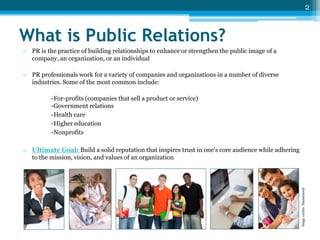
o PR professionals work for a variety of companies and organizations in a number of diverse
industries. Some of the most common include:
-For-profits (companies that sell a product or service)
-Government relations
-Health care
-Higher education
-Nonprofits

Image credits: Shutterstock

o Ultimate Goal: Build a solid reputation that inspires trust in one’s core audience while adhering
to the mission, vision, and values of an organization
3

Tools in the PR Arsenal
Two purposes in PR: Inform or Persuade

o Informative tools include fact sheets, press releases, press conferences,
video news releases, and media kits

Image credit: freedigitalphotos.net

o Persuasive tools include speeches, letters to the editor, guest columns,
and online, radio or television appearances and interviews
4

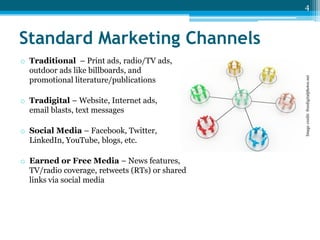
o Traditional – Print ads, radio/TV ads,
outdoor ads like billboards, and
promotional literature/publications
o Tradigital – Website, Internet ads,
email blasts, text messages
o Social Media – Facebook, Twitter,
LinkedIn, YouTube, blogs, etc.
o Earned or Free Media – News features,
TV/radio coverage, retweets (RTs) or shared
links via social media

Image credit: freedigitalphotos.net

Standard Marketing Channels
5

What Type of People Work in PR?
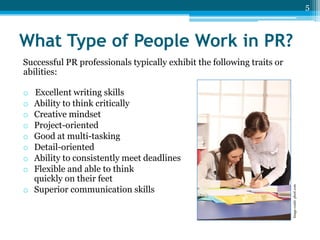
Successful PR professionals typically exhibit the following traits or
abilities:
Excellent writing skills
Ability to think critically
Creative mindset
Project-oriented
Good at multi-tasking
Detail-oriented
Ability to consistently meet deadlines
Flexible and able to think
quickly on their feet
o Superior communication skills

Image credit: photl.com

o
o
o
o
o
o
o
o
6

Can Introverts Work in PR?
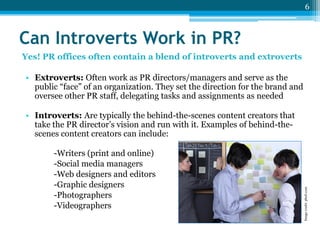
Yes! PR offices often contain a blend of introverts and extroverts

• Extroverts: Often work as PR directors/managers and serve as the
public “face” of an organization. They set the direction for the brand and
oversee other PR staff, delegating tasks and assignments as needed

-Writers (print and online)
-Social media managers
-Web designers and editors
-Graphic designers
-Photographers
-Videographers

Image credit: photl.com

• Introverts: Are typically the behind-the-scenes content creators that
take the PR director’s vision and run with it. Examples of behind-thescenes content creators can include:
7

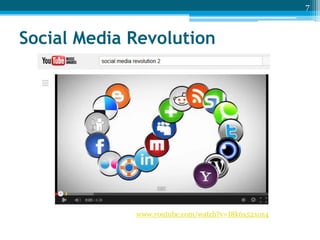
Social Media Revolution

www.youtube.com/watch?v=I8k6x52xoz4
8

How Web & New Media Changed PR Forever
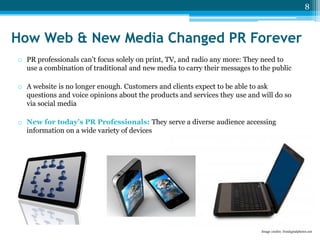
o PR professionals can’t focus solely on print, TV, and radio any more: They need to
use a combination of traditional and new media to carry their messages to the public
o A website is no longer enough. Customers and clients expect to be able to ask
questions and voice opinions about the products and services they use and will do so
via social media
o New for today’s PR Professionals: They serve a diverse audience accessing
information on a wide variety of devices

Image credits: freedigitalphotos.net
9

How I Found a Job as a Social Media Specialist in Higher Ed
10

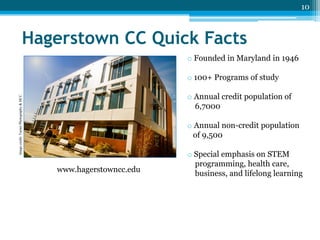
Hagerstown CC Quick Facts
o Founded in Maryland in 1946
o 100+ Programs of study
Image credit: Turner Photography & HCC

o Annual credit population of
6,7000
o Annual non-credit population
of 9,500

www.hagerstowncc.edu

o Special emphasis on STEM
programming, health care,
business, and lifelong learning
11

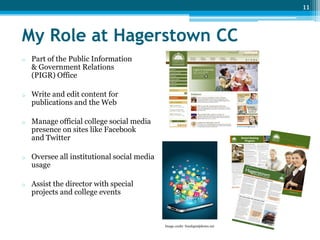
My Role at Hagerstown CC
o

Part of the Public Information
& Government Relations
(PIGR) Office

o

Write and edit content for
publications and the Web

o

Manage official college social media
presence on sites like Facebook
and Twitter

o

Oversee all institutional social media
usage

o

Assist the director with special
projects and college events

Image credit: freedigitalphotos.net
12

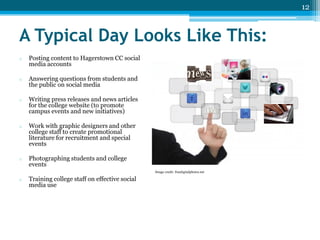
A Typical Day Looks Like This:
o

Posting content to Hagerstown CC social
media accounts

o

Answering questions from students and
the public on social media

o

Writing press releases and news articles
for the college website (to promote
campus events and new initiatives)

o

Work with graphic designers and other
college staff to create promotional
literature for recruitment and special
events

o

Photographing students and college
events
Image credit: freedigitalphotos.net

o

Training college staff on effective social
media use
13

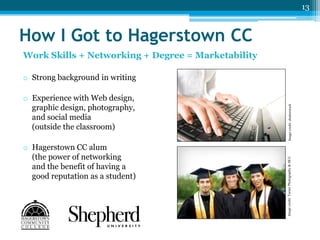
How I Got to Hagerstown CC
Work Skills + Networking + Degree = Marketability

o Hagerstown CC alum
(the power of networking
and the benefit of having a
good reputation as a student)

Image credit: Turner Photography & HCC

o Experience with Web design,
graphic design, photography,
and social media
(outside the classroom)

Image credit: shutterstock

o Strong background in writing
14

A Closer Look at Social Media Administration & Management
15

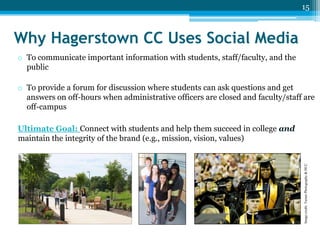
Why Hagerstown CC Uses Social Media
o To communicate important information with students, staff/faculty, and the
public
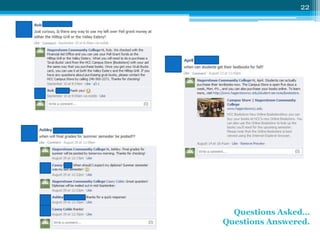
o To provide a forum for discussion where students can ask questions and get
answers on off-hours when administrative officers are closed and faculty/staff are
off-campus

???

Image credit: Turner Photography & HCC

Ultimate Goal: Connect with students and help them succeed in college and
maintain the integrity of the brand (e.g., mission, vision, values)
16

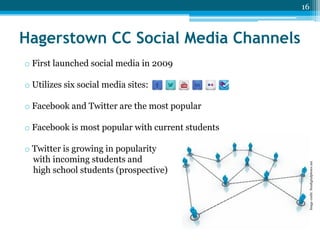
Hagerstown CC Social Media Channels
o First launched social media in 2009
o Utilizes six social media sites:
o Facebook and Twitter are the most popular

o Twitter is growing in popularity
with incoming students and
high school students (prospective)

Image credit: freedigitalphotos.net

o Facebook is most popular with current students
17

How Social Media is Managed
o Hagerstown CC has social media guidelines that govern social media
usage at the institution
o Each college account has at least one faculty or staff administrator
charged with managing the account
o Administrators have to check the account daily, post content frequently,
and answer ALL questions posed by fans and followers

-Be offensive, harassing, or threatening
-Contain profanity
-Be construed as defamation of character
-Violate existing college policies
(e.g., privacy, copyright law, etc.)

Image credit: freedigitalphotos.net

o Comments/questions are not censored. Students can post complaints as
long as those complaints don’t violate the Code of Conduct, which states
that content can’t:
18

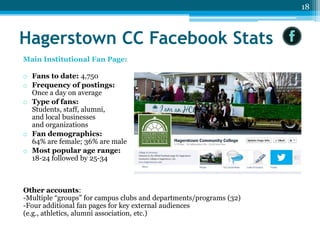
Hagerstown CC Facebook Stats
Main Institutional Fan Page:
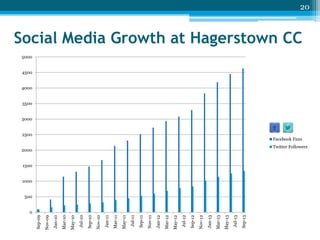
o Fans to date: 4,750
o Frequency of postings:
Once a day on average
o Type of fans:
Students, staff, alumni,
and local businesses
and organizations
o Fan demographics:
64% are female; 36% are male
o Most popular age range:
18-24 followed by 25-34

Other accounts:
-Multiple “groups” for campus clubs and departments/programs (32)
-Four additional fan pages for key external audiences
(e.g., athletics, alumni association, etc.)
19

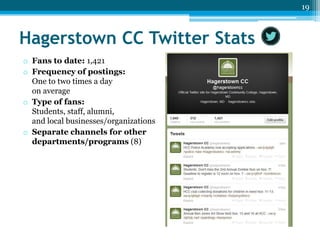
Hagerstown CC Twitter Stats
o Fans to date: 1,421
o Frequency of postings:
One to two times a day
on average
o Type of fans:
Students, staff, alumni,
and local businesses/organizations
o Separate channels for other
departments/programs (8)
Sep-13

Jul-13

May-13

Mar-13

Jan-13

Nov-12

Sep-12

Jul-12

May-12

Mar-12

Jan-12

Nov-11

Sep-11

Jul-11

May-11

Mar-11

Jan-11

Nov-10

Sep-10

Jul-10

May-10

Mar-10

Jan-10

Nov-09

Sep-09

20

Social Media Growth at Hagerstown CC
5000

4500

4000

3500

3000

2500
Facebook Fans

2000
Twitter Followers

1500

1000

500

0
21

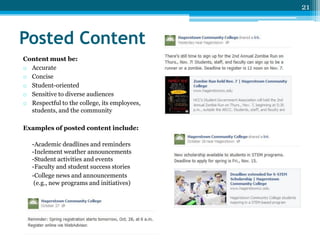
Posted Content
Content must be:
o Accurate
o Concise
o Student-oriented
o Sensitive to diverse audiences
o Respectful to the college, its employees,
students, and the community
Examples of posted content include:
-Academic deadlines and reminders
-Inclement weather announcements
-Student activities and events
-Faculty and student success stories
-College news and announcements
(e.g., new programs and initiatives)
22

Questions Asked…
Questions Answered.
23

Challenges in Social Media Administration
o Deciding what to post and how often
-The “once a day” rule
-Integrating messages from multiple sources (one main portal through which
all messages are shared or separate portals for specific audiences)
o Avoiding “shiny object syndrome”
-Making sure every social media channel has a purpose and an audience
-Choosing appropriate channels that can be managed effectively

Image credit: freedigitalphotos.net

o Training staff on effective social media usage
-Training on how to use various channels (making sure admins follow
college guidelines)
-Customer service training (how to handle questions and complaints)
24

The Pros, the Cons, and What You Can Do to Get Ready
25

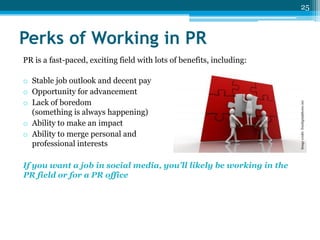
Perks of Working in PR
o Stable job outlook and decent pay
o Opportunity for advancement
o Lack of boredom
(something is always happening)
o Ability to make an impact
o Ability to merge personal and
professional interests
If you want a job in social media, you’ll likely be working in the
PR field or for a PR office

Image credit: freedigitalphotos.net

PR is a fast-paced, exciting field with lots of benefits, including:
26

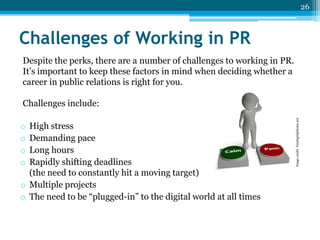
Challenges of Working in PR
Despite the perks, there are a number of challenges to working in PR.
It’s important to keep these factors in mind when deciding whether a
career in public relations is right for you.

High stress
Demanding pace
Long hours
Rapidly shifting deadlines
(the need to constantly hit a moving target)
o Multiple projects
o The need to be “plugged-in” to the digital world at all times
o
o
o
o

Image credit: freedigitalphotos.net

Challenges include:
27

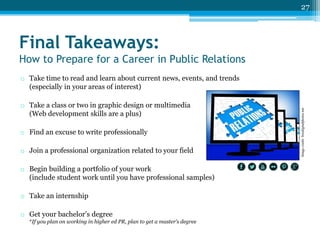
Final Takeaways:
How to Prepare for a Career in Public Relations

o Take a class or two in graphic design or multimedia
(Web development skills are a plus)

o Find an excuse to write professionally
o Join a professional organization related to your field
o Begin building a portfolio of your work
(include student work until you have professional samples)
o Take an internship
o Get your bachelor’s degree
*If you plan on working in higher ed PR, plan to get a master’s degree

Image credit: freedigitalphotos.net

o Take time to read and learn about current news, events, and trends
(especially in your areas of interest)
28

Questions?

Leigh-Anne Lawrence
lmlawrence@hagerstowncc.edu
Twitter: @writenowsocial
www.linkedin.com/in/leighannelawrence

A Career in Public Relations and the Importance of Social Media in the PR Field

  • 1.
    A Career inPublic Relations And the Importance of Social Media in the PR Field November 5, 2013 Presentation by Leigh-Anne Mauk Lawrence Social Media & Public Information Specialist Hagerstown Community College
  • 2.
    2 What is PublicRelations? o PR is the practice of building relationships to enhance or strengthen the public image of a company, an organization, or an individual o PR professionals work for a variety of companies and organizations in a number of diverse industries. Some of the most common include: -For-profits (companies that sell a product or service) -Government relations -Health care -Higher education -Nonprofits Image credits: Shutterstock o Ultimate Goal: Build a solid reputation that inspires trust in one’s core audience while adhering to the mission, vision, and values of an organization
  • 3.
    3 Tools in thePR Arsenal Two purposes in PR: Inform or Persuade o Informative tools include fact sheets, press releases, press conferences, video news releases, and media kits Image credit: freedigitalphotos.net o Persuasive tools include speeches, letters to the editor, guest columns, and online, radio or television appearances and interviews
  • 4.
    4 o Traditional –Print ads, radio/TV ads, outdoor ads like billboards, and promotional literature/publications o Tradigital – Website, Internet ads, email blasts, text messages o Social Media – Facebook, Twitter, LinkedIn, YouTube, blogs, etc. o Earned or Free Media – News features, TV/radio coverage, retweets (RTs) or shared links via social media Image credit: freedigitalphotos.net Standard Marketing Channels
  • 5.
    5 What Type ofPeople Work in PR? Successful PR professionals typically exhibit the following traits or abilities: Excellent writing skills Ability to think critically Creative mindset Project-oriented Good at multi-tasking Detail-oriented Ability to consistently meet deadlines Flexible and able to think quickly on their feet o Superior communication skills Image credit: photl.com o o o o o o o o
  • 6.
    6 Can Introverts Workin PR? Yes! PR offices often contain a blend of introverts and extroverts • Extroverts: Often work as PR directors/managers and serve as the public “face” of an organization. They set the direction for the brand and oversee other PR staff, delegating tasks and assignments as needed -Writers (print and online) -Social media managers -Web designers and editors -Graphic designers -Photographers -Videographers Image credit: photl.com • Introverts: Are typically the behind-the-scenes content creators that take the PR director’s vision and run with it. Examples of behind-thescenes content creators can include:
  • 7.
  • 8.
    8 How Web &New Media Changed PR Forever o PR professionals can’t focus solely on print, TV, and radio any more: They need to use a combination of traditional and new media to carry their messages to the public o A website is no longer enough. Customers and clients expect to be able to ask questions and voice opinions about the products and services they use and will do so via social media o New for today’s PR Professionals: They serve a diverse audience accessing information on a wide variety of devices Image credits: freedigitalphotos.net
  • 9.
    9 How I Founda Job as a Social Media Specialist in Higher Ed
  • 10.
    10 Hagerstown CC QuickFacts o Founded in Maryland in 1946 o 100+ Programs of study Image credit: Turner Photography & HCC o Annual credit population of 6,7000 o Annual non-credit population of 9,500 www.hagerstowncc.edu o Special emphasis on STEM programming, health care, business, and lifelong learning
  • 11.
    11 My Role atHagerstown CC o Part of the Public Information & Government Relations (PIGR) Office o Write and edit content for publications and the Web o Manage official college social media presence on sites like Facebook and Twitter o Oversee all institutional social media usage o Assist the director with special projects and college events Image credit: freedigitalphotos.net
  • 12.
    12 A Typical DayLooks Like This: o Posting content to Hagerstown CC social media accounts o Answering questions from students and the public on social media o Writing press releases and news articles for the college website (to promote campus events and new initiatives) o Work with graphic designers and other college staff to create promotional literature for recruitment and special events o Photographing students and college events Image credit: freedigitalphotos.net o Training college staff on effective social media use
  • 13.
    13 How I Gotto Hagerstown CC Work Skills + Networking + Degree = Marketability o Hagerstown CC alum (the power of networking and the benefit of having a good reputation as a student) Image credit: Turner Photography & HCC o Experience with Web design, graphic design, photography, and social media (outside the classroom) Image credit: shutterstock o Strong background in writing
  • 14.
    14 A Closer Lookat Social Media Administration & Management
  • 15.
    15 Why Hagerstown CCUses Social Media o To communicate important information with students, staff/faculty, and the public o To provide a forum for discussion where students can ask questions and get answers on off-hours when administrative officers are closed and faculty/staff are off-campus ??? Image credit: Turner Photography & HCC Ultimate Goal: Connect with students and help them succeed in college and maintain the integrity of the brand (e.g., mission, vision, values)
  • 16.
    16 Hagerstown CC SocialMedia Channels o First launched social media in 2009 o Utilizes six social media sites: o Facebook and Twitter are the most popular o Twitter is growing in popularity with incoming students and high school students (prospective) Image credit: freedigitalphotos.net o Facebook is most popular with current students
  • 17.
    17 How Social Mediais Managed o Hagerstown CC has social media guidelines that govern social media usage at the institution o Each college account has at least one faculty or staff administrator charged with managing the account o Administrators have to check the account daily, post content frequently, and answer ALL questions posed by fans and followers -Be offensive, harassing, or threatening -Contain profanity -Be construed as defamation of character -Violate existing college policies (e.g., privacy, copyright law, etc.) Image credit: freedigitalphotos.net o Comments/questions are not censored. Students can post complaints as long as those complaints don’t violate the Code of Conduct, which states that content can’t:
  • 18.
    18 Hagerstown CC FacebookStats Main Institutional Fan Page: o Fans to date: 4,750 o Frequency of postings: Once a day on average o Type of fans: Students, staff, alumni, and local businesses and organizations o Fan demographics: 64% are female; 36% are male o Most popular age range: 18-24 followed by 25-34 Other accounts: -Multiple “groups” for campus clubs and departments/programs (32) -Four additional fan pages for key external audiences (e.g., athletics, alumni association, etc.)
  • 19.
    19 Hagerstown CC TwitterStats o Fans to date: 1,421 o Frequency of postings: One to two times a day on average o Type of fans: Students, staff, alumni, and local businesses/organizations o Separate channels for other departments/programs (8)
  • 20.
  • 21.
    21 Posted Content Content mustbe: o Accurate o Concise o Student-oriented o Sensitive to diverse audiences o Respectful to the college, its employees, students, and the community Examples of posted content include: -Academic deadlines and reminders -Inclement weather announcements -Student activities and events -Faculty and student success stories -College news and announcements (e.g., new programs and initiatives)
  • 22.
  • 23.
    23 Challenges in SocialMedia Administration o Deciding what to post and how often -The “once a day” rule -Integrating messages from multiple sources (one main portal through which all messages are shared or separate portals for specific audiences) o Avoiding “shiny object syndrome” -Making sure every social media channel has a purpose and an audience -Choosing appropriate channels that can be managed effectively Image credit: freedigitalphotos.net o Training staff on effective social media usage -Training on how to use various channels (making sure admins follow college guidelines) -Customer service training (how to handle questions and complaints)
  • 24.
    24 The Pros, theCons, and What You Can Do to Get Ready
  • 25.
    25 Perks of Workingin PR o Stable job outlook and decent pay o Opportunity for advancement o Lack of boredom (something is always happening) o Ability to make an impact o Ability to merge personal and professional interests If you want a job in social media, you’ll likely be working in the PR field or for a PR office Image credit: freedigitalphotos.net PR is a fast-paced, exciting field with lots of benefits, including:
  • 26.
    26 Challenges of Workingin PR Despite the perks, there are a number of challenges to working in PR. It’s important to keep these factors in mind when deciding whether a career in public relations is right for you. High stress Demanding pace Long hours Rapidly shifting deadlines (the need to constantly hit a moving target) o Multiple projects o The need to be “plugged-in” to the digital world at all times o o o o Image credit: freedigitalphotos.net Challenges include:
  • 27.
    27 Final Takeaways: How toPrepare for a Career in Public Relations o Take a class or two in graphic design or multimedia (Web development skills are a plus) o Find an excuse to write professionally o Join a professional organization related to your field o Begin building a portfolio of your work (include student work until you have professional samples) o Take an internship o Get your bachelor’s degree *If you plan on working in higher ed PR, plan to get a master’s degree Image credit: freedigitalphotos.net o Take time to read and learn about current news, events, and trends (especially in your areas of interest)
  • 28.