PhD Completion Seminar


Metaphor as a means to influence behaviour
  and knowledge transfer in projects for
           enhanced outcomes

                              Arthur Shelley
                                  March 7 2012


      © Arthur Shelley 2009 under Creative Commons License. Available for public use provided
                                                                                                1
      source is acknowledged. Permission of the author required for commercial use.
Context
• We all know behaviour has an impact on how
  we interact with others.
• History shows many team projects fail to meet
  their objectives and behaviour is part of this
  problem.
• We also know these failures cost millions of
  dollars, not to mention the stress and emotional
  consequences.
Despite these facts, very few people attempt to
proactively manage the behavioural environment.
       © Arthur Shelley 2009 under Creative Commons License. Available for public use provided
                                                                                                 2
       source is acknowledged. Permission of the author required for commercial use.
Original Research Proposition

      Specific behavioural interventions*,
      can enhance project performance
      and outcomes.

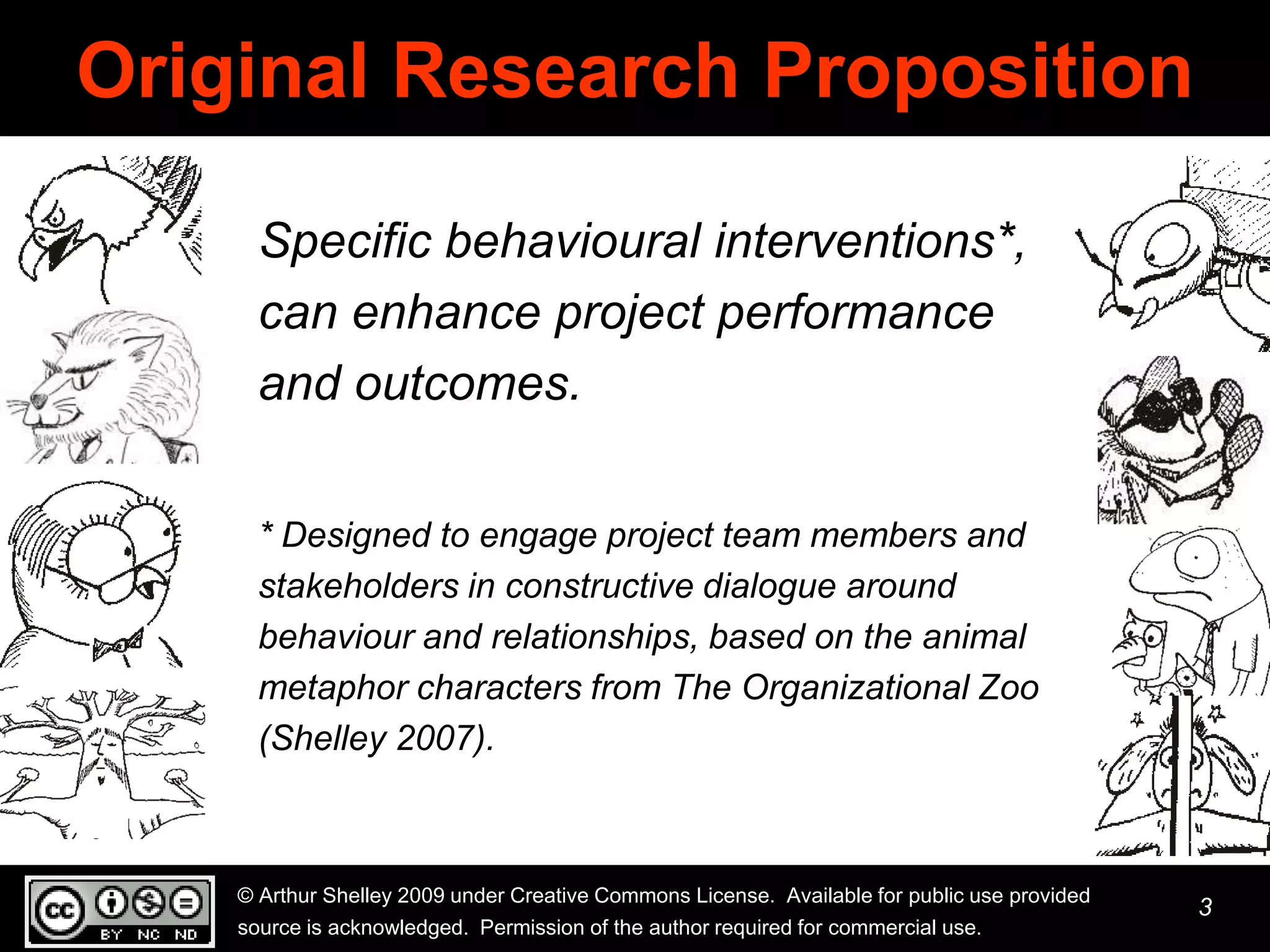
      * Designed to engage project team members and
      stakeholders in constructive dialogue around
      behaviour and relationships, based on the animal
      metaphor characters from The Organizational Zoo
      (Shelley 2007).


    © Arthur Shelley 2009 under Creative Commons License. Available for public use provided
                                                                                              3
    source is acknowledged. Permission of the author required for commercial use.
Research Questions
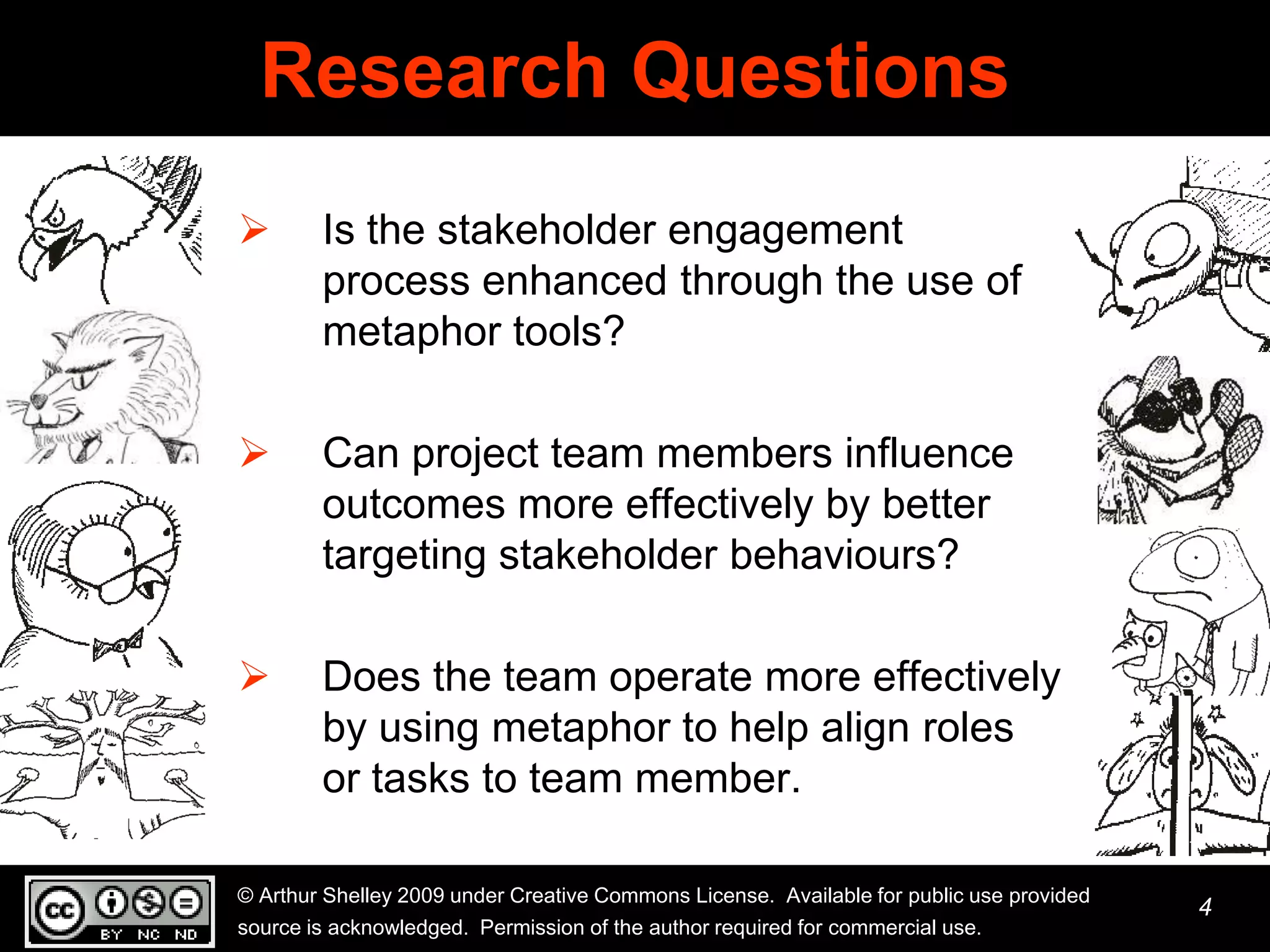
       Is the stakeholder engagement
        process enhanced through the use of
        metaphor tools?

       Can project team members influence
        outcomes more effectively by better
        targeting stakeholder behaviours?

       Does the team operate more effectively
        by using metaphor to help align roles
        or tasks to team member.

© Arthur Shelley 2009 under Creative Commons License. Available for public use provided
                                                                                          4
source is acknowledged. Permission of the author required for commercial use.
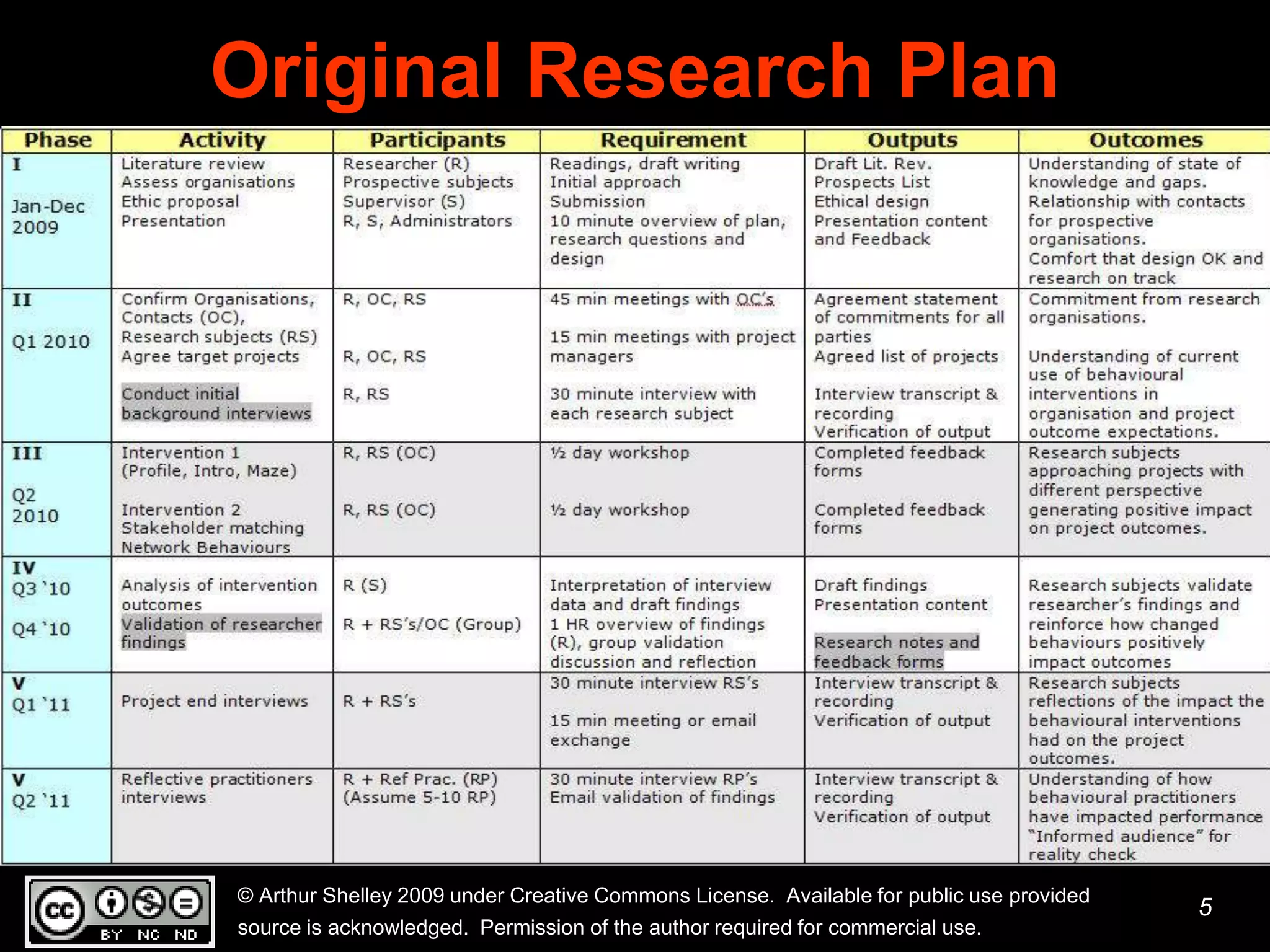
Original Research Plan


© Arthur Shelley 2009 under Creative Commons License. Available for public use provided
                                                                                          5
source is acknowledged. Permission of the author required for commercial use.
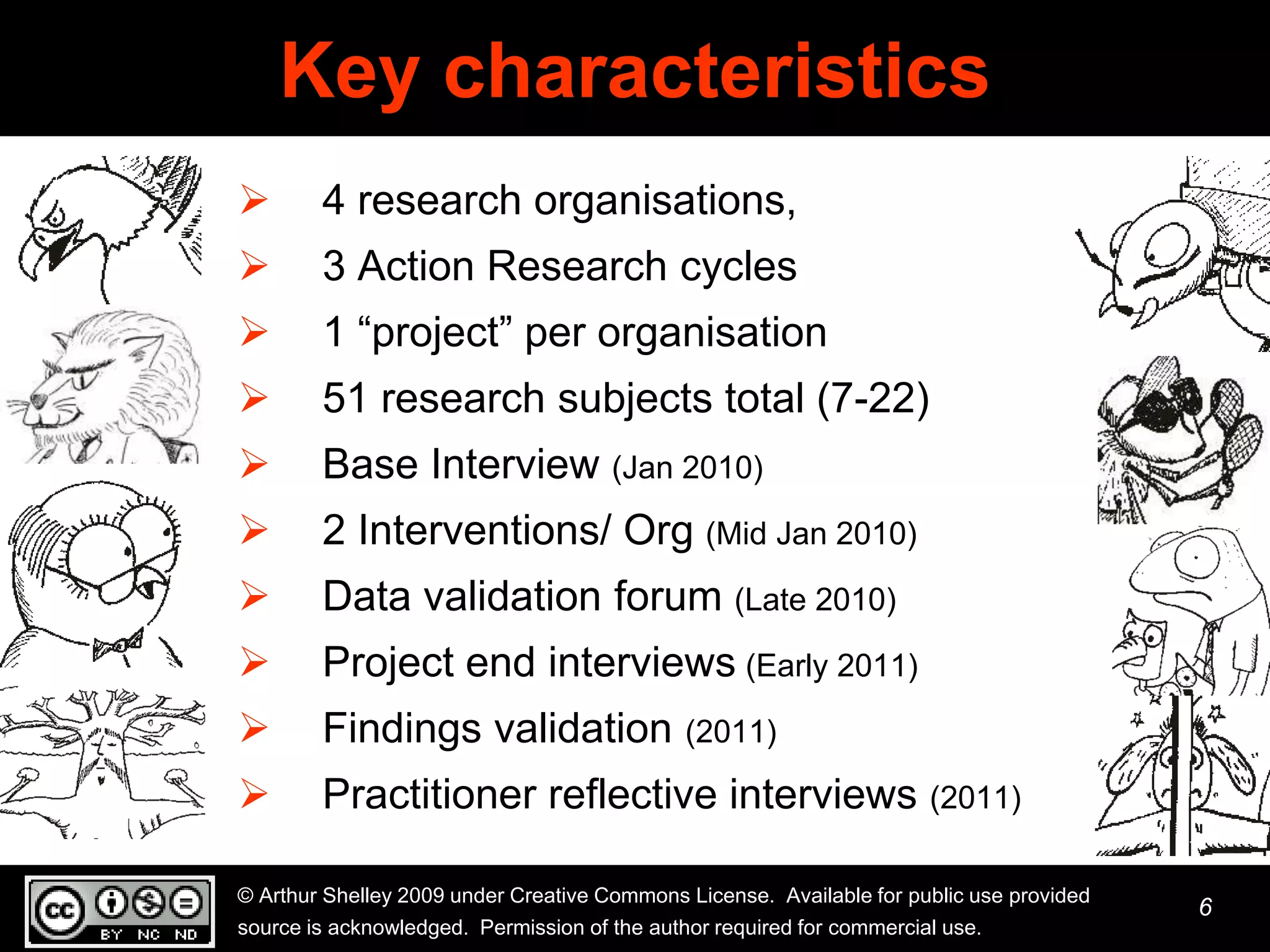
Key characteristics
       4 research organisations,
       3 Action Research cycles
       1 “project” per organisation
       51 research subjects total (7-22)
       Base Interview (Jan 2010)
       2 Interventions/ Org (Mid Jan 2010)
       Data validation forum (Late 2010)
       Project end interviews (Early 2011)
       Findings validation (2011)
       Practitioner reflective interviews (2011)

© Arthur Shelley 2009 under Creative Commons License. Available for public use provided
                                                                                          6
source is acknowledged. Permission of the author required for commercial use.
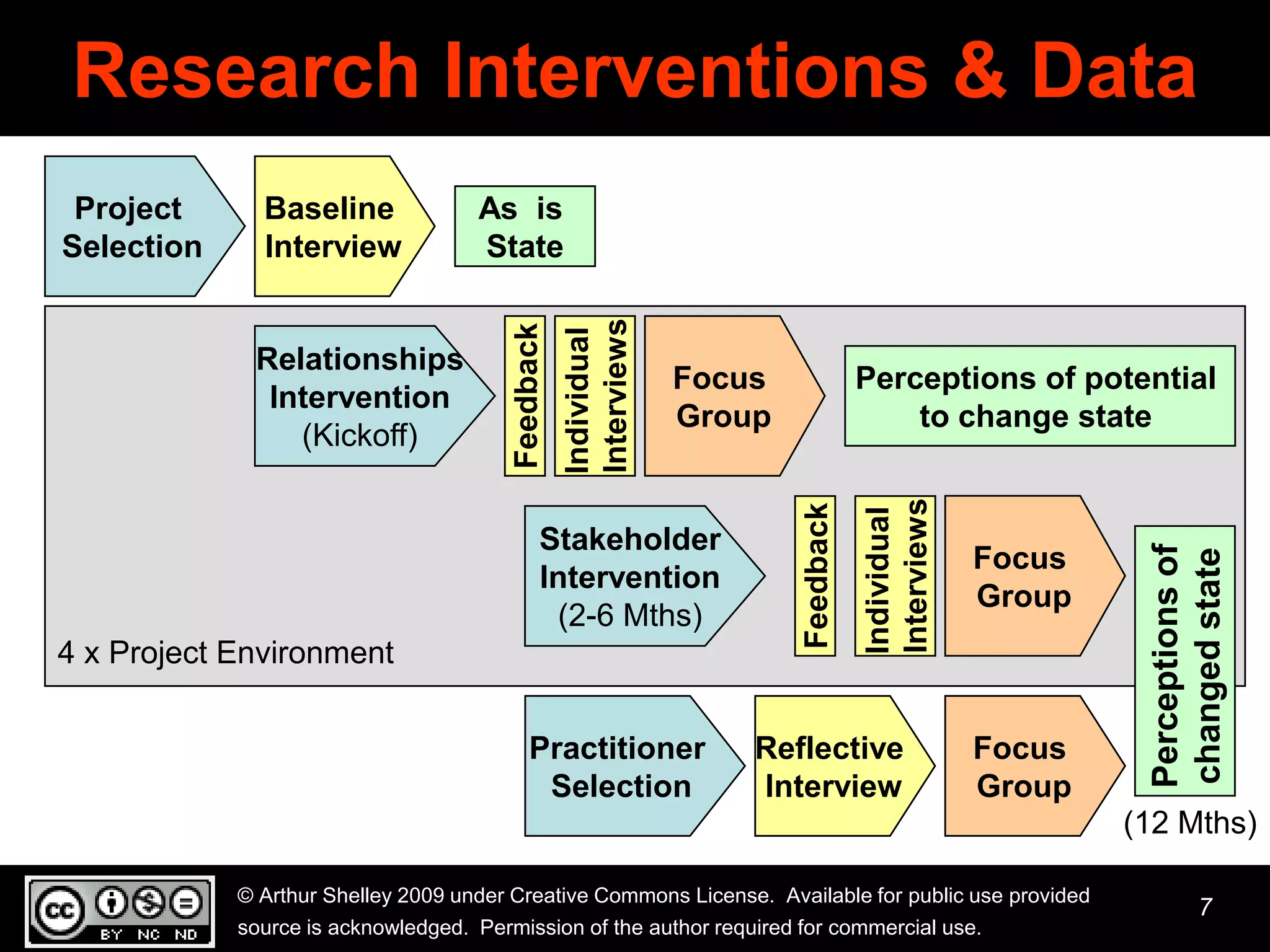
Research Interventions & Data
 Project      Baseline              As is
Selection     Interview             State


                                                   Interviews
                                        Feedback
                                                   Individual
             Relationships
                                                                Focus              Perceptions of potential
              Intervention
                                                                Group                  to change state
                (Kickoff)


                                                                                   Interviews
                                                                        Feedback
                                                                                   Individual
                                              Stakeholder


                                                                                                         Perceptions of
                                                                                                Focus


                                                                                                         changed state
                                              Intervention
                                                                                                Group
                                               (2-6 Mths)
4 x Project Environment


                                            Practitioner            Reflective                  Focus
                                             Selection              Interview                   Group
                                                                                                        (12 Mths)

            © Arthur Shelley 2009 under Creative Commons License. Available for public use provided
                                                                                                                 7
            source is acknowledged. Permission of the author required for commercial use.
The reality check
• Half of the organisations who opted in originally, did not participate –
  new organisations engaged
• All 4 organisations in the research went through significant
  restructures during or immediately after the research that had a direct
  impact on some or all research participants
• Several research participants left the organisation during or not long
  after the research was done, making any longitudinal study impossible
• Difficult to get specific times agreed to do agreed interventions, and
  almost impossible to get any additional time or activities done (despite
  significant interest in the techniques)
• Hard to achieve consistency when only have such sort time with
  research subjects (limited mindshare and competing with tasks)
• Challenge of balancing learning activities with research data gathering
  (they want to learn and do, researcher wants to gather and reflect)

          © Arthur Shelley 2009 under Creative Commons License. Available for public use provided
                                                                                                    8
          source is acknowledged. Permission of the author required for commercial use.
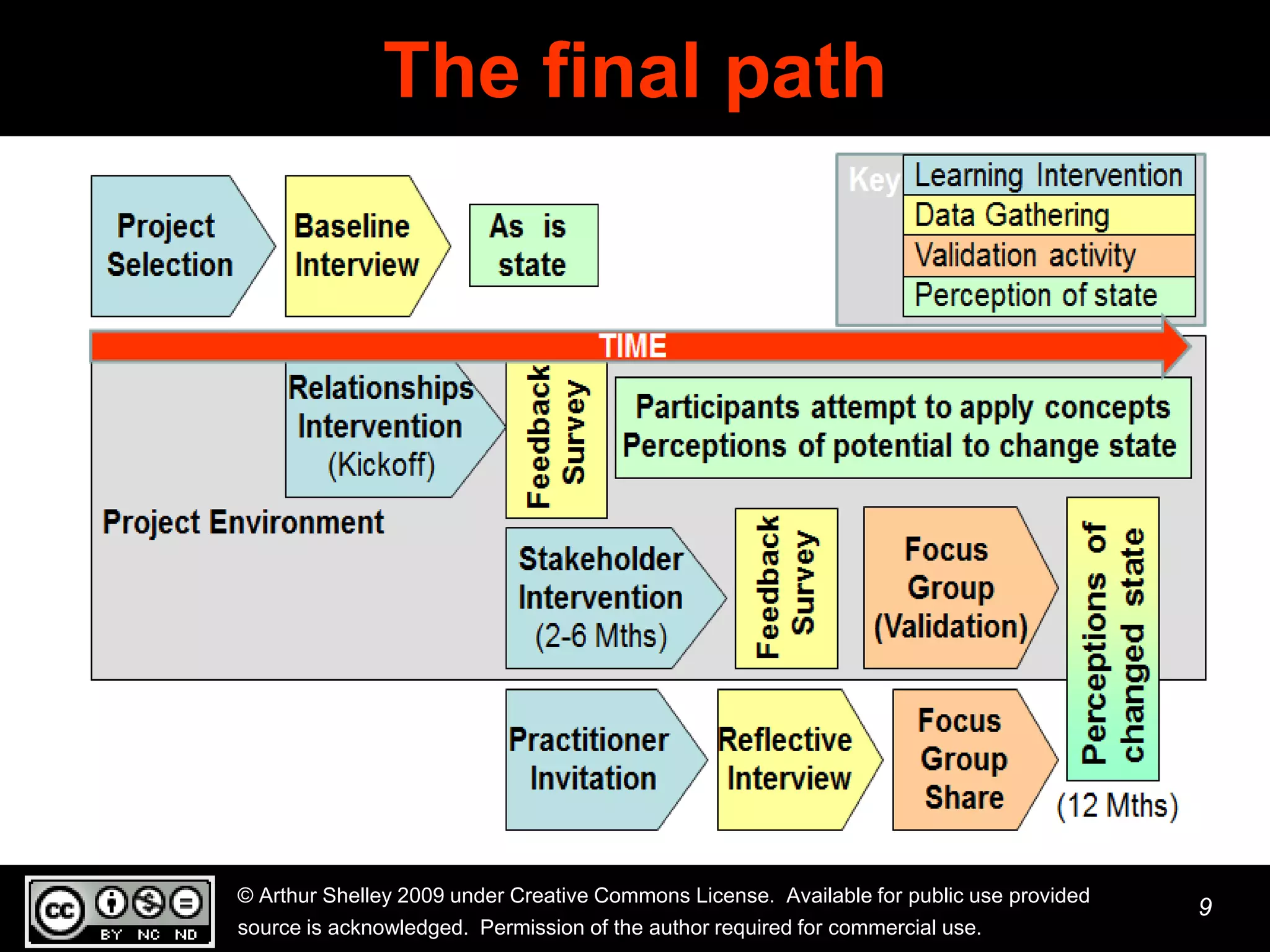
The final path


© Arthur Shelley 2009 under Creative Commons License. Available for public use provided
                                                                                          9
source is acknowledged. Permission of the author required for commercial use.
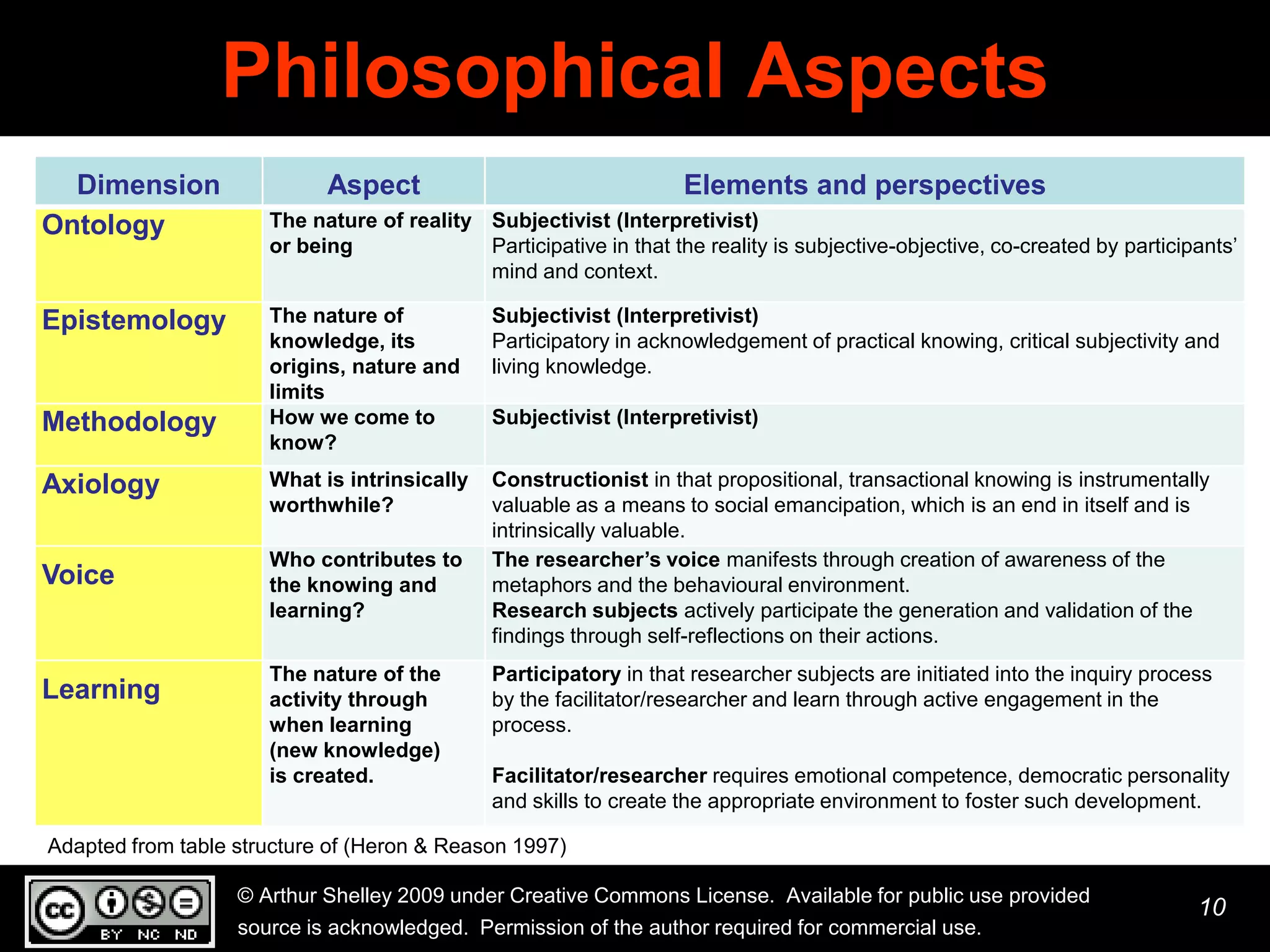
Philosophical Aspects
  Dimension                 Aspect                                  Elements and perspectives
Ontology              The nature of reality Subjectivist (Interpretivist)
                      or being              Participative in that the reality is subjective-objective, co-created by participants’
                                            mind and context.

Epistemology          The nature of           Subjectivist (Interpretivist)
                      knowledge, its          Participatory in acknowledgement of practical knowing, critical subjectivity and
                      origins, nature and     living knowledge.
                      limits
Methodology           How we come to          Subjectivist (Interpretivist)
                      know?

Axiology              What is intrinsically   Constructionist in that propositional, transactional knowing is instrumentally
                      worthwhile?             valuable as a means to social emancipation, which is an end in itself and is
                                              intrinsically valuable.
                      Who contributes to      The researcher’s voice manifests through creation of awareness of the
Voice                 the knowing and         metaphors and the behavioural environment.
                      learning?               Research subjects actively participate the generation and validation of the
                                              findings through self-reflections on their actions.
                      The nature of the       Participatory in that researcher subjects are initiated into the inquiry process
Learning              activity through        by the facilitator/researcher and learn through active engagement in the
                      when learning           process.
                      (new knowledge)
                      is created.             Facilitator/researcher requires emotional competence, democratic personality
                                              and skills to create the appropriate environment to foster such development.

Adapted from table structure of (Heron & Reason 1997)

                   © Arthur Shelley 2009 under Creative Commons License. Available for public use provided
                                                                                                                             10
                   source is acknowledged. Permission of the author required for commercial use.
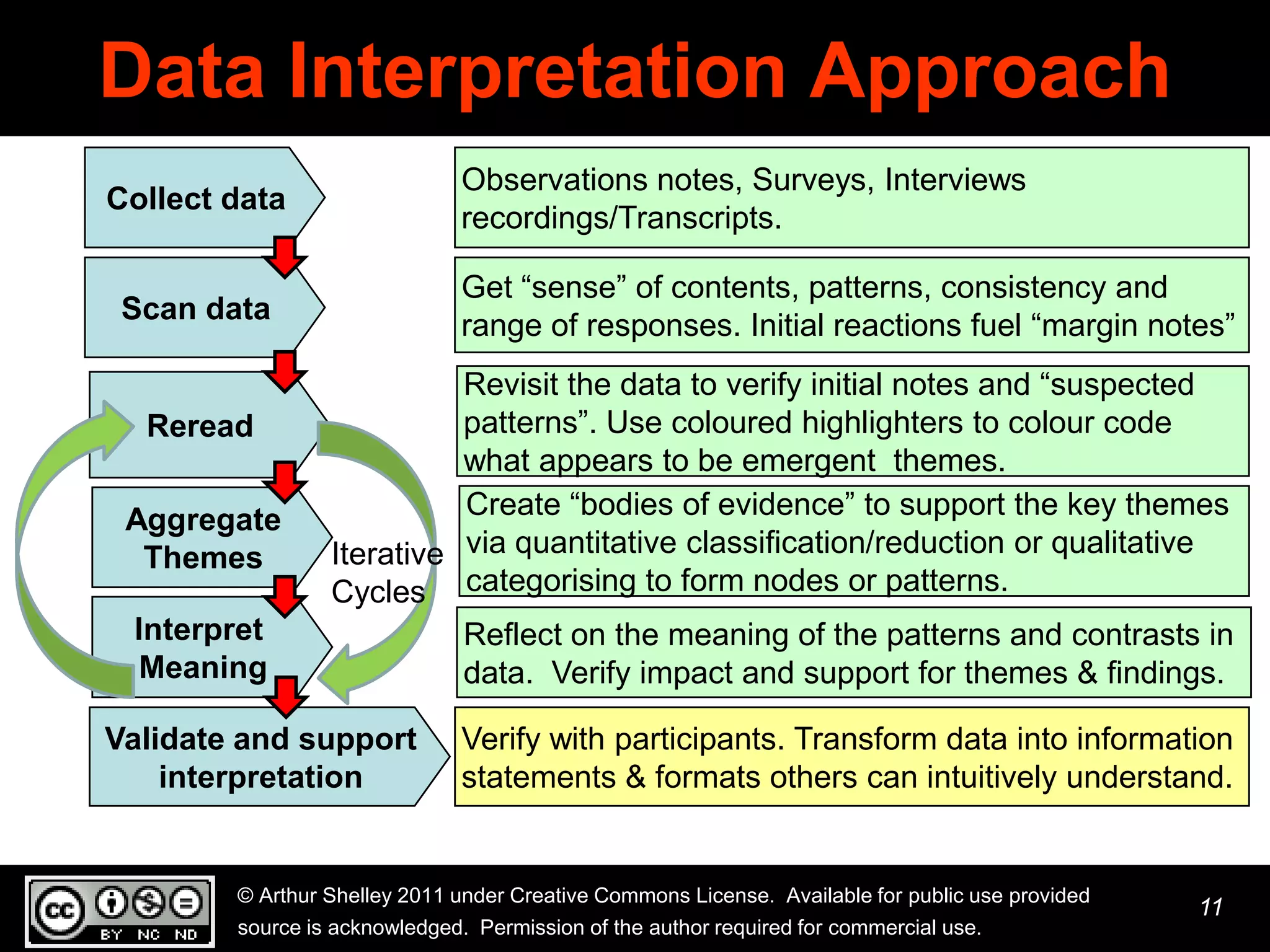
Data Interpretation Approach
                               Observations notes, Surveys, Interviews
Collect data
                               recordings/Transcripts.

                               Get “sense” of contents, patterns, consistency and
 Scan data
                               range of responses. Initial reactions fuel “margin notes”
                           Revisit the data to verify initial notes and “suspected
  Reread                   patterns”. Use coloured highlighters to colour code
                           what appears to be emergent themes.
 Aggregate                 Create “bodies of evidence” to support the key themes
  Themes         Iterative via quantitative classification/reduction or qualitative
                 Cycles categorising to form nodes or patterns.
 Interpret                 Reflect on the meaning of the patterns and contrasts in
 Meaning                   data. Verify impact and support for themes & findings.

Validate and support           Verify with participants. Transform data into information
    interpretation             statements & formats others can intuitively understand.


        © Arthur Shelley 2011 under Creative Commons License. Available for public use provided
                                                                                                  11
        source is acknowledged. Permission of the author required for commercial use.
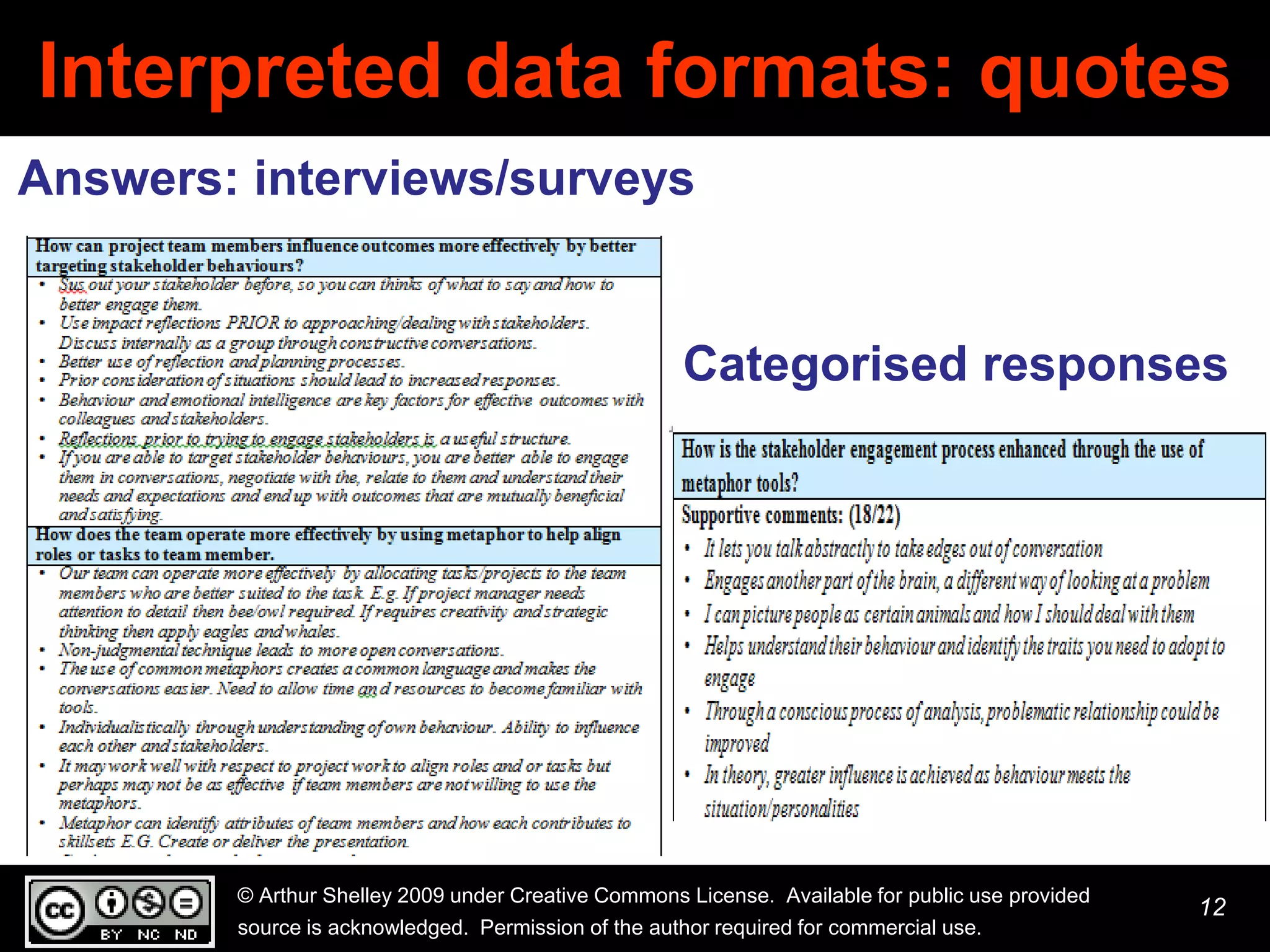
Interpreted data formats: quotes
Answers: interviews/surveys


                                                      Categorised responses


        © Arthur Shelley 2009 under Creative Commons License. Available for public use provided
                                                                                                  12
        source is acknowledged. Permission of the author required for commercial use.
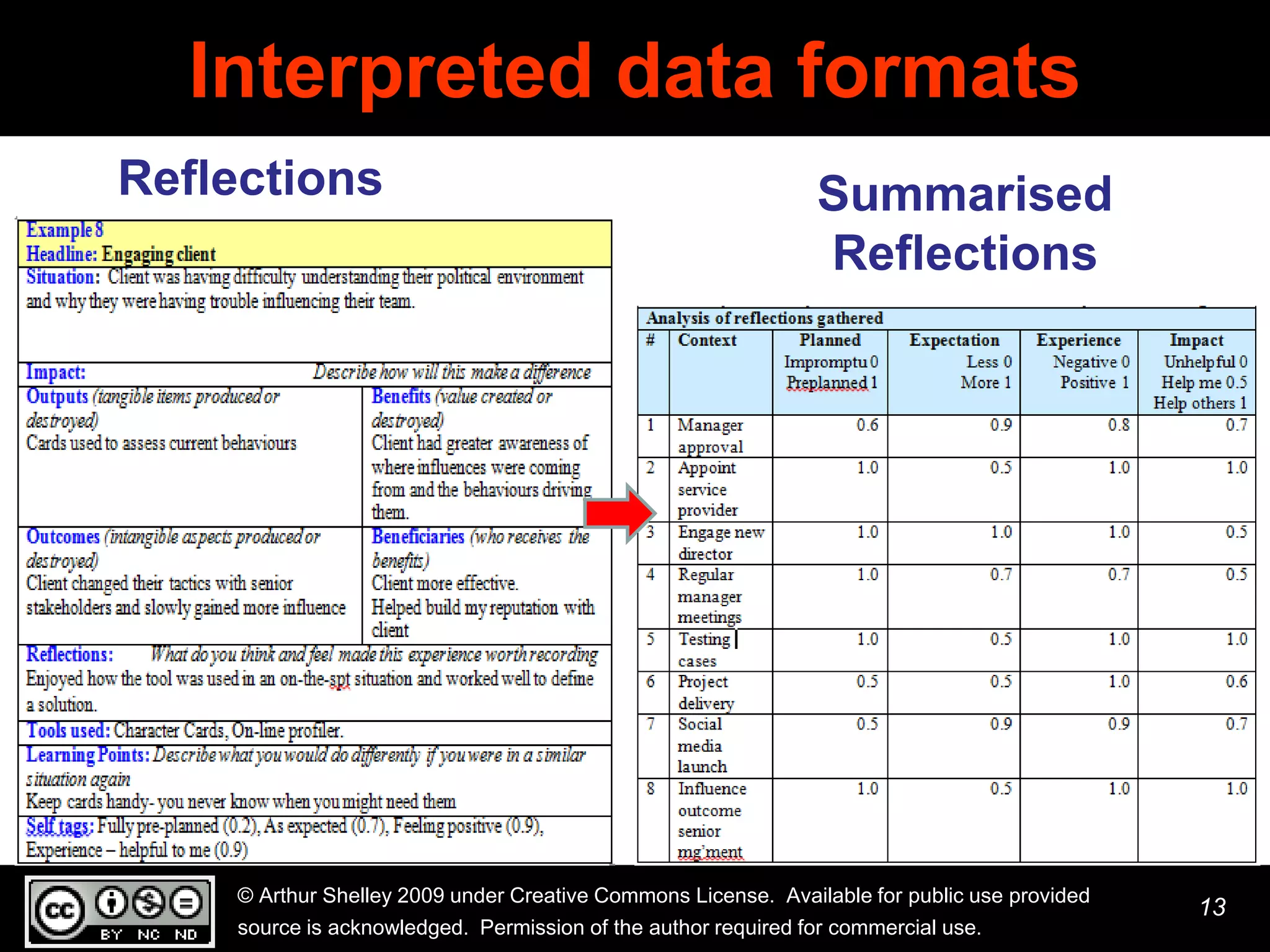
Interpreted data formats
Reflections                                                    Summarised
                                                               Reflections


    © Arthur Shelley 2009 under Creative Commons License. Available for public use provided
                                                                                              13
    source is acknowledged. Permission of the author required for commercial use.
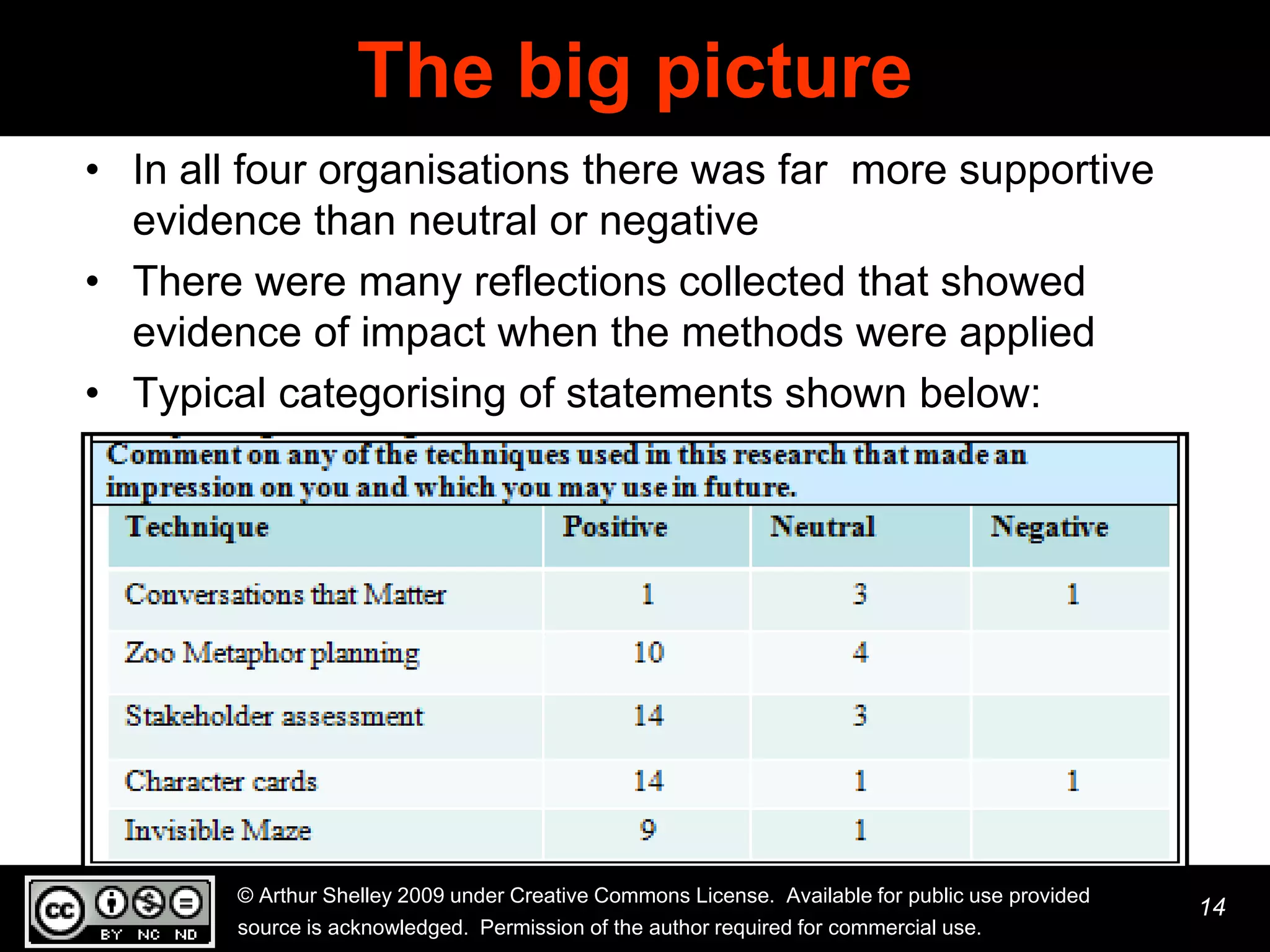
The big picture
• In all four organisations there was far more supportive
  evidence than neutral or negative
• There were many reflections collected that showed
  evidence of impact when the methods were applied
• Typical categorising of statements shown below:


        © Arthur Shelley 2009 under Creative Commons License. Available for public use provided
                                                                                                  14
        source is acknowledged. Permission of the author required for commercial use.
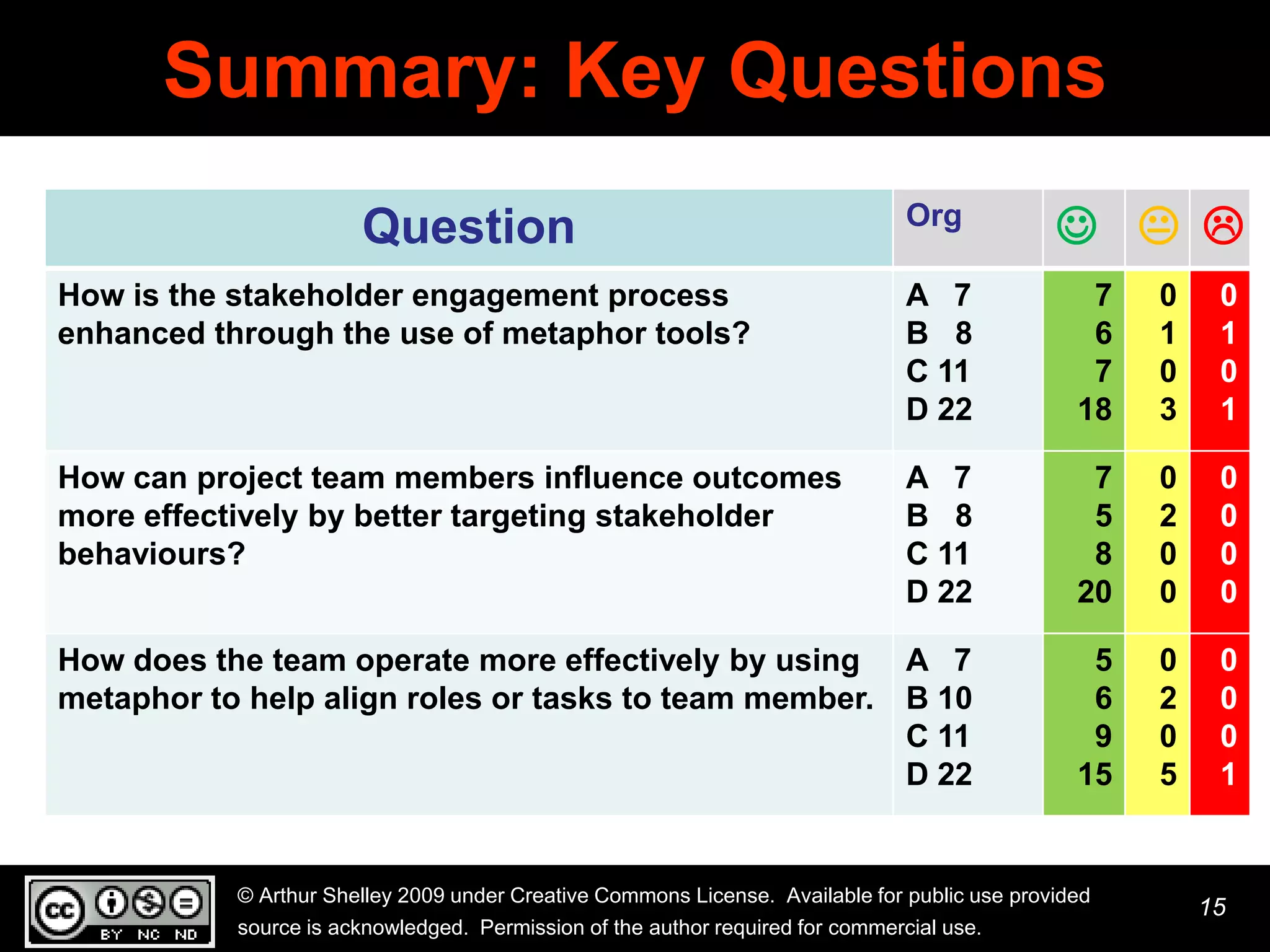
Summary: Key Questions
                       Question                                                 Org
                                                                                                
How is the stakeholder engagement process                                       A 7              7   0    0
enhanced through the use of metaphor tools?                                     B 8              6   1    1
                                                                                C 11             7   0    0
                                                                                D 22            18   3    1

How can project team members influence outcomes                                 A 7              7   0    0
more effectively by better targeting stakeholder                                B 8              5   2    0
behaviours?                                                                     C 11             8   0    0
                                                                                D 22            20   0    0

How does the team operate more effectively by using                             A 7              5   0    0
metaphor to help align roles or tasks to team member.                           B 10             6   2    0
                                                                                C 11             9   0    0
                                                                                D 22            15   5    1


           © Arthur Shelley 2009 under Creative Commons License. Available for public use provided
                                                                                                         15
           source is acknowledged. Permission of the author required for commercial use.
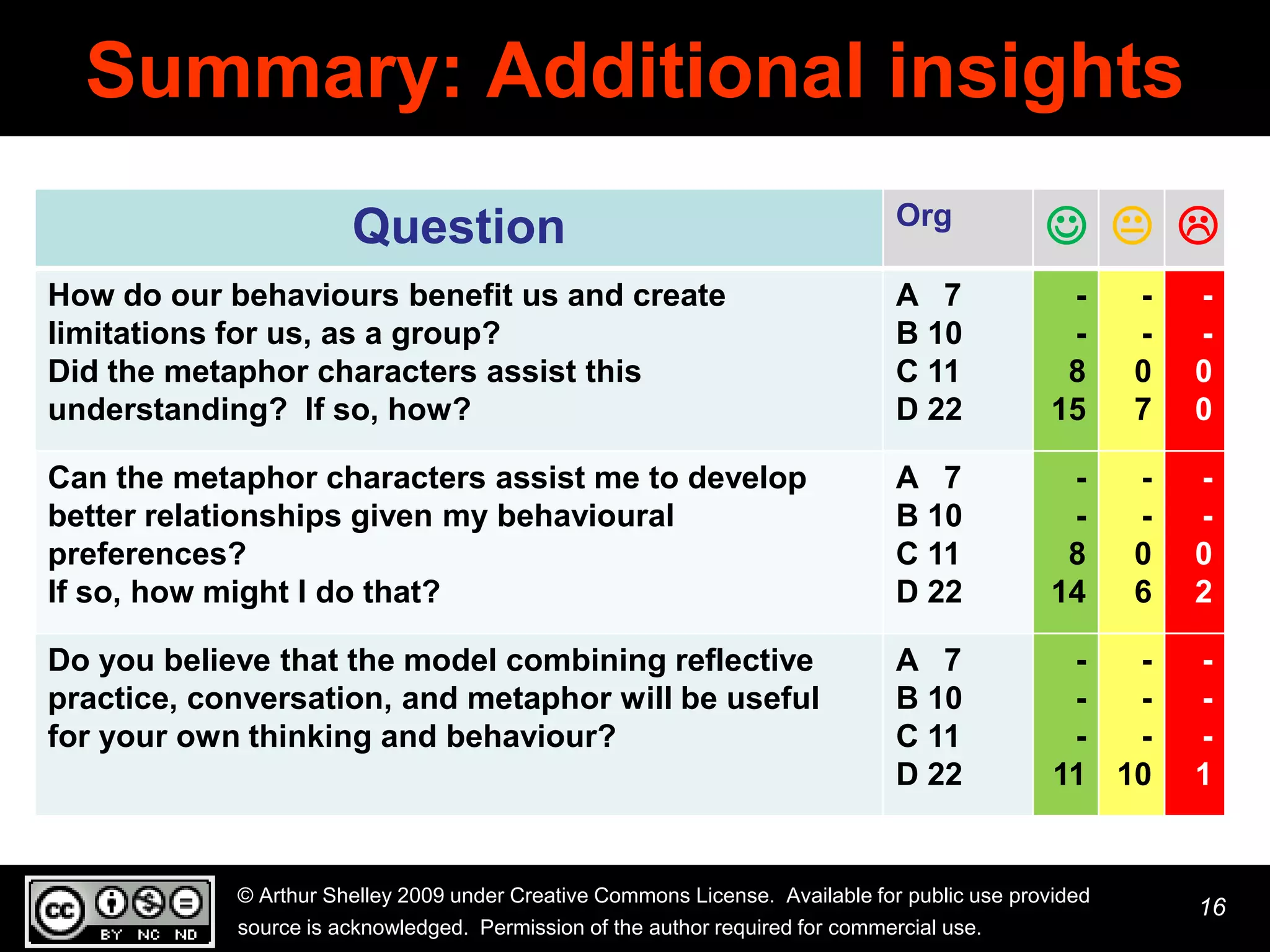
Summary: Additional insights
                       Question                                                 Org
                                                                                                
How do our behaviours benefit us and create                                     A 7            -      -   -
limitations for us, as a group?                                                 B 10           -      -   -
Did the metaphor characters assist this                                         C 11           8      0   0
understanding? If so, how?                                                      D 22          15      7   0

Can the metaphor characters assist me to develop                                A 7            -      -   -
better relationships given my behavioural                                       B 10           -      -   -
preferences?                                                                    C 11           8      0   0
If so, how might I do that?                                                     D 22          14      6   2

Do you believe that the model combining reflective                              A 7             -  -      -
practice, conversation, and metaphor will be useful                             B 10            -  -      -
for your own thinking and behaviour?                                            C 11            -  -      -
                                                                                D 22           11 10      1


            © Arthur Shelley 2009 under Creative Commons License. Available for public use provided
                                                                                                          16
            source is acknowledged. Permission of the author required for commercial use.
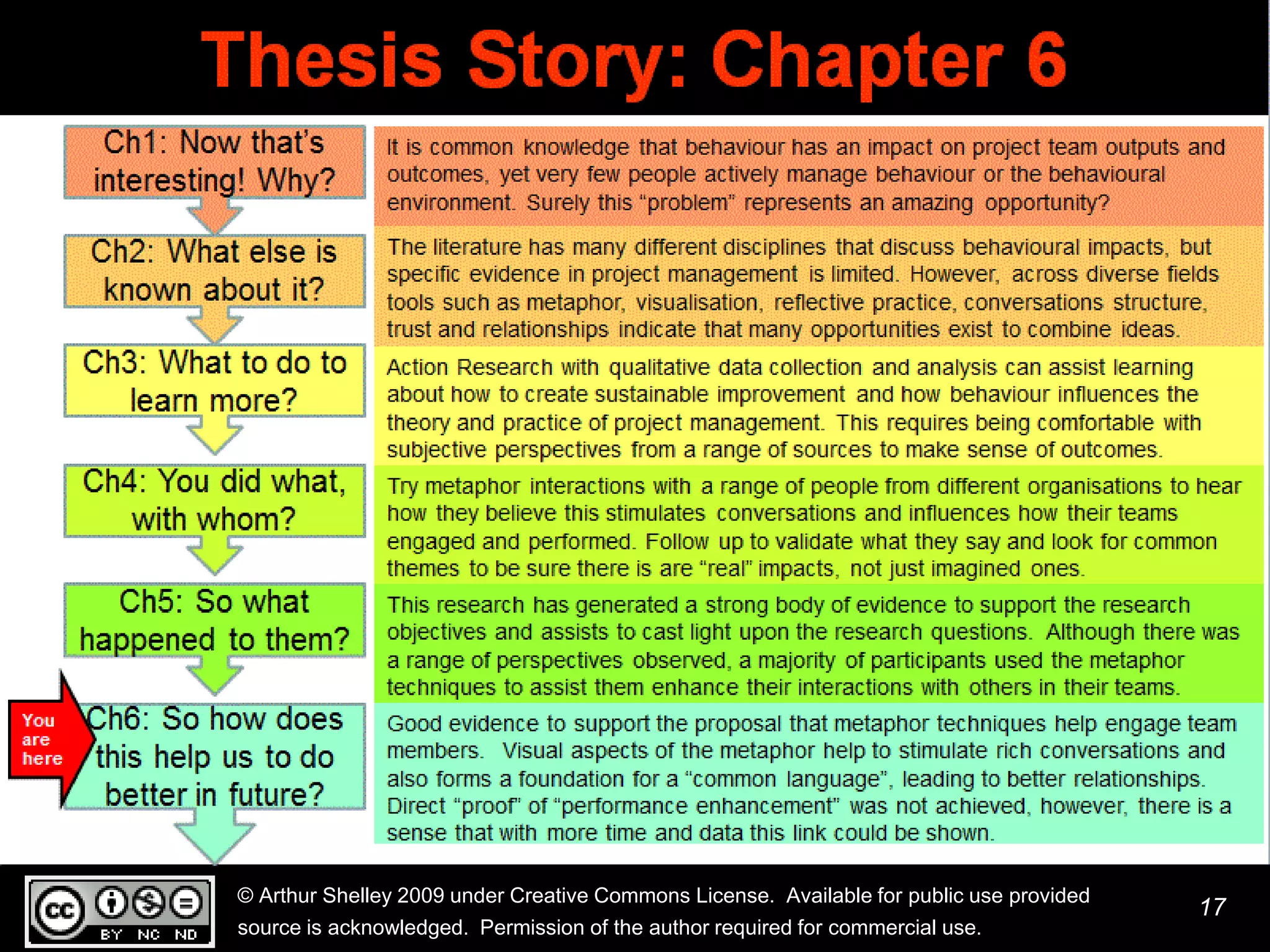
© Arthur Shelley 2009 under Creative Commons License. Available for public use provided
                                                                                          17
source is acknowledged. Permission of the author required for commercial use.
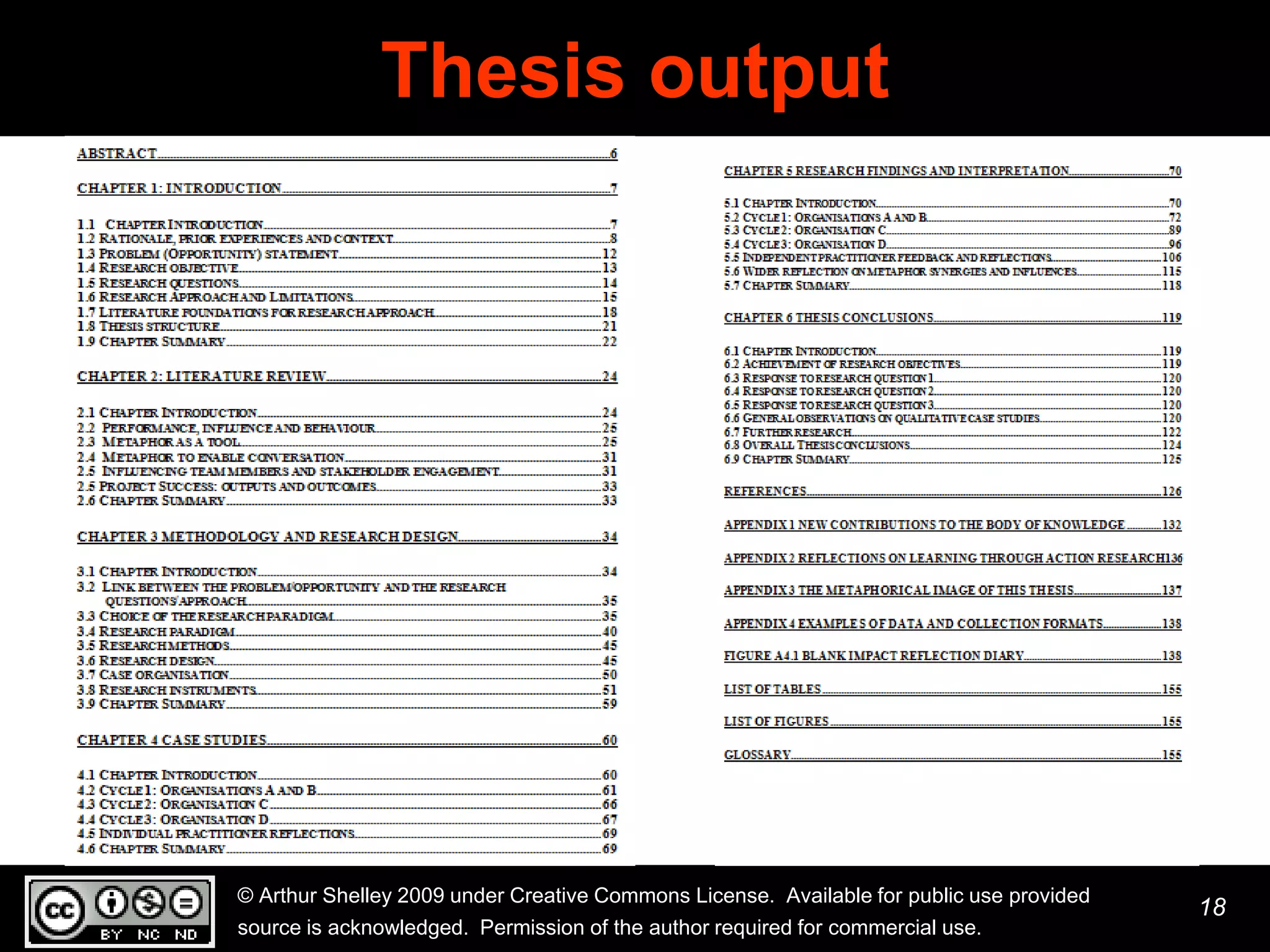
Thesis output


© Arthur Shelley 2009 under Creative Commons License. Available for public use provided
                                                                                          18
source is acknowledged. Permission of the author required for commercial use.
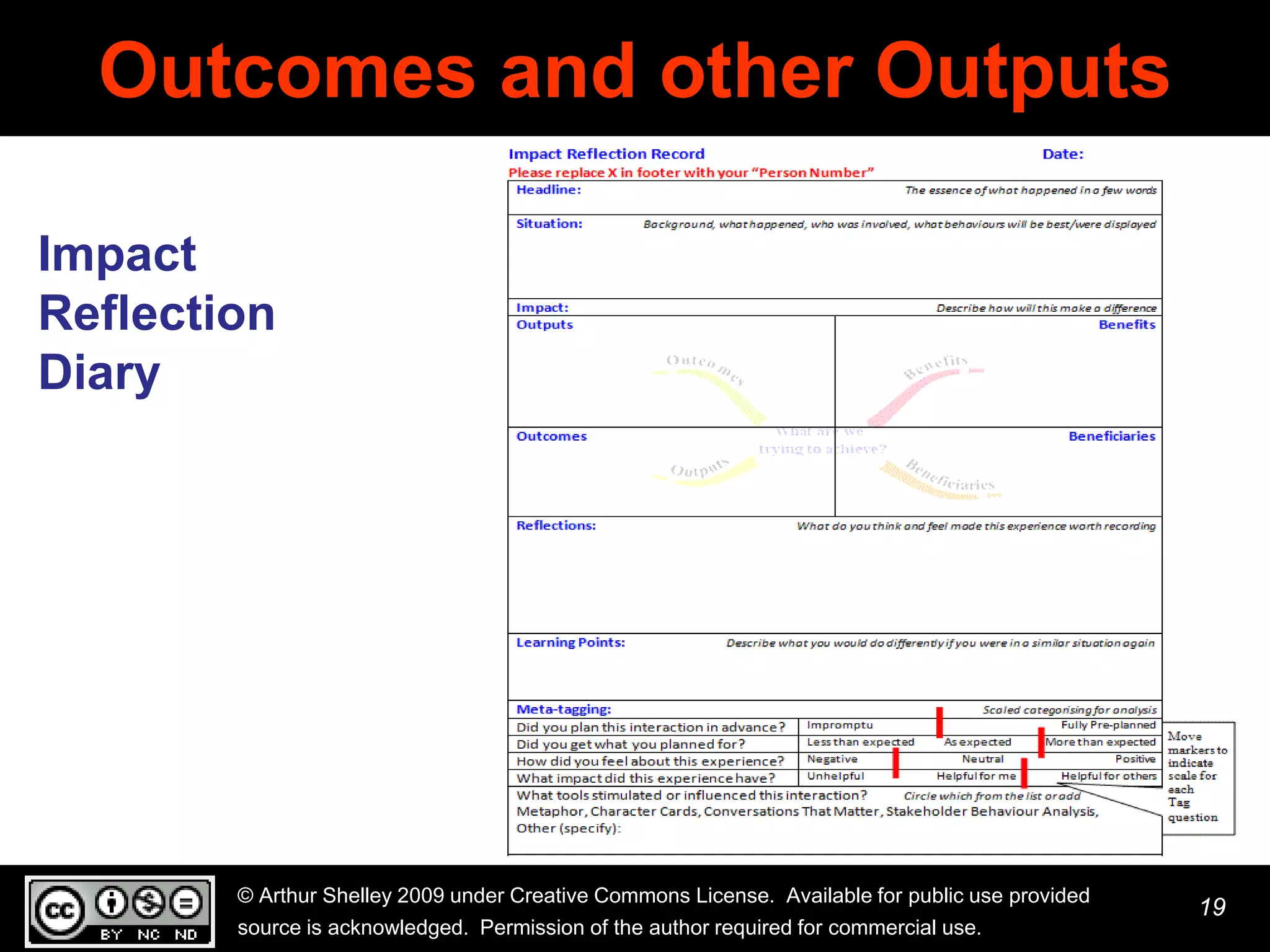
Outcomes and other Outputs

Impact
Reflection
Diary


        © Arthur Shelley 2009 under Creative Commons License. Available for public use provided
                                                                                                  19
        source is acknowledged. Permission of the author required for commercial use.
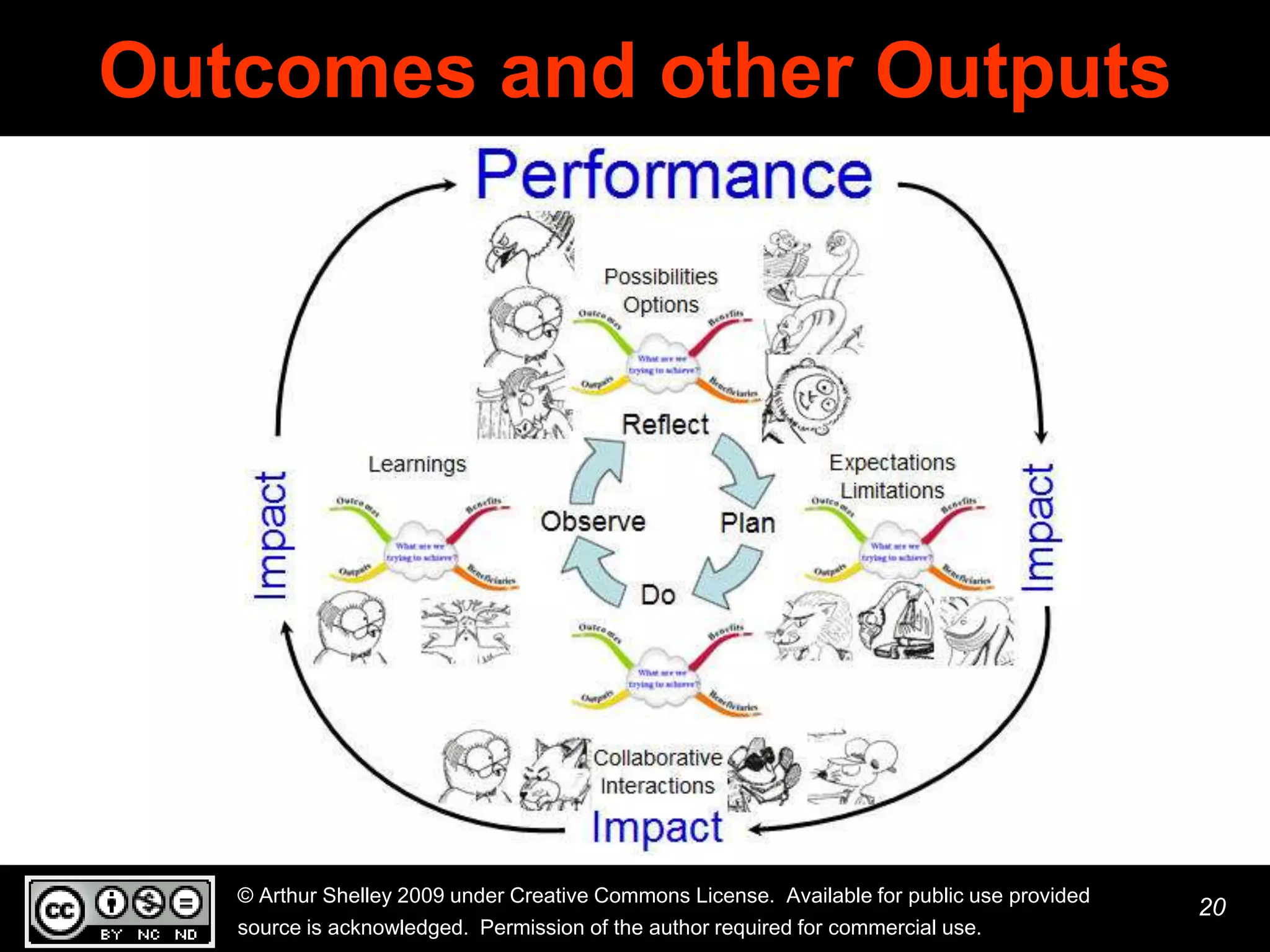
Outcomes and other Outputs


   © Arthur Shelley 2009 under Creative Commons License. Available for public use provided
                                                                                             20
   source is acknowledged. Permission of the author required for commercial use.
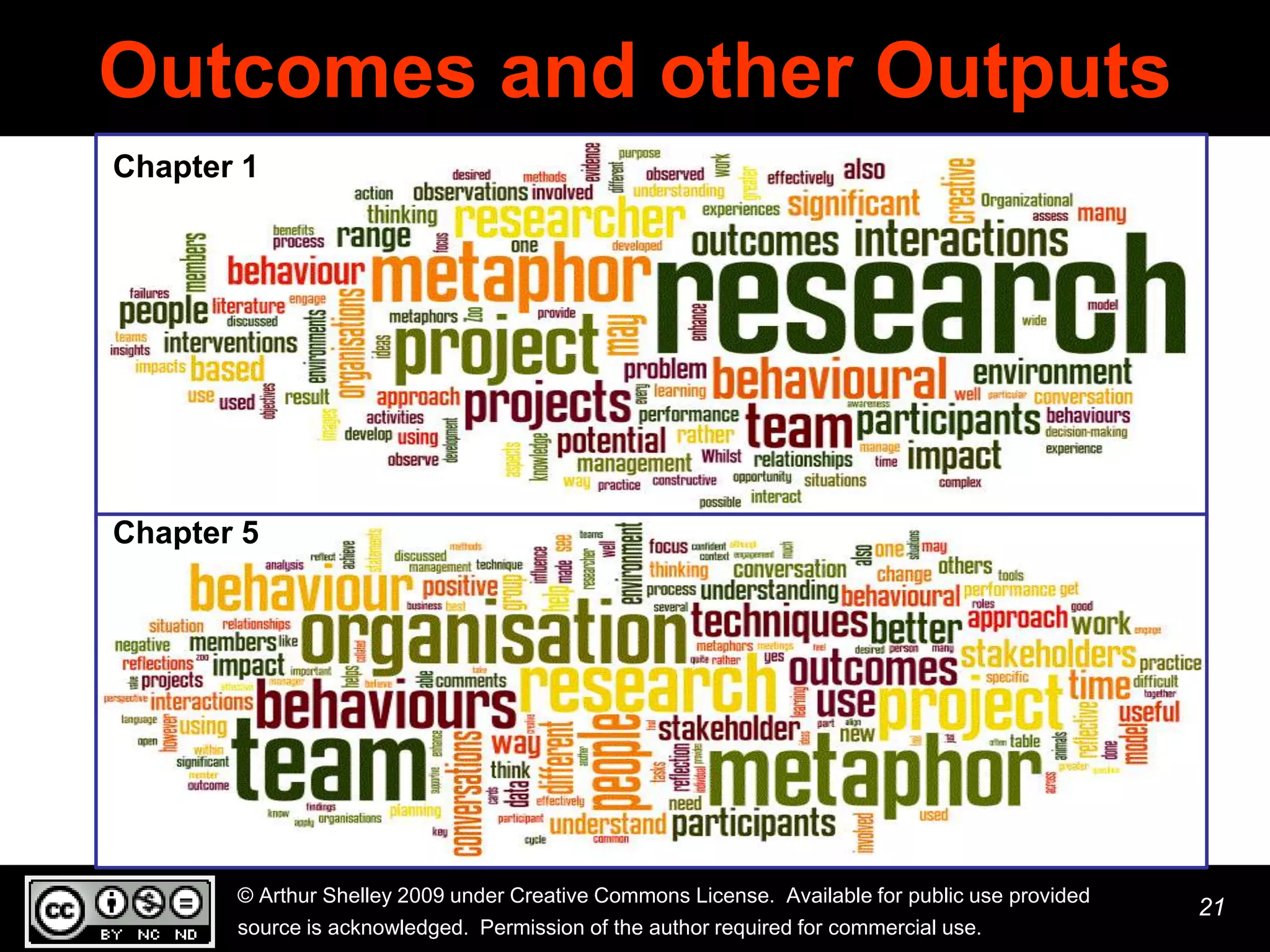
Outcomes and other Outputs
Chapter 1


Chapter 5


       © Arthur Shelley 2009 under Creative Commons License. Available for public use provided
                                                                                                 21
       source is acknowledged. Permission of the author required for commercial use.
Key personal learning
• The PhD process is an emergent process that probably
  can’t be planned in advance
• It stimulates significant growth professionally and
  intellectually
• You can view situations form many aspects and
  metaphor assist creative perspectives
• Metaphor operates like a language- a structure through
  which people can simplify reality and understand and
  communicate it better
• It is definitely worth doing, but I am glad I started 26
  years after I was first asked to - richer experience!
• Action research is awesome- you make a real difference!
       © Arthur Shelley 2009 under Creative Commons License. Available for public use provided
                                                                                                 22
       source is acknowledged. Permission of the author required for commercial use.
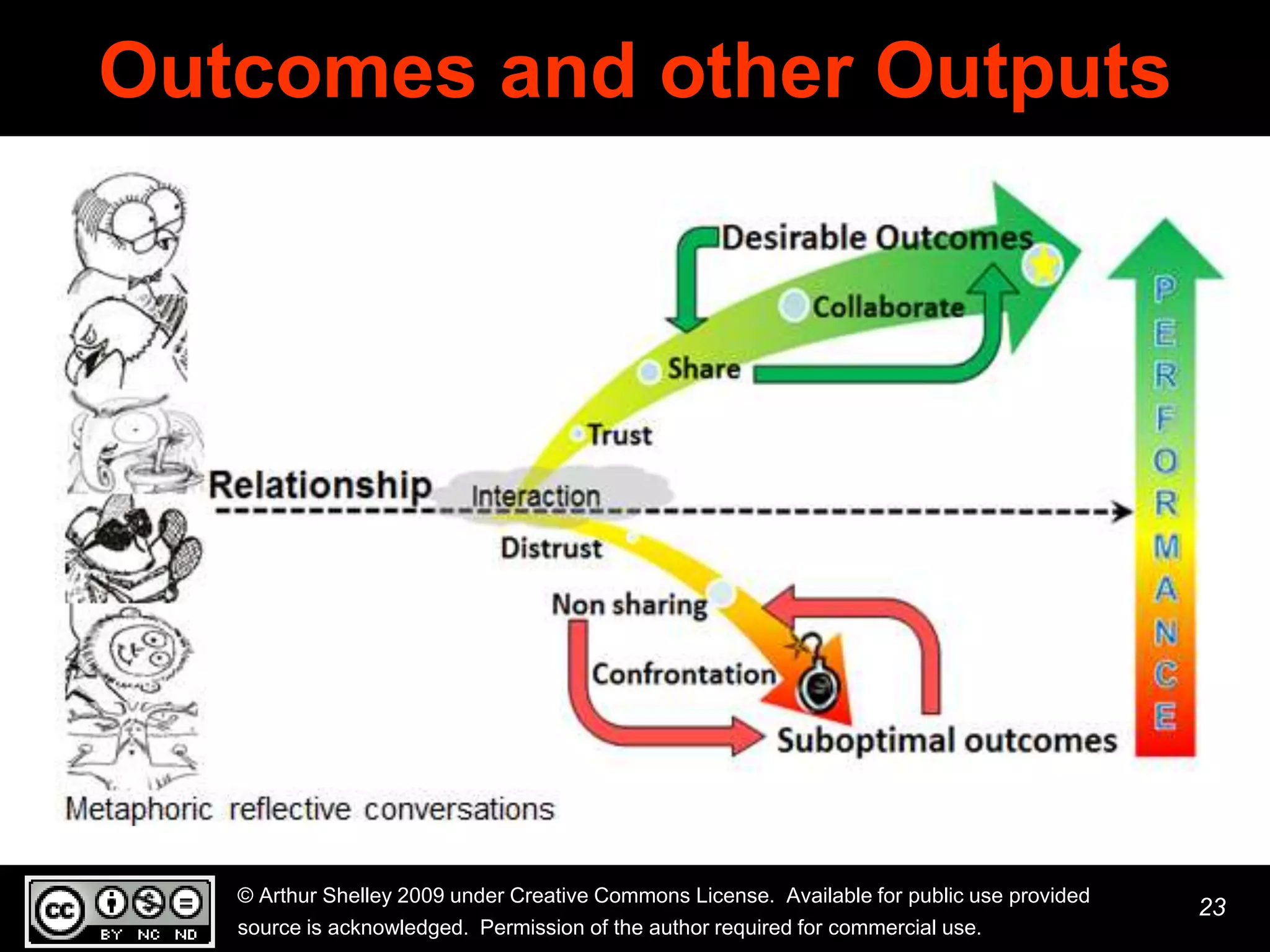
Outcomes and other Outputs


   © Arthur Shelley 2009 under Creative Commons License. Available for public use provided
                                                                                             23
   source is acknowledged. Permission of the author required for commercial use.
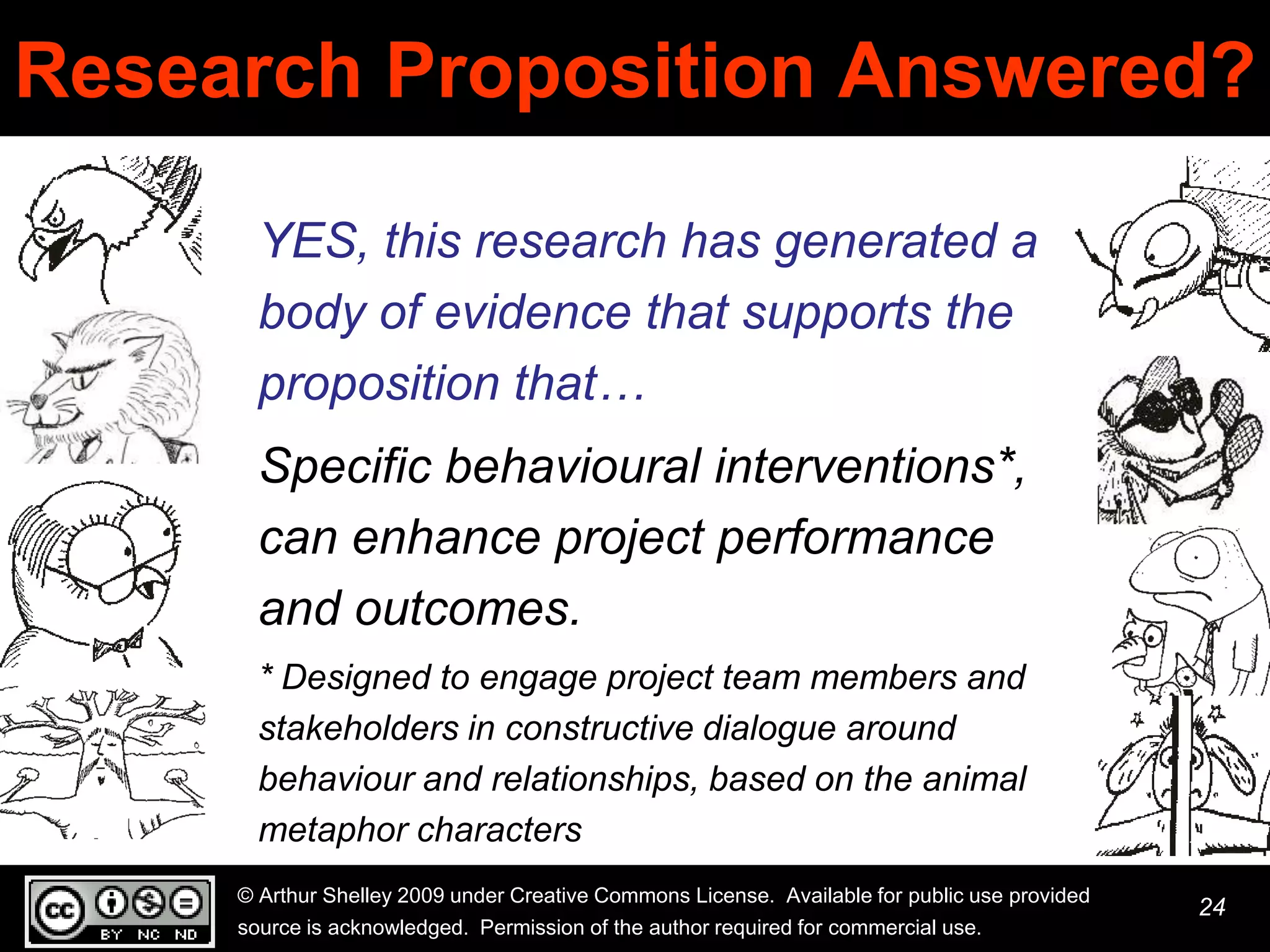
Research Proposition Answered?

       YES, this research has generated a
       body of evidence that supports the
       proposition that…
       Specific behavioural interventions*,
       can enhance project performance
       and outcomes.
       * Designed to engage project team members and
       stakeholders in constructive dialogue around
       behaviour and relationships, based on the animal
       metaphor characters
     © Arthur Shelley 2009 under Creative Commons License. Available for public use provided
                                                                                               24
     source is acknowledged. Permission of the author required for commercial use.
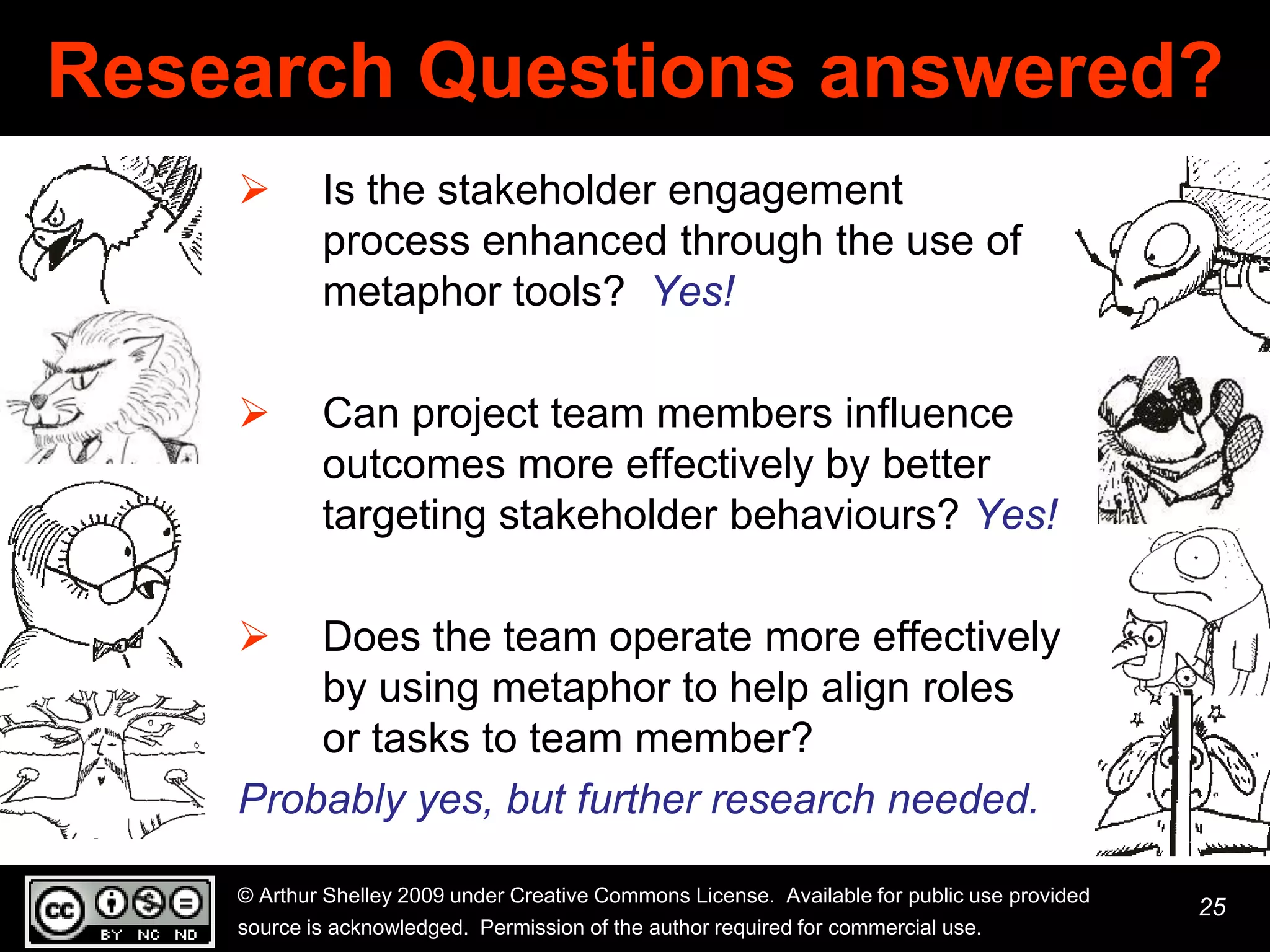
Research Questions answered?
           Is the stakeholder engagement
            process enhanced through the use of
            metaphor tools? Yes!

           Can project team members influence
            outcomes more effectively by better
            targeting stakeholder behaviours? Yes!

       Does the team operate more effectively
        by using metaphor to help align roles
        or tasks to team member?
    Probably yes, but further research needed.

    © Arthur Shelley 2009 under Creative Commons License. Available for public use provided
                                                                                              25
    source is acknowledged. Permission of the author required for commercial use.
Contributions to knowledge
• Evidence that behaviour can be actively
  managed to achieve desired outcomes
• Show metaphor can stimulate appropriate
  conversations and develop trusting relationships
• Methods and techniques to be used in project
  environments to enhance outcomes and team
  dynamics
• Research tools to enhance qualitative methods
  in project management research
  – RPC, Interventions, metaphor games, reflective
    diary, Trust to performance model
      © Arthur Shelley 2009 under Creative Commons License. Available for public use provided
                                                                                                26
      source is acknowledged. Permission of the author required for commercial use.
Metaphor works because it…
• Simplifies reality into familiar patterns and images
  that are more easily understood
• Stimulates creative conversations and engages
  people to continue them
• Creates synergies between behaviour, reflection
  and context through richer conversation cycles
• Assists communication and knowledge flow

If we proactively used metaphor tools more in
projects, we would achieve better outcomes
         © Arthur Shelley 2009 under Creative Commons License. Available for public use provided
                                                                                                   27
         source is acknowledged. Permission of the author required for commercial use.
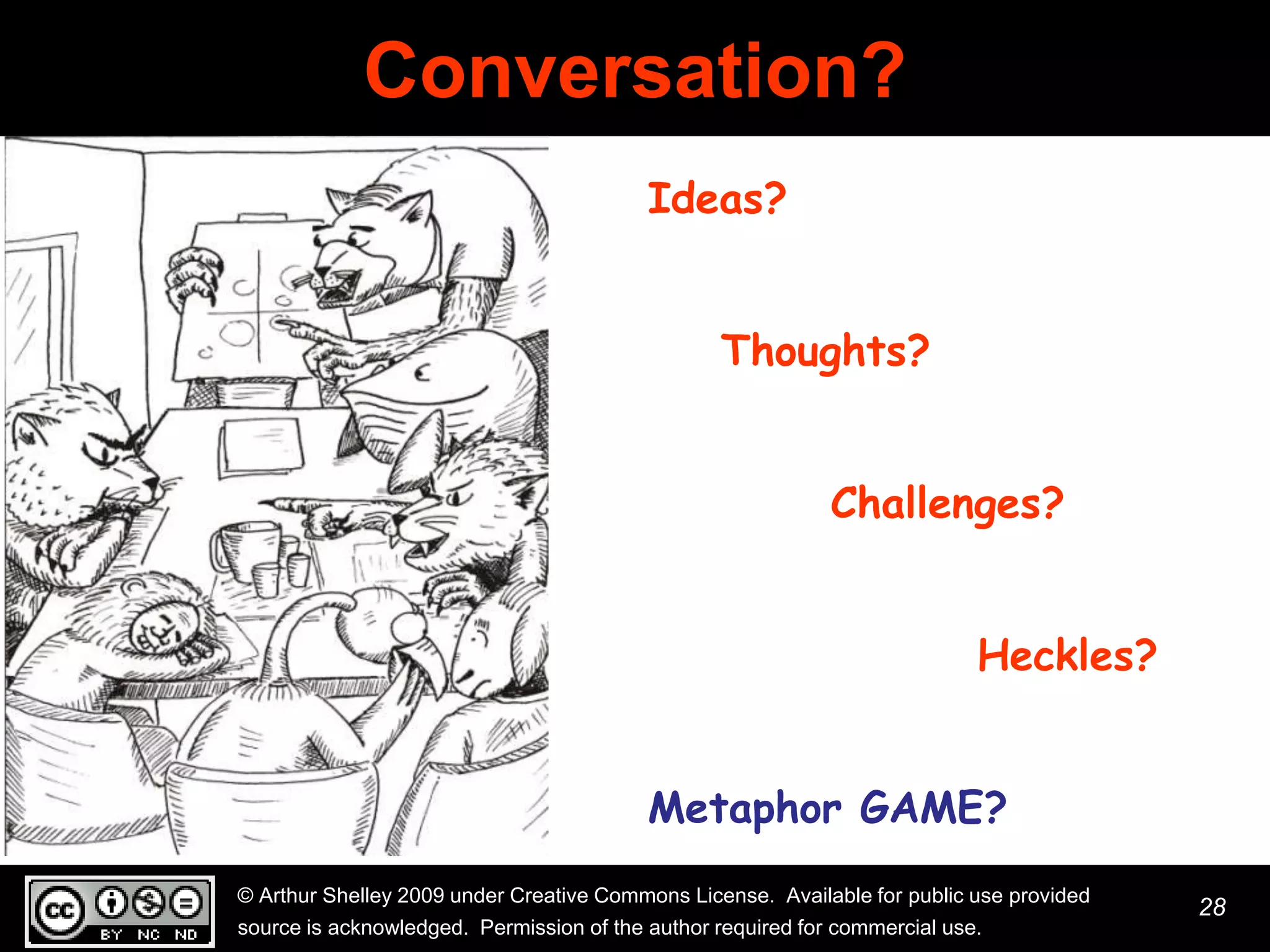
Conversation?
                                          Ideas?


                                                 Thoughts?


                                                             Challenges?


                                                                            Heckles?


                                          Metaphor GAME?
© Arthur Shelley 2009 under Creative Commons License. Available for public use provided
                                                                                          28
source is acknowledged. Permission of the author required for commercial use.

Shelley: Metaphor Behaviour and Projects

  • 1.
    PhD Completion Seminar Metaphoras a means to influence behaviour and knowledge transfer in projects for enhanced outcomes Arthur Shelley March 7 2012 © Arthur Shelley 2009 under Creative Commons License. Available for public use provided 1 source is acknowledged. Permission of the author required for commercial use.
  • 2.
    Context • We allknow behaviour has an impact on how we interact with others. • History shows many team projects fail to meet their objectives and behaviour is part of this problem. • We also know these failures cost millions of dollars, not to mention the stress and emotional consequences. Despite these facts, very few people attempt to proactively manage the behavioural environment. © Arthur Shelley 2009 under Creative Commons License. Available for public use provided 2 source is acknowledged. Permission of the author required for commercial use.
  • 3.
    Original Research Proposition Specific behavioural interventions*, can enhance project performance and outcomes. * Designed to engage project team members and stakeholders in constructive dialogue around behaviour and relationships, based on the animal metaphor characters from The Organizational Zoo (Shelley 2007). © Arthur Shelley 2009 under Creative Commons License. Available for public use provided 3 source is acknowledged. Permission of the author required for commercial use.
  • 4.
    Research Questions  Is the stakeholder engagement process enhanced through the use of metaphor tools?  Can project team members influence outcomes more effectively by better targeting stakeholder behaviours?  Does the team operate more effectively by using metaphor to help align roles or tasks to team member. © Arthur Shelley 2009 under Creative Commons License. Available for public use provided 4 source is acknowledged. Permission of the author required for commercial use.
  • 5.
    Original Research Plan ©Arthur Shelley 2009 under Creative Commons License. Available for public use provided 5 source is acknowledged. Permission of the author required for commercial use.
  • 6.
    Key characteristics  4 research organisations,  3 Action Research cycles  1 “project” per organisation  51 research subjects total (7-22)  Base Interview (Jan 2010)  2 Interventions/ Org (Mid Jan 2010)  Data validation forum (Late 2010)  Project end interviews (Early 2011)  Findings validation (2011)  Practitioner reflective interviews (2011) © Arthur Shelley 2009 under Creative Commons License. Available for public use provided 6 source is acknowledged. Permission of the author required for commercial use.
  • 7.
    Research Interventions &Data Project Baseline As is Selection Interview State Interviews Feedback Individual Relationships Focus Perceptions of potential Intervention Group to change state (Kickoff) Interviews Feedback Individual Stakeholder Perceptions of Focus changed state Intervention Group (2-6 Mths) 4 x Project Environment Practitioner Reflective Focus Selection Interview Group (12 Mths) © Arthur Shelley 2009 under Creative Commons License. Available for public use provided 7 source is acknowledged. Permission of the author required for commercial use.
  • 8.
    The reality check •Half of the organisations who opted in originally, did not participate – new organisations engaged • All 4 organisations in the research went through significant restructures during or immediately after the research that had a direct impact on some or all research participants • Several research participants left the organisation during or not long after the research was done, making any longitudinal study impossible • Difficult to get specific times agreed to do agreed interventions, and almost impossible to get any additional time or activities done (despite significant interest in the techniques) • Hard to achieve consistency when only have such sort time with research subjects (limited mindshare and competing with tasks) • Challenge of balancing learning activities with research data gathering (they want to learn and do, researcher wants to gather and reflect) © Arthur Shelley 2009 under Creative Commons License. Available for public use provided 8 source is acknowledged. Permission of the author required for commercial use.
  • 9.
    The final path ©Arthur Shelley 2009 under Creative Commons License. Available for public use provided 9 source is acknowledged. Permission of the author required for commercial use.
  • 10.
    Philosophical Aspects Dimension Aspect Elements and perspectives Ontology The nature of reality Subjectivist (Interpretivist) or being Participative in that the reality is subjective-objective, co-created by participants’ mind and context. Epistemology The nature of Subjectivist (Interpretivist) knowledge, its Participatory in acknowledgement of practical knowing, critical subjectivity and origins, nature and living knowledge. limits Methodology How we come to Subjectivist (Interpretivist) know? Axiology What is intrinsically Constructionist in that propositional, transactional knowing is instrumentally worthwhile? valuable as a means to social emancipation, which is an end in itself and is intrinsically valuable. Who contributes to The researcher’s voice manifests through creation of awareness of the Voice the knowing and metaphors and the behavioural environment. learning? Research subjects actively participate the generation and validation of the findings through self-reflections on their actions. The nature of the Participatory in that researcher subjects are initiated into the inquiry process Learning activity through by the facilitator/researcher and learn through active engagement in the when learning process. (new knowledge) is created. Facilitator/researcher requires emotional competence, democratic personality and skills to create the appropriate environment to foster such development. Adapted from table structure of (Heron & Reason 1997) © Arthur Shelley 2009 under Creative Commons License. Available for public use provided 10 source is acknowledged. Permission of the author required for commercial use.
  • 11.
    Data Interpretation Approach Observations notes, Surveys, Interviews Collect data recordings/Transcripts. Get “sense” of contents, patterns, consistency and Scan data range of responses. Initial reactions fuel “margin notes” Revisit the data to verify initial notes and “suspected Reread patterns”. Use coloured highlighters to colour code what appears to be emergent themes. Aggregate Create “bodies of evidence” to support the key themes Themes Iterative via quantitative classification/reduction or qualitative Cycles categorising to form nodes or patterns. Interpret Reflect on the meaning of the patterns and contrasts in Meaning data. Verify impact and support for themes & findings. Validate and support Verify with participants. Transform data into information interpretation statements & formats others can intuitively understand. © Arthur Shelley 2011 under Creative Commons License. Available for public use provided 11 source is acknowledged. Permission of the author required for commercial use.
  • 12.
    Interpreted data formats:quotes Answers: interviews/surveys Categorised responses © Arthur Shelley 2009 under Creative Commons License. Available for public use provided 12 source is acknowledged. Permission of the author required for commercial use.
  • 13.
    Interpreted data formats Reflections Summarised Reflections © Arthur Shelley 2009 under Creative Commons License. Available for public use provided 13 source is acknowledged. Permission of the author required for commercial use.
  • 14.
    The big picture •In all four organisations there was far more supportive evidence than neutral or negative • There were many reflections collected that showed evidence of impact when the methods were applied • Typical categorising of statements shown below: © Arthur Shelley 2009 under Creative Commons License. Available for public use provided 14 source is acknowledged. Permission of the author required for commercial use.
  • 15.
    Summary: Key Questions Question Org    How is the stakeholder engagement process A 7 7 0 0 enhanced through the use of metaphor tools? B 8 6 1 1 C 11 7 0 0 D 22 18 3 1 How can project team members influence outcomes A 7 7 0 0 more effectively by better targeting stakeholder B 8 5 2 0 behaviours? C 11 8 0 0 D 22 20 0 0 How does the team operate more effectively by using A 7 5 0 0 metaphor to help align roles or tasks to team member. B 10 6 2 0 C 11 9 0 0 D 22 15 5 1 © Arthur Shelley 2009 under Creative Commons License. Available for public use provided 15 source is acknowledged. Permission of the author required for commercial use.
  • 16.
    Summary: Additional insights Question Org    How do our behaviours benefit us and create A 7 - - - limitations for us, as a group? B 10 - - - Did the metaphor characters assist this C 11 8 0 0 understanding? If so, how? D 22 15 7 0 Can the metaphor characters assist me to develop A 7 - - - better relationships given my behavioural B 10 - - - preferences? C 11 8 0 0 If so, how might I do that? D 22 14 6 2 Do you believe that the model combining reflective A 7 - - - practice, conversation, and metaphor will be useful B 10 - - - for your own thinking and behaviour? C 11 - - - D 22 11 10 1 © Arthur Shelley 2009 under Creative Commons License. Available for public use provided 16 source is acknowledged. Permission of the author required for commercial use.
  • 17.
    © Arthur Shelley2009 under Creative Commons License. Available for public use provided 17 source is acknowledged. Permission of the author required for commercial use.
  • 18.
    Thesis output © ArthurShelley 2009 under Creative Commons License. Available for public use provided 18 source is acknowledged. Permission of the author required for commercial use.
  • 19.
    Outcomes and otherOutputs Impact Reflection Diary © Arthur Shelley 2009 under Creative Commons License. Available for public use provided 19 source is acknowledged. Permission of the author required for commercial use.
  • 20.
    Outcomes and otherOutputs © Arthur Shelley 2009 under Creative Commons License. Available for public use provided 20 source is acknowledged. Permission of the author required for commercial use.
  • 21.
    Outcomes and otherOutputs Chapter 1 Chapter 5 © Arthur Shelley 2009 under Creative Commons License. Available for public use provided 21 source is acknowledged. Permission of the author required for commercial use.
  • 22.
    Key personal learning •The PhD process is an emergent process that probably can’t be planned in advance • It stimulates significant growth professionally and intellectually • You can view situations form many aspects and metaphor assist creative perspectives • Metaphor operates like a language- a structure through which people can simplify reality and understand and communicate it better • It is definitely worth doing, but I am glad I started 26 years after I was first asked to - richer experience! • Action research is awesome- you make a real difference! © Arthur Shelley 2009 under Creative Commons License. Available for public use provided 22 source is acknowledged. Permission of the author required for commercial use.
  • 23.
    Outcomes and otherOutputs © Arthur Shelley 2009 under Creative Commons License. Available for public use provided 23 source is acknowledged. Permission of the author required for commercial use.
  • 24.
    Research Proposition Answered? YES, this research has generated a body of evidence that supports the proposition that… Specific behavioural interventions*, can enhance project performance and outcomes. * Designed to engage project team members and stakeholders in constructive dialogue around behaviour and relationships, based on the animal metaphor characters © Arthur Shelley 2009 under Creative Commons License. Available for public use provided 24 source is acknowledged. Permission of the author required for commercial use.
  • 25.
    Research Questions answered?  Is the stakeholder engagement process enhanced through the use of metaphor tools? Yes!  Can project team members influence outcomes more effectively by better targeting stakeholder behaviours? Yes!  Does the team operate more effectively by using metaphor to help align roles or tasks to team member? Probably yes, but further research needed. © Arthur Shelley 2009 under Creative Commons License. Available for public use provided 25 source is acknowledged. Permission of the author required for commercial use.
  • 26.
    Contributions to knowledge •Evidence that behaviour can be actively managed to achieve desired outcomes • Show metaphor can stimulate appropriate conversations and develop trusting relationships • Methods and techniques to be used in project environments to enhance outcomes and team dynamics • Research tools to enhance qualitative methods in project management research – RPC, Interventions, metaphor games, reflective diary, Trust to performance model © Arthur Shelley 2009 under Creative Commons License. Available for public use provided 26 source is acknowledged. Permission of the author required for commercial use.
  • 27.
    Metaphor works becauseit… • Simplifies reality into familiar patterns and images that are more easily understood • Stimulates creative conversations and engages people to continue them • Creates synergies between behaviour, reflection and context through richer conversation cycles • Assists communication and knowledge flow If we proactively used metaphor tools more in projects, we would achieve better outcomes © Arthur Shelley 2009 under Creative Commons License. Available for public use provided 27 source is acknowledged. Permission of the author required for commercial use.
  • 28.
    Conversation? Ideas? Thoughts? Challenges? Heckles? Metaphor GAME? © Arthur Shelley 2009 under Creative Commons License. Available for public use provided 28 source is acknowledged. Permission of the author required for commercial use.